1
The Process Cloud
INTRODUCING ZAPTIC:
AN OPTIMIST’S VIEW ON THE FUTURE OF WORK
SHARE THIS
1
This is not a very British thing to say, but at Zaptic we’re insatiably optimistic about
the future. To borrow a term from Peter Theil, we’d put ourselves in the ‘definite’
optimists’ camp. Unlike the indefinite optimists, who are bullish about the future but
don’t have any particular plan, we have a concrete vision for the future and believe
it to be better than today. It’s the reason we’ve built Zaptic. To mark its launch, we
want to share our vision for the future of work and Zaptic, and to invite everyone
who is an optimist to be part of an exciting journey.
...so, what’s our reason for being so optimistic? It’s really very simple:
A definite optimist’s view on the future of work
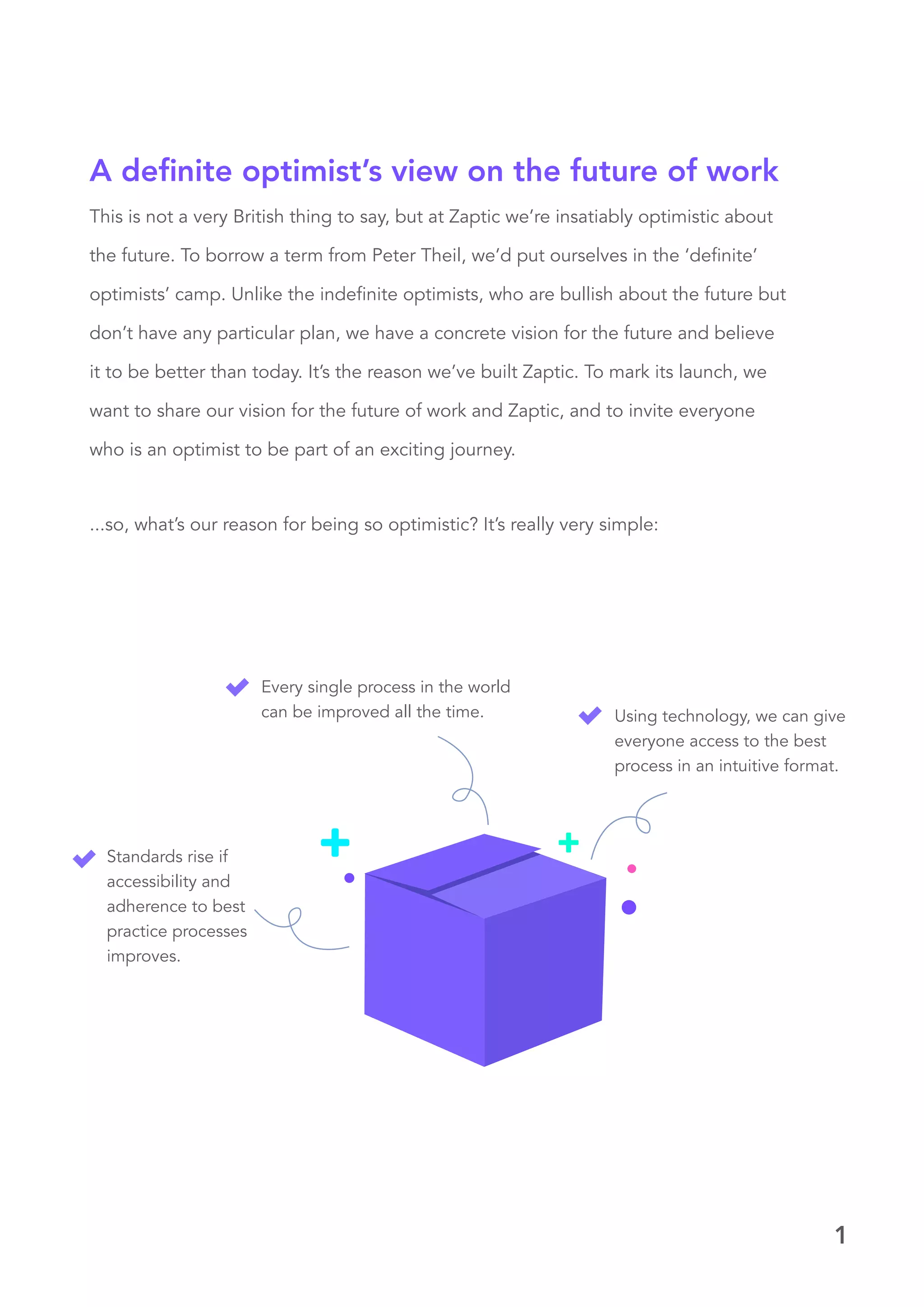
Standards rise if
accessibility and
adherence to best
practice processes
improves.
Every single process in the world
can be improved all the time. Using technology, we can give
everyone access to the best
process in an intuitive format.
2
Our mission is to change the way people share
and experience procedural guidance at work.
SHARE THIS
3
Whether in the supply chain, customer experience management or product
engineering, if the design and execution of process improves, standards rise. To take
just one real world example, supply chain improvements in order fulfillment have
supported today’s mindboggling levels of shopper choice, the supply of medical
care around the globe, and the delivery of life saving aid to the world’s 21.6 million
refugees. If the design and execution of this supply chain process continues to
improve, standards of living for millions of people will continue to rise.
Success is a process
In the enterprise, the way processes are improved is called Business Process
Management (BPM). BPM is an approach to designing, executing, measuring and
optimising processes. In theory, it’s a great thing. But BPM is too often a siloed
activity, with little impact on an entire workforce or business network. Process
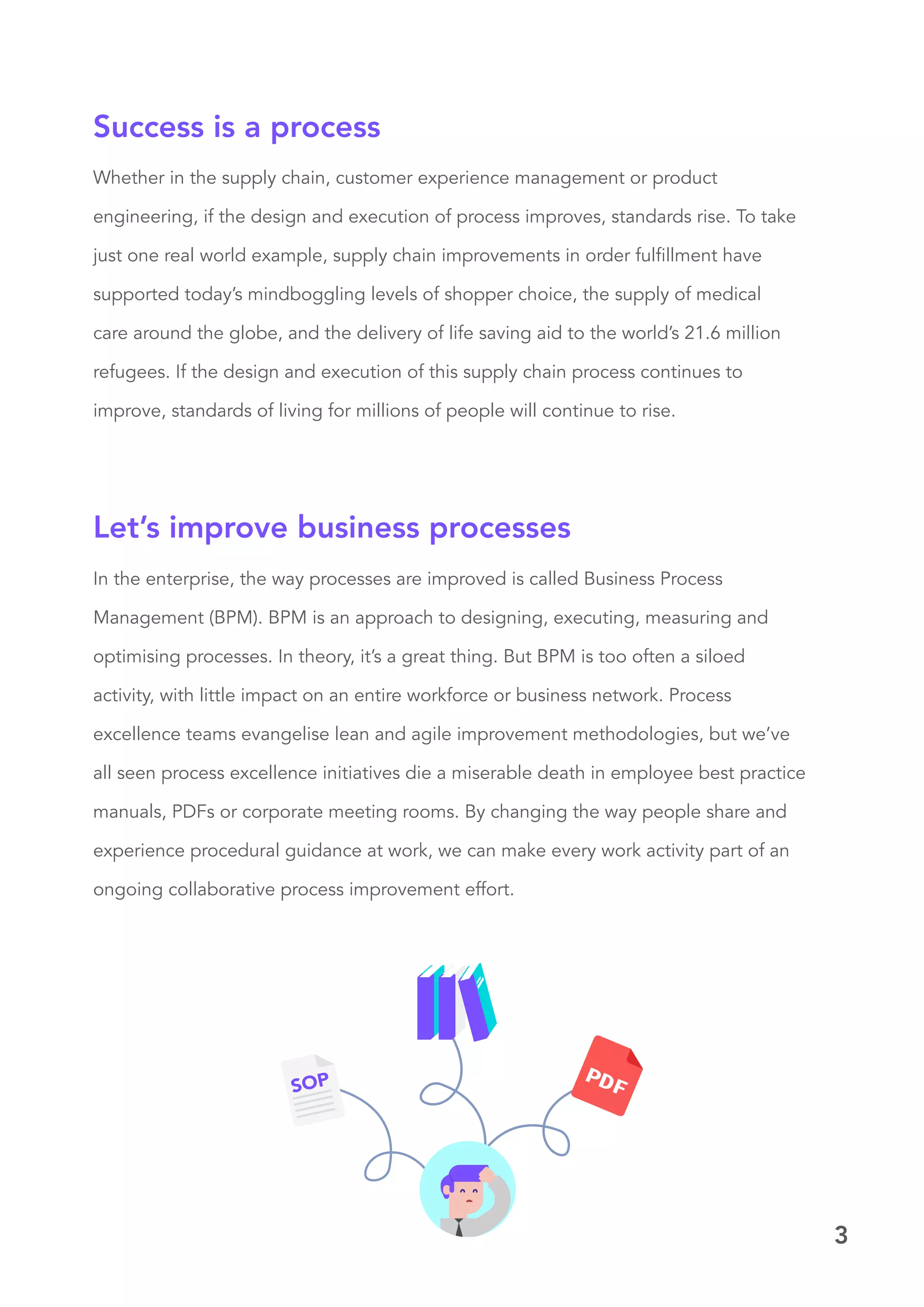
excellence teams evangelise lean and agile improvement methodologies, but we’ve
all seen process excellence initiatives die a miserable death in employee best practice
manuals, PDFs or corporate meeting rooms. By changing the way people share and
experience procedural guidance at work, we can make every work activity part of an
ongoing collaborative process improvement effort.
Let’s improve business processes
4
Enterprise Software has come a long
way since the silver age of on premise
Enterprise Resource Planning (ERP) and
Siebel salesforce automation systems.
Once screwed in, these ‘systems of
record’ helped to reduce the labour
costs of business processes. But the
software largely dictated the process,
and both were centrally controlled by
small groups of IT experts or specialists
at great expense.
experiences. Individual functions and
their respective processes are now
directly manageable by users (or
“subscribers”). Function by function,
companies like SuccessFactors,
Salesforce and Workday have kick-
started a great decentralization in the
management of business processes.
When considered alongside the
trend of advancing automation, it’s
no surprise that CIOs and business
leaders are rethinking the way
business processes are managed
and accelerating towards a digital
transformation of the enterprise.
The golden age of “Software as a
service” has seen the disaggregation
of major ERP platforms, and the move
towards self-serve, intuitive user
Software eats the world,
one process at a time
TWEET THIS
5
As more and more business processes are streamlined by the next SaaS solution, and
tasks automated by AI or “bots”, there is a need to somehow co-ordinate all the work
activities taking place on these solutions in a joined up way. Make the technologies
“talk to each other”; and “bring everything into one place”, are phrases we frequently
hear from customers. Neil Ward Dutton of MWD Advisors describes the challenge
more prosaically, to “weave a digital thread” through all the activities of customer
experience management, operational excellence and product leadership. The
business platform of the future is therefore one that will enable a de-centralised co-
ordination of work activities, tools and procedural guidance.
Re-thinking the way business processes
are managed
a de-centralised co-ordination of work activities,
tools and procedural guidance
TWEET THIS
6
BPM is a great candidate to form this digital work platform of the future, with the
promise of converging awareness, knowledge and action across the enterprise. Unlike
a CRM, for example, which is embedded in one very important enterprise process
(customer intimacy), BPM can be an organising principle and interface for all work
activities.
So how come we’re not all using a BPM platform at work? The challenge is to move
away from software that simply supports BPM in silo, towards software that delivers BPM
as a service to each enterprise, function, or worker responsible for part of a business
process . “BPM as a service” can and must be more than simply hosting process
apps in the cloud which perpetuate the activity of process improvement in silo. A self-
serve user experience at work must also match the fluidity, responsiveness and design
we’ve come to expect in apps outside of work; a reason for the success of new tools like
Slack and Quip.
BPM as the Digital work platform of the future
“BPM as a service” can and must be more than simply
hosting process apps in the cloud
TWEET THIS
7
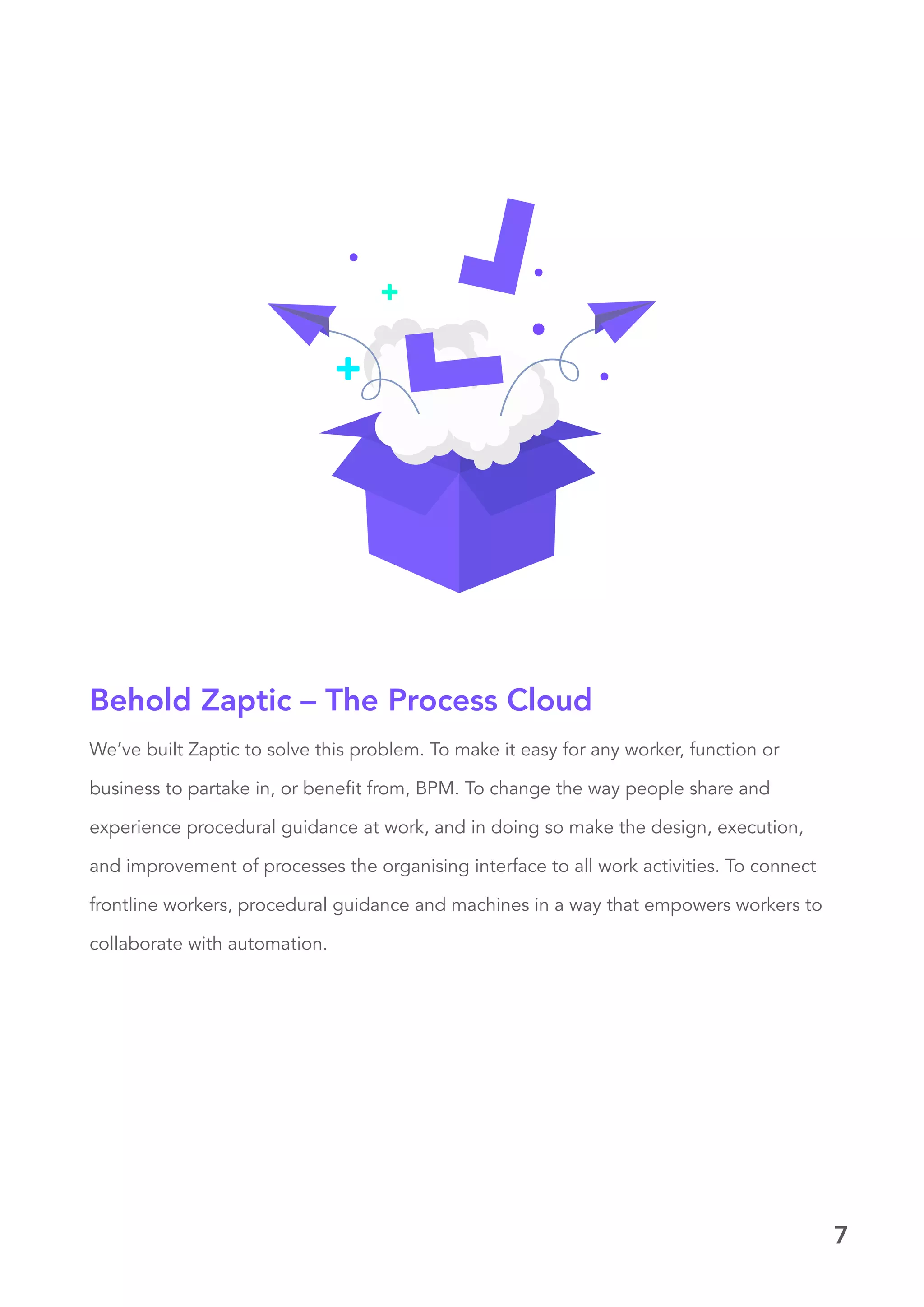
We’ve built Zaptic to solve this problem. To make it easy for any worker, function or
business to partake in, or benefit from, BPM. To change the way people share and
experience procedural guidance at work, and in doing so make the design, execution,
and improvement of processes the organising interface to all work activities. To connect
frontline workers, procedural guidance and machines in a way that empowers workers to
collaborate with automation.
Behold Zaptic – The Process Cloud
8
As an example, Zaptic is being used to co-ordinate frontline retail execution activities
for large consumer goods (CPG) companies. Process experts in the head office design
and optimise field sales and marketing process, field reps or gig workers execute the
activities in store, and managers monitor progress in key performance indicators like
on shelf availability, promotional compliance and share of shelf. Advanced analytics
are used to predict out of stocks and direct agents to the highest commercial
opportunities. All the relevant information from systems of record is displayed at
the point of action, and tasks automation apps such as image recognition and
augmentation are seamlessly incorporated into the agent’s workflow.
Next-generation retail execution in the process cloud
9
With a well designed process delivered via an intuitive and intelligent to do list, agents
are guided through each activity with insights to help them meet the highest standards.
The Zaptic gamification motivates and rewards agents, and generates a record of
correctly accomplished work. We believe in a world where free agents, empowered by
new levels of work flexibility and autonomy, take their Zaptic account from job to job,
collecting recognition and reward for high quality work accomplished.
Did someone mention the Gig Economy?
10
From accounting to compliance, small business owners are inundated with processes to
follow. If only they could be served the best practice on a plate to execute, they could
focus on what they really care about – serving customers.
For example, independent retail and catering businesses are required to meet all
kinds of compliance procedures, from food safety and hygiene to pest control and
tobacco regulations. In the Zaptic process cloud, each process authority can design
and distribute best practice to agents. Small business owners follow intelligent to do
lists of things to check and do in order to stay compliant. Important record keeping is
automated, producing a valuable log of standards being met.
Digitally transforming small
business with BPM as a service
A good process can and should be executed by many agents (1 to N) rather than
each agent re-creating their own process (1 to 1). Economics 101 tells us that this
kind of allocative inefficiency creates a commercial opportunity for process experts;
Zaptic gives rise to thousands of opportunities available to organisations with
procedural expertise. By offering a new way to share procedural guidance with
agents, Zaptic gives process experts a platform to scale their impact, commercialise
their knowledge, and contribute to improved standards for all.
Let’s work together!
11
REQUEST A DEMO
Hey, want to see Zaptic in action?
SHARE THIS

Zaptic intro

  • 1.
    1 The Process Cloud INTRODUCINGZAPTIC: AN OPTIMIST’S VIEW ON THE FUTURE OF WORK SHARE THIS
  • 2.
    1 This is nota very British thing to say, but at Zaptic we’re insatiably optimistic about the future. To borrow a term from Peter Theil, we’d put ourselves in the ‘definite’ optimists’ camp. Unlike the indefinite optimists, who are bullish about the future but don’t have any particular plan, we have a concrete vision for the future and believe it to be better than today. It’s the reason we’ve built Zaptic. To mark its launch, we want to share our vision for the future of work and Zaptic, and to invite everyone who is an optimist to be part of an exciting journey. ...so, what’s our reason for being so optimistic? It’s really very simple: A definite optimist’s view on the future of work Standards rise if accessibility and adherence to best practice processes improves. Every single process in the world can be improved all the time. Using technology, we can give everyone access to the best process in an intuitive format.
  • 3.
    2 Our mission isto change the way people share and experience procedural guidance at work. SHARE THIS
  • 4.
    3 Whether in thesupply chain, customer experience management or product engineering, if the design and execution of process improves, standards rise. To take just one real world example, supply chain improvements in order fulfillment have supported today’s mindboggling levels of shopper choice, the supply of medical care around the globe, and the delivery of life saving aid to the world’s 21.6 million refugees. If the design and execution of this supply chain process continues to improve, standards of living for millions of people will continue to rise. Success is a process In the enterprise, the way processes are improved is called Business Process Management (BPM). BPM is an approach to designing, executing, measuring and optimising processes. In theory, it’s a great thing. But BPM is too often a siloed activity, with little impact on an entire workforce or business network. Process excellence teams evangelise lean and agile improvement methodologies, but we’ve all seen process excellence initiatives die a miserable death in employee best practice manuals, PDFs or corporate meeting rooms. By changing the way people share and experience procedural guidance at work, we can make every work activity part of an ongoing collaborative process improvement effort. Let’s improve business processes
  • 5.
    4 Enterprise Software hascome a long way since the silver age of on premise Enterprise Resource Planning (ERP) and Siebel salesforce automation systems. Once screwed in, these ‘systems of record’ helped to reduce the labour costs of business processes. But the software largely dictated the process, and both were centrally controlled by small groups of IT experts or specialists at great expense. experiences. Individual functions and their respective processes are now directly manageable by users (or “subscribers”). Function by function, companies like SuccessFactors, Salesforce and Workday have kick- started a great decentralization in the management of business processes. When considered alongside the trend of advancing automation, it’s no surprise that CIOs and business leaders are rethinking the way business processes are managed and accelerating towards a digital transformation of the enterprise. The golden age of “Software as a service” has seen the disaggregation of major ERP platforms, and the move towards self-serve, intuitive user Software eats the world, one process at a time TWEET THIS
  • 6.
    5 As more andmore business processes are streamlined by the next SaaS solution, and tasks automated by AI or “bots”, there is a need to somehow co-ordinate all the work activities taking place on these solutions in a joined up way. Make the technologies “talk to each other”; and “bring everything into one place”, are phrases we frequently hear from customers. Neil Ward Dutton of MWD Advisors describes the challenge more prosaically, to “weave a digital thread” through all the activities of customer experience management, operational excellence and product leadership. The business platform of the future is therefore one that will enable a de-centralised co- ordination of work activities, tools and procedural guidance. Re-thinking the way business processes are managed a de-centralised co-ordination of work activities, tools and procedural guidance TWEET THIS
  • 7.
    6 BPM is agreat candidate to form this digital work platform of the future, with the promise of converging awareness, knowledge and action across the enterprise. Unlike a CRM, for example, which is embedded in one very important enterprise process (customer intimacy), BPM can be an organising principle and interface for all work activities. So how come we’re not all using a BPM platform at work? The challenge is to move away from software that simply supports BPM in silo, towards software that delivers BPM as a service to each enterprise, function, or worker responsible for part of a business process . “BPM as a service” can and must be more than simply hosting process apps in the cloud which perpetuate the activity of process improvement in silo. A self- serve user experience at work must also match the fluidity, responsiveness and design we’ve come to expect in apps outside of work; a reason for the success of new tools like Slack and Quip. BPM as the Digital work platform of the future “BPM as a service” can and must be more than simply hosting process apps in the cloud TWEET THIS
  • 8.
    7 We’ve built Zapticto solve this problem. To make it easy for any worker, function or business to partake in, or benefit from, BPM. To change the way people share and experience procedural guidance at work, and in doing so make the design, execution, and improvement of processes the organising interface to all work activities. To connect frontline workers, procedural guidance and machines in a way that empowers workers to collaborate with automation. Behold Zaptic – The Process Cloud
  • 9.
    8 As an example,Zaptic is being used to co-ordinate frontline retail execution activities for large consumer goods (CPG) companies. Process experts in the head office design and optimise field sales and marketing process, field reps or gig workers execute the activities in store, and managers monitor progress in key performance indicators like on shelf availability, promotional compliance and share of shelf. Advanced analytics are used to predict out of stocks and direct agents to the highest commercial opportunities. All the relevant information from systems of record is displayed at the point of action, and tasks automation apps such as image recognition and augmentation are seamlessly incorporated into the agent’s workflow. Next-generation retail execution in the process cloud
  • 10.
    9 With a welldesigned process delivered via an intuitive and intelligent to do list, agents are guided through each activity with insights to help them meet the highest standards. The Zaptic gamification motivates and rewards agents, and generates a record of correctly accomplished work. We believe in a world where free agents, empowered by new levels of work flexibility and autonomy, take their Zaptic account from job to job, collecting recognition and reward for high quality work accomplished. Did someone mention the Gig Economy?
  • 11.
    10 From accounting tocompliance, small business owners are inundated with processes to follow. If only they could be served the best practice on a plate to execute, they could focus on what they really care about – serving customers. For example, independent retail and catering businesses are required to meet all kinds of compliance procedures, from food safety and hygiene to pest control and tobacco regulations. In the Zaptic process cloud, each process authority can design and distribute best practice to agents. Small business owners follow intelligent to do lists of things to check and do in order to stay compliant. Important record keeping is automated, producing a valuable log of standards being met. Digitally transforming small business with BPM as a service A good process can and should be executed by many agents (1 to N) rather than each agent re-creating their own process (1 to 1). Economics 101 tells us that this kind of allocative inefficiency creates a commercial opportunity for process experts; Zaptic gives rise to thousands of opportunities available to organisations with procedural expertise. By offering a new way to share procedural guidance with agents, Zaptic gives process experts a platform to scale their impact, commercialise their knowledge, and contribute to improved standards for all. Let’s work together!
  • 12.
    11 REQUEST A DEMO Hey,want to see Zaptic in action? SHARE THIS