Fragrances
 Isolates
 Synthetics and Semisynthetics Used in Perfumes and Flavors
Isolates
Isolates are pure chemical compound whose
source is an essential oil or other natural perfume
material.
Examples:
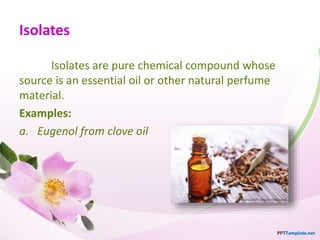
a. Eugenol from clove oil
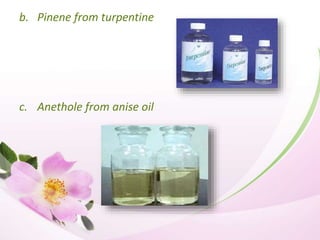
b. Pinene from turpentine
c. Anethole from anise oil
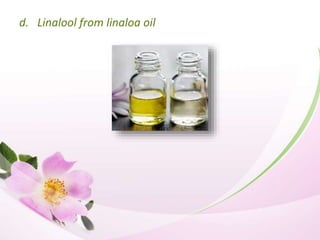
d. Linalool from linaloa oil
Synthetics and Semisynthetics Used in
Perfumes and Flavors
Condensation Processes:
a. Coumarin
Salicyaldehyde, acetic anhydride, and
sodium acetate are refluxed at 135 to 155°e.
The reaction mixture is cooled and washed.
The coumarin is recovered by solvent
extraction or distillation.
b. Diphenyl oxide or ether
Diphenyl oxide is obtained as a by-
product in the manufacture of phenol from
chlorobenzene and caustic soda.
c. Ionone
The manufacture of Ionone involves two steps:
First the pseudo-ionone is prepared by
the condensation of citral obtained from
lemon-grass oil.
This is followed by an acid ring closure
and the commercial ionone is purified by
distillation.
d. Cinnamic Aldehyde
It is synthesized by the action of alkali
upon a mixture of benzaldehyde and
acetaldehyde.
Esterification Processes:
a. Benzyl benzoate
It is prepared commercially by the
esterification of benzoic acid with benzyl
alcohol.
b. Benzyl Acetate
It is prepared by esterification of benzyl
alcohol, by heating with either an excess of
acetic anhydride or acetic acid with mineral
acids.
c. Benzyl alcohol
It is made by hydrolyzing benzyl chloride.
d. Salicylic acid (Amyl salicylate and Methyl
salicylate)
These are prepared as follows:
Carbon dioxide and sodium phenate are
reacted under pressure to obtain the salt of
phenyl-carbonic acid. This salt is isomerized to
sodium salicylate by heating to 120 to 140°C.
Grignard Process:
a. Phenylethyl alcohol
Phenylethyl alcohol can be made by a
number of procedures; the Grignard reaction is
used generally.
Nitration Processes:
a. Artificial Musks (Nitro Musk)
- Musk Ambrette
- Musk Xylene
- Musk Ketone

Isolates

  • 1.
    Fragrances  Isolates  Syntheticsand Semisynthetics Used in Perfumes and Flavors
  • 2.
    Isolates Isolates are purechemical compound whose source is an essential oil or other natural perfume material. Examples: a. Eugenol from clove oil
  • 3.
    b. Pinene fromturpentine c. Anethole from anise oil
  • 4.
    d. Linalool fromlinaloa oil
  • 5.
    Synthetics and SemisyntheticsUsed in Perfumes and Flavors Condensation Processes: a. Coumarin Salicyaldehyde, acetic anhydride, and sodium acetate are refluxed at 135 to 155°e. The reaction mixture is cooled and washed. The coumarin is recovered by solvent extraction or distillation.
  • 6.
    b. Diphenyl oxideor ether Diphenyl oxide is obtained as a by- product in the manufacture of phenol from chlorobenzene and caustic soda. c. Ionone The manufacture of Ionone involves two steps: First the pseudo-ionone is prepared by the condensation of citral obtained from lemon-grass oil. This is followed by an acid ring closure and the commercial ionone is purified by distillation.
  • 7.
    d. Cinnamic Aldehyde Itis synthesized by the action of alkali upon a mixture of benzaldehyde and acetaldehyde.
  • 8.
    Esterification Processes: a. Benzylbenzoate It is prepared commercially by the esterification of benzoic acid with benzyl alcohol. b. Benzyl Acetate It is prepared by esterification of benzyl alcohol, by heating with either an excess of acetic anhydride or acetic acid with mineral acids.
  • 9.
    c. Benzyl alcohol Itis made by hydrolyzing benzyl chloride. d. Salicylic acid (Amyl salicylate and Methyl salicylate) These are prepared as follows: Carbon dioxide and sodium phenate are reacted under pressure to obtain the salt of phenyl-carbonic acid. This salt is isomerized to sodium salicylate by heating to 120 to 140°C.
  • 10.
    Grignard Process: a. Phenylethylalcohol Phenylethyl alcohol can be made by a number of procedures; the Grignard reaction is used generally.
  • 11.
    Nitration Processes: a. ArtificialMusks (Nitro Musk) - Musk Ambrette - Musk Xylene - Musk Ketone