Welcome to Project Luangwa

   “Ensuring the people of the Luangwa Valley gain the
  full benefit from tourism by investing in education and
                   business development.”
   Our aim is to create an effective, coordinated approach to helping local
   communities improve their long term economic prospects whilst avoiding
   a negative impact on the environment and wildlife.


   We believe as a charity operating in Zambia that by developing and
   improving schools and creating training opportunities we can help
   families have the chance of a lasting and sustainable income.

   100% of each and every donation is guaranteed to go directly to your
   nominated project.
Kakumbi letters
Meet the teachers . . .
. . . from Kakumbi Basic School


        When we visited Kakumbi Basic School we
        asked some of the teachers to write to us and
        describe some of the problems they and the
        children face daily.
        Below are extracts from these letters.

        When we visited Kakumbi Basic School we
        asked some of the teachers to write to us
        and describe some of the problems they
        and the children face daily.
        Below are extracts from these letters.
Tasila Tonga Mwale
"My name is Tasila Tonga and I am married with
two sons and I am keeping two girls, who are
orphans. Karen Beattie and David Hopson visited
our school and we were really glad to see them.
Children at our school face a lot of difficulties and
they have to walk long distances. Most of them
have no uniforms or shoes for them to wear to
school. The school has over 400 pupils and only 5
rooms to accommodate them. The pupils
could double if we had enough classrooms and staff
houses. We are forced to over-enroll each year
because parents have realized the importance of
education."
Elijah Mwale
"I am married to a beautiful lady known as Tasila
Tonga [the headmistress] and we have two
children named Rabin and Zachariah, aged 7 and 3
years. We have many challenges here in our
profession. Due to poor infrastructure we teach
pupils of different ages in the same class. Most
classes are more than 60 pupils. Teachers face
problems of over enrolment and this makes it
difficult to teach the slow learners.
Accommodation is another problem . . . many
teachers have no house and have to rent [huts] in
the villages. Many pupils are orphans and depend
on donor meals. most come to school without
eating anything."
Philimon Moses Mwale
"About myself: I am a male
Zambian teacher . . .35 years
old and married with three
children, one girl and two boys.
My friends, schools here
are different from those you
have in Europe.
I teach grade 3 and have 72
children crowded in one
classroom. Desks are not
enough and there is no lighting
system. The ages of my pupils
is 12 to 15 years. These children
have difficulties in buying school
essentials."
Betty Kapensa
"My name is Betty Kapensa
and I am 30 years old. I don't
have accommodation near the
school, instead I am renting a
house four kilometers away.
I have 65 pupils in Grade 2 and
find it difficult to concentrate
on the slow learners.
We don't have enough learning
and teaching materials, e.g..
books reading
books, charts, paints, crayons,
water colors, or story
books. About half my class are
orphans, either double or one
parent."
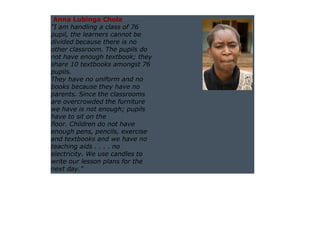
Anna Lubinga Chola
"I am handling a class of 76
pupil, the learners cannot be
divided because there is no
other classroom. The pupils do
not have enough textbook; they
share 10 textbooks amongst 76
pupils.
They have no uniform and no
books because they have no
parents. Since the classrooms
are overcrowded the furniture
we have is not enough; pupils
have to sit on the
floor. Children do not have
enough pens, pencils, exercise
and textbooks and we have no
teaching aids . . . . no
electricity. We use candles to
write our lesson plans for the
next day."
Cecilia Chulu Micheal
"My name is Cecilia Chulu
Micheal. I am single and 25
years old. Currently I am a
teacher at Kakumbi school
teaching Grade 1. These are
the difficulties and challenges I
am facing in my career as a
teacher:
So many pupils in the class
hence it is difficult to teach
effectively. Pupils have no
uniforms as most of them have
no parents. I have problems of
few teaching and learning
materials such as exercise
books, pencils, crayons, wall
charts, and textbooks.
Teachers' houses are not in
good condition."
Paul Mwembe
"I am 29 years old . . .
currently a teacher [at
Kakumbi]. I joined the career
with the passion of a Zambian
child in the year 2005.
Challenges faced in my career
are teaching 72 children in one
classroom, inadequate teaching
and learning materials such as
exercise books, wall charts,
pencils and pens for the
children and most of the
children are orphaned.
There are no extra evening
lessons because the school is
not powered . . .so solar
equipment would be of great
help. Learning is made difficult
due to the above named
causes. It is my hope that one
day these things can be ironed
out."
Nsefu Middle Basic School


 2007: Building work continues on                2010 - Two 1 x 3 classroom blocks giving six
 the new classroom blocks                        classrooms


The original building; one classroom is still    In spite of its condition and lack of
in use                                           desks this classroom is still used
Nsefu Middle Basic School


You need good eyesight to see
                                                 Wednesday afternoon Chess Club
 the writing on this old blackboard


Grade 8 unpacks their textbooks                 The 'naughty stump'?
In Chief Nsefu's chiefdom, between the Msandile River and
  Nsefu Basic School lie many small villages. The nearest schools,
  Chiutika Basic to the south east and Nsefu Basic School to the
  north were too far for most of the children to reach easily and
  safely.


Humble beginnings; Kapita School in 2006   2009 Work starts on making cement blocks for
                                           the classrooms


Slab level on the teacher's house          Building the toilets
Kapita School


Kapita Kids
Katapila School
Katapila School
Every little helps

There are many items that are small that you can bring out with you to donate to the
local schools. These include:
Pencils, Pens, Erasers, Solar Scientific Calculators (not ordinary Calculators), Rulers,
Math sets, Boxes of Chalk, Lined A4 hardback exercise books for Secondary pupils and
A5 soft back exercise books for Basic school pupils, Crayons, Coloured Pencils, Soccer
Balls, Teaching Aids (Maps, Posters, Charts), Encyclopedias, simple or illustrated
children's dictionaries, reference books and books suitable for kids in Africa.
Dorm Room and Sitting Area
Bathroom and Shower

Zambia schools

  • 1.
    Welcome to ProjectLuangwa “Ensuring the people of the Luangwa Valley gain the full benefit from tourism by investing in education and business development.” Our aim is to create an effective, coordinated approach to helping local communities improve their long term economic prospects whilst avoiding a negative impact on the environment and wildlife. We believe as a charity operating in Zambia that by developing and improving schools and creating training opportunities we can help families have the chance of a lasting and sustainable income. 100% of each and every donation is guaranteed to go directly to your nominated project.
  • 2.
    Kakumbi letters Meet theteachers . . . . . . from Kakumbi Basic School When we visited Kakumbi Basic School we asked some of the teachers to write to us and describe some of the problems they and the children face daily. Below are extracts from these letters. When we visited Kakumbi Basic School we asked some of the teachers to write to us and describe some of the problems they and the children face daily. Below are extracts from these letters.
  • 3.
    Tasila Tonga Mwale "Myname is Tasila Tonga and I am married with two sons and I am keeping two girls, who are orphans. Karen Beattie and David Hopson visited our school and we were really glad to see them. Children at our school face a lot of difficulties and they have to walk long distances. Most of them have no uniforms or shoes for them to wear to school. The school has over 400 pupils and only 5 rooms to accommodate them. The pupils could double if we had enough classrooms and staff houses. We are forced to over-enroll each year because parents have realized the importance of education."
  • 4.
    Elijah Mwale "I ammarried to a beautiful lady known as Tasila Tonga [the headmistress] and we have two children named Rabin and Zachariah, aged 7 and 3 years. We have many challenges here in our profession. Due to poor infrastructure we teach pupils of different ages in the same class. Most classes are more than 60 pupils. Teachers face problems of over enrolment and this makes it difficult to teach the slow learners. Accommodation is another problem . . . many teachers have no house and have to rent [huts] in the villages. Many pupils are orphans and depend on donor meals. most come to school without eating anything."
  • 5.
    Philimon Moses Mwale "Aboutmyself: I am a male Zambian teacher . . .35 years old and married with three children, one girl and two boys. My friends, schools here are different from those you have in Europe. I teach grade 3 and have 72 children crowded in one classroom. Desks are not enough and there is no lighting system. The ages of my pupils is 12 to 15 years. These children have difficulties in buying school essentials."
  • 6.
    Betty Kapensa "My nameis Betty Kapensa and I am 30 years old. I don't have accommodation near the school, instead I am renting a house four kilometers away. I have 65 pupils in Grade 2 and find it difficult to concentrate on the slow learners. We don't have enough learning and teaching materials, e.g.. books reading books, charts, paints, crayons, water colors, or story books. About half my class are orphans, either double or one parent."
  • 7.
    Anna Lubinga Chola "Iam handling a class of 76 pupil, the learners cannot be divided because there is no other classroom. The pupils do not have enough textbook; they share 10 textbooks amongst 76 pupils. They have no uniform and no books because they have no parents. Since the classrooms are overcrowded the furniture we have is not enough; pupils have to sit on the floor. Children do not have enough pens, pencils, exercise and textbooks and we have no teaching aids . . . . no electricity. We use candles to write our lesson plans for the next day."
  • 8.
    Cecilia Chulu Micheal "Myname is Cecilia Chulu Micheal. I am single and 25 years old. Currently I am a teacher at Kakumbi school teaching Grade 1. These are the difficulties and challenges I am facing in my career as a teacher: So many pupils in the class hence it is difficult to teach effectively. Pupils have no uniforms as most of them have no parents. I have problems of few teaching and learning materials such as exercise books, pencils, crayons, wall charts, and textbooks. Teachers' houses are not in good condition."
  • 9.
    Paul Mwembe "I am29 years old . . . currently a teacher [at Kakumbi]. I joined the career with the passion of a Zambian child in the year 2005. Challenges faced in my career are teaching 72 children in one classroom, inadequate teaching and learning materials such as exercise books, wall charts, pencils and pens for the children and most of the children are orphaned. There are no extra evening lessons because the school is not powered . . .so solar equipment would be of great help. Learning is made difficult due to the above named causes. It is my hope that one day these things can be ironed out."
  • 10.
    Nsefu Middle BasicSchool 2007: Building work continues on 2010 - Two 1 x 3 classroom blocks giving six the new classroom blocks classrooms The original building; one classroom is still In spite of its condition and lack of in use desks this classroom is still used
  • 11.
    Nsefu Middle BasicSchool You need good eyesight to see Wednesday afternoon Chess Club the writing on this old blackboard Grade 8 unpacks their textbooks The 'naughty stump'?
  • 12.
    In Chief Nsefu'schiefdom, between the Msandile River and Nsefu Basic School lie many small villages. The nearest schools, Chiutika Basic to the south east and Nsefu Basic School to the north were too far for most of the children to reach easily and safely. Humble beginnings; Kapita School in 2006 2009 Work starts on making cement blocks for the classrooms Slab level on the teacher's house Building the toilets
  • 13.
  • 14.
  • 16.
  • 17.
    Every little helps Thereare many items that are small that you can bring out with you to donate to the local schools. These include: Pencils, Pens, Erasers, Solar Scientific Calculators (not ordinary Calculators), Rulers, Math sets, Boxes of Chalk, Lined A4 hardback exercise books for Secondary pupils and A5 soft back exercise books for Basic school pupils, Crayons, Coloured Pencils, Soccer Balls, Teaching Aids (Maps, Posters, Charts), Encyclopedias, simple or illustrated children's dictionaries, reference books and books suitable for kids in Africa.
  • 18.
    Dorm Room andSitting Area
  • 19.