Schools for Madagascar Making the grade 20
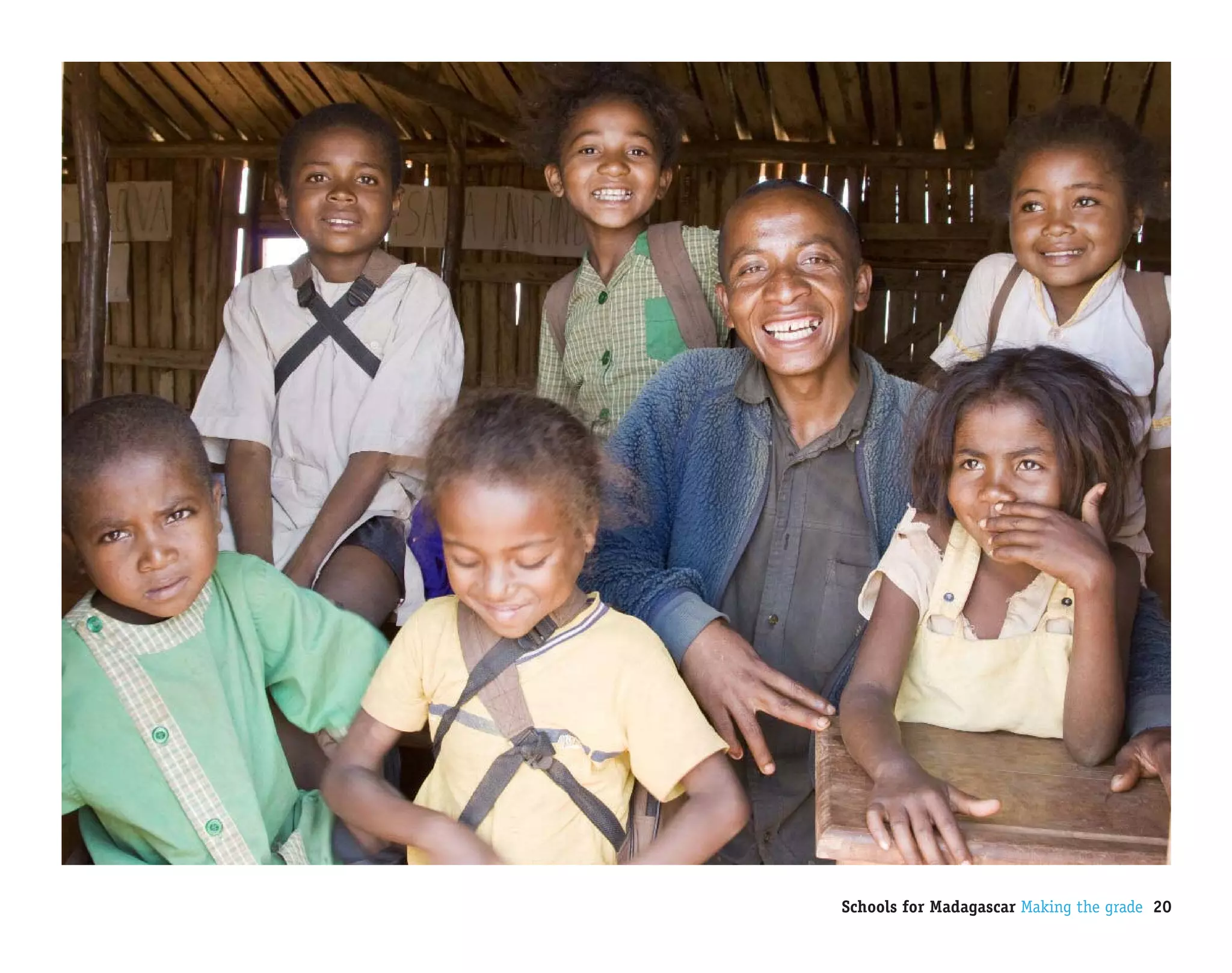
Namorisoa
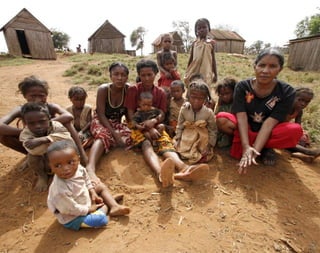
President, Ankilimanintsy II village


As the president of this village it is my role to motivate the parents to    know, the way they carry themselves and how they keep themselves
send their children to school. Sending children to school is important       clean — they are motivated to send the others.
for the development of our village and our district.                           When we built Ankilimanintsy II school the parents were motivated
   Before we were in the dark. Our minds were closed. But now most           to help. There was no school in the village and each family — if they
parents are convinced that education is very important. It used to be        had enough money — contributed ten pieces of wood. The classroom
that the culture of our area emphasized the importance of cattle:            is small, but we cannot a ord to build another. This is one of the main
Cattle were important and all of the children were sent out to watch         reasons that this is an incomplete cycle school. The other is the lack of
them. But that has changed. In recent years many cattle have been            a second teacher.
stolen and the environment is drier than it used to be. Now there are          I know all about not being able to complete your education. My
not enough cattle.                                                           parents stopped me going to school when I was in grade four. Some of
   Most of the parents in this village never went to school. But now         my classmates continued and now they are living and working outside
that there are fewer cattle they see that it is important to send their      the country as doctors and in other jobs. I may be the Village President
children to school, so that they learn other things. They see that this is   and the most educated man in this village, but when I see what my
necessary — that their children can open their minds to receive new          friends achieved it makes me sad. If I had been able to continue I
things from the world, and when they grow up they can have a job.            might have done so much more.
   There are still some who resist; some who still want to send their          This is why I push children to go to school — my children and the
children out with the cattle. They think ‘If I have ve children, I can       children of this village. This is why we worked together to build this
have one help with the cooking, one keep the cows, one stay with the         school. But now when I see children like Manjo repeating the same
small children and the other two can go to school.’                          class again and again, I see my own situation and I feel sad all over
   But other parents are changing their thinking. They are thinking          again. I worry that they may not have the opportunity to continue
‘One will manage the cattle and the other four will go to school.’ When      their studies. It is because of Manjo and the others like him that we
parents see changes in their school-going children — in what they            keep ghting to have grade three here.

                                                                                                          Schools for Madagascar Making the grade 21
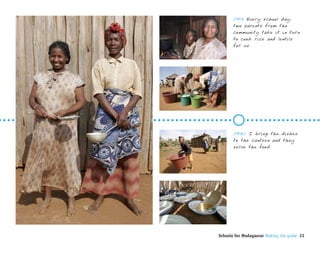
0918 Every school day,
       two parents from the
       community take it in turn
       to cook rice and lentils
       for us.


       0930 I bring the dishes
       to the canteen and they
       serve the food.


Schools for Madagascar Making the grade 22
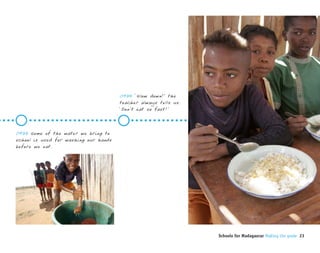
0935 ‘Slow down!’ the
                                       teacher always tells us.
                                       ‘Don’t eat so fast!’


0933 Some of the water we bring to
school is used for washing our hands
before we eat.


                                                                  Schools for Madagascar Making the grade 23
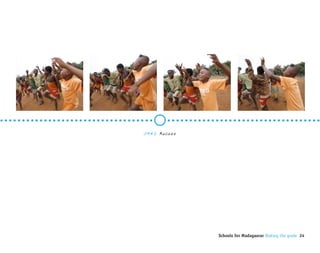
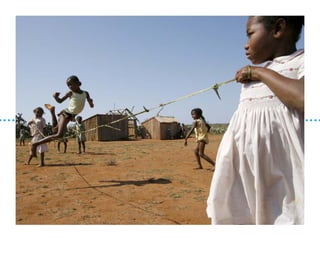
0942 Recess


              Schools for Madagascar Making the grade 24
Helene Ramanantenasoa
Pedagogic Counsellor, Ambovombe district


Before, parents in Ambovombe district were not interested in sending           The second reason for the large number of incomplete schools is
their children to school. When UNICEF started work in this district in       that there are not enough teachers. This situation is easier to resolve. If
1994 there were only 70 schools. Now there are 239.                          there is someone in the village who has completed grade nine or ten,
  It is good that so many parents want to send their children to             they can be recruited and trained.
school. The problem is that the government doesn’t have the funds to           The problem with incomplete cycle schools is that children only
build all of the classrooms that are needed. So this job is falling to the   complete a few grades and then they are stuck. If you only get an
parents; they can’t wait for the government if they want their children      education through grade two or three, there is a risk that you will fall
to go to school. So, in communities like this one, they organize             back again into illiteracy. There are studies that say that you need a
themselves and build a school so that their children are not left out.       minimum of a fth grade education in order to retain literacy.
  Of the 236 primary schools in this district, 119 are incomplete.             We want to see these children move ahead with their education.
There are two main reasons for this. First, and most important, there        One solution to this is doing more of what is already being done:
are not enough classrooms. In this area building materials are scarce        organizing the community to build the schools. The parents would
and costly. They can’t make bricks here. Cement is available in town,        buy what materials they can. And if, for example, they can’t a ord to
but it is expensive and hard to transport to remote areas. Also, there is    buy cement, they can go to the mayor of the community and ask him
very little water here. How can you make cement without water?               if he will participate by buying cement, and go to the district
Wood is scarce and expensive because the forests have been                   education chief to ask if he will give part of the roof if he can. In other
destroyed. This is why the parents can only a ord to build a small           words, they organize themselves and negotiate the economics within
classroom.                                                                   the community.

                                                                                                           Schools for Madagascar Making the grade 26
But even if they did this, these parents have no idea how to          help, everyone inevitably agrees to build the school because they are
organize and manage those who would construct the school. If we         aware of the bene ts it will bring. This means that even if it costs them
can teach them how to do this, they can proceed on their own. But       time or money, they will participate willingly because they understand
even then, the schools will need to be renewed or rebuilt every year    why they are doing it. Without this — if you only dictate to them —
or two, depending on the weather. So another idea is to ask organi-     they will not be motivated. That is why the CPRS is so important.
zations like UNICEF to help us build durable schools — schools that       In the future I would like UNICEF to help us to improve the quality
would not require parents to build or renew them.                       of education in Madagascar. Children need to know more than
  We have been working with UNICEF for 15 years now. In that time,      reading, writing, calculating and speaking French. They need life skills.
they have introduced some valuable systems to encourage                 Their parents should see that there is a di erence if children go to
community participation. The CPRS or ‘contract for school success’ is   school. Children should acquire some knowledge, some competencies
the biggest bene t of our collaboration. The CPRS encourages the        that help them in their lives. They should also learn some activities
participation of all the community members — parents, local             that will help them to nd employment when they nish school.
authorities, the district education chief, teachers and children — in     I would like to see one other thing happen — and I hope UNICEF
order to promote education.                                             can help with this: I would like to situate junior secondary schools
  This starts even before they build a school. The community has a      nearer to primary schools. To go to primary school children walk, on
meeting and the stakeholders discuss the problems of education in       average, three to four kms each way. To go to secondary schools they
their community. When everyone understands the problems children        often walk as far as 10-15 kms. More children could continue their
will face if they don’t go to school, and know what they can do to      education if schools were not so far away.

                                                                                                    Schools for Madagascar Making the grade 28
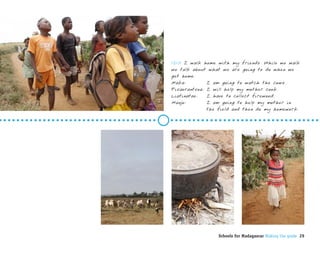
1210 I walk home with my friends. While we walk
we talk about what we are going to do when we
get home.
Maka:         I am going to watch the cows.
Fisaorantsoa: I will help my mother cook.
Liatinatae:   I have to collect firewood.
Manjo:        I am going to help my mother in
              the field and then do my homework.


                 Schools for Madagascar Making the grade 29
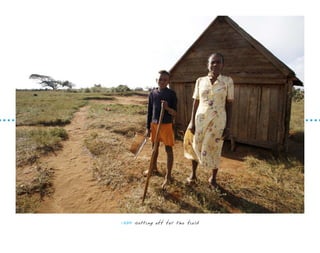
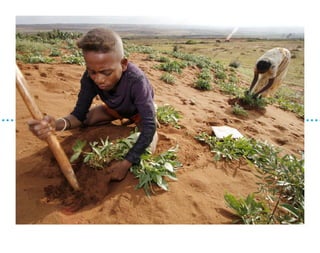
1335 Setting off for the field
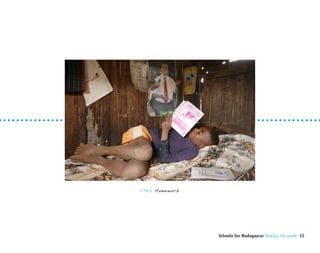
1742 Homework


                Schools for Madagascar Making the grade 32
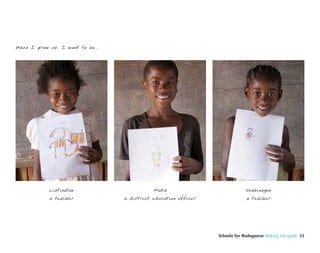
When I grow up, I want to be...


            Liatinatae                       Maka                             Soabinagoe
            a teacher             a district education officer                a teacher


                                                                 Schools for Madagascar Making the grade 33
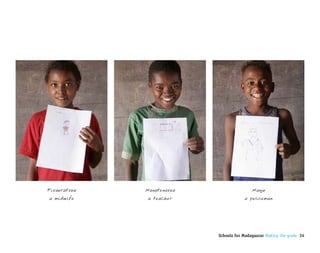
Fisaoratsoa   Manatenasoa                   Manjo
a midwife      a teacher                a policeman


                            Schools for Madagascar Making the grade 34
Manjo and generations of children following him need a
complete primary education if they are to have a chance
to achieve their dreams.

With your help, by 2013 UNICEF Madagascar will complete
180 incomplete cycle schools.

This is part of a larger UNICEF initiative to complete more
than 1200 child-friendly schools in Madagascar by 2013.
By equipping them with the amenities, staff and materials
needed to provide a quality education, UNICEF will have a
direct impact on more than 125,000 children by 2013, and
on many more in the generations to come.
For further information contact


UNICEF Madagascar
Maison commune des Nations Unies
Zone Galaxy Andraharo
Antananarivo 101
Madagascar
Tel : 261 20 23 300 92/93/04
antananarivo@unicef.org
www.unicef.org

Photography, words & design: Kelley Lynch
www.kelleyslynch.com

Manjo's Story Part II

  • 1.
    Schools for MadagascarMaking the grade 20
  • 2.
    Namorisoa President, Ankilimanintsy IIvillage As the president of this village it is my role to motivate the parents to know, the way they carry themselves and how they keep themselves send their children to school. Sending children to school is important clean — they are motivated to send the others. for the development of our village and our district. When we built Ankilimanintsy II school the parents were motivated Before we were in the dark. Our minds were closed. But now most to help. There was no school in the village and each family — if they parents are convinced that education is very important. It used to be had enough money — contributed ten pieces of wood. The classroom that the culture of our area emphasized the importance of cattle: is small, but we cannot a ord to build another. This is one of the main Cattle were important and all of the children were sent out to watch reasons that this is an incomplete cycle school. The other is the lack of them. But that has changed. In recent years many cattle have been a second teacher. stolen and the environment is drier than it used to be. Now there are I know all about not being able to complete your education. My not enough cattle. parents stopped me going to school when I was in grade four. Some of Most of the parents in this village never went to school. But now my classmates continued and now they are living and working outside that there are fewer cattle they see that it is important to send their the country as doctors and in other jobs. I may be the Village President children to school, so that they learn other things. They see that this is and the most educated man in this village, but when I see what my necessary — that their children can open their minds to receive new friends achieved it makes me sad. If I had been able to continue I things from the world, and when they grow up they can have a job. might have done so much more. There are still some who resist; some who still want to send their This is why I push children to go to school — my children and the children out with the cattle. They think ‘If I have ve children, I can children of this village. This is why we worked together to build this have one help with the cooking, one keep the cows, one stay with the school. But now when I see children like Manjo repeating the same small children and the other two can go to school.’ class again and again, I see my own situation and I feel sad all over But other parents are changing their thinking. They are thinking again. I worry that they may not have the opportunity to continue ‘One will manage the cattle and the other four will go to school.’ When their studies. It is because of Manjo and the others like him that we parents see changes in their school-going children — in what they keep ghting to have grade three here. Schools for Madagascar Making the grade 21
  • 3.
    0918 Every schoolday, two parents from the community take it in turn to cook rice and lentils for us. 0930 I bring the dishes to the canteen and they serve the food. Schools for Madagascar Making the grade 22
  • 4.
    0935 ‘Slow down!’the teacher always tells us. ‘Don’t eat so fast!’ 0933 Some of the water we bring to school is used for washing our hands before we eat. Schools for Madagascar Making the grade 23
  • 5.
    0942 Recess Schools for Madagascar Making the grade 24
  • 7.
    Helene Ramanantenasoa Pedagogic Counsellor,Ambovombe district Before, parents in Ambovombe district were not interested in sending The second reason for the large number of incomplete schools is their children to school. When UNICEF started work in this district in that there are not enough teachers. This situation is easier to resolve. If 1994 there were only 70 schools. Now there are 239. there is someone in the village who has completed grade nine or ten, It is good that so many parents want to send their children to they can be recruited and trained. school. The problem is that the government doesn’t have the funds to The problem with incomplete cycle schools is that children only build all of the classrooms that are needed. So this job is falling to the complete a few grades and then they are stuck. If you only get an parents; they can’t wait for the government if they want their children education through grade two or three, there is a risk that you will fall to go to school. So, in communities like this one, they organize back again into illiteracy. There are studies that say that you need a themselves and build a school so that their children are not left out. minimum of a fth grade education in order to retain literacy. Of the 236 primary schools in this district, 119 are incomplete. We want to see these children move ahead with their education. There are two main reasons for this. First, and most important, there One solution to this is doing more of what is already being done: are not enough classrooms. In this area building materials are scarce organizing the community to build the schools. The parents would and costly. They can’t make bricks here. Cement is available in town, buy what materials they can. And if, for example, they can’t a ord to but it is expensive and hard to transport to remote areas. Also, there is buy cement, they can go to the mayor of the community and ask him very little water here. How can you make cement without water? if he will participate by buying cement, and go to the district Wood is scarce and expensive because the forests have been education chief to ask if he will give part of the roof if he can. In other destroyed. This is why the parents can only a ord to build a small words, they organize themselves and negotiate the economics within classroom. the community. Schools for Madagascar Making the grade 26
  • 9.
    But even ifthey did this, these parents have no idea how to help, everyone inevitably agrees to build the school because they are organize and manage those who would construct the school. If we aware of the bene ts it will bring. This means that even if it costs them can teach them how to do this, they can proceed on their own. But time or money, they will participate willingly because they understand even then, the schools will need to be renewed or rebuilt every year why they are doing it. Without this — if you only dictate to them — or two, depending on the weather. So another idea is to ask organi- they will not be motivated. That is why the CPRS is so important. zations like UNICEF to help us build durable schools — schools that In the future I would like UNICEF to help us to improve the quality would not require parents to build or renew them. of education in Madagascar. Children need to know more than We have been working with UNICEF for 15 years now. In that time, reading, writing, calculating and speaking French. They need life skills. they have introduced some valuable systems to encourage Their parents should see that there is a di erence if children go to community participation. The CPRS or ‘contract for school success’ is school. Children should acquire some knowledge, some competencies the biggest bene t of our collaboration. The CPRS encourages the that help them in their lives. They should also learn some activities participation of all the community members — parents, local that will help them to nd employment when they nish school. authorities, the district education chief, teachers and children — in I would like to see one other thing happen — and I hope UNICEF order to promote education. can help with this: I would like to situate junior secondary schools This starts even before they build a school. The community has a nearer to primary schools. To go to primary school children walk, on meeting and the stakeholders discuss the problems of education in average, three to four kms each way. To go to secondary schools they their community. When everyone understands the problems children often walk as far as 10-15 kms. More children could continue their will face if they don’t go to school, and know what they can do to education if schools were not so far away. Schools for Madagascar Making the grade 28
  • 10.
    1210 I walkhome with my friends. While we walk we talk about what we are going to do when we get home. Maka: I am going to watch the cows. Fisaorantsoa: I will help my mother cook. Liatinatae: I have to collect firewood. Manjo: I am going to help my mother in the field and then do my homework. Schools for Madagascar Making the grade 29
  • 11.
    1335 Setting offfor the field
  • 13.
    1742 Homework Schools for Madagascar Making the grade 32
  • 14.
    When I growup, I want to be... Liatinatae Maka Soabinagoe a teacher a district education officer a teacher Schools for Madagascar Making the grade 33
  • 15.
    Fisaoratsoa Manatenasoa Manjo a midwife a teacher a policeman Schools for Madagascar Making the grade 34
  • 16.
    Manjo and generationsof children following him need a complete primary education if they are to have a chance to achieve their dreams. With your help, by 2013 UNICEF Madagascar will complete 180 incomplete cycle schools. This is part of a larger UNICEF initiative to complete more than 1200 child-friendly schools in Madagascar by 2013. By equipping them with the amenities, staff and materials needed to provide a quality education, UNICEF will have a direct impact on more than 125,000 children by 2013, and on many more in the generations to come.
  • 17.
    For further informationcontact UNICEF Madagascar Maison commune des Nations Unies Zone Galaxy Andraharo Antananarivo 101 Madagascar Tel : 261 20 23 300 92/93/04 antananarivo@unicef.org www.unicef.org Photography, words & design: Kelley Lynch www.kelleyslynch.com