Yunasko achievements in supercapacitor 
and hybrid (supercabattery) technologies 
Yurii Maletin, Chief Scientist 
NEST Supercapacitor Workshop 
Frankfurt, 14-15 October 2014
Yunasko supercapacitors and hybrids 
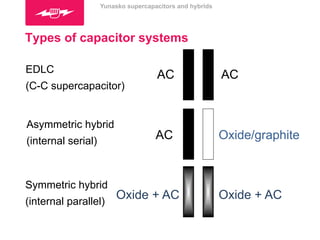
Types of capacitor systems 
EDLC 
(C-C supercapacitor) 
AC AC 
AC Oxide/graphite 
Oxide + AC Oxide + AC 
Asymmetric hybrid 
(internal serial) 
Symmetric hybrid 
(internal parallel)
Yunasko supercapacitors and hybrids 
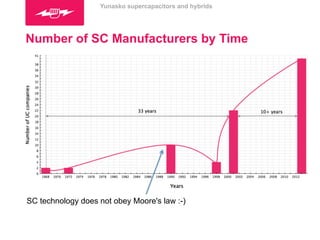
Number of SC Manufacturers by Time 
SC technology does not obey Moore's law :-)
Yunasko supercapacitors and hybrids 
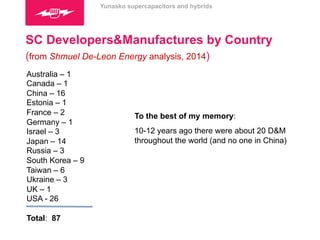
SC Developers&Manufactures by Country 
(from Shmuel De-Leon Energy analysis, 2014) 
Australia – 1 
Canada – 1 
China – 16 
Estonia – 1 
France – 2 
Germany – 1 
Israel – 3 
Japan – 14 
Russia – 3 
South Korea – 9 
Taiwan – 6 
Ukraine – 3 
UK – 1 
USA - 26 
Total: 87 
To the best of my memory: 
10-12 years ago there were about 20 D&M 
throughout the world (and no one in China)
Yunasko supercapacitors and hybrids 
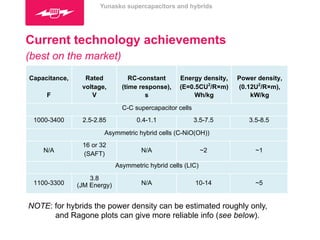
Current technology achievements 
(best on the market) 
Сapacitance, 
F 
Rated 
voltage, 
V 
RC-constant 
(time response), 
s 
Energy density, 
(E=0.5CU2/R×m) 
Wh/kg 
Power density, 
(0.12U2/R×m), 
kW/kg 
C-C supercapacitor cells 
1000-3400 2.5-2.85 0.4-1.1 3.5-7.5 3.5-8.5 
Asymmetric hybrid cells (C-NiO(OH)) 
N/A 
16 or 32 
(SAFT) 
N/A ~2 ~1 
Asymmetric hybrid cells (LIC) 
1100-3300 
3.8 
(JM Energy) 
N/A 10-14 ~5 
! 
NOTE: for hybrids the power density can be estimated roughly only, 
and Ragone plots can give more reliable info (see below).
Yunasko supercapacitors and hybrids 
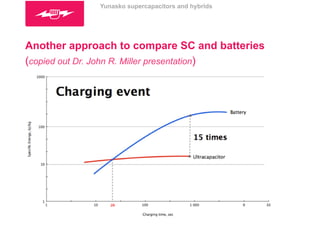
Another approach to compare SC and batteries 
(copied out Dr. John R. Miller presentation)
Yunasko supercapacitors and hybrids 
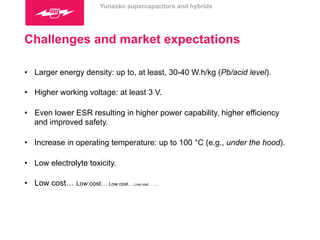
Challenges and market expectations 
• Larger energy density: up to, at least, 30-40 W.h/kg (Pb/acid level). 
• Higher working voltage: at least 3 V. 
• Even lower ESR resulting in higher power capability, higher efficiency 
and improved safety. 
• Increase in operating temperature: up to 100 °C (e.g., under the hood). 
• Low electrolyte toxicity. 
• Low cost… Low cost… Low cost… Low cost… ….
Yunasko supercapacitors and hybrids 
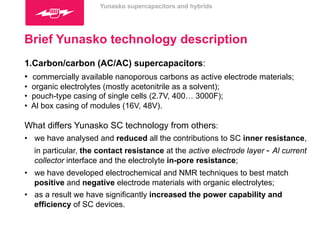
Brief Yunasko technology description 
1. Carbon/carbon (AC/AC) supercapacitors: 
• commercially available nanoporous carbons as active electrode materials; 
• organic electrolytes (mostly acetonitrile as a solvent); 
• pouch-type casing of single cells (2.7V, 400… 3000F); 
• Al box casing of modules (16V, 48V). 
What differs Yunasko SC technology from others: 
• we have analysed and reduced all the contributions to SC inner resistance, 
in particular, the contact resistance at the active electrode layer - Al current 
collector interface and the electrolyte in-pore resistance; 
• we have developed electrochemical and NMR techniques to best match 
positive and negative electrode materials with organic electrolytes; 
• as a result we have significantly increased the power capability and 
efficiency of SC devices.
Yunasko supercapacitors and hybrids 
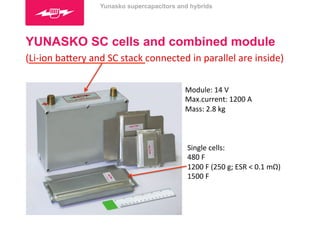
YUNASKO SC cells and combined module 
(Li-­‐ion 
ba*ery 
and 
SC 
stack 
connected 
in 
parallel 
are 
inside) 
Module: 
14 
V 
Max.current: 
1200 
A 
Mass: 
2.8 
kg 
Single 
cells: 
480 
F 
1200 
F 
(250 
g; 
ESR 
< 
0.1 
mΩ) 
1500 
F
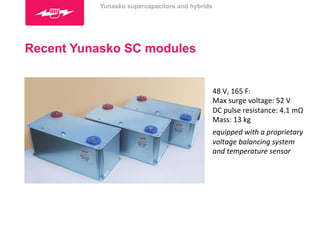
Recent Yunasko SC modules 
48 
V, 
165 
F: 
Max 
surge 
voltage: 
52 
V 
DC 
pulse 
resistance: 
4.1 
mΩ 
Mass: 
13 
kg 
equipped 
with 
a 
proprietary 
voltage 
balancing 
system 
and 
temperature 
sensor 
Yunasko supercapacitors and hybrids
Yunasko supercapacitors and hybrids 
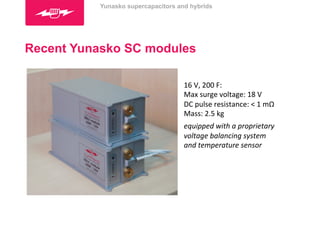
Recent Yunasko SC modules 
16 
V, 
200 
F: 
Max 
surge 
voltage: 
18 
V 
DC 
pulse 
resistance: 
< 
1 
mΩ 
Mass: 
2.5 
kg 
equipped 
with 
a 
proprietary 
voltage 
balancing 
system 
and 
temperature 
sensor
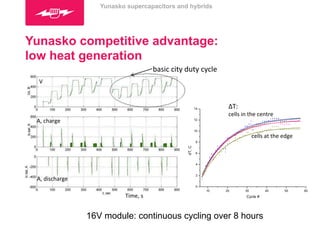
Yunasko competitive advantage: 
low heat generation 
basic 
city 
duty 
cycle 
ΔT: 
cells 
in 
the 
centre 
cells 
at 
the 
edge 
Time, 
s 
16V module: continuous cycling over 8 hours 
V 
A, 
charge 
A, 
discharge 
Yunasko supercapacitors and hybrids
Yunasko supercapacitors and hybrids 
Brief Yunasko technology description 
2. Hybrid devices: 
• mixture of Li-intercalated metal oxide and nanoporous carbon as active 
materials in BOTH electrodes; 
• organic electrolytes (mostly, acetonitrile as a solvent); 
• pouch-type casing of prototype cells (2.8V, 1.3 A.h). 
What differs YUNASKO hybrid technology from others: 
• both positive and negative electrodes are hybridized; 
• potential ranges and energy/power capabilities of metal oxide and 
carbon components are thoroughly matched; 
• as a result we have significantly increased the energy density keeping 
at the same time the high power capability and efficiency.
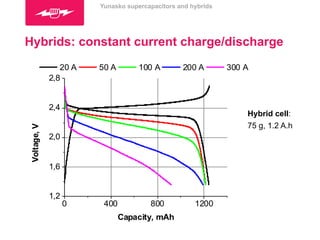
Hybrids: constant current charge/discharge 
20 A 50 A 100 A 200 A 300 A 
0 400 800 1200 
2,8 
2,4 
2,0 
1,6 
1,2 
Voltage, V 
Capacity, mAh 
Hybrid cell: 
75 g, 1.2 A.h 
Yunasko supercapacitors and hybrids
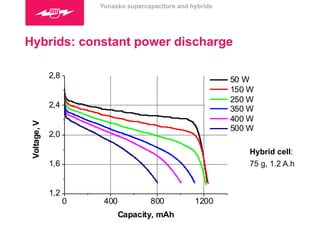
Hybrids: constant power discharge 
0 400 800 1200 
2,8 
2,4 
2,0 
1,6 
1,2 
Voltage, V 
Capacity, mAh 
50 W 
150 W 
250 W 
350 W 
400 W 
500 W 
Hybrid cell: 
75 g, 1.2 A.h 
Yunasko supercapacitors and hybrids
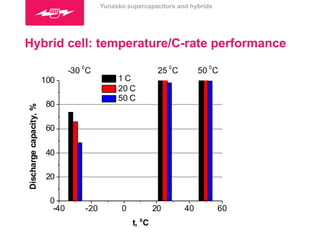
Hybrid cell: temperature/C-rate performance 
100 
80 
60 
40 
20 
0 
25 0C 50 0C 
1 C 
20 C 
50 C 
-40 -20 0 20 40 60 
Discharge capacity, % 
t, 0C 
-30 0C 
Yunasko supercapacitors and hybrids
Yunasko supercapacitors and hybrids 
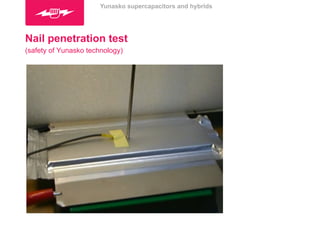
Nail penetration test 
(safety of Yunasko technology)
Yunasko supercapacitors and hybrids 
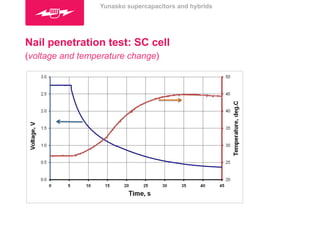
Nail penetration test: SC cell 
(voltage and temperature change)
Yunasko supercapacitors and hybrids 
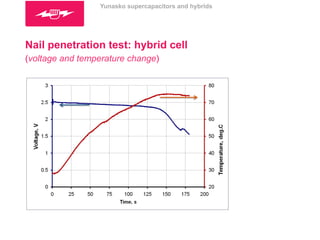
Nail penetration test: hybrid cell 
(voltage and temperature change)
Yunasko supercapacitors and hybrids 
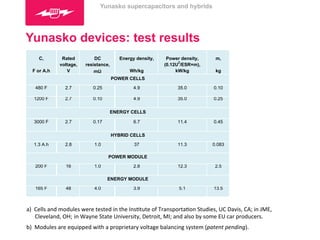
Yunasko devices: test results 
С, 
F or A.h 
Rated 
voltage, 
V 
DC 
resistance, 
mΩ 
Energy density, 
Wh/kg 
Power density, 
(0.12U2/ESR×m), 
kW/kg 
m, 
kg 
POWER CELLS 
480 F 2.7 0.25 4.9 35.0 0.10 
1200 F 2.7 0.10 4.9 35.0 0.25 
ENERGY CELLS 
3000 F 2.7 0.17 6.7 11.4 0.45 
HYBRID CELLS 
1.3 A.h 2.8 1.0 37 11.3 0.083 
0.76 
0.48 
6.5 
3.8 
72 
POWER MODULE 
200 F 16 1.0 2.8 12.3 2.5 
0.33 
0.50 
6.7 
3.7 
168 
ENERGY MODULE 
165 F 48 4.0 3.9 5.1 13.5 
! 
a) 
Cells 
and 
modules 
were 
tested 
in 
the 
InsWtute 
of 
TransportaWon 
Studies, 
UC 
Davis, 
CA; 
in 
JME, 
Cleveland, 
OH; 
in 
Wayne 
State 
University, 
Detroit, 
MI; 
and 
also 
by 
some 
EU 
car 
producers. 
b) 
Modules 
are 
equipped 
with 
a 
proprietary 
voltage 
balancing 
system 
(patent 
pending).
Yunasko supercapacitors and hybrids 
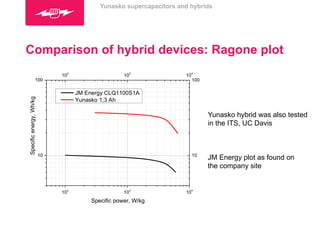
Comparison of hybrid devices: Ragone plot 
Yunasko hybrid was also tested 
in the ITS, UC Davis 
JM Energy plot as found on 
the company site
Yunasko supercapacitors and hybrids 
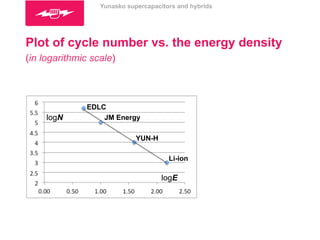
Plot of cycle number vs. the energy density 
(in logarithmic scale) 
logN 
logE 
EDLC 
JM Energy 
YUN-H 
Li-ion
Yunasko supercapacitors and hybrids 
YUNASKO background and prospects 
Principal researchers participate in various supercapacitor 
projects since 1989 
YUNASKO Ltd: registered in the UK since 2010. Today the 
company is a developer and licensor of the most advanced 
supercapacitor technology. 
Subsidiaries: 
YUNASKO-Ukraine: R&D, Design Bureau and Pilot Plant since 2010 
YUNASKO-Latvia: industrial scale production will start in 2015 
(For more information see: www.yunasko.com )
Yunasko supercapacitors and hybrids 
R&D cooperation 
MTS Systems, Minneapolis, MN, USA www.mts.com 
Yo-Engineering (now: TEEMP), Russia www.yo-engineering.ru 
Two of the biggest EU car makers (under NDA). 
JME Inc., Cleveland, OH, USA jmecapacitor@att.net 
Institute of Transportation Studies, Davis, CA, USA 
afburke@ucdavis.edu 
Wayne State University, Detroit, MI, USA corrigan@wayne.edu 
Custom Cell / Fraunhofer Institute, Germany www.customcells.de 
ALSO: a production partner in China (under NDA)
Yunasko supercapacitors and hybrids 
Some results of cooperation 
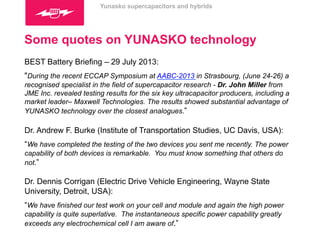
• A partner in China is close to launching industrial scale production of 
SC modules (under NDA). 
• STCU project #5500 “Development and design of combined power 
supply units based on nanosized electrode materials for space 
applications”: supercapacitors can withstand high radiation levels, 
even exceeding those typical for microsatellite orbits ( www.stcu.int )
Yunasko supercapacitors and hybrids 
Some quotes on YUNASKO technology 
BEST Battery Briefing – 29 July 2013: 
"During the recent ECCAP Symposium at AABC-2013 in Strasbourg, (June 24-26) a 
recognised specialist in the field of supercapacitor research - Dr. John Miller from 
JME Inc. revealed testing results for the six key ultracapacitor producers, including a 
market leader– Maxwell Technologies. The results showed substantial advantage of 
YUNASKO technology over the closest analogues.” 
Dr. Andrew F. Burke (Institute of Transportation Studies, UC Davis, USA): 
“We have completed the testing of the two devices you sent me recently. The power 
capability of both devices is remarkable. You must know something that others do 
not.” 
Dr. Dennis Corrigan (Electric Drive Vehicle Engineering, Wayne State 
University, Detroit, USA): 
“We have finished our test work on your cell and module and again the high power 
capability is quite superlative. The instantaneous specific power capability greatly 
exceeds any electrochemical cell I am aware of.”
Yunasko supercapacitors and hybrids 
Yunasko today’s R&D portfolio 
• High temperature (also low toxic, low cost) electrolytes – testing @100 °C is 
currently in progress 
• Nanoporous carbon modification – fine tuning the pore size and doping the 
surface with N-heteroatoms 
• Dry method for electrode production aimed at reducing the cost 
• Hybrid systems of improved performance
Yunasko supercapacitors and hybrids 
Acknowledgements 
Special thanks to my colleagues in Yunasko R&D Lab, Design Bureau 
and Pilot Plant 
for their dedication and bright ideas 
Many thanks to Dr. Andrew F. Burke (ITS), Dr. John R. Miller (JME), 
and Dr. Dennis Corrigan (Wayne State University) 
for their valuable help in SC testing and stimulating discussions 
Participation in FP7 “Energy Caps” project 
is very much acknowledged
THANKS FOR YOUR ATTENTION! 
and we are open to cooperation 
Please visit us at: www.yunasko.com

Yunasko frankfurt oct'14

  • 1.
    Yunasko achievements insupercapacitor and hybrid (supercabattery) technologies Yurii Maletin, Chief Scientist NEST Supercapacitor Workshop Frankfurt, 14-15 October 2014
  • 2.
    Yunasko supercapacitors andhybrids Types of capacitor systems EDLC (C-C supercapacitor) AC AC AC Oxide/graphite Oxide + AC Oxide + AC Asymmetric hybrid (internal serial) Symmetric hybrid (internal parallel)
  • 3.
    Yunasko supercapacitors andhybrids Number of SC Manufacturers by Time SC technology does not obey Moore's law :-)
  • 4.
    Yunasko supercapacitors andhybrids SC Developers&Manufactures by Country (from Shmuel De-Leon Energy analysis, 2014) Australia – 1 Canada – 1 China – 16 Estonia – 1 France – 2 Germany – 1 Israel – 3 Japan – 14 Russia – 3 South Korea – 9 Taiwan – 6 Ukraine – 3 UK – 1 USA - 26 Total: 87 To the best of my memory: 10-12 years ago there were about 20 D&M throughout the world (and no one in China)
  • 5.
    Yunasko supercapacitors andhybrids Current technology achievements (best on the market) Сapacitance, F Rated voltage, V RC-constant (time response), s Energy density, (E=0.5CU2/R×m) Wh/kg Power density, (0.12U2/R×m), kW/kg C-C supercapacitor cells 1000-3400 2.5-2.85 0.4-1.1 3.5-7.5 3.5-8.5 Asymmetric hybrid cells (C-NiO(OH)) N/A 16 or 32 (SAFT) N/A ~2 ~1 Asymmetric hybrid cells (LIC) 1100-3300 3.8 (JM Energy) N/A 10-14 ~5 ! NOTE: for hybrids the power density can be estimated roughly only, and Ragone plots can give more reliable info (see below).
  • 6.
    Yunasko supercapacitors andhybrids Another approach to compare SC and batteries (copied out Dr. John R. Miller presentation)
  • 7.
    Yunasko supercapacitors andhybrids Challenges and market expectations • Larger energy density: up to, at least, 30-40 W.h/kg (Pb/acid level). • Higher working voltage: at least 3 V. • Even lower ESR resulting in higher power capability, higher efficiency and improved safety. • Increase in operating temperature: up to 100 °C (e.g., under the hood). • Low electrolyte toxicity. • Low cost… Low cost… Low cost… Low cost… ….
  • 8.
    Yunasko supercapacitors andhybrids Brief Yunasko technology description 1. Carbon/carbon (AC/AC) supercapacitors: • commercially available nanoporous carbons as active electrode materials; • organic electrolytes (mostly acetonitrile as a solvent); • pouch-type casing of single cells (2.7V, 400… 3000F); • Al box casing of modules (16V, 48V). What differs Yunasko SC technology from others: • we have analysed and reduced all the contributions to SC inner resistance, in particular, the contact resistance at the active electrode layer - Al current collector interface and the electrolyte in-pore resistance; • we have developed electrochemical and NMR techniques to best match positive and negative electrode materials with organic electrolytes; • as a result we have significantly increased the power capability and efficiency of SC devices.
  • 9.
    Yunasko supercapacitors andhybrids YUNASKO SC cells and combined module (Li-­‐ion ba*ery and SC stack connected in parallel are inside) Module: 14 V Max.current: 1200 A Mass: 2.8 kg Single cells: 480 F 1200 F (250 g; ESR < 0.1 mΩ) 1500 F
  • 10.
    Recent Yunasko SCmodules 48 V, 165 F: Max surge voltage: 52 V DC pulse resistance: 4.1 mΩ Mass: 13 kg equipped with a proprietary voltage balancing system and temperature sensor Yunasko supercapacitors and hybrids
  • 11.
    Yunasko supercapacitors andhybrids Recent Yunasko SC modules 16 V, 200 F: Max surge voltage: 18 V DC pulse resistance: < 1 mΩ Mass: 2.5 kg equipped with a proprietary voltage balancing system and temperature sensor
  • 12.
    Yunasko competitive advantage: low heat generation basic city duty cycle ΔT: cells in the centre cells at the edge Time, s 16V module: continuous cycling over 8 hours V A, charge A, discharge Yunasko supercapacitors and hybrids
  • 13.
    Yunasko supercapacitors andhybrids Brief Yunasko technology description 2. Hybrid devices: • mixture of Li-intercalated metal oxide and nanoporous carbon as active materials in BOTH electrodes; • organic electrolytes (mostly, acetonitrile as a solvent); • pouch-type casing of prototype cells (2.8V, 1.3 A.h). What differs YUNASKO hybrid technology from others: • both positive and negative electrodes are hybridized; • potential ranges and energy/power capabilities of metal oxide and carbon components are thoroughly matched; • as a result we have significantly increased the energy density keeping at the same time the high power capability and efficiency.
  • 14.
    Hybrids: constant currentcharge/discharge 20 A 50 A 100 A 200 A 300 A 0 400 800 1200 2,8 2,4 2,0 1,6 1,2 Voltage, V Capacity, mAh Hybrid cell: 75 g, 1.2 A.h Yunasko supercapacitors and hybrids
  • 15.
    Hybrids: constant powerdischarge 0 400 800 1200 2,8 2,4 2,0 1,6 1,2 Voltage, V Capacity, mAh 50 W 150 W 250 W 350 W 400 W 500 W Hybrid cell: 75 g, 1.2 A.h Yunasko supercapacitors and hybrids
  • 16.
    Hybrid cell: temperature/C-rateperformance 100 80 60 40 20 0 25 0C 50 0C 1 C 20 C 50 C -40 -20 0 20 40 60 Discharge capacity, % t, 0C -30 0C Yunasko supercapacitors and hybrids
  • 17.
    Yunasko supercapacitors andhybrids Nail penetration test (safety of Yunasko technology)
  • 18.
    Yunasko supercapacitors andhybrids Nail penetration test: SC cell (voltage and temperature change)
  • 19.
    Yunasko supercapacitors andhybrids Nail penetration test: hybrid cell (voltage and temperature change)
  • 20.
    Yunasko supercapacitors andhybrids Yunasko devices: test results С, F or A.h Rated voltage, V DC resistance, mΩ Energy density, Wh/kg Power density, (0.12U2/ESR×m), kW/kg m, kg POWER CELLS 480 F 2.7 0.25 4.9 35.0 0.10 1200 F 2.7 0.10 4.9 35.0 0.25 ENERGY CELLS 3000 F 2.7 0.17 6.7 11.4 0.45 HYBRID CELLS 1.3 A.h 2.8 1.0 37 11.3 0.083 0.76 0.48 6.5 3.8 72 POWER MODULE 200 F 16 1.0 2.8 12.3 2.5 0.33 0.50 6.7 3.7 168 ENERGY MODULE 165 F 48 4.0 3.9 5.1 13.5 ! a) Cells and modules were tested in the InsWtute of TransportaWon Studies, UC Davis, CA; in JME, Cleveland, OH; in Wayne State University, Detroit, MI; and also by some EU car producers. b) Modules are equipped with a proprietary voltage balancing system (patent pending).
  • 21.
    Yunasko supercapacitors andhybrids Comparison of hybrid devices: Ragone plot Yunasko hybrid was also tested in the ITS, UC Davis JM Energy plot as found on the company site
  • 22.
    Yunasko supercapacitors andhybrids Plot of cycle number vs. the energy density (in logarithmic scale) logN logE EDLC JM Energy YUN-H Li-ion
  • 23.
    Yunasko supercapacitors andhybrids YUNASKO background and prospects Principal researchers participate in various supercapacitor projects since 1989 YUNASKO Ltd: registered in the UK since 2010. Today the company is a developer and licensor of the most advanced supercapacitor technology. Subsidiaries: YUNASKO-Ukraine: R&D, Design Bureau and Pilot Plant since 2010 YUNASKO-Latvia: industrial scale production will start in 2015 (For more information see: www.yunasko.com )
  • 24.
    Yunasko supercapacitors andhybrids R&D cooperation MTS Systems, Minneapolis, MN, USA www.mts.com Yo-Engineering (now: TEEMP), Russia www.yo-engineering.ru Two of the biggest EU car makers (under NDA). JME Inc., Cleveland, OH, USA jmecapacitor@att.net Institute of Transportation Studies, Davis, CA, USA afburke@ucdavis.edu Wayne State University, Detroit, MI, USA corrigan@wayne.edu Custom Cell / Fraunhofer Institute, Germany www.customcells.de ALSO: a production partner in China (under NDA)
  • 25.
    Yunasko supercapacitors andhybrids Some results of cooperation • A partner in China is close to launching industrial scale production of SC modules (under NDA). • STCU project #5500 “Development and design of combined power supply units based on nanosized electrode materials for space applications”: supercapacitors can withstand high radiation levels, even exceeding those typical for microsatellite orbits ( www.stcu.int )
  • 26.
    Yunasko supercapacitors andhybrids Some quotes on YUNASKO technology BEST Battery Briefing – 29 July 2013: "During the recent ECCAP Symposium at AABC-2013 in Strasbourg, (June 24-26) a recognised specialist in the field of supercapacitor research - Dr. John Miller from JME Inc. revealed testing results for the six key ultracapacitor producers, including a market leader– Maxwell Technologies. The results showed substantial advantage of YUNASKO technology over the closest analogues.” Dr. Andrew F. Burke (Institute of Transportation Studies, UC Davis, USA): “We have completed the testing of the two devices you sent me recently. The power capability of both devices is remarkable. You must know something that others do not.” Dr. Dennis Corrigan (Electric Drive Vehicle Engineering, Wayne State University, Detroit, USA): “We have finished our test work on your cell and module and again the high power capability is quite superlative. The instantaneous specific power capability greatly exceeds any electrochemical cell I am aware of.”
  • 27.
    Yunasko supercapacitors andhybrids Yunasko today’s R&D portfolio • High temperature (also low toxic, low cost) electrolytes – testing @100 °C is currently in progress • Nanoporous carbon modification – fine tuning the pore size and doping the surface with N-heteroatoms • Dry method for electrode production aimed at reducing the cost • Hybrid systems of improved performance
  • 28.
    Yunasko supercapacitors andhybrids Acknowledgements Special thanks to my colleagues in Yunasko R&D Lab, Design Bureau and Pilot Plant for their dedication and bright ideas Many thanks to Dr. Andrew F. Burke (ITS), Dr. John R. Miller (JME), and Dr. Dennis Corrigan (Wayne State University) for their valuable help in SC testing and stimulating discussions Participation in FP7 “Energy Caps” project is very much acknowledged
  • 29.
    THANKS FOR YOURATTENTION! and we are open to cooperation Please visit us at: www.yunasko.com