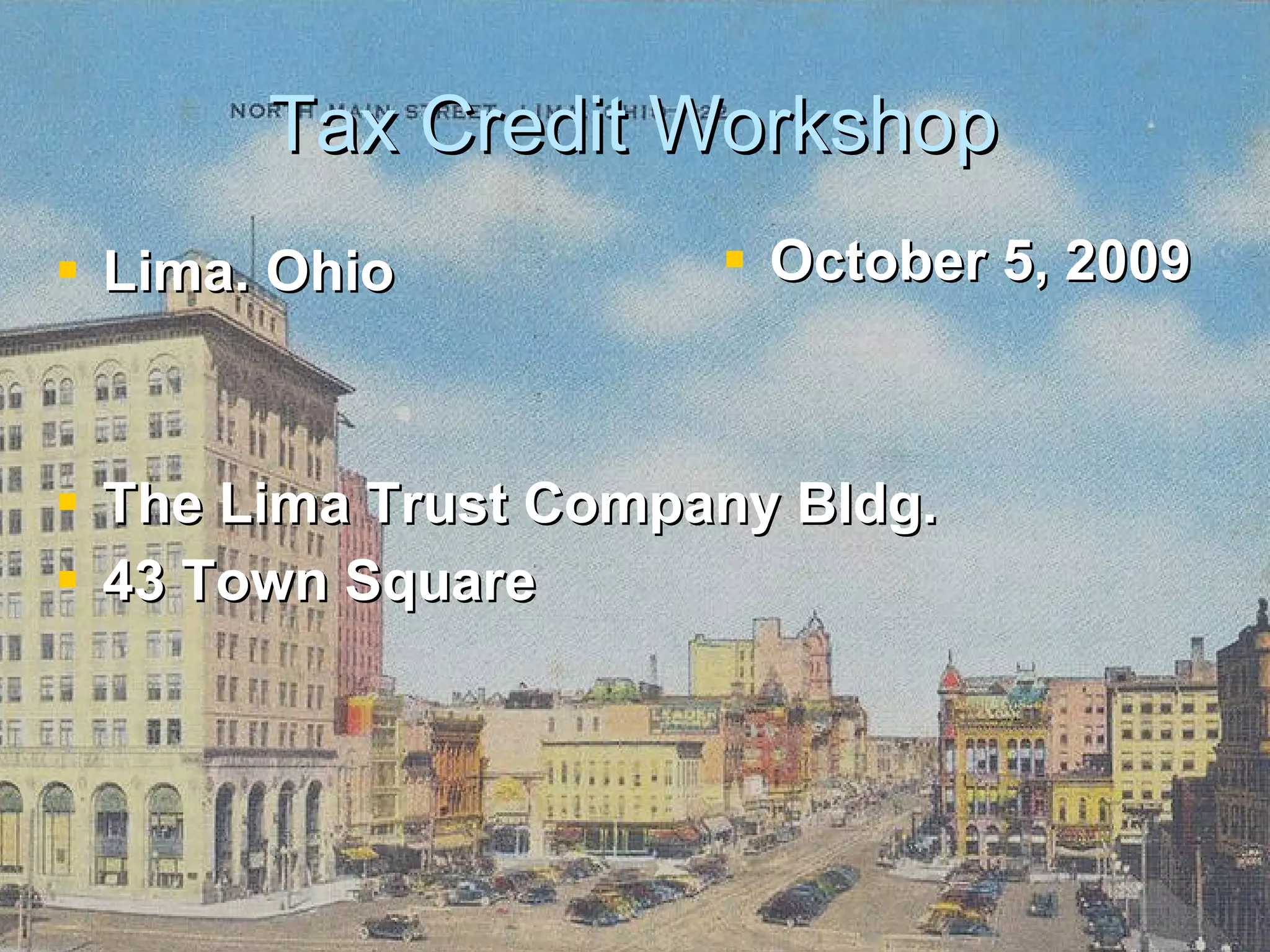
Tax Credit Workshop Lima. Ohio   The Lima Trust Company Bldg. 43 Town Square   October 5, 2009
Information Town Square Center. Owner Built in 1926 Weary and Alford. Chicago Architects W.H. Horster, Tulsa Oklahoma. Contractors Neoclassic Revival Style Historic Preservation Consultants. Chambers Murphy and Burge, Restoration Architects. Akron
Eligibility Listed on the National Register of Historic Places. Multiple Resource Area. 1980 Rehabilitation Resources Ohio Historic Preservation Tax Credit Federal Tax Rehabilitation Credit
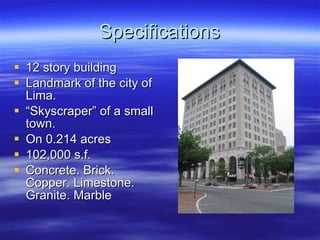
Specifications 12 story building Landmark of the city of Lima. “ Skyscraper” of a small town. On 0.214 acres 102,000 s.f. Concrete. Brick. Copper. Limestone. Granite. Marble
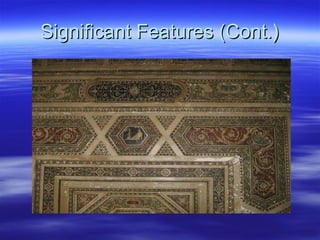
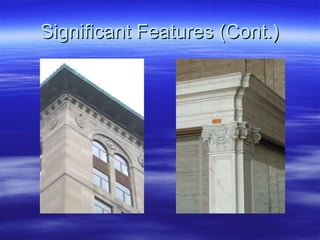
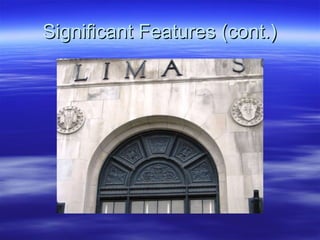
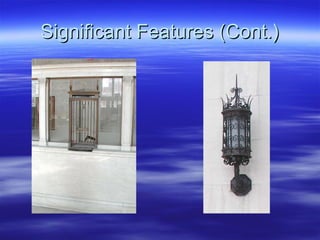
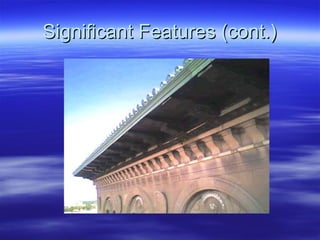
Character Defining Features Architectural Elements Materials Space Cornice Stair System Windows Millwork Lobby Fireplace Ornamental Light Fixtures Office Corridors
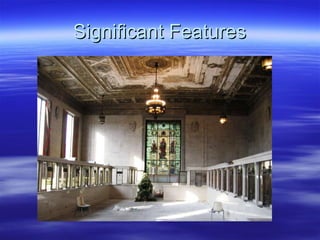
Significant Features
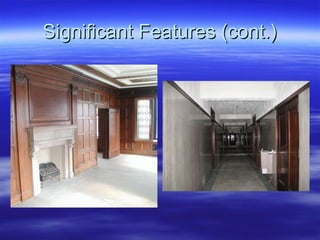
Significant Features (cont.)
Significant Features (Cont.)
Significant Features (cont.)
Significant Features (Cont.)
Significant Features (cont.)
Significant Features (cont.) Decorative plaster ceiling Stained glass window Original storefronts Vault doors.  Limestone cladding Metal panels. Spandrels. Arches. Wood paneling. American Walnut.
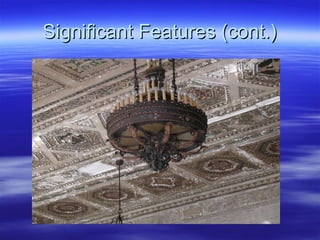
Significant Features (cont.) Flooring. Marble. Linoleum Skylight Marble partitions, floors, stairs. Bronze Teller windows Ornamental Plaster. Crown Molding Granite Base Chandeliers
Ohio Historic Preservation Tax Credit Application Combined Tax Credit Application, State and Federal Submitted on August 10, 2007 Submitted part 2 for Federal rehabilitation tax credit (already listed on the NR, no need for part 1) Include corresponding photos, drawings. Staged Project. Submitted Rationale for Staged Project form Submitted Major Factor Information Narrative Cost Benefit Analysis. Prepared by Accountant.
Rationale For Staged Project Form Total Estimated Expenditures $10,500,000 Five Year Staged Project Plan (60-month) (Same as Federal Tax Rehabilitation Credit) Time period. October 2007 to October 2012 Stage 1. Rehabilitate 1 st  and 2 nd  Floors. ADA. HVAC. Electrical.Plumbing Stage 2. Rehabilitate 3 rd  to 5 th  floor (as tenant leases are obtained) HVAC. Electrical. Plumbing
Rationale (Cont.) Stage 3. Rehabilitate 6 to 8 th . Same as Stage 2 Stage 4. Rehabilitate 9 th  to 12 th . Same as Stage 2.  Stage 5. Rehabilitation of Storefronts. Dependent on Lease Progress
Ohio Historic Preservation Tax Credit. Amendments Amendments can be submitted anytime changes occur. Any changes or clarifications requested by the SHPO generates an Amendment.  Send corresponding copies to ODOD Use Federal Tax Rehabilitation Amendment Form. Lima Trust project submitted 3 amendments to date.
Ohio Department of Development Progress Reports To be filed with ODOD. ODOD sends letter about status of project, and owner updates information in the white spaces. If gray space information needs to be changes then the owner has to file an Amendment with the ODOD, like for example change of ownership. Existing amendments are listed.
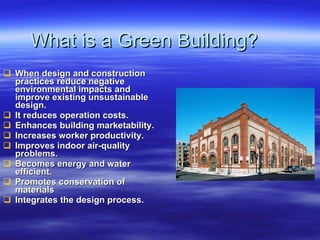
What is a Green Building? When design and construction practices reduce negative environmental impacts and improve existing unsustainable design.  It reduces operation costs. Enhances building marketability. Increases worker productivity. Improves indoor air-quality problems. Becomes energy and water efficient. Promotes conservation of materials Integrates the design process.
What is an Historic Building? Listed individually on the National Register of Historic Places. Contributing building in a National Register Historic District. Determined eligible to be listed on the National Register by the State Historic Preservation Office. At least 50 years old and eligible to be listed. Achieving significance within 50 years because of exceptional importance. Moved buildings with historic significance. Accurately reconstructed building in an appropriate setting. Listed at State or Local level complying with National Register historic criteria standards
Common issues in Historic Preservation and Green Building Embodied energy and reuse of existing resources.  ( Embodied energy of a standard building is equal to 5-15 gallons of gasoline per s.f.) Conservation resources. Preservation of Cultural Heritage Adapting existing Historic Structures to current societal needs
Common challenges facing the Green and Historic Preservation movements. Not a clear public policy encouraging green and historic preservation. Not significant public investment, especially local. Lack of public interest due to education Continued urban sprawl and construction of disposable architecture. Cost of Historic Restoration with Green Criteria compared to new construction
Current Public Green Initiatives In legislation, executive orders, resolution, ordinances, policies and initiatives. 13 federal agencies 17 public school systems 39 institutions of higher education 45 states 195 localities (132 cities, 35 counties, 28 towns)
Green Initiatives Examples GSA. Decided in 2000 that starting in 2003 all capital building projects must earn LEED certification.  Largest civilian landlord 8,600 buildings. First Federal USGBC member. Palo Alto. CA. Commercial LEED certified. Residential Build It Green’s Green Point rating system Lakewood, OH. Adopted resolution use LEED Green principles in public projects.
Green Initiative examples New Albany, OH. New building incentives for Green commercial buildings. Shaker Hts. OH. Encourage municipal and private sector to follow LEED guidelines Cincinnati, OH. All municipal buildings, new and renovated be LEED certified. Automatic 100% Real Property Tax Exempt of assessed property value for residential and commercial LEED Certified structures.
Green Initiatives Examples Lima, OH. Green initiative adopted for public works in Transportation Lighting Wastewater Water Supply  Solid Waste
Green Rating Systems USGBC LEED (Leadership in Energy and Environmental Design ) Build it Green. Green Point. CA National Association of Home Builders. National Green Building Standards. Built Green. CO Sustainable Space. CA Built Green. WA
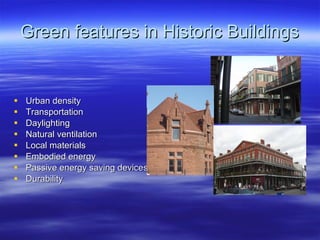
Green features in Historic Buildings Urban density Transportation Daylighting Natural ventilation Local materials Embodied energy Passive energy saving devices Durability
Greening Historic Property Discussion Components Envelope.   Windows,  wall, roof and foundation performance HVAC system.  Space for new systems. Meeting energy/thermal performance. Lighting.  Day lighting and electric lighting integration and issues. Materials.  Conflicts with green or historic standards. Lack of acceptance of green imitation of historic materials
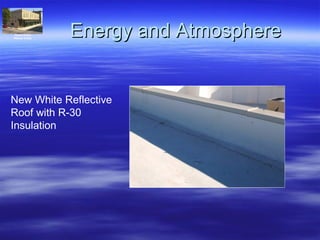
Energy and Atmosphere New White Reflective Roof with R-30 Insulation Historic District Whitaker & State
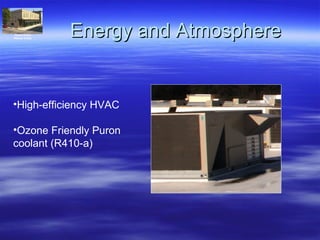
Energy and Atmosphere High-efficiency HVAC Ozone Friendly Puron coolant (R410-a) Historic District Whitaker & State
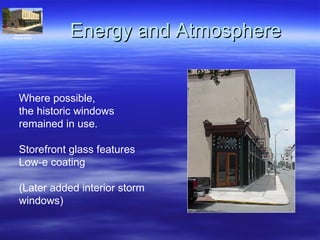
Energy and Atmosphere Where possible,  the historic windows  remained in use.  Storefront glass features Low-e coating (Later added interior storm windows)   Historic District Whitaker & State
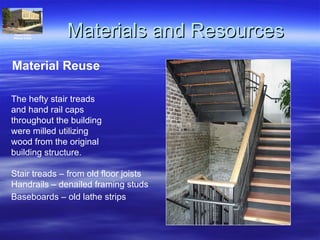
Energy and Atmosphere High efficiency lighting installed which consumes less energy and produces less heat Motion sensors Dual ballasts  Overall, a 43% reduction in electricity consumption and downsized HVAC by 6 tons Historic District Whitaker & State
Building Reuse 100% of the shell and the majority of the interior was reused Purchased materials were locally sourced, and high in recycled content Materials and Resources Historic District Whitaker & State
Materials and Resources Material Reuse The hefty stair treads  and hand rail caps throughout the building were milled utilizing  wood from the original  building structure.  Stair treads – from old floor joists Handrails – denailed framing studs Baseboards – old lathe strips   Historic District Whitaker & State
Indoor Environmental Quality All paints and finishes  were low VOC  (volatile organic compounds)   products.   Safer to breathe  and don’t continue to off-gas over time  Historic District Whitaker & State
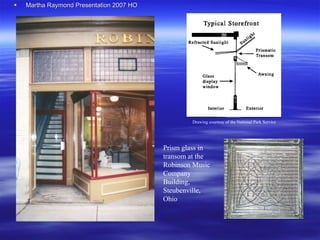
Martha Raymond Presentation 2007 HO Prism glass in transom at the Robinson Music Company Building, Steubenville, Ohio  Drawing courtesy of the National Park Service
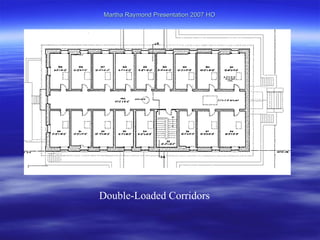
Martha Raymond Presentation 2007 HO Double-Loaded Corridors
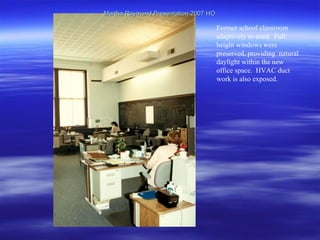
Martha Raymond Presentation 2007 HO Former school classroom adaptively re-used.  Full height windows were preserved, providing  natural daylight within the new office space.  HVAC duct work is also exposed.
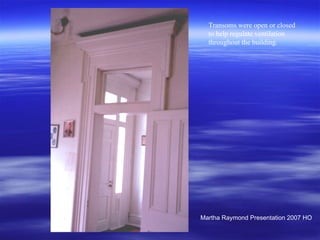
Transoms were open or closed to help regulate ventilation throughout the building. Martha Raymond Presentation 2007 HO
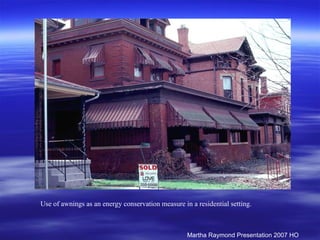
Use of awnings as an energy conservation measure in a residential setting. Martha Raymond Presentation 2007 HO
The Community Restoration and Revitalization Act HR 1043  S 584 Re-introduced on October 1, 2009 Senators Lincoln (D-AR) Snowe (R-ME) HR Schwartz (D-PA) Tiberi (R-OH) 8 Amendments to 1986 Federal Rehabilitation Tax Credit. Enabling Smaller Rehabilitation Projects Providing Downtown Housing in Historic Buildings Using a practical definition for “Older Building”
Community Restoration (Cont.) Rehabilitating Qualified Non-profit and Public Historic Buildings Making Historic Buildings as Energy Efficient as they can be. Facilitating smaller projects through Transferability Encouraging Moderate Rehabilitation through Reducing the Substantial Rehabilitation Requirements Allowing State Historic Tax Credits to Work More Effectively with the Federal Credit
Historic Homeowners Revitalization Act HR 3670 Introduced in September 29, 2009 HR Carnahan (D-MO) Federal Tax Credit 20%. “Qualified Rehabilitation expenditures made by the tax payer with respect to a qualified historic home”. Cap of $60,000 Increase in credit for buildings in “high cost” or economically distressed areas.
Historic Homeowners (Cont.) Ability of credits to be transferred or assigned. Available for “For Sale” housing. Additional information at the following web pages: www.PreservationAction.org www.PreservationNation.org
Presenter Yolita E. Rausche M.Arch HP Historic Preservation Specialist Chambers Murphy & Burge Restoration Architects, Akron, Ohio Heritage Ohio Board Member Email:yrausche@sbcglobal.net [email_address]

Chambers Murphy & Burge Restoration

  • 1.
    Tax Credit WorkshopLima. Ohio The Lima Trust Company Bldg. 43 Town Square October 5, 2009
  • 2.
    Information Town SquareCenter. Owner Built in 1926 Weary and Alford. Chicago Architects W.H. Horster, Tulsa Oklahoma. Contractors Neoclassic Revival Style Historic Preservation Consultants. Chambers Murphy and Burge, Restoration Architects. Akron
  • 3.
    Eligibility Listed onthe National Register of Historic Places. Multiple Resource Area. 1980 Rehabilitation Resources Ohio Historic Preservation Tax Credit Federal Tax Rehabilitation Credit
  • 4.
    Specifications 12 storybuilding Landmark of the city of Lima. “ Skyscraper” of a small town. On 0.214 acres 102,000 s.f. Concrete. Brick. Copper. Limestone. Granite. Marble
  • 5.
    Character Defining FeaturesArchitectural Elements Materials Space Cornice Stair System Windows Millwork Lobby Fireplace Ornamental Light Fixtures Office Corridors
  • 6.
  • 7.
  • 8.
  • 9.
  • 10.
  • 11.
  • 12.
  • 13.
  • 14.
    Significant Features (cont.)Decorative plaster ceiling Stained glass window Original storefronts Vault doors. Limestone cladding Metal panels. Spandrels. Arches. Wood paneling. American Walnut.
  • 15.
    Significant Features (cont.)Flooring. Marble. Linoleum Skylight Marble partitions, floors, stairs. Bronze Teller windows Ornamental Plaster. Crown Molding Granite Base Chandeliers
  • 16.
    Ohio Historic PreservationTax Credit Application Combined Tax Credit Application, State and Federal Submitted on August 10, 2007 Submitted part 2 for Federal rehabilitation tax credit (already listed on the NR, no need for part 1) Include corresponding photos, drawings. Staged Project. Submitted Rationale for Staged Project form Submitted Major Factor Information Narrative Cost Benefit Analysis. Prepared by Accountant.
  • 17.
    Rationale For StagedProject Form Total Estimated Expenditures $10,500,000 Five Year Staged Project Plan (60-month) (Same as Federal Tax Rehabilitation Credit) Time period. October 2007 to October 2012 Stage 1. Rehabilitate 1 st and 2 nd Floors. ADA. HVAC. Electrical.Plumbing Stage 2. Rehabilitate 3 rd to 5 th floor (as tenant leases are obtained) HVAC. Electrical. Plumbing
  • 18.
    Rationale (Cont.) Stage3. Rehabilitate 6 to 8 th . Same as Stage 2 Stage 4. Rehabilitate 9 th to 12 th . Same as Stage 2. Stage 5. Rehabilitation of Storefronts. Dependent on Lease Progress
  • 19.
    Ohio Historic PreservationTax Credit. Amendments Amendments can be submitted anytime changes occur. Any changes or clarifications requested by the SHPO generates an Amendment. Send corresponding copies to ODOD Use Federal Tax Rehabilitation Amendment Form. Lima Trust project submitted 3 amendments to date.
  • 20.
    Ohio Department ofDevelopment Progress Reports To be filed with ODOD. ODOD sends letter about status of project, and owner updates information in the white spaces. If gray space information needs to be changes then the owner has to file an Amendment with the ODOD, like for example change of ownership. Existing amendments are listed.
  • 21.
    What is aGreen Building? When design and construction practices reduce negative environmental impacts and improve existing unsustainable design. It reduces operation costs. Enhances building marketability. Increases worker productivity. Improves indoor air-quality problems. Becomes energy and water efficient. Promotes conservation of materials Integrates the design process.
  • 22.
    What is anHistoric Building? Listed individually on the National Register of Historic Places. Contributing building in a National Register Historic District. Determined eligible to be listed on the National Register by the State Historic Preservation Office. At least 50 years old and eligible to be listed. Achieving significance within 50 years because of exceptional importance. Moved buildings with historic significance. Accurately reconstructed building in an appropriate setting. Listed at State or Local level complying with National Register historic criteria standards
  • 23.
    Common issues inHistoric Preservation and Green Building Embodied energy and reuse of existing resources. ( Embodied energy of a standard building is equal to 5-15 gallons of gasoline per s.f.) Conservation resources. Preservation of Cultural Heritage Adapting existing Historic Structures to current societal needs
  • 24.
    Common challenges facingthe Green and Historic Preservation movements. Not a clear public policy encouraging green and historic preservation. Not significant public investment, especially local. Lack of public interest due to education Continued urban sprawl and construction of disposable architecture. Cost of Historic Restoration with Green Criteria compared to new construction
  • 25.
    Current Public GreenInitiatives In legislation, executive orders, resolution, ordinances, policies and initiatives. 13 federal agencies 17 public school systems 39 institutions of higher education 45 states 195 localities (132 cities, 35 counties, 28 towns)
  • 26.
    Green Initiatives ExamplesGSA. Decided in 2000 that starting in 2003 all capital building projects must earn LEED certification. Largest civilian landlord 8,600 buildings. First Federal USGBC member. Palo Alto. CA. Commercial LEED certified. Residential Build It Green’s Green Point rating system Lakewood, OH. Adopted resolution use LEED Green principles in public projects.
  • 27.
    Green Initiative examplesNew Albany, OH. New building incentives for Green commercial buildings. Shaker Hts. OH. Encourage municipal and private sector to follow LEED guidelines Cincinnati, OH. All municipal buildings, new and renovated be LEED certified. Automatic 100% Real Property Tax Exempt of assessed property value for residential and commercial LEED Certified structures.
  • 28.
    Green Initiatives ExamplesLima, OH. Green initiative adopted for public works in Transportation Lighting Wastewater Water Supply Solid Waste
  • 29.
    Green Rating SystemsUSGBC LEED (Leadership in Energy and Environmental Design ) Build it Green. Green Point. CA National Association of Home Builders. National Green Building Standards. Built Green. CO Sustainable Space. CA Built Green. WA
  • 30.
    Green features inHistoric Buildings Urban density Transportation Daylighting Natural ventilation Local materials Embodied energy Passive energy saving devices Durability
  • 31.
    Greening Historic PropertyDiscussion Components Envelope. Windows, wall, roof and foundation performance HVAC system. Space for new systems. Meeting energy/thermal performance. Lighting. Day lighting and electric lighting integration and issues. Materials. Conflicts with green or historic standards. Lack of acceptance of green imitation of historic materials
  • 32.
    Energy and AtmosphereNew White Reflective Roof with R-30 Insulation Historic District Whitaker & State
  • 33.
    Energy and AtmosphereHigh-efficiency HVAC Ozone Friendly Puron coolant (R410-a) Historic District Whitaker & State
  • 34.
    Energy and AtmosphereWhere possible, the historic windows remained in use.  Storefront glass features Low-e coating (Later added interior storm windows)  Historic District Whitaker & State
  • 35.
    Energy and AtmosphereHigh efficiency lighting installed which consumes less energy and produces less heat Motion sensors Dual ballasts Overall, a 43% reduction in electricity consumption and downsized HVAC by 6 tons Historic District Whitaker & State
  • 36.
    Building Reuse 100%of the shell and the majority of the interior was reused Purchased materials were locally sourced, and high in recycled content Materials and Resources Historic District Whitaker & State
  • 37.
    Materials and ResourcesMaterial Reuse The hefty stair treads and hand rail caps throughout the building were milled utilizing wood from the original building structure.  Stair treads – from old floor joists Handrails – denailed framing studs Baseboards – old lathe strips Historic District Whitaker & State
  • 38.
    Indoor Environmental QualityAll paints and finishes were low VOC (volatile organic compounds) products.  Safer to breathe and don’t continue to off-gas over time Historic District Whitaker & State
  • 39.
    Martha Raymond Presentation2007 HO Prism glass in transom at the Robinson Music Company Building, Steubenville, Ohio Drawing courtesy of the National Park Service
  • 40.
    Martha Raymond Presentation2007 HO Double-Loaded Corridors
  • 41.
    Martha Raymond Presentation2007 HO Former school classroom adaptively re-used. Full height windows were preserved, providing natural daylight within the new office space. HVAC duct work is also exposed.
  • 42.
    Transoms were openor closed to help regulate ventilation throughout the building. Martha Raymond Presentation 2007 HO
  • 43.
    Use of awningsas an energy conservation measure in a residential setting. Martha Raymond Presentation 2007 HO
  • 44.
    The Community Restorationand Revitalization Act HR 1043 S 584 Re-introduced on October 1, 2009 Senators Lincoln (D-AR) Snowe (R-ME) HR Schwartz (D-PA) Tiberi (R-OH) 8 Amendments to 1986 Federal Rehabilitation Tax Credit. Enabling Smaller Rehabilitation Projects Providing Downtown Housing in Historic Buildings Using a practical definition for “Older Building”
  • 45.
    Community Restoration (Cont.)Rehabilitating Qualified Non-profit and Public Historic Buildings Making Historic Buildings as Energy Efficient as they can be. Facilitating smaller projects through Transferability Encouraging Moderate Rehabilitation through Reducing the Substantial Rehabilitation Requirements Allowing State Historic Tax Credits to Work More Effectively with the Federal Credit
  • 46.
    Historic Homeowners RevitalizationAct HR 3670 Introduced in September 29, 2009 HR Carnahan (D-MO) Federal Tax Credit 20%. “Qualified Rehabilitation expenditures made by the tax payer with respect to a qualified historic home”. Cap of $60,000 Increase in credit for buildings in “high cost” or economically distressed areas.
  • 47.
    Historic Homeowners (Cont.)Ability of credits to be transferred or assigned. Available for “For Sale” housing. Additional information at the following web pages: www.PreservationAction.org www.PreservationNation.org
  • 48.
    Presenter Yolita E.Rausche M.Arch HP Historic Preservation Specialist Chambers Murphy & Burge Restoration Architects, Akron, Ohio Heritage Ohio Board Member Email:yrausche@sbcglobal.net [email_address]

Editor's Notes

  • #40 This is the Robinson Music Company Building, an early 20th century building in Steubenville, Ohio. The commercial storefront features “prism glass.” (The detail shown here is of particular interest because they were designed by Frank Lloyd Wright.) With electricity so new, lighting was still a problem in city storefronts. The glass prisms have ridges on the inside surface that refract or bend sunlight, bringing it towards the rear of the building.
  • #41 The double-loaded corridor provides another lesson in effective daylighting. Shown here, there are two rows of rooms separated by a corridor such that every room has an exterior wall. Daylight is available to all rooms through the outside wall. In some buildings, transom windows above the interior doors bring lower levels of “borrowed” light to the hall.
  • #42 This former school is adaptively re-used as offices. The large, double-hung windows still bring daylight into the former classroom. For double-hung windows -- both the upper and lower sash are operable. Before reliance on air conditioning, in warm weather the upper sash could be lowered to exhaust warm air, drawing in cooler air through the open bottom sash.
  • #43 Above the door is a narrow, hinged window -- a transom -- that allows daylight into a room and when open, allows air circulation and improves interior ventilation.
  • #44 Another passive solar device is the adjustable awning. Other methods traditionally used to minimize heat gain and loss include: interior & exterior window shutters interior venetian blinds curtains & drapes It was common to close off rooms during temperature extremes to reduce the amount of energy needed to heat or cool them.