 COMPANY HISTORY
 UPLOADING
QUALITY AND FORMATS
 CONTENT ACCESSIBILITY
 YOUTUBERED
 YouTube was founded by Chad Hurley, Steve Chen and Jawed Karim, who
were all early employees of PayPal. Hurley had studied design at Indiana
University of Pennsylvania, and Chen and Karim studied computer
science together at the University of Illinois at Urbana-Champaign .
According to a story that has often been repeated in the media, Hurley
and Chen developed the idea for YouTube during the early months of
2005, after they had experienced difficulty sharing videos that had been
shot at a dinner party at Chen's apartment in San Francisco. Karim did not
attend the party and denied that it had occurred, but Chen commented
that the idea that YouTube was founded after a dinner party "was probably
very strengthened by marketing ideas around creating a story that was
very digestible".
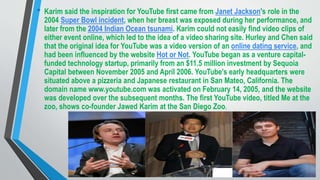
• Karim said the inspiration for YouTube first came from Janet Jackson's role in the
2004 Super Bowl incident, when her breast was exposed during her performance, and
later from the 2004 Indian Ocean tsunami. Karim could not easily find video clips of
either event online, which led to the idea of a video sharing site. Hurley and Chen said
that the original idea for YouTube was a video version of an online dating service, and
had been influenced by the website Hot or Not. YouTube began as a venture capital-
funded technology startup, primarily from an $11.5 million investment by Sequoia
Capital between November 2005 and April 2006. YouTube's early headquarters were
situated above a pizzeria and Japanese restaurant in San Mateo, California. The
domain name www.youtube.com was activated on February 14, 2005, and the website
was developed over the subsequent months. The first YouTube video, titled Me at the
zoo, shows co-founder Jawed Karim at the San Diego Zoo.
• All YouTube users can upload videos up to 15 minutes each in duration. Users who
have a good track record of complying with the site's Community Guidelines may
be offered the ability to upload videos up to 12 hours in length, as well as live
streams, which requires verifying the account, normally through a mobile phone .
When YouTube was launched in 2005, it was possible to upload longer videos, but
a ten-minute limit was introduced in March 2006 after YouTube found that the
majority of videos exceeding this length were unauthorized uploads of television
shows and films. The 10-minute limit was increased to 15 minutes in July 2010.In
the past, it was possible to upload videos longer than 12 hours. Videos can be at
most 128 GB in size. Video captions are made using speech recognition technology
when uploaded. Such captioning is usually not perfectly accurate, so YouTube
provides several options for manually entering the captions for greater accuracy.
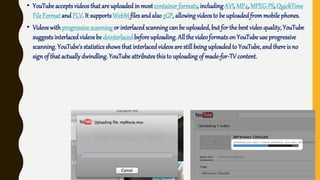
• YouTube accepts videos that are uploaded in most container formats, including AVI, MP4, MPEG-PS, QuickTime
File Format and FLV. It supports WebMfiles andalso 3GP, allowingvideosto be uploadedfrom mobile phones.
• Videoswithprogressive scanning or interlacedscanningcan be uploaded, but for the best videoquality, YouTube
suggests interlaced videos be deinterlacedbefore uploading. All the videoformats on YouTube useprogressive
scanning. YouTube's statistics shows that interlacedvideos are still being uploadedto YouTube, andthere is no
signof that actuallydwindling. YouTube attributes this to uploadingof made-for-TVcontent.
Qualityandformats
• YouTube originally offered videos at only one quality level, displayed at a resolution of 320×240 pixels using the Sorenson
Spark codec (a variant of H.263), with mono MP3 audio. In June 2007, YouTube added an option to watch videos in 3GP format
on mobile phones. In March 2008, a high-quality mode was added, which increased the resolution to 480×360 pixels. In November
2008, 720p HD support was added. At the time of the 720p launch, the YouTube player was changed from a 4:3 aspect ratio to
a widescreen 16:9. With this new feature, YouTube began a switchover to H.264/MPEG-4 AVC as its default video compression
format. In November 2009, 1080p HD support was added. In July 2010, YouTube announced that it had launched a range of
videos in 4K format, which allows a resolution of up to 4096×3072 pixels. In June 2015, support for 8K resolution was added, with
the videos playing at 7680×4320 pixels. In November 2016, support for HDR video was added which can be encoded with Hybrid
Log-Gamma(HLG) or Perceptual Quantizer (PQ). HDR video can be encoded with the Rec. 2020 color space.
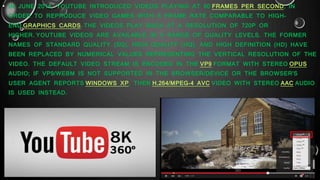
• IN JUNE 2014, YOUTUBE INTRODUCED VIDEOS PLAYING AT 60 FRAMES PER SECOND, IN
ORDER TO REPRODUCE VIDEO GAMES WITH A FRAME RATE COMPARABLE TO HIGH-
END GRAPHICS CARDS. THE VIDEOS PLAY BACK AT A RESOLUTION OF 720P OR
HIGHER. YOUTUBE VIDEOS ARE AVAILABLE IN A RANGE OF QUALITY LEVELS. THE FORMER
NAMES OF STANDARD QUALITY (SQ), HIGH QUALITY (HQ), AND HIGH DEFINITION (HD) HAVE
BEEN REPLACED BY NUMERICAL VALUES REPRESENTING THE VERTICAL RESOLUTION OF THE
VIDEO. THE DEFAULT VIDEO STREAM IS ENCODED IN THE VP9 FORMAT WITH STEREO OPUS
AUDIO; IF VP9/WEBM IS NOT SUPPORTED IN THE BROWSER/DEVICE OR THE BROWSER'S
USER AGENT REPORTS WINDOWS XP, THEN H.264/MPEG-4 AVC VIDEO WITH STEREO AAC AUDIO
IS USED INSTEAD.
YouTube offers users the ability to view its videos on web
pages outside their website. Each YouTube video is
accompanied by a piece of HTML that can be used to
embed it on any page on the Web. This functionality is
often used to embed YouTube videos in social networking
pages and blogs. Users wishing to post a video discussing,
inspired by or related to another user's video are able to
make a "video response". On August 27, 2013, YouTube
announced that it would remove video responses for being
an underused feature. Embedding, rating, commenting
and response posting can be disabled by the video owner.
In February 2009, YouTube announced a test service, allowing some partners to offer video
downloads for free or for a fee paid through Google Checkout.In June 2012, Google sent cease and
desist letters threatening legal action against several websites offering online download and
conversion of YouTube videos. In response, Zamzar removed the ability to download YouTube
videos from its site.
YOUTUBE RED
– YouTube Red is YouTube's premium subscription service. It offers
advertising-free streaming, access to exclusive content, background and
offline video playback on mobile devices, and access to the Google Play
Music "All Access" service. YouTube Red was originally announced on
November 12, 2014, as "Music Key", a subscription music streaming
service, and was intended to integrate with and replace the existing
Google Play Music "All Access" service. On October 28, 2015, the service
was re-launched as YouTube Red, offering ad-free streaming of all videos,
as well as access to exclusive original content. As of November 2016, the
service has 1.5 million subscribers, with a further million on a free-
trial basis. As of June 2017, the first season of YouTube Red Originals
had gotten 250 million views in total.
• In May 2014, before Music Key service was launched, the independent music trade organization Worldwide Independent
Network alleged that YouTube was using non-negotiable contracts with independent labels that were "undervalued" in
comparison to other streaming services, and that YouTube would block all music content from labels who do not reach a
deal to be included on the paid service. In a statement to the Financial Times in June 2014, Robert Kyncl confirmed that
YouTube would block the content of labels who do not negotiate deals to be included in the paid service "to ensure that all
content on the platform is governed by its new contractual terms." Stating that 90% of labels had reached deals, he went
on to say that "while we wish that we had [a] 100% success rate, we understand that is not likely an achievable goal and
therefore it is our responsibility to our users and the industry to launch the enhanced music experience."
 On February 28, 2017, in a press announcement held at YouTube Space Los Angeles,
YouTube announced the launch of YouTube TV, an over-the-top MVPD-style
subscription service that would be available for $35 per month. Initially launching in
five major U.S. markets (New York City, Los Angeles, Chicago, Philadelphia and San
Francisco) on April 5, 2017, the service offers live streams of programming from the
five major broadcast networks (ABC, CBS, The CW, Fox Broadcasting
Company and NBC), as well as approximately 40 cable channels owned by the
corporate parents of those networks, The Walt Disney Company, CBS
Corporation, 21st Century Fox, and NBCUniversal (including among
others Bravo, USA Network, Syfy, Disney Channel, E!, Fox Sports
1, Freeform, FX and ESPN). Subscribers can also receive Showtime and Fox Soccer
Plus as optional add-ons for an extra fee, and can access YouTube Red original
content (YouTube TV does not include a YouTube Red subscription).
• Google does not provide detailed figures for YouTube's running costs, and YouTube's revenues in 2007 were noted as "not material" in a
regulatory filing. In June 2008, a Forbes magazine article projected the 2008 revenue at $200 million, noting progress in advertising sales. In
January 2012, it was estimated that visitors to YouTube spent an average of 15 minutes a day on the site, in contrast to the four or five hours a day
spent by a typical US citizen watching television.In 2012, YouTube's revenue from its ads program was estimated at $3.7 billion. In 2013 it nearly
doubled and estimated to hit $5.6 billion according to eMarketer, others estimated 4.7 billion, The vast majority of videos on YouTube are free to
view and supported by advertising. In May 2013, YouTube introduced a trial scheme of 53 subscription channels with prices ranging from $0.99
to $6.99 a month . The move was seen as an attempt to compete with other providers of online subscription services such as Netflix and Hulu. In
2017, viewers watch YouTube on mobile devices for more than an hour every day.
Follow @Bhavesh Singh

Youtube - Broadcast Yourself

  • 2.
     COMPANY HISTORY UPLOADING QUALITY AND FORMATS  CONTENT ACCESSIBILITY  YOUTUBERED
  • 3.
     YouTube wasfounded by Chad Hurley, Steve Chen and Jawed Karim, who were all early employees of PayPal. Hurley had studied design at Indiana University of Pennsylvania, and Chen and Karim studied computer science together at the University of Illinois at Urbana-Champaign . According to a story that has often been repeated in the media, Hurley and Chen developed the idea for YouTube during the early months of 2005, after they had experienced difficulty sharing videos that had been shot at a dinner party at Chen's apartment in San Francisco. Karim did not attend the party and denied that it had occurred, but Chen commented that the idea that YouTube was founded after a dinner party "was probably very strengthened by marketing ideas around creating a story that was very digestible".
  • 4.
    • Karim saidthe inspiration for YouTube first came from Janet Jackson's role in the 2004 Super Bowl incident, when her breast was exposed during her performance, and later from the 2004 Indian Ocean tsunami. Karim could not easily find video clips of either event online, which led to the idea of a video sharing site. Hurley and Chen said that the original idea for YouTube was a video version of an online dating service, and had been influenced by the website Hot or Not. YouTube began as a venture capital- funded technology startup, primarily from an $11.5 million investment by Sequoia Capital between November 2005 and April 2006. YouTube's early headquarters were situated above a pizzeria and Japanese restaurant in San Mateo, California. The domain name www.youtube.com was activated on February 14, 2005, and the website was developed over the subsequent months. The first YouTube video, titled Me at the zoo, shows co-founder Jawed Karim at the San Diego Zoo.
  • 5.
    • All YouTubeusers can upload videos up to 15 minutes each in duration. Users who have a good track record of complying with the site's Community Guidelines may be offered the ability to upload videos up to 12 hours in length, as well as live streams, which requires verifying the account, normally through a mobile phone . When YouTube was launched in 2005, it was possible to upload longer videos, but a ten-minute limit was introduced in March 2006 after YouTube found that the majority of videos exceeding this length were unauthorized uploads of television shows and films. The 10-minute limit was increased to 15 minutes in July 2010.In the past, it was possible to upload videos longer than 12 hours. Videos can be at most 128 GB in size. Video captions are made using speech recognition technology when uploaded. Such captioning is usually not perfectly accurate, so YouTube provides several options for manually entering the captions for greater accuracy.
  • 6.
    • YouTube acceptsvideos that are uploaded in most container formats, including AVI, MP4, MPEG-PS, QuickTime File Format and FLV. It supports WebMfiles andalso 3GP, allowingvideosto be uploadedfrom mobile phones. • Videoswithprogressive scanning or interlacedscanningcan be uploaded, but for the best videoquality, YouTube suggests interlaced videos be deinterlacedbefore uploading. All the videoformats on YouTube useprogressive scanning. YouTube's statistics shows that interlacedvideos are still being uploadedto YouTube, andthere is no signof that actuallydwindling. YouTube attributes this to uploadingof made-for-TVcontent.
  • 7.
    Qualityandformats • YouTube originallyoffered videos at only one quality level, displayed at a resolution of 320×240 pixels using the Sorenson Spark codec (a variant of H.263), with mono MP3 audio. In June 2007, YouTube added an option to watch videos in 3GP format on mobile phones. In March 2008, a high-quality mode was added, which increased the resolution to 480×360 pixels. In November 2008, 720p HD support was added. At the time of the 720p launch, the YouTube player was changed from a 4:3 aspect ratio to a widescreen 16:9. With this new feature, YouTube began a switchover to H.264/MPEG-4 AVC as its default video compression format. In November 2009, 1080p HD support was added. In July 2010, YouTube announced that it had launched a range of videos in 4K format, which allows a resolution of up to 4096×3072 pixels. In June 2015, support for 8K resolution was added, with the videos playing at 7680×4320 pixels. In November 2016, support for HDR video was added which can be encoded with Hybrid Log-Gamma(HLG) or Perceptual Quantizer (PQ). HDR video can be encoded with the Rec. 2020 color space.
  • 8.
    • IN JUNE2014, YOUTUBE INTRODUCED VIDEOS PLAYING AT 60 FRAMES PER SECOND, IN ORDER TO REPRODUCE VIDEO GAMES WITH A FRAME RATE COMPARABLE TO HIGH- END GRAPHICS CARDS. THE VIDEOS PLAY BACK AT A RESOLUTION OF 720P OR HIGHER. YOUTUBE VIDEOS ARE AVAILABLE IN A RANGE OF QUALITY LEVELS. THE FORMER NAMES OF STANDARD QUALITY (SQ), HIGH QUALITY (HQ), AND HIGH DEFINITION (HD) HAVE BEEN REPLACED BY NUMERICAL VALUES REPRESENTING THE VERTICAL RESOLUTION OF THE VIDEO. THE DEFAULT VIDEO STREAM IS ENCODED IN THE VP9 FORMAT WITH STEREO OPUS AUDIO; IF VP9/WEBM IS NOT SUPPORTED IN THE BROWSER/DEVICE OR THE BROWSER'S USER AGENT REPORTS WINDOWS XP, THEN H.264/MPEG-4 AVC VIDEO WITH STEREO AAC AUDIO IS USED INSTEAD.
  • 9.
    YouTube offers usersthe ability to view its videos on web pages outside their website. Each YouTube video is accompanied by a piece of HTML that can be used to embed it on any page on the Web. This functionality is often used to embed YouTube videos in social networking pages and blogs. Users wishing to post a video discussing, inspired by or related to another user's video are able to make a "video response". On August 27, 2013, YouTube announced that it would remove video responses for being an underused feature. Embedding, rating, commenting and response posting can be disabled by the video owner.
  • 10.
    In February 2009,YouTube announced a test service, allowing some partners to offer video downloads for free or for a fee paid through Google Checkout.In June 2012, Google sent cease and desist letters threatening legal action against several websites offering online download and conversion of YouTube videos. In response, Zamzar removed the ability to download YouTube videos from its site.
  • 11.
    YOUTUBE RED – YouTubeRed is YouTube's premium subscription service. It offers advertising-free streaming, access to exclusive content, background and offline video playback on mobile devices, and access to the Google Play Music "All Access" service. YouTube Red was originally announced on November 12, 2014, as "Music Key", a subscription music streaming service, and was intended to integrate with and replace the existing Google Play Music "All Access" service. On October 28, 2015, the service was re-launched as YouTube Red, offering ad-free streaming of all videos, as well as access to exclusive original content. As of November 2016, the service has 1.5 million subscribers, with a further million on a free- trial basis. As of June 2017, the first season of YouTube Red Originals had gotten 250 million views in total.
  • 12.
    • In May2014, before Music Key service was launched, the independent music trade organization Worldwide Independent Network alleged that YouTube was using non-negotiable contracts with independent labels that were "undervalued" in comparison to other streaming services, and that YouTube would block all music content from labels who do not reach a deal to be included on the paid service. In a statement to the Financial Times in June 2014, Robert Kyncl confirmed that YouTube would block the content of labels who do not negotiate deals to be included in the paid service "to ensure that all content on the platform is governed by its new contractual terms." Stating that 90% of labels had reached deals, he went on to say that "while we wish that we had [a] 100% success rate, we understand that is not likely an achievable goal and therefore it is our responsibility to our users and the industry to launch the enhanced music experience."
  • 13.
     On February28, 2017, in a press announcement held at YouTube Space Los Angeles, YouTube announced the launch of YouTube TV, an over-the-top MVPD-style subscription service that would be available for $35 per month. Initially launching in five major U.S. markets (New York City, Los Angeles, Chicago, Philadelphia and San Francisco) on April 5, 2017, the service offers live streams of programming from the five major broadcast networks (ABC, CBS, The CW, Fox Broadcasting Company and NBC), as well as approximately 40 cable channels owned by the corporate parents of those networks, The Walt Disney Company, CBS Corporation, 21st Century Fox, and NBCUniversal (including among others Bravo, USA Network, Syfy, Disney Channel, E!, Fox Sports 1, Freeform, FX and ESPN). Subscribers can also receive Showtime and Fox Soccer Plus as optional add-ons for an extra fee, and can access YouTube Red original content (YouTube TV does not include a YouTube Red subscription).
  • 14.
    • Google doesnot provide detailed figures for YouTube's running costs, and YouTube's revenues in 2007 were noted as "not material" in a regulatory filing. In June 2008, a Forbes magazine article projected the 2008 revenue at $200 million, noting progress in advertising sales. In January 2012, it was estimated that visitors to YouTube spent an average of 15 minutes a day on the site, in contrast to the four or five hours a day spent by a typical US citizen watching television.In 2012, YouTube's revenue from its ads program was estimated at $3.7 billion. In 2013 it nearly doubled and estimated to hit $5.6 billion according to eMarketer, others estimated 4.7 billion, The vast majority of videos on YouTube are free to view and supported by advertising. In May 2013, YouTube introduced a trial scheme of 53 subscription channels with prices ranging from $0.99 to $6.99 a month . The move was seen as an attempt to compete with other providers of online subscription services such as Netflix and Hulu. In 2017, viewers watch YouTube on mobile devices for more than an hour every day.
  • 15.