Custom Report Package
Arvind Kumar December 21, 2016
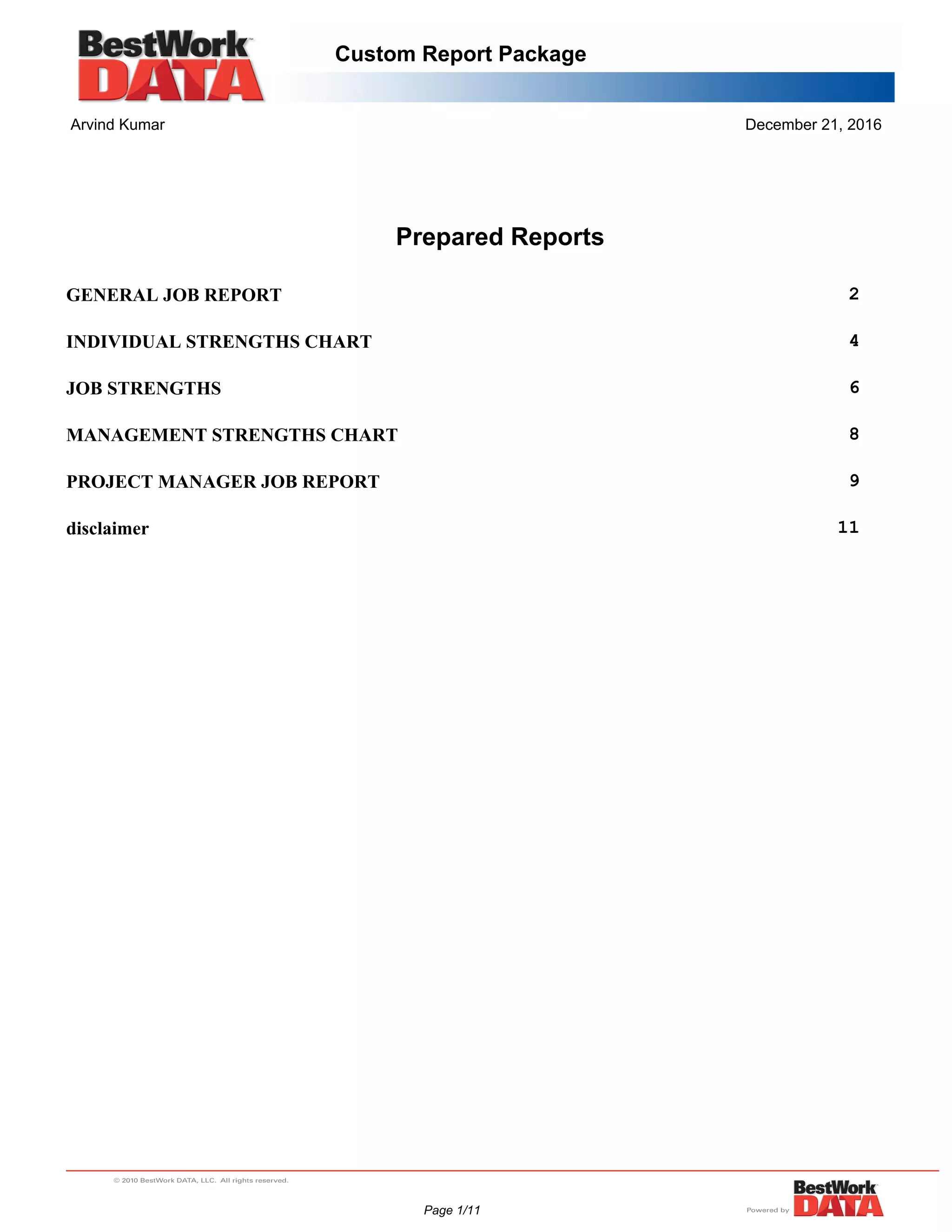
Prepared Reports
GENERAL JOB REPORT 2
INDIVIDUAL STRENGTHS CHART 4
JOB STRENGTHS 6
MANAGEMENT STRENGTHS CHART 8
PROJECT MANAGER JOB REPORT 9
disclaimer 11
Page 1/11
GENERAL JOB REPORT
Arvind Kumar December 21, 2016
About this report:
GENERAL JOB REPORT
The BestWork Assessment measures personality traits and cognitive abilities that tend to remain stable over time.
This report applies those measurements to specific job-related behaviors or capabilities and explains how this
candidate is most likely to perform those tasks. Areas of particular note are in BOLD type.
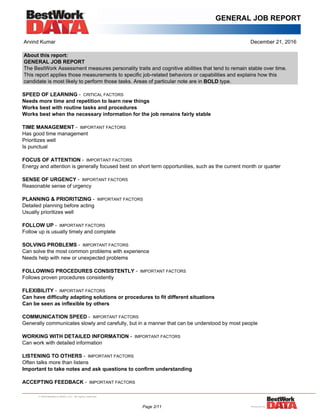
SPEED OF LEARNING - CRITICAL FACTORS
Needs more time and repetition to learn new things
Works best with routine tasks and procedures
Works best when the necessary information for the job remains fairly stable
TIME MANAGEMENT - IMPORTANT FACTORS
Has good time management
Prioritizes well
Is punctual
FOCUS OF ATTENTION - IMPORTANT FACTORS
Energy and attention is generally focused best on short term opportunities, such as the current month or quarter
SENSE OF URGENCY - IMPORTANT FACTORS
Reasonable sense of urgency
PLANNING & PRIORITIZING - IMPORTANT FACTORS
Detailed planning before acting
Usually prioritizes well
FOLLOW UP - IMPORTANT FACTORS
Follow up is usually timely and complete
SOLVING PROBLEMS - IMPORTANT FACTORS
Can solve the most common problems with experience
Needs help with new or unexpected problems
FOLLOWING PROCEDURES CONSISTENTLY - IMPORTANT FACTORS
Follows proven procedures consistently
FLEXIBILITY - IMPORTANT FACTORS
Can have difficulty adapting solutions or procedures to fit different situations
Can be seen as inflexible by others
COMMUNICATION SPEED - IMPORTANT FACTORS
Generally communicates slowly and carefully, but in a manner that can be understood by most people
WORKING WITH DETAILED INFORMATION - IMPORTANT FACTORS
Can work with detailed information
LISTENING TO OTHERS - IMPORTANT FACTORS
Often talks more than listens
Important to take notes and ask questions to confirm understanding
ACCEPTING FEEDBACK - IMPORTANT FACTORS
Page 2/11
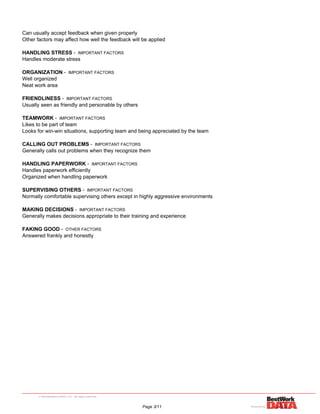
Can usually accept feedback when given properly
Other factors may affect how well the feedback will be applied
HANDLING STRESS - IMPORTANT FACTORS
Handles moderate stress
ORGANIZATION - IMPORTANT FACTORS
Well organized
Neat work area
FRIENDLINESS - IMPORTANT FACTORS
Usually seen as friendly and personable by others
TEAMWORK - IMPORTANT FACTORS
Likes to be part of team
Looks for win-win situations, supporting team and being appreciated by the team
CALLING OUT PROBLEMS - IMPORTANT FACTORS
Generally calls out problems when they recognize them
HANDLING PAPERWORK - IMPORTANT FACTORS
Handles paperwork efficiently
Organized when handling paperwork
SUPERVISING OTHERS - IMPORTANT FACTORS
Normally comfortable supervising others except in highly aggressive environments
MAKING DECISIONS - IMPORTANT FACTORS
Generally makes decisions appropriate to their training and experience
FAKING GOOD - OTHER FACTORS
Answered frankly and honestly
Page 3/11
INDIVIDUAL STRENGTHS CHART
Arvind Kumar December 21, 2016
About this report:
You have many talents. The value of these talents depends upon how they relate to the requirements for a specific
job. Tall is very good for basketball, but it can be a problem for a coal miner. Sometimes it is hard to see how well you
fit a job until you know more about it.
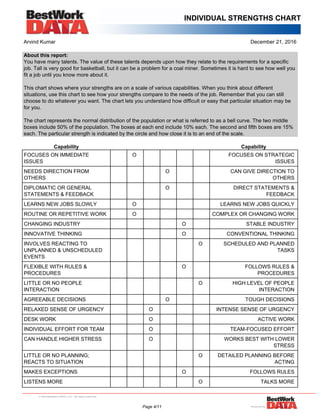
This chart shows where your strengths are on a scale of various capabilities. When you think about different
situations, use this chart to see how your strengths compare to the needs of the job. Remember that you can still
choose to do whatever you want. The chart lets you understand how difficult or easy that particular situation may be
for you.
The chart represents the normal distribution of the population or what is referred to as a bell curve. The two middle
boxes include 50% of the population. The boxes at each end include 10% each. The second and fifth boxes are 15%
each. The particular strength is indicated by the circle and how close it is to an end of the scale.
Capability Capability
FOCUSES ON IMMEDIATE
ISSUES
O FOCUSES ON STRATEGIC
ISSUES
NEEDS DIRECTION FROM
OTHERS
O CAN GIVE DIRECTION TO
OTHERS
DIPLOMATIC OR GENERAL
STATEMENTS & FEEDBACK
O DIRECT STATEMENTS &
FEEDBACK
LEARNS NEW JOBS SLOWLY O LEARNS NEW JOBS QUICKLY
ROUTINE OR REPETITIVE WORK O COMPLEX OR CHANGING WORK
CHANGING INDUSTRY O STABLE INDUSTRY
INNOVATIVE THINKING O CONVENTIONAL THINKING
INVOLVES REACTING TO
UNPLANNED & UNSCHEDULED
EVENTS
O SCHEDULED AND PLANNED
TASKS
FLEXIBLE WITH RULES &
PROCEDURES
O FOLLOWS RULES &
PROCEDURES
LITTLE OR NO PEOPLE
INTERACTION
O HIGH LEVEL OF PEOPLE
INTERACTION
AGREEABLE DECISIONS O TOUGH DECISIONS
RELAXED SENSE OF URGENCY O INTENSE SENSE OF URGENCY
DESK WORK O ACTIVE WORK
INDIVIDUAL EFFORT FOR TEAM O TEAM-FOCUSED EFFORT
CAN HANDLE HIGHER STRESS O WORKS BEST WITH LOWER
STRESS
LITTLE OR NO PLANNING;
REACTS TO SITUATION
O DETAILED PLANNING BEFORE
ACTING
MAKES EXCEPTIONS O FOLLOWS RULES
LISTENS MORE O TALKS MORE
Page 4/11
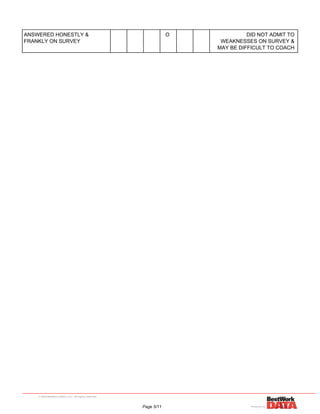
ANSWERED HONESTLY &
FRANKLY ON SURVEY
O DID NOT ADMIT TO
WEAKNESSES ON SURVEY &
MAY BE DIFFICULT TO COACH
Page 5/11
JOB STRENGTHS
Arvind Kumar December 21, 2016
About this report:
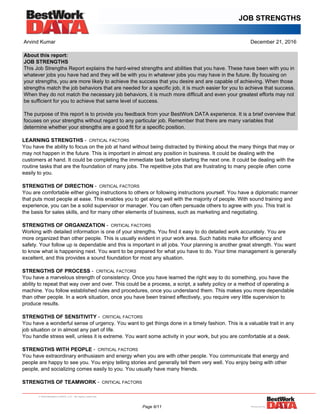
JOB STRENGTHS
This Job Strengths Report explains the hard-wired strengths and abilities that you have. These have been with you in
whatever jobs you have had and they will be with you in whatever jobs you may have in the future. By focusing on
your strengths, you are more likely to achieve the success that you desire and are capable of achieving. When those
strengths match the job behaviors that are needed for a specific job, it is much easier for you to achieve that success.
When they do not match the necessary job behaviors, it is much more difficult and even your greatest efforts may not
be sufficient for you to achieve that same level of success.
The purpose of this report is to provide you feedback from your BestWork DATA experience. It is a brief overview that
focuses on your strengths without regard to any particular job. Remember that there are many variables that
determine whether your strengths are a good fit for a specific position.
LEARNING STRENGTHS - CRITICAL FACTORS
You have the ability to focus on the job at hand without being distracted by thinking about the many things that may or
may not happen in the future. This is important in almost any position in business. It could be dealing with the
customers at hand. It could be completing the immediate task before starting the next one. It could be dealing with the
routine tasks that are the foundation of many jobs. The repetitive jobs that are frustrating to many people often come
easily to you.
STRENGTHS OF DIRECTION - CRITICAL FACTORS
You are comfortable either giving instructions to others or following instructions yourself. You have a diplomatic manner
that puts most people at ease. This enables you to get along well with the majority of people. With sound training and
experience, you can be a solid supervisor or manager. You can often persuade others to agree with you. This trait is
the basis for sales skills, and for many other elements of business, such as marketing and negotiating.
STRENGTHS OF ORGANIZATION - CRITICAL FACTORS
Working with detailed information is one of your strengths. You find it easy to do detailed work accurately. You are
more organized than other people. This is usually evident in your work area. Such habits make for efficiency and
safety. Your follow up is dependable and this is important in all jobs. Your planning is another great strength. You want
to know what is happening next. You want to be prepared for what you have to do. Your time management is generally
excellent, and this provides a sound foundation for most any situation.
STRENGTHS OF PROCESS - CRITICAL FACTORS
You have a marvelous strength of consistency. Once you have learned the right way to do something, you have the
ability to repeat that way over and over. This could be a process, a script, a safety policy or a method of operating a
machine. You follow established rules and procedures, once you understand them. This makes you more dependable
than other people. In a work situation, once you have been trained effectively, you require very little supervision to
produce results.
STRENGTHS OF SENSITIVITY - CRITICAL FACTORS
You have a wonderful sense of urgency. You want to get things done in a timely fashion. This is a valuable trait in any
job situation or in almost any part of life.
You handle stress well, unless it is extreme. You want some activity in your work, but you are comfortable at a desk.
STRENGTHS WITH PEOPLE - CRITICAL FACTORS
You have extraordinary enthusiasm and energy when you are with other people. You communicate that energy and
people are happy to see you. You enjoy telling stories and generally tell them very well. You enjoy being with other
people, and socializing comes easily to you. You usually have many friends.
STRENGTHS OF TEAMWORK - CRITICAL FACTORS
Page 6/11
You are a loyal team member. You want to contribute to the success of your team, and you want to be recognized for
what you do. You are easily motivated when that happens. You look for win-win situations in life. You want to succeed
and you want the people you know and work with to succeed also.
STRENGTH OF OPENNESS - CRITICAL FACTORS
You are somewhat comfortable with who you are, but you have difficulty admitting some of your faults. A frank and
open manner will serve you well in working closely with other people.
Page 7/11
MANAGEMENT STRENGTHS CHART
Arvind Kumar December 21, 2016
About this report:
MANAGEMENT STRENGTHS CHART
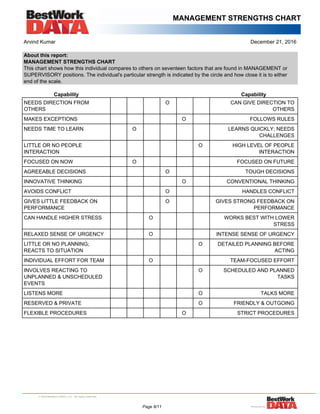
This chart shows how this individual compares to others on seventeen factors that are found in MANAGEMENT or
SUPERVISORY positions. The individual's particular strength is indicated by the circle and how close it is to either
end of the scale.
Capability Capability
NEEDS DIRECTION FROM
OTHERS
O CAN GIVE DIRECTION TO
OTHERS
MAKES EXCEPTIONS O FOLLOWS RULES
NEEDS TIME TO LEARN O LEARNS QUICKLY; NEEDS
CHALLENGES
LITTLE OR NO PEOPLE
INTERACTION
O HIGH LEVEL OF PEOPLE
INTERACTION
FOCUSED ON NOW O FOCUSED ON FUTURE
AGREEABLE DECISIONS O TOUGH DECISIONS
INNOVATIVE THINKING O CONVENTIONAL THINKING
AVOIDS CONFLICT O HANDLES CONFLICT
GIVES LITTLE FEEDBACK ON
PERFORMANCE
O GIVES STRONG FEEDBACK ON
PERFORMANCE
CAN HANDLE HIGHER STRESS O WORKS BEST WITH LOWER
STRESS
RELAXED SENSE OF URGENCY O INTENSE SENSE OF URGENCY
LITTLE OR NO PLANNING;
REACTS TO SITUATION
O DETAILED PLANNING BEFORE
ACTING
INDIVIDUAL EFFORT FOR TEAM O TEAM-FOCUSED EFFORT
INVOLVES REACTING TO
UNPLANNED & UNSCHEDULED
EVENTS
O SCHEDULED AND PLANNED
TASKS
LISTENS MORE O TALKS MORE
RESERVED & PRIVATE O FRIENDLY & OUTGOING
FLEXIBLE PROCEDURES O STRICT PROCEDURES
Page 8/11
PROJECT MANAGER JOB REPORT
Arvind Kumar December 21, 2016
About this report:
PROJECT MANAGER
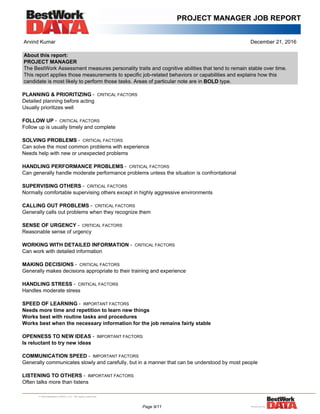
The BestWork Assessment measures personality traits and cognitive abilities that tend to remain stable over time.
This report applies those measurements to specific job-related behaviors or capabilities and explains how this
candidate is most likely to perform those tasks. Areas of particular note are in BOLD type.
PLANNING & PRIORITIZING - CRITICAL FACTORS
Detailed planning before acting
Usually prioritizes well
FOLLOW UP - CRITICAL FACTORS
Follow up is usually timely and complete
SOLVING PROBLEMS - CRITICAL FACTORS
Can solve the most common problems with experience
Needs help with new or unexpected problems
HANDLING PERFORMANCE PROBLEMS - CRITICAL FACTORS
Can generally handle moderate performance problems unless the situation is confrontational
SUPERVISING OTHERS - CRITICAL FACTORS
Normally comfortable supervising others except in highly aggressive environments
CALLING OUT PROBLEMS - CRITICAL FACTORS
Generally calls out problems when they recognize them
SENSE OF URGENCY - CRITICAL FACTORS
Reasonable sense of urgency
WORKING WITH DETAILED INFORMATION - CRITICAL FACTORS
Can work with detailed information
MAKING DECISIONS - CRITICAL FACTORS
Generally makes decisions appropriate to their training and experience
HANDLING STRESS - CRITICAL FACTORS
Handles moderate stress
SPEED OF LEARNING - IMPORTANT FACTORS
Needs more time and repetition to learn new things
Works best with routine tasks and procedures
Works best when the necessary information for the job remains fairly stable
OPENNESS TO NEW IDEAS - IMPORTANT FACTORS
Is reluctant to try new ideas
COMMUNICATION SPEED - IMPORTANT FACTORS
Generally communicates slowly and carefully, but in a manner that can be understood by most people
LISTENING TO OTHERS - IMPORTANT FACTORS
Often talks more than listens
Page 9/11
Important to take notes and ask questions to confirm understanding
HANDLING PAPERWORK - IMPORTANT FACTORS
Handles paperwork efficiently
Organized when handling paperwork
ORGANIZATION - IMPORTANT FACTORS
Well organized
Neat work area
FOLLOWING PROCEDURES CONSISTENTLY - IMPORTANT FACTORS
Follows proven procedures consistently
TEAMWORK - IMPORTANT FACTORS
Likes to be part of team
Looks for win-win situations, supporting team and being appreciated by the team
TIME MANAGEMENT - IMPORTANT FACTORS
Has good time management
Prioritizes well
Is punctual
FAKING GOOD - OTHER FACTORS
Answered frankly and honestly
Page 10/11
Statements made in this report are based upon the assumption that the participant in this assessment has had the
appropriate training and adequate experience necessary to perform these specific job elements. If you are a job
applicant, this assessment provides only one part of the information that may be used for making hiring or placement
decisions. This assessment is one of many tools that help employers match people with jobs that offer the best
opportunity for their success and that help them to manage them more effectively to achieve their full potential. The
proper use of the BestWork Assessment will help to ensure that you are treated fairly, without regard to race, religion,
sex, age, or national origin. The BestWork Assessment was designed and developed to conform to the human rights
legislation and best practices concerning the use of psychometric assessments. These include the EEOC Guidelines,
the Americans with Disabilities Act and the standards for test development and administration, published by the
American Psychological Association.
Powered by TCPDF (www.tcpdf.org)
Page 11/11

YOUR REPORTS-MR. ARVIND KUMAR (1)

  • 1.
    Custom Report Package ArvindKumar December 21, 2016 Prepared Reports GENERAL JOB REPORT 2 INDIVIDUAL STRENGTHS CHART 4 JOB STRENGTHS 6 MANAGEMENT STRENGTHS CHART 8 PROJECT MANAGER JOB REPORT 9 disclaimer 11 Page 1/11
  • 2.
    GENERAL JOB REPORT ArvindKumar December 21, 2016 About this report: GENERAL JOB REPORT The BestWork Assessment measures personality traits and cognitive abilities that tend to remain stable over time. This report applies those measurements to specific job-related behaviors or capabilities and explains how this candidate is most likely to perform those tasks. Areas of particular note are in BOLD type. SPEED OF LEARNING - CRITICAL FACTORS Needs more time and repetition to learn new things Works best with routine tasks and procedures Works best when the necessary information for the job remains fairly stable TIME MANAGEMENT - IMPORTANT FACTORS Has good time management Prioritizes well Is punctual FOCUS OF ATTENTION - IMPORTANT FACTORS Energy and attention is generally focused best on short term opportunities, such as the current month or quarter SENSE OF URGENCY - IMPORTANT FACTORS Reasonable sense of urgency PLANNING & PRIORITIZING - IMPORTANT FACTORS Detailed planning before acting Usually prioritizes well FOLLOW UP - IMPORTANT FACTORS Follow up is usually timely and complete SOLVING PROBLEMS - IMPORTANT FACTORS Can solve the most common problems with experience Needs help with new or unexpected problems FOLLOWING PROCEDURES CONSISTENTLY - IMPORTANT FACTORS Follows proven procedures consistently FLEXIBILITY - IMPORTANT FACTORS Can have difficulty adapting solutions or procedures to fit different situations Can be seen as inflexible by others COMMUNICATION SPEED - IMPORTANT FACTORS Generally communicates slowly and carefully, but in a manner that can be understood by most people WORKING WITH DETAILED INFORMATION - IMPORTANT FACTORS Can work with detailed information LISTENING TO OTHERS - IMPORTANT FACTORS Often talks more than listens Important to take notes and ask questions to confirm understanding ACCEPTING FEEDBACK - IMPORTANT FACTORS Page 2/11
  • 3.
    Can usually acceptfeedback when given properly Other factors may affect how well the feedback will be applied HANDLING STRESS - IMPORTANT FACTORS Handles moderate stress ORGANIZATION - IMPORTANT FACTORS Well organized Neat work area FRIENDLINESS - IMPORTANT FACTORS Usually seen as friendly and personable by others TEAMWORK - IMPORTANT FACTORS Likes to be part of team Looks for win-win situations, supporting team and being appreciated by the team CALLING OUT PROBLEMS - IMPORTANT FACTORS Generally calls out problems when they recognize them HANDLING PAPERWORK - IMPORTANT FACTORS Handles paperwork efficiently Organized when handling paperwork SUPERVISING OTHERS - IMPORTANT FACTORS Normally comfortable supervising others except in highly aggressive environments MAKING DECISIONS - IMPORTANT FACTORS Generally makes decisions appropriate to their training and experience FAKING GOOD - OTHER FACTORS Answered frankly and honestly Page 3/11
  • 4.
    INDIVIDUAL STRENGTHS CHART ArvindKumar December 21, 2016 About this report: You have many talents. The value of these talents depends upon how they relate to the requirements for a specific job. Tall is very good for basketball, but it can be a problem for a coal miner. Sometimes it is hard to see how well you fit a job until you know more about it. This chart shows where your strengths are on a scale of various capabilities. When you think about different situations, use this chart to see how your strengths compare to the needs of the job. Remember that you can still choose to do whatever you want. The chart lets you understand how difficult or easy that particular situation may be for you. The chart represents the normal distribution of the population or what is referred to as a bell curve. The two middle boxes include 50% of the population. The boxes at each end include 10% each. The second and fifth boxes are 15% each. The particular strength is indicated by the circle and how close it is to an end of the scale. Capability Capability FOCUSES ON IMMEDIATE ISSUES O FOCUSES ON STRATEGIC ISSUES NEEDS DIRECTION FROM OTHERS O CAN GIVE DIRECTION TO OTHERS DIPLOMATIC OR GENERAL STATEMENTS & FEEDBACK O DIRECT STATEMENTS & FEEDBACK LEARNS NEW JOBS SLOWLY O LEARNS NEW JOBS QUICKLY ROUTINE OR REPETITIVE WORK O COMPLEX OR CHANGING WORK CHANGING INDUSTRY O STABLE INDUSTRY INNOVATIVE THINKING O CONVENTIONAL THINKING INVOLVES REACTING TO UNPLANNED & UNSCHEDULED EVENTS O SCHEDULED AND PLANNED TASKS FLEXIBLE WITH RULES & PROCEDURES O FOLLOWS RULES & PROCEDURES LITTLE OR NO PEOPLE INTERACTION O HIGH LEVEL OF PEOPLE INTERACTION AGREEABLE DECISIONS O TOUGH DECISIONS RELAXED SENSE OF URGENCY O INTENSE SENSE OF URGENCY DESK WORK O ACTIVE WORK INDIVIDUAL EFFORT FOR TEAM O TEAM-FOCUSED EFFORT CAN HANDLE HIGHER STRESS O WORKS BEST WITH LOWER STRESS LITTLE OR NO PLANNING; REACTS TO SITUATION O DETAILED PLANNING BEFORE ACTING MAKES EXCEPTIONS O FOLLOWS RULES LISTENS MORE O TALKS MORE Page 4/11
  • 5.
    ANSWERED HONESTLY & FRANKLYON SURVEY O DID NOT ADMIT TO WEAKNESSES ON SURVEY & MAY BE DIFFICULT TO COACH Page 5/11
  • 6.
    JOB STRENGTHS Arvind KumarDecember 21, 2016 About this report: JOB STRENGTHS This Job Strengths Report explains the hard-wired strengths and abilities that you have. These have been with you in whatever jobs you have had and they will be with you in whatever jobs you may have in the future. By focusing on your strengths, you are more likely to achieve the success that you desire and are capable of achieving. When those strengths match the job behaviors that are needed for a specific job, it is much easier for you to achieve that success. When they do not match the necessary job behaviors, it is much more difficult and even your greatest efforts may not be sufficient for you to achieve that same level of success. The purpose of this report is to provide you feedback from your BestWork DATA experience. It is a brief overview that focuses on your strengths without regard to any particular job. Remember that there are many variables that determine whether your strengths are a good fit for a specific position. LEARNING STRENGTHS - CRITICAL FACTORS You have the ability to focus on the job at hand without being distracted by thinking about the many things that may or may not happen in the future. This is important in almost any position in business. It could be dealing with the customers at hand. It could be completing the immediate task before starting the next one. It could be dealing with the routine tasks that are the foundation of many jobs. The repetitive jobs that are frustrating to many people often come easily to you. STRENGTHS OF DIRECTION - CRITICAL FACTORS You are comfortable either giving instructions to others or following instructions yourself. You have a diplomatic manner that puts most people at ease. This enables you to get along well with the majority of people. With sound training and experience, you can be a solid supervisor or manager. You can often persuade others to agree with you. This trait is the basis for sales skills, and for many other elements of business, such as marketing and negotiating. STRENGTHS OF ORGANIZATION - CRITICAL FACTORS Working with detailed information is one of your strengths. You find it easy to do detailed work accurately. You are more organized than other people. This is usually evident in your work area. Such habits make for efficiency and safety. Your follow up is dependable and this is important in all jobs. Your planning is another great strength. You want to know what is happening next. You want to be prepared for what you have to do. Your time management is generally excellent, and this provides a sound foundation for most any situation. STRENGTHS OF PROCESS - CRITICAL FACTORS You have a marvelous strength of consistency. Once you have learned the right way to do something, you have the ability to repeat that way over and over. This could be a process, a script, a safety policy or a method of operating a machine. You follow established rules and procedures, once you understand them. This makes you more dependable than other people. In a work situation, once you have been trained effectively, you require very little supervision to produce results. STRENGTHS OF SENSITIVITY - CRITICAL FACTORS You have a wonderful sense of urgency. You want to get things done in a timely fashion. This is a valuable trait in any job situation or in almost any part of life. You handle stress well, unless it is extreme. You want some activity in your work, but you are comfortable at a desk. STRENGTHS WITH PEOPLE - CRITICAL FACTORS You have extraordinary enthusiasm and energy when you are with other people. You communicate that energy and people are happy to see you. You enjoy telling stories and generally tell them very well. You enjoy being with other people, and socializing comes easily to you. You usually have many friends. STRENGTHS OF TEAMWORK - CRITICAL FACTORS Page 6/11
  • 7.
    You are aloyal team member. You want to contribute to the success of your team, and you want to be recognized for what you do. You are easily motivated when that happens. You look for win-win situations in life. You want to succeed and you want the people you know and work with to succeed also. STRENGTH OF OPENNESS - CRITICAL FACTORS You are somewhat comfortable with who you are, but you have difficulty admitting some of your faults. A frank and open manner will serve you well in working closely with other people. Page 7/11
  • 8.
    MANAGEMENT STRENGTHS CHART ArvindKumar December 21, 2016 About this report: MANAGEMENT STRENGTHS CHART This chart shows how this individual compares to others on seventeen factors that are found in MANAGEMENT or SUPERVISORY positions. The individual's particular strength is indicated by the circle and how close it is to either end of the scale. Capability Capability NEEDS DIRECTION FROM OTHERS O CAN GIVE DIRECTION TO OTHERS MAKES EXCEPTIONS O FOLLOWS RULES NEEDS TIME TO LEARN O LEARNS QUICKLY; NEEDS CHALLENGES LITTLE OR NO PEOPLE INTERACTION O HIGH LEVEL OF PEOPLE INTERACTION FOCUSED ON NOW O FOCUSED ON FUTURE AGREEABLE DECISIONS O TOUGH DECISIONS INNOVATIVE THINKING O CONVENTIONAL THINKING AVOIDS CONFLICT O HANDLES CONFLICT GIVES LITTLE FEEDBACK ON PERFORMANCE O GIVES STRONG FEEDBACK ON PERFORMANCE CAN HANDLE HIGHER STRESS O WORKS BEST WITH LOWER STRESS RELAXED SENSE OF URGENCY O INTENSE SENSE OF URGENCY LITTLE OR NO PLANNING; REACTS TO SITUATION O DETAILED PLANNING BEFORE ACTING INDIVIDUAL EFFORT FOR TEAM O TEAM-FOCUSED EFFORT INVOLVES REACTING TO UNPLANNED & UNSCHEDULED EVENTS O SCHEDULED AND PLANNED TASKS LISTENS MORE O TALKS MORE RESERVED & PRIVATE O FRIENDLY & OUTGOING FLEXIBLE PROCEDURES O STRICT PROCEDURES Page 8/11
  • 9.
    PROJECT MANAGER JOBREPORT Arvind Kumar December 21, 2016 About this report: PROJECT MANAGER The BestWork Assessment measures personality traits and cognitive abilities that tend to remain stable over time. This report applies those measurements to specific job-related behaviors or capabilities and explains how this candidate is most likely to perform those tasks. Areas of particular note are in BOLD type. PLANNING & PRIORITIZING - CRITICAL FACTORS Detailed planning before acting Usually prioritizes well FOLLOW UP - CRITICAL FACTORS Follow up is usually timely and complete SOLVING PROBLEMS - CRITICAL FACTORS Can solve the most common problems with experience Needs help with new or unexpected problems HANDLING PERFORMANCE PROBLEMS - CRITICAL FACTORS Can generally handle moderate performance problems unless the situation is confrontational SUPERVISING OTHERS - CRITICAL FACTORS Normally comfortable supervising others except in highly aggressive environments CALLING OUT PROBLEMS - CRITICAL FACTORS Generally calls out problems when they recognize them SENSE OF URGENCY - CRITICAL FACTORS Reasonable sense of urgency WORKING WITH DETAILED INFORMATION - CRITICAL FACTORS Can work with detailed information MAKING DECISIONS - CRITICAL FACTORS Generally makes decisions appropriate to their training and experience HANDLING STRESS - CRITICAL FACTORS Handles moderate stress SPEED OF LEARNING - IMPORTANT FACTORS Needs more time and repetition to learn new things Works best with routine tasks and procedures Works best when the necessary information for the job remains fairly stable OPENNESS TO NEW IDEAS - IMPORTANT FACTORS Is reluctant to try new ideas COMMUNICATION SPEED - IMPORTANT FACTORS Generally communicates slowly and carefully, but in a manner that can be understood by most people LISTENING TO OTHERS - IMPORTANT FACTORS Often talks more than listens Page 9/11
  • 10.
    Important to takenotes and ask questions to confirm understanding HANDLING PAPERWORK - IMPORTANT FACTORS Handles paperwork efficiently Organized when handling paperwork ORGANIZATION - IMPORTANT FACTORS Well organized Neat work area FOLLOWING PROCEDURES CONSISTENTLY - IMPORTANT FACTORS Follows proven procedures consistently TEAMWORK - IMPORTANT FACTORS Likes to be part of team Looks for win-win situations, supporting team and being appreciated by the team TIME MANAGEMENT - IMPORTANT FACTORS Has good time management Prioritizes well Is punctual FAKING GOOD - OTHER FACTORS Answered frankly and honestly Page 10/11
  • 11.
    Statements made inthis report are based upon the assumption that the participant in this assessment has had the appropriate training and adequate experience necessary to perform these specific job elements. If you are a job applicant, this assessment provides only one part of the information that may be used for making hiring or placement decisions. This assessment is one of many tools that help employers match people with jobs that offer the best opportunity for their success and that help them to manage them more effectively to achieve their full potential. The proper use of the BestWork Assessment will help to ensure that you are treated fairly, without regard to race, religion, sex, age, or national origin. The BestWork Assessment was designed and developed to conform to the human rights legislation and best practices concerning the use of psychometric assessments. These include the EEOC Guidelines, the Americans with Disabilities Act and the standards for test development and administration, published by the American Psychological Association. Powered by TCPDF (www.tcpdf.org) Page 11/11