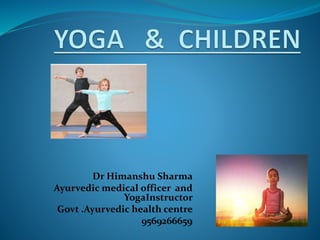
Dr Himanshu Sharma
Ayurvedic medical officer and
YogaInstructor
Govt .Ayurvedic health centre
9569266659
What is yoga?
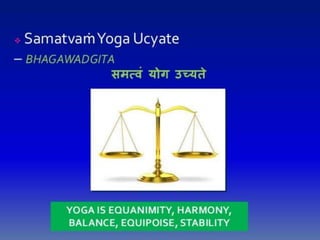
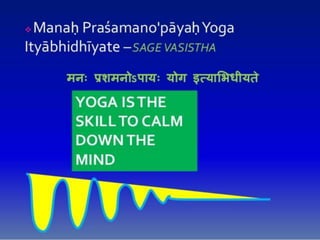
 Yoga is conscious process to gain mastery over mind.
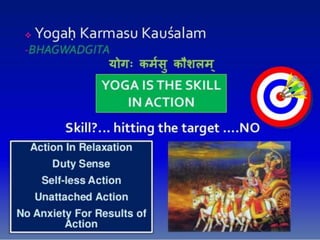
 Dexterity in every action with relaxation.
 Yoga means doing action with duty sense and give your
best to it with an attitude of detachment.
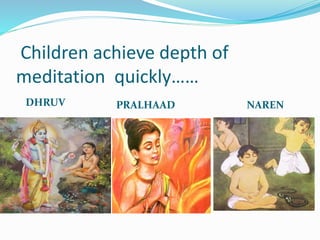
Children achieve depth of
meditation quickly……
DHRUV PRALHAAD NAREN
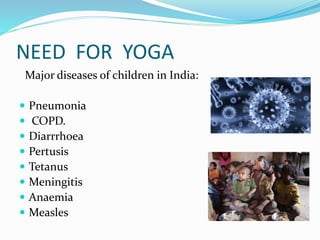
NEED FOR YOGA
Major diseases of children in India:
 Pneumonia
 COPD.
 Diarrrhoea
 Pertusis
 Tetanus
 Meningitis
 Anaemia
 Measles
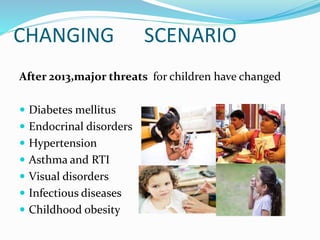
CHANGING SCENARIO
After 2013,major threats for children have changed
 Diabetes mellitus
 Endocrinal disorders
 Hypertension
 Asthma and RTI
 Visual disorders
 Infectious diseases
 Childhood obesity
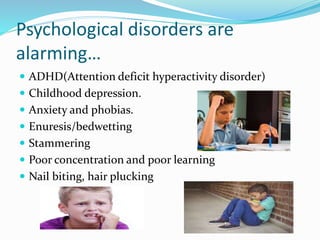
Psychological disorders are
alarming…
 ADHD(Attention deficit hyperactivity disorder)
 Childhood depression.
 Anxiety and phobias.
 Enuresis/bedwetting
 Stammering
 Poor concentration and poor learning
 Nail biting, hair plucking
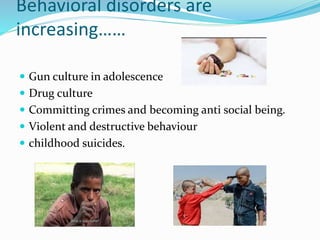
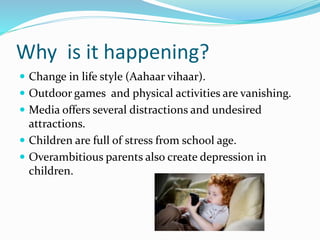
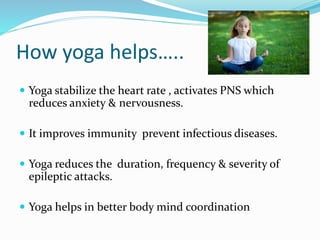
Behavioral disorders are
increasing……
 Gun culture in adolescence
 Drug culture
 Committing crimes and becoming anti social being.
 Violent and destructive behaviour
 childhood suicides.
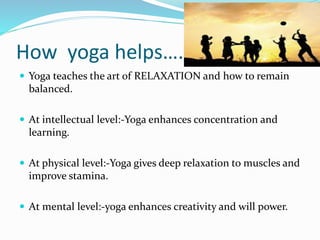
Why is it happening?
 Change in life style (Aahaar vihaar).
 Outdoor games and physical activities are vanishing.
 Media offers several distractions and undesired
attractions.
 Children are full of stress from school age.
 Overambitious parents also create depression in
children.
…
How yoga helps…..
 Yoga stabilize the heart rate , activates PNS which
reduces anxiety & nervousness.
 It improves immunity prevent infectious diseases.
 Yoga reduces the duration, frequency & severity of
epileptic attacks.
 Yoga helps in better body mind coordination
How yoga helps….
 Yoga teaches the art of RELAXATION and how to remain
balanced.
 At intellectual level:-Yoga enhances concentration and
learning.
 At physical level:-Yoga gives deep relaxation to muscles and
improve stamina.
 At mental level:-yoga enhances creativity and will power.
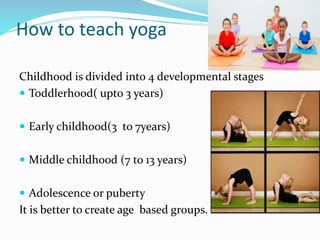
How to teach yoga
Childhood is divided into 4 developmental stages
 Toddlerhood( upto 3 years)
 Early childhood(3 to 7years)
 Middle childhood (7 to 13 years)
 Adolescence or puberty
It is better to create age based groups.
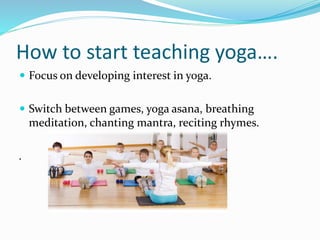
How to start teaching yoga….
 Focus on developing interest in yoga.
 Switch between games, yoga asana, breathing
meditation, chanting mantra, reciting rhymes.
.
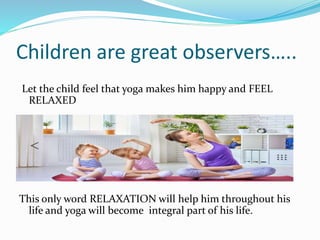
Children are great observers…..
Let the child feel that yoga makes him happy and FEEL
RELAXED
This only word RELAXATION will help him throughout his
life and yoga will become integral part of his life.
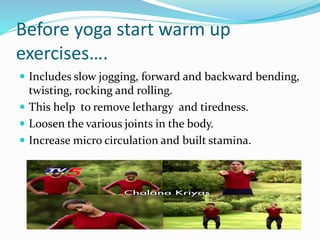
Before yoga start warm up
exercises….
 Includes slow jogging, forward and backward bending,
twisting, rocking and rolling.
 This help to remove lethargy and tiredness.
 Loosen the various joints in the body.
 Increase micro circulation and built stamina.
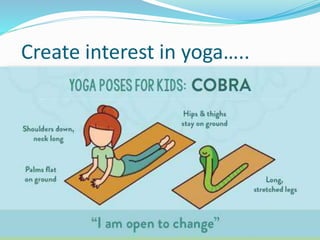
Create interest in yoga…..
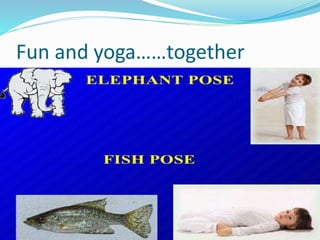
Fun and yoga……together
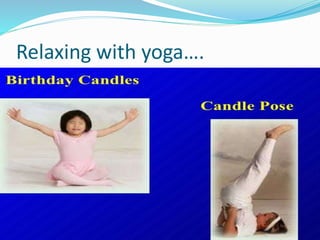
Relaxing with yoga….
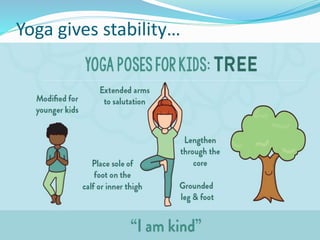
Yoga gives stability…
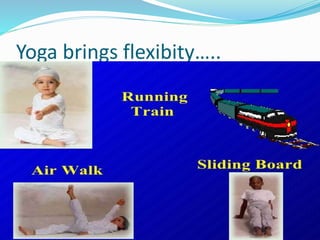
Yoga brings flexibity…..
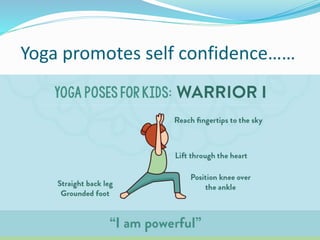
Yoga promotes self confidence……
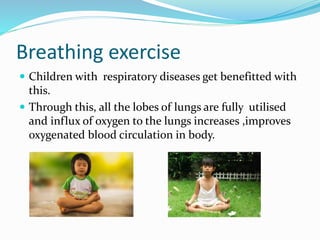
Breathing exercise
 Children with respiratory diseases get benefitted with
this.
 Through this, all the lobes of lungs are fully utilised
and influx of oxygen to the lungs increases ,improves
oxygenated blood circulation in body.
Precautions to be taken……..
1. There are chances of muscle sprain and injuries.
2. Children with epilepsy need to avoid few poses
that bring extra pressure to the head.
3. Child with asthma, bronchitis may need to avoid
certain breathing and yogic techniques
4. Advise child to stop if a pose is uncomfortable.
5. Advise child to stretch slowly and breathe deeply.
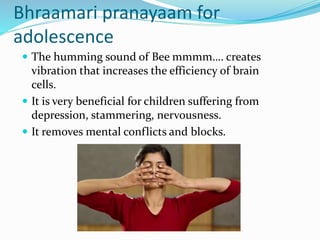
Bhraamari pranayaam for
adolescence
 The humming sound of Bee mmmm…. creates
vibration that increases the efficiency of brain
cells.
 It is very beneficial for children suffering from
depression, stammering, nervousness.
 It removes mental conflicts and blocks.
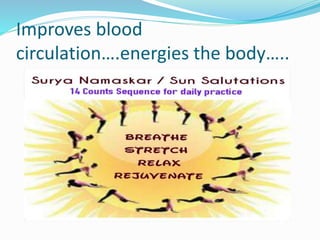
Improves blood
circulation….energies the body…..
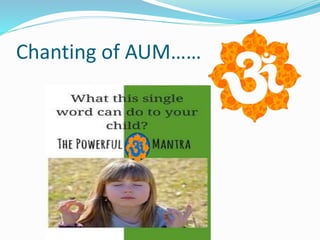
Chanting of AUM……
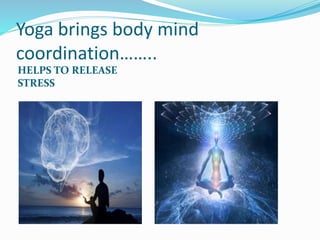
Yoga brings body mind
coordination……..
HELPS TO RELEASE
STRESS
Motivate children to read good
literature……
Karma yoga…..
conclusion
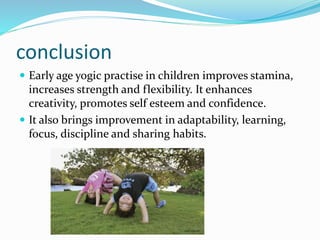
 Early age yogic practise in children improves stamina,
increases strength and flexibility. It enhances
creativity, promotes self esteem and confidence.
 It also brings improvement in adaptability, learning,
focus, discipline and sharing habits.
At the END…..
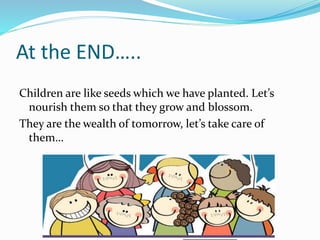
Children are like seeds which we have planted. Let’s
nourish them so that they grow and blossom.
They are the wealth of tomorrow, let’s take care of
them…
THANK YOU
My special THANKS to…
 Dr Gagandeep Sharma, M.D(Ayurveda).
JAI HIND..
JAI AYURVED….
Dr Himanshu Sharma
9569266659
drhimanshu.herbalcure@gmail.com

Yoga for children ppt

  • 1.
    Dr Himanshu Sharma Ayurvedicmedical officer and YogaInstructor Govt .Ayurvedic health centre 9569266659
  • 6.
    What is yoga? Yoga is conscious process to gain mastery over mind.  Dexterity in every action with relaxation.  Yoga means doing action with duty sense and give your best to it with an attitude of detachment.
  • 7.
    Children achieve depthof meditation quickly…… DHRUV PRALHAAD NAREN
  • 8.
    NEED FOR YOGA Majordiseases of children in India:  Pneumonia  COPD.  Diarrrhoea  Pertusis  Tetanus  Meningitis  Anaemia  Measles
  • 9.
    CHANGING SCENARIO After 2013,majorthreats for children have changed  Diabetes mellitus  Endocrinal disorders  Hypertension  Asthma and RTI  Visual disorders  Infectious diseases  Childhood obesity
  • 10.
    Psychological disorders are alarming… ADHD(Attention deficit hyperactivity disorder)  Childhood depression.  Anxiety and phobias.  Enuresis/bedwetting  Stammering  Poor concentration and poor learning  Nail biting, hair plucking
  • 11.
    Behavioral disorders are increasing…… Gun culture in adolescence  Drug culture  Committing crimes and becoming anti social being.  Violent and destructive behaviour  childhood suicides.
  • 12.
    Why is ithappening?  Change in life style (Aahaar vihaar).  Outdoor games and physical activities are vanishing.  Media offers several distractions and undesired attractions.  Children are full of stress from school age.  Overambitious parents also create depression in children.
  • 13.
  • 14.
    How yoga helps….. Yoga stabilize the heart rate , activates PNS which reduces anxiety & nervousness.  It improves immunity prevent infectious diseases.  Yoga reduces the duration, frequency & severity of epileptic attacks.  Yoga helps in better body mind coordination
  • 15.
    How yoga helps…. Yoga teaches the art of RELAXATION and how to remain balanced.  At intellectual level:-Yoga enhances concentration and learning.  At physical level:-Yoga gives deep relaxation to muscles and improve stamina.  At mental level:-yoga enhances creativity and will power.
  • 16.
    How to teachyoga Childhood is divided into 4 developmental stages  Toddlerhood( upto 3 years)  Early childhood(3 to 7years)  Middle childhood (7 to 13 years)  Adolescence or puberty It is better to create age based groups.
  • 17.
    How to startteaching yoga….  Focus on developing interest in yoga.  Switch between games, yoga asana, breathing meditation, chanting mantra, reciting rhymes. .
  • 18.
    Children are greatobservers….. Let the child feel that yoga makes him happy and FEEL RELAXED This only word RELAXATION will help him throughout his life and yoga will become integral part of his life.
  • 19.
    Before yoga startwarm up exercises….  Includes slow jogging, forward and backward bending, twisting, rocking and rolling.  This help to remove lethargy and tiredness.  Loosen the various joints in the body.  Increase micro circulation and built stamina.
  • 20.
  • 21.
  • 22.
  • 23.
  • 24.
  • 25.
    Yoga promotes selfconfidence……
  • 26.
    Breathing exercise  Childrenwith respiratory diseases get benefitted with this.  Through this, all the lobes of lungs are fully utilised and influx of oxygen to the lungs increases ,improves oxygenated blood circulation in body.
  • 27.
    Precautions to betaken…….. 1. There are chances of muscle sprain and injuries. 2. Children with epilepsy need to avoid few poses that bring extra pressure to the head. 3. Child with asthma, bronchitis may need to avoid certain breathing and yogic techniques 4. Advise child to stop if a pose is uncomfortable. 5. Advise child to stretch slowly and breathe deeply.
  • 28.
    Bhraamari pranayaam for adolescence The humming sound of Bee mmmm…. creates vibration that increases the efficiency of brain cells.  It is very beneficial for children suffering from depression, stammering, nervousness.  It removes mental conflicts and blocks.
  • 29.
  • 30.
  • 31.
    Yoga brings bodymind coordination…….. HELPS TO RELEASE STRESS
  • 32.
    Motivate children toread good literature…… Karma yoga…..
  • 33.
    conclusion  Early ageyogic practise in children improves stamina, increases strength and flexibility. It enhances creativity, promotes self esteem and confidence.  It also brings improvement in adaptability, learning, focus, discipline and sharing habits.
  • 34.
    At the END….. Childrenare like seeds which we have planted. Let’s nourish them so that they grow and blossom. They are the wealth of tomorrow, let’s take care of them…
  • 36.
    THANK YOU My specialTHANKS to…  Dr Gagandeep Sharma, M.D(Ayurveda). JAI HIND.. JAI AYURVED…. Dr Himanshu Sharma 9569266659 drhimanshu.herbalcure@gmail.com