How to Bake the Best
Yeast Breads
Baking bread is actually quite simple. It's just
a handful of basic ingredients. Still, it's an art
as well as an exacting science, requiring
attention to detail. The main point to keep in
mind is that the star of the show, yeast, is
actually a living organism. It requires a warm,
moist environment and a food source to grow
and thrive. Before you're a baker, you're kind
of a rancher, feeding and growing the yeast.
Step 1. Proof the Yeast
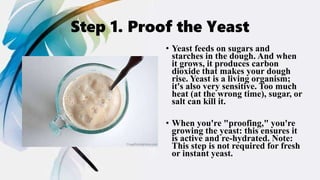
• Yeast feeds on sugars and
starches in the dough. And when
it grows, it produces carbon
dioxide that makes your dough
rise. Yeast is a living organism;
it's also very sensitive. Too much
heat (at the wrong time), sugar, or
salt can kill it.
• When you're "proofing," you're
growing the yeast: this ensures it
is active and re-hydrated. Note:
This step is not required for fresh
or instant yeast.
To proof yeast:
•Pour 1 cup of warm (110 degrees F) water
into a bowl.
•Add 2 teaspoons of sugar; stir to dissolve.
•Sprinkle a packet of yeast (2 ½ teaspoons)
on top.
•Let it sit for a few minutes, then stir until it
dissolves.
•Cover the bowl with plastic wrap and set it in a
warm, draft-free place (inside your turned-off
oven, for example).
•Within 5 to 10 minutes the top of the mixture
should have turned creamy and foamy, which
means the yeast is working. If nothing happens,
the yeast is dead; discard the mixture and try
again with different yeast.
Types of Yeast:
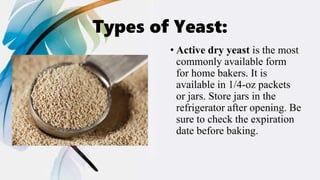
• Active dry yeast is the most
commonly available form
for home bakers. It is
available in 1/4-oz packets
or jars. Store jars in the
refrigerator after opening. Be
sure to check the expiration
date before baking.
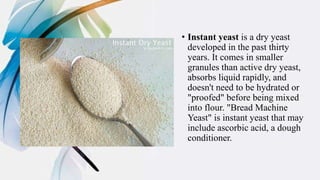
• Instant yeast is a dry yeast
developed in the past thirty
years. It comes in smaller
granules than active dry yeast,
absorbs liquid rapidly, and
doesn't need to be hydrated or
"proofed" before being mixed
into flour. "Bread Machine
Yeast" is instant yeast that may
include ascorbic acid, a dough
conditioner.
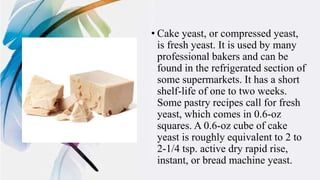
• Cake yeast, or compressed yeast,
is fresh yeast. It is used by many
professional bakers and can be
found in the refrigerated section of
some supermarkets. It has a short
shelf-life of one to two weeks.
Some pastry recipes call for fresh
yeast, which comes in 0.6-oz
squares. A 0.6-oz cube of cake
yeast is roughly equivalent to 2 to
2-1/4 tsp. active dry rapid rise,
instant, or bread machine yeast.
Step 2. Combine Ingredients
and Mix Well
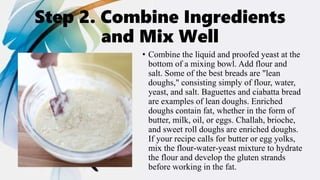
• Combine the liquid and proofed yeast at the
bottom of a mixing bowl. Add flour and
salt. Some of the best breads are "lean
doughs," consisting simply of flour, water,
yeast, and salt. Baguettes and ciabatta bread
are examples of lean doughs. Enriched
doughs contain fat, whether in the form of
butter, milk, oil, or eggs. Challah, brioche,
and sweet roll doughs are enriched doughs.
If your recipe calls for butter or egg yolks,
mix the flour-water-yeast mixture to hydrate
the flour and develop the gluten strands
before working in the fat.
Step 3. Knead the Dough until
Smooth and Soft
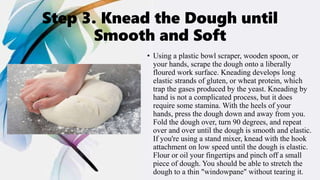
• Using a plastic bowl scraper, wooden spoon, or
your hands, scrape the dough onto a liberally
floured work surface. Kneading develops long
elastic strands of gluten, or wheat protein, which
trap the gases produced by the yeast. Kneading by
hand is not a complicated process, but it does
require some stamina. With the heels of your
hands, press the dough down and away from you.
Fold the dough over, turn 90 degrees, and repeat
over and over until the dough is smooth and elastic.
If you're using a stand mixer, knead with the hook
attachment on low speed until the dough is elastic.
Flour or oil your fingertips and pinch off a small
piece of dough. You should be able to stretch the
dough to a thin "windowpane" without tearing it.
Step 4. Let the Dough Rise
until Doubled
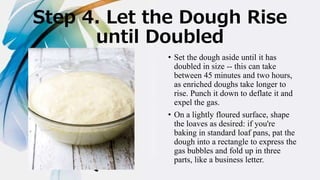
• Set the dough aside until it has
doubled in size -- this can take
between 45 minutes and two hours,
as enriched doughs take longer to
rise. Punch it down to deflate it and
expel the gas.
• On a lightly floured surface, shape
the loaves as desired: if you're
baking in standard loaf pans, pat the
dough into a rectangle to express the
gas bubbles and fold up in three
parts, like a business letter.
Step 5. Place Bread in a
Greased Loaf Pan
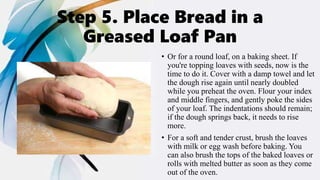
• Or for a round loaf, on a baking sheet. If
you're topping loaves with seeds, now is the
time to do it. Cover with a damp towel and let
the dough rise again until nearly doubled
while you preheat the oven. Flour your index
and middle fingers, and gently poke the sides
of your loaf. The indentations should remain;
if the dough springs back, it needs to rise
more.
• For a soft and tender crust, brush the loaves
with milk or egg wash before baking. You
can also brush the tops of the baked loaves or
rolls with melted butter as soon as they come
out of the oven.
Step 6. Bake the Bread
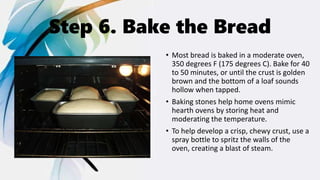
• Most bread is baked in a moderate oven,
350 degrees F (175 degrees C). Bake for 40
to 50 minutes, or until the crust is golden
brown and the bottom of a loaf sounds
hollow when tapped.
• Baking stones help home ovens mimic
hearth ovens by storing heat and
moderating the temperature.
• To help develop a crisp, chewy crust, use a
spray bottle to spritz the walls of the
oven, creating a blast of steam.
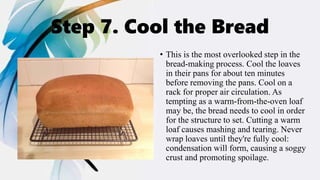
Step 7. Cool the Bread
• This is the most overlooked step in the
bread-making process. Cool the loaves
in their pans for about ten minutes
before removing the pans. Cool on a
rack for proper air circulation. As
tempting as a warm-from-the-oven loaf
may be, the bread needs to cool in order
for the structure to set. Cutting a warm
loaf causes mashing and tearing. Never
wrap loaves until they're fully cool:
condensation will form, causing a soggy
crust and promoting spoilage.
THANK YOU :)
Prepared by :
John Denver C. Begino

How to bake the best yeast breads

  • 1.
    How to Bakethe Best Yeast Breads
  • 2.
    Baking bread isactually quite simple. It's just a handful of basic ingredients. Still, it's an art as well as an exacting science, requiring attention to detail. The main point to keep in mind is that the star of the show, yeast, is actually a living organism. It requires a warm, moist environment and a food source to grow and thrive. Before you're a baker, you're kind of a rancher, feeding and growing the yeast.
  • 3.
    Step 1. Proofthe Yeast • Yeast feeds on sugars and starches in the dough. And when it grows, it produces carbon dioxide that makes your dough rise. Yeast is a living organism; it's also very sensitive. Too much heat (at the wrong time), sugar, or salt can kill it. • When you're "proofing," you're growing the yeast: this ensures it is active and re-hydrated. Note: This step is not required for fresh or instant yeast.
  • 4.
    To proof yeast: •Pour1 cup of warm (110 degrees F) water into a bowl. •Add 2 teaspoons of sugar; stir to dissolve. •Sprinkle a packet of yeast (2 ½ teaspoons) on top. •Let it sit for a few minutes, then stir until it dissolves.
  • 5.
    •Cover the bowlwith plastic wrap and set it in a warm, draft-free place (inside your turned-off oven, for example). •Within 5 to 10 minutes the top of the mixture should have turned creamy and foamy, which means the yeast is working. If nothing happens, the yeast is dead; discard the mixture and try again with different yeast.
  • 6.
    Types of Yeast: •Active dry yeast is the most commonly available form for home bakers. It is available in 1/4-oz packets or jars. Store jars in the refrigerator after opening. Be sure to check the expiration date before baking.
  • 7.
    • Instant yeastis a dry yeast developed in the past thirty years. It comes in smaller granules than active dry yeast, absorbs liquid rapidly, and doesn't need to be hydrated or "proofed" before being mixed into flour. "Bread Machine Yeast" is instant yeast that may include ascorbic acid, a dough conditioner.
  • 8.
    • Cake yeast,or compressed yeast, is fresh yeast. It is used by many professional bakers and can be found in the refrigerated section of some supermarkets. It has a short shelf-life of one to two weeks. Some pastry recipes call for fresh yeast, which comes in 0.6-oz squares. A 0.6-oz cube of cake yeast is roughly equivalent to 2 to 2-1/4 tsp. active dry rapid rise, instant, or bread machine yeast.
  • 9.
    Step 2. CombineIngredients and Mix Well • Combine the liquid and proofed yeast at the bottom of a mixing bowl. Add flour and salt. Some of the best breads are "lean doughs," consisting simply of flour, water, yeast, and salt. Baguettes and ciabatta bread are examples of lean doughs. Enriched doughs contain fat, whether in the form of butter, milk, oil, or eggs. Challah, brioche, and sweet roll doughs are enriched doughs. If your recipe calls for butter or egg yolks, mix the flour-water-yeast mixture to hydrate the flour and develop the gluten strands before working in the fat.
  • 10.
    Step 3. Kneadthe Dough until Smooth and Soft • Using a plastic bowl scraper, wooden spoon, or your hands, scrape the dough onto a liberally floured work surface. Kneading develops long elastic strands of gluten, or wheat protein, which trap the gases produced by the yeast. Kneading by hand is not a complicated process, but it does require some stamina. With the heels of your hands, press the dough down and away from you. Fold the dough over, turn 90 degrees, and repeat over and over until the dough is smooth and elastic. If you're using a stand mixer, knead with the hook attachment on low speed until the dough is elastic. Flour or oil your fingertips and pinch off a small piece of dough. You should be able to stretch the dough to a thin "windowpane" without tearing it.
  • 11.
    Step 4. Letthe Dough Rise until Doubled • Set the dough aside until it has doubled in size -- this can take between 45 minutes and two hours, as enriched doughs take longer to rise. Punch it down to deflate it and expel the gas. • On a lightly floured surface, shape the loaves as desired: if you're baking in standard loaf pans, pat the dough into a rectangle to express the gas bubbles and fold up in three parts, like a business letter.
  • 12.
    Step 5. PlaceBread in a Greased Loaf Pan • Or for a round loaf, on a baking sheet. If you're topping loaves with seeds, now is the time to do it. Cover with a damp towel and let the dough rise again until nearly doubled while you preheat the oven. Flour your index and middle fingers, and gently poke the sides of your loaf. The indentations should remain; if the dough springs back, it needs to rise more. • For a soft and tender crust, brush the loaves with milk or egg wash before baking. You can also brush the tops of the baked loaves or rolls with melted butter as soon as they come out of the oven.
  • 13.
    Step 6. Bakethe Bread • Most bread is baked in a moderate oven, 350 degrees F (175 degrees C). Bake for 40 to 50 minutes, or until the crust is golden brown and the bottom of a loaf sounds hollow when tapped. • Baking stones help home ovens mimic hearth ovens by storing heat and moderating the temperature. • To help develop a crisp, chewy crust, use a spray bottle to spritz the walls of the oven, creating a blast of steam.
  • 14.
    Step 7. Coolthe Bread • This is the most overlooked step in the bread-making process. Cool the loaves in their pans for about ten minutes before removing the pans. Cool on a rack for proper air circulation. As tempting as a warm-from-the-oven loaf may be, the bread needs to cool in order for the structure to set. Cutting a warm loaf causes mashing and tearing. Never wrap loaves until they're fully cool: condensation will form, causing a soggy crust and promoting spoilage.
  • 15.
    THANK YOU :) Preparedby : John Denver C. Begino