Years 8-13 English Open House Presentation October 2010
MYP English Curriculum 7-11:  skills based reading writing speaking  listening viewing
MYP English Curriculum 7-11:  informed by the five areas of interaction approaches to learning what are the techniques and tools we use to communicate effectively? How do others’ ideas influence our own? How does English influence our understanding of other cultures?
These questions require: learning to learn clear thinking  imaginative responses structuring ideas problem solving collaboration IT skills - writing, research
MYP English Curriculum 7-11:  informed by the five areas of interaction community and service What role does literature play in a community? What would the world be like without literature? How do English skills enable debate on ethical, spiritual, moral and social issues?
MYP English Curriculum 7-11:  informed by the five areas of interaction health and social education what does literature have to say about human emotions and issues? How does our maturity influence our perception of language and literature? How do language and literature facilitate our understanding of ourselves and others?
MYP English Curriculum 7-11:  informed by the five areas of interaction environments How does setting influence characterisation? Which descriptive techniques do writers use to communicate a sense of place? How do writers depict the inner landscape?
MYP English Curriculum 7-11:  informed by the five areas of interaction human ingenuity How do writers create a sense of what Gerard Manley Hopkins calls ‘thisness’? How do texts make us think differently? How does literature challenge us with its ‘infinite variety’ of styles and genres? Which writers and ideas inspire me?
Curriculum Continuum cyclical curriculum focus on literature and language  preparation for IB diploma and beyond
Focus on Literature novels short stories poetry plays media
Language grammar  syntax punctuation vocabulary spelling dictionary/thesaurus editing
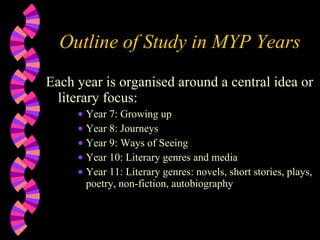
Outline of Study in MYP Years Each year is organised around a central idea or literary focus: Year 7: Growing up  Year 8: Journeys Year 9: Ways of Seeing Year 10: Literary genres and media Year 11: Literary genres: novels, short stories, plays, poetry, non-fiction, autobiography
Activities  reading and discussion writing in response to literature  persuasive writing  creative writing dramatisations, debates  oral presentations prepared and impromptu talks interviews individual and group research
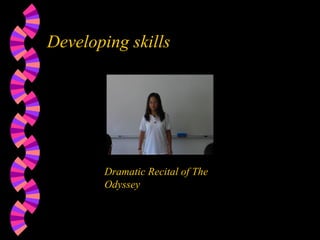
Developing skills Dramatic Recital of The Odyssey
Assessment students are assessed on oral and written work three criteria: A: content B: organisation C: style and language use
Reporting:  criteria   mark    grade written comments outline the student’s strengths and suggest ways of improving a mark for each criterion  an overall grade which indicates the level at which the student consistently performs
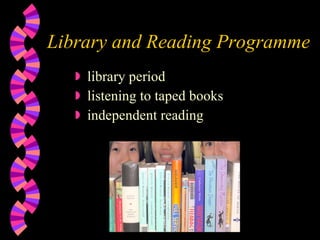
Library and Reading Programme library period listening to taped books independent reading
Homework CIS policy  quality, not quantity – time not task communication
Years 7-11 curiosity engagement imagination critical thinking reflection assurance sound foundations for diploma programme
IB Diploma Programme English A1 Higher and Standard Level English A2 Higher and Standard Level
English A1 programmes enable students to understand and appreciate literature develop clear and effective written and oral expression  broaden their perspectives enjoy and take a lifelong interest in literature
English A1 content 15 texts at higher level, 11 at standard level a range of poetry, novels, short stories, plays, non-fiction, works in translation  selected from a number of periods, writers and places.
Four parts for both HL and SL part 1: world literature part 2: detailed study part 3: groups of works – drama texts part 4: school’s free choice of texts
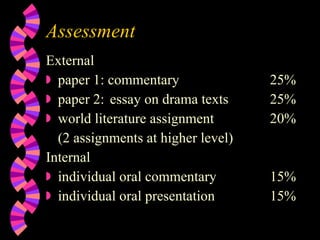
Assessment External paper 1: commentary  25% paper 2: essay on drama texts 25% world literature assignment 20% (2 assignments at higher level) Internal individual oral commentary  15% individual oral presentation 15%
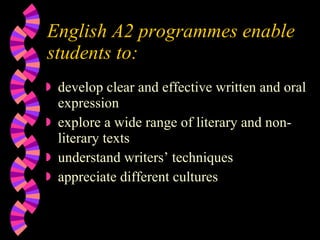
English A2 programmes enable students to: develop clear and effective written and oral expression  explore a wide range of literary and non-literary texts understand writers’ techniques appreciate different cultures
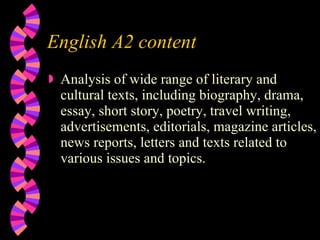
English A2 content Analysis of wide range of literary and cultural texts, including biography, drama, essay, short story, poetry, travel writing, advertisements, editorials, magazine articles, news reports, letters and texts related to various issues and topics.
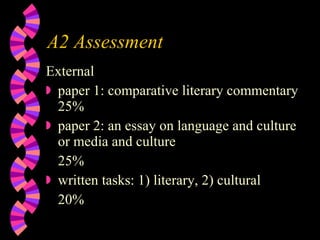
A2 Assessment  External  paper 1: comparative literary commentary 25% paper 2: an essay on language and culture or media and culture 25% written tasks: 1) literary, 2) cultural  20%
A2 Assessment cont. Internal individual oral based on a cultural or literary option 15% interactive oral activity based on either a cultural or literary option 15%
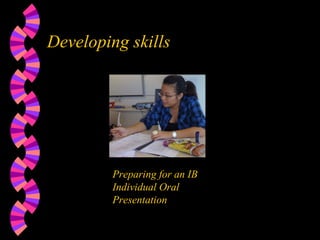
Developing skills Preparing for an IB Individual Oral Presentation
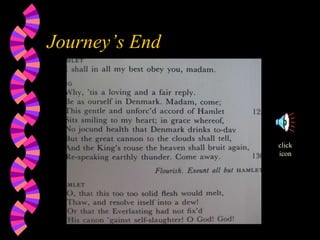
Journey’s End click icon
‘ The real voyage of discovery consists not in seeking new landscapes, but in having new eyes.’ Marcel Proust

Years 8-13 English Oct 2010

  • 1.
    Years 8-13 EnglishOpen House Presentation October 2010
  • 2.
    MYP English Curriculum7-11: skills based reading writing speaking listening viewing
  • 3.
    MYP English Curriculum7-11: informed by the five areas of interaction approaches to learning what are the techniques and tools we use to communicate effectively? How do others’ ideas influence our own? How does English influence our understanding of other cultures?
  • 4.
    These questions require:learning to learn clear thinking imaginative responses structuring ideas problem solving collaboration IT skills - writing, research
  • 5.
    MYP English Curriculum7-11: informed by the five areas of interaction community and service What role does literature play in a community? What would the world be like without literature? How do English skills enable debate on ethical, spiritual, moral and social issues?
  • 6.
    MYP English Curriculum7-11: informed by the five areas of interaction health and social education what does literature have to say about human emotions and issues? How does our maturity influence our perception of language and literature? How do language and literature facilitate our understanding of ourselves and others?
  • 7.
    MYP English Curriculum7-11: informed by the five areas of interaction environments How does setting influence characterisation? Which descriptive techniques do writers use to communicate a sense of place? How do writers depict the inner landscape?
  • 8.
    MYP English Curriculum7-11: informed by the five areas of interaction human ingenuity How do writers create a sense of what Gerard Manley Hopkins calls ‘thisness’? How do texts make us think differently? How does literature challenge us with its ‘infinite variety’ of styles and genres? Which writers and ideas inspire me?
  • 9.
    Curriculum Continuum cyclicalcurriculum focus on literature and language preparation for IB diploma and beyond
  • 10.
    Focus on Literaturenovels short stories poetry plays media
  • 11.
    Language grammar syntax punctuation vocabulary spelling dictionary/thesaurus editing
  • 12.
    Outline of Studyin MYP Years Each year is organised around a central idea or literary focus: Year 7: Growing up Year 8: Journeys Year 9: Ways of Seeing Year 10: Literary genres and media Year 11: Literary genres: novels, short stories, plays, poetry, non-fiction, autobiography
  • 13.
    Activities readingand discussion writing in response to literature persuasive writing creative writing dramatisations, debates oral presentations prepared and impromptu talks interviews individual and group research
  • 14.
    Developing skills DramaticRecital of The Odyssey
  • 15.
    Assessment students areassessed on oral and written work three criteria: A: content B: organisation C: style and language use
  • 16.
    Reporting: criteria mark  grade written comments outline the student’s strengths and suggest ways of improving a mark for each criterion an overall grade which indicates the level at which the student consistently performs
  • 17.
    Library and ReadingProgramme library period listening to taped books independent reading
  • 18.
    Homework CIS policy quality, not quantity – time not task communication
  • 19.
    Years 7-11 curiosityengagement imagination critical thinking reflection assurance sound foundations for diploma programme
  • 20.
    IB Diploma ProgrammeEnglish A1 Higher and Standard Level English A2 Higher and Standard Level
  • 21.
    English A1 programmesenable students to understand and appreciate literature develop clear and effective written and oral expression broaden their perspectives enjoy and take a lifelong interest in literature
  • 22.
    English A1 content15 texts at higher level, 11 at standard level a range of poetry, novels, short stories, plays, non-fiction, works in translation selected from a number of periods, writers and places.
  • 23.
    Four parts forboth HL and SL part 1: world literature part 2: detailed study part 3: groups of works – drama texts part 4: school’s free choice of texts
  • 24.
    Assessment External paper1: commentary 25% paper 2: essay on drama texts 25% world literature assignment 20% (2 assignments at higher level) Internal individual oral commentary 15% individual oral presentation 15%
  • 25.
    English A2 programmesenable students to: develop clear and effective written and oral expression explore a wide range of literary and non-literary texts understand writers’ techniques appreciate different cultures
  • 26.
    English A2 contentAnalysis of wide range of literary and cultural texts, including biography, drama, essay, short story, poetry, travel writing, advertisements, editorials, magazine articles, news reports, letters and texts related to various issues and topics.
  • 27.
    A2 Assessment External paper 1: comparative literary commentary 25% paper 2: an essay on language and culture or media and culture 25% written tasks: 1) literary, 2) cultural 20%
  • 28.
    A2 Assessment cont.Internal individual oral based on a cultural or literary option 15% interactive oral activity based on either a cultural or literary option 15%
  • 29.
    Developing skills Preparingfor an IB Individual Oral Presentation
  • 30.
  • 31.
    ‘ The realvoyage of discovery consists not in seeking new landscapes, but in having new eyes.’ Marcel Proust