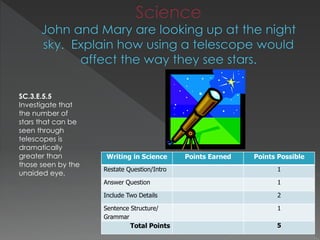
SC.3.E.5.5
Investigate that
the number of
stars that can be
seen through
telescopes is
dramatically
greater than
those seen by the
unaided eye.
Writing in Science Points Earned Points Possible
Restate Question/Intro 1
Answer Question 1
Include Two Details 2
Sentence Structure/
Grammar
1
Total Points 5
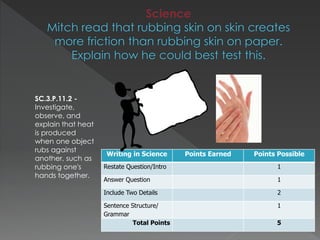
SC.3.P.11.2 -
Investigate,
observe, and
explain that heat
is produced
when one object
rubs against
another, such as
rubbing one's
hands together.
Writing in Science Points Earned Points Possible
Restate Question/Intro 1
Answer Question 1
Include Two Details 2
Sentence Structure/
Grammar
1
Total Points 5
Writing in Science Points Earned Points Possible
Restate Question/Intro 1
Answer Question 1
Include Two Details 2
Sentence Structure/
Grammar
1
Total Points 5
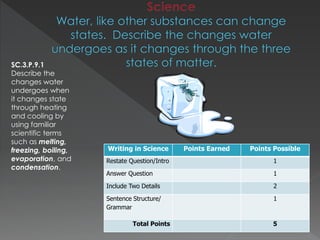
SC.3.P.9.1
Describe the
changes water
undergoes when
it changes state
through heating
and cooling by
using familiar
scientific terms
such as melting,
freezing, boiling,
evaporation, and
condensation.
Writing in Science Points Earned Points Possible
Restate Question/Intro 1
Answer Question 1
Include Two Details 2
Sentence Structure/
Grammar
1
Total Points 5
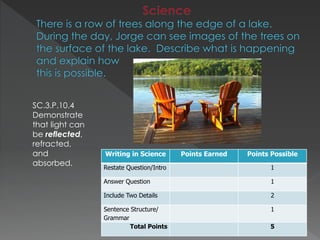
SC.3.P.10.4
Demonstrate
that light can
be reflected,
refracted,
and
absorbed.
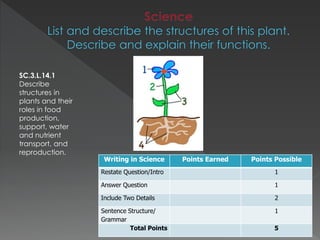
SC.3.L.14.1
Describe
structures in
plants and their
roles in food
production,
support, water
and nutrient
transport, and
reproduction.
Writing in Science Points Earned Points Possible
Restate Question/Intro 1
Answer Question 1
Include Two Details 2
Sentence Structure/
Grammar
1
Total Points 5
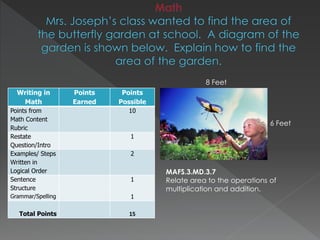
8 Feet
6 Feet
Writing in
Math
Points
Earned
Points
Possible
Points from
Math Content
Rubric
10
Restate
Question/Intro
1
Examples/ Steps
Written in
Logical Order
2
Sentence
Structure
Grammar/Spelling
1
1
Total Points 15
MAFS.3.MD.3.7
Relate area to the operations of
multiplication and addition.
0-5 Points
Getting Started
6-7 points
Moving Forward
8-9 Points
Almost There
10 Points
Got It
The student
attempts to draw a
grid on the
rectangle to form
unit squares but
draws the wrong
number of squares
or draws squares of
different sizes. The
student finds the
perimeter instead
of the area.
The student draws a
grid on the
rectangle forming
unit squares and
then counts the
number of unit
squares or skip-
counts to find the
area. When asked if
the student could
use multiplication to
find the area, the
student says no or is
unable to
determine how
multiplication might
be used.
The student counts
by eights as a
strategy for
multiplying 8x6 but
says the area is 46.
The student uses
multiplication to
find the area of the
rectangle and
explains the
product represents
the number of unit
squares it would
take to tile the
rectangles with no
gaps or overlaps.
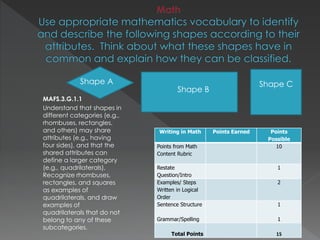
MAFS.3.G.1.1
Understand that shapes in
different categories (e.g.,
rhombuses, rectangles,
and others) may share
attributes (e.g., having
four sides), and that the
shared attributes can
define a larger category
(e.g., quadrilaterals).
Recognize rhombuses,
rectangles, and squares
as examples of
quadrilaterals, and draw
examples of
quadrilaterals that do not
belong to any of these
subcategories.
Shape A
Shape B
Shape C
Writing in Math Points Earned Points
Possible
Points from Math
Content Rubric
10
Restate
Question/Intro
1
Examples/ Steps
Written in Logical
Order
2
Sentence Structure
Grammar/Spelling
1
1
Total Points 15
0-5 Points
Getting Started
6-7 points
Moving Forward
8-9 Points
Almost There
10 Points
Got It
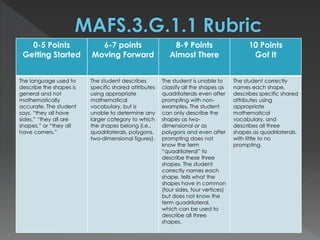
The language used to
describe the shapes is
general and not
mathematically
accurate. The student
says, “they all have
sides,” “they all are
shapes,” or “they all
have corners.”
The student describes
specific shared attributes
using appropriate
mathematical
vocabulary, but is
unable to determine any
larger category to which
the shapes belong (i.e.,
quadrilaterals, polygons,
two-dimensional figures).
The student is unable to
classify all the shapes as
quadrilaterals even after
prompting with non-
examples. The student
can only describe the
shapes as two-
dimensional or as
polygons and even after
prompting does not
know the term
“quadrilateral” to
describe these three
shapes. The student
correctly names each
shape, tells what the
shapes have in common
(four sides, four vertices)
but does not know the
term quadrilateral,
which can be used to
describe all three
shapes.
The student correctly
names each shape,
describes specific shared
attributes using
appropriate
mathematical
vocabulary, and
describes all three
shapes as quadrilaterals,
with little to no
prompting.
Writing in Math Points Earned Points
Possible
Points from Math
Content Rubric
10
Restate
Question/Intro
1
Examples/ Steps
Written in Logical
Order
2
Sentence Structure
Grammar/Spelling
1
1
Total Points 15
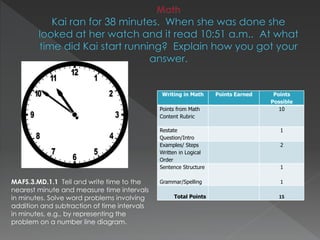
MAFS.3.MD.1.1 Tell and write time to the
nearest minute and measure time intervals
in minutes. Solve word problems involving
addition and subtraction of time intervals
in minutes, e.g., by representing the
problem on a number line diagram.
0-5 Points
Getting Started
6-7 points
Moving Forward
8-9 Points
Almost There
10 Points
Got It
The student
attempts to add
the elapsed
minutes to the
finish time given.
The student has an
effective strategy
for solving the
problem, and
attempts to count
back to find the
starting time but
makes significant
errors and gets lost
in his or her
strategy.
The student makes
a computational
error such as
subtracting 38
from 51 and
getting 23 instead
of 13. The student
says that Kai
started running at
9:13 a.m. instead
of 10:13 a.m.
The student
correctly subtracts
38 minutes from 51
minutes, getting a
final answer of
10:13 a.m.
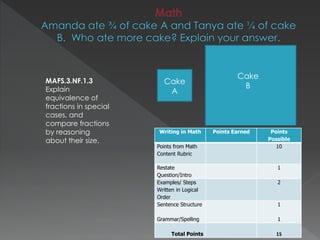
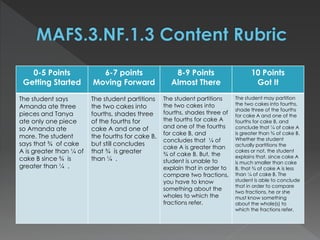
MAFS.3.NF.1.3
Explain
equivalence of
fractions in special
cases, and
compare fractions
by reasoning
about their size.
Cake
A
Cake
B
Writing in Math Points Earned Points
Possible
Points from Math
Content Rubric
10
Restate
Question/Intro
1
Examples/ Steps
Written in Logical
Order
2
Sentence Structure
Grammar/Spelling
1
1
Total Points 15
0-5 Points
Getting Started
6-7 points
Moving Forward
8-9 Points
Almost There
10 Points
Got It
The student says
Amanda ate three
pieces and Tanya
ate only one piece
so Amanda ate
more. The student
says that ¾ of cake
A is greater than ¼ of
cake B since ¾ is
greater than ¼ .
The student partitions
the two cakes into
fourths, shades three
of the fourths for
cake A and one of
the fourths for cake B,
but still concludes
that ¾ is greater
than ¼ .
The student partitions
the two cakes into
fourths, shades three of
the fourths for cake A
and one of the fourths
for cake B, and
concludes that ¼ of
cake A is greater than
¾ of cake B. But, the
student is unable to
explain that in order to
compare two fractions,
you have to know
something about the
wholes to which the
fractions refer.
The student may partition
the two cakes into fourths,
shade three of the fourths
for cake A and one of the
fourths for cake B, and
conclude that ¼ of cake A
is greater than ¾ of cake B.
Whether the student
actually partitions the
cakes or not, the student
explains that, since cake A
is much smaller than cake
B, that ¾ of cake A is less
than ¼ of cake B. The
student is able to conclude
that in order to compare
two fractions, he or she
must know something
about the whole(s) to
which the fractions refer.
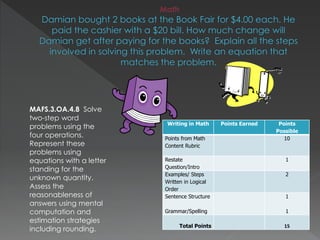
MAFS.3.OA.4.8 Solve
two-step word
problems using the
four operations.
Represent these
problems using
equations with a letter
standing for the
unknown quantity.
Assess the
reasonableness of
answers using mental
computation and
estimation strategies
including rounding.
Writing in Math Points Earned Points
Possible
Points from Math
Content Rubric
10
Restate
Question/Intro
1
Examples/ Steps
Written in Logical
Order
2
Sentence Structure
Grammar/Spelling
1
1
Total Points 15
0-5 Points
Getting Started
6-7 points
Moving Forward
8-9 Points
Almost There
10 Points
Got It
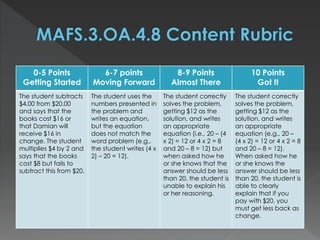
The student subtracts
$4.00 from $20.00
and says that the
books cost $16 or
that Damian will
receive $16 in
change. The student
multiplies $4 by 2 and
says that the books
cost $8 but fails to
subtract this from $20.
The student uses the
numbers presented in
the problem and
writes an equation,
but the equation
does not match the
word problem (e.g.,
the student writes (4 x
2) – 20 = 12).
The student correctly
solves the problem,
getting $12 as the
solution, and writes
an appropriate
equation (i.e., 20 – (4
x 2) = 12 or 4 x 2 = 8
and 20 – 8 = 12) but
when asked how he
or she knows that the
answer should be less
than 20, the student is
unable to explain his
or her reasoning.
The student correctly
solves the problem,
getting $12 as the
solution, and writes
an appropriate
equation (e.g., 20 –
(4 x 2) = 12 or 4 x 2 = 8
and 20 – 8 = 12).
When asked how he
or she knows the
answer should be less
than 20, the student is
able to clearly
explain that if you
pay with $20, you
must get less back as
change.

Online actions in writing duval

  • 2.
    SC.3.E.5.5 Investigate that the numberof stars that can be seen through telescopes is dramatically greater than those seen by the unaided eye. Writing in Science Points Earned Points Possible Restate Question/Intro 1 Answer Question 1 Include Two Details 2 Sentence Structure/ Grammar 1 Total Points 5
  • 3.
    SC.3.P.11.2 - Investigate, observe, and explainthat heat is produced when one object rubs against another, such as rubbing one's hands together. Writing in Science Points Earned Points Possible Restate Question/Intro 1 Answer Question 1 Include Two Details 2 Sentence Structure/ Grammar 1 Total Points 5
  • 4.
    Writing in SciencePoints Earned Points Possible Restate Question/Intro 1 Answer Question 1 Include Two Details 2 Sentence Structure/ Grammar 1 Total Points 5 SC.3.P.9.1 Describe the changes water undergoes when it changes state through heating and cooling by using familiar scientific terms such as melting, freezing, boiling, evaporation, and condensation.
  • 5.
    Writing in SciencePoints Earned Points Possible Restate Question/Intro 1 Answer Question 1 Include Two Details 2 Sentence Structure/ Grammar 1 Total Points 5 SC.3.P.10.4 Demonstrate that light can be reflected, refracted, and absorbed.
  • 6.
    SC.3.L.14.1 Describe structures in plants andtheir roles in food production, support, water and nutrient transport, and reproduction. Writing in Science Points Earned Points Possible Restate Question/Intro 1 Answer Question 1 Include Two Details 2 Sentence Structure/ Grammar 1 Total Points 5
  • 7.
    8 Feet 6 Feet Writingin Math Points Earned Points Possible Points from Math Content Rubric 10 Restate Question/Intro 1 Examples/ Steps Written in Logical Order 2 Sentence Structure Grammar/Spelling 1 1 Total Points 15 MAFS.3.MD.3.7 Relate area to the operations of multiplication and addition.
  • 8.
    0-5 Points Getting Started 6-7points Moving Forward 8-9 Points Almost There 10 Points Got It The student attempts to draw a grid on the rectangle to form unit squares but draws the wrong number of squares or draws squares of different sizes. The student finds the perimeter instead of the area. The student draws a grid on the rectangle forming unit squares and then counts the number of unit squares or skip- counts to find the area. When asked if the student could use multiplication to find the area, the student says no or is unable to determine how multiplication might be used. The student counts by eights as a strategy for multiplying 8x6 but says the area is 46. The student uses multiplication to find the area of the rectangle and explains the product represents the number of unit squares it would take to tile the rectangles with no gaps or overlaps.
  • 9.
    MAFS.3.G.1.1 Understand that shapesin different categories (e.g., rhombuses, rectangles, and others) may share attributes (e.g., having four sides), and that the shared attributes can define a larger category (e.g., quadrilaterals). Recognize rhombuses, rectangles, and squares as examples of quadrilaterals, and draw examples of quadrilaterals that do not belong to any of these subcategories. Shape A Shape B Shape C Writing in Math Points Earned Points Possible Points from Math Content Rubric 10 Restate Question/Intro 1 Examples/ Steps Written in Logical Order 2 Sentence Structure Grammar/Spelling 1 1 Total Points 15
  • 10.
    0-5 Points Getting Started 6-7points Moving Forward 8-9 Points Almost There 10 Points Got It The language used to describe the shapes is general and not mathematically accurate. The student says, “they all have sides,” “they all are shapes,” or “they all have corners.” The student describes specific shared attributes using appropriate mathematical vocabulary, but is unable to determine any larger category to which the shapes belong (i.e., quadrilaterals, polygons, two-dimensional figures). The student is unable to classify all the shapes as quadrilaterals even after prompting with non- examples. The student can only describe the shapes as two- dimensional or as polygons and even after prompting does not know the term “quadrilateral” to describe these three shapes. The student correctly names each shape, tells what the shapes have in common (four sides, four vertices) but does not know the term quadrilateral, which can be used to describe all three shapes. The student correctly names each shape, describes specific shared attributes using appropriate mathematical vocabulary, and describes all three shapes as quadrilaterals, with little to no prompting.
  • 11.
    Writing in MathPoints Earned Points Possible Points from Math Content Rubric 10 Restate Question/Intro 1 Examples/ Steps Written in Logical Order 2 Sentence Structure Grammar/Spelling 1 1 Total Points 15 MAFS.3.MD.1.1 Tell and write time to the nearest minute and measure time intervals in minutes. Solve word problems involving addition and subtraction of time intervals in minutes, e.g., by representing the problem on a number line diagram.
  • 12.
    0-5 Points Getting Started 6-7points Moving Forward 8-9 Points Almost There 10 Points Got It The student attempts to add the elapsed minutes to the finish time given. The student has an effective strategy for solving the problem, and attempts to count back to find the starting time but makes significant errors and gets lost in his or her strategy. The student makes a computational error such as subtracting 38 from 51 and getting 23 instead of 13. The student says that Kai started running at 9:13 a.m. instead of 10:13 a.m. The student correctly subtracts 38 minutes from 51 minutes, getting a final answer of 10:13 a.m.
  • 13.
    MAFS.3.NF.1.3 Explain equivalence of fractions inspecial cases, and compare fractions by reasoning about their size. Cake A Cake B Writing in Math Points Earned Points Possible Points from Math Content Rubric 10 Restate Question/Intro 1 Examples/ Steps Written in Logical Order 2 Sentence Structure Grammar/Spelling 1 1 Total Points 15
  • 14.
    0-5 Points Getting Started 6-7points Moving Forward 8-9 Points Almost There 10 Points Got It The student says Amanda ate three pieces and Tanya ate only one piece so Amanda ate more. The student says that ¾ of cake A is greater than ¼ of cake B since ¾ is greater than ¼ . The student partitions the two cakes into fourths, shades three of the fourths for cake A and one of the fourths for cake B, but still concludes that ¾ is greater than ¼ . The student partitions the two cakes into fourths, shades three of the fourths for cake A and one of the fourths for cake B, and concludes that ¼ of cake A is greater than ¾ of cake B. But, the student is unable to explain that in order to compare two fractions, you have to know something about the wholes to which the fractions refer. The student may partition the two cakes into fourths, shade three of the fourths for cake A and one of the fourths for cake B, and conclude that ¼ of cake A is greater than ¾ of cake B. Whether the student actually partitions the cakes or not, the student explains that, since cake A is much smaller than cake B, that ¾ of cake A is less than ¼ of cake B. The student is able to conclude that in order to compare two fractions, he or she must know something about the whole(s) to which the fractions refer.
  • 15.
    MAFS.3.OA.4.8 Solve two-step word problemsusing the four operations. Represent these problems using equations with a letter standing for the unknown quantity. Assess the reasonableness of answers using mental computation and estimation strategies including rounding. Writing in Math Points Earned Points Possible Points from Math Content Rubric 10 Restate Question/Intro 1 Examples/ Steps Written in Logical Order 2 Sentence Structure Grammar/Spelling 1 1 Total Points 15
  • 16.
    0-5 Points Getting Started 6-7points Moving Forward 8-9 Points Almost There 10 Points Got It The student subtracts $4.00 from $20.00 and says that the books cost $16 or that Damian will receive $16 in change. The student multiplies $4 by 2 and says that the books cost $8 but fails to subtract this from $20. The student uses the numbers presented in the problem and writes an equation, but the equation does not match the word problem (e.g., the student writes (4 x 2) – 20 = 12). The student correctly solves the problem, getting $12 as the solution, and writes an appropriate equation (i.e., 20 – (4 x 2) = 12 or 4 x 2 = 8 and 20 – 8 = 12) but when asked how he or she knows that the answer should be less than 20, the student is unable to explain his or her reasoning. The student correctly solves the problem, getting $12 as the solution, and writes an appropriate equation (e.g., 20 – (4 x 2) = 12 or 4 x 2 = 8 and 20 – 8 = 12). When asked how he or she knows the answer should be less than 20, the student is able to clearly explain that if you pay with $20, you must get less back as change.