HR PLANINNG
PRESENTED BY –
YASHIKA SINGH
( 21709107)
PRESENTED
TO – RUBY
SANGAR
HR PLANNING
HR planning, also known as Human Resources Planning, refers to the process
of forecasting an organization's future workforce needs and developing
strategies to meet those needs effectively. It involves analyzing the current
and future demands for human resources within an organization and ensuring
that the right people with the right skills are available at the right time.
IMPORTANCE OF HR PLANNING
TYPES OF ON THE JOB TRAINING
 JOB ROTATION  Job rotation is a human resource management
practice that involves moving employees across different roles or positions
within an organization. It is a systematic approach where employees are
given the opportunity to work in various departments, functions, or job
roles for a specific period of time, often on a temporary basis.
 COACHING  Coaching in HRM refers to the process of providing
guidance, support, and feedback to individuals within the HR department
or the broader organization to help them develop their skills, knowledge,
and performance. It involves a one-on-one relationship between a coach,
who could be a manager, HR professional, or external coach, and an
individual employee, often referred to as the coachee.
 Job instruction Training  It is a training method that focuses on
teaching employees specific job-related skills and knowledge in a step-by-
step manner. It begins with an overview of job responsibilities and
expected results and continues with a description of the skills required.
 INTERNSHIP  Internship in HR (Human Resources) is a temporary work
opportunity that provides students or individuals interested in pursuing a
career in HR with practical exposure and experience in the field. It offers a
chance to apply academic knowledge to real-world HR situations and gain
valuable insights into the HR profession.
 Apprenticeship  IT is a structured training program that combines
on-the-job learning with classroom instruction for individuals pursuing a
career in human resource management. It provides a hands-on experience
in various HR functions while allowing participants to acquire the
necessary knowledge, skills, and competencies required in the field.
OFF THE JOB TRAINING
 Off-the-job training refers to training activities that take place away from
the actual work environment. It typically involves providing employees
with opportunities to enhance their skills, knowledge, and competencies
through external programs, workshops, courses, or educational activities
conducted by specialized trainers or institutions.
 This type of training essentially helps employees perform their job more
efficiently. Unlike on-the-job training, off-the-job training can take place
near the workplace or somewhere further away, such as at a resort or at a
training center. When employers hold training away from the workplace, it
helps minimize distractions so employees can fully focus on the material
they're learning.
TYPES OF OFF THE JOB TRAINING
 Role-Playing Sessions  Role-playing sessions involve throwing
participants into the middle of a hypothetical situation where they have to
deal with an organizational crisis or persuade clients in the middle of a
conflict. As one of the most exciting off-the-job training methods, role-
playing can be used to enhance interpersonal skills, polish sales
techniques.
 Lectures  One of the most traditional off-the-job methods involves
lectures and seminars. Lectures are a useful way of clarifying concepts,
resolving doubts and engaging in moderated discussions about ideas and
theories concerning one’s role. All off-the-job training methods must
include lectures or seminars that promote critical thinking and allow
participants to track their knowledge growth over time.
 Vestibule training  The employees are trained on the equipment
they will be utilizing in their daily work process. However, the training
takes place away from the real work environment. Employees use the same
content, files, and equipment as in real-life work situations created in a
classroom. Vestibule training takes place in a classroom or workstation
within or close to the main manufacturing unit.
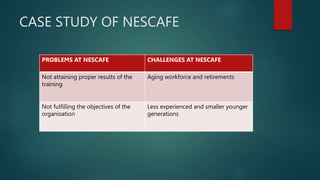
CASE STUDY OF NESCAFE
PROBLEMS AT NESCAFE CHALLENGES AT NESCAFE
Not attaining proper results of the
training
Aging workforce and retirements
Not fulfilling the objectives of the
organisation
Less experienced and smaller younger
generations
SOLUTION
 Nescafe decided to go deep into the problems to
find its solution and realised that the job
specification did not match fully with the training
that they gave to employees. So to maintain the
quality of product and healthy working environment
for employees Nescafe decided to work on their
training programs.
CONCLUSION
 Nestle’s principle is that each employee should have the opportunity to
develop the maximum of his or her potential. Nestle do this because they
believe it pays off in the long run in their business results, and that
sustainable long run in their business results, and that sustainable long –
run relationships with highly competent people and with the communities
where they operate enhance their ability to make consistent profits. It is
important to give people the opportunities for life – long learning as at
Nestle that all employees are called upon to upgrade their skills in a fast –
changing world.
THANK YOU

Yashikasingh.pptx

  • 1.
    HR PLANINNG PRESENTED BY– YASHIKA SINGH ( 21709107) PRESENTED TO – RUBY SANGAR
  • 2.
    HR PLANNING HR planning,also known as Human Resources Planning, refers to the process of forecasting an organization's future workforce needs and developing strategies to meet those needs effectively. It involves analyzing the current and future demands for human resources within an organization and ensuring that the right people with the right skills are available at the right time.
  • 3.
  • 4.
    TYPES OF ONTHE JOB TRAINING  JOB ROTATION  Job rotation is a human resource management practice that involves moving employees across different roles or positions within an organization. It is a systematic approach where employees are given the opportunity to work in various departments, functions, or job roles for a specific period of time, often on a temporary basis.  COACHING  Coaching in HRM refers to the process of providing guidance, support, and feedback to individuals within the HR department or the broader organization to help them develop their skills, knowledge, and performance. It involves a one-on-one relationship between a coach, who could be a manager, HR professional, or external coach, and an individual employee, often referred to as the coachee.
  • 5.
     Job instructionTraining  It is a training method that focuses on teaching employees specific job-related skills and knowledge in a step-by- step manner. It begins with an overview of job responsibilities and expected results and continues with a description of the skills required.  INTERNSHIP  Internship in HR (Human Resources) is a temporary work opportunity that provides students or individuals interested in pursuing a career in HR with practical exposure and experience in the field. It offers a chance to apply academic knowledge to real-world HR situations and gain valuable insights into the HR profession.  Apprenticeship  IT is a structured training program that combines on-the-job learning with classroom instruction for individuals pursuing a career in human resource management. It provides a hands-on experience in various HR functions while allowing participants to acquire the necessary knowledge, skills, and competencies required in the field.
  • 6.
    OFF THE JOBTRAINING  Off-the-job training refers to training activities that take place away from the actual work environment. It typically involves providing employees with opportunities to enhance their skills, knowledge, and competencies through external programs, workshops, courses, or educational activities conducted by specialized trainers or institutions.  This type of training essentially helps employees perform their job more efficiently. Unlike on-the-job training, off-the-job training can take place near the workplace or somewhere further away, such as at a resort or at a training center. When employers hold training away from the workplace, it helps minimize distractions so employees can fully focus on the material they're learning.
  • 7.
    TYPES OF OFFTHE JOB TRAINING  Role-Playing Sessions  Role-playing sessions involve throwing participants into the middle of a hypothetical situation where they have to deal with an organizational crisis or persuade clients in the middle of a conflict. As one of the most exciting off-the-job training methods, role- playing can be used to enhance interpersonal skills, polish sales techniques.  Lectures  One of the most traditional off-the-job methods involves lectures and seminars. Lectures are a useful way of clarifying concepts, resolving doubts and engaging in moderated discussions about ideas and theories concerning one’s role. All off-the-job training methods must include lectures or seminars that promote critical thinking and allow participants to track their knowledge growth over time.
  • 8.
     Vestibule training The employees are trained on the equipment they will be utilizing in their daily work process. However, the training takes place away from the real work environment. Employees use the same content, files, and equipment as in real-life work situations created in a classroom. Vestibule training takes place in a classroom or workstation within or close to the main manufacturing unit.
  • 9.
    CASE STUDY OFNESCAFE PROBLEMS AT NESCAFE CHALLENGES AT NESCAFE Not attaining proper results of the training Aging workforce and retirements Not fulfilling the objectives of the organisation Less experienced and smaller younger generations
  • 10.
    SOLUTION  Nescafe decidedto go deep into the problems to find its solution and realised that the job specification did not match fully with the training that they gave to employees. So to maintain the quality of product and healthy working environment for employees Nescafe decided to work on their training programs.
  • 11.
    CONCLUSION  Nestle’s principleis that each employee should have the opportunity to develop the maximum of his or her potential. Nestle do this because they believe it pays off in the long run in their business results, and that sustainable long run in their business results, and that sustainable long – run relationships with highly competent people and with the communities where they operate enhance their ability to make consistent profits. It is important to give people the opportunities for life – long learning as at Nestle that all employees are called upon to upgrade their skills in a fast – changing world.
  • 12.