p.224
©iStockphoto.com/alvarez
7
Learning and Development
Media Library
CHAPTER 7 Media Library
PREMIUM VIDEO
HRM in Action
Training Employees
LICENSED VIDEO
Evaluating Training Programs
LEARNING OBJECTIVES
After studying this chapter, you should be able to do the
following:
7-1. Discuss the major difference between training and
development and identify the common situations where training
may be needed.PAGE 226
7-2. Briefly discuss the steps in the training and development
process and the common challenges to the process.PAGE 229
7-3. Identify the three common learning theories and how they
are used to create the four methods for shaping behavior.PAGE
233
7-4. Discuss each of the major training delivery types.PAGE
239
7-5. Briefly discuss the Four-Level Evaluation Method for
assessing training programs and the three common ways we
measure training success.PAGE 243
7-6. Discuss the term career and the three common methods of
employee development.PAGE 247
7-7. Describe the concepts of gamification, digital learning,
and micro-learning, and the reasons that they have become more
critical in today’s organizations.PAGE 254
CHAPTER OUTLINE
The Need for Training and Development
Training and Development
When Is Training Needed?
The Training Process and Needs Assessment
Steps in the Training Process
Needs Assessment
Challenges to the Training Process
Employee Readiness
Learning and Shaping Behavior
Learning
Learning Theories
Shaping Behavior
Learning Styles
Design and Delivery of Training
On-the-Job Training (OJT)
Classroom Training
Distance or E-Learning
Simulations
Assessing Training
Assessment Methods
Choosing Assessment Methods
Measuring Training Success
Talent Management and Development
Careers
Why Career Development?
Common Methods of Employee Development
A Model of Career Development Consequences
Trends and Issues in HRM
Gamification—A Phoenix Rising?
The Corporate Learning Imperative
p.225
Practitioner’s Perspective
Cindy told the story of Jennifer, who had worked in the same
position for 10 years. Jennifer had always been a valuable
employee, but lately, her productivity and performance had
started to decline. Her supervisor, Mandy, finally called her in
to find out what was wrong.
After some hesitation, Jennifer said, “To tell the truth, I feel
like I am in a rut. I just don’t get the same satisfaction from
doing my job that I used to get.”
“I wish we’d had this talk sooner,” Mandy replied, “but now
that I know how you feel, there is something we can do. Let’s
take a look at some of the training opportunities coming up this
quarter. Tell me what training classes you might be interested in
taking.”
What if Jennifer and Mandy never had that talk? Do you think
Jennifer would have remained at her job? Chapter 7 looks at the
ins and outs of managing and retaining talent through training
and development.
SHRM HR CONTENT
See Appendix: SHRM 2016 Curriculum Guidebook for the
complete list
E. Job Analysis/Job Design (required)
5. Training and development
Vocational and career counseling
Needs assessment
Career pathing
L. Training and Development (required)
1. Needs assessment
2. Competency models
3. Learning theories: Behaviorism, constructivism, cognitive
models, adult learning, knowledge management
4. Training evaluation: Kirkpatrick’s model
5. E-learning and use of technology in training
6. On-the-job training (OJT)
7. Outsourcing (secondary)
8. Transfer of training: Design issues, facilitating transfer
9. Employee development: Formal education, experience,
assessment
10. Determining return on investment (ROI)
11. The role of training in succession planning
12. Human/intellectual capital
Q. Organizational Development (required—graduate students
only)
2. Developing human resources
3. Emotional intelligence
4. Equipping the organization for present and future talent
needs
8. Measurement systems
11. Organizational learning
13. Outsourcing employee development
16. Training employees to meet current and future job
demands
T. HR Career Planning (secondary)
1. Definition of a career
2. Balancing work and life
7. Plateauing
9. Career development
Get the edge on your studies. edge.sagepub.com/lussierhrm3e
• Take a quiz to find out what you’ve learned.
• Review key terms with eFlashcards.
• Watch videos that enhance chapter content.
p.226
THE NEED FOR TRAINING AND DEVELOPMENT
LO 7-1
Discuss the major difference between training and development
and identify the common situations where training may be
needed.
Now that we’ve made it through the process of selecting
individuals into the organization, the next thing we need to do
is train them to successfully work within the new environment
and to do their new jobs. In all cases, new employees should get
at least basic training about the organization and its routine
processes as well as the training for the job they are going to be
filling. We can’t reasonably expect them to do a job
successfully unless they’re trained in how to do it; and there is
a relationship between training and job satisfaction,1 so we
need to insure that the required onboarding training is
completed. Offering training and development also generally
decreases expensive turnover2 and makes it less likely that
employees will engage in neglectful behavior.3 Training is
costly though, so it must be done correctly to get sufficient
benefits to outweigh the cost.4
Effective training and development are investments, not
expenses, as they pay for themselves through competitive
advantage and increased performance.5 This is why companies
worldwide are investing heavily in training and long-term
employee development.6 Hudson Trail Outfitters even rewards
employees for completing training programs.7 As managers’
skills should also be developed,8leadership programs and
courses are currently popular.9 This is why best-practice
companies (e.g., GE, IBM, and Johnson & Johnson) provide
leadership programs.10
Training and Development
Before we get into the details of training and development, we
need to understand competency models because training is
based on the competencies we want employees to
have. Competency models identify the knowledge, skills, and
abilities (known in HR as KSAs) needed to perform a particular
job in the organization. We can utilize competency models to
identify what types of training a new employee or an employee
changing jobs will need. We go through a process of identifying
and providing the training, evaluating how well the employee
has learned, and then assessing the training process itself using
one of several options. We will discuss this in more detail in a
little while, but for now, just remember that training is a critical
piece in the education of each employee in the organization.
SHRM
L:2
Competency Models
In this chapter, we will discuss both organizational training and
employee development. The two are related but separate pieces
of the organization’s processes involving the management of its
employees.
p.227
Marriott is one of many companies that offer a variety of
training programs to its employees. Training topics include
leadership, management, and work-life balance.
Spencer Platt/Getty Images
Training is the process of teaching employees the skills
necessary to perform a job. We train employees to provide them
with the KSAs that they will need to succeed in their work for
the organization. Training is primarily intended to be put to
immediate use by the individual being trained. As an
example, Amazon focuses on customer service, so it trains its
employees by drilling them in what steps to follow when they
get everyday questions and when fielding more unusual
requests. To make sure everyone at Amazon understands how
customer service works, each employee, including the CEO,
spends 2 days on the service desk every 2 years.11
SHRM
E:5
Training and Development
Somewhat in contrast to the training we do so that employees
can do a new job or do an existing job better is the process of
employee development. Both colleges and corporations have
been criticized for not doing a good job of developing business
leaders.12 This is one of the reasons why this book focuses on
developing HR skills, not just knowledge. Employee
development is ongoing education to improve knowledge and
skills for present and future jobs. So, employee development is
designed to teach our workers how to move up in the
organization in the future by becoming skilled at those tasks
that they will need to know to move into higher-level jobs.
Development tends to be less technical, and it is aimed at
improving human, communication, conceptual, and decision-
making skills in employees. To remain competitive in today’s
dynamic environment, organizations must have employees who
maintain up-to-date knowledge and skills; and development
plays an important role in this effort.13
SHRM
Q:16
Training Employees to Meet Current and Future Job Demands
When Is Training Needed?
To successfully determine what kinds of training need to be
carried out within the organization, HR managers should begin
by completing a needs assessment. We will discuss needs
assessments in the next section. For now, let’s review some
common points at which we should probably complete a needs
assessment and at least consider providing training to our
people.
SHRM
Q:2
Developing Human Resources
NEW EMPLOYEE ONBOARDING.Orientation, known better
now by the term onboarding, is the process of introducing new
employees to the organization and their jobs. New employees
are often called newcomersin organizational entry;14 and
newcomer socialization done effectively during the onboarding
process increases new employee job satisfaction and
performance and reduces turnover rates.15,16 Onboarding
frequently emphasizes corporate values, culture, and
strengths.17 Organizations that have developed innovative
onboarding programs include Rover.com, Wipro, Rackspace,
Bazaarvoice, and Google.18 This socialization process is
important to both newcomers and organizations, as newcomers
learn the ropes and understand what is expected from them in
their work as they assimilate into the organization and attempt
to become productive members.19 Thus, job and career
orientation have long-lasting effects on new employee job
attitudes and satisfaction, behavior, work mastery, and
performance.20
Onboarding is an introduction of the person to the company.
What do we need to think about when we introduce somebody to
the company? We need to think about introducing the new
employee to all of the things that exist within the organizational
society that they are entering. The process is very similar to
someone moving to a different country and having to assimilate
into a new culture. What do people need to know in order to be
able to go about their daily lives, do the routine things that they
need to do, and provide for their own personal needs?
Orientation should be designed to answer all of the questions
necessary to allow new employees to integrate into the
“society” that they are entering.
p.228
WORK
APPLICATION 7-1
Select a job you hold in the present or held in the past. Did you
receive both training and development or just training? Explain
in some detail why it was one or both.
One of the first things an individual would need to know is what
the laws, rules, and regulations are in the new society; so we
need to introduce the new employee to the organization’s
policies and procedures, rules, and regulations. The second
thing that people would probably want to know is how to act
and interact with others in the new society. So in addition to
introducing the employee to the job and how to perform it
within the organization, we would want to talk to the individual
about the underlying organizational structure, plus where to go
and whom to talk to in order to get certain things done. Who
should they talk to in their department if they have questions
about their job or about how things are done within the
department? Who should they speak with in other departments if
they have questions that can’t be answered within their primary
workgroup, and when is it acceptable to go to individuals in
other departments?
Next, they might want to know how they get the money that
they need in order to survive in society. So we need to tell them
about their pay and benefits, including whom to contact with
questions. People entering this new society would also probably
want to know how to stay safe as they go about their business,
so we need to talk to them about safety in the organization.
They would also likely need to fill out paperwork—to get a
driver’s license, to open a bank account, to identify who they
are, and so forth. Similarly, certain paperwork is necessary for
the organization to function successfully, so during onboarding
we ask the new employee to fill out this paperwork.
As you can see, there are many different things that we need to
teach someone entering our new society, so we can’t
legitimately perform the entire onboarding process in one day or
a couple of hours. Effective onboarding of employees also
results in lower turnover rates,21 so orientation to the firm and
the new employee’s job should “last at least one year to ensure
high retention say staffing and HR experts.”22 Here are a few
examples of world-class companies with long onboarding
programs: Toyota has a 5-week orientation, Honda has a 6-week
orientation, and Southwest Airlines has a 90-day orientation.
However, in most organizations, the onboarding process is
significantly shorter than this, and this is one reason that our
organizations suffer significant early turnover of new hires. If
our new employee is frustrated due to not knowing how to do
the job, where to locate tools, whom to go to with a problem, or
how to fix an issue with pay, the likelihood of that person
leaving the organization goes up drastically. Many
organizations could significantly reduce new-hire turnover by
modestly increasing the onboarding and socialization period for
new hires.
WORK
APPLICATION 7-2
Briefly describe the orientation you received for a job. How
could it be improved?
NEW JOB REQUIREMENTS OR PROCESSES. The second
common point where training may be necessary occurs when
jobs change in some form. Whether our employee is in the same
job or is changing jobs and needs to learn new processes, if
there is a significant change in any work requirements, we need
to train the employee. The change may be based on discovery of
new techniques or technologies to perform particular work to
make the work more efficient. The organization may have
changed its strategic direction; and as a result, some or all of
the jobs within the organization may require new processes or
procedures. In any of these cases or any similar situation where
the change has significance for that job, we should go through
the process of performing a training needs assessment. If the
result of the needs assessment shows that training is necessary,
then an appropriate training program can be designed and
implemented.
REMEDIATION. The third common point at which managers
need to investigate the requirement for additional training
occurs when there has been some failure of an employee or
some employees to perform successfully and meet
organizational standards. Remediation is the correction of a
deficiency or failure in a process or procedure. In remediation,
we work to correct the actions of the individual or individuals
responsible for the process or procedure so that they can
successfully carry out the action in the future. We don’t want to
make a common mistake, though. Remediation is not about
assigning blame for a failure. The emphasis in this case should
always be on correcting the actions of the employee to better
serve both the employee’s and the organization’s interests.
Organizational managers act just as a good physician or
mechanic would act—by diagnosing the situation first
and then taking appropriate corrective action to solve the
problem.
p.229
EMPLOYEE DEVELOPMENT FOR ADVANCEMENT. The
next point at which to evaluate the need for training is in
situations where we are working to develop current employee
skills and abilities so that employees can move into higher level
jobs within the organization. Offering development
opportunities generally decreases turnover.23 As noted
in Chapter 4, all organizations have a responsibility to plan for
the succession of individuals in management and executive
positions; and this planning is usually a function assigned to the
HR department. Providing development opportunities and
succession planning is the only way the organization can be
sustainable over long periods of time. To successfully carry out
a succession process, people at lower levels in the organization
must be trained in the knowledge and skills necessary to be able
to take on higher-level duties. One area getting particular
attention today is training and development in ethics and social
responsibility, in part because of the litany of ethical failures in
scores of companies over the past couple of decades. While very
few organizations will attempt to develop all of the employees
within the firm, most organizations go through an informal or
formal process of identifying high-potential individuals for
development and, ultimately, advancement into managerial and
executive slots.
SHRM
L:11
The Role of Training in Succession Planning
Many 21st century organizations have rigorous development
programs that include job rotation to various departments within
the organization, classroom and on-the-job training, assigned
mentors, and many other programs–all of which are designed to
train employees and develop their capabilities for future use
within the firm. Organizations that neglect succession processes
and employee development can find themselves at a competitive
disadvantage when senior personnel leave the firm through
either retirement or resignation. It is critical that HR lead the
process of planning for succession and employee development.
Although in this chapter we will focus more on training than
development (there are five major sections explaining training,
followed by one section on employee development), both are
important to the organization over the long term.
THE TRAINING PROCESS AND NEEDS ASSESSMENT
LO 7-2
Briefly discuss the steps in the training and development
process and the common challenges to the process.
How are we going to go about training our employees? How do
we know who needs what training, in what forms, and at what
point? How do we determine whether or not the employee is
ready and willing to participate in the training? Finally, how do
we know that the training was effective? In order to answer
these questions, we have to plan our training processes very
carefully. We need to look at what’s currently going on in the
organization and how that differs from what needs to happen in
the future to accomplish our strategic business goals. So
training and development are another set of strategic HRM
tasks. Once we do this, we can analyze the types of training that
will be necessary to build new knowledge, skills, and abilities
for our workforce.
Licensed Video
Evaluating Training Programs
Steps in the Training Process
This chapter is primarily organized to follow the steps in the
training process. Let’s take a look at how we go through the
training process in Exhibit 7-1. We’ll follow that up with a brief
discussion of the steps and then provide more detail throughout
the chapter.
Step 1: Assessing needs. We conduct a needs assessment to
determine what training is necessary to improve performance.
We will discuss this step in this section.
p.230
Exhibit 7-1 THE TRAINING PROCESS
Step 2: Selecting how to shape behavior. We select a method of
shaping employee behavior based on learning theories so that
we can change employee behavior to improve performance. We
will discuss this step in this chapter’s section “Learning and
Shaping Behavior.”
Step 3: Designing training. We design the training and
development based on the needs assessment. We must determine
which training methods we will use to shape employee behavior.
We discuss this step in this chapter’s section “Design and
Delivery of Training.”
Step 4: Delivering training. Before we actually conduct the
training and development, we must select the delivery method.
We also discuss the delivery options in the section “Design and
Delivery of Training.”
SHRM
Q:4
Equipping the Organization for Present and Future Talent Needs
Step 5: Assessing training. After we complete the training, our
last step is to assess how effective the training was at
developing the needed skills. We do this by determining our
success at shaping behavior. We discuss this step in this
chapter’s section “Assessing Training.”
SHRM
E:5, L:1
Needs Assessment
Interrelationship of the Training Process Steps. Note in Exhibit
7-1 that each of steps 2, 3, 4, and 5 has a double-headed arrow;
this is because all the steps are so closely related and based on
each other that they are commonly planned together before
actually delivering the training. In other words, you are
constantly thinking ahead and behind your current step in the
training process. If the assessment of the training reveals that
the behavior has not been shaped (changed) as needed, we may
have to go back to step 1 and start the training process again.
Needs Assessment
The first major step in the training process, and probably one of
the most important, is the needs assessment. A needs
assessment is the process of analyzing the difference between
what is currently occurring within a job or jobs and what is
required—either now or in the future—based on the
organization’s operations and strategic goals. If a needs
assessment is not done correctly, a training course may be
poorly designed, or it may cover the wrong information. The
wrong employees may be asked to participate in the training, or
they may not yet be capable of absorbing the information in the
training because of a lack of a knowledge base or skill set. We
may end up creating a training program that’s unnecessary, or
we may fail to determine that an issue is based on poor
performance rather than lack of knowledge. These are
significant issues that we can avoid if we correctly go through
the process of a needs assessment.
p.231
Similar to those good physicians and automobile mechanics that
we just mentioned, organizational managers have to diagnose
what may currently be wrong with a process so that they can
successfully repair and/or tune the process up. If they don’t do
the diagnosis correctly, managers may create training solutions
that don’t solve the existing problem. So the manager has to go
through a process of identifying where in a current sequence of
events things are not working the way they should, or how they
can be done more efficiently. Only by diligently going through
the process of looking at that chain of events in the status quo
can a manager identify where the process can be changed to
improve organizational productivity and reach the
organization’s goals.
Challenges to the Training Process
As part of the needs assessment and in order to design training
appropriately, we need to identify and discuss some common
challenges to the training process. These include minimally
prepared or unprepared workers, difficulty in identifying the
return on investment provided from training, employee
resistance to change and feelings of insecurity, matching the
training to the strategic goals of the organization, and logistics
issues—including scheduling and making locations available for
training courses. Managers have to work through each of these
challenges in order for training programs to be successful.
Unprepared Workforce. One of the most significant challenges
to work process training is the fact that so many of the
individuals being hired into the workforce are ill prepared in the
educational basics, including reading and math skills. As we
noted in Chapter 6, employers continue to hire substantial
numbers of new entrants who have significant education but
poor work skills, requiring additional company investment to
improve workforce readiness.24 In cases where the employees
don’t have the basic skills necessary to succeed, the
organization must train them in those basic skill sets before
they can be taught the advanced skills necessary to improve
organizational processes.
WORK
APPLICATION 7-3
Do a simple needs assessment for a job you have or had. Be sure
to state the competency model (knowledge, skills, and abilities)
it takes to do the job.
Return on Investment/Cost Justification.Businesses today are
naturally concerned with the return that they get from any
corporate investment. Training is time-consuming and
expensive,25 and it is no different from any other investment.
Executives expect and, in fact, require that training provide a
positive return on investment (ROI). HR managers have become
more familiar with the ROI calculation discussed in Chapter 2,
and they use it to provide justification for the financial cost of
training programs.
WORK
APPLICATION 7-4
Think about the people you have worked with. What is your
perception of the preparation they have had for the workforce?
Resistance to Change and Employee Insecurity.Since this is not
a change management text, suffice it to say that virtually all
individuals resist changes to their routine. They resist for a
variety of reasons—including insecurity, based on their concern
that they may not be able to successfully adapt to the change in
some way. This insecurity leads to resistance to change, and it
can cause significant difficulty in the training process.
Management must overcome resistance to change exhibited by
the workers so that training can be successful.
WORK
APPLICATION 7-5
Think about the people you have worked with. What is your
perception of their resistance to changes in their work routine?
Strategic Congruence. Strategic congruence is another challenge
to the training process. One of the most critical requirements in
corporate training programs is the need to ensure that the
training furthers the strategic goals of the organization. Any
training program that does not aim squarely at the strategic
goals of the organization is difficult to justify in a corporate
environment. As HR managers, we have to ensure that our
training and development programs help to carry out the
organization’s strategy over the long term.
Scheduling. The last of our common challenges, scheduling,
involves both the timing and the location of the training. As
with most things, there’s never an ideal time to schedule a
training course, especially if it runs for several days or even
weeks. The trainees have to leave their regular jobs undone for
the period of the training, and the organization has to be able to
operate without those trainees performing their normal tasks. In
addition, the training may require the use of physical locations
that have special equipment or tools and that are available only
for limited time periods during the year. These logistics issues
may seem minimal, but they frequently create significant
problems for the HR department in scheduling training courses.
p.232
©iStockphoto.com/Thomas_EyeDesign
HR managers select employees who have the ability and
willingness to be trained to succeed on the job.
Employee Readiness
As part of our needs assessment, the manager needs to evaluate
the employees who would be taking part in the training.
Employees may feel insecure about their ability to learn, and
they may therefore be unwilling to participate in training for
new processes. We must also evaluate whether the employees
are physically and mentally ready to go through the training
process successfully. In other words, are they able and
willing to learn?26 Do they have the skills and competencies
necessary to succeed in this training process?
ABILITY. We have to determine whether or not our employees
feel that they are able to participate in the training process.
They might feel that they don’t have the background training
necessary to succeed in training for a more complex process,
meaning they may feel that their core set of skills needs to be
improved before they can be successful in more intricate
training. Self-efficacy is whether or not a person believes that
they have the capability to do something or attain a particular
goal. If the employee’s self-efficacy is low, they may not
believe that they have the ability to succeed in the training
process. Regardless of whether or not it is true, if the
employee believes they are unable to learn, then it is highly
unlikely that they will be successful in any training process
because they are unlikely to try.
If employees feel that they are unable to learn, then the job of
the manager becomes one of upgrading the employees’ abilities
if necessary and then convincing them of their capabilities. In
addition, the manager has to analyze the true abilities and
limitations of each of the employees who may participate in the
training process. Remember that each of us has physical
abilities and intellectual abilities, but we don’t all have
the same physical and intellectual abilities. Again, it is
management’s job to diagnose and determine whether or not an
individual has the abilities necessary to succeed in a training
process, and not to put people into situations where their lack of
specific abilities condemns them to failure.
What happens when people are put into situations where they
are almost certain to fail? What happens to their motivation,
morale, and job satisfaction? What most likely will happen to
their productivity? If managers put people into this type of
situation, we are almost assured of lowering their performance
level rather than raising it. This is certainly not the way to get
maximum productivity out of our workforce, so we want to
avoid putting people in training situations where they are almost
certainly going to fail.
WORK
APPLICATION 7-6
Describe your self-efficacy for a job you have or have had. How
does or did your self-efficacy affect your job performance?
WILLINGNESS. The second major piece in the employee
readiness equation is whether or not employees are willing to
learn what’s being taught in a training program. In other words,
we have to determine their motivation to learn. Why would our
workers not be motivated to learn? There are several potential
reasons.
First, the individual may not feel that they need to learn a new
process. If they feel that the current process is sufficient and
that the new process won’t improve their work environment,
they may be unwilling to learn. If they feel that the training
process is being done solely for political reasons (e.g., many
workers harbor a false belief that programs such as diversity
training and sexual harassment prevention training are
motivated by the perceived need of the organization to be
politically correct, even though this is not true), then they may
not be interested in the training. If the individual doesn’t feel
that the training is related to their job, they may not be
motivated to learn. If the employee is concerned that their work
will pile up while they’re gone, they may not be motivated to
train. If their coworkers or supervisors don’t support the fact
that the individual will have to be away from the job in order to
go through a training course, and as a result put pressure on the
individual, that person may not be motivated to go through the
training.
p.233
A significant part of willingness to learn is based on the support
the individual gets from the people around them, including
coworkers, supervisors, and even family members. If one of
your employees is going to be away from home for a period of
several weeks and the employee’s family members are opposed
to this extended period of separation, it’s extremely unlikely the
employee is going to be willing to participate in the training. So
the manager needs to make sure that the employee is willing to
go through the training process.
LEARNING AND SHAPING BEHAVIOR
LO 7-3
Identify the three common learning theories and how they are
used to create the four methods for shaping behavior.
Step 2 of the training process consists of selecting how to shape
or change employee behavior. To do this, trainers have to
understand how people learn. So in this section, we begin by
explaining learning. Then we discuss three basic learning
theories used to shape employee behavior. Next, we put the
theories together in Exhibit 7-2 and discuss how to shape or
change employee behavior. Then we end with learning styles.
WORK
APPLICATION 7-7
Do you like to learn new things? Describe your willingness to
learn in college and to train on the job. Will you voluntarily
sign up for company training and development programs that
are not required for your job?
Learning
What is learning? Learning can be many different things; but in
a business, we usually need to know that our employees have
learned something that we are trying to train them to do. How
do we know that they have learned a particular thing, then? We
know because of changes in their behavior at work. So in our
case, learning is any relatively permanent change in behavior
that occurs as a result of experience or practice.27 This is a
good definition to use in the organizational learning process,
due to the fact that it provides us with the visible evidence that
individuals have learned something because they change the
way they act.
People learn in multiple ways. We learn through trial and error,
from the consequences that occur as a result of something we’ve
done, and from the consequences of other people’s actions. And
what makes this process even more complex is the fact that
different people prefer to learn differently. We all have
preferred learning styles, and we like having the option to pick
one style over another.
SHRM
Q:11
Organizational Learning
Learning Theories
Let’s take a look now at three common learning theories:
classical conditioning, operant conditioning, and social
learning. Each of the three is useful for certain types of
training.
SHRM
L:3
Learning Theories
CLASSICAL CONDITIONING. Classical conditioning was
made famous by a physiologist named Ivan Pavlov. Pavlov
became famous by causing dogs to salivate even when not in the
presence of food. Pavlov proved that when dogs were
conditioned to associate the ringing of a bell with being fed,
they “learned” to salivate when the bell was rung. What does
the fact that a dog would salivate on command have to do with
human learning? At first glance, it looks a little silly. However,
what Pavlov proved was that animals will react involuntarily to
a stimulus in their environment if they associate that stimulus
with something else. OK, but humans are not dogs, so do
humans react involuntarily to a stimulus in the environment? Of
course they do. Human beings react involuntarily to stimuli the
same way all other animals do.
Have you ever walked down a row of restaurants in your
hometown and smelled the aroma of fresh food being prepared,
and that reminded you of a relative’s home when they were
cooking your favorite dinner? This pleasant memory may
change your mood, and in fact, it may change your behavior
because of the feeling of well-being that it creates. Alternately,
have you ever heard a sound that caused you to be afraid or to
want to run away from it? Why does such as sound cause you to
be afraid? If you think for a few seconds, you will probably
realize that the sound indicates danger to you, whether you
consciously realize it or not. You’ve been involuntarily
conditioned to the feeling of danger associated with the sound.
So, Pavlov’s classical conditioning results in “direct,
involuntary, learned behaviors.” The behaviors
are learned because you have changed the way you act due to
some prior experience, and they are involuntary because you
didn’t intentionally learn to act in a particular way in response
to the stimulus. Finally, the behaviors are direct because the
learning occurs as a result of something happening directly to
you.
p.234
OPERANT CONDITIONING. The second common learning
theory is called operant conditioning, which is based on
reinforcement. Again, most of us have heard of the individual
who made this learning theory famous—B. F. Skinner.
Skinner’s theory of operant conditioning says that behavior is
based on the consequences received from behaving in a similar
way at an earlier point in time. In other words, if we acted in a
certain way previously and received a reward, we will likely
repeat that behavior. If, however, we acted in a particular way
and received a negative consequence (punishment), then we will
probably not repeat the behavior. Skinner tested his theory
using his “Skinner box.” He would put animals such as a pigeon
or a rat in a box and provide a stimulus such as a light above a
lever. If the animal chose the right lever, they were rewarded
with food. If the animal chose the incorrect lever they would
receive punishment such as a mild electrical shock.
Skinner showed that very quickly, the animals would figure out
which lever to press in order to receive the reward. So, operant
conditioning results in “direct, voluntary, learned behaviors.”
The subjects in Skinner’s experiments voluntarily selected the
lever that provided the reward, so they learned to behave in a
particular way based on the direct consequences of their
actions. So Skinner proved that animals will voluntary act in
order to receive a reward and avoid acting in order to avoid
receiving punishment.
WORK
APPLICATION 7-8
Give examples of what you learned in an organization through
classical conditioning, operant conditioning, and social
learning.
SOCIAL LEARNING. Our third type of learning, social
learning, is similar in form to operant conditioning. The
difference here is that we are not learning from the
consequences of our own actions but from the consequences of
the actions of another person. Social learning is also called
vicarious learning. The word vicarious means “experienced or
realized through imaginative or sympathetic participation in the
experience of another.”28 So social or vicarious learning is
experienced through watching the actions of another person and
witnessing the consequences of those actions. In other words, if
a young boy watches his sister receive a cookie as a reward for
cleaning her room and he wants a cookie too, he may determine
that the best way to get a cookie is to go clean his own room.
This would be an example of social learning. Again, social
learning is based on voluntary, learned actions on the part of the
individual, but it is based on indirect consequences of the
actions of another person.
7-1 APPLYING THE CONCEPT
Learning Theories
Review the three learning theories below and write the letter
corresponding to each theory before the statement(s) illustrating
it:
a. classical conditioning
b. operant conditioning
c. social learning
____ 1. My parents continuously told me how to behave
properly as I was growing up. Could that be why customers
comment on my good manners and social skills?
____ 2. I got caught smoking in a no-smoking area and was
given a verbal warning. I’m not doing it again because I don’t
want to get into more trouble and possibly end up losing my
job.
____ 3. Shelly is a very hard worker, but I’ve never even seen
her get as much as a thank-you for her performance. So why
should I work?
____ 4. After seeing what happened to Sean, you better
believe that I’m keeping my goggles on when I’m on the job.
p.235
SOCIAL MEDIA FOR SOCIAL LEARNING. Recent innovation
in using social media has provided a new tool for applying
social learning. We know that people learn from each other as
much as or more than they do from formal training. This is one
reason why OJT is used so much. Because this type of learning
works so well, and because more than 3 billion people
worldwide are members of at least one social media site, we can
utilize social media as a learning tool.
Social media is all around us today. It is also easy to adapt as a
platform for organizational learning, especially a fairly new
form called micro-learning that we will discuss in more detail in
the Trends and Issues section of this chapter. We can discuss
problems, provide video and/or audio step-by-step instructions,
utilize team-based brainstorming sessions and problem analysis,
and discuss complex questions with large groups of combined
customers, employees, and managers. You will need to
understand the applications of social media in a training and
learning environment to successfully manage learning in today’s
organizations.
Shaping Behavior
We can use the three types of learning that we have just
reviewed, especially Skinner’s concept of operant conditioning,
to shape the behaviors of the employees in the organization. In
order to shape the behavior of our employees, we can provide
reinforcement (rewards) or punishment or, as a third alternative,
provide neither. Take a look at Exhibit 7-2. It shows four
methods of shaping behavior. We can break these methods down
into a process of applying a reward, removing a reward,
applying punishment, removing punishment, or providing no
response to the actions of the individual.
So, what’s the value of understanding Exhibit 7-2 and the four
methods of shaping behavior? If we understand each of the four
methods, we can use them to cause workers to act in ways that
are conducive to the improvement and ultimate success of the
organization. Let’s discuss each part of the exhibit.
Exhibit 7-2 SHAPING BEHAVIOR
p.236
Positive reinforcement. If we apply a reward (the upper left
quadrant A in the exhibit), we’re using the concept of positive
reinforcement. Positive reinforcement is providing a reward in
return for a constructive action on the part of the subject. For
example, if our employees do something that improves the
safety of workers in the organization, we may give them a bonus
as a reward. This would be positive reinforcement. Applying a
reward to a particular behavior is likely to cause the individual
to perform that behavior, or similar behaviors, again. So our
employees would be likely to provide other suggestions to
improve our business operations because of the past reward. We
should realize that positive reinforcement is the most commonly
used method of shaping employee behavior when we train new
employees to do their jobs and when existing employees need to
learn new job requirements and processes.
Negative reinforcement. Our second option would be to avoid or
remove a noxious stimulus (the lower right quadrant D in the
exhibit), a process called negative reinforcement. Negative
reinforcement is the withdrawal of a harmful thing from the
environment in response to a positive action on the part of the
subject. Negative reinforcement is commonly based on rules,
with punishment being given for breaking the rules. A rule itself
is not a punishment; it is a means of getting people to do or
avoid a specific behavior, such as coming to work on time. But
if the rule is broken, punishment is usually the consequence. An
example of negative reinforcement working as intended would
be you coming to work on time not because you want to be on
time but because you want to avoid a punishment for being late.
It can also be removing an employee from disciplinary
probation for tardiness in response to their positive action of
showing up for work on time for a period of time after being
disciplined. Avoiding or taking away a negative consequence in
response to a positive behavior is likely to cause the individual
to perform the desired behavior again. We should realize that
negative reinforcement is commonly used during the new
employee orientation to make sure employees know the
expected behaviors and the consequences for breaking rules. We
certainly don’t want to punish employees for breaking a rule
that they don’t know exists.
WORK
APPLICATION 7-9
Give examples of how an organization uses positive
reinforcement, punishment, negative reinforcement, and
extinction to shape employee behavior.
Punishment. In contrast to reinforcement, we may punish bad
behaviors. Punishment is the application of an adverse
consequence, or the removal of a reward, in order to decrease an
unwanted behavior. One method of punishment would be to
remove a reward (the lower left quadrant C in the exhibit) as a
result of people doing something that they shouldn’t have done.
Think of taking away the car keys for a school-age driver who
does something wrong. Or let’s say that our organization has a
policy of providing free parking for our workers in a crowded
downtown area. We might take away the parking privileges of
an individual who continually harasses other workers in the
parking lot.
Alternatively, we can apply a noxious stimulus (the upper right
quadrant B in the exhibit), which is also considered to be
punishment. An example here would be suspending a worker
without pay because of excessive absenteeism. By suspending
the worker, we’re applying a negative response. The negative
response received by the worker is designed to cause a decline
in the behavior that created such a response. So in other words,
punishment can be the application of something bad (a noxious
stimulus) or the removal of something good (a reward).
We should realize that punishment is not commonly used during
training of employees; rather, it is commonly used when
employees know how to do the job but just will not meet the job
standards, or when employees break a rule and get disciplined
for doing so. We will learn more about when and how to
discipline employees in Chapter 9.
Extinction. We noted earlier in this section that there are four
options for shaping behavior. What is the other option? The last
option doesn’t fit in the diagram itself, because it’s the absence
of reinforcement or punishment of any kind. Extinction is the
lack of response, either positive or negative, in order to avoid
reinforcing an undesirable behavior. You may have heard the
phrase “Ignore it and it will go away.” How does a lack of
response cause behavior to be shaped in a way that we desire?
p.237
Employees will sometimes exhibit problem behavior to cause a
reaction from the manager or fellow employees. The employee
who exhibits the behavior may delight in causing others concern
or consternation. For example, the male employee who
continually asks his female manager about organizational sexual
harassment policies in front of other workers to cause her
discomfort as she explains the policy is most
likely intentionally acting to cause her embarrassment. In such a
case, the female manager may be able to ignore the stimulus
behavior and provide no reinforcement. If the manager does so
for a long enough time, the employee’s behavior will most
likely decline or go away completely, because it is not having
the desired negative effect on the manager. We should realize
that extinction is also not very commonly used because when we
train employees, we don’t usually ignore behavior in the hope
that it will not be repeated—we correct it.
Shaping (changing) behavior. If you understand these methods
of shaping behavior, they become powerful tools in your
managerial toolbox for changing behavior to increase
performance. These tools allow you to cause your employees to
act in ways you want them to and avoid acting in ways that are
detrimental to themselves, their division or department, or the
organization as a whole. Now let’s discuss how to increase and
decrease behaviors to increase performance.
Increasing targeted behavior. If we want to cause the behavior
to increase, then we want to use positive or negative
reinforcement (quadrant A or D in Exhibit 7-2). Reinforcement,
whether positive or negative, is designed to cause an increase in
the targeted behavior.
Decreasing targeted behavior. If, on the other hand, we want to
cause a particular behavior to decrease, we would use
punishment (in either of its forms) or extinction (quadrant B, C,
or E in Exhibit 7-2). Punishment and extinction are designed to
cause a targeted behavior to decrease over time.
Learning Styles
As a last point in our review of the learning process, we need to
briefly discuss various learning styles that people prefer to use.
There are more than 70 learning style inventories available in
the psychology literature and even some questionnaires that
track learning style on the Internet.29 There is, however,
disagreement concerning whether or not we should use preferred
learning styles in designing training, including work-related
training. Some of the recent research, including a study done by
Dr. Beth Rogowsky and her colleagues, says that although we
do have preferred learning styles, there is no evidence that
receiving instruction in that preferred style allows us to learn
any better than receiving instruction in another style.30 Others
argue, though, that there is evidence that we learn better using
individual preferred learning styles, if for no other reason than
we are more comfortable with our preferred style.31,32 Despite
the disagreement, it pays us to at least understand the issue of
individual learning styles because there is no evidence that
training using preferred learning styles harm the learning
environment, and using individual preferred learning style may
even help the trainee learn better. HRM training and
development experts might want to continue to review this
research over the next several years to see how it ultimately
affects student learning though.
7-2 APPLYING THE CONCEPT
Shaping Behavior
Review the following methods of shaping employee behavior
and write the letter corresponding to each before the situation(s)
illustrating it.
a. positive reinforcement
b. punishment—give bad consequence
c. punishment—remove reward
d. negative reinforcement
e. extinction
____ 6. Betty used to give me that intimidating look when I
assigned her a task she didn’t want to do, and that behavior
made me uncomfortable. So I just ignored it and didn’t let her
make me feel uncomfortable, and she stopped giving me the
look.
____ 7. You know the rules. That behavior is going to cost
you $25.
____ 8. You got that angry lady to calm down and leave the
store as a happy customer. This behavior leads to keeping our
customers. Thanks, keep up the good work.
____ 9. If you don’t stop breaking the pricing gun, you will
have to buy a new one.
____ 10. I know you like to get out of work for a while and get
our lunches, but because you mixed up the order today, Santana
will go tomorrow.
p.238
7-1 SELF ASSESSMENT
Your Learning Style
Below are 10 statements. For each statement, distribute 5 points
between the A and B alternatives. If the A statement is very
characteristic of you and the B statement is not, place a 5 on the
A line and a 0 on the B line. If the A statement is characteristic
of you and the B statement is occasionally or somewhat
characteristic of you, place a 4 on the A line and a 1 on the B
line. If both statements are characteristic of you, place a 3 on
the line that is more characteristic of you and a 2 on the line
that is less characteristic of you. Be sure to distribute 5 points
between each A and B alternative for each of the 10 statements.
When distributing the 5 points, try to recall recent situations on
the job or in school.
1. When learning:
_____ A. I watch and listen.
_____ B. I get involved and participate.
2. When learning:
_____ A. I rely on my hunches and feelings.
_____ B. I rely on logical and rational thinking.
3. When making decisions:
_____ A. I take my time.
_____ B. I make them quickly.
4. When making decisions:
_____ A. I rely on my gut feelings about the best alternative
course of action.
_____ B. I rely on a logical analysis of the situation.
5. When doing things:
_____ A. I am careful.
_____ B. I am practical.
6. When doing things:
_____ A. I have strong feelings and reactions.
_____ B. I reason things out.
7. I would describe myself in the following way:
_____ A. I am a reflective person.
_____ B. I am an active person.
8. I would describe myself in the following way:
_____ A. I am influenced by my emotions.
_____ B. I am influenced by my thoughts.
9. When interacting in small groups:
_____ A. I listen, watch, and get involved slowly.
_____ B. I am quick to get involved.
10. When interacting in small groups:
_____ A. I express what I am feeling.
_____ B. I say what I am thinking.
Scoring: Place your answer numbers (0–5) on the lines below.
Then add the numbers in each column vertically. Each of the
four columns should have a total number between 0 and 25. The
total of the two A and B columns should equal 25.
1. _____ A. _____ B. (5)
2. _____ A. _____ B. (5)
3. _____ A. _____ B. (5)
4. _____ A. _____ B. (5)
5. _____ A. _____ B. (5)
6. _____ A. _____ B. (5)
7. _____ A. _____ B. (5)
8. _____ A. _____ B. (5)
9. _____ A. _____ B. (5) 10. _____ A. _____ B. (5)
Totals: _____ A. _____ B. (25) _____ A. _____ B. (25)
Style: Observing Doing Feeling Thinking
There is no best or right learning style; each of the four learning
styles has its pros and cons. The more evenly distributed your
scores are between the A’s and B’s, the more flexible you are at
changing styles. Understanding your preferred learning style
can help you get the most from your learning experiences.
Determining Your Preferred Learning Style
The five odd-numbered A statements refer to your self-
description as being “observing,” and the five odd-numbered B
statements refer to your self-description as “doing.” The column
with the highest number is your preferred style of learning.
Write that style here: _________________________
The five even-numbered A statements refer to your self-
description as being a “feeling” person, and the five even-
numbered B statements refer to your self-description as being a
“thinking” person. The column with the highest number is your
preferred style. Write that style here:
_____________________________
Putting the two preferences together gives you your preferred
learning style. Check it off below:
_____ Diverger (combines observing and feeling)
_____ Converger (combines doing and thinking)
_____ Assimilator (combines observing and thinking)
_____ Accommodator (combines doing and feeling)
p.239
Fleming learning styles. One of the common learning style
inventories, by Neil Fleming, provides three primary learner
options. These three options are visual, auditory, and tactile
learning.33 As you would think, visual learners prefer to have
material provided in a visual format such as graphs and charts.
Auditory learners, on the other hand, generally prefer to learn
information based on hearing that information. Auditory
learners tend to perform best in a historical classroom setting
where the teacher stands in front of the class and teaches while
the students passively listen. Finally, tactile learners prefer to
learn by doing. Tactile learners want to physically perform a
task in order to learn. Most of us use a mix of all three of the
major learning styles. Therefore, a trainer should take each of
the styles into account when creating a training program.
You should realize that we provide multiple tactile-learning
application and skill-building opportunities in this book. Which
of the three options do you prefer when learning something?
Kolb learning styles. A more complex learning style inventory
was developed by David Kolb.34 Kolb’s model is probably the
most accepted of the learning style models in use today.35 To
determine your preferred learning style, complete Self-
Assessment 7-1.
DESIGN AND DELIVERY OF TRAINING
LO 7-4
Discuss each of the major training delivery types.
Recall that back in Chapter 1, we identified four important
HRM skills: technical, human relations, conceptual and design
(decision making), and business skills. Essentially, all of the
training methods are used to develop specific skills that can be
classified into one of these four skills categories. Once we have
completed our needs assessment and selected how we plan to
shape behavior, we are ready to complete step 3 of the training
process: designing the training by selecting training methods
and then delivering the training. So in this section, we will
present which training methods to use based on which types of
skills we are developing. Exhibit 7-3 presents the type of skills,
the training methods appropriate for developing each skill, and
descriptions of the training methods.
Before we actually conduct the training, in step 4, the HR
department or other trainers also have to select the types of
training delivery. The choice will depend to some extent on
what information is being transferred, as well as on the options
that are available to the particular organization. We also need to
look at the best type of training to use in order to maximize
transfer of knowledge while minimizing the cost of the training
process. Each of the four training types has advantages and
disadvantages that have to be understood to assign the correct
option to a specific type of training program. In the next
sections, we discuss our four options: on-the-job, classroom,
distance, and simulation training.
WORK
APPLICATION 7-10
Identify and describe the training method(s) used to train and
develop you for a job you have or have had.
On-the-Job Training (OJT)
On-the-job training (OJT) is done at the work site with the
resources the employee uses to perform the job. The manager,
or an employee selected by the manager, usually conducts the
training one-on-one with the trainee. Because of its proven
record of success, job instructional training (JIT)—a specific
type of on-the-job training—is a popular training type used
worldwide.
p.240
Exhibit 7-3 SKILLS AND TRAINING METHODS
7-3 APPLYING THE CONCEPT
Training Methods
For each of the training situations below, identify the most
appropriate training method. Use the letters a through j
from Exhibit 7-3 as your answers.
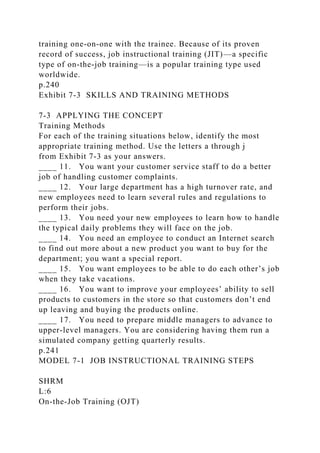
____ 11. You want your customer service staff to do a better
job of handling customer complaints.
____ 12. Your large department has a high turnover rate, and
new employees need to learn several rules and regulations to
perform their jobs.
____ 13. You need your new employees to learn how to handle
the typical daily problems they will face on the job.
____ 14. You need an employee to conduct an Internet search
to find out more about a new product you want to buy for the
department; you want a special report.
____ 15. You want employees to be able to do each other’s job
when they take vacations.
____ 16. You want to improve your employees’ ability to sell
products to customers in the store so that customers don’t end
up leaving and buying the products online.
____ 17. You need to prepare middle managers to advance to
upper-level managers. You are considering having them run a
simulated company getting quarterly results.
p.241
MODEL 7-1 JOB INSTRUCTIONAL TRAINING STEPS
SHRM
L:6
On-the-Job Training (OJT)
JOB INSTRUCTIONAL TRAINING (JIT). JIT has four steps,
presented in Model 7-1 and described here.
Step 1: Preparation of the trainee. Put the trainee at ease as you
create interest in the job and encourage questions. Explain the
task objectives and quantity and quality requirements, and
discuss their importance.
Step 2: Presentation of the task by the trainer. Perform the task
yourself slowly, explaining each step several times. Once the
trainee seems to have the steps memorized, have the trainee
explain each step as you perform the task. Prepare a written list
of the steps in complex tasks and give a copy to the trainee.
Step 3: Performance of the task by the trainee. Have the trainee
perform the task slowly while explaining each step. Correct any
errors and be willing to help the trainee perform any difficult
steps. Continue until the employee can perform the task
proficiently.
Step 4: Follow-up. Tell the trainee who is available to provide
help with any questions or problems. Gradually give the trainee
more autonomy. Begin by checking quality and quantity
frequently; then decrease the amount of checking based on the
trainee’s skill level. Watch the trainee perform the task and be
sure to correct any errors or faulty work procedures before they
become habits. Be patient and encouraging.
Even though OJT is fairly expensive on a per-person basis,
many organizations still use it heavily because of the fact that it
works very well. See Exhibit 7-4 for the advantages and
disadvantages of OJT.
John Lund/Marc Romanelli
Employees are often given on-the-job training, especially in
small businesses.
Classroom Training
Our second training option is classroom training. Classroom
training is also a common form of training in organizations. To
accomplish classroom training, the organization will create a
training course—including content, instruction methods, lesson
plans, and instructor materials—and provide all these materials
to a qualified instructor who will teach the class.
Classroom training is generally very good for consistently
transferring general knowledge or theories about a topic to a
large number of people. It is generally not very good for
teaching specific hands-on skills because of the passive nature
of learning in a classroom. However, it is effective when using
the same equipment that is used on the job. For example, many
large banks have to train lots of tellers, and they conduct teller
training in a classroom setting at headquarters, using an expert
trainer so that the employees can go to the bank and actually
begin work without any further training at the branch.
Let’s do a quick review of some of the advantages and
disadvantages of classroom training in Exhibit 7-5.
p.242
Exhibit 7-4 ON-THE-JOB TRAINING’S ADVANTAGES AND
DISADVANTAGES
Exhibit 7-5 CLASSROOM TRAINING’S ADVANTAGES AND
DISADVANTAGES
Distance or E-Learning
Our third option is some form of distance learning—also called
e-learning—in either a synchronous or an asynchronous
format. Synchronous distance learning occurs when all of the
trainees sign in to a particular Learning Management System
(LMS) such as Blackboard or Moodle, or a corporate LMS,
where their instructor then interacts with them and teaches the
topics for the day. In contrast, asynchronous distance
learning is a process in which the student can sign in to the
training site at any point in time, and materials are available for
their studies. The instructor may or may not be online at the
same time as the student, but there’s no dedicated connection
between the two for the purpose of teaching the information. In
many cases today, the student does not have to work through an
LMS. They can learn using any number of free or low-cost apps
for training in just about any field.
Distance learning, similar to classroom training, is valuable for
teaching basic concepts and providing general information on
the topic. There’s typically even less interaction between an
instructor and trainees in this form than in classroom training.
Let’s analyze some of the advantages and disadvantages of
distance learning in Exhibit 7-6.
p.243
Exhibit 7-6 DISTANCE TRAINING’S ADVANTAGES AND
DISADVANTAGES
SHRM
L:5
E-Learning and Use of Technology in Training
Self-directed learning is a specific kind of distance learning. In
self-directed learning, individuals go completely at their own
pace, and they are able to study whatever aspects of the topic
they think they need to study to be successful while leaving
other parts of the training uncompleted. Massively Open Online
Courses, or MOOCs, are primarily self-directed learning. Self-
directed training tends to have all of the potential advantages
and disadvantages of other forms of distance learning. The most
significant issue in self-directed learning tends to be the fact
that if individuals are not motivated to learn on their own, they
will be unsuccessful because nobody else is going to follow
their progress and push them to complete the training.
WORK
APPLICATION 7-11
Identify and describe the type(s) of training you received for a
job you have or had.
Simulations
The trend today is toward having more active involvement of
participants and offering online simulation training and
development.36 A simulation is a training method whereby we
may simulate a real-life situation to teach students what actions
to take in the event that they encounter the same or a similar
situation on the job. Some common examples of simulations are
flight simulators, driving simulators, and firefighting
simulations. Simulations would typically be used in situations
where actually performing an action or set of actions could lead
to significant financial cost (because of lost equipment) or
could put the trainee in significant danger of injury or death.
SHRM
Q:8
Measurement Systems
In these types of cases, providing simulations makes much more
sense than actually performing a particular task. Asking
students to perform in a simulation will also generally cause
them to go through the same set of emotions that they would go
through in the real-life situation being simulated. Training
through the use of a simulation allows the student to experience
these emotions and learn to control them in order to resolve a
complex and dangerous situation. Let’s review the advantages
and disadvantages of simulations in Exhibit 7-7.
ASSESSING TRAINING
LO 7-5
Briefly discuss the Four-Level Evaluation Method for assessing
training programs and the three common ways we measure
training success.
The fifth and last step of our training process (Exhibit 7-1) is
assessment. No matter what the training covers, we always want
to evaluate whether or not it achieved the shaped behavior
identified through our needs assessment. Training can be
designed to cause changes in a variety of employee attitudes
and behaviors; and as a result, it can be assessed in a number of
different ways, depending on what we were trying to
accomplish. In this section, we present four assessment methods
and how to choose an assessment method.
p.244
Exhibit 7-7 SIMULATION TRAINING’S ADVANTAGES AND
DISADVANTAGES
SHRM
L:4
Training Evaluation: Kirkpatrick’s Model
Assessment Methods
One of the most common assessment options, first identified by
Donald Kirkpatrick, is called the Four-Level Evaluation
Method.37 It measures reaction, learning,
behaviors, and results.
Reaction evaluations measure how the individual responds to
the actual training process. Self-reporting measures are quick
and common measures of training.38 In reaction evaluations,
the organization asks the participants how they feel about the
training process, including the content provided, the instructors,
and the knowledge that they gained by going through the
process. They may also be asked about what new skills they
have learned during the training process. This is the lowest
level of training evaluation, and it is frequently discounted due
to its subjectivity and because some people overestimate their
capabilities.39 After all, is the trainee the best person to
evaluate the knowledge they’ve gained if that knowledge is
brand new to them? Certainly, reaction evaluations are less
rigorous than some other forms of evaluation, but they still
provide the organization with valuable feedback concerning the
learners’ state of mind at the end of the training process as well
as their attitude toward the process at its conclusion. Student
course assessments are an example of reaction evaluations.
Learning evaluations are level-two measures designed to
determine what knowledge the individual gained, whether they
learned any new skills because of the training, and whether the
person’s attitudes toward their knowledge or skill set has
changed as a result of the training. Learning evaluations are
easily done using quizzes, tests, and even topic-based
discussions. Learning evaluations help the organization evaluate
the skill of the instructor as well as the change in the knowledge
set of the trainee. If the instructor is inadequate as a teacher, it
should show up in a learning evaluation measurement. We
should also be able to see whether or not the individual gained
knowledge of the subject because of the training process.
Behavior evaluations are the third level of evaluating training
processes. Behavior evaluations are designed to determine
whether or not the trainee’s on-the-job behaviors changed as a
result of the training. Behavior evaluations usually take the
form of observation of the individual on the job, after
completion of the training process. Did the process of going
through the training have a direct effect on the individual’s
post-training job performance? The behavior evaluation is
specifically designed to identify whether or not the individual is
able to transfer the knowledge gained into new skills that they
then use in their work.
p.245
©iStockphoto.com/monkeybusinessimages
The Four-Level Evaluation Method helps managers measure the
effectiveness of employee training.
Results evaluation is the fourth and final level of training
evaluation. In a results evaluation, we try to determine whether
or not individual behavioral changes have improved
organizational results. In other words, we look at the
organization’s bottom line to determine whether or not
productivity has increased. This is the level at which ROI is
measured and evaluated to see whether or not the training has
paid off for the company. However, ROI is not the only thing
that we measure at this level. Other results that we may measure
include increased quality of work, lower absenteeism and
turnover, reductions in rework and scrap, lower on-the-job
accident rates, and many others. What we’re looking for in a
results evaluation is concrete evidence that the training resulted
in organizational changes that were valuable in some form.
WORK
APPLICATION 7-12
Which training assessment methods are used where you work or
have worked? Give examples of the training and its assessment
method.
Choosing Assessment Methods
Why not just evaluate all of our training programs at each of the
four levels? The primary reason is that it costs the organization
money to go through the evaluation process. So we don’t want
to evaluate something unless we need to. In fact, as we go from
levels 1 through 4, the cost of evaluating the training process
increases with each level. Let’s identify when we might use
each of the four evaluation levels.
SHRM
L:8
Transfer of Training: Design Issues, Facilitating Transfer
Reaction evaluations (level 1) help us identify employee
attitudes toward the training process. If, in fact, the training
process has been designed to change employee attitudes such as
motivation toward their work or satisfaction with their job,
level 1 evaluation may be critical. The perception of the trainee
in this case may be more important in changing their level of
motivation and job satisfaction than any new skills that they
actually learned.
Learning evaluations (level 2) are used if there’s a need to
evaluate more than employee attitude. We may wish to be
certain that the trainee has gained a depth of knowledge of a
particular issue to ensure that they are capable of putting their
knowledge to use. For instance, to comply with federal
harassment statutes, all US businesses need to ensure that their
employees are trained on the concept of sexual harassment and
how to avoid it. If we want to be certain that our employees
know what sexual harassment is, we may choose to do a
learning evaluation of that particular training session through
giving a test.
p.246
Behavior evaluation (level 3) is needed not only to ensure that
new knowledge has been gained but also to ensure that the
individual knows how to apply that knowledge by acting in a
certain way. Performing a behavior evaluation is the only way
that we can truly measure whether or not the individual has
transferred the knowledge gained into actions that will improve
their performance. An example here would be training operators
for a nuclear power plant. Determining their attitude toward
their work and whether or not they have the innate knowledge
necessary to perform the work is insufficient in this case. It
would be critical to determine whether or not they could act
correctly to maintain and operate the nuclear reactor, so we
would observe their actual performance on the job. You can
quickly see here that we need to be absolutely certain that
they’ll take correct action—in other words, that they will
behave in the manner necessary to correct the failure.
Results evaluation (level 4) is the fourth and final level. In a
results evaluation, we’re trying to determine whether individual
behavioral changes have improved organizational results. In
other words, we’re looking at the bottom line for the
organization to determine if productivity increased. This is the
level at which ROI will be measured and evaluated in order to
see it the training has paid off for the company. However, ROI
is not the only thing that we will measure at this level. Other
results that may be measured include increased quality of work,
lower absenteeism and turnover, reductions in rework and scrap,
lower on-the-job accident rates, and many others. What we’re
looking for in a results evaluation is concrete evidence that the
training resulted in organizational changes that were valuable in
some form.
Measuring Training Success
One challenge in assessment is developing metrics to assess
training.40 Measurements of training have become significantly
more important in the past few years. We now have the capacity
to analyze large sets of data to find out how successful a
particular approach is in creating a more skilled workforce. We
also want to make sure we don’t spend money without getting
results. There are dozens of metrics for measuring training
effectiveness, but let’s take a look at a few of the most common
measures here.
7-4 APPLYING THE CONCEPT
Training Assessment Methods
Review the following assessment methods and write the letter
corresponding to each one before the situation(s) where it is
most appropriate.
a. reaction evaluation
b. learning evaluation
c. behavior evaluation
d. results evaluation
____ 18. You are a software sales manager and you want your
new sales reps to be able to demonstrate the various features of
your software.
____ 19. You are a restaurant owner who installed a new food-
ordering computer system with the objective of speeding up the
time it takes to serve meals, so you need to train employees on
how to use the new system.
____ 20. You are the HR manager and want to make sure that
your staff understands what questions they can and can’t legally
ask during the selection process.
____ 21. You are the service desk manager at a retail store and
need to train employees on how to effectively deal with angry
customers when they return merchandise. You want the
employees to remain calm and satisfy the customer.
____ 22. You are the HR manager responsible for diversity,
and you develop a training program to help employees better
understand each other and not use stereotypes so that they can
work well together.
p.247
SHRM
L:10
Determining Return on Investment (ROI)
ROI (a results metric) is probably still the measure with the
most meaning to those outside the HR department. Although it
is sometimes hard to identify how to calculate ROI in a training
situation (because of the difficulty of identifying the specific
value of the gain), in at least some cases, it can be done quickly
and easily. For instance, if a particular training program is
designed to reduce annual voluntary turnover rates and it does
so, the ROI measure would be as follows:
Average cost of turnover of one employee = $7,500
Annual voluntary turnover reduction after training = 8
employees
Total cost of training (course development, materials,
instructor, etc.) 5 $25,000
Customer satisfaction (another result) is another area where we
may want to measure training results. If we perform customer
service training and have baseline surveys on historical levels
of customer satisfaction, we can compare those levels prior to
and after the training to see whether customer satisfaction rates
went up. This will not provide a direct dollar value for the
training, but if the sales or marketing managers have data on
“value per customer” provided to the organization and rates at
which dissatisfied customers leave, and if these rates show
lower customer attrition—then this can give us the means to do
an indirect ROI calculation.
We may also want to evaluate employee satisfaction (reaction)
levels after particular types of training—especially
developmental training, which usually doesn’t give us an
immediate return on our investment. We will talk in detail about
employee job satisfaction, and why and how we measure it,
in Chapter 10. But for now, just remember that it is a predictor
of absenteeism and turnover, which both cost companies lots of
money. There are also strong correlations between job
satisfaction and customer satisfaction as well as other positive
organizational outcomes like sales performance/revenue
generation (result), individual
productivity (behavior), accuracy/quality(learning/behavior) of
work, and others.
TALENT MANAGEMENT AND DEVELOPMENT
LO 7-6
Discuss the term career and the three common methods of
employee development.
Now that you have learned about the five steps of the training
process, let’s discuss developing employees. We should realize,
however, that development programs also follow the same five
steps of the training process, as the steps listed in Exhibit 7-
1 state both training and development. Remember from the
beginning of the chapter that employee development deals
primarily with training workers for futurejobs, not their current
position. In this section, we discuss careers, common methods
of employee development, and a model of career development
consequences.
HRM in Action
Training Employees
Careers
What is a career? Is a career in the 21st century the same as a
career in the 1960s or 1970s? Do individuals today go through
just one or many careers throughout their work life? Half a
century ago, a large percentage of people would spend their
entire work life with one company. This obviously does not
happen very often in modern organizations. In fact, there’s
much evidence that says that you will likely have several
changes in career throughout your work life.
A Bureau of Labor Statistics survey that followed individuals
born between 1957 and 1964 cited an average of 11 jobs per
person in this group. The report defined a job as an
uninterrupted period of work with a particular employer.41 So,
if we defined a career as we did in the 1960s and said that to
have a successful career, you had to go to work after graduating
from college, stay with that employer for 40 years while moving
upward through a progression of jobs from lower levels to
higher levels, and then retire with a pension, very few of us
today would have a “successful” career. Obviously, then, the
concept of career has changed.
p.248
SHRM
T:1
Definition of a Career
So how do we define a career in the 21st century workforce?
Douglas Hall defined career as a process where the person, not
the organization, is the manager of the process. His definition
states: “A career is the individually perceived sequence of
attitudes and behaviors associated with work-related
experiences and activities over the span of the person’s
life.”42 Whew! Let’s break this definition down into its
subcomponents.
“Individually perceived.” This definition of the
term career relies heavily on the perception of the individual
who is making the judgment concerning success or failure of the
career. So, whether or not a career is defined as successful or a
failure is determined within the individual’s own mind. If you
go through 4, or 5, or 10 different jobs in your lifetime, and if
you perceive that as being successful, then you are a success. If
you perceive it as a failure, then you have failed.
“Sequence of attitudes and behaviors.” A career consists of both
attitudes and behaviors, so it is not only what you do; it’s also
the way you feel about what you do and how well you think
you’ve done over time. What is an attitude? Attitude is simply a
positive or negative individual judgment about a particular
situation. So your career involves not only the things that you
do but also the way you think and how you feel about your
progression of jobs over time.
SHRM
T:2
Balancing Work and Life
“Associated with work-related experiences and activities over
the span of the person’s life.” The definition of career involves
not only the direct work that is done but also all work-related
experiences and activities. So, even nonwork activities that are
work related, such as training off-site, would be included in our
definition of career. We can even extend this to the way your
family and friends interact with you and your job, and we can
say that any interaction of family, friends, and work could help
define your career. This is one place where attitudes come into
play. Your friends and family know how you feel about your job
and how it allows you to interact with others or prevents you
from interacting with others in different circumstances. Using
this definition of career avoids the problem of having to
confront the fact that by the 1960s definition, most of us would
fail to have a successful career; and it also allows us to take
into account the significant factors of perception and attitude.
SHRM
E:5
Training and Development: Vocational and Career Counseling/
Career Pathing
Why Career Development?
Twenty-first century organizations need to provide our
employees with reasonable career paths and career counseling
so that they can achieve their personal goals over the course of
their career. These services can create significant motivation in
our workforce that, as we noted earlier, can lead to a major
improvement in productivity and job satisfaction as well as
lower absenteeism and turnover.43
SHRM
T:9
Career Development
The first factor that has caused companies to become more
concerned with career development is the nature of jobs in a
modern organization. Recall from Chapter 2that many of our
jobs are knowledge management jobs and that the individuals
who fill these jobs have special skills. Because people with
these special skills (human intellectual capital) are in short
supply, the organization cannot afford to lose individuals with
such abilities. So we spend significant amounts of time and
money on developing them, which can help the organization
reduce turnover of highly skilled employees.
SHRM
L:12
Human/Intellectual Capital
Another issue is that the national culture of the United States
has changed in the past 30 to 40 years, and the millennial
generation of workers (many of you) have significantly
different expectations of what they are going to be able to do in
their careers than did their parents. millennial workers expect to
have significant freedom at work to do what they think they
need to do and make the money that they expect to make. Such
high expectations create difficulty for organizations. We have to
create policies and procedures that will not harm these
individuals’ initiative to work but that will also cause them to
recognize the realities of the workplace. Through the process of
career development, we can show these younger workers how
they can progress in their careers, be entrepreneurial, and reach
their personal career goals.
p.249
The next major reason for career development is the significant
continuing pressure that organizations are getting from
governments to provide career paths for individuals who have
historically been disadvantaged. Even though there are many
different EEO laws on the books and we have had such laws for
over 50 years, there’s still a significant disparity between the
number of Caucasian male managers and managers from all
other groups.44 Career development programs can create career
paths for individuals who are members of these disadvantaged
groups and who are qualified to go into management or other
professional programs. This not only helps the individual
employee; it also assists the organization in its diversity efforts.
Finally, good employee development and career planning
programs can help the organization avoid productivity and
disciplinary problems associated with employees who are
stagnating in a particular job. This may be due to career
plateauing. A career plateau occurs when an individual feels
unchallenged in their current job and has little or no chance of
advancement. If our employees feel as if their career has
stagnated, they are more likely to become disciplinary
problems. We may be able to avoid such problems by providing
the opportunity for individuals to progress in their career over
time.
SHRM
T:7
Plateauing
There are many other reasons for career development, but these
are some of the most common issues. So as you can see, there
are a number of reasons why career planning has become a
major issue to 21st century organizations.
Common Methods of Employee Development
So we need to develop our employees. How do we go about
doing that? Can we outsource the development function to
organizations with specific expertise in that field, or should we
perform this function in-house? There are a series of common
methods that organizations use, including the outsourcing
option, or internal development through formal education,
experience, and assessments. Let’s go through a brief
description of each of these options for development.
OUTSOURCING EMPLOYEE DEVELOPMENT. Based on a
recent survey by ADP, “91 percent of large companies and 80
percent of midsized companies” say that outsourcing one or
more HR functions provides “real value.”45 Outsourcing of the
training and development function significantly lags other
functions in the HR department, though.46 Even so, modern
organizations must evaluate whether or not outsourcing of the
training and development functions makes sense. If the
company can reduce costs for training and development as well
as improve the quality of the development function, it may
make sense for the organization to consider outsourcing of these
functions.
SHRM
L:7; Q:13
Outsourcing Employee Development
Probably the most significant strategic issue in any outsourcing
debate is whether or not the organization might lose control of
key processes or functions that have historically been performed
within the company. If training and development are critical
functions within the organization that help us maintain or
advance our competitive advantage over rivals, we can ill afford
to outsource those functions.
SHRM
L:9
Employee Development: Formal Education, Experience,
Assessment
FORMAL EDUCATION. Our first internal method of employee
development, formal education, provides employees the
opportunity to participate in programs that will improve their
general knowledge in areas such as finance, project
management, or logistics. These formal education opportunities
include such things as degree programs at colleges and
universities, short courses of study that are available from many
different sources (including private training firms and public
agencies), and courses in community colleges. Such formal
education courses may be held with any of the training and
delivery methods discussed earlier.
The intent of formal education programs is to provide the
student with a specific set of information about a particular
topic. Through formal education, we can provide programs for
every individual within the organization, from the executives
down to the first-line supervisors. At the executive level, we
might send a strong midlevel manager from the company to a
university executive MBA program. In contrast, at the
supervisor level, the organization would probably want new
first-line supervisors to go through courses that teach
supervisory skills, leadership, coaching, and basic financial
analysis. Many organizations pay part or all of the cost of
formal education for their employees.
p.250
EXPERIENCE. Employee development programs that use
experience as a method for developing the individual would
seek to put the person through a number of different types of
job-related experiences over time. Such an experience-based
program might include job rotation to provide them with a wide
range of experiences within the company. This allows the
person to see more of what goes on within the organization and
how each job ties to others.
Experience-based employee development might also include the
use of coaches or mentors for the individual. The coach or
mentor will work with the person to identify how these different
job experiences help the individual to learn and grow within the
organization.47 Development using job experience can
successfully be used from the executive level all the way down
to the level of work teams within the organization. In fact,
there’s significant evidence that career experience, team
experience, and job-related skills are all related to higher levels
of team performance.48
In today’s flatter organizations, it has become more difficult to
climb the old corporate ladder. Plus, younger workers become
bored doing the same job. Therefore, giving employees a variety
of experience through lateral jobs that provide new challenges
and experience, with pay raises, may help to keep employees
satisfied and with the organization.
WORK
APPLICATION 7-13
State some of your career goals and the methods you will use to
develop yourself to meet these goals.
EMPLOYEE ASSESSMENT. There are a number of different
assessment tools that provide individuals with information
about how they think, how they interact with others, and how
they manage their own actions and emotions. These assessments
provide individuals with information that allows them to
understand better how they can manage others within the
organization. Some of the more common measures include
psychological assessments, emotional intelligence tests, and
performance appraisals. Each of these assessments, if properly
used, provides individuals with information that can be used to
modify the way that they interact with others within the
organization. We will review performance appraisals in the next
chapter. However, let’s take a look at the other two options
now.
SHRM
Q:3
Emotional Intelligence
Psychological Assessments. These have gained significant
acceptance within the workplace, and they include tests such as
the Myers-Briggs Type Indicator (MBTI), the Birkman Method,
and the Benchmarks Assessment tool. Each of the psychological
assessment tools provides information about the person’s style
of thinking, interacting with others, management, and
leadership.
The MBTI is probably the most common personality-type
assessment used for employee development, but each of the
tests has advantages and disadvantages compared to the other
options. However, the validity and reliability of any of the
common forms of psychological assessment have been
questioned by various researchers.49 Even with the weaknesses
in validity and reliability, several of the personality assessment
tools have been in use for many years and have shown
legitimate real-world value in assessing the basic type of
personality exhibited by individual employees within the
organization.
Emotional Intelligence. Emotional intelligence is the way that
we identify, understand, and use our own emotions as well as
the emotions of others to promote our working relationships. It
is an important part of human relations skills. Emotional
intelligence is also referred to as an emotional quotient (EQ),
making it similar to intelligence quotient (IQ). It is said that to
be highly successful, a person needs a high IQ, a high EQ, and
training on what to do to succeed.
p.251
Emotional intelligence has also been described as “Our Most
Versatile Tool for Success.”50 Author James Runde says, “What
I found was that EQ was the secret sauce to career
success.”51 We also now know that “regulating negative
emotions is critical to peak performance”52 in any work we
perform, so how do we analyze EQ? The Mayer-Salovey-Caruso
Emotional Intelligence Test (MSCEIT) is one of the more
common tools used to measure emotional intelligence. The
MSCEIT consists of four pieces: perceiving emotion (the ability
to identify your own and others’ emotions), the use of emotion
to facilitate thought (the ability to use emotions to focus
attention and to think more rationally, logically, and
creatively), understanding emotion (the ability to analyze and
evaluate your own and others’ emotions), and managing
emotion (the ability to adjust emotions of yourself and
others).53
Here again, the validity and reliability of the tests are still in
some question. However, as with personality assessments,
there’s at least some evidence in the business arena that higher
levels of emotional intelligence provide employees with a
greater chance of success as they move up in the
organization.54
A Model of Career Development Consequences
Because the organization and the individual have joint
responsibility for career planning and development, both will
suffer significant consequences if the planning isn’t done
successfully. Individual employees go through a series of career
stages as they progress through their work life. Within each of
these stages, the employee has different needs that the
organization must meet so the relationship between the two can
remain stable and the worker will continue to be motivated to
produce for the organization. Organizations must respond
successfully to the individual employee based on the
employee’s current career stage.
Let’s discuss the commonly identified stages of career
development first identified by Donald Super and Douglas
Hall.55 You can see them summarized in the first section
of Exhibit 7-8.
Exploration. The first career development stage, called
the exploration stage, is the period of time during which the
individual is identifying the personal needs that will be satisfied
by a particular type of work, the types of jobs that interest
them, and the skill sets necessary to be able to accomplish those
types of jobs. This stage is usually identified as being between
the ages of 15 and 24.
Exhibit 7-8 CAREER STAGES AND THE HIERARCHY OF
NEEDS
p.252
Establishment. The second stage, called establishment, is the
period when the individual has entered into a career and
becomes concerned with building a skill set, developing work
relationships, and advancing and stabilizing their career. In the
establishment phase, we see the individual begin to make
significant personal contributions to their career in the
organization and begin to create relationships or alliances with
coworkers that allow them to become more secure within the
organization. This stage is usually identified as covering
approximately age 25 through the mid-40s.
Maintenance. This is the third stage of career development. The
maintenance stage covers the period from the mid-40s to age 60
years old or older. In the maintenance stage, the individual
typically continues to advance but begins to seek personal
satisfaction in the jobs that they perform for the organization.
This is the phase where we see individual employees begin to
act as mentors or trainers to their younger coworkers and to act
to improve the organization and its processes and policies
because they see a need to do so.
Disengagement. Finally, the fourth stage is identified as
the disengagement stage. This stage typically shows lower
levels of output and productivity as the individual prepares for
life after work. During this stage, because of the desire to
balance nonwork with work activities, the individual may begin
to choose to work only on efforts they feel are necessary or
worthy of their attention. They may continue to mentor or
sponsor other individuals in the organization as those others
progress through their own careers. Obviously, this stage goes
from the early 60s to whatever point at which the individual
finally completely disengages from the organization through
retirement.
You may be wondering why these career stages matter. Let’s
take a look now at the second part of Exhibit 7-8. We have
added Abraham Maslow’s Hierarchy of Needs below each of the
career stages. It’s rather surprising how closely Maslow’s needs
hierarchy matches up with our career stages. We could
accomplish a similar matching process with many other
motivation theories, but this one serves to illustrate why career
stages matter so much to managers in the organization, and
especially to HR management.
WORK
APPLICATION 7-14
Identify the level of career development you are on.
Using Exhibit 7-8, but in your own words, describe your career
stage and the Maslow motivational issues you are dealing with
now.
What are people most concerned with at the earliest career stage
or when they have to fall back to a lower level of work? They
are typically most concerned with physical and safety/security
issues, right? Are they physically able to get the basic
things that they need in order to live and work—like money for
shelter, food to eat, fuel for their car? Are they getting paid
enough to survive and be safe? Then, as they get into the
establishment and maintenance stages, they become more
concerned with social interactions and then gaining status and
recognition as organizational leaders. Finally, as they move to
the disengagement stage, they are more concerned with higher-
level esteem needs such as self-respect, achievement of personal
goals, and being able to do the things that they think are
important. So, we see people go through these different
motivational points in their life as they go through their career.
It’s very interesting that the career stages follow almost exactly
with what the motivation theories show us.
Now that we understand a little bit about the career stages that
individuals go through during their work life and how those
stages identify what might motivate workers in a particular
stage, let’s match those up with organizational HR strategies
that are available to reinforce employee behavior. This will give
us a general working model of how organizational HR strategies
can create either positive or negative consequences for both the
individual and the organization, depending on how the HR
strategies are applied in a particular situation. Take a look
at Exhibit 7-9. We have individual career stages identified on
the left side of the diagram. On the right side are some of the
major organizational HR strategies that are available.
Depending on how the HR strategies are applied, and based on
the individual’s career stage and motivating factors, we end up
with either positive or negative consequences to both the
individual and the organization.
If we apply the correct HR strategy or strategies to an
individual employee based on the factors that motivate the
employee, we can improve each of the major organizational
dependent variables that we identified in Chapter 1—job
satisfaction, productivity, absenteeism, and turnover. In
addition, there are several other organizational factors that can
either improve or decline based on the application (or lack
thereof) of the correct HR strategy. These factors include labor
costs, organizational safety, employee lawsuits, and
organizational reputation, among others. So as you can see, if
the organization fails to apply the correct strategy to motivate
the employee (based on the employee’s current career stage),
the consequences can be severe.
p.253
Exhibit 7-9 CONSEQUENCES OF CAREER PLANNING
On the other side of the diagram, the consequences to the
employee are equally significant. If the organization applies the
correct types of HR strategies to develop the employee
successfully over time, individual feelings of accomplishment
and achievement increase, self-worth and self-reliance increase,
the employee’s sense of security increases, and their morale is
likely to increase due to higher individual satisfaction levels.
Again, if the strategies applied are unsuccessful, each of these
individual consequences can become negative. After looking at
the model, it should become obvious that successfully applying
HR strategies to individual employees based on their personal
motivating factors and career stage is critical to overall
organizational success over time.
So now you know why it’s so important to create career paths
for our employees within the organization and provide employee
development opportunities. If we do these things successfully,
we end up with a series of positive consequences for both the
organization and the individuals involved. We have better
productivity, better job satisfaction and employee engagement,
and lower absenteeism and turnover. However, if we fail to do
these things successfully, a series of negative consequences can
occur that ultimately cost both the organization and the
individual time and money. Employee development is a critical
piece in the organizational puzzle in order to provide long-term
success.
p.254
TRENDS AND ISSUES IN HRM
LO 7-7
Describe the concepts of gamification, digital learning, and
micro-learning, and the reasons that they have become more
critical in today’s organizations.
Let’s take a look now at a couple of current trends and issues in
training and development. The first trend involves the
“gamification” of training and development and where it has
been over the past several years, and the second looks at the
issues of digital and micro-learning and their necessity in
today’s workforce.
Gamification—A Phoenix Rising?
A 2017 article by author Simon Parkin asks, “Was Gamification
a Terrible Lie?”56 Gamification continues to be a major trend
in organizational training, but it has had its ups and downs in
the past few years. Gamification is the process of designing and
utilizing video, social media, and other game technologies to
teach the player a business concept. It gained popularity a few
years ago, but some early attempts did not provide the learning
outcomes that were expected because of poor training design so
it fell out of favor with some companies. Technology providers
that jumped into gamification programs and apps, although they
were not well versed in training and learning, have now washed
out of the market though; and gamification is making a
comeback in some circles. In many cases gamification is simply
a new form of simulation training. It is being used for training
in areas such as corporate values training, leadership
development, customer service training, technical training, and
more. It is also being used by a diverse group of organizations
including Unilever, the Department of Defense, Weight
Watchers, and Nike, so you can see that it isn’t just useful in
technology companies.57
Gamification is not a panacea for what is ailing a corporate
learning and development program. There is at least some
evidence that it does not improve long-term retention of
concepts learned in training environments in all training
situations. In fact, in some cases, traditional classroom learning
has been shown to outperform various types of gamification or
social learning.58 What problems do we continue to see in
learning using gamification? One issue has been the fact that
gamification has been overhyped as a cure-all for training
problems. Another common problem is that the player may
become wrapped up in playing the game, and not
understand why a result occurs, and will therefore miss the
lesson to be learned. A third issue is poor game design—about
80% of them still fail to meet business objectives because the
provider does not understand basic learning theories. However,
one of the key challenges with training has always been to get
people engaged in the process, and the evidence is mounting
that gamification can help with engagement and ultimately get
people to learn and retain key information for work.
The Corporate Learning Imperative
Employers today are concerned that their workers don’t have
the skills necessary to compete in modern organizations. In a
recent Gallup poll, almost 90 percent of business leaders said
that college graduates did not have the necessary skill sets for
the workplace.59 Other studies note that existing employee skill
sets go stale at an alarming rate as well. Partially as a result of
this lack of confidence in employee skills, US and European
companies continue to increase their spending on internal talent
development. Each year from 2010 through 2015 companies
increased their spending on employee training, and that trend
appears to be continuing.60,61
There is a problem with corporate learning environments
though—no large blocks of time to learn. The average employee
has about 25 minutes a week to “slow down and learn.”62 One
manager noted, “Even TED Talks are now too long” in many
cases!63 As a result of this problem, companies are exploring
various forms of digital learning that can provide just-in-time
content that is compact and valuable. Digital
learning, according to Josh Bersin of Bersin by Deloitte, is
“employee-directed, intelligent-machine driven, and brings
“learning to where employees are.”64
One solution to the problem of lack of time for training is
micro-learning. Micro-learning is a learning form that uses
“small, specific bursts” or chunks to learn a single piece of
content that the user needs to know to solve a problem right
now.65 Micro-learning as a form of digital learning allows
around the clock access in many cases—whenever, wherever,
however the employee wants to access it. Most micro-learning
takes less than 5 minutes and includes a quiz.66 Micro-learning
“is effective, but limited,” according to Stanford neuroscientist
Priya Rajasethupathy67—it is designed to answer specific
questions, quickly, during the course of doing the work—but it
is one tool available for learning on the fly. However, other
continued learning will be necessary for workers in modern
organizations.
p.255
Life-long learning will continue to become more
necessary.68 Many times a professor will hear “I’ll be glad
when I graduate. I’ll never have to go to class again” from one
of their students and will chuckle. The professor knows that
their student will be “going to class” constantly for the rest of
their work life. Executives note that the average “shelf life” of
skills associated with a college degree is 5 years.69HR
managers will need to understand the new technologies
available and the new ways that their employees learn, and will
have to adapt to each challenge to enable the self-directed
training that will become a more important part of the
workplace.
Want a better grade?
Get the tools you need to sharpen your study skills. Access
practice quizzes, eFlashcards, video and multimedia, and more
at edge.sagepub.com/lussierhrm3e.
DIGITAL RESOURCES
Training*
Training and Development
Experiential Learning as Management Development
Onboarding*
Bloom’s Taxonomy
Effects of Training in Universal Design for Learning on
Lesson Plan Development
Evaluating Training Programs*
Classical Conditioning
* premium video only available in the interactive eBook
p.256
CHAPTER SUMMARY
7-1.Discuss the major difference between training and
development and identify the common situations where training
may be needed.
Training is designed to provide employees with the knowledge,
skills, and abilities (KSAs) that they need to succeed in their
work for the organization. Training is primarily intended to be
put to immediate use by the individual being trained. Employee
development is designed to teach our workers how to move up
in the organization in the future by becoming skilled at those
tasks that they will need to know how to do to perform higher-
level jobs.
The most common points at which managers should consider
workforce training include new-employee orientation, which is
used to acculturate new employees to the organization and its
culture and to prepare them to do their own job within the
organization; when processes or procedures have
changed; whenever there has been some failure to
performsuccessfully; or when employee
development opportunities come up, allowing the company to
develop current employees’ skills and abilities so that they are
able to move into higher-level jobs within the organization.
7-2.Briefly discuss the steps in the training and development
process and the common challenges to the process.
The first step involves conducting a needs assessment to
identify the type of training needed. The second step involves
selecting how to shape employee behavior. The third step
involves designing the training by selecting training methods.
The fourth step involves selecting the delivery method and
delivering the training. The last step involves assessing the
training to determine if employee behavior has changed to
improve performance—if not, return to step one. The steps are
so closely related and based on each other that they are
commonly planned together before actually delivering the
training.
Common challenges to the training process include unprepared
workers, difficulty in identifying the ROI provided from
training, employee resistance to changes in processes and
procedures, matching the training to the company’s strategic
goals, and logistics issues—including scheduling and locations
available for training courses.
7-3.Identify the three common learning theories and how they
are used to create the four methods for shaping behavior.
The three common learning theories are classical conditioning,
operant conditioning, and social learning theory. Classical
conditioning results in direct, involuntary, learned behaviors.
Operant conditioning results in direct, voluntary, learned
behaviors. Social learning is experienced through watching the
actions of other people and witnessing the consequences of their
actions, so it is voluntary and learned, but it is based on indirect
consequences of the actions of others.
We can use the operant conditioning and social learning
concepts of reward and punishmentto create the four options for
shaping behavior. These include positive reinforcement,
negative reinforcement, punishment, and extinction. Positive
reinforcement involves the application of a reward in response
to a person’s behavior in order to increase the chances that that
behavior will be repeated. Negative reinforcement involves the
withdrawal of a noxious stimulus, or a negative thing, in
response to a person’s positive behavior to increase the chances
that the behavior will be repeated. Punishment occurs either
when a noxious stimulus is applied or when a reward is taken
away in response to a negative behavior. Extinction provides no
reinforcement, either positive or negative, to the actions of the
subject.
7-4.Discuss each of the major training delivery types.
On-the-job training (OJT) is done at the work site with the
resources the employee uses to perform the job, and it is
conducted one-on-one with the trainee. In classroom
training, the organization creates a training course and provides
a qualified instructor to teach the class in a single location at a
specific time. Distance learning, also called e-learning, allows
the students to sign in to the training site and provides materials
to them for their studies. There’s typically less interaction
between an instructor and trainee than in OJT or classroom
training. Simulations mimic a real-life situation to teach
students what actions to take in the event that they encounter
the same or a similar situation in their job.
7-5.Briefly discuss the Four-Level Evaluation Method for
assessing training programs and the three common ways we
measure training success.
The four-level evaluation method
measures reaction,learning,behaviors, and results. In reaction
evaluations, we ask the participants how they feel about the
training process, including the content provided, the
instructor(s), and the knowledge that they gained. Learning
evaluations are designed to determine what knowledge was
gained by the individual, whether any new skills have been
learned, and whether attitudes have changed as a result of the
training. Behavior evaluations are designed to determine
whether or not the trainee’s on-the-job behaviors changed as a
result of the training. In a results evaluation, we try to
determine whether or not individual behavioral changes have
improved organizational results. This is the level at which ROI
will be measured and evaluated.
ROI, customer satisfaction and employee satisfaction were
discussed as ways to measure training success. ROI and
customer service are results metrics, while employee
satisfaction is a reaction metric. There are strong correlations
between employee satisfaction and customer satisfaction, and
indirect relationships with ROI through individual productivity
and accuracy/quality of work.
7-6.Discuss the termcareerand the three common methods of
employee development.
Our definition of a career is “the individually perceived
sequence of attitudes and behaviors associated with work-
related experiences and activities over the span of the person’s
life.”
Individually perceived means that if you perceive your career as
being successful, then you are a success. If you perceive it as a
failure, then you have failed. Sequence of attitudes and
behaviors means that your career involves not only the things
that you do, but also the way you think and how you feel about
your progression of jobs over time. Associated with work-
related experiences and activities over time means that even
nonwork activities that are work related would be included in
our definition of career. Using this definition of career avoids
the problem of having to confront the fact that by the 1960s
definition, most of us would fail to have a successful career.
p.257
The three methods of employee development are formal
education, experience, and assessment. Formal
education provides the opportunity to participate in programs
that will improve general knowledge in areas such as finance,
project management, or logistics. Experience as a method for
developing the individual seeks to put the person through
different types of job-related experiences over
time. Assessment tools provide employees with information
about how they think, how they interact with others, and how
they manage their own actions and emotions.
7-7.Describe the concepts of gamification, digital learning, and
micro-learning, and the reasons that they have become more
critical in today’s organizations.
Gamification is the process of designing and utilizing video,
social media, and other game technologies to teach the player a
business concept. There is some evidence that gamification can
engage the learners better than traditional learning in some
cases and ultimately get people to learn and retain key
information for work. Digital learning is “employee-directed,
intelligent-machine driven, and brings “learning to where
employees are.” Again, engagement may increase if the
company can provide the necessary training whenever and
wherever the employee needs it. Micro-learning is one form of
digital learning. It uses small, specific bursts to learn a single
piece of content that the user needs right now, and again meets
the learner when and where he or she needs the information.
Each process gives information to solve problems that engages
the employee better than some traditional forms of learning, in
at least some cases.
KEY TERMS
career 248
career plateau 249
competency model 226
emotional intelligence 250
employee development 227
extinction 236
learning 233
needs assessment 230
negative reinforcement 236
onboarding 227
positive reinforcement 236
punishment 236
remediation 228
self-efficacy 232
training 227
KEY TERMS REVIEW
Complete each of the following statements using one of this
chapter’s key terms.
1. __________ identifies the knowledge, skills, and abilities
(KSAs) needed to perform a particular job in the organization.
2. __________ is the process of teaching employees the skills
necessary to perform a job.
3. __________ is ongoing education to improve knowledge
and skills for present and future jobs.
4. __________ is the process of introducing new employees
to the organization and their jobs.
5. __________ is the correction of a deficiency or failure in a
process or procedure.
6. __________ is the process of analyzing the difference
between what is currently occurring within a job or jobs in
comparison with what is required—either now or in the future—
based on the organization’s operations and strategic goals.
7. __________ is whether people believe that they have the
capability to do something or attain a particular goal.
8. __________ is any relatively permanent change in
behavior that occurs as a result of experience or practice.
9. __________ is providing a reward in return for a
constructive action on the part of the subject.
10. __________ is the withdrawal of a harmful thing from the
environment in response to a positive action on the part of the
subject.
11. __________ is the application of an adverse consequence,
or the removal of a reward, in order to decrease an unwanted
behavior.
12. __________ is the total lack of response, either positive or
negative, to avoid reinforcing an undesirable behavior.
13. __________ is the individually perceived sequence of
attitudes and behaviors associated with work-related
experiences and activities over the span of a person’s life.
14. __________ occurs when an individual feels unchallenged
in their current job and has little or no chance of advancement.
15. __________ is the way that we identify, understand, and
use our own emotions as well as the emotions of others to
promote our working relationships.
COMMUNICATION SKILLS
The following critical-thinking questions can be used for class
discussion and/or for written assignments to develop
communication skills. Be sure to give complete explanations for
all answers.
1. Is the currently available workforce really not sufficiently
trained to participate in knowledge-intensive jobs? Why or why
not?
2. Think of and then list all of the items that you think should
be included in a new employee orientation. Briefly justify why
each item should be included.
3. Briefly describe a job you have or had. (If you haven’t had
a job, think of someone you know well.) If you were to be
promoted, which training method(s) would you use to train the
person to do your current job?
p.258
4. Which one of the primary delivery of training types would
you use to teach basic accounting to a group of employees?
Justify your answer.
5. Have you ever filled out an evaluation form for an
employee training class? Which type of evaluation was it? What
evidence led you to think it was this type?
6. Do you agree with the definition of a career presented in
the text? Why or why not? How would you change it?
7. Which of the reasons for creating career development
programs from the text do you feel are most valid, considering
the cost of career development programs? Justify your choice.
8. Which method of development, formal education,
experience, or assessment do you think is most valuable? Justify
your choice.
9. Identify and discuss two or three ways in which poor
application of HR strategies (Exhibit 7-9) would create
negative employee consequences.
10. If you were the lead trainer for your company, how would
you go about trying to create an organization-wide commitment
to sustainability? Why?
CASE 7-1 DOING CRUNCHES AT NESTLé: CONTINUOUS
IMPROVEMENT OF HUMAN ASSETS
With instant coffee, baby food, and bottled water in the mix,
Nestlé crunches more than just chocolate. The world’s #1 food
and drinks company in terms of sales, Nestlé is also the world
leader in coffee (Nescafé). It also makes coffee for the home-
brewing system, Nespresso. Nestlé is one of the world’s top
bottled water makers (Nestlé Waters), one of the biggest frozen
pizza makers (DiGiorno), and a big player in the pet food
business (Friskies, Purina). Its most well-known global food
brands include Buitoni, Dreyer’s, Maggi, Milkmaid, Carnation,
and Kit Kat. The company also owns Gerber Products. North
America is Nestlé’s most important market.(1)
Nestlé has over 2,000 brands, which are made in 418 factories
located in 86 countries, and employees nearly 330,000
employees selling products in 191 countries.(2) How does one
feed this growing concern? Mergers and acquisitions is one
answer, yet that does not solve the skills-gap issue faced
worldwide. The firm credits their success to their top-
down/bottom-up approach to training.
Top-Down. Their Rive-Reine International Training Centre in
Switzerland, since the late 1980s, has served as the focal point
for mentoring and training from senior management. Trainee
selection matches local domestic managers’ candidate
nominations, who hail from over 80 countries, with corporate-
driven selection criteria usually resulting in a class of 15 to 20
nationalities from differing areas of expertise.
Who teaches these classes? “Course leaders” as they are called
provide instruction to about 1,700 managers and are comprised
predominately of highly experienced executives from numerous
locations, with consultants teaching only 25% of the 70 courses
offered per annum. The courses have two differing foci: internal
operations and working with external stakeholders.
Executive Courses/Industry Analysis: This series of courses has
been created to assist managers who attended management
courses between five and ten years ago to develop the ability to
identify and work with key external stakeholders (i.e.,
customers, competitors, suppliers). The focus is on industry
analysis from the stakeholder’s point of view and the actions
they might take (i.e., What are our competitors’ mostly likely
actions and how do we counteract them?).
Management Courses/Operations and Business Value
Chain: Two-thirds of the classes in this program are taken by
managers who have been with the company 5 years or less. Here
managers learn about the firm’s business model (its internal
operations) and the underlying values that drive that model.(3)
Bottom-up. An important factor in Nestlé’s productivity is the
skill set of entry-level workers. Employers invest in the skills
of new entrants as an alternative to hiring more experienced
people, partly on grounds of cost but also for the opportunity to
shape ways of working around specific technologies and
processes and particular company values.(4)
For most employees at Nestlé to be successful, they must have a
passion for learning, and their recruitment process emphasizes
this. Once hired, employees’ training is predominately “on-the-
job” (OTJ), where an employee’s supervisor serves as mentor,
providing motivation and guidance to ensure employees’
growth. Before training can begin, whether formally or
informally, employees must possess the basic skill set necessary
for continued learning (i.e., reading, writing, computer usage,
oral communications, etc.); this is usually provided through an
employee’s schooling. In certain countries, their education may
have been inadequate and the worker may decide to improve
their skill set, especially in the area of communications. Special
programs have been established to provide such training on a
country-by-country basis. Once employees have acquired the
basic skill set, individualized development formal training
programs are created that increase workers’ knowledge, skills,
and abilities (KSAs). New employees with high school or
university qualifications inevitably enter management-training
programs in their local centers.
Local Training Centers. In addition to centralized training,
residential training centers exist for many of their local
operations—the net effect being that “people development”
occurs predominately at local centers. This decentralized
approach for employee training and development makes each
manager accountable and directly involved in employee
learning. Coaching and counseling skills are therefore
emphasized where needed through a myriad of programs.
Besides training current managers, local centers look to develop
future managers by developing supervisory skills of ex-
apprentices as well as technical personnel in the areas of IT
management, maintenance and electrical engineering.
Specialists are also “home-grown” through continuous training,
given local market and employment conditions. Those seeking a
purely administrative career path will find that OJT plays a
critical role supported by in-house training. Even at the local
level, outsourcing of training and education increases with an
employee’s rank and use of new technologies.
Production is one of the key success factors for Nestlé, and
therefore employees (two-thirds of whom work in factories)
need continuous OTJ on new factory technology and equipment;
the faster the change, the greater the need for training. New
technology also means learning how to work better and
differently with others. Team and inter-team management
training (including self-managed work teams) focusing on
developing flex-manufacturing capabilities is needed in order to
maximize equipment utilization.
p.259
Training methods are also changing with the times, especially
related to the Internet. Distance learning, the use of information
technology to deliver content, has led to the new methods of
corporate instruction and special corporate training assistants
and has allowed employees to obtain training and education that
align with their life styles. For example, employees in
Singapore are given the option to attend online, job-related
night courses, which, if they lead to some formal qualification
(i.e., certificate, diploma, degree), would qualify for cost
reimbursement.(5)
The Singapore example indicates that although there is a
commonality of training among local centers, training can be
significantly different by location. New employees at Nestlé
take management-training courses, but the approach of these
courses varies widely by country. For example, in Japan the
courses are short and usually last about 3 days each. In India,
however, the programs run for 12 months. In West African
countries, the management training programs run even longer,
typically 18–24 months.(6)
Questions
1. For what purposes does Nestlé train and develop
employees?
2. What challenges does Nestlé face in conducting their
training programs?
3. Which skill sets does Nestlé focus on in their training
programs?
4. What on-the-job training methods does Nestlé utilize in
their training programs?
5. What forms of off-the-job training are available at Nestlé?
6. What are some of the ways that Nestlé’s training programs
address career development?
7. What trends in training and development is Nestlé utilizing,
and what trends could they benefit from?
References
(1) Oliver, L. (n.d.). Nestlé S.A. Hoovers. Retrieved April 26,
2017, from http://0-
subscriber.hoovers.com.liucat.lib.liu.edu/H/company360/fulldes
cription.html?companyId=41815000000000
(2) Nestlé: At a glance. (n.d.). Retrieved April 26, 2017,
from http://www.nestle.com/aboutus/overview
(3) Francis, A. (n.d.). Case study of Nestlé: Training and
development. Retrieved April 26, 2017,
from https://www.mbaknol.com/management-case-studies/case-
study-of-nestle-training-and-development/
(4) Nestlé: Business ownership of skills. (n.d.). Retrieved
April 26, 2017,
from http://www.nestle.co.uk/productivity/owning-the-skills-
pipeline
(5) Francis, A. (n.d.). Case study of Nestlé: Training and
development. Retrieved April 26, 2017,
from https://www.mbaknol.com/management-case-studies/case-
study-of-nestle-training-and-development/
(6) Ibid.
Case created by Herbert Sherman and Theodore Vallas,
Department of Management Sciences, Long Island University
School of Business, Brooklyn Campus
CASE 7-2 GOOGLE SEARCH: BUILDING THE PROGRAM
THAT WRITES THE CODE TO FIND FEMALE TALENT
Google Inc. took Web searching to a much more sophisticated
level when it offered targeted search results from billions of
Web pages, based on a proprietary algorithm that allowed for
greater customization than did prior engines like Web Crawler
and Dogpile. Employing more than 50,000 people, Google
generates most of its revenue from advertising sales. In 2013,
its net income was close to $13 billion, and the company
showed 60% revenue growth between 2012 and 2014. Added to
that, Google has been on the top of the Fortune “Best Places to
Work” list since 2012.(1) Google is one of the best firms at
making employees feel welcomed and supported; but being in
the technology field, the company had become a “boys’ club,”
with women constituting only 30% of its entire workforce.
Alongside Google, other Silicon Valley technology giants like
Facebook, Yahoo, and LinkedIn recently disclosed their gender
and racial diversity ratios in their workplaces. On average,
Google’s workforce consists of more than 65% males, 55%
whites, and 35% Asians. The gaps between these numbers are
even wider in technology-related positions. As shown in its May
2014 report, it employs only 2% blacks and 3% Hispanics.
Google admitted that this problem required immediate action.
Google’s sharing of demographic information is a promising
sign that it is willing to change, but action speaks louder than
words.
Google took quick action and performed its own search. It
found that women were losing interest in computer sciences as a
career at an alarming rate. Only 14% of the computer science
graduates were women in 2013, and surveys indicated that less
than 1% of women expressed any interest in majoring in
computer sciences in college.(2) Google then recognized that it
could not use traditional recruitment techniques to hire women
since they were just not present in the labor pool.
Google also examined its own unique hiring processes and
concluded that they were both difficult and tedious—women
were not emerging through these processes, and Google could
not just sit back and hope to gain new female employees from a
labor pool that could not supply them.(3)
Google decided to be far more proactive in the area of women
employee development and committed $50 million for both
research and solution strategies. Its research indicated that if
women were exposed to coding at an early age, they would more
likely look favorably at a career path in computer science.(4)
Google’s research also noted that compared to the companies
led by men, tech companies led by women achieved a 35%
higher return on investment and 12% higher revenue.(5)
Google understood that its answer to this labor shortage, as well
as to greater profitability, was to show young girls how
interesting aspects of computer science could be, as well as how
lucrative, and to inspire them to pursue a career in this field.
Secondly, only 10% of the schools in the United States offered
computer science courses, so access to this field was a major
problem. To achieve its goal of more women in the workforce,
Google initiated a project called “Made With Code” (MWC) that
was designed to attract women to the sciences and, in the long
run, diminish possible gender biases in its own organization, as
well as in the field.(6)
p.260
MWC was launched as an event in New York City, with the
participation of teenage girls from local public schools; famous
female entrepreneurs; and many professional women who
utilized coding in the film, music, and fashion industries. To
increase exposure and inspiration, Google is working closely
with producers and writers in the Science & Entertainment
Exchange to have more female coders in movies and television
series.(7)
With the MWC program targeting the people who normally did
not have the access or the opportunity to pursue a career in
computer science, Google provided accelerated tech-training
programs to help them succeed in high-level tech jobs. Google
did this by offering free coding classes online to pull
extraordinary talent from the cities surrounding Silicon
Valley.(8) It also provided workshops that fostered student
collaboration on simple coding projects like 3-D printed
bracelets. Research has noted that women thrive in team
environments, and Google wanted them to understand that
teamwork is the cornerstone of software development. To this
end, Google gave an additional 3 months of free access to its
Code School to women.(9) Google hopes that the outcome of its
programs will increase younger girls’ involvement in computer
science and, in the long run, increase women’s visibility in the
profession and at Google.
Questions
1. What is a needs assessment, and how might Google use this
tool to increase the presence of women in its workforce?
2. Some might argue that Google’s “Made With Code”
program has redefined the concept of employee development.
Agree or disagree and provide an explanation supporting your
position.
3. Explain how Google’s particular situation demonstrates the
relationship between employee recruitment and employee
development, given the above discussion.
4. Explain how Google’s “Made With Code” has become an
integral part of its career planning.
5. How might the concepts of self-efficacy and reinforcement
theory help us better understand schoolgirls’ relative lack of
interest in computer science?
6. Assume that Google is ultimately successful and receives
more female applicants, whom it then hires. What suggestions
do you have for managing this new talent pool?
References
(1) Hoover’s Inc. (2014). Google Inc. Hoover’s Company
Records: In-Depth Records. Retrieved July 19, 2014, from Long
Island University Academic Database.
(2) Lapowsky, I. (2014, July 1). Google and Square recruit
girls early to tackle tech’s gender
problem. Wired.com. Retrieved
from http://www.wired.com/2014/07/girls-coding/
(3) Warnes, S. (2014, July 1). 70% male, 50% white: Why
Silicon Valley needs to diversify. Mirror.Retrieved
from http://ampp3d.mirror.co.uk/2014/07/01/70-male-50-white-
why-silicon-valley-needs-to-diversify/
(4) Mejia, P. (2014, July 11). Codes, not bros: Google pledges
$50 million to ladies in tech. Newsweek.Retrieved
from http://www.newsweek.com/codes-not-bros-google-pledges-
50-million-ladies-tech-258298/
(5) Warnes, S. (2014, July 1). 70% male, 50% white: Why
Silicon Valley needs to diversify. Mirror.Retrieved
from http://ampp3d.mirror.co.uk/2014/07/01/70-male-50-white-
why-silicon-valley-needs-to-diversify/
(6) Mejia, P. (2014, July 11). Codes, not bros: Google pledges
$50 million to ladies in tech. Newsweek.Retrieved
from http://www.newsweek.com/codes-not-bros-google-pledges-
50-million-ladies-tech-258298/
(7) Ibid.
(8) Jones, V. (2014, July 8). How to hook up tech sector with
talent. CNN. Retrieved
from http://www.cnn.com/2014/07/08/opinion/jones-tech-
minorities/
(9) Mejia, P. (2014, July 11). Codes, not bros: Google pledges
$50 million to ladies in tech. Newsweek.Retrieved
from http://www.newsweek.com/codes-not-bros-google-pledges-
50-million-ladies-tech-258298/
Case created by Herbert Sherman and Theodore Vallas,
Department of Management Sciences, Long Island University
School of Business, Brooklyn Campus
SKILL BUILDER 7-1 THE TRAINING PROCESS
Objectives
To develop your ability to conduct a needs assessment, to select
how to shape employee behavior, to design a training program
by selecting training methods, to select a method to deliver
training, and to choose an assessment method
Skills
The primary skills developed through this exercise are as
follows:
1. HR management skill—conceptual and design skills
2. SHRM 2016 Curriculum Guidebook—L: Training and
Development
Assignment
As an individual or group, select a job and write out your
answers. Follow the steps in the training process below to train
a person to do the job.
Step 1: Needs assessment. Conduct a needs assessment for the
job by developing a competency model identifying the
knowledge, skills, and abilities needed to do the job
successfully.
Step 2: Select how you will shape behavior. Be sure to specify
if you will use positive reinforcement, punishment, negative
reinforcement, or extinction. State the rewards and/or
punishment.
Step 3: Design the training. Select and describe in detail the
training method(s) you will use to shape the behavior.
Step 4: Deliver the training. Just select one of the four methods
of delivery that you will use to conduct the actual training and
describe how you will deliver the training.
Step 5: Assessment of training. Just select one of the four
assessment methods and describe in detail how you will
determine if the training did in fact shape the behavior.
p.261
Apply It
What did I learn from this experience? How will I use this
knowledge in the future?
_____________________________________________________
__
_____________________________________________________
__
_____________________________________________________
__
_____________________________________________________
__
Your instructor may ask you to do this Skill Builder in class by
breaking into groups of four to six and doing the preparation. If
so, the instructor will provide you with any necessary
information or additional instructions.
SKILL BUILDER 7-2 CAREER DEVELOPMENT
Objective
To begin to think about and develop your career plan
Skills
The primary skills developed through this exercise are as
follows:
1. HR management skill—conceptual and design skills
2. SHRM 2016 Curriculum Guidebook—L: Training and
Development
Assignment
Write out your answers to the following questions.
1. Do you now, or do you want to, work in HRM? Why? If not,
what career do you want to pursue, and why?
2. If you want to work in HR, based on your self-assessment
back in Chapter 1 or other knowledge, list your highest levels of
interest in HR disciplines. If not, what are your highest levels
of interests, functions, or disciplines within your chosen career?
3. What methods of employee development (formal education,
experience-internships and jobs, and assessment) are you using
to prepare for your career?
Apply It
What did I learn from this exercise? How will I use this
knowledge in the future?
_____________________________________________________
__
_____________________________________________________
__
Your instructor may ask you to do this Skill Builder in class by
breaking into groups of two to three and discussing your career
plans. If so, the instructor will provide you with any necessary
information or additional instructions.
Use the Harvard Business Case, “Clique Pens: The Writing
Implements Division of U.S. Homes” to answer the following
questions:
Are the products really differentiated at all in the consumers’
minds?
Does the retailer see any difference, except price? How much
spending is required to maintain their brand?
Discuss a plan to increase Clique Pen’s gross profit that will
work with their retailers and motivate their consumers.
Minimum 2 scholarly Articles References.
Minimum of 500 Words, APA Format
Your paper will be submitted to Turnitin software, No
plagiarism.
p.508
©iStockphoto.com/deimagine
14
Workplace Safety, Health, and Security
Media Library
CHAPTER 14 Media Library
PREMIUM VIDEO
HRM in Action
Employee Wellness Programs
LICENSED VIDEO
Workplace Stress
Workplace Violence
LEARNING OBJECTIVES
After studying this chapter, you should be able to do the
following:
14-1. Briefly describe what OSHA does in a worksite
inspection, the types of violations that OSHA looks for, and
employer rights during the inspection.PAGE 510
14-2. Briefly discuss EAPs, EWPs, and ergonomics and what
the value of each of these is to companies and employees.PAGE
516
14-3. Briefly discuss the causes of stress and how it can be
managed.PAGE 521
14-4. Identify the top concerns for security in the workplace
today and what can be done to make the workplace more
secure.PAGE 527
14-5. Discuss the new OSHA regulation on drug testing and
the value of wellness organizations like eDocAmerica.PAGE
533
CHAPTER OUTLINE
Workplace Safety and OSHA
The Occupational Safety and Health Act (OSH Act)
The Occupational Safety and Health Administration (OSHA)
National Institute of Occupational Safety and Health (NIOSH)
Federal Notice Posting Requirements
Employee Health
Work–Life Balance
Employee Assistance Programs (EAPs) and Employee Wellness
Programs (EWPs)
Ergonomics and Musculoskeletal Disorders (MSDs)
Safety and Health Management and Training
Stress
Functional and Dysfunctional Stress
Causes of Job Stress
Stress Management
The Stress Tug-of-War
Workplace Security
Cyber Security
Workplace Violence
Social Media for Workplace Safety and Security
Employee Selection and Screening
General Security Policies, Including Business Continuity and
Recovery
Trends and Issues in HRM
OSHA Limits Postaccident Drug Testing
eDocAmerica: Health and Wellness Online
p.509
Practitioner’s Perspective
Describing her workplace, Cindy says, “We believe a safe and
healthy workplace is a right—whether you work in a factory or
an office. Is it also an employer’s responsibility to provide for
their employees’ mental health? Not everyone may see it as an
obligation, but there is great benefit in assisting an employee
whose personal issues may be impacting their job performance.”
“I think I am going to have to take time off,” Nancy confessed
the other day. “I just can’t seem to manage everything going on
in my life, and I can’t concentrate at work.”
“I know things are tough with the divorce—but can you really
afford to miss work right now?” her coworker Chloe queried.
“Have you seen the information HR posted about the Employee
Assistance Program? Let’s get the contact information. It’s
completely confidential and available to you and your family.
Perhaps they can help. In the meantime, you can talk to your
supervisor about the new flexible work hours until things are
better.”
Could this level of support “save” a good employee? Learn
more about the issues and ethics behind workplace health,
safety, and security in Chapter 14.
SHRM HR CONTENT
See Appendix: SHRM 2016 Curriculum Guidebook for the
complete list
A. Employee and Labor Relations (required)
23. Posting requirements
B. Employment Law (required)
26. The Occupational Safety and Health Act of 1970 (OSHA)
C. Ethics (required)
6. Behavior within ethical boundaries
14. Abusive behavior—Workplace bullying
E. Job Analysis/Job Design (required)
6. Compliance with legal requirements
Ergonomics and workplace safety (work hazards and mitigation)
K. Total Rewards (required)
B. Employee Benefits
9. Employee assistance/wellness programs
17. Wellness programs
T. HR Career Planning (secondary)
4. Company policies to accommodate work and nonwork
activities
X. Workplace Health, Safety, and Security (secondary)
1. OSHA citations and penalties (required)
2. Disaster preparation, continuity, and recovery planning
3. Employee health
4. Inspection
5. Protection from retaliation
6. Safety management
7. Security concerns at work
8. Communicable diseases
9. Data security
11. Ergonomics
Get the edge on your studies. edge.sagepub.com/lussierhrm3e
• Take a quiz to find out what you’ve learned.
• Review key terms with eFlashcards.
• Watch videos that enhance chapter content.
p.510
WORKPLACE SAFETY AND OSHA
LO 14-1
Briefly describe what OSHA does in a worksite inspection, the
types of violations that OSHA looks for, and employer rights
during the inspection.
We now have a workforce that is reasonably compensated, well
trained, and productive. The next major management concern is
to keep them safe and healthy so that they can continue to
perform at high levels. This chapter will first focus on federal
workplace safety laws and regulations as well as the governing
agencies for industrial safety and health. Later in the chapter,
we will cover employee health issues—including the need for
work–life balance for our employees, employee assistance and
employee wellness programs, and stress—and how they affect
our employees. Finally, we will discuss the increasingly
important topic of workplace security from the organizational
perspective, so let’s get started.
Employees are concerned about safety.1 The HR department
commonly has responsibility for ensuring the health and safety
of employees and needs to develop policies and rules to provide
a safe environment for all groups.2 It works closely with the
other departments to enforce safety rules and maintains health
and safety records. Employee-owned PCL Construction boasts a
safety record five times better than the national average.3 A
growing area of safety concern is workplace incivility and
violence.4 As a manager, you should know the safety and
security rules, be sure your employees know them, and enforce
them to prevent accidents and acts of violence.
SHRM
B:26
The Occupational Safety and Health Act of 1970 (OSHA)
The Occupational Safety and Health Act (OSH Act)
Workplace safety is a concern for all companies, but especially
in more dangerous industries with higher death rates ranked as
construction; transportation and warehousing; agriculture,
forestry, fishing, and hunting; professional and business
services; and manufacturing.5 Most accidents such as plane
crashes,6 and 98% of truck accidents,7 are caused by human
error. To help protect employees, the Occupational Safety and
Health Act (OSH Act) of 1970 requires employers to pursue
workplace safety. Workplace safety deals with the physical
protection of people from injury or illness while on the
job. Employers must meet all Occupational Safety and Health
Administration (OSHA) safety standards, maintain records of
injuries and deaths due to workplace accidents, and submit to
on-site inspections when notified. Those who do not comply are
subject to citations and penalties, usually in the form of
fines.8 You may save a few bucks skimping on safety, but it can
be very costly, like at BP for the Gulf oil spill.
p.511
Many of you know that OSHA is a US safety and health
regulator, but did you know that employers can go to prison for
willfully failing to maintain safe work environments? You may
have heard that the walls of a building that was being
demolished in Philadelphia in 2013 caved in on a Salvation
Armystore, killing six people. The company in that
case, Campbell Construction, has been cited for willful
violations (we will discuss this term shortly) of the OSH Act,
and the general contractor, Griffin Campbell, was convicted of
involuntary manslaughter and aggravated assault in that case
and received a sentence of 15 to 30 years in prison for failing to
follow a series of safety procedures. In addition, the crane
operator subcontractor who was working on the building when it
collapsed was convicted of involuntary manslaughter.9 Willful
violations of the OSH Act that cause a death are punishable
with a fine of up to $500,000 for the organization and $250,000
and up to 6 months in prison for an individual who is found
culpable.
Today, the HR department commonly has responsibility for
ensuring the health and safety of employees. HRM works
closely with other departments and maintains health and safety
records along with managing safety training programs. As an
HR manager, it will be absolutely critical that you know the
safety rules, be sure your employees know them, and that you
and other managers enforce them to prevent accidents. In
addition to many specific requirements in the act, the general
duties clause in the OSH Act that covers all employers states
that each employer10
1. shall furnish a place of employment that is free from
recognized hazards that are causing or are likely to cause death
or serious physical harm to employees;
2. shall comply with occupational safety and health standards
and all rules, regulations, and orders issued pursuant to this Act
which are applicable to his own actions and conduct.
The general duties clause also states that each employee has
a duty to comply with occupational safety standards, rules, and
regulations.
In 1970, the year that the OSH Act was passed, job-related
accidents accounted for more than 14,000 worker deaths in the
United States.11 The good news is that the rate of fatal work
injuries has fallen, but the bad news is that in 2015 (the last
year of available Bureau of Labor Statisticsinformation), there
were still 4,836 fatalities12 and almost 3 million injuries or
illnesses, half of which required time away from work.13 This
is a rate of about 3 per 100 equivalent full-time workers. Recall
from Chapter 1 that absenteeism is one of the major concerns of
all managers, and by allowing injuries and occupational
illnesses to occur, we are contributing to that absenteeism. So
losing this many workdays, as well as more than 4,800 lives,
has to be a concern for HRM as well as line managers.
The Occupational Safety and Health Administration (OSHA)
OSHA is the division within the Department of Labor that is
charged with overseeing the OSH Act. It was created to “assure
safe and healthful working conditions for working men and
women by setting and enforcing standards and by providing
training, outreach, education and assistance.”14OSHA has broad
authority to investigate complaints and impose citations and
penalties on employers who violate the OSH Act.
WHAT DOES OSHA DO? OSHA is responsible for setting
federal safety and health standards and promulgating those
standards to employers. OSHA is also the responsible agency of
the federal government for occupational safety and health
inspections. Inspections are made without any advance notice to
the employer and are done based on the following issues (in
priority order):15
• Imminent danger
• Catastrophes (fatalities or hospitalizations)
p.512
• Worker complaints and referrals
• Targeted inspections (particular hazards, high injury rates)
• Follow-up inspections
Inspectors must identify themselves and tell the employer the
reason for the inspection upon arrival at the worksite. The
employer can decide not to allow the inspection without
an inspection warrant (a court order establishing OSHA’s
probable cause for the inspection), but this is generally not a
very good idea on a number of levels. Besides making it look
like the company might have something to hide, it wastes time,
and the inspector will be less likely to be disposed to assist the
employer in immediately correcting discrepancies that might be
found during the inspection—which will ultimately occur
anyway after the warrant is provided. In general, it makes more
sense to allow the inspection to go on, in accordance with
OSHA rules.16
WORK
APPLICATION 14-1
Identify any unsafe or unhealthy working conditions that you
have observed in any organization (business, sports, school,
etc.).
EMPLOYER AND EMPLOYEE RIGHTS AND
RESPONSIBILITIES UNDER OSHA. General rights of
employers and employees are shown in Exhibit 14-1. We want
to make sure that company management always stays within
their rights in interactions with OSHA.
Employer rights. Employer rights during an inspection are a bit
more specific. The employer has a right to get the inspector’s
credentials, including their name and badge number, and to
receive information on the reason for the inspection—either the
employee complaint or the program inspection
information.17 The employer also has the right to refuse to
allow the inspection without a warrant being provided (which
we have already said is generally a bad idea).
Exhibit 14-1 EMPLOYER AND EMPLOYEE RIGHTS AND
RESPONSIBILITIES UNDER OSHA
Sources: SHRM, https://www.shrm.org/resourcesandtools/hr-
topics/risk-management/pages/osha-employer-inspection-
rights.aspx; OSHA, https://www.osha.gov/Publications/3439at-
a-glance.pdf (retrieved July 31, 2017).
p.513
14-1 APPLYING THE CONCEPT
Employer Rights and Responsibilities Under OSHA
Respond yes or no to each question regarding employer rights
and responsibilities.
a. Yes
b. No
____ 1. Is it permissible to ask the inspector the reason for the
inspection?
____ 2. Henry got us into trouble with OSHA, so is it OK to
demote him?
____ 3. Is it OK to take some notes during the OSHA
inspection?
____ 4. Does OSHA require us to inform and train employees
about existing hazards in the workplace?
____ 5. Does OSHA require us to keep records of work-related
injuries or illnesses?
____ 6. Does a member of the HR staff have to accompany the
OSHA inspector during the site visit?
____ 7. Can we require employees to buy their own safety
equipment?
SHRM
X:4
Inspection
So assuming that the inspection is allowed, we need to be aware
of some things that we have a right to and that we should do
during the inspection.
• If the inspection is being conducted due to a worker
complaint, we have the right to get a copy of the complaint
(without the employee’s name), and we want to do so because
we want to know what is being alleged.
• Secondly, we have a right to have a company representative
accompany inspectors as they go through their site visit, and
we, as the HR representative, want to accompany them.
There are a few reasons to accompany the inspector. First, we
want to understand any violations that the inspector finds and
notes because sometimes, no matter how hard a person tries to
describe a problem, it will sometimes be unclear unless we see
it ourselves. Secondly, in many cases we can immediately fix a
discrepancy such as loose lines or hoses strung across a
workspace. Although the discrepancy will almost surely still be
noted, the inspector will see that we are willing to comply with
the law and OSHA regulations quickly and to the best of our
ability. This willingness can keep minor infractions from
becoming major infractions. Third, we want to make sure that
the inspection stays within the scope noted in the complaint or
the program inspection guidelines. We don’t really want the
OSHA representative wandering all over the worksite, and we
have a right to limit their movements to cover only the
inspection scope.
An employer representative also has a right to be present when
the inspector is interviewing employees (unless the interview is
private by request of the employee being interviewed) and the
right to stop interviews that are becoming confrontational or
disturbing the work environment.
The employer also has a right to inform the employees of their
rights during the inspection. The inspector will provide the
employer with a list of discrepancies upon completion of their
inspection. After an inspection, employers have a right to
contest any citations that they receive through OSHA.
SHRM
X:5
Protection From Retaliation
Employee rights. Employee rights during inspections include
the right to refuse to be interviewed, or if an employee agrees to
an interview, they can request that an employer representative
be present or that the interview be held in private. The
employee also has the right to legal representation during the
interview if they request it, and they can end the interview at
any point in time just by requesting that the interview be
discontinued. Finally, employees have a right against company
retaliation for taking part in an interview with the inspector and
telling the truth.18
p.514
14-2 APPLYING THE CONCEPT
Employee Rights and Responsibilities Under OSHA
Respond yes or no to each questions regarding employee rights
and responsibilities.
a. Yes
b. No
____ 8. Is it OK to object to the time frame for correction of
discrepancies of OSHA standards?
____ 9. Can OSHA make my employer maintain working
conditions free from any hazards?
____ 10. If I see hazardous conditions, does OSHA state that I
have to tell my supervisor?
____ 11. Do I have to wear this back brace? It is heavy and
uncomfortable, and I can’t move as well with it on.
____ 12. If I report hazardous conditions to HR, do I have to
tell them who I am?
____ 13. If an OSHA inspector interviews me, can I cover up
for the company and say we followed OSHA guidelines so we
don’t get into trouble?
____ 14. Do I have to tell my supervisor I just got hurt? I
don’t want him to be mad at me for making him do all the
paperwork.
HAZARD COMMUNICATION STANDARDS. OSHA requires
that all employers maintain information at each work site that
describes any chemical hazards that may be present on-site. A
new set of Hazard Communication Standards (HCS) was
promulgated in 2012 and can be found on the OSHA website
(http://www.osha.gov). Under federal law, “All employers with
hazardous chemicals in their workplaces are required to have a
hazard communication program, including container labels,
safety data sheets, and employee training.”19 Safety Data
Sheets (SDS) are documents that provide information on a
hazardous chemical and its characteristics. The OSHA-required
SDS format is provided in Exhibit 14-2 (Items 12–15 are
nonmandatory). The SDS provides employees with a quick
reference to the hazards of working with a particular chemical
compound.20 Electronic versions of SDS are acceptable, as long
as there are no barriers to immediate access at the worksite.
SHRM
X:1
OSHA Citations and Penalties
VIOLATIONS, CITATIONS, AND
PENALTIES. OSHA violations include the following:21
• Willful—a violation in which the employer knew that a
hazardous condition existed but made no effort to eliminate the
hazard
• Serious—a violation where the hazard could cause injury or
illness that would most likely result in death or significant
physical harm
• Other than serious—a violation where any illness or injury
likely to result from the hazard is unlikely to cause death or
serious physical harm, but the violation does have a direct
impact on employees’ safety and health
• De minimis—violations that have no direct or immediate
safety or health danger. This does not result in citations or
penalties.
• Failure to abate—violations where the employer has not
corrected a previous violation for which a citation was issued
and the settlement date has passed
• Repeated—violations where the employer has been
previously cited for the same type of violation within the
previous 5 years
WORK
APPLICATION 14-2
Identify any organization (business, sports, school, etc.) that
was cited and/or penalized for not meeting OSHA standards. Be
sure to provide details of the situation.
Willful and/or repeated violations can bring the employer up to
a $126,749 fine for each violation. Failure to abate violations
can cost the employer as much as $12,675 per day while the
violation continues to exist, and serious violations can also cost
the employer a $12,675 fine.22
p.515
Exhibit 14-2 SAFETY DATA SHEETS (SDS) FORMAT
Source: OSHA, https://www.osha.gov/dsg/hazcom/hazcom-
appendix-d.html, retrieved July 31, 2017.
National Institute of Occupational Safety and Health (NIOSH)
NIOSH works under the umbrella of the Centers for Disease
Control and Prevention (CDC). NIOSH was also created as part
of the 1970 OSH Act, and its mission is global in scope.
“[NIOSH] is the federal agency that conducts research and
makes recommendations to prevent worker injury and
illness.”23 NIOSH notes three major goals in its strategic
plan:24
• Conduct research to reduce work-related illnesses and
injuries.
• Promote safe and healthy workplaces through interventions,
recommendations, and capacity building.
• Enhance international workplace safety and health through
global collaborations.
p.516
Mark Boster / Los Angeles Times via Getty Images
Workplace safety is of critical importance to employers. Here,
Los Angeles prosecutor Hoon Chun and Deputy District
Attorney Christopher Curtis discuss the settlement for Bumble
Bee Foods’ violation of worker safety rules that caused the
death of employee Jose Melina in 2012.
NIOSH routinely works with worldwide government health
laboratories and other member nations in the World Health
Organization (WHO) to identify workplace issues that can cause
illness or injury and to create standards for the WHO member
countries. NIOSH also works hand in hand with OSHA to
identify workplace illnesses and to track diseases that can be
passed from one person to another in the work environment. It
does research on occupational safety and health topics from
ergonomics (we will discuss this shortly) to MRSA (methicillin-
resistant Staphylococcus aureus) infections and workplace
violence. NIOSH research frequently provides the data that
OSHA uses to create new workplace standards and regulations.
One of the most significant areas of research at NIOSH is
communicable disease research. Again, in conjunction with
other countries in the WHO, NIOSH has done research on a
number of respiratory diseases that can be passed from one
person to another, including tuberculosis and various strains of
flu virus. NIOSH research attempts to identify methods of
transmission and then provide guidelines for minimizing danger
of transmission of dangerous diseases that may exist in the
workplace. The entire intent of NIOSH research is to make the
workplace safer for all employees.
SHRM
X:8
Communicable Diseases
Federal Notice Posting Requirements
There are a number of notices that employers are required to
post in a convenient location frequented by employees during
normal working hours. The notices or posters contain important
information about employee rights and company responsibilities
under federal law. OSHA’s Job Safety and Health Protection
poster is one of these, but there are also other posting
requirements. Take a look at the following information for
general federally mandated posting requirements.
SHRM
A:23
Posting Requirements
The Department of Labor provides a number of posting
requirements on its website (http://www.dol.gov), and we have
reproduced some of the major ones in an abridged version
in Exhibit 14-3.25
WORK
APPLICATION 14-3
Identify safety and health posters you have seen displayed at
any organization (business, sports, school, etc.).
In addition to all of the other requirements, each state has its
own posting requirements. Most states have requirements to at
least post information on workers’ compensation,
unemployment insurance, and state minimum wage laws, while
many states have a large number of other requirements as well.
We need to become aware of and maintain knowledge of our
state’s requirements. Finally, employers must make certain that
they also notify new hires of the above information.
EMPLOYEE HEALTH
LO 14-2
Briefly discuss EAPs, EWPs, and ergonomics and what the
value of each of these is to companies and employees.
Meeting OSHA requirements is necessary, but there are many
other aspects to maintaining good employee health. Employee
health is the state of physical and psychological wellness in the
workforce. We have to consider both physical andpsychological
health in order to have a strong workforce. We need to provide
our employees with the ability to maintain both. In this section,
we are going to complete a quick review of some of the other
physical and psychological issues in today’s workplace.
Work–Life Balance
In analyzing the needs of the workforce, work–life balance is
high on the list of issues facing both employers and
employees.26 Thus, individual employees and their leaders are
seeking work–life balance.27 Work–life balance is a perpetually
hot topic.28 With mobile technology, especially the
smartphone,29 the boundary between work and nonwork hours
becomes fuzzy.30 Some 44% of Internet users regularly perform
some job tasks outside of work,31 as employees even check in
at work during their weekends and vacations, increasing the
likelihood of work–family spillover. On the other side,
employees are using company electronic devices for personal
use during work hours, such as social media and
shopping.32 Spillover is the effect of work and family on one
another that generates similarities between the two domains.33
p.517
Exhibit 14-3 DEPARTMENT OF LABOR POSTING
REQUIREMENTS FOR BUSINESSES AND OTHER
EMPLOYERS
p.518
Source: US Department of Labor.
SHRM
X:3
Employee Health
With 40% of full-time American workers logging more than 50
work hours a week,34 organizations are starting to intervene
when employees are working too many hours.35 In fact, one in
three full-time employees say, “maintaining a healthy work–life
balance has become more difficult in the last five years.”36
Although more men are getting more involved in child
care,37 and both men and women say balancing work and family
life difficulties deters them from seeking executive
roles,38 work–life balance is especially difficult for women
because of gender family responsibility inequity.39 Balance
between work and home lives is sought but rarely happens for
long because of work–family conflict. This conflict is also
linked with some other bad consequences such as stress;
absenteeism; burnout; and dissatisfaction with job, family, and
life—all of which can lead to excessive job turnover and the
breakup of families.40
p.519
SHRM
T:4
Company Policies to Accommodate Work and Nonwork
Activities
To help employees maintain a better work–life balance, the
trend is for firms to offer more work–family
benefits.41 commonly called family-friendly practices.42 For
example, employers are offering flexible work schedules so that
employees can start and end work around the times that help
them balance work and family, and they also allow their people
flexible time off to attend family activities such as parent–
teacher meetings and sporting events. Many more firms are
offering child care and elder care at or near their place of work
than in the past, and they are providing the flexibility for their
employees to select this as a standard benefit, as on-site child-
care relates to lower absenteeism.43 Some companies,
including Campbell Soup and Lowe’s, are providing seminars
and workshops on how to better balance work and life. Family-
friendly practices also include individual and family counseling
benefits to help improve family life so that it doesn’t have a
negative impact on work. Such counseling is commonly offered
through the employee assistance programs (EAP), our next
topic. For more information and help, visit the Families and
Work Institute website www.familiesandwork.org.
WORK
APPLICATION 14-4
Assess your work–life and/or school–life balance? What
percentage of your waking hours are typically devoted to work,
school, and personal life? How can you improve the balance?
Employee Assistance Programs (EAPs) and Employee Wellness
Programs (EWPs)
Two significant employee services that can assist with work–
life balance and other aspects of employee mental and physical
health are employee assistance programs (EAPs) and employee
wellness programs (EWPs), also known as workplace wellness
programs (WWPs). EAPs and EWPs continue to grow in
popularity in the United States and other countries around the
world, most likely because companies are seeing results from
the use of such programs.44
SHRM
K:B9
Employee Assistance/Wellness Programs
EAPS. An EAP is a set of counseling and other services
provided to employees that help them to resolve personal issues
that may affect their work. About three-quarters of private-
sector workers (77%) have access to an employee assistance
plan (EAP).45 An EAP is designed to assist employees in
confronting and overcoming problems in their personal life such
as marital problems or divorce, financial problems, substance
addictions, emotional problems, and many other issues. Why do
the majority of employers pay for these services? The simple
answer is that such services can save valuable employees and,
as a result, save the company money if they are available to the
employee when they are needed.46,47
SHRM
K:B17
Wellness Programs
EAPs are confidential services provided to the employee. The
employee can contact the company EAP and receive counseling
and/or treatment for emotional or other personal issues as
necessary. In some cases, EAPs may be regulated by federal
laws, including the requirements of ERISA and COBRA, so
company HR personnel need to be aware of this fact.
WORK
APPLICATION 14-5
Select an organization that offers an Employee Assistance
Program (EAP) and Employee Wellness Program (EWP).
Describe the program offerings.
EWPS. EWPs are designed to cater to the employee’s physical,
instead of psychological, welfare through education and training
programs. Wellness programs offer health education, training
and fitness, weight and lifestyle management, and health risk
assessment services to employees. The obvious goal is
improving the health of our workforce, but why? There is strong
evidence that Americans (and people in most other countries) do
not exercise enough. More than a third of Americans are obese,
with many more overweight.48 Obesity and excess weight
create all kinds of health problems, and we are seeing the
effects of overweight employees at work. Many employees have
health problems such as diabetes, high blood pressure, and heart
disease that are brought on by excess weight. Employee
wellness programs (EWPs) work to help our employees become
more healthy and fit and to lower the incidence of these types of
health problems.
HRM in Action
Employee Wellness Programs
In a now-famous Harvard Business Review article, a Harvard
lecturer said that “sitting is the smoking of our
generation.”49 A research study by the National Institutes of
Health says that “sitting for prolonged periods can compromise
metabolic health” and that “too much sitting is distinct from too
little exercise.”50 Getting people up and moving is valuable to
organizations. Companies like Johnson & Johnson claim EWPs
have succeeded in slowing health care cost increases because
they get employees moving.51 EWPs can return from $2 to $6
in lower health care and lost productivity costs for every dollar
spent.52 Another interesting effect of EWPs appears to be lower
turnover: “Healthy employees stay with your
company. . . . [O]rganizations with highly effective wellness
programs report significantly lower voluntary attrition than do
those whose programs have low effectiveness (9% vs.
15%).”53 The Affordable Care Act also provides an employer
benefit; it allows an incentive for participation in wellness
programs of up to 30% of an employee’s total health care
premium, up from a 20% premium prior to the law’s passage. So
wellness programs provide employers with high return on
investment and help with productivity, absenteeism, and
turnover. No wonder companies continue to institute these
programs.
p.520
We need to remember, though, that EWPs are also regulated at
the federal level. There is currently some concern that some
EWPs may violate provisions of the Genetic Information
Nondisclosure Act (GINA), 54 and because they are employee
welfare programs ERISA may apply. Congress is reviewing
options to allow EWPs to continue to provide incentives for
employee wellness while also being in compliance with GINA.
HR managers will want to stay apprised of changes in
regulations concerning EWPs so that they can continue to
provide wellness services to their employees without violating
federal law or regulations.
Ergonomics and Musculoskeletal Disorders (MSDs)
According to OSHA, “Ergonomics is the science of fitting
workplace conditions and job demands to the capabilities of the
working population.”55 The CDC identifies the goal of
ergonomics as being to “reduce stress and eliminate injuries and
disorders associated with the overuse of muscles, bad posture,
and repeated tasks.”56 Workplace ergonomics focuses on design
of jobs and workspaces to limit the repetitive stresses that
employees face in doing their daily work. OSHA provides
employers with a set of voluntary guidelines on ergonomics in
the workplace. These voluntary guidelines took the place of an
earlier set of more rigid rules from OSHA on ergonomics that
were rescinded by Congress in 2001.57
Several industries, including shipyards, poultry processors,
retail stores, and nursing homes, among others, have specific
sets of guidelines provided by OSHA. Other industries have the
general set of voluntary guidelines published by OSHA.58 It is
wise for the organization to know OSHA’s voluntary guidelines
for their industry even though the earlier ergonomics rule was
rescinded, because the OSHA website notes that “under the
OSH Act’s General Duty Clause, employers must keep their
workplaces free from recognized serious hazards, including
ergonomic hazards. This requirement exists whether or not there
are voluntary guidelines.”59
SHRM
E:6
Compliance With Legal Requirements
Ergonomics and Workplace Safety
In addition to the potential for enforcement actions on the part
of OSHA, it just makes sense to pay attention to ergonomics.
Musculoskeletal disorders (MSDs) affect the body’s muscles,
joints, tendons, ligaments, and nerves and can occur in many
different work environments. They can take a toll on employee
productivity when workers suffer from these issues. MSDs
include a commonly known repetitive stress injury
(RSI) called carpal tunnel syndrome in which the nerves in the
wrist become inflamed and painful, making movement difficult.
But a large number of other problems fall under the MSD
category, including other RSIs like rotator cuff syndrome,
tennis elbow, carpet layer’s knee, and many others.60 All of
these problems have the potential to cost the organization
money in the form of lost productivity as well as workers’
compensation claims. So paying attention to ergonomics at work
can both improve productivity and save the company money.
SHRM
X:11
Ergonomics
Cornell University has an ergonomics program
called CUErgo that has a large number of tools to help design
jobs that are less stressful on employees; for a listing, go to its
website at http://ergo.human.cornell.edu. It provides
information from research by the Cornell Human Factors and
Ergonomics Research Group (CHFERG).61 It also provides
information on everything from hospital work environments to
general workstation design in offices and is a great help in
identifying potential ergonomic issues in the workplace.
p.521
WORK
APPLICATION 14-6
Identify potential ergonomics and musculoskeletal disorders
(MSDs) in an industry that you work in or want to work in.
Safety and Health Management and Training
HR managers need to understand OSHArules and standards in
order to be able to make the workplace as safe as possible, and
offering EAPs and EWPs and stress management training (our
next section) is part of safety and health management.
SHRM
X:6
Safety Management
By keeping the number of accidents and incidents low, we lower
absenteeism plus increase job satisfaction. Nobody wants to
work in an unsafe environment. Because we improve two of our
four most important variables at work—absenteeism and job
satisfaction—we are almost assured of increasing productivity
over time. This is yet another way that HRM can assist in
reaching organizational goals while using the fewest
organizational resources possible.
STRESS
LO 14-3
Briefly discuss the causes of stress and how it can be managed.
People often have internal reactions to external environmental
stimuli. Stress is the body’s reaction to environmental
demands.This reaction can be emotional and/or physical and can
be caused by a lack of work–life balance.62 According
to Forbes, 35% of Americans have thought about leaving a job
because of stress at work, and 42% have actually done so!63 As
stated in Chapter 1, absenteeism is costly, and there is a
relationship between absenteeism and workplace
stress.64 Stress levels are on a continuum from low to high. But
stress is an individual perception matter. Some people are better
at handling stress than others.65 In the same situation, one
person may be very comfortable and stress free while another is
stressed out. In this section, we discuss functional and
dysfunctional stress, the causes of stress, how to manage it, and
the stress tug-of-war.
Licensed Video
Workplace Stress
WORK
APPLICATION 14-7
Describe any safety, health, and stress training offered by an
organization, preferably one you work or have worked for.
Functional and Dysfunctional Stress
Let’s begin by describing the difference between functional and
dysfunctional stress and the consequences of dysfunctional
stress.
WORK
APPLICATION 14-8
Assess your ability to deal with stress. Identify when you tend
to get stressed and the negative consequences you experience
from dysfunctional stress.
FUNCTIONAL STRESS. Stress is functional (also called acute
and eustress66 stress) when it helps improve performance by
challenging and motivating people to meet objectives. People
perform best under some pressure. Stress is an asset that
stretches capacity and fuels creativity. When deadlines are
approaching, adrenaline flows and people rise to the occasion.
Stress actually provides greater strength and focus than we
think we are capable of—so long as we are in control of it.67
DYSFUNCTIONAL STRESS. On the other hand, too much
stress is dysfunctional because it decreases
performance. Stressors are factors that may, if extreme, cause
people to feel overwhelmed by anxiety, tension, and/or
pressure. Stress that is constant, chronic, and severe can lead to
burnout over a period of time.68 Burnout is a constant lack of
interest and motivation to perform one’s job.Burnout results
from too much stress.69 Stress that is severe enough to lead to
burnout is dysfunctional stress.70
NEGATIVE CONSEQUENCES OF DYSFUNCTIONAL
STRESS. Some readers may wonder why individual stress is a
topic in an HRM text. The fact is that stress has some
significant organizational consequences due to its effects on
individual employees, so managers need to understand and be
able to recognize the symptoms of stress, and especially
dysfunctional stress because it causes mental and physical
health problems.71 More than 80% of Americans said they were
less productive at work because of stress. Excess stress costs an
estimated $300 billion a year in absenteeism; decreased
productivity; employee turnover; accidents; and medical, legal,
and insurance fees.72
p.522
Burnout can cause mental and physical health problems
including colds, weight gain, sleep dysfunction, heart disease,
depression, ulcers and other stomach problems, and back, neck,
and shoulder pain.73 Stress also weakens our immune system, it
makes us sick more often, it ages us so we look older, it makes
us fatter, it decreases our sex drive, it ruins our sleep, and it can
even kill us.74 In fact, at its extremes, stress can cause even
more serious problems. For instance, an Uber engineer was said
to have suffered so much stress on the job due to overwork that
he committed suicide.75 We should always be aware that
extreme stress can cause extreme reactions.
Causes of Job Stress
There are five common contributors to job stress: personality
type, organizational culture and change, management behavior,
type of work, and interpersonal relations.
PERSONALITY TYPE. The Type A personality is characterized
as fast-moving, hard-driving, time-conscious, competitive,
impatient, and preoccupied with work.76 The Type B
personality is pretty much the opposite of Type A. In general,
people with Type A personalities experience more stress than
people with Type B personalities. If you have a Type A
personality, you could end up with some of the problems
associated with dysfunctional stress. Complete Self-Assessment
14-1 to determine your personality type as it relates to stress.
14-1 SELF ASSESSMENT
Personality Type A or B and Stress
Identify how frequently each item applies to you at work or
school. Place a number from 1 to 5 on the line before each
statement.
_______ 1. I enjoy competition, and I work/play to win.
_______ 2. I skip meals or eat fast when there is a lot of
work to do.
_______ 3. I’m in a hurry.
_______ 4. I do more than one thing at a time.
_______ 5. I’m aggravated and upset.
_______ 6. I get irritated or anxious when I have to wait.
_______ 7. I measure progress in terms of time and
performance.
_______ 8. I push myself to work to the point of getting
tired.
_______ 9. I work on days off.
_______ 10. I set short deadlines for myself.
_______ 11. I’m not satisfied with my accomplishments for
very long.
_______ 12. I try to outperform others.
_______ 13. I get upset when my schedule has to be changed.
_______ 14. I consistently try to get more done in less time.
_______ 15. I take on more work when I already have plenty
to do.
_______ 16. I enjoy work/school more than other activities.
_______ 17. I talk and walk fast.
_______ 18. I set high standards for myself and work hard to
meet them.
_______ 19. I’m considered a hard worker by others.
_______ 20. I work at a fast pace.
_______ Total. Add up the numbers you assigned to all 20
items. Your score will range from 20 to 100. Indicate where
your score falls on the continuum below.
The higher your score, the more characteristic you are of the
Type A personality. The lower your score, the more
characteristic you are of the Type B personality.
p.523
ORGANIZATIONAL CULTURE AND CHANGE. The amount
of cooperation and motivation that a person experiences and the
level of organizational morale both affect stress levels. The
more positive the organizational culture, the less stress there is.
Organizations that push employees to high levels of
performance but do little to ensure a positive work climate
create a stressful situation. A climate with fear of layoffs can
also be extremely stressful. Plus, change is stressful to many
people, so cultures that continually make major changes can be
stressful.77
MANAGEMENT BEHAVIOR. The better managers are at
supervising employees, the less stress there is. Lack of control
tends to induce stress. Calm, participative management styles
are less stressful. Bad bosses cause employee stress. Workers
with bad bosses are more likely to report the stress-related
problems that we discussed earlier.78
TYPE OF WORK. Some types of work are more stressful than
others.79 People who have jobs that they enjoy derive more
satisfaction from their work and handle stress better than those
who do not. In some cases, changing to a job with more
enjoyable work is a wise move that can lower stress levels. This
is one major reason that people decide to make career changes.
INTERPERSONAL RELATIONS. Conflicts among people who
do not get along can be very stressful. People who don’t really
like the work they must perform but who do like the people they
work with can feel less stress and experience higher job
satisfaction.
• Time Pressure. The time pressure of a deadline can help
motivate completing the task,80 but too much time pressure of
deadlines can be very stressful.81
• Smartphones. Smartphones are actually more of a time
waster than saver, as the average person stairs at their phone
221 times per day. Repeatedly checking your phone, especially
after work hours, can be stressful. Constantly looking at your
phone creates eyestrain, and looking down puts stress on your
neck and shoulders, which can cause long-term problems.82
©iStockphoto.com/m-imagephotography
How we manage stress affects our job performance and health.
Stress Management
When we continually feel pressured and fear that we will miss
deadlines or fail, we are experiencing stress. People watch TV
or movies, drink, take drugs, eat, or sleep more than usual to
escape stress. But for the most part, these activities don’t work
in the long run because they are used mostly to escape stress
rather than to deal directly with the stress.
We can limit job stress,83 so many firms are making wellness a
top priority through training employees in stress management
because it affects the bottom line.84 EWPs (mentioned earlier
in this chapter) frequently provide stress management programs
for employees. Stress management is about taking control of
stress and making it functional.85 We can reduce stress with
stress management interventions by better recognizing and
managing stress symptoms as they occur.86 Stress
management is the process of reducing stress and making it
functional. Here are seven stress management techniques. We
don’t need to use them all because little changes can make big
differences, so just implement the techniques that interest
you.87
p.524
TIME MANAGEMENT. Generally, people with good time
management skills experience less job stress.88Vince Lombardi,
the famous football coach, said, “Plan your work and work your
plan.” Remember that procrastinating gives us more time to
think about what we have to do and to get stressed before
starting. It’s a huge relief when we finish the task. 89 If we are
perfectionists, we may do a high-quality job, but perfectionism
stresses us as we perform the work, so sometimes it’s OK to
define what is “good enough” and stop there.
RELAXATION. Relaxation is an excellent stress management
technique, and we should relax both on and off the
job. Laughter releases stress-reducing endorphins that lower
blood pressure, relax muscles, stimulate our brain, improve our
mood, and increase our oxygen intake—so laugh it up.90 In
addition, understand that each of us has our own way of
relaxing. Some will read a book; others will lie in the sun; still
others will play a game. Religious practices also combat stress,
as nearly 100 studies found a positive association between
religious involvement and better health, longevity, incomes, and
happiness.91 It doesn’t matter how you relax as long as you
relax in a way that is soothing to you.
Relaxation on the job. Use relaxation on the job and off when
feeling stress coming on by meditating or doing deep breathing
and/or muscle relaxation exercises.92
• Meditation. This can be simple. When we feel stress, we can
close our eyes and think happy thoughts to calm ourselves: for
example, picture ourselves doing something we enjoy or
visualize the ocean with waves crashing down. Meditation
works well with deep breathing.
• Deep breathing. When feeling stress, simply take five slow,
deep breaths, preferably through the nose. Hold each breath
(about 5 seconds), then let it out slowly (about 7 seconds),
preferably through lightly closed lips. To breathe deeply, we
must inhale by expanding the stomach, not the chest. Think of
the stomach as a balloon; slowly fill and then empty it. We can
also breathe deeply while performing relaxation exercises.
• Muscle relaxation exercises. When feeling stress, we can
also perform relaxation exercises. If we feel tension in one
muscle, we may do a specific relaxation exercise. We may relax
our entire body going from head to toe or vice versa. Exhibit
14-4 lists relaxation exercises that we can do almost anywhere.
Relaxation off the job. We need to relax off the job. Try to
leave work behind—don’t do any work while away, and don’t
even think about it. If you have a Type A personality, slow
down and enjoy yourself. Cultivate interests that do not relate
to the job.
• Activities. Take time for yourself and do things you enjoy to
relax and get away from work. What do you enjoy doing?
• Sleep. A good night’s sleep makes you more
productive.93 Recent research found that 7 hours of sleep a
night is the best amount of sleep to function the next day; and
skimping on a full night’s sleep, even by 20 minutes, impairs
performance and memory the next day. But too much sleep is
associated with diabetes, obesity, and cardiovascular disease.
Of course, not everyone is average, and some people need more
sleep than others.94 A lack of sleep can even cause brain
damage,95 and it also makes you more selfish and emotional,
and you are more likely to get into arguments and hurt
relationships.96
• Sleeping tips. Stress can delay sleep or reduce deep sleep.
Working, using the Internet, cellphones, text messages, and
caffeine close to bedtime can delay sleep and increase alertness.
Doing a relaxing activity, like reading, before going to bed
helps us sleep. We should shut off the TV, computer, and cell
phone, because the flickering lights from these devices
overstimulate our brain and hurt the quality of our
sleep.97 Alcohol can promote sleep initially, but it can
contribute to wakefulness later.98
p.525
Exhibit 14-4 RELAXATION EXERCISES
NUTRITION. Good health is essential to everyone’s
performance, and nutrition is a major factor in
health.99 Underlying stress can lead to overeating and
compulsive dieting, and being overweight is stressful on the
body. Unfortunately, around 34% of Americans are obese, while
another 32% are overweight.100 Men with a waist over 40
inches and women over 35 inches are twice as likely to die a
premature death.101 Obesity costs US businesses about $45
billion a year in medical expenses and lost productivity.102 Are
you overweight? Do you need to change your eating habits?
We should watch our intake of junk foods, which contain fat
(fried meat and vegetables, including French fries and chips),
sugar (pastry, candy, fruit drinks, and soda), too much caffeine
(coffee, tea, soda), and salt. Artificial sweeteners, like in coffee
and diet soda, may not have sugar or calories, but they do
increase your risk of developing diabetes and other health
problems.103 Eat more fruits and vegetables and whole grains,
and drink water and pure juices. Realize that poor nutrition,
overeating, and the use of tobacco, alcohol, and drugs to reduce
stress often create other stressful problems over a period of
time.
WORK
APPLICATION 14-9
Identify your major causes of stress; then select stress
management techniques you will use to help overcome the
causes of your stress.
When we eat, we should take our time and relax, because
rushing is stressful and can cause an upset stomach and weight
gain. Also, when people eat more slowly, they tend to eat less.
Taking a break generates energy and makes us more productive.
So we should avoid eating at our work area.
Breakfast is considered the most important meal of the day for
good reason. Getting up and going to work just drinking coffee
or soda without eating until lunch is stressful on the body. A
good breakfast increases our ability to resist stress.
EXERCISE. Contrary to the belief of many, proper exercise
increases our energy level rather than depleting it. Physical
exercise is an excellent way to improve health while releasing
stress.104 If we are stressed for any reason, the fastest way to
tame our anxiety can be physical activity. In fact, exercise is
usually more effective than antidepressants in making moderate
depression disappear.105 Staying fit can reduce the production
of stress hormones.106
p.526
Aerobic exercise, in which we increase the heart rate and
maintain it for 30 minutes, is generally considered the most
beneficial type of exercise for stress reduction. Fast walking or
jogging, biking, swimming, and aerobic dance or exercise fall
into this category. Playing sports and weight lifting are also
beneficial and can be aerobic if we don’t take many breaks and
we cross-train by mixing weights with other aerobic exercises.
Before starting an exercise program, check with a doctor to
make sure you are able to do so safely. Always remember that
the objective is to relax and reduce stress. The “no pain, no
gain” mentality applies to competitive athletes, not to stress
management.
If we don’t enjoy the workout, we most likely will not stick
with it anyway, so pick something fun or at least enjoyable, like
playing a sport. Having an exercise partner really makes
exercise more enjoyable, and it helps motivate us to show up
and exercise when we’d rather not. We may also find out that
we get in a great workout when we think we were too tired to
exercise.
POSITIVE THINKING. People with an optimistic personality
and attitude generally have less stress than
pessimists107 because thoughts of gloom and doom (which are
often distorted anyway) lead to stress.108 Once we start having
doubts about our ability to do what we have to do, we become
stressed. Make statements to yourself in the affirmative, such as
“This is easy,” and “I will do it.” Repeating positive statements
while doing deep breathing helps us relax and increase
performance.
SUPPORT NETWORK. Reaching out to supportive family,
friends, and colleagues in our network can help reduce
stress.109 So we can find a confidant at work or people outside
of the workplace and talk things through.110 Venting to people
we trust and hearing their support of our abilities relieves
stress. Being out of work–life balance is stressful, so cultivate a
supportive network of family, friends, and colleagues to help
maintain that critical work–life balance.111
CUT BACK SMARTPHONE CHECKING. Stop your addiction
to constantly looking at it. Set a time limit of frequency of
checking it (such as every half hour), or better yet shut it off for
an extended period when you can; especially when you have a
high-priority task to complete. When looking at it, hold it
higher to help avoid neck and shoulder stress.112 Also, place
your other screens (computer monitor, TV) higher so you look
up a bit to help offset your downward pressure.
The Stress Tug-of-War
Think of stress as a tug-of-war with you in the center, as
illustrated in Exhibit 14-5. On the left are causes of stress
trying to pull you toward burnout. On the right are stress
management techniques you use to keep you in the center. If the
stress becomes too powerful, it will pull us off center to the
left, and we may suffer burnout and dysfunctional stress with
low performance. If there is no stress, we tend to move to the
right and just take it easy and perform at low levels. The stress
tug-of-war is an ongoing game. Our main objective is to stay in
the center with functional stress, which leads to high levels of
performance.113
If we try stress management but still experience long-term
burnout, we should seriously consider getting out of the
situation. Ask yourself two questions: Is my long-term health
important? Is this situation worth hurting my health for? If you
answer yes and no respectively, a change of situations may be
advisable. Career changes are often made for this reason.
p.527
Exhibit 14-5 THE STRESS TUG-OF-WAR
WORKPLACE SECURITY
LO 14-4
Identify the top concerns for security in the workplace today
and what can be done to make the workplace more secure.
Workplace security is the management of personnel, equipment,
and facilities in order to protect them. While workplace safety
deals with the issue of minimizing occupational illness and
injury, workplace security covers topics such as violence in the
workplace (including bullying), bomb threats, management of
natural and man-made disasters, risk to company computer
systems and intranets, and many other issues. Workplace
security is concerned with mitigating these risks to the
organization and its members. Securitas Security Services USA,
a large security firm, identified Internet/intranet security,
workplace violence, active shooter threats, business continuity
planning, and mobile security as the top security threats to
businesses for the year 2017.114 Prior to 2010, workplace
violence had been the number-one concern for more than 10
years, but cyber security in several forms replaced it as the
number-one concern in 2010.115 Let’s take a brief look at some
of these major workplace security issues in order of concern.
SHRM
X:7
Security Concerns at Work
Cyber Security
While this is not an information systems text, let’s do a quick
review of some of the issues companies face today with cyber
security in the form of both Internet/intranet and mobile
systems security. Cyber security is the use of tools and
processes to protect organizational computer systems and
networks. This topic has been in the news constantly for the
past several years, with concerns that amateur and professional
hackers, hactivists, terrorist organizations, and even some
governments are working to break into company computer
systems and mobile devices for a variety of purposes. In 2014,
the US attorney general accused hackers working for the
Chinese government of hacking US companies,
including Westinghouse, Alcoa, and the United Steel Workers
Union.116 More recently, the Russian government was accused
of being complicit in hacking various political institutions to try
to sway the 2016 presidential election.117Every company has to
be concerned with this issue and do what they can to prevent
becoming a victim.
SHRM
X:9
Data Security
HRM is especially concerned with outsiders penetrating
company computer systems that have sensitive employee
information on them, such as information on medical records,
payroll and banking data, and other personal data. HR managers
must work with company security managers to put up strong
roadblocks to outsiders who seek to enter systems with this type
of data. In 2013, AvMed left two unsecured laptops with private
employee data on them in an unlocked conference room, and
they were stolen. The company ultimately agreed to pay a $3
million settlement to the employees for failure to safeguard
information in accordance with HIPAA.118 While there is no
foolproof way to harden company computer systems, we have to
do the best that we can to make it as hard as possible for
hackers or other unauthorized users to find and exploit
employee data. Obviously, the HR manager won’t be the person
to research and implement this type of computer security, but
we do need to know that it is an issue. We will work with our
company’s computer security managers to make it as hard as
possible to get access if a person is not an authorized user. One
simple tool is to encrypt any company computers with sensitive
data on their hard drives. This makes it much more difficult to
gain access to such information.
p.528
14-3 APPLYING THE CONCEPT
Stress Management Techniques
Put the letter of the technique being used on the line next to the
corresponding statement.
a. time management
b. relaxation
c. nutrition
d. exercise
e. positive thinking
f. support network
____ 15. “I’ve been stressed out, so I have been praying more
lately.”
____ 16. “I’ve been working on positive affirmations, so I
have been repeating to myself that ‘I can meet the deadline.’”
____ 17. “I’m not too organized, so I’ve started using a to-do
list.”
____ 18. “I’ve been taking a walk at lunchtime with Latoya.”
____ 19 “I’ve been getting up earlier and eating a healthy
breakfast.”
____ 20. “I have a bad boss, so I’ve been talking to my
colleague Tom about her.”
Workplace Violence
There were 417 workplace homicides in 2015, and workplace
shootings rose by 15%. While this is serious, and we need to
take precautions to respond if such incidents happen, we should
also understand that workplace homicides are still extremely
rare and that we should not panic over such statistics. These 417
homicides took place in an environment with tens of millions of
businesses.119So for now, let’s focus on anger that can lead to
violence and how to prevent it. Human resource managers have
reported increased violence between employees, stating it can
happen anywhere. And don’t think that this is just an issue of
men harming women. Women commit nearly a quarter of all
threats or attacks. There has also been an increase in violence
between outsiders and employees, such as customers shooting
employees and other customers. A psychiatrist at Mercy
Fitzgerald Hospital outside Philadelphia was forced to shoot a
patient after he had killed a case worker in 2014, and this is just
one of thousands of incidents that occur in the United States
alone each year.120The key to preventing workplace violence is
to recognize and handle suspicious behavior before it turns
violent;121 that’s what this subsection is all about.
Licensed Video
Workplace Violence
CAUSES OF ANGER AND VIOLENCE. Anger can lead to
violence. You have most likely heard of road rage. In business
we have desk rage, which can take the form of yelling, verbal
abuse, and physical violence. Frustration, stress, and fear also
bring out anger.122 Unresolved interpersonal conflicts make
people angry.123 In fact, violence is almost always prompted by
unresolved conflict, and the violence often takes the form of
sabotage against other employees (backstabbing, spreading false
rumors) or the organization (damage to property) to get
even.124
The physical work environment (such as space to work, noise,
odors, temperature [hot], ventilation, and color) contributes to
making people angry. A bad work environment (called toxicity)
leads to violence. People also tend to copy, or model, others’
behavior. For example, children who have been abused
(emotionally and/or physically) are more likely, as parents, to
abuse their children. If employees see others being violent,
especially managers, and nothing is done about it, they are more
apt to also use violent behavior at work. Violence in the
community surrounding an organization, including family
violence, may be brought into the workplace. Some but not all
experts also report that drugs contribute to violence.125
p.529
©iStockphoto.com/julief514
Employees need to find a healthy way to deal with conflict.
Unresolved conflict can lead to resentment, anger, and
potentially violence.
DEALING WITH ANGER
Your anger and emotional control. A secondary feeling of anger
follows many of our feelings. Your boss may surprise you with
extra work, which makes you angry. Disappointment often leads
to anger. Your coworkers don’t do their share of the work, so
you get mad at them. Buddha said, “You will not be punished
FOR your anger; you will be punished BY your anger.” Anger
can lead to perception problems and poor decisions and
hostility, which are stressful and can harm your health.126
It is natural to get angry sometimes, as we cannot control the
feeling of anger. However, we can control our behavior, and we
can learn to deal with anger in more positive ways to get rid of
it. Letting anger build up often leads initially to passively not
doing or saying anything but then later blowing up at another
person. Here are some tips for effectively getting rid of our
anger:
• Use objective, rational thinking. For example, when dealing
with customers, tell yourself, “Their anger is to be expected.
It’s part of my job to stay calm.”
• Look for positives. In many bad situations, there is some
good.
• Look for the humor in the situation to help defuse the anger.
Finding appropriate humor can help keep us from moping and
getting angry.
• Develop a positive attitude about how to deal with anger.
Develop positive affirmations such as “I stay calm when in
traffic” (not “I must stop getting mad in traffic”) and “I get
along well with Joe” (not “I must stop letting Joe get me
angry”).
• Use an anger journal. A first step to emotional control of
anger is self-awareness. Answer these questions. How often do
you get irritated/angry each day? What makes you
irritated/angry? How upset do you get? What feelings do you
have when you are angry? What behavior (yell, say specific
words, pound desk, do and say nothing, accommodate) do you
use when you are angry? Are you good at dealing with your
irritations/anger? One good way to improve your ability to
control your anger is to write the answers to these questions in
an anger journal. It is a method of letting out the anger in an
effective way. People who use a journal often change their
behavior without even trying.
Anger of others and emotional control. Here are some tips from
the Crisis Prevention Institute and the National Institute for
Occupational Safety & Health (NIOSH) to help us deal with the
anger of others through our emotional control to prevent
violence. These tips can be very valuable to us as managers:
• Never make any type of putdown statement, as it can make
the person angrier. As stated earlier, you may use appropriate
humor to cut the tension, but be careful that it is not viewed as
a sarcastic putdown. Such behavior can lead to violence.
• Don’t respond to anger and threats with the same behavior.
This is the key to success in maintaining your emotional
control.
p.530
• Don’t give orders or ultimatums. This can increase anger
and push the person to violence.
• Watch your nonverbal communications to show concern and
to avoid appearing aggressive. Use eye contact to show concern,
but be aware that staring or glaring can make you appear
aggressive. Maintain a calm, soothing tone to defuse anger and
frustration. Talking loudly and with frustration, anger, or
annoyance in your tone of voice will convey aggression. Don’t
move rapidly, point at the person, get too close (stay 2–5 feet
apart), or touch.
• Realize that anger is natural and encourage people to vent in
appropriate ways. With the aggressor, the problem is usually to
keep the behavior acceptable. With the passive person, you may
need to ask probing questions to get them to vent, such as
“What is making you angry? What did I do to make you mad?”
• Acknowledge the person’s feelings. Using reflective
responses by paraphrasing the way the person appears to be
feeling shows that we care and helps calm the person so they
can get back in control of their emotions.
• Get away from the person if necessary. If possible, call in a
third party to deal with the person and leave.
WORK
APPLICATION 14-10
Recall a situation in which someone was angry with you,
preferably at work. What was the cause of the anger? Did the
person display any signs of potential violence? If so, what were
they? How well did the person deal with their anger? Give
specific tips the person did and did not follow.
SIGNS OF POTENTIAL VIOLENCE. Workplace violence is
rarely spontaneous; it is more commonly passive-aggressive
behavior in rising steps, related to an unresolved conflict.
Employees do give warning signs that violence is possible, so it
can be prevented if we look for these signs and take action to
defuse the anger before it becomes violent.127
• Take verbal threats seriously. Most violent people do make a
threat of some kind before they act. If we hear a threat or hear
about a threat from someone else, talk to the person who made
the threat and try to resolve the issue.
• Watch nonverbal communication. Behavior such as yelling,
gestures, or other body language that conveys anger can also
indicate a threat of violence. Talk to the person to find out
what’s going on.
• Watch for stalking and harassment. It usually starts small,
but it can lead to violence. Put a stop to it.
• Watch for damage to property. If an employee kicks a desk,
punches a wall, and so on, talk to the person to get to the reason
for the behavior. People who damage property can become
violent to coworkers.
• Watch for indications of alcohol and drug use. People can be
violent under their influence. Get them out of the workplace,
and get them professional help from the EAP if it’s a recurring
problem.
• Include the isolated employee. It is common for violent
people to be employees who don’t fit in, especially if they are
picked on or harassed by coworkers. Reach out to this employee
and help them fit in or get them to a place where they do.
• Look for the presence of weapons or objects that might be
used as weapons. You may try talking to the person if you feel
safe, but get security involved if you feel the least bit unsafe.
SHRM
C:6
Behavior Within Ethical Boundaries
BULLYING IN THE WORKPLACE. Have you ever been the
victim of a bully—on the school playground or at work?
Managers do not want their company put into the news spotlight
because of such behavior. Bullying behaviors have been found
to be four times more common than sexual harassment,128 but
there are still no laws at the national level in the United States
that deal directly with bullying as an offense.129 There are
certainly ways in which managers can use existing laws when
bullying behaviors are based on protected-class characteristics
(e.g., race, religion, disability, etc.) or other illegal actions such
as assault or sexual harassment, but there is no federal law
directly associated with workplace bullying.
p.531
SHRM
C:14
Abusive Behavior: Workplace Bullying
HR managers need to know the state and local laws that can be
used for bullying behaviors, but they also need to address the
issue in company handbooks and provide training on processes
that should be used if someone suspects bullying behaviors or
are themselves a victim of such behavior.
ORGANIZATIONAL PREVENTION OF VIOLENCE. The
number-one preventive method is to train all employees to deal
with anger and prevent violence,130 which is what you are
learning now. In addition, company culture should encourage
employees to talk about any concerns about coworkers or others
that they think might be violent toward others.131 However, the
starting place is with a written policy addressing workplace
violence, and a zero-tolerance policy is the best preventive
policy. From the HR manager’s perspective, it is very important
to take quick disciplinary action against employees who are
violent at work. Follow these steps to help stop any type of
violent behavior in your organization:
1. Develop a policy on bullying and other forms of violent
behavior, defining the concepts and making it clear that such
behavior will not be tolerated.
2. Train all employees on the policy on a routine basis—
typically at least once per year and upon hiring of new
employees.
3. Develop mechanisms for reporting violent behaviors that are
outside the normal chain of command, since such behavior
frequently occurs with supervisors who have control over other
employees.
4. Investigate all reported incidents using the Just Cause
procedures that we discussed in Chapter 9.
5. Take prompt, fair disciplinary action with those individuals
who have been found to be guilty of any violent behaviors,
whether senior members of the organization or subordinate
individuals.
As discussed in Chapter 10, the organization should have a
system for dealing with grievances, and it should also track
incidents of violence as part of its policy. Organizations can
(and should when allowed by law) also screen job applicants for
past or potential violence so that they are not hired. They
should also develop a good work environment, addressing the
issues listed earlier as causes of violence. Demotions, firing,
and layoffs should be handled in a humane way following the
guidelines to deal with anger, and outplacement services to help
employees find new jobs can help cut down on violence.
Finally, it is probably prudent in most, if not all, companies to
hold training on active shooters and practice active shooter
drills on an ongoing basis.132
INDIVIDUAL PREVENTION OF VIOLENCE. One thing you
should realize is that the police department will not help
prevent personal or workplace violence. Police only get
involved after violence takes place. We have already given you
most of the tips. But here are a few more tips.133 Keep in mind
that there is always potential violence, and look for escalating
frustration and anger to defuse it before it becomes violence.
Never be alone with a potentially violent person or stand
between the person and the exit. Know when to get away from
the person, and utilize the organization policy of calling in
security help if you are concerned. Report any troubling
incidents to security staff.
Social Media for Workplace Safety and Security
We have discussed a number of areas of HRM that have been
enhanced through the use of social media. This is another case
where social media tools can assist companies in dealing with a
situation in which employees may need information quickly and
accurately. Organizations around the world are establishing
security alert systems like Rave Guardian and AlertMedia to be
used in the case of a company emergency of any type, including
a violent individual or group on organization property. The
systems use existing technology like Twitter and text messaging
to provide immediate warnings to all persons who are signed up
to receive alerts, and they can even provide information on what
steps to take to remain safe in such situations. These systems
have already undoubtedly saved lives in violent incidents in
many companies, and any company without such a system
should probably look at installing the capability as soon as
feasible.
p.532
WORK
APPLICATION 14-11
Recall a situation in which you were angry with someone,
preferably at work. What was the cause of your anger? Did you
display any signs of potential violence? If so, what were they?
How well did you deal with your anger? Give specific tips you
did and did not follow.
Employee Selection and Screening
We discussed tools concerning employee selection and
screening in Chapter 6, but we need to be reminded of some of
them again here because of their importance to company
security. The first tool that we want to make sure that we use in
employee screening is background checks. Recall that we can be
held liable for monetary damages if we are guilty of a
“negligent hire.” One way to guard against such a hire is
through the consistent use of criminal background checks that
specifically look for a history of violent actions or threats of
violence on the part of an applicant or employee. Even in states
and cities that have passed “ban-the-box” laws, a background
check can generally be completed once a conditional
employment offer is extended.
Other background checks can also help with organizational
security. Web searches can sometimes turn up negative
information on an applicant that may show that they are a
potential security risk, even when criminal checks do not. In
addition, credit checks might show evidence of a history of
unethical behavior that would make it more likely that an
applicant might be unscrupulous and might even intentionally
harm other employees if hired. So we do have some tools
available in background checks to mitigate the risk of hiring the
wrong type of person.
In addition to background checks, substance abuse testing can
provide us with a tool to minimize the security dangers in your
company. As we noted in Chapter 6, “Most employers have the
right to test for a wide variety of substances in the
workplace,”134 and the former head of the White House Office
of National Drug Control Policy has said that the “issue of
drugs in the workplace is an understated crisis that results in
$200 billion in lost productivity annually.”135 According
to SHRM, “Substance abuse prevention is an essential element
of an effective workplace safety and security program. Properly
implemented preventive programs—including drug and alcohol
testing—protect the business from liability.”136 The US
Department of Justice noted that “the link between drug use and
crime has been well-documented in recent years.”137 Screening
out substance abusers in the applicant stage can minimize
security threats to the organization, because there is strong
evidence that at least some substance abusers will commit
crimes, including violent crimes at work in many cases.
SHRM
X:2
Disaster Preparation, Continuity, and Recovery Planning
General Security Policies, Including Business Continuity and
Recovery
Common disasters and emergencies might include such events
as fires, floods, earthquakes, severe weather, tsunamis, terrorist
attacks, bomb threats, and many others. Some are dependent on
the company’s geographic location, while others are universal
possibilities. One thing is sure, though—disasters and
emergencies happen without warning, creating a situation in
which the normal organizational services can become
overwhelmed or even disappear. You may remember the nuclear
crisis in Fukushima, Japan, when a tsunami wiped out electrical
power to a nuclear plant and then, because there was no power
to pump water, several of the reactors melted down. During
such a crisis, companies require a set of processes that address
the needs of emergency response and recovery operations. The
power company, TEPCO, did not have a sufficient process for
such a disaster. To address these types of emergencies, the
company should establish an emergency response plan, which
provides guidelines for immediate actions and operations
required to respond to an emergency or disaster, and these
guidelines need to take into consideration everything that a
company can think of in order to provide the appropriate plan.
The overall priorities of any plan in any emergency or disaster
should be these:
• Protect human life; prevent/minimize personal injury.
• Preserve physical assets.
p.533
• Protect the environment.
• Restore programs and return operations to normal.
The overall objective is to respond to the emergency and
manage the process of restoring the organization, as well as its
associated programs and services.
But what part does the HRM professional play in this planning
process? HRM should be part of the management team that
determines the goals of the plan. Once the goals are determined,
HR can again help operational management to staff the various
key positions in the disaster recovery teams by understanding
the types of people that are necessary to do these jobs under
crisis circumstances.
Additionally, HR is typically responsible for the training
function in the company, and everyone in the organization needs
to be trained on the plan and its processes. The training should
also become part of the new employee orientation (Chapter 7)
so that all personnel are aware of the correct responses to
potential emergencies. There are many examples of good
emergency response and business recovery plans out there on
the Internet for free. All the company needs to do is find a good
sample and modify it for their particular circumstances and the
likely disasters that would occur based on their geographic
locations. A company in Arkansas probably doesn’t need a plan
for tsunami recovery, while a company on the coast of
California is unlikely to need tornado or hurricane sheltering
plans.
One final thing that HRM needs to determine is where extra
assistance might come from if needed because of a disaster or
emergency. For instance, if severe weather were to kill and
injure a number of company employees, grief counseling
services might become necessary. Most companies don’t
routinely have grief counselors on hand, but in this type of
situation, they may need access to such counselors very quickly.
HRM can think of likely situations and their aftermaths and
determine where these types of services might be procured if
the need presented itself. One potential provider in at least some
cases might be the vendor that services the company EAP.
Recall that EAPs are services for the psychological well-being
of our employees. Therefore, they may have the needed
personnel to handle the psychological aftermath of a disaster.
TRENDS AND ISSUES IN HRM
LO 14-5
Discuss the new OSHA regulation on drug testing and the value
of wellness organizations like eDocAmerica.
What are some of the significant trends and issues in workplace
safety and health? First, we are going to explore a
new OSHAregulation concerning when we can complete drug
testing. The second item we will take a look at is a program that
uses the Internet to promote workplace health—a trend that is
occurring with greater frequency in today’s workplaces, so let’s
get started.
OSHA Limits Postaccident Drug Testing
In late 2016, OSHA announced new rules on workplace safety
programs to take effect in January 2017. While rule-making by
OSHA is not unusual, some of the provisions of one of the new
rules included significant changes that require many companies
to revisit their workplace drug and alcohol testing policies. The
new rule—29 CFR 1904—basically made it illegal to
do blanket post-accident drug and alcohol testing. In the eyes of
OSHA, these blanket policies “have the effect of retaliating
against workers who report injuries.”138
OSHA says workplace drug testing policies should be limited to
cases in which drug use likely contributed to the accident to
prevent these policies from having a punitive effect. In other
words, if we have a policy to automatically drug test someone
who reports that they had an accident and then punish them
because we found drugs in their system, the assumption is that
the employee may not report such accidents if they can avoid
doing so. OSHA wants to remove the potential punishment to
encourage truthful reporting of workplace accidents.
Using the same logic, OSHA also said that “it considers injury-
free incentive programs may also deter reporting of
injuries.”139 So if the company provides an incentive for “zero
workplace accidents for the quarter,” OSHA would consider that
to be a deterrent to reporting, and it would violate their safety
regulations.
p.534
What can companies do under the new regulation? Do we have
to stop using postaccident drug testing? No, that isn’t the case.
Employers can continue to use such testing in any case where
there is “a reasonable possibility that drug use by the reporting
employee was a contributing factor to the reported injury or
illness to justify an employer requiring a drug test [emphasis
added].”140 Also, OSHA will not issue citations for drug
testing required under a mandatory state law, a voluntary drug-
free workplace law, workers’ compensation law, or other
federally-regulated program,141 so employers can and should
continue testing under these programs.
However, most employers will likely need to review and update
their current testing policies. “Remove any blanket testing rules
for OSHA post-accident testing and make certain testing occurs
only when there is a reasonable basis to assume drug use
contributed to an accident or injury.”142 “All post-accident
policies should be reviewed and updated to ensure that the
language is not retaliatory and does not deter or discourage the
reporting of illnesses or injuries.”143
Companies will also need to look at requiring supervisory
training, since they will need to recognize potential impairment
and determine whether there is reasonable evidence (remember
Chapter 10’s discussion of reasonable evidence) that drug use
may have contributed to an accident before we can legitimately
apply postaccident drug testing.144 If we follow these
guidelines, the new rules should not create a significant barrier
to drug testing after a workplace accident.
eDocAmerica: Health and Wellness Online
One example of a new kind of online provider of occupational
and employee health-related services is eDocAmerica, found
at http://www.edocamerica.com. eDocAmerica is a health care
service provider that “gives individuals and their family
members unlimited email access to board certified physicians,
psychologists, pharmacists, dentists, dietitians and fitness
experts who provide personal answers to all health-related
questions.”145 eDocAmerica was started by a physician at the
University of Arkansas for Medical Sciences to provide
outreach services to employees of client businesses.
The services of eDocAmerica and other similar providers make
it much easier and quicker for employees of client firms to get
answers to most of their routine health questions. This has two
major benefits. First, it allows the employee to take more
control of their personal and family health, and second, it takes
some pressure off of the larger health care system because
employees are not running to the doctor’s office every time they
need a simple question answered.
As a side benefit for the organization, it appears that companies
may save money on their group health insurance plans because
of the lower utilization rates made possible by quick and easy
email access to expertise. eDocAmerica has so far been quite
successful in creating a more open and accessible health care
system with their client company employees. This is just one of
the new breed of web-based providers of safety and health
services to companies and employees. We will likely continue
to see more companies with similar services come online in the
near future.
Want a better grade?
Get the tools you need to sharpen your study skills. Access
practice quizzes, eFlashcards, video and multimedia, and more
at edge.sagepub.com/lussierhrm3e.
p.535
DIGITAL RESOURCES
Workplace Safety, Health, and Security*
Workplace Accidents and Prevention
Assessment of Workplace Safety Symbols
Workplace Violence*
Healthy Employees
A Union-Initiated Safety Training Program Leads to Improved
Workplace Safety
Workplace Stress*
Can Stress Actually Kill You?
* premium video only available in the interactive eBook
CHAPTER SUMMARY
14-1.Briefly describe what OSHA does in a worksite inspection,
the types of violations that OSHA looks for, and employer
rights during the inspection.
OSHA can inspect a worksite without advance notice. The
inspector will identify themselves and provide the reason for the
inspection when they arrive. Once the employer provides access
to the worksite, the inspector will do an inspection. The
inspector has the right to interview employees during the
inspection and may do so unless the interview becomes
confrontational or disruptive of the work environment. The
inspector will provide the employer with a list of discrepancies
upon completion of the inspection.
Violations include the following:
1. Willful—where the employer knew that a hazardous
condition existed but made no effort to eliminate the hazard
2. Serious—where the hazard could cause injury or illness that
would most likely result in death or significant physical harm
3. Other than serious—where any illness or injury incurred is
unlikely to cause death or serious physical harm, but the
violation does have a direct impact on safety and health
4. De minimis—violations that have no direct or immediate
safety or health danger
5. Failure to abate—where the employer has not corrected a
previous violation for which a citation was issued and the
settlement date has passed
6. Repeated—the employer has been cited for the same type of
violation within 5 years
The employer has a right to ask for positive identification from
the OSHA inspector. The employer also has a right to know the
reason for the inspection. Employers can refuse to allow the
inspector into the worksite, unless they have a court order, but
this is usually not a very good idea. The employer also has a
right to have a representative accompany the inspector and has
the right to tell employees their rights in the inspection process.
The employer can also have a representative in any interviews
unless the employee specifically requests that the interview be
private, and the employer can stop interviews if they become
disruptive. Finally, the employer has the right to contest any
citations that they receive.
14-2.Briefly discuss EAPs, EWPs, and ergonomics and what the
value of each of these is to companies and employees.
EAPs and EWPs both help employees with their work–life
balance. EAPs provide confidential counseling and other
personal services to employees to help them cope with stress
created by personal issues related to either work or home life.
EWPs help employees with their physical wellness. They
provide programs to employees such as health education,
training and fitness programs, weight management, and health
risk assessments.
Ergonomics is the science of fitting workplace conditions and
job demands to the capabilities of the working population. The
goal of ergonomics is to reduce stress and limit injuries due to
overuse of muscles, bad posture, and repetitive tasks. OSHA
provides guidelines on ergonomics in the workplace that are
voluntary but that can be assessed during an inspection based on
the general duties clause of the OSH Act. OSHA also has
specific ergonomic guidelines for a number of different
industries, so HR representatives should check to make sure that
they are following OSHA guidelines based on the industry that
they are a part of.
p.536
14-3.Briefly discuss the causes of stress and how it can be
managed.
The major causes of stress include personality type,
organizational culture and change, management behavior, type
of work, and interpersonal issues. Type A personalities, weak
organizational cultures and rapidly changing organizations, bad
management, jobs that employees don’t enjoy, and poor
interpersonal relations all make stress more prevalent in the
workplace. Stress management techniques include good time
management skills, the ability to relax once in a while (in
whatever form you choose), good nutrition, moderate amounts
of exercise, positive thinking skills, and a strong personal
support network. All of these tools help us cope with stress
successfully.
14-4.Identify the top concerns for security in the workplace
today and what can be done to make the workplace more secure.
The five biggest concerns of employers today are
Internet/intranet security, workplace violence, active shooter
threats, business continuity planning, and mobile security.
Cyber security in the form of both Internet/intranet and mobile
security deals with the company’s computers and network
security, including how mobile devices connect to those
company systems. Workplace violence is another major issue
because of the continuing rise in incidents of workplace
violence. Active shooter threats, while uncommon, must be
taken seriously, and companies should take precautions to
respond if such an incident happens to them. Business
continuity planning has become a much more significant issue
to most employers in the past 10 years, partly because of
terrorism threats but also because of a number of large-scale
environmental and natural disasters worldwide.
Companies need to do the following:
1. Develop a policy on violent behavior, defining the concepts
and making it clear that such behavior will not be tolerated.
2. Train all employees on the policy on a routine basis.
3. Develop mechanisms for reporting violent behaviors that are
outside the normal chain of command.
4. Investigate all reported incidents using Just Cause
procedures.
5. Take prompt, fair disciplinary action with those found
guilty of any violent behaviors.
14-5.Discuss the new OSHA regulation on drug testing and the
value of wellness organizations like eDocAmerica.
OSHA announced new rules that basically made it illegal to
do blanket post-accident drug and alcohol testing. OSHA says
these blanket policies have the effect of retaliating against
workers who report injuries. Employers can continue to test
when there is “a reasonable possibility” that drug use by the
reporting employee was a contributing factor to the reported
injury or illness to justify an employer requiring a drug test.
However, companies need to go over existing policies and train
supervisors on the new regulation.
eDocAmerica is an online provider of occupational and
employee health-related services that gives individuals and their
family members unlimited email access to board-certified
physicians, psychologists, dietitians, and the like who provide
personal answers to all health-related questions. The main
benefits are that the employee can take control of their health
and that it takes some pressure off of the larger health care
system because employees are not constantly going to the
doctor’s office.
KEY TERMS
burnout 521
cyber security 527
EAP 519
employee health 516
ergonomics 520
EWPs 519
Safety Data Sheets 514
stress 521
stressors 521
workplace safety 510
workplace security 527
KEY TERMS REVIEW
Complete each of the following statements using one of this
chapter’s key terms.
1. _________ is the physical protection of people from injury
or illness while on the job.
2. _________ are documents that provide information on a
hazardous chemical and its characteristics.
3. _________ is the state of physical and psychological
wellness in the workforce.
4. _________ is a set of counseling and other services
provided to employees that help them to resolve personal issues
that may affect their work.
5. _________ are designed to cater to the employee’s
physical, instead of psychological, welfare through education
and training programs.
6. _________ is the science of fitting workplace conditions
and job demands to the capabilities of the working population.
7. _________ is the body’s reaction to environmental
demands.
8. _________ are factors that may, if extreme, cause people
to feel overwhelmed by anxiety, tension, and/or pressure.
9. _________ is a constant lack of interest and motivation to
perform one’s job.
10. _________ is the management of personnel, equipment,
and facilities in order to protect them.
11. _________ is the use of tools and processes to protect
organizational computer systems and networks.
p.537
COMMUNICATION SKILLS
The following critical-thinking questions can be used for class
discussion and/or for written assignments to develop
communication skills. Be sure to give complete explanations for
all answers.
1. Are some number of occupational illnesses and injuries an
acceptable part of doing business? Why or why not? Explain
your answers.
2. Do you foresee a situation in which you would ever refuse
to allow an OSHA inspector on your worksite? Why or why not?
3. What actions would you take if you were the company
representative accompanying an OSHA inspector who found a
serious violation in your company? Explain your answer.
4. Is there ever a reason why a company should be charged
with a failure to abate a hazard in the workplace? Can you think
of any situations that might cause such a charge that would be
outside the employer’s control?
5. Do you think the OSHA and NIOSH occupational safety
and health requirements generally make sense? Why or why
not?
6. If you were in charge, would you put an EAP into place at
your company? How about an EWP? Why or why not?
7. Can you think of some things that you might be able to
institute at work for very little or no cost in order to improve
work–life balance for your employees? Be specific in your
answers.
8. Have you ever suffered from an MSD injury? Were you
able to recover from it? What did you do to help you recover or
mitigate the problem associated with the MSD injury?
9. Do you think that you suffer from too much stress? Name a
few things that you could do to minimize the dysfunctional
stress in your life.
10. Go through the process of how you would train your
employees on a new business continuity and disaster recovery
plan. What do you think the most important part of the training
would be? Why?
11. Should smoking be banned in all buildings where smokers
and nonsmokers have to work together? Why or why not?
12. What programs would you put into effect as a leader in
order to make your employees understand that occupational
safety and health are critical to a modern company?
CASE 14-1 HANDLING THE UNHEALTHY EMPLOYEE
Bill is an award-winning newspaper reporter for the city news
who can crank out twice as many feature articles as anyone else.
To keep relevant in a period of downsizing in the newspaper
industry, Bill also maintains the newspaper blog and social
network pages. Over time, his work hours grew. He often chain-
smoked his way to 3 hours of sleep or less. He gained weight
and started to develop a considerable waist. He always had
snacks by his desk because he had little time to go out to a
restaurant or make a home-cooked meal.
Bill was known to be irritable and often yelled at his colleagues
for not getting information he needed for articles. “Time is
important. The second reporter to the story might as well be the
last reporter to the story.” His colleagues thought he was too
pushy and often yelled back at him.
One morning he collapsed at his office desk. He was rushed to
the hospital via ambulance. Doctors found that he’d had a
retinal stroke with loss of significant vision in his right eye.
Doctors said he would be fine as long as he would lose weight
and take better care of himself.
Diane is the owner/manager of the newspaper and is concerned
about Bill’s condition, along with that of with the other
overworked reporters and editors who have been survivors of
the many downsizings over the years. She has decided to
implement several stress and health management policies to
help maintain productivity while keeping the employees
healthy. In an employee meeting, she mentioned several new
initiatives as follows:
“First, in the past, smoking has been limited to offices. Now
smoking will be banned from the building. If you want to
smoke, there will be a designated smoking area in back of the
building.
“Second, in the past, vending machines have had junk food.
Now the machines have been eliminated. Fresh fruits and
vegetables will be provided for free in the cafeteria.
“Third, periodically, courses on healthy eating and exercise will
be provided by experts. These courses will be regarded as
important as mandatory staff meetings. The courses will last for
approximately 1 hour and may involve minor physical activity.
“Fourth, health checks by a nearby medical service will be
available for free twice a year. This will be totally paid for by
our organization.
“Finally, if management feels that you are overworked or
overstressed, we would like to sit down with you and talk to see
what is happening.”
Bill was aghast at this new policy. In discussions with a
colleague, Bill said the following:
“Diane is trying to impose her will and culture upon me.
Smoking relaxes me. I write better when I smoke. Now that
there is a no-smoking policy in the office, this is the one thing
that would increase my blood pressure through the roof.”
“The vending machines were a convenient way to get food. I am
a carnivore, and I like my occasional beef jerky. I like my
chips. Granola is for the birds.”
“The mandatory classes concerning nutrition and exercise are a
waste of time for the staff. If there is a great story out there, it
is more important to get the story in the middle of the day than
waste time on Diane’s religion. The newspaper provides
significant financial incentives for each feature that is published
every week. I write the most features because I am good at it, I
write fast, and I need the money. My wife’s sick in the hospital,
and I’ve got two teenagers to feed. I might lose my house.”
“The ‘free’ medical service and management visits about health
are basically nosy efforts by management to pry into personal
business. It is none of management’s business to intervene in
my personal affairs.”
There are several other reporters in the office who feel the same
way as Bill and have threatened to resign if Diane’s initiatives
go through. The reporters offered a very simple alternative of
having the newspaper add 3 days of sick leave benefits per year.
They feel that Diane has no right to impose her lifestyle and her
culture on them. Diane especially has no right to monitor the
lifestyle and personal habits of employees that do not affect
work.
p.538
Diane counters the group by saying that lifestyle and culture
can affect work. “If you are not healthy, in the long term, you
will not be productive. I want you around for a long time.”
Questions
1. What are the causes of stress in Bill’s organization?
2. Has Diane gone too far in imposing a smoking policy,
removing junk food from the vending machines, and offering
free medical service and management visits?
3. Diane has selected several ways to reduce the stress and
improve the health of her employees. What other ways did the
chapter mention she could also use to reduce stress and improve
employee health?
4. What do you think about the reporters’ sick leave proposal?
Case created by Gundars Kaupins, Boise State University
CASE 14-2 YOU ARE NOT HURT? GOOD—YOU’RE
FIRED!
CEO Ashley Chen founded ActioNet (AN) in 1998, supporting
clients hailing from industries including transportation,
manufacturing, telecommunications, retail, the public sector and
financial services; their most prominent clients include the
Departments of Labor and Energy and Qwest with IT services.
AN is a full-service IT firm providing their clients with project
management, custom software development, network design,
computer security assessment, training, systems integration, and
design and consulting services.(1)
AN’s “core values” include instilling integrity in everything
they do, innovating to enable their mission, making their
customers and each other successful, achieving service delivery
excellence and partnering for success.
At ActioNet, we are committed to conducting our business with
integrity, not only doing things right, but also doing the right
things. We believe in transparency and accuracy with open and
honest communication. Being fair and ethical are an integral
part of how we do business and strengthens our relationships.(2)
Core values aside, the firms of V. James DeSimone Law and
Navab Law won a substantive civil law suit against AN,
alleging that their client was subjected to wrongful termination
and workplace violence. (See Case 2:14-cv-00792-AB-PJW,
Yowan Yang v. ActioNet, Inc.) Why did AN have to pay $2.4
million plus $5 million in punitive damages to Los Angeles
employment lawyers Jim DeSimone and Kaveh Navab’s client?
How is this possible given the firm’s core values and their
belief in open and honest communications?
Mr. Yang was originally hired as an employee of L-3 National
Security
Solution
s in September 2008 and became an employee of AN when they
took over L-3’s federal contract to the Federal Aviation
Administration in April 2010. Yang provided technical support
to the contract and was employed by AN because of his prior
excellent performance. He continued to excel at his job with
AN, obtaining merit pay and superior evaluations, the last one
leading to a pay raise merely a few months before his job loss.
The problems started at AN when they hired Cy Tymony to
provide similar services as Yang. Yang and Tymony were
placed on the same work group and worked in close proximity
(4 feet away from one another).(3)
Yang said he and Tymony had several public incidents in the
workplace, including some in which Tymony was publicly upset
because Yang had either stored cans of soda in the office
freezer or was eating candy during a staff meeting, according to
the amended complaint. Towards the end of the meeting,
Tymony pounded his fist against a cubicle, told Yang that he
had no respect for others, and cursed several times, the later-
filed complaint said. On July 24, 2012, both Tymony and Yang
met individually with supervisors to see who would be willing
to move to another cubicle, according to the complaint. After
Tymony left the meeting, he loudly complained that Yang was
an “asshole” who chewed ice. After Yang suggested that
Tymony move his cubicle, Tymony grabbed him by the neck
and, yelling curses, threatened his life.(4) The results? Yang’s
workstation lay in a shambles, the result of Tymony’s losing
control of his emotions.
AN took quick, albeit questionable, action. They fired both
Tymony and Yang on the spot without supporting
documentation. Although a federal investigation 2 days later
indicated no wrong doing on Yang’s part (he was called a
“complete victim”), AN took no further action in the matter.
One would have expected AN to rehire Yang, or at least do their
own research on the matter. Worse, AN never responded to
requests from Yang asking for a rationale for his firing as well
as a demand for his job back.
Mr. Yang then filed a civil legal complaint that said that rather
than properly investigate the incident, AN simply moved to
quickly fire him and the other employee, causing him emotional
harm and making it difficult for him to find a new job.
After being fired “for cause,” Mr. Yang applied unsuccessfully
for hundreds of jobs, says DeSimone, his lawyer. Mr. Yang lost
his career, his apartment, his independence, his self-worth, and
his self-esteem.(5)
AN argued in the case that it should not be held responsible
because of any violent tendencies of Tymony, because he was
fit to perform his job, because there is no evidence that the
company tolerated Tymony’s conduct and because Tymony was
not acting in the “course and scope” of his job during the
altercation.(6)
AN was penalized and Mr. Yang compensated for what the jury
regarded as callous disregard of Mr. Yang’s rights. “The jury
sent a loud and clear message via this case to companies that
harassment, workplace violence and termination would not be
tolerated. ActioNet never took responsibility for its wrongful
conduct and the jury held them accountable.”(7)
Questions
1. This case was a civil case. How might it have become a
federal case under OSHA’s charge?
2. How might ActioNet have not upheld their OSHA
responsibilities?
3. Although a federal investigation 2 days later indicated no
wrongdoing on Yang’s part (he was called a “complete victim”),
ActioNet took no further action in the matter. If these were
OSHA investigators, under what category of violation might
ActioNet be subject to penalty?
4. Stress might have been the cause of Tymony’s intolerable
conduct. Which cause(s) of stress might have accounted for his
inexcusable behavior?
p.539
5. What are the causes of workplace violence, and how might
they help us better understand this case?
6. What are the signs of potential violence, and were any
exhibited in this case?
7. What trends or issues in workplace safety apply to this
case?
References
(1) Green, T. (n.d.). ActioNet Inc. Hoovers. Retrieved May 15,
2017, from http://0-
subscriber.hoovers.com.liucat.lib.liu.edu/H/company360/overvi
ew.html?companyId=130020000000000
(2) Anonymous. (n.d.). Who we are. ActioNet. Retrieved May
15, 2017, from https://www.actionet.com/about-us/
(3) DiSimone, J. (2016, March 18). Workplace violence
wrongful termination case. V James DiSimone Law. Retrieved
May 15, 2017,
from http://www.vjamesdesimonelaw.com/Blog/2016/March/Wo
rkplace-Violence-Wrongful-Termination-Case.aspx
(4) Penton, K. (n.d.). Tech co. must pay $7.4M to worker
choked at office. Portfolio Media. Inc. Retrieved May 15, 2017,
from http://www.vjamesdesimonelaw.com/documents/law360.pd
f
(5) DiSimone, J. (2016, March 18). Workplace violence
wrongful termination case. V James DiSimone Law. Retrieved
May 15, 2017,
from http://www.vjamesdesimonelaw.com/Blog/2016/March/Wo
rkplace-Violence-Wrongful-Termination-Case.aspx
(6) Penton, K. (n.d.). Tech co. must pay $7.4m to worker
choked at office. Portfolio Media. Inc. Retrieved May 15, 2017,
from http://www.vjamesdesimonelaw.com/documents/law360.pd
f
(7) DiSimone, J. (2016, March 18). Workplace violence
wrongful termination case. V James DiSimone Law. Retrieved
May 15, 2017,
from http://www.vjamesdesimonelaw.com/Blog/2016/March/Wo
rkplace-Violence-Wrongful-Termination-Case.aspx
Case created by Herbert Sherman and Theodore Vallas,
Department of Management Sciences, Long Island University
School of Business, Brooklyn Campus
SKILL BUILDER 14-1 DEVELOPING A STRESS
MANAGEMENT PLAN
Objective
To develop your skill at managing stress
Skills
The primary skills developed through this exercise are as
follows:
1. HR management skills—Conceptual and design
2. SHRM 2016 Curriculum Guidebook—X: Workplace health,
safety, and security
Assignment
Write out the answers to these questions:
1. Identify your major causes of stress.
2. How do you currently manage stress?
3. Select stress management techniques you will use to help
overcome the causes of your stress.
SKILL BUILDER 14-2 SAFETY, HEALTH, AND SECURITY
Objective
To assess the safety, health, and security at your place of work,
school, and home and to recommend improvements
Skills
The primary skills developed through this exercise are as
follows:
1. HR management skills—Conceptual and design
2. SHRM 2016 Curriculum Guidebook—L: Training and
development
Assignment
Write out the answers to these questions:
1.A. How safe do you feel at work, at school, and at home?
Have you seen any OSHA violations?
1.B. How can safety be improved at work, at school, and at
home?
2.A. Has your place of work, school, or home experienced a
cyber attack, including social media? Have you seen or
experienced any uncontrolled anger, bullying, or violence at
work, at school, or at home?
2.B. How can security be improved at work, at school, and at
home?
3.A. How good is your balance of work, school, and home
life? Is there an EAP and/or EWP available to help you?
3.B. How can you improve your balance?
©iStockphoto.com/Yagi-Studio
13
Employee Benefits
Media Library
CHAPTER 13 Media Library
PREMIUM VIDEO
HRM in Action
Employee Benefits
LICENSED VIDEO
Employee Benefits
Health Benefits
LEARNING OBJECTIVES
After studying this chapter, you should be able to do the
following:
13-1. Discuss the strategic value of benefits programs, why
these programs continue to grow, and considerations that need
to be taken into account in providing benefits.PAGE 464
13-2. Identify and summarize the major components of
OASDI and the Medicare program.PAGE 468
13-3. Identify the statutory requirements other than OASDI,
including those required iforganizations choose to provide
health care or retirement plans for their employees.PAGE 471
13-4. Briefly describe the main categories of voluntary
benefits available to organizations.PAGE 482
13-5. Discuss the organization’s options when providing
flexible benefit plans and why benefit plans need to be
communicated to employees.PAGE 493
13-6. Discuss the issue of domestic partner benefits and
review the issues in personalization of health care.PAGE 496
CHAPTER OUTLINE
The Strategic Value of Benefits Programs
Why Are Benefits Continuing to Grow as a Portion of Overall
Compensation?
Considerations in Providing Benefits Programs
Old Age, Survivors, and Disability Insurance (OASDI)
Social Security and Medicare
Other Statutory Benefits
Workers’ Compensation
Unemployment Insurance
Family and Medical Leave Act of 1993 (FMLA)
The Patient Protection and Affordable Care Act of 2010 (ACA)
Statutory Requirements When Providing Certain Voluntary
Benefits
Voluntary Benefits
Group Health Insurance
Retirement Benefits
Paid Time Off
Other Employee Insurance Coverage
Employee Services
Administration and Communication of Benefits
Flexible Benefit (Cafeteria) Plans
Communicate Value to Employees
Trends and Issues in HRM
Benefits for “Domestic Partners”
Personalization of Health Care
p.463
Practitioner’s Perspective
Cindy says that as a benefits administrator for several years, she
is a firm believer in the value of health and welfare benefits as
part of an attractive total compensation package. But she asks:
“Do all employees value all benefits equally?”
The first-ever employee benefits survey at one company
revealed real differences between different ages and
classifications of employees. Older workers valued employer
contributions to the 401(k) plan; younger workers wanted more
paid time off. Floor workers were concerned about affordable
health care premiums, while the supervisors were interested in
vision insurance. Management wisely proved to their employees
that their opinion counted—an increase was made in the
employer 401(k) contribution, vision insurance was added with
the total cost of the payroll-deducted premium paid by the
employee (employees still regarded it as a desirable benefit),
and the firm adopted a paid-time-off plan that allowed the
largely male workforce some flexible time off to attend to
family responsibilities.
How do we create benefit packages that provide the greatest
value to employees at a price employers can afford? Chapter
13 provides insight into voluntary and involuntary benefits and
company benefit plans.
SHRM HR CONTENT
See Appendix: SHRM 2016 Curriculum Guidebook for the
complete list
B. Employment Law (required)
7. Employer Retirement Income Security Act of 1974
(ERISA)
9. Family and Medical Leave Act of 1993 (FMLA)
33. COBRA: Consolidated Omnibus Budget Reconciliation Act
of 1985
34. American Recovery and Reinvestment Act of 2009
(ARRA)
37. Health Insurance Portability and Accountability Act
(HIPAA) of 1996
K. Total Rewards (required)
B. Employee Benefits
1. Statutory vs. voluntary benefits
2. Types of retirement plans (defined benefit, defined
contribution, hybrid plans)
3. Regulation of retirement plans (FLSA, ERISA, Pension
Protection Act of 2006)
4. Types of health care plans (multiple payer/single payer,
universal health care systems, HMOs, PPOs, fee-for-service,
consumer-directed)
5. Regulation of health insurance programs (COBRA,
HIPAA, Health Maintenance Organization Act of 1973)
6. Federal insurance programs (Old-Age, Survivor, and
Disability Insurance [OASDI], Medicare)
7. Disability insurance
8. Educational benefits
10. Family-oriented benefits
12. Life insurance
13. Nonqualified plans for highly paid and executive
employees
15. Time off and other benefits
16. Unemployment Insurance
19. Managing employee benefits (cost control, monitoring
future obligations, action planning, strategic planning)
20. Domestic partner benefits
21. Paid leave plans
22. Workers’ compensation
Get the edge on your studies. edge.sagepub.com/lussierhrm3e
• Take a quiz to find out what you’ve learned.
• Review key terms with eFlashcards.
• Watch videos that enhance chapter content.
p.464
THE STRATEGIC VALUE OF BENEFITS PROGRAMS
LO 13-1
Discuss the strategic value of benefits programs, why these
programs continue to grow, and considerations that need to be
taken into account in providing benefits.
The last of our chapters on compensation deals with benefits—
indirect compensation that provides something of value to the
employee. Some benefits are mandatory, due to federal and state
statutes, and some are optional, based on the desires of the firm.
In addition, we need to understand that if we choose to provide
some benefits to our employees, there are mandatory laws that
we have to follow as well. We will get into all of these shortly.
First, though, we want to discuss the cost of benefits programs
to the company.
Licensed Video
Employee Benefits
SHRM
K:B1
Statutory vs. Voluntary Benefits
How much would you think that companies spend on benefits
packages—5% of direct wages? 10%? more? Benefits are
expensive.1 According to the US Bureau of Labor
Statistics (BLS), benefits for all groups of workers average
roughly 32% of total employee compensation cost.2 Looking at
it another way, benefit costs equaled about a 46.4% premium on
top of direct wage costs in March 2014. This means that for
every $100 that goes into employee paychecks, another $46.40
is spent on benefits. So, if you get a full-time job with average
benefits and your salary is $50,000, you would be getting
around $23,200 in benefits, or have a total compensation cost
(to the firm) of around $73,200.
SHRM
K:B19
Managing Employee Benefits
If you became the HR manager for an organization and you were
spending nearly one third of your total compensation dollars on
employee benefits, would you want to manage those costs as
closely as possible? It makes sense that you would. Luckily, we
have somecontrol over benefits costs, and as HR managers, we
want to make sure that we get the best return possible—in
loyalty, job satisfaction, and employee engagement—for our
money.
SHRM
K:B10
Family-Oriented Benefits
The costs of benefits programs are staggering to most people.
Of course, the BLS numbers are just an average cost to
companies, but that means that for some employers, the costs
are even higher than those noted already. Because benefits cost
our companies so much, we need to plan our benefits programs
to add value for our employees and their families as well as
provide a strategic advantage to the company.3 How do benefits
programs provide strategic value to the firm? As we noted
in Chapter 1, our human resources are one of the few potential
sources for competitive advantage in a modern organization.
What keeps these employees happy and engaged and willing to
create a competitive advantage for our firm? The totality of
their compensation—including their benefits packages—is one
major factor.4 While we are all aware that most employees take
a job because of the advertised level of pay, many stay with a
job because of the benefits package associated with it.5
p.465
WORK
APPLICATION 13-1
How important are benefits to you in selecting and staying on a
job? How do benefits affect employment where you work or
have worked?
Today, workers are demanding more benefits and an improved
mix of choices and flexibility to better fit with their lifestyle
and that of their family.6 This phenomenon has made it more
difficult for the firm to keep track of and control benefits costs.
Because people demand more and better benefits, companies
add new benefits to what they have historically offered.7 This
requires HR to spend more time monitoring the cost as well as
the value provided by different types of benefits. But it also
provides an incentive to our employees to continue working for
us due to the fact that they feel as if they are being cared for by
the company.8We increase job satisfaction and engagement
because when employees are taken care of, they work harder
and take good care of our customers and the organization.9
Why Are Benefits Continuing to Grow as a Portion of Overall
Compensation?
Growth in the cost of providing employee benefits has occurred
for a number of reasons. Let’s take a quick look at some of the
biggest reasons for growth in benefits programs in the United
States and worldwide.
TAX ADVANTAGES. One reason benefits are growing is that
there are federal and sometimes state tax advantages for
companies that provide them. If the company provides its
employees with a benefit, the firm can write off all or part of
the cost of providing the benefit. Sometimes the company can
get benefits pretax for employees as well. As an example, most
health insurance premiums are tax deductible for employers and
are not taxable as income (pretax) for employees. So providing
some benefits can reduce the tax burden on both the company
and the individual. Take a look at the table on benefits taxation
that is reproduced from IRS Publication 15B10 in Exhibit 13-1.
STATUTORY REQUIREMENTS. Federal—and, increasingly,
state and local—laws require companies to provide certain
benefits. A number of states have now made sick leave, other
paid time off, retirement, health care, and other benefits
mandatory for most or all private corporate employers in
addition to the minimum wage increases we noted in Chapter
11. In 1935, Social Security laws were passed that required
companies to provide employees with old-age, survivor, and
disability benefits. Over the ensuing years, Congress has added
other mandatory benefits such as unemployment, workers’
compensation, family and medical leave, and the Affordable
Care Act or ACA (we will discuss each of these shortly). Each
time Congress or the states require employers to provide a new
benefit, the cost to employers for providing benefits goes up.
Exhibit 13-1 SPECIAL RULES FOR VARIOUS TYPES OF
FRINGE BENEFITS
p.466
Source: IRS Publication 15B (2017) Fully or Partially Tax
Exempt Benefits.
a Exemption doesn’t apply to S corporation employees who are
2% shareholders.
b Exemption doesn’t apply to certain highly compensated
employees under a self-insured plan that favors those
employees.
c Exemption doesn’t apply to certain highly compensated
employees under a program that favors those employees.
d Exemption doesn’t apply to certain key employees under a
plan that favors those employees.
e Exemption doesn’t apply to services for tax preparation,
accounting, legal, or brokerage services.
f If the employee receives a qualified bicycle commuting
reimbursement in a qualified bicycle commuting month, the
employee can’t receive commuter highway vehicle, transit pass,
or qualified parking benefits in that same month.
g You must include in your employee’s wages the cost of group-
term life insurance beyond $50,000 worth of coverage, reduced
by the amount the employee paid toward the insurance. Report
it as wages in boxes 1, 3, and 5 of the employee’s Form W-2.
Also, show it in box 12 with code “C.” The amount is subject to
social security and Medicare taxes, and you may, at your option,
withhold federal income tax.
p.467
INFLUENCE OF ORGANIZED LABOR. We talked about the
National Labor Relations Act in Chapter 9 and noted then that
the act allows employees to “bargain collectively” with their
employers. This is another reason that benefit costs have grown
for companies over the years. A large part of collective
bargaining is usually focused on employee benefits (for a
variety of reasons), and once union members gain such benefits,
employees in other competing companies use this as leverage to
have the same benefits added to their workplace, even if the
company is not unionized. Unions also use the tax-favored
status of many benefits to make them more palatable to the
company during negotiations, and organizations may prefer
benefits concessions to wage concessions because of the tax
advantages. So unions have had a significant effect on the cost
and variety of benefits.
BUYING IN BULK. Virtually everyone now knows that if you
buy things in larger quantities, you get them cheaper
(think Sam’s Club or Costco). Buying benefits in bulk works the
same way. If companies buy benefits in bulk for employees, it is
cheaper than if the employee buys the same benefits
individually.
As you can see, there are a variety of reasons why the costs of
benefits have grown in the last 80 years. And once a benefit
becomes part of the employee’s compensation package, it is
very hard to delete that benefit in the future. We consider them
an entitlement (Chapter 12)—we feel that the company owes us
this benefit.11 So the cost of providing benefits almost never
goes down; it just keeps going up. However, some companies,
especially companies with fewer than 50 employees, have
decided to drop health care benefits for their employees as a
result of the detailed requirements in the ACA. An EBRI study
noted that “many small employers may have decided that the
increasing costs and risks associated with offering health
coverage were no longer justified.”12
Considerations in Providing Benefits Programs
How do we create and then administer a benefits program for
our workforce? We need to understand several things before
creating the program so that we create a system that is both
valuable to the employees and affordable for the organization.
Remember that our goal is to have a program that increases
employee motivation and engagement and helps create a
competitive advantage.
As part of strategic value, to help attract and retain the best
workers, some companies offer generous voluntary
benefits. Google is well known for its generous benefits,
including free gourmet food all day long, free gyms and
massages, and generous parental leave, and dogs are welcome at
work.13 L.L. Bean gives employees discounts of 33% to 40% on
company-made items, and it increased its tuition reimbursement
from $2,750 to $5,250 per year.14 Starbucks will reimburse
tuition cost for online degrees from Arizona State
University.15 But of course, any firm that decides to provide
these generous benefits must be able to afford the high cost.
AMOUNTS. The first issue is how much money the company is
willing to spend to provide an employee benefits program.
Many companies will calculate this as a percentage of direct
compensation. We may analyze the current situation and come
to the conclusion that we are able to provide a 40% premium to
direct compensation for the cost of benefits. We have to be very
careful in our consideration of the amounts available for
employee benefit programs. As with other types of
compensation, if we tell our employees that we will provide a
benefit that they value and then fail to follow through for any
reason, it is just as damaging to motivation and engagement as
any other type of management action that breaks the expectancy
theory process discussed in Chapter 11. We need to make
absolutely sure that we will have the funds available if we
commit to providing the benefit.
MIX. Once we know how much money is available, we need to
decide what types of benefits we will offer. Here again, the
number of different types of benefits has exploded over the past
40 years. In the 1960s and 1970s, most companies had limited
benefit programs. They might have offered their employees a
retirement benefit, health insurance, life and disability
insurance, and possibly dental care, but nobody ever thought
about providing “$2,000 to travel” like Airbnb or “acupuncture
or improv classes” like Twitter!16 Today, the number and type
of benefits available in some company programs is limited only
by the imagination of the employees of the firm.
p.468
John van Hasselt/Corbis via Getty Images
Airbnb CEO Brian Chesky. Airbnb provides employees $2,000
to travel as part of its benefits program.
As an example, companies today may provide a transportation
subsidy such as a vehicle allowance, a public transportation
voucher, free parking near the office or a parking voucher,
alternative vehicle allowances (for buying “green” vehicles),
allowances for bicycles and places for bike parking, a van or
shuttle service to take employees to work and back
home . . . and this is just benefits associated with transporting
the worker to and from work. The company can provide on-site
wellness centers and child care,17 child care vouchers, sick
child care, paid child care leave, paid leave for pregnancy and
childbirth, elder care, and/or pet care. So we can quickly see
how large the pool of potential employee benefits can become.
We have to decide which of the options is going to provide our
workforce with the best benefits package for the money spent.
WORK
APPLICATION 13-2
How important is benefits flexibility to you? How does benefits
flexibility affect employment where you work or have worked?
FLEXIBILITY. Finally, we need to consider how much
flexibility we are willing to build into our benefits program
because flexible options are very important to today’s
employees. Flexible benefit programs allow employees to pick
from a set of benefits in some way. The employee can, at least
for a portion of their benefit package, choose one type of
benefit over another in flexible benefit plans. Flexibility is
important to motivation because it gives employees the benefits
that are of value to them—expectancy theory.
We will get into the reasons behind these issues later in the
chapter. Right now let’s get into a review of the mandatory and
common voluntary benefits available today.
OLD AGE, SURVIVORS, AND DISABILITY INSURANCE
(OASDI)
LO 13-2
Identify and summarize the major components of OASDI and
the Medicare program.
Statutory benefits are benefits that are required by law. A
number of benefits are required by federal laws in the United
States and in many other countries. There are also laws that
apply if the company chooses certain optional, or
nonmandatory, benefits in certain cases. Always remember that
laws vary in every state and every country, so check to make
sure you know all of the requirements based on where your
organization is based. The first of our statutory benefits in the
United States is Old Age, Survivors, and Disability Insurance.
Social Security and Medicare
SHRM
K:B6
Federal Insurance Programs
By far the largest of the statutory US programs, in both size and
cost to employers (and employees), are Social Security and
Medicare. The combined cost of the Old Age, Survivors, and
Disability Insurance (OASDI)—the formal name for what we
generally call Social Security—and Medicare programs was
more than $1.5 trillion in 2016.18 To put that in perspective,
the total federal revenue collected in 2016 was expected to be
about $ 3.27 trillion.19 This means that this one group of
programs cost more than 46% of all money the federal
government received in 2016.
Employers and employees are required to provide funds for
Social Security benefits. The program was created with the
passage of the Social Security Act of 1935. The act created a
series of programs for the social welfare of the population of
the United States, including OASDI, Medicare for elderly and
disabled individuals, and several other lesser-known programs.
Since these programs are so complex, and this is an introductory
overview of the field of HRM, the best that we can do in this
text is to provide some general information on the programs.
p.469
How much money does the employee’s Social Security benefit
cost, and who pays for it? The employer and employee jointly
pay into Social Security through withholdings from the
employee’s paycheck and a mandatory employer payment. Each
of them pays 6.2% of the employee’s total pay per pay period
into OASDI and 1.45% of the employee’s pay into the Medicare
fund. The 6.2% contribution is only withheld on the first
$127,200 the employee earns during the year (in 2017),20 and
then it stops, but the 1.45% tax for Medicare is paid on all
income, no matter how much is earned. So the combined amount
sent to the federal government is 15.3% of the employee’s
income, half from the employer and half from the employee.
How does an employee become eligible for OASDI benefits? As
a general rule, the individual must receive 40 “credits” in their
lifetime in order to become eligible for Social
Security retirement. They must earn $1,300 in one quarter (in
2017) in order to receive 1 credit. The amount of earnings
required to receive 1 credit rises each year as average earnings
rise. The 40 credits do not have to be in consecutive quarters—
the individual does not have to work for 10 years without a
break in employment—and more than 1 credit can be earned in a
quarter (if a person made $2,600 in a quarter, they would earn 2
credits), but a person can only earn 4 credits per
year.21 However, the 40-credit rule does not necessarily apply
to disability or survivor benefits. While we would normally
need 40 credits in order to be eligible for disability payments, if
we were disabled before we could reasonably earn the 40
credits, we might become eligible earlier. For example, if
disabled before age 24, you could qualify for disability benefits
with as few as 6 credits earned in the 3 years prior to becoming
disabled.22
WORK
APPLICATION 13-3
Look at your last pay stub. How much was taken out for Social
Security tax and Medicare tax? How much did your employer
pay?
RETIREMENT. Once an employee becomes eligible through
earning 40 credits and meeting the retirement age requirements,
they can receive a monthly check, but is that monthly check
supposed to help the employee maintain the lifestyle that they
had before retirement? Social Security was only designed to pay
about 30% of preretirement income. It was never designed to
replace 100% of preretirement income. However, many
employees plan on it as their only retirement.
©iStockphoto.com/XiXinXing
The key to having money at retirement is to start saving at a
young age to take advantage of compound interest.
As HR managers, part of your job will be to make employees
aware that they need to also save for retirement. Most people
aren’t saving at all or are not saving enough for
retirement.23 The savings rate in the United States compared to
that in many other developed countries is low. In 1990 the US
savings rate was around 7%, but by 2005 it had dropped to less
than 1.5% and by 2017 had recovered to about 5.5%.24 This
compares with savings rates of 10% or more in Germany,
Sweden, and Switzerland.
Regardless of your age, think retirement, right now.25 There are
sayings, such as pay yourself first and retirement should always
be your top payment priority.26 The common recommendation
is to start when you get your first full-time job by putting 10%
of your income into a retirement fund every month, no matter
how low or high your income is, and always take advantage of
matching benefits from your employer.27 We’ll talk more about
retirement later in this chapter.
At what age are we eligible for Social Security retirement? If
you were born in 1937 or earlier, you are eligible for retirement
at age 65. If you were born in 1960 or later, your retirement age
is 67. For those born between 1937 and 1960, it is based on a
sliding scale. Take a look at Exhibit 13-2. If you were born in
1956, you are eligible for full retirement benefits from Social
Security at age 66 and 4 months.28
p.470
Exhibit 13-2 FULL SOCIAL SECURITY RETIREMENT AGE
Source: US Social Security Administration,
https://www.ssa.gov/planners/retire/agereduction.html, retrieved
July 29, 2017.
One of the most important things to understand about social
security is how many people lived to be age 65 when the Social
Security law originally passed and how many it supports now.
In 1935, approximately 6% of the population was age 65 or
older, but in the year 2000, that number was about 12.4%, and
in 2017, it was estimated at 14.9%.29 The Social Security
program was designed around a retiree population of 6%, but
that has more than doubled, and it will continue to rise for many
years to come. This is one of the issues with the way Social
Security is set up today and one of the reasons that the program
constantly has to be reevaluated. The changes in life span and
changes in income that have occurred over the past 70 years
have made the program unsustainable in its current form.
Another major issue with Social Security is the large number of
baby boomers who are starting to retire, with fewer younger
workers paying into the Social Security system. The Social
Security Board of Governors estimates that the OASDI fund
will have greater outflows than it takes in beginning in 2022
and will exhaust its funds in 2034 if legislative corrections are
not undertaken.30
What about early retirement? Can a person retire earlier than
age 65–67? Yes, but their benefits will be permanently reduced.
For example, if an employee was eligible for retirement at age
65, they could take early retirement and get an 80% benefit at
age 62. That 20% reduction is forever, not just until they reach
age 65. If an individual is not eligible for full retirement
benefits until age 67 (they were born after 1960), the reduction
is 30% at age 62—again for the life of the retirement benefit.
DISABILITY AND SURVIVOR BENEFITS. These components
are really basically the same benefit. If an employee becomes
disabled or dies and is otherwise eligible, the disability or
survivor benefit will apply in most cases. The employee, or
their survivors, will get payments each month roughly equal to
what the employee would have gotten in retirement based on
their historical earnings. If the employee is disabled for at least
5 months and is expected to be disabled for at least 12 months,
Social Security disability will be allowed. The disability must
last at least 12 months or be expected to ultimately cause the
covered person’s death.
p.471
Survivor benefits can go to a widow/widower over age 60, any
child or grandchild who is a dependent of the deceased and is
under age 18, or any dependent parent over 62. If an individual
has survivors in multiple categories, then the survivor benefit
gets split among eligible survivors.31
MEDICARE. Finally, there is the Medicare component.
Individuals become eligible for Medicare at the same time as
their eligibility for Social Security retirement begins. There are
currently four parts to Medicare:32
• Part A is Hospital Insurance (HI). Hospitalization covers the
inpatient care of a retiree in a hospital, skilled nursing facility,
or hospice. Again, according to the Social Security Board of
Governors: “The HI . . . trust fund ratio is already below 100
percent of annual costs, and is expected to stay about unchanged
to 2021 before declining in a continuous fashion until reserve
depletion in 2029.”33
• Part B covers non–hospital-related (outpatient) Medical
Services Insurance (MSI).
• Part C Medicare recipients can also now choose this option,
called Medicare Advantage plans, instead of Part A and Part B.
Option C combines Part A (HI) and Part B (MSI) coverage in a
plan similar to an HMO or PPO (we will talk about these in
detail shortly). Private insurance companies approved by
Medicare provide this coverage. Costs may be lower than in the
original Medicare Part A and B plans, and the insured may get
extra benefits.
• Part D is a prescription drug benefit. Part A and B are
basically automatic upon the individual’s retirement. The retiree
has to elect to participate in Part C and/or D.
WORK
APPLICATION 13-4
Using Exhibit 13-2, at what age can you expect to collect full
Social Security?
Medicare is not completely free to the retiree. The covered
person has to pay copayments and deductibles of various types,
the details of which are beyond the scope of this text. But
understand that there are out-of-pocket costs involved with
Medicare. There are also limitations on what is covered. So
Medicare provides basic medical benefits, but it was not
designed to be a full-coverage program.
OTHER STATUTORY BENEFITS
LO 13-3
Identify the statutory requirements other than OASDI, including
those required if organizations choose to provide health care or
retirement plans for their employees.
While social security and Medicare are massive programs that
take up much of the federal budget in the US, there are a
number of other required benefits. In addition, there are several
statutory requirements if the company chooses to provide
certain health and welfare or retirement benefits to their
workforce. Let’s review these requirements now.
Workers’ Compensation
SHRM
K:B22
Workers’ Compensation
The next mandatory benefit is workers’ compensation. Workers’
compensation is an insurance program designed to provide
medical treatment and temporary payments to employees who
cannot work because of an employment-related injury or illness.
“Employment-related” means that the illness or injury had to do
with the worker’s actions for the company, although the injury
or illness didn’t have to happen while the person was actually at
work. For instance, if an employee were traveling through an
airport as part of their job and picked up their suitcase, injuring
their back, this would be an “employment-related” injury.
The workers’ compensation program is paid for by employers—
employees pay none of the cost of workers’ compensation
insurance. Workers’ compensation payments to sick or injured
employees are not permanent in most cases. The program was
created to provide workers with short-term relief because of
work-related injuries or illnesses. Social Security disability, on
the other hand, generally provides long-term relief in the form
of disability payments. Workers’ compensation does, however,
pay a survivor benefit in the case of death of the employee.
p.472
Workers’ compensation is a type of “no-fault” insurance, which
means that no matter which party—the employer or the
employee—was at fault in an accident- or illness-related
situation, the insurance will be paid out to the party harmed.
Why is no-fault such an issue? The main reason is the problems
that would arise if the employee had to sue in court. First, there
would almost certainly be animosity between the employer and
employee if the employer were to be sued. It would also take
significant time to get the case settled and for the injured party
(if the decision went in their favor) to receive compensation.
The employer’s maximum liability is also limited by workers’
compensation. Without it, the employer could potentially be
bankrupted by a single employment accident or incident,
especially if an employee were killed. In all but situations
of gross negligence or intent to harm (willful misconduct),
neither party can take the other to court over compensation for
such an injury or illness because of the no-fault nature of the
insurance. So the ability to provide no-fault insurance in this
circumstance is valuable to both parties.
Workers’ compensation is mandatory in every state with the
exception of Texas, where coverage is optional.34 In the states
where it is mandatory, employers must purchase workers’
compensation insurance in order to operate their business. In
Texas, companies can choose not to purchase insurance, but in
fact most still do. Texas’s nonsubscriber rate (those companies
that do not purchase workers’ compensation insurance) was
about 22% in 2016.35 Why would they buy this insurance if it is
not mandatory? The simple answer is that it is cheaper than
losing a court case concerning an employee injury. Here again,
if there isn’t an insurance policy in place, the employee can,
and likely will, sue the company because they are unable to
work. As most of you have seen in the newspaper, these types of
court cases may provide very large awards to injured parties. It
is likely that workers’ compensation insurance is a very low-
cost method to insure against a very large potential jury award.
Of course, the company can get a blanket liability policy that
would cover on-the-job injuries, but it might be much more
expensive than workers’ compensation insurance, and the
company could still be bankrupted by a lawsuit if the liability
policy limits were exceeded.
Just how expensive is workers’ compensation insurance? It
varies, but as an average, it generally costs between 1.2% and
2% of payroll for most companies.36 It can go much higher than
this, though, in some cases. Rates are primarily determined by
three factors:
1. Occupations. Within a company, what are the risks of injury
associated with each job? Some occupations are much more
risky than others. For instance, it costs a lot more to insure
firefighters, police officers, or construction workers than it does
to cover office workers, sales clerks in a mall, or a librarian.
2. Experience ratings. An experience rating is a measure of
how often claims are made against an insurance policy. A
company’s workers’ compensation experience rating is basically
calculated on the frequency and severity of injuries that occur
within that company. There are companies that are in dangerous
industries, but they have very few on-the-job injuries because
they have very strong safety programs, while other companies in
the same industry might have really high injury rates because
they don’t pay as much attention to safety. Experience ratings
can significantly affect a company’s workers’ compensation
costs.
3. Level of benefits payable. Injured workers will get
compensated based on their particular state’s workers’
compensation rating manual. This manual provides the required
payout rates for various types of injuries. For instance, an
amputation of a finger other than the index finger or thumb
might provide the employee with a small, one-time payment, but
amputation of an arm below the elbow would likely provide
more and continuing payments. Individual states can set the
rates for injuries within the state’s boundaries, and these rates
affect the cost of workers’ compensation insurance.
p.473
If you read the previous paragraph closely, you will notice that
the company has some control over their workers’ compensation
rates. The experience rating figures heavily into the company’s
cost of providing this insurance, so if we can lower our
experience rating, we can lower our insurance cost as well. And
the savings associated with a low experience rating aren’t just
one-time savings; our costs continue to be lower for as long as
we maintain a safer-than-average work environment (we will
discuss safety further in the next chapter). This is an area that
HR managers need to understand so that they can lower
company costs for workers’ compensation insurance.
Who manages and monitors the workers’ compensation
programs? State governments have the primary authority for
managing their state’s program. However, the insurance doesn’t
come from the state itself. The insurance is almost always
provided by a private insurance company that provides workers’
compensation insurance in that state. Each state has an
insurance commission that authorizes insurance firms to operate
in that state, and if insurance companies choose to offer
workers’ compensation insurance in a particular state, they have
to follow that state’s guidelines. The company approaches a
private insurer for workers’ compensation insurance and
purchases a policy from whichever state-licensed insurer they
choose.
What if the company has a poor experience rating because of
excessive accidents? In such a case, the insurers may choose not
to provide insurance to the company because the risk to the
insurance firm is too great. In this situation, the company that
has been denied insurance can go to the state workers’
compensation commission and ask to be covered in the workers’
compensation pool. The pool is made up of insurers who
provide workers’ compensation policies in the state. Each
insurer that is licensed to provide such insurance typically has
to be part of the pool. The state commission will then assign the
company requesting coverage to one of the insurers, and the
insurer will have to write the policy for the company that was
previously denied coverage.
The pool assignments are usually based on the percent share of
each insurer’s policies within the state. For instance, if one
insurer writes workers’ compensation policies that cover 13% of
all employees in the state of Arkansas, that insurer would be
asked to cover about 13% of the employees whose companies
have to resort to the state pool for coverage. While this is a
simplified example, it gives you an idea of how companies can
get insured, even if no insurance company is willing to cover
the risks associated with such an employer with a poor
experience rating. Remember though that the cost associated
with being in the state pool is significantly more in most cases
than it is if the company can get insurance coverage without
becoming part of the pool.
WORK
APPLICATION 13-5
How would you rate the risk of occupational injury or illness
where you work or at an organization where you have worked?
Is it high, moderate, or low? Why?
Because of their industry and their experience rating, there are
cases where companies are spending significant amounts of
money on worker’s compensation. In some cases, as much as
25% of a company’s total personnel costs can come from
workers’ compensation costs if they are in a high-risk business
and their experience rating is also high. Obviously, it can be
different from company to company. But again, we can actually
lower our experience rating by providing safety training as
discussed in Chapter 14.
Unemployment Insurance
SHRM
K:B16
Unemployment Insurance
The third statutory benefit is Unemployment
Insurance. Unemployment Insurance (UI) provides workers who
lose their jobs with continuing subsistence payments from their
state for a specified period of time. It is a federally mandated
program but is managed and administered separately by each of
the states. UI originated under the Social Security Act of 1935
and is applied as a tax on the employers—“Only Alaska, New
Jersey, and Pennsylvania levy UI taxes on workers.”37 The
basic federal tax rate is set at 6.2% of wages earned (in 2011)
for the first $7,000 in individual wages, but this rate can be
(and generally is) reduced by up to 5.4% if the employer pays
state unemployment taxes on time and avoids tax delinquencies.
A minimum of 5.4% of the first $7,000 paid to each employee
goes to the state unemployment fund, and 0.8% goes to the
federal government.38
p.474
In addition to the federal minimum of 6.2%, states can vary the
tax rate and effective wage rate within their borders. Here
again, as in workers’ compensation, the tax rate is also affected
by the company’s “experience rating.” Employers who tend to
terminate more employees who are eligible for UI benefits have
a higher experience rating and, as a result, a higher UI tax rate.
So, within the same state, some employers will pay much more
in UI taxes than other employers will.
What is the logic behind UI? It is there to allow people to
continue to have at least some purchasing power even when they
are unemployed. If UI was not available, when the country
experienced a recession, many individuals and families would
stop spending as much as they possibly could. This could cause
the recession to deepen even more and make it more difficult
for the economy to recover, because consumer spending is the
largest input into the national economy. If, however,
unemployed individuals are provided with some funds, the
overall economy is not harmed as much as it would otherwise
be. In ordinary times, when unemployment rates are not very
high, unemployment payments are capped at 26 weeks per
recipient in most states. However, in times of high
unemployment, this can be (and usually is) extended. In the
2007–2009 recession, some states with very high unemployment
rates were allowed to extend unemployment benefits to as long
as 99 weeks—nearly 2 years!39
How does an individual become eligible for UI? What has to
happen? They have to be terminated from employment—either
through downsizing, layoff, or other processes—and in most
cases must have worked in four of the last five quarters and met
minimum income guidelines in each of those quarters. What
makes them ineligible? A series of things can occur that make
the individual ineligible:
• The individual quit voluntarily.
• They fail to look for work.
• They were terminated “for cause” (because they did
something wrong).
• They refuse suitable work (work comparable to what they
were doing prior to being terminated).
• They, as a member of a union, participate in a strike against
the company (in most states).
• They become self-employed.
• They fail to disclose any monies earned in a period of
unemployment.
What does the individual receive in the way of UI benefits?
Generally the weekly benefit is about 60% of what the person
was making when they were employed, but this also varies some
by state, and there is a cap on the amount that will be paid out
in unemployment benefits. So if the individual was highly paid,
in some states they may only receive 25% (or even less) of their
prior weekly pay because of the cap.
SHRM
B:9
Family and Medical Leave Act of 1993 (FMLA)
The next mandatory benefit is Family and Medical Act leave,
more commonly known as FMLA leave. FMLA requires that the
employer provide unpaid leave for an “eligible employee” when
they are faced with any of the following situations:40
• Leave of 12 workweeks in a 12-month period for:
○ The birth of a child and to care for the newborn child within
1 year of birth
○ The placement with the employee of a child for adoption or
foster care and to care for the newly placed child within 1 year
of placement
○ To care for the employee’s spouse, child, or parent who has
a serious health condition
○ A serious health condition that makes the employee unable
to perform the essential functions of their job
○ Any qualifying exigency arising out of the fact that the
employee’s spouse, son, daughter, or parent is a covered
military member on “covered active duty”
or . . .
p.475
• Leave of 26 workweeks during a single 12-month period to
care for a covered service member with a serious injury or
illness if the eligible employee is the spouse, son, daughter,
parent, or next of kin (military caregiver leave)
In addition, upon the employee’s return from FMLA leave, they
must be restored to their original job or one that is equivalent in
pay, benefits, and other terms and conditions of employment.
Any private-sector employer is covered under the act if they
have 50 or more employees who worked at least 20 weeks
during the year, working within a 75-mile radius of a central
location.
Eligible employees must
• work for a covered employer;
• have worked for the employer for a total of 12 months (not
necessarily consecutive); or
• have worked at least 1,250 hours over the previous 12
months.
The act also exempts some eligible employees. “A salaried
eligible employee who is among the highest paid 10% of the
employees employed by the employer within 75 miles of the
facility at which the employee is employed”41 is exempted from
FMLA leave and can be denied restoration of their job if they
utilize their “eligible employee” status to take such leave.
Reasons to deny restoration to a job include the following:42
• Such denial is necessary to prevent substantial and grievous
economic injury to the operations of the employer.
• The employer notifies the employee of the intent of the
employer to deny restoration on such basis at the time the
employer determines that such injury would occur.
• In any case in which the leave has commenced, the
employee elects not to return to employment after receiving
such notice.
One of the problems that employers run into with FMLA is the
definition of “serious health condition.” Under FMLA, a serious
health condition means an illness, injury, impairment, or
physical or mental condition that involves either inpatient care
or continuing care for at least 3 consecutive days, but there is
strong evidence that FMLA leave is heavily abused. All an
employee needs in order to be able to claim FMLA leave is a
document from a health care provider that says that they have
such a serious health condition. When President Bill Clinton
pushed the law through during his first term, the intent of the
law was noble. However, the execution left something to be
desired for businesses dealing with abuse of this benefit.
Why are there problems with the law? The employer has little
leeway when an employee requests FMLA leave and has
documentation of a serious health condition. The employer has
to cover the costs of not having the employee at work (we
talked about the costs of absenteeism in Chapter 1). The law
also says that we have to give at least 90% (remember, we can
exempt the top 10%) of our employees up to 12 weeks of FMLA
leave per year and then have to give them their job back, or a
comparable job. So if we have 50 employees who work within
75 miles of a central location, we would have to allow up to 45
of those employees to miss up to a quarter of the work year,
every year. This puts a huge burden on both HR and operational
managers, and it can easily affect morale of the other employees
who have to take up the slack for the employee who is on
FMLA leave. And remember when we discussed the issue of bad
employees in Chapter 9, we noted that one bad employee can
affect everyone’s productivity. In fact, there is evidence that
one person who games the company for unfair time off can
bring performance of the entire organization down by 30% to
40%.43
p.476
©iStockphoto.com/kali9
Many employees want to have time to spend with their family,
which is made possible through FMLA leave.
Because of the burden that FMLA can create, employers want to
make sure to the best of their ability that employees are not
abusing FMLA. One thing that the employer can do to lower
abuse is to enforce the requirement that employees give 30
days’ advance notice of intent to use FMLA leave if they know
that it will be needed. The law also says that if an employee
cannot foresee the need 30 days ahead of time, they must
provide notice to the company as soon as practicable. Usually
this is within 1 day of learning of the need for FMLA leave, or
if the need is emergent (for example, an employee is hurt in a
car accident), they must notify the employer as soon as
possible. Employers also have the right to require that the
reason behind a request for FMLA leave be documented by a
health care provider, at the employee’s expense. The employer
can also require a second or even third opinion on such reasons
for FMLA leave (at the employer’s expense), as well as
requiring periodic certification of the continuing need for
FMLA leave when the condition lasts for an extended period of
time. Employers should typically get a second certification
when it is suspected that an employee is abusing FMLA.
Companies can additionally require that employees substitute
paid leave and completely use such leave up before taking
unpaid FMLA leave as long as that is the employer’s normal
policy. And they can recover health care premiums that were
paid to an employee on FMLA leave if the employee doesn’t
return to work.
Additional employer requirements include the requirement to
post notice of FMLA benefits prominently in the workplace and
to include this notice in either an employee handbook or other
written guidance to employees when they are hired. Employers
must also maintain health insurance coverage for the employee
on FMLA leave if such health benefits are normally provided,
again adding to the employer’s costs.
All in all, even though FMLA requires only unpaid leave, the
costs to the company are significant. It puts a significant strain
on businesses, especially small businesses. The HR department
usually bears a large part of the burden of monitoring and
curbing abuses of FMLA leave, and HR managers must be aware
of the rules and regulations in order to apply the law correctly.
The Patient Protection and Affordable Care Act of 2010 (ACA)
The last mandatory benefit is the Patient Protection and
Affordable Care Act of 2010. This act mandated that all
employers with more than 50 employees provide their full-time
employees with health care coverage or face penalties for
failing to do so.44 Offering health insurance benefits helps to
attract and retain employees, and it is a major concern for both
employees and employers.45 A MetLife study found that 60% of
employees are concerned about having access to affordable
health insurance and worry about how they will pay for the out-
of-pocket medical costs. Employers are concerned about the
rising cost of health care and how the ACA will affect their
health care benefits as it is implemented46 and the still
unknown possible changes and effects of the ACA. The major
provisions of the law are presented in Exhibit 13-3, by the year
in which they became effective.
p.477
Exhibit 13-3 AFFORDABLE CARE ACT
Source: Affordable Care Act of 2010.
The “pay or play” penalty noted in Exhibit 13-3 under 2015
applies to full-time equivalent (FTE) employees. Full-time
equivalents include all workers putting in 30 or more hours per
week plus the total number of hours worked by part-time
employees per month divided by 120. For example, take a look
at the calculation below. If a company has 42 employees who
work 40 or more hours per week, 22 employees who work fewer
than 40 hours per week but more than 30, and 25 employees
who work fewer than 30 hours per week and worked a total of
1,500 hours per month (an average of about 15 hours per person
per week), the calculation of FTEs would be as follows:
p.478
If this company chose not to provide health insurance, they
would have to pay a fine of $94,000: 77 FTEs − 30 FTEs = 47,
47 × $2,000 = $94,000.
Another provision of the law is that employees not covered by a
health care plan at work are requiredto go to the state health
exchange, where they can purchase individual coverage.
Individuals who fail to gain coverage will also be fined. The
penalty was a minimum of $695 in 2017 and is indexed for
inflation after that. The total amount of the penalty for a family
will not exceed $2,250. One caveat is necessary here. These
penalties and amounts are as of the time that this text was
written. There are ongoing attempts to change the structure of
the ACA or even completely repeal the law. If this were to
happen, HR managers would need to update themselves on the
provisions of the law.
“Qualified” ACA plans (plans that meet the guidelines of the
law) will have to pay at least 60% of allowed charges and meet
some minimum benefit standards. The plan must also be
“affordable,” which means it will not exceed 9.5% of the
employee’s household income. If an employer offers a plan that
is not “qualified and affordable,” they will be fined $3,000
annually for each employee who goes to the health care
exchange for coverage. So for an employer, offering no plan is
cheaper than offering a plan that isn’t qualified and
affordable—it costs $2,000 per employee to have no coverage
but $3,000 to have nonqualifying coverage.
One of the most significant questions associated with the ACA
is “Will employers just choose to pay the fine rather than
provide health insurance, because the fine is less expensive?”
The average cost for employer coverage of a full-time worker in
2016 was nearly $6,000,47 and cost for a family health plan was
about $17,000,48 and that is just the direct cost of the
insurance; it doesn’t include the costs of managing the program
requirements created by the ACA. So a $2,000 penalty may be
the lesser of two evils for companies that are struggling with
profitability.
Another concern associated with the ACA is that the company
only has to provide insurance to full-time employees, even
though part-time employees are part of the calculation of firm
size under the law. This has caused a significant number of
businesses to shift at least a portion of their workforce from
full-time to part-time49 and to cut existing part-timers’
hours.50 There has also been a notable shift to more part time,
contract, and other contingent employment, and companies
expect that shift to intensify as they adjust to the new
law.51 Uber has thousands of drivers, but they are contractors
and don’t get any benefits. Everyone hired at Sid Simone

p.224©iStockphoto.comalvarez7Learning and Development.docx

  • 1.
    p.224 ©iStockphoto.com/alvarez 7 Learning and Development MediaLibrary CHAPTER 7 Media Library PREMIUM VIDEO HRM in Action Training Employees LICENSED VIDEO Evaluating Training Programs LEARNING OBJECTIVES After studying this chapter, you should be able to do the following: 7-1. Discuss the major difference between training and development and identify the common situations where training may be needed.PAGE 226 7-2. Briefly discuss the steps in the training and development process and the common challenges to the process.PAGE 229 7-3. Identify the three common learning theories and how they are used to create the four methods for shaping behavior.PAGE 233 7-4. Discuss each of the major training delivery types.PAGE 239 7-5. Briefly discuss the Four-Level Evaluation Method for assessing training programs and the three common ways we measure training success.PAGE 243 7-6. Discuss the term career and the three common methods of employee development.PAGE 247 7-7. Describe the concepts of gamification, digital learning, and micro-learning, and the reasons that they have become more critical in today’s organizations.PAGE 254
  • 2.
    CHAPTER OUTLINE The Needfor Training and Development Training and Development When Is Training Needed? The Training Process and Needs Assessment Steps in the Training Process Needs Assessment Challenges to the Training Process Employee Readiness Learning and Shaping Behavior Learning Learning Theories Shaping Behavior Learning Styles Design and Delivery of Training On-the-Job Training (OJT) Classroom Training Distance or E-Learning Simulations Assessing Training Assessment Methods Choosing Assessment Methods Measuring Training Success Talent Management and Development Careers Why Career Development? Common Methods of Employee Development A Model of Career Development Consequences Trends and Issues in HRM Gamification—A Phoenix Rising? The Corporate Learning Imperative p.225 Practitioner’s Perspective Cindy told the story of Jennifer, who had worked in the same position for 10 years. Jennifer had always been a valuable employee, but lately, her productivity and performance had
  • 3.
    started to decline.Her supervisor, Mandy, finally called her in to find out what was wrong. After some hesitation, Jennifer said, “To tell the truth, I feel like I am in a rut. I just don’t get the same satisfaction from doing my job that I used to get.” “I wish we’d had this talk sooner,” Mandy replied, “but now that I know how you feel, there is something we can do. Let’s take a look at some of the training opportunities coming up this quarter. Tell me what training classes you might be interested in taking.” What if Jennifer and Mandy never had that talk? Do you think Jennifer would have remained at her job? Chapter 7 looks at the ins and outs of managing and retaining talent through training and development. SHRM HR CONTENT See Appendix: SHRM 2016 Curriculum Guidebook for the complete list E. Job Analysis/Job Design (required) 5. Training and development Vocational and career counseling Needs assessment Career pathing L. Training and Development (required) 1. Needs assessment 2. Competency models 3. Learning theories: Behaviorism, constructivism, cognitive models, adult learning, knowledge management 4. Training evaluation: Kirkpatrick’s model 5. E-learning and use of technology in training 6. On-the-job training (OJT) 7. Outsourcing (secondary) 8. Transfer of training: Design issues, facilitating transfer 9. Employee development: Formal education, experience,
  • 4.
    assessment 10. Determining returnon investment (ROI) 11. The role of training in succession planning 12. Human/intellectual capital Q. Organizational Development (required—graduate students only) 2. Developing human resources 3. Emotional intelligence 4. Equipping the organization for present and future talent needs 8. Measurement systems 11. Organizational learning 13. Outsourcing employee development 16. Training employees to meet current and future job demands T. HR Career Planning (secondary) 1. Definition of a career 2. Balancing work and life 7. Plateauing 9. Career development Get the edge on your studies. edge.sagepub.com/lussierhrm3e • Take a quiz to find out what you’ve learned. • Review key terms with eFlashcards. • Watch videos that enhance chapter content. p.226 THE NEED FOR TRAINING AND DEVELOPMENT LO 7-1 Discuss the major difference between training and development and identify the common situations where training may be needed. Now that we’ve made it through the process of selecting individuals into the organization, the next thing we need to do is train them to successfully work within the new environment and to do their new jobs. In all cases, new employees should get at least basic training about the organization and its routine
  • 5.
    processes as wellas the training for the job they are going to be filling. We can’t reasonably expect them to do a job successfully unless they’re trained in how to do it; and there is a relationship between training and job satisfaction,1 so we need to insure that the required onboarding training is completed. Offering training and development also generally decreases expensive turnover2 and makes it less likely that employees will engage in neglectful behavior.3 Training is costly though, so it must be done correctly to get sufficient benefits to outweigh the cost.4 Effective training and development are investments, not expenses, as they pay for themselves through competitive advantage and increased performance.5 This is why companies worldwide are investing heavily in training and long-term employee development.6 Hudson Trail Outfitters even rewards employees for completing training programs.7 As managers’ skills should also be developed,8leadership programs and courses are currently popular.9 This is why best-practice companies (e.g., GE, IBM, and Johnson & Johnson) provide leadership programs.10 Training and Development Before we get into the details of training and development, we need to understand competency models because training is based on the competencies we want employees to have. Competency models identify the knowledge, skills, and abilities (known in HR as KSAs) needed to perform a particular job in the organization. We can utilize competency models to identify what types of training a new employee or an employee changing jobs will need. We go through a process of identifying and providing the training, evaluating how well the employee has learned, and then assessing the training process itself using one of several options. We will discuss this in more detail in a little while, but for now, just remember that training is a critical piece in the education of each employee in the organization. SHRM L:2
  • 6.
    Competency Models In thischapter, we will discuss both organizational training and employee development. The two are related but separate pieces of the organization’s processes involving the management of its employees. p.227 Marriott is one of many companies that offer a variety of training programs to its employees. Training topics include leadership, management, and work-life balance. Spencer Platt/Getty Images Training is the process of teaching employees the skills necessary to perform a job. We train employees to provide them with the KSAs that they will need to succeed in their work for the organization. Training is primarily intended to be put to immediate use by the individual being trained. As an example, Amazon focuses on customer service, so it trains its employees by drilling them in what steps to follow when they get everyday questions and when fielding more unusual requests. To make sure everyone at Amazon understands how customer service works, each employee, including the CEO, spends 2 days on the service desk every 2 years.11 SHRM E:5 Training and Development Somewhat in contrast to the training we do so that employees can do a new job or do an existing job better is the process of employee development. Both colleges and corporations have been criticized for not doing a good job of developing business leaders.12 This is one of the reasons why this book focuses on developing HR skills, not just knowledge. Employee development is ongoing education to improve knowledge and skills for present and future jobs. So, employee development is designed to teach our workers how to move up in the organization in the future by becoming skilled at those tasks that they will need to know to move into higher-level jobs.
  • 7.
    Development tends tobe less technical, and it is aimed at improving human, communication, conceptual, and decision- making skills in employees. To remain competitive in today’s dynamic environment, organizations must have employees who maintain up-to-date knowledge and skills; and development plays an important role in this effort.13 SHRM Q:16 Training Employees to Meet Current and Future Job Demands When Is Training Needed? To successfully determine what kinds of training need to be carried out within the organization, HR managers should begin by completing a needs assessment. We will discuss needs assessments in the next section. For now, let’s review some common points at which we should probably complete a needs assessment and at least consider providing training to our people. SHRM Q:2 Developing Human Resources NEW EMPLOYEE ONBOARDING.Orientation, known better now by the term onboarding, is the process of introducing new employees to the organization and their jobs. New employees are often called newcomersin organizational entry;14 and newcomer socialization done effectively during the onboarding process increases new employee job satisfaction and performance and reduces turnover rates.15,16 Onboarding frequently emphasizes corporate values, culture, and strengths.17 Organizations that have developed innovative onboarding programs include Rover.com, Wipro, Rackspace, Bazaarvoice, and Google.18 This socialization process is important to both newcomers and organizations, as newcomers learn the ropes and understand what is expected from them in their work as they assimilate into the organization and attempt to become productive members.19 Thus, job and career orientation have long-lasting effects on new employee job
  • 8.
    attitudes and satisfaction,behavior, work mastery, and performance.20 Onboarding is an introduction of the person to the company. What do we need to think about when we introduce somebody to the company? We need to think about introducing the new employee to all of the things that exist within the organizational society that they are entering. The process is very similar to someone moving to a different country and having to assimilate into a new culture. What do people need to know in order to be able to go about their daily lives, do the routine things that they need to do, and provide for their own personal needs? Orientation should be designed to answer all of the questions necessary to allow new employees to integrate into the “society” that they are entering. p.228 WORK APPLICATION 7-1 Select a job you hold in the present or held in the past. Did you receive both training and development or just training? Explain in some detail why it was one or both. One of the first things an individual would need to know is what the laws, rules, and regulations are in the new society; so we need to introduce the new employee to the organization’s policies and procedures, rules, and regulations. The second thing that people would probably want to know is how to act and interact with others in the new society. So in addition to introducing the employee to the job and how to perform it within the organization, we would want to talk to the individual about the underlying organizational structure, plus where to go and whom to talk to in order to get certain things done. Who should they talk to in their department if they have questions about their job or about how things are done within the department? Who should they speak with in other departments if they have questions that can’t be answered within their primary workgroup, and when is it acceptable to go to individuals in other departments?
  • 9.
    Next, they mightwant to know how they get the money that they need in order to survive in society. So we need to tell them about their pay and benefits, including whom to contact with questions. People entering this new society would also probably want to know how to stay safe as they go about their business, so we need to talk to them about safety in the organization. They would also likely need to fill out paperwork—to get a driver’s license, to open a bank account, to identify who they are, and so forth. Similarly, certain paperwork is necessary for the organization to function successfully, so during onboarding we ask the new employee to fill out this paperwork. As you can see, there are many different things that we need to teach someone entering our new society, so we can’t legitimately perform the entire onboarding process in one day or a couple of hours. Effective onboarding of employees also results in lower turnover rates,21 so orientation to the firm and the new employee’s job should “last at least one year to ensure high retention say staffing and HR experts.”22 Here are a few examples of world-class companies with long onboarding programs: Toyota has a 5-week orientation, Honda has a 6-week orientation, and Southwest Airlines has a 90-day orientation. However, in most organizations, the onboarding process is significantly shorter than this, and this is one reason that our organizations suffer significant early turnover of new hires. If our new employee is frustrated due to not knowing how to do the job, where to locate tools, whom to go to with a problem, or how to fix an issue with pay, the likelihood of that person leaving the organization goes up drastically. Many organizations could significantly reduce new-hire turnover by modestly increasing the onboarding and socialization period for new hires. WORK APPLICATION 7-2 Briefly describe the orientation you received for a job. How could it be improved? NEW JOB REQUIREMENTS OR PROCESSES. The second
  • 10.
    common point wheretraining may be necessary occurs when jobs change in some form. Whether our employee is in the same job or is changing jobs and needs to learn new processes, if there is a significant change in any work requirements, we need to train the employee. The change may be based on discovery of new techniques or technologies to perform particular work to make the work more efficient. The organization may have changed its strategic direction; and as a result, some or all of the jobs within the organization may require new processes or procedures. In any of these cases or any similar situation where the change has significance for that job, we should go through the process of performing a training needs assessment. If the result of the needs assessment shows that training is necessary, then an appropriate training program can be designed and implemented. REMEDIATION. The third common point at which managers need to investigate the requirement for additional training occurs when there has been some failure of an employee or some employees to perform successfully and meet organizational standards. Remediation is the correction of a deficiency or failure in a process or procedure. In remediation, we work to correct the actions of the individual or individuals responsible for the process or procedure so that they can successfully carry out the action in the future. We don’t want to make a common mistake, though. Remediation is not about assigning blame for a failure. The emphasis in this case should always be on correcting the actions of the employee to better serve both the employee’s and the organization’s interests. Organizational managers act just as a good physician or mechanic would act—by diagnosing the situation first and then taking appropriate corrective action to solve the problem. p.229 EMPLOYEE DEVELOPMENT FOR ADVANCEMENT. The next point at which to evaluate the need for training is in situations where we are working to develop current employee
  • 11.
    skills and abilitiesso that employees can move into higher level jobs within the organization. Offering development opportunities generally decreases turnover.23 As noted in Chapter 4, all organizations have a responsibility to plan for the succession of individuals in management and executive positions; and this planning is usually a function assigned to the HR department. Providing development opportunities and succession planning is the only way the organization can be sustainable over long periods of time. To successfully carry out a succession process, people at lower levels in the organization must be trained in the knowledge and skills necessary to be able to take on higher-level duties. One area getting particular attention today is training and development in ethics and social responsibility, in part because of the litany of ethical failures in scores of companies over the past couple of decades. While very few organizations will attempt to develop all of the employees within the firm, most organizations go through an informal or formal process of identifying high-potential individuals for development and, ultimately, advancement into managerial and executive slots. SHRM L:11 The Role of Training in Succession Planning Many 21st century organizations have rigorous development programs that include job rotation to various departments within the organization, classroom and on-the-job training, assigned mentors, and many other programs–all of which are designed to train employees and develop their capabilities for future use within the firm. Organizations that neglect succession processes and employee development can find themselves at a competitive disadvantage when senior personnel leave the firm through either retirement or resignation. It is critical that HR lead the process of planning for succession and employee development. Although in this chapter we will focus more on training than development (there are five major sections explaining training, followed by one section on employee development), both are
  • 12.
    important to theorganization over the long term. THE TRAINING PROCESS AND NEEDS ASSESSMENT LO 7-2 Briefly discuss the steps in the training and development process and the common challenges to the process. How are we going to go about training our employees? How do we know who needs what training, in what forms, and at what point? How do we determine whether or not the employee is ready and willing to participate in the training? Finally, how do we know that the training was effective? In order to answer these questions, we have to plan our training processes very carefully. We need to look at what’s currently going on in the organization and how that differs from what needs to happen in the future to accomplish our strategic business goals. So training and development are another set of strategic HRM tasks. Once we do this, we can analyze the types of training that will be necessary to build new knowledge, skills, and abilities for our workforce. Licensed Video Evaluating Training Programs Steps in the Training Process This chapter is primarily organized to follow the steps in the training process. Let’s take a look at how we go through the training process in Exhibit 7-1. We’ll follow that up with a brief discussion of the steps and then provide more detail throughout the chapter. Step 1: Assessing needs. We conduct a needs assessment to determine what training is necessary to improve performance. We will discuss this step in this section. p.230 Exhibit 7-1 THE TRAINING PROCESS Step 2: Selecting how to shape behavior. We select a method of shaping employee behavior based on learning theories so that we can change employee behavior to improve performance. We
  • 13.
    will discuss thisstep in this chapter’s section “Learning and Shaping Behavior.” Step 3: Designing training. We design the training and development based on the needs assessment. We must determine which training methods we will use to shape employee behavior. We discuss this step in this chapter’s section “Design and Delivery of Training.” Step 4: Delivering training. Before we actually conduct the training and development, we must select the delivery method. We also discuss the delivery options in the section “Design and Delivery of Training.” SHRM Q:4 Equipping the Organization for Present and Future Talent Needs Step 5: Assessing training. After we complete the training, our last step is to assess how effective the training was at developing the needed skills. We do this by determining our success at shaping behavior. We discuss this step in this chapter’s section “Assessing Training.” SHRM E:5, L:1 Needs Assessment Interrelationship of the Training Process Steps. Note in Exhibit 7-1 that each of steps 2, 3, 4, and 5 has a double-headed arrow; this is because all the steps are so closely related and based on each other that they are commonly planned together before actually delivering the training. In other words, you are constantly thinking ahead and behind your current step in the training process. If the assessment of the training reveals that the behavior has not been shaped (changed) as needed, we may have to go back to step 1 and start the training process again. Needs Assessment The first major step in the training process, and probably one of the most important, is the needs assessment. A needs assessment is the process of analyzing the difference between
  • 14.
    what is currentlyoccurring within a job or jobs and what is required—either now or in the future—based on the organization’s operations and strategic goals. If a needs assessment is not done correctly, a training course may be poorly designed, or it may cover the wrong information. The wrong employees may be asked to participate in the training, or they may not yet be capable of absorbing the information in the training because of a lack of a knowledge base or skill set. We may end up creating a training program that’s unnecessary, or we may fail to determine that an issue is based on poor performance rather than lack of knowledge. These are significant issues that we can avoid if we correctly go through the process of a needs assessment. p.231 Similar to those good physicians and automobile mechanics that we just mentioned, organizational managers have to diagnose what may currently be wrong with a process so that they can successfully repair and/or tune the process up. If they don’t do the diagnosis correctly, managers may create training solutions that don’t solve the existing problem. So the manager has to go through a process of identifying where in a current sequence of events things are not working the way they should, or how they can be done more efficiently. Only by diligently going through the process of looking at that chain of events in the status quo can a manager identify where the process can be changed to improve organizational productivity and reach the organization’s goals. Challenges to the Training Process As part of the needs assessment and in order to design training appropriately, we need to identify and discuss some common challenges to the training process. These include minimally prepared or unprepared workers, difficulty in identifying the return on investment provided from training, employee resistance to change and feelings of insecurity, matching the training to the strategic goals of the organization, and logistics issues—including scheduling and making locations available for
  • 15.
    training courses. Managershave to work through each of these challenges in order for training programs to be successful. Unprepared Workforce. One of the most significant challenges to work process training is the fact that so many of the individuals being hired into the workforce are ill prepared in the educational basics, including reading and math skills. As we noted in Chapter 6, employers continue to hire substantial numbers of new entrants who have significant education but poor work skills, requiring additional company investment to improve workforce readiness.24 In cases where the employees don’t have the basic skills necessary to succeed, the organization must train them in those basic skill sets before they can be taught the advanced skills necessary to improve organizational processes. WORK APPLICATION 7-3 Do a simple needs assessment for a job you have or had. Be sure to state the competency model (knowledge, skills, and abilities) it takes to do the job. Return on Investment/Cost Justification.Businesses today are naturally concerned with the return that they get from any corporate investment. Training is time-consuming and expensive,25 and it is no different from any other investment. Executives expect and, in fact, require that training provide a positive return on investment (ROI). HR managers have become more familiar with the ROI calculation discussed in Chapter 2, and they use it to provide justification for the financial cost of training programs. WORK APPLICATION 7-4 Think about the people you have worked with. What is your perception of the preparation they have had for the workforce? Resistance to Change and Employee Insecurity.Since this is not a change management text, suffice it to say that virtually all individuals resist changes to their routine. They resist for a variety of reasons—including insecurity, based on their concern
  • 16.
    that they maynot be able to successfully adapt to the change in some way. This insecurity leads to resistance to change, and it can cause significant difficulty in the training process. Management must overcome resistance to change exhibited by the workers so that training can be successful. WORK APPLICATION 7-5 Think about the people you have worked with. What is your perception of their resistance to changes in their work routine? Strategic Congruence. Strategic congruence is another challenge to the training process. One of the most critical requirements in corporate training programs is the need to ensure that the training furthers the strategic goals of the organization. Any training program that does not aim squarely at the strategic goals of the organization is difficult to justify in a corporate environment. As HR managers, we have to ensure that our training and development programs help to carry out the organization’s strategy over the long term. Scheduling. The last of our common challenges, scheduling, involves both the timing and the location of the training. As with most things, there’s never an ideal time to schedule a training course, especially if it runs for several days or even weeks. The trainees have to leave their regular jobs undone for the period of the training, and the organization has to be able to operate without those trainees performing their normal tasks. In addition, the training may require the use of physical locations that have special equipment or tools and that are available only for limited time periods during the year. These logistics issues may seem minimal, but they frequently create significant problems for the HR department in scheduling training courses. p.232 ©iStockphoto.com/Thomas_EyeDesign HR managers select employees who have the ability and willingness to be trained to succeed on the job. Employee Readiness
  • 17.
    As part ofour needs assessment, the manager needs to evaluate the employees who would be taking part in the training. Employees may feel insecure about their ability to learn, and they may therefore be unwilling to participate in training for new processes. We must also evaluate whether the employees are physically and mentally ready to go through the training process successfully. In other words, are they able and willing to learn?26 Do they have the skills and competencies necessary to succeed in this training process? ABILITY. We have to determine whether or not our employees feel that they are able to participate in the training process. They might feel that they don’t have the background training necessary to succeed in training for a more complex process, meaning they may feel that their core set of skills needs to be improved before they can be successful in more intricate training. Self-efficacy is whether or not a person believes that they have the capability to do something or attain a particular goal. If the employee’s self-efficacy is low, they may not believe that they have the ability to succeed in the training process. Regardless of whether or not it is true, if the employee believes they are unable to learn, then it is highly unlikely that they will be successful in any training process because they are unlikely to try. If employees feel that they are unable to learn, then the job of the manager becomes one of upgrading the employees’ abilities if necessary and then convincing them of their capabilities. In addition, the manager has to analyze the true abilities and limitations of each of the employees who may participate in the training process. Remember that each of us has physical abilities and intellectual abilities, but we don’t all have the same physical and intellectual abilities. Again, it is management’s job to diagnose and determine whether or not an individual has the abilities necessary to succeed in a training process, and not to put people into situations where their lack of specific abilities condemns them to failure. What happens when people are put into situations where they
  • 18.
    are almost certainto fail? What happens to their motivation, morale, and job satisfaction? What most likely will happen to their productivity? If managers put people into this type of situation, we are almost assured of lowering their performance level rather than raising it. This is certainly not the way to get maximum productivity out of our workforce, so we want to avoid putting people in training situations where they are almost certainly going to fail. WORK APPLICATION 7-6 Describe your self-efficacy for a job you have or have had. How does or did your self-efficacy affect your job performance? WILLINGNESS. The second major piece in the employee readiness equation is whether or not employees are willing to learn what’s being taught in a training program. In other words, we have to determine their motivation to learn. Why would our workers not be motivated to learn? There are several potential reasons. First, the individual may not feel that they need to learn a new process. If they feel that the current process is sufficient and that the new process won’t improve their work environment, they may be unwilling to learn. If they feel that the training process is being done solely for political reasons (e.g., many workers harbor a false belief that programs such as diversity training and sexual harassment prevention training are motivated by the perceived need of the organization to be politically correct, even though this is not true), then they may not be interested in the training. If the individual doesn’t feel that the training is related to their job, they may not be motivated to learn. If the employee is concerned that their work will pile up while they’re gone, they may not be motivated to train. If their coworkers or supervisors don’t support the fact that the individual will have to be away from the job in order to go through a training course, and as a result put pressure on the individual, that person may not be motivated to go through the training.
  • 19.
    p.233 A significant partof willingness to learn is based on the support the individual gets from the people around them, including coworkers, supervisors, and even family members. If one of your employees is going to be away from home for a period of several weeks and the employee’s family members are opposed to this extended period of separation, it’s extremely unlikely the employee is going to be willing to participate in the training. So the manager needs to make sure that the employee is willing to go through the training process. LEARNING AND SHAPING BEHAVIOR LO 7-3 Identify the three common learning theories and how they are used to create the four methods for shaping behavior. Step 2 of the training process consists of selecting how to shape or change employee behavior. To do this, trainers have to understand how people learn. So in this section, we begin by explaining learning. Then we discuss three basic learning theories used to shape employee behavior. Next, we put the theories together in Exhibit 7-2 and discuss how to shape or change employee behavior. Then we end with learning styles. WORK APPLICATION 7-7 Do you like to learn new things? Describe your willingness to learn in college and to train on the job. Will you voluntarily sign up for company training and development programs that are not required for your job? Learning What is learning? Learning can be many different things; but in a business, we usually need to know that our employees have learned something that we are trying to train them to do. How do we know that they have learned a particular thing, then? We know because of changes in their behavior at work. So in our case, learning is any relatively permanent change in behavior that occurs as a result of experience or practice.27 This is a good definition to use in the organizational learning process,
  • 20.
    due to thefact that it provides us with the visible evidence that individuals have learned something because they change the way they act. People learn in multiple ways. We learn through trial and error, from the consequences that occur as a result of something we’ve done, and from the consequences of other people’s actions. And what makes this process even more complex is the fact that different people prefer to learn differently. We all have preferred learning styles, and we like having the option to pick one style over another. SHRM Q:11 Organizational Learning Learning Theories Let’s take a look now at three common learning theories: classical conditioning, operant conditioning, and social learning. Each of the three is useful for certain types of training. SHRM L:3 Learning Theories CLASSICAL CONDITIONING. Classical conditioning was made famous by a physiologist named Ivan Pavlov. Pavlov became famous by causing dogs to salivate even when not in the presence of food. Pavlov proved that when dogs were conditioned to associate the ringing of a bell with being fed, they “learned” to salivate when the bell was rung. What does the fact that a dog would salivate on command have to do with human learning? At first glance, it looks a little silly. However, what Pavlov proved was that animals will react involuntarily to a stimulus in their environment if they associate that stimulus with something else. OK, but humans are not dogs, so do humans react involuntarily to a stimulus in the environment? Of course they do. Human beings react involuntarily to stimuli the same way all other animals do. Have you ever walked down a row of restaurants in your
  • 21.
    hometown and smelledthe aroma of fresh food being prepared, and that reminded you of a relative’s home when they were cooking your favorite dinner? This pleasant memory may change your mood, and in fact, it may change your behavior because of the feeling of well-being that it creates. Alternately, have you ever heard a sound that caused you to be afraid or to want to run away from it? Why does such as sound cause you to be afraid? If you think for a few seconds, you will probably realize that the sound indicates danger to you, whether you consciously realize it or not. You’ve been involuntarily conditioned to the feeling of danger associated with the sound. So, Pavlov’s classical conditioning results in “direct, involuntary, learned behaviors.” The behaviors are learned because you have changed the way you act due to some prior experience, and they are involuntary because you didn’t intentionally learn to act in a particular way in response to the stimulus. Finally, the behaviors are direct because the learning occurs as a result of something happening directly to you. p.234 OPERANT CONDITIONING. The second common learning theory is called operant conditioning, which is based on reinforcement. Again, most of us have heard of the individual who made this learning theory famous—B. F. Skinner. Skinner’s theory of operant conditioning says that behavior is based on the consequences received from behaving in a similar way at an earlier point in time. In other words, if we acted in a certain way previously and received a reward, we will likely repeat that behavior. If, however, we acted in a particular way and received a negative consequence (punishment), then we will probably not repeat the behavior. Skinner tested his theory using his “Skinner box.” He would put animals such as a pigeon or a rat in a box and provide a stimulus such as a light above a lever. If the animal chose the right lever, they were rewarded with food. If the animal chose the incorrect lever they would receive punishment such as a mild electrical shock.
  • 22.
    Skinner showed thatvery quickly, the animals would figure out which lever to press in order to receive the reward. So, operant conditioning results in “direct, voluntary, learned behaviors.” The subjects in Skinner’s experiments voluntarily selected the lever that provided the reward, so they learned to behave in a particular way based on the direct consequences of their actions. So Skinner proved that animals will voluntary act in order to receive a reward and avoid acting in order to avoid receiving punishment. WORK APPLICATION 7-8 Give examples of what you learned in an organization through classical conditioning, operant conditioning, and social learning. SOCIAL LEARNING. Our third type of learning, social learning, is similar in form to operant conditioning. The difference here is that we are not learning from the consequences of our own actions but from the consequences of the actions of another person. Social learning is also called vicarious learning. The word vicarious means “experienced or realized through imaginative or sympathetic participation in the experience of another.”28 So social or vicarious learning is experienced through watching the actions of another person and witnessing the consequences of those actions. In other words, if a young boy watches his sister receive a cookie as a reward for cleaning her room and he wants a cookie too, he may determine that the best way to get a cookie is to go clean his own room. This would be an example of social learning. Again, social learning is based on voluntary, learned actions on the part of the individual, but it is based on indirect consequences of the actions of another person. 7-1 APPLYING THE CONCEPT Learning Theories Review the three learning theories below and write the letter corresponding to each theory before the statement(s) illustrating it:
  • 23.
    a. classical conditioning b.operant conditioning c. social learning ____ 1. My parents continuously told me how to behave properly as I was growing up. Could that be why customers comment on my good manners and social skills? ____ 2. I got caught smoking in a no-smoking area and was given a verbal warning. I’m not doing it again because I don’t want to get into more trouble and possibly end up losing my job. ____ 3. Shelly is a very hard worker, but I’ve never even seen her get as much as a thank-you for her performance. So why should I work? ____ 4. After seeing what happened to Sean, you better believe that I’m keeping my goggles on when I’m on the job. p.235 SOCIAL MEDIA FOR SOCIAL LEARNING. Recent innovation in using social media has provided a new tool for applying social learning. We know that people learn from each other as much as or more than they do from formal training. This is one reason why OJT is used so much. Because this type of learning works so well, and because more than 3 billion people worldwide are members of at least one social media site, we can utilize social media as a learning tool. Social media is all around us today. It is also easy to adapt as a platform for organizational learning, especially a fairly new form called micro-learning that we will discuss in more detail in the Trends and Issues section of this chapter. We can discuss problems, provide video and/or audio step-by-step instructions, utilize team-based brainstorming sessions and problem analysis, and discuss complex questions with large groups of combined customers, employees, and managers. You will need to understand the applications of social media in a training and learning environment to successfully manage learning in today’s organizations. Shaping Behavior
  • 24.
    We can usethe three types of learning that we have just reviewed, especially Skinner’s concept of operant conditioning, to shape the behaviors of the employees in the organization. In order to shape the behavior of our employees, we can provide reinforcement (rewards) or punishment or, as a third alternative, provide neither. Take a look at Exhibit 7-2. It shows four methods of shaping behavior. We can break these methods down into a process of applying a reward, removing a reward, applying punishment, removing punishment, or providing no response to the actions of the individual. So, what’s the value of understanding Exhibit 7-2 and the four methods of shaping behavior? If we understand each of the four methods, we can use them to cause workers to act in ways that are conducive to the improvement and ultimate success of the organization. Let’s discuss each part of the exhibit. Exhibit 7-2 SHAPING BEHAVIOR p.236 Positive reinforcement. If we apply a reward (the upper left quadrant A in the exhibit), we’re using the concept of positive reinforcement. Positive reinforcement is providing a reward in return for a constructive action on the part of the subject. For example, if our employees do something that improves the safety of workers in the organization, we may give them a bonus as a reward. This would be positive reinforcement. Applying a reward to a particular behavior is likely to cause the individual to perform that behavior, or similar behaviors, again. So our employees would be likely to provide other suggestions to improve our business operations because of the past reward. We should realize that positive reinforcement is the most commonly used method of shaping employee behavior when we train new employees to do their jobs and when existing employees need to learn new job requirements and processes. Negative reinforcement. Our second option would be to avoid or remove a noxious stimulus (the lower right quadrant D in the exhibit), a process called negative reinforcement. Negative
  • 25.
    reinforcement is thewithdrawal of a harmful thing from the environment in response to a positive action on the part of the subject. Negative reinforcement is commonly based on rules, with punishment being given for breaking the rules. A rule itself is not a punishment; it is a means of getting people to do or avoid a specific behavior, such as coming to work on time. But if the rule is broken, punishment is usually the consequence. An example of negative reinforcement working as intended would be you coming to work on time not because you want to be on time but because you want to avoid a punishment for being late. It can also be removing an employee from disciplinary probation for tardiness in response to their positive action of showing up for work on time for a period of time after being disciplined. Avoiding or taking away a negative consequence in response to a positive behavior is likely to cause the individual to perform the desired behavior again. We should realize that negative reinforcement is commonly used during the new employee orientation to make sure employees know the expected behaviors and the consequences for breaking rules. We certainly don’t want to punish employees for breaking a rule that they don’t know exists. WORK APPLICATION 7-9 Give examples of how an organization uses positive reinforcement, punishment, negative reinforcement, and extinction to shape employee behavior. Punishment. In contrast to reinforcement, we may punish bad behaviors. Punishment is the application of an adverse consequence, or the removal of a reward, in order to decrease an unwanted behavior. One method of punishment would be to remove a reward (the lower left quadrant C in the exhibit) as a result of people doing something that they shouldn’t have done. Think of taking away the car keys for a school-age driver who does something wrong. Or let’s say that our organization has a policy of providing free parking for our workers in a crowded downtown area. We might take away the parking privileges of
  • 26.
    an individual whocontinually harasses other workers in the parking lot. Alternatively, we can apply a noxious stimulus (the upper right quadrant B in the exhibit), which is also considered to be punishment. An example here would be suspending a worker without pay because of excessive absenteeism. By suspending the worker, we’re applying a negative response. The negative response received by the worker is designed to cause a decline in the behavior that created such a response. So in other words, punishment can be the application of something bad (a noxious stimulus) or the removal of something good (a reward). We should realize that punishment is not commonly used during training of employees; rather, it is commonly used when employees know how to do the job but just will not meet the job standards, or when employees break a rule and get disciplined for doing so. We will learn more about when and how to discipline employees in Chapter 9. Extinction. We noted earlier in this section that there are four options for shaping behavior. What is the other option? The last option doesn’t fit in the diagram itself, because it’s the absence of reinforcement or punishment of any kind. Extinction is the lack of response, either positive or negative, in order to avoid reinforcing an undesirable behavior. You may have heard the phrase “Ignore it and it will go away.” How does a lack of response cause behavior to be shaped in a way that we desire? p.237 Employees will sometimes exhibit problem behavior to cause a reaction from the manager or fellow employees. The employee who exhibits the behavior may delight in causing others concern or consternation. For example, the male employee who continually asks his female manager about organizational sexual harassment policies in front of other workers to cause her discomfort as she explains the policy is most likely intentionally acting to cause her embarrassment. In such a case, the female manager may be able to ignore the stimulus behavior and provide no reinforcement. If the manager does so
  • 27.
    for a longenough time, the employee’s behavior will most likely decline or go away completely, because it is not having the desired negative effect on the manager. We should realize that extinction is also not very commonly used because when we train employees, we don’t usually ignore behavior in the hope that it will not be repeated—we correct it. Shaping (changing) behavior. If you understand these methods of shaping behavior, they become powerful tools in your managerial toolbox for changing behavior to increase performance. These tools allow you to cause your employees to act in ways you want them to and avoid acting in ways that are detrimental to themselves, their division or department, or the organization as a whole. Now let’s discuss how to increase and decrease behaviors to increase performance. Increasing targeted behavior. If we want to cause the behavior to increase, then we want to use positive or negative reinforcement (quadrant A or D in Exhibit 7-2). Reinforcement, whether positive or negative, is designed to cause an increase in the targeted behavior. Decreasing targeted behavior. If, on the other hand, we want to cause a particular behavior to decrease, we would use punishment (in either of its forms) or extinction (quadrant B, C, or E in Exhibit 7-2). Punishment and extinction are designed to cause a targeted behavior to decrease over time. Learning Styles As a last point in our review of the learning process, we need to briefly discuss various learning styles that people prefer to use. There are more than 70 learning style inventories available in the psychology literature and even some questionnaires that track learning style on the Internet.29 There is, however, disagreement concerning whether or not we should use preferred learning styles in designing training, including work-related training. Some of the recent research, including a study done by Dr. Beth Rogowsky and her colleagues, says that although we do have preferred learning styles, there is no evidence that receiving instruction in that preferred style allows us to learn
  • 28.
    any better thanreceiving instruction in another style.30 Others argue, though, that there is evidence that we learn better using individual preferred learning styles, if for no other reason than we are more comfortable with our preferred style.31,32 Despite the disagreement, it pays us to at least understand the issue of individual learning styles because there is no evidence that training using preferred learning styles harm the learning environment, and using individual preferred learning style may even help the trainee learn better. HRM training and development experts might want to continue to review this research over the next several years to see how it ultimately affects student learning though. 7-2 APPLYING THE CONCEPT Shaping Behavior Review the following methods of shaping employee behavior and write the letter corresponding to each before the situation(s) illustrating it. a. positive reinforcement b. punishment—give bad consequence c. punishment—remove reward d. negative reinforcement e. extinction ____ 6. Betty used to give me that intimidating look when I assigned her a task she didn’t want to do, and that behavior made me uncomfortable. So I just ignored it and didn’t let her make me feel uncomfortable, and she stopped giving me the look. ____ 7. You know the rules. That behavior is going to cost you $25. ____ 8. You got that angry lady to calm down and leave the store as a happy customer. This behavior leads to keeping our customers. Thanks, keep up the good work. ____ 9. If you don’t stop breaking the pricing gun, you will have to buy a new one. ____ 10. I know you like to get out of work for a while and get our lunches, but because you mixed up the order today, Santana
  • 29.
    will go tomorrow. p.238 7-1SELF ASSESSMENT Your Learning Style Below are 10 statements. For each statement, distribute 5 points between the A and B alternatives. If the A statement is very characteristic of you and the B statement is not, place a 5 on the A line and a 0 on the B line. If the A statement is characteristic of you and the B statement is occasionally or somewhat characteristic of you, place a 4 on the A line and a 1 on the B line. If both statements are characteristic of you, place a 3 on the line that is more characteristic of you and a 2 on the line that is less characteristic of you. Be sure to distribute 5 points between each A and B alternative for each of the 10 statements. When distributing the 5 points, try to recall recent situations on the job or in school. 1. When learning: _____ A. I watch and listen. _____ B. I get involved and participate. 2. When learning: _____ A. I rely on my hunches and feelings. _____ B. I rely on logical and rational thinking. 3. When making decisions: _____ A. I take my time. _____ B. I make them quickly. 4. When making decisions: _____ A. I rely on my gut feelings about the best alternative course of action. _____ B. I rely on a logical analysis of the situation. 5. When doing things: _____ A. I am careful. _____ B. I am practical. 6. When doing things: _____ A. I have strong feelings and reactions. _____ B. I reason things out. 7. I would describe myself in the following way:
  • 30.
    _____ A. Iam a reflective person. _____ B. I am an active person. 8. I would describe myself in the following way: _____ A. I am influenced by my emotions. _____ B. I am influenced by my thoughts. 9. When interacting in small groups: _____ A. I listen, watch, and get involved slowly. _____ B. I am quick to get involved. 10. When interacting in small groups: _____ A. I express what I am feeling. _____ B. I say what I am thinking. Scoring: Place your answer numbers (0–5) on the lines below. Then add the numbers in each column vertically. Each of the four columns should have a total number between 0 and 25. The total of the two A and B columns should equal 25. 1. _____ A. _____ B. (5) 2. _____ A. _____ B. (5) 3. _____ A. _____ B. (5) 4. _____ A. _____ B. (5) 5. _____ A. _____ B. (5) 6. _____ A. _____ B. (5) 7. _____ A. _____ B. (5) 8. _____ A. _____ B. (5) 9. _____ A. _____ B. (5) 10. _____ A. _____ B. (5) Totals: _____ A. _____ B. (25) _____ A. _____ B. (25) Style: Observing Doing Feeling Thinking There is no best or right learning style; each of the four learning styles has its pros and cons. The more evenly distributed your scores are between the A’s and B’s, the more flexible you are at changing styles. Understanding your preferred learning style can help you get the most from your learning experiences. Determining Your Preferred Learning Style The five odd-numbered A statements refer to your self- description as being “observing,” and the five odd-numbered B statements refer to your self-description as “doing.” The column with the highest number is your preferred style of learning.
  • 31.
    Write that stylehere: _________________________ The five even-numbered A statements refer to your self- description as being a “feeling” person, and the five even- numbered B statements refer to your self-description as being a “thinking” person. The column with the highest number is your preferred style. Write that style here: _____________________________ Putting the two preferences together gives you your preferred learning style. Check it off below: _____ Diverger (combines observing and feeling) _____ Converger (combines doing and thinking) _____ Assimilator (combines observing and thinking) _____ Accommodator (combines doing and feeling) p.239 Fleming learning styles. One of the common learning style inventories, by Neil Fleming, provides three primary learner options. These three options are visual, auditory, and tactile learning.33 As you would think, visual learners prefer to have material provided in a visual format such as graphs and charts. Auditory learners, on the other hand, generally prefer to learn information based on hearing that information. Auditory learners tend to perform best in a historical classroom setting where the teacher stands in front of the class and teaches while the students passively listen. Finally, tactile learners prefer to learn by doing. Tactile learners want to physically perform a task in order to learn. Most of us use a mix of all three of the major learning styles. Therefore, a trainer should take each of the styles into account when creating a training program. You should realize that we provide multiple tactile-learning application and skill-building opportunities in this book. Which of the three options do you prefer when learning something? Kolb learning styles. A more complex learning style inventory was developed by David Kolb.34 Kolb’s model is probably the most accepted of the learning style models in use today.35 To determine your preferred learning style, complete Self- Assessment 7-1.
  • 32.
    DESIGN AND DELIVERYOF TRAINING LO 7-4 Discuss each of the major training delivery types. Recall that back in Chapter 1, we identified four important HRM skills: technical, human relations, conceptual and design (decision making), and business skills. Essentially, all of the training methods are used to develop specific skills that can be classified into one of these four skills categories. Once we have completed our needs assessment and selected how we plan to shape behavior, we are ready to complete step 3 of the training process: designing the training by selecting training methods and then delivering the training. So in this section, we will present which training methods to use based on which types of skills we are developing. Exhibit 7-3 presents the type of skills, the training methods appropriate for developing each skill, and descriptions of the training methods. Before we actually conduct the training, in step 4, the HR department or other trainers also have to select the types of training delivery. The choice will depend to some extent on what information is being transferred, as well as on the options that are available to the particular organization. We also need to look at the best type of training to use in order to maximize transfer of knowledge while minimizing the cost of the training process. Each of the four training types has advantages and disadvantages that have to be understood to assign the correct option to a specific type of training program. In the next sections, we discuss our four options: on-the-job, classroom, distance, and simulation training. WORK APPLICATION 7-10 Identify and describe the training method(s) used to train and develop you for a job you have or have had. On-the-Job Training (OJT) On-the-job training (OJT) is done at the work site with the resources the employee uses to perform the job. The manager, or an employee selected by the manager, usually conducts the
  • 33.
    training one-on-one withthe trainee. Because of its proven record of success, job instructional training (JIT)—a specific type of on-the-job training—is a popular training type used worldwide. p.240 Exhibit 7-3 SKILLS AND TRAINING METHODS 7-3 APPLYING THE CONCEPT Training Methods For each of the training situations below, identify the most appropriate training method. Use the letters a through j from Exhibit 7-3 as your answers. ____ 11. You want your customer service staff to do a better job of handling customer complaints. ____ 12. Your large department has a high turnover rate, and new employees need to learn several rules and regulations to perform their jobs. ____ 13. You need your new employees to learn how to handle the typical daily problems they will face on the job. ____ 14. You need an employee to conduct an Internet search to find out more about a new product you want to buy for the department; you want a special report. ____ 15. You want employees to be able to do each other’s job when they take vacations. ____ 16. You want to improve your employees’ ability to sell products to customers in the store so that customers don’t end up leaving and buying the products online. ____ 17. You need to prepare middle managers to advance to upper-level managers. You are considering having them run a simulated company getting quarterly results. p.241 MODEL 7-1 JOB INSTRUCTIONAL TRAINING STEPS SHRM L:6 On-the-Job Training (OJT)
  • 34.
    JOB INSTRUCTIONAL TRAINING(JIT). JIT has four steps, presented in Model 7-1 and described here. Step 1: Preparation of the trainee. Put the trainee at ease as you create interest in the job and encourage questions. Explain the task objectives and quantity and quality requirements, and discuss their importance. Step 2: Presentation of the task by the trainer. Perform the task yourself slowly, explaining each step several times. Once the trainee seems to have the steps memorized, have the trainee explain each step as you perform the task. Prepare a written list of the steps in complex tasks and give a copy to the trainee. Step 3: Performance of the task by the trainee. Have the trainee perform the task slowly while explaining each step. Correct any errors and be willing to help the trainee perform any difficult steps. Continue until the employee can perform the task proficiently. Step 4: Follow-up. Tell the trainee who is available to provide help with any questions or problems. Gradually give the trainee more autonomy. Begin by checking quality and quantity frequently; then decrease the amount of checking based on the trainee’s skill level. Watch the trainee perform the task and be sure to correct any errors or faulty work procedures before they become habits. Be patient and encouraging. Even though OJT is fairly expensive on a per-person basis, many organizations still use it heavily because of the fact that it works very well. See Exhibit 7-4 for the advantages and disadvantages of OJT. John Lund/Marc Romanelli Employees are often given on-the-job training, especially in small businesses. Classroom Training Our second training option is classroom training. Classroom training is also a common form of training in organizations. To accomplish classroom training, the organization will create a training course—including content, instruction methods, lesson
  • 35.
    plans, and instructormaterials—and provide all these materials to a qualified instructor who will teach the class. Classroom training is generally very good for consistently transferring general knowledge or theories about a topic to a large number of people. It is generally not very good for teaching specific hands-on skills because of the passive nature of learning in a classroom. However, it is effective when using the same equipment that is used on the job. For example, many large banks have to train lots of tellers, and they conduct teller training in a classroom setting at headquarters, using an expert trainer so that the employees can go to the bank and actually begin work without any further training at the branch. Let’s do a quick review of some of the advantages and disadvantages of classroom training in Exhibit 7-5. p.242 Exhibit 7-4 ON-THE-JOB TRAINING’S ADVANTAGES AND DISADVANTAGES Exhibit 7-5 CLASSROOM TRAINING’S ADVANTAGES AND DISADVANTAGES Distance or E-Learning Our third option is some form of distance learning—also called e-learning—in either a synchronous or an asynchronous format. Synchronous distance learning occurs when all of the trainees sign in to a particular Learning Management System (LMS) such as Blackboard or Moodle, or a corporate LMS, where their instructor then interacts with them and teaches the topics for the day. In contrast, asynchronous distance learning is a process in which the student can sign in to the training site at any point in time, and materials are available for their studies. The instructor may or may not be online at the same time as the student, but there’s no dedicated connection between the two for the purpose of teaching the information. In many cases today, the student does not have to work through an LMS. They can learn using any number of free or low-cost apps
  • 36.
    for training injust about any field. Distance learning, similar to classroom training, is valuable for teaching basic concepts and providing general information on the topic. There’s typically even less interaction between an instructor and trainees in this form than in classroom training. Let’s analyze some of the advantages and disadvantages of distance learning in Exhibit 7-6. p.243 Exhibit 7-6 DISTANCE TRAINING’S ADVANTAGES AND DISADVANTAGES SHRM L:5 E-Learning and Use of Technology in Training Self-directed learning is a specific kind of distance learning. In self-directed learning, individuals go completely at their own pace, and they are able to study whatever aspects of the topic they think they need to study to be successful while leaving other parts of the training uncompleted. Massively Open Online Courses, or MOOCs, are primarily self-directed learning. Self- directed training tends to have all of the potential advantages and disadvantages of other forms of distance learning. The most significant issue in self-directed learning tends to be the fact that if individuals are not motivated to learn on their own, they will be unsuccessful because nobody else is going to follow their progress and push them to complete the training. WORK APPLICATION 7-11 Identify and describe the type(s) of training you received for a job you have or had. Simulations The trend today is toward having more active involvement of participants and offering online simulation training and development.36 A simulation is a training method whereby we may simulate a real-life situation to teach students what actions to take in the event that they encounter the same or a similar
  • 37.
    situation on thejob. Some common examples of simulations are flight simulators, driving simulators, and firefighting simulations. Simulations would typically be used in situations where actually performing an action or set of actions could lead to significant financial cost (because of lost equipment) or could put the trainee in significant danger of injury or death. SHRM Q:8 Measurement Systems In these types of cases, providing simulations makes much more sense than actually performing a particular task. Asking students to perform in a simulation will also generally cause them to go through the same set of emotions that they would go through in the real-life situation being simulated. Training through the use of a simulation allows the student to experience these emotions and learn to control them in order to resolve a complex and dangerous situation. Let’s review the advantages and disadvantages of simulations in Exhibit 7-7. ASSESSING TRAINING LO 7-5 Briefly discuss the Four-Level Evaluation Method for assessing training programs and the three common ways we measure training success. The fifth and last step of our training process (Exhibit 7-1) is assessment. No matter what the training covers, we always want to evaluate whether or not it achieved the shaped behavior identified through our needs assessment. Training can be designed to cause changes in a variety of employee attitudes and behaviors; and as a result, it can be assessed in a number of different ways, depending on what we were trying to accomplish. In this section, we present four assessment methods and how to choose an assessment method. p.244 Exhibit 7-7 SIMULATION TRAINING’S ADVANTAGES AND DISADVANTAGES
  • 38.
    SHRM L:4 Training Evaluation: Kirkpatrick’sModel Assessment Methods One of the most common assessment options, first identified by Donald Kirkpatrick, is called the Four-Level Evaluation Method.37 It measures reaction, learning, behaviors, and results. Reaction evaluations measure how the individual responds to the actual training process. Self-reporting measures are quick and common measures of training.38 In reaction evaluations, the organization asks the participants how they feel about the training process, including the content provided, the instructors, and the knowledge that they gained by going through the process. They may also be asked about what new skills they have learned during the training process. This is the lowest level of training evaluation, and it is frequently discounted due to its subjectivity and because some people overestimate their capabilities.39 After all, is the trainee the best person to evaluate the knowledge they’ve gained if that knowledge is brand new to them? Certainly, reaction evaluations are less rigorous than some other forms of evaluation, but they still provide the organization with valuable feedback concerning the learners’ state of mind at the end of the training process as well as their attitude toward the process at its conclusion. Student course assessments are an example of reaction evaluations. Learning evaluations are level-two measures designed to determine what knowledge the individual gained, whether they learned any new skills because of the training, and whether the person’s attitudes toward their knowledge or skill set has changed as a result of the training. Learning evaluations are easily done using quizzes, tests, and even topic-based discussions. Learning evaluations help the organization evaluate the skill of the instructor as well as the change in the knowledge set of the trainee. If the instructor is inadequate as a teacher, it should show up in a learning evaluation measurement. We
  • 39.
    should also beable to see whether or not the individual gained knowledge of the subject because of the training process. Behavior evaluations are the third level of evaluating training processes. Behavior evaluations are designed to determine whether or not the trainee’s on-the-job behaviors changed as a result of the training. Behavior evaluations usually take the form of observation of the individual on the job, after completion of the training process. Did the process of going through the training have a direct effect on the individual’s post-training job performance? The behavior evaluation is specifically designed to identify whether or not the individual is able to transfer the knowledge gained into new skills that they then use in their work. p.245 ©iStockphoto.com/monkeybusinessimages The Four-Level Evaluation Method helps managers measure the effectiveness of employee training. Results evaluation is the fourth and final level of training evaluation. In a results evaluation, we try to determine whether or not individual behavioral changes have improved organizational results. In other words, we look at the organization’s bottom line to determine whether or not productivity has increased. This is the level at which ROI is measured and evaluated to see whether or not the training has paid off for the company. However, ROI is not the only thing that we measure at this level. Other results that we may measure include increased quality of work, lower absenteeism and turnover, reductions in rework and scrap, lower on-the-job accident rates, and many others. What we’re looking for in a results evaluation is concrete evidence that the training resulted in organizational changes that were valuable in some form. WORK APPLICATION 7-12 Which training assessment methods are used where you work or have worked? Give examples of the training and its assessment
  • 40.
    method. Choosing Assessment Methods Whynot just evaluate all of our training programs at each of the four levels? The primary reason is that it costs the organization money to go through the evaluation process. So we don’t want to evaluate something unless we need to. In fact, as we go from levels 1 through 4, the cost of evaluating the training process increases with each level. Let’s identify when we might use each of the four evaluation levels. SHRM L:8 Transfer of Training: Design Issues, Facilitating Transfer Reaction evaluations (level 1) help us identify employee attitudes toward the training process. If, in fact, the training process has been designed to change employee attitudes such as motivation toward their work or satisfaction with their job, level 1 evaluation may be critical. The perception of the trainee in this case may be more important in changing their level of motivation and job satisfaction than any new skills that they actually learned. Learning evaluations (level 2) are used if there’s a need to evaluate more than employee attitude. We may wish to be certain that the trainee has gained a depth of knowledge of a particular issue to ensure that they are capable of putting their knowledge to use. For instance, to comply with federal harassment statutes, all US businesses need to ensure that their employees are trained on the concept of sexual harassment and how to avoid it. If we want to be certain that our employees know what sexual harassment is, we may choose to do a learning evaluation of that particular training session through giving a test. p.246 Behavior evaluation (level 3) is needed not only to ensure that new knowledge has been gained but also to ensure that the individual knows how to apply that knowledge by acting in a certain way. Performing a behavior evaluation is the only way
  • 41.
    that we cantruly measure whether or not the individual has transferred the knowledge gained into actions that will improve their performance. An example here would be training operators for a nuclear power plant. Determining their attitude toward their work and whether or not they have the innate knowledge necessary to perform the work is insufficient in this case. It would be critical to determine whether or not they could act correctly to maintain and operate the nuclear reactor, so we would observe their actual performance on the job. You can quickly see here that we need to be absolutely certain that they’ll take correct action—in other words, that they will behave in the manner necessary to correct the failure. Results evaluation (level 4) is the fourth and final level. In a results evaluation, we’re trying to determine whether individual behavioral changes have improved organizational results. In other words, we’re looking at the bottom line for the organization to determine if productivity increased. This is the level at which ROI will be measured and evaluated in order to see it the training has paid off for the company. However, ROI is not the only thing that we will measure at this level. Other results that may be measured include increased quality of work, lower absenteeism and turnover, reductions in rework and scrap, lower on-the-job accident rates, and many others. What we’re looking for in a results evaluation is concrete evidence that the training resulted in organizational changes that were valuable in some form. Measuring Training Success One challenge in assessment is developing metrics to assess training.40 Measurements of training have become significantly more important in the past few years. We now have the capacity to analyze large sets of data to find out how successful a particular approach is in creating a more skilled workforce. We also want to make sure we don’t spend money without getting results. There are dozens of metrics for measuring training effectiveness, but let’s take a look at a few of the most common measures here.
  • 42.
    7-4 APPLYING THECONCEPT Training Assessment Methods Review the following assessment methods and write the letter corresponding to each one before the situation(s) where it is most appropriate. a. reaction evaluation b. learning evaluation c. behavior evaluation d. results evaluation ____ 18. You are a software sales manager and you want your new sales reps to be able to demonstrate the various features of your software. ____ 19. You are a restaurant owner who installed a new food- ordering computer system with the objective of speeding up the time it takes to serve meals, so you need to train employees on how to use the new system. ____ 20. You are the HR manager and want to make sure that your staff understands what questions they can and can’t legally ask during the selection process. ____ 21. You are the service desk manager at a retail store and need to train employees on how to effectively deal with angry customers when they return merchandise. You want the employees to remain calm and satisfy the customer. ____ 22. You are the HR manager responsible for diversity, and you develop a training program to help employees better understand each other and not use stereotypes so that they can work well together. p.247 SHRM L:10 Determining Return on Investment (ROI) ROI (a results metric) is probably still the measure with the most meaning to those outside the HR department. Although it is sometimes hard to identify how to calculate ROI in a training situation (because of the difficulty of identifying the specific value of the gain), in at least some cases, it can be done quickly
  • 43.
    and easily. Forinstance, if a particular training program is designed to reduce annual voluntary turnover rates and it does so, the ROI measure would be as follows: Average cost of turnover of one employee = $7,500 Annual voluntary turnover reduction after training = 8 employees Total cost of training (course development, materials, instructor, etc.) 5 $25,000 Customer satisfaction (another result) is another area where we may want to measure training results. If we perform customer service training and have baseline surveys on historical levels of customer satisfaction, we can compare those levels prior to and after the training to see whether customer satisfaction rates went up. This will not provide a direct dollar value for the training, but if the sales or marketing managers have data on “value per customer” provided to the organization and rates at which dissatisfied customers leave, and if these rates show lower customer attrition—then this can give us the means to do an indirect ROI calculation. We may also want to evaluate employee satisfaction (reaction) levels after particular types of training—especially developmental training, which usually doesn’t give us an immediate return on our investment. We will talk in detail about employee job satisfaction, and why and how we measure it, in Chapter 10. But for now, just remember that it is a predictor of absenteeism and turnover, which both cost companies lots of money. There are also strong correlations between job satisfaction and customer satisfaction as well as other positive organizational outcomes like sales performance/revenue generation (result), individual productivity (behavior), accuracy/quality(learning/behavior) of work, and others. TALENT MANAGEMENT AND DEVELOPMENT LO 7-6 Discuss the term career and the three common methods of
  • 44.
    employee development. Now thatyou have learned about the five steps of the training process, let’s discuss developing employees. We should realize, however, that development programs also follow the same five steps of the training process, as the steps listed in Exhibit 7- 1 state both training and development. Remember from the beginning of the chapter that employee development deals primarily with training workers for futurejobs, not their current position. In this section, we discuss careers, common methods of employee development, and a model of career development consequences. HRM in Action Training Employees Careers What is a career? Is a career in the 21st century the same as a career in the 1960s or 1970s? Do individuals today go through just one or many careers throughout their work life? Half a century ago, a large percentage of people would spend their entire work life with one company. This obviously does not happen very often in modern organizations. In fact, there’s much evidence that says that you will likely have several changes in career throughout your work life. A Bureau of Labor Statistics survey that followed individuals born between 1957 and 1964 cited an average of 11 jobs per person in this group. The report defined a job as an uninterrupted period of work with a particular employer.41 So, if we defined a career as we did in the 1960s and said that to have a successful career, you had to go to work after graduating from college, stay with that employer for 40 years while moving upward through a progression of jobs from lower levels to higher levels, and then retire with a pension, very few of us today would have a “successful” career. Obviously, then, the concept of career has changed. p.248 SHRM
  • 45.
    T:1 Definition of aCareer So how do we define a career in the 21st century workforce? Douglas Hall defined career as a process where the person, not the organization, is the manager of the process. His definition states: “A career is the individually perceived sequence of attitudes and behaviors associated with work-related experiences and activities over the span of the person’s life.”42 Whew! Let’s break this definition down into its subcomponents. “Individually perceived.” This definition of the term career relies heavily on the perception of the individual who is making the judgment concerning success or failure of the career. So, whether or not a career is defined as successful or a failure is determined within the individual’s own mind. If you go through 4, or 5, or 10 different jobs in your lifetime, and if you perceive that as being successful, then you are a success. If you perceive it as a failure, then you have failed. “Sequence of attitudes and behaviors.” A career consists of both attitudes and behaviors, so it is not only what you do; it’s also the way you feel about what you do and how well you think you’ve done over time. What is an attitude? Attitude is simply a positive or negative individual judgment about a particular situation. So your career involves not only the things that you do but also the way you think and how you feel about your progression of jobs over time. SHRM T:2 Balancing Work and Life “Associated with work-related experiences and activities over the span of the person’s life.” The definition of career involves not only the direct work that is done but also all work-related experiences and activities. So, even nonwork activities that are work related, such as training off-site, would be included in our definition of career. We can even extend this to the way your family and friends interact with you and your job, and we can
  • 46.
    say that anyinteraction of family, friends, and work could help define your career. This is one place where attitudes come into play. Your friends and family know how you feel about your job and how it allows you to interact with others or prevents you from interacting with others in different circumstances. Using this definition of career avoids the problem of having to confront the fact that by the 1960s definition, most of us would fail to have a successful career; and it also allows us to take into account the significant factors of perception and attitude. SHRM E:5 Training and Development: Vocational and Career Counseling/ Career Pathing Why Career Development? Twenty-first century organizations need to provide our employees with reasonable career paths and career counseling so that they can achieve their personal goals over the course of their career. These services can create significant motivation in our workforce that, as we noted earlier, can lead to a major improvement in productivity and job satisfaction as well as lower absenteeism and turnover.43 SHRM T:9 Career Development The first factor that has caused companies to become more concerned with career development is the nature of jobs in a modern organization. Recall from Chapter 2that many of our jobs are knowledge management jobs and that the individuals who fill these jobs have special skills. Because people with these special skills (human intellectual capital) are in short supply, the organization cannot afford to lose individuals with such abilities. So we spend significant amounts of time and money on developing them, which can help the organization reduce turnover of highly skilled employees. SHRM L:12
  • 47.
    Human/Intellectual Capital Another issueis that the national culture of the United States has changed in the past 30 to 40 years, and the millennial generation of workers (many of you) have significantly different expectations of what they are going to be able to do in their careers than did their parents. millennial workers expect to have significant freedom at work to do what they think they need to do and make the money that they expect to make. Such high expectations create difficulty for organizations. We have to create policies and procedures that will not harm these individuals’ initiative to work but that will also cause them to recognize the realities of the workplace. Through the process of career development, we can show these younger workers how they can progress in their careers, be entrepreneurial, and reach their personal career goals. p.249 The next major reason for career development is the significant continuing pressure that organizations are getting from governments to provide career paths for individuals who have historically been disadvantaged. Even though there are many different EEO laws on the books and we have had such laws for over 50 years, there’s still a significant disparity between the number of Caucasian male managers and managers from all other groups.44 Career development programs can create career paths for individuals who are members of these disadvantaged groups and who are qualified to go into management or other professional programs. This not only helps the individual employee; it also assists the organization in its diversity efforts. Finally, good employee development and career planning programs can help the organization avoid productivity and disciplinary problems associated with employees who are stagnating in a particular job. This may be due to career plateauing. A career plateau occurs when an individual feels unchallenged in their current job and has little or no chance of advancement. If our employees feel as if their career has stagnated, they are more likely to become disciplinary
  • 48.
    problems. We maybe able to avoid such problems by providing the opportunity for individuals to progress in their career over time. SHRM T:7 Plateauing There are many other reasons for career development, but these are some of the most common issues. So as you can see, there are a number of reasons why career planning has become a major issue to 21st century organizations. Common Methods of Employee Development So we need to develop our employees. How do we go about doing that? Can we outsource the development function to organizations with specific expertise in that field, or should we perform this function in-house? There are a series of common methods that organizations use, including the outsourcing option, or internal development through formal education, experience, and assessments. Let’s go through a brief description of each of these options for development. OUTSOURCING EMPLOYEE DEVELOPMENT. Based on a recent survey by ADP, “91 percent of large companies and 80 percent of midsized companies” say that outsourcing one or more HR functions provides “real value.”45 Outsourcing of the training and development function significantly lags other functions in the HR department, though.46 Even so, modern organizations must evaluate whether or not outsourcing of the training and development functions makes sense. If the company can reduce costs for training and development as well as improve the quality of the development function, it may make sense for the organization to consider outsourcing of these functions. SHRM L:7; Q:13 Outsourcing Employee Development Probably the most significant strategic issue in any outsourcing debate is whether or not the organization might lose control of
  • 49.
    key processes orfunctions that have historically been performed within the company. If training and development are critical functions within the organization that help us maintain or advance our competitive advantage over rivals, we can ill afford to outsource those functions. SHRM L:9 Employee Development: Formal Education, Experience, Assessment FORMAL EDUCATION. Our first internal method of employee development, formal education, provides employees the opportunity to participate in programs that will improve their general knowledge in areas such as finance, project management, or logistics. These formal education opportunities include such things as degree programs at colleges and universities, short courses of study that are available from many different sources (including private training firms and public agencies), and courses in community colleges. Such formal education courses may be held with any of the training and delivery methods discussed earlier. The intent of formal education programs is to provide the student with a specific set of information about a particular topic. Through formal education, we can provide programs for every individual within the organization, from the executives down to the first-line supervisors. At the executive level, we might send a strong midlevel manager from the company to a university executive MBA program. In contrast, at the supervisor level, the organization would probably want new first-line supervisors to go through courses that teach supervisory skills, leadership, coaching, and basic financial analysis. Many organizations pay part or all of the cost of formal education for their employees. p.250 EXPERIENCE. Employee development programs that use experience as a method for developing the individual would seek to put the person through a number of different types of
  • 50.
    job-related experiences overtime. Such an experience-based program might include job rotation to provide them with a wide range of experiences within the company. This allows the person to see more of what goes on within the organization and how each job ties to others. Experience-based employee development might also include the use of coaches or mentors for the individual. The coach or mentor will work with the person to identify how these different job experiences help the individual to learn and grow within the organization.47 Development using job experience can successfully be used from the executive level all the way down to the level of work teams within the organization. In fact, there’s significant evidence that career experience, team experience, and job-related skills are all related to higher levels of team performance.48 In today’s flatter organizations, it has become more difficult to climb the old corporate ladder. Plus, younger workers become bored doing the same job. Therefore, giving employees a variety of experience through lateral jobs that provide new challenges and experience, with pay raises, may help to keep employees satisfied and with the organization. WORK APPLICATION 7-13 State some of your career goals and the methods you will use to develop yourself to meet these goals. EMPLOYEE ASSESSMENT. There are a number of different assessment tools that provide individuals with information about how they think, how they interact with others, and how they manage their own actions and emotions. These assessments provide individuals with information that allows them to understand better how they can manage others within the organization. Some of the more common measures include psychological assessments, emotional intelligence tests, and performance appraisals. Each of these assessments, if properly used, provides individuals with information that can be used to modify the way that they interact with others within the
  • 51.
    organization. We willreview performance appraisals in the next chapter. However, let’s take a look at the other two options now. SHRM Q:3 Emotional Intelligence Psychological Assessments. These have gained significant acceptance within the workplace, and they include tests such as the Myers-Briggs Type Indicator (MBTI), the Birkman Method, and the Benchmarks Assessment tool. Each of the psychological assessment tools provides information about the person’s style of thinking, interacting with others, management, and leadership. The MBTI is probably the most common personality-type assessment used for employee development, but each of the tests has advantages and disadvantages compared to the other options. However, the validity and reliability of any of the common forms of psychological assessment have been questioned by various researchers.49 Even with the weaknesses in validity and reliability, several of the personality assessment tools have been in use for many years and have shown legitimate real-world value in assessing the basic type of personality exhibited by individual employees within the organization. Emotional Intelligence. Emotional intelligence is the way that we identify, understand, and use our own emotions as well as the emotions of others to promote our working relationships. It is an important part of human relations skills. Emotional intelligence is also referred to as an emotional quotient (EQ), making it similar to intelligence quotient (IQ). It is said that to be highly successful, a person needs a high IQ, a high EQ, and training on what to do to succeed. p.251 Emotional intelligence has also been described as “Our Most Versatile Tool for Success.”50 Author James Runde says, “What I found was that EQ was the secret sauce to career
  • 52.
    success.”51 We alsonow know that “regulating negative emotions is critical to peak performance”52 in any work we perform, so how do we analyze EQ? The Mayer-Salovey-Caruso Emotional Intelligence Test (MSCEIT) is one of the more common tools used to measure emotional intelligence. The MSCEIT consists of four pieces: perceiving emotion (the ability to identify your own and others’ emotions), the use of emotion to facilitate thought (the ability to use emotions to focus attention and to think more rationally, logically, and creatively), understanding emotion (the ability to analyze and evaluate your own and others’ emotions), and managing emotion (the ability to adjust emotions of yourself and others).53 Here again, the validity and reliability of the tests are still in some question. However, as with personality assessments, there’s at least some evidence in the business arena that higher levels of emotional intelligence provide employees with a greater chance of success as they move up in the organization.54 A Model of Career Development Consequences Because the organization and the individual have joint responsibility for career planning and development, both will suffer significant consequences if the planning isn’t done successfully. Individual employees go through a series of career stages as they progress through their work life. Within each of these stages, the employee has different needs that the organization must meet so the relationship between the two can remain stable and the worker will continue to be motivated to produce for the organization. Organizations must respond successfully to the individual employee based on the employee’s current career stage. Let’s discuss the commonly identified stages of career development first identified by Donald Super and Douglas Hall.55 You can see them summarized in the first section of Exhibit 7-8. Exploration. The first career development stage, called
  • 53.
    the exploration stage,is the period of time during which the individual is identifying the personal needs that will be satisfied by a particular type of work, the types of jobs that interest them, and the skill sets necessary to be able to accomplish those types of jobs. This stage is usually identified as being between the ages of 15 and 24. Exhibit 7-8 CAREER STAGES AND THE HIERARCHY OF NEEDS p.252 Establishment. The second stage, called establishment, is the period when the individual has entered into a career and becomes concerned with building a skill set, developing work relationships, and advancing and stabilizing their career. In the establishment phase, we see the individual begin to make significant personal contributions to their career in the organization and begin to create relationships or alliances with coworkers that allow them to become more secure within the organization. This stage is usually identified as covering approximately age 25 through the mid-40s. Maintenance. This is the third stage of career development. The maintenance stage covers the period from the mid-40s to age 60 years old or older. In the maintenance stage, the individual typically continues to advance but begins to seek personal satisfaction in the jobs that they perform for the organization. This is the phase where we see individual employees begin to act as mentors or trainers to their younger coworkers and to act to improve the organization and its processes and policies because they see a need to do so. Disengagement. Finally, the fourth stage is identified as the disengagement stage. This stage typically shows lower levels of output and productivity as the individual prepares for life after work. During this stage, because of the desire to balance nonwork with work activities, the individual may begin to choose to work only on efforts they feel are necessary or
  • 54.
    worthy of theirattention. They may continue to mentor or sponsor other individuals in the organization as those others progress through their own careers. Obviously, this stage goes from the early 60s to whatever point at which the individual finally completely disengages from the organization through retirement. You may be wondering why these career stages matter. Let’s take a look now at the second part of Exhibit 7-8. We have added Abraham Maslow’s Hierarchy of Needs below each of the career stages. It’s rather surprising how closely Maslow’s needs hierarchy matches up with our career stages. We could accomplish a similar matching process with many other motivation theories, but this one serves to illustrate why career stages matter so much to managers in the organization, and especially to HR management. WORK APPLICATION 7-14 Identify the level of career development you are on. Using Exhibit 7-8, but in your own words, describe your career stage and the Maslow motivational issues you are dealing with now. What are people most concerned with at the earliest career stage or when they have to fall back to a lower level of work? They are typically most concerned with physical and safety/security issues, right? Are they physically able to get the basic things that they need in order to live and work—like money for shelter, food to eat, fuel for their car? Are they getting paid enough to survive and be safe? Then, as they get into the establishment and maintenance stages, they become more concerned with social interactions and then gaining status and recognition as organizational leaders. Finally, as they move to the disengagement stage, they are more concerned with higher- level esteem needs such as self-respect, achievement of personal goals, and being able to do the things that they think are important. So, we see people go through these different motivational points in their life as they go through their career.
  • 55.
    It’s very interestingthat the career stages follow almost exactly with what the motivation theories show us. Now that we understand a little bit about the career stages that individuals go through during their work life and how those stages identify what might motivate workers in a particular stage, let’s match those up with organizational HR strategies that are available to reinforce employee behavior. This will give us a general working model of how organizational HR strategies can create either positive or negative consequences for both the individual and the organization, depending on how the HR strategies are applied in a particular situation. Take a look at Exhibit 7-9. We have individual career stages identified on the left side of the diagram. On the right side are some of the major organizational HR strategies that are available. Depending on how the HR strategies are applied, and based on the individual’s career stage and motivating factors, we end up with either positive or negative consequences to both the individual and the organization. If we apply the correct HR strategy or strategies to an individual employee based on the factors that motivate the employee, we can improve each of the major organizational dependent variables that we identified in Chapter 1—job satisfaction, productivity, absenteeism, and turnover. In addition, there are several other organizational factors that can either improve or decline based on the application (or lack thereof) of the correct HR strategy. These factors include labor costs, organizational safety, employee lawsuits, and organizational reputation, among others. So as you can see, if the organization fails to apply the correct strategy to motivate the employee (based on the employee’s current career stage), the consequences can be severe. p.253 Exhibit 7-9 CONSEQUENCES OF CAREER PLANNING On the other side of the diagram, the consequences to the employee are equally significant. If the organization applies the
  • 56.
    correct types ofHR strategies to develop the employee successfully over time, individual feelings of accomplishment and achievement increase, self-worth and self-reliance increase, the employee’s sense of security increases, and their morale is likely to increase due to higher individual satisfaction levels. Again, if the strategies applied are unsuccessful, each of these individual consequences can become negative. After looking at the model, it should become obvious that successfully applying HR strategies to individual employees based on their personal motivating factors and career stage is critical to overall organizational success over time. So now you know why it’s so important to create career paths for our employees within the organization and provide employee development opportunities. If we do these things successfully, we end up with a series of positive consequences for both the organization and the individuals involved. We have better productivity, better job satisfaction and employee engagement, and lower absenteeism and turnover. However, if we fail to do these things successfully, a series of negative consequences can occur that ultimately cost both the organization and the individual time and money. Employee development is a critical piece in the organizational puzzle in order to provide long-term success. p.254 TRENDS AND ISSUES IN HRM LO 7-7 Describe the concepts of gamification, digital learning, and micro-learning, and the reasons that they have become more critical in today’s organizations. Let’s take a look now at a couple of current trends and issues in training and development. The first trend involves the “gamification” of training and development and where it has been over the past several years, and the second looks at the issues of digital and micro-learning and their necessity in today’s workforce. Gamification—A Phoenix Rising?
  • 57.
    A 2017 articleby author Simon Parkin asks, “Was Gamification a Terrible Lie?”56 Gamification continues to be a major trend in organizational training, but it has had its ups and downs in the past few years. Gamification is the process of designing and utilizing video, social media, and other game technologies to teach the player a business concept. It gained popularity a few years ago, but some early attempts did not provide the learning outcomes that were expected because of poor training design so it fell out of favor with some companies. Technology providers that jumped into gamification programs and apps, although they were not well versed in training and learning, have now washed out of the market though; and gamification is making a comeback in some circles. In many cases gamification is simply a new form of simulation training. It is being used for training in areas such as corporate values training, leadership development, customer service training, technical training, and more. It is also being used by a diverse group of organizations including Unilever, the Department of Defense, Weight Watchers, and Nike, so you can see that it isn’t just useful in technology companies.57 Gamification is not a panacea for what is ailing a corporate learning and development program. There is at least some evidence that it does not improve long-term retention of concepts learned in training environments in all training situations. In fact, in some cases, traditional classroom learning has been shown to outperform various types of gamification or social learning.58 What problems do we continue to see in learning using gamification? One issue has been the fact that gamification has been overhyped as a cure-all for training problems. Another common problem is that the player may become wrapped up in playing the game, and not understand why a result occurs, and will therefore miss the lesson to be learned. A third issue is poor game design—about 80% of them still fail to meet business objectives because the provider does not understand basic learning theories. However, one of the key challenges with training has always been to get
  • 58.
    people engaged inthe process, and the evidence is mounting that gamification can help with engagement and ultimately get people to learn and retain key information for work. The Corporate Learning Imperative Employers today are concerned that their workers don’t have the skills necessary to compete in modern organizations. In a recent Gallup poll, almost 90 percent of business leaders said that college graduates did not have the necessary skill sets for the workplace.59 Other studies note that existing employee skill sets go stale at an alarming rate as well. Partially as a result of this lack of confidence in employee skills, US and European companies continue to increase their spending on internal talent development. Each year from 2010 through 2015 companies increased their spending on employee training, and that trend appears to be continuing.60,61 There is a problem with corporate learning environments though—no large blocks of time to learn. The average employee has about 25 minutes a week to “slow down and learn.”62 One manager noted, “Even TED Talks are now too long” in many cases!63 As a result of this problem, companies are exploring various forms of digital learning that can provide just-in-time content that is compact and valuable. Digital learning, according to Josh Bersin of Bersin by Deloitte, is “employee-directed, intelligent-machine driven, and brings “learning to where employees are.”64 One solution to the problem of lack of time for training is micro-learning. Micro-learning is a learning form that uses “small, specific bursts” or chunks to learn a single piece of content that the user needs to know to solve a problem right now.65 Micro-learning as a form of digital learning allows around the clock access in many cases—whenever, wherever, however the employee wants to access it. Most micro-learning takes less than 5 minutes and includes a quiz.66 Micro-learning “is effective, but limited,” according to Stanford neuroscientist Priya Rajasethupathy67—it is designed to answer specific questions, quickly, during the course of doing the work—but it
  • 59.
    is one toolavailable for learning on the fly. However, other continued learning will be necessary for workers in modern organizations. p.255 Life-long learning will continue to become more necessary.68 Many times a professor will hear “I’ll be glad when I graduate. I’ll never have to go to class again” from one of their students and will chuckle. The professor knows that their student will be “going to class” constantly for the rest of their work life. Executives note that the average “shelf life” of skills associated with a college degree is 5 years.69HR managers will need to understand the new technologies available and the new ways that their employees learn, and will have to adapt to each challenge to enable the self-directed training that will become a more important part of the workplace. Want a better grade? Get the tools you need to sharpen your study skills. Access practice quizzes, eFlashcards, video and multimedia, and more at edge.sagepub.com/lussierhrm3e. DIGITAL RESOURCES Training* Training and Development Experiential Learning as Management Development Onboarding* Bloom’s Taxonomy Effects of Training in Universal Design for Learning on Lesson Plan Development Evaluating Training Programs* Classical Conditioning * premium video only available in the interactive eBook p.256 CHAPTER SUMMARY 7-1.Discuss the major difference between training and development and identify the common situations where training
  • 60.
    may be needed. Trainingis designed to provide employees with the knowledge, skills, and abilities (KSAs) that they need to succeed in their work for the organization. Training is primarily intended to be put to immediate use by the individual being trained. Employee development is designed to teach our workers how to move up in the organization in the future by becoming skilled at those tasks that they will need to know how to do to perform higher- level jobs. The most common points at which managers should consider workforce training include new-employee orientation, which is used to acculturate new employees to the organization and its culture and to prepare them to do their own job within the organization; when processes or procedures have changed; whenever there has been some failure to performsuccessfully; or when employee development opportunities come up, allowing the company to develop current employees’ skills and abilities so that they are able to move into higher-level jobs within the organization. 7-2.Briefly discuss the steps in the training and development process and the common challenges to the process. The first step involves conducting a needs assessment to identify the type of training needed. The second step involves selecting how to shape employee behavior. The third step involves designing the training by selecting training methods. The fourth step involves selecting the delivery method and delivering the training. The last step involves assessing the training to determine if employee behavior has changed to improve performance—if not, return to step one. The steps are so closely related and based on each other that they are commonly planned together before actually delivering the training. Common challenges to the training process include unprepared workers, difficulty in identifying the ROI provided from training, employee resistance to changes in processes and procedures, matching the training to the company’s strategic
  • 61.
    goals, and logisticsissues—including scheduling and locations available for training courses. 7-3.Identify the three common learning theories and how they are used to create the four methods for shaping behavior. The three common learning theories are classical conditioning, operant conditioning, and social learning theory. Classical conditioning results in direct, involuntary, learned behaviors. Operant conditioning results in direct, voluntary, learned behaviors. Social learning is experienced through watching the actions of other people and witnessing the consequences of their actions, so it is voluntary and learned, but it is based on indirect consequences of the actions of others. We can use the operant conditioning and social learning concepts of reward and punishmentto create the four options for shaping behavior. These include positive reinforcement, negative reinforcement, punishment, and extinction. Positive reinforcement involves the application of a reward in response to a person’s behavior in order to increase the chances that that behavior will be repeated. Negative reinforcement involves the withdrawal of a noxious stimulus, or a negative thing, in response to a person’s positive behavior to increase the chances that the behavior will be repeated. Punishment occurs either when a noxious stimulus is applied or when a reward is taken away in response to a negative behavior. Extinction provides no reinforcement, either positive or negative, to the actions of the subject. 7-4.Discuss each of the major training delivery types. On-the-job training (OJT) is done at the work site with the resources the employee uses to perform the job, and it is conducted one-on-one with the trainee. In classroom training, the organization creates a training course and provides a qualified instructor to teach the class in a single location at a specific time. Distance learning, also called e-learning, allows the students to sign in to the training site and provides materials to them for their studies. There’s typically less interaction between an instructor and trainee than in OJT or classroom
  • 62.
    training. Simulations mimica real-life situation to teach students what actions to take in the event that they encounter the same or a similar situation in their job. 7-5.Briefly discuss the Four-Level Evaluation Method for assessing training programs and the three common ways we measure training success. The four-level evaluation method measures reaction,learning,behaviors, and results. In reaction evaluations, we ask the participants how they feel about the training process, including the content provided, the instructor(s), and the knowledge that they gained. Learning evaluations are designed to determine what knowledge was gained by the individual, whether any new skills have been learned, and whether attitudes have changed as a result of the training. Behavior evaluations are designed to determine whether or not the trainee’s on-the-job behaviors changed as a result of the training. In a results evaluation, we try to determine whether or not individual behavioral changes have improved organizational results. This is the level at which ROI will be measured and evaluated. ROI, customer satisfaction and employee satisfaction were discussed as ways to measure training success. ROI and customer service are results metrics, while employee satisfaction is a reaction metric. There are strong correlations between employee satisfaction and customer satisfaction, and indirect relationships with ROI through individual productivity and accuracy/quality of work. 7-6.Discuss the termcareerand the three common methods of employee development. Our definition of a career is “the individually perceived sequence of attitudes and behaviors associated with work- related experiences and activities over the span of the person’s life.” Individually perceived means that if you perceive your career as being successful, then you are a success. If you perceive it as a failure, then you have failed. Sequence of attitudes and
  • 63.
    behaviors means thatyour career involves not only the things that you do, but also the way you think and how you feel about your progression of jobs over time. Associated with work- related experiences and activities over time means that even nonwork activities that are work related would be included in our definition of career. Using this definition of career avoids the problem of having to confront the fact that by the 1960s definition, most of us would fail to have a successful career. p.257 The three methods of employee development are formal education, experience, and assessment. Formal education provides the opportunity to participate in programs that will improve general knowledge in areas such as finance, project management, or logistics. Experience as a method for developing the individual seeks to put the person through different types of job-related experiences over time. Assessment tools provide employees with information about how they think, how they interact with others, and how they manage their own actions and emotions. 7-7.Describe the concepts of gamification, digital learning, and micro-learning, and the reasons that they have become more critical in today’s organizations. Gamification is the process of designing and utilizing video, social media, and other game technologies to teach the player a business concept. There is some evidence that gamification can engage the learners better than traditional learning in some cases and ultimately get people to learn and retain key information for work. Digital learning is “employee-directed, intelligent-machine driven, and brings “learning to where employees are.” Again, engagement may increase if the company can provide the necessary training whenever and wherever the employee needs it. Micro-learning is one form of digital learning. It uses small, specific bursts to learn a single piece of content that the user needs right now, and again meets the learner when and where he or she needs the information. Each process gives information to solve problems that engages
  • 64.
    the employee betterthan some traditional forms of learning, in at least some cases. KEY TERMS career 248 career plateau 249 competency model 226 emotional intelligence 250 employee development 227 extinction 236 learning 233 needs assessment 230 negative reinforcement 236 onboarding 227 positive reinforcement 236 punishment 236 remediation 228 self-efficacy 232 training 227 KEY TERMS REVIEW Complete each of the following statements using one of this chapter’s key terms. 1. __________ identifies the knowledge, skills, and abilities (KSAs) needed to perform a particular job in the organization. 2. __________ is the process of teaching employees the skills necessary to perform a job. 3. __________ is ongoing education to improve knowledge and skills for present and future jobs. 4. __________ is the process of introducing new employees to the organization and their jobs. 5. __________ is the correction of a deficiency or failure in a process or procedure. 6. __________ is the process of analyzing the difference between what is currently occurring within a job or jobs in comparison with what is required—either now or in the future— based on the organization’s operations and strategic goals. 7. __________ is whether people believe that they have the
  • 65.
    capability to dosomething or attain a particular goal. 8. __________ is any relatively permanent change in behavior that occurs as a result of experience or practice. 9. __________ is providing a reward in return for a constructive action on the part of the subject. 10. __________ is the withdrawal of a harmful thing from the environment in response to a positive action on the part of the subject. 11. __________ is the application of an adverse consequence, or the removal of a reward, in order to decrease an unwanted behavior. 12. __________ is the total lack of response, either positive or negative, to avoid reinforcing an undesirable behavior. 13. __________ is the individually perceived sequence of attitudes and behaviors associated with work-related experiences and activities over the span of a person’s life. 14. __________ occurs when an individual feels unchallenged in their current job and has little or no chance of advancement. 15. __________ is the way that we identify, understand, and use our own emotions as well as the emotions of others to promote our working relationships. COMMUNICATION SKILLS The following critical-thinking questions can be used for class discussion and/or for written assignments to develop communication skills. Be sure to give complete explanations for all answers. 1. Is the currently available workforce really not sufficiently trained to participate in knowledge-intensive jobs? Why or why not? 2. Think of and then list all of the items that you think should be included in a new employee orientation. Briefly justify why each item should be included. 3. Briefly describe a job you have or had. (If you haven’t had a job, think of someone you know well.) If you were to be promoted, which training method(s) would you use to train the person to do your current job?
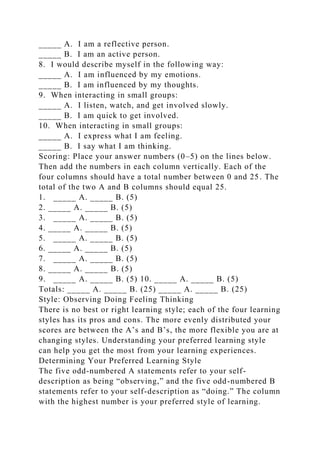
  • 66.
    p.258 4. Which oneof the primary delivery of training types would you use to teach basic accounting to a group of employees? Justify your answer. 5. Have you ever filled out an evaluation form for an employee training class? Which type of evaluation was it? What evidence led you to think it was this type? 6. Do you agree with the definition of a career presented in the text? Why or why not? How would you change it? 7. Which of the reasons for creating career development programs from the text do you feel are most valid, considering the cost of career development programs? Justify your choice. 8. Which method of development, formal education, experience, or assessment do you think is most valuable? Justify your choice. 9. Identify and discuss two or three ways in which poor application of HR strategies (Exhibit 7-9) would create negative employee consequences. 10. If you were the lead trainer for your company, how would you go about trying to create an organization-wide commitment to sustainability? Why? CASE 7-1 DOING CRUNCHES AT NESTLé: CONTINUOUS IMPROVEMENT OF HUMAN ASSETS With instant coffee, baby food, and bottled water in the mix, Nestlé crunches more than just chocolate. The world’s #1 food and drinks company in terms of sales, Nestlé is also the world leader in coffee (Nescafé). It also makes coffee for the home- brewing system, Nespresso. Nestlé is one of the world’s top bottled water makers (Nestlé Waters), one of the biggest frozen pizza makers (DiGiorno), and a big player in the pet food business (Friskies, Purina). Its most well-known global food brands include Buitoni, Dreyer’s, Maggi, Milkmaid, Carnation, and Kit Kat. The company also owns Gerber Products. North America is Nestlé’s most important market.(1) Nestlé has over 2,000 brands, which are made in 418 factories
  • 67.
    located in 86countries, and employees nearly 330,000 employees selling products in 191 countries.(2) How does one feed this growing concern? Mergers and acquisitions is one answer, yet that does not solve the skills-gap issue faced worldwide. The firm credits their success to their top- down/bottom-up approach to training. Top-Down. Their Rive-Reine International Training Centre in Switzerland, since the late 1980s, has served as the focal point for mentoring and training from senior management. Trainee selection matches local domestic managers’ candidate nominations, who hail from over 80 countries, with corporate- driven selection criteria usually resulting in a class of 15 to 20 nationalities from differing areas of expertise. Who teaches these classes? “Course leaders” as they are called provide instruction to about 1,700 managers and are comprised predominately of highly experienced executives from numerous locations, with consultants teaching only 25% of the 70 courses offered per annum. The courses have two differing foci: internal operations and working with external stakeholders. Executive Courses/Industry Analysis: This series of courses has been created to assist managers who attended management courses between five and ten years ago to develop the ability to identify and work with key external stakeholders (i.e., customers, competitors, suppliers). The focus is on industry analysis from the stakeholder’s point of view and the actions they might take (i.e., What are our competitors’ mostly likely actions and how do we counteract them?). Management Courses/Operations and Business Value Chain: Two-thirds of the classes in this program are taken by managers who have been with the company 5 years or less. Here managers learn about the firm’s business model (its internal operations) and the underlying values that drive that model.(3) Bottom-up. An important factor in Nestlé’s productivity is the skill set of entry-level workers. Employers invest in the skills of new entrants as an alternative to hiring more experienced people, partly on grounds of cost but also for the opportunity to
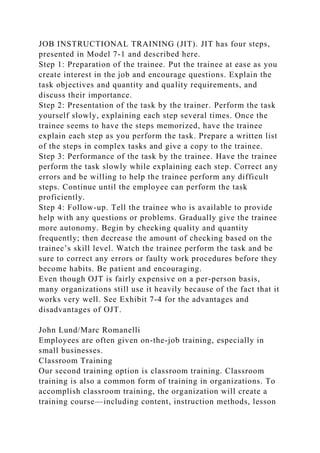
  • 68.
    shape ways ofworking around specific technologies and processes and particular company values.(4) For most employees at Nestlé to be successful, they must have a passion for learning, and their recruitment process emphasizes this. Once hired, employees’ training is predominately “on-the- job” (OTJ), where an employee’s supervisor serves as mentor, providing motivation and guidance to ensure employees’ growth. Before training can begin, whether formally or informally, employees must possess the basic skill set necessary for continued learning (i.e., reading, writing, computer usage, oral communications, etc.); this is usually provided through an employee’s schooling. In certain countries, their education may have been inadequate and the worker may decide to improve their skill set, especially in the area of communications. Special programs have been established to provide such training on a country-by-country basis. Once employees have acquired the basic skill set, individualized development formal training programs are created that increase workers’ knowledge, skills, and abilities (KSAs). New employees with high school or university qualifications inevitably enter management-training programs in their local centers. Local Training Centers. In addition to centralized training, residential training centers exist for many of their local operations—the net effect being that “people development” occurs predominately at local centers. This decentralized approach for employee training and development makes each manager accountable and directly involved in employee learning. Coaching and counseling skills are therefore emphasized where needed through a myriad of programs. Besides training current managers, local centers look to develop future managers by developing supervisory skills of ex- apprentices as well as technical personnel in the areas of IT management, maintenance and electrical engineering. Specialists are also “home-grown” through continuous training, given local market and employment conditions. Those seeking a purely administrative career path will find that OJT plays a
  • 69.
    critical role supportedby in-house training. Even at the local level, outsourcing of training and education increases with an employee’s rank and use of new technologies. Production is one of the key success factors for Nestlé, and therefore employees (two-thirds of whom work in factories) need continuous OTJ on new factory technology and equipment; the faster the change, the greater the need for training. New technology also means learning how to work better and differently with others. Team and inter-team management training (including self-managed work teams) focusing on developing flex-manufacturing capabilities is needed in order to maximize equipment utilization. p.259 Training methods are also changing with the times, especially related to the Internet. Distance learning, the use of information technology to deliver content, has led to the new methods of corporate instruction and special corporate training assistants and has allowed employees to obtain training and education that align with their life styles. For example, employees in Singapore are given the option to attend online, job-related night courses, which, if they lead to some formal qualification (i.e., certificate, diploma, degree), would qualify for cost reimbursement.(5) The Singapore example indicates that although there is a commonality of training among local centers, training can be significantly different by location. New employees at Nestlé take management-training courses, but the approach of these courses varies widely by country. For example, in Japan the courses are short and usually last about 3 days each. In India, however, the programs run for 12 months. In West African countries, the management training programs run even longer, typically 18–24 months.(6) Questions 1. For what purposes does Nestlé train and develop employees? 2. What challenges does Nestlé face in conducting their
  • 70.
    training programs? 3. Whichskill sets does Nestlé focus on in their training programs? 4. What on-the-job training methods does Nestlé utilize in their training programs? 5. What forms of off-the-job training are available at Nestlé? 6. What are some of the ways that Nestlé’s training programs address career development? 7. What trends in training and development is Nestlé utilizing, and what trends could they benefit from? References (1) Oliver, L. (n.d.). Nestlé S.A. Hoovers. Retrieved April 26, 2017, from http://0- subscriber.hoovers.com.liucat.lib.liu.edu/H/company360/fulldes cription.html?companyId=41815000000000 (2) Nestlé: At a glance. (n.d.). Retrieved April 26, 2017, from http://www.nestle.com/aboutus/overview (3) Francis, A. (n.d.). Case study of Nestlé: Training and development. Retrieved April 26, 2017, from https://www.mbaknol.com/management-case-studies/case- study-of-nestle-training-and-development/ (4) Nestlé: Business ownership of skills. (n.d.). Retrieved April 26, 2017, from http://www.nestle.co.uk/productivity/owning-the-skills- pipeline (5) Francis, A. (n.d.). Case study of Nestlé: Training and development. Retrieved April 26, 2017, from https://www.mbaknol.com/management-case-studies/case- study-of-nestle-training-and-development/ (6) Ibid. Case created by Herbert Sherman and Theodore Vallas, Department of Management Sciences, Long Island University School of Business, Brooklyn Campus CASE 7-2 GOOGLE SEARCH: BUILDING THE PROGRAM THAT WRITES THE CODE TO FIND FEMALE TALENT
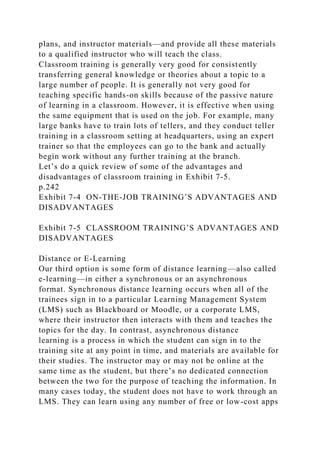
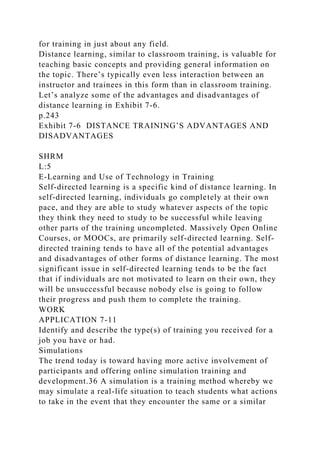
  • 71.
    Google Inc. tookWeb searching to a much more sophisticated level when it offered targeted search results from billions of Web pages, based on a proprietary algorithm that allowed for greater customization than did prior engines like Web Crawler and Dogpile. Employing more than 50,000 people, Google generates most of its revenue from advertising sales. In 2013, its net income was close to $13 billion, and the company showed 60% revenue growth between 2012 and 2014. Added to that, Google has been on the top of the Fortune “Best Places to Work” list since 2012.(1) Google is one of the best firms at making employees feel welcomed and supported; but being in the technology field, the company had become a “boys’ club,” with women constituting only 30% of its entire workforce. Alongside Google, other Silicon Valley technology giants like Facebook, Yahoo, and LinkedIn recently disclosed their gender and racial diversity ratios in their workplaces. On average, Google’s workforce consists of more than 65% males, 55% whites, and 35% Asians. The gaps between these numbers are even wider in technology-related positions. As shown in its May 2014 report, it employs only 2% blacks and 3% Hispanics. Google admitted that this problem required immediate action. Google’s sharing of demographic information is a promising sign that it is willing to change, but action speaks louder than words. Google took quick action and performed its own search. It found that women were losing interest in computer sciences as a career at an alarming rate. Only 14% of the computer science graduates were women in 2013, and surveys indicated that less than 1% of women expressed any interest in majoring in computer sciences in college.(2) Google then recognized that it could not use traditional recruitment techniques to hire women since they were just not present in the labor pool. Google also examined its own unique hiring processes and concluded that they were both difficult and tedious—women were not emerging through these processes, and Google could not just sit back and hope to gain new female employees from a
  • 72.
    labor pool thatcould not supply them.(3) Google decided to be far more proactive in the area of women employee development and committed $50 million for both research and solution strategies. Its research indicated that if women were exposed to coding at an early age, they would more likely look favorably at a career path in computer science.(4) Google’s research also noted that compared to the companies led by men, tech companies led by women achieved a 35% higher return on investment and 12% higher revenue.(5) Google understood that its answer to this labor shortage, as well as to greater profitability, was to show young girls how interesting aspects of computer science could be, as well as how lucrative, and to inspire them to pursue a career in this field. Secondly, only 10% of the schools in the United States offered computer science courses, so access to this field was a major problem. To achieve its goal of more women in the workforce, Google initiated a project called “Made With Code” (MWC) that was designed to attract women to the sciences and, in the long run, diminish possible gender biases in its own organization, as well as in the field.(6) p.260 MWC was launched as an event in New York City, with the participation of teenage girls from local public schools; famous female entrepreneurs; and many professional women who utilized coding in the film, music, and fashion industries. To increase exposure and inspiration, Google is working closely with producers and writers in the Science & Entertainment Exchange to have more female coders in movies and television series.(7) With the MWC program targeting the people who normally did not have the access or the opportunity to pursue a career in computer science, Google provided accelerated tech-training programs to help them succeed in high-level tech jobs. Google did this by offering free coding classes online to pull extraordinary talent from the cities surrounding Silicon Valley.(8) It also provided workshops that fostered student
  • 73.
    collaboration on simplecoding projects like 3-D printed bracelets. Research has noted that women thrive in team environments, and Google wanted them to understand that teamwork is the cornerstone of software development. To this end, Google gave an additional 3 months of free access to its Code School to women.(9) Google hopes that the outcome of its programs will increase younger girls’ involvement in computer science and, in the long run, increase women’s visibility in the profession and at Google. Questions 1. What is a needs assessment, and how might Google use this tool to increase the presence of women in its workforce? 2. Some might argue that Google’s “Made With Code” program has redefined the concept of employee development. Agree or disagree and provide an explanation supporting your position. 3. Explain how Google’s particular situation demonstrates the relationship between employee recruitment and employee development, given the above discussion. 4. Explain how Google’s “Made With Code” has become an integral part of its career planning. 5. How might the concepts of self-efficacy and reinforcement theory help us better understand schoolgirls’ relative lack of interest in computer science? 6. Assume that Google is ultimately successful and receives more female applicants, whom it then hires. What suggestions do you have for managing this new talent pool? References (1) Hoover’s Inc. (2014). Google Inc. Hoover’s Company Records: In-Depth Records. Retrieved July 19, 2014, from Long Island University Academic Database. (2) Lapowsky, I. (2014, July 1). Google and Square recruit girls early to tackle tech’s gender problem. Wired.com. Retrieved from http://www.wired.com/2014/07/girls-coding/ (3) Warnes, S. (2014, July 1). 70% male, 50% white: Why
  • 74.
    Silicon Valley needsto diversify. Mirror.Retrieved from http://ampp3d.mirror.co.uk/2014/07/01/70-male-50-white- why-silicon-valley-needs-to-diversify/ (4) Mejia, P. (2014, July 11). Codes, not bros: Google pledges $50 million to ladies in tech. Newsweek.Retrieved from http://www.newsweek.com/codes-not-bros-google-pledges- 50-million-ladies-tech-258298/ (5) Warnes, S. (2014, July 1). 70% male, 50% white: Why Silicon Valley needs to diversify. Mirror.Retrieved from http://ampp3d.mirror.co.uk/2014/07/01/70-male-50-white- why-silicon-valley-needs-to-diversify/ (6) Mejia, P. (2014, July 11). Codes, not bros: Google pledges $50 million to ladies in tech. Newsweek.Retrieved from http://www.newsweek.com/codes-not-bros-google-pledges- 50-million-ladies-tech-258298/ (7) Ibid. (8) Jones, V. (2014, July 8). How to hook up tech sector with talent. CNN. Retrieved from http://www.cnn.com/2014/07/08/opinion/jones-tech- minorities/ (9) Mejia, P. (2014, July 11). Codes, not bros: Google pledges $50 million to ladies in tech. Newsweek.Retrieved from http://www.newsweek.com/codes-not-bros-google-pledges- 50-million-ladies-tech-258298/ Case created by Herbert Sherman and Theodore Vallas, Department of Management Sciences, Long Island University School of Business, Brooklyn Campus SKILL BUILDER 7-1 THE TRAINING PROCESS Objectives To develop your ability to conduct a needs assessment, to select how to shape employee behavior, to design a training program by selecting training methods, to select a method to deliver training, and to choose an assessment method Skills The primary skills developed through this exercise are as
  • 75.
    follows: 1. HR managementskill—conceptual and design skills 2. SHRM 2016 Curriculum Guidebook—L: Training and Development Assignment As an individual or group, select a job and write out your answers. Follow the steps in the training process below to train a person to do the job. Step 1: Needs assessment. Conduct a needs assessment for the job by developing a competency model identifying the knowledge, skills, and abilities needed to do the job successfully. Step 2: Select how you will shape behavior. Be sure to specify if you will use positive reinforcement, punishment, negative reinforcement, or extinction. State the rewards and/or punishment. Step 3: Design the training. Select and describe in detail the training method(s) you will use to shape the behavior. Step 4: Deliver the training. Just select one of the four methods of delivery that you will use to conduct the actual training and describe how you will deliver the training. Step 5: Assessment of training. Just select one of the four assessment methods and describe in detail how you will determine if the training did in fact shape the behavior. p.261 Apply It What did I learn from this experience? How will I use this knowledge in the future? _____________________________________________________ __ _____________________________________________________ __ _____________________________________________________ __ _____________________________________________________ __
  • 76.
    Your instructor mayask you to do this Skill Builder in class by breaking into groups of four to six and doing the preparation. If so, the instructor will provide you with any necessary information or additional instructions. SKILL BUILDER 7-2 CAREER DEVELOPMENT Objective To begin to think about and develop your career plan Skills The primary skills developed through this exercise are as follows: 1. HR management skill—conceptual and design skills 2. SHRM 2016 Curriculum Guidebook—L: Training and Development Assignment Write out your answers to the following questions. 1. Do you now, or do you want to, work in HRM? Why? If not, what career do you want to pursue, and why? 2. If you want to work in HR, based on your self-assessment back in Chapter 1 or other knowledge, list your highest levels of interest in HR disciplines. If not, what are your highest levels of interests, functions, or disciplines within your chosen career? 3. What methods of employee development (formal education, experience-internships and jobs, and assessment) are you using to prepare for your career? Apply It What did I learn from this exercise? How will I use this knowledge in the future? _____________________________________________________ __ _____________________________________________________ __ Your instructor may ask you to do this Skill Builder in class by breaking into groups of two to three and discussing your career plans. If so, the instructor will provide you with any necessary information or additional instructions.
  • 77.
    Use the HarvardBusiness Case, “Clique Pens: The Writing Implements Division of U.S. Homes” to answer the following questions: Are the products really differentiated at all in the consumers’ minds? Does the retailer see any difference, except price? How much spending is required to maintain their brand? Discuss a plan to increase Clique Pen’s gross profit that will work with their retailers and motivate their consumers. Minimum 2 scholarly Articles References. Minimum of 500 Words, APA Format Your paper will be submitted to Turnitin software, No plagiarism. p.508 ©iStockphoto.com/deimagine 14 Workplace Safety, Health, and Security Media Library CHAPTER 14 Media Library PREMIUM VIDEO HRM in Action Employee Wellness Programs LICENSED VIDEO Workplace Stress Workplace Violence LEARNING OBJECTIVES After studying this chapter, you should be able to do the following: 14-1. Briefly describe what OSHA does in a worksite inspection, the types of violations that OSHA looks for, and
  • 78.
    employer rights duringthe inspection.PAGE 510 14-2. Briefly discuss EAPs, EWPs, and ergonomics and what the value of each of these is to companies and employees.PAGE 516 14-3. Briefly discuss the causes of stress and how it can be managed.PAGE 521 14-4. Identify the top concerns for security in the workplace today and what can be done to make the workplace more secure.PAGE 527 14-5. Discuss the new OSHA regulation on drug testing and the value of wellness organizations like eDocAmerica.PAGE 533 CHAPTER OUTLINE Workplace Safety and OSHA The Occupational Safety and Health Act (OSH Act) The Occupational Safety and Health Administration (OSHA) National Institute of Occupational Safety and Health (NIOSH) Federal Notice Posting Requirements Employee Health Work–Life Balance Employee Assistance Programs (EAPs) and Employee Wellness Programs (EWPs) Ergonomics and Musculoskeletal Disorders (MSDs) Safety and Health Management and Training Stress Functional and Dysfunctional Stress Causes of Job Stress Stress Management The Stress Tug-of-War Workplace Security Cyber Security Workplace Violence Social Media for Workplace Safety and Security Employee Selection and Screening General Security Policies, Including Business Continuity and Recovery
  • 79.
    Trends and Issuesin HRM OSHA Limits Postaccident Drug Testing eDocAmerica: Health and Wellness Online p.509 Practitioner’s Perspective Describing her workplace, Cindy says, “We believe a safe and healthy workplace is a right—whether you work in a factory or an office. Is it also an employer’s responsibility to provide for their employees’ mental health? Not everyone may see it as an obligation, but there is great benefit in assisting an employee whose personal issues may be impacting their job performance.” “I think I am going to have to take time off,” Nancy confessed the other day. “I just can’t seem to manage everything going on in my life, and I can’t concentrate at work.” “I know things are tough with the divorce—but can you really afford to miss work right now?” her coworker Chloe queried. “Have you seen the information HR posted about the Employee Assistance Program? Let’s get the contact information. It’s completely confidential and available to you and your family. Perhaps they can help. In the meantime, you can talk to your supervisor about the new flexible work hours until things are better.” Could this level of support “save” a good employee? Learn more about the issues and ethics behind workplace health, safety, and security in Chapter 14. SHRM HR CONTENT See Appendix: SHRM 2016 Curriculum Guidebook for the complete list A. Employee and Labor Relations (required) 23. Posting requirements B. Employment Law (required) 26. The Occupational Safety and Health Act of 1970 (OSHA) C. Ethics (required)
  • 80.
    6. Behavior withinethical boundaries 14. Abusive behavior—Workplace bullying E. Job Analysis/Job Design (required) 6. Compliance with legal requirements Ergonomics and workplace safety (work hazards and mitigation) K. Total Rewards (required) B. Employee Benefits 9. Employee assistance/wellness programs 17. Wellness programs T. HR Career Planning (secondary) 4. Company policies to accommodate work and nonwork activities X. Workplace Health, Safety, and Security (secondary) 1. OSHA citations and penalties (required) 2. Disaster preparation, continuity, and recovery planning 3. Employee health 4. Inspection 5. Protection from retaliation 6. Safety management 7. Security concerns at work 8. Communicable diseases 9. Data security 11. Ergonomics Get the edge on your studies. edge.sagepub.com/lussierhrm3e • Take a quiz to find out what you’ve learned. • Review key terms with eFlashcards. • Watch videos that enhance chapter content. p.510 WORKPLACE SAFETY AND OSHA LO 14-1 Briefly describe what OSHA does in a worksite inspection, the types of violations that OSHA looks for, and employer rights during the inspection. We now have a workforce that is reasonably compensated, well trained, and productive. The next major management concern is
  • 81.
    to keep themsafe and healthy so that they can continue to perform at high levels. This chapter will first focus on federal workplace safety laws and regulations as well as the governing agencies for industrial safety and health. Later in the chapter, we will cover employee health issues—including the need for work–life balance for our employees, employee assistance and employee wellness programs, and stress—and how they affect our employees. Finally, we will discuss the increasingly important topic of workplace security from the organizational perspective, so let’s get started. Employees are concerned about safety.1 The HR department commonly has responsibility for ensuring the health and safety of employees and needs to develop policies and rules to provide a safe environment for all groups.2 It works closely with the other departments to enforce safety rules and maintains health and safety records. Employee-owned PCL Construction boasts a safety record five times better than the national average.3 A growing area of safety concern is workplace incivility and violence.4 As a manager, you should know the safety and security rules, be sure your employees know them, and enforce them to prevent accidents and acts of violence. SHRM B:26 The Occupational Safety and Health Act of 1970 (OSHA) The Occupational Safety and Health Act (OSH Act) Workplace safety is a concern for all companies, but especially in more dangerous industries with higher death rates ranked as construction; transportation and warehousing; agriculture, forestry, fishing, and hunting; professional and business services; and manufacturing.5 Most accidents such as plane crashes,6 and 98% of truck accidents,7 are caused by human error. To help protect employees, the Occupational Safety and Health Act (OSH Act) of 1970 requires employers to pursue workplace safety. Workplace safety deals with the physical protection of people from injury or illness while on the job. Employers must meet all Occupational Safety and Health
  • 82.
    Administration (OSHA) safetystandards, maintain records of injuries and deaths due to workplace accidents, and submit to on-site inspections when notified. Those who do not comply are subject to citations and penalties, usually in the form of fines.8 You may save a few bucks skimping on safety, but it can be very costly, like at BP for the Gulf oil spill. p.511 Many of you know that OSHA is a US safety and health regulator, but did you know that employers can go to prison for willfully failing to maintain safe work environments? You may have heard that the walls of a building that was being demolished in Philadelphia in 2013 caved in on a Salvation Armystore, killing six people. The company in that case, Campbell Construction, has been cited for willful violations (we will discuss this term shortly) of the OSH Act, and the general contractor, Griffin Campbell, was convicted of involuntary manslaughter and aggravated assault in that case and received a sentence of 15 to 30 years in prison for failing to follow a series of safety procedures. In addition, the crane operator subcontractor who was working on the building when it collapsed was convicted of involuntary manslaughter.9 Willful violations of the OSH Act that cause a death are punishable with a fine of up to $500,000 for the organization and $250,000 and up to 6 months in prison for an individual who is found culpable. Today, the HR department commonly has responsibility for ensuring the health and safety of employees. HRM works closely with other departments and maintains health and safety records along with managing safety training programs. As an HR manager, it will be absolutely critical that you know the safety rules, be sure your employees know them, and that you and other managers enforce them to prevent accidents. In addition to many specific requirements in the act, the general duties clause in the OSH Act that covers all employers states that each employer10 1. shall furnish a place of employment that is free from
  • 83.
    recognized hazards thatare causing or are likely to cause death or serious physical harm to employees; 2. shall comply with occupational safety and health standards and all rules, regulations, and orders issued pursuant to this Act which are applicable to his own actions and conduct. The general duties clause also states that each employee has a duty to comply with occupational safety standards, rules, and regulations. In 1970, the year that the OSH Act was passed, job-related accidents accounted for more than 14,000 worker deaths in the United States.11 The good news is that the rate of fatal work injuries has fallen, but the bad news is that in 2015 (the last year of available Bureau of Labor Statisticsinformation), there were still 4,836 fatalities12 and almost 3 million injuries or illnesses, half of which required time away from work.13 This is a rate of about 3 per 100 equivalent full-time workers. Recall from Chapter 1 that absenteeism is one of the major concerns of all managers, and by allowing injuries and occupational illnesses to occur, we are contributing to that absenteeism. So losing this many workdays, as well as more than 4,800 lives, has to be a concern for HRM as well as line managers. The Occupational Safety and Health Administration (OSHA) OSHA is the division within the Department of Labor that is charged with overseeing the OSH Act. It was created to “assure safe and healthful working conditions for working men and women by setting and enforcing standards and by providing training, outreach, education and assistance.”14OSHA has broad authority to investigate complaints and impose citations and penalties on employers who violate the OSH Act. WHAT DOES OSHA DO? OSHA is responsible for setting federal safety and health standards and promulgating those standards to employers. OSHA is also the responsible agency of the federal government for occupational safety and health inspections. Inspections are made without any advance notice to the employer and are done based on the following issues (in priority order):15
  • 84.
    • Imminent danger •Catastrophes (fatalities or hospitalizations) p.512 • Worker complaints and referrals • Targeted inspections (particular hazards, high injury rates) • Follow-up inspections Inspectors must identify themselves and tell the employer the reason for the inspection upon arrival at the worksite. The employer can decide not to allow the inspection without an inspection warrant (a court order establishing OSHA’s probable cause for the inspection), but this is generally not a very good idea on a number of levels. Besides making it look like the company might have something to hide, it wastes time, and the inspector will be less likely to be disposed to assist the employer in immediately correcting discrepancies that might be found during the inspection—which will ultimately occur anyway after the warrant is provided. In general, it makes more sense to allow the inspection to go on, in accordance with OSHA rules.16 WORK APPLICATION 14-1 Identify any unsafe or unhealthy working conditions that you have observed in any organization (business, sports, school, etc.). EMPLOYER AND EMPLOYEE RIGHTS AND RESPONSIBILITIES UNDER OSHA. General rights of employers and employees are shown in Exhibit 14-1. We want to make sure that company management always stays within their rights in interactions with OSHA. Employer rights. Employer rights during an inspection are a bit more specific. The employer has a right to get the inspector’s credentials, including their name and badge number, and to receive information on the reason for the inspection—either the employee complaint or the program inspection information.17 The employer also has the right to refuse to allow the inspection without a warrant being provided (which
  • 85.
    we have alreadysaid is generally a bad idea). Exhibit 14-1 EMPLOYER AND EMPLOYEE RIGHTS AND RESPONSIBILITIES UNDER OSHA Sources: SHRM, https://www.shrm.org/resourcesandtools/hr- topics/risk-management/pages/osha-employer-inspection- rights.aspx; OSHA, https://www.osha.gov/Publications/3439at- a-glance.pdf (retrieved July 31, 2017). p.513 14-1 APPLYING THE CONCEPT Employer Rights and Responsibilities Under OSHA Respond yes or no to each question regarding employer rights and responsibilities. a. Yes b. No ____ 1. Is it permissible to ask the inspector the reason for the inspection? ____ 2. Henry got us into trouble with OSHA, so is it OK to demote him? ____ 3. Is it OK to take some notes during the OSHA inspection? ____ 4. Does OSHA require us to inform and train employees about existing hazards in the workplace? ____ 5. Does OSHA require us to keep records of work-related injuries or illnesses? ____ 6. Does a member of the HR staff have to accompany the OSHA inspector during the site visit? ____ 7. Can we require employees to buy their own safety equipment? SHRM X:4 Inspection So assuming that the inspection is allowed, we need to be aware of some things that we have a right to and that we should do during the inspection. • If the inspection is being conducted due to a worker
  • 86.
    complaint, we havethe right to get a copy of the complaint (without the employee’s name), and we want to do so because we want to know what is being alleged. • Secondly, we have a right to have a company representative accompany inspectors as they go through their site visit, and we, as the HR representative, want to accompany them. There are a few reasons to accompany the inspector. First, we want to understand any violations that the inspector finds and notes because sometimes, no matter how hard a person tries to describe a problem, it will sometimes be unclear unless we see it ourselves. Secondly, in many cases we can immediately fix a discrepancy such as loose lines or hoses strung across a workspace. Although the discrepancy will almost surely still be noted, the inspector will see that we are willing to comply with the law and OSHA regulations quickly and to the best of our ability. This willingness can keep minor infractions from becoming major infractions. Third, we want to make sure that the inspection stays within the scope noted in the complaint or the program inspection guidelines. We don’t really want the OSHA representative wandering all over the worksite, and we have a right to limit their movements to cover only the inspection scope. An employer representative also has a right to be present when the inspector is interviewing employees (unless the interview is private by request of the employee being interviewed) and the right to stop interviews that are becoming confrontational or disturbing the work environment. The employer also has a right to inform the employees of their rights during the inspection. The inspector will provide the employer with a list of discrepancies upon completion of their inspection. After an inspection, employers have a right to contest any citations that they receive through OSHA. SHRM X:5 Protection From Retaliation Employee rights. Employee rights during inspections include
  • 87.
    the right torefuse to be interviewed, or if an employee agrees to an interview, they can request that an employer representative be present or that the interview be held in private. The employee also has the right to legal representation during the interview if they request it, and they can end the interview at any point in time just by requesting that the interview be discontinued. Finally, employees have a right against company retaliation for taking part in an interview with the inspector and telling the truth.18 p.514 14-2 APPLYING THE CONCEPT Employee Rights and Responsibilities Under OSHA Respond yes or no to each questions regarding employee rights and responsibilities. a. Yes b. No ____ 8. Is it OK to object to the time frame for correction of discrepancies of OSHA standards? ____ 9. Can OSHA make my employer maintain working conditions free from any hazards? ____ 10. If I see hazardous conditions, does OSHA state that I have to tell my supervisor? ____ 11. Do I have to wear this back brace? It is heavy and uncomfortable, and I can’t move as well with it on. ____ 12. If I report hazardous conditions to HR, do I have to tell them who I am? ____ 13. If an OSHA inspector interviews me, can I cover up for the company and say we followed OSHA guidelines so we don’t get into trouble? ____ 14. Do I have to tell my supervisor I just got hurt? I don’t want him to be mad at me for making him do all the paperwork. HAZARD COMMUNICATION STANDARDS. OSHA requires that all employers maintain information at each work site that describes any chemical hazards that may be present on-site. A new set of Hazard Communication Standards (HCS) was
  • 88.
    promulgated in 2012and can be found on the OSHA website (http://www.osha.gov). Under federal law, “All employers with hazardous chemicals in their workplaces are required to have a hazard communication program, including container labels, safety data sheets, and employee training.”19 Safety Data Sheets (SDS) are documents that provide information on a hazardous chemical and its characteristics. The OSHA-required SDS format is provided in Exhibit 14-2 (Items 12–15 are nonmandatory). The SDS provides employees with a quick reference to the hazards of working with a particular chemical compound.20 Electronic versions of SDS are acceptable, as long as there are no barriers to immediate access at the worksite. SHRM X:1 OSHA Citations and Penalties VIOLATIONS, CITATIONS, AND PENALTIES. OSHA violations include the following:21 • Willful—a violation in which the employer knew that a hazardous condition existed but made no effort to eliminate the hazard • Serious—a violation where the hazard could cause injury or illness that would most likely result in death or significant physical harm • Other than serious—a violation where any illness or injury likely to result from the hazard is unlikely to cause death or serious physical harm, but the violation does have a direct impact on employees’ safety and health • De minimis—violations that have no direct or immediate safety or health danger. This does not result in citations or penalties. • Failure to abate—violations where the employer has not corrected a previous violation for which a citation was issued and the settlement date has passed • Repeated—violations where the employer has been previously cited for the same type of violation within the previous 5 years
  • 89.
    WORK APPLICATION 14-2 Identify anyorganization (business, sports, school, etc.) that was cited and/or penalized for not meeting OSHA standards. Be sure to provide details of the situation. Willful and/or repeated violations can bring the employer up to a $126,749 fine for each violation. Failure to abate violations can cost the employer as much as $12,675 per day while the violation continues to exist, and serious violations can also cost the employer a $12,675 fine.22 p.515 Exhibit 14-2 SAFETY DATA SHEETS (SDS) FORMAT Source: OSHA, https://www.osha.gov/dsg/hazcom/hazcom- appendix-d.html, retrieved July 31, 2017. National Institute of Occupational Safety and Health (NIOSH) NIOSH works under the umbrella of the Centers for Disease Control and Prevention (CDC). NIOSH was also created as part of the 1970 OSH Act, and its mission is global in scope. “[NIOSH] is the federal agency that conducts research and makes recommendations to prevent worker injury and illness.”23 NIOSH notes three major goals in its strategic plan:24 • Conduct research to reduce work-related illnesses and injuries. • Promote safe and healthy workplaces through interventions, recommendations, and capacity building. • Enhance international workplace safety and health through global collaborations. p.516 Mark Boster / Los Angeles Times via Getty Images Workplace safety is of critical importance to employers. Here, Los Angeles prosecutor Hoon Chun and Deputy District Attorney Christopher Curtis discuss the settlement for Bumble
  • 90.
    Bee Foods’ violationof worker safety rules that caused the death of employee Jose Melina in 2012. NIOSH routinely works with worldwide government health laboratories and other member nations in the World Health Organization (WHO) to identify workplace issues that can cause illness or injury and to create standards for the WHO member countries. NIOSH also works hand in hand with OSHA to identify workplace illnesses and to track diseases that can be passed from one person to another in the work environment. It does research on occupational safety and health topics from ergonomics (we will discuss this shortly) to MRSA (methicillin- resistant Staphylococcus aureus) infections and workplace violence. NIOSH research frequently provides the data that OSHA uses to create new workplace standards and regulations. One of the most significant areas of research at NIOSH is communicable disease research. Again, in conjunction with other countries in the WHO, NIOSH has done research on a number of respiratory diseases that can be passed from one person to another, including tuberculosis and various strains of flu virus. NIOSH research attempts to identify methods of transmission and then provide guidelines for minimizing danger of transmission of dangerous diseases that may exist in the workplace. The entire intent of NIOSH research is to make the workplace safer for all employees. SHRM X:8 Communicable Diseases Federal Notice Posting Requirements There are a number of notices that employers are required to post in a convenient location frequented by employees during normal working hours. The notices or posters contain important information about employee rights and company responsibilities under federal law. OSHA’s Job Safety and Health Protection poster is one of these, but there are also other posting requirements. Take a look at the following information for general federally mandated posting requirements.
  • 91.
    SHRM A:23 Posting Requirements The Departmentof Labor provides a number of posting requirements on its website (http://www.dol.gov), and we have reproduced some of the major ones in an abridged version in Exhibit 14-3.25 WORK APPLICATION 14-3 Identify safety and health posters you have seen displayed at any organization (business, sports, school, etc.). In addition to all of the other requirements, each state has its own posting requirements. Most states have requirements to at least post information on workers’ compensation, unemployment insurance, and state minimum wage laws, while many states have a large number of other requirements as well. We need to become aware of and maintain knowledge of our state’s requirements. Finally, employers must make certain that they also notify new hires of the above information. EMPLOYEE HEALTH LO 14-2 Briefly discuss EAPs, EWPs, and ergonomics and what the value of each of these is to companies and employees. Meeting OSHA requirements is necessary, but there are many other aspects to maintaining good employee health. Employee health is the state of physical and psychological wellness in the workforce. We have to consider both physical andpsychological health in order to have a strong workforce. We need to provide our employees with the ability to maintain both. In this section, we are going to complete a quick review of some of the other physical and psychological issues in today’s workplace. Work–Life Balance In analyzing the needs of the workforce, work–life balance is high on the list of issues facing both employers and employees.26 Thus, individual employees and their leaders are seeking work–life balance.27 Work–life balance is a perpetually
  • 92.
    hot topic.28 Withmobile technology, especially the smartphone,29 the boundary between work and nonwork hours becomes fuzzy.30 Some 44% of Internet users regularly perform some job tasks outside of work,31 as employees even check in at work during their weekends and vacations, increasing the likelihood of work–family spillover. On the other side, employees are using company electronic devices for personal use during work hours, such as social media and shopping.32 Spillover is the effect of work and family on one another that generates similarities between the two domains.33 p.517 Exhibit 14-3 DEPARTMENT OF LABOR POSTING REQUIREMENTS FOR BUSINESSES AND OTHER EMPLOYERS p.518 Source: US Department of Labor. SHRM X:3 Employee Health With 40% of full-time American workers logging more than 50 work hours a week,34 organizations are starting to intervene when employees are working too many hours.35 In fact, one in three full-time employees say, “maintaining a healthy work–life balance has become more difficult in the last five years.”36 Although more men are getting more involved in child care,37 and both men and women say balancing work and family life difficulties deters them from seeking executive roles,38 work–life balance is especially difficult for women because of gender family responsibility inequity.39 Balance between work and home lives is sought but rarely happens for long because of work–family conflict. This conflict is also linked with some other bad consequences such as stress; absenteeism; burnout; and dissatisfaction with job, family, and life—all of which can lead to excessive job turnover and the breakup of families.40
  • 93.
    p.519 SHRM T:4 Company Policies toAccommodate Work and Nonwork Activities To help employees maintain a better work–life balance, the trend is for firms to offer more work–family benefits.41 commonly called family-friendly practices.42 For example, employers are offering flexible work schedules so that employees can start and end work around the times that help them balance work and family, and they also allow their people flexible time off to attend family activities such as parent– teacher meetings and sporting events. Many more firms are offering child care and elder care at or near their place of work than in the past, and they are providing the flexibility for their employees to select this as a standard benefit, as on-site child- care relates to lower absenteeism.43 Some companies, including Campbell Soup and Lowe’s, are providing seminars and workshops on how to better balance work and life. Family- friendly practices also include individual and family counseling benefits to help improve family life so that it doesn’t have a negative impact on work. Such counseling is commonly offered through the employee assistance programs (EAP), our next topic. For more information and help, visit the Families and Work Institute website www.familiesandwork.org. WORK APPLICATION 14-4 Assess your work–life and/or school–life balance? What percentage of your waking hours are typically devoted to work, school, and personal life? How can you improve the balance? Employee Assistance Programs (EAPs) and Employee Wellness Programs (EWPs) Two significant employee services that can assist with work– life balance and other aspects of employee mental and physical health are employee assistance programs (EAPs) and employee wellness programs (EWPs), also known as workplace wellness
  • 94.
    programs (WWPs). EAPsand EWPs continue to grow in popularity in the United States and other countries around the world, most likely because companies are seeing results from the use of such programs.44 SHRM K:B9 Employee Assistance/Wellness Programs EAPS. An EAP is a set of counseling and other services provided to employees that help them to resolve personal issues that may affect their work. About three-quarters of private- sector workers (77%) have access to an employee assistance plan (EAP).45 An EAP is designed to assist employees in confronting and overcoming problems in their personal life such as marital problems or divorce, financial problems, substance addictions, emotional problems, and many other issues. Why do the majority of employers pay for these services? The simple answer is that such services can save valuable employees and, as a result, save the company money if they are available to the employee when they are needed.46,47 SHRM K:B17 Wellness Programs EAPs are confidential services provided to the employee. The employee can contact the company EAP and receive counseling and/or treatment for emotional or other personal issues as necessary. In some cases, EAPs may be regulated by federal laws, including the requirements of ERISA and COBRA, so company HR personnel need to be aware of this fact. WORK APPLICATION 14-5 Select an organization that offers an Employee Assistance Program (EAP) and Employee Wellness Program (EWP). Describe the program offerings. EWPS. EWPs are designed to cater to the employee’s physical, instead of psychological, welfare through education and training programs. Wellness programs offer health education, training
  • 95.
    and fitness, weightand lifestyle management, and health risk assessment services to employees. The obvious goal is improving the health of our workforce, but why? There is strong evidence that Americans (and people in most other countries) do not exercise enough. More than a third of Americans are obese, with many more overweight.48 Obesity and excess weight create all kinds of health problems, and we are seeing the effects of overweight employees at work. Many employees have health problems such as diabetes, high blood pressure, and heart disease that are brought on by excess weight. Employee wellness programs (EWPs) work to help our employees become more healthy and fit and to lower the incidence of these types of health problems. HRM in Action Employee Wellness Programs In a now-famous Harvard Business Review article, a Harvard lecturer said that “sitting is the smoking of our generation.”49 A research study by the National Institutes of Health says that “sitting for prolonged periods can compromise metabolic health” and that “too much sitting is distinct from too little exercise.”50 Getting people up and moving is valuable to organizations. Companies like Johnson & Johnson claim EWPs have succeeded in slowing health care cost increases because they get employees moving.51 EWPs can return from $2 to $6 in lower health care and lost productivity costs for every dollar spent.52 Another interesting effect of EWPs appears to be lower turnover: “Healthy employees stay with your company. . . . [O]rganizations with highly effective wellness programs report significantly lower voluntary attrition than do those whose programs have low effectiveness (9% vs. 15%).”53 The Affordable Care Act also provides an employer benefit; it allows an incentive for participation in wellness programs of up to 30% of an employee’s total health care premium, up from a 20% premium prior to the law’s passage. So wellness programs provide employers with high return on
  • 96.
    investment and helpwith productivity, absenteeism, and turnover. No wonder companies continue to institute these programs. p.520 We need to remember, though, that EWPs are also regulated at the federal level. There is currently some concern that some EWPs may violate provisions of the Genetic Information Nondisclosure Act (GINA), 54 and because they are employee welfare programs ERISA may apply. Congress is reviewing options to allow EWPs to continue to provide incentives for employee wellness while also being in compliance with GINA. HR managers will want to stay apprised of changes in regulations concerning EWPs so that they can continue to provide wellness services to their employees without violating federal law or regulations. Ergonomics and Musculoskeletal Disorders (MSDs) According to OSHA, “Ergonomics is the science of fitting workplace conditions and job demands to the capabilities of the working population.”55 The CDC identifies the goal of ergonomics as being to “reduce stress and eliminate injuries and disorders associated with the overuse of muscles, bad posture, and repeated tasks.”56 Workplace ergonomics focuses on design of jobs and workspaces to limit the repetitive stresses that employees face in doing their daily work. OSHA provides employers with a set of voluntary guidelines on ergonomics in the workplace. These voluntary guidelines took the place of an earlier set of more rigid rules from OSHA on ergonomics that were rescinded by Congress in 2001.57 Several industries, including shipyards, poultry processors, retail stores, and nursing homes, among others, have specific sets of guidelines provided by OSHA. Other industries have the general set of voluntary guidelines published by OSHA.58 It is wise for the organization to know OSHA’s voluntary guidelines for their industry even though the earlier ergonomics rule was rescinded, because the OSHA website notes that “under the OSH Act’s General Duty Clause, employers must keep their
  • 97.
    workplaces free fromrecognized serious hazards, including ergonomic hazards. This requirement exists whether or not there are voluntary guidelines.”59 SHRM E:6 Compliance With Legal Requirements Ergonomics and Workplace Safety In addition to the potential for enforcement actions on the part of OSHA, it just makes sense to pay attention to ergonomics. Musculoskeletal disorders (MSDs) affect the body’s muscles, joints, tendons, ligaments, and nerves and can occur in many different work environments. They can take a toll on employee productivity when workers suffer from these issues. MSDs include a commonly known repetitive stress injury (RSI) called carpal tunnel syndrome in which the nerves in the wrist become inflamed and painful, making movement difficult. But a large number of other problems fall under the MSD category, including other RSIs like rotator cuff syndrome, tennis elbow, carpet layer’s knee, and many others.60 All of these problems have the potential to cost the organization money in the form of lost productivity as well as workers’ compensation claims. So paying attention to ergonomics at work can both improve productivity and save the company money. SHRM X:11 Ergonomics Cornell University has an ergonomics program called CUErgo that has a large number of tools to help design jobs that are less stressful on employees; for a listing, go to its website at http://ergo.human.cornell.edu. It provides information from research by the Cornell Human Factors and Ergonomics Research Group (CHFERG).61 It also provides information on everything from hospital work environments to general workstation design in offices and is a great help in identifying potential ergonomic issues in the workplace. p.521
  • 98.
    WORK APPLICATION 14-6 Identify potentialergonomics and musculoskeletal disorders (MSDs) in an industry that you work in or want to work in. Safety and Health Management and Training HR managers need to understand OSHArules and standards in order to be able to make the workplace as safe as possible, and offering EAPs and EWPs and stress management training (our next section) is part of safety and health management. SHRM X:6 Safety Management By keeping the number of accidents and incidents low, we lower absenteeism plus increase job satisfaction. Nobody wants to work in an unsafe environment. Because we improve two of our four most important variables at work—absenteeism and job satisfaction—we are almost assured of increasing productivity over time. This is yet another way that HRM can assist in reaching organizational goals while using the fewest organizational resources possible. STRESS LO 14-3 Briefly discuss the causes of stress and how it can be managed. People often have internal reactions to external environmental stimuli. Stress is the body’s reaction to environmental demands.This reaction can be emotional and/or physical and can be caused by a lack of work–life balance.62 According to Forbes, 35% of Americans have thought about leaving a job because of stress at work, and 42% have actually done so!63 As stated in Chapter 1, absenteeism is costly, and there is a relationship between absenteeism and workplace stress.64 Stress levels are on a continuum from low to high. But stress is an individual perception matter. Some people are better at handling stress than others.65 In the same situation, one person may be very comfortable and stress free while another is stressed out. In this section, we discuss functional and
  • 99.
    dysfunctional stress, thecauses of stress, how to manage it, and the stress tug-of-war. Licensed Video Workplace Stress WORK APPLICATION 14-7 Describe any safety, health, and stress training offered by an organization, preferably one you work or have worked for. Functional and Dysfunctional Stress Let’s begin by describing the difference between functional and dysfunctional stress and the consequences of dysfunctional stress. WORK APPLICATION 14-8 Assess your ability to deal with stress. Identify when you tend to get stressed and the negative consequences you experience from dysfunctional stress. FUNCTIONAL STRESS. Stress is functional (also called acute and eustress66 stress) when it helps improve performance by challenging and motivating people to meet objectives. People perform best under some pressure. Stress is an asset that stretches capacity and fuels creativity. When deadlines are approaching, adrenaline flows and people rise to the occasion. Stress actually provides greater strength and focus than we think we are capable of—so long as we are in control of it.67 DYSFUNCTIONAL STRESS. On the other hand, too much stress is dysfunctional because it decreases performance. Stressors are factors that may, if extreme, cause people to feel overwhelmed by anxiety, tension, and/or pressure. Stress that is constant, chronic, and severe can lead to burnout over a period of time.68 Burnout is a constant lack of interest and motivation to perform one’s job.Burnout results from too much stress.69 Stress that is severe enough to lead to burnout is dysfunctional stress.70 NEGATIVE CONSEQUENCES OF DYSFUNCTIONAL
  • 100.
    STRESS. Some readersmay wonder why individual stress is a topic in an HRM text. The fact is that stress has some significant organizational consequences due to its effects on individual employees, so managers need to understand and be able to recognize the symptoms of stress, and especially dysfunctional stress because it causes mental and physical health problems.71 More than 80% of Americans said they were less productive at work because of stress. Excess stress costs an estimated $300 billion a year in absenteeism; decreased productivity; employee turnover; accidents; and medical, legal, and insurance fees.72 p.522 Burnout can cause mental and physical health problems including colds, weight gain, sleep dysfunction, heart disease, depression, ulcers and other stomach problems, and back, neck, and shoulder pain.73 Stress also weakens our immune system, it makes us sick more often, it ages us so we look older, it makes us fatter, it decreases our sex drive, it ruins our sleep, and it can even kill us.74 In fact, at its extremes, stress can cause even more serious problems. For instance, an Uber engineer was said to have suffered so much stress on the job due to overwork that he committed suicide.75 We should always be aware that extreme stress can cause extreme reactions. Causes of Job Stress There are five common contributors to job stress: personality type, organizational culture and change, management behavior, type of work, and interpersonal relations. PERSONALITY TYPE. The Type A personality is characterized as fast-moving, hard-driving, time-conscious, competitive, impatient, and preoccupied with work.76 The Type B personality is pretty much the opposite of Type A. In general, people with Type A personalities experience more stress than people with Type B personalities. If you have a Type A personality, you could end up with some of the problems associated with dysfunctional stress. Complete Self-Assessment 14-1 to determine your personality type as it relates to stress.
  • 101.
    14-1 SELF ASSESSMENT PersonalityType A or B and Stress Identify how frequently each item applies to you at work or school. Place a number from 1 to 5 on the line before each statement. _______ 1. I enjoy competition, and I work/play to win. _______ 2. I skip meals or eat fast when there is a lot of work to do. _______ 3. I’m in a hurry. _______ 4. I do more than one thing at a time. _______ 5. I’m aggravated and upset. _______ 6. I get irritated or anxious when I have to wait. _______ 7. I measure progress in terms of time and performance. _______ 8. I push myself to work to the point of getting tired. _______ 9. I work on days off. _______ 10. I set short deadlines for myself. _______ 11. I’m not satisfied with my accomplishments for very long. _______ 12. I try to outperform others. _______ 13. I get upset when my schedule has to be changed. _______ 14. I consistently try to get more done in less time. _______ 15. I take on more work when I already have plenty to do. _______ 16. I enjoy work/school more than other activities. _______ 17. I talk and walk fast. _______ 18. I set high standards for myself and work hard to meet them. _______ 19. I’m considered a hard worker by others. _______ 20. I work at a fast pace. _______ Total. Add up the numbers you assigned to all 20 items. Your score will range from 20 to 100. Indicate where your score falls on the continuum below.
  • 102.
    The higher yourscore, the more characteristic you are of the Type A personality. The lower your score, the more characteristic you are of the Type B personality. p.523 ORGANIZATIONAL CULTURE AND CHANGE. The amount of cooperation and motivation that a person experiences and the level of organizational morale both affect stress levels. The more positive the organizational culture, the less stress there is. Organizations that push employees to high levels of performance but do little to ensure a positive work climate create a stressful situation. A climate with fear of layoffs can also be extremely stressful. Plus, change is stressful to many people, so cultures that continually make major changes can be stressful.77 MANAGEMENT BEHAVIOR. The better managers are at supervising employees, the less stress there is. Lack of control tends to induce stress. Calm, participative management styles are less stressful. Bad bosses cause employee stress. Workers with bad bosses are more likely to report the stress-related problems that we discussed earlier.78 TYPE OF WORK. Some types of work are more stressful than others.79 People who have jobs that they enjoy derive more satisfaction from their work and handle stress better than those who do not. In some cases, changing to a job with more enjoyable work is a wise move that can lower stress levels. This is one major reason that people decide to make career changes. INTERPERSONAL RELATIONS. Conflicts among people who do not get along can be very stressful. People who don’t really like the work they must perform but who do like the people they work with can feel less stress and experience higher job satisfaction. • Time Pressure. The time pressure of a deadline can help motivate completing the task,80 but too much time pressure of deadlines can be very stressful.81 • Smartphones. Smartphones are actually more of a time waster than saver, as the average person stairs at their phone
  • 103.
    221 times perday. Repeatedly checking your phone, especially after work hours, can be stressful. Constantly looking at your phone creates eyestrain, and looking down puts stress on your neck and shoulders, which can cause long-term problems.82 ©iStockphoto.com/m-imagephotography How we manage stress affects our job performance and health. Stress Management When we continually feel pressured and fear that we will miss deadlines or fail, we are experiencing stress. People watch TV or movies, drink, take drugs, eat, or sleep more than usual to escape stress. But for the most part, these activities don’t work in the long run because they are used mostly to escape stress rather than to deal directly with the stress. We can limit job stress,83 so many firms are making wellness a top priority through training employees in stress management because it affects the bottom line.84 EWPs (mentioned earlier in this chapter) frequently provide stress management programs for employees. Stress management is about taking control of stress and making it functional.85 We can reduce stress with stress management interventions by better recognizing and managing stress symptoms as they occur.86 Stress management is the process of reducing stress and making it functional. Here are seven stress management techniques. We don’t need to use them all because little changes can make big differences, so just implement the techniques that interest you.87 p.524 TIME MANAGEMENT. Generally, people with good time management skills experience less job stress.88Vince Lombardi, the famous football coach, said, “Plan your work and work your plan.” Remember that procrastinating gives us more time to think about what we have to do and to get stressed before starting. It’s a huge relief when we finish the task. 89 If we are perfectionists, we may do a high-quality job, but perfectionism stresses us as we perform the work, so sometimes it’s OK to
  • 104.
    define what is“good enough” and stop there. RELAXATION. Relaxation is an excellent stress management technique, and we should relax both on and off the job. Laughter releases stress-reducing endorphins that lower blood pressure, relax muscles, stimulate our brain, improve our mood, and increase our oxygen intake—so laugh it up.90 In addition, understand that each of us has our own way of relaxing. Some will read a book; others will lie in the sun; still others will play a game. Religious practices also combat stress, as nearly 100 studies found a positive association between religious involvement and better health, longevity, incomes, and happiness.91 It doesn’t matter how you relax as long as you relax in a way that is soothing to you. Relaxation on the job. Use relaxation on the job and off when feeling stress coming on by meditating or doing deep breathing and/or muscle relaxation exercises.92 • Meditation. This can be simple. When we feel stress, we can close our eyes and think happy thoughts to calm ourselves: for example, picture ourselves doing something we enjoy or visualize the ocean with waves crashing down. Meditation works well with deep breathing. • Deep breathing. When feeling stress, simply take five slow, deep breaths, preferably through the nose. Hold each breath (about 5 seconds), then let it out slowly (about 7 seconds), preferably through lightly closed lips. To breathe deeply, we must inhale by expanding the stomach, not the chest. Think of the stomach as a balloon; slowly fill and then empty it. We can also breathe deeply while performing relaxation exercises. • Muscle relaxation exercises. When feeling stress, we can also perform relaxation exercises. If we feel tension in one muscle, we may do a specific relaxation exercise. We may relax our entire body going from head to toe or vice versa. Exhibit 14-4 lists relaxation exercises that we can do almost anywhere. Relaxation off the job. We need to relax off the job. Try to leave work behind—don’t do any work while away, and don’t even think about it. If you have a Type A personality, slow
  • 105.
    down and enjoyyourself. Cultivate interests that do not relate to the job. • Activities. Take time for yourself and do things you enjoy to relax and get away from work. What do you enjoy doing? • Sleep. A good night’s sleep makes you more productive.93 Recent research found that 7 hours of sleep a night is the best amount of sleep to function the next day; and skimping on a full night’s sleep, even by 20 minutes, impairs performance and memory the next day. But too much sleep is associated with diabetes, obesity, and cardiovascular disease. Of course, not everyone is average, and some people need more sleep than others.94 A lack of sleep can even cause brain damage,95 and it also makes you more selfish and emotional, and you are more likely to get into arguments and hurt relationships.96 • Sleeping tips. Stress can delay sleep or reduce deep sleep. Working, using the Internet, cellphones, text messages, and caffeine close to bedtime can delay sleep and increase alertness. Doing a relaxing activity, like reading, before going to bed helps us sleep. We should shut off the TV, computer, and cell phone, because the flickering lights from these devices overstimulate our brain and hurt the quality of our sleep.97 Alcohol can promote sleep initially, but it can contribute to wakefulness later.98 p.525 Exhibit 14-4 RELAXATION EXERCISES NUTRITION. Good health is essential to everyone’s performance, and nutrition is a major factor in health.99 Underlying stress can lead to overeating and compulsive dieting, and being overweight is stressful on the body. Unfortunately, around 34% of Americans are obese, while another 32% are overweight.100 Men with a waist over 40 inches and women over 35 inches are twice as likely to die a premature death.101 Obesity costs US businesses about $45 billion a year in medical expenses and lost productivity.102 Are
  • 106.
    you overweight? Doyou need to change your eating habits? We should watch our intake of junk foods, which contain fat (fried meat and vegetables, including French fries and chips), sugar (pastry, candy, fruit drinks, and soda), too much caffeine (coffee, tea, soda), and salt. Artificial sweeteners, like in coffee and diet soda, may not have sugar or calories, but they do increase your risk of developing diabetes and other health problems.103 Eat more fruits and vegetables and whole grains, and drink water and pure juices. Realize that poor nutrition, overeating, and the use of tobacco, alcohol, and drugs to reduce stress often create other stressful problems over a period of time. WORK APPLICATION 14-9 Identify your major causes of stress; then select stress management techniques you will use to help overcome the causes of your stress. When we eat, we should take our time and relax, because rushing is stressful and can cause an upset stomach and weight gain. Also, when people eat more slowly, they tend to eat less. Taking a break generates energy and makes us more productive. So we should avoid eating at our work area. Breakfast is considered the most important meal of the day for good reason. Getting up and going to work just drinking coffee or soda without eating until lunch is stressful on the body. A good breakfast increases our ability to resist stress. EXERCISE. Contrary to the belief of many, proper exercise increases our energy level rather than depleting it. Physical exercise is an excellent way to improve health while releasing stress.104 If we are stressed for any reason, the fastest way to tame our anxiety can be physical activity. In fact, exercise is usually more effective than antidepressants in making moderate depression disappear.105 Staying fit can reduce the production of stress hormones.106 p.526 Aerobic exercise, in which we increase the heart rate and
  • 107.
    maintain it for30 minutes, is generally considered the most beneficial type of exercise for stress reduction. Fast walking or jogging, biking, swimming, and aerobic dance or exercise fall into this category. Playing sports and weight lifting are also beneficial and can be aerobic if we don’t take many breaks and we cross-train by mixing weights with other aerobic exercises. Before starting an exercise program, check with a doctor to make sure you are able to do so safely. Always remember that the objective is to relax and reduce stress. The “no pain, no gain” mentality applies to competitive athletes, not to stress management. If we don’t enjoy the workout, we most likely will not stick with it anyway, so pick something fun or at least enjoyable, like playing a sport. Having an exercise partner really makes exercise more enjoyable, and it helps motivate us to show up and exercise when we’d rather not. We may also find out that we get in a great workout when we think we were too tired to exercise. POSITIVE THINKING. People with an optimistic personality and attitude generally have less stress than pessimists107 because thoughts of gloom and doom (which are often distorted anyway) lead to stress.108 Once we start having doubts about our ability to do what we have to do, we become stressed. Make statements to yourself in the affirmative, such as “This is easy,” and “I will do it.” Repeating positive statements while doing deep breathing helps us relax and increase performance. SUPPORT NETWORK. Reaching out to supportive family, friends, and colleagues in our network can help reduce stress.109 So we can find a confidant at work or people outside of the workplace and talk things through.110 Venting to people we trust and hearing their support of our abilities relieves stress. Being out of work–life balance is stressful, so cultivate a supportive network of family, friends, and colleagues to help maintain that critical work–life balance.111 CUT BACK SMARTPHONE CHECKING. Stop your addiction
  • 108.
    to constantly lookingat it. Set a time limit of frequency of checking it (such as every half hour), or better yet shut it off for an extended period when you can; especially when you have a high-priority task to complete. When looking at it, hold it higher to help avoid neck and shoulder stress.112 Also, place your other screens (computer monitor, TV) higher so you look up a bit to help offset your downward pressure. The Stress Tug-of-War Think of stress as a tug-of-war with you in the center, as illustrated in Exhibit 14-5. On the left are causes of stress trying to pull you toward burnout. On the right are stress management techniques you use to keep you in the center. If the stress becomes too powerful, it will pull us off center to the left, and we may suffer burnout and dysfunctional stress with low performance. If there is no stress, we tend to move to the right and just take it easy and perform at low levels. The stress tug-of-war is an ongoing game. Our main objective is to stay in the center with functional stress, which leads to high levels of performance.113 If we try stress management but still experience long-term burnout, we should seriously consider getting out of the situation. Ask yourself two questions: Is my long-term health important? Is this situation worth hurting my health for? If you answer yes and no respectively, a change of situations may be advisable. Career changes are often made for this reason. p.527 Exhibit 14-5 THE STRESS TUG-OF-WAR WORKPLACE SECURITY LO 14-4 Identify the top concerns for security in the workplace today and what can be done to make the workplace more secure. Workplace security is the management of personnel, equipment, and facilities in order to protect them. While workplace safety deals with the issue of minimizing occupational illness and injury, workplace security covers topics such as violence in the
  • 109.
    workplace (including bullying),bomb threats, management of natural and man-made disasters, risk to company computer systems and intranets, and many other issues. Workplace security is concerned with mitigating these risks to the organization and its members. Securitas Security Services USA, a large security firm, identified Internet/intranet security, workplace violence, active shooter threats, business continuity planning, and mobile security as the top security threats to businesses for the year 2017.114 Prior to 2010, workplace violence had been the number-one concern for more than 10 years, but cyber security in several forms replaced it as the number-one concern in 2010.115 Let’s take a brief look at some of these major workplace security issues in order of concern. SHRM X:7 Security Concerns at Work Cyber Security While this is not an information systems text, let’s do a quick review of some of the issues companies face today with cyber security in the form of both Internet/intranet and mobile systems security. Cyber security is the use of tools and processes to protect organizational computer systems and networks. This topic has been in the news constantly for the past several years, with concerns that amateur and professional hackers, hactivists, terrorist organizations, and even some governments are working to break into company computer systems and mobile devices for a variety of purposes. In 2014, the US attorney general accused hackers working for the Chinese government of hacking US companies, including Westinghouse, Alcoa, and the United Steel Workers Union.116 More recently, the Russian government was accused of being complicit in hacking various political institutions to try to sway the 2016 presidential election.117Every company has to be concerned with this issue and do what they can to prevent becoming a victim. SHRM
  • 110.
    X:9 Data Security HRM isespecially concerned with outsiders penetrating company computer systems that have sensitive employee information on them, such as information on medical records, payroll and banking data, and other personal data. HR managers must work with company security managers to put up strong roadblocks to outsiders who seek to enter systems with this type of data. In 2013, AvMed left two unsecured laptops with private employee data on them in an unlocked conference room, and they were stolen. The company ultimately agreed to pay a $3 million settlement to the employees for failure to safeguard information in accordance with HIPAA.118 While there is no foolproof way to harden company computer systems, we have to do the best that we can to make it as hard as possible for hackers or other unauthorized users to find and exploit employee data. Obviously, the HR manager won’t be the person to research and implement this type of computer security, but we do need to know that it is an issue. We will work with our company’s computer security managers to make it as hard as possible to get access if a person is not an authorized user. One simple tool is to encrypt any company computers with sensitive data on their hard drives. This makes it much more difficult to gain access to such information. p.528 14-3 APPLYING THE CONCEPT Stress Management Techniques Put the letter of the technique being used on the line next to the corresponding statement. a. time management b. relaxation c. nutrition d. exercise e. positive thinking f. support network ____ 15. “I’ve been stressed out, so I have been praying more
  • 111.
    lately.” ____ 16. “I’vebeen working on positive affirmations, so I have been repeating to myself that ‘I can meet the deadline.’” ____ 17. “I’m not too organized, so I’ve started using a to-do list.” ____ 18. “I’ve been taking a walk at lunchtime with Latoya.” ____ 19 “I’ve been getting up earlier and eating a healthy breakfast.” ____ 20. “I have a bad boss, so I’ve been talking to my colleague Tom about her.” Workplace Violence There were 417 workplace homicides in 2015, and workplace shootings rose by 15%. While this is serious, and we need to take precautions to respond if such incidents happen, we should also understand that workplace homicides are still extremely rare and that we should not panic over such statistics. These 417 homicides took place in an environment with tens of millions of businesses.119So for now, let’s focus on anger that can lead to violence and how to prevent it. Human resource managers have reported increased violence between employees, stating it can happen anywhere. And don’t think that this is just an issue of men harming women. Women commit nearly a quarter of all threats or attacks. There has also been an increase in violence between outsiders and employees, such as customers shooting employees and other customers. A psychiatrist at Mercy Fitzgerald Hospital outside Philadelphia was forced to shoot a patient after he had killed a case worker in 2014, and this is just one of thousands of incidents that occur in the United States alone each year.120The key to preventing workplace violence is to recognize and handle suspicious behavior before it turns violent;121 that’s what this subsection is all about. Licensed Video Workplace Violence CAUSES OF ANGER AND VIOLENCE. Anger can lead to violence. You have most likely heard of road rage. In business
  • 112.
    we have deskrage, which can take the form of yelling, verbal abuse, and physical violence. Frustration, stress, and fear also bring out anger.122 Unresolved interpersonal conflicts make people angry.123 In fact, violence is almost always prompted by unresolved conflict, and the violence often takes the form of sabotage against other employees (backstabbing, spreading false rumors) or the organization (damage to property) to get even.124 The physical work environment (such as space to work, noise, odors, temperature [hot], ventilation, and color) contributes to making people angry. A bad work environment (called toxicity) leads to violence. People also tend to copy, or model, others’ behavior. For example, children who have been abused (emotionally and/or physically) are more likely, as parents, to abuse their children. If employees see others being violent, especially managers, and nothing is done about it, they are more apt to also use violent behavior at work. Violence in the community surrounding an organization, including family violence, may be brought into the workplace. Some but not all experts also report that drugs contribute to violence.125 p.529 ©iStockphoto.com/julief514 Employees need to find a healthy way to deal with conflict. Unresolved conflict can lead to resentment, anger, and potentially violence. DEALING WITH ANGER Your anger and emotional control. A secondary feeling of anger follows many of our feelings. Your boss may surprise you with extra work, which makes you angry. Disappointment often leads to anger. Your coworkers don’t do their share of the work, so you get mad at them. Buddha said, “You will not be punished FOR your anger; you will be punished BY your anger.” Anger can lead to perception problems and poor decisions and hostility, which are stressful and can harm your health.126 It is natural to get angry sometimes, as we cannot control the
  • 113.
    feeling of anger.However, we can control our behavior, and we can learn to deal with anger in more positive ways to get rid of it. Letting anger build up often leads initially to passively not doing or saying anything but then later blowing up at another person. Here are some tips for effectively getting rid of our anger: • Use objective, rational thinking. For example, when dealing with customers, tell yourself, “Their anger is to be expected. It’s part of my job to stay calm.” • Look for positives. In many bad situations, there is some good. • Look for the humor in the situation to help defuse the anger. Finding appropriate humor can help keep us from moping and getting angry. • Develop a positive attitude about how to deal with anger. Develop positive affirmations such as “I stay calm when in traffic” (not “I must stop getting mad in traffic”) and “I get along well with Joe” (not “I must stop letting Joe get me angry”). • Use an anger journal. A first step to emotional control of anger is self-awareness. Answer these questions. How often do you get irritated/angry each day? What makes you irritated/angry? How upset do you get? What feelings do you have when you are angry? What behavior (yell, say specific words, pound desk, do and say nothing, accommodate) do you use when you are angry? Are you good at dealing with your irritations/anger? One good way to improve your ability to control your anger is to write the answers to these questions in an anger journal. It is a method of letting out the anger in an effective way. People who use a journal often change their behavior without even trying. Anger of others and emotional control. Here are some tips from the Crisis Prevention Institute and the National Institute for Occupational Safety & Health (NIOSH) to help us deal with the anger of others through our emotional control to prevent violence. These tips can be very valuable to us as managers:
  • 114.
    • Never makeany type of putdown statement, as it can make the person angrier. As stated earlier, you may use appropriate humor to cut the tension, but be careful that it is not viewed as a sarcastic putdown. Such behavior can lead to violence. • Don’t respond to anger and threats with the same behavior. This is the key to success in maintaining your emotional control. p.530 • Don’t give orders or ultimatums. This can increase anger and push the person to violence. • Watch your nonverbal communications to show concern and to avoid appearing aggressive. Use eye contact to show concern, but be aware that staring or glaring can make you appear aggressive. Maintain a calm, soothing tone to defuse anger and frustration. Talking loudly and with frustration, anger, or annoyance in your tone of voice will convey aggression. Don’t move rapidly, point at the person, get too close (stay 2–5 feet apart), or touch. • Realize that anger is natural and encourage people to vent in appropriate ways. With the aggressor, the problem is usually to keep the behavior acceptable. With the passive person, you may need to ask probing questions to get them to vent, such as “What is making you angry? What did I do to make you mad?” • Acknowledge the person’s feelings. Using reflective responses by paraphrasing the way the person appears to be feeling shows that we care and helps calm the person so they can get back in control of their emotions. • Get away from the person if necessary. If possible, call in a third party to deal with the person and leave. WORK APPLICATION 14-10 Recall a situation in which someone was angry with you, preferably at work. What was the cause of the anger? Did the person display any signs of potential violence? If so, what were they? How well did the person deal with their anger? Give specific tips the person did and did not follow.
  • 115.
    SIGNS OF POTENTIALVIOLENCE. Workplace violence is rarely spontaneous; it is more commonly passive-aggressive behavior in rising steps, related to an unresolved conflict. Employees do give warning signs that violence is possible, so it can be prevented if we look for these signs and take action to defuse the anger before it becomes violent.127 • Take verbal threats seriously. Most violent people do make a threat of some kind before they act. If we hear a threat or hear about a threat from someone else, talk to the person who made the threat and try to resolve the issue. • Watch nonverbal communication. Behavior such as yelling, gestures, or other body language that conveys anger can also indicate a threat of violence. Talk to the person to find out what’s going on. • Watch for stalking and harassment. It usually starts small, but it can lead to violence. Put a stop to it. • Watch for damage to property. If an employee kicks a desk, punches a wall, and so on, talk to the person to get to the reason for the behavior. People who damage property can become violent to coworkers. • Watch for indications of alcohol and drug use. People can be violent under their influence. Get them out of the workplace, and get them professional help from the EAP if it’s a recurring problem. • Include the isolated employee. It is common for violent people to be employees who don’t fit in, especially if they are picked on or harassed by coworkers. Reach out to this employee and help them fit in or get them to a place where they do. • Look for the presence of weapons or objects that might be used as weapons. You may try talking to the person if you feel safe, but get security involved if you feel the least bit unsafe. SHRM C:6 Behavior Within Ethical Boundaries BULLYING IN THE WORKPLACE. Have you ever been the victim of a bully—on the school playground or at work?
  • 116.
    Managers do notwant their company put into the news spotlight because of such behavior. Bullying behaviors have been found to be four times more common than sexual harassment,128 but there are still no laws at the national level in the United States that deal directly with bullying as an offense.129 There are certainly ways in which managers can use existing laws when bullying behaviors are based on protected-class characteristics (e.g., race, religion, disability, etc.) or other illegal actions such as assault or sexual harassment, but there is no federal law directly associated with workplace bullying. p.531 SHRM C:14 Abusive Behavior: Workplace Bullying HR managers need to know the state and local laws that can be used for bullying behaviors, but they also need to address the issue in company handbooks and provide training on processes that should be used if someone suspects bullying behaviors or are themselves a victim of such behavior. ORGANIZATIONAL PREVENTION OF VIOLENCE. The number-one preventive method is to train all employees to deal with anger and prevent violence,130 which is what you are learning now. In addition, company culture should encourage employees to talk about any concerns about coworkers or others that they think might be violent toward others.131 However, the starting place is with a written policy addressing workplace violence, and a zero-tolerance policy is the best preventive policy. From the HR manager’s perspective, it is very important to take quick disciplinary action against employees who are violent at work. Follow these steps to help stop any type of violent behavior in your organization: 1. Develop a policy on bullying and other forms of violent behavior, defining the concepts and making it clear that such behavior will not be tolerated. 2. Train all employees on the policy on a routine basis— typically at least once per year and upon hiring of new
  • 117.
    employees. 3. Develop mechanismsfor reporting violent behaviors that are outside the normal chain of command, since such behavior frequently occurs with supervisors who have control over other employees. 4. Investigate all reported incidents using the Just Cause procedures that we discussed in Chapter 9. 5. Take prompt, fair disciplinary action with those individuals who have been found to be guilty of any violent behaviors, whether senior members of the organization or subordinate individuals. As discussed in Chapter 10, the organization should have a system for dealing with grievances, and it should also track incidents of violence as part of its policy. Organizations can (and should when allowed by law) also screen job applicants for past or potential violence so that they are not hired. They should also develop a good work environment, addressing the issues listed earlier as causes of violence. Demotions, firing, and layoffs should be handled in a humane way following the guidelines to deal with anger, and outplacement services to help employees find new jobs can help cut down on violence. Finally, it is probably prudent in most, if not all, companies to hold training on active shooters and practice active shooter drills on an ongoing basis.132 INDIVIDUAL PREVENTION OF VIOLENCE. One thing you should realize is that the police department will not help prevent personal or workplace violence. Police only get involved after violence takes place. We have already given you most of the tips. But here are a few more tips.133 Keep in mind that there is always potential violence, and look for escalating frustration and anger to defuse it before it becomes violence. Never be alone with a potentially violent person or stand between the person and the exit. Know when to get away from the person, and utilize the organization policy of calling in security help if you are concerned. Report any troubling incidents to security staff.
  • 118.
    Social Media forWorkplace Safety and Security We have discussed a number of areas of HRM that have been enhanced through the use of social media. This is another case where social media tools can assist companies in dealing with a situation in which employees may need information quickly and accurately. Organizations around the world are establishing security alert systems like Rave Guardian and AlertMedia to be used in the case of a company emergency of any type, including a violent individual or group on organization property. The systems use existing technology like Twitter and text messaging to provide immediate warnings to all persons who are signed up to receive alerts, and they can even provide information on what steps to take to remain safe in such situations. These systems have already undoubtedly saved lives in violent incidents in many companies, and any company without such a system should probably look at installing the capability as soon as feasible. p.532 WORK APPLICATION 14-11 Recall a situation in which you were angry with someone, preferably at work. What was the cause of your anger? Did you display any signs of potential violence? If so, what were they? How well did you deal with your anger? Give specific tips you did and did not follow. Employee Selection and Screening We discussed tools concerning employee selection and screening in Chapter 6, but we need to be reminded of some of them again here because of their importance to company security. The first tool that we want to make sure that we use in employee screening is background checks. Recall that we can be held liable for monetary damages if we are guilty of a “negligent hire.” One way to guard against such a hire is through the consistent use of criminal background checks that specifically look for a history of violent actions or threats of violence on the part of an applicant or employee. Even in states
  • 119.
    and cities thathave passed “ban-the-box” laws, a background check can generally be completed once a conditional employment offer is extended. Other background checks can also help with organizational security. Web searches can sometimes turn up negative information on an applicant that may show that they are a potential security risk, even when criminal checks do not. In addition, credit checks might show evidence of a history of unethical behavior that would make it more likely that an applicant might be unscrupulous and might even intentionally harm other employees if hired. So we do have some tools available in background checks to mitigate the risk of hiring the wrong type of person. In addition to background checks, substance abuse testing can provide us with a tool to minimize the security dangers in your company. As we noted in Chapter 6, “Most employers have the right to test for a wide variety of substances in the workplace,”134 and the former head of the White House Office of National Drug Control Policy has said that the “issue of drugs in the workplace is an understated crisis that results in $200 billion in lost productivity annually.”135 According to SHRM, “Substance abuse prevention is an essential element of an effective workplace safety and security program. Properly implemented preventive programs—including drug and alcohol testing—protect the business from liability.”136 The US Department of Justice noted that “the link between drug use and crime has been well-documented in recent years.”137 Screening out substance abusers in the applicant stage can minimize security threats to the organization, because there is strong evidence that at least some substance abusers will commit crimes, including violent crimes at work in many cases. SHRM X:2 Disaster Preparation, Continuity, and Recovery Planning General Security Policies, Including Business Continuity and Recovery
  • 120.
    Common disasters andemergencies might include such events as fires, floods, earthquakes, severe weather, tsunamis, terrorist attacks, bomb threats, and many others. Some are dependent on the company’s geographic location, while others are universal possibilities. One thing is sure, though—disasters and emergencies happen without warning, creating a situation in which the normal organizational services can become overwhelmed or even disappear. You may remember the nuclear crisis in Fukushima, Japan, when a tsunami wiped out electrical power to a nuclear plant and then, because there was no power to pump water, several of the reactors melted down. During such a crisis, companies require a set of processes that address the needs of emergency response and recovery operations. The power company, TEPCO, did not have a sufficient process for such a disaster. To address these types of emergencies, the company should establish an emergency response plan, which provides guidelines for immediate actions and operations required to respond to an emergency or disaster, and these guidelines need to take into consideration everything that a company can think of in order to provide the appropriate plan. The overall priorities of any plan in any emergency or disaster should be these: • Protect human life; prevent/minimize personal injury. • Preserve physical assets. p.533 • Protect the environment. • Restore programs and return operations to normal. The overall objective is to respond to the emergency and manage the process of restoring the organization, as well as its associated programs and services. But what part does the HRM professional play in this planning process? HRM should be part of the management team that determines the goals of the plan. Once the goals are determined, HR can again help operational management to staff the various key positions in the disaster recovery teams by understanding the types of people that are necessary to do these jobs under
  • 121.
    crisis circumstances. Additionally, HRis typically responsible for the training function in the company, and everyone in the organization needs to be trained on the plan and its processes. The training should also become part of the new employee orientation (Chapter 7) so that all personnel are aware of the correct responses to potential emergencies. There are many examples of good emergency response and business recovery plans out there on the Internet for free. All the company needs to do is find a good sample and modify it for their particular circumstances and the likely disasters that would occur based on their geographic locations. A company in Arkansas probably doesn’t need a plan for tsunami recovery, while a company on the coast of California is unlikely to need tornado or hurricane sheltering plans. One final thing that HRM needs to determine is where extra assistance might come from if needed because of a disaster or emergency. For instance, if severe weather were to kill and injure a number of company employees, grief counseling services might become necessary. Most companies don’t routinely have grief counselors on hand, but in this type of situation, they may need access to such counselors very quickly. HRM can think of likely situations and their aftermaths and determine where these types of services might be procured if the need presented itself. One potential provider in at least some cases might be the vendor that services the company EAP. Recall that EAPs are services for the psychological well-being of our employees. Therefore, they may have the needed personnel to handle the psychological aftermath of a disaster. TRENDS AND ISSUES IN HRM LO 14-5 Discuss the new OSHA regulation on drug testing and the value of wellness organizations like eDocAmerica. What are some of the significant trends and issues in workplace safety and health? First, we are going to explore a new OSHAregulation concerning when we can complete drug
  • 122.
    testing. The seconditem we will take a look at is a program that uses the Internet to promote workplace health—a trend that is occurring with greater frequency in today’s workplaces, so let’s get started. OSHA Limits Postaccident Drug Testing In late 2016, OSHA announced new rules on workplace safety programs to take effect in January 2017. While rule-making by OSHA is not unusual, some of the provisions of one of the new rules included significant changes that require many companies to revisit their workplace drug and alcohol testing policies. The new rule—29 CFR 1904—basically made it illegal to do blanket post-accident drug and alcohol testing. In the eyes of OSHA, these blanket policies “have the effect of retaliating against workers who report injuries.”138 OSHA says workplace drug testing policies should be limited to cases in which drug use likely contributed to the accident to prevent these policies from having a punitive effect. In other words, if we have a policy to automatically drug test someone who reports that they had an accident and then punish them because we found drugs in their system, the assumption is that the employee may not report such accidents if they can avoid doing so. OSHA wants to remove the potential punishment to encourage truthful reporting of workplace accidents. Using the same logic, OSHA also said that “it considers injury- free incentive programs may also deter reporting of injuries.”139 So if the company provides an incentive for “zero workplace accidents for the quarter,” OSHA would consider that to be a deterrent to reporting, and it would violate their safety regulations. p.534 What can companies do under the new regulation? Do we have to stop using postaccident drug testing? No, that isn’t the case. Employers can continue to use such testing in any case where there is “a reasonable possibility that drug use by the reporting employee was a contributing factor to the reported injury or illness to justify an employer requiring a drug test [emphasis
  • 123.
    added].”140 Also, OSHAwill not issue citations for drug testing required under a mandatory state law, a voluntary drug- free workplace law, workers’ compensation law, or other federally-regulated program,141 so employers can and should continue testing under these programs. However, most employers will likely need to review and update their current testing policies. “Remove any blanket testing rules for OSHA post-accident testing and make certain testing occurs only when there is a reasonable basis to assume drug use contributed to an accident or injury.”142 “All post-accident policies should be reviewed and updated to ensure that the language is not retaliatory and does not deter or discourage the reporting of illnesses or injuries.”143 Companies will also need to look at requiring supervisory training, since they will need to recognize potential impairment and determine whether there is reasonable evidence (remember Chapter 10’s discussion of reasonable evidence) that drug use may have contributed to an accident before we can legitimately apply postaccident drug testing.144 If we follow these guidelines, the new rules should not create a significant barrier to drug testing after a workplace accident. eDocAmerica: Health and Wellness Online One example of a new kind of online provider of occupational and employee health-related services is eDocAmerica, found at http://www.edocamerica.com. eDocAmerica is a health care service provider that “gives individuals and their family members unlimited email access to board certified physicians, psychologists, pharmacists, dentists, dietitians and fitness experts who provide personal answers to all health-related questions.”145 eDocAmerica was started by a physician at the University of Arkansas for Medical Sciences to provide outreach services to employees of client businesses. The services of eDocAmerica and other similar providers make it much easier and quicker for employees of client firms to get answers to most of their routine health questions. This has two major benefits. First, it allows the employee to take more
  • 124.
    control of theirpersonal and family health, and second, it takes some pressure off of the larger health care system because employees are not running to the doctor’s office every time they need a simple question answered. As a side benefit for the organization, it appears that companies may save money on their group health insurance plans because of the lower utilization rates made possible by quick and easy email access to expertise. eDocAmerica has so far been quite successful in creating a more open and accessible health care system with their client company employees. This is just one of the new breed of web-based providers of safety and health services to companies and employees. We will likely continue to see more companies with similar services come online in the near future. Want a better grade? Get the tools you need to sharpen your study skills. Access practice quizzes, eFlashcards, video and multimedia, and more at edge.sagepub.com/lussierhrm3e. p.535 DIGITAL RESOURCES Workplace Safety, Health, and Security* Workplace Accidents and Prevention Assessment of Workplace Safety Symbols Workplace Violence* Healthy Employees A Union-Initiated Safety Training Program Leads to Improved Workplace Safety Workplace Stress* Can Stress Actually Kill You? * premium video only available in the interactive eBook CHAPTER SUMMARY 14-1.Briefly describe what OSHA does in a worksite inspection, the types of violations that OSHA looks for, and employer rights during the inspection. OSHA can inspect a worksite without advance notice. The
  • 125.
    inspector will identifythemselves and provide the reason for the inspection when they arrive. Once the employer provides access to the worksite, the inspector will do an inspection. The inspector has the right to interview employees during the inspection and may do so unless the interview becomes confrontational or disruptive of the work environment. The inspector will provide the employer with a list of discrepancies upon completion of the inspection. Violations include the following: 1. Willful—where the employer knew that a hazardous condition existed but made no effort to eliminate the hazard 2. Serious—where the hazard could cause injury or illness that would most likely result in death or significant physical harm 3. Other than serious—where any illness or injury incurred is unlikely to cause death or serious physical harm, but the violation does have a direct impact on safety and health 4. De minimis—violations that have no direct or immediate safety or health danger 5. Failure to abate—where the employer has not corrected a previous violation for which a citation was issued and the settlement date has passed 6. Repeated—the employer has been cited for the same type of violation within 5 years The employer has a right to ask for positive identification from the OSHA inspector. The employer also has a right to know the reason for the inspection. Employers can refuse to allow the inspector into the worksite, unless they have a court order, but this is usually not a very good idea. The employer also has a right to have a representative accompany the inspector and has the right to tell employees their rights in the inspection process. The employer can also have a representative in any interviews unless the employee specifically requests that the interview be private, and the employer can stop interviews if they become disruptive. Finally, the employer has the right to contest any citations that they receive. 14-2.Briefly discuss EAPs, EWPs, and ergonomics and what the
  • 126.
    value of eachof these is to companies and employees. EAPs and EWPs both help employees with their work–life balance. EAPs provide confidential counseling and other personal services to employees to help them cope with stress created by personal issues related to either work or home life. EWPs help employees with their physical wellness. They provide programs to employees such as health education, training and fitness programs, weight management, and health risk assessments. Ergonomics is the science of fitting workplace conditions and job demands to the capabilities of the working population. The goal of ergonomics is to reduce stress and limit injuries due to overuse of muscles, bad posture, and repetitive tasks. OSHA provides guidelines on ergonomics in the workplace that are voluntary but that can be assessed during an inspection based on the general duties clause of the OSH Act. OSHA also has specific ergonomic guidelines for a number of different industries, so HR representatives should check to make sure that they are following OSHA guidelines based on the industry that they are a part of. p.536 14-3.Briefly discuss the causes of stress and how it can be managed. The major causes of stress include personality type, organizational culture and change, management behavior, type of work, and interpersonal issues. Type A personalities, weak organizational cultures and rapidly changing organizations, bad management, jobs that employees don’t enjoy, and poor interpersonal relations all make stress more prevalent in the workplace. Stress management techniques include good time management skills, the ability to relax once in a while (in whatever form you choose), good nutrition, moderate amounts of exercise, positive thinking skills, and a strong personal support network. All of these tools help us cope with stress successfully. 14-4.Identify the top concerns for security in the workplace
  • 127.
    today and whatcan be done to make the workplace more secure. The five biggest concerns of employers today are Internet/intranet security, workplace violence, active shooter threats, business continuity planning, and mobile security. Cyber security in the form of both Internet/intranet and mobile security deals with the company’s computers and network security, including how mobile devices connect to those company systems. Workplace violence is another major issue because of the continuing rise in incidents of workplace violence. Active shooter threats, while uncommon, must be taken seriously, and companies should take precautions to respond if such an incident happens to them. Business continuity planning has become a much more significant issue to most employers in the past 10 years, partly because of terrorism threats but also because of a number of large-scale environmental and natural disasters worldwide. Companies need to do the following: 1. Develop a policy on violent behavior, defining the concepts and making it clear that such behavior will not be tolerated. 2. Train all employees on the policy on a routine basis. 3. Develop mechanisms for reporting violent behaviors that are outside the normal chain of command. 4. Investigate all reported incidents using Just Cause procedures. 5. Take prompt, fair disciplinary action with those found guilty of any violent behaviors. 14-5.Discuss the new OSHA regulation on drug testing and the value of wellness organizations like eDocAmerica. OSHA announced new rules that basically made it illegal to do blanket post-accident drug and alcohol testing. OSHA says these blanket policies have the effect of retaliating against workers who report injuries. Employers can continue to test when there is “a reasonable possibility” that drug use by the reporting employee was a contributing factor to the reported injury or illness to justify an employer requiring a drug test. However, companies need to go over existing policies and train
  • 128.
    supervisors on thenew regulation. eDocAmerica is an online provider of occupational and employee health-related services that gives individuals and their family members unlimited email access to board-certified physicians, psychologists, dietitians, and the like who provide personal answers to all health-related questions. The main benefits are that the employee can take control of their health and that it takes some pressure off of the larger health care system because employees are not constantly going to the doctor’s office. KEY TERMS burnout 521 cyber security 527 EAP 519 employee health 516 ergonomics 520 EWPs 519 Safety Data Sheets 514 stress 521 stressors 521 workplace safety 510 workplace security 527 KEY TERMS REVIEW Complete each of the following statements using one of this chapter’s key terms. 1. _________ is the physical protection of people from injury or illness while on the job. 2. _________ are documents that provide information on a hazardous chemical and its characteristics. 3. _________ is the state of physical and psychological wellness in the workforce. 4. _________ is a set of counseling and other services provided to employees that help them to resolve personal issues that may affect their work. 5. _________ are designed to cater to the employee’s physical, instead of psychological, welfare through education
  • 129.
    and training programs. 6._________ is the science of fitting workplace conditions and job demands to the capabilities of the working population. 7. _________ is the body’s reaction to environmental demands. 8. _________ are factors that may, if extreme, cause people to feel overwhelmed by anxiety, tension, and/or pressure. 9. _________ is a constant lack of interest and motivation to perform one’s job. 10. _________ is the management of personnel, equipment, and facilities in order to protect them. 11. _________ is the use of tools and processes to protect organizational computer systems and networks. p.537 COMMUNICATION SKILLS The following critical-thinking questions can be used for class discussion and/or for written assignments to develop communication skills. Be sure to give complete explanations for all answers. 1. Are some number of occupational illnesses and injuries an acceptable part of doing business? Why or why not? Explain your answers. 2. Do you foresee a situation in which you would ever refuse to allow an OSHA inspector on your worksite? Why or why not? 3. What actions would you take if you were the company representative accompanying an OSHA inspector who found a serious violation in your company? Explain your answer. 4. Is there ever a reason why a company should be charged with a failure to abate a hazard in the workplace? Can you think of any situations that might cause such a charge that would be outside the employer’s control? 5. Do you think the OSHA and NIOSH occupational safety and health requirements generally make sense? Why or why not? 6. If you were in charge, would you put an EAP into place at your company? How about an EWP? Why or why not?
  • 130.
    7. Can youthink of some things that you might be able to institute at work for very little or no cost in order to improve work–life balance for your employees? Be specific in your answers. 8. Have you ever suffered from an MSD injury? Were you able to recover from it? What did you do to help you recover or mitigate the problem associated with the MSD injury? 9. Do you think that you suffer from too much stress? Name a few things that you could do to minimize the dysfunctional stress in your life. 10. Go through the process of how you would train your employees on a new business continuity and disaster recovery plan. What do you think the most important part of the training would be? Why? 11. Should smoking be banned in all buildings where smokers and nonsmokers have to work together? Why or why not? 12. What programs would you put into effect as a leader in order to make your employees understand that occupational safety and health are critical to a modern company? CASE 14-1 HANDLING THE UNHEALTHY EMPLOYEE Bill is an award-winning newspaper reporter for the city news who can crank out twice as many feature articles as anyone else. To keep relevant in a period of downsizing in the newspaper industry, Bill also maintains the newspaper blog and social network pages. Over time, his work hours grew. He often chain- smoked his way to 3 hours of sleep or less. He gained weight and started to develop a considerable waist. He always had snacks by his desk because he had little time to go out to a restaurant or make a home-cooked meal. Bill was known to be irritable and often yelled at his colleagues for not getting information he needed for articles. “Time is important. The second reporter to the story might as well be the last reporter to the story.” His colleagues thought he was too pushy and often yelled back at him. One morning he collapsed at his office desk. He was rushed to
  • 131.
    the hospital viaambulance. Doctors found that he’d had a retinal stroke with loss of significant vision in his right eye. Doctors said he would be fine as long as he would lose weight and take better care of himself. Diane is the owner/manager of the newspaper and is concerned about Bill’s condition, along with that of with the other overworked reporters and editors who have been survivors of the many downsizings over the years. She has decided to implement several stress and health management policies to help maintain productivity while keeping the employees healthy. In an employee meeting, she mentioned several new initiatives as follows: “First, in the past, smoking has been limited to offices. Now smoking will be banned from the building. If you want to smoke, there will be a designated smoking area in back of the building. “Second, in the past, vending machines have had junk food. Now the machines have been eliminated. Fresh fruits and vegetables will be provided for free in the cafeteria. “Third, periodically, courses on healthy eating and exercise will be provided by experts. These courses will be regarded as important as mandatory staff meetings. The courses will last for approximately 1 hour and may involve minor physical activity. “Fourth, health checks by a nearby medical service will be available for free twice a year. This will be totally paid for by our organization. “Finally, if management feels that you are overworked or overstressed, we would like to sit down with you and talk to see what is happening.” Bill was aghast at this new policy. In discussions with a colleague, Bill said the following: “Diane is trying to impose her will and culture upon me. Smoking relaxes me. I write better when I smoke. Now that there is a no-smoking policy in the office, this is the one thing that would increase my blood pressure through the roof.” “The vending machines were a convenient way to get food. I am
  • 132.
    a carnivore, andI like my occasional beef jerky. I like my chips. Granola is for the birds.” “The mandatory classes concerning nutrition and exercise are a waste of time for the staff. If there is a great story out there, it is more important to get the story in the middle of the day than waste time on Diane’s religion. The newspaper provides significant financial incentives for each feature that is published every week. I write the most features because I am good at it, I write fast, and I need the money. My wife’s sick in the hospital, and I’ve got two teenagers to feed. I might lose my house.” “The ‘free’ medical service and management visits about health are basically nosy efforts by management to pry into personal business. It is none of management’s business to intervene in my personal affairs.” There are several other reporters in the office who feel the same way as Bill and have threatened to resign if Diane’s initiatives go through. The reporters offered a very simple alternative of having the newspaper add 3 days of sick leave benefits per year. They feel that Diane has no right to impose her lifestyle and her culture on them. Diane especially has no right to monitor the lifestyle and personal habits of employees that do not affect work. p.538 Diane counters the group by saying that lifestyle and culture can affect work. “If you are not healthy, in the long term, you will not be productive. I want you around for a long time.” Questions 1. What are the causes of stress in Bill’s organization? 2. Has Diane gone too far in imposing a smoking policy, removing junk food from the vending machines, and offering free medical service and management visits? 3. Diane has selected several ways to reduce the stress and improve the health of her employees. What other ways did the chapter mention she could also use to reduce stress and improve employee health? 4. What do you think about the reporters’ sick leave proposal?
  • 133.
    Case created byGundars Kaupins, Boise State University CASE 14-2 YOU ARE NOT HURT? GOOD—YOU’RE FIRED! CEO Ashley Chen founded ActioNet (AN) in 1998, supporting clients hailing from industries including transportation, manufacturing, telecommunications, retail, the public sector and financial services; their most prominent clients include the Departments of Labor and Energy and Qwest with IT services. AN is a full-service IT firm providing their clients with project management, custom software development, network design, computer security assessment, training, systems integration, and design and consulting services.(1) AN’s “core values” include instilling integrity in everything they do, innovating to enable their mission, making their customers and each other successful, achieving service delivery excellence and partnering for success. At ActioNet, we are committed to conducting our business with integrity, not only doing things right, but also doing the right things. We believe in transparency and accuracy with open and honest communication. Being fair and ethical are an integral part of how we do business and strengthens our relationships.(2) Core values aside, the firms of V. James DeSimone Law and Navab Law won a substantive civil law suit against AN, alleging that their client was subjected to wrongful termination and workplace violence. (See Case 2:14-cv-00792-AB-PJW, Yowan Yang v. ActioNet, Inc.) Why did AN have to pay $2.4 million plus $5 million in punitive damages to Los Angeles employment lawyers Jim DeSimone and Kaveh Navab’s client? How is this possible given the firm’s core values and their belief in open and honest communications? Mr. Yang was originally hired as an employee of L-3 National Security
  • 134.
    Solution s in September2008 and became an employee of AN when they took over L-3’s federal contract to the Federal Aviation Administration in April 2010. Yang provided technical support to the contract and was employed by AN because of his prior excellent performance. He continued to excel at his job with AN, obtaining merit pay and superior evaluations, the last one leading to a pay raise merely a few months before his job loss. The problems started at AN when they hired Cy Tymony to provide similar services as Yang. Yang and Tymony were placed on the same work group and worked in close proximity (4 feet away from one another).(3) Yang said he and Tymony had several public incidents in the workplace, including some in which Tymony was publicly upset because Yang had either stored cans of soda in the office freezer or was eating candy during a staff meeting, according to the amended complaint. Towards the end of the meeting, Tymony pounded his fist against a cubicle, told Yang that he had no respect for others, and cursed several times, the later- filed complaint said. On July 24, 2012, both Tymony and Yang met individually with supervisors to see who would be willing to move to another cubicle, according to the complaint. After
  • 135.
    Tymony left themeeting, he loudly complained that Yang was an “asshole” who chewed ice. After Yang suggested that Tymony move his cubicle, Tymony grabbed him by the neck and, yelling curses, threatened his life.(4) The results? Yang’s workstation lay in a shambles, the result of Tymony’s losing control of his emotions. AN took quick, albeit questionable, action. They fired both Tymony and Yang on the spot without supporting documentation. Although a federal investigation 2 days later indicated no wrong doing on Yang’s part (he was called a “complete victim”), AN took no further action in the matter. One would have expected AN to rehire Yang, or at least do their own research on the matter. Worse, AN never responded to requests from Yang asking for a rationale for his firing as well as a demand for his job back. Mr. Yang then filed a civil legal complaint that said that rather than properly investigate the incident, AN simply moved to quickly fire him and the other employee, causing him emotional harm and making it difficult for him to find a new job. After being fired “for cause,” Mr. Yang applied unsuccessfully for hundreds of jobs, says DeSimone, his lawyer. Mr. Yang lost his career, his apartment, his independence, his self-worth, and his self-esteem.(5) AN argued in the case that it should not be held responsible because of any violent tendencies of Tymony, because he was
  • 136.
    fit to performhis job, because there is no evidence that the company tolerated Tymony’s conduct and because Tymony was not acting in the “course and scope” of his job during the altercation.(6) AN was penalized and Mr. Yang compensated for what the jury regarded as callous disregard of Mr. Yang’s rights. “The jury sent a loud and clear message via this case to companies that harassment, workplace violence and termination would not be tolerated. ActioNet never took responsibility for its wrongful conduct and the jury held them accountable.”(7) Questions 1. This case was a civil case. How might it have become a federal case under OSHA’s charge? 2. How might ActioNet have not upheld their OSHA responsibilities? 3. Although a federal investigation 2 days later indicated no wrongdoing on Yang’s part (he was called a “complete victim”), ActioNet took no further action in the matter. If these were OSHA investigators, under what category of violation might ActioNet be subject to penalty? 4. Stress might have been the cause of Tymony’s intolerable conduct. Which cause(s) of stress might have accounted for his inexcusable behavior? p.539 5. What are the causes of workplace violence, and how might
  • 137.
    they help usbetter understand this case? 6. What are the signs of potential violence, and were any exhibited in this case? 7. What trends or issues in workplace safety apply to this case? References (1) Green, T. (n.d.). ActioNet Inc. Hoovers. Retrieved May 15, 2017, from http://0- subscriber.hoovers.com.liucat.lib.liu.edu/H/company360/overvi ew.html?companyId=130020000000000 (2) Anonymous. (n.d.). Who we are. ActioNet. Retrieved May 15, 2017, from https://www.actionet.com/about-us/ (3) DiSimone, J. (2016, March 18). Workplace violence wrongful termination case. V James DiSimone Law. Retrieved May 15, 2017, from http://www.vjamesdesimonelaw.com/Blog/2016/March/Wo rkplace-Violence-Wrongful-Termination-Case.aspx (4) Penton, K. (n.d.). Tech co. must pay $7.4M to worker choked at office. Portfolio Media. Inc. Retrieved May 15, 2017, from http://www.vjamesdesimonelaw.com/documents/law360.pd f (5) DiSimone, J. (2016, March 18). Workplace violence wrongful termination case. V James DiSimone Law. Retrieved May 15, 2017, from http://www.vjamesdesimonelaw.com/Blog/2016/March/Wo
  • 138.
    rkplace-Violence-Wrongful-Termination-Case.aspx (6) Penton, K.(n.d.). Tech co. must pay $7.4m to worker choked at office. Portfolio Media. Inc. Retrieved May 15, 2017, from http://www.vjamesdesimonelaw.com/documents/law360.pd f (7) DiSimone, J. (2016, March 18). Workplace violence wrongful termination case. V James DiSimone Law. Retrieved May 15, 2017, from http://www.vjamesdesimonelaw.com/Blog/2016/March/Wo rkplace-Violence-Wrongful-Termination-Case.aspx Case created by Herbert Sherman and Theodore Vallas, Department of Management Sciences, Long Island University School of Business, Brooklyn Campus SKILL BUILDER 14-1 DEVELOPING A STRESS MANAGEMENT PLAN Objective To develop your skill at managing stress Skills The primary skills developed through this exercise are as follows: 1. HR management skills—Conceptual and design 2. SHRM 2016 Curriculum Guidebook—X: Workplace health, safety, and security Assignment
  • 139.
    Write out theanswers to these questions: 1. Identify your major causes of stress. 2. How do you currently manage stress? 3. Select stress management techniques you will use to help overcome the causes of your stress. SKILL BUILDER 14-2 SAFETY, HEALTH, AND SECURITY Objective To assess the safety, health, and security at your place of work, school, and home and to recommend improvements Skills The primary skills developed through this exercise are as follows: 1. HR management skills—Conceptual and design 2. SHRM 2016 Curriculum Guidebook—L: Training and development Assignment Write out the answers to these questions: 1.A. How safe do you feel at work, at school, and at home? Have you seen any OSHA violations? 1.B. How can safety be improved at work, at school, and at home? 2.A. Has your place of work, school, or home experienced a cyber attack, including social media? Have you seen or experienced any uncontrolled anger, bullying, or violence at
  • 140.
    work, at school,or at home? 2.B. How can security be improved at work, at school, and at home? 3.A. How good is your balance of work, school, and home life? Is there an EAP and/or EWP available to help you? 3.B. How can you improve your balance? ©iStockphoto.com/Yagi-Studio 13 Employee Benefits Media Library CHAPTER 13 Media Library PREMIUM VIDEO HRM in Action Employee Benefits LICENSED VIDEO Employee Benefits Health Benefits LEARNING OBJECTIVES After studying this chapter, you should be able to do the following: 13-1. Discuss the strategic value of benefits programs, why
  • 141.
    these programs continueto grow, and considerations that need to be taken into account in providing benefits.PAGE 464 13-2. Identify and summarize the major components of OASDI and the Medicare program.PAGE 468 13-3. Identify the statutory requirements other than OASDI, including those required iforganizations choose to provide health care or retirement plans for their employees.PAGE 471 13-4. Briefly describe the main categories of voluntary benefits available to organizations.PAGE 482 13-5. Discuss the organization’s options when providing flexible benefit plans and why benefit plans need to be communicated to employees.PAGE 493 13-6. Discuss the issue of domestic partner benefits and review the issues in personalization of health care.PAGE 496 CHAPTER OUTLINE The Strategic Value of Benefits Programs Why Are Benefits Continuing to Grow as a Portion of Overall Compensation? Considerations in Providing Benefits Programs Old Age, Survivors, and Disability Insurance (OASDI) Social Security and Medicare Other Statutory Benefits Workers’ Compensation Unemployment Insurance Family and Medical Leave Act of 1993 (FMLA)
  • 142.
    The Patient Protectionand Affordable Care Act of 2010 (ACA) Statutory Requirements When Providing Certain Voluntary Benefits Voluntary Benefits Group Health Insurance Retirement Benefits Paid Time Off Other Employee Insurance Coverage Employee Services Administration and Communication of Benefits Flexible Benefit (Cafeteria) Plans Communicate Value to Employees Trends and Issues in HRM Benefits for “Domestic Partners” Personalization of Health Care p.463 Practitioner’s Perspective Cindy says that as a benefits administrator for several years, she is a firm believer in the value of health and welfare benefits as part of an attractive total compensation package. But she asks: “Do all employees value all benefits equally?” The first-ever employee benefits survey at one company revealed real differences between different ages and classifications of employees. Older workers valued employer contributions to the 401(k) plan; younger workers wanted more
  • 143.
    paid time off.Floor workers were concerned about affordable health care premiums, while the supervisors were interested in vision insurance. Management wisely proved to their employees that their opinion counted—an increase was made in the employer 401(k) contribution, vision insurance was added with the total cost of the payroll-deducted premium paid by the employee (employees still regarded it as a desirable benefit), and the firm adopted a paid-time-off plan that allowed the largely male workforce some flexible time off to attend to family responsibilities. How do we create benefit packages that provide the greatest value to employees at a price employers can afford? Chapter 13 provides insight into voluntary and involuntary benefits and company benefit plans. SHRM HR CONTENT See Appendix: SHRM 2016 Curriculum Guidebook for the complete list B. Employment Law (required) 7. Employer Retirement Income Security Act of 1974 (ERISA) 9. Family and Medical Leave Act of 1993 (FMLA) 33. COBRA: Consolidated Omnibus Budget Reconciliation Act
  • 144.
    of 1985 34. AmericanRecovery and Reinvestment Act of 2009 (ARRA) 37. Health Insurance Portability and Accountability Act (HIPAA) of 1996 K. Total Rewards (required) B. Employee Benefits 1. Statutory vs. voluntary benefits 2. Types of retirement plans (defined benefit, defined contribution, hybrid plans) 3. Regulation of retirement plans (FLSA, ERISA, Pension Protection Act of 2006) 4. Types of health care plans (multiple payer/single payer, universal health care systems, HMOs, PPOs, fee-for-service, consumer-directed) 5. Regulation of health insurance programs (COBRA, HIPAA, Health Maintenance Organization Act of 1973) 6. Federal insurance programs (Old-Age, Survivor, and Disability Insurance [OASDI], Medicare) 7. Disability insurance 8. Educational benefits 10. Family-oriented benefits 12. Life insurance 13. Nonqualified plans for highly paid and executive employees
  • 145.
    15. Time offand other benefits 16. Unemployment Insurance 19. Managing employee benefits (cost control, monitoring future obligations, action planning, strategic planning) 20. Domestic partner benefits 21. Paid leave plans 22. Workers’ compensation Get the edge on your studies. edge.sagepub.com/lussierhrm3e • Take a quiz to find out what you’ve learned. • Review key terms with eFlashcards. • Watch videos that enhance chapter content. p.464 THE STRATEGIC VALUE OF BENEFITS PROGRAMS LO 13-1 Discuss the strategic value of benefits programs, why these programs continue to grow, and considerations that need to be taken into account in providing benefits. The last of our chapters on compensation deals with benefits— indirect compensation that provides something of value to the employee. Some benefits are mandatory, due to federal and state statutes, and some are optional, based on the desires of the firm. In addition, we need to understand that if we choose to provide some benefits to our employees, there are mandatory laws that we have to follow as well. We will get into all of these shortly.
  • 146.
    First, though, wewant to discuss the cost of benefits programs to the company. Licensed Video Employee Benefits SHRM K:B1 Statutory vs. Voluntary Benefits How much would you think that companies spend on benefits packages—5% of direct wages? 10%? more? Benefits are expensive.1 According to the US Bureau of Labor Statistics (BLS), benefits for all groups of workers average roughly 32% of total employee compensation cost.2 Looking at it another way, benefit costs equaled about a 46.4% premium on top of direct wage costs in March 2014. This means that for every $100 that goes into employee paychecks, another $46.40 is spent on benefits. So, if you get a full-time job with average benefits and your salary is $50,000, you would be getting around $23,200 in benefits, or have a total compensation cost (to the firm) of around $73,200. SHRM K:B19 Managing Employee Benefits If you became the HR manager for an organization and you were spending nearly one third of your total compensation dollars on
  • 147.
    employee benefits, wouldyou want to manage those costs as closely as possible? It makes sense that you would. Luckily, we have somecontrol over benefits costs, and as HR managers, we want to make sure that we get the best return possible—in loyalty, job satisfaction, and employee engagement—for our money. SHRM K:B10 Family-Oriented Benefits The costs of benefits programs are staggering to most people. Of course, the BLS numbers are just an average cost to companies, but that means that for some employers, the costs are even higher than those noted already. Because benefits cost our companies so much, we need to plan our benefits programs to add value for our employees and their families as well as provide a strategic advantage to the company.3 How do benefits programs provide strategic value to the firm? As we noted in Chapter 1, our human resources are one of the few potential sources for competitive advantage in a modern organization. What keeps these employees happy and engaged and willing to create a competitive advantage for our firm? The totality of their compensation—including their benefits packages—is one major factor.4 While we are all aware that most employees take a job because of the advertised level of pay, many stay with a job because of the benefits package associated with it.5
  • 148.
    p.465 WORK APPLICATION 13-1 How importantare benefits to you in selecting and staying on a job? How do benefits affect employment where you work or have worked? Today, workers are demanding more benefits and an improved mix of choices and flexibility to better fit with their lifestyle and that of their family.6 This phenomenon has made it more difficult for the firm to keep track of and control benefits costs. Because people demand more and better benefits, companies add new benefits to what they have historically offered.7 This requires HR to spend more time monitoring the cost as well as the value provided by different types of benefits. But it also provides an incentive to our employees to continue working for us due to the fact that they feel as if they are being cared for by the company.8We increase job satisfaction and engagement because when employees are taken care of, they work harder and take good care of our customers and the organization.9 Why Are Benefits Continuing to Grow as a Portion of Overall Compensation? Growth in the cost of providing employee benefits has occurred for a number of reasons. Let’s take a quick look at some of the biggest reasons for growth in benefits programs in the United States and worldwide.
  • 149.
    TAX ADVANTAGES. Onereason benefits are growing is that there are federal and sometimes state tax advantages for companies that provide them. If the company provides its employees with a benefit, the firm can write off all or part of the cost of providing the benefit. Sometimes the company can get benefits pretax for employees as well. As an example, most health insurance premiums are tax deductible for employers and are not taxable as income (pretax) for employees. So providing some benefits can reduce the tax burden on both the company and the individual. Take a look at the table on benefits taxation that is reproduced from IRS Publication 15B10 in Exhibit 13-1. STATUTORY REQUIREMENTS. Federal—and, increasingly, state and local—laws require companies to provide certain benefits. A number of states have now made sick leave, other paid time off, retirement, health care, and other benefits mandatory for most or all private corporate employers in addition to the minimum wage increases we noted in Chapter 11. In 1935, Social Security laws were passed that required companies to provide employees with old-age, survivor, and disability benefits. Over the ensuing years, Congress has added other mandatory benefits such as unemployment, workers’ compensation, family and medical leave, and the Affordable Care Act or ACA (we will discuss each of these shortly). Each time Congress or the states require employers to provide a new benefit, the cost to employers for providing benefits goes up.
  • 150.
    Exhibit 13-1 SPECIALRULES FOR VARIOUS TYPES OF FRINGE BENEFITS p.466 Source: IRS Publication 15B (2017) Fully or Partially Tax Exempt Benefits. a Exemption doesn’t apply to S corporation employees who are 2% shareholders. b Exemption doesn’t apply to certain highly compensated employees under a self-insured plan that favors those employees. c Exemption doesn’t apply to certain highly compensated employees under a program that favors those employees. d Exemption doesn’t apply to certain key employees under a plan that favors those employees. e Exemption doesn’t apply to services for tax preparation, accounting, legal, or brokerage services. f If the employee receives a qualified bicycle commuting reimbursement in a qualified bicycle commuting month, the employee can’t receive commuter highway vehicle, transit pass, or qualified parking benefits in that same month. g You must include in your employee’s wages the cost of group- term life insurance beyond $50,000 worth of coverage, reduced by the amount the employee paid toward the insurance. Report it as wages in boxes 1, 3, and 5 of the employee’s Form W-2.
  • 151.
    Also, show itin box 12 with code “C.” The amount is subject to social security and Medicare taxes, and you may, at your option, withhold federal income tax. p.467 INFLUENCE OF ORGANIZED LABOR. We talked about the National Labor Relations Act in Chapter 9 and noted then that the act allows employees to “bargain collectively” with their employers. This is another reason that benefit costs have grown for companies over the years. A large part of collective bargaining is usually focused on employee benefits (for a variety of reasons), and once union members gain such benefits, employees in other competing companies use this as leverage to have the same benefits added to their workplace, even if the company is not unionized. Unions also use the tax-favored status of many benefits to make them more palatable to the company during negotiations, and organizations may prefer benefits concessions to wage concessions because of the tax advantages. So unions have had a significant effect on the cost and variety of benefits. BUYING IN BULK. Virtually everyone now knows that if you buy things in larger quantities, you get them cheaper (think Sam’s Club or Costco). Buying benefits in bulk works the same way. If companies buy benefits in bulk for employees, it is cheaper than if the employee buys the same benefits individually.
  • 152.
    As you cansee, there are a variety of reasons why the costs of benefits have grown in the last 80 years. And once a benefit becomes part of the employee’s compensation package, it is very hard to delete that benefit in the future. We consider them an entitlement (Chapter 12)—we feel that the company owes us this benefit.11 So the cost of providing benefits almost never goes down; it just keeps going up. However, some companies, especially companies with fewer than 50 employees, have decided to drop health care benefits for their employees as a result of the detailed requirements in the ACA. An EBRI study noted that “many small employers may have decided that the increasing costs and risks associated with offering health coverage were no longer justified.”12 Considerations in Providing Benefits Programs How do we create and then administer a benefits program for our workforce? We need to understand several things before creating the program so that we create a system that is both valuable to the employees and affordable for the organization. Remember that our goal is to have a program that increases employee motivation and engagement and helps create a competitive advantage. As part of strategic value, to help attract and retain the best workers, some companies offer generous voluntary benefits. Google is well known for its generous benefits, including free gourmet food all day long, free gyms and
  • 153.
    massages, and generousparental leave, and dogs are welcome at work.13 L.L. Bean gives employees discounts of 33% to 40% on company-made items, and it increased its tuition reimbursement from $2,750 to $5,250 per year.14 Starbucks will reimburse tuition cost for online degrees from Arizona State University.15 But of course, any firm that decides to provide these generous benefits must be able to afford the high cost. AMOUNTS. The first issue is how much money the company is willing to spend to provide an employee benefits program. Many companies will calculate this as a percentage of direct compensation. We may analyze the current situation and come to the conclusion that we are able to provide a 40% premium to direct compensation for the cost of benefits. We have to be very careful in our consideration of the amounts available for employee benefit programs. As with other types of compensation, if we tell our employees that we will provide a benefit that they value and then fail to follow through for any reason, it is just as damaging to motivation and engagement as any other type of management action that breaks the expectancy theory process discussed in Chapter 11. We need to make absolutely sure that we will have the funds available if we commit to providing the benefit. MIX. Once we know how much money is available, we need to decide what types of benefits we will offer. Here again, the number of different types of benefits has exploded over the past
  • 154.
    40 years. Inthe 1960s and 1970s, most companies had limited benefit programs. They might have offered their employees a retirement benefit, health insurance, life and disability insurance, and possibly dental care, but nobody ever thought about providing “$2,000 to travel” like Airbnb or “acupuncture or improv classes” like Twitter!16 Today, the number and type of benefits available in some company programs is limited only by the imagination of the employees of the firm. p.468 John van Hasselt/Corbis via Getty Images Airbnb CEO Brian Chesky. Airbnb provides employees $2,000 to travel as part of its benefits program. As an example, companies today may provide a transportation subsidy such as a vehicle allowance, a public transportation voucher, free parking near the office or a parking voucher, alternative vehicle allowances (for buying “green” vehicles), allowances for bicycles and places for bike parking, a van or shuttle service to take employees to work and back home . . . and this is just benefits associated with transporting the worker to and from work. The company can provide on-site wellness centers and child care,17 child care vouchers, sick child care, paid child care leave, paid leave for pregnancy and childbirth, elder care, and/or pet care. So we can quickly see how large the pool of potential employee benefits can become.
  • 155.
    We have todecide which of the options is going to provide our workforce with the best benefits package for the money spent. WORK APPLICATION 13-2 How important is benefits flexibility to you? How does benefits flexibility affect employment where you work or have worked? FLEXIBILITY. Finally, we need to consider how much flexibility we are willing to build into our benefits program because flexible options are very important to today’s employees. Flexible benefit programs allow employees to pick from a set of benefits in some way. The employee can, at least for a portion of their benefit package, choose one type of benefit over another in flexible benefit plans. Flexibility is important to motivation because it gives employees the benefits that are of value to them—expectancy theory. We will get into the reasons behind these issues later in the chapter. Right now let’s get into a review of the mandatory and common voluntary benefits available today. OLD AGE, SURVIVORS, AND DISABILITY INSURANCE (OASDI) LO 13-2 Identify and summarize the major components of OASDI and the Medicare program. Statutory benefits are benefits that are required by law. A number of benefits are required by federal laws in the United
  • 156.
    States and inmany other countries. There are also laws that apply if the company chooses certain optional, or nonmandatory, benefits in certain cases. Always remember that laws vary in every state and every country, so check to make sure you know all of the requirements based on where your organization is based. The first of our statutory benefits in the United States is Old Age, Survivors, and Disability Insurance. Social Security and Medicare SHRM K:B6 Federal Insurance Programs By far the largest of the statutory US programs, in both size and cost to employers (and employees), are Social Security and Medicare. The combined cost of the Old Age, Survivors, and Disability Insurance (OASDI)—the formal name for what we generally call Social Security—and Medicare programs was more than $1.5 trillion in 2016.18 To put that in perspective, the total federal revenue collected in 2016 was expected to be about $ 3.27 trillion.19 This means that this one group of programs cost more than 46% of all money the federal government received in 2016. Employers and employees are required to provide funds for Social Security benefits. The program was created with the passage of the Social Security Act of 1935. The act created a series of programs for the social welfare of the population of
  • 157.
    the United States,including OASDI, Medicare for elderly and disabled individuals, and several other lesser-known programs. Since these programs are so complex, and this is an introductory overview of the field of HRM, the best that we can do in this text is to provide some general information on the programs. p.469 How much money does the employee’s Social Security benefit cost, and who pays for it? The employer and employee jointly pay into Social Security through withholdings from the employee’s paycheck and a mandatory employer payment. Each of them pays 6.2% of the employee’s total pay per pay period into OASDI and 1.45% of the employee’s pay into the Medicare fund. The 6.2% contribution is only withheld on the first $127,200 the employee earns during the year (in 2017),20 and then it stops, but the 1.45% tax for Medicare is paid on all income, no matter how much is earned. So the combined amount sent to the federal government is 15.3% of the employee’s income, half from the employer and half from the employee. How does an employee become eligible for OASDI benefits? As a general rule, the individual must receive 40 “credits” in their lifetime in order to become eligible for Social Security retirement. They must earn $1,300 in one quarter (in 2017) in order to receive 1 credit. The amount of earnings required to receive 1 credit rises each year as average earnings rise. The 40 credits do not have to be in consecutive quarters—
  • 158.
    the individual doesnot have to work for 10 years without a break in employment—and more than 1 credit can be earned in a quarter (if a person made $2,600 in a quarter, they would earn 2 credits), but a person can only earn 4 credits per year.21 However, the 40-credit rule does not necessarily apply to disability or survivor benefits. While we would normally need 40 credits in order to be eligible for disability payments, if we were disabled before we could reasonably earn the 40 credits, we might become eligible earlier. For example, if disabled before age 24, you could qualify for disability benefits with as few as 6 credits earned in the 3 years prior to becoming disabled.22 WORK APPLICATION 13-3 Look at your last pay stub. How much was taken out for Social Security tax and Medicare tax? How much did your employer pay? RETIREMENT. Once an employee becomes eligible through earning 40 credits and meeting the retirement age requirements, they can receive a monthly check, but is that monthly check supposed to help the employee maintain the lifestyle that they had before retirement? Social Security was only designed to pay about 30% of preretirement income. It was never designed to replace 100% of preretirement income. However, many employees plan on it as their only retirement.
  • 159.
    ©iStockphoto.com/XiXinXing The key tohaving money at retirement is to start saving at a young age to take advantage of compound interest. As HR managers, part of your job will be to make employees aware that they need to also save for retirement. Most people aren’t saving at all or are not saving enough for retirement.23 The savings rate in the United States compared to that in many other developed countries is low. In 1990 the US savings rate was around 7%, but by 2005 it had dropped to less than 1.5% and by 2017 had recovered to about 5.5%.24 This compares with savings rates of 10% or more in Germany, Sweden, and Switzerland. Regardless of your age, think retirement, right now.25 There are sayings, such as pay yourself first and retirement should always be your top payment priority.26 The common recommendation is to start when you get your first full-time job by putting 10% of your income into a retirement fund every month, no matter how low or high your income is, and always take advantage of matching benefits from your employer.27 We’ll talk more about retirement later in this chapter. At what age are we eligible for Social Security retirement? If you were born in 1937 or earlier, you are eligible for retirement at age 65. If you were born in 1960 or later, your retirement age is 67. For those born between 1937 and 1960, it is based on a
  • 160.
    sliding scale. Takea look at Exhibit 13-2. If you were born in 1956, you are eligible for full retirement benefits from Social Security at age 66 and 4 months.28 p.470 Exhibit 13-2 FULL SOCIAL SECURITY RETIREMENT AGE Source: US Social Security Administration, https://www.ssa.gov/planners/retire/agereduction.html, retrieved July 29, 2017. One of the most important things to understand about social security is how many people lived to be age 65 when the Social Security law originally passed and how many it supports now. In 1935, approximately 6% of the population was age 65 or older, but in the year 2000, that number was about 12.4%, and in 2017, it was estimated at 14.9%.29 The Social Security program was designed around a retiree population of 6%, but that has more than doubled, and it will continue to rise for many years to come. This is one of the issues with the way Social Security is set up today and one of the reasons that the program constantly has to be reevaluated. The changes in life span and changes in income that have occurred over the past 70 years have made the program unsustainable in its current form. Another major issue with Social Security is the large number of baby boomers who are starting to retire, with fewer younger workers paying into the Social Security system. The Social
  • 161.
    Security Board ofGovernors estimates that the OASDI fund will have greater outflows than it takes in beginning in 2022 and will exhaust its funds in 2034 if legislative corrections are not undertaken.30 What about early retirement? Can a person retire earlier than age 65–67? Yes, but their benefits will be permanently reduced. For example, if an employee was eligible for retirement at age 65, they could take early retirement and get an 80% benefit at age 62. That 20% reduction is forever, not just until they reach age 65. If an individual is not eligible for full retirement benefits until age 67 (they were born after 1960), the reduction is 30% at age 62—again for the life of the retirement benefit. DISABILITY AND SURVIVOR BENEFITS. These components are really basically the same benefit. If an employee becomes disabled or dies and is otherwise eligible, the disability or survivor benefit will apply in most cases. The employee, or their survivors, will get payments each month roughly equal to what the employee would have gotten in retirement based on their historical earnings. If the employee is disabled for at least 5 months and is expected to be disabled for at least 12 months, Social Security disability will be allowed. The disability must last at least 12 months or be expected to ultimately cause the covered person’s death. p.471 Survivor benefits can go to a widow/widower over age 60, any
  • 162.
    child or grandchildwho is a dependent of the deceased and is under age 18, or any dependent parent over 62. If an individual has survivors in multiple categories, then the survivor benefit gets split among eligible survivors.31 MEDICARE. Finally, there is the Medicare component. Individuals become eligible for Medicare at the same time as their eligibility for Social Security retirement begins. There are currently four parts to Medicare:32 • Part A is Hospital Insurance (HI). Hospitalization covers the inpatient care of a retiree in a hospital, skilled nursing facility, or hospice. Again, according to the Social Security Board of Governors: “The HI . . . trust fund ratio is already below 100 percent of annual costs, and is expected to stay about unchanged to 2021 before declining in a continuous fashion until reserve depletion in 2029.”33 • Part B covers non–hospital-related (outpatient) Medical Services Insurance (MSI). • Part C Medicare recipients can also now choose this option, called Medicare Advantage plans, instead of Part A and Part B. Option C combines Part A (HI) and Part B (MSI) coverage in a plan similar to an HMO or PPO (we will talk about these in detail shortly). Private insurance companies approved by Medicare provide this coverage. Costs may be lower than in the original Medicare Part A and B plans, and the insured may get extra benefits.
  • 163.
    • Part Dis a prescription drug benefit. Part A and B are basically automatic upon the individual’s retirement. The retiree has to elect to participate in Part C and/or D. WORK APPLICATION 13-4 Using Exhibit 13-2, at what age can you expect to collect full Social Security? Medicare is not completely free to the retiree. The covered person has to pay copayments and deductibles of various types, the details of which are beyond the scope of this text. But understand that there are out-of-pocket costs involved with Medicare. There are also limitations on what is covered. So Medicare provides basic medical benefits, but it was not designed to be a full-coverage program. OTHER STATUTORY BENEFITS LO 13-3 Identify the statutory requirements other than OASDI, including those required if organizations choose to provide health care or retirement plans for their employees. While social security and Medicare are massive programs that take up much of the federal budget in the US, there are a number of other required benefits. In addition, there are several statutory requirements if the company chooses to provide certain health and welfare or retirement benefits to their workforce. Let’s review these requirements now.
  • 164.
    Workers’ Compensation SHRM K:B22 Workers’ Compensation Thenext mandatory benefit is workers’ compensation. Workers’ compensation is an insurance program designed to provide medical treatment and temporary payments to employees who cannot work because of an employment-related injury or illness. “Employment-related” means that the illness or injury had to do with the worker’s actions for the company, although the injury or illness didn’t have to happen while the person was actually at work. For instance, if an employee were traveling through an airport as part of their job and picked up their suitcase, injuring their back, this would be an “employment-related” injury. The workers’ compensation program is paid for by employers— employees pay none of the cost of workers’ compensation insurance. Workers’ compensation payments to sick or injured employees are not permanent in most cases. The program was created to provide workers with short-term relief because of work-related injuries or illnesses. Social Security disability, on the other hand, generally provides long-term relief in the form of disability payments. Workers’ compensation does, however, pay a survivor benefit in the case of death of the employee. p.472 Workers’ compensation is a type of “no-fault” insurance, which
  • 165.
    means that nomatter which party—the employer or the employee—was at fault in an accident- or illness-related situation, the insurance will be paid out to the party harmed. Why is no-fault such an issue? The main reason is the problems that would arise if the employee had to sue in court. First, there would almost certainly be animosity between the employer and employee if the employer were to be sued. It would also take significant time to get the case settled and for the injured party (if the decision went in their favor) to receive compensation. The employer’s maximum liability is also limited by workers’ compensation. Without it, the employer could potentially be bankrupted by a single employment accident or incident, especially if an employee were killed. In all but situations of gross negligence or intent to harm (willful misconduct), neither party can take the other to court over compensation for such an injury or illness because of the no-fault nature of the insurance. So the ability to provide no-fault insurance in this circumstance is valuable to both parties. Workers’ compensation is mandatory in every state with the exception of Texas, where coverage is optional.34 In the states where it is mandatory, employers must purchase workers’ compensation insurance in order to operate their business. In Texas, companies can choose not to purchase insurance, but in fact most still do. Texas’s nonsubscriber rate (those companies that do not purchase workers’ compensation insurance) was
  • 166.
    about 22% in2016.35 Why would they buy this insurance if it is not mandatory? The simple answer is that it is cheaper than losing a court case concerning an employee injury. Here again, if there isn’t an insurance policy in place, the employee can, and likely will, sue the company because they are unable to work. As most of you have seen in the newspaper, these types of court cases may provide very large awards to injured parties. It is likely that workers’ compensation insurance is a very low- cost method to insure against a very large potential jury award. Of course, the company can get a blanket liability policy that would cover on-the-job injuries, but it might be much more expensive than workers’ compensation insurance, and the company could still be bankrupted by a lawsuit if the liability policy limits were exceeded. Just how expensive is workers’ compensation insurance? It varies, but as an average, it generally costs between 1.2% and 2% of payroll for most companies.36 It can go much higher than this, though, in some cases. Rates are primarily determined by three factors: 1. Occupations. Within a company, what are the risks of injury associated with each job? Some occupations are much more risky than others. For instance, it costs a lot more to insure firefighters, police officers, or construction workers than it does to cover office workers, sales clerks in a mall, or a librarian. 2. Experience ratings. An experience rating is a measure of
  • 167.
    how often claimsare made against an insurance policy. A company’s workers’ compensation experience rating is basically calculated on the frequency and severity of injuries that occur within that company. There are companies that are in dangerous industries, but they have very few on-the-job injuries because they have very strong safety programs, while other companies in the same industry might have really high injury rates because they don’t pay as much attention to safety. Experience ratings can significantly affect a company’s workers’ compensation costs. 3. Level of benefits payable. Injured workers will get compensated based on their particular state’s workers’ compensation rating manual. This manual provides the required payout rates for various types of injuries. For instance, an amputation of a finger other than the index finger or thumb might provide the employee with a small, one-time payment, but amputation of an arm below the elbow would likely provide more and continuing payments. Individual states can set the rates for injuries within the state’s boundaries, and these rates affect the cost of workers’ compensation insurance. p.473 If you read the previous paragraph closely, you will notice that the company has some control over their workers’ compensation rates. The experience rating figures heavily into the company’s cost of providing this insurance, so if we can lower our
  • 168.
    experience rating, wecan lower our insurance cost as well. And the savings associated with a low experience rating aren’t just one-time savings; our costs continue to be lower for as long as we maintain a safer-than-average work environment (we will discuss safety further in the next chapter). This is an area that HR managers need to understand so that they can lower company costs for workers’ compensation insurance. Who manages and monitors the workers’ compensation programs? State governments have the primary authority for managing their state’s program. However, the insurance doesn’t come from the state itself. The insurance is almost always provided by a private insurance company that provides workers’ compensation insurance in that state. Each state has an insurance commission that authorizes insurance firms to operate in that state, and if insurance companies choose to offer workers’ compensation insurance in a particular state, they have to follow that state’s guidelines. The company approaches a private insurer for workers’ compensation insurance and purchases a policy from whichever state-licensed insurer they choose. What if the company has a poor experience rating because of excessive accidents? In such a case, the insurers may choose not to provide insurance to the company because the risk to the insurance firm is too great. In this situation, the company that has been denied insurance can go to the state workers’
  • 169.
    compensation commission andask to be covered in the workers’ compensation pool. The pool is made up of insurers who provide workers’ compensation policies in the state. Each insurer that is licensed to provide such insurance typically has to be part of the pool. The state commission will then assign the company requesting coverage to one of the insurers, and the insurer will have to write the policy for the company that was previously denied coverage. The pool assignments are usually based on the percent share of each insurer’s policies within the state. For instance, if one insurer writes workers’ compensation policies that cover 13% of all employees in the state of Arkansas, that insurer would be asked to cover about 13% of the employees whose companies have to resort to the state pool for coverage. While this is a simplified example, it gives you an idea of how companies can get insured, even if no insurance company is willing to cover the risks associated with such an employer with a poor experience rating. Remember though that the cost associated with being in the state pool is significantly more in most cases than it is if the company can get insurance coverage without becoming part of the pool. WORK APPLICATION 13-5 How would you rate the risk of occupational injury or illness where you work or at an organization where you have worked?
  • 170.
    Is it high,moderate, or low? Why? Because of their industry and their experience rating, there are cases where companies are spending significant amounts of money on worker’s compensation. In some cases, as much as 25% of a company’s total personnel costs can come from workers’ compensation costs if they are in a high-risk business and their experience rating is also high. Obviously, it can be different from company to company. But again, we can actually lower our experience rating by providing safety training as discussed in Chapter 14. Unemployment Insurance SHRM K:B16 Unemployment Insurance The third statutory benefit is Unemployment Insurance. Unemployment Insurance (UI) provides workers who lose their jobs with continuing subsistence payments from their state for a specified period of time. It is a federally mandated program but is managed and administered separately by each of the states. UI originated under the Social Security Act of 1935 and is applied as a tax on the employers—“Only Alaska, New Jersey, and Pennsylvania levy UI taxes on workers.”37 The basic federal tax rate is set at 6.2% of wages earned (in 2011) for the first $7,000 in individual wages, but this rate can be (and generally is) reduced by up to 5.4% if the employer pays
  • 171.
    state unemployment taxeson time and avoids tax delinquencies. A minimum of 5.4% of the first $7,000 paid to each employee goes to the state unemployment fund, and 0.8% goes to the federal government.38 p.474 In addition to the federal minimum of 6.2%, states can vary the tax rate and effective wage rate within their borders. Here again, as in workers’ compensation, the tax rate is also affected by the company’s “experience rating.” Employers who tend to terminate more employees who are eligible for UI benefits have a higher experience rating and, as a result, a higher UI tax rate. So, within the same state, some employers will pay much more in UI taxes than other employers will. What is the logic behind UI? It is there to allow people to continue to have at least some purchasing power even when they are unemployed. If UI was not available, when the country experienced a recession, many individuals and families would stop spending as much as they possibly could. This could cause the recession to deepen even more and make it more difficult for the economy to recover, because consumer spending is the largest input into the national economy. If, however, unemployed individuals are provided with some funds, the overall economy is not harmed as much as it would otherwise be. In ordinary times, when unemployment rates are not very high, unemployment payments are capped at 26 weeks per
  • 172.
    recipient in moststates. However, in times of high unemployment, this can be (and usually is) extended. In the 2007–2009 recession, some states with very high unemployment rates were allowed to extend unemployment benefits to as long as 99 weeks—nearly 2 years!39 How does an individual become eligible for UI? What has to happen? They have to be terminated from employment—either through downsizing, layoff, or other processes—and in most cases must have worked in four of the last five quarters and met minimum income guidelines in each of those quarters. What makes them ineligible? A series of things can occur that make the individual ineligible: • The individual quit voluntarily. • They fail to look for work. • They were terminated “for cause” (because they did something wrong). • They refuse suitable work (work comparable to what they were doing prior to being terminated). • They, as a member of a union, participate in a strike against the company (in most states). • They become self-employed. • They fail to disclose any monies earned in a period of unemployment. What does the individual receive in the way of UI benefits? Generally the weekly benefit is about 60% of what the person
  • 173.
    was making whenthey were employed, but this also varies some by state, and there is a cap on the amount that will be paid out in unemployment benefits. So if the individual was highly paid, in some states they may only receive 25% (or even less) of their prior weekly pay because of the cap. SHRM B:9 Family and Medical Leave Act of 1993 (FMLA) Family and Medical Leave Act of 1993 (FMLA) The next mandatory benefit is Family and Medical Act leave, more commonly known as FMLA leave. FMLA requires that the employer provide unpaid leave for an “eligible employee” when they are faced with any of the following situations:40 • Leave of 12 workweeks in a 12-month period for: ○ The birth of a child and to care for the newborn child within 1 year of birth ○ The placement with the employee of a child for adoption or foster care and to care for the newly placed child within 1 year of placement ○ To care for the employee’s spouse, child, or parent who has a serious health condition ○ A serious health condition that makes the employee unable to perform the essential functions of their job ○ Any qualifying exigency arising out of the fact that the employee’s spouse, son, daughter, or parent is a covered
  • 174.
    military member on“covered active duty” or . . . p.475 • Leave of 26 workweeks during a single 12-month period to care for a covered service member with a serious injury or illness if the eligible employee is the spouse, son, daughter, parent, or next of kin (military caregiver leave) In addition, upon the employee’s return from FMLA leave, they must be restored to their original job or one that is equivalent in pay, benefits, and other terms and conditions of employment. Any private-sector employer is covered under the act if they have 50 or more employees who worked at least 20 weeks during the year, working within a 75-mile radius of a central location. Eligible employees must • work for a covered employer; • have worked for the employer for a total of 12 months (not necessarily consecutive); or • have worked at least 1,250 hours over the previous 12 months. The act also exempts some eligible employees. “A salaried eligible employee who is among the highest paid 10% of the employees employed by the employer within 75 miles of the facility at which the employee is employed”41 is exempted from FMLA leave and can be denied restoration of their job if they
  • 175.
    utilize their “eligibleemployee” status to take such leave. Reasons to deny restoration to a job include the following:42 • Such denial is necessary to prevent substantial and grievous economic injury to the operations of the employer. • The employer notifies the employee of the intent of the employer to deny restoration on such basis at the time the employer determines that such injury would occur. • In any case in which the leave has commenced, the employee elects not to return to employment after receiving such notice. One of the problems that employers run into with FMLA is the definition of “serious health condition.” Under FMLA, a serious health condition means an illness, injury, impairment, or physical or mental condition that involves either inpatient care or continuing care for at least 3 consecutive days, but there is strong evidence that FMLA leave is heavily abused. All an employee needs in order to be able to claim FMLA leave is a document from a health care provider that says that they have such a serious health condition. When President Bill Clinton pushed the law through during his first term, the intent of the law was noble. However, the execution left something to be desired for businesses dealing with abuse of this benefit. Why are there problems with the law? The employer has little leeway when an employee requests FMLA leave and has documentation of a serious health condition. The employer has
  • 176.
    to cover thecosts of not having the employee at work (we talked about the costs of absenteeism in Chapter 1). The law also says that we have to give at least 90% (remember, we can exempt the top 10%) of our employees up to 12 weeks of FMLA leave per year and then have to give them their job back, or a comparable job. So if we have 50 employees who work within 75 miles of a central location, we would have to allow up to 45 of those employees to miss up to a quarter of the work year, every year. This puts a huge burden on both HR and operational managers, and it can easily affect morale of the other employees who have to take up the slack for the employee who is on FMLA leave. And remember when we discussed the issue of bad employees in Chapter 9, we noted that one bad employee can affect everyone’s productivity. In fact, there is evidence that one person who games the company for unfair time off can bring performance of the entire organization down by 30% to 40%.43 p.476 ©iStockphoto.com/kali9 Many employees want to have time to spend with their family, which is made possible through FMLA leave. Because of the burden that FMLA can create, employers want to make sure to the best of their ability that employees are not abusing FMLA. One thing that the employer can do to lower
  • 177.
    abuse is toenforce the requirement that employees give 30 days’ advance notice of intent to use FMLA leave if they know that it will be needed. The law also says that if an employee cannot foresee the need 30 days ahead of time, they must provide notice to the company as soon as practicable. Usually this is within 1 day of learning of the need for FMLA leave, or if the need is emergent (for example, an employee is hurt in a car accident), they must notify the employer as soon as possible. Employers also have the right to require that the reason behind a request for FMLA leave be documented by a health care provider, at the employee’s expense. The employer can also require a second or even third opinion on such reasons for FMLA leave (at the employer’s expense), as well as requiring periodic certification of the continuing need for FMLA leave when the condition lasts for an extended period of time. Employers should typically get a second certification when it is suspected that an employee is abusing FMLA. Companies can additionally require that employees substitute paid leave and completely use such leave up before taking unpaid FMLA leave as long as that is the employer’s normal policy. And they can recover health care premiums that were paid to an employee on FMLA leave if the employee doesn’t return to work. Additional employer requirements include the requirement to post notice of FMLA benefits prominently in the workplace and
  • 178.
    to include thisnotice in either an employee handbook or other written guidance to employees when they are hired. Employers must also maintain health insurance coverage for the employee on FMLA leave if such health benefits are normally provided, again adding to the employer’s costs. All in all, even though FMLA requires only unpaid leave, the costs to the company are significant. It puts a significant strain on businesses, especially small businesses. The HR department usually bears a large part of the burden of monitoring and curbing abuses of FMLA leave, and HR managers must be aware of the rules and regulations in order to apply the law correctly. The Patient Protection and Affordable Care Act of 2010 (ACA) The last mandatory benefit is the Patient Protection and Affordable Care Act of 2010. This act mandated that all employers with more than 50 employees provide their full-time employees with health care coverage or face penalties for failing to do so.44 Offering health insurance benefits helps to attract and retain employees, and it is a major concern for both employees and employers.45 A MetLife study found that 60% of employees are concerned about having access to affordable health insurance and worry about how they will pay for the out- of-pocket medical costs. Employers are concerned about the rising cost of health care and how the ACA will affect their health care benefits as it is implemented46 and the still unknown possible changes and effects of the ACA. The major
  • 179.
    provisions of thelaw are presented in Exhibit 13-3, by the year in which they became effective. p.477 Exhibit 13-3 AFFORDABLE CARE ACT Source: Affordable Care Act of 2010. The “pay or play” penalty noted in Exhibit 13-3 under 2015 applies to full-time equivalent (FTE) employees. Full-time equivalents include all workers putting in 30 or more hours per week plus the total number of hours worked by part-time employees per month divided by 120. For example, take a look at the calculation below. If a company has 42 employees who work 40 or more hours per week, 22 employees who work fewer than 40 hours per week but more than 30, and 25 employees who work fewer than 30 hours per week and worked a total of 1,500 hours per month (an average of about 15 hours per person per week), the calculation of FTEs would be as follows: p.478 If this company chose not to provide health insurance, they would have to pay a fine of $94,000: 77 FTEs − 30 FTEs = 47, 47 × $2,000 = $94,000. Another provision of the law is that employees not covered by a health care plan at work are requiredto go to the state health exchange, where they can purchase individual coverage.
  • 180.
    Individuals who failto gain coverage will also be fined. The penalty was a minimum of $695 in 2017 and is indexed for inflation after that. The total amount of the penalty for a family will not exceed $2,250. One caveat is necessary here. These penalties and amounts are as of the time that this text was written. There are ongoing attempts to change the structure of the ACA or even completely repeal the law. If this were to happen, HR managers would need to update themselves on the provisions of the law. “Qualified” ACA plans (plans that meet the guidelines of the law) will have to pay at least 60% of allowed charges and meet some minimum benefit standards. The plan must also be “affordable,” which means it will not exceed 9.5% of the employee’s household income. If an employer offers a plan that is not “qualified and affordable,” they will be fined $3,000 annually for each employee who goes to the health care exchange for coverage. So for an employer, offering no plan is cheaper than offering a plan that isn’t qualified and affordable—it costs $2,000 per employee to have no coverage but $3,000 to have nonqualifying coverage. One of the most significant questions associated with the ACA is “Will employers just choose to pay the fine rather than provide health insurance, because the fine is less expensive?” The average cost for employer coverage of a full-time worker in 2016 was nearly $6,000,47 and cost for a family health plan was
  • 181.
    about $17,000,48 andthat is just the direct cost of the insurance; it doesn’t include the costs of managing the program requirements created by the ACA. So a $2,000 penalty may be the lesser of two evils for companies that are struggling with profitability. Another concern associated with the ACA is that the company only has to provide insurance to full-time employees, even though part-time employees are part of the calculation of firm size under the law. This has caused a significant number of businesses to shift at least a portion of their workforce from full-time to part-time49 and to cut existing part-timers’ hours.50 There has also been a notable shift to more part time, contract, and other contingent employment, and companies expect that shift to intensify as they adjust to the new law.51 Uber has thousands of drivers, but they are contractors and don’t get any benefits. Everyone hired at Sid Simone