Global Steel Industries FZCO
Yash Bajaj
Introduction
• Global Steel Industries, established in the year
2002 in the Jebel Ali Free Zone, Dubai, United
Arab Emirates, is currently one of the Leading
Pipe Manufacturers in the Gulf Region.
Production
• The steel pipes are produced on a flow line
which is constantly regulated by workers so
that there is uninterrupted production.
• The production line is divided into two parts-
the slitting machine and the tube mill.
• The slitting machine is used to convert the
steel coil into a thin metal sheet.
• The tube mill rounds the thin metal sheet to
make into pipes of desirable lengths.
Slitting machine
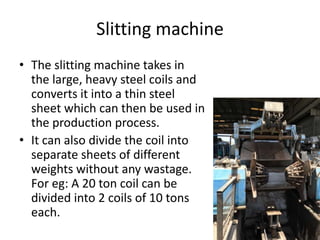
• The slitting machine takes in
the large, heavy steel coils and
converts it into a thin steel
sheet which can then be used in
the production process.
• It can also divide the coil into
separate sheets of different
weights without any wastage.
For eg: A 20 ton coil can be
divided into 2 coils of 10 tons
each.
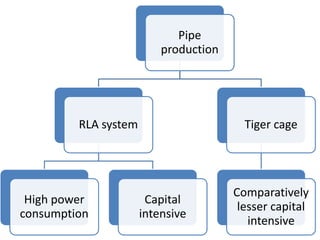
Pipe
production
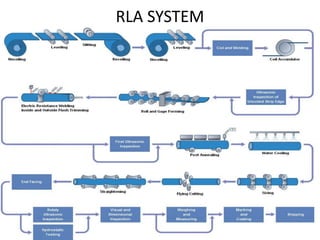
RLA system
High power
consumption
Capital
intensive
Tiger cage
Comparatively
lesser capital
intensive
RLA SYSTEM
Recoiler
• It converts the steel sheets into the shape of
the coil, so that it is easier to transport it to
the tube mill where production of the pipes
can begin.
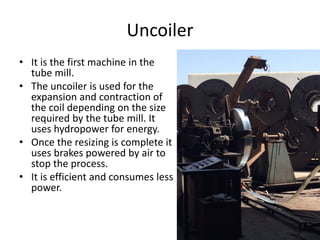
Uncoiler
• It is the first machine in the
tube mill.
• The uncoiler is used for the
expansion and contraction of
the coil depending on the size
required by the tube mill. It
uses hydropower for energy.
• Once the resizing is complete it
uses brakes powered by air to
stop the process.
• It is efficient and consumes less
power.
Welding point
• The welding point is an automated machine
which joins two sheets of metals so that it is a
continuous process.
• The machine uses sensors to detect the point
at which heat is supplied, where the sheet is
melted and joined into one.
• The welding point also uses guide and leveling
rolls to to make sure the sheet is exactly
horizontal or vertical.
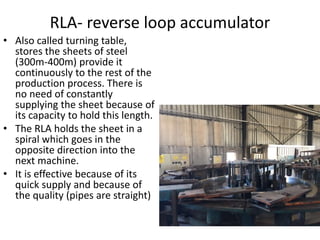
RLA- reverse loop accumulator
• Also called turning table,
stores the sheets of steel
(300m-400m) provide it
continuously to the rest of the
production process. There is
no need of constantly
supplying the sheet because of
its capacity to hold this length.
• The RLA holds the sheet in a
spiral which goes in the
opposite direction into the
next machine.
• It is effective because of its
quick supply and because of
the quality (pipes are straight)
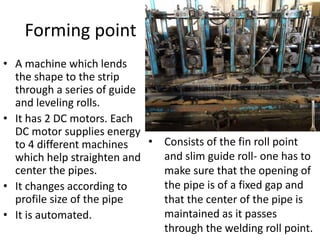
Forming point
• A machine which lends
the shape to the strip
through a series of guide
and leveling rolls.
• It has 2 DC motors. Each
DC motor supplies energy
to 4 different machines
which help straighten and
center the pipes.
• It changes according to
profile size of the pipe
• It is automated.
• Consists of the fin roll point
and slim guide roll- one has to
make sure that the opening of
the pipe is of a fixed gap and
that the center of the pipe is
maintained as it passes
through the welding roll point.
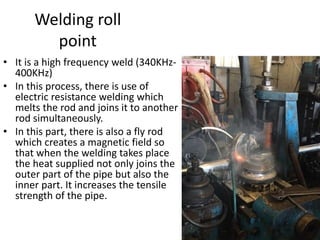
Welding roll
point
• It is a high frequency weld (340KHz-
400KHz)
• In this process, there is use of
electric resistance welding which
melts the rod and joins it to another
rod simultaneously.
• In this part, there is also a fly rod
which creates a magnetic field so
that when the welding takes place
the heat supplied not only joins the
outer part of the pipe but also the
inner part. It increases the tensile
strength of the pipe.
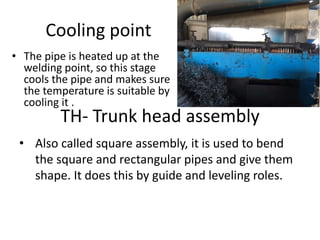
Cooling point
• The pipe is heated up at the
welding point, so this stage
cools the pipe and makes sure
the temperature is suitable by
cooling it .
TH- Trunk head assembly
• Also called square assembly, it is used to bend
the square and rectangular pipes and give them
shape. It does this by guide and leveling roles.
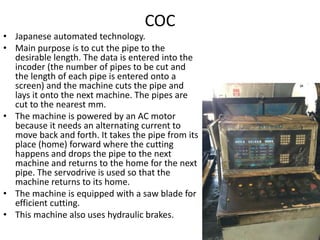
COC
• Japanese automated technology.
• Main purpose is to cut the pipe to the
desirable length. The data is entered into the
incoder (the number of pipes to be cut and
the length of each pipe is entered onto a
screen) and the machine cuts the pipe and
lays it onto the next machine. The pipes are
cut to the nearest mm.
• The machine is powered by an AC motor
because it needs an alternating current to
move back and forth. It takes the pipe from its
place (home) forward where the cutting
happens and drops the pipe to the next
machine and returns to the home for the next
pipe. The servodrive is used so that the
machine returns to its home.
• The machine is equipped with a saw blade for
efficient cutting.
• This machine also uses hydraulic brakes.
ROT- run out table
It ends the process (finishing of assembly lines)
Pnuematic cylinder
It is an air based machine which separates the
defected pipes from the lot which is fine for
dispatch. It does this with the help of a sensor.
Facing point
• It gives the pipes a smooth finish.
• The machine finishes the pipe faces on both sides by putting a smooth layer on
top of the edges.
Straightening machine
• Some pipes which are rejected because of the defects in the pneumatic
cylinder can be corrected.
• The straightening machine fixes bends in the pipes and reduces wastage. It is
very economical as the power consumption reduces; faults in the pipes are
low as the assembly line involves minimum human interference.
Dispatch according to order
Currently, Global Steel Industries FZCO is using
the RLA system. On looking at the how the
system works, the quantity of steel pipes
manufactured and the power consumption, I
suggested that they switch to the Tiger Cage, a
new system for the manufacturing of steel
pipes.
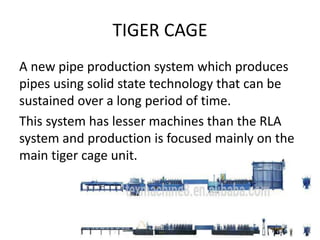
TIGER CAGE
A new pipe production system which produces
pipes using solid state technology that can be
sustained over a long period of time.
This system has lesser machines than the RLA
system and production is focused mainly on the
main tiger cage unit.
Quality
• The quality of the pipe remains similar to the
the steel pipes designed earlier in terms of
weight and strength but the finished pipe has
a mark that runs on it.
• The finished product is the same as the RLA
system except for the marked strip.
Power Consumption
• The tiger cage is a system of machines which is
comparatively less capital intensive and more
labor intensive. It also combines a series of
tasks done by different machines in the RLA
system into one fundamental task done in one
machine.
• The power consumption is 7% of the power
consumption of the RLA.
Consumption of Space
• The tiger cage occupies a quarter of the space
of the RLA system and can be fitted in
approximately a 30 m2 area. The whole
process takes place in one unit and so there is
no need to transport it to other parts of the
machine.
Capacity and Wastage
• The tiger cage produces with very low power
consumption. There is very less time wasted on
changing from one type of pipe to another
because the workers can adjust easily. But there
are more chances of errors with pipes and so
there can be wastage. Production is slower than
the RLA system. When demand of steel pipes is
low , the tiger cage is more suitable because
there the power consumption is lower than that
of the RLA system.
Capacity and Wastage
• The RLA produces on a very large scale and
production is fast. But when there is low
demand (such as in Ramadan), a lot of the
pipes are wasted and are stored. There is also
wastage of time when the production shifts
from one size of a pipe to another or to a
different shape.

Yash Bajaj Internship

  • 1.
    Global Steel IndustriesFZCO Yash Bajaj
  • 2.
    Introduction • Global SteelIndustries, established in the year 2002 in the Jebel Ali Free Zone, Dubai, United Arab Emirates, is currently one of the Leading Pipe Manufacturers in the Gulf Region.
  • 3.
    Production • The steelpipes are produced on a flow line which is constantly regulated by workers so that there is uninterrupted production. • The production line is divided into two parts- the slitting machine and the tube mill. • The slitting machine is used to convert the steel coil into a thin metal sheet. • The tube mill rounds the thin metal sheet to make into pipes of desirable lengths.
  • 4.
    Slitting machine • Theslitting machine takes in the large, heavy steel coils and converts it into a thin steel sheet which can then be used in the production process. • It can also divide the coil into separate sheets of different weights without any wastage. For eg: A 20 ton coil can be divided into 2 coils of 10 tons each.
  • 5.
  • 6.
  • 7.
    Recoiler • It convertsthe steel sheets into the shape of the coil, so that it is easier to transport it to the tube mill where production of the pipes can begin.
  • 8.
    Uncoiler • It isthe first machine in the tube mill. • The uncoiler is used for the expansion and contraction of the coil depending on the size required by the tube mill. It uses hydropower for energy. • Once the resizing is complete it uses brakes powered by air to stop the process. • It is efficient and consumes less power.
  • 9.
    Welding point • Thewelding point is an automated machine which joins two sheets of metals so that it is a continuous process. • The machine uses sensors to detect the point at which heat is supplied, where the sheet is melted and joined into one. • The welding point also uses guide and leveling rolls to to make sure the sheet is exactly horizontal or vertical.
  • 10.
    RLA- reverse loopaccumulator • Also called turning table, stores the sheets of steel (300m-400m) provide it continuously to the rest of the production process. There is no need of constantly supplying the sheet because of its capacity to hold this length. • The RLA holds the sheet in a spiral which goes in the opposite direction into the next machine. • It is effective because of its quick supply and because of the quality (pipes are straight)
  • 11.
    Forming point • Amachine which lends the shape to the strip through a series of guide and leveling rolls. • It has 2 DC motors. Each DC motor supplies energy to 4 different machines which help straighten and center the pipes. • It changes according to profile size of the pipe • It is automated. • Consists of the fin roll point and slim guide roll- one has to make sure that the opening of the pipe is of a fixed gap and that the center of the pipe is maintained as it passes through the welding roll point.
  • 12.
    Welding roll point • Itis a high frequency weld (340KHz- 400KHz) • In this process, there is use of electric resistance welding which melts the rod and joins it to another rod simultaneously. • In this part, there is also a fly rod which creates a magnetic field so that when the welding takes place the heat supplied not only joins the outer part of the pipe but also the inner part. It increases the tensile strength of the pipe.
  • 13.
    Cooling point • Thepipe is heated up at the welding point, so this stage cools the pipe and makes sure the temperature is suitable by cooling it . TH- Trunk head assembly • Also called square assembly, it is used to bend the square and rectangular pipes and give them shape. It does this by guide and leveling roles.
  • 14.
    COC • Japanese automatedtechnology. • Main purpose is to cut the pipe to the desirable length. The data is entered into the incoder (the number of pipes to be cut and the length of each pipe is entered onto a screen) and the machine cuts the pipe and lays it onto the next machine. The pipes are cut to the nearest mm. • The machine is powered by an AC motor because it needs an alternating current to move back and forth. It takes the pipe from its place (home) forward where the cutting happens and drops the pipe to the next machine and returns to the home for the next pipe. The servodrive is used so that the machine returns to its home. • The machine is equipped with a saw blade for efficient cutting. • This machine also uses hydraulic brakes.
  • 15.
    ROT- run outtable It ends the process (finishing of assembly lines) Pnuematic cylinder It is an air based machine which separates the defected pipes from the lot which is fine for dispatch. It does this with the help of a sensor.
  • 16.
    Facing point • Itgives the pipes a smooth finish. • The machine finishes the pipe faces on both sides by putting a smooth layer on top of the edges. Straightening machine • Some pipes which are rejected because of the defects in the pneumatic cylinder can be corrected. • The straightening machine fixes bends in the pipes and reduces wastage. It is very economical as the power consumption reduces; faults in the pipes are low as the assembly line involves minimum human interference. Dispatch according to order
  • 17.
    Currently, Global SteelIndustries FZCO is using the RLA system. On looking at the how the system works, the quantity of steel pipes manufactured and the power consumption, I suggested that they switch to the Tiger Cage, a new system for the manufacturing of steel pipes.
  • 18.
    TIGER CAGE A newpipe production system which produces pipes using solid state technology that can be sustained over a long period of time. This system has lesser machines than the RLA system and production is focused mainly on the main tiger cage unit.
  • 19.
    Quality • The qualityof the pipe remains similar to the the steel pipes designed earlier in terms of weight and strength but the finished pipe has a mark that runs on it. • The finished product is the same as the RLA system except for the marked strip.
  • 20.
    Power Consumption • Thetiger cage is a system of machines which is comparatively less capital intensive and more labor intensive. It also combines a series of tasks done by different machines in the RLA system into one fundamental task done in one machine. • The power consumption is 7% of the power consumption of the RLA.
  • 21.
    Consumption of Space •The tiger cage occupies a quarter of the space of the RLA system and can be fitted in approximately a 30 m2 area. The whole process takes place in one unit and so there is no need to transport it to other parts of the machine.
  • 22.
    Capacity and Wastage •The tiger cage produces with very low power consumption. There is very less time wasted on changing from one type of pipe to another because the workers can adjust easily. But there are more chances of errors with pipes and so there can be wastage. Production is slower than the RLA system. When demand of steel pipes is low , the tiger cage is more suitable because there the power consumption is lower than that of the RLA system.
  • 23.
    Capacity and Wastage •The RLA produces on a very large scale and production is fast. But when there is low demand (such as in Ramadan), a lot of the pipes are wasted and are stored. There is also wastage of time when the production shifts from one size of a pipe to another or to a different shape.