OVERVIEW OF
PROCESS PLANT PIPING
SYSTEM
Reza Manafi
 Definition
 Piping component
 Piping drawing
 Design
 Pipe work
 Codes & Standards
Piping components: summary
Prepared by Reza Manafi
Definition
Prepared by Reza Manafi
 piping:
assemblies of piping components
used…[for] fluid flows. Piping also
includes pipe supporting elements, but
does not include support structures…or
equipment…
 piping system:
interconnected piping subject to the
same design conditions
Definition:
Prepared by Reza Manafi
 piping components:
mechanical elements suitable for joining
or assembly into pressure tight fluid-
containing piping systems include
Definition:
Prepared by Reza Manafi
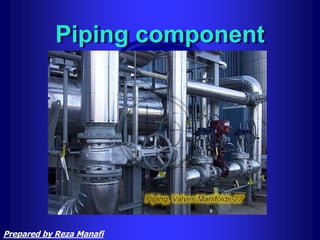
Piping component
Prepared by Reza Manafi
Piping components:
 piping components includes:
 Pipe & tube
 Fittings (e.g. elbows, reducers, branch,
connections, flanges, etc.)
 gaskets, bolting
 valves
 Pipe support
 Special items such as expansion
joints…
Prepared by Reza Manafi
Pipe & Tube
Prepared by Reza Manafi
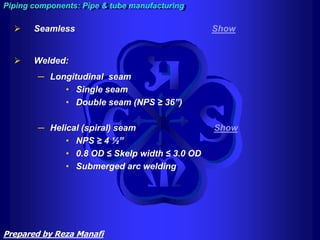
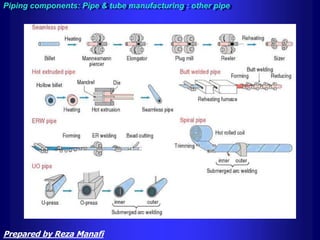
 Seamless Show
 Welded:
─ Longitudinal seam
• Single seam
• Double seam (NPS ≥ 36”)
─ Helical (spiral) seam Show
• NPS ≥ 4 ½”
• 0.8 OD ≤ Skelp width ≤ 3.0 OD
• Submerged arc welding
Piping components: Pipe & tube manufacturing
Prepared by Reza Manafi
 Welding process:
─ Without filler metal
• Electric welding Show
• Continuous welding Show
– With filler metal
• Sub-merged arc welding
• Gas metal arc welding
Piping components: Pipe & tube manufacturing
Prepared by Reza Manafi
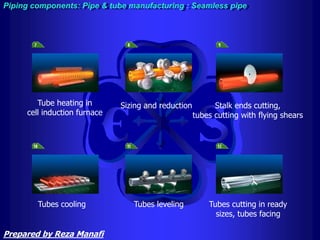
Billet preparing
visual control
Billet chopping
Billet heating
in annular furnace
Rough tube
piercing
Tube rolling in
continuous mandrel mill
Mandrel removing
Piping components: Pipe & tube manufacturing : Seamless pipe
Prepared by Reza Manafi
Tube heating in
cell induction furnace
Sizing and reduction Stalk ends cutting,
tubes cutting with flying shears
Tubes cooling Tubes leveling Tubes cutting in ready
sizes, tubes facing
Piping components: Pipe & tube manufacturing : Seamless pipe
Prepared by Reza Manafi
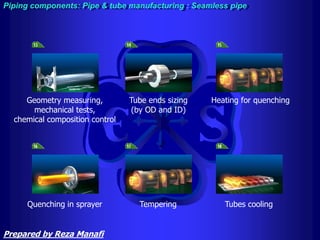
Geometry measuring,
mechanical tests,
chemical composition control
Tube ends sizing
(by OD and ID)
Heating for quenching
Quenching in sprayer Tempering Tubes cooling
Piping components: Pipe & tube manufacturing : Seamless pipe
Prepared by Reza Manafi
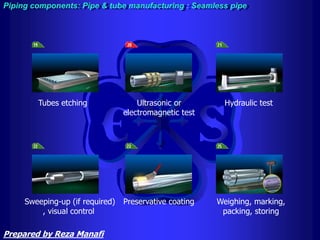
Tubes etching Ultrasonic or
electromagnetic test
Hydraulic test
Sweeping-up (if required)
, visual control
Preservative coating Weighing, marking,
packing, storing
Piping components: Pipe & tube manufacturing : Seamless pipe
Prepared by Reza Manafi
Tube end upset Thermal treatment Leveling
Sweeping-up and
grading by length
Threading, thread
quality monitoring
Couplings screwing-on
Piping components: Pipe & tube manufacturing : Seamless pipe (threaded)
Prepared by Reza Manafi
Hydraulic test Tubes inspection,
rings and nipple
screwing-on, marking
Painting (if required))
Packing, storing
Piping components: Pipe & tube manufacturing : Seamless pipe (threaded)
Prepared by Reza Manafi
Piping components: Pipe & tube manufacturing : other pipe
Prepared by Reza Manafi
 Pipe classification:
─ Iron pipe size (approximate internal dia.)
─ Manufacturers’ weight: NPS +
• STD
• XS
• XXS
─ Schedule number: NPS +
• 5, 5s, 10, 10s, 20, 20s, 30, 40, 40s, 60, 80, 80s, 100, 120,
140, 160 Show
• SCH ≈ 1000 P/S
• NPS ≤ 12, OD ≥ NPS
• NPS ≥ 14, OD = NPS
• NPS ≤ 10, SCH 40 = STD
• NPS ≤ 8, SCH 80 = XS
• Light wall = light gage = 5, 5s, 10, 10s
– API designation
• A25, A, B, X42, X46, X52, X60, X65, X70
• X(AA), AA = Allowable stress
– Pressure-Temperature Ratings
• 150, 300, 400, 600, 900, 1500, 2500
Piping components: pipe & tube classification
Prepared by Reza Manafi
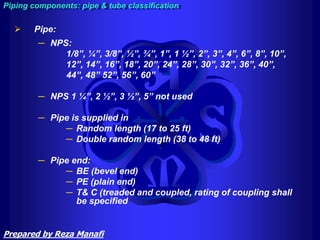
 Pipe:
─ NPS:
1/8”, ¼”, 3/8”, ½”, ¾”, 1”, 1 ½”, 2”, 3”, 4”, 6”, 8”, 10”,
12”, 14”, 16”, 18”, 20”, 24”, 28”, 30”, 32”, 36”, 40”,
44”, 48” 52”, 56”, 60”
─ NPS 1 ¼”, 2 ½”, 3 ½”, 5” not used
─ Pipe is supplied in
─ Random length (17 to 25 ft)
─ Double random length (38 to 48 ft)
─ Pipe end:
─ BE (bevel end)
─ PE (plain end)
─ T& C (treaded and coupled, rating of coupling shall
be specified
Piping components: pipe & tube classification
Prepared by Reza Manafi
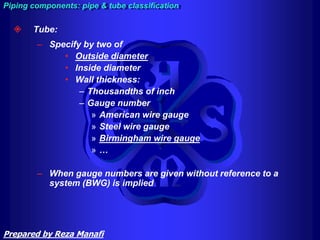
 Tube:
– Specify by two of
• Outside diameter
• Inside diameter
• Wall thickness:
– Thousandths of inch
– Gauge number
» American wire gauge
» Steel wire gauge
» Birmingham wire gauge
» …
– When gauge numbers are given without reference to a
system (BWG) is implied
Piping components: pipe & tube classification
Prepared by Reza Manafi
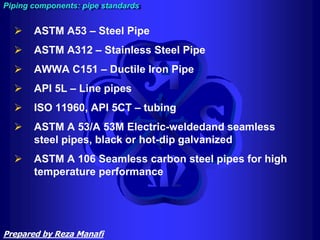
 ASTM A53 – Steel Pipe
 ASTM A312 – Stainless Steel Pipe
 AWWA C151 – Ductile Iron Pipe
 API 5L – Line pipes
 ISO 11960, API 5CT – tubing
 ASTM A 53/A 53М Electric-weldedand seamless
steel pipes, black or hot-dip galvanized
 ASTM A 106 Seamless carbon steel pipes for high
temperature performance
Piping components: pipe standards
Prepared by Reza Manafi
Piping components: Fitting
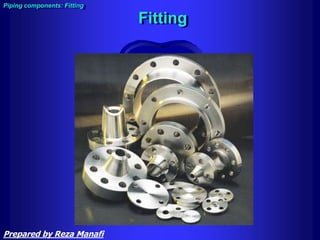
Fitting
Prepared by Reza Manafi
 Fitting produce change in geometry and include:
– Change in direction of piping
– Alter pipe diameter
– Terminate pipe
– Bring pipes together
(made branch from main pipe run)
Piping components: Fitting
Prepared by Reza Manafi
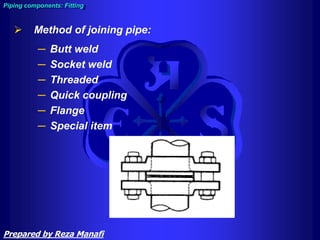
 Method of joining pipe:
─ Butt weld
─ Socket weld
─ Threaded
─ Quick coupling
─ Flange
─ Special item
Piping components: Fitting
Prepared by Reza Manafi
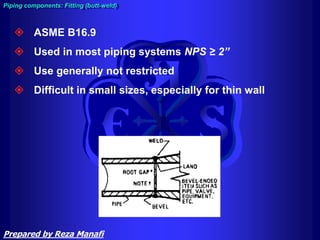
 ASME B16.9
 Used in most piping systems NPS ≥ 2”
 Use generally not restricted
 Difficult in small sizes, especially for thin wall
Piping components: Fitting (butt-weld)
Prepared by Reza Manafi
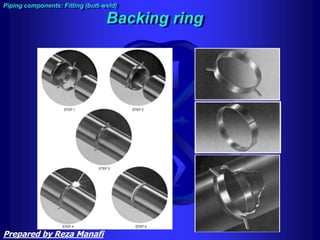
Backing ring
Piping components: Fitting (butt-weld)
Prepared by Reza Manafi
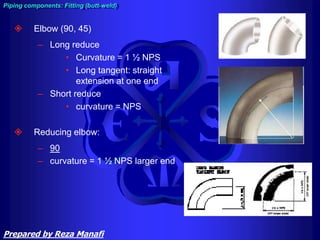
 Elbow (90, 45)
– Long reduce
• Curvature = 1 ½ NPS
• Long tangent: straight
extension at one end
– Short reduce
• curvature = NPS
 Reducing elbow:
– 90
– curvature = 1 ½ NPS larger end
Piping components: Fitting (butt-weld)
Prepared by Reza Manafi
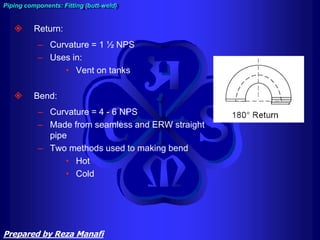
 Return:
– Curvature = 1 ½ NPS
– Uses in:
• Vent on tanks
 Bend:
– Curvature = 4 - 6 NPS
– Made from seamless and ERW straight
pipe
– Two methods used to making bend
• Hot
• Cold
Piping components: Fitting (butt-weld)
Prepared by Reza Manafi
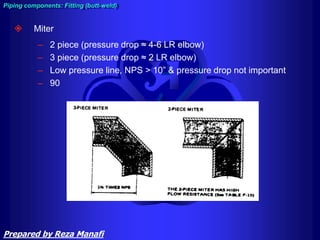
 Miter
– 2 piece (pressure drop ≈ 4-6 LR elbow)
– 3 piece (pressure drop ≈ 2 LR elbow)
– Low pressure line, NPS > 10” & pressure drop not important
– 90
Piping components: Fitting (butt-weld)
Prepared by Reza Manafi
 Reducer
– Eccentric
• Suction & discharge of pump
• support
– concentric
Piping components: Fitting (butt-weld)
Prepared by Reza Manafi
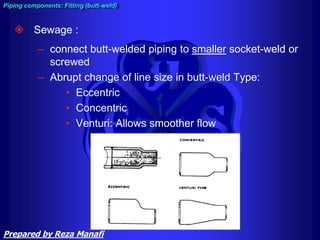
 Sewage :
– connect butt-welded piping to smaller socket-weld or
screwed
– Abrupt change of line size in butt-weld Type:
• Eccentric
• Concentric
• Venturi: Allows smoother flow
Piping components: Fitting (butt-weld)
Prepared by Reza Manafi
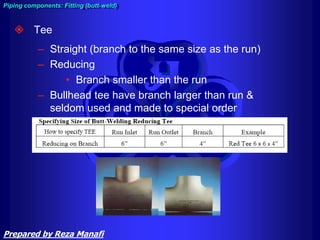
 Tee
– Straight (branch to the same size as the run)
– Reducing
• Branch smaller than the run
– Bullhead tee have branch larger than run &
seldom used and made to special order
Piping components: Fitting (butt-weld)
Prepared by Reza Manafi
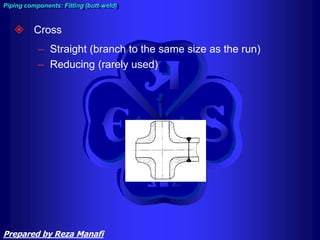
 Cross
– Straight (branch to the same size as the run)
– Reducing (rarely used)
Piping components: Fitting (butt-weld)
Prepared by Reza Manafi
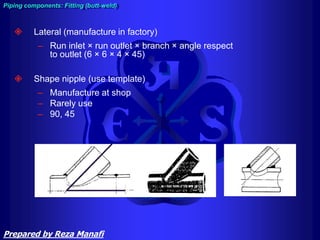
 Lateral (manufacture in factory)
– Run inlet × run outlet × branch × angle respect
to outlet (6 × 6 × 4 × 45)
 Shape nipple (use template)
– Manufacture at shop
– Rarely use
– 90, 45
45
Piping components: Fitting (butt-weld)
Prepared by Reza Manafi
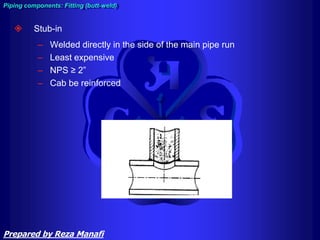
 Stub-in
– Welded directly in the side of the main pipe run
– Least expensive
– NPS ≥ 2”
– Cab be reinforced
Piping components: Fitting (butt-weld)
Prepared by Reza Manafi
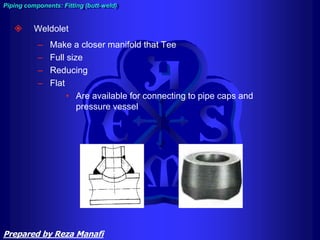
 Weldolet
– Make a closer manifold that Tee
– Full size
– Reducing
– Flat
• Are available for connecting to pipe caps and
pressure vessel
Piping components: Fitting (butt-weld)
Prepared by Reza Manafi
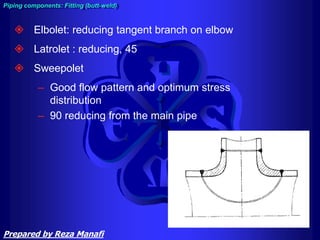
 Elbolet: reducing tangent branch on elbow
 Latrolet : reducing, 45
 Sweepolet
– Good flow pattern and optimum stress
distribution
– 90 reducing from the main pipe
Piping components: Fitting (butt-weld)
Prepared by Reza Manafi
 Closure
– Cap
– Flat closure
Piping components: Fitting (butt-weld)
Prepared by Reza Manafi
 Size frequently limited to NPS≤ 1 ½” (ASME B16.11)
 Not used in “severe cyclic conditions” and in
services where corrosion is accelerated in crevices
 No weld metal can enter bore, easier alignment on
small line than butt-weld
 Tack is unnecessary
 Have not any leakage
Piping components: Fitting (socket)
Prepared by Reza Manafi
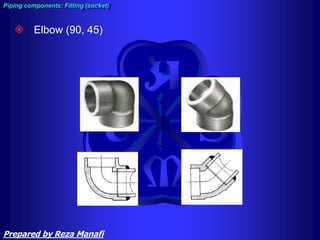
 Elbow (90, 45)
Piping components: Fitting (socket)
Prepared by Reza Manafi
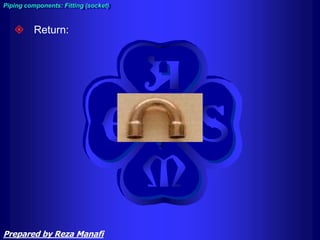
 Return:
Piping components: Fitting (socket)
Prepared by Reza Manafi
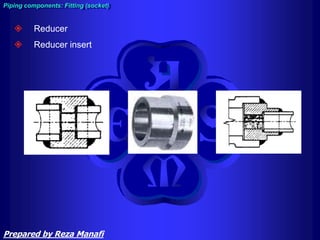
 Reducer
 Reducer insert
Piping components: Fitting (socket)
Prepared by Reza Manafi
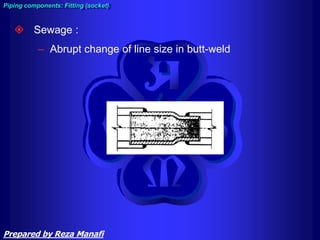
 Sewage :
– Abrupt change of line size in butt-weld
Piping components: Fitting (socket)
Prepared by Reza Manafi
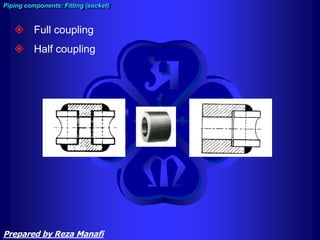
 Full coupling
 Half coupling
Piping components: Fitting (socket)
Prepared by Reza Manafi
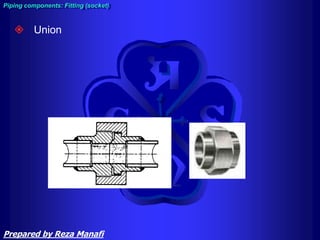
 Union
Piping components: Fitting (socket)
Prepared by Reza Manafi
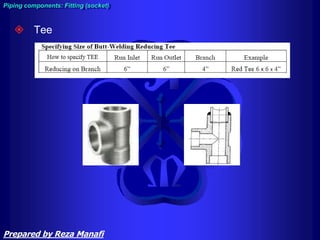
 Tee
Piping components: Fitting (socket)
Prepared by Reza Manafi
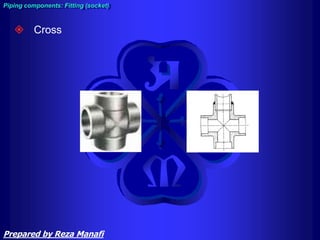
 Cross
Piping components: Fitting (socket)
Prepared by Reza Manafi
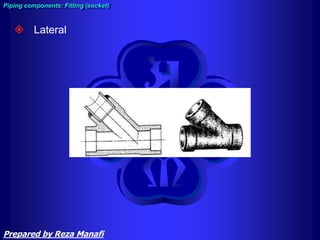
 Lateral
Piping components: Fitting (socket)
Prepared by Reza Manafi
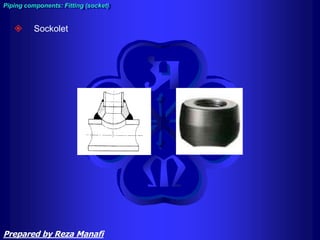
 Sockolet
Piping components: Fitting (socket)
Prepared by Reza Manafi
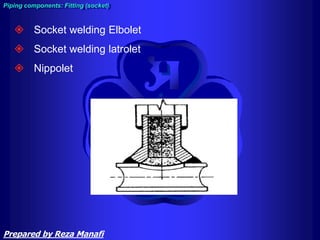
 Socket welding Elbolet
 Socket welding latrolet
 Nippolet
Piping components: Fitting (socket)
Prepared by Reza Manafi
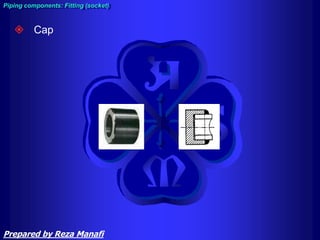
 Cap
Piping components: Fitting (socket)
Prepared by Reza Manafi
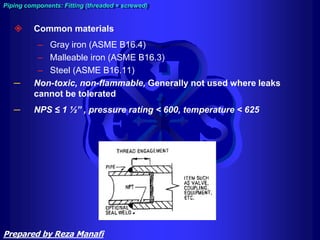
 Common materials
– Gray iron (ASME B16.4)
– Malleable iron (ASME B16.3)
– Steel (ASME B16.11)
─ Non-toxic, non-flammable, Generally not used where leaks
cannot be tolerated
─ NPS ≤ 1 ½” , pressure rating < 600, temperature < 625
Piping components: Fitting (threaded = screwed)
Prepared by Reza Manafi
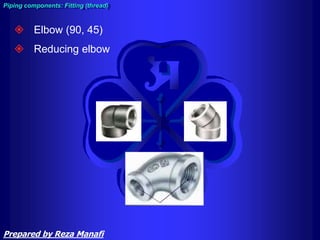
 Elbow (90, 45)
 Reducing elbow
Piping components: Fitting (thread)
Prepared by Reza Manafi
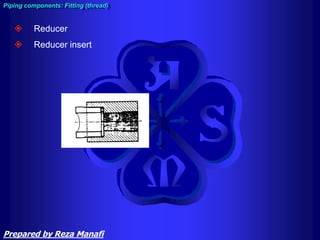
 Reducer
 Reducer insert
Piping components: Fitting (thread)
Prepared by Reza Manafi
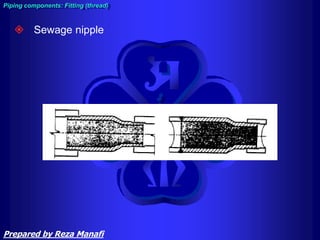
 Sewage nipple
Piping components: Fitting (thread)
Prepared by Reza Manafi
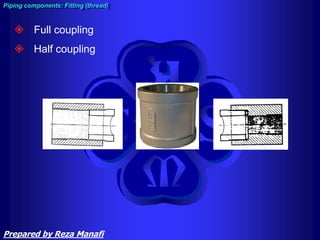
 Full coupling
 Half coupling
Piping components: Fitting (thread)
Prepared by Reza Manafi
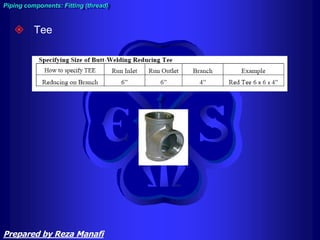
 Tee
Piping components: Fitting (thread)
Prepared by Reza Manafi
 Nipple
Piping components: Fitting (thread)
Prepared by Reza Manafi
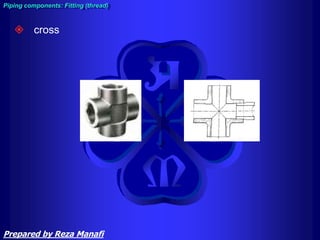
 cross
Piping components: Fitting (thread)
Prepared by Reza Manafi
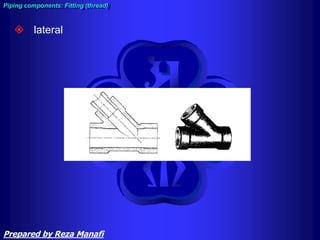
 lateral
Piping components: Fitting (thread)
Prepared by Reza Manafi
 Union
Piping components: Fitting (thread)
Prepared by Reza Manafi
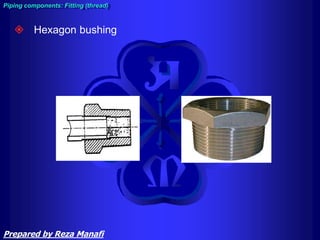
 Hexagon bushing
Piping components: Fitting (thread)
Prepared by Reza Manafi
 Threadolet
Piping components: Fitting (thread)
Prepared by Reza Manafi
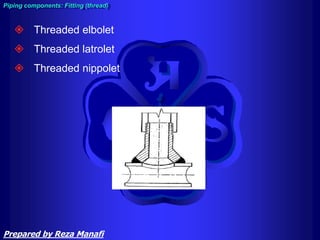
 Threaded elbolet
 Threaded latrolet
 Threaded nippolet
Piping components: Fitting (thread)
Prepared by Reza Manafi
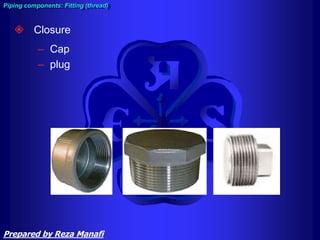
 Closure
– Cap
– plug
Piping components: Fitting (thread)
Prepared by Reza Manafi
Piping components: Fitting
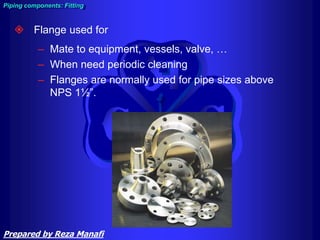
 Flange used for
– Mate to equipment, vessels, valve, …
– When need periodic cleaning
– Flanges are normally used for pipe sizes above
NPS 1½”.
Prepared by Reza Manafi
Piping components: Fitting
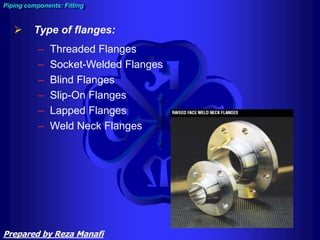
 Type of flanges:
– Threaded Flanges
– Socket-Welded Flanges
– Blind Flanges
– Slip-On Flanges
– Lapped Flanges
– Weld Neck Flanges
Prepared by Reza Manafi
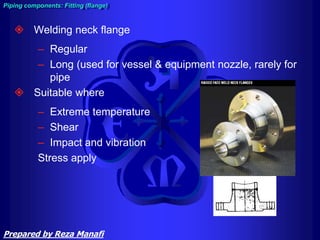
 Welding neck flange
– Regular
– Long (used for vessel & equipment nozzle, rarely for
pipe
 Suitable where
– Extreme temperature
– Shear
– Impact and vibration
Stress apply
Piping components: Fitting (flange)
Prepared by Reza Manafi
 Slip-on flange
– Internal welds is slightly more subject to corrosion
than the butt-weld (0 – 1/16”)
– Poor resistance to shock and vibration
– Cheaper to buy, costlier to assemble
– Strength under internal pressure 1/3 of corresponding
welding neck flange
– Easier to align than the welding neck flange
Piping components: Fitting (flange)
Prepared by Reza Manafi
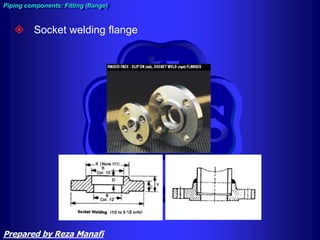
 Socket welding flange
Piping components: Fitting (flange)
Prepared by Reza Manafi
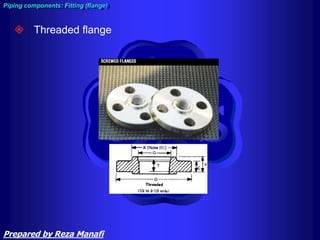
 Threaded flange
Piping components: Fitting (flange)
Prepared by Reza Manafi
 Reducing flange
– Specify by size of smaller pipe and outside diameter
of flange to be mate
• Ex/ RED FLG 4” × 11”
– Should not be used if abrupt transition would create
undesirable turbulence as at pump
Piping components: Fitting (flange)
Prepared by Reza Manafi
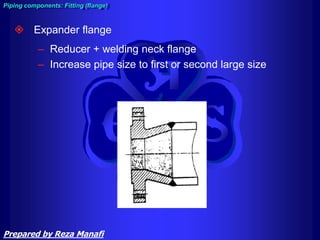
 Expander flange
– Reducer + welding neck flange
– Increase pipe size to first or second large size
Piping components: Fitting (flange)
Prepared by Reza Manafi
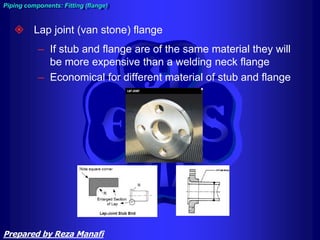
 Lap joint (van stone) flange
– If stub and flange are of the same material they will
be more expensive than a welding neck flange
– Economical for different material of stub and flange
Piping components: Fitting (flange)
Prepared by Reza Manafi
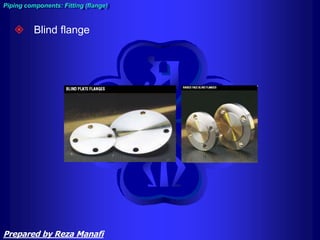
 Blind flange
Piping components: Fitting (flange)
Prepared by Reza Manafi
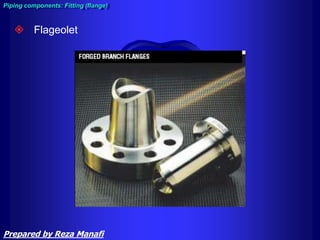
 Flageolet
Piping components: Fitting (flange)
Prepared by Reza Manafi
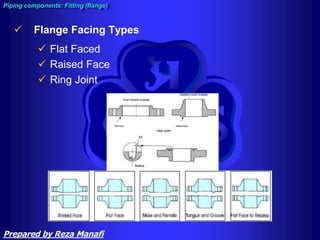
 Flange Facing Types
 Flat Faced
 Raised Face
 Ring Joint
Piping components: Fitting (flange)
Prepared by Reza Manafi
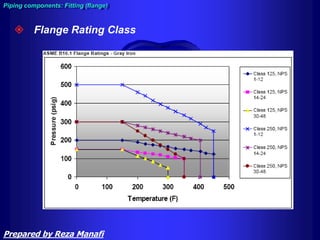
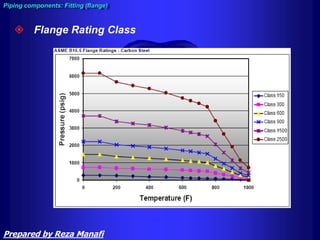
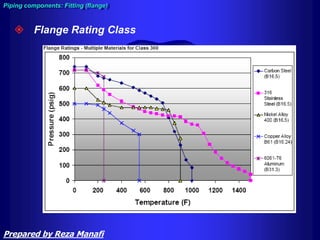
 Flange Rating Class:
– pressure/temperature combinations
– Seven classes (150, 300, 400, 600, 900, 1,500,
2,500)
– Flange strength increases with class number
– The material specifications are grouped within
Material Group Numbers.
Piping components: Fitting (flange)
Prepared by Reza Manafi
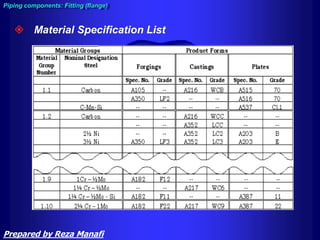
 Material Specification List
Piping components: Fitting (flange)
Prepared by Reza Manafi
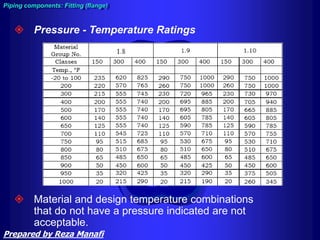
 Material and design temperature combinations
that do not have a pressure indicated are not
acceptable.
 Pressure - Temperature Ratings
Piping components: Fitting (flange)
Prepared by Reza Manafi
 Flange Rating Class
Piping components: Fitting (flange)
Prepared by Reza Manafi
 Flange Rating Class
Piping components: Fitting (flange)
Prepared by Reza Manafi
 Flange Rating Class
Piping components: Fitting (flange)
Prepared by Reza Manafi
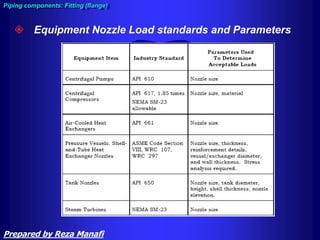
 Equipment Nozzle Load standards and Parameters
Piping components: Fitting (flange)
Prepared by Reza Manafi
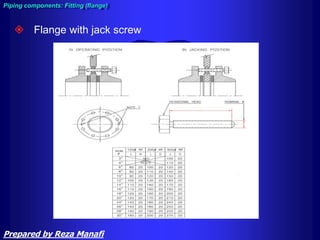
 Flange with jack screw
Piping components: Fitting (flange)
Prepared by Reza Manafi
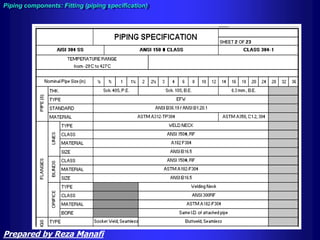
Piping components: Fitting (piping specification)
Prepared by Reza Manafi
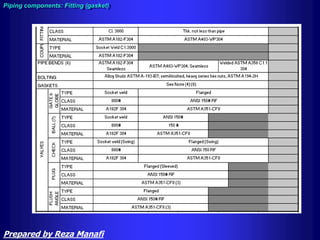
Piping components: Fitting (gasket)
Prepared by Reza Manafi
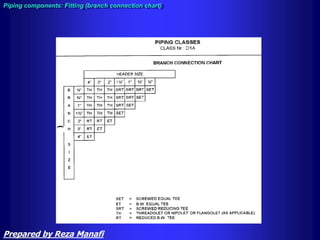
Piping components: Fitting (branch connection chart)
Prepared by Reza Manafi
 Gasket:
– Resilient material
– Inserted between flanges
– Compressed by bolts to create seal
– Commonly used types
• Sheet
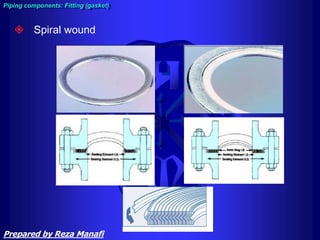
• Spiral wound
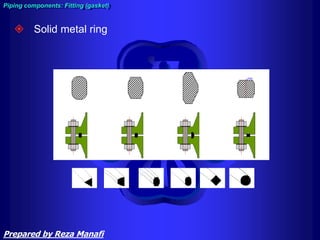
• Solid metal ring
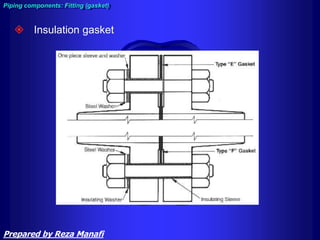
• Insulation gasket
Piping components: Fitting (gasket)
Prepared by Reza Manafi
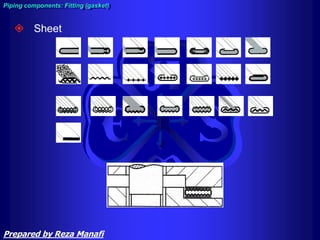
 Sheet
Piping components: Fitting (gasket)
Prepared by Reza Manafi
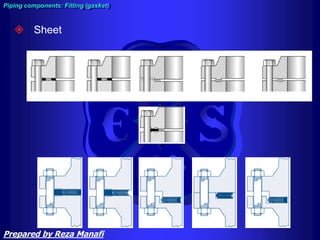
 Sheet
Piping components: Fitting (gasket)
Prepared by Reza Manafi
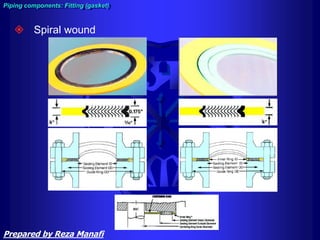
 Spiral wound
Piping components: Fitting (gasket)
Prepared by Reza Manafi
 Spiral wound
Piping components: Fitting (gasket)
Prepared by Reza Manafi
 Spiral wound
Piping components: Fitting (gasket)
Prepared by Reza Manafi
 Solid metal ring
Piping components: Fitting (gasket)
Prepared by Reza Manafi
 Insulation gasket
Piping components: Fitting (gasket)
Prepared by Reza Manafi
 Bolt type:
– Stud bolt
• Easily remove if corroded
• Material can be readily made
– Machine bolt
 Has to be strong enough to seat the gasket
Piping components: Fitting (bolt)
Prepared by Reza Manafi
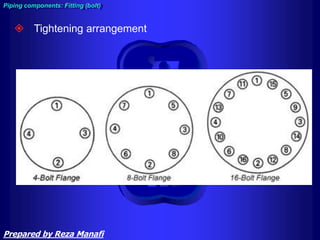
 Tightening arrangement
Piping components: Fitting (bolt)
Prepared by Reza Manafi
 ASME B16.5, Pipe Flanges and Flanged Fittings
(NPS ≤ 24”)
Piping components: Fitting
Prepared by Reza Manafi
 Quick coupling
Piping components: Fitting (special item)
Prepared by Reza Manafi
Piping components: Fitting (special item)
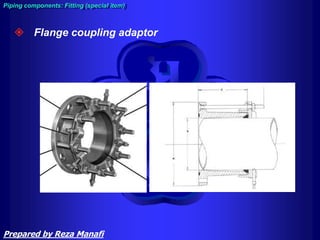
 Flange coupling adaptor
Prepared by Reza Manafi
Piping components: Fitting (special item)
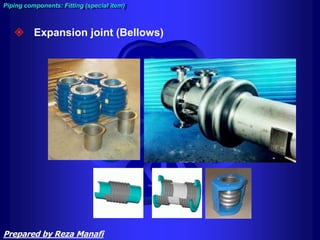
 Expansion joint (Bellows)
Prepared by Reza Manafi
Piping components: Fitting (special item)
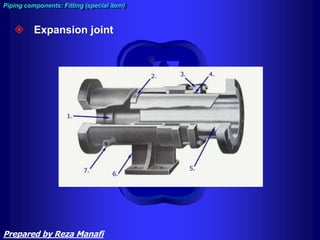
 Expansion joint
Prepared by Reza Manafi
Piping components: Fitting (special item)
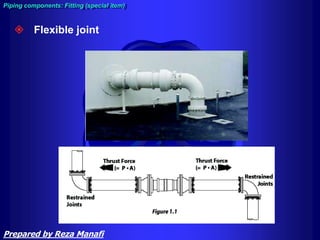
 Flexible joint
Prepared by Reza Manafi
Piping components: Fitting (special item)
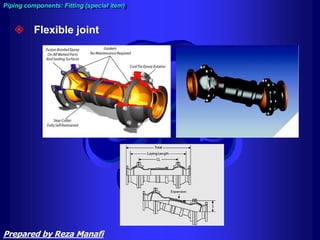
 Flexible joint
Prepared by Reza Manafi
Piping components: Fitting (special item)
 Double block & bleed
Prepared by Reza Manafi
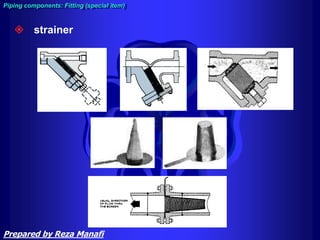
 strainer
Piping components: Fitting (special item)
Prepared by Reza Manafi
 Spectacle blind
Piping components: Fitting (special item)
Prepared by Reza Manafi
Piping components: Fitting (special item)
 Thermal sleeve & Queel
Prepared by Reza Manafi
Piping components: Fitting
Piping components: Fitting (special item)
 Bird screen
Prepared by Reza Manafi
Piping components: Fitting
Piping components: Fitting (special item)
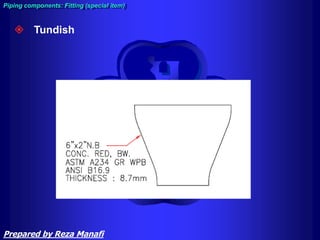
 Tundish
Prepared by Reza Manafi
Piping components: Fitting
Piping components: Fitting (special item)
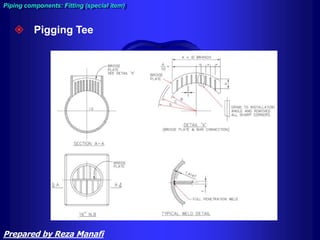
 Pigging Tee
Prepared by Reza Manafi
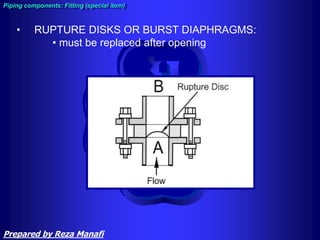
• RUPTURE DISKS OR BURST DIAPHRAGMS:
• must be replaced after opening
Piping components: Fitting (special item)
Prepared by Reza Manafi
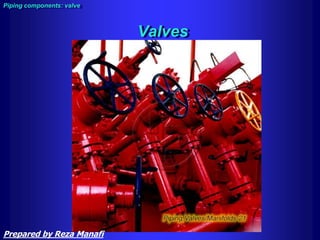
Valves
Piping components: valve
Prepared by Reza Manafi
 Valve are use for
– Controlling process and utility service
– Isolating equipment or instrument for
maintenances
– Discharge gas, vapor or liquid
– Draining piping and equipment on
shutdown
– Emergency shutdown
Piping components: valve
Prepared by Reza Manafi
 Classify valves according to functions:
– Block flow (On / Off)
– Regulating (Throttle flow)
– Checking (Prevent flow reversal)
– Switching
– Discharging (pressure relive valve)
 Classify valves according to operating device:
– Manual
– Hydraulic
– Motor (electric and air operated)
– Solenoid
Piping components: valve
Prepared by Reza Manafi
Piping components: valve
 Type of valves:
– Ball valves
– Gate valves
– Globe valves
– Check Valves
– Plug valve
– Butterfly valves
– Pinch valve
– Needle valves
– Relief Valve
Prepared by Reza Manafi
Ball Valve
Piping components: valve
Prepared by Reza Manafi
Piping components: valve (ball valve)
Prepared by Reza Manafi
Piping components: valve (ball valve)
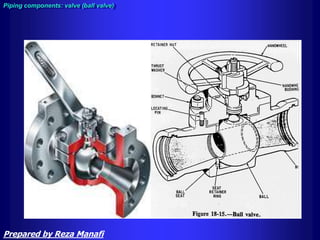
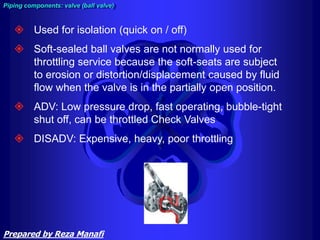
 Used for isolation (quick on / off)
 Soft-sealed ball valves are not normally used for
throttling service because the soft-seats are subject
to erosion or distortion/displacement caused by fluid
flow when the valve is in the partially open position.
 ADV: Low pressure drop, fast operating, bubble-tight
shut off, can be throttled Check Valves
 DISADV: Expensive, heavy, poor throttling
Prepared by Reza Manafi
Gate Valve
Piping components: valve
Prepared by Reza Manafi
Piping components: valve (gate valve)
Prepared by Reza Manafi
Piping components: valve (gate valve)
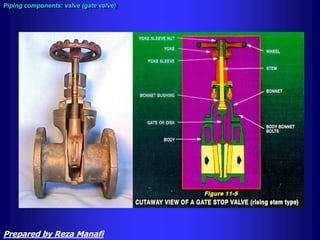
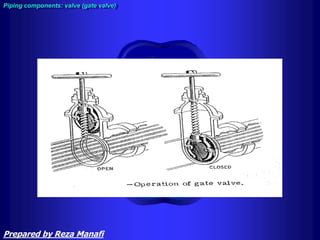
 About 75% of all valves in process plants
 an optimum engineering and economic choice for on
or off service. (cutout or isolation valves)
 ADV: small pressure drop across valve
 DISADV: poor throttling characteristics
Prepared by Reza Manafi
Piping components: valve (gate valve)
Prepared by Reza Manafi
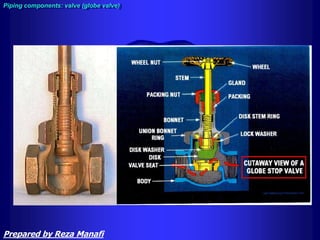
Globe Valve
Piping components: valve
Prepared by Reza Manafi
Piping components: valve (globe valve)
Prepared by Reza Manafi
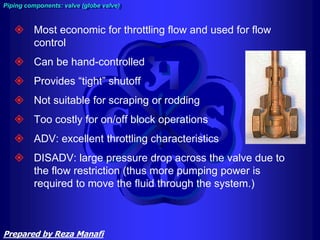
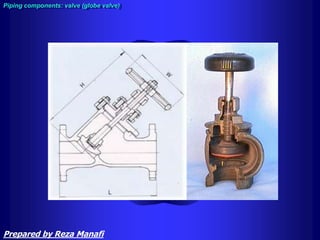
 Most economic for throttling flow and used for flow
control
 Can be hand-controlled
 Provides “tight” shutoff
 Not suitable for scraping or rodding
 Too costly for on/off block operations
 ADV: excellent throttling characteristics
 DISADV: large pressure drop across the valve due to
the flow restriction (thus more pumping power is
required to move the fluid through the system.)
Piping components: valve (globe valve)
Prepared by Reza Manafi
Piping components: valve (globe valve)
Prepared by Reza Manafi
Check Valve
Piping components: valve
Prepared by Reza Manafi
Piping components: (check valve / swing check valve)
Prepared by Reza Manafi
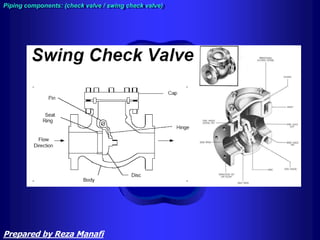
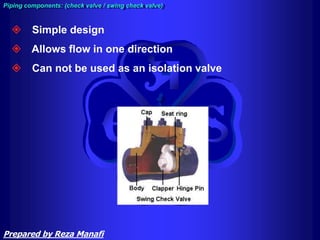
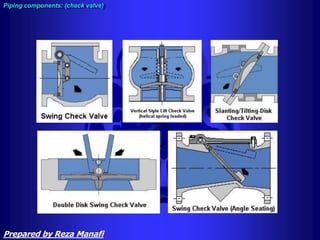
 Simple design
 Allows flow in one direction
 Can not be used as an isolation valve
Piping components: (check valve / swing check valve)
Prepared by Reza Manafi
Piping components: (check valve / ball check valve)
Prepared by Reza Manafi
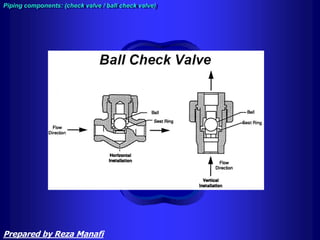
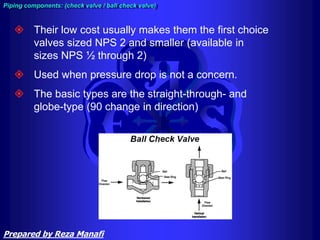
 Their low cost usually makes them the first choice
valves sized NPS 2 and smaller (available in
sizes NPS ½ through 2)
 Used when pressure drop is not a concern.
 The basic types are the straight-through- and
globe-type (90 change in direction)
Piping components: (check valve / ball check valve)
Prepared by Reza Manafi
Piping components: (check valve)
Prepared by Reza Manafi
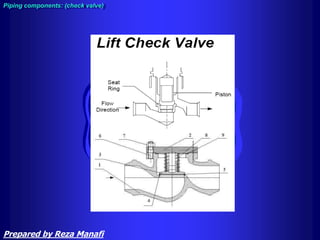
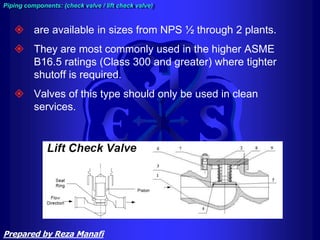
 are available in sizes from NPS ½ through 2 plants.
 They are most commonly used in the higher ASME
B16.5 ratings (Class 300 and greater) where tighter
shutoff is required.
 Valves of this type should only be used in clean
services.
Piping components: (check valve / lift check valve)
Prepared by Reza Manafi
Wafer Check Valve
Piping components: (check valve)
Prepared by Reza Manafi
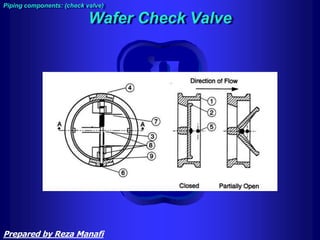
 Valves of this type are placed between pipe flanges
and held in place by the compressive force between
the flanges and transmitted through the gaskets.
Piping components: (check valve / wafer check valve)
Prepared by Reza Manafi
Stop Check Valve
Piping components: (check valve)
Prepared by Reza Manafi
Piping components: (check valve / stop check valve)
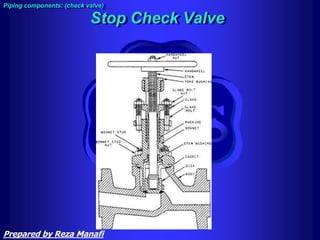
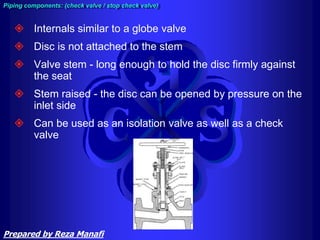
 Internals similar to a globe valve
 Disc is not attached to the stem
 Valve stem - long enough to hold the disc firmly against
the seat
 Stem raised - the disc can be opened by pressure on the
inlet side
 Can be used as an isolation valve as well as a check
valve
Prepared by Reza Manafi
Piping components: (check valve)
Prepared by Reza Manafi
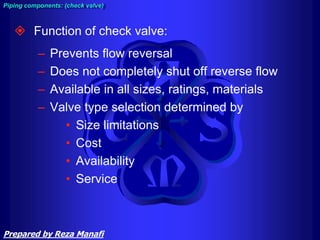
 Function of check valve:
– Prevents flow reversal
– Does not completely shut off reverse flow
– Available in all sizes, ratings, materials
– Valve type selection determined by
• Size limitations
• Cost
• Availability
• Service
Piping components: (check valve)
Prepared by Reza Manafi
Plug Valve
Piping components: valve
Prepared by Reza Manafi
Plug Valve
Piping components: valve (plug valve)
Prepared by Reza Manafi
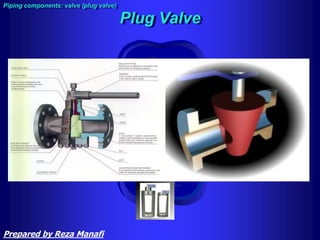
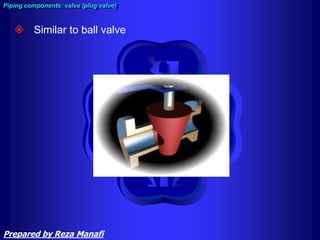
 Similar to ball valve
Piping components: valve (plug valve)
Prepared by Reza Manafi
Butterfly Valve
Piping components: valve
Prepared by Reza Manafi
Butterfly Valve
Piping components: valve (butterfly valve)
Prepared by Reza Manafi
Piping components: valve (butterfly valve)
 used as cutout/isolation valves
 ADV: quick-acting low pressure drop across the valve,
has adequate throttling characteristics
 DISADV: only used for low press/low temp systems
due to force involved in valve operation
Prepared by Reza Manafi
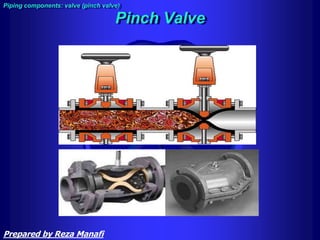
Pinch Valve
Piping components: valve
Prepared by Reza Manafi
Pinch Valve
Piping components: valve (pinch valve)
Prepared by Reza Manafi
Needle Valve
Piping components: valve
Prepared by Reza Manafi
Needle Valve
Piping components: valve (needle valve)
Prepared by Reza Manafi
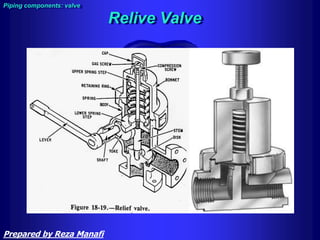
Relive Valve
Piping components: valve
Prepared by Reza Manafi
Relive Valve
Piping components: valve
Prepared by Reza Manafi
Piping components: valve (relive valve)
 special type of valve designed to operate automatically
(self actuating) in a system overpressure condition (a
protective feature in most systems)
 most relief valves use an adjustable spring to determine lift
pressure. System pressure opposes spring pressure, and
when pressure is high enough, the valve will open against
spring pressure and port the fluid to another location
(typically, overboard for ‘safe’ fluids)
 Type of relive valve:
– Relief Valve - liquid systems
– Safety Valve - gas and vapor systems
– Safety Relief Valve - liquid and/or vapor systems
Prepared by Reza Manafi
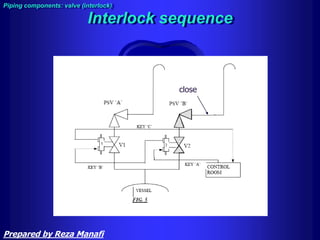
Interlock sequence
Piping components: valve (interlock)
close
Prepared by Reza Manafi
Parts of valves:
– disk:
• The moving part directly affecting the flow
– seat:
• Non-moving part that disk bear on it
– Metallic
– Non-metallic (elastomer)
– port:
• Maximum internal opening for flow when the
valve is fully open
– Stem:
• Move the disk
– Handwheel:
• Rise with the stem
• Stem rise thru the handwheel
Piping components: valve (parts)
Prepared by Reza Manafi
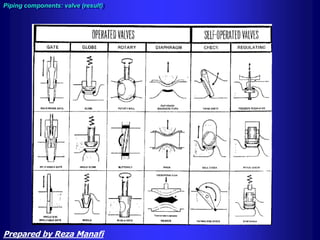
Piping components: valve (result)
Prepared by Reza Manafi
 General procedure for valve selection.
– Identify design information including
pressure and temperature, valve function,
material, etc.
– Identify potentially appropriate valve types
and components based on application and
function (i.e., block, throttle, or reverse flow
prevention).
Piping components: valve (valve selection process)
Prepared by Reza Manafi
– Determine valve application requirements
(i.e., design or service limitations).
– Finalize valve selection. Check factors to
consider if two or more valves are
suitable.
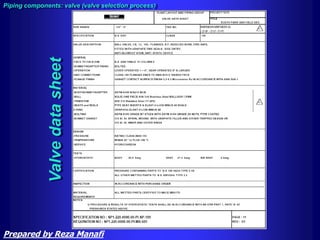
– Provide full technical description
specifying type, material, flange rating,
etc.
Piping components: valve (valve selection process)
Prepared by Reza Manafi
Valve
data
sheet
Piping components: valve (valve selection process)
Prepared by Reza Manafi
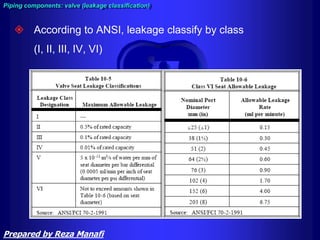
 According to ANSI, leakage classify by class
(I, II, III, IV, VI)
Piping components: valve (leakage classification)
Prepared by Reza Manafi
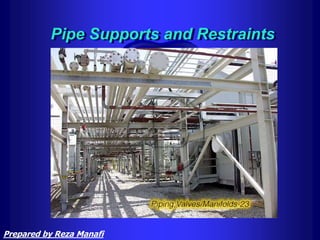
Pipe Supports and Restraints
Prepared by Reza Manafi
 Function of supports and restraints:
– To carry load
– To ensure that material is not stressed beyond a
safe limit
– Holdup of liquid can occurred due to pipe sagging
(allow draining)
– To permit thermal expansion
– To withstand and dampen vibrational forces applied
to the piping
Piping components: pipe supports and restraints
Prepared by Reza Manafi
 Supports:
– Absorb system weight
– Reduce:
• longitudinal pipe stress
• pipe sag
• end point reaction loads
Piping components: pipe supports and restraints
Prepared by Reza Manafi
 Restraints
– Control, limit, redirect thermal movement
• Reduce thermal stress
• Reduce loads on equipment connections
– Absorb imposed loads
• Wind
• Earthquake
• Slug flow
• Water hammer
• Flow induced-vibration
Piping components: pipe supports and restraints
Prepared by Reza Manafi
 Support and Restraint Selection Factors:
– Weight load
– Available attachment clearance
– Availability of structural steel
– Direction of loads and/or movement
– Design temperature
– Vertical thermal movement at supports
Piping components: pipe supports and restraints
Prepared by Reza Manafi
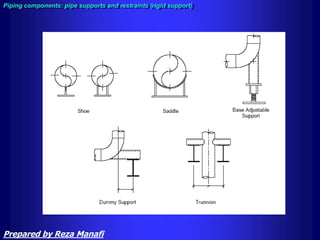
Piping components: pipe supports and restraints (rigid support)
Prepared by Reza Manafi
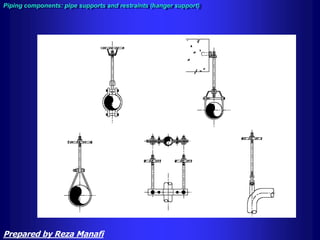
Piping components: pipe supports and restraints (hanger support)
Prepared by Reza Manafi
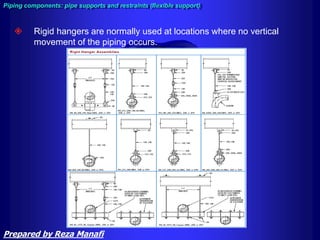
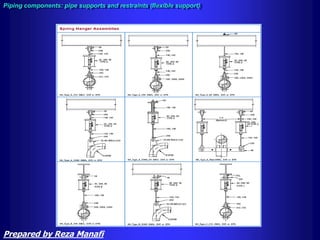
Piping components: pipe supports and restraints (flexible support)
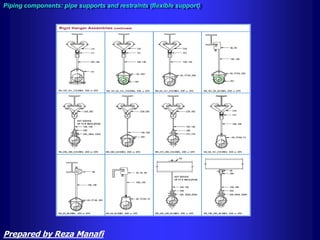
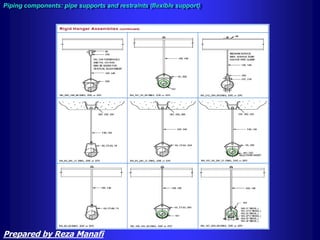
 Rigid hangers are normally used at locations where no vertical
movement of the piping occurs.
Prepared by Reza Manafi
Piping components: pipe supports and restraints (flexible support)
Prepared by Reza Manafi
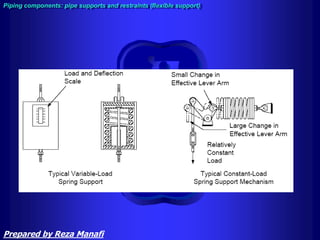
Flexible Supports
Piping components: pipe supports and restraints (flexible support)
Prepared by Reza Manafi
Piping components: pipe supports and restraints (flexible support)
Prepared by Reza Manafi
Flexible Supports
Piping components: pipe supports and restraints (flexible support)
Prepared by Reza Manafi
Flexible Supports
Piping components: pipe supports and restraints (flexible support)
Prepared by Reza Manafi
Piping components: pipe supports and restraints (flexible support)
Prepared by Reza Manafi
Piping components: pipe supports and restraints (flexible support)
Prepared by Reza Manafi
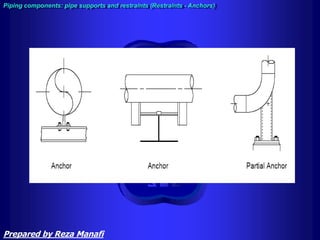
 Anchor
– Full fixation
– Permits very limited (if any) translation or
rotation
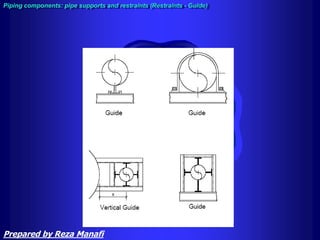
 Guide
– Permits movement along pipe axis
– Prevents lateral movement
– May permit pipe rotation
Piping components: pipe supports and restraints (anchor, guide)
Prepared by Reza Manafi
Piping components: pipe supports and restraints (Restraints - Anchors)
Prepared by Reza Manafi
Piping components: pipe supports and restraints (Restraints - Guide)
Prepared by Reza Manafi
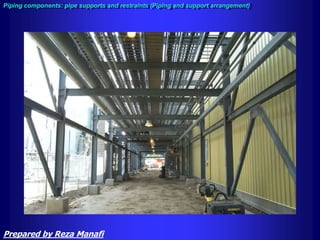
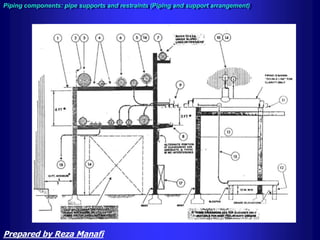
 Piping can be arranged
– On piperacks
– Near grade on sleeper
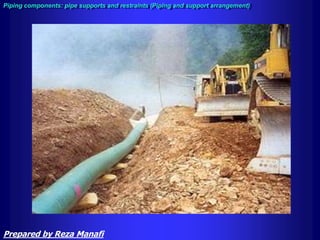
– In trench
– Near steelwork or equipment
Piping components: pipe supports and restraints (Piping and support arrangement)
Prepared by Reza Manafi
Piping components: pipe supports and restraints (Piping and support arrangement)
Prepared by Reza Manafi
Piping components: pipe supports and restraints (Piping and support arrangement)
Prepared by Reza Manafi
Piping components: pipe supports and restraints (Piping and support arrangement)
Prepared by Reza Manafi
 Pipeway:
– Is the space allocated for routing several parallel
adjacent lines
– Group lines in pipeway
 Piperack
– Is a structure in the pipeway for carrying pipes and
is usually fabricated from Steel, Concrete & steel,
also provide protected location for ancillary
equipment (pump, utility station, …)
– Piperack shape termed tee-head support
Piping components: pipe supports and restraints (Piping and support arrangement / support definition)
Prepared by Reza Manafi
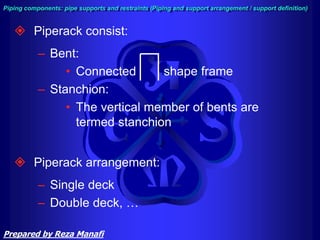
 Piperack consist:
– Bent:
• Connected shape frame
– Stanchion:
• The vertical member of bents are
termed stanchion
 Piperack arrangement:
– Single deck
– Double deck, …
Piping components: pipe supports and restraints (Piping and support arrangement / support definition)
Prepared by Reza Manafi
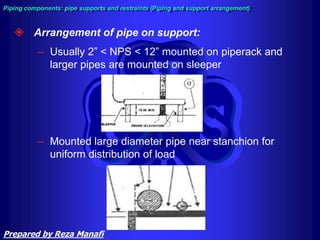
 Arrangement of pipe on support:
– Usually 2” < NPS < 12” mounted on piperack and
larger pipes are mounted on sleeper
– Mounted large diameter pipe near stanchion for
uniform distribution of load
Piping components: pipe supports and restraints (Piping and support arrangement)
Prepared by Reza Manafi
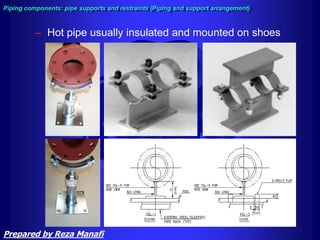
– Hot pipe usually insulated and mounted on shoes
Piping components: pipe supports and restraints (Piping and support arrangement)
Prepared by Reza Manafi
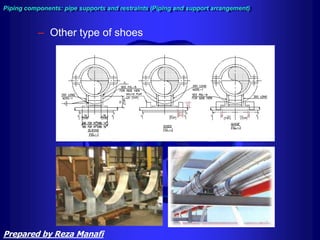
– Other type of shoes
Piping components: pipe supports and restraints (Piping and support arrangement)
Prepared by Reza Manafi
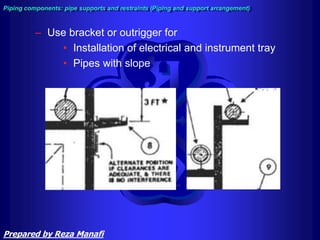
– Use bracket or outrigger for
• Installation of electrical and instrument tray
• Pipes with slope
Piping components: pipe supports and restraints (Piping and support arrangement)
Prepared by Reza Manafi
– Group requiring expansion loop at one side of
the pipe rack
– Design hanger for 2 ½” and larger pipe
Piping components: pipe supports and restraints (Piping and support arrangement)
Prepared by Reza Manafi
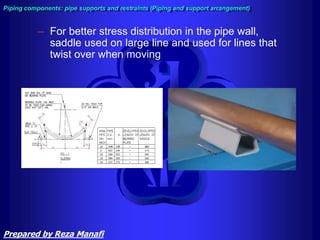
– For better stress distribution in the pipe wall,
saddle used on large line and used for lines that
twist over when moving
Piping components: pipe supports and restraints (Piping and support arrangement)
Prepared by Reza Manafi
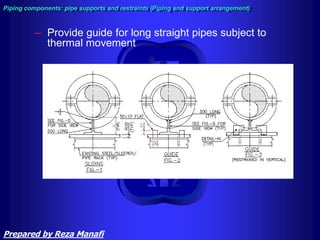
– Provide guide for long straight pipes subject to
thermal movement
Piping components: pipe supports and restraints (Piping and support arrangement)
Prepared by Reza Manafi
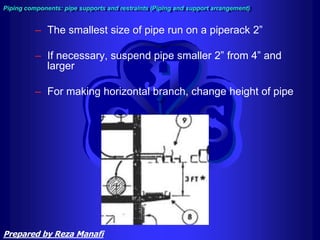
– The smallest size of pipe run on a piperack 2”
– If necessary, suspend pipe smaller 2” from 4” and
larger
– For making horizontal branch, change height of pipe
Piping components: pipe supports and restraints (Piping and support arrangement)
Prepared by Reza Manafi
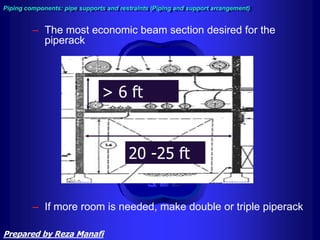
– The most economic beam section desired for the
piperack
– If more room is needed, make double or triple piperack
Piping components: pipe supports and restraints (Piping and support arrangement)
20 -25 ft
> 6 ft
Prepared by Reza Manafi
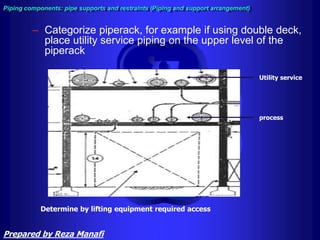
– Categorize piperack, for example if using double deck,
place utility service piping on the upper level of the
piperack
Piping components: pipe supports and restraints (Piping and support arrangement)
Utility service
process
Determine by lifting equipment required access
Prepared by Reza Manafi
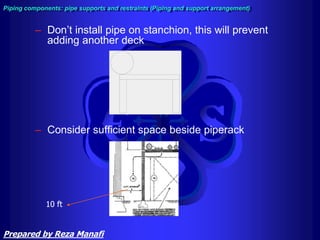
– Don’t install pipe on stanchion, this will prevent
adding another deck
– Consider sufficient space beside piperack
Piping components: pipe supports and restraints (Piping and support arrangement)
10 ft
Prepared by Reza Manafi
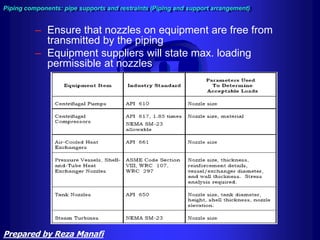
– Ensure that nozzles on equipment are free from
transmitted by the piping
– Equipment suppliers will state max. loading
permissible at nozzles
Piping components: pipe supports and restraints (Piping and support arrangement)
Prepared by Reza Manafi
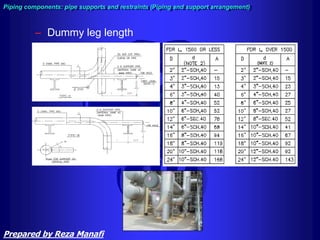
– Dummy leg length
Piping components: pipe supports and restraints (Piping and support arrangement)
Prepared by Reza Manafi
– For line smaller than 2” and non-critical arrange
supports in the field
– Pocketing of liquid due to sagging can be eliminated
by sloping the line so that the difference in height
between adjacent supports is at least equal to triple
deflection at the midpoint
– As a rule of thumb, spans for insulated lines should
be reduced by approximately %30 from those for
uninsulated pipes
Piping components: pipe supports and restraints (Piping and support arrangement)
Prepared by Reza Manafi
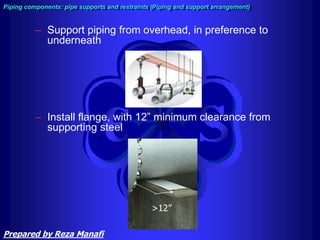
– Support piping from overhead, in preference to
underneath
– Install flange, with 12” minimum clearance from
supporting steel
>12”
Piping components: pipe supports and restraints (Piping and support arrangement)
Prepared by Reza Manafi
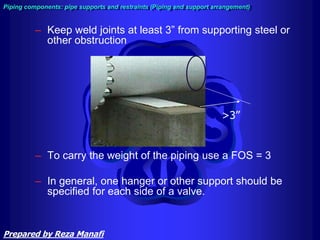
– Keep weld joints at least 3” from supporting steel or
other obstruction
– To carry the weight of the piping use a FOS = 3
– In general, one hanger or other support should be
specified for each side of a valve.
Piping components: pipe supports and restraints (Piping and support arrangement)
>3”
Prepared by Reza Manafi
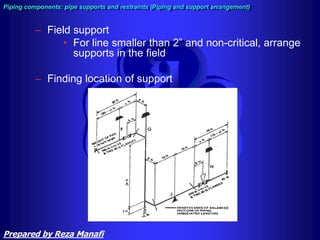
– Field support
• For line smaller than 2” and non-critical, arrange
supports in the field
– Finding location of support
Piping components: pipe supports and restraints (Piping and support arrangement)
Prepared by Reza Manafi
Piping components: pipe supports and restraints (piping support document)
Prepared by Reza Manafi
Piping components: pipe supports and restraints (piping support document)
Prepared by Reza Manafi
Piping components: pipe supports and restraints (piping support drawing)
Prepared by Reza Manafi
Piping Drawing
Prepared by Reza Manafi
 The main purpose of a drawing is to communicate information
in a simple and explicit way for construction apart from
specification
 Pipe represent by
– Single line:
• Only centerline of the pipe is drawn
– Double line:
• Very time-consuming
• Difficult to read
Piping drawings:
Prepared by Reza Manafi
 Three type of drawing that developed from schematic (Block
Flow Diagram (BFD)) diagram are:
– Process Flow Diagram (PFD)
– Piping & Instrument Diagram (P&ID)
– Piping drawing
Piping drawings:
Prepared by Reza Manafi
Block Flow Diagram
BFD
Prepared by Reza Manafi
Piping drawings: block flow diagram
Prepared by Reza Manafi
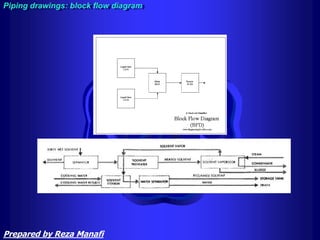
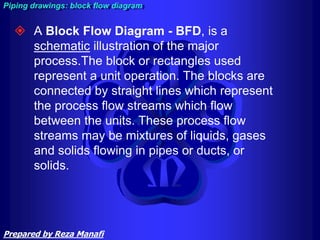
 A Block Flow Diagram - BFD, is a
schematic illustration of the major
process.The block or rectangles used
represent a unit operation. The blocks are
connected by straight lines which represent
the process flow streams which flow
between the units. These process flow
streams may be mixtures of liquids, gases
and solids flowing in pipes or ducts, or
solids.
Piping drawings: block flow diagram
Prepared by Reza Manafi
 In order to prepare block flow diagrams a number of rules
should be followed:
– unit operations such as mixers, separators, reactors,
distillation columns and heat exchangers are usually
denoted by a simple block or rectangle.
– groups of unit operations may be noted by a single block
or rectangle.
– process flow streams flowing into and out of the blocks are
represented by neatly drawn straight lines. These lines
should either be horizontal or vertical.
– the direction of flow of each of the process flow streams
must be clearly indicated by arrows.
– flow streams should be numbered sequentially in a logical
order.
– unit operations (i.e., blocks) should be labeled.
– where possible the diagram should be arranged so that the
process material flows from left to right, with upstream
units on the left and downstream units on the right.
Piping drawings: block flow diagram
Prepared by Reza Manafi
Process Flow Diagram
PFD
Prepared by Reza Manafi
Piping drawings: process flow diagram
Prepared by Reza Manafi
Piping drawings: process flow diagram
Prepared by Reza Manafi
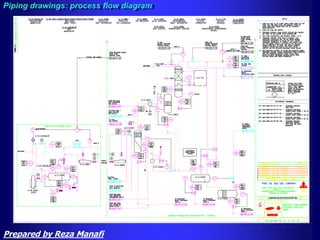
 A Process Flow Diagram - PFD, is a
schematic illustration of the system.PFD's
shows the relationships between the major
components in the system. PFD also tabulate
process design values for the components in
different operating modes, typical minimum,
normal and maximum. PFD's do not show
minor components, piping systems, piping
ratings, standby equipment
– It is advisable to draw equipment that is
operated cyclically
Piping drawings: process flow diagram
Prepared by Reza Manafi
 A PFD should include:
– Process Piping
– Major equipment symbols, names and identification
numbers
– Control, valves and valves that affect operation of
the system
– Interconnection with other systems
– System ratings and operational values as
minimum, normal and maximum flow, temperature
and pressure
– Composition of fluids
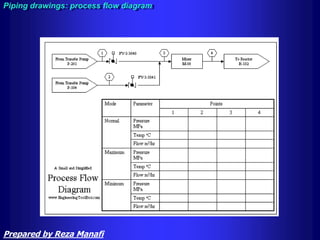
– This figure depict a small and simplified PFD:
Piping drawings: process flow diagram
Prepared by Reza Manafi
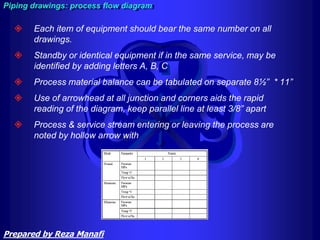
 Each item of equipment should bear the same number on all
drawings.
 Standby or identical equipment if in the same service, may be
identified by adding letters A, B, C
 Process material balance can be tabulated on separate 8½” * 11”
 Use of arrowhead at all junction and corners aids the rapid
reading of the diagram, keep parallel line at least 3/8” apart
 Process & service stream entering or leaving the process are
noted by hollow arrow with
Piping drawings: process flow diagram
Prepared by Reza Manafi
Piping and Instrumentation Diagram
P&ID
Prepared by Reza Manafi
Piping drawings: piping and instrumentation diagram
Prepared by Reza Manafi
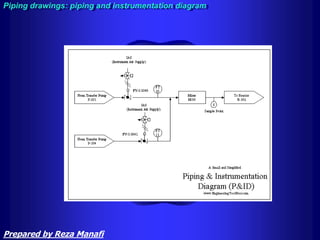
 A Piping and Instrumentation Diagram -
P&ID, is a schematic illustration of functional
relationship of piping, instrumentation and
system equipment components.P&ID shows
all of piping including the physical sequence
of branches, reducers, valves, equipment,
instrumentation and control interlocks. The
P&ID are used to operate the process
system.
Piping drawings: piping and instrumentation diagram
Prepared by Reza Manafi
 A P&ID should include:
– Instrumentation and designations
– Mechanical equipment with names and numbers
– All valves and their identifications
– Process piping, sizes and identification
– Miscellaneous - vents, drains, special fittings,
sampling lines, reducers and increasers
– Flow directions
– Interconnections
– Control inputs and outputs, interlocks
Piping drawings: piping and instrumentation diagram
Prepared by Reza Manafi
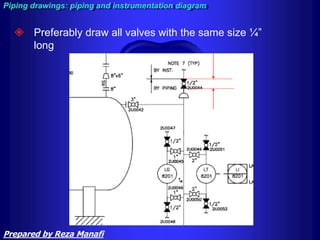
 Preferably draw all valves with the same size ¼”
long
Piping drawings: piping and instrumentation diagram
Prepared by Reza Manafi
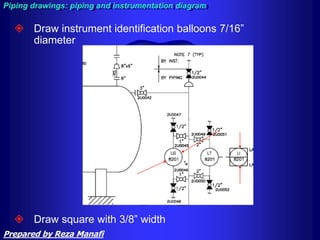
 Draw instrument identification balloons 7/16”
diameter
 Draw square with 3/8” width
Piping drawings: piping and instrumentation diagram
Prepared by Reza Manafi
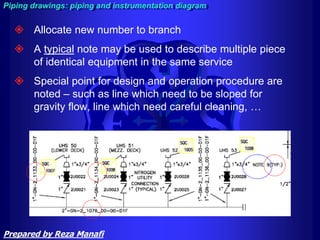
 Allocate new number to branch
 A typical note may be used to describe multiple piece
of identical equipment in the same service
 Special point for design and operation procedure are
noted – such as line which need to be sloped for
gravity flow, line which need careful cleaning, …
Piping drawings: piping and instrumentation diagram
Prepared by Reza Manafi
 Terminate the number at major number of a
equipment such as tank, pressure vessel, mixer
or any equipment carrying an individual
equipment number
 Show and tag process and service valve with size
and identification number
Piping drawings: piping and instrumentation diagram
Prepared by Reza Manafi
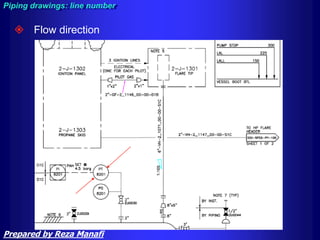
 Flow direction
Piping drawings: line number
Prepared by Reza Manafi
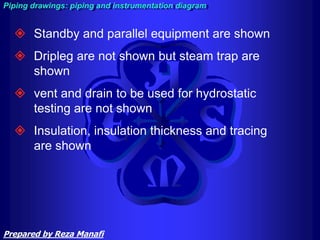
 Standby and parallel equipment are shown
 Dripleg are not shown but steam trap are
shown
 vent and drain to be used for hydrostatic
testing are not shown
 Insulation, insulation thickness and tracing
are shown
Piping drawings: piping and instrumentation diagram
Prepared by Reza Manafi
Drawing component
Prepared by Reza Manafi
 Drawing components include:
– Title block
– Revision
– Key plan
– Reference drawings
– Legend
– Important notes
– Graphic reference point
– line number
– Flow directions
– connections
Piping drawings: drawing component
Prepared by Reza Manafi
 Title block
Piping drawings: drawing component (title block)
Prepared by Reza Manafi
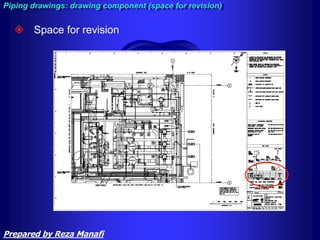
 Space for revision
Piping drawings: drawing component (space for revision)
Prepared by Reza Manafi
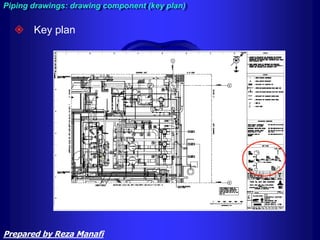
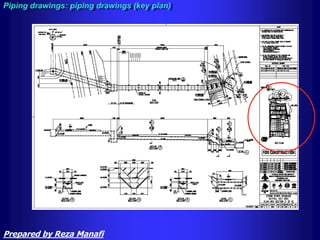
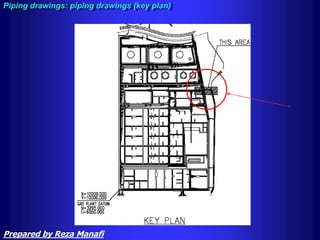
 Key plan
Piping drawings: drawing component (key plan)
Prepared by Reza Manafi
 reference drawing
Piping drawings: drawing component (reference drawing)
Prepared by Reza Manafi
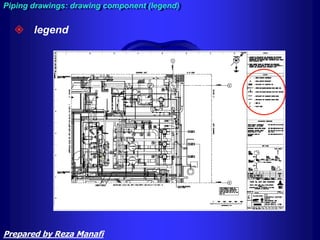
 legend
Piping drawings: drawing component (legend)
Prepared by Reza Manafi
 Important note
Piping drawings: drawing component (important note)
Prepared by Reza Manafi
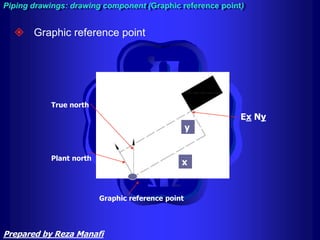
 Graphic reference point
Piping drawings: drawing component (Graphic reference point)
Prepared by Reza Manafi
Piping drawings: drawing component (Graphic reference point)
 Graphic reference point
Graphic reference point
Ex Ny
y
x
True north
Plant north
Prepared by Reza Manafi
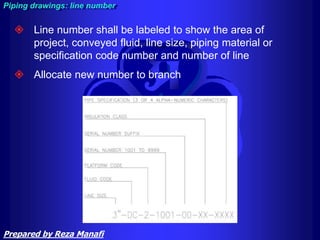
 Line number shall be labeled to show the area of
project, conveyed fluid, line size, piping material or
specification code number and number of line
 Allocate new number to branch
Piping drawings: line number
Prepared by Reza Manafi
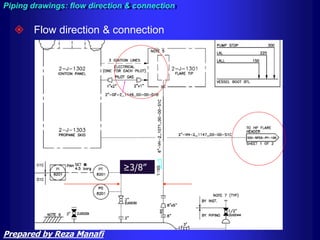
 Flow direction & connection
Piping drawings: flow direction & connection
≥3/8”
Prepared by Reza Manafi
Line list
Prepared by Reza Manafi
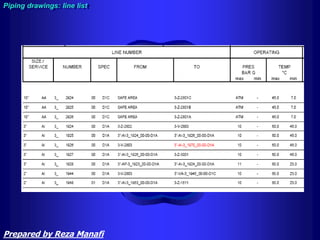
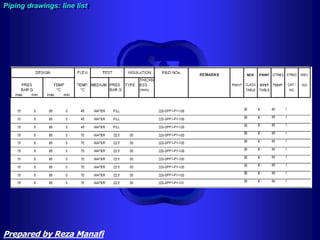
 Line list (line designation sheet or table)
include:
– The number of the line
– Line size
– Material of construction
– Conveyed fluid
– Pressure, temperature, flow rate
– Test pressure
– Insulation and jacketing
– Connected line (which will usually branch)
Piping drawings: line list
Prepared by Reza Manafi
Piping drawings: line list
Prepared by Reza Manafi
Piping drawings: line list
Prepared by Reza Manafi
Drawing view
Prepared by Reza Manafi
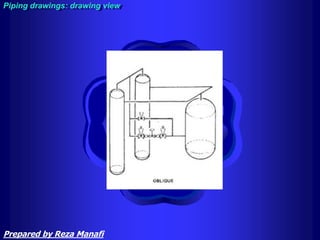
 Two type of view are used for piping drawing:
– Orthographic
• Plans √
• Elevation
– Pictorial:
in complex piping system where orthographic
view may not easily illustrate the design
• Isometric √
• Oblique
Piping drawings: drawing view
Prepared by Reza Manafi
Piping drawings: drawing view
Prepared by Reza Manafi
Piping drawings: drawing view
Prepared by Reza Manafi
Piping drawing
Prepared by Reza Manafi
 Piping drawing include:
– Site plan
• Key plan
– Equipment layout
– Piping layout (plan)
– Isometric
– Support drawing
– …
Piping drawings: piping drawings
Prepared by Reza Manafi
Piping drawings: piping drawings (site plan)
Prepared by Reza Manafi
Piping drawings: piping drawings (key plan)
Prepared by Reza Manafi
Piping drawings: piping drawings (key plan)
Prepared by Reza Manafi
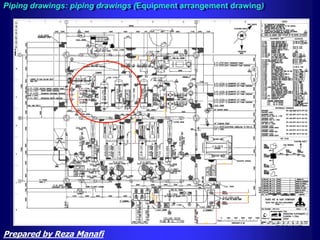
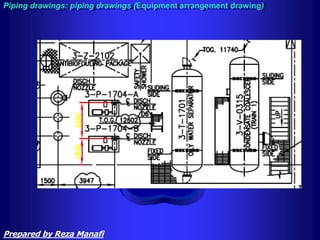
Piping drawings: piping drawings (Equipment arrangement drawing)
Prepared by Reza Manafi
Piping drawings: piping drawings (Equipment arrangement drawing)
Prepared by Reza Manafi
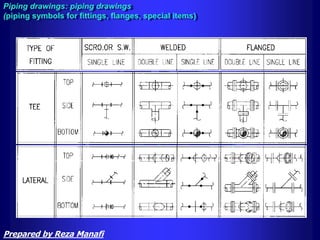
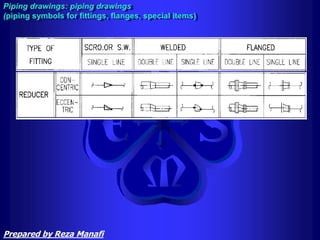
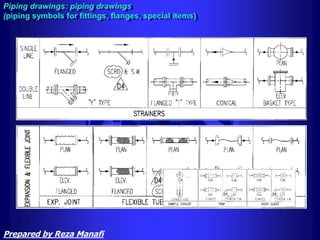
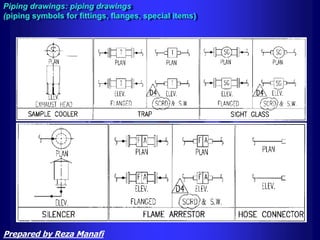
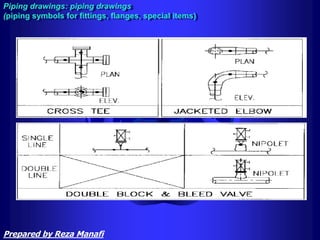
piping symbols for fittings, flanges,
special items
Prepared by Reza Manafi
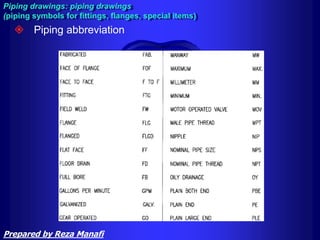
 Piping abbreviation
Piping drawings: piping drawings
(piping symbols for fittings, flanges, special items)
Prepared by Reza Manafi
Piping drawings: piping drawings
(piping symbols for fittings, flanges, special items)
Prepared by Reza Manafi
Piping drawings: piping drawings
(piping symbols for fittings, flanges, special items)
Prepared by Reza Manafi
Piping drawings: piping drawings
(piping symbols for fittings, flanges, special items)
Prepared by Reza Manafi
Piping drawings: piping drawings
(piping symbols for fittings, flanges, special items)
Prepared by Reza Manafi
Piping drawings: piping drawings
(piping symbols for fittings, flanges, special items)
Prepared by Reza Manafi
Piping drawings: piping drawings
(piping symbols for fittings, flanges, special items)
Prepared by Reza Manafi
Piping drawings: piping drawings
(piping symbols for fittings, flanges, special items)
Prepared by Reza Manafi
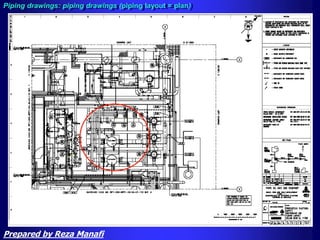
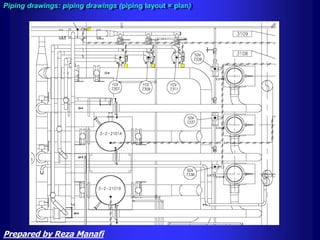
Piping drawings: piping drawings (piping layout = plan)
Prepared by Reza Manafi
Piping drawings: piping drawings (piping layout = plan)
Prepared by Reza Manafi
Piping drawing
 isometric
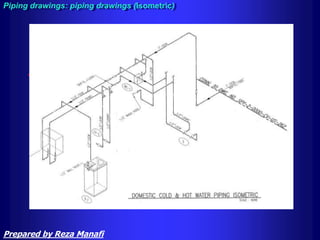
Piping drawings: piping drawings (Isometric)
Prepared by Reza Manafi
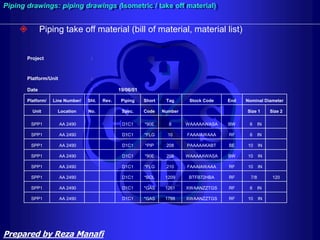
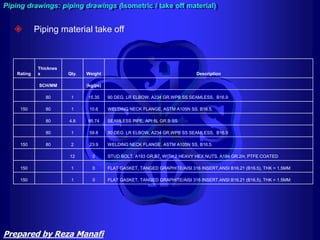
 Piping take off material (bill of material, material list)
Project :
Platform/Unit :
Date : 19/06/01
Platform/ Line Number/ Sht. Rev. Piping Short Tag Stock Code End Nominal Diameter
Unit Location No. Spec. Code Number Size 1 Size 2
SPP1 AA 2490 D1C1 *90E 8 WAAAAAWASA BW 6 IN
SPP1 AA 2490 D1C1 *FLG 10 FAAAIAWAAA RF 6 IN
SPP1 AA 2490 D1C1 *PIP 208 PAAAAAKABT BE 10 IN
SPP1 AA 2490 D1C1 *90E 209 WAAAAAWASA BW 10 IN
SPP1 AA 2490 D1C1 *FLG 210 FAAAIAWAAA RF 10 IN
SPP1 AA 2490 D1C1 *BOL 1209 BTFB72HBA RF 7/8 120
SPP1 AA 2490 D1C1 *GAS 1261 XWAANZZTGS RF 6 IN
SPP1 AA 2490 D1C1 *GAS 1788 XWAANZZTGS RF 10 IN
Piping drawings: piping drawings (Isometric / take off material)
Prepared by Reza Manafi
 Piping material take off
Rating
Thicknes
s Qty. Weight Description
SCH/MM (kg/ps)
80 1 15.35 90 DEG. LR ELBOW, A234 GR.WPB SS SEAMLESS, B16.9
150 80 1 10.6 WELDING NECK FLANGE, ASTM A105N SS, B16.5.
80 4.8 95.74 SEAMLESS PIPE, API 5L GR.B SS
80 1 59.8 90 DEG. LR ELBOW, A234 GR.WPB SS SEAMLESS, B16.9
150 80 2 23.9 WELDING NECK FLANGE, ASTM A105N SS, B16.5.
12 0 STUD BOLT, A193 GR.B7, WITH 2 HEAVY HEX.NUTS, A194 GR.2H, PTFE COATED
150 1 0 FLAT GASKET, TANGED GRAPHITE/AISI 316 INSERT,ANSI B16.21 (B16.5), THK = 1.5MM
Piping drawings: piping drawings (Isometric / take off material)
Prepared by Reza Manafi
Welding
Prepared by Reza Manafi
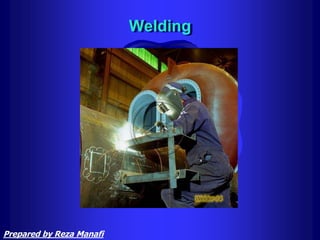
 What is Welding?
– Welding is a joining process in which metals are
heated, melted and mixed to produce a joint with
properties similar to those of the materials being
joined.
Welding
Penetration Depth
Weld Reinforcement
Heat Affected
Zone (HAZ)
Weld Pool
Parent Metal
Weld Root
Prepared by Reza Manafi
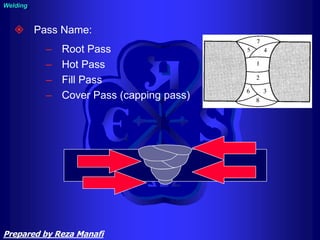
 Pass Name:
– Root Pass
– Hot Pass
– Fill Pass
– Cover Pass (capping pass)
Welding
Prepared by Reza Manafi
 Weld type:
– Fillet
• Used when joining two pieces of metal
without preparing the surface of the metal
first.
– Groove
• used when preparing the metal before
welding it into place, include:
– Square
– Bevel
– Single or double V
– Single or double U
– Single or double J
Welding
Prepared by Reza Manafi
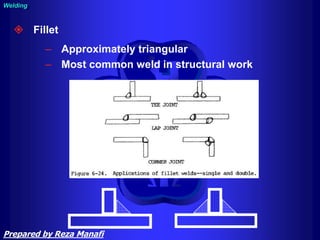
 Fillet
– Approximately triangular
– Most common weld in structural work
Welding
Prepared by Reza Manafi
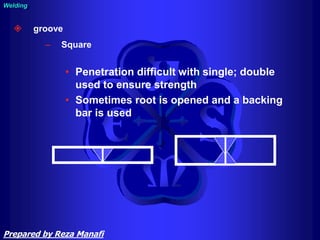
 groove
– Square
• Penetration difficult with single; double
used to ensure strength
• Sometimes root is opened and a backing
bar is used
Welding
Prepared by Reza Manafi
 groove
– Bevel
• Single bevel is widely used
• Double preferred if metal thickness >3/4
Welding
Prepared by Reza Manafi
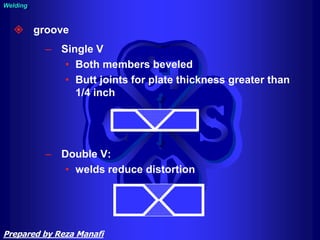
 groove
– Single V
• Both members beveled
• Butt joints for plate thickness greater than
1/4 inch
– Double V:
• welds reduce distortion
Welding
Prepared by Reza Manafi
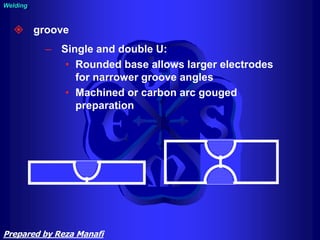
 groove
– Single and double U:
• Rounded base allows larger electrodes
for narrower groove angles
• Machined or carbon arc gouged
preparation
Welding
Prepared by Reza Manafi
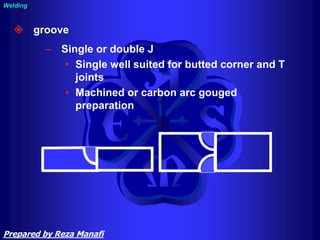
 groove
– Single or double J
• Single well suited for butted corner and T
joints
• Machined or carbon arc gouged
preparation
Welding
Prepared by Reza Manafi
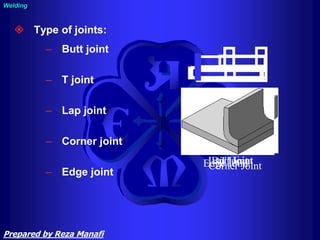
 Type of joints:
– Butt joint
– T joint
– Lap joint
– Corner joint
– Edge joint
Welding
Butt Joint
‘T’ Joint
Lap Joint
Corner Joint
Edge Joint
Prepared by Reza Manafi
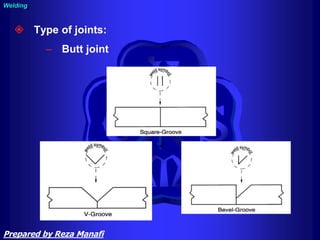
 Type of joints:
– Butt joint
Welding
Prepared by Reza Manafi
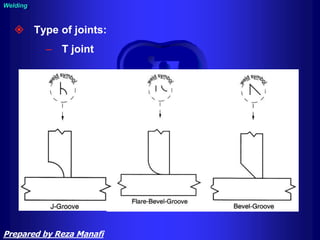
 Type of joints:
– T joint
Welding
Prepared by Reza Manafi
 Type of joints:
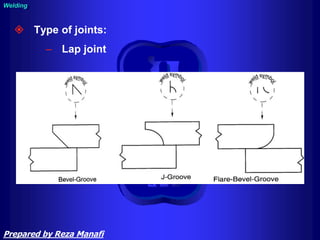
– Lap joint
Welding
Prepared by Reza Manafi
 Type of joints:
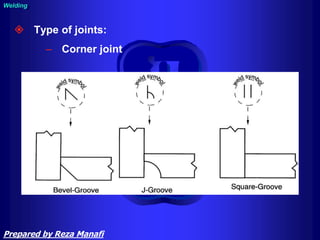
– Corner joint
Welding
Prepared by Reza Manafi
 Type of joints:
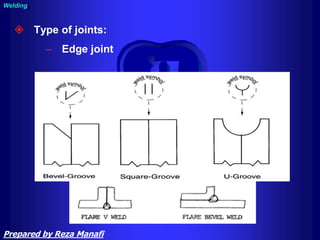
– Edge joint
Welding
Prepared by Reza Manafi
Pipe welding position
Prepared by Reza Manafi
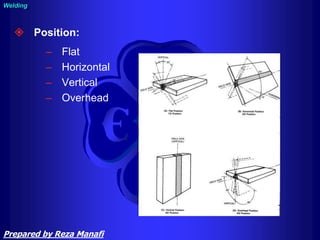
 Position:
– Flat
– Horizontal
– Vertical
– Overhead
Welding
Prepared by Reza Manafi
 Position according to standards:
– 1G
– 2G
– 5G
– 6G
– 1F
– 2F
– 2FR
– 4F
– 5F
Welding
Prepared by Reza Manafi
 Position:
– 1G
• Pipe rotated, Electrode is always at the top
• Either a split bead or weave technique may be
used
Welding
Prepared by Reza Manafi
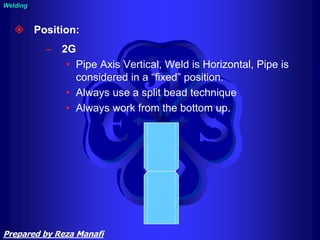
 Position:
– 2G
• Pipe Axis Vertical, Weld is Horizontal, Pipe is
considered in a “fixed” position.
• Always use a split bead technique
• Always work from the bottom up.
Welding
Prepared by Reza Manafi
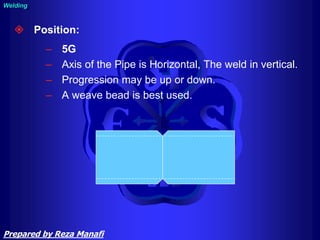
 Position:
– 5G
– Axis of the Pipe is Horizontal, The weld in vertical.
– Progression may be up or down.
– A weave bead is best used.
Welding
Prepared by Reza Manafi
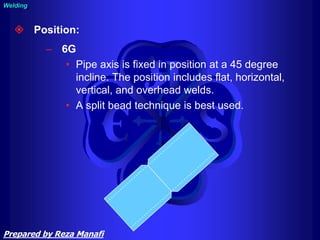
 Position:
– 6G
• Pipe axis is fixed in position at a 45 degree
incline. The position includes flat, horizontal,
vertical, and overhead welds.
• A split bead technique is best used.
Welding
Prepared by Reza Manafi
 Position:
– 1F
• Pipe is rotated. The pipe axis is at a 45
degree incline. Welding is to occur at the
top of the pipe.
• Split bead or weave technique may be
used.
Welding
Prepared by Reza Manafi
 Position:
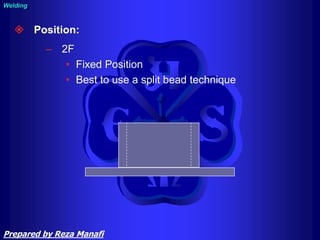
– 2F
• Fixed Position
• Best to use a split bead technique
Welding
Prepared by Reza Manafi
 Position:
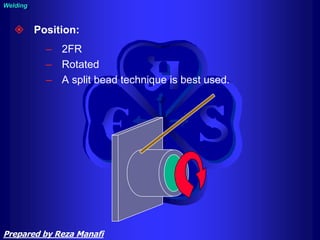
– 2FR
– Rotated
– A split bead technique is best used.
Welding
Prepared by Reza Manafi
 Position:
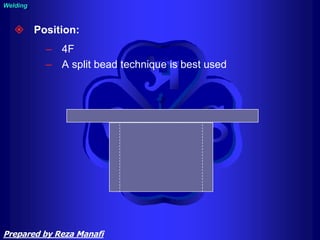
– 4F
– A split bead technique is best used
Welding
Prepared by Reza Manafi
 Position:
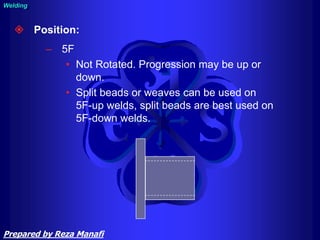
– 5F
• Not Rotated. Progression may be up or
down.
• Split beads or weaves can be used on
5F-up welds, split beads are best used on
5F-down welds.
Welding
Prepared by Reza Manafi
 Type of welding:
– Oxy-fuel gas welding
– Arc welding
• SMAW
• GTAW
Welding
Prepared by Reza Manafi
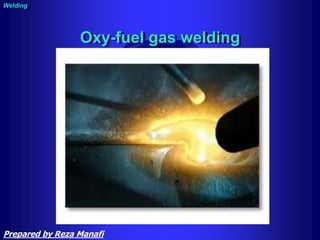
Oxy-fuel gas welding
Welding
Prepared by Reza Manafi
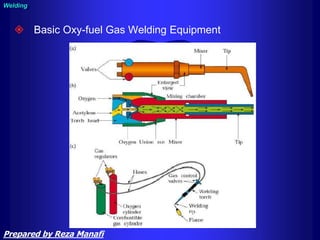
 Basic Oxy-fuel Gas Welding Equipment
Welding
Prepared by Reza Manafi
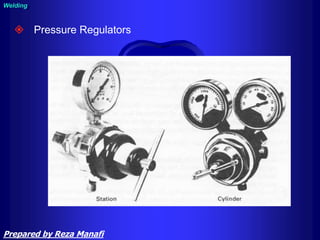
 Pressure Regulators
Welding
Prepared by Reza Manafi
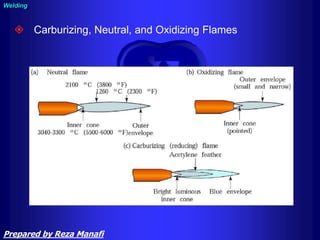
 Acetylene and oxygen cylinder
Welding
Prepared by Reza Manafi
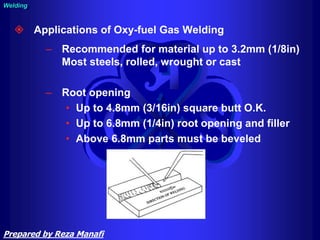
 Carburizing, Neutral, and Oxidizing Flames
Welding
Prepared by Reza Manafi
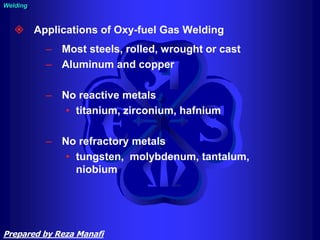
 Applications of Oxy-fuel Gas Welding
– Recommended for material up to 3.2mm (1/8in)
Most steels, rolled, wrought or cast
– Root opening
• Up to 4.8mm (3/16in) square butt O.K.
• Up to 6.8mm (1/4in) root opening and filler
• Above 6.8mm parts must be beveled
Welding
Prepared by Reza Manafi
 Applications of Oxy-fuel Gas Welding
– Most steels, rolled, wrought or cast
– Aluminum and copper
– No reactive metals
• titanium, zirconium, hafnium
– No refractory metals
• tungsten, molybdenum, tantalum,
niobium
Welding
Prepared by Reza Manafi
 Advantages of Oxy-fuel Gas Welding
– Very portable
– Low cost
– Gentle flame
 Disadvantages of Oxy-fuel Gas Weld.
– Poor air protection
– Low heat input
– Safety issues
Welding
Prepared by Reza Manafi
Shielded Metal-Arc Welding
( MMAW, SMAW, Stick welding)
Welding
Prepared by Reza Manafi
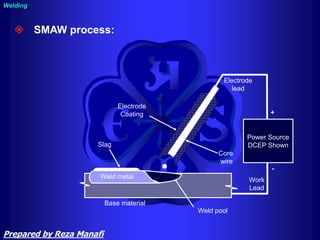
Work
Lead
+
-
Electrode
lead
Power Source
DCEP Shown
Base material
Electrode
Coating
Core
wire
Weld pool
Slag
Weld metal
Welding
 SMAW process:
Prepared by Reza Manafi
Welding
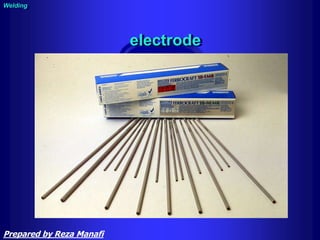
electrode
Prepared by Reza Manafi
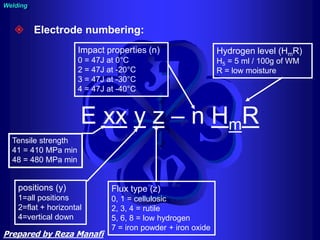
E xx y z – n HmR
positions (y)
1=all positions
2=flat + horizontal
4=vertical down
Tensile strength
41 = 410 MPa min
48 = 480 MPa min
Flux type (z)
0, 1 = cellulosic
2, 3, 4 = rutile
5, 6, 8 = low hydrogen
7 = iron powder + iron oxide
Impact properties (n)
0 = 47J at 0°C
2 = 47J at -20°C
3 = 47J at -30°C
4 = 47J at -40°C
Hydrogen level (HmR)
H5 = 5 ml / 100g of WM
R = low moisture
Welding
 Electrode numbering:
Prepared by Reza Manafi
 Advantages
– Equipment simple, inexpensive, and
portable
– Process can be used in any position
– Shop repairs, pipelines, building
construction
 Disadvantages
– Limited deposition rate relative to other
welding processes due to stubs and slag
– Weld not well protected form the
atmosphere
– Welds have more inclusions than welds
made with other processes
Welding
Prepared by Reza Manafi
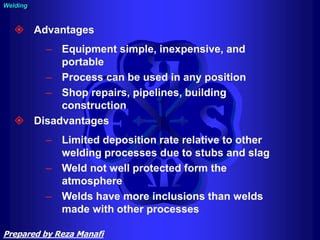
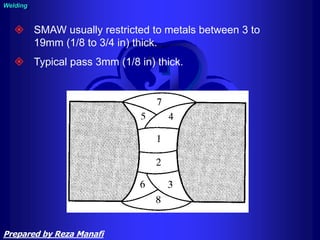
 SMAW usually restricted to metals between 3 to
19mm (1/8 to 3/4 in) thick.
 Typical pass 3mm (1/8 in) thick.
Welding
Prepared by Reza Manafi
Gas Tungsten Arc Welding
Welding
Prepared by Reza Manafi
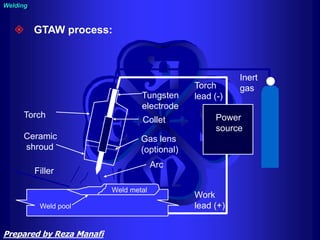
Ceramic
shroud
Torch
Gas lens
(optional)
Inert
gas
Power
source
Torch
lead (-)
Work
lead (+)
Filler
Arc
Weld metal
Weld pool
Collet
Tungsten
electrode
Welding
 GTAW process:
Prepared by Reza Manafi
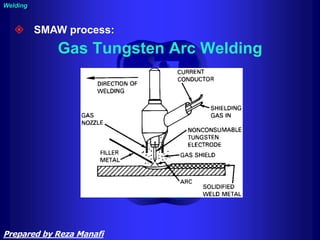
Gas Tungsten Arc Welding
Welding
 SMAW process:
Prepared by Reza Manafi
Welding
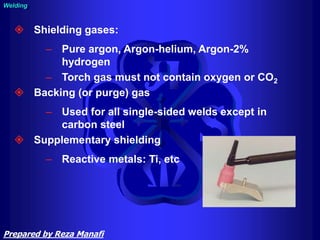
 Shielding gases:
– Pure argon, Argon-helium, Argon-2%
hydrogen
– Torch gas must not contain oxygen or CO2
 Backing (or purge) gas
– Used for all single-sided welds except in
carbon steel
 Supplementary shielding
– Reactive metals: Ti, etc
Prepared by Reza Manafi
Welding
 TIG Process features :
– can also be used to weld dissimilar metals
(but not very well)
– Slower and more costly than consumable
welding
– Independently added filler
– Used for root, pass runs in pipe or thin
sheet
– High quality, Clean process, no slag
– Low oxygen and nitrogen weld metal
– Defect free, excellent profile even for single
sided welds
Prepared by Reza Manafi
Welding
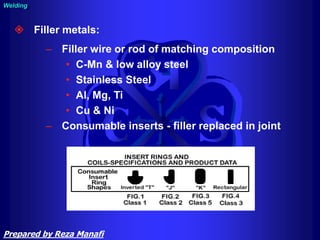
 Filler metals:
– Filler wire or rod of matching composition
• C-Mn & low alloy steel
• Stainless Steel
• Al, Mg, Ti
• Cu & Ni
– Consumable inserts - filler replaced in joint
Prepared by Reza Manafi
Welding Symbols
Prepared by Reza Manafi
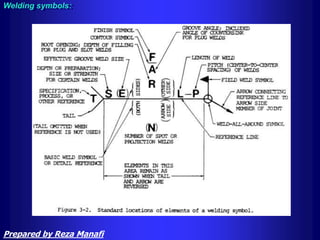
 The welding symbols devised by the AWS has 8
elements
– Reference line
– Arrow
– Basic weld symbols
– Dimensions and other data
– Supplementary symbols
– Finish symbols
– Tail
– Specification or others reference
Welding symbols:
Prepared by Reza Manafi
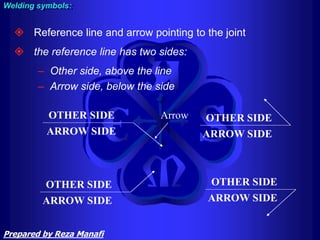
 Reference line and arrow pointing to the joint
 the reference line has two sides:
– Other side, above the line
– Arrow side, below the side
Welding symbols:
ARROW SIDE
OTHER SIDE Arrow
ARROW SIDE
OTHER SIDE
ARROW SIDE
OTHER SIDE
ARROW SIDE
OTHER SIDE
Prepared by Reza Manafi
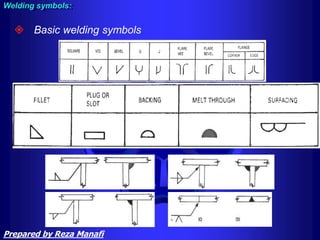
 Basic welding symbols
Welding symbols:
Prepared by Reza Manafi
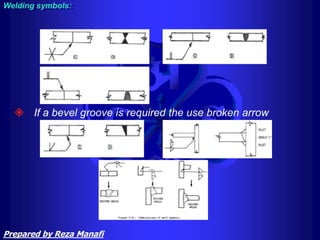
 If a bevel groove is required the use broken arrow
Welding symbols:
Prepared by Reza Manafi
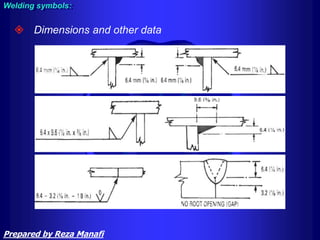
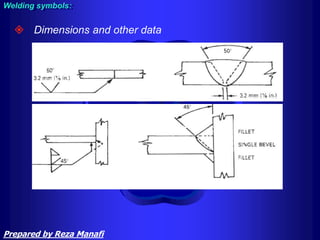
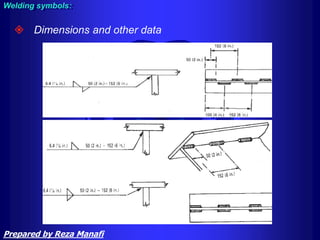
 Dimensions and other data
Welding symbols:
Prepared by Reza Manafi
 Dimensions and other data
Welding symbols:
Prepared by Reza Manafi
 Dimensions and other data
Welding symbols:
Prepared by Reza Manafi
Welding symbols:
 Supplementary symbols
Prepared by Reza Manafi
Welding symbols:
 A circle at the tangent of the arrow and the reference
line means welding to be all around.
Prepared by Reza Manafi
Welding symbols:
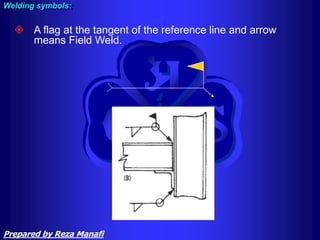
 A flag at the tangent of the reference line and arrow
means Field Weld.
Prepared by Reza Manafi
Tail
Welding symbols:
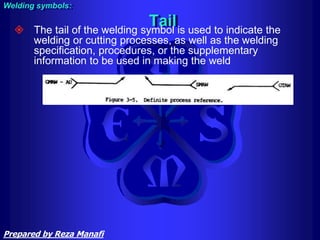
 The tail of the welding symbol is used to indicate the
welding or cutting processes, as well as the welding
specification, procedures, or the supplementary
information to be used in making the weld
Prepared by Reza Manafi
Welding symbols:
Prepared by Reza Manafi
Arrangement
Prepared by Reza Manafi
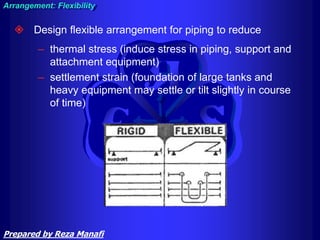
 Design flexible arrangement for piping to reduce
– thermal stress (induce stress in piping, support and
attachment equipment)
– settlement strain (foundation of large tanks and
heavy equipment may settle or tilt slightly in course
of time)
Arrangement: Flexibility
Prepared by Reza Manafi
Arrangement: Flexibility
Prepared by Reza Manafi
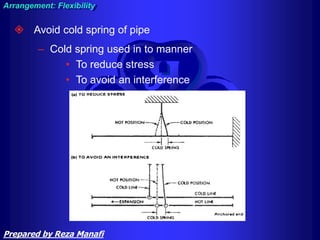
 Avoid cold spring of pipe
– Cold spring used in to manner
• To reduce stress
• To avoid an interference
Arrangement: Flexibility
Prepared by Reza Manafi
 Flexible pipe connection should have a length of
6 to 10 NPS
Arrangement: Flexibility
Prepared by Reza Manafi
 Take gas and vapor branch lines from tops of header
where it is necessary to reduce the chance of
drawing off condensate or sediment which may
damage rotating equipment
Arrangement:
Prepared by Reza Manafi
 Allow room for the joint to be made
Arrangement:
Prepared by Reza Manafi
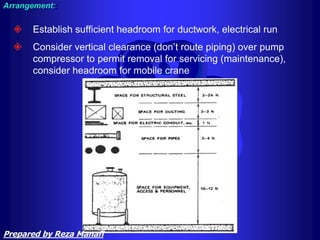
 Establish sufficient headroom for ductwork, electrical run
 Consider vertical clearance (don’t route piping) over pump
compressor to permit removal for servicing (maintenance),
consider headroom for mobile crane
Arrangement:
Prepared by Reza Manafi
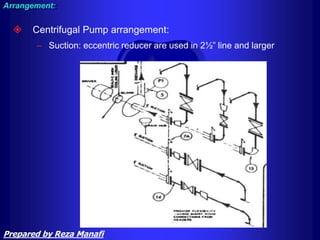
 Centrifugal Pump arrangement:
– Suction: eccentric reducer are used in 2½” line and larger
Arrangement:
Prepared by Reza Manafi
 Centrifugal Pump arrangement:
– Suction (socket weld)
Arrangement:
Prepared by Reza Manafi
 Centrifugal Pump arrangement:
– Suction arrangement
Arrangement:
Prepared by Reza Manafi
 Don’t use globe valves at suction and discharge for
isolating pump
 Route suction line as directly as possible Don’t route
piping over the pump, as this interferes with
maintenance
 If pump positioned close to supply tanks and are on
separate foundations, avoid rigid piping arrangement,
for settle of tank in course of time
 Locate the pump as closely as practicable to source of
liquid to be pumped from storage tank
Arrangement:
Prepared by Reza Manafi
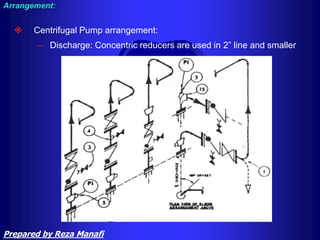
 Centrifugal Pump arrangement:
– Discharge: Concentric reducers are used in 2” line and smaller
Arrangement:
Prepared by Reza Manafi
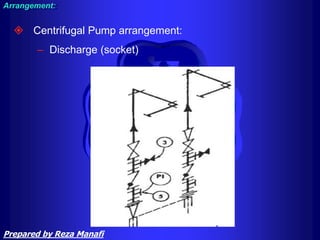
 Centrifugal Pump arrangement:
– Discharge (socket)
Arrangement:
Prepared by Reza Manafi
 Centrifugal Pump arrangement:
– Discharge (manifold)
Arrangement:
Prepared by Reza Manafi
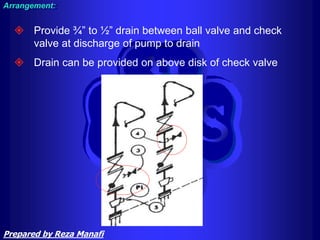
 Provide ¾” to ½” drain between ball valve and check
valve at discharge of pump to drain
 Drain can be provided on above disk of check valve
Arrangement:
Prepared by Reza Manafi
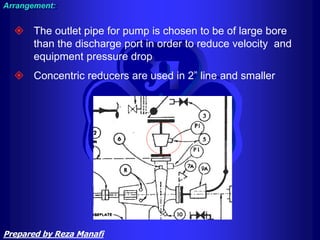
 The outlet pipe for pump is chosen to be of large bore
than the discharge port in order to reduce velocity and
equipment pressure drop
 Concentric reducers are used in 2” line and smaller
Arrangement:
Prepared by Reza Manafi
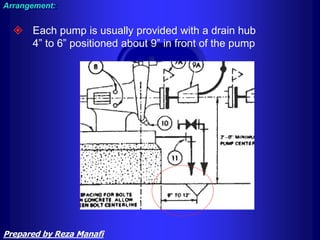
 Each pump is usually provided with a drain hub
4” to 6” positioned about 9” in front of the pump
Arrangement:
Prepared by Reza Manafi
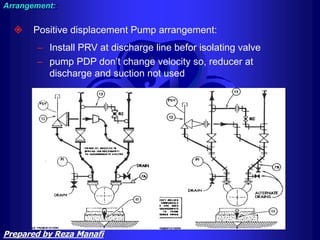
 Positive displacement Pump arrangement:
– Install PRV at discharge line befor isolating valve
– pump PDP don’t change velocity so, reducer at
discharge and suction not used
Arrangement:
Prepared by Reza Manafi
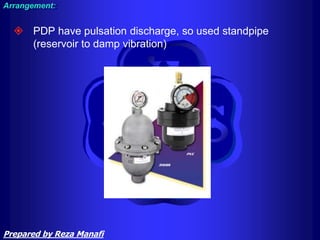
 PDP have pulsation discharge, so used standpipe
(reservoir to damp vibration)
Arrangement:
Prepared by Reza Manafi
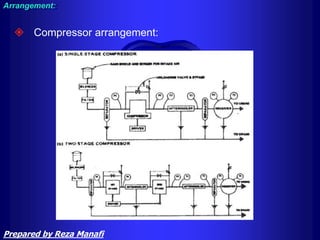
 Compressor arrangement:
Arrangement:
Prepared by Reza Manafi
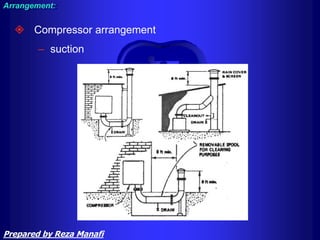
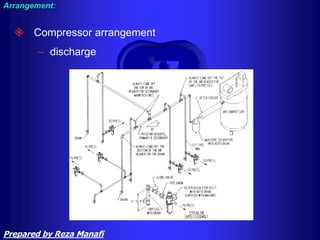
 Compressor arrangement
– suction
Arrangement:
Prepared by Reza Manafi
 Compressor arrangement
– discharge
Arrangement:
Prepared by Reza Manafi
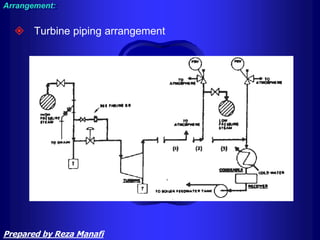
 Turbine piping arrangement
Arrangement:
Prepared by Reza Manafi
 Piping may have thru concrete floor as walls, inform
the civil and architectural to avoid cutting exciting
reinforcement
 Don’t run piping under foundation
 If there is no possibility of future road or site
development, lay piping such as
– Line to outside storage
– Loading and receiving facilities
At grade on pipe sleeper
 Avoiding burying steam line that pocket, due the
difficulty to collecting condensate
 Burying line (water, gas, drain) bellow the frost line to
avoid freezing water and solutions, save the expense
of tracing long horizontal parts of the line
Arrangement:
Prepared by Reza Manafi
 Vent all high point and drain all low point on lines,
place vent and drain valve to permit easily drained or
purged during shutdown period (important for reducing
cost of winterizing)
 Avoid pocketing lines. Arrange piping lines to drain
back into equipment or into lines that can to be
drained
 Run piping beneath of platforms, rather than over
them.
 If need removing equipment, cleaning line provide
– Union
– Flanged
– Removable spool
– Cross instead elbows to permit removing solid
Arrangement:
Prepared by Reza Manafi
 Don’t obstruct access ways (doorways, escape road, …)
 Consider vertical clearance (don’t route piping) over
pump to permit removal for servicing (maintenance),
consider headroom for mobile crane
Arrangement:
Prepared by Reza Manafi
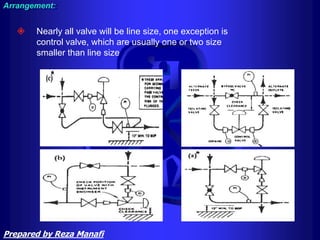
 Nearly all valve will be line size, one exception is
control valve, which are usually one or two size
smaller than line size
Arrangement:
Prepared by Reza Manafi
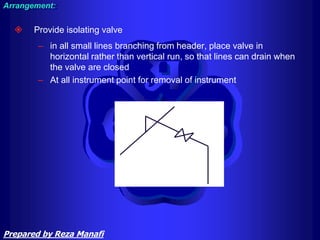
 Provide isolating valve
– in all small lines branching from header, place valve in
horizontal rather than vertical run, so that lines can drain when
the valve are closed
– At all instrument point for removal of instrument
Arrangement:
Prepared by Reza Manafi
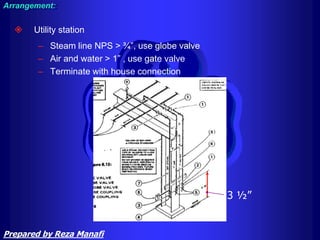
 Utility station
– Steam line NPS > ¾”, use globe valve
– Air and water > 1” , use gate valve
– Terminate with house connection
3 ½”
Arrangement:
Prepared by Reza Manafi
 Arrange valve so that support will not be on removable spools
 In critical application, use two pressure relive valve with interlock
Arrangement:
Prepared by Reza Manafi
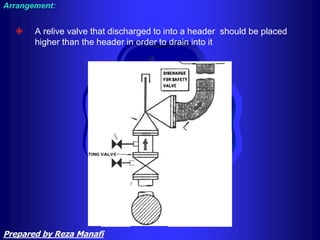
 A relive valve that discharged to into a header should be placed
higher than the header in order to drain into it
Arrangement:
Prepared by Reza Manafi
 Required space between pipes
Arrangement:
Prepared by Reza Manafi
Pipe Work
 Material work:
– Fabricate, test, certificate
– Test (spectrograph), marking
 Storing
– SS shall be separated from other steels and
without any contact to zinc material
Pipe work
Prepared by Reza Manafi
 Person who are engaged for
– Tack welding
– Welding
Shall be qualified according to ASME SEC. IX
– Pipe fitting
– Assembling
– Erection
– Control weld temperature
fully trained and have certificate (license, pass) of
employer
Pipe work
Prepared by Reza Manafi
 Cutting method:
– Shear
– Milling
– Planer
– Flame cutting
– Flame gouging
– Arc gouging
Pipe work
Prepared by Reza Manafi
 Cutting:
– In the case of thermal cutting
• Cutting surface shall be ground to remove any
edge and roughness (dross, scale, .. At HAZ)
and to be made flush and smooth
• Cutting slag stuck to the inside of the pipe shall
be completely removed
• After thermal cutting
– Machining for C.S, SS not require
– for other material required (3 mm of HAZ)
– In the abrasive disk case
• Abrasive disk for SS shall not be used for C.S
or vise verse
– Plasma jet cutting may be applied for SS, etc
Pipe work
Prepared by Reza Manafi
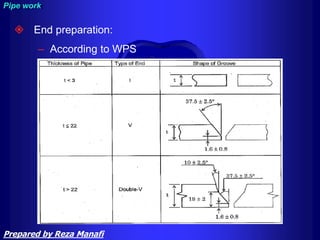
 End preparation:
– According to WPS
Pipe work
Prepared by Reza Manafi
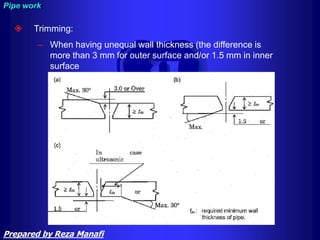
 Trimming:
– When having unequal wall thickness (the difference is
more than 3 mm for outer surface and/or 1.5 mm in inner
surface
Pipe work
Prepared by Reza Manafi
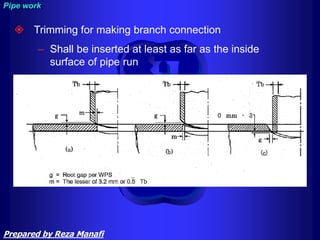
 Trimming for making branch connection
– Shall be inserted at least as far as the inside
surface of pipe run
Pipe work
Prepared by Reza Manafi
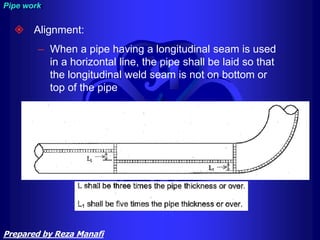
 Alignment:
– When a pipe having a longitudinal seam is used
in a horizontal line, the pipe shall be laid so that
the longitudinal weld seam is not on bottom or
top of the pipe
Pipe work
Prepared by Reza Manafi
Pipe work
Prepared by Reza Manafi
Pipe work
Prepared by Reza Manafi
 To measure root opening use taper gauge
Pipe work
Prepared by Reza Manafi
 To measure internal misalignment of joint use hi-low
mismatch gauge
– T > 19 mm, 2.5 mm
– T < 19 mm, 1.6 mm
Pipe work
Prepared by Reza Manafi
 Tolerance:
Pipe work
Prepared by Reza Manafi
 cleaning:
– The bevel shall be fully clean so that there is no rust, oil,
grease, … (50 mm from bevel edge)
• Solvent:
– Non-injurious to the material
– Halide free
– Material of wire brush shall be properly selected for
working CS and SS respectively
• Iron free
• Grinding wheel (or disk) shall be organic resin bond
Pipe work
Prepared by Reza Manafi
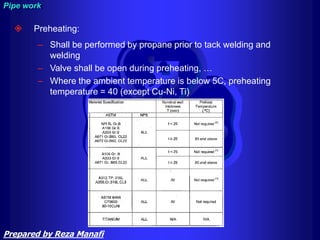
 Preheating:
– Shall be performed by propane prior to tack welding and
welding
– Valve shall be open during preheating, …
– Where the ambient temperature is below 5C, preheating
temperature = 40 (except Cu-Ni, Ti)
Pipe work
Prepared by Reza Manafi
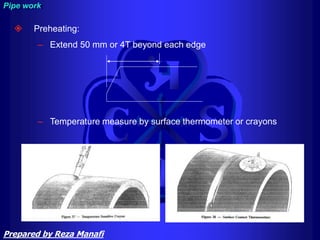
 Preheating:
– Extend 50 mm or 4T beyond each edge
– Temperature measure by surface thermometer or crayons
Pipe work
Prepared by Reza Manafi
 Preheating:
– Preheat temperature shall be measured based on 2
minutes per 25 mm thickness
Pipe work
Prepared by Reza Manafi
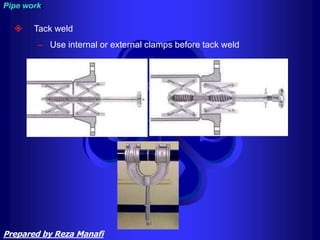
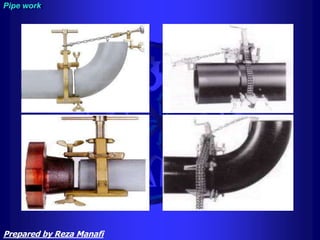
 Tack weld
– Use internal or external clamps before tack weld
Pipe work
Prepared by Reza Manafi
Pipe work
Prepared by Reza Manafi
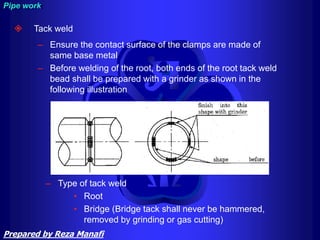
 Tack weld
– Ensure the contact surface of the clamps are made of
same base metal
– Before welding of the root, both ends of the root tack weld
bead shall be prepared with a grinder as shown in the
following illustration
– Type of tack weld
• Root
• Bridge (Bridge tack shall never be hammered,
removed by grinding or gas cutting)
Pipe work
Prepared by Reza Manafi
 Welding:
– WPS, PQR shall be approved
– Welder shall be qualified according to ASME SEC. IX
– All welding processes shall be protected from adverse
weather (use shelter)
– All welding equipment shall be calibrated
– When preheat is applied, welding shall not be interrupted
or stopped until 30% of the final weld has been completed
– Bolts hole:
• symmetrically from a vertical center line
• Symmetrically from plant north
Pipe work
Prepared by Reza Manafi
 Welding:
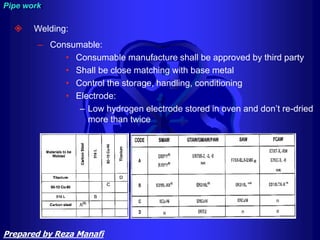
– Consumable:
• Consumable manufacture shall be approved by third party
• Shall be close matching with base metal
• Control the storage, handling, conditioning
• Electrode:
– Low hydrogen electrode stored in oven and don’t re-dried
more than twice
Pipe work
Prepared by Reza Manafi
 Welding:
– Consumable:
• Purge gas, shielding gas:
– Check Mixture tolerance, Purity, Dew point
– moisture < 10 PPM
– Nitrogen not used for SS
– Before tack weld and root pass welding monitoring the
oxygen content < 5000 PPM
– Use purge gas for
» Thin wall tubing or piping T < 5.5 mm
– Root pass without backing, single sided for all weld metal
Pipe work
Prepared by Reza Manafi
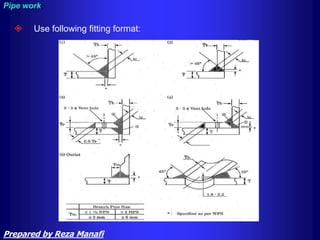
 Use following fitting format:
Pipe work
Prepared by Reza Manafi
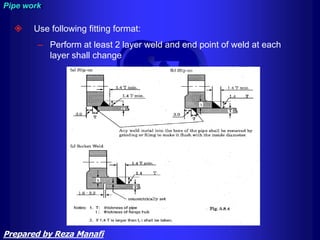
 Use following fitting format:
– Perform at least 2 layer weld and end point of weld at each
layer shall change
Pipe work
Prepared by Reza Manafi
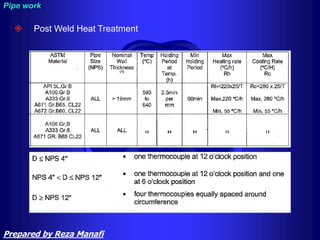
 Post Weld Heat Treatment
Pipe work
Prepared by Reza Manafi
 Weld Test include:
– Tensile
– Bending
– Impacting
– Hardness
Pipe work
Prepared by Reza Manafi
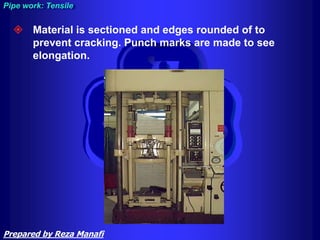
 Material is sectioned and edges rounded of to
prevent cracking. Punch marks are made to see
elongation.
Pipe work: Tensile
Prepared by Reza Manafi
Pipe work: Tensile
Prepared by Reza Manafi
 Shows physical condition of the weld and
Determine welds efficiency
– Tensile strength
– Ductility
– Fusion and penetration
Pipe work: Bend test
Prepared by Reza Manafi
 Bend through 180
O
 the specimen should be a minimum of 30mm wide
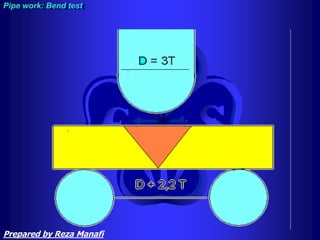
 The fulcrums diameter is 3x thickness of the plate
 The bottom rollers have a distance of the diameter
of the former + 2.2 times the thickness of the plate
 Upper and lower surfaces ground or filed flat and
edges rounded off.
 the tests should be one against the root -another
against the face ,and in some cases a side bend.
Pipe work: Bend test
Prepared by Reza Manafi
Pipe work: Bend test
Prepared by Reza Manafi
Pipe work: Bend test: face bend
Prepared by Reza Manafi
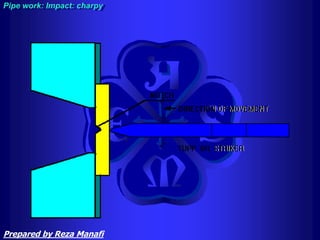
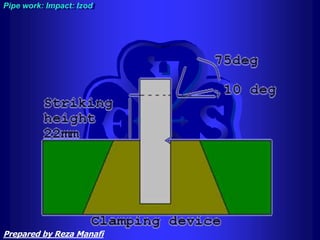
 CHARPY AND IZOD:
– Gives the toughness and shock loading of
the material and weld at varying
temperatures with a notch such as under cut
– The measurement is the energy required to
break a specimen with a given notch
– 2mm depth at a 45
o
bevel or a “U” notch.
Pipe work: Impact
Prepared by Reza Manafi
Pipe work: Impact: charpy
Prepared by Reza Manafi
Pipe work: Impact: charpy
Prepared by Reza Manafi
Pipe work: Impact: Izod
Prepared by Reza Manafi
 This gives the metals ability to show resistance
to indentation which show it’s resistance to
wear and abrasion.
Pipe work: Hardness tests
Prepared by Reza Manafi
Design
Prepared by Reza Manafi
 ASME B31.3 provides requirements for:
– Design
– Materials
– Fabrication
– Erection
– Inspection
– Testing
 process plants including
– Petroleum refineries
– Chemical plants
– Pharmaceutical plants
– Textile plants
– Paper plants
– Semiconductor
– plants
– Cryogenic plants
ASME B31.3
Prepared by Reza Manafi
 ASME B31.3 applied to piping and piping components
of all fluid services:
– Raw, intermediate, and finished chemicals
– Petroleum products
– Gas, steam, air, and water
– Fluidized solids
– Refrigerants
– Cryogenic fluids
ASME B31.3: Scope of ASME B31.3
Prepared by Reza Manafi
 The following are excluded from the scope of
ASME B31.3
 Piping system that design according to BPV
and other B31
 .
This item not exclude vacuum system
 Tube, … inside a fire heater
 Fire protection system (NFPA )
 Plumbing, sanitary sewer (AWWA)
ASME B31.3: Scope exclusions specified
Prepared by Reza Manafi
 The factors that affect piping material selection are:
 Strength
 Yield & Tensile strength
 Creep strength
 Fatigue strength
 Corrosion resistance
 Material fracture toughness
 Fabricability
 Availability & cost
ASME B31.3: Material
Prepared by Reza Manafi
ASME B31.3: Material: Stress - Strain Diagram
Prepared by Reza Manafi
ASME B31.3: Material: Variation of strength with temperature
Prepared by Reza Manafi
ASME B31.3: Material: Variation of strength with temperature
Prepared by Reza Manafi
ASME B31.3: Material: Variation of strength with temperature
Prepared by Reza Manafi
 Below about 750°F for a given stress, the strain in
most materials remains constant with time. Above this
temperature, even with constant stress, the strain in
the material will increase with time. This behavior is
known as creep.
ASME B31.3: Material: creep
Prepared by Reza Manafi
 The type of fatigue are:
– Static:
specimen breaks under a load that it has
previously withstood for a length of time.
Examples of static fatigue are: creep
fracture and stress corrosion cracking.
– Cyclic:
specimen breaks during a load cycle that it
has previously withstood several times.
ASME B31.3: Material: fatigue
Prepared by Reza Manafi
 Corrosion of materials involves deterioration of the
metal by chemical or electrochemical attack and
include:
– General or Uniform Corrosion:
Characterized by uniform metal loss over entire
surface of material. May be combined with erosion
if material is exposed to high-velocity fluids, or
moving fluids that contain abrasive materials.
– Pitting Corrosion:
Form of localized metal loss randomly located on
material surface. Occurs most often in stagnant
areas or areas of low-flow velocity.
ASME B31.3: Material: Corrosion resistance
Prepared by Reza Manafi
– Galvanic Corrosion:
Occurs when two dissimilar metals contact each other in
corrosive electrolytic environment. The anodic metal
develops deep pits or grooves as a current flows from it to
the cathodic metal.
ASME B31.3: Material: Corrosion resistance
– Crevice Corrosion:
Localized corrosion similar to pitting. Occurs at
places such as gaskets, lap joints, and bolts, where
a crevice can exist.
Prepared by Reza Manafi
– Concentration Cell Corrosion:
Occurs when different concentration of either
corrosive fluid or dissolved oxygen contacts
areas of same metal. Usually associated with
stagnant fluid.
– Graphitic Corrosion:
Occurs in cast iron exposed to salt water or
weak acids. Reduces iron in the cast iron and
leaves the graphite in place. Result is extremely
soft material with no metal loss.
ASME B31.3: Material: Corrosion resistance
Prepared by Reza Manafi
 It is the amount of energy necessary to initiate and
propagate a crack at a given temperature.
– The addition of manganese or nickel improves
fracture toughness.
– Mostly of concern for carbon steels
– Generally decreases as temperature decreases
– Factors affecting fracture toughness include:
• Chemical composition or alloying elements
• Heat treatment
• Grain size
– The impact energy required to fracture a material
sample at a given temperature can be measured
by standard Charpy V-notch tests.
ASME B31.3: Material: Material fracture toughness
Prepared by Reza Manafi
ASME B31.3: Material: Material fracture toughness
Prepared by Reza Manafi
ASME B31.3: Material: Cost
Prepared by Reza Manafi
 FAILURE BY GERNRAL YIELDING: Failure is due to
excessive plastic deformation.
– Yielding at Sub Elevated temperature: Body
undergoes plastic deformation under slip action of
grains.
– Yielding at Elevated temperature: After slippage,
material re-crystallizes and hence yielding continues
without increasing load. This phenomenon is known as
creep.
 FAILURE BY FRACTURE: Body fails without undergoing
yielding.
– Brittle fracture: Occurs in brittle materials.
– Fatigue: Due to cyclic loading initially a small crack is
developed which grows after each cycle and results in
sudden failure.
ASME B31.3: Material: Modes of failures
Prepared by Reza Manafi
ASME B31.3: Material: Modes of failures: Ductile Deformation
Prepared by Reza Manafi
ASME B31.3: Material: Modes of failures: Brittle Fracture
Prepared by Reza Manafi
 Category D
 Category M
 High Pressure
 Normal
ASME B31.3: B31.3 Fluid Service Definitions
Prepared by Reza Manafi
 Category D:
– The fluid handled is nonflammable,
nontoxic and not damaging to human
tissue. The design pressure does not
exceed 150 psig (1035 kPa). The design
temperature is greater than -20°F (-29°C)
and does not exceed 366 °F (186°C).
– Often characterized as “utility”
ASME B31.3: B31.3 Fluid Service Definitions
Prepared by Reza Manafi
 Category M:
– A fluid service in which the potential
for personnel exposure is judged to be
significant and in which a single
exposure to a very small quantity of a
toxic fluid, caused by leakage, can
produce serious irreversible harm to
persons upon breathing or on bodily
contact, even when prompt restorative
measures are taken.
– Often characterized as “lethal”
ASME B31.3: B31.3 Fluid Service Definitions
Prepared by Reza Manafi
 High Pressure:
– A service for which the owner
specifies the use of Chapter IX [of
B31.3] for piping design and
construction… considered to be in
excess of Class 2500 (PN 420).
Characterized as “high pressure”
 Normal: Everything else.
– Often characterized as “process”
ASME B31.3: B31.3 Fluid Service Definitions
Prepared by Reza Manafi
 Normal operating conditions:
Are those expected to occur during normal
operation, excluding failure of any operating device,
operator error, and the occasional, short-term
variations stated in the applicable code.
 Design conditions:
Are those which govern the design and selection of
piping components, and are based on the most
severe conditions expected to occur in service.
ASME B31.3: B31.3 Definitions
Prepared by Reza Manafi
 Loading classification
– Primary loads: These can be divided into two categories based
on the duration of loading.
• Sustained loads: These loads are expected to be present
through out the plant operation. e.g.
– internal & external pressure
– weight of system (piping material and operating
pressure).
• Occasional loads: These loads are present at infrequent
intervals during plant operation. e.g.
– Wind, ice and snow load
– seismic load
– Dynamic load (pressure surge, water hammer, energy
release by pressure relief valve, …
– Hydrostatic leak test load
– Wheel load (traffic load)
ASME B31.3: B31.3 Definitions
Prepared by Reza Manafi
– Expansion loads: These are loads due to
displacements of piping. e.g.
• thermal expansion:
– are created when the free expansion and
contraction of the piping is prevented at
its end points by connected equipment,
or prevented at intermediate points by
supports and/or restraints that are
installed. pipe thermal loads can be from
the thermal expansion of equipment at
pipe-to-equipment nozzle attachment
points, causing displacements in the
piping system.
• seismic anchor movements
• building settlement.
ASME B31.3: B31.3 Definitions
Prepared by Reza Manafi
 Principal pipe load types
– Sustained loads
• Act on system all or most of time
• Consist of pressure and total weight load
– Occasional loads
• Act for short portion of operating time
• Seismic and/or dynamic loading
– Thermal expansion loads
• Caused by thermal displacements
• Result from restrained movement
ASME B31.3: B31.3 Definitions: result
Prepared by Reza Manafi
 Primary Stresses: These are developed by the imposed
loading and are necessary to satisfy the equilibrium between
external and internal forces and moments of the piping
system. Primary stresses are not self-limiting.
– Direct
– Shear
– Bending
 Secondary stresses: These are developed by the constraint
of displacements of a structure. These displacements can be
caused either by thermal expansion or by outwardly imposed
restraint and anchor point movements. Secondary stresses
are self-limiting.
– Act across pipe wall thickness
– Cause local yielding and minor distortions
– Not a source of direct failure
ASME B31.3: B31.3 Definitions: Stress Categorization
Prepared by Reza Manafi
 Peak stresses: Unlike loading condition of
secondary stress which cause distortion, peak
stresses cause no significant distortion. Peak
stresses are responsible for causing fatigue failure.
– More localized
– Rapidly decrease within short distance of origin
– Occur where stress concentrations and fatigue
failure might occur
– Significance equivalent to secondary stresses
– Do not cause significant distortion
ASME B31.3: B31.3 Definitions: Stress Categorization
Prepared by Reza Manafi
– t = Required thickness for internal pressure, in.
– P = Internal design pressure, psig
– S = Allowable stress in tension, psi
– E = Longitudinal-joint quality factor
– Y = Wall thickness correction factor
– tm = Total minimum required wall thickness, in.
– tnom = Minimum required nominal pipe wall
thickness, in.
ASME B31.3:
Required Wall Thickness for Internal Pressure of Straight Pipe
Prepared by Reza Manafi
 Function of
– Material properties
– Temperature
– Safety factors
ASME B31.3: Allowable Stresses
Prepared by Reza Manafi
ASME B31.3: Wall thickness correction factor
Prepared by Reza Manafi
ASME B31.3: Wall thickness correction factor
Prepared by Reza Manafi
 Uninsulated component:
– T < 150F:
• the metal design temperature of the pipe and component
taken as the fluid temperature unless solar radiation or
other effects result in higher temperature
– T > 150F
• pipe = 0.95 FT (Fluid Temperature)
• Flange = 0.9 FT
• Lap joint = 0.85 FT
• Bolt = 0.8 FT
 Externally Insulated:
– Metal design temperature = FT
– Where piping is heated or cooled by heat tracing or jacketing,
the effect shall be included in the determination of the metal
design temperature.
 Internally insulated:
– Require heat transfer calculation
ASME B31.3: Design temperature
Prepared by Reza Manafi
 The design pressure of a piping system is the pressure at the
most severe condition of coincident internal or external pressure
and temperature expected during service. unless all of the
following criteria are met.
– The piping system have no pressure containing components
of cast iron or other non ductile metal.
– Nominal pressure stresses shall not exceed the yield
strength, Sy data in [ASME] BPV Code, Section II, Part D,
Table Y-1).
– The total number of pressure-temperature variations shall not
exceed 1000 during the life of the piping system.
– Increased pressure shall not exceed the test pressure
ASME B31.3: Design pressure
Prepared by Reza Manafi
– Occasional variations above design conditions shall remain
within one of the following limits for pressure design.
• Subject to the owner's approval, it is permissible to
exceed the pressure rating or the allowable stress for
pressure design at the temperature of the increased
condition by not more than:
– 33% for no more than 10 hour at any one time and
no more than 100 hour per year; or
– 20% for no more than 50 hour at any one time and
no more than 500 hour per year.
• When the variation is self-limiting (e.g., due to a
pressure relieving event), 20% for no more than 50
hour at any one time and no more than 500 hour per
year.
ASME B31.3: Design pressure
Prepared by Reza Manafi
– The combined effects of the sustained and cyclic
variations shall have been evaluated.
– Temperature variations below the minimum
temperature shown in Appendix A [of ASME B31.3]
are not permitted.
– The application of pressures exceeding pressure-
temperature ratings of valves may cause loss of
seat tightness or difficulty of operation. The
differential pressure on the valve closure element
should not exceed the maximum differential
pressure rating established by the valve
manufacturer.
ASME B31.3: Design pressure
Prepared by Reza Manafi
 For buried piping, dead weight is not a factor.
However, a sustained load that is analyzed is the
load from the earth above the buried piping. The
earth load on rigid piping may be calculated using
the following formula.
ASME B31.3: Load: Weight
Prepared by Reza Manafi
 Wheel load
ASME B31.3: Load
Prepared by Reza Manafi
 Wind load:
– Wind load can cause other loads, such as
vibratory loads, due to reaction from a deflection
caused by the wind. The design wind speed is
determined from ASCE 7
ASME B31.3: Load
Prepared by Reza Manafi
 Snow load (ANSI A58.1)
– Assuming that snow laying on a pipe will take the
approximate shape of an equilateral triangle with
the base equal to the pipe diameter.
– For most heavy snow climates, a minimum snow
load of 1.2 kpa (25 psf) is used in the design.
ASME B31.3: Load
Prepared by Reza Manafi
 Ice load:
– Unless local or regional data suggests
assumption of 50 to 75 mm (2 to 3 in) maximum
ice accumulation to calculate an ice loading
ASME B31.3: Load
Prepared by Reza Manafi

Piping-Training-Coursebplant system1.ppt

  • 1.
    OVERVIEW OF PROCESS PLANTPIPING SYSTEM Reza Manafi
  • 2.
     Definition  Pipingcomponent  Piping drawing  Design  Pipe work  Codes & Standards Piping components: summary Prepared by Reza Manafi
  • 3.
  • 4.
     piping: assemblies ofpiping components used…[for] fluid flows. Piping also includes pipe supporting elements, but does not include support structures…or equipment…  piping system: interconnected piping subject to the same design conditions Definition: Prepared by Reza Manafi
  • 5.
     piping components: mechanicalelements suitable for joining or assembly into pressure tight fluid- containing piping systems include Definition: Prepared by Reza Manafi
  • 6.
  • 7.
    Piping components:  pipingcomponents includes:  Pipe & tube  Fittings (e.g. elbows, reducers, branch, connections, flanges, etc.)  gaskets, bolting  valves  Pipe support  Special items such as expansion joints… Prepared by Reza Manafi
  • 8.
    Pipe & Tube Preparedby Reza Manafi
  • 9.
     Seamless Show Welded: ─ Longitudinal seam • Single seam • Double seam (NPS ≥ 36”) ─ Helical (spiral) seam Show • NPS ≥ 4 ½” • 0.8 OD ≤ Skelp width ≤ 3.0 OD • Submerged arc welding Piping components: Pipe & tube manufacturing Prepared by Reza Manafi
  • 10.
     Welding process: ─Without filler metal • Electric welding Show • Continuous welding Show – With filler metal • Sub-merged arc welding • Gas metal arc welding Piping components: Pipe & tube manufacturing Prepared by Reza Manafi
  • 11.
    Billet preparing visual control Billetchopping Billet heating in annular furnace Rough tube piercing Tube rolling in continuous mandrel mill Mandrel removing Piping components: Pipe & tube manufacturing : Seamless pipe Prepared by Reza Manafi
  • 12.
    Tube heating in cellinduction furnace Sizing and reduction Stalk ends cutting, tubes cutting with flying shears Tubes cooling Tubes leveling Tubes cutting in ready sizes, tubes facing Piping components: Pipe & tube manufacturing : Seamless pipe Prepared by Reza Manafi
  • 13.
    Geometry measuring, mechanical tests, chemicalcomposition control Tube ends sizing (by OD and ID) Heating for quenching Quenching in sprayer Tempering Tubes cooling Piping components: Pipe & tube manufacturing : Seamless pipe Prepared by Reza Manafi
  • 14.
    Tubes etching Ultrasonicor electromagnetic test Hydraulic test Sweeping-up (if required) , visual control Preservative coating Weighing, marking, packing, storing Piping components: Pipe & tube manufacturing : Seamless pipe Prepared by Reza Manafi
  • 15.
    Tube end upsetThermal treatment Leveling Sweeping-up and grading by length Threading, thread quality monitoring Couplings screwing-on Piping components: Pipe & tube manufacturing : Seamless pipe (threaded) Prepared by Reza Manafi
  • 16.
    Hydraulic test Tubesinspection, rings and nipple screwing-on, marking Painting (if required)) Packing, storing Piping components: Pipe & tube manufacturing : Seamless pipe (threaded) Prepared by Reza Manafi
  • 17.
    Piping components: Pipe& tube manufacturing : other pipe Prepared by Reza Manafi
  • 18.
     Pipe classification: ─Iron pipe size (approximate internal dia.) ─ Manufacturers’ weight: NPS + • STD • XS • XXS ─ Schedule number: NPS + • 5, 5s, 10, 10s, 20, 20s, 30, 40, 40s, 60, 80, 80s, 100, 120, 140, 160 Show • SCH ≈ 1000 P/S • NPS ≤ 12, OD ≥ NPS • NPS ≥ 14, OD = NPS • NPS ≤ 10, SCH 40 = STD • NPS ≤ 8, SCH 80 = XS • Light wall = light gage = 5, 5s, 10, 10s – API designation • A25, A, B, X42, X46, X52, X60, X65, X70 • X(AA), AA = Allowable stress – Pressure-Temperature Ratings • 150, 300, 400, 600, 900, 1500, 2500 Piping components: pipe & tube classification Prepared by Reza Manafi
  • 19.
     Pipe: ─ NPS: 1/8”,¼”, 3/8”, ½”, ¾”, 1”, 1 ½”, 2”, 3”, 4”, 6”, 8”, 10”, 12”, 14”, 16”, 18”, 20”, 24”, 28”, 30”, 32”, 36”, 40”, 44”, 48” 52”, 56”, 60” ─ NPS 1 ¼”, 2 ½”, 3 ½”, 5” not used ─ Pipe is supplied in ─ Random length (17 to 25 ft) ─ Double random length (38 to 48 ft) ─ Pipe end: ─ BE (bevel end) ─ PE (plain end) ─ T& C (treaded and coupled, rating of coupling shall be specified Piping components: pipe & tube classification Prepared by Reza Manafi
  • 20.
     Tube: – Specifyby two of • Outside diameter • Inside diameter • Wall thickness: – Thousandths of inch – Gauge number » American wire gauge » Steel wire gauge » Birmingham wire gauge » … – When gauge numbers are given without reference to a system (BWG) is implied Piping components: pipe & tube classification Prepared by Reza Manafi
  • 21.
     ASTM A53– Steel Pipe  ASTM A312 – Stainless Steel Pipe  AWWA C151 – Ductile Iron Pipe  API 5L – Line pipes  ISO 11960, API 5CT – tubing  ASTM A 53/A 53М Electric-weldedand seamless steel pipes, black or hot-dip galvanized  ASTM A 106 Seamless carbon steel pipes for high temperature performance Piping components: pipe standards Prepared by Reza Manafi
  • 22.
  • 23.
     Fitting producechange in geometry and include: – Change in direction of piping – Alter pipe diameter – Terminate pipe – Bring pipes together (made branch from main pipe run) Piping components: Fitting Prepared by Reza Manafi
  • 24.
     Method ofjoining pipe: ─ Butt weld ─ Socket weld ─ Threaded ─ Quick coupling ─ Flange ─ Special item Piping components: Fitting Prepared by Reza Manafi
  • 25.
     ASME B16.9 Used in most piping systems NPS ≥ 2”  Use generally not restricted  Difficult in small sizes, especially for thin wall Piping components: Fitting (butt-weld) Prepared by Reza Manafi
  • 26.
    Backing ring Piping components:Fitting (butt-weld) Prepared by Reza Manafi
  • 27.
     Elbow (90,45) – Long reduce • Curvature = 1 ½ NPS • Long tangent: straight extension at one end – Short reduce • curvature = NPS  Reducing elbow: – 90 – curvature = 1 ½ NPS larger end Piping components: Fitting (butt-weld) Prepared by Reza Manafi
  • 28.
     Return: – Curvature= 1 ½ NPS – Uses in: • Vent on tanks  Bend: – Curvature = 4 - 6 NPS – Made from seamless and ERW straight pipe – Two methods used to making bend • Hot • Cold Piping components: Fitting (butt-weld) Prepared by Reza Manafi
  • 29.
     Miter – 2piece (pressure drop ≈ 4-6 LR elbow) – 3 piece (pressure drop ≈ 2 LR elbow) – Low pressure line, NPS > 10” & pressure drop not important – 90 Piping components: Fitting (butt-weld) Prepared by Reza Manafi
  • 30.
     Reducer – Eccentric •Suction & discharge of pump • support – concentric Piping components: Fitting (butt-weld) Prepared by Reza Manafi
  • 31.
     Sewage : –connect butt-welded piping to smaller socket-weld or screwed – Abrupt change of line size in butt-weld Type: • Eccentric • Concentric • Venturi: Allows smoother flow Piping components: Fitting (butt-weld) Prepared by Reza Manafi
  • 32.
     Tee – Straight(branch to the same size as the run) – Reducing • Branch smaller than the run – Bullhead tee have branch larger than run & seldom used and made to special order Piping components: Fitting (butt-weld) Prepared by Reza Manafi
  • 33.
     Cross – Straight(branch to the same size as the run) – Reducing (rarely used) Piping components: Fitting (butt-weld) Prepared by Reza Manafi
  • 34.
     Lateral (manufacturein factory) – Run inlet × run outlet × branch × angle respect to outlet (6 × 6 × 4 × 45)  Shape nipple (use template) – Manufacture at shop – Rarely use – 90, 45 45 Piping components: Fitting (butt-weld) Prepared by Reza Manafi
  • 35.
     Stub-in – Weldeddirectly in the side of the main pipe run – Least expensive – NPS ≥ 2” – Cab be reinforced Piping components: Fitting (butt-weld) Prepared by Reza Manafi
  • 36.
     Weldolet – Makea closer manifold that Tee – Full size – Reducing – Flat • Are available for connecting to pipe caps and pressure vessel Piping components: Fitting (butt-weld) Prepared by Reza Manafi
  • 37.
     Elbolet: reducingtangent branch on elbow  Latrolet : reducing, 45  Sweepolet – Good flow pattern and optimum stress distribution – 90 reducing from the main pipe Piping components: Fitting (butt-weld) Prepared by Reza Manafi
  • 38.
     Closure – Cap –Flat closure Piping components: Fitting (butt-weld) Prepared by Reza Manafi
  • 39.
     Size frequentlylimited to NPS≤ 1 ½” (ASME B16.11)  Not used in “severe cyclic conditions” and in services where corrosion is accelerated in crevices  No weld metal can enter bore, easier alignment on small line than butt-weld  Tack is unnecessary  Have not any leakage Piping components: Fitting (socket) Prepared by Reza Manafi
  • 40.
     Elbow (90,45) Piping components: Fitting (socket) Prepared by Reza Manafi
  • 41.
     Return: Piping components:Fitting (socket) Prepared by Reza Manafi
  • 42.
     Reducer  Reducerinsert Piping components: Fitting (socket) Prepared by Reza Manafi
  • 43.
     Sewage : –Abrupt change of line size in butt-weld Piping components: Fitting (socket) Prepared by Reza Manafi
  • 44.
     Full coupling Half coupling Piping components: Fitting (socket) Prepared by Reza Manafi
  • 45.
     Union Piping components:Fitting (socket) Prepared by Reza Manafi
  • 46.
     Tee Piping components:Fitting (socket) Prepared by Reza Manafi
  • 47.
     Cross Piping components:Fitting (socket) Prepared by Reza Manafi
  • 48.
     Lateral Piping components:Fitting (socket) Prepared by Reza Manafi
  • 49.
     Sockolet Piping components:Fitting (socket) Prepared by Reza Manafi
  • 50.
     Socket weldingElbolet  Socket welding latrolet  Nippolet Piping components: Fitting (socket) Prepared by Reza Manafi
  • 51.
     Cap Piping components:Fitting (socket) Prepared by Reza Manafi
  • 52.
     Common materials –Gray iron (ASME B16.4) – Malleable iron (ASME B16.3) – Steel (ASME B16.11) ─ Non-toxic, non-flammable, Generally not used where leaks cannot be tolerated ─ NPS ≤ 1 ½” , pressure rating < 600, temperature < 625 Piping components: Fitting (threaded = screwed) Prepared by Reza Manafi
  • 53.
     Elbow (90,45)  Reducing elbow Piping components: Fitting (thread) Prepared by Reza Manafi
  • 54.
     Reducer  Reducerinsert Piping components: Fitting (thread) Prepared by Reza Manafi
  • 55.
     Sewage nipple Pipingcomponents: Fitting (thread) Prepared by Reza Manafi
  • 56.
     Full coupling Half coupling Piping components: Fitting (thread) Prepared by Reza Manafi
  • 57.
     Tee Piping components:Fitting (thread) Prepared by Reza Manafi
  • 58.
     Nipple Piping components:Fitting (thread) Prepared by Reza Manafi
  • 59.
     cross Piping components:Fitting (thread) Prepared by Reza Manafi
  • 60.
     lateral Piping components:Fitting (thread) Prepared by Reza Manafi
  • 61.
     Union Piping components:Fitting (thread) Prepared by Reza Manafi
  • 62.
     Hexagon bushing Pipingcomponents: Fitting (thread) Prepared by Reza Manafi
  • 63.
     Threadolet Piping components:Fitting (thread) Prepared by Reza Manafi
  • 64.
     Threaded elbolet Threaded latrolet  Threaded nippolet Piping components: Fitting (thread) Prepared by Reza Manafi
  • 65.
     Closure – Cap –plug Piping components: Fitting (thread) Prepared by Reza Manafi
  • 66.
    Piping components: Fitting Flange used for – Mate to equipment, vessels, valve, … – When need periodic cleaning – Flanges are normally used for pipe sizes above NPS 1½”. Prepared by Reza Manafi
  • 67.
    Piping components: Fitting Type of flanges: – Threaded Flanges – Socket-Welded Flanges – Blind Flanges – Slip-On Flanges – Lapped Flanges – Weld Neck Flanges Prepared by Reza Manafi
  • 68.
     Welding neckflange – Regular – Long (used for vessel & equipment nozzle, rarely for pipe  Suitable where – Extreme temperature – Shear – Impact and vibration Stress apply Piping components: Fitting (flange) Prepared by Reza Manafi
  • 69.
     Slip-on flange –Internal welds is slightly more subject to corrosion than the butt-weld (0 – 1/16”) – Poor resistance to shock and vibration – Cheaper to buy, costlier to assemble – Strength under internal pressure 1/3 of corresponding welding neck flange – Easier to align than the welding neck flange Piping components: Fitting (flange) Prepared by Reza Manafi
  • 70.
     Socket weldingflange Piping components: Fitting (flange) Prepared by Reza Manafi
  • 71.
     Threaded flange Pipingcomponents: Fitting (flange) Prepared by Reza Manafi
  • 72.
     Reducing flange –Specify by size of smaller pipe and outside diameter of flange to be mate • Ex/ RED FLG 4” × 11” – Should not be used if abrupt transition would create undesirable turbulence as at pump Piping components: Fitting (flange) Prepared by Reza Manafi
  • 73.
     Expander flange –Reducer + welding neck flange – Increase pipe size to first or second large size Piping components: Fitting (flange) Prepared by Reza Manafi
  • 74.
     Lap joint(van stone) flange – If stub and flange are of the same material they will be more expensive than a welding neck flange – Economical for different material of stub and flange Piping components: Fitting (flange) Prepared by Reza Manafi
  • 75.
     Blind flange Pipingcomponents: Fitting (flange) Prepared by Reza Manafi
  • 76.
     Flageolet Piping components:Fitting (flange) Prepared by Reza Manafi
  • 77.
     Flange FacingTypes  Flat Faced  Raised Face  Ring Joint Piping components: Fitting (flange) Prepared by Reza Manafi
  • 78.
     Flange RatingClass: – pressure/temperature combinations – Seven classes (150, 300, 400, 600, 900, 1,500, 2,500) – Flange strength increases with class number – The material specifications are grouped within Material Group Numbers. Piping components: Fitting (flange) Prepared by Reza Manafi
  • 79.
     Material SpecificationList Piping components: Fitting (flange) Prepared by Reza Manafi
  • 80.
     Material anddesign temperature combinations that do not have a pressure indicated are not acceptable.  Pressure - Temperature Ratings Piping components: Fitting (flange) Prepared by Reza Manafi
  • 81.
     Flange RatingClass Piping components: Fitting (flange) Prepared by Reza Manafi
  • 82.
     Flange RatingClass Piping components: Fitting (flange) Prepared by Reza Manafi
  • 83.
     Flange RatingClass Piping components: Fitting (flange) Prepared by Reza Manafi
  • 84.
     Equipment NozzleLoad standards and Parameters Piping components: Fitting (flange) Prepared by Reza Manafi
  • 85.
     Flange withjack screw Piping components: Fitting (flange) Prepared by Reza Manafi
  • 86.
    Piping components: Fitting(piping specification) Prepared by Reza Manafi
  • 87.
    Piping components: Fitting(gasket) Prepared by Reza Manafi
  • 88.
    Piping components: Fitting(branch connection chart) Prepared by Reza Manafi
  • 89.
     Gasket: – Resilientmaterial – Inserted between flanges – Compressed by bolts to create seal – Commonly used types • Sheet • Spiral wound • Solid metal ring • Insulation gasket Piping components: Fitting (gasket) Prepared by Reza Manafi
  • 90.
     Sheet Piping components:Fitting (gasket) Prepared by Reza Manafi
  • 91.
     Sheet Piping components:Fitting (gasket) Prepared by Reza Manafi
  • 92.
     Spiral wound Pipingcomponents: Fitting (gasket) Prepared by Reza Manafi
  • 93.
     Spiral wound Pipingcomponents: Fitting (gasket) Prepared by Reza Manafi
  • 94.
     Spiral wound Pipingcomponents: Fitting (gasket) Prepared by Reza Manafi
  • 95.
     Solid metalring Piping components: Fitting (gasket) Prepared by Reza Manafi
  • 96.
     Insulation gasket Pipingcomponents: Fitting (gasket) Prepared by Reza Manafi
  • 97.
     Bolt type: –Stud bolt • Easily remove if corroded • Material can be readily made – Machine bolt  Has to be strong enough to seat the gasket Piping components: Fitting (bolt) Prepared by Reza Manafi
  • 98.
     Tightening arrangement Pipingcomponents: Fitting (bolt) Prepared by Reza Manafi
  • 99.
     ASME B16.5,Pipe Flanges and Flanged Fittings (NPS ≤ 24”) Piping components: Fitting Prepared by Reza Manafi
  • 100.
     Quick coupling Pipingcomponents: Fitting (special item) Prepared by Reza Manafi
  • 101.
    Piping components: Fitting(special item)  Flange coupling adaptor Prepared by Reza Manafi
  • 102.
    Piping components: Fitting(special item)  Expansion joint (Bellows) Prepared by Reza Manafi
  • 103.
    Piping components: Fitting(special item)  Expansion joint Prepared by Reza Manafi
  • 104.
    Piping components: Fitting(special item)  Flexible joint Prepared by Reza Manafi
  • 105.
    Piping components: Fitting(special item)  Flexible joint Prepared by Reza Manafi
  • 106.
    Piping components: Fitting(special item)  Double block & bleed Prepared by Reza Manafi
  • 107.
     strainer Piping components:Fitting (special item) Prepared by Reza Manafi
  • 108.
     Spectacle blind Pipingcomponents: Fitting (special item) Prepared by Reza Manafi
  • 109.
    Piping components: Fitting(special item)  Thermal sleeve & Queel Prepared by Reza Manafi
  • 110.
    Piping components: Fitting Pipingcomponents: Fitting (special item)  Bird screen Prepared by Reza Manafi
  • 111.
    Piping components: Fitting Pipingcomponents: Fitting (special item)  Tundish Prepared by Reza Manafi
  • 112.
    Piping components: Fitting Pipingcomponents: Fitting (special item)  Pigging Tee Prepared by Reza Manafi
  • 113.
    • RUPTURE DISKSOR BURST DIAPHRAGMS: • must be replaced after opening Piping components: Fitting (special item) Prepared by Reza Manafi
  • 114.
  • 115.
     Valve areuse for – Controlling process and utility service – Isolating equipment or instrument for maintenances – Discharge gas, vapor or liquid – Draining piping and equipment on shutdown – Emergency shutdown Piping components: valve Prepared by Reza Manafi
  • 116.
     Classify valvesaccording to functions: – Block flow (On / Off) – Regulating (Throttle flow) – Checking (Prevent flow reversal) – Switching – Discharging (pressure relive valve)  Classify valves according to operating device: – Manual – Hydraulic – Motor (electric and air operated) – Solenoid Piping components: valve Prepared by Reza Manafi
  • 117.
    Piping components: valve Type of valves: – Ball valves – Gate valves – Globe valves – Check Valves – Plug valve – Butterfly valves – Pinch valve – Needle valves – Relief Valve Prepared by Reza Manafi
  • 118.
    Ball Valve Piping components:valve Prepared by Reza Manafi
  • 119.
    Piping components: valve(ball valve) Prepared by Reza Manafi
  • 120.
    Piping components: valve(ball valve)  Used for isolation (quick on / off)  Soft-sealed ball valves are not normally used for throttling service because the soft-seats are subject to erosion or distortion/displacement caused by fluid flow when the valve is in the partially open position.  ADV: Low pressure drop, fast operating, bubble-tight shut off, can be throttled Check Valves  DISADV: Expensive, heavy, poor throttling Prepared by Reza Manafi
  • 121.
    Gate Valve Piping components:valve Prepared by Reza Manafi
  • 122.
    Piping components: valve(gate valve) Prepared by Reza Manafi
  • 123.
    Piping components: valve(gate valve)  About 75% of all valves in process plants  an optimum engineering and economic choice for on or off service. (cutout or isolation valves)  ADV: small pressure drop across valve  DISADV: poor throttling characteristics Prepared by Reza Manafi
  • 124.
    Piping components: valve(gate valve) Prepared by Reza Manafi
  • 125.
    Globe Valve Piping components:valve Prepared by Reza Manafi
  • 126.
    Piping components: valve(globe valve) Prepared by Reza Manafi
  • 127.
     Most economicfor throttling flow and used for flow control  Can be hand-controlled  Provides “tight” shutoff  Not suitable for scraping or rodding  Too costly for on/off block operations  ADV: excellent throttling characteristics  DISADV: large pressure drop across the valve due to the flow restriction (thus more pumping power is required to move the fluid through the system.) Piping components: valve (globe valve) Prepared by Reza Manafi
  • 128.
    Piping components: valve(globe valve) Prepared by Reza Manafi
  • 129.
    Check Valve Piping components:valve Prepared by Reza Manafi
  • 130.
    Piping components: (checkvalve / swing check valve) Prepared by Reza Manafi
  • 131.
     Simple design Allows flow in one direction  Can not be used as an isolation valve Piping components: (check valve / swing check valve) Prepared by Reza Manafi
  • 132.
    Piping components: (checkvalve / ball check valve) Prepared by Reza Manafi
  • 133.
     Their lowcost usually makes them the first choice valves sized NPS 2 and smaller (available in sizes NPS ½ through 2)  Used when pressure drop is not a concern.  The basic types are the straight-through- and globe-type (90 change in direction) Piping components: (check valve / ball check valve) Prepared by Reza Manafi
  • 134.
    Piping components: (checkvalve) Prepared by Reza Manafi
  • 135.
     are availablein sizes from NPS ½ through 2 plants.  They are most commonly used in the higher ASME B16.5 ratings (Class 300 and greater) where tighter shutoff is required.  Valves of this type should only be used in clean services. Piping components: (check valve / lift check valve) Prepared by Reza Manafi
  • 136.
    Wafer Check Valve Pipingcomponents: (check valve) Prepared by Reza Manafi
  • 137.
     Valves ofthis type are placed between pipe flanges and held in place by the compressive force between the flanges and transmitted through the gaskets. Piping components: (check valve / wafer check valve) Prepared by Reza Manafi
  • 138.
    Stop Check Valve Pipingcomponents: (check valve) Prepared by Reza Manafi
  • 139.
    Piping components: (checkvalve / stop check valve)  Internals similar to a globe valve  Disc is not attached to the stem  Valve stem - long enough to hold the disc firmly against the seat  Stem raised - the disc can be opened by pressure on the inlet side  Can be used as an isolation valve as well as a check valve Prepared by Reza Manafi
  • 140.
    Piping components: (checkvalve) Prepared by Reza Manafi
  • 141.
     Function ofcheck valve: – Prevents flow reversal – Does not completely shut off reverse flow – Available in all sizes, ratings, materials – Valve type selection determined by • Size limitations • Cost • Availability • Service Piping components: (check valve) Prepared by Reza Manafi
  • 142.
    Plug Valve Piping components:valve Prepared by Reza Manafi
  • 143.
    Plug Valve Piping components:valve (plug valve) Prepared by Reza Manafi
  • 144.
     Similar toball valve Piping components: valve (plug valve) Prepared by Reza Manafi
  • 145.
    Butterfly Valve Piping components:valve Prepared by Reza Manafi
  • 146.
    Butterfly Valve Piping components:valve (butterfly valve) Prepared by Reza Manafi
  • 147.
    Piping components: valve(butterfly valve)  used as cutout/isolation valves  ADV: quick-acting low pressure drop across the valve, has adequate throttling characteristics  DISADV: only used for low press/low temp systems due to force involved in valve operation Prepared by Reza Manafi
  • 148.
    Pinch Valve Piping components:valve Prepared by Reza Manafi
  • 149.
    Pinch Valve Piping components:valve (pinch valve) Prepared by Reza Manafi
  • 150.
    Needle Valve Piping components:valve Prepared by Reza Manafi
  • 151.
    Needle Valve Piping components:valve (needle valve) Prepared by Reza Manafi
  • 152.
    Relive Valve Piping components:valve Prepared by Reza Manafi
  • 153.
    Relive Valve Piping components:valve Prepared by Reza Manafi
  • 154.
    Piping components: valve(relive valve)  special type of valve designed to operate automatically (self actuating) in a system overpressure condition (a protective feature in most systems)  most relief valves use an adjustable spring to determine lift pressure. System pressure opposes spring pressure, and when pressure is high enough, the valve will open against spring pressure and port the fluid to another location (typically, overboard for ‘safe’ fluids)  Type of relive valve: – Relief Valve - liquid systems – Safety Valve - gas and vapor systems – Safety Relief Valve - liquid and/or vapor systems Prepared by Reza Manafi
  • 155.
    Interlock sequence Piping components:valve (interlock) close Prepared by Reza Manafi
  • 156.
    Parts of valves: –disk: • The moving part directly affecting the flow – seat: • Non-moving part that disk bear on it – Metallic – Non-metallic (elastomer) – port: • Maximum internal opening for flow when the valve is fully open – Stem: • Move the disk – Handwheel: • Rise with the stem • Stem rise thru the handwheel Piping components: valve (parts) Prepared by Reza Manafi
  • 157.
    Piping components: valve(result) Prepared by Reza Manafi
  • 158.
     General procedurefor valve selection. – Identify design information including pressure and temperature, valve function, material, etc. – Identify potentially appropriate valve types and components based on application and function (i.e., block, throttle, or reverse flow prevention). Piping components: valve (valve selection process) Prepared by Reza Manafi
  • 159.
    – Determine valveapplication requirements (i.e., design or service limitations). – Finalize valve selection. Check factors to consider if two or more valves are suitable. – Provide full technical description specifying type, material, flange rating, etc. Piping components: valve (valve selection process) Prepared by Reza Manafi
  • 160.
    Valve data sheet Piping components: valve(valve selection process) Prepared by Reza Manafi
  • 161.
     According toANSI, leakage classify by class (I, II, III, IV, VI) Piping components: valve (leakage classification) Prepared by Reza Manafi
  • 162.
    Pipe Supports andRestraints Prepared by Reza Manafi
  • 163.
     Function ofsupports and restraints: – To carry load – To ensure that material is not stressed beyond a safe limit – Holdup of liquid can occurred due to pipe sagging (allow draining) – To permit thermal expansion – To withstand and dampen vibrational forces applied to the piping Piping components: pipe supports and restraints Prepared by Reza Manafi
  • 164.
     Supports: – Absorbsystem weight – Reduce: • longitudinal pipe stress • pipe sag • end point reaction loads Piping components: pipe supports and restraints Prepared by Reza Manafi
  • 165.
     Restraints – Control,limit, redirect thermal movement • Reduce thermal stress • Reduce loads on equipment connections – Absorb imposed loads • Wind • Earthquake • Slug flow • Water hammer • Flow induced-vibration Piping components: pipe supports and restraints Prepared by Reza Manafi
  • 166.
     Support andRestraint Selection Factors: – Weight load – Available attachment clearance – Availability of structural steel – Direction of loads and/or movement – Design temperature – Vertical thermal movement at supports Piping components: pipe supports and restraints Prepared by Reza Manafi
  • 167.
    Piping components: pipesupports and restraints (rigid support) Prepared by Reza Manafi
  • 168.
    Piping components: pipesupports and restraints (hanger support) Prepared by Reza Manafi
  • 169.
    Piping components: pipesupports and restraints (flexible support)  Rigid hangers are normally used at locations where no vertical movement of the piping occurs. Prepared by Reza Manafi
  • 170.
    Piping components: pipesupports and restraints (flexible support) Prepared by Reza Manafi
  • 171.
    Flexible Supports Piping components:pipe supports and restraints (flexible support) Prepared by Reza Manafi
  • 172.
    Piping components: pipesupports and restraints (flexible support) Prepared by Reza Manafi
  • 173.
    Flexible Supports Piping components:pipe supports and restraints (flexible support) Prepared by Reza Manafi
  • 174.
    Flexible Supports Piping components:pipe supports and restraints (flexible support) Prepared by Reza Manafi
  • 175.
    Piping components: pipesupports and restraints (flexible support) Prepared by Reza Manafi
  • 176.
    Piping components: pipesupports and restraints (flexible support) Prepared by Reza Manafi
  • 177.
     Anchor – Fullfixation – Permits very limited (if any) translation or rotation  Guide – Permits movement along pipe axis – Prevents lateral movement – May permit pipe rotation Piping components: pipe supports and restraints (anchor, guide) Prepared by Reza Manafi
  • 178.
    Piping components: pipesupports and restraints (Restraints - Anchors) Prepared by Reza Manafi
  • 179.
    Piping components: pipesupports and restraints (Restraints - Guide) Prepared by Reza Manafi
  • 180.
     Piping canbe arranged – On piperacks – Near grade on sleeper – In trench – Near steelwork or equipment Piping components: pipe supports and restraints (Piping and support arrangement) Prepared by Reza Manafi
  • 181.
    Piping components: pipesupports and restraints (Piping and support arrangement) Prepared by Reza Manafi
  • 182.
    Piping components: pipesupports and restraints (Piping and support arrangement) Prepared by Reza Manafi
  • 183.
    Piping components: pipesupports and restraints (Piping and support arrangement) Prepared by Reza Manafi
  • 184.
     Pipeway: – Isthe space allocated for routing several parallel adjacent lines – Group lines in pipeway  Piperack – Is a structure in the pipeway for carrying pipes and is usually fabricated from Steel, Concrete & steel, also provide protected location for ancillary equipment (pump, utility station, …) – Piperack shape termed tee-head support Piping components: pipe supports and restraints (Piping and support arrangement / support definition) Prepared by Reza Manafi
  • 185.
     Piperack consist: –Bent: • Connected shape frame – Stanchion: • The vertical member of bents are termed stanchion  Piperack arrangement: – Single deck – Double deck, … Piping components: pipe supports and restraints (Piping and support arrangement / support definition) Prepared by Reza Manafi
  • 186.
     Arrangement ofpipe on support: – Usually 2” < NPS < 12” mounted on piperack and larger pipes are mounted on sleeper – Mounted large diameter pipe near stanchion for uniform distribution of load Piping components: pipe supports and restraints (Piping and support arrangement) Prepared by Reza Manafi
  • 187.
    – Hot pipeusually insulated and mounted on shoes Piping components: pipe supports and restraints (Piping and support arrangement) Prepared by Reza Manafi
  • 188.
    – Other typeof shoes Piping components: pipe supports and restraints (Piping and support arrangement) Prepared by Reza Manafi
  • 189.
    – Use bracketor outrigger for • Installation of electrical and instrument tray • Pipes with slope Piping components: pipe supports and restraints (Piping and support arrangement) Prepared by Reza Manafi
  • 190.
    – Group requiringexpansion loop at one side of the pipe rack – Design hanger for 2 ½” and larger pipe Piping components: pipe supports and restraints (Piping and support arrangement) Prepared by Reza Manafi
  • 191.
    – For betterstress distribution in the pipe wall, saddle used on large line and used for lines that twist over when moving Piping components: pipe supports and restraints (Piping and support arrangement) Prepared by Reza Manafi
  • 192.
    – Provide guidefor long straight pipes subject to thermal movement Piping components: pipe supports and restraints (Piping and support arrangement) Prepared by Reza Manafi
  • 193.
    – The smallestsize of pipe run on a piperack 2” – If necessary, suspend pipe smaller 2” from 4” and larger – For making horizontal branch, change height of pipe Piping components: pipe supports and restraints (Piping and support arrangement) Prepared by Reza Manafi
  • 194.
    – The mosteconomic beam section desired for the piperack – If more room is needed, make double or triple piperack Piping components: pipe supports and restraints (Piping and support arrangement) 20 -25 ft > 6 ft Prepared by Reza Manafi
  • 195.
    – Categorize piperack,for example if using double deck, place utility service piping on the upper level of the piperack Piping components: pipe supports and restraints (Piping and support arrangement) Utility service process Determine by lifting equipment required access Prepared by Reza Manafi
  • 196.
    – Don’t installpipe on stanchion, this will prevent adding another deck – Consider sufficient space beside piperack Piping components: pipe supports and restraints (Piping and support arrangement) 10 ft Prepared by Reza Manafi
  • 197.
    – Ensure thatnozzles on equipment are free from transmitted by the piping – Equipment suppliers will state max. loading permissible at nozzles Piping components: pipe supports and restraints (Piping and support arrangement) Prepared by Reza Manafi
  • 198.
    – Dummy leglength Piping components: pipe supports and restraints (Piping and support arrangement) Prepared by Reza Manafi
  • 199.
    – For linesmaller than 2” and non-critical arrange supports in the field – Pocketing of liquid due to sagging can be eliminated by sloping the line so that the difference in height between adjacent supports is at least equal to triple deflection at the midpoint – As a rule of thumb, spans for insulated lines should be reduced by approximately %30 from those for uninsulated pipes Piping components: pipe supports and restraints (Piping and support arrangement) Prepared by Reza Manafi
  • 200.
    – Support pipingfrom overhead, in preference to underneath – Install flange, with 12” minimum clearance from supporting steel >12” Piping components: pipe supports and restraints (Piping and support arrangement) Prepared by Reza Manafi
  • 201.
    – Keep weldjoints at least 3” from supporting steel or other obstruction – To carry the weight of the piping use a FOS = 3 – In general, one hanger or other support should be specified for each side of a valve. Piping components: pipe supports and restraints (Piping and support arrangement) >3” Prepared by Reza Manafi
  • 202.
    – Field support •For line smaller than 2” and non-critical, arrange supports in the field – Finding location of support Piping components: pipe supports and restraints (Piping and support arrangement) Prepared by Reza Manafi
  • 203.
    Piping components: pipesupports and restraints (piping support document) Prepared by Reza Manafi
  • 204.
    Piping components: pipesupports and restraints (piping support document) Prepared by Reza Manafi
  • 205.
    Piping components: pipesupports and restraints (piping support drawing) Prepared by Reza Manafi
  • 206.
  • 207.
     The mainpurpose of a drawing is to communicate information in a simple and explicit way for construction apart from specification  Pipe represent by – Single line: • Only centerline of the pipe is drawn – Double line: • Very time-consuming • Difficult to read Piping drawings: Prepared by Reza Manafi
  • 208.
     Three typeof drawing that developed from schematic (Block Flow Diagram (BFD)) diagram are: – Process Flow Diagram (PFD) – Piping & Instrument Diagram (P&ID) – Piping drawing Piping drawings: Prepared by Reza Manafi
  • 209.
  • 210.
    Piping drawings: blockflow diagram Prepared by Reza Manafi
  • 211.
     A BlockFlow Diagram - BFD, is a schematic illustration of the major process.The block or rectangles used represent a unit operation. The blocks are connected by straight lines which represent the process flow streams which flow between the units. These process flow streams may be mixtures of liquids, gases and solids flowing in pipes or ducts, or solids. Piping drawings: block flow diagram Prepared by Reza Manafi
  • 212.
     In orderto prepare block flow diagrams a number of rules should be followed: – unit operations such as mixers, separators, reactors, distillation columns and heat exchangers are usually denoted by a simple block or rectangle. – groups of unit operations may be noted by a single block or rectangle. – process flow streams flowing into and out of the blocks are represented by neatly drawn straight lines. These lines should either be horizontal or vertical. – the direction of flow of each of the process flow streams must be clearly indicated by arrows. – flow streams should be numbered sequentially in a logical order. – unit operations (i.e., blocks) should be labeled. – where possible the diagram should be arranged so that the process material flows from left to right, with upstream units on the left and downstream units on the right. Piping drawings: block flow diagram Prepared by Reza Manafi
  • 213.
  • 214.
    Piping drawings: processflow diagram Prepared by Reza Manafi
  • 215.
    Piping drawings: processflow diagram Prepared by Reza Manafi
  • 216.
     A ProcessFlow Diagram - PFD, is a schematic illustration of the system.PFD's shows the relationships between the major components in the system. PFD also tabulate process design values for the components in different operating modes, typical minimum, normal and maximum. PFD's do not show minor components, piping systems, piping ratings, standby equipment – It is advisable to draw equipment that is operated cyclically Piping drawings: process flow diagram Prepared by Reza Manafi
  • 217.
     A PFDshould include: – Process Piping – Major equipment symbols, names and identification numbers – Control, valves and valves that affect operation of the system – Interconnection with other systems – System ratings and operational values as minimum, normal and maximum flow, temperature and pressure – Composition of fluids – This figure depict a small and simplified PFD: Piping drawings: process flow diagram Prepared by Reza Manafi
  • 218.
     Each itemof equipment should bear the same number on all drawings.  Standby or identical equipment if in the same service, may be identified by adding letters A, B, C  Process material balance can be tabulated on separate 8½” * 11”  Use of arrowhead at all junction and corners aids the rapid reading of the diagram, keep parallel line at least 3/8” apart  Process & service stream entering or leaving the process are noted by hollow arrow with Piping drawings: process flow diagram Prepared by Reza Manafi
  • 219.
    Piping and InstrumentationDiagram P&ID Prepared by Reza Manafi
  • 220.
    Piping drawings: pipingand instrumentation diagram Prepared by Reza Manafi
  • 221.
     A Pipingand Instrumentation Diagram - P&ID, is a schematic illustration of functional relationship of piping, instrumentation and system equipment components.P&ID shows all of piping including the physical sequence of branches, reducers, valves, equipment, instrumentation and control interlocks. The P&ID are used to operate the process system. Piping drawings: piping and instrumentation diagram Prepared by Reza Manafi
  • 222.
     A P&IDshould include: – Instrumentation and designations – Mechanical equipment with names and numbers – All valves and their identifications – Process piping, sizes and identification – Miscellaneous - vents, drains, special fittings, sampling lines, reducers and increasers – Flow directions – Interconnections – Control inputs and outputs, interlocks Piping drawings: piping and instrumentation diagram Prepared by Reza Manafi
  • 223.
     Preferably drawall valves with the same size ¼” long Piping drawings: piping and instrumentation diagram Prepared by Reza Manafi
  • 224.
     Draw instrumentidentification balloons 7/16” diameter  Draw square with 3/8” width Piping drawings: piping and instrumentation diagram Prepared by Reza Manafi
  • 225.
     Allocate newnumber to branch  A typical note may be used to describe multiple piece of identical equipment in the same service  Special point for design and operation procedure are noted – such as line which need to be sloped for gravity flow, line which need careful cleaning, … Piping drawings: piping and instrumentation diagram Prepared by Reza Manafi
  • 226.
     Terminate thenumber at major number of a equipment such as tank, pressure vessel, mixer or any equipment carrying an individual equipment number  Show and tag process and service valve with size and identification number Piping drawings: piping and instrumentation diagram Prepared by Reza Manafi
  • 227.
     Flow direction Pipingdrawings: line number Prepared by Reza Manafi
  • 228.
     Standby andparallel equipment are shown  Dripleg are not shown but steam trap are shown  vent and drain to be used for hydrostatic testing are not shown  Insulation, insulation thickness and tracing are shown Piping drawings: piping and instrumentation diagram Prepared by Reza Manafi
  • 229.
  • 230.
     Drawing componentsinclude: – Title block – Revision – Key plan – Reference drawings – Legend – Important notes – Graphic reference point – line number – Flow directions – connections Piping drawings: drawing component Prepared by Reza Manafi
  • 231.
     Title block Pipingdrawings: drawing component (title block) Prepared by Reza Manafi
  • 232.
     Space forrevision Piping drawings: drawing component (space for revision) Prepared by Reza Manafi
  • 233.
     Key plan Pipingdrawings: drawing component (key plan) Prepared by Reza Manafi
  • 234.
     reference drawing Pipingdrawings: drawing component (reference drawing) Prepared by Reza Manafi
  • 235.
     legend Piping drawings:drawing component (legend) Prepared by Reza Manafi
  • 236.
     Important note Pipingdrawings: drawing component (important note) Prepared by Reza Manafi
  • 237.
     Graphic referencepoint Piping drawings: drawing component (Graphic reference point) Prepared by Reza Manafi
  • 238.
    Piping drawings: drawingcomponent (Graphic reference point)  Graphic reference point Graphic reference point Ex Ny y x True north Plant north Prepared by Reza Manafi
  • 239.
     Line numbershall be labeled to show the area of project, conveyed fluid, line size, piping material or specification code number and number of line  Allocate new number to branch Piping drawings: line number Prepared by Reza Manafi
  • 240.
     Flow direction& connection Piping drawings: flow direction & connection ≥3/8” Prepared by Reza Manafi
  • 241.
  • 242.
     Line list(line designation sheet or table) include: – The number of the line – Line size – Material of construction – Conveyed fluid – Pressure, temperature, flow rate – Test pressure – Insulation and jacketing – Connected line (which will usually branch) Piping drawings: line list Prepared by Reza Manafi
  • 243.
    Piping drawings: linelist Prepared by Reza Manafi
  • 244.
    Piping drawings: linelist Prepared by Reza Manafi
  • 245.
  • 246.
     Two typeof view are used for piping drawing: – Orthographic • Plans √ • Elevation – Pictorial: in complex piping system where orthographic view may not easily illustrate the design • Isometric √ • Oblique Piping drawings: drawing view Prepared by Reza Manafi
  • 247.
    Piping drawings: drawingview Prepared by Reza Manafi
  • 248.
    Piping drawings: drawingview Prepared by Reza Manafi
  • 249.
  • 250.
     Piping drawinginclude: – Site plan • Key plan – Equipment layout – Piping layout (plan) – Isometric – Support drawing – … Piping drawings: piping drawings Prepared by Reza Manafi
  • 251.
    Piping drawings: pipingdrawings (site plan) Prepared by Reza Manafi
  • 252.
    Piping drawings: pipingdrawings (key plan) Prepared by Reza Manafi
  • 253.
    Piping drawings: pipingdrawings (key plan) Prepared by Reza Manafi
  • 254.
    Piping drawings: pipingdrawings (Equipment arrangement drawing) Prepared by Reza Manafi
  • 255.
    Piping drawings: pipingdrawings (Equipment arrangement drawing) Prepared by Reza Manafi
  • 256.
    piping symbols forfittings, flanges, special items Prepared by Reza Manafi
  • 257.
     Piping abbreviation Pipingdrawings: piping drawings (piping symbols for fittings, flanges, special items) Prepared by Reza Manafi
  • 258.
    Piping drawings: pipingdrawings (piping symbols for fittings, flanges, special items) Prepared by Reza Manafi
  • 259.
    Piping drawings: pipingdrawings (piping symbols for fittings, flanges, special items) Prepared by Reza Manafi
  • 260.
    Piping drawings: pipingdrawings (piping symbols for fittings, flanges, special items) Prepared by Reza Manafi
  • 261.
    Piping drawings: pipingdrawings (piping symbols for fittings, flanges, special items) Prepared by Reza Manafi
  • 262.
    Piping drawings: pipingdrawings (piping symbols for fittings, flanges, special items) Prepared by Reza Manafi
  • 263.
    Piping drawings: pipingdrawings (piping symbols for fittings, flanges, special items) Prepared by Reza Manafi
  • 264.
    Piping drawings: pipingdrawings (piping symbols for fittings, flanges, special items) Prepared by Reza Manafi
  • 265.
    Piping drawings: pipingdrawings (piping layout = plan) Prepared by Reza Manafi
  • 266.
    Piping drawings: pipingdrawings (piping layout = plan) Prepared by Reza Manafi
  • 267.
    Piping drawing  isometric Pipingdrawings: piping drawings (Isometric) Prepared by Reza Manafi
  • 268.
     Piping takeoff material (bill of material, material list) Project : Platform/Unit : Date : 19/06/01 Platform/ Line Number/ Sht. Rev. Piping Short Tag Stock Code End Nominal Diameter Unit Location No. Spec. Code Number Size 1 Size 2 SPP1 AA 2490 D1C1 *90E 8 WAAAAAWASA BW 6 IN SPP1 AA 2490 D1C1 *FLG 10 FAAAIAWAAA RF 6 IN SPP1 AA 2490 D1C1 *PIP 208 PAAAAAKABT BE 10 IN SPP1 AA 2490 D1C1 *90E 209 WAAAAAWASA BW 10 IN SPP1 AA 2490 D1C1 *FLG 210 FAAAIAWAAA RF 10 IN SPP1 AA 2490 D1C1 *BOL 1209 BTFB72HBA RF 7/8 120 SPP1 AA 2490 D1C1 *GAS 1261 XWAANZZTGS RF 6 IN SPP1 AA 2490 D1C1 *GAS 1788 XWAANZZTGS RF 10 IN Piping drawings: piping drawings (Isometric / take off material) Prepared by Reza Manafi
  • 269.
     Piping materialtake off Rating Thicknes s Qty. Weight Description SCH/MM (kg/ps) 80 1 15.35 90 DEG. LR ELBOW, A234 GR.WPB SS SEAMLESS, B16.9 150 80 1 10.6 WELDING NECK FLANGE, ASTM A105N SS, B16.5. 80 4.8 95.74 SEAMLESS PIPE, API 5L GR.B SS 80 1 59.8 90 DEG. LR ELBOW, A234 GR.WPB SS SEAMLESS, B16.9 150 80 2 23.9 WELDING NECK FLANGE, ASTM A105N SS, B16.5. 12 0 STUD BOLT, A193 GR.B7, WITH 2 HEAVY HEX.NUTS, A194 GR.2H, PTFE COATED 150 1 0 FLAT GASKET, TANGED GRAPHITE/AISI 316 INSERT,ANSI B16.21 (B16.5), THK = 1.5MM 150 1 0 FLAT GASKET, TANGED GRAPHITE/AISI 316 INSERT,ANSI B16.21 (B16.5), THK = 1.5MM Piping drawings: piping drawings (Isometric / take off material) Prepared by Reza Manafi
  • 270.
  • 271.
     What isWelding? – Welding is a joining process in which metals are heated, melted and mixed to produce a joint with properties similar to those of the materials being joined. Welding Penetration Depth Weld Reinforcement Heat Affected Zone (HAZ) Weld Pool Parent Metal Weld Root Prepared by Reza Manafi
  • 272.
     Pass Name: –Root Pass – Hot Pass – Fill Pass – Cover Pass (capping pass) Welding Prepared by Reza Manafi
  • 273.
     Weld type: –Fillet • Used when joining two pieces of metal without preparing the surface of the metal first. – Groove • used when preparing the metal before welding it into place, include: – Square – Bevel – Single or double V – Single or double U – Single or double J Welding Prepared by Reza Manafi
  • 274.
     Fillet – Approximatelytriangular – Most common weld in structural work Welding Prepared by Reza Manafi
  • 275.
     groove – Square •Penetration difficult with single; double used to ensure strength • Sometimes root is opened and a backing bar is used Welding Prepared by Reza Manafi
  • 276.
     groove – Bevel •Single bevel is widely used • Double preferred if metal thickness >3/4 Welding Prepared by Reza Manafi
  • 277.
     groove – SingleV • Both members beveled • Butt joints for plate thickness greater than 1/4 inch – Double V: • welds reduce distortion Welding Prepared by Reza Manafi
  • 278.
     groove – Singleand double U: • Rounded base allows larger electrodes for narrower groove angles • Machined or carbon arc gouged preparation Welding Prepared by Reza Manafi
  • 279.
     groove – Singleor double J • Single well suited for butted corner and T joints • Machined or carbon arc gouged preparation Welding Prepared by Reza Manafi
  • 280.
     Type ofjoints: – Butt joint – T joint – Lap joint – Corner joint – Edge joint Welding Butt Joint ‘T’ Joint Lap Joint Corner Joint Edge Joint Prepared by Reza Manafi
  • 281.
     Type ofjoints: – Butt joint Welding Prepared by Reza Manafi
  • 282.
     Type ofjoints: – T joint Welding Prepared by Reza Manafi
  • 283.
     Type ofjoints: – Lap joint Welding Prepared by Reza Manafi
  • 284.
     Type ofjoints: – Corner joint Welding Prepared by Reza Manafi
  • 285.
     Type ofjoints: – Edge joint Welding Prepared by Reza Manafi
  • 286.
  • 287.
     Position: – Flat –Horizontal – Vertical – Overhead Welding Prepared by Reza Manafi
  • 288.
     Position accordingto standards: – 1G – 2G – 5G – 6G – 1F – 2F – 2FR – 4F – 5F Welding Prepared by Reza Manafi
  • 289.
     Position: – 1G •Pipe rotated, Electrode is always at the top • Either a split bead or weave technique may be used Welding Prepared by Reza Manafi
  • 290.
     Position: – 2G •Pipe Axis Vertical, Weld is Horizontal, Pipe is considered in a “fixed” position. • Always use a split bead technique • Always work from the bottom up. Welding Prepared by Reza Manafi
  • 291.
     Position: – 5G –Axis of the Pipe is Horizontal, The weld in vertical. – Progression may be up or down. – A weave bead is best used. Welding Prepared by Reza Manafi
  • 292.
     Position: – 6G •Pipe axis is fixed in position at a 45 degree incline. The position includes flat, horizontal, vertical, and overhead welds. • A split bead technique is best used. Welding Prepared by Reza Manafi
  • 293.
     Position: – 1F •Pipe is rotated. The pipe axis is at a 45 degree incline. Welding is to occur at the top of the pipe. • Split bead or weave technique may be used. Welding Prepared by Reza Manafi
  • 294.
     Position: – 2F •Fixed Position • Best to use a split bead technique Welding Prepared by Reza Manafi
  • 295.
     Position: – 2FR –Rotated – A split bead technique is best used. Welding Prepared by Reza Manafi
  • 296.
     Position: – 4F –A split bead technique is best used Welding Prepared by Reza Manafi
  • 297.
     Position: – 5F •Not Rotated. Progression may be up or down. • Split beads or weaves can be used on 5F-up welds, split beads are best used on 5F-down welds. Welding Prepared by Reza Manafi
  • 298.
     Type ofwelding: – Oxy-fuel gas welding – Arc welding • SMAW • GTAW Welding Prepared by Reza Manafi
  • 299.
  • 300.
     Basic Oxy-fuelGas Welding Equipment Welding Prepared by Reza Manafi
  • 301.
  • 302.
     Acetylene andoxygen cylinder Welding Prepared by Reza Manafi
  • 303.
     Carburizing, Neutral,and Oxidizing Flames Welding Prepared by Reza Manafi
  • 304.
     Applications ofOxy-fuel Gas Welding – Recommended for material up to 3.2mm (1/8in) Most steels, rolled, wrought or cast – Root opening • Up to 4.8mm (3/16in) square butt O.K. • Up to 6.8mm (1/4in) root opening and filler • Above 6.8mm parts must be beveled Welding Prepared by Reza Manafi
  • 305.
     Applications ofOxy-fuel Gas Welding – Most steels, rolled, wrought or cast – Aluminum and copper – No reactive metals • titanium, zirconium, hafnium – No refractory metals • tungsten, molybdenum, tantalum, niobium Welding Prepared by Reza Manafi
  • 306.
     Advantages ofOxy-fuel Gas Welding – Very portable – Low cost – Gentle flame  Disadvantages of Oxy-fuel Gas Weld. – Poor air protection – Low heat input – Safety issues Welding Prepared by Reza Manafi
  • 307.
    Shielded Metal-Arc Welding (MMAW, SMAW, Stick welding) Welding Prepared by Reza Manafi
  • 308.
    Work Lead + - Electrode lead Power Source DCEP Shown Basematerial Electrode Coating Core wire Weld pool Slag Weld metal Welding  SMAW process: Prepared by Reza Manafi
  • 309.
  • 310.
    E xx yz – n HmR positions (y) 1=all positions 2=flat + horizontal 4=vertical down Tensile strength 41 = 410 MPa min 48 = 480 MPa min Flux type (z) 0, 1 = cellulosic 2, 3, 4 = rutile 5, 6, 8 = low hydrogen 7 = iron powder + iron oxide Impact properties (n) 0 = 47J at 0°C 2 = 47J at -20°C 3 = 47J at -30°C 4 = 47J at -40°C Hydrogen level (HmR) H5 = 5 ml / 100g of WM R = low moisture Welding  Electrode numbering: Prepared by Reza Manafi
  • 311.
     Advantages – Equipmentsimple, inexpensive, and portable – Process can be used in any position – Shop repairs, pipelines, building construction  Disadvantages – Limited deposition rate relative to other welding processes due to stubs and slag – Weld not well protected form the atmosphere – Welds have more inclusions than welds made with other processes Welding Prepared by Reza Manafi
  • 312.
     SMAW usuallyrestricted to metals between 3 to 19mm (1/8 to 3/4 in) thick.  Typical pass 3mm (1/8 in) thick. Welding Prepared by Reza Manafi
  • 313.
    Gas Tungsten ArcWelding Welding Prepared by Reza Manafi
  • 314.
    Ceramic shroud Torch Gas lens (optional) Inert gas Power source Torch lead (-) Work lead(+) Filler Arc Weld metal Weld pool Collet Tungsten electrode Welding  GTAW process: Prepared by Reza Manafi
  • 315.
    Gas Tungsten ArcWelding Welding  SMAW process: Prepared by Reza Manafi
  • 316.
    Welding  Shielding gases: –Pure argon, Argon-helium, Argon-2% hydrogen – Torch gas must not contain oxygen or CO2  Backing (or purge) gas – Used for all single-sided welds except in carbon steel  Supplementary shielding – Reactive metals: Ti, etc Prepared by Reza Manafi
  • 317.
    Welding  TIG Processfeatures : – can also be used to weld dissimilar metals (but not very well) – Slower and more costly than consumable welding – Independently added filler – Used for root, pass runs in pipe or thin sheet – High quality, Clean process, no slag – Low oxygen and nitrogen weld metal – Defect free, excellent profile even for single sided welds Prepared by Reza Manafi
  • 318.
    Welding  Filler metals: –Filler wire or rod of matching composition • C-Mn & low alloy steel • Stainless Steel • Al, Mg, Ti • Cu & Ni – Consumable inserts - filler replaced in joint Prepared by Reza Manafi
  • 319.
  • 320.
     The weldingsymbols devised by the AWS has 8 elements – Reference line – Arrow – Basic weld symbols – Dimensions and other data – Supplementary symbols – Finish symbols – Tail – Specification or others reference Welding symbols: Prepared by Reza Manafi
  • 321.
     Reference lineand arrow pointing to the joint  the reference line has two sides: – Other side, above the line – Arrow side, below the side Welding symbols: ARROW SIDE OTHER SIDE Arrow ARROW SIDE OTHER SIDE ARROW SIDE OTHER SIDE ARROW SIDE OTHER SIDE Prepared by Reza Manafi
  • 322.
     Basic weldingsymbols Welding symbols: Prepared by Reza Manafi
  • 323.
     If abevel groove is required the use broken arrow Welding symbols: Prepared by Reza Manafi
  • 324.
     Dimensions andother data Welding symbols: Prepared by Reza Manafi
  • 325.
     Dimensions andother data Welding symbols: Prepared by Reza Manafi
  • 326.
     Dimensions andother data Welding symbols: Prepared by Reza Manafi
  • 327.
    Welding symbols:  Supplementarysymbols Prepared by Reza Manafi
  • 328.
    Welding symbols:  Acircle at the tangent of the arrow and the reference line means welding to be all around. Prepared by Reza Manafi
  • 329.
    Welding symbols:  Aflag at the tangent of the reference line and arrow means Field Weld. Prepared by Reza Manafi
  • 330.
    Tail Welding symbols:  Thetail of the welding symbol is used to indicate the welding or cutting processes, as well as the welding specification, procedures, or the supplementary information to be used in making the weld Prepared by Reza Manafi
  • 331.
  • 332.
  • 333.
     Design flexiblearrangement for piping to reduce – thermal stress (induce stress in piping, support and attachment equipment) – settlement strain (foundation of large tanks and heavy equipment may settle or tilt slightly in course of time) Arrangement: Flexibility Prepared by Reza Manafi
  • 334.
  • 335.
     Avoid coldspring of pipe – Cold spring used in to manner • To reduce stress • To avoid an interference Arrangement: Flexibility Prepared by Reza Manafi
  • 336.
     Flexible pipeconnection should have a length of 6 to 10 NPS Arrangement: Flexibility Prepared by Reza Manafi
  • 337.
     Take gasand vapor branch lines from tops of header where it is necessary to reduce the chance of drawing off condensate or sediment which may damage rotating equipment Arrangement: Prepared by Reza Manafi
  • 338.
     Allow roomfor the joint to be made Arrangement: Prepared by Reza Manafi
  • 339.
     Establish sufficientheadroom for ductwork, electrical run  Consider vertical clearance (don’t route piping) over pump compressor to permit removal for servicing (maintenance), consider headroom for mobile crane Arrangement: Prepared by Reza Manafi
  • 340.
     Centrifugal Pumparrangement: – Suction: eccentric reducer are used in 2½” line and larger Arrangement: Prepared by Reza Manafi
  • 341.
     Centrifugal Pumparrangement: – Suction (socket weld) Arrangement: Prepared by Reza Manafi
  • 342.
     Centrifugal Pumparrangement: – Suction arrangement Arrangement: Prepared by Reza Manafi
  • 343.
     Don’t useglobe valves at suction and discharge for isolating pump  Route suction line as directly as possible Don’t route piping over the pump, as this interferes with maintenance  If pump positioned close to supply tanks and are on separate foundations, avoid rigid piping arrangement, for settle of tank in course of time  Locate the pump as closely as practicable to source of liquid to be pumped from storage tank Arrangement: Prepared by Reza Manafi
  • 344.
     Centrifugal Pumparrangement: – Discharge: Concentric reducers are used in 2” line and smaller Arrangement: Prepared by Reza Manafi
  • 345.
     Centrifugal Pumparrangement: – Discharge (socket) Arrangement: Prepared by Reza Manafi
  • 346.
     Centrifugal Pumparrangement: – Discharge (manifold) Arrangement: Prepared by Reza Manafi
  • 347.
     Provide ¾”to ½” drain between ball valve and check valve at discharge of pump to drain  Drain can be provided on above disk of check valve Arrangement: Prepared by Reza Manafi
  • 348.
     The outletpipe for pump is chosen to be of large bore than the discharge port in order to reduce velocity and equipment pressure drop  Concentric reducers are used in 2” line and smaller Arrangement: Prepared by Reza Manafi
  • 349.
     Each pumpis usually provided with a drain hub 4” to 6” positioned about 9” in front of the pump Arrangement: Prepared by Reza Manafi
  • 350.
     Positive displacementPump arrangement: – Install PRV at discharge line befor isolating valve – pump PDP don’t change velocity so, reducer at discharge and suction not used Arrangement: Prepared by Reza Manafi
  • 351.
     PDP havepulsation discharge, so used standpipe (reservoir to damp vibration) Arrangement: Prepared by Reza Manafi
  • 352.
  • 353.
     Compressor arrangement –suction Arrangement: Prepared by Reza Manafi
  • 354.
     Compressor arrangement –discharge Arrangement: Prepared by Reza Manafi
  • 355.
     Turbine pipingarrangement Arrangement: Prepared by Reza Manafi
  • 356.
     Piping mayhave thru concrete floor as walls, inform the civil and architectural to avoid cutting exciting reinforcement  Don’t run piping under foundation  If there is no possibility of future road or site development, lay piping such as – Line to outside storage – Loading and receiving facilities At grade on pipe sleeper  Avoiding burying steam line that pocket, due the difficulty to collecting condensate  Burying line (water, gas, drain) bellow the frost line to avoid freezing water and solutions, save the expense of tracing long horizontal parts of the line Arrangement: Prepared by Reza Manafi
  • 357.
     Vent allhigh point and drain all low point on lines, place vent and drain valve to permit easily drained or purged during shutdown period (important for reducing cost of winterizing)  Avoid pocketing lines. Arrange piping lines to drain back into equipment or into lines that can to be drained  Run piping beneath of platforms, rather than over them.  If need removing equipment, cleaning line provide – Union – Flanged – Removable spool – Cross instead elbows to permit removing solid Arrangement: Prepared by Reza Manafi
  • 358.
     Don’t obstructaccess ways (doorways, escape road, …)  Consider vertical clearance (don’t route piping) over pump to permit removal for servicing (maintenance), consider headroom for mobile crane Arrangement: Prepared by Reza Manafi
  • 359.
     Nearly allvalve will be line size, one exception is control valve, which are usually one or two size smaller than line size Arrangement: Prepared by Reza Manafi
  • 360.
     Provide isolatingvalve – in all small lines branching from header, place valve in horizontal rather than vertical run, so that lines can drain when the valve are closed – At all instrument point for removal of instrument Arrangement: Prepared by Reza Manafi
  • 361.
     Utility station –Steam line NPS > ¾”, use globe valve – Air and water > 1” , use gate valve – Terminate with house connection 3 ½” Arrangement: Prepared by Reza Manafi
  • 362.
     Arrange valveso that support will not be on removable spools  In critical application, use two pressure relive valve with interlock Arrangement: Prepared by Reza Manafi
  • 363.
     A relivevalve that discharged to into a header should be placed higher than the header in order to drain into it Arrangement: Prepared by Reza Manafi
  • 364.
     Required spacebetween pipes Arrangement: Prepared by Reza Manafi
  • 365.
  • 366.
     Material work: –Fabricate, test, certificate – Test (spectrograph), marking  Storing – SS shall be separated from other steels and without any contact to zinc material Pipe work Prepared by Reza Manafi
  • 367.
     Person whoare engaged for – Tack welding – Welding Shall be qualified according to ASME SEC. IX – Pipe fitting – Assembling – Erection – Control weld temperature fully trained and have certificate (license, pass) of employer Pipe work Prepared by Reza Manafi
  • 368.
     Cutting method: –Shear – Milling – Planer – Flame cutting – Flame gouging – Arc gouging Pipe work Prepared by Reza Manafi
  • 369.
     Cutting: – Inthe case of thermal cutting • Cutting surface shall be ground to remove any edge and roughness (dross, scale, .. At HAZ) and to be made flush and smooth • Cutting slag stuck to the inside of the pipe shall be completely removed • After thermal cutting – Machining for C.S, SS not require – for other material required (3 mm of HAZ) – In the abrasive disk case • Abrasive disk for SS shall not be used for C.S or vise verse – Plasma jet cutting may be applied for SS, etc Pipe work Prepared by Reza Manafi
  • 370.
     End preparation: –According to WPS Pipe work Prepared by Reza Manafi
  • 371.
     Trimming: – Whenhaving unequal wall thickness (the difference is more than 3 mm for outer surface and/or 1.5 mm in inner surface Pipe work Prepared by Reza Manafi
  • 372.
     Trimming formaking branch connection – Shall be inserted at least as far as the inside surface of pipe run Pipe work Prepared by Reza Manafi
  • 373.
     Alignment: – Whena pipe having a longitudinal seam is used in a horizontal line, the pipe shall be laid so that the longitudinal weld seam is not on bottom or top of the pipe Pipe work Prepared by Reza Manafi
  • 374.
  • 375.
  • 376.
     To measureroot opening use taper gauge Pipe work Prepared by Reza Manafi
  • 377.
     To measureinternal misalignment of joint use hi-low mismatch gauge – T > 19 mm, 2.5 mm – T < 19 mm, 1.6 mm Pipe work Prepared by Reza Manafi
  • 378.
  • 379.
     cleaning: – Thebevel shall be fully clean so that there is no rust, oil, grease, … (50 mm from bevel edge) • Solvent: – Non-injurious to the material – Halide free – Material of wire brush shall be properly selected for working CS and SS respectively • Iron free • Grinding wheel (or disk) shall be organic resin bond Pipe work Prepared by Reza Manafi
  • 380.
     Preheating: – Shallbe performed by propane prior to tack welding and welding – Valve shall be open during preheating, … – Where the ambient temperature is below 5C, preheating temperature = 40 (except Cu-Ni, Ti) Pipe work Prepared by Reza Manafi
  • 381.
     Preheating: – Extend50 mm or 4T beyond each edge – Temperature measure by surface thermometer or crayons Pipe work Prepared by Reza Manafi
  • 382.
     Preheating: – Preheattemperature shall be measured based on 2 minutes per 25 mm thickness Pipe work Prepared by Reza Manafi
  • 383.
     Tack weld –Use internal or external clamps before tack weld Pipe work Prepared by Reza Manafi
  • 384.
  • 385.
     Tack weld –Ensure the contact surface of the clamps are made of same base metal – Before welding of the root, both ends of the root tack weld bead shall be prepared with a grinder as shown in the following illustration – Type of tack weld • Root • Bridge (Bridge tack shall never be hammered, removed by grinding or gas cutting) Pipe work Prepared by Reza Manafi
  • 386.
     Welding: – WPS,PQR shall be approved – Welder shall be qualified according to ASME SEC. IX – All welding processes shall be protected from adverse weather (use shelter) – All welding equipment shall be calibrated – When preheat is applied, welding shall not be interrupted or stopped until 30% of the final weld has been completed – Bolts hole: • symmetrically from a vertical center line • Symmetrically from plant north Pipe work Prepared by Reza Manafi
  • 387.
     Welding: – Consumable: •Consumable manufacture shall be approved by third party • Shall be close matching with base metal • Control the storage, handling, conditioning • Electrode: – Low hydrogen electrode stored in oven and don’t re-dried more than twice Pipe work Prepared by Reza Manafi
  • 388.
     Welding: – Consumable: •Purge gas, shielding gas: – Check Mixture tolerance, Purity, Dew point – moisture < 10 PPM – Nitrogen not used for SS – Before tack weld and root pass welding monitoring the oxygen content < 5000 PPM – Use purge gas for » Thin wall tubing or piping T < 5.5 mm – Root pass without backing, single sided for all weld metal Pipe work Prepared by Reza Manafi
  • 389.
     Use followingfitting format: Pipe work Prepared by Reza Manafi
  • 390.
     Use followingfitting format: – Perform at least 2 layer weld and end point of weld at each layer shall change Pipe work Prepared by Reza Manafi
  • 391.
     Post WeldHeat Treatment Pipe work Prepared by Reza Manafi
  • 392.
     Weld Testinclude: – Tensile – Bending – Impacting – Hardness Pipe work Prepared by Reza Manafi
  • 393.
     Material issectioned and edges rounded of to prevent cracking. Punch marks are made to see elongation. Pipe work: Tensile Prepared by Reza Manafi
  • 394.
  • 395.
     Shows physicalcondition of the weld and Determine welds efficiency – Tensile strength – Ductility – Fusion and penetration Pipe work: Bend test Prepared by Reza Manafi
  • 396.
     Bend through180 O  the specimen should be a minimum of 30mm wide  The fulcrums diameter is 3x thickness of the plate  The bottom rollers have a distance of the diameter of the former + 2.2 times the thickness of the plate  Upper and lower surfaces ground or filed flat and edges rounded off.  the tests should be one against the root -another against the face ,and in some cases a side bend. Pipe work: Bend test Prepared by Reza Manafi
  • 397.
    Pipe work: Bendtest Prepared by Reza Manafi
  • 398.
    Pipe work: Bendtest: face bend Prepared by Reza Manafi
  • 399.
     CHARPY ANDIZOD: – Gives the toughness and shock loading of the material and weld at varying temperatures with a notch such as under cut – The measurement is the energy required to break a specimen with a given notch – 2mm depth at a 45 o bevel or a “U” notch. Pipe work: Impact Prepared by Reza Manafi
  • 400.
    Pipe work: Impact:charpy Prepared by Reza Manafi
  • 401.
    Pipe work: Impact:charpy Prepared by Reza Manafi
  • 402.
    Pipe work: Impact:Izod Prepared by Reza Manafi
  • 403.
     This givesthe metals ability to show resistance to indentation which show it’s resistance to wear and abrasion. Pipe work: Hardness tests Prepared by Reza Manafi
  • 404.
  • 405.
     ASME B31.3provides requirements for: – Design – Materials – Fabrication – Erection – Inspection – Testing  process plants including – Petroleum refineries – Chemical plants – Pharmaceutical plants – Textile plants – Paper plants – Semiconductor – plants – Cryogenic plants ASME B31.3 Prepared by Reza Manafi
  • 406.
     ASME B31.3applied to piping and piping components of all fluid services: – Raw, intermediate, and finished chemicals – Petroleum products – Gas, steam, air, and water – Fluidized solids – Refrigerants – Cryogenic fluids ASME B31.3: Scope of ASME B31.3 Prepared by Reza Manafi
  • 407.
     The followingare excluded from the scope of ASME B31.3  Piping system that design according to BPV and other B31  . This item not exclude vacuum system  Tube, … inside a fire heater  Fire protection system (NFPA )  Plumbing, sanitary sewer (AWWA) ASME B31.3: Scope exclusions specified Prepared by Reza Manafi
  • 408.
     The factorsthat affect piping material selection are:  Strength  Yield & Tensile strength  Creep strength  Fatigue strength  Corrosion resistance  Material fracture toughness  Fabricability  Availability & cost ASME B31.3: Material Prepared by Reza Manafi
  • 409.
    ASME B31.3: Material:Stress - Strain Diagram Prepared by Reza Manafi
  • 410.
    ASME B31.3: Material:Variation of strength with temperature Prepared by Reza Manafi
  • 411.
    ASME B31.3: Material:Variation of strength with temperature Prepared by Reza Manafi
  • 412.
    ASME B31.3: Material:Variation of strength with temperature Prepared by Reza Manafi
  • 413.
     Below about750°F for a given stress, the strain in most materials remains constant with time. Above this temperature, even with constant stress, the strain in the material will increase with time. This behavior is known as creep. ASME B31.3: Material: creep Prepared by Reza Manafi
  • 414.
     The typeof fatigue are: – Static: specimen breaks under a load that it has previously withstood for a length of time. Examples of static fatigue are: creep fracture and stress corrosion cracking. – Cyclic: specimen breaks during a load cycle that it has previously withstood several times. ASME B31.3: Material: fatigue Prepared by Reza Manafi
  • 415.
     Corrosion ofmaterials involves deterioration of the metal by chemical or electrochemical attack and include: – General or Uniform Corrosion: Characterized by uniform metal loss over entire surface of material. May be combined with erosion if material is exposed to high-velocity fluids, or moving fluids that contain abrasive materials. – Pitting Corrosion: Form of localized metal loss randomly located on material surface. Occurs most often in stagnant areas or areas of low-flow velocity. ASME B31.3: Material: Corrosion resistance Prepared by Reza Manafi
  • 416.
    – Galvanic Corrosion: Occurswhen two dissimilar metals contact each other in corrosive electrolytic environment. The anodic metal develops deep pits or grooves as a current flows from it to the cathodic metal. ASME B31.3: Material: Corrosion resistance – Crevice Corrosion: Localized corrosion similar to pitting. Occurs at places such as gaskets, lap joints, and bolts, where a crevice can exist. Prepared by Reza Manafi
  • 417.
    – Concentration CellCorrosion: Occurs when different concentration of either corrosive fluid or dissolved oxygen contacts areas of same metal. Usually associated with stagnant fluid. – Graphitic Corrosion: Occurs in cast iron exposed to salt water or weak acids. Reduces iron in the cast iron and leaves the graphite in place. Result is extremely soft material with no metal loss. ASME B31.3: Material: Corrosion resistance Prepared by Reza Manafi
  • 418.
     It isthe amount of energy necessary to initiate and propagate a crack at a given temperature. – The addition of manganese or nickel improves fracture toughness. – Mostly of concern for carbon steels – Generally decreases as temperature decreases – Factors affecting fracture toughness include: • Chemical composition or alloying elements • Heat treatment • Grain size – The impact energy required to fracture a material sample at a given temperature can be measured by standard Charpy V-notch tests. ASME B31.3: Material: Material fracture toughness Prepared by Reza Manafi
  • 419.
    ASME B31.3: Material:Material fracture toughness Prepared by Reza Manafi
  • 420.
    ASME B31.3: Material:Cost Prepared by Reza Manafi
  • 421.
     FAILURE BYGERNRAL YIELDING: Failure is due to excessive plastic deformation. – Yielding at Sub Elevated temperature: Body undergoes plastic deformation under slip action of grains. – Yielding at Elevated temperature: After slippage, material re-crystallizes and hence yielding continues without increasing load. This phenomenon is known as creep.  FAILURE BY FRACTURE: Body fails without undergoing yielding. – Brittle fracture: Occurs in brittle materials. – Fatigue: Due to cyclic loading initially a small crack is developed which grows after each cycle and results in sudden failure. ASME B31.3: Material: Modes of failures Prepared by Reza Manafi
  • 422.
    ASME B31.3: Material:Modes of failures: Ductile Deformation Prepared by Reza Manafi
  • 423.
    ASME B31.3: Material:Modes of failures: Brittle Fracture Prepared by Reza Manafi
  • 424.
     Category D Category M  High Pressure  Normal ASME B31.3: B31.3 Fluid Service Definitions Prepared by Reza Manafi
  • 425.
     Category D: –The fluid handled is nonflammable, nontoxic and not damaging to human tissue. The design pressure does not exceed 150 psig (1035 kPa). The design temperature is greater than -20°F (-29°C) and does not exceed 366 °F (186°C). – Often characterized as “utility” ASME B31.3: B31.3 Fluid Service Definitions Prepared by Reza Manafi
  • 426.
     Category M: –A fluid service in which the potential for personnel exposure is judged to be significant and in which a single exposure to a very small quantity of a toxic fluid, caused by leakage, can produce serious irreversible harm to persons upon breathing or on bodily contact, even when prompt restorative measures are taken. – Often characterized as “lethal” ASME B31.3: B31.3 Fluid Service Definitions Prepared by Reza Manafi
  • 427.
     High Pressure: –A service for which the owner specifies the use of Chapter IX [of B31.3] for piping design and construction… considered to be in excess of Class 2500 (PN 420). Characterized as “high pressure”  Normal: Everything else. – Often characterized as “process” ASME B31.3: B31.3 Fluid Service Definitions Prepared by Reza Manafi
  • 428.
     Normal operatingconditions: Are those expected to occur during normal operation, excluding failure of any operating device, operator error, and the occasional, short-term variations stated in the applicable code.  Design conditions: Are those which govern the design and selection of piping components, and are based on the most severe conditions expected to occur in service. ASME B31.3: B31.3 Definitions Prepared by Reza Manafi
  • 429.
     Loading classification –Primary loads: These can be divided into two categories based on the duration of loading. • Sustained loads: These loads are expected to be present through out the plant operation. e.g. – internal & external pressure – weight of system (piping material and operating pressure). • Occasional loads: These loads are present at infrequent intervals during plant operation. e.g. – Wind, ice and snow load – seismic load – Dynamic load (pressure surge, water hammer, energy release by pressure relief valve, … – Hydrostatic leak test load – Wheel load (traffic load) ASME B31.3: B31.3 Definitions Prepared by Reza Manafi
  • 430.
    – Expansion loads:These are loads due to displacements of piping. e.g. • thermal expansion: – are created when the free expansion and contraction of the piping is prevented at its end points by connected equipment, or prevented at intermediate points by supports and/or restraints that are installed. pipe thermal loads can be from the thermal expansion of equipment at pipe-to-equipment nozzle attachment points, causing displacements in the piping system. • seismic anchor movements • building settlement. ASME B31.3: B31.3 Definitions Prepared by Reza Manafi
  • 431.
     Principal pipeload types – Sustained loads • Act on system all or most of time • Consist of pressure and total weight load – Occasional loads • Act for short portion of operating time • Seismic and/or dynamic loading – Thermal expansion loads • Caused by thermal displacements • Result from restrained movement ASME B31.3: B31.3 Definitions: result Prepared by Reza Manafi
  • 432.
     Primary Stresses:These are developed by the imposed loading and are necessary to satisfy the equilibrium between external and internal forces and moments of the piping system. Primary stresses are not self-limiting. – Direct – Shear – Bending  Secondary stresses: These are developed by the constraint of displacements of a structure. These displacements can be caused either by thermal expansion or by outwardly imposed restraint and anchor point movements. Secondary stresses are self-limiting. – Act across pipe wall thickness – Cause local yielding and minor distortions – Not a source of direct failure ASME B31.3: B31.3 Definitions: Stress Categorization Prepared by Reza Manafi
  • 433.
     Peak stresses:Unlike loading condition of secondary stress which cause distortion, peak stresses cause no significant distortion. Peak stresses are responsible for causing fatigue failure. – More localized – Rapidly decrease within short distance of origin – Occur where stress concentrations and fatigue failure might occur – Significance equivalent to secondary stresses – Do not cause significant distortion ASME B31.3: B31.3 Definitions: Stress Categorization Prepared by Reza Manafi
  • 434.
    – t =Required thickness for internal pressure, in. – P = Internal design pressure, psig – S = Allowable stress in tension, psi – E = Longitudinal-joint quality factor – Y = Wall thickness correction factor – tm = Total minimum required wall thickness, in. – tnom = Minimum required nominal pipe wall thickness, in. ASME B31.3: Required Wall Thickness for Internal Pressure of Straight Pipe Prepared by Reza Manafi
  • 435.
     Function of –Material properties – Temperature – Safety factors ASME B31.3: Allowable Stresses Prepared by Reza Manafi
  • 436.
    ASME B31.3: Wallthickness correction factor Prepared by Reza Manafi
  • 437.
    ASME B31.3: Wallthickness correction factor Prepared by Reza Manafi
  • 438.
     Uninsulated component: –T < 150F: • the metal design temperature of the pipe and component taken as the fluid temperature unless solar radiation or other effects result in higher temperature – T > 150F • pipe = 0.95 FT (Fluid Temperature) • Flange = 0.9 FT • Lap joint = 0.85 FT • Bolt = 0.8 FT  Externally Insulated: – Metal design temperature = FT – Where piping is heated or cooled by heat tracing or jacketing, the effect shall be included in the determination of the metal design temperature.  Internally insulated: – Require heat transfer calculation ASME B31.3: Design temperature Prepared by Reza Manafi
  • 439.
     The designpressure of a piping system is the pressure at the most severe condition of coincident internal or external pressure and temperature expected during service. unless all of the following criteria are met. – The piping system have no pressure containing components of cast iron or other non ductile metal. – Nominal pressure stresses shall not exceed the yield strength, Sy data in [ASME] BPV Code, Section II, Part D, Table Y-1). – The total number of pressure-temperature variations shall not exceed 1000 during the life of the piping system. – Increased pressure shall not exceed the test pressure ASME B31.3: Design pressure Prepared by Reza Manafi
  • 440.
    – Occasional variationsabove design conditions shall remain within one of the following limits for pressure design. • Subject to the owner's approval, it is permissible to exceed the pressure rating or the allowable stress for pressure design at the temperature of the increased condition by not more than: – 33% for no more than 10 hour at any one time and no more than 100 hour per year; or – 20% for no more than 50 hour at any one time and no more than 500 hour per year. • When the variation is self-limiting (e.g., due to a pressure relieving event), 20% for no more than 50 hour at any one time and no more than 500 hour per year. ASME B31.3: Design pressure Prepared by Reza Manafi
  • 441.
    – The combinedeffects of the sustained and cyclic variations shall have been evaluated. – Temperature variations below the minimum temperature shown in Appendix A [of ASME B31.3] are not permitted. – The application of pressures exceeding pressure- temperature ratings of valves may cause loss of seat tightness or difficulty of operation. The differential pressure on the valve closure element should not exceed the maximum differential pressure rating established by the valve manufacturer. ASME B31.3: Design pressure Prepared by Reza Manafi
  • 442.
     For buriedpiping, dead weight is not a factor. However, a sustained load that is analyzed is the load from the earth above the buried piping. The earth load on rigid piping may be calculated using the following formula. ASME B31.3: Load: Weight Prepared by Reza Manafi
  • 443.
     Wheel load ASMEB31.3: Load Prepared by Reza Manafi
  • 444.
     Wind load: –Wind load can cause other loads, such as vibratory loads, due to reaction from a deflection caused by the wind. The design wind speed is determined from ASCE 7 ASME B31.3: Load Prepared by Reza Manafi
  • 445.
     Snow load(ANSI A58.1) – Assuming that snow laying on a pipe will take the approximate shape of an equilateral triangle with the base equal to the pipe diameter. – For most heavy snow climates, a minimum snow load of 1.2 kpa (25 psf) is used in the design. ASME B31.3: Load Prepared by Reza Manafi
  • 446.
     Ice load: –Unless local or regional data suggests assumption of 50 to 75 mm (2 to 3 in) maximum ice accumulation to calculate an ice loading ASME B31.3: Load Prepared by Reza Manafi