CASE STUDY
Spotlight on Learning
Using the HBDI®
Assessment to Improve
Learning Process, Quality, and Outcomes
at Yale College, Wales
Carolyn H. May (BA Hons. M. Ed); Herrmann HBDI®
Certificated Practitioner
Paul H. May (BA Hons. M. Ed)
c a s e s t u d y
Copyright © 2012 Herrmann Global, LLC. All Rights Reserved • www.HerrmannSolutions.com • 800-432-4234 • Page 2
In the conclusion of the report, many of the current learning style
questionnaires in common use are found to be lacking. Coffield concludes
that learning style models are not of equal worth and writes that “it matters
fundamentally which instrument is chosen.” The Herrmann Brain Dominance
Instrument®
(HBDI®
), Herrmann International’s Whole Brain®
Thinking Model,
was designated as one of the six recommended models and especially
for use in Further Education. Coffield writes that the HBDI®
Assessment is
intended to throw light on group dynamics as well as to encourage awareness
and understanding of self and others. His research led him to the conclusion
that Herrmann had “devised well tried procedures for facilitating personal and
organizational change.”
“Herrmann’s model,” he goes on to say, ”may prove especially valuable in
education and training since its raison d’être is to foster creative thinking
and problem solving”. Coffield concluded that the Herrmann Whole Brain®
Thinking approach to teaching and learning needs further research,
development, and evaluation within education because ‘it is grounded in
values which are inclusive, open, optimistic, and systematic.’ “It encourages
flexibility, adaptation and, change, rather than an avoidance of less preferred
activities.”
Since the Coffield Report stresses that “it matters fundamentally which
instrument is chosen” and sees the HBDI®
Assessment as possessing the
potential to encourage “flexibility, adaptation, and change” in individuals as
well as facilitating “personal and organizational change,” it seemed that within
the HBDI®
Profile, lay the possibility of transforming the learning culture within
Yale College as well as improving the learning process for individuals and
groups. However, since Coffield writes too, that the Herrmann Whole Brain®
Thinking approach needs further research, it seemed sensible to combine
educational research with the provision of an innovative and valuable learning
experience for students within a Learning to Learn project, which motivated
the learners by involving them in a dialogue about learning.
In July 2004, the Coffield Report was published. This report,
commissioned by the Learning and Skills Council in England,
investigated the wide range of learning style instruments designed
to make learning a more successful process for students. The report
evaluates the main theories about learning styles, selects the most
important studies from literature, assesses the theoretical robustness
of each model, and evaluates the implications of these models
for pedagogy in post-16 contexts. The report also presents the key
problems besetting learning styles, indicates major gaps in the current
state of knowledge and comments on prospects for learning styles.
c a s e s t u d y
Copyright © 2012 Herrmann Global, LLC. All Rights Reserved • www.HerrmannSolutions.com • 800-432-4234 • Page 3
The Challenge and Desired Outcomes
The report seemed an excellent starting point for planning a Learning to
Learn project in Yale College, Wrexham, North Wales, designed to improve
the learning experience for students and help them become independent,
confident learners who would attain better results. The aim of the project
was “To raise the quality of learning and teaching from good to outstanding
throughout Yale College.” Though there are pockets of outstanding practice
in the college, as with any large institution, practice is variable. The intention
was to put the focus firmly on teaching and learning, raise awareness of the
latest research findings, and to create both a theoretical and practical debate
about learning. In essence, an excitement about learning would emanate
from the project.
The HBDI®
Assessment provided the key to unlocking the learning potential of
students across the college by using it as a motivating catalyst, as a means
of identifying high, and low learning preferences and as the key to finding
appropriate learning strategies to address learning challenges.
In more detail, outcomes were identified as:
For students
•	 Improved learning
•	 Improved attainment
•	 Improved motivation
•	 Improved confidence
•	 Improved self-awareness
For staff
•	 Improvement of established practice
•	 Improvement in knowledge and understanding
•	 Improvement in relationships with students
•	 Sharing of good practice, collaboration on learning
•	 Continuous professional development
•	 Publication of work
•	 Qualification in educational enquiry
In a corporate sense, the project was designed to improve the client (in this
case, the learner) experience, but also to improve the Return on Investment
for the organization - Yale College. The improvement in learning through use
of the HBDI®
Profile would lead to the following:
c a s e s t u d y
Copyright © 2012 Herrmann Global, LLC. All Rights Reserved • www.HerrmannSolutions.com • 800-432-4234 • Page 4
A quadrant
Greater customer satisfaction; improvement in performance indicators
(retention and attainment); growth in student numbers and therefore
increased funding; more efficient use of teacher and learner time – focused
directly on challenges identified by HBDI®
Profile; logical rationale for selected
teaching and learning strategies; analytical approach to project; marketing
of college through publicity from conferences/presentations/press articles;
analysis of results.
B quadrant
Secure, controlled environment for learners; high quality of learning sessions;
careful planning of Spotlight on Learning Project and of learning sessions;
organized, structured project; sequential nature of project; planned outcomes;
clear sense of direction; planned prepared resources for learning sessions;
staff satisfaction and security; measured, quantifiable results.
C quadrant
Better, effective professional relationships between staff and students, and
between students and students; improvement in relationships in staff teams,
professional development of staff; improved satisfaction of learners/clients,
evidenced in questionnaires; improved communication between teachers
and learners with regard to a clear dialogue about learning; improvement in
morale and motivation of both staff and students; improved PR in the local
community and in Wales; improved results for staff and students; improved
personal development for staff and students.
D quadrant
Innovative original project; innovative research; innovative teaching and
learning strategies; opportunities to be creative for both staff and students;
enjoyment/fun with learning; unexpected findings; strategic decisions about
improving learning in the future.
The Intervention
In essence, the HBDI®
Assessment was used as a motivating catalyst, as
a means of identifying low and high learning preferences, and as the key
to finding appropriate learning strategies to address those low preferences,
some of which may be essential to success in a particular subject. Staff in
the pilot subject areas, both academic and vocational (and including one
Welsh medium course), began by identifying topics which students usually
found difficult within specifications and syllabuses, and then selecting the
Herrmann®
thinking skills that underpinned those topics.
c a s e s t u d y
Copyright © 2012 Herrmann Global, LLC. All Rights Reserved • www.HerrmannSolutions.com • 800-432-4234 • Page 5
The next step was to profile the students in each group, using the HBDI®
Profile, so that staff could then identify the students who had low learning
preferences for the thinking skills essential to achieve in that topic area.
The staff, too, were profiled so that they were aware of how their own brain
profiles were influencing the ways in which they taught and the methods
that they chose to use with students. The staff therefore had a personal
development tool that they could use to enhance their own professional
practice.
The Herrmann®
model not only identifies preferred thinking skills, but also
indicates the preferred teaching and learning strategies of each type of
thinker. Using their expertise, staff selected appropriate strategies (largely
chosen from the methods found to be most effective by the research into
effect sizes of Professor John Hattie, Auckland University) that would
encourage students to challenge and improve their low thinking preferences
and therefore improve achievement and attainment in particular topic areas.
After teaching a topic in the usual way, most staff assessed the students
then employed the teaching and learning innovation, and then re-assessed
the students using a test which was identical in format but with different
questions. They measured the difference to see how much improvement
students had made.
Staff teaching Biology worked with control and experimental groups using the
innovation with the experimental group only. The reason for this was that the
large number of students studying Biology made such a research experiment
possible. Both groups sat externally assessed A level examinations and
results compared via Alis residuals (see How it Works). The students were
involved in the learning process at all stages, knew why they were being
taught differently, and were involved too in ongoing evaluation and feedback.
How it Works/Process
As said before, the HBDI®
Assessment provided the key to unlocking the
learning potential of students by using the profiling as a motivating catalyst,
as a means of identifying high and low learning preferences, and as the key
to finding appropriate learning strategies to address learning challenges.
The methodology worked by identifying in a rank order, from high to low
preferences the thinking styles preferred by each subject area in the study.
Course content that students found difficult was identified, and the thinking
skills required to succeed with such content were compared with the rank
order of thinking preferences. This analysis led to a review of the teaching
strategies used to deliver difficult content. The attainment results were
analysed. In order to ensure that variables affecting student attainment were
addressed attainment was analysed using Alis residuals.
c a s e s t u d y
Copyright © 2012 Herrmann Global, LLC. All Rights Reserved • www.HerrmannSolutions.com • 800-432-4234 • Page 6
The Advanced Level Information System (Alis) provides performance
indicators for post-16 students across all sectors of education in the UK and
in the context of the study at Yale College which includes analysis of A level,
AS level, and BTEC National assessment results: The reason that Alis was
used to compare results was that the value-added approach provides fair
comparisons between the progress made by students as it takes into account
prior attainment based on GCSE performance.
To ascertain student opinion of the use of HBDI®
Profile, a questionnaire
was completed by respondents involved in the research to establish if they
valued the use of the HBDI®
Assessment instrument as a way of improving
attainment and/or enjoyment of their educational experience.
The Results
The project culminated in the Spotlight on Learning Conference in July 2008
where the results of the project were disseminated to an audience from a
range of educational sectors across England and Wales. Ann Herrmann-
Nehdi, CEO of Herrmann International, spoke about recent brain research
and the impact of the findings on learning while Dr. David Frost, from
Cambridge University, delivered a presentation on teacher-led research.
Carolyn May explained the genesis of the project, its rationale, process, and
method, while Paul May provided an analysis of the overall research findings.
Discussions with staff revealed that teachers thought that the project
focused attention on learning, created debate and discussion, and provided
a systematic method devoted to improving learning. Conversations with
learners established that the personal attention and the individual focus of
the HBDI®
profiles gave students a tangible illustration of their own thinking
skills. They found this both interesting and motivational. Students who
had previously resisted particular teaching and learning strategies now
appreciated the reasons why they were being asked to employ them and
were far more willing to do so.
The learning dialogue between staff and students improved relationships and
motivation. Many students felt that they firstly had been given clear reasons
why they found certain skills difficult, and secondly that they were given the
means to overcome them. This involved them in the learning and made them
feel that they could move from “I can’t” to “I can.” They also felt that the staff
was listening to their views, taking account of them, and acting upon them,
which improved professional relationships. The awareness of how they were
thinking and learning instilled a sense of confidence in most learners. They
believed that they were able to attain results that previously they had thought
to be impossible.
c a s e s t u d y
Copyright © 2012 Herrmann Global, LLC. All Rights Reserved • www.HerrmannSolutions.com • 800-432-4234 • Page 7
Outcomes
As previously explained, after profiling the students using the HBDI®
Assessment, staff identified a topic that students found difficult and then,
using their professional judgement, chose appropriate teaching and learning
strategies to encourage students to challenge and improve their low thinking
preferences and therefore improve achievement and attainment in these
particular topic areas. After teaching a topic in the usual way, students were
assessed, then staff introduced the teaching and learning innovation, and
then re-assessed the students. In order to provide the staff with detailed
information about the range of student thinking skills within individual
subjects, an analysis of the rank order of student cluster preferences within
quadrants was produced (Fig. 1).
It can be seen that the distribution of rankings varies between subjects. In
some subjects, such as English, the highest preference of 1 is found only in
one key descriptor (D – imaginative), while in others, the highest preference
of 1 is found across several key descriptors, for example Biology (A – logical,
B - speaker, C – talker). Where high preferences are found in one key
descriptor, there will be less difference in preferred thinking styles compared
to a situation where the high preferences for key descriptors are distributed
more widely. In the latter case, to ensure effective learning, differentiated
teaching strategies will be required to address the wider range of thinking
styles, and in such cases, the extent of differentiation will need to be greater
than in subjects where the range of thinking styles is less.
Travel and Tourism is an interesting example as the results of this particular
research indicate that the “spatial” key descriptor ranks at 18, while
“simultaneous,” ‘talker”, and “speaker” rank at 1. This would suggest that
prospective employees for the travel industry, from this particular group
of students, are more interested in the customer care aspect of the travel
Fig. 1 Numeric Rank Order of Clusters by a Sample of Subjects
c a s e s t u d y
Copyright © 2012 Herrmann Global, LLC. All Rights Reserved • www.HerrmannSolutions.com • 800-432-4234 • Page 8
industry rather than the spatial (geographical / travel) aspect. This feature
also requires particular learning activities to address what may well be a
“spatial” low preference, and future research could be productive in this area.
The range of the differences can be more clearly seen if displayed graphically
(Fig. 2). These results once again highlight the fact that individually targeted
differentiation is crucial for effective learning to take place.
In some subjects the research involved an assessment before and after an
intervention in teaching (Fig. 3).
Subject			 Assessment Score (%)		 % Change
			 Before Intervention	 After Intervention	
Administration			73			90		 17
Child Care			 39.3			 70		 30.7
Civil Engineering HNC	 65			 70.9		 5.9
Fabrication & Welding		 62.8			 71.2		 8.4
Media A2			 57			 61		 4
Spa Therapy			 70			 70.8		 0.8
Spanish A			74			86		 12
Theater Studies A		 61			 66		 5
Travel and Tourism		 37.8			 89		 51.2
In this sample of subjects, there was an increase in assessment score
following the intervention in teaching in all cases. The intervention used was
decided upon after an analysis of the HBDI®
Profiles of students in each class
which indicated the high and low preferences. Once the content and skill
of the session to be addressed via the intervention was determined, then a
Fig. 3 Assessment Scores; Before and After an Intervention in Teaching
(based on HBDI®
Profile)
Rank Order of Clusters
0
5
10
15
20
25
30
Factual
QuantitativeCriticalRational
MathematicalLogical
Analytical
ConservativeControlled
SequentialDetailedDominantSpeakerReaderEm
otionalMusicalSpiritualSymbolicIntuitive
TalkerReader
ImaginativeArtisticIntuitiveHolistic
Synthesizer
SimultaneousSpatial
Cluster
RankOrder
Biology AS
Travel & Tourism
Spa Therapy
English Lang. & Lit.
AS
Child Care L3
Diploma
PGCE
Fig. 2 Graphical Rank Order of Clusters by a Sample of Subjects
c a s e s t u d y
Copyright © 2012 Herrmann Global, LLC. All Rights Reserved • www.HerrmannSolutions.com • 800-432-4234 • Page 9
suitable teaching strategy was decided upon, based on the preferences to be
supported.
While the evidence from this small sample does not constitute a causal
relationship, as there were other variables that could have produced an
increase in performance, not least the “Hawthorn Effect”, qualitative case
study evidence suggest that the use of an intervention in teaching based
on the use of HBDI®
Profile results, profiling may well have produced an
improvement in learning outcomes. This is a rich area of interest for future
research using larger samples.
Travel and Tourism is one of the areas that produced exceptionally good
assessment results after introducing an intervention after HBDI®
Profile
analysis. The subject demands that students be proficient in quantitative
skills in order to be capable of working out accurate costings for holidays. The
HBDI®
Profile analysis indicated that the group of 21 BTEC National Diploma
Travel & Tourism students in their 2nd year (of a 2-year course) had low
preferences for “mathematical”, “quantitative”, and “reader” key descriptors
but strong preferences for “talker”, “speaker”, and “imaginative”. This cohort
had demonstrated difficulty in completing tour operating calculations in the
Autumn term.
In order to improve the mathematical skills of the students, the teacher
devised a game called the “Battle of the Borderlands”. This was designed to
appeal to their preferred ways of thinking (talking, speaking, and imaginative)
and was also underpinned by Hattie’s high effect size for co-operative
learning. The game encouraged the students to improve their skills by
introducing calculations in a competitive, fun, but non-threatening manner,
and combining a range of learning outcomes and subjects (linked to two
BTEC units: Tourism in the Countryside and Tour Operations).
The usual manner of teaching the students calculating skills was through
worksheets, so the teacher taught in the traditional way and then assessed
the students, who achieved an average of 38% in the test. After HBDI®
Profile
analysis and the consequent innovation of the “Battle of the Borderlands”
game, the students achieved 90% in a similar mathematical test. While it is
not possible to establish a definite causal link, it is nevertheless likely that
this dramatic improvement was a result of the teaching innovation that was
introduced as a result of the HBDI®
Profile analysis.
Media students traditionally found the genre module difficult. An intervention
was carried out to support students in using a Whole Brain®
Thinking
approach to their thinking. Such an approach had a particular emphasis on
synthesizing material using a holistic approach to ensure that an evaluation
of how a film contributed to the development of its genre was produced. The
standard of the evaluation was expected to improve after the intervention.
Media students had right brain preferences (see Fig. 4 and 5).
c a s e s t u d y
Copyright © 2012 Herrmann Global, LLC. All Rights Reserved • www.HerrmannSolutions.com • 800-432-4234 • Page 10
Fig. 4 Media Students – Team HBDI®
Profile Clusters
Fig. 5 Team Profile HBDI®
Profile Scores
c a s e s t u d y
Copyright © 2012 Herrmann Global, LLC. All Rights Reserved • www.HerrmannSolutions.com • 800-432-4234 • Page 11
The high preferences for right brain clusters where identified when the
clusters were placed in rank order (Fig. 6)
Cluster		 Rank
Logical			1
Emotional			2
Artistic			2
Imaginative		4
Simultaneous		 4
Detailed			6
Dominant			7
Reader			7
Musical			7
Reader			7
Critical 			11
Sequential			11
Spiritual			11
Intuitive			11
Intuitive (Solutions)	 11
Factual			16
Rational			16
Analytical			16
Controlled			16
Speaker			16
Symbolic			16
Talker			16
Mathematical		 23
Conservative		 23
Synthesizer		 23
Spatial			23
Holistic			27
Fig. 6 Rank Order of Clusters for Media Students
c a s e s t u d y
Copyright © 2012 Herrmann Global, LLC. All Rights Reserved • www.HerrmannSolutions.com • 800-432-4234 • Page 12
As a result of the intervention, overall class assessment result increased by
an average of 15.79%, thirteen students improved their mark, one student
remained the same, and only one student had a lower mark (of 1.72%). The
student whose mark remained the same had a Whole Brain®
Thinking profile
and so was receptive to any teaching method. The student who attained a
lower grade had a profile which indicated strong preferences in the green
quadrant, but very low preferences in the yellow quadrant (score of 35),
so really disliked the lesson that was directed at the group profile of strong
yellow preferences. One student with low preferences in the A quadrant
(score of 42) and the B quadrant (score of 44) actually improved his mark by
over 17%, suggesting that the use of a Whole Brain®
Thinking approach did
improve thinking skills for this particular student.
One particular student achieved a D grade at A2 in June 2007. He therefore
re-sat the examination in June 2008. He had very strong preferences in the
blue and green quadrants (1122) and therefore did not fit the overall profile
of the Media group who had strong red and yellow preferences. The Media
tutor worked with this student during 2007-2008 using his green and blue
preferences to try to improve his essay writing which had always been a
problem for him. The support offered by the tutor was structured, sequential,
and logical. For every essay he was given a grid with questions which he had
to fill in with the relevant answers. He would then write the grid as an essay
with each block written up as a paragraph. In 2008, his grade in the final
examination improved from a D to a B. He is now studying Mathematics at
university.
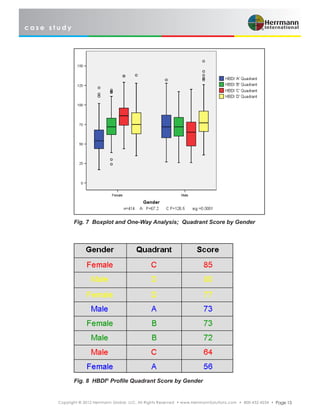
Outcomes revealed that gender played an important role in differences in
thinking styles with more females having right brain (56% right and 44% left)
and limbic preferences (54% limbic and 46% cerebral) compared to more
males having left brain (52% left and 48% right) and cerebral (53% cerebral
and 47% limbic) preferences. These differences in thinking styles were
statistically significant between males and females’ left and right brain scores
(n=414, F=37, sig.=0.0001) as well as limbic and cerebral scores (n=414,
F=102, sig.=0001).
Significant differences were also found between the sexes and the four
quadrants, which would be expected to correlate with the differences already
identified between left and right brain, and limbic and cerebral. (Fig. 7 and
8). There was a significant difference at the 0.0001 level (F=67.2) between
quadrant scores between males and females. This reveals the importance
of differentiation when teaching mixed gender groups associated skills that
require high preferences in A and C thinking styles.
c a s e s t u d y
Copyright © 2012 Herrmann Global, LLC. All Rights Reserved • www.HerrmannSolutions.com • 800-432-4234 • Page 13
Fig. 7 Boxplot and One-Way Analysis; Quadrant Score by Gender
Fig. 8 HBDI®
Profile Quadrant Score by Gender
c a s e s t u d y
Copyright © 2012 Herrmann Global, LLC. All Rights Reserved • www.HerrmannSolutions.com • 800-432-4234 • Page 14
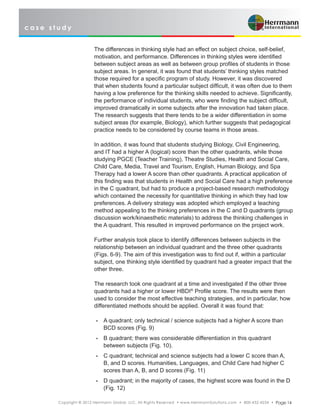
The differences in thinking style had an effect on subject choice, self-belief,
motivation, and performance. Differences in thinking styles were identified
between subject areas as well as between group profiles of students in those
subject areas. In general, it was found that students’ thinking styles matched
those required for a specific program of study. However, it was discovered
that when students found a particular subject difficult, it was often due to them
having a low preference for the thinking skills needed to achieve. Significantly,
the performance of individual students, who were finding the subject difficult,
improved dramatically in some subjects after the innovation had taken place.
The research suggests that there tends to be a wider differentiation in some
subject areas (for example, Biology), which further suggests that pedagogical
practice needs to be considered by course teams in those areas.
In addition, it was found that students studying Biology, Civil Engineering,
and IT had a higher A (logical) score than the other quadrants, while those
studying PGCE (Teacher Training), Theatre Studies, Health and Social Care,
Child Care, Media, Travel and Tourism, English, Human Biology, and Spa
Therapy had a lower A score than other quadrants. A practical application of
this finding was that students in Health and Social Care had a high preference
in the C quadrant, but had to produce a project-based research methodology
which contained the necessity for quantitative thinking in which they had low
preferences. A delivery strategy was adopted which employed a teaching
method appealing to the thinking preferences in the C and D quadrants (group
discussion work/kinaesthetic materials) to address the thinking challenges in
the A quadrant. This resulted in improved performance on the project work.
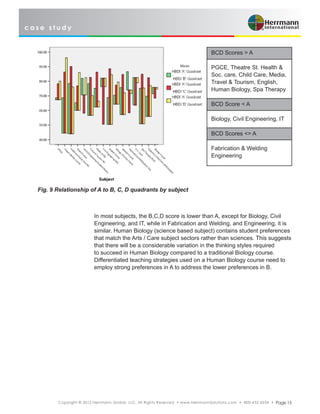
Further analysis took place to identify differences between subjects in the
relationship between an individual quadrant and the three other quadrants
(Figs. 6-9). The aim of this investigation was to find out if, within a particular
subject, one thinking style identified by quadrant had a greater impact that the
other three.
The research took one quadrant at a time and investigated if the other three
quadrants had a higher or lower HBDI®
Profile score. The results were then
used to consider the most effective teaching strategies, and in particular, how
differentiated methods should be applied. Overall it was found that:
•	 A quadrant; only technical / science subjects had a higher A score than
BCD scores (Fig. 9)
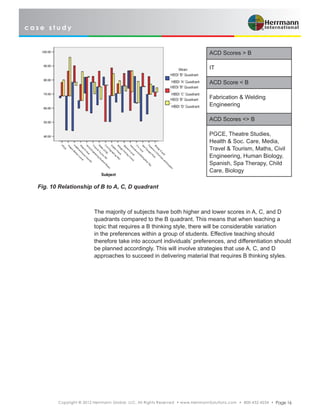
•	 B quadrant; there was considerable differentiation in this quadrant
between subjects (Fig. 10).
•	 C quadrant; technical and science subjects had a lower C score than A,
B, and D scores. Humanities, Languages, and Child Care had higher C
scores than A, B, and D scores (Fig. 11)
•	 D quadrant; in the majority of cases, the highest score was found in the D
(Fig. 12)
c a s e s t u d y
Copyright © 2012 Herrmann Global, LLC. All Rights Reserved • www.HerrmannSolutions.com • 800-432-4234 • Page 15
In most subjects, the B,C,D score is lower than A, except for Biology, Civil
Engineering, and IT, while in Fabrication and Welding, and Engineering, it is
similar. Human Biology (science based subject) contains student preferences
that match the Arts / Care subject sectors rather than sciences. This suggests
that there will be a considerable variation in the thinking styles required
to succeed in Human Biology compared to a traditional Biology course.
Differentiated teaching strategies used on a Human Biology course need to
employ strong preferences in A to address the lower preferences in B.
Fig. 9 Relationship of A to B, C, D quadrants by subject
BCD Scores > A
PGCE, Theatre St. Health &
Soc. care, Child Care, Media,
Travel & Tourism, English,
Human Biology, Spa Therapy
BCD Score < A
Biology, Civil Engineering, IT
BCD Scores <> A
Fabrication & Welding
Engineering
c a s e s t u d y
Copyright © 2012 Herrmann Global, LLC. All Rights Reserved • www.HerrmannSolutions.com • 800-432-4234 • Page 16
ACD Scores > B
IT
ACD Score < B
Fabrication & Welding
Engineering
ACD Scores <> B
PGCE, Theatre Studies,
Health & Soc. Care, Media,
Travel & Tourism, Maths, Civil
Engineering, Human Biology,
Spanish, Spa Therapy, Child
Care, Biology
Fig. 10 Relationship of B to A, C, D quadrant
The majority of subjects have both higher and lower scores in A, C, and D
quadrants compared to the B quadrant. This means that when teaching a
topic that requires a B thinking style, there will be considerable variation
in the preferences within a group of students. Effective teaching should
therefore take into account individuals’ preferences, and differentiation should
be planned accordingly. This will involve strategies that use A, C, and D
approaches to succeed in delivering material that requires B thinking styles.
c a s e s t u d y
Copyright © 2012 Herrmann Global, LLC. All Rights Reserved • www.HerrmannSolutions.com • 800-432-4234 • Page 17
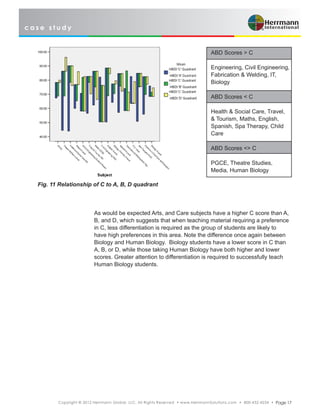
Fig. 11 Relationship of C to A, B, D quadrant
As would be expected Arts, and Care subjects have a higher C score than A,
B, and D, which suggests that when teaching material requiring a preference
in C, less differentiation is required as the group of students are likely to
have high preferences in this area. Note the difference once again between
Biology and Human Biology. Biology students have a lower score in C than
A, B, or D, while those taking Human Biology have both higher and lower
scores. Greater attention to differentiation is required to successfully teach
Human Biology students.
ABD Scores > C
Engineering, Civil Engineering,
Fabrication & Welding, IT,
Biology
ABD Scores < C
Health & Social Care, Travel,
& Tourism, Maths, English,
Spanish, Spa Therapy, Child
Care
ABD Scores <> C
PGCE, Theatre Studies,
Media, Human Biology
c a s e s t u d y
Copyright © 2012 Herrmann Global, LLC. All Rights Reserved • www.HerrmannSolutions.com • 800-432-4234 • Page 18
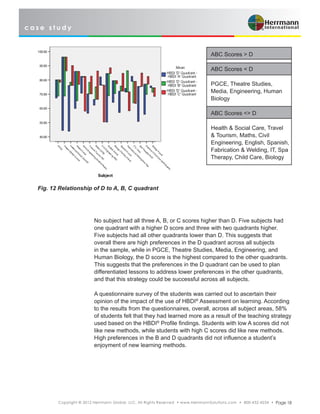
No subject had all three A, B, or C scores higher than D. Five subjects had
one quadrant with a higher D score and three with two quadrants higher.
Five subjects had all other quadrants lower than D. This suggests that
overall there are high preferences in the D quadrant across all subjects
in the sample, while in PGCE, Theatre Studies, Media, Engineering, and
Human Biology, the D score is the highest compared to the other quadrants.
This suggests that the preferences in the D quadrant can be used to plan
differentiated lessons to address lower preferences in the other quadrants,
and that this strategy could be successful across all subjects.
A questionnaire survey of the students was carried out to ascertain their
opinion of the impact of the use of HBDI®
Assessment on learning. According
to the results from the questionnaires, overall, across all subject areas, 58%
of students felt that they had learned more as a result of the teaching strategy
used based on the HBDI®
Profile findings. Students with low A scores did not
like new methods, while students with high C scores did like new methods.
High preferences in the B and D quadrants did not influence a student’s
enjoyment of new learning methods.
Fig. 12 Relationship of D to A, B, C quadrant
ABC Scores > D
ABC Scores < D
PGCE, Theatre Studies,
Media, Engineering, Human
Biology
ABC Scores <> D
Health & Social Care, Travel
& Tourism, Maths, Civil
Engineering, English, Spanish,
Fabrication & Welding, IT, Spa
Therapy, Child Care, Biology
c a s e s t u d y
Copyright © 2012 Herrmann Global, LLC. All Rights Reserved • www.HerrmannSolutions.com • 800-432-4234 • Page 19
Right brain students (predominance of female) were more open to new
teaching and learning methods. The main reason for students enjoying the
new teaching strategies was that they felt that the material was easier to
understand. This may have been a reason for improvement in Alis residuals
and is a relationship that could be tested in future research.
Examination results from the five A Level subjects in the research project
were analysed to see if there were improvements in Alis residuals. A residual
of 0.0 equates to the national benchmark, while a figure above this indicates
added value. An improvement in the figure year on year suggests an
improved outcome over time.
It must be noted that all subject groups (except Media) contained less than
50 students, a figure below in which Alis suggests that the results can be
questionable. With this note of caution, it was still found that overall there
was an average increase in the residual of 0.54, large increases of 0.9
in Human Biology, and 0.5 in Media. Such an increase in the residual in
one year is usually attributable to improvements in teaching and learning
strategies used to deliver a curriculum to a group of students. Further
research is required to establish meaningful relationships between the use of
the HBDI®
Assessmentand changes in teaching strategies and improvements
in achievement, but these initial results are both exciting and encouraging.
Results were also analysed within subject groups. Students studying A Level
English Language and Literature used an online resource bank on the Yale
College VLE (Moodle). This included a threaded discussion board where
the tutor instigated focused critical questions for the students, study notes
to supplement class teaching, plus worksheets on characters, themes, and
stylistics in the text (Wuthering Heights by Emily Brontë). There were video
clips of a film of the text available, and hyperlinked pages where students
could research the historical context of the period in which the text was set.
The tutor monitored the usage and the accessing of pages by each student,
and related this usage to the HBDI®
Profile for each student. This usage was
then compared to the external examination results obtained by each student.
Initial findings from this tutor suggest that there is a correlation between the
use of the VLE and examination performance. The group profile can be seen
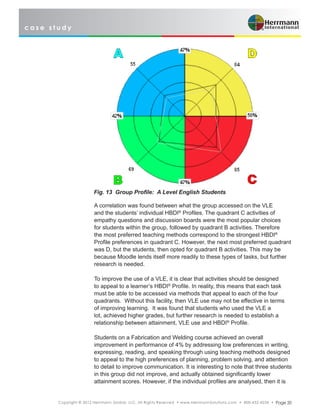
in Fig. 13.
c a s e s t u d y
Copyright © 2012 Herrmann Global, LLC. All Rights Reserved • www.HerrmannSolutions.com • 800-432-4234 • Page 20
A correlation was found between what the group accessed on the VLE
and the students’ individual HBDI®
Profiles. The quadrant C activities of
empathy questions and discussion boards were the most popular choices
for students within the group, followed by quadrant B activities. Therefore
the most preferred teaching methods correspond to the strongest HBDI®
Profile preferences in quadrant C. However, the next most preferred quadrant
was D, but the students, then opted for quadrant B activities. This may be
because Moodle lends itself more readily to these types of tasks, but further
research is needed.
To improve the use of a VLE, it is clear that activities should be designed
to appeal to a learner’s HBDI®
Profile. In reality, this means that each task
must be able to be accessed via methods that appeal to each of the four
quadrants. Without this facility, then VLE use may not be effective in terms
of improving learning. It was found that students who used the VLE a
lot, achieved higher grades, but further research is needed to establish a
relationship between attainment, VLE use and HBDI®
Profile.
Students on a Fabrication and Welding course achieved an overall
improvement in performance of 4% by addressing low preferences in writing,
expressing, reading, and speaking through using teaching methods designed
to appeal to the high preferences of planning, problem solving, and attention
to detail to improve communication. It is interesting to note that three students
in this group did not improve, and actually obtained significantly lower
attainment scores. However, if the individual profiles are analysed, then it is
Fig. 13 Group Profile: A Level English Students
c a s e s t u d y
Copyright © 2012 Herrmann Global, LLC. All Rights Reserved • www.HerrmannSolutions.com • 800-432-4234 • Page 21
clear that these three students did not conform to the overall group pattern.
This means that, though using a group profile to plan effective learning
designed to improve attainment is important, it is just as important to address
individual needs through differentiation. Some students will need different
activities from the rest of the group.
In Media Studies A Level, there was an overall half a grade improvement
between AS (year one) and A2 (year 2) which resulted in 35% of students
(n=14) improving by one grade, 7% by 2 grades, and 50% remaining the
same. All the students who improved by one or more grades had a strong
preference (1) in quadrant C and D (i.e. the thinking skills that equate to
Media Studies). Of the students who did not improve a grade, 28% had a
strong preference in the C quadrant (1) and a medium preference (2) in the D
quadrant.
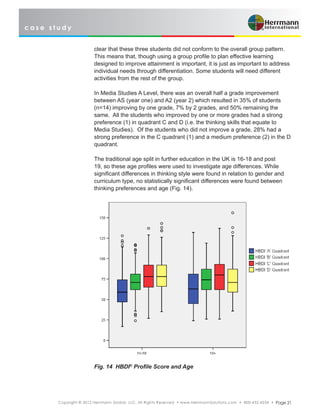
The traditional age split in further education in the UK is 16-18 and post
19, so these age profiles were used to investigate age differences. While
significant differences in thinking style were found in relation to gender and
curriculum type, no statistically significant differences were found between
thinking preferences and age (Fig. 14).
Fig. 14 HBDI®
Profile Score and Age
c a s e s t u d y
Copyright © 2012 Herrmann Global, LLC. All Rights Reserved • www.HerrmannSolutions.com • 800-432-4234 • Page 22
This is an important finding as there is a view in further education that adults
need to be taught in a different way from younger students. This research
suggests that from the age of 16 upwards no differences in thinking styles
are found, therefore similar teaching strategies can be used with 16-18 year
old students and those over 19. However, the research did not address the
social-economic differences of 16-18 year old students and those over 19,
which often results in very real tutorial and pastoral provision for these two
age groups.
The Future
The research allowed teachers to precisely identify areas of thinking in which
students may have difficulty, discuss these difficulties with the students,
and implement specific teaching strategies to address such difficulties. As
a result, students suggested that they enjoyed the lesson more as they felt
that they had been included in the learning process and had learned more
effectively. The application of the HBDI®
Profile was therefore successful in
terms of student motivation and achievement.
In order to use the HBDI®
Profile effectively to improve student attainment in
more institutions and learning situations, further research is needed, of both
a qualitative and quantitative nature. This would provide more evidence of
improved attainment and would therefore lead to a long-term investment in
using the HBDI®
assessment. Therefore, it is important to promote further
research into relationships between changes in teaching strategies as a
result of HBDI®
Profile analysis of student thinking skills and the impact this
has on attainment. Further research using control and experimental groups
is also necessary to establish the impact of HBDI®
Profile on improved
attainment.
Other key results from the research need further exploration; in particular
gender differences in thinking skill profiles and significant differences in
subject group profiles. The relationship between these thinking skills and
teaching and learning methods, need to be investigated. The greater
differentiation between students in some subject areas, and the subsequent
need to consider pedagogy, would be a rich source for research, as would the
relationship of thinking skills and subject choice.
The learner voice is increasingly important in any analysis of learner
satisfaction. England will be one of the criteria used to provide a score for the
Framework for Excellence Self-Assessment regime, introduced from 2008.
In Wales, too, the increased emphasis on Self-Assessment processes will
necessitate evaluation of learner satisfaction. It would therefore be of interest
to carry out further research to establish any relationships between the use of
HBDI®
Profile and overall learner satisfaction with either a course and/or an
educational institution.
The Originators of Whole Brain®
Technology and the Creators of the Herrmann Brain Dominance Instrument®
(HBDI®
)	
794 Buffalo Creek Road, Lake Lure, NC, 28746. Phone: 1-828-625-9153 or 1-800-432-4234  Fax: 1-828-625-1402	
www.HerrmannSolutions.com	 08 12
better results through better thinking
Clients
Herrmann International clients, for whom better thinking has become integral to their business culture,
include:
Altera
American Express
AT&T
BlackRock
Blue Cross Blue Shield
Bunnell Idea Group
Caesar’s
Christiana Care Health Systems
Cintas
Coca-Cola
Global Novations
IBM
Johnson & Johnson
Kraft
Limited Brands
Lockheed Martin
Macy’s
Memorial Sloan-Kettering Hospital
Microsoft
MIT
Mitsubishi
NASA
Nav Canada
Novartis
Novo Nordisk
Pella Corporation
Perfetti Van Melle
Purdue Pharma
Queen’s University
Rogers Communications
Sobeys
Thomson Reuters
Ultimate Software
Wharton
Follow us:
@herrmannintl Whole Brain®
Thinking-HBDI®
Whole Brain®
Thinking
and HBDI®
herrmannintlThe Whole
Brain®
Blog

Case Study Yale College, Wales

  • 1.
    CASE STUDY Spotlight onLearning Using the HBDI® Assessment to Improve Learning Process, Quality, and Outcomes at Yale College, Wales Carolyn H. May (BA Hons. M. Ed); Herrmann HBDI® Certificated Practitioner Paul H. May (BA Hons. M. Ed)
  • 2.
    c a se s t u d y Copyright © 2012 Herrmann Global, LLC. All Rights Reserved • www.HerrmannSolutions.com • 800-432-4234 • Page 2 In the conclusion of the report, many of the current learning style questionnaires in common use are found to be lacking. Coffield concludes that learning style models are not of equal worth and writes that “it matters fundamentally which instrument is chosen.” The Herrmann Brain Dominance Instrument® (HBDI® ), Herrmann International’s Whole Brain® Thinking Model, was designated as one of the six recommended models and especially for use in Further Education. Coffield writes that the HBDI® Assessment is intended to throw light on group dynamics as well as to encourage awareness and understanding of self and others. His research led him to the conclusion that Herrmann had “devised well tried procedures for facilitating personal and organizational change.” “Herrmann’s model,” he goes on to say, ”may prove especially valuable in education and training since its raison d’être is to foster creative thinking and problem solving”. Coffield concluded that the Herrmann Whole Brain® Thinking approach to teaching and learning needs further research, development, and evaluation within education because ‘it is grounded in values which are inclusive, open, optimistic, and systematic.’ “It encourages flexibility, adaptation and, change, rather than an avoidance of less preferred activities.” Since the Coffield Report stresses that “it matters fundamentally which instrument is chosen” and sees the HBDI® Assessment as possessing the potential to encourage “flexibility, adaptation, and change” in individuals as well as facilitating “personal and organizational change,” it seemed that within the HBDI® Profile, lay the possibility of transforming the learning culture within Yale College as well as improving the learning process for individuals and groups. However, since Coffield writes too, that the Herrmann Whole Brain® Thinking approach needs further research, it seemed sensible to combine educational research with the provision of an innovative and valuable learning experience for students within a Learning to Learn project, which motivated the learners by involving them in a dialogue about learning. In July 2004, the Coffield Report was published. This report, commissioned by the Learning and Skills Council in England, investigated the wide range of learning style instruments designed to make learning a more successful process for students. The report evaluates the main theories about learning styles, selects the most important studies from literature, assesses the theoretical robustness of each model, and evaluates the implications of these models for pedagogy in post-16 contexts. The report also presents the key problems besetting learning styles, indicates major gaps in the current state of knowledge and comments on prospects for learning styles.
  • 3.
    c a se s t u d y Copyright © 2012 Herrmann Global, LLC. All Rights Reserved • www.HerrmannSolutions.com • 800-432-4234 • Page 3 The Challenge and Desired Outcomes The report seemed an excellent starting point for planning a Learning to Learn project in Yale College, Wrexham, North Wales, designed to improve the learning experience for students and help them become independent, confident learners who would attain better results. The aim of the project was “To raise the quality of learning and teaching from good to outstanding throughout Yale College.” Though there are pockets of outstanding practice in the college, as with any large institution, practice is variable. The intention was to put the focus firmly on teaching and learning, raise awareness of the latest research findings, and to create both a theoretical and practical debate about learning. In essence, an excitement about learning would emanate from the project. The HBDI® Assessment provided the key to unlocking the learning potential of students across the college by using it as a motivating catalyst, as a means of identifying high, and low learning preferences and as the key to finding appropriate learning strategies to address learning challenges. In more detail, outcomes were identified as: For students • Improved learning • Improved attainment • Improved motivation • Improved confidence • Improved self-awareness For staff • Improvement of established practice • Improvement in knowledge and understanding • Improvement in relationships with students • Sharing of good practice, collaboration on learning • Continuous professional development • Publication of work • Qualification in educational enquiry In a corporate sense, the project was designed to improve the client (in this case, the learner) experience, but also to improve the Return on Investment for the organization - Yale College. The improvement in learning through use of the HBDI® Profile would lead to the following:
  • 4.
    c a se s t u d y Copyright © 2012 Herrmann Global, LLC. All Rights Reserved • www.HerrmannSolutions.com • 800-432-4234 • Page 4 A quadrant Greater customer satisfaction; improvement in performance indicators (retention and attainment); growth in student numbers and therefore increased funding; more efficient use of teacher and learner time – focused directly on challenges identified by HBDI® Profile; logical rationale for selected teaching and learning strategies; analytical approach to project; marketing of college through publicity from conferences/presentations/press articles; analysis of results. B quadrant Secure, controlled environment for learners; high quality of learning sessions; careful planning of Spotlight on Learning Project and of learning sessions; organized, structured project; sequential nature of project; planned outcomes; clear sense of direction; planned prepared resources for learning sessions; staff satisfaction and security; measured, quantifiable results. C quadrant Better, effective professional relationships between staff and students, and between students and students; improvement in relationships in staff teams, professional development of staff; improved satisfaction of learners/clients, evidenced in questionnaires; improved communication between teachers and learners with regard to a clear dialogue about learning; improvement in morale and motivation of both staff and students; improved PR in the local community and in Wales; improved results for staff and students; improved personal development for staff and students. D quadrant Innovative original project; innovative research; innovative teaching and learning strategies; opportunities to be creative for both staff and students; enjoyment/fun with learning; unexpected findings; strategic decisions about improving learning in the future. The Intervention In essence, the HBDI® Assessment was used as a motivating catalyst, as a means of identifying low and high learning preferences, and as the key to finding appropriate learning strategies to address those low preferences, some of which may be essential to success in a particular subject. Staff in the pilot subject areas, both academic and vocational (and including one Welsh medium course), began by identifying topics which students usually found difficult within specifications and syllabuses, and then selecting the Herrmann® thinking skills that underpinned those topics.
  • 5.
    c a se s t u d y Copyright © 2012 Herrmann Global, LLC. All Rights Reserved • www.HerrmannSolutions.com • 800-432-4234 • Page 5 The next step was to profile the students in each group, using the HBDI® Profile, so that staff could then identify the students who had low learning preferences for the thinking skills essential to achieve in that topic area. The staff, too, were profiled so that they were aware of how their own brain profiles were influencing the ways in which they taught and the methods that they chose to use with students. The staff therefore had a personal development tool that they could use to enhance their own professional practice. The Herrmann® model not only identifies preferred thinking skills, but also indicates the preferred teaching and learning strategies of each type of thinker. Using their expertise, staff selected appropriate strategies (largely chosen from the methods found to be most effective by the research into effect sizes of Professor John Hattie, Auckland University) that would encourage students to challenge and improve their low thinking preferences and therefore improve achievement and attainment in particular topic areas. After teaching a topic in the usual way, most staff assessed the students then employed the teaching and learning innovation, and then re-assessed the students using a test which was identical in format but with different questions. They measured the difference to see how much improvement students had made. Staff teaching Biology worked with control and experimental groups using the innovation with the experimental group only. The reason for this was that the large number of students studying Biology made such a research experiment possible. Both groups sat externally assessed A level examinations and results compared via Alis residuals (see How it Works). The students were involved in the learning process at all stages, knew why they were being taught differently, and were involved too in ongoing evaluation and feedback. How it Works/Process As said before, the HBDI® Assessment provided the key to unlocking the learning potential of students by using the profiling as a motivating catalyst, as a means of identifying high and low learning preferences, and as the key to finding appropriate learning strategies to address learning challenges. The methodology worked by identifying in a rank order, from high to low preferences the thinking styles preferred by each subject area in the study. Course content that students found difficult was identified, and the thinking skills required to succeed with such content were compared with the rank order of thinking preferences. This analysis led to a review of the teaching strategies used to deliver difficult content. The attainment results were analysed. In order to ensure that variables affecting student attainment were addressed attainment was analysed using Alis residuals.
  • 6.
    c a se s t u d y Copyright © 2012 Herrmann Global, LLC. All Rights Reserved • www.HerrmannSolutions.com • 800-432-4234 • Page 6 The Advanced Level Information System (Alis) provides performance indicators for post-16 students across all sectors of education in the UK and in the context of the study at Yale College which includes analysis of A level, AS level, and BTEC National assessment results: The reason that Alis was used to compare results was that the value-added approach provides fair comparisons between the progress made by students as it takes into account prior attainment based on GCSE performance. To ascertain student opinion of the use of HBDI® Profile, a questionnaire was completed by respondents involved in the research to establish if they valued the use of the HBDI® Assessment instrument as a way of improving attainment and/or enjoyment of their educational experience. The Results The project culminated in the Spotlight on Learning Conference in July 2008 where the results of the project were disseminated to an audience from a range of educational sectors across England and Wales. Ann Herrmann- Nehdi, CEO of Herrmann International, spoke about recent brain research and the impact of the findings on learning while Dr. David Frost, from Cambridge University, delivered a presentation on teacher-led research. Carolyn May explained the genesis of the project, its rationale, process, and method, while Paul May provided an analysis of the overall research findings. Discussions with staff revealed that teachers thought that the project focused attention on learning, created debate and discussion, and provided a systematic method devoted to improving learning. Conversations with learners established that the personal attention and the individual focus of the HBDI® profiles gave students a tangible illustration of their own thinking skills. They found this both interesting and motivational. Students who had previously resisted particular teaching and learning strategies now appreciated the reasons why they were being asked to employ them and were far more willing to do so. The learning dialogue between staff and students improved relationships and motivation. Many students felt that they firstly had been given clear reasons why they found certain skills difficult, and secondly that they were given the means to overcome them. This involved them in the learning and made them feel that they could move from “I can’t” to “I can.” They also felt that the staff was listening to their views, taking account of them, and acting upon them, which improved professional relationships. The awareness of how they were thinking and learning instilled a sense of confidence in most learners. They believed that they were able to attain results that previously they had thought to be impossible.
  • 7.
    c a se s t u d y Copyright © 2012 Herrmann Global, LLC. All Rights Reserved • www.HerrmannSolutions.com • 800-432-4234 • Page 7 Outcomes As previously explained, after profiling the students using the HBDI® Assessment, staff identified a topic that students found difficult and then, using their professional judgement, chose appropriate teaching and learning strategies to encourage students to challenge and improve their low thinking preferences and therefore improve achievement and attainment in these particular topic areas. After teaching a topic in the usual way, students were assessed, then staff introduced the teaching and learning innovation, and then re-assessed the students. In order to provide the staff with detailed information about the range of student thinking skills within individual subjects, an analysis of the rank order of student cluster preferences within quadrants was produced (Fig. 1). It can be seen that the distribution of rankings varies between subjects. In some subjects, such as English, the highest preference of 1 is found only in one key descriptor (D – imaginative), while in others, the highest preference of 1 is found across several key descriptors, for example Biology (A – logical, B - speaker, C – talker). Where high preferences are found in one key descriptor, there will be less difference in preferred thinking styles compared to a situation where the high preferences for key descriptors are distributed more widely. In the latter case, to ensure effective learning, differentiated teaching strategies will be required to address the wider range of thinking styles, and in such cases, the extent of differentiation will need to be greater than in subjects where the range of thinking styles is less. Travel and Tourism is an interesting example as the results of this particular research indicate that the “spatial” key descriptor ranks at 18, while “simultaneous,” ‘talker”, and “speaker” rank at 1. This would suggest that prospective employees for the travel industry, from this particular group of students, are more interested in the customer care aspect of the travel Fig. 1 Numeric Rank Order of Clusters by a Sample of Subjects
  • 8.
    c a se s t u d y Copyright © 2012 Herrmann Global, LLC. All Rights Reserved • www.HerrmannSolutions.com • 800-432-4234 • Page 8 industry rather than the spatial (geographical / travel) aspect. This feature also requires particular learning activities to address what may well be a “spatial” low preference, and future research could be productive in this area. The range of the differences can be more clearly seen if displayed graphically (Fig. 2). These results once again highlight the fact that individually targeted differentiation is crucial for effective learning to take place. In some subjects the research involved an assessment before and after an intervention in teaching (Fig. 3). Subject Assessment Score (%) % Change Before Intervention After Intervention Administration 73 90 17 Child Care 39.3 70 30.7 Civil Engineering HNC 65 70.9 5.9 Fabrication & Welding 62.8 71.2 8.4 Media A2 57 61 4 Spa Therapy 70 70.8 0.8 Spanish A 74 86 12 Theater Studies A 61 66 5 Travel and Tourism 37.8 89 51.2 In this sample of subjects, there was an increase in assessment score following the intervention in teaching in all cases. The intervention used was decided upon after an analysis of the HBDI® Profiles of students in each class which indicated the high and low preferences. Once the content and skill of the session to be addressed via the intervention was determined, then a Fig. 3 Assessment Scores; Before and After an Intervention in Teaching (based on HBDI® Profile) Rank Order of Clusters 0 5 10 15 20 25 30 Factual QuantitativeCriticalRational MathematicalLogical Analytical ConservativeControlled SequentialDetailedDominantSpeakerReaderEm otionalMusicalSpiritualSymbolicIntuitive TalkerReader ImaginativeArtisticIntuitiveHolistic Synthesizer SimultaneousSpatial Cluster RankOrder Biology AS Travel & Tourism Spa Therapy English Lang. & Lit. AS Child Care L3 Diploma PGCE Fig. 2 Graphical Rank Order of Clusters by a Sample of Subjects
  • 9.
    c a se s t u d y Copyright © 2012 Herrmann Global, LLC. All Rights Reserved • www.HerrmannSolutions.com • 800-432-4234 • Page 9 suitable teaching strategy was decided upon, based on the preferences to be supported. While the evidence from this small sample does not constitute a causal relationship, as there were other variables that could have produced an increase in performance, not least the “Hawthorn Effect”, qualitative case study evidence suggest that the use of an intervention in teaching based on the use of HBDI® Profile results, profiling may well have produced an improvement in learning outcomes. This is a rich area of interest for future research using larger samples. Travel and Tourism is one of the areas that produced exceptionally good assessment results after introducing an intervention after HBDI® Profile analysis. The subject demands that students be proficient in quantitative skills in order to be capable of working out accurate costings for holidays. The HBDI® Profile analysis indicated that the group of 21 BTEC National Diploma Travel & Tourism students in their 2nd year (of a 2-year course) had low preferences for “mathematical”, “quantitative”, and “reader” key descriptors but strong preferences for “talker”, “speaker”, and “imaginative”. This cohort had demonstrated difficulty in completing tour operating calculations in the Autumn term. In order to improve the mathematical skills of the students, the teacher devised a game called the “Battle of the Borderlands”. This was designed to appeal to their preferred ways of thinking (talking, speaking, and imaginative) and was also underpinned by Hattie’s high effect size for co-operative learning. The game encouraged the students to improve their skills by introducing calculations in a competitive, fun, but non-threatening manner, and combining a range of learning outcomes and subjects (linked to two BTEC units: Tourism in the Countryside and Tour Operations). The usual manner of teaching the students calculating skills was through worksheets, so the teacher taught in the traditional way and then assessed the students, who achieved an average of 38% in the test. After HBDI® Profile analysis and the consequent innovation of the “Battle of the Borderlands” game, the students achieved 90% in a similar mathematical test. While it is not possible to establish a definite causal link, it is nevertheless likely that this dramatic improvement was a result of the teaching innovation that was introduced as a result of the HBDI® Profile analysis. Media students traditionally found the genre module difficult. An intervention was carried out to support students in using a Whole Brain® Thinking approach to their thinking. Such an approach had a particular emphasis on synthesizing material using a holistic approach to ensure that an evaluation of how a film contributed to the development of its genre was produced. The standard of the evaluation was expected to improve after the intervention. Media students had right brain preferences (see Fig. 4 and 5).
  • 10.
    c a se s t u d y Copyright © 2012 Herrmann Global, LLC. All Rights Reserved • www.HerrmannSolutions.com • 800-432-4234 • Page 10 Fig. 4 Media Students – Team HBDI® Profile Clusters Fig. 5 Team Profile HBDI® Profile Scores
  • 11.
    c a se s t u d y Copyright © 2012 Herrmann Global, LLC. All Rights Reserved • www.HerrmannSolutions.com • 800-432-4234 • Page 11 The high preferences for right brain clusters where identified when the clusters were placed in rank order (Fig. 6) Cluster Rank Logical 1 Emotional 2 Artistic 2 Imaginative 4 Simultaneous 4 Detailed 6 Dominant 7 Reader 7 Musical 7 Reader 7 Critical 11 Sequential 11 Spiritual 11 Intuitive 11 Intuitive (Solutions) 11 Factual 16 Rational 16 Analytical 16 Controlled 16 Speaker 16 Symbolic 16 Talker 16 Mathematical 23 Conservative 23 Synthesizer 23 Spatial 23 Holistic 27 Fig. 6 Rank Order of Clusters for Media Students
  • 12.
    c a se s t u d y Copyright © 2012 Herrmann Global, LLC. All Rights Reserved • www.HerrmannSolutions.com • 800-432-4234 • Page 12 As a result of the intervention, overall class assessment result increased by an average of 15.79%, thirteen students improved their mark, one student remained the same, and only one student had a lower mark (of 1.72%). The student whose mark remained the same had a Whole Brain® Thinking profile and so was receptive to any teaching method. The student who attained a lower grade had a profile which indicated strong preferences in the green quadrant, but very low preferences in the yellow quadrant (score of 35), so really disliked the lesson that was directed at the group profile of strong yellow preferences. One student with low preferences in the A quadrant (score of 42) and the B quadrant (score of 44) actually improved his mark by over 17%, suggesting that the use of a Whole Brain® Thinking approach did improve thinking skills for this particular student. One particular student achieved a D grade at A2 in June 2007. He therefore re-sat the examination in June 2008. He had very strong preferences in the blue and green quadrants (1122) and therefore did not fit the overall profile of the Media group who had strong red and yellow preferences. The Media tutor worked with this student during 2007-2008 using his green and blue preferences to try to improve his essay writing which had always been a problem for him. The support offered by the tutor was structured, sequential, and logical. For every essay he was given a grid with questions which he had to fill in with the relevant answers. He would then write the grid as an essay with each block written up as a paragraph. In 2008, his grade in the final examination improved from a D to a B. He is now studying Mathematics at university. Outcomes revealed that gender played an important role in differences in thinking styles with more females having right brain (56% right and 44% left) and limbic preferences (54% limbic and 46% cerebral) compared to more males having left brain (52% left and 48% right) and cerebral (53% cerebral and 47% limbic) preferences. These differences in thinking styles were statistically significant between males and females’ left and right brain scores (n=414, F=37, sig.=0.0001) as well as limbic and cerebral scores (n=414, F=102, sig.=0001). Significant differences were also found between the sexes and the four quadrants, which would be expected to correlate with the differences already identified between left and right brain, and limbic and cerebral. (Fig. 7 and 8). There was a significant difference at the 0.0001 level (F=67.2) between quadrant scores between males and females. This reveals the importance of differentiation when teaching mixed gender groups associated skills that require high preferences in A and C thinking styles.
  • 13.
    c a se s t u d y Copyright © 2012 Herrmann Global, LLC. All Rights Reserved • www.HerrmannSolutions.com • 800-432-4234 • Page 13 Fig. 7 Boxplot and One-Way Analysis; Quadrant Score by Gender Fig. 8 HBDI® Profile Quadrant Score by Gender
  • 14.
    c a se s t u d y Copyright © 2012 Herrmann Global, LLC. All Rights Reserved • www.HerrmannSolutions.com • 800-432-4234 • Page 14 The differences in thinking style had an effect on subject choice, self-belief, motivation, and performance. Differences in thinking styles were identified between subject areas as well as between group profiles of students in those subject areas. In general, it was found that students’ thinking styles matched those required for a specific program of study. However, it was discovered that when students found a particular subject difficult, it was often due to them having a low preference for the thinking skills needed to achieve. Significantly, the performance of individual students, who were finding the subject difficult, improved dramatically in some subjects after the innovation had taken place. The research suggests that there tends to be a wider differentiation in some subject areas (for example, Biology), which further suggests that pedagogical practice needs to be considered by course teams in those areas. In addition, it was found that students studying Biology, Civil Engineering, and IT had a higher A (logical) score than the other quadrants, while those studying PGCE (Teacher Training), Theatre Studies, Health and Social Care, Child Care, Media, Travel and Tourism, English, Human Biology, and Spa Therapy had a lower A score than other quadrants. A practical application of this finding was that students in Health and Social Care had a high preference in the C quadrant, but had to produce a project-based research methodology which contained the necessity for quantitative thinking in which they had low preferences. A delivery strategy was adopted which employed a teaching method appealing to the thinking preferences in the C and D quadrants (group discussion work/kinaesthetic materials) to address the thinking challenges in the A quadrant. This resulted in improved performance on the project work. Further analysis took place to identify differences between subjects in the relationship between an individual quadrant and the three other quadrants (Figs. 6-9). The aim of this investigation was to find out if, within a particular subject, one thinking style identified by quadrant had a greater impact that the other three. The research took one quadrant at a time and investigated if the other three quadrants had a higher or lower HBDI® Profile score. The results were then used to consider the most effective teaching strategies, and in particular, how differentiated methods should be applied. Overall it was found that: • A quadrant; only technical / science subjects had a higher A score than BCD scores (Fig. 9) • B quadrant; there was considerable differentiation in this quadrant between subjects (Fig. 10). • C quadrant; technical and science subjects had a lower C score than A, B, and D scores. Humanities, Languages, and Child Care had higher C scores than A, B, and D scores (Fig. 11) • D quadrant; in the majority of cases, the highest score was found in the D (Fig. 12)
  • 15.
    c a se s t u d y Copyright © 2012 Herrmann Global, LLC. All Rights Reserved • www.HerrmannSolutions.com • 800-432-4234 • Page 15 In most subjects, the B,C,D score is lower than A, except for Biology, Civil Engineering, and IT, while in Fabrication and Welding, and Engineering, it is similar. Human Biology (science based subject) contains student preferences that match the Arts / Care subject sectors rather than sciences. This suggests that there will be a considerable variation in the thinking styles required to succeed in Human Biology compared to a traditional Biology course. Differentiated teaching strategies used on a Human Biology course need to employ strong preferences in A to address the lower preferences in B. Fig. 9 Relationship of A to B, C, D quadrants by subject BCD Scores > A PGCE, Theatre St. Health & Soc. care, Child Care, Media, Travel & Tourism, English, Human Biology, Spa Therapy BCD Score < A Biology, Civil Engineering, IT BCD Scores <> A Fabrication & Welding Engineering
  • 16.
    c a se s t u d y Copyright © 2012 Herrmann Global, LLC. All Rights Reserved • www.HerrmannSolutions.com • 800-432-4234 • Page 16 ACD Scores > B IT ACD Score < B Fabrication & Welding Engineering ACD Scores <> B PGCE, Theatre Studies, Health & Soc. Care, Media, Travel & Tourism, Maths, Civil Engineering, Human Biology, Spanish, Spa Therapy, Child Care, Biology Fig. 10 Relationship of B to A, C, D quadrant The majority of subjects have both higher and lower scores in A, C, and D quadrants compared to the B quadrant. This means that when teaching a topic that requires a B thinking style, there will be considerable variation in the preferences within a group of students. Effective teaching should therefore take into account individuals’ preferences, and differentiation should be planned accordingly. This will involve strategies that use A, C, and D approaches to succeed in delivering material that requires B thinking styles.
  • 17.
    c a se s t u d y Copyright © 2012 Herrmann Global, LLC. All Rights Reserved • www.HerrmannSolutions.com • 800-432-4234 • Page 17 Fig. 11 Relationship of C to A, B, D quadrant As would be expected Arts, and Care subjects have a higher C score than A, B, and D, which suggests that when teaching material requiring a preference in C, less differentiation is required as the group of students are likely to have high preferences in this area. Note the difference once again between Biology and Human Biology. Biology students have a lower score in C than A, B, or D, while those taking Human Biology have both higher and lower scores. Greater attention to differentiation is required to successfully teach Human Biology students. ABD Scores > C Engineering, Civil Engineering, Fabrication & Welding, IT, Biology ABD Scores < C Health & Social Care, Travel, & Tourism, Maths, English, Spanish, Spa Therapy, Child Care ABD Scores <> C PGCE, Theatre Studies, Media, Human Biology
  • 18.
    c a se s t u d y Copyright © 2012 Herrmann Global, LLC. All Rights Reserved • www.HerrmannSolutions.com • 800-432-4234 • Page 18 No subject had all three A, B, or C scores higher than D. Five subjects had one quadrant with a higher D score and three with two quadrants higher. Five subjects had all other quadrants lower than D. This suggests that overall there are high preferences in the D quadrant across all subjects in the sample, while in PGCE, Theatre Studies, Media, Engineering, and Human Biology, the D score is the highest compared to the other quadrants. This suggests that the preferences in the D quadrant can be used to plan differentiated lessons to address lower preferences in the other quadrants, and that this strategy could be successful across all subjects. A questionnaire survey of the students was carried out to ascertain their opinion of the impact of the use of HBDI® Assessment on learning. According to the results from the questionnaires, overall, across all subject areas, 58% of students felt that they had learned more as a result of the teaching strategy used based on the HBDI® Profile findings. Students with low A scores did not like new methods, while students with high C scores did like new methods. High preferences in the B and D quadrants did not influence a student’s enjoyment of new learning methods. Fig. 12 Relationship of D to A, B, C quadrant ABC Scores > D ABC Scores < D PGCE, Theatre Studies, Media, Engineering, Human Biology ABC Scores <> D Health & Social Care, Travel & Tourism, Maths, Civil Engineering, English, Spanish, Fabrication & Welding, IT, Spa Therapy, Child Care, Biology
  • 19.
    c a se s t u d y Copyright © 2012 Herrmann Global, LLC. All Rights Reserved • www.HerrmannSolutions.com • 800-432-4234 • Page 19 Right brain students (predominance of female) were more open to new teaching and learning methods. The main reason for students enjoying the new teaching strategies was that they felt that the material was easier to understand. This may have been a reason for improvement in Alis residuals and is a relationship that could be tested in future research. Examination results from the five A Level subjects in the research project were analysed to see if there were improvements in Alis residuals. A residual of 0.0 equates to the national benchmark, while a figure above this indicates added value. An improvement in the figure year on year suggests an improved outcome over time. It must be noted that all subject groups (except Media) contained less than 50 students, a figure below in which Alis suggests that the results can be questionable. With this note of caution, it was still found that overall there was an average increase in the residual of 0.54, large increases of 0.9 in Human Biology, and 0.5 in Media. Such an increase in the residual in one year is usually attributable to improvements in teaching and learning strategies used to deliver a curriculum to a group of students. Further research is required to establish meaningful relationships between the use of the HBDI® Assessmentand changes in teaching strategies and improvements in achievement, but these initial results are both exciting and encouraging. Results were also analysed within subject groups. Students studying A Level English Language and Literature used an online resource bank on the Yale College VLE (Moodle). This included a threaded discussion board where the tutor instigated focused critical questions for the students, study notes to supplement class teaching, plus worksheets on characters, themes, and stylistics in the text (Wuthering Heights by Emily Brontë). There were video clips of a film of the text available, and hyperlinked pages where students could research the historical context of the period in which the text was set. The tutor monitored the usage and the accessing of pages by each student, and related this usage to the HBDI® Profile for each student. This usage was then compared to the external examination results obtained by each student. Initial findings from this tutor suggest that there is a correlation between the use of the VLE and examination performance. The group profile can be seen in Fig. 13.
  • 20.
    c a se s t u d y Copyright © 2012 Herrmann Global, LLC. All Rights Reserved • www.HerrmannSolutions.com • 800-432-4234 • Page 20 A correlation was found between what the group accessed on the VLE and the students’ individual HBDI® Profiles. The quadrant C activities of empathy questions and discussion boards were the most popular choices for students within the group, followed by quadrant B activities. Therefore the most preferred teaching methods correspond to the strongest HBDI® Profile preferences in quadrant C. However, the next most preferred quadrant was D, but the students, then opted for quadrant B activities. This may be because Moodle lends itself more readily to these types of tasks, but further research is needed. To improve the use of a VLE, it is clear that activities should be designed to appeal to a learner’s HBDI® Profile. In reality, this means that each task must be able to be accessed via methods that appeal to each of the four quadrants. Without this facility, then VLE use may not be effective in terms of improving learning. It was found that students who used the VLE a lot, achieved higher grades, but further research is needed to establish a relationship between attainment, VLE use and HBDI® Profile. Students on a Fabrication and Welding course achieved an overall improvement in performance of 4% by addressing low preferences in writing, expressing, reading, and speaking through using teaching methods designed to appeal to the high preferences of planning, problem solving, and attention to detail to improve communication. It is interesting to note that three students in this group did not improve, and actually obtained significantly lower attainment scores. However, if the individual profiles are analysed, then it is Fig. 13 Group Profile: A Level English Students
  • 21.
    c a se s t u d y Copyright © 2012 Herrmann Global, LLC. All Rights Reserved • www.HerrmannSolutions.com • 800-432-4234 • Page 21 clear that these three students did not conform to the overall group pattern. This means that, though using a group profile to plan effective learning designed to improve attainment is important, it is just as important to address individual needs through differentiation. Some students will need different activities from the rest of the group. In Media Studies A Level, there was an overall half a grade improvement between AS (year one) and A2 (year 2) which resulted in 35% of students (n=14) improving by one grade, 7% by 2 grades, and 50% remaining the same. All the students who improved by one or more grades had a strong preference (1) in quadrant C and D (i.e. the thinking skills that equate to Media Studies). Of the students who did not improve a grade, 28% had a strong preference in the C quadrant (1) and a medium preference (2) in the D quadrant. The traditional age split in further education in the UK is 16-18 and post 19, so these age profiles were used to investigate age differences. While significant differences in thinking style were found in relation to gender and curriculum type, no statistically significant differences were found between thinking preferences and age (Fig. 14). Fig. 14 HBDI® Profile Score and Age
  • 22.
    c a se s t u d y Copyright © 2012 Herrmann Global, LLC. All Rights Reserved • www.HerrmannSolutions.com • 800-432-4234 • Page 22 This is an important finding as there is a view in further education that adults need to be taught in a different way from younger students. This research suggests that from the age of 16 upwards no differences in thinking styles are found, therefore similar teaching strategies can be used with 16-18 year old students and those over 19. However, the research did not address the social-economic differences of 16-18 year old students and those over 19, which often results in very real tutorial and pastoral provision for these two age groups. The Future The research allowed teachers to precisely identify areas of thinking in which students may have difficulty, discuss these difficulties with the students, and implement specific teaching strategies to address such difficulties. As a result, students suggested that they enjoyed the lesson more as they felt that they had been included in the learning process and had learned more effectively. The application of the HBDI® Profile was therefore successful in terms of student motivation and achievement. In order to use the HBDI® Profile effectively to improve student attainment in more institutions and learning situations, further research is needed, of both a qualitative and quantitative nature. This would provide more evidence of improved attainment and would therefore lead to a long-term investment in using the HBDI® assessment. Therefore, it is important to promote further research into relationships between changes in teaching strategies as a result of HBDI® Profile analysis of student thinking skills and the impact this has on attainment. Further research using control and experimental groups is also necessary to establish the impact of HBDI® Profile on improved attainment. Other key results from the research need further exploration; in particular gender differences in thinking skill profiles and significant differences in subject group profiles. The relationship between these thinking skills and teaching and learning methods, need to be investigated. The greater differentiation between students in some subject areas, and the subsequent need to consider pedagogy, would be a rich source for research, as would the relationship of thinking skills and subject choice. The learner voice is increasingly important in any analysis of learner satisfaction. England will be one of the criteria used to provide a score for the Framework for Excellence Self-Assessment regime, introduced from 2008. In Wales, too, the increased emphasis on Self-Assessment processes will necessitate evaluation of learner satisfaction. It would therefore be of interest to carry out further research to establish any relationships between the use of HBDI® Profile and overall learner satisfaction with either a course and/or an educational institution.
  • 23.
    The Originators ofWhole Brain® Technology and the Creators of the Herrmann Brain Dominance Instrument® (HBDI® ) 794 Buffalo Creek Road, Lake Lure, NC, 28746. Phone: 1-828-625-9153 or 1-800-432-4234 Fax: 1-828-625-1402 www.HerrmannSolutions.com 08 12 better results through better thinking Clients Herrmann International clients, for whom better thinking has become integral to their business culture, include: Altera American Express AT&T BlackRock Blue Cross Blue Shield Bunnell Idea Group Caesar’s Christiana Care Health Systems Cintas Coca-Cola Global Novations IBM Johnson & Johnson Kraft Limited Brands Lockheed Martin Macy’s Memorial Sloan-Kettering Hospital Microsoft MIT Mitsubishi NASA Nav Canada Novartis Novo Nordisk Pella Corporation Perfetti Van Melle Purdue Pharma Queen’s University Rogers Communications Sobeys Thomson Reuters Ultimate Software Wharton Follow us: @herrmannintl Whole Brain® Thinking-HBDI® Whole Brain® Thinking and HBDI® herrmannintlThe Whole Brain® Blog