
yacs Macnana ! December 2008 by Bernard Paques
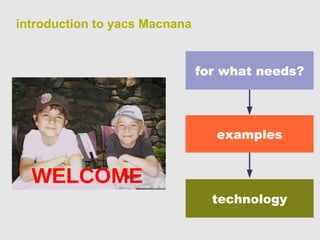
introduction to yacs Macnana WELCOME
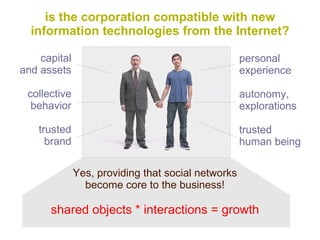
is the corporation compatible with new information technologies from the Internet? capital and assets collective behavior trusted brand personal experience autonomy, explorations trusted human being Yes, providing that social networks become core to the business! shared objects * interactions = growth
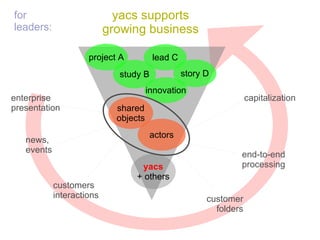
yacs supports growing business customer folders customers interactions news, events enterprise presentation end-to-end processing capitalization actors shared objects project A lead C yacs + others story D study B innovation
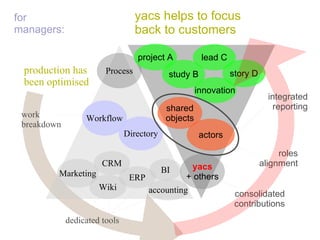
yacs helps to focus back to customers production has been optimised dedicated tools consolidated contributions work breakdown roles alignment integrated reporting Workflow Directory Process ERP Wiki Marketing accounting CRM BI actors shared objects project A lead C yacs + others story D study B innovation
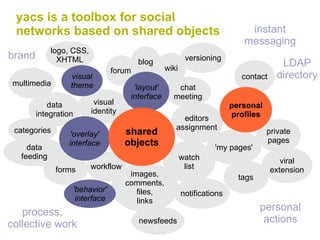
yacs is a toolbox for social networks based on shared objects
yacs is an evolving project yacs matches expectations  of today surfers: self-service user interface is simple enough pre-requisites: web browser and mail client yacs is a web 2.0 platform  that suits the corporation: flexible and adaptative content management 100% control of the visual identity extension through PHP/javascript programming yacs is provided for free (LGPL)  and leverages  the Apache / PHP / MySQL / AJAX architecture: more than 150,000 lines of high-quality code and a set of selected components provided by third-parties
some examples
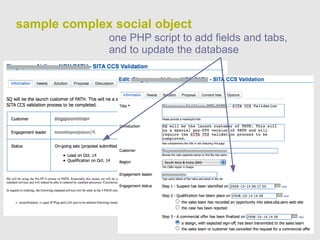
sample complex social object one PHP script to add fields and tabs, and to update the database
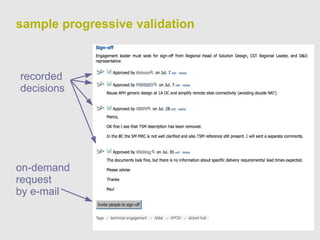
sample progressive validation on-demand request by e-mail recorded decisions
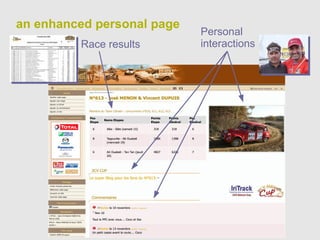
an enhanced personal page Race results Personal interactions
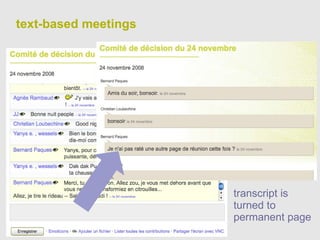
text-based meetings transcript is turned to permanent page
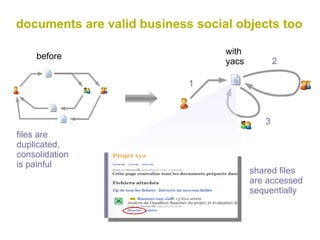
documents are valid business social objects too before with yacs files are duplicated, consolidation is painful shared files are accessed sequentially 1 2 3
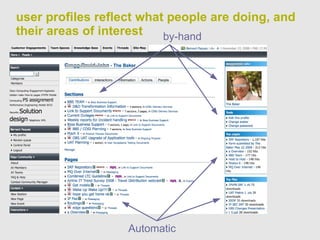
user profiles reflect what people are doing, and their areas of interest Automatic by-hand
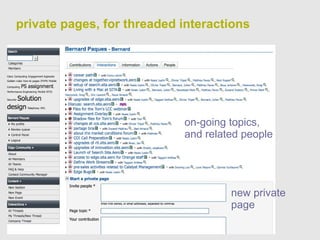
private pages, for threaded interactions on-going topics, and related people new private page
technology
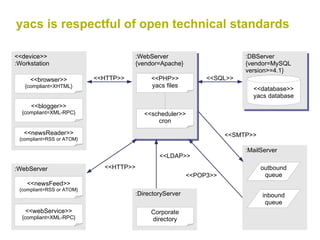
yacs is respectful of open technical standards  <<LDAP>> <<HTTP>> <<POP3>> <<SMTP>> <<HTTP>> <<SQL>> :WebServer {vendor=Apache} <<device>> :Workstation :DBServer {vendor=MySQL version>=4.1} :MailServer :DirectoryServer :WebServer <<browser>> {compliant=XHTML} <<blogger>> {compliant=XML-RPC} <<newsReader>> {compliant=RSS or ATOM} <<webService>> {compliant=XML-RPC} Corporate directory <<scheduler>> cron <<database>> yacs database outbound queue inbound queue <<PHP>> yacs files <<newsFeed>> {compliant=RSS or ATOM}
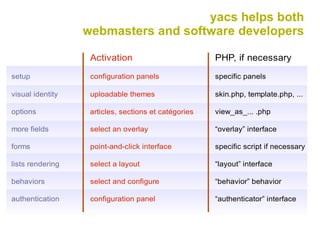
yacs helps both webmasters and software developers
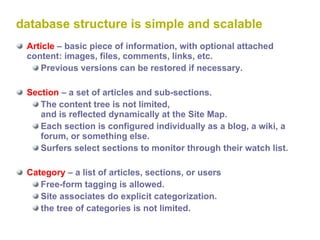
database structure is simple and scalable Article  – basic piece of information, with optional attached content: images, files, comments, links, etc. Previous versions can be restored if necessary. Section  – a set of articles and sub-sections. The content tree is not limited,  and is reflected dynamically at the Site Map. Each section is configured individually as a blog, a wiki, a forum, or something else. Surfers select sections to monitor through their watch list. Category  – a list of articles, sections, or users Free-form tagging is allowed. Site associates do explicit categorization. the tree of categories is not limited.
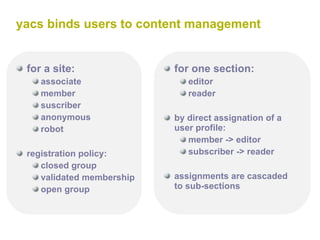
yacs binds users to content management for a site: associate member suscriber anonymous robot registration policy: closed group validated membership open group for one section: editor reader by direct assignation of a  user profile: member -> editor subscriber -> reader assignments are cascaded to sub-sections
yacs codes are a powerful way  to manage flows of information [updated=category:462,10] [updated.simple=self, 7] [updated.timeline]
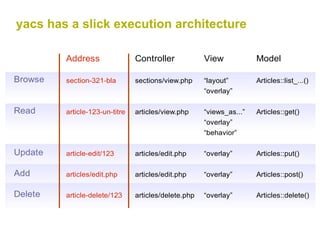
yacs has a slick execution architecture
yacs is the only open content management system  that adapts new usages of the Internet  to specific corporate processes, (through structured social objects)
and you, how will use yacs to support the growth of your business?
« introduction to yacs Macnana » by Bernard Paques http://www.linkedin.com/in/webnetworker You are free to share (to copy, distribute and transmit the work) and to remix (adapt) this work, under the following conditions: - Attribution. You must attribute the work in the manner specified by the author or licensor (but not in any way that suggests that they endorse you or your use of the work). - Noncommercial. You may not use this work for commercial purposes. - Share Alike. If you alter, transform, or build upon this work, you may distribute the resulting work only under the same or similar license to this one.

yacs Macnana

  • 1.
    yacs Macnana !December 2008 by Bernard Paques
  • 2.
    introduction to yacsMacnana WELCOME
  • 3.
    is the corporationcompatible with new information technologies from the Internet? capital and assets collective behavior trusted brand personal experience autonomy, explorations trusted human being Yes, providing that social networks become core to the business! shared objects * interactions = growth
  • 4.
    yacs supports growingbusiness customer folders customers interactions news, events enterprise presentation end-to-end processing capitalization actors shared objects project A lead C yacs + others story D study B innovation
  • 5.
    yacs helps tofocus back to customers production has been optimised dedicated tools consolidated contributions work breakdown roles alignment integrated reporting Workflow Directory Process ERP Wiki Marketing accounting CRM BI actors shared objects project A lead C yacs + others story D study B innovation
  • 6.
    yacs is atoolbox for social networks based on shared objects
  • 7.
    yacs is anevolving project yacs matches expectations of today surfers: self-service user interface is simple enough pre-requisites: web browser and mail client yacs is a web 2.0 platform that suits the corporation: flexible and adaptative content management 100% control of the visual identity extension through PHP/javascript programming yacs is provided for free (LGPL) and leverages the Apache / PHP / MySQL / AJAX architecture: more than 150,000 lines of high-quality code and a set of selected components provided by third-parties
  • 8.
  • 9.
    sample complex socialobject one PHP script to add fields and tabs, and to update the database
  • 10.
    sample progressive validationon-demand request by e-mail recorded decisions
  • 11.
    an enhanced personalpage Race results Personal interactions
  • 12.
    text-based meetings transcriptis turned to permanent page
  • 13.
    documents are validbusiness social objects too before with yacs files are duplicated, consolidation is painful shared files are accessed sequentially 1 2 3
  • 14.
    user profiles reflectwhat people are doing, and their areas of interest Automatic by-hand
  • 15.
    private pages, forthreaded interactions on-going topics, and related people new private page
  • 16.
  • 17.
    yacs is respectfulof open technical standards <<LDAP>> <<HTTP>> <<POP3>> <<SMTP>> <<HTTP>> <<SQL>> :WebServer {vendor=Apache} <<device>> :Workstation :DBServer {vendor=MySQL version>=4.1} :MailServer :DirectoryServer :WebServer <<browser>> {compliant=XHTML} <<blogger>> {compliant=XML-RPC} <<newsReader>> {compliant=RSS or ATOM} <<webService>> {compliant=XML-RPC} Corporate directory <<scheduler>> cron <<database>> yacs database outbound queue inbound queue <<PHP>> yacs files <<newsFeed>> {compliant=RSS or ATOM}
  • 18.
    yacs helps bothwebmasters and software developers
  • 19.
    database structure issimple and scalable Article – basic piece of information, with optional attached content: images, files, comments, links, etc. Previous versions can be restored if necessary. Section – a set of articles and sub-sections. The content tree is not limited, and is reflected dynamically at the Site Map. Each section is configured individually as a blog, a wiki, a forum, or something else. Surfers select sections to monitor through their watch list. Category – a list of articles, sections, or users Free-form tagging is allowed. Site associates do explicit categorization. the tree of categories is not limited.
  • 20.
    yacs binds usersto content management for a site: associate member suscriber anonymous robot registration policy: closed group validated membership open group for one section: editor reader by direct assignation of a user profile: member -> editor subscriber -> reader assignments are cascaded to sub-sections
  • 21.
    yacs codes area powerful way to manage flows of information [updated=category:462,10] [updated.simple=self, 7] [updated.timeline]
  • 22.
    yacs has aslick execution architecture
  • 23.
    yacs is theonly open content management system that adapts new usages of the Internet to specific corporate processes, (through structured social objects)
  • 24.
    and you, howwill use yacs to support the growth of your business?
  • 25.
    « introduction to yacsMacnana » by Bernard Paques http://www.linkedin.com/in/webnetworker You are free to share (to copy, distribute and transmit the work) and to remix (adapt) this work, under the following conditions: - Attribution. You must attribute the work in the manner specified by the author or licensor (but not in any way that suggests that they endorse you or your use of the work). - Noncommercial. You may not use this work for commercial purposes. - Share Alike. If you alter, transform, or build upon this work, you may distribute the resulting work only under the same or similar license to this one.