Pests in the Pantry 
Keys to moth management 
By Meghan Taylor 
Those who have had moths flying around their kitchen 
know what a hassle it is to get rid of them. Pantry pests 
cause quite a disturbance in your cabinets, not to men-tion 
in your delicious food! They live, die and hatch eggs in 
your groceries. Sounds crass. But fortunately there is a way to 
keep a moth infestation from occupying your kitchen, and 
you don’t have to give up the whole grains and delectable 
treats that currently grace your cupboards to do so. 
lnspection 
Most moth-infested cabinets are a result of infested food that 
has been brought in from the outside. All it takes is one fe-male 
to enter the house in your grocery bag, and you may 
face an influx. Once she is there, she has the potential to lay 
over several hundred eggs. All groceries, packages and food 
should be carefully inspected for signs of infestation to keep 
her and her buddies out of your home. Usually, if recently 
purchased food is infested, it will contain pests in the egg 
stage. The eggs will then hatch, feed and pupate and infest 
the other food in your cabinet. Products including flour, whole 
grains, crackers, peas, beans, nuts, dried fruit, spices and even 
pet food need to be checked for moth presence. Look for tell-tale 
signs of moths: small holes in the packaging and web-bing 
in the tighter areas of the package. 
Once detected, you have several options. If the pests are 
present in groceries you’ve just purchased, place the food in a 
bag in the freezer, and save your receipt. After four days in the 
freezer, the insects will be dead. Take your receipt and food 
back to the store and alert the manager to the infested supply. 
If the food is not recently purchased, you can simply place the 
contaminated food in a sealed plastic bag and discard outside 
the home. Alternatively, if you’d prefer not to part with all of 
those groceries, you can kill moths in your food by manipulat-ing 
temperatures they are exposed to. If you choose this method, 
just remember the moths’ bodies will remain in the food and 
must be sifted out afterwards. Storing food in your freezer for 
four days will guarantee killing the moths. Heating also works. 
130 degrees Fahrenheit for two hours should do the trick. Just 
make sure that insects are exposed to the heat for the required 
time. Those in the middle of the food may not feel the heat as 
soon as those on the top. 
Prevention 
■ Keep the infested food 
out of your house, and 
you keep the moths 
from invading. Always 
inspect your groceries 
for infestation. 
■ Check out packaging while at the 
grocery store, looking for signals of moth and larva pres-ence, 
such as small holes. When buying bulk grains, keep 
your eye out for any insects in the food. 
■ Store all of your food in tightly sealed containers. This 
Page 20 Pesticides and You Vol. 23, No. 2, 2003 
Beyond Pesticides/National Coalition Against the Misuse of Pesticides
will keep any pantry pests that slipped through your in-spection 
from infesting other food in your kitchen. Glass 
jars with lids that have rubber gaskets are an excellent 
choice. Beware that even jars with screw tops may not be 
sufficient against pantry pest invasion. 
■ Clean up all spills and crumbs promptly. If you notice 
cracks and crevices where crumbs tend to become lodged, 
use caulk to seal these up. 
■ Cupboards and shelves should fit flush against cabinet walls 
so as not to provide spaces for crumbs to accumulate. 
■ Make sure that other areas that attract crumbs, such as in 
the toaster, stay clean. 
Control 
If moths have already made themselves at home in your cabi-nets, 
it is best not to use chemicals to get rid of them. 
■ Inspect all of your food. Go through each and every pack-age 
and container, looking for the common signs of infes-tation. 
If you see any holes, or webbing in the corners, 
Which moths are in my cabinets? 
Vol. 23, No. 2, 2003 Pesticides and You Page 21 
Beyond Pesticides/National Coalition Against the Misuse of Pesticides 
consider it infested. 
■ Discard the infested food in sealed bags outside of your 
home or use temperature manipulation described above 
to kill off the insects. Remember to sift them out of the 
food afterwards. 
■ If you store larger than normal quantities of grain that 
become infested, you can use Bacillus thuringiensis (Bt) 
to manage the problem. Apply only to the surface, since 
these pests usually will not go deeper than four inches 
into the grain. 
■ Once the food in your pantry is moth-free, thoroughly 
clean the infested area. Use soap and hot water in your 
pantry, paying special attention to corners and crevices. 
■ Take all cans out and wash them as well to kill any micro-scopic 
larvae. 
■ Vacuum any infested areas in the kitchen. 
■ Take the preventive measures described above and moni-tor 
the problem after clean up. 
■ Pheromone traps come in handy here. After you have 
taken care of the majority of the infestation, they can 
be used to kill any leftover moths and to monitor their 
population. These traps are normally effective for about 
three months. If you notice an increase in the number 
of moths in your traps, it is time to inspect your food 
again. Non-toxic pheromone pantry pest traps are avail-able 
from companies such as Victor Safer Brand 
(www.victorpest.com) 
■ Without having to buy any supplies, you can just leave 
your kitchen light on at night, with all other lights in the 
house off. You can capture the stray moth when it comes 
out from its hiding spot to the light. 
■ If you are still catching moths after a thorough cleanup, 
and you have taken all preventive measures, consider 
using a least-toxic insecticidal soap such as Safers Brand 
to clean out your cabinets. Be sure to clean it up thor-oughly, 
and as with any pesticide, use caution. Use this 
only as a last resort. 
Resources 
Moeller, Mike. 1988. “Controlling Pantry Pests.” Straight Talk From TDA. 
Deputy Commissioner, Texas Department of Agriculture. 
Olkowski, William and Sheila Daar. Fall 1986. “Pantry Pests: Beetles and Moths 
in Stored Foods.” Common Sense Pest Control. 2(4): 16-19. Berkeley, CA. 
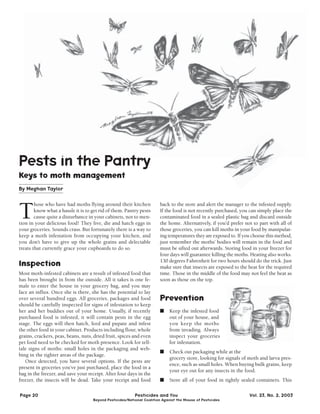
More likely than not, you will not have to identify 
the exact type of moth that is in your kitchen. 
The control methods described below apply to a broad 
range of pantry moths. However, if you are going to 
use pheromone traps, which are helpful in detecting 
if a moth problem still exists after a cleanup, you will 
have to know which type of moth you have on your 
hands in order to buy the right trap. Generally, one of 
three moths will be in your pantries. The Angoumois 
Grain Moth is rather small, with a buff, gray or yel-low- 
brown coloring. The hind wings, with long hairs, 
narrow to a point. The Mediterranean Flour Moth is a 
bit longer (about .48”), and is usually a pale gray with 
two black lines on its forewings. Lastly, the Indian Meal 
Moth, about .8” long, has pale gray wings with a red-brown 
coloring on its outer forewings.

Pantry Moths Natural Pest Control

  • 1.
    Pests in thePantry Keys to moth management By Meghan Taylor Those who have had moths flying around their kitchen know what a hassle it is to get rid of them. Pantry pests cause quite a disturbance in your cabinets, not to men-tion in your delicious food! They live, die and hatch eggs in your groceries. Sounds crass. But fortunately there is a way to keep a moth infestation from occupying your kitchen, and you don’t have to give up the whole grains and delectable treats that currently grace your cupboards to do so. lnspection Most moth-infested cabinets are a result of infested food that has been brought in from the outside. All it takes is one fe-male to enter the house in your grocery bag, and you may face an influx. Once she is there, she has the potential to lay over several hundred eggs. All groceries, packages and food should be carefully inspected for signs of infestation to keep her and her buddies out of your home. Usually, if recently purchased food is infested, it will contain pests in the egg stage. The eggs will then hatch, feed and pupate and infest the other food in your cabinet. Products including flour, whole grains, crackers, peas, beans, nuts, dried fruit, spices and even pet food need to be checked for moth presence. Look for tell-tale signs of moths: small holes in the packaging and web-bing in the tighter areas of the package. Once detected, you have several options. If the pests are present in groceries you’ve just purchased, place the food in a bag in the freezer, and save your receipt. After four days in the freezer, the insects will be dead. Take your receipt and food back to the store and alert the manager to the infested supply. If the food is not recently purchased, you can simply place the contaminated food in a sealed plastic bag and discard outside the home. Alternatively, if you’d prefer not to part with all of those groceries, you can kill moths in your food by manipulat-ing temperatures they are exposed to. If you choose this method, just remember the moths’ bodies will remain in the food and must be sifted out afterwards. Storing food in your freezer for four days will guarantee killing the moths. Heating also works. 130 degrees Fahrenheit for two hours should do the trick. Just make sure that insects are exposed to the heat for the required time. Those in the middle of the food may not feel the heat as soon as those on the top. Prevention ■ Keep the infested food out of your house, and you keep the moths from invading. Always inspect your groceries for infestation. ■ Check out packaging while at the grocery store, looking for signals of moth and larva pres-ence, such as small holes. When buying bulk grains, keep your eye out for any insects in the food. ■ Store all of your food in tightly sealed containers. This Page 20 Pesticides and You Vol. 23, No. 2, 2003 Beyond Pesticides/National Coalition Against the Misuse of Pesticides
  • 2.
    will keep anypantry pests that slipped through your in-spection from infesting other food in your kitchen. Glass jars with lids that have rubber gaskets are an excellent choice. Beware that even jars with screw tops may not be sufficient against pantry pest invasion. ■ Clean up all spills and crumbs promptly. If you notice cracks and crevices where crumbs tend to become lodged, use caulk to seal these up. ■ Cupboards and shelves should fit flush against cabinet walls so as not to provide spaces for crumbs to accumulate. ■ Make sure that other areas that attract crumbs, such as in the toaster, stay clean. Control If moths have already made themselves at home in your cabi-nets, it is best not to use chemicals to get rid of them. ■ Inspect all of your food. Go through each and every pack-age and container, looking for the common signs of infes-tation. If you see any holes, or webbing in the corners, Which moths are in my cabinets? Vol. 23, No. 2, 2003 Pesticides and You Page 21 Beyond Pesticides/National Coalition Against the Misuse of Pesticides consider it infested. ■ Discard the infested food in sealed bags outside of your home or use temperature manipulation described above to kill off the insects. Remember to sift them out of the food afterwards. ■ If you store larger than normal quantities of grain that become infested, you can use Bacillus thuringiensis (Bt) to manage the problem. Apply only to the surface, since these pests usually will not go deeper than four inches into the grain. ■ Once the food in your pantry is moth-free, thoroughly clean the infested area. Use soap and hot water in your pantry, paying special attention to corners and crevices. ■ Take all cans out and wash them as well to kill any micro-scopic larvae. ■ Vacuum any infested areas in the kitchen. ■ Take the preventive measures described above and moni-tor the problem after clean up. ■ Pheromone traps come in handy here. After you have taken care of the majority of the infestation, they can be used to kill any leftover moths and to monitor their population. These traps are normally effective for about three months. If you notice an increase in the number of moths in your traps, it is time to inspect your food again. Non-toxic pheromone pantry pest traps are avail-able from companies such as Victor Safer Brand (www.victorpest.com) ■ Without having to buy any supplies, you can just leave your kitchen light on at night, with all other lights in the house off. You can capture the stray moth when it comes out from its hiding spot to the light. ■ If you are still catching moths after a thorough cleanup, and you have taken all preventive measures, consider using a least-toxic insecticidal soap such as Safers Brand to clean out your cabinets. Be sure to clean it up thor-oughly, and as with any pesticide, use caution. Use this only as a last resort. Resources Moeller, Mike. 1988. “Controlling Pantry Pests.” Straight Talk From TDA. Deputy Commissioner, Texas Department of Agriculture. Olkowski, William and Sheila Daar. Fall 1986. “Pantry Pests: Beetles and Moths in Stored Foods.” Common Sense Pest Control. 2(4): 16-19. Berkeley, CA. More likely than not, you will not have to identify the exact type of moth that is in your kitchen. The control methods described below apply to a broad range of pantry moths. However, if you are going to use pheromone traps, which are helpful in detecting if a moth problem still exists after a cleanup, you will have to know which type of moth you have on your hands in order to buy the right trap. Generally, one of three moths will be in your pantries. The Angoumois Grain Moth is rather small, with a buff, gray or yel-low- brown coloring. The hind wings, with long hairs, narrow to a point. The Mediterranean Flour Moth is a bit longer (about .48”), and is usually a pale gray with two black lines on its forewings. Lastly, the Indian Meal Moth, about .8” long, has pale gray wings with a red-brown coloring on its outer forewings.