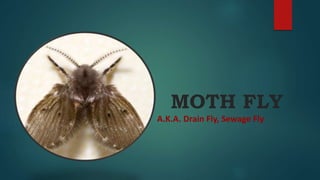
MOTH FLY
A.K.A. Drain Fly, Sewage Fly
What are these creatures?
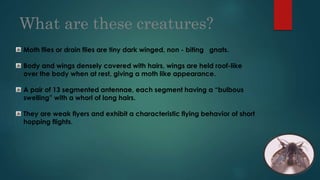
Moth flies or drain flies are tiny dark winged, non - biting gnats.
Body and wings densely covered with hairs, wings are held roof-like
over the body when at rest, giving a moth like appearance.
A pair of 13 segmented antennae, each segment having a “bulbous
swelling” with a whorl of long hairs.
They are weak flyers and exhibit a characteristic flying behavior of short
hopping flights.
LIFE CYCLE
Like all flies, moth flies undertake complete metamorphosis in egg, larval, pupal and adult
stages.
Female lay eggs in moist to nearly saturated organic matter. In urban environment,
development occurs in slimy organic matter coating of sink or floor drains “thus the name
drain fly came into being” which most pest management professionals generally used.
However, it may also found developing on wet animal manure, sewage or even compost
and any organic materials which is damp and wet.
Once the eggs, had been laid, they hatch in about 48 hours and continue to progress on
wet organic matter as larvae.
Larvae in the final (3rd) larval stage are roughly 1/4 inch in length, have a distinct head and
a siphon in one end which allows them to breath in wet environment.
Juvenile flies pupate at the surface of the breeding media and after 20 to 40 hours, new
adults emerge.
Life cycle can be completed in one to three weeks. ADULTS live in about two weeks, with
old ones dying and new ones emerging.
LIFE CYCLE
MOTH FLY LIFE CYCLE
BEHAVIOR
Being weak flyer, it is identifiable by its habit of making short hopping flights when
disturb, rather than flying a distance.
This will also determine that moth fly usually found near the source. Although
because of its size and light weight it can be carried on the wind to a home from a
source of up to a mile away.
Feeds on decaying organic materials in mud, moss, and polluted water as well as
flower nectar.
It can live and breed almost anywhere that standing water or organic materials
accumulates for a week or more.
It is most active in the evening, during the day the fly will generally rest in shaded
spots inside or on sides of showers, unused sinks.
HABITAT
In home & Buildings – sinks drains, floor drains, in basements & garage, in and
around unused sinks, windows, walls near drains, unwashed garbage
disposals. In frequently used toilets – in bowls & on floor, loose tiles where
moisture accumulates.
Outside; around the home – compost files, dirty garbage areas, damp septic
lines, standing water, or even a nearby sewage plant.
In Nature – shallow, polluted water or high moisture organic materials or
compost.
BEING A PEST
Moth fly are not harmful nor bite humans and animals, and they cause no
damage to structure or plants. Conversely, because of these flies develop in
decaying organic materials on unusual sites such as sinks, sewerage system, and
on manure and raw sewage. They had the potentials to carry pathogens
acquired on these developmental sites to areas where sterility is important such
as; health care facilities and food preparation areas.
It may also affect human health when present in high numbers, since the bodies
of dead flies may disintegrate to form potential allergens.
Aside of these health risks, moth flies are also nuisance pets, especially when
present in large population, or when they land on people or fall into food.
MANAGEMENT
&
CONTROL
INSPECTION & PREVENTION
The significant features in managing moth flies is the elimination of breeding sites . Includes
the following;
a. toilet & bath floor drains in residential homes
b. sink & floor drains in food preparation areas, grease traps, mop drying tubs,
evaporation pans placed beneath appliances.
In cases where adults sighted resting on walls first check all drains within for the presence of
larvae because being weak flyer adults can often be found near development site. Better
check all drains and for exact source, you can have sampling technique using monitoring
device installed in each drain, but having the luxury of time cleaning all available drainage
will be good for long term solution.
Having finished cleaning all drains, no larvae found it might be developing in organic
material found in much deeper within the pipes.
CONTROL
The key to control is locating and eliminating the source. Modified traps can be
made out of clear plastic cup;
a. Lightly coat the inside of the cup with Vaseline or vegetable oil
b. Invert it over drain openings.
c. Leave it for days, but check it daily.
d. Flies emerge and will stick to glass surface, there you have
found the source.
e. Having no flies are detected for several days.
f. Expand your investigation to outdoors. Once the source is
found you can eliminate it by removal or cleaning the origin.
h. However, it can take determined, ongoing work to completely
eliminate a moth fly problem.
PHYSICAL CONTROL
INDOORS
Clean in and around drains, sinks, drain pipes, using long stiff brush for cleaning
deeper on pipes.
Fix pipes leak. Clear any organic material, cleaning in and around garbage bins.
Get rid of standing water or moist & damp areas, such as wet lint in laundry area
and standing water under in drain pan beneath refrigerators or house plants.
OUTDOORS
Eliminate standing water whenever possible.
Clean garbage bins, air conditioners, bird baths. Once eliminated the population,
prevent future problems by keeping the area in good sanitation condition.
CHEMICAL CONTROL
Generally pesticide options have limited value and rarely required for moth fly
management.
The use of insecticide sometimes employed to knock down adult or to help break
the lifecycle and prevent emergence of adults, but will not provide long term
control.
Insecticide may also be utilized when flies produce off-site or larval development
sites cannot be eliminated. In this case residual application on resting surfaces
may provide some relief.
Conclusion/Recommendation
Long term solution can be breakdown into the basics of IPM; Investigation,
Inspection & monitoring, Prevention & Control, Evaluation.
Take into consideration to dig deeper or widen the scope of conducting
inspection.
Be sure to carefully employ all available control measures before going into
chemical treatment.
MOTH FLY

MOTH FLY

  • 1.
    MOTH FLY A.K.A. DrainFly, Sewage Fly
  • 2.
    What are thesecreatures? Moth flies or drain flies are tiny dark winged, non - biting gnats. Body and wings densely covered with hairs, wings are held roof-like over the body when at rest, giving a moth like appearance. A pair of 13 segmented antennae, each segment having a “bulbous swelling” with a whorl of long hairs. They are weak flyers and exhibit a characteristic flying behavior of short hopping flights.
  • 3.
    LIFE CYCLE Like allflies, moth flies undertake complete metamorphosis in egg, larval, pupal and adult stages. Female lay eggs in moist to nearly saturated organic matter. In urban environment, development occurs in slimy organic matter coating of sink or floor drains “thus the name drain fly came into being” which most pest management professionals generally used. However, it may also found developing on wet animal manure, sewage or even compost and any organic materials which is damp and wet. Once the eggs, had been laid, they hatch in about 48 hours and continue to progress on wet organic matter as larvae. Larvae in the final (3rd) larval stage are roughly 1/4 inch in length, have a distinct head and a siphon in one end which allows them to breath in wet environment. Juvenile flies pupate at the surface of the breeding media and after 20 to 40 hours, new adults emerge. Life cycle can be completed in one to three weeks. ADULTS live in about two weeks, with old ones dying and new ones emerging.
  • 4.
  • 5.
    BEHAVIOR Being weak flyer,it is identifiable by its habit of making short hopping flights when disturb, rather than flying a distance. This will also determine that moth fly usually found near the source. Although because of its size and light weight it can be carried on the wind to a home from a source of up to a mile away. Feeds on decaying organic materials in mud, moss, and polluted water as well as flower nectar. It can live and breed almost anywhere that standing water or organic materials accumulates for a week or more. It is most active in the evening, during the day the fly will generally rest in shaded spots inside or on sides of showers, unused sinks.
  • 6.
    HABITAT In home &Buildings – sinks drains, floor drains, in basements & garage, in and around unused sinks, windows, walls near drains, unwashed garbage disposals. In frequently used toilets – in bowls & on floor, loose tiles where moisture accumulates. Outside; around the home – compost files, dirty garbage areas, damp septic lines, standing water, or even a nearby sewage plant. In Nature – shallow, polluted water or high moisture organic materials or compost.
  • 7.
    BEING A PEST Mothfly are not harmful nor bite humans and animals, and they cause no damage to structure or plants. Conversely, because of these flies develop in decaying organic materials on unusual sites such as sinks, sewerage system, and on manure and raw sewage. They had the potentials to carry pathogens acquired on these developmental sites to areas where sterility is important such as; health care facilities and food preparation areas. It may also affect human health when present in high numbers, since the bodies of dead flies may disintegrate to form potential allergens. Aside of these health risks, moth flies are also nuisance pets, especially when present in large population, or when they land on people or fall into food.
  • 8.
  • 9.
    INSPECTION & PREVENTION Thesignificant features in managing moth flies is the elimination of breeding sites . Includes the following; a. toilet & bath floor drains in residential homes b. sink & floor drains in food preparation areas, grease traps, mop drying tubs, evaporation pans placed beneath appliances. In cases where adults sighted resting on walls first check all drains within for the presence of larvae because being weak flyer adults can often be found near development site. Better check all drains and for exact source, you can have sampling technique using monitoring device installed in each drain, but having the luxury of time cleaning all available drainage will be good for long term solution. Having finished cleaning all drains, no larvae found it might be developing in organic material found in much deeper within the pipes.
  • 10.
    CONTROL The key tocontrol is locating and eliminating the source. Modified traps can be made out of clear plastic cup; a. Lightly coat the inside of the cup with Vaseline or vegetable oil b. Invert it over drain openings. c. Leave it for days, but check it daily. d. Flies emerge and will stick to glass surface, there you have found the source. e. Having no flies are detected for several days. f. Expand your investigation to outdoors. Once the source is found you can eliminate it by removal or cleaning the origin. h. However, it can take determined, ongoing work to completely eliminate a moth fly problem.
  • 11.
    PHYSICAL CONTROL INDOORS Clean inand around drains, sinks, drain pipes, using long stiff brush for cleaning deeper on pipes. Fix pipes leak. Clear any organic material, cleaning in and around garbage bins. Get rid of standing water or moist & damp areas, such as wet lint in laundry area and standing water under in drain pan beneath refrigerators or house plants. OUTDOORS Eliminate standing water whenever possible. Clean garbage bins, air conditioners, bird baths. Once eliminated the population, prevent future problems by keeping the area in good sanitation condition.
  • 12.
    CHEMICAL CONTROL Generally pesticideoptions have limited value and rarely required for moth fly management. The use of insecticide sometimes employed to knock down adult or to help break the lifecycle and prevent emergence of adults, but will not provide long term control. Insecticide may also be utilized when flies produce off-site or larval development sites cannot be eliminated. In this case residual application on resting surfaces may provide some relief.
  • 13.
    Conclusion/Recommendation Long term solutioncan be breakdown into the basics of IPM; Investigation, Inspection & monitoring, Prevention & Control, Evaluation. Take into consideration to dig deeper or widen the scope of conducting inspection. Be sure to carefully employ all available control measures before going into chemical treatment.