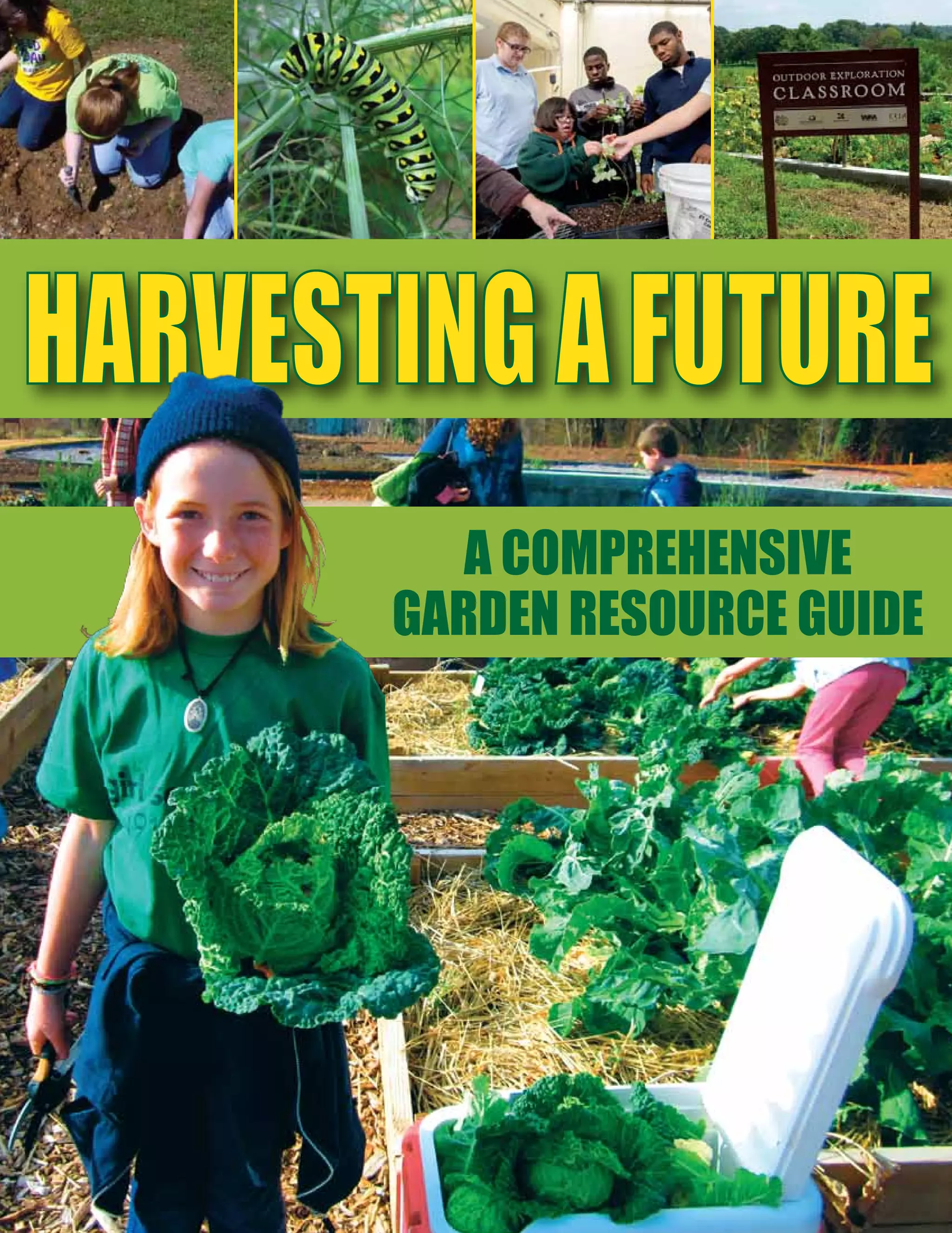
HARVESTING A FUTURE 
A COMPREHENSIVE 
GARDEN RESOURCE GUIDE
1 
Table of Contents 
• Community Gardens - Page 3 
o Basics of developing a community garden 
o Who to involve and how to gain support 
o Benefits of a community garden 
o How to fund a community garden 
o Sustaining a community garden 
o Challenges 
• School Gardens - Page 6 
o Basics of developing a school garden 
o Who to involve and how to gain support 
o Benefits of a school garden 
o How to fund a school garden 
o Sustaining a school garden 
o Challenges 
• Specialized Gardens (Faith based, Intergenerational) - Page 9 
o Basics of developing a specialized garden 
o Who to involve and how to gain support 
o Benefits of a specialized garden 
o How to fund a specialized garden 
o Sustaining a specialized garden 
o Challenges 
• Americans with Disabilities Act (ADA) Guidelines - Page 12 
o Some organizations are going to require ADA, 
all should follow in order to make your garden to everyone 
Department of Health. Authorization No. 343061, 5/13, Website only.
2 
Introduction 
Special thanks go to the Community/School Garden Resource Work Group 
for their giving their time, effort and knowledge to this project. 
Members of the work group include: 
Liz Aleman, Vanderbilt Children’s Health Improvement & Prevention 
Dare Bible, Tennessee Department of Health 
Rick Canada, Tennessee Department of Health 
Joan Cook, Tennessee Department of Health 
Chris Fleming, Tennessee Farm Bureau 
Mark Fly, The Human Dimensions Research Lab, The University of Tennessee, 
Dawn Gale, Private Consultant and ECO Gardens Manager 
Valerie Hawkins-King, Tennessee Commission on Aging and Disability 
Trevor Henderson, Metro Nashville Health Department 
Nancy Murphy, University of Tennessee and Tennessee State University Agricultural Extension 
Ginger Reasonover, Lipscomb Academy Elementary School 
Nancy West, Coordinated School Health Dyersburg City Schools 
The Garden Resource guide grew out of the need for a simple way to find resources and expertise for 
those developing a community garden. From this concept, experts in community gardening were brought 
together to develop a simple resource document that would assist individuals or groups with gardening 
basics, who to involve, benefits of a garden, how to find funding for your garden, sustaining a garden and 
finally challenges that you may encounter when building a community, school or specialty garden. 
There are many obvious benefits of a community garden, but some are not quite so obvious. Our main 
goal is to increase physical activity and healthy eating, but as you browse the resources located under benefits 
in each section, you will learn that the benefits of a community garden are numerous. In most instances, 
you are going to need community involvement and funding in order to see your dream of a community 
garden become reality. The sections on who to involve and how to fund a community garden will assist you 
with whom to recruit and how to pay for your project. 
After all of the hard work you have done to complete a community garden, it is logical that you would 
want to sustain it for more than one growing season. The resources around sustaining a community garden 
will help during the years after the garden has been established. Resources focusing on challenges will assist 
you to consider challenges before they ever occur. And finally, a success story has been added at the end of 
each section to demonstrate how one organization successfully constructed a community garden. 
We hope you find this Garden Resource guide to be helpful to you in your community garden efforts and 
we wish you success in growing your garden!
3 
Community Gardens 
Community gardens are becoming increasingly popular, yet many gardeners do not have the expertise to 
gain the greatest potential from a community garden. This section on developing a community garden will 
equip you with the resources necessary for getting the most out of your community garden, who to involve, 
the possible benefits of a garden, funding for your community garden and challenges that you can address 
before you even begin. Follow the advice found in these resources and you will be well on your way to 
having a successful community garden. 
Basics of Developing a Community Garden 
It does not matter if you are a novice gardener or an advanced master gardener, when beginning to build 
your community garden; it is good to begin with the basics. It has been said that you can simply put a seed 
into soil and add water and it will grow. However, by following some basic advice found in these resources 
your garden will flourish. 
• Knoxville Area Guide to Community Gardens - 
http://www.cityofknoxville.org/boards/food/toolkit.pdf 
• USDA Garden Resources - 
http://www.usda.gov/wps/portal/usda/usdahome?navid=GARDEN_RT3&parentnav=PEOPLES_GARDEN&navtype=RT 
• Community Gardens - 
www.dhhs.nh.gov/dphs/nhp/healthygardens.htm 
• Portland Parks and Recreation Community Gardens Toolkit - 
http://www.portlandonline.com/parks/index.cfm?a=282909&c=39846 
• ACGA Starting a Community Garden - 
http://www.communitygarden.org/learn/starting-a-community-garden.php 
• UT Institute of Agriculture Resources for Starting a Community Garden - 
http://communitygardening.tennessee.edu/starting.htm 
• Let’s Move Community Garden Checklist - 
http://www.letsmove.gov/community-garden-checklist 
• The Masters Gardener Articles - 
http://www.emmitsburg.net/gardens/articles.htm 
• University of Missouri Extension “Composting”- 
http://extension.missouri.edu/publications/DisplayPub.aspx?P=G6957#.T0UMmD89MeA.facebook 
• How to Build Raised Beds - 
http://growtest.org/resources/how-to-build-raised-beds
4 
Who to Involve and How to Gain Support 
Depending on the size of your community garden, chances are you can use as much help as possible to 
have a successful project. You may also need approval to begin a garden on a public land space. These 
resources will guide you to who to involve and how to gain support for your community garden. 
• Start a Community Garden: Get the Community Involved - 
http://www.houselogic.com/home-advice/gardens/start-community-garden/ 
• The Basics of Organizing a Community Garden - 
http://feeds.uwex.edu/about/startingacommunitygarden.cfm 
Benefits of a Community Garden 
Community gardens offer a wealth of benefits to both the individual and the community. Everyone will 
benefit from working in the garden and eating the fruits and vegetables harvested. But there can be many 
unseen benefits of a garden and this section will bring these to your understanding. 
• Garden Works “The Multiple Benefits of Community Gardens” - 
http://www.communitygarden.org/docs/learn/articles/multiple_benefits.pdf 
How to Fund a Community Garden 
A community garden does not have to cost very much, but in order to sustain the garden will probably 
require some revenue from somewhere other than volunteers. This section outlines a number of excellent 
resources to assist in funding your garden. 
• USDA Financial Resources - 
http://www.usda.gov/wps/portal/usda/usdahome?contentidonly=true&contentid=financial_resources.html 
• Food Corps - 
http://foodcorps.org/our-structure/site-eligibility 
Sustaining a Community Garden 
Planning and developing a community garden requires considerable work if for only one growing season. 
Once you have done the intense work of planting that first garden, it just makes sense to have a plan in place 
to sustain the garden for years to come. 
• Creating and Sustaining a Community Garden - 
http://www.downtoearthnw.com/stories/2008/oct/28/creating-sustaining-community-gardens/ 
• Carbon Masters Community Garden Project - 
http://whatcom.wsu.edu/carbonmasters/documents/CommunityGardenProject.pdf 
Challenges 
As with any project you embrace, there are going to be challenges that must be overcome. This section 
will help you address possible challenges in the beginning and therefore minimizing the hurdles you will 
need to work through for a successful community garden. 
• Ground Rules “A Legal Toolkit for Community Gardens” - 
http://www.state.nj.us/health/fhs/shapingnj/work/publications/CommunityGardenToolkit_Final.pdf 
• Challenges and Solutions to Community Gardens - 
http://www.localharvest.org/blog/20618/entry/challenges_and_solutions_to_some
5 
Success Story 
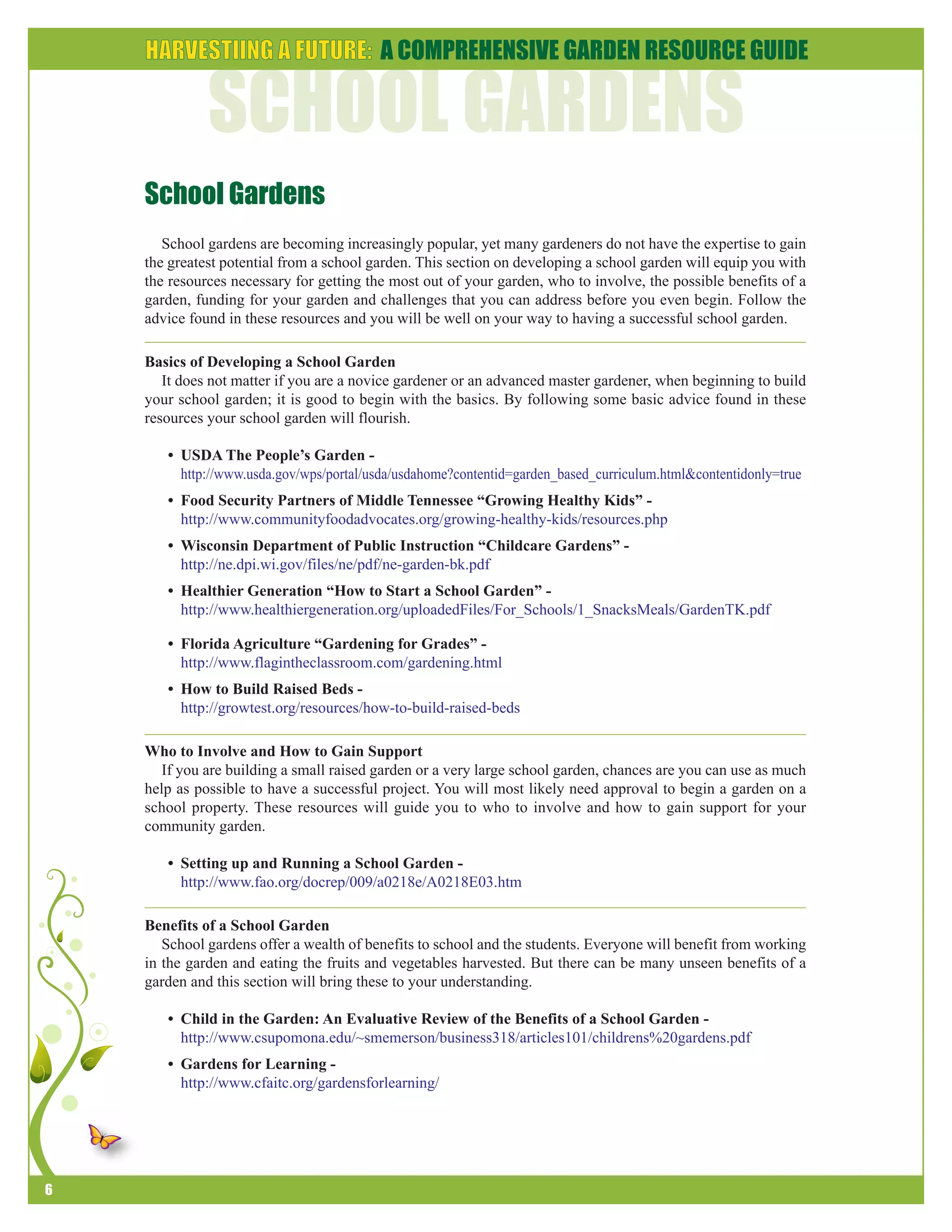
The following thoughts are on how to have 
a successful community garden such as the one 
in Lake County, Tennessee. For a community 
garden to be successful, one needs many 
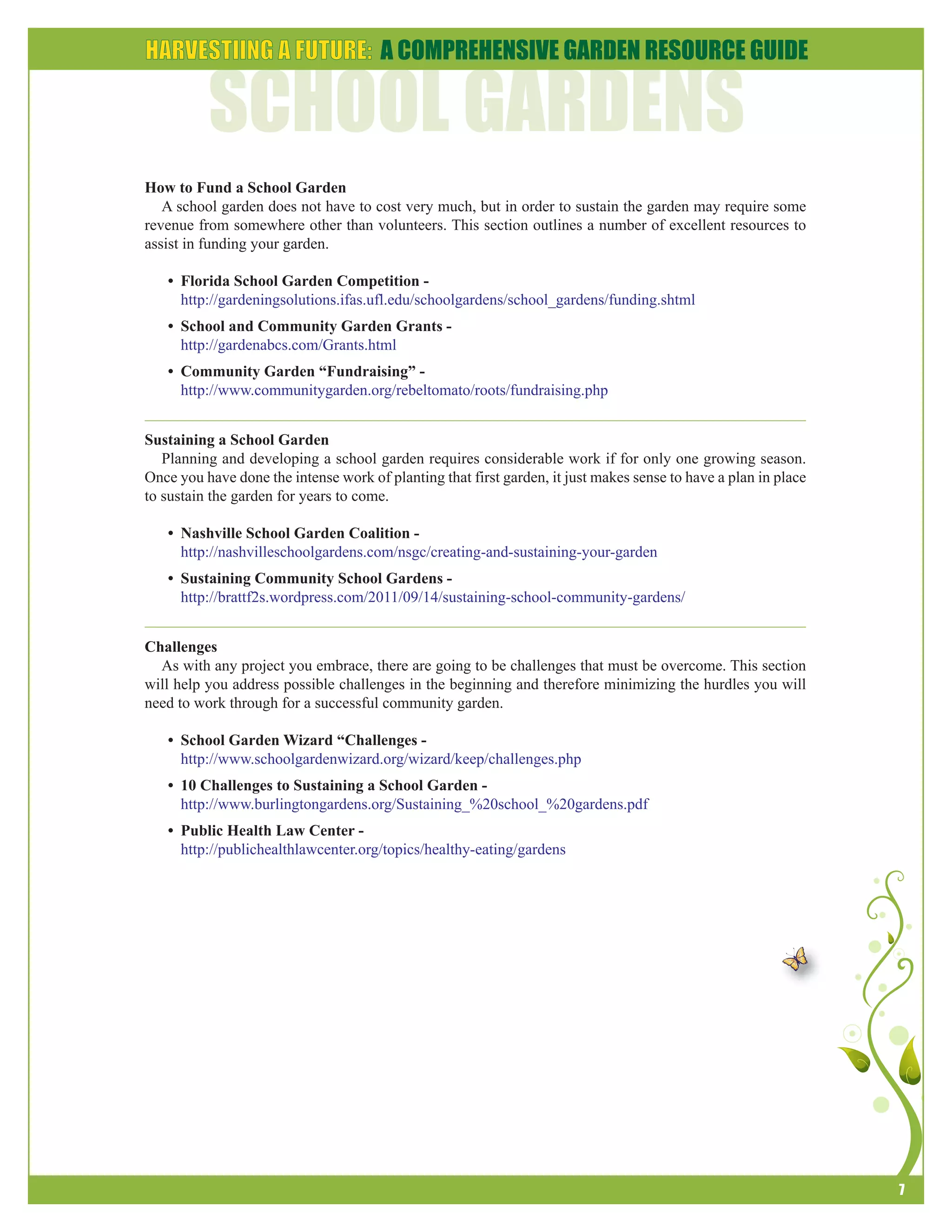
volunteers that are willing to help. 
Contributions of land, tools, seeds, fencing, 
soil improvements or money are all vital to a 
successful community garden. It takes 
planning, support from your suppliers and 
favorable media coverage and you have the 
makings of a wonderful marketing opportunity 
and a great community garden. In our county, 
we were blessed to have media, community 
support, elected officials, land owners and 
many senior citizens willing to carry the load. 
The number one task was to get the right 
people in place in the beginning. These people 
need to have a positive attitude and be well liked in the community. A good example is the mayor of the 
county. This person will have contacts and be able to make arrangements and get things moving quickly. 
Our garden was also a huge success due to the media 
attention which drew interest of the community. Each week 
the local newspaper featured a photograph and an article to 
update the community of the progress of the garden. The 
site needs to be easily accessible also. The one we chose 
was located in the city park. This was very easy for parents 
and grandparents to bring their children along while 
harvesting or working in the garden. The city already has 
insurance and the garden could fall under the umbrella 
policy. 
Connie Hopper, Lake County Tennessee Garden Project
6 
School Gardens 
School gardens are becoming increasingly popular, yet many gardeners do not have the expertise to gain 
the greatest potential from a school garden. This section on developing a school garden will equip you with 
the resources necessary for getting the most out of your garden, who to involve, the possible benefits of a 
garden, funding for your garden and challenges that you can address before you even begin. Follow the 
advice found in these resources and you will be well on your way to having a successful school garden. 
Basics of Developing a School Garden 
It does not matter if you are a novice gardener or an advanced master gardener, when beginning to build 
your school garden; it is good to begin with the basics. By following some basic advice found in these 
resources your school garden will flourish. 
• USDA The People’s Garden - 
http://www.usda.gov/wps/portal/usda/usdahome?contentid=garden_based_curriculum.html&contentidonly=true 
• Food Security Partners of Middle Tennessee “Growing Healthy Kids” - 
http://www.communityfoodadvocates.org/growing-healthy-kids/resources.php 
• Wisconsin Department of Public Instruction “Childcare Gardens” - 
http://ne.dpi.wi.gov/files/ne/pdf/ne-garden-bk.pdf 
• Healthier Generation “How to Start a School Garden” - 
http://www.healthiergeneration.org/uploadedFiles/For_Schools/1_SnacksMeals/GardenTK.pdf 
• Florida Agriculture “Gardening for Grades” - 
http://www.flagintheclassroom.com/gardening.html 
• How to Build Raised Beds - 
http://growtest.org/resources/how-to-build-raised-beds 
Who to Involve and How to Gain Support 
If you are building a small raised garden or a very large school garden, chances are you can use as much 
help as possible to have a successful project. You will most likely need approval to begin a garden on a 
school property. These resources will guide you to who to involve and how to gain support for your 
community garden. 
• Setting up and Running a School Garden - 
http://www.fao.org/docrep/009/a0218e/A0218E03.htm 
Benefits of a School Garden 
School gardens offer a wealth of benefits to school and the students. Everyone will benefit from working 
in the garden and eating the fruits and vegetables harvested. But there can be many unseen benefits of a 
garden and this section will bring these to your understanding. 
• Child in the Garden: An Evaluative Review of the Benefits of a School Garden - 
http://www.csupomona.edu/~smemerson/business318/articles101/childrens%20gardens.pdf 
• Gardens for Learning - 
http://www.cfaitc.org/gardensforlearning/
7 
How to Fund a School Garden 
A school garden does not have to cost very much, but in order to sustain the garden may require some 
revenue from somewhere other than volunteers. This section outlines a number of excellent resources to 
assist in funding your garden. 
• Florida School Garden Competition - 
http://gardeningsolutions.ifas.ufl.edu/schoolgardens/school_gardens/funding.shtml 
• School and Community Garden Grants - 
http://gardenabcs.com/Grants.html 
• Community Garden “Fundraising” - 
http://www.communitygarden.org/rebeltomato/roots/fundraising.php 
Sustaining a School Garden 
Planning and developing a school garden requires considerable work if for only one growing season. 
Once you have done the intense work of planting that first garden, it just makes sense to have a plan in place 
to sustain the garden for years to come. 
• Nashville School Garden Coalition - 
http://nashvilleschoolgardens.com/nsgc/creating-and-sustaining-your-garden 
• Sustaining Community School Gardens - 
http://brattf2s.wordpress.com/2011/09/14/sustaining-school-community-gardens/ 
Challenges 
As with any project you embrace, there are going to be challenges that must be overcome. This section 
will help you address possible challenges in the beginning and therefore minimizing the hurdles you will 
need to work through for a successful community garden. 
• School Garden Wizard “Challenges - 
http://www.schoolgardenwizard.org/wizard/keep/challenges.php 
• 10 Challenges to Sustaining a School Garden - 
http://www.burlingtongardens.org/Sustaining_%20school_%20gardens.pdf 
• Public Health Law Center - 
http://publichealthlawcenter.org/topics/healthy-eating/gardens
8 
Success Story 
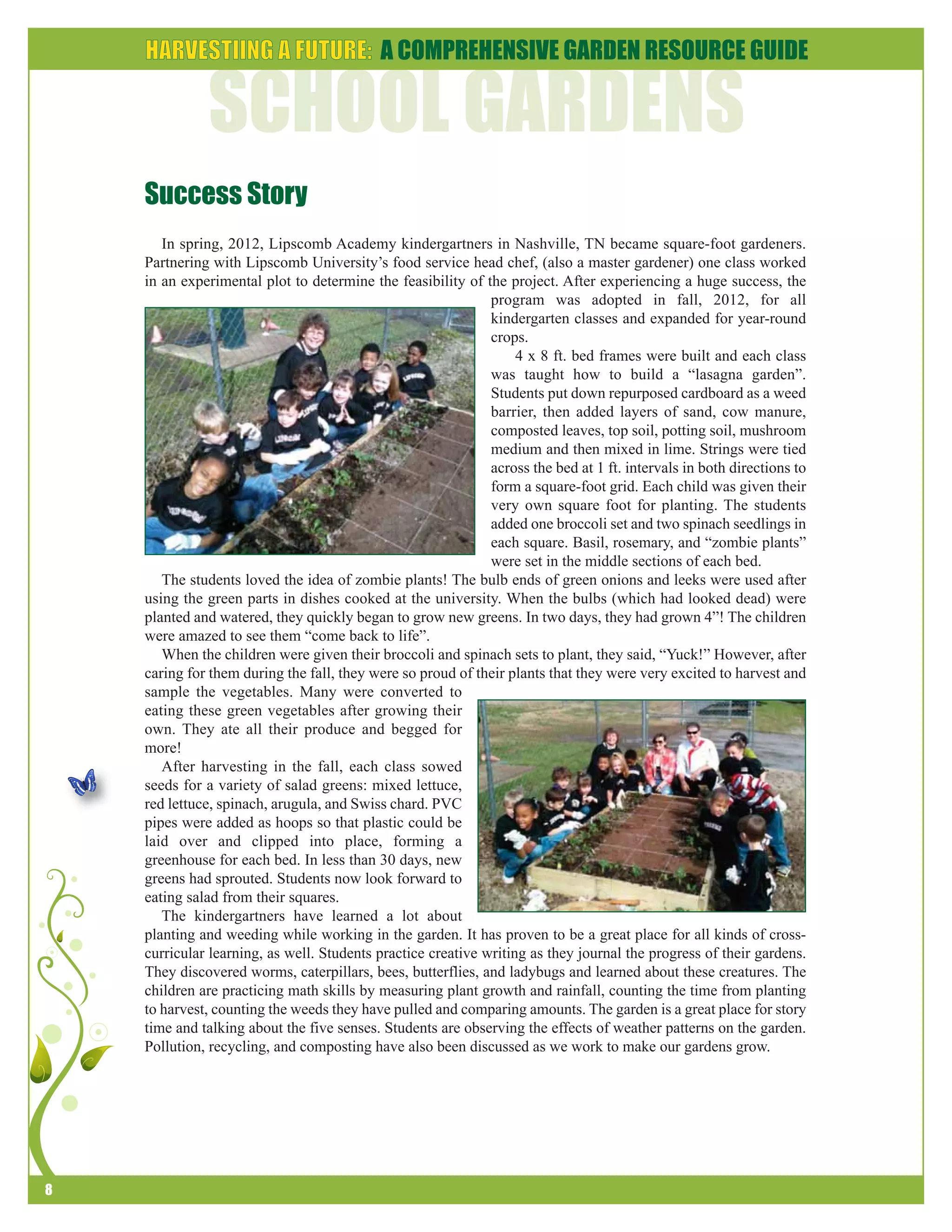
In spring, 2012, Lipscomb Academy kindergartners in Nashville, TN became square-foot gardeners. 
Partnering with Lipscomb University’s food service head chef, (also a master gardener) one class worked 
in an experimental plot to determine the feasibility of the project. After experiencing a huge success, the 
program was adopted in fall, 2012, for all 
kindergarten classes and expanded for year-round 
crops. 
4 x 8 ft. bed frames were built and each class 
was taught how to build a “lasagna garden”. 
Students put down repurposed cardboard as a weed 
barrier, then added layers of sand, cow manure, 
composted leaves, top soil, potting soil, mushroom 
medium and then mixed in lime. Strings were tied 
across the bed at 1 ft. intervals in both directions to 
form a square-foot grid. Each child was given their 
very own square foot for planting. The students 
added one broccoli set and two spinach seedlings in 
each square. Basil, rosemary, and “zombie plants” 
were set in the middle sections of each bed. 
The students loved the idea of zombie plants! The bulb ends of green onions and leeks were used after 
using the green parts in dishes cooked at the university. When the bulbs (which had looked dead) were 
planted and watered, they quickly began to grow new greens. In two days, they had grown 4”! The children 
were amazed to see them “come back to life”. 
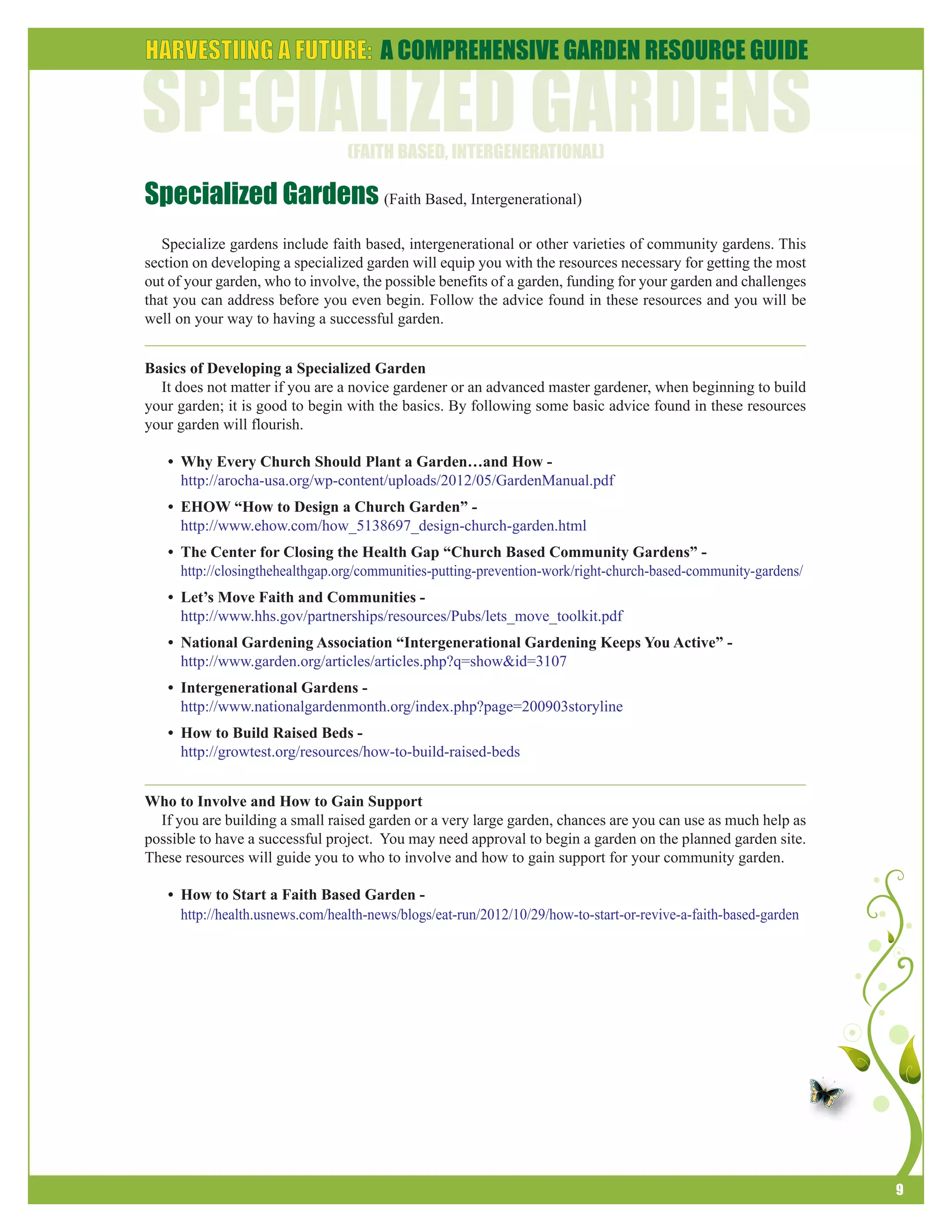
When the children were given their broccoli and spinach sets to plant, they said, “Yuck!” However, after 
caring for them during the fall, they were so proud of their plants that they were very excited to harvest and 
sample the vegetables. Many were converted to 
eating these green vegetables after growing their 
own. They ate all their produce and begged for 
more! 
After harvesting in the fall, each class sowed 
seeds for a variety of salad greens: mixed lettuce, 
red lettuce, spinach, arugula, and Swiss chard. PVC 
pipes were added as hoops so that plastic could be 
laid over and clipped into place, forming a 
greenhouse for each bed. In less than 30 days, new 
greens had sprouted. Students now look forward to 
eating salad from their squares. 
The kindergartners have learned a lot about 
planting and weeding while working in the garden. It has proven to be a great place for all kinds of cross-curricular 
learning, as well. Students practice creative writing as they journal the progress of their gardens. 
They discovered worms, caterpillars, bees, butterflies, and ladybugs and learned about these creatures. The 
children are practicing math skills by measuring plant growth and rainfall, counting the time from planting 
to harvest, counting the weeds they have pulled and comparing amounts. The garden is a great place for story 
time and talking about the five senses. Students are observing the effects of weather patterns on the garden. 
Pollution, recycling, and composting have also been discussed as we work to make our gardens grow.
9 
Specialized Gardens (Faith Based, Intergenerational) 
Specialize gardens include faith based, intergenerational or other varieties of community gardens. This 
section on developing a specialized garden will equip you with the resources necessary for getting the most 
out of your garden, who to involve, the possible benefits of a garden, funding for your garden and challenges 
that you can address before you even begin. Follow the advice found in these resources and you will be 
well on your way to having a successful garden. 
Basics of Developing a Specialized Garden 
It does not matter if you are a novice gardener or an advanced master gardener, when beginning to build 
your garden; it is good to begin with the basics. By following some basic advice found in these resources 
your garden will flourish. 
• Why Every Church Should Plant a Garden…and How - 
http://arocha-usa.org/wp-content/uploads/2012/05/GardenManual.pdf 
• EHOW “How to Design a Church Garden” - 
http://www.ehow.com/how_5138697_design-church-garden.html 
• The Center for Closing the Health Gap “Church Based Community Gardens” - 
http://closingthehealthgap.org/communities-putting-prevention-work/right-church-based-community-gardens/ 
• Let’s Move Faith and Communities - 
http://www.hhs.gov/partnerships/resources/Pubs/lets_move_toolkit.pdf 
• National Gardening Association “Intergenerational Gardening Keeps You Active” - 
http://www.garden.org/articles/articles.php?q=show&id=3107 
• Intergenerational Gardens - 
http://www.nationalgardenmonth.org/index.php?page=200903storyline 
• How to Build Raised Beds - 
http://growtest.org/resources/how-to-build-raised-beds 
Who to Involve and How to Gain Support 
If you are building a small raised garden or a very large garden, chances are you can use as much help as 
possible to have a successful project. You may need approval to begin a garden on the planned garden site. 
These resources will guide you to who to involve and how to gain support for your community garden. 
• How to Start a Faith Based Garden - 
http://health.usnews.com/health-news/blogs/eat-run/2012/10/29/how-to-start-or-revive-a-faith-based-garden
10 
Benefits of a Specialized Garden 
Gardens offer a wealth of benefits to everyone involved. From the exercise benefits of working in the 
garden to the nutritional benefits of eating the fruits and vegetables harvested. But there can be many unseen 
benefits of a garden and this section will bring these to your understanding. 
• Tips for Starting Community Faith Based Gardens - 
http://www.montgomeryvictorygardens.org/documents/pdf/Tips%20for%20FBCG.pdf 
• Kid Gardening “Intergenerational Gardens” - 
http://www.kidsgardening.org/node/11424 
How to Fund a Specialized Garden 
A garden does not have to cost very much, but sustaining the garden may require some revenue from 
somewhere other than volunteers. This section outlines a number of excellent resources to assist in funding 
your garden. 
• USDA Financial Resources - 
http://www.usda.gov/wps/portal/usda/usdahome?contentidonly=true&contentid=financial_resources.html 
• Food Corps - 
http://foodcorps.org/our-structure/site-eligibility 
• Grants and Funding - 
http://grants.kidsgardening.org/ 
• Garden Grants for Seniors - 
http://www.ehow.com/list_6637177_garden-grants-seniors.html 
Sustaining a Specialized Garden 
Planning and developing a community garden requires considerable work. It just makes sense to have a 
plan in place to sustain the garden for more than one year. Once you have done the intense work of planting 
that first garden, these resources will offer advice on sustaining the garden. 
• Creating and Sustaining a Community Garden - 
http://www.downtoearthnw.com/stories/2008/oct/28/creating-sustaining-community-gardens/ 
• Carbon Masters Community Garden Project - 
http://whatcom.wsu.edu/carbonmasters/documents/CommunityGardenProject.pdf 
Challenges 
As with any project you embrace, there are going to be challenges that must be overcome. This section 
will help you address possible challenges in the beginning and therefore minimizing the hurdles you will 
need to work through for a successful garden. 
• Ground Rules “A Legal Toolkit for Community Gardens” - 
http://www.state.nj.us/health/fhs/shapingnj/work/publications/CommunityGardenToolkit_Final.pdf 
• Challenges and Solutions to Community Gardens - 
http://www.localharvest.org/blog/20618/entry/challenges_and_solutions_to_some
11 
Success Story 
Homer Dudley had no idea that the Master Gardner course his son signed him up for upon his retirement 
would have such a profound effect on his life. 
After attending the course, he approached leaders at his church, College Hills Church of Christ in 
Lebanon, Tennessee, about using part of the property for a community garden and they agreed. 
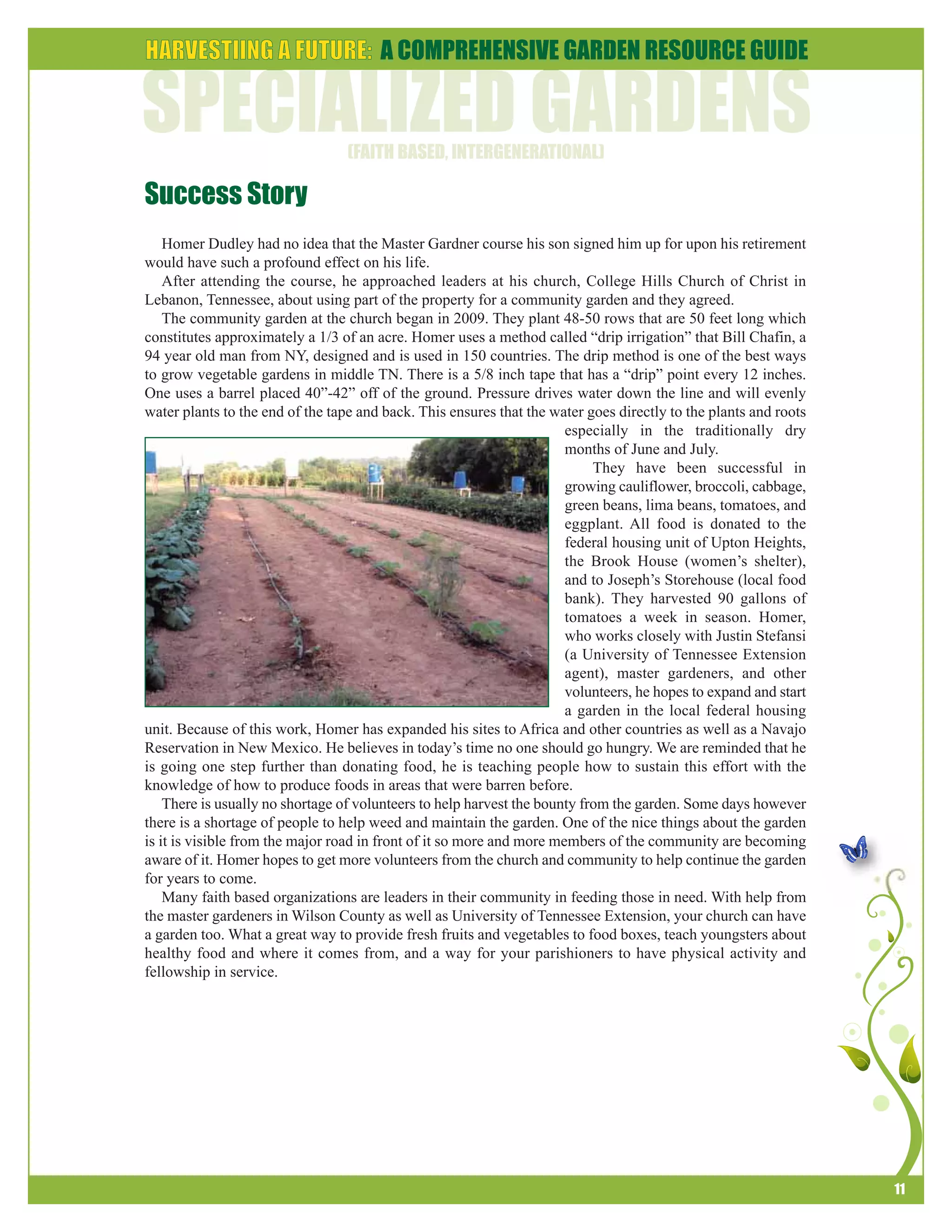
The community garden at the church began in 2009. They plant 48-50 rows that are 50 feet long which 
constitutes approximately a 1/3 of an acre. Homer uses a method called “drip irrigation” that Bill Chafin, a 
94 year old man from NY, designed and is used in 150 countries. The drip method is one of the best ways 
to grow vegetable gardens in middle TN. There is a 5/8 inch tape that has a “drip” point every 12 inches. 
One uses a barrel placed 40”-42” off of the ground. Pressure drives water down the line and will evenly 
water plants to the end of the tape and back. This ensures that the water goes directly to the plants and roots 
especially in the traditionally dry 
months of June and July. 
They have been successful in 
growing cauliflower, broccoli, cabbage, 
green beans, lima beans, tomatoes, and 
eggplant. All food is donated to the 
federal housing unit of Upton Heights, 
the Brook House (women’s shelter), 
and to Joseph’s Storehouse (local food 
bank). They harvested 90 gallons of 
tomatoes a week in season. Homer, 
who works closely with Justin Stefansi 
(a University of Tennessee Extension 
agent), master gardeners, and other 
volunteers, he hopes to expand and start 
a garden in the local federal housing 
unit. Because of this work, Homer has expanded his sites to Africa and other countries as well as a Navajo 
Reservation in New Mexico. He believes in today’s time no one should go hungry. We are reminded that he 
is going one step further than donating food, he is teaching people how to sustain this effort with the 
knowledge of how to produce foods in areas that were barren before. 
There is usually no shortage of volunteers to help harvest the bounty from the garden. Some days however 
there is a shortage of people to help weed and maintain the garden. One of the nice things about the garden 
is it is visible from the major road in front of it so more and more members of the community are becoming 
aware of it. Homer hopes to get more volunteers from the church and community to help continue the garden 
for years to come. 
Many faith based organizations are leaders in their community in feeding those in need. With help from 
the master gardeners in Wilson County as well as University of Tennessee Extension, your church can have 
a garden too. What a great way to provide fresh fruits and vegetables to food boxes, teach youngsters about 
healthy food and where it comes from, and a way for your parishioners to have physical activity and 
fellowship in service.
12 
ADA Guidelines 
Community gardens offer so many benefits, gardening should be accessible to everyone, including those with 
physical disabilities and the elderly. All gardens should be constructed following the ADA guidelines as much 
as possible. This section will give you specific guidelines to accommodate everyone and make gardening safe, 
accessible and enjoyable to all. 
• ADA Accessibility Guidelines - 
http://www.access-board.gov/adaag/html/adaag.htm 
• US Department of Justice “ADA Guidelines” - 
http://www.ada.gov/stdspdf.htm 
• Handicap Accessible Gardening - 
http://www.inthecountrygardenandgifts.com/jspece/gardening/accessible.html 
• Accessible Gardens for All Resources - 
http://accessiblegardens.blogspot.com/p/resource-list-accessible-gardens-for.html

Harvesting a Future: A Comprehensive Garden Resource Guide

  • 1.
    HARVESTING A FUTURE A COMPREHENSIVE GARDEN RESOURCE GUIDE
  • 2.
    1 Table ofContents • Community Gardens - Page 3 o Basics of developing a community garden o Who to involve and how to gain support o Benefits of a community garden o How to fund a community garden o Sustaining a community garden o Challenges • School Gardens - Page 6 o Basics of developing a school garden o Who to involve and how to gain support o Benefits of a school garden o How to fund a school garden o Sustaining a school garden o Challenges • Specialized Gardens (Faith based, Intergenerational) - Page 9 o Basics of developing a specialized garden o Who to involve and how to gain support o Benefits of a specialized garden o How to fund a specialized garden o Sustaining a specialized garden o Challenges • Americans with Disabilities Act (ADA) Guidelines - Page 12 o Some organizations are going to require ADA, all should follow in order to make your garden to everyone Department of Health. Authorization No. 343061, 5/13, Website only.
  • 3.
    2 Introduction Specialthanks go to the Community/School Garden Resource Work Group for their giving their time, effort and knowledge to this project. Members of the work group include: Liz Aleman, Vanderbilt Children’s Health Improvement & Prevention Dare Bible, Tennessee Department of Health Rick Canada, Tennessee Department of Health Joan Cook, Tennessee Department of Health Chris Fleming, Tennessee Farm Bureau Mark Fly, The Human Dimensions Research Lab, The University of Tennessee, Dawn Gale, Private Consultant and ECO Gardens Manager Valerie Hawkins-King, Tennessee Commission on Aging and Disability Trevor Henderson, Metro Nashville Health Department Nancy Murphy, University of Tennessee and Tennessee State University Agricultural Extension Ginger Reasonover, Lipscomb Academy Elementary School Nancy West, Coordinated School Health Dyersburg City Schools The Garden Resource guide grew out of the need for a simple way to find resources and expertise for those developing a community garden. From this concept, experts in community gardening were brought together to develop a simple resource document that would assist individuals or groups with gardening basics, who to involve, benefits of a garden, how to find funding for your garden, sustaining a garden and finally challenges that you may encounter when building a community, school or specialty garden. There are many obvious benefits of a community garden, but some are not quite so obvious. Our main goal is to increase physical activity and healthy eating, but as you browse the resources located under benefits in each section, you will learn that the benefits of a community garden are numerous. In most instances, you are going to need community involvement and funding in order to see your dream of a community garden become reality. The sections on who to involve and how to fund a community garden will assist you with whom to recruit and how to pay for your project. After all of the hard work you have done to complete a community garden, it is logical that you would want to sustain it for more than one growing season. The resources around sustaining a community garden will help during the years after the garden has been established. Resources focusing on challenges will assist you to consider challenges before they ever occur. And finally, a success story has been added at the end of each section to demonstrate how one organization successfully constructed a community garden. We hope you find this Garden Resource guide to be helpful to you in your community garden efforts and we wish you success in growing your garden!
  • 4.
    3 Community Gardens Community gardens are becoming increasingly popular, yet many gardeners do not have the expertise to gain the greatest potential from a community garden. This section on developing a community garden will equip you with the resources necessary for getting the most out of your community garden, who to involve, the possible benefits of a garden, funding for your community garden and challenges that you can address before you even begin. Follow the advice found in these resources and you will be well on your way to having a successful community garden. Basics of Developing a Community Garden It does not matter if you are a novice gardener or an advanced master gardener, when beginning to build your community garden; it is good to begin with the basics. It has been said that you can simply put a seed into soil and add water and it will grow. However, by following some basic advice found in these resources your garden will flourish. • Knoxville Area Guide to Community Gardens - http://www.cityofknoxville.org/boards/food/toolkit.pdf • USDA Garden Resources - http://www.usda.gov/wps/portal/usda/usdahome?navid=GARDEN_RT3&parentnav=PEOPLES_GARDEN&navtype=RT • Community Gardens - www.dhhs.nh.gov/dphs/nhp/healthygardens.htm • Portland Parks and Recreation Community Gardens Toolkit - http://www.portlandonline.com/parks/index.cfm?a=282909&c=39846 • ACGA Starting a Community Garden - http://www.communitygarden.org/learn/starting-a-community-garden.php • UT Institute of Agriculture Resources for Starting a Community Garden - http://communitygardening.tennessee.edu/starting.htm • Let’s Move Community Garden Checklist - http://www.letsmove.gov/community-garden-checklist • The Masters Gardener Articles - http://www.emmitsburg.net/gardens/articles.htm • University of Missouri Extension “Composting”- http://extension.missouri.edu/publications/DisplayPub.aspx?P=G6957#.T0UMmD89MeA.facebook • How to Build Raised Beds - http://growtest.org/resources/how-to-build-raised-beds
  • 5.
    4 Who toInvolve and How to Gain Support Depending on the size of your community garden, chances are you can use as much help as possible to have a successful project. You may also need approval to begin a garden on a public land space. These resources will guide you to who to involve and how to gain support for your community garden. • Start a Community Garden: Get the Community Involved - http://www.houselogic.com/home-advice/gardens/start-community-garden/ • The Basics of Organizing a Community Garden - http://feeds.uwex.edu/about/startingacommunitygarden.cfm Benefits of a Community Garden Community gardens offer a wealth of benefits to both the individual and the community. Everyone will benefit from working in the garden and eating the fruits and vegetables harvested. But there can be many unseen benefits of a garden and this section will bring these to your understanding. • Garden Works “The Multiple Benefits of Community Gardens” - http://www.communitygarden.org/docs/learn/articles/multiple_benefits.pdf How to Fund a Community Garden A community garden does not have to cost very much, but in order to sustain the garden will probably require some revenue from somewhere other than volunteers. This section outlines a number of excellent resources to assist in funding your garden. • USDA Financial Resources - http://www.usda.gov/wps/portal/usda/usdahome?contentidonly=true&contentid=financial_resources.html • Food Corps - http://foodcorps.org/our-structure/site-eligibility Sustaining a Community Garden Planning and developing a community garden requires considerable work if for only one growing season. Once you have done the intense work of planting that first garden, it just makes sense to have a plan in place to sustain the garden for years to come. • Creating and Sustaining a Community Garden - http://www.downtoearthnw.com/stories/2008/oct/28/creating-sustaining-community-gardens/ • Carbon Masters Community Garden Project - http://whatcom.wsu.edu/carbonmasters/documents/CommunityGardenProject.pdf Challenges As with any project you embrace, there are going to be challenges that must be overcome. This section will help you address possible challenges in the beginning and therefore minimizing the hurdles you will need to work through for a successful community garden. • Ground Rules “A Legal Toolkit for Community Gardens” - http://www.state.nj.us/health/fhs/shapingnj/work/publications/CommunityGardenToolkit_Final.pdf • Challenges and Solutions to Community Gardens - http://www.localharvest.org/blog/20618/entry/challenges_and_solutions_to_some
  • 6.
    5 Success Story The following thoughts are on how to have a successful community garden such as the one in Lake County, Tennessee. For a community garden to be successful, one needs many volunteers that are willing to help. Contributions of land, tools, seeds, fencing, soil improvements or money are all vital to a successful community garden. It takes planning, support from your suppliers and favorable media coverage and you have the makings of a wonderful marketing opportunity and a great community garden. In our county, we were blessed to have media, community support, elected officials, land owners and many senior citizens willing to carry the load. The number one task was to get the right people in place in the beginning. These people need to have a positive attitude and be well liked in the community. A good example is the mayor of the county. This person will have contacts and be able to make arrangements and get things moving quickly. Our garden was also a huge success due to the media attention which drew interest of the community. Each week the local newspaper featured a photograph and an article to update the community of the progress of the garden. The site needs to be easily accessible also. The one we chose was located in the city park. This was very easy for parents and grandparents to bring their children along while harvesting or working in the garden. The city already has insurance and the garden could fall under the umbrella policy. Connie Hopper, Lake County Tennessee Garden Project
  • 7.
    6 School Gardens School gardens are becoming increasingly popular, yet many gardeners do not have the expertise to gain the greatest potential from a school garden. This section on developing a school garden will equip you with the resources necessary for getting the most out of your garden, who to involve, the possible benefits of a garden, funding for your garden and challenges that you can address before you even begin. Follow the advice found in these resources and you will be well on your way to having a successful school garden. Basics of Developing a School Garden It does not matter if you are a novice gardener or an advanced master gardener, when beginning to build your school garden; it is good to begin with the basics. By following some basic advice found in these resources your school garden will flourish. • USDA The People’s Garden - http://www.usda.gov/wps/portal/usda/usdahome?contentid=garden_based_curriculum.html&contentidonly=true • Food Security Partners of Middle Tennessee “Growing Healthy Kids” - http://www.communityfoodadvocates.org/growing-healthy-kids/resources.php • Wisconsin Department of Public Instruction “Childcare Gardens” - http://ne.dpi.wi.gov/files/ne/pdf/ne-garden-bk.pdf • Healthier Generation “How to Start a School Garden” - http://www.healthiergeneration.org/uploadedFiles/For_Schools/1_SnacksMeals/GardenTK.pdf • Florida Agriculture “Gardening for Grades” - http://www.flagintheclassroom.com/gardening.html • How to Build Raised Beds - http://growtest.org/resources/how-to-build-raised-beds Who to Involve and How to Gain Support If you are building a small raised garden or a very large school garden, chances are you can use as much help as possible to have a successful project. You will most likely need approval to begin a garden on a school property. These resources will guide you to who to involve and how to gain support for your community garden. • Setting up and Running a School Garden - http://www.fao.org/docrep/009/a0218e/A0218E03.htm Benefits of a School Garden School gardens offer a wealth of benefits to school and the students. Everyone will benefit from working in the garden and eating the fruits and vegetables harvested. But there can be many unseen benefits of a garden and this section will bring these to your understanding. • Child in the Garden: An Evaluative Review of the Benefits of a School Garden - http://www.csupomona.edu/~smemerson/business318/articles101/childrens%20gardens.pdf • Gardens for Learning - http://www.cfaitc.org/gardensforlearning/
  • 8.
    7 How toFund a School Garden A school garden does not have to cost very much, but in order to sustain the garden may require some revenue from somewhere other than volunteers. This section outlines a number of excellent resources to assist in funding your garden. • Florida School Garden Competition - http://gardeningsolutions.ifas.ufl.edu/schoolgardens/school_gardens/funding.shtml • School and Community Garden Grants - http://gardenabcs.com/Grants.html • Community Garden “Fundraising” - http://www.communitygarden.org/rebeltomato/roots/fundraising.php Sustaining a School Garden Planning and developing a school garden requires considerable work if for only one growing season. Once you have done the intense work of planting that first garden, it just makes sense to have a plan in place to sustain the garden for years to come. • Nashville School Garden Coalition - http://nashvilleschoolgardens.com/nsgc/creating-and-sustaining-your-garden • Sustaining Community School Gardens - http://brattf2s.wordpress.com/2011/09/14/sustaining-school-community-gardens/ Challenges As with any project you embrace, there are going to be challenges that must be overcome. This section will help you address possible challenges in the beginning and therefore minimizing the hurdles you will need to work through for a successful community garden. • School Garden Wizard “Challenges - http://www.schoolgardenwizard.org/wizard/keep/challenges.php • 10 Challenges to Sustaining a School Garden - http://www.burlingtongardens.org/Sustaining_%20school_%20gardens.pdf • Public Health Law Center - http://publichealthlawcenter.org/topics/healthy-eating/gardens
  • 9.
    8 Success Story In spring, 2012, Lipscomb Academy kindergartners in Nashville, TN became square-foot gardeners. Partnering with Lipscomb University’s food service head chef, (also a master gardener) one class worked in an experimental plot to determine the feasibility of the project. After experiencing a huge success, the program was adopted in fall, 2012, for all kindergarten classes and expanded for year-round crops. 4 x 8 ft. bed frames were built and each class was taught how to build a “lasagna garden”. Students put down repurposed cardboard as a weed barrier, then added layers of sand, cow manure, composted leaves, top soil, potting soil, mushroom medium and then mixed in lime. Strings were tied across the bed at 1 ft. intervals in both directions to form a square-foot grid. Each child was given their very own square foot for planting. The students added one broccoli set and two spinach seedlings in each square. Basil, rosemary, and “zombie plants” were set in the middle sections of each bed. The students loved the idea of zombie plants! The bulb ends of green onions and leeks were used after using the green parts in dishes cooked at the university. When the bulbs (which had looked dead) were planted and watered, they quickly began to grow new greens. In two days, they had grown 4”! The children were amazed to see them “come back to life”. When the children were given their broccoli and spinach sets to plant, they said, “Yuck!” However, after caring for them during the fall, they were so proud of their plants that they were very excited to harvest and sample the vegetables. Many were converted to eating these green vegetables after growing their own. They ate all their produce and begged for more! After harvesting in the fall, each class sowed seeds for a variety of salad greens: mixed lettuce, red lettuce, spinach, arugula, and Swiss chard. PVC pipes were added as hoops so that plastic could be laid over and clipped into place, forming a greenhouse for each bed. In less than 30 days, new greens had sprouted. Students now look forward to eating salad from their squares. The kindergartners have learned a lot about planting and weeding while working in the garden. It has proven to be a great place for all kinds of cross-curricular learning, as well. Students practice creative writing as they journal the progress of their gardens. They discovered worms, caterpillars, bees, butterflies, and ladybugs and learned about these creatures. The children are practicing math skills by measuring plant growth and rainfall, counting the time from planting to harvest, counting the weeds they have pulled and comparing amounts. The garden is a great place for story time and talking about the five senses. Students are observing the effects of weather patterns on the garden. Pollution, recycling, and composting have also been discussed as we work to make our gardens grow.
  • 10.
    9 Specialized Gardens(Faith Based, Intergenerational) Specialize gardens include faith based, intergenerational or other varieties of community gardens. This section on developing a specialized garden will equip you with the resources necessary for getting the most out of your garden, who to involve, the possible benefits of a garden, funding for your garden and challenges that you can address before you even begin. Follow the advice found in these resources and you will be well on your way to having a successful garden. Basics of Developing a Specialized Garden It does not matter if you are a novice gardener or an advanced master gardener, when beginning to build your garden; it is good to begin with the basics. By following some basic advice found in these resources your garden will flourish. • Why Every Church Should Plant a Garden…and How - http://arocha-usa.org/wp-content/uploads/2012/05/GardenManual.pdf • EHOW “How to Design a Church Garden” - http://www.ehow.com/how_5138697_design-church-garden.html • The Center for Closing the Health Gap “Church Based Community Gardens” - http://closingthehealthgap.org/communities-putting-prevention-work/right-church-based-community-gardens/ • Let’s Move Faith and Communities - http://www.hhs.gov/partnerships/resources/Pubs/lets_move_toolkit.pdf • National Gardening Association “Intergenerational Gardening Keeps You Active” - http://www.garden.org/articles/articles.php?q=show&id=3107 • Intergenerational Gardens - http://www.nationalgardenmonth.org/index.php?page=200903storyline • How to Build Raised Beds - http://growtest.org/resources/how-to-build-raised-beds Who to Involve and How to Gain Support If you are building a small raised garden or a very large garden, chances are you can use as much help as possible to have a successful project. You may need approval to begin a garden on the planned garden site. These resources will guide you to who to involve and how to gain support for your community garden. • How to Start a Faith Based Garden - http://health.usnews.com/health-news/blogs/eat-run/2012/10/29/how-to-start-or-revive-a-faith-based-garden
  • 11.
    10 Benefits ofa Specialized Garden Gardens offer a wealth of benefits to everyone involved. From the exercise benefits of working in the garden to the nutritional benefits of eating the fruits and vegetables harvested. But there can be many unseen benefits of a garden and this section will bring these to your understanding. • Tips for Starting Community Faith Based Gardens - http://www.montgomeryvictorygardens.org/documents/pdf/Tips%20for%20FBCG.pdf • Kid Gardening “Intergenerational Gardens” - http://www.kidsgardening.org/node/11424 How to Fund a Specialized Garden A garden does not have to cost very much, but sustaining the garden may require some revenue from somewhere other than volunteers. This section outlines a number of excellent resources to assist in funding your garden. • USDA Financial Resources - http://www.usda.gov/wps/portal/usda/usdahome?contentidonly=true&contentid=financial_resources.html • Food Corps - http://foodcorps.org/our-structure/site-eligibility • Grants and Funding - http://grants.kidsgardening.org/ • Garden Grants for Seniors - http://www.ehow.com/list_6637177_garden-grants-seniors.html Sustaining a Specialized Garden Planning and developing a community garden requires considerable work. It just makes sense to have a plan in place to sustain the garden for more than one year. Once you have done the intense work of planting that first garden, these resources will offer advice on sustaining the garden. • Creating and Sustaining a Community Garden - http://www.downtoearthnw.com/stories/2008/oct/28/creating-sustaining-community-gardens/ • Carbon Masters Community Garden Project - http://whatcom.wsu.edu/carbonmasters/documents/CommunityGardenProject.pdf Challenges As with any project you embrace, there are going to be challenges that must be overcome. This section will help you address possible challenges in the beginning and therefore minimizing the hurdles you will need to work through for a successful garden. • Ground Rules “A Legal Toolkit for Community Gardens” - http://www.state.nj.us/health/fhs/shapingnj/work/publications/CommunityGardenToolkit_Final.pdf • Challenges and Solutions to Community Gardens - http://www.localharvest.org/blog/20618/entry/challenges_and_solutions_to_some
  • 12.
    11 Success Story Homer Dudley had no idea that the Master Gardner course his son signed him up for upon his retirement would have such a profound effect on his life. After attending the course, he approached leaders at his church, College Hills Church of Christ in Lebanon, Tennessee, about using part of the property for a community garden and they agreed. The community garden at the church began in 2009. They plant 48-50 rows that are 50 feet long which constitutes approximately a 1/3 of an acre. Homer uses a method called “drip irrigation” that Bill Chafin, a 94 year old man from NY, designed and is used in 150 countries. The drip method is one of the best ways to grow vegetable gardens in middle TN. There is a 5/8 inch tape that has a “drip” point every 12 inches. One uses a barrel placed 40”-42” off of the ground. Pressure drives water down the line and will evenly water plants to the end of the tape and back. This ensures that the water goes directly to the plants and roots especially in the traditionally dry months of June and July. They have been successful in growing cauliflower, broccoli, cabbage, green beans, lima beans, tomatoes, and eggplant. All food is donated to the federal housing unit of Upton Heights, the Brook House (women’s shelter), and to Joseph’s Storehouse (local food bank). They harvested 90 gallons of tomatoes a week in season. Homer, who works closely with Justin Stefansi (a University of Tennessee Extension agent), master gardeners, and other volunteers, he hopes to expand and start a garden in the local federal housing unit. Because of this work, Homer has expanded his sites to Africa and other countries as well as a Navajo Reservation in New Mexico. He believes in today’s time no one should go hungry. We are reminded that he is going one step further than donating food, he is teaching people how to sustain this effort with the knowledge of how to produce foods in areas that were barren before. There is usually no shortage of volunteers to help harvest the bounty from the garden. Some days however there is a shortage of people to help weed and maintain the garden. One of the nice things about the garden is it is visible from the major road in front of it so more and more members of the community are becoming aware of it. Homer hopes to get more volunteers from the church and community to help continue the garden for years to come. Many faith based organizations are leaders in their community in feeding those in need. With help from the master gardeners in Wilson County as well as University of Tennessee Extension, your church can have a garden too. What a great way to provide fresh fruits and vegetables to food boxes, teach youngsters about healthy food and where it comes from, and a way for your parishioners to have physical activity and fellowship in service.
  • 13.
    12 ADA Guidelines Community gardens offer so many benefits, gardening should be accessible to everyone, including those with physical disabilities and the elderly. All gardens should be constructed following the ADA guidelines as much as possible. This section will give you specific guidelines to accommodate everyone and make gardening safe, accessible and enjoyable to all. • ADA Accessibility Guidelines - http://www.access-board.gov/adaag/html/adaag.htm • US Department of Justice “ADA Guidelines” - http://www.ada.gov/stdspdf.htm • Handicap Accessible Gardening - http://www.inthecountrygardenandgifts.com/jspece/gardening/accessible.html • Accessible Gardens for All Resources - http://accessiblegardens.blogspot.com/p/resource-list-accessible-gardens-for.html