XML-Free Programming : Java Server
and Client Development Without <>
Stephen Chin                     Arun Gupta
Chief Agile Methodologist, GXS   Oracle Corporation
steveonjava@gmail.com            arun.p.gupta@oracle.com
tweet: @steveonjava              tweet: @arungupta
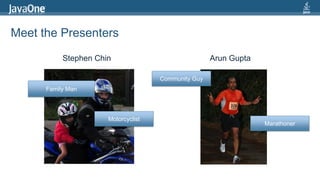
Meet the Presenters

           Stephen Chin                              Arun Gupta

                                     Community Guy
      Family Man


                      Motorcyclist
                                                                  Marathoner
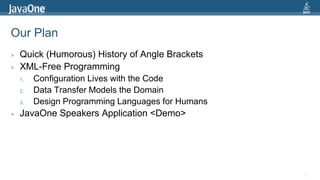
Our Plan
>   Quick (Humorous) History of Angle Brackets
>   XML-Free Programming
    1.   Configuration Lives with the Code
    2.   Data Transfer Models the Domain
    3.   Design Programming Languages for Humans
>   JavaOne Speakers Application <Demo>


                                                   3
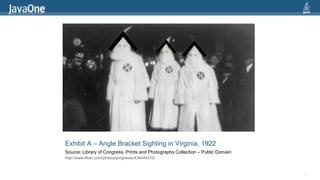
Exhibit A – Angle Bracket Sighting in Virginia, 1922
Source: Library of Congress, Prints and Photographs Collection – Public Domain
http://www.flickr.com/photos/pingnews/434444310/


                                                                                 4
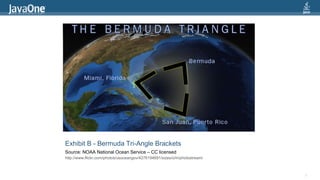
Exhibit B - Bermuda Tri-Angle Brackets
Source: NOAA National Ocean Service – CC licensed
http://www.flickr.com/photos/usoceangov/4276194691/sizes/o/in/photostream/


                                                                             5
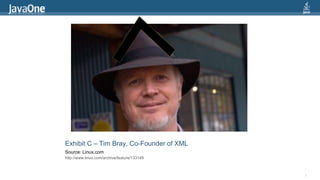
Exhibit C – Tim Bray, Co-Founder of XML
Source: Linux.com
http://www.linux.com/archive/feature/133149


                                              6
History of XML
>   Based on Standard Generalized Markup Language (SGML)
>   Created by a W3C working group of eleven members

>   Version History:
       XML 1.0 (1998) – Widely adopted with 5 subsequent revisions
       XML 1.1 (2004) – Limited adoption


                                                                      7
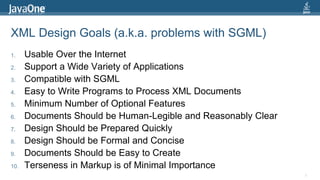
XML Design Goals (a.k.a. problems with SGML)
1.    Usable Over the Internet
2.    Support a Wide Variety of Applications
3.    Compatible with SGML
4.    Easy to Write Programs to Process XML Documents
5.    Minimum Number of Optional Features
6.    Documents Should be Human-Legible and Reasonably Clear
7.    Design Should be Prepared Quickly
8.    Design Should be Formal and Concise
9.    Documents Should be Easy to Create
10.   Terseness in Markup is of Minimal Importance
                                                               8
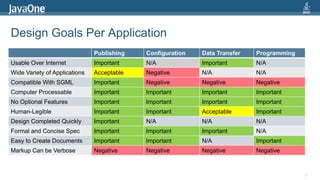
Design Goals Per Application
                               Publishing   Configuration   Data Transfer   Programming
Usable Over Internet           Important    N/A             Important       N/A
Wide Variety of Applications   Acceptable   Negative        N/A             N/A
Compatible With SGML           Important    Negative        Negative        Negative
Computer Processable           Important    Important       Important       Important
No Optional Features           Important    Important       Important       Important
Human-Legible                  Important    Important       Acceptable      Important
Design Completed Quickly       Important    N/A             N/A             N/A
Formal and Concise Spec        Important    Important       Important       N/A
Easy to Create Documents       Important    Important       N/A             Important
Markup Can be Verbose          Negative     Negative        Negative        Negative


                                                                                          9
Tenet 1


Configuration Lives with the
Code


                               10
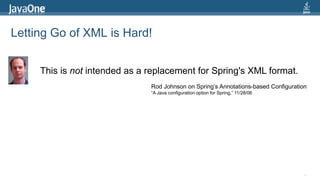
Letting Go of XML is Hard!


     This is not intended as a replacement for Spring's XML format.
                               Rod Johnson on Spring’s Annotations-based Configuration
                               “A Java configuration option for Spring,” 11/28/06


                                                                                    11
Java EE 6 Annotations
>   @Stateless
>   @Path
>   @WebServlet
>   @Inject
>   @Named
>   @Entity


                        12
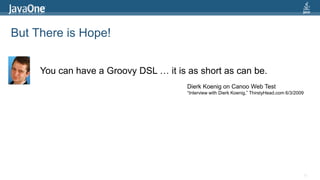
But There is Hope!


     You can have a Groovy DSL … it is as short as can be.
                                       Dierk Koenig on Canoo Web Test
                                       “Interview with Dierk Koenig,” ThirstyHead.com 6/3/2009


                                                                                             13
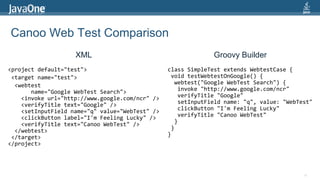
Canoo Web Test Comparison
                    XML                                        Groovy Builder
<project default="test">                         class SimpleTest extends WebtestCase {
 <target name="test">                             void testWebtestOnGoogle() {
  <webtest                                         webtest("Google WebTest Search") {
       name="Google WebTest Search">                invoke "http://www.google.com/ncr"
    <invoke url="http://www.google.com/ncr" />      verifyTitle "Google"
    <verifyTitle text="Google" />                   setInputField name: "q", value: "WebTest"
    <setInputField name="q" value="WebTest" />      clickButton "I'm Feeling Lucky"
    <clickButton label="I'm Feeling Lucky" />       verifyTitle "Canoo WebTest"
    <verifyTitle text="Canoo WebTest" />           }
  </webtest>                                      }
 </target>                                       }
</project>


                                                                                          14
Tenet 2


Data Transfer Models the
Domain


                           15
JavaScript Object Notation (JSON)
>   Matches Relational/Object-Oriented Structures
>   Easy to Read and Write
>   Simple to Parse and Generate
>   Familiar to Programmers of the C-family of languages:
       C, C++, C#, Java, JavaScript, Perl, Python, etc.
>   Very Simple Specification


                                                            16
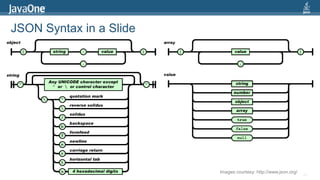
JSON Syntax in a Slide


                         Images courtesy: http://www.json.org/
                                                                 17
JAX-RS Sample
@Stateless                                             @GET
@Path("sezzion")                                       @Produces({"application/json", "application/xml"})
public class SezzionFacadeREST extends                 public List<Sezzion> findAll() {
AbstractFacade<Sezzion> {                                return super.findAll();
  @PersistenceContext                                  }
  private EntityManager em;
                                                        @GET
@POST                                                   @Path("{from}/{to}")
@Consumes({"application/json", "application/xml"})      @Produces({"application/xml", "application/json"})
 public void create(Sezzion entity) {                   public List<Sezzion> findRange(@PathParam("from") Integer
   super.create(entity);                             from, @PathParam("to") Integer to) {
 }                                                        return super.findRange(new int[]{from, to});
                                                        }


                                                                                                              18
Tenet 3


Design Programming
Languages for Humans


                       19
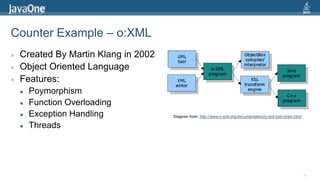
Counter Example – o:XML
>   Created By Martin Klang in 2002
>   Object Oriented Language
>   Features:
       Poymorphism
       Function Overloading
       Exception Handling            Diagram from: http://www.o-xml.org/documentation/o-xml-tool-chain.html

       Threads


                                                                                                               20
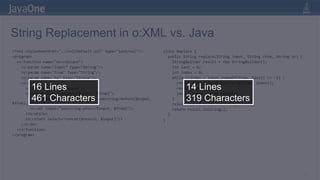
String Replacement in o:XML vs. Java
<?xml-stylesheethref="../xsl/default.xsl" type="text/xsl"?>       class Replace {
<program>                                                           public String replace(String input, String from, String to) {
  <o:function name="ex:replace">                                      StringBuilder result = new StringBuilder();
    <o:param name="input" type="String"/>                             int last = 0;
    <o:param name="from" type="String"/>                              int index = 0;
    <o:param name="to" type="String"/>                                while ((index = input.indexOf(from, last)) != -1) {
    <o:do>                                                              result.append(input.substring(last, index));
        16 Lines
      <o:variable name="result"/>                                           14 Lines
                                                                        result.append(to);
      <o:while test="contains($input, $from)">                          last = index + from.length()
        461 Characters
        <o:set result="concat($result, substring-before($input,
$from), $to)"/>
                                                                      }     319 Characters
                                                                      result.append(input.substring(last));
        <o:set input="substring-after($input, $from)"/>               return result.toString();
      </o:while>                                                    }
      <o:return select="concat($result, $input)"/>                }
    </o:do>
  </o:function>
</program>


                                                                                                                                    21
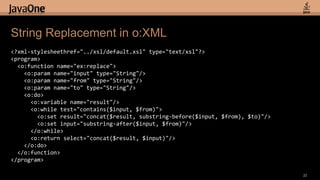
String Replacement in o:XML
<?xml-stylesheethref="../xsl/default.xsl" type="text/xsl"?>
<program>
  <o:function name="ex:replace">
    <o:param name="input" type="String"/>
    <o:param name="from" type="String"/>
    <o:param name="to" type="String"/>
    <o:do>
      <o:variable name="result"/>
      <o:while test="contains($input, $from)">
        <o:set result="concat($result, substring-before($input, $from), $to)"/>
        <o:set input="substring-after($input, $from)"/>
      </o:while>
      <o:return select="concat($result, $input)"/>
    </o:do>
  </o:function>
</program>

                                                                                  22
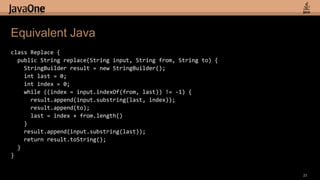
Equivalent Java
class Replace {
  public String replace(String input, String from, String to) {
    StringBuilder result = new StringBuilder();
    int last = 0;
    int index = 0;
    while ((index = input.indexOf(from, last)) != -1) {
      result.append(input.substring(last, index));
      result.append(to);
      last = index + from.length()
    }
    result.append(input.substring(last));
    return result.toString();
  }
}


                                                                  23
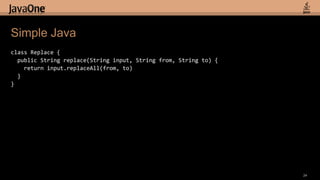
Simple Java
class Replace {
  public String replace(String input, String from, String to) {
    return input.replaceAll(from, to)
  }
}


                                                                  24
JavaFX 2.0
>   Powerful graphics, animation, and media capabilities
>   Deploys in the browser or on desktop
>   Includes builders for declarative construction
>   Alternative languages can also be used for simpler UI creation
       GroovyFX
       ScalaFX
       Visage


                                                                     25
Hello JavaOne (Java Version)
public class HelloJavaOne extends Application {
  public static void main(String[] args) {
    launch(HelloJavaOne.class, args);
  }
  @Override
  public void start(Stage primaryStage) {
    primaryStage.setTitle("Hello JavaOne");
    Group root = new Group();
    Scene scene = new Scene(root, 400, 250, Color.ALICEBLUE);
    Text text = new Text();
    text.setX(105);
    text.setY(120);
    text.setFont(new Font(30));
    text.setText("Hello JavaOne");
    root.getChildren().add(text);
    primaryStage.setScene(scene);
    primaryStage.show();
  }
}
                                                                26
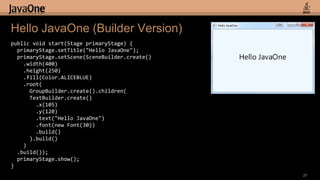
Hello JavaOne (Builder Version)
public void start(Stage primaryStage) {
  primaryStage.setTitle("Hello JavaOne");
  primaryStage.setScene(SceneBuilder.create()
    .width(400)
    .height(250)
    .fill(Color.ALICEBLUE)
    .root(
      GroupBuilder.create().children(
      TextBuilder.create()
        .x(105)
        .y(120)
        .text("Hello JavaOne")
        .font(new Font(30))
        .build()
      ).build()
    )
  .build());
  primaryStage.show();
}
                                                27
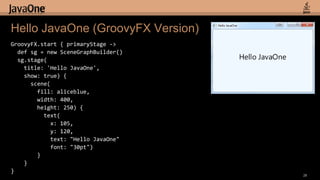
Hello JavaOne (GroovyFX Version)
GroovyFX.start { primaryStage ->
  def sg = new SceneGraphBuilder()
  sg.stage(
    title: 'Hello JavaOne',
    show: true) {
      scene(
        fill: aliceblue,
        width: 400,
        height: 250) {
          text(
             x: 105,
             y: 120,
             text: "Hello JavaOne"
             font: "30pt")
        }
    }
}
                                     28
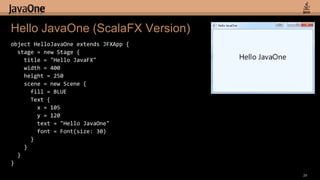
Hello JavaOne (ScalaFX Version)
object HelloJavaOne extends JFXApp {
  stage = new Stage {
    title = "Hello JavaFX"
    width = 400
    height = 250
    scene = new Scene {
      fill = BLUE
      Text {
        x = 105
        y = 120
        text = "Hello JavaOne"
        font = Font(size: 30)
      }
    }
  }
}
                                       29
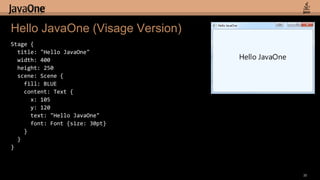
Hello JavaOne (Visage Version)
Stage {
  title: "Hello JavaOne"
  width: 400
  height: 250
  scene: Scene {
    fill: BLUE
    content: Text {
      x: 105
      y: 120
      text: "Hello JavaOne"
      font: Font {size: 30pt}
    }
  }
}


                                 30
JavaOne Speakers Application
>   End-to-end application with no XML coding
>   Server written using JavaEE 6 annotations
>   Data transfer uses JSON
>   Client written in JavaFX 2.0


                                                31
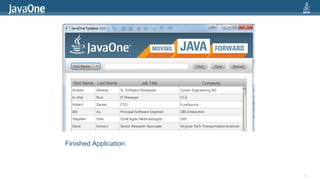
Finished Application


                       32
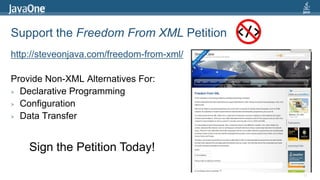
Support the Freedom From XML Petition      </>
http://steveonjava.com/freedom-from-xml/

Provide Non-XML Alternatives For:
> Declarative Programming

> Configuration

> Data Transfer


    Sign the Petition Today!

                                                 33
Stephen Chin            Arun Gupta
steveonjava@gmail.com   arun.p.gupta@oracle.com
tweet: @steveonjava     tweet: @arungupta


                                                  34

XML-Free Programming : Java Server and Client Development without &lt;>

  • 1.
    XML-Free Programming :Java Server and Client Development Without <> Stephen Chin Arun Gupta Chief Agile Methodologist, GXS Oracle Corporation steveonjava@gmail.com arun.p.gupta@oracle.com tweet: @steveonjava tweet: @arungupta
  • 2.
    Meet the Presenters Stephen Chin Arun Gupta Community Guy Family Man Motorcyclist Marathoner
  • 3.
    Our Plan > Quick (Humorous) History of Angle Brackets > XML-Free Programming 1. Configuration Lives with the Code 2. Data Transfer Models the Domain 3. Design Programming Languages for Humans > JavaOne Speakers Application <Demo> 3
  • 4.
    Exhibit A –Angle Bracket Sighting in Virginia, 1922 Source: Library of Congress, Prints and Photographs Collection – Public Domain http://www.flickr.com/photos/pingnews/434444310/ 4
  • 5.
    Exhibit B -Bermuda Tri-Angle Brackets Source: NOAA National Ocean Service – CC licensed http://www.flickr.com/photos/usoceangov/4276194691/sizes/o/in/photostream/ 5
  • 6.
    Exhibit C –Tim Bray, Co-Founder of XML Source: Linux.com http://www.linux.com/archive/feature/133149 6
  • 7.
    History of XML > Based on Standard Generalized Markup Language (SGML) > Created by a W3C working group of eleven members > Version History:  XML 1.0 (1998) – Widely adopted with 5 subsequent revisions  XML 1.1 (2004) – Limited adoption 7
  • 8.
    XML Design Goals(a.k.a. problems with SGML) 1. Usable Over the Internet 2. Support a Wide Variety of Applications 3. Compatible with SGML 4. Easy to Write Programs to Process XML Documents 5. Minimum Number of Optional Features 6. Documents Should be Human-Legible and Reasonably Clear 7. Design Should be Prepared Quickly 8. Design Should be Formal and Concise 9. Documents Should be Easy to Create 10. Terseness in Markup is of Minimal Importance 8
  • 9.
    Design Goals PerApplication Publishing Configuration Data Transfer Programming Usable Over Internet Important N/A Important N/A Wide Variety of Applications Acceptable Negative N/A N/A Compatible With SGML Important Negative Negative Negative Computer Processable Important Important Important Important No Optional Features Important Important Important Important Human-Legible Important Important Acceptable Important Design Completed Quickly Important N/A N/A N/A Formal and Concise Spec Important Important Important N/A Easy to Create Documents Important Important N/A Important Markup Can be Verbose Negative Negative Negative Negative 9
  • 10.
  • 11.
    Letting Go ofXML is Hard! This is not intended as a replacement for Spring's XML format. Rod Johnson on Spring’s Annotations-based Configuration “A Java configuration option for Spring,” 11/28/06 11
  • 12.
    Java EE 6Annotations > @Stateless > @Path > @WebServlet > @Inject > @Named > @Entity 12
  • 13.
    But There isHope! You can have a Groovy DSL … it is as short as can be. Dierk Koenig on Canoo Web Test “Interview with Dierk Koenig,” ThirstyHead.com 6/3/2009 13
  • 14.
    Canoo Web TestComparison XML Groovy Builder <project default="test"> class SimpleTest extends WebtestCase { <target name="test"> void testWebtestOnGoogle() { <webtest webtest("Google WebTest Search") { name="Google WebTest Search"> invoke "http://www.google.com/ncr" <invoke url="http://www.google.com/ncr" /> verifyTitle "Google" <verifyTitle text="Google" /> setInputField name: "q", value: "WebTest" <setInputField name="q" value="WebTest" /> clickButton "I'm Feeling Lucky" <clickButton label="I'm Feeling Lucky" /> verifyTitle "Canoo WebTest" <verifyTitle text="Canoo WebTest" /> } </webtest> } </target> } </project> 14
  • 15.
    Tenet 2 Data TransferModels the Domain 15
  • 16.
    JavaScript Object Notation(JSON) > Matches Relational/Object-Oriented Structures > Easy to Read and Write > Simple to Parse and Generate > Familiar to Programmers of the C-family of languages:  C, C++, C#, Java, JavaScript, Perl, Python, etc. > Very Simple Specification 16
  • 17.
    JSON Syntax ina Slide Images courtesy: http://www.json.org/ 17
  • 18.
    JAX-RS Sample @Stateless @GET @Path("sezzion") @Produces({"application/json", "application/xml"}) public class SezzionFacadeREST extends public List<Sezzion> findAll() { AbstractFacade<Sezzion> { return super.findAll(); @PersistenceContext } private EntityManager em; @GET @POST @Path("{from}/{to}") @Consumes({"application/json", "application/xml"}) @Produces({"application/xml", "application/json"}) public void create(Sezzion entity) { public List<Sezzion> findRange(@PathParam("from") Integer super.create(entity); from, @PathParam("to") Integer to) { } return super.findRange(new int[]{from, to}); } 18
  • 19.
  • 20.
    Counter Example –o:XML > Created By Martin Klang in 2002 > Object Oriented Language > Features:  Poymorphism  Function Overloading  Exception Handling Diagram from: http://www.o-xml.org/documentation/o-xml-tool-chain.html  Threads 20
  • 21.
    String Replacement ino:XML vs. Java <?xml-stylesheethref="../xsl/default.xsl" type="text/xsl"?> class Replace { <program> public String replace(String input, String from, String to) { <o:function name="ex:replace"> StringBuilder result = new StringBuilder(); <o:param name="input" type="String"/> int last = 0; <o:param name="from" type="String"/> int index = 0; <o:param name="to" type="String"/> while ((index = input.indexOf(from, last)) != -1) { <o:do> result.append(input.substring(last, index)); 16 Lines <o:variable name="result"/> 14 Lines result.append(to); <o:while test="contains($input, $from)"> last = index + from.length() 461 Characters <o:set result="concat($result, substring-before($input, $from), $to)"/> } 319 Characters result.append(input.substring(last)); <o:set input="substring-after($input, $from)"/> return result.toString(); </o:while> } <o:return select="concat($result, $input)"/> } </o:do> </o:function> </program> 21
  • 22.
    String Replacement ino:XML <?xml-stylesheethref="../xsl/default.xsl" type="text/xsl"?> <program> <o:function name="ex:replace"> <o:param name="input" type="String"/> <o:param name="from" type="String"/> <o:param name="to" type="String"/> <o:do> <o:variable name="result"/> <o:while test="contains($input, $from)"> <o:set result="concat($result, substring-before($input, $from), $to)"/> <o:set input="substring-after($input, $from)"/> </o:while> <o:return select="concat($result, $input)"/> </o:do> </o:function> </program> 22
  • 23.
    Equivalent Java class Replace{ public String replace(String input, String from, String to) { StringBuilder result = new StringBuilder(); int last = 0; int index = 0; while ((index = input.indexOf(from, last)) != -1) { result.append(input.substring(last, index)); result.append(to); last = index + from.length() } result.append(input.substring(last)); return result.toString(); } } 23
  • 24.
    Simple Java class Replace{ public String replace(String input, String from, String to) { return input.replaceAll(from, to) } } 24
  • 25.
    JavaFX 2.0 > Powerful graphics, animation, and media capabilities > Deploys in the browser or on desktop > Includes builders for declarative construction > Alternative languages can also be used for simpler UI creation  GroovyFX  ScalaFX  Visage 25
  • 26.
    Hello JavaOne (JavaVersion) public class HelloJavaOne extends Application { public static void main(String[] args) { launch(HelloJavaOne.class, args); } @Override public void start(Stage primaryStage) { primaryStage.setTitle("Hello JavaOne"); Group root = new Group(); Scene scene = new Scene(root, 400, 250, Color.ALICEBLUE); Text text = new Text(); text.setX(105); text.setY(120); text.setFont(new Font(30)); text.setText("Hello JavaOne"); root.getChildren().add(text); primaryStage.setScene(scene); primaryStage.show(); } } 26
  • 27.
    Hello JavaOne (BuilderVersion) public void start(Stage primaryStage) { primaryStage.setTitle("Hello JavaOne"); primaryStage.setScene(SceneBuilder.create() .width(400) .height(250) .fill(Color.ALICEBLUE) .root( GroupBuilder.create().children( TextBuilder.create() .x(105) .y(120) .text("Hello JavaOne") .font(new Font(30)) .build() ).build() ) .build()); primaryStage.show(); } 27
  • 28.
    Hello JavaOne (GroovyFXVersion) GroovyFX.start { primaryStage -> def sg = new SceneGraphBuilder() sg.stage( title: 'Hello JavaOne', show: true) { scene( fill: aliceblue, width: 400, height: 250) { text( x: 105, y: 120, text: "Hello JavaOne" font: "30pt") } } } 28
  • 29.
    Hello JavaOne (ScalaFXVersion) object HelloJavaOne extends JFXApp { stage = new Stage { title = "Hello JavaFX" width = 400 height = 250 scene = new Scene { fill = BLUE Text { x = 105 y = 120 text = "Hello JavaOne" font = Font(size: 30) } } } } 29
  • 30.
    Hello JavaOne (VisageVersion) Stage { title: "Hello JavaOne" width: 400 height: 250 scene: Scene { fill: BLUE content: Text { x: 105 y: 120 text: "Hello JavaOne" font: Font {size: 30pt} } } } 30
  • 31.
    JavaOne Speakers Application > End-to-end application with no XML coding > Server written using JavaEE 6 annotations > Data transfer uses JSON > Client written in JavaFX 2.0 31
  • 32.
  • 33.
    Support the FreedomFrom XML Petition </> http://steveonjava.com/freedom-from-xml/ Provide Non-XML Alternatives For: > Declarative Programming > Configuration > Data Transfer Sign the Petition Today! 33
  • 34.
    Stephen Chin Arun Gupta steveonjava@gmail.com arun.p.gupta@oracle.com tweet: @steveonjava tweet: @arungupta 34