Highlights from Java 10 and 11
and Future of Java
by Vadym Kazulkin, ip.labs GmbH
Contact
Vadym Kazulkin, ip.labs GmbH
v.kazulkin@gmail.com
www.xing.com/profile/Vadym_Kazulkin
@VKazulkin
ip.labs GmbH
Highlights from Java 10
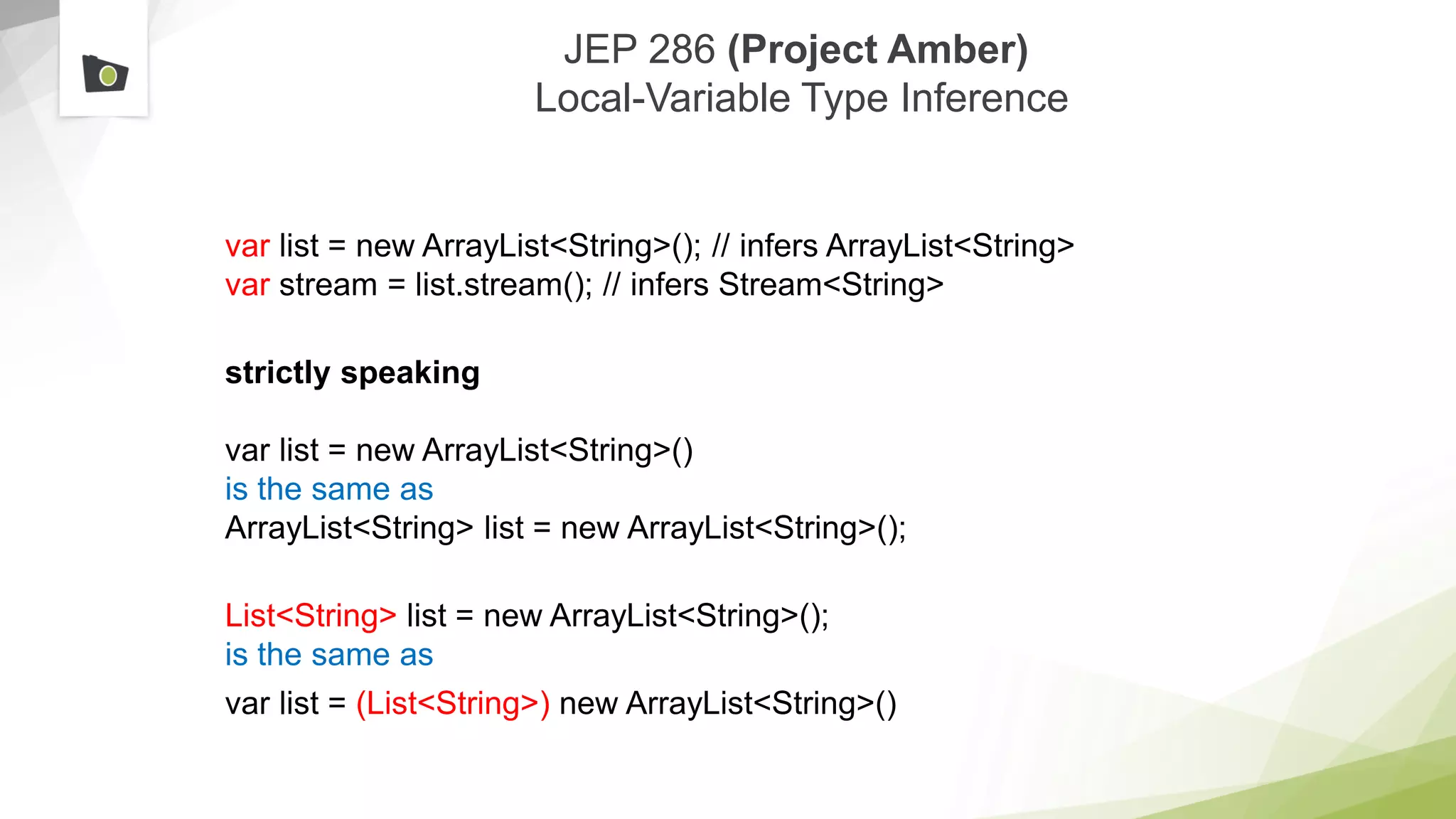
JEP 286 (Project Amber)
Local-Variable Type Inference
var list = new ArrayList<String>(); // infers ArrayList<String>
var stream = list.stream(); // infers Stream<String>
strictly speaking
var list = new ArrayList<String>()
is the same as
ArrayList<String> list = new ArrayList<String>();
List<String> list = new ArrayList<String>();
is the same as
var list = (List<String>) new ArrayList<String>()
JEP 307
Parallel Full GC for G1
Goal:
● Improve G1 worst-case latencies (when the concurrent collections can't
reclaim memory fast enough) by making the full GC parallel.
JEP 304
Garbage Collector Interface
Goals:
● Better modularity for HotSpot internal GC code
● Make it simpler to add a new GC to HotSpot without perturbing the current
code base
● Make it easier to exclude a GC from a JDK build
JEP 317
Experimental Java-Based JIT Compiler
Graal, a Java-based JIT compiler on the Linux/x64 platform, is the basis of the
experimental Ahead-of-Time (AOT) compiler introduced in JDK 9.
To Enable:
-XX:+UnlockExperimentalVMOptions -XX:+UseJVMCICompiler
Miscellanious API Changes
Better container-awareness
● Before later versions of Java 8
– Runtime.getRuntime().availableProcessors() -> retrieves value from sysconf, means the total
number of processors for VM
– Runtime.getRuntime().maxMemory() -> gets the value for VM overall memory
● Java 9 is container-aware automatically detecting cpusets
JVM considers cgroups memory limits if the following flags are specified:
– -XX:+UseCGroupMemoryLimitForHeap
– -XX:+UnlockExperimentalVMOptions
– Max Heap space will be automatically set (if not overwritten) to the limit specified by the cgroup
Miscellanious API Changes
Better container-awareness
● For “fixing” CPU shares in Java 9 overwrite
– -XMX for memory
– -XX:ParallelGCThreads and -XX:ConcGCThreads for CPU
– -System property java.util.concurrent.ForkJoinPool.common.parallelism for ForkJoinPool
● Better container-awareness in Java 10 (CPU shares support is included)
– Runtime.getRuntime().availableProcessors()
– Runtime.getRuntime().maxMemory()
Sources: „Java SE 9 support for Docker CPU and memory limits“https://blogs.oracle.com/java-platform-group/java-se-support-for-
docker-cpu-and-memory-limits
„ Nobody puts Java in a container” https://jaxenter.com/nobody-puts-java-container-139373.html
„Improve docker container detection and resource configuration usage” https://bugs.openjdk.java.net/browse/JDK-8146115
„ Better containerized JVMs in JDK 10” https://jaxenter.com/better-containerized-jvms-jdk-10-140593.html
Miscellanious API Changes
● java.util.List, Set, Map.copyOf(Collection)
● java.util.stream.Collectors.toUnmodifiableList/Set/Map(Stream)
● Optional.orElseThrow()
Highlights from Java 11
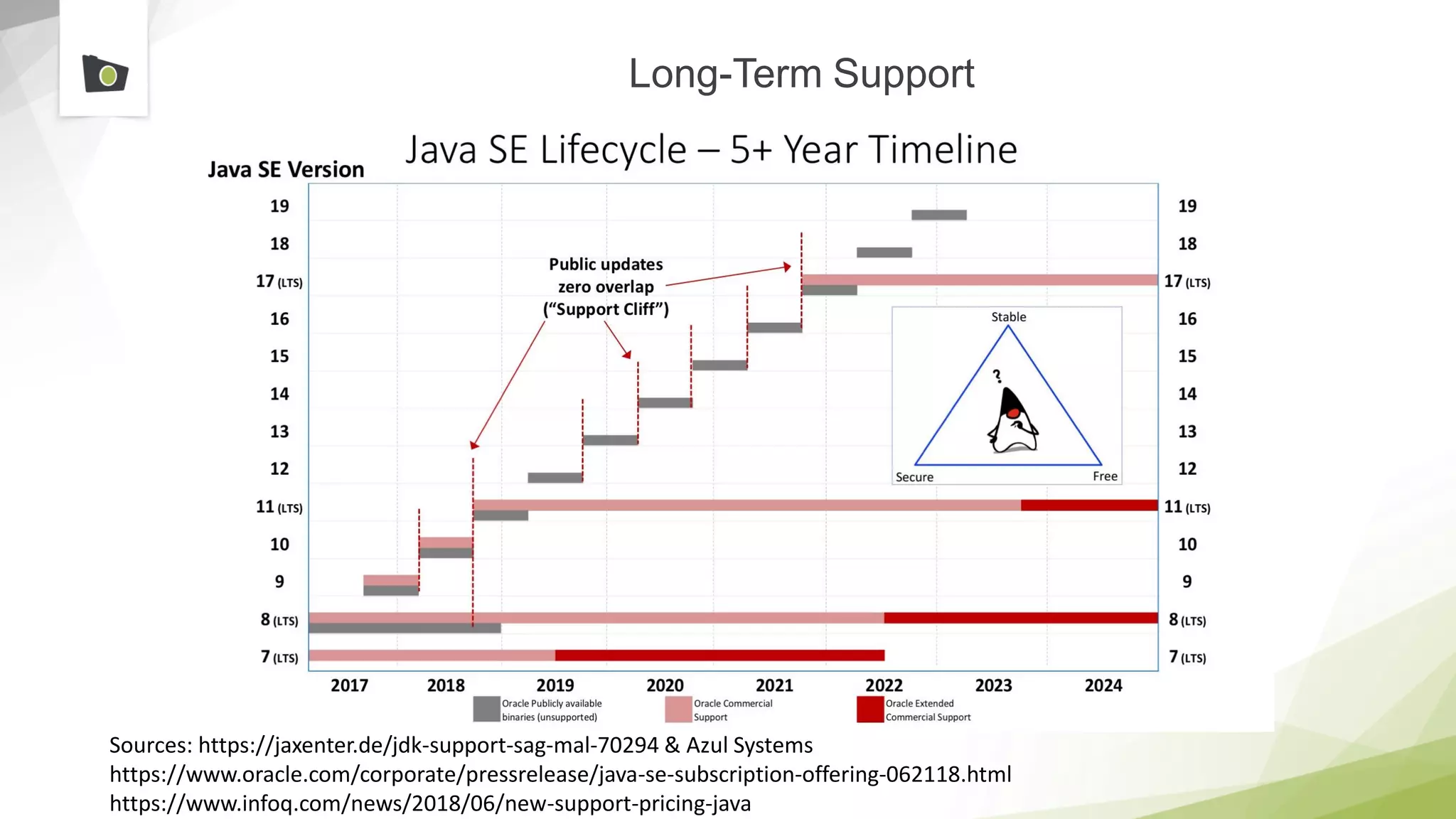
Long-Term Support
Sources: https://jaxenter.de/jdk-support-sag-mal-70294 & Azul Systems
https://www.oracle.com/corporate/pressrelease/java-se-subscription-offering-062118.html
https://www.infoq.com/news/2018/06/new-support-pricing-java
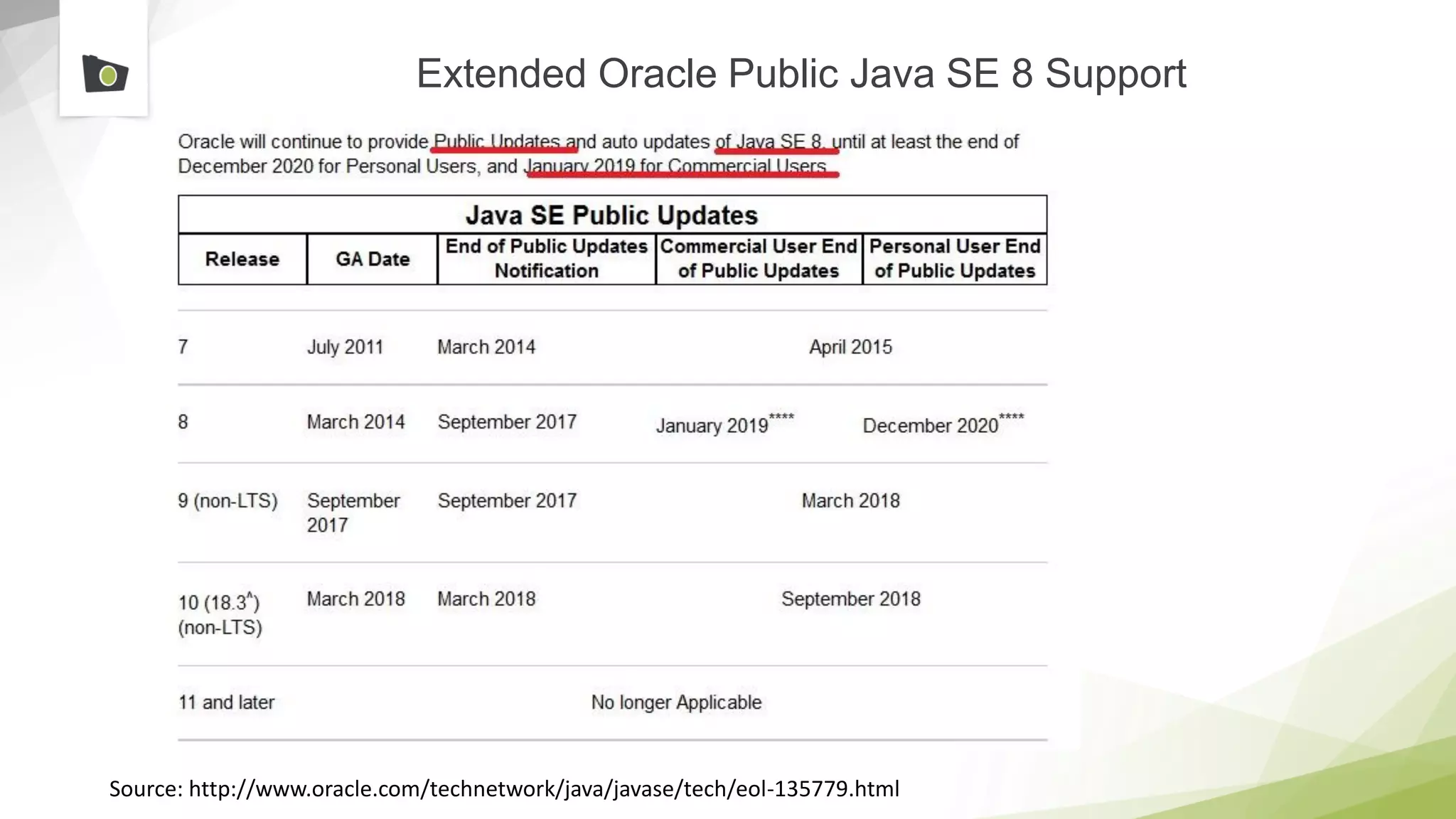
Extended Oracle Public Java SE 8 Support
Source: http://www.oracle.com/technetwork/java/javase/tech/eol-135779.html
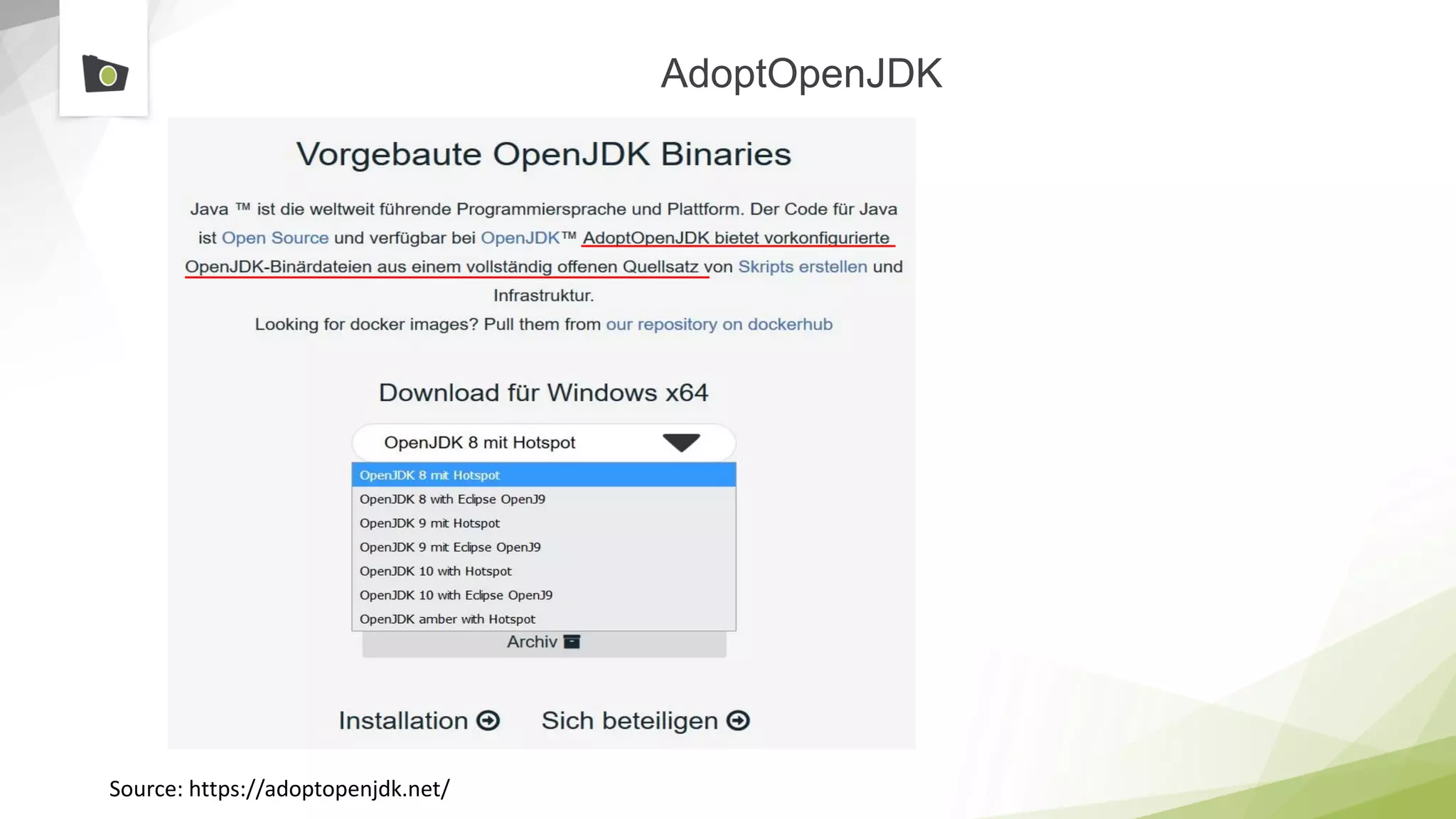
AdoptOpenJDK
Source: https://adoptopenjdk.net/
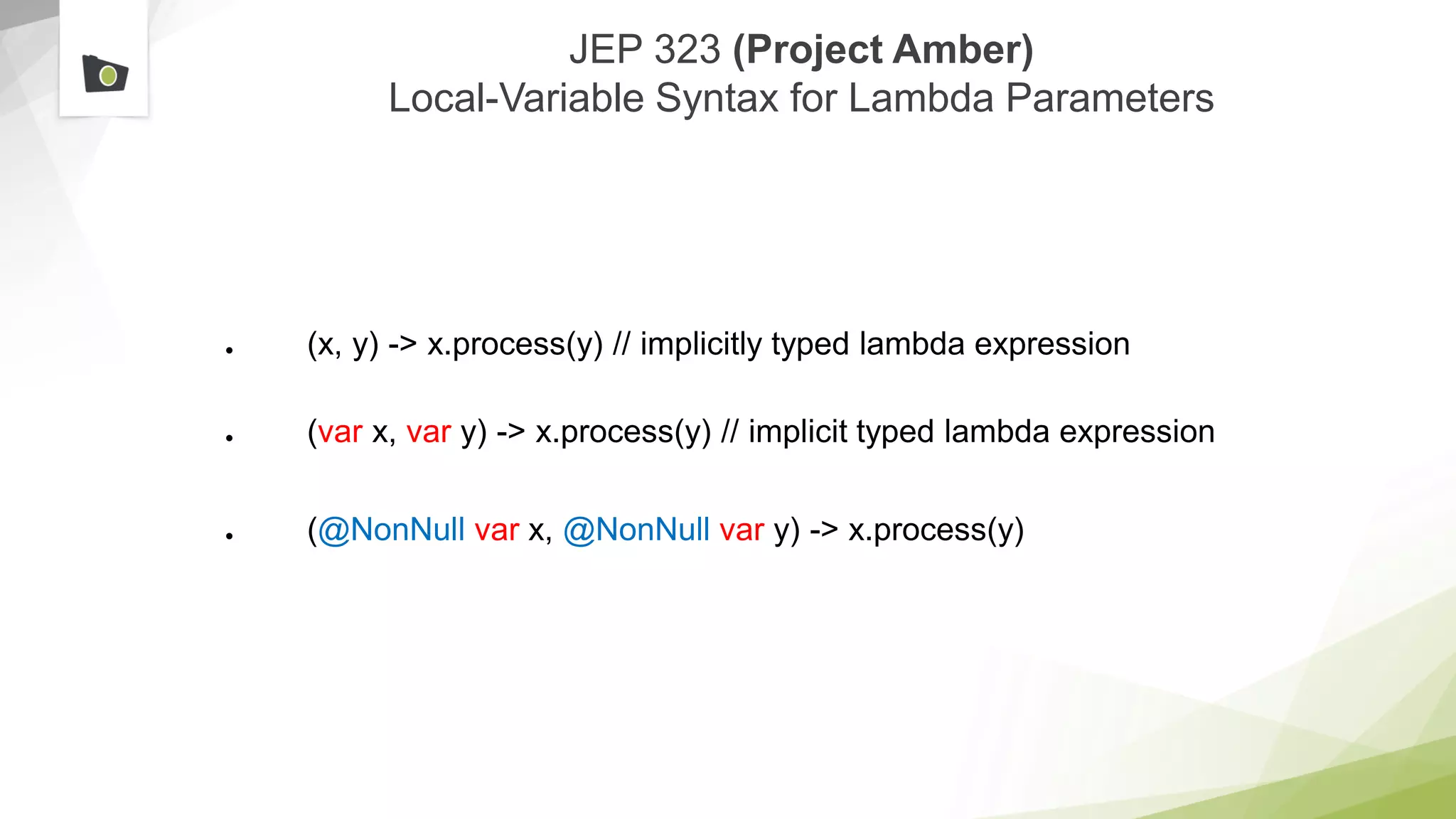
JEP 323 (Project Amber)
Local-Variable Syntax for Lambda Parameters
● (x, y) -> x.process(y) // implicitly typed lambda expression
● (var x, var y) -> x.process(y) // implicit typed lambda expression
● (@NonNull var x, @NonNull var y) -> x.process(y)
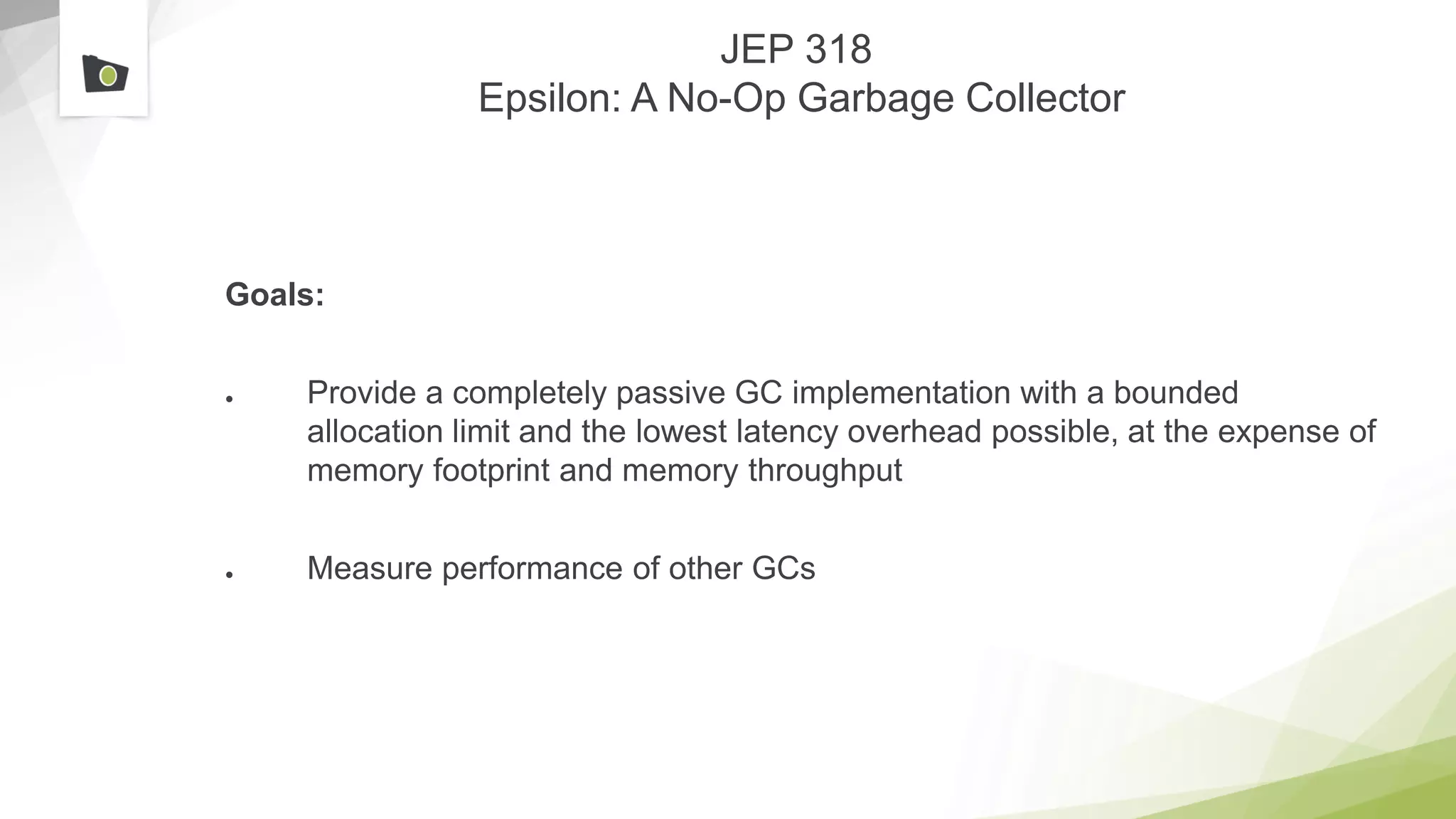
JEP 318
Epsilon: A No-Op Garbage Collector
Goals:
● Provide a completely passive GC implementation with a bounded
allocation limit and the lowest latency overhead possible, at the expense of
memory footprint and memory throughput
● Measure performance of other GCs
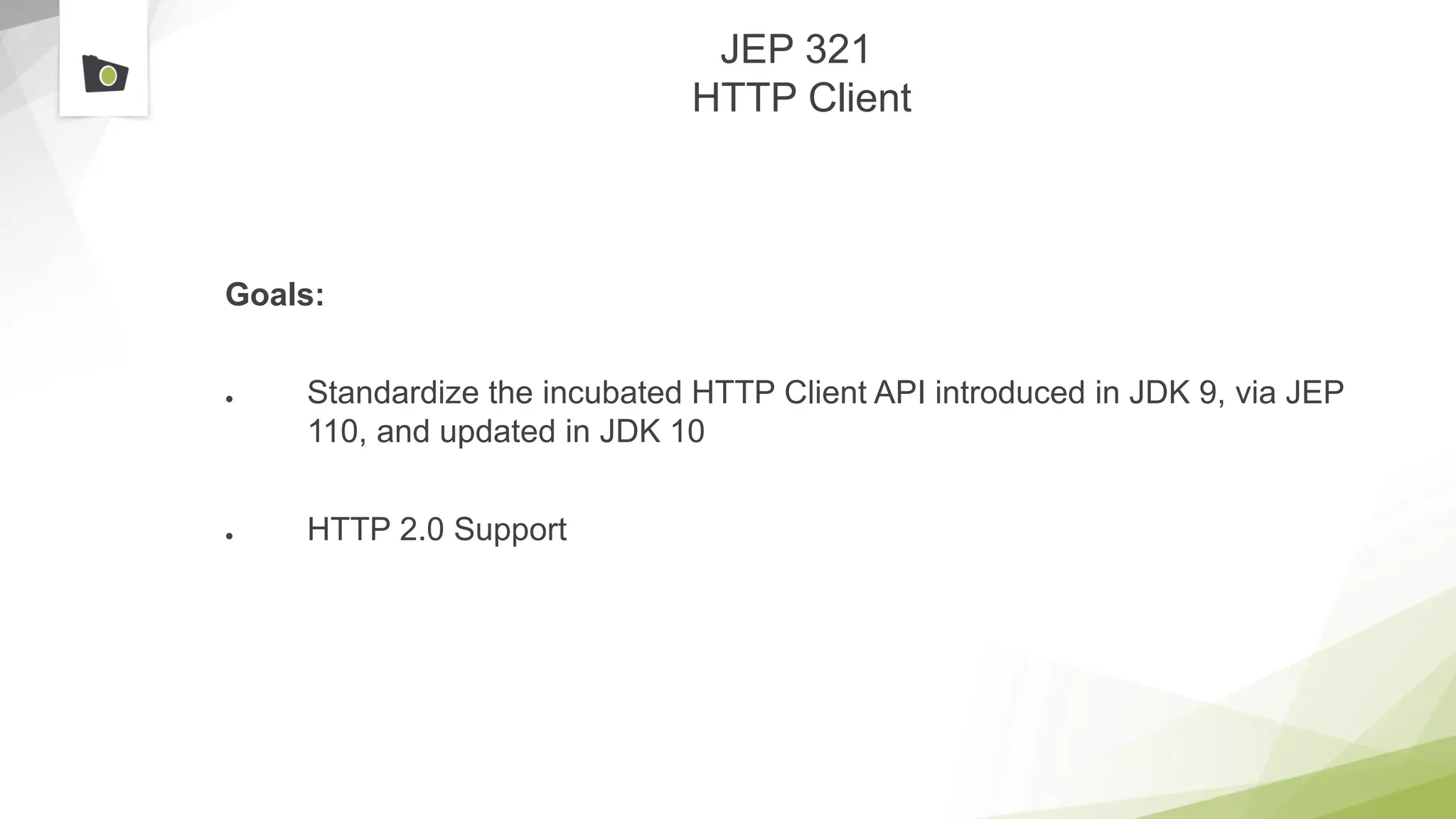
JEP 321
HTTP Client
Goals:
● Standardize the incubated HTTP Client API introduced in JDK 9, via JEP
110, and updated in JDK 10
● HTTP 2.0 Support
JEP 332
Transport Layer Security 1.3
Goal:
● Implement version 1.3 of the Transport Layer Security (TLS) Protocol
Miscellanious API Changes
● File.isSameContents() in addition to File.isSameFile()
● New methods and behaviour on the Java String class
– trim() method : uses the definition of space as any codepoint that is less than or equal to the
space character codepoint (u0040.)
– String.lines() and String.strip() also use this definition
– isBlank() : true if the string is empty or contains only white space
– stripLeading(), stripTrailing() : removal of Unicode white space from the beginning/end
Sources: https://bugs.openjdk.java.net/browse/JDK-8202285
https://www.javacodegeeks.com/2018/05/new-jdk-11-files-method-issamecontent.html
Future of Java
Beyond Java 11
Project Amber
Simplifying syntax (continuing)
Source: http://openjdk.java.net/projects/amber/
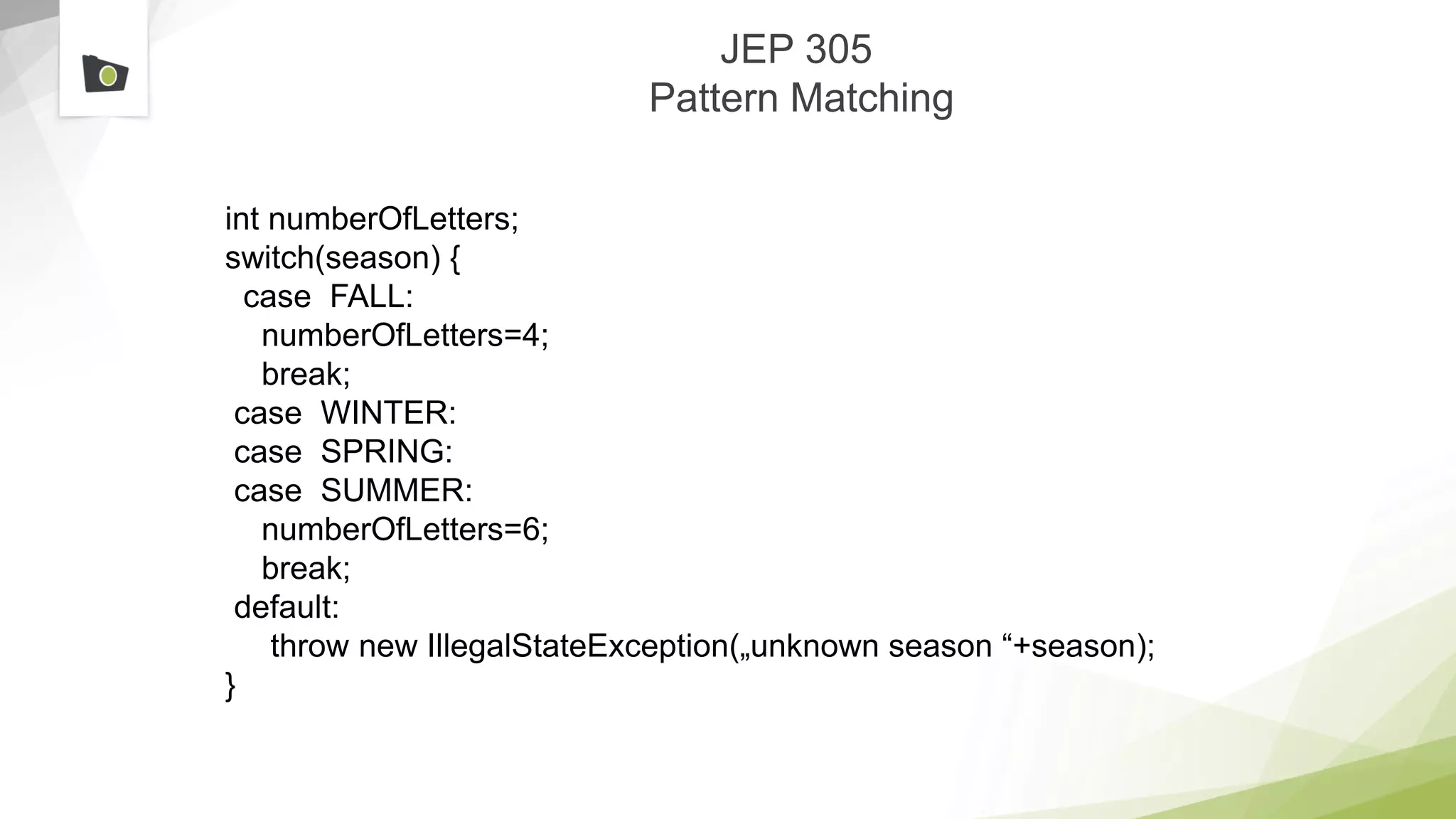
JEP 305
Pattern Matching
int numberOfLetters;
switch(season) {
case FALL:
numberOfLetters=4;
break;
case WINTER:
case SPRING:
case SUMMER:
numberOfLetters=6;
break;
default:
throw new IllegalStateException(„unknown season “+season);
}
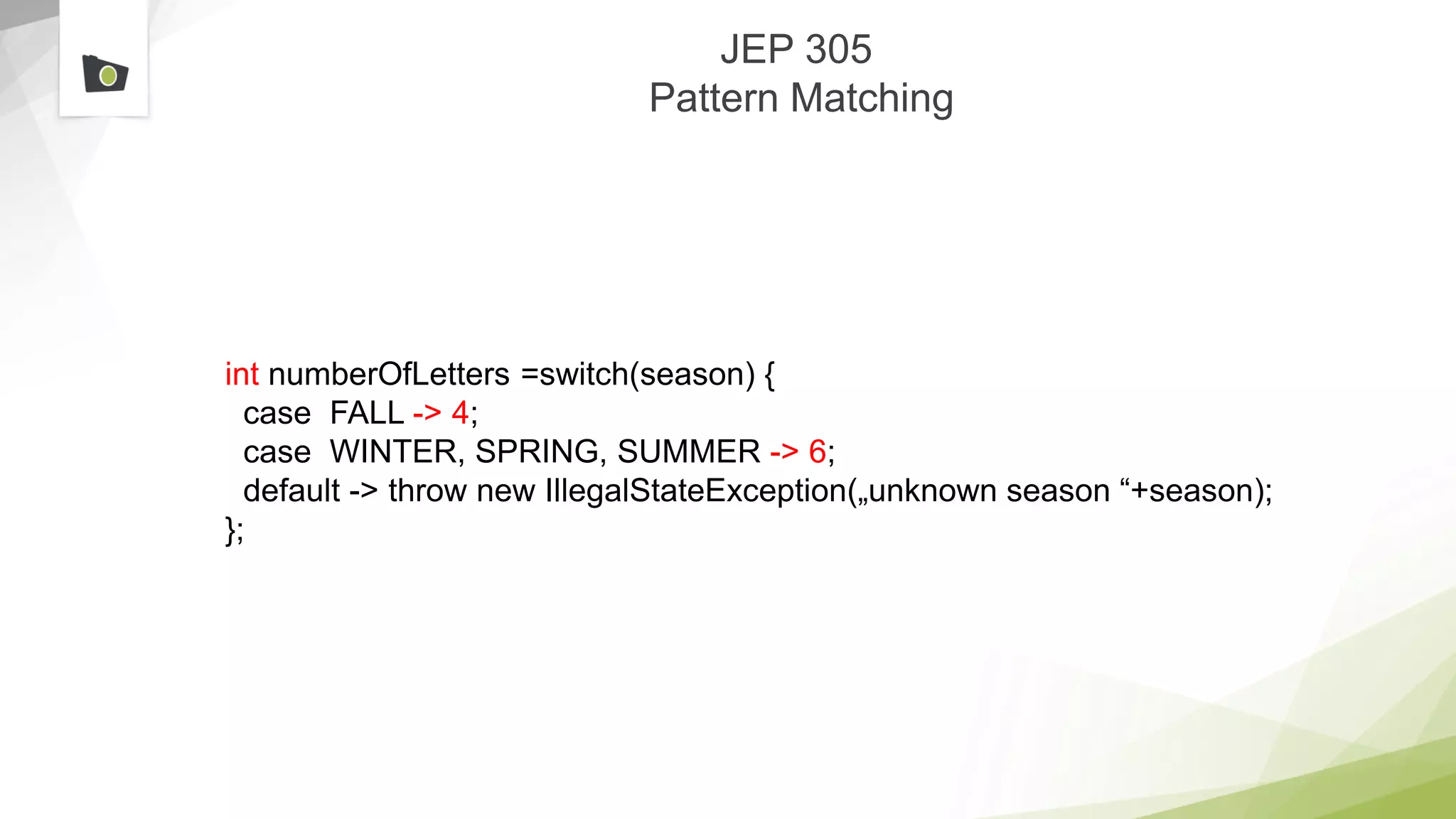
JEP 305
Pattern Matching
int numberOfLetters =switch(season) {
case FALL -> 4;
case WINTER, SPRING, SUMMER -> 6;
default -> throw new IllegalStateException(„unknown season “+season);
};
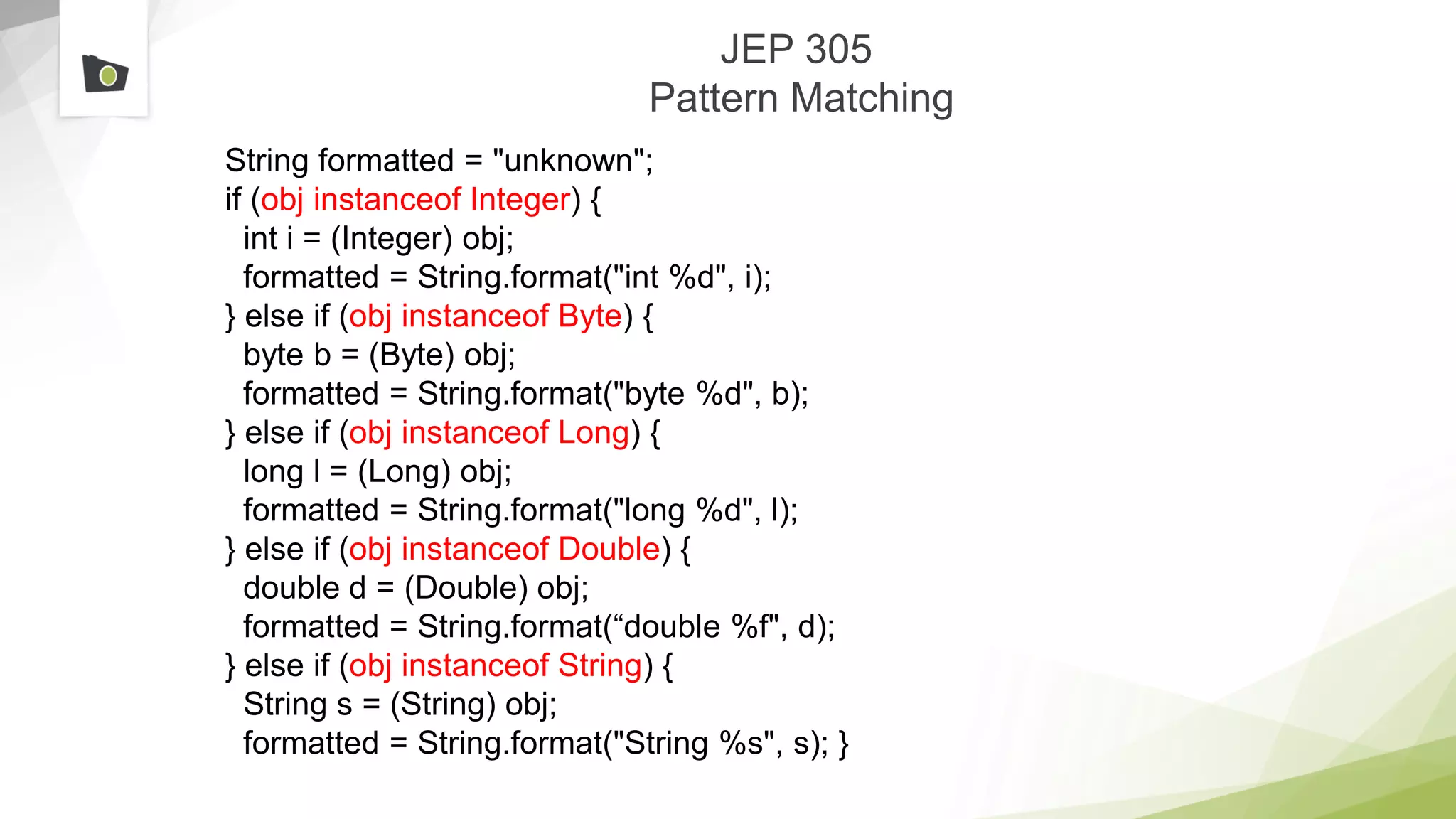
JEP 305
Pattern Matching
String formatted = "unknown";
if (obj instanceof Integer) {
int i = (Integer) obj;
formatted = String.format("int %d", i);
} else if (obj instanceof Byte) {
byte b = (Byte) obj;
formatted = String.format("byte %d", b);
} else if (obj instanceof Long) {
long l = (Long) obj;
formatted = String.format("long %d", l);
} else if (obj instanceof Double) {
double d = (Double) obj;
formatted = String.format(“double %f", d);
} else if (obj instanceof String) {
String s = (String) obj;
formatted = String.format("String %s", s); }
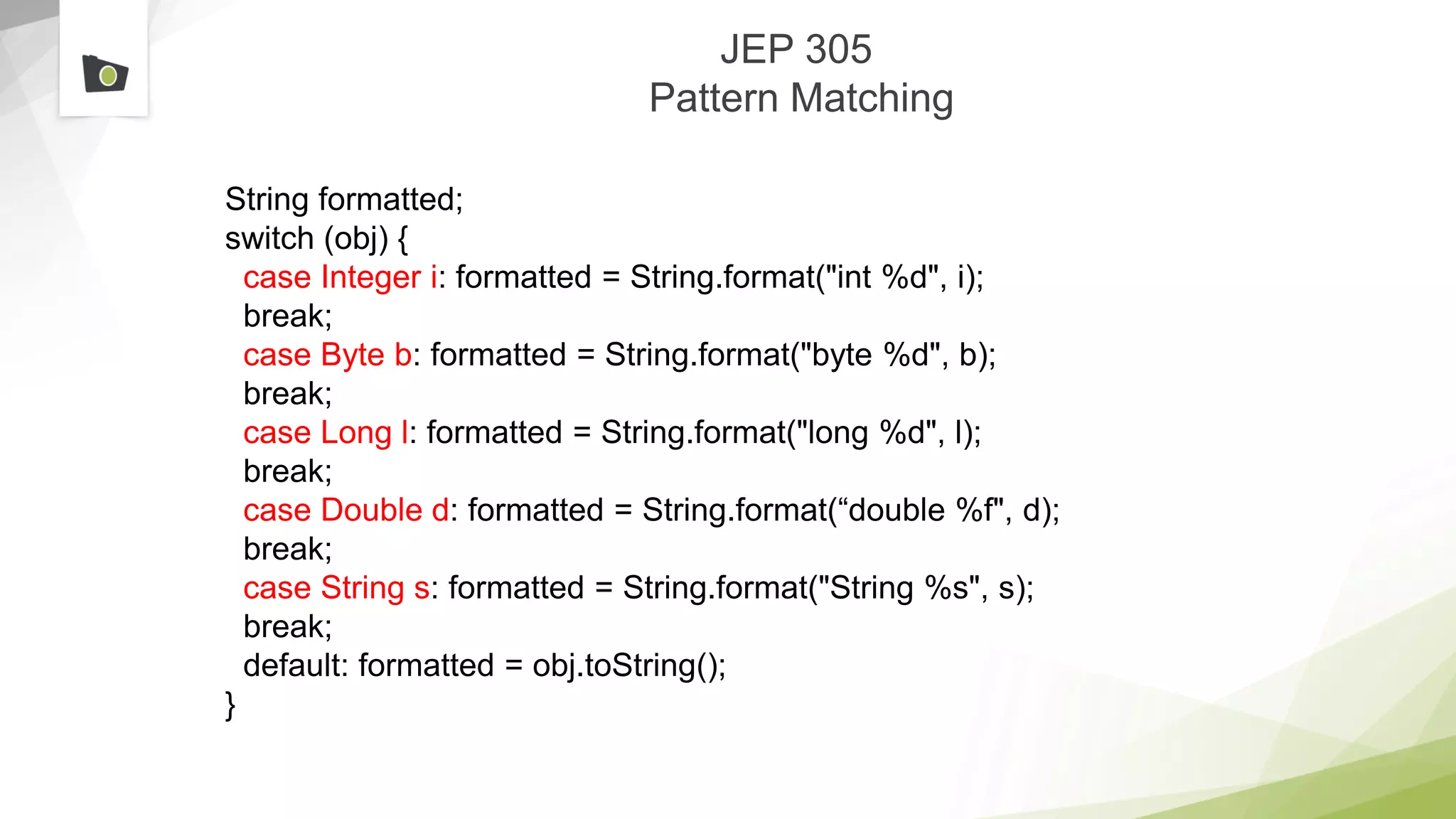
JEP 305
Pattern Matching
String formatted;
switch (obj) {
case Integer i: formatted = String.format("int %d", i);
break;
case Byte b: formatted = String.format("byte %d", b);
break;
case Long l: formatted = String.format("long %d", l);
break;
case Double d: formatted = String.format(“double %f", d);
break;
case String s: formatted = String.format("String %s", s);
break;
default: formatted = obj.toString();
}
Project Valhalla
Value types and specialised generics
Source: http://openjdk.java.net/projects/valhalla/
Project Valhalla
Value Object
Value Object is an immutable type that is distinguishable only
by the state of its properties
Project Valhalla
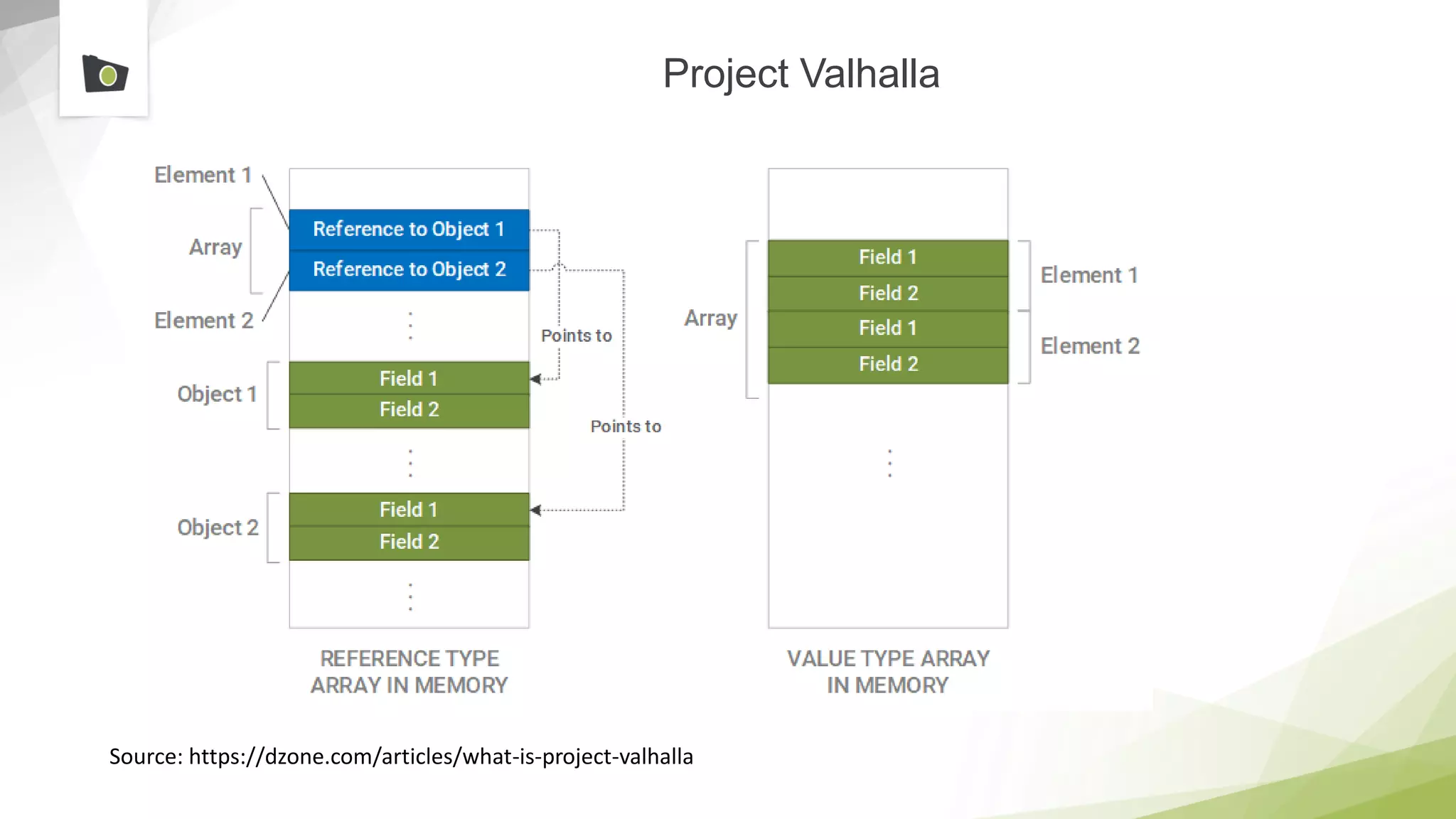
Source: https://dzone.com/articles/what-is-project-valhalla
Project Valhalla
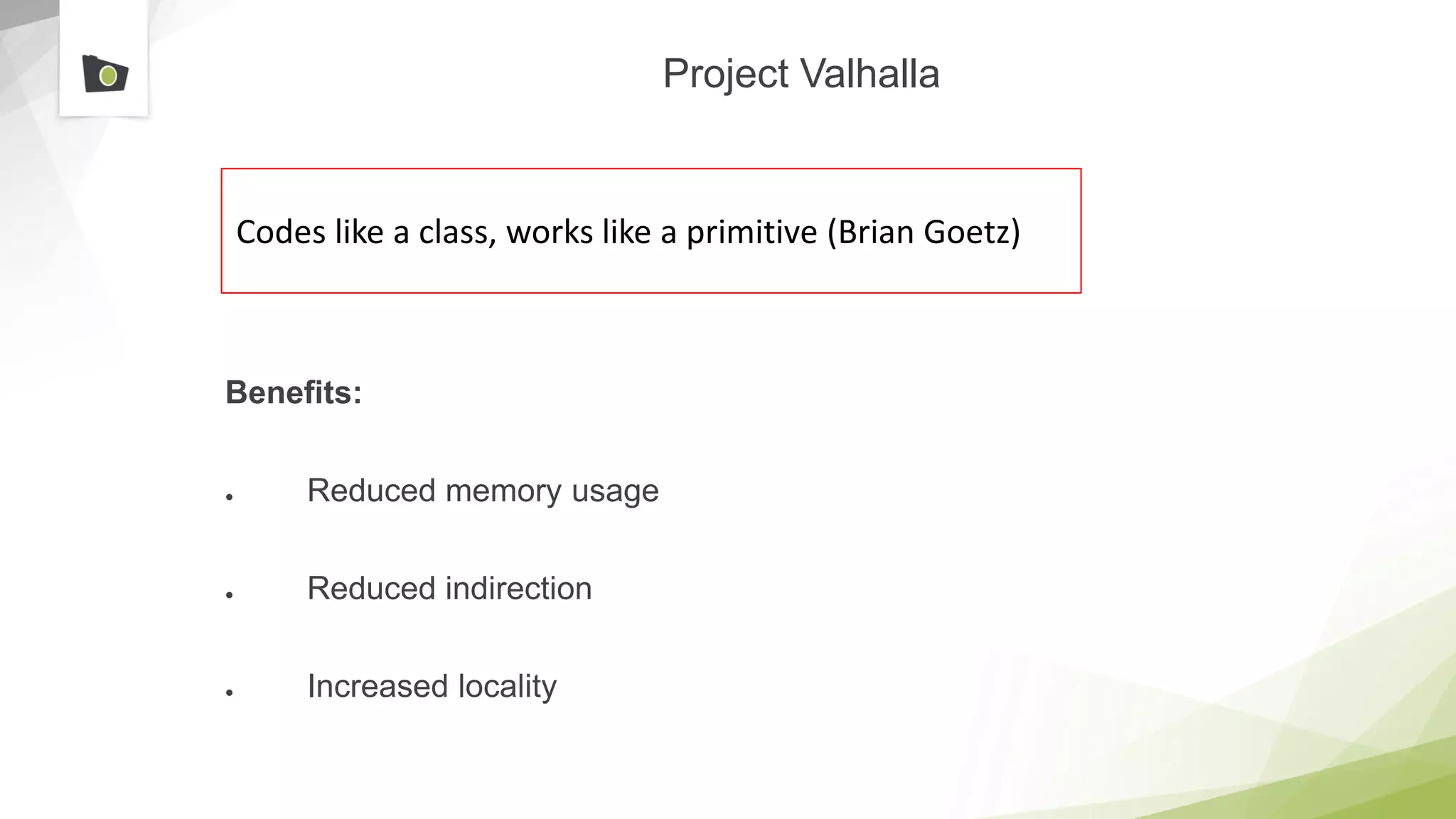
Benefits:
● Reduced memory usage
● Reduced indirection
● Increased locality
Codes like a class, works like a primitive (Brian Goetz)
Project Valhalla
Value Types
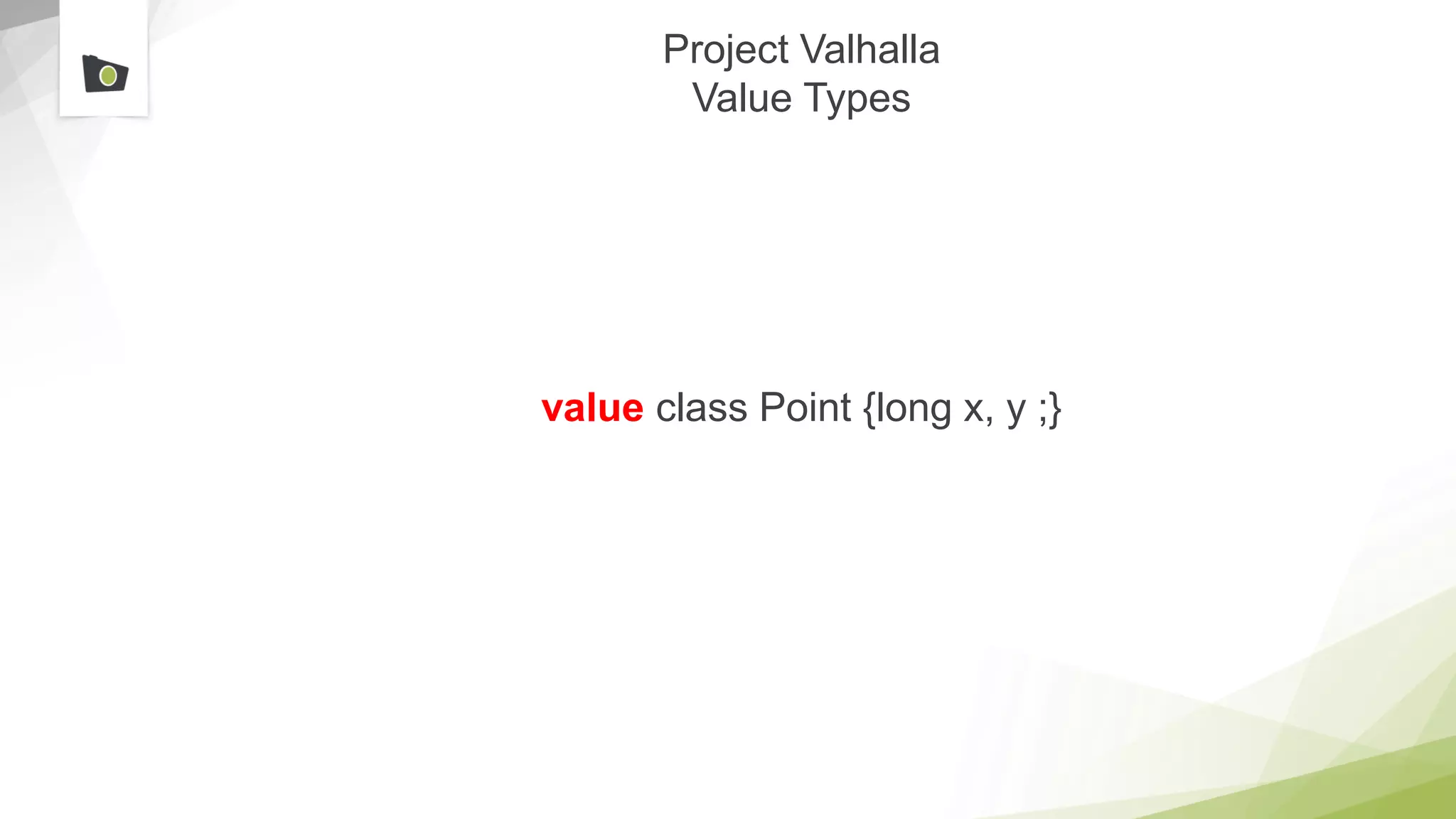
value class Point {long x, y ;}
Project Valhalla
Value Types
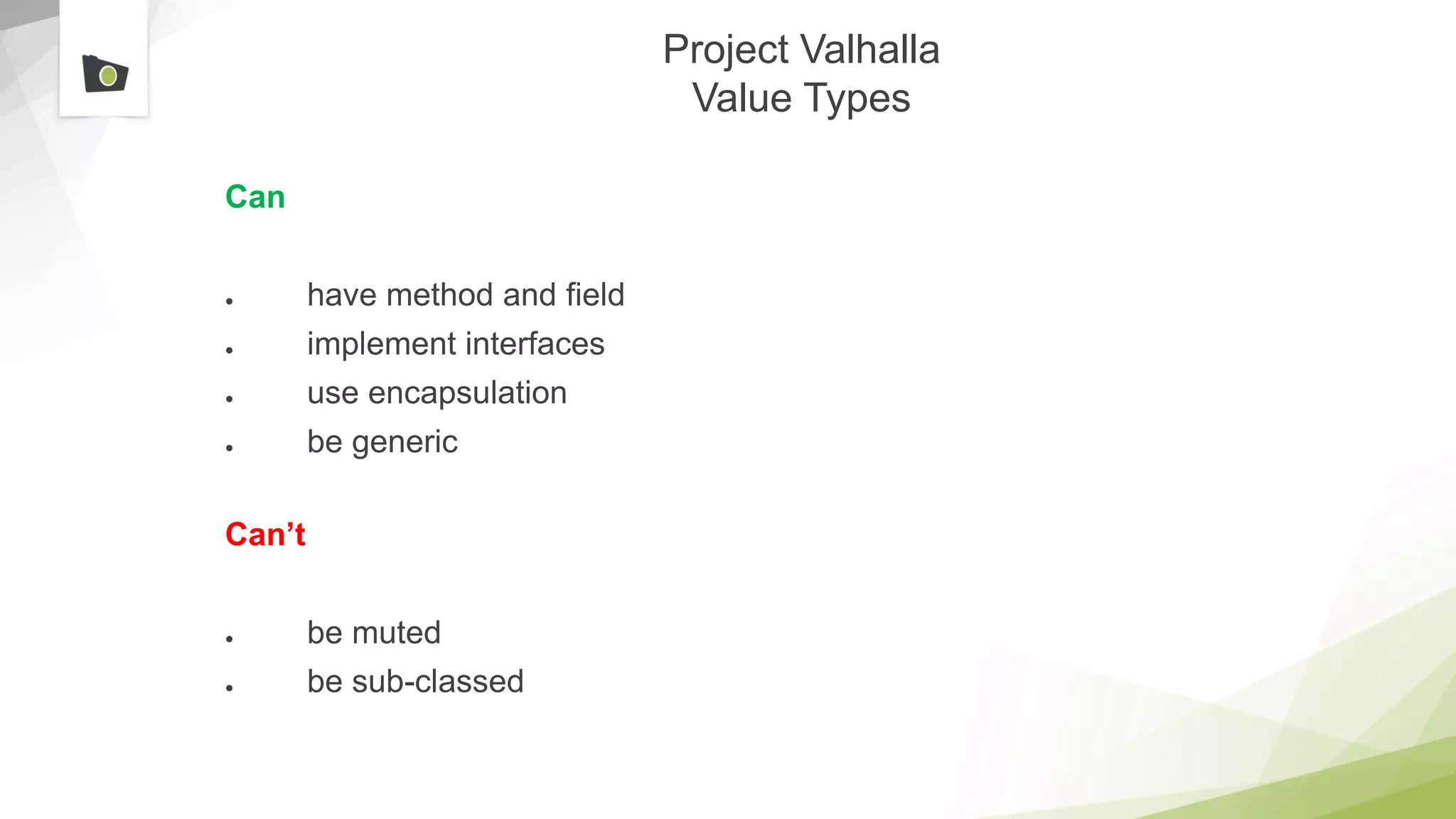
Can
● have method and field
● implement interfaces
● use encapsulation
● be generic
Can’t
● be muted
● be sub-classed
Project Valhalla
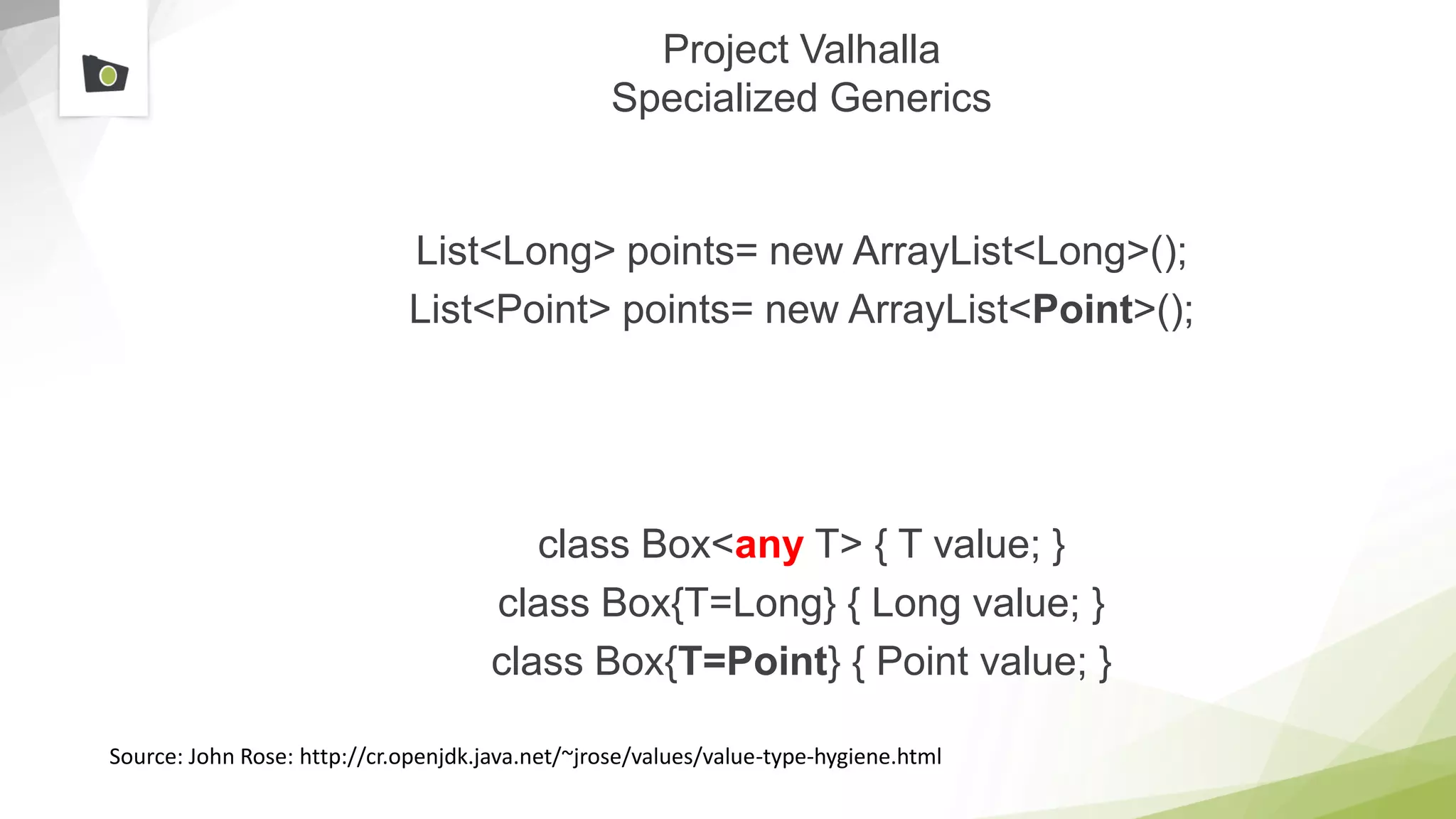
Specialized Generics
List<Long> points= new ArrayList<Long>();
List<Point> points= new ArrayList<Point>();
class Box<any T> { T value; }
class Box{T=Long} { Long value; }
class Box{T=Point} { Point value; }
Source: John Rose: http://cr.openjdk.java.net/~jrose/values/value-type-hygiene.html
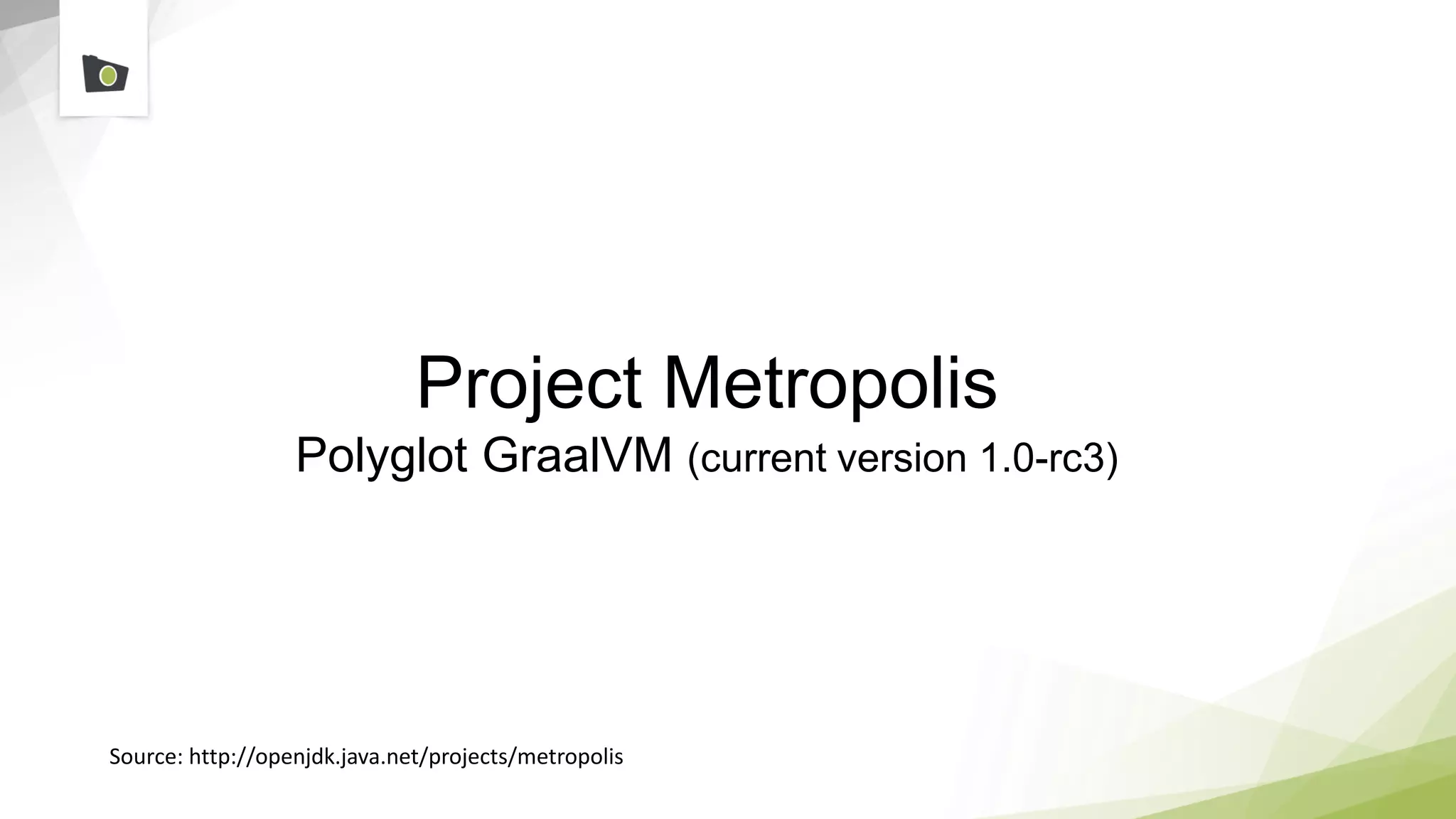
Project Metropolis
Polyglot GraalVM (current version 1.0-rc3)
Source: http://openjdk.java.net/projects/metropolis
Project Metropolis
Goals:
● High performance for all languages
● Zero overhead interoperability between languages
● Language-level virtualization level for shared tooling
Source: Oleg Selajev : “Run Code in Any Language Anywhere with GraalVM” https://www.youtube.com/watch?v=JoDOo4FyYMU
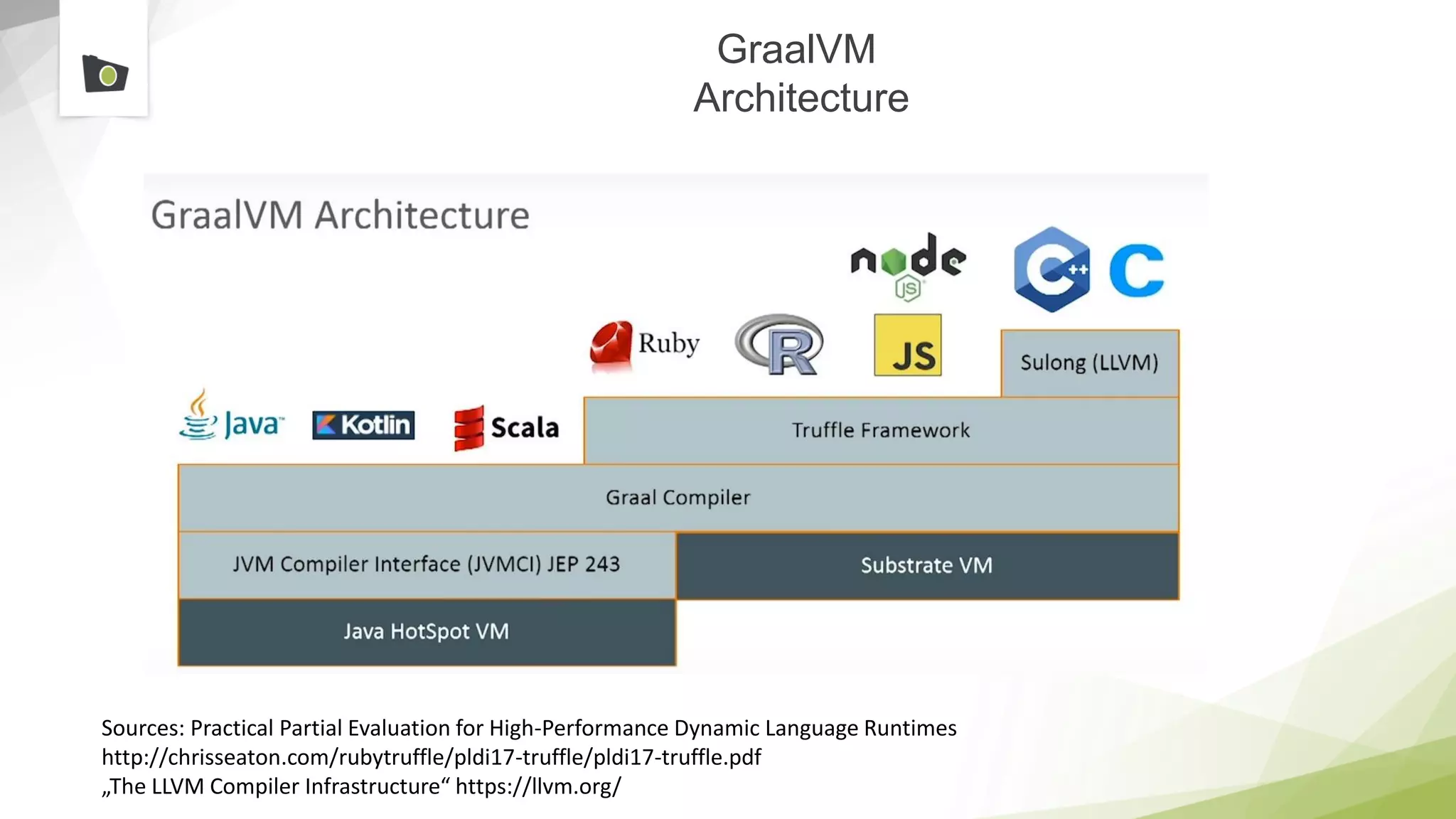
GraalVM
Architecture
Sources: Practical Partial Evaluation for High-Performance Dynamic Language Runtimes
http://chrisseaton.com/rubytruffle/pldi17-truffle/pldi17-truffle.pdf
„The LLVM Compiler Infrastructure“ https://llvm.org/
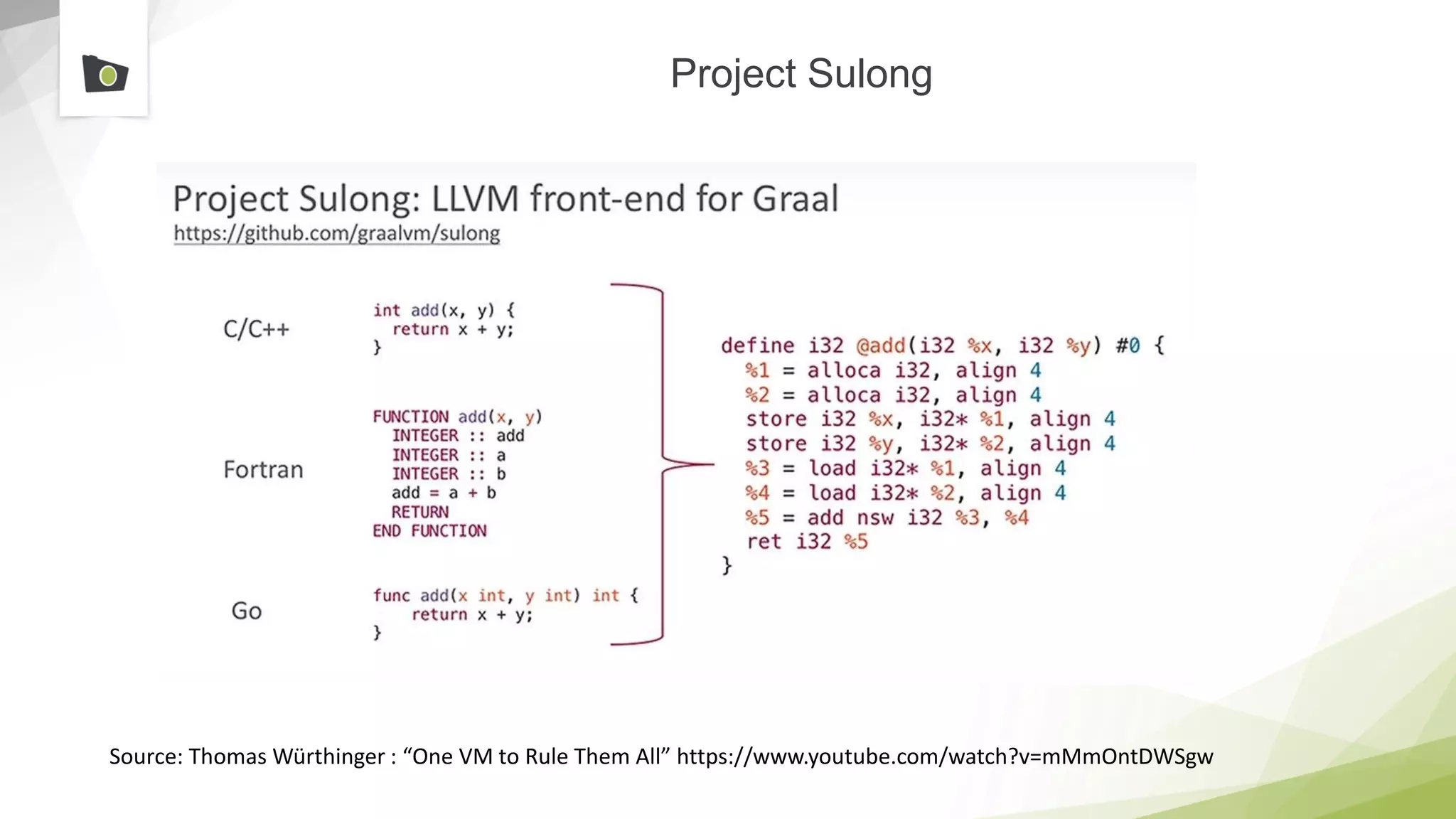
Project Sulong
Source: Thomas Würthinger : “One VM to Rule Them All” https://www.youtube.com/watch?v=mMmOntDWSgw
GraalVM
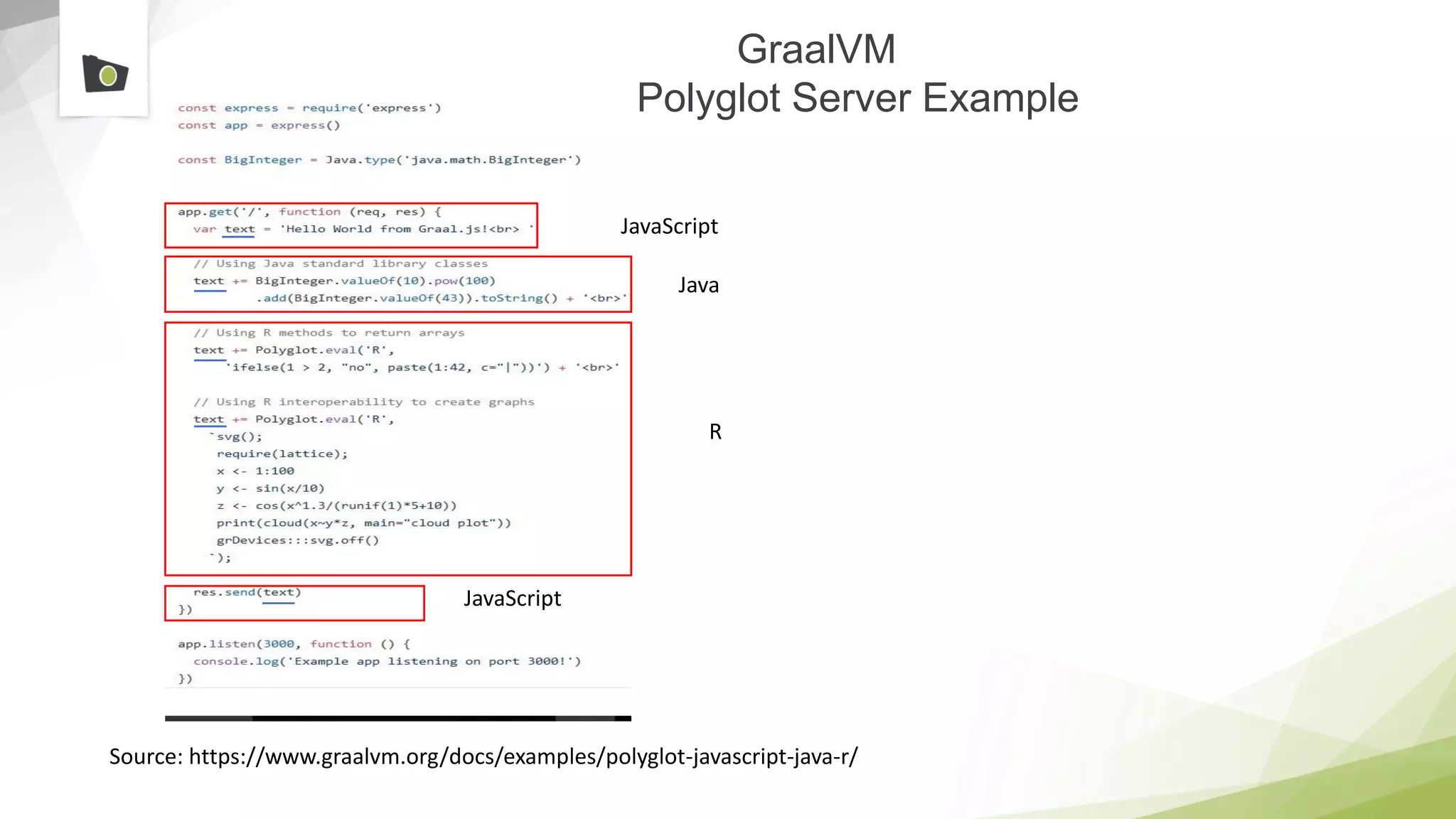
Polyglot Server Example
Source: https://www.graalvm.org/docs/examples/polyglot-javascript-java-r/
JavaScript
Java
R
JavaScript
GraalVM
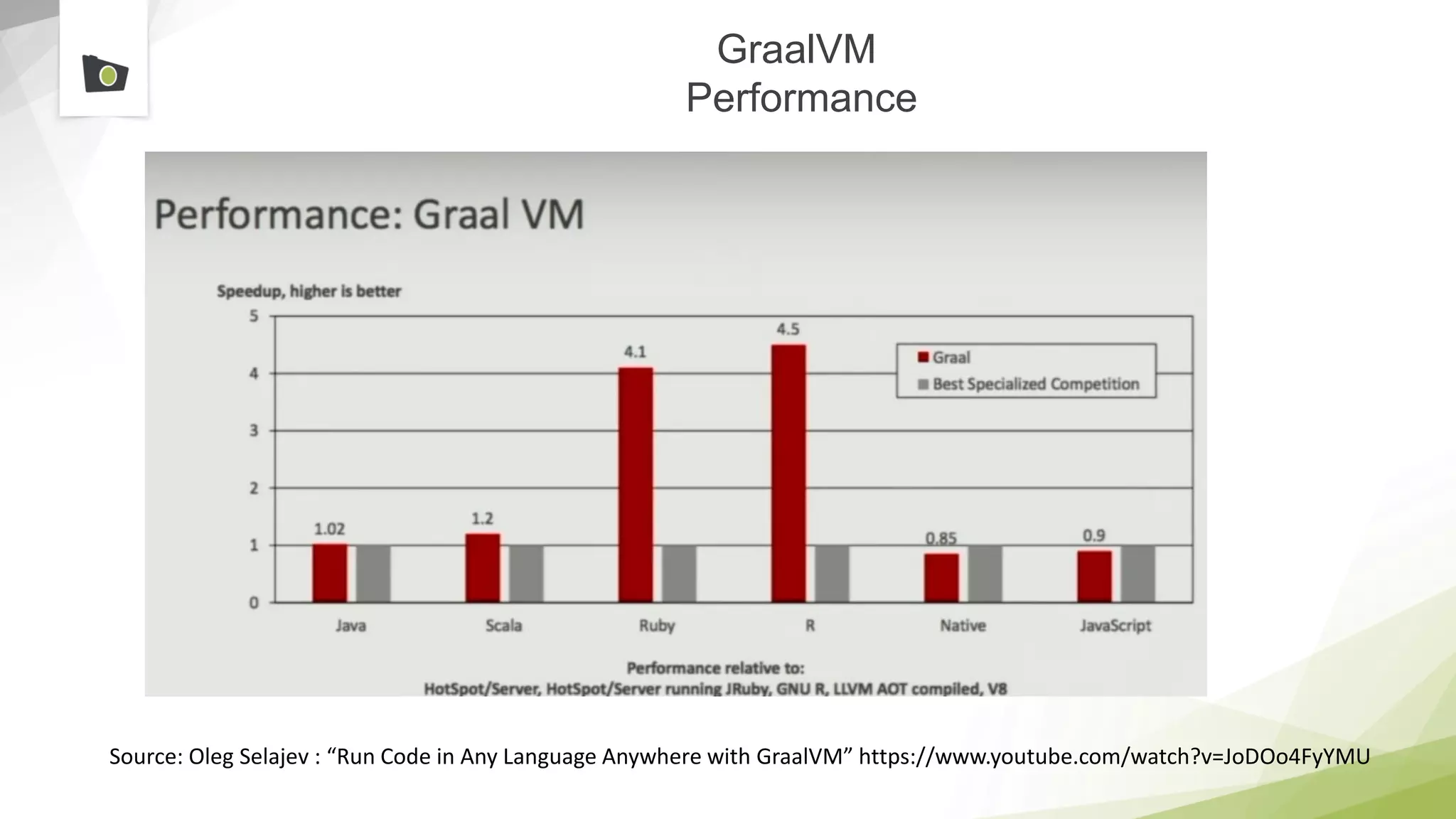
Performance
Source: Oleg Selajev : “Run Code in Any Language Anywhere with GraalVM” https://www.youtube.com/watch?v=JoDOo4FyYMU
GraalVM
Architecture
Sources: Practical Partial Evaluation for High-Performance Dynamic Language Runtimes
http://chrisseaton.com/rubytruffle/pldi17-truffle/pldi17-truffle.pdf
„The LLVM Compiler Infrastructure“ https://llvm.org/
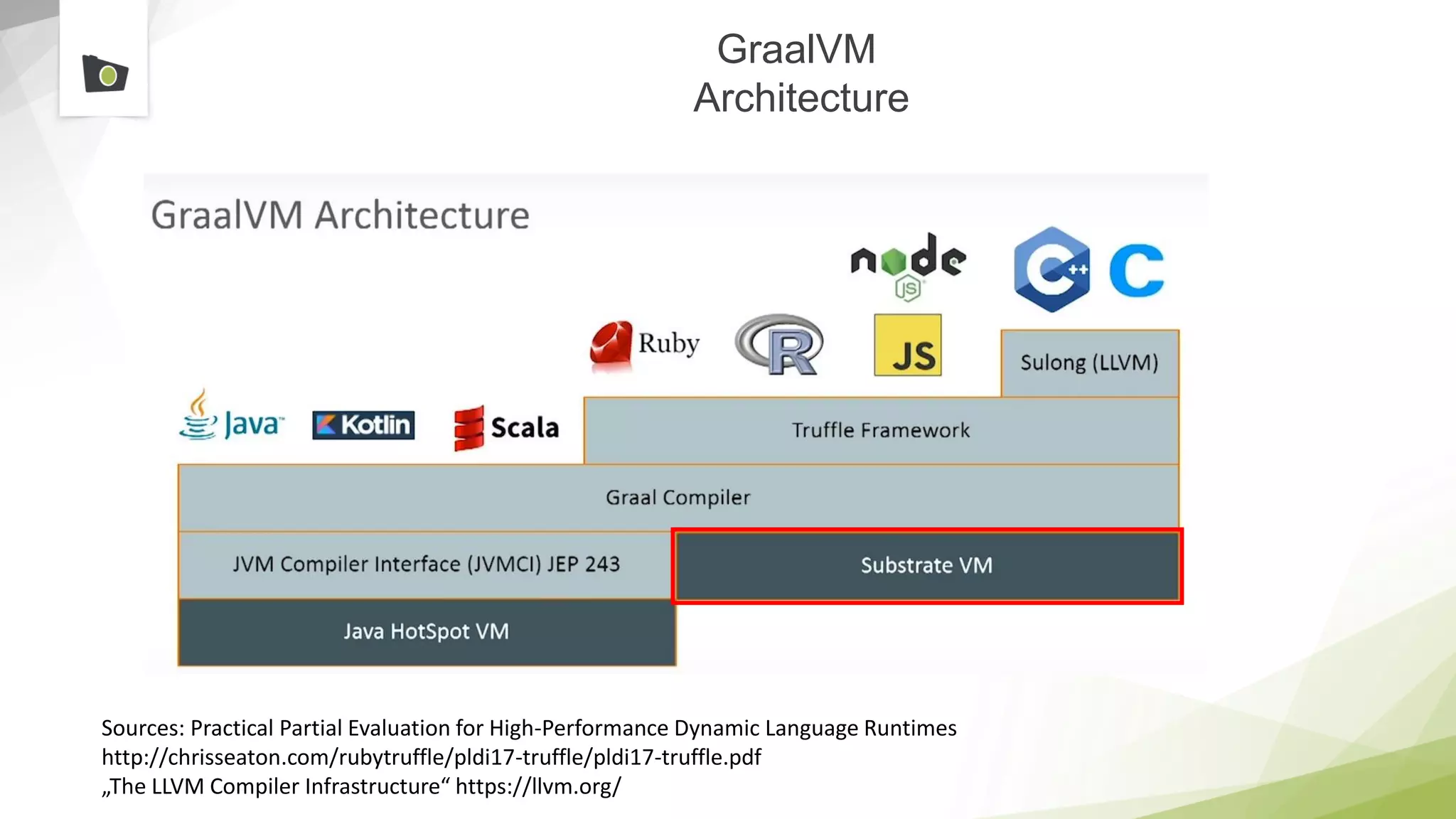
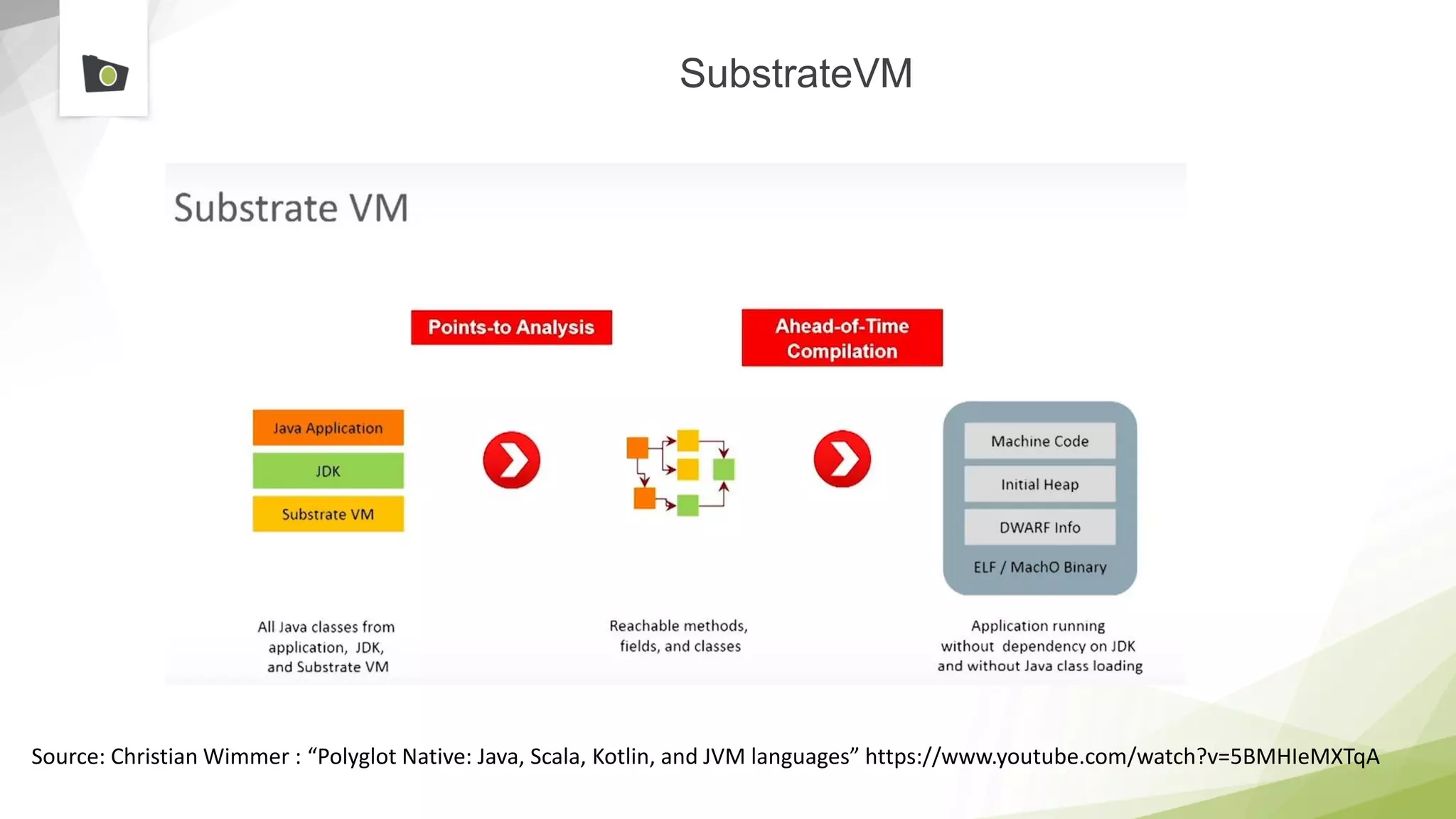
SubstrateVM
Source: Christian Wimmer : “Polyglot Native: Java, Scala, Kotlin, and JVM languages” https://www.youtube.com/watch?v=5BMHIeMXTqA
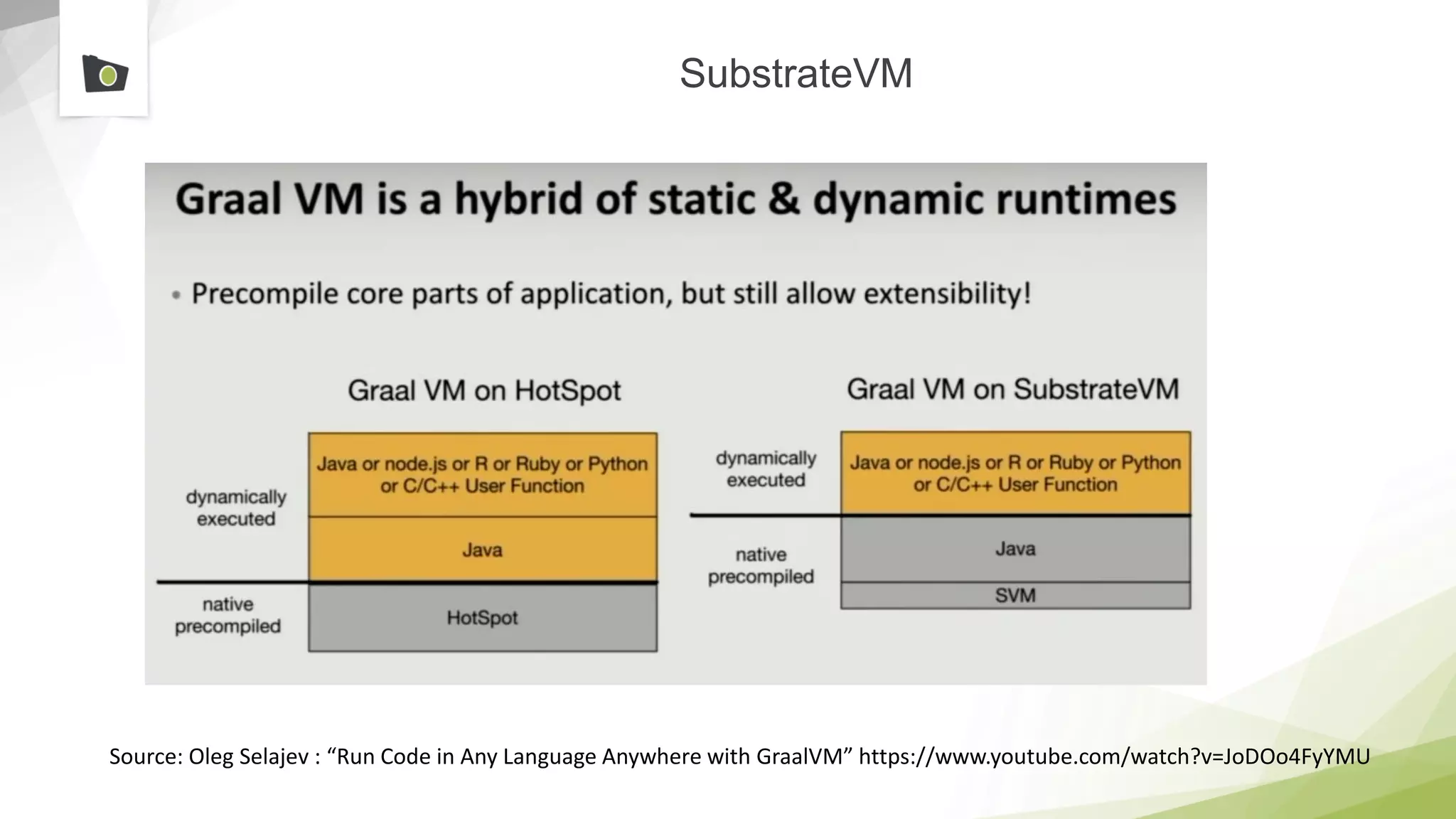
SubstrateVM
Source: Oleg Selajev : “Run Code in Any Language Anywhere with GraalVM” https://www.youtube.com/watch?v=JoDOo4FyYMU
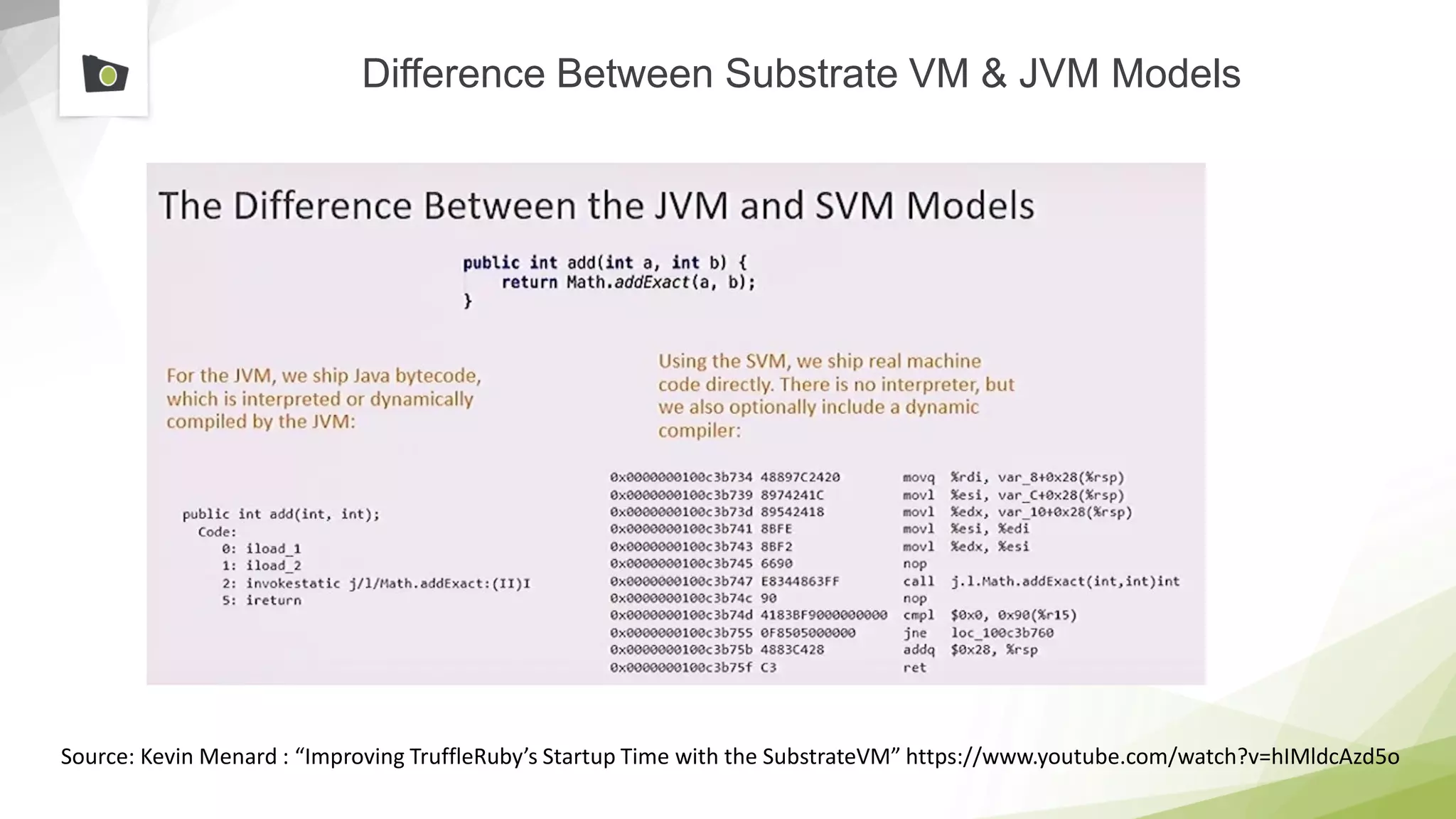
Difference Between Substrate VM & JVM Models
Source: Kevin Menard : “Improving TruffleRuby’s Startup Time with the SubstrateVM” https://www.youtube.com/watch?v=hIMldcAzd5o
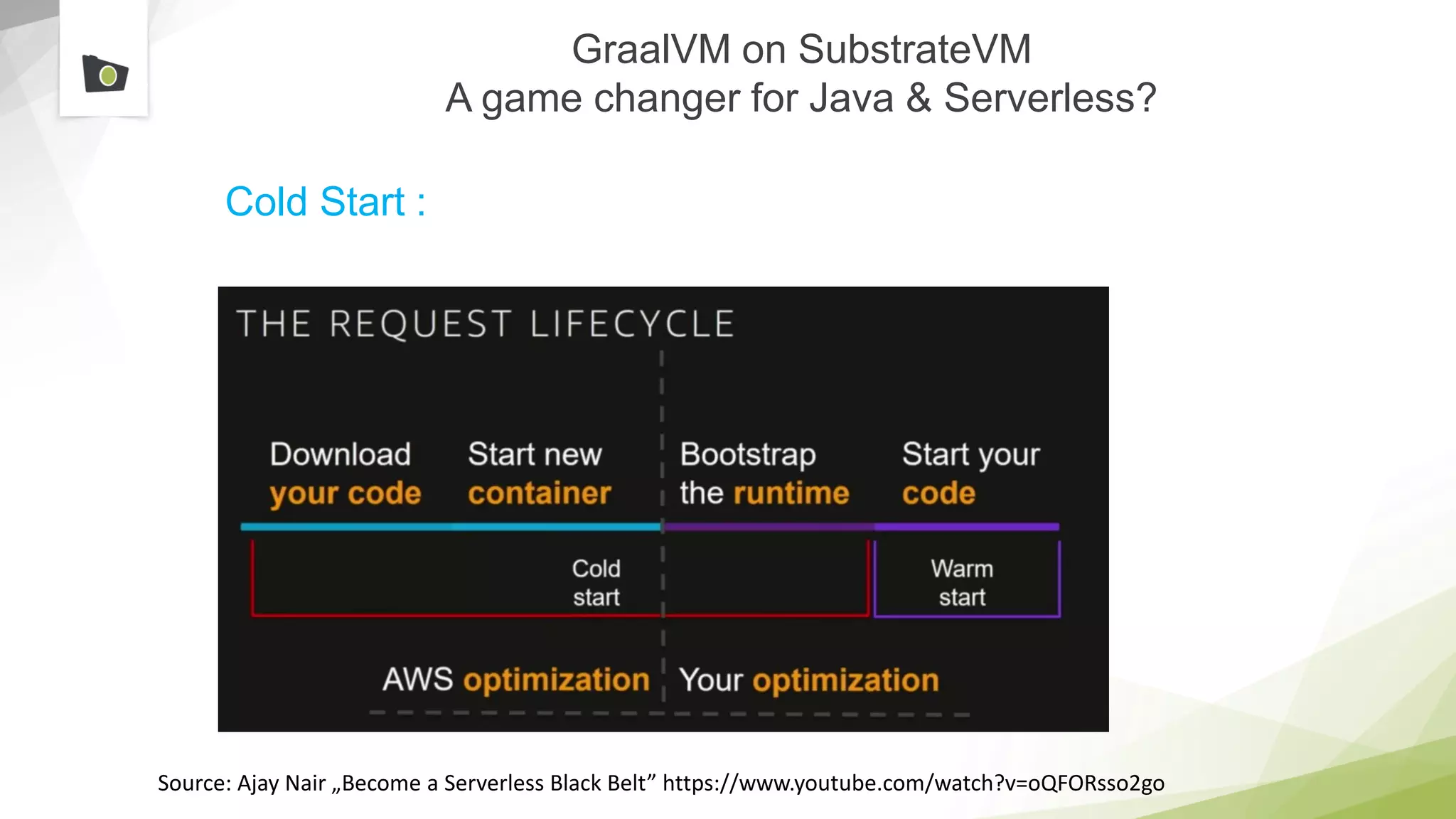
GraalVM on SubstrateVM
A game changer for Java & Serverless?
Cold Start :
Source: Ajay Nair „Become a Serverless Black Belt” https://www.youtube.com/watch?v=oQFORsso2go
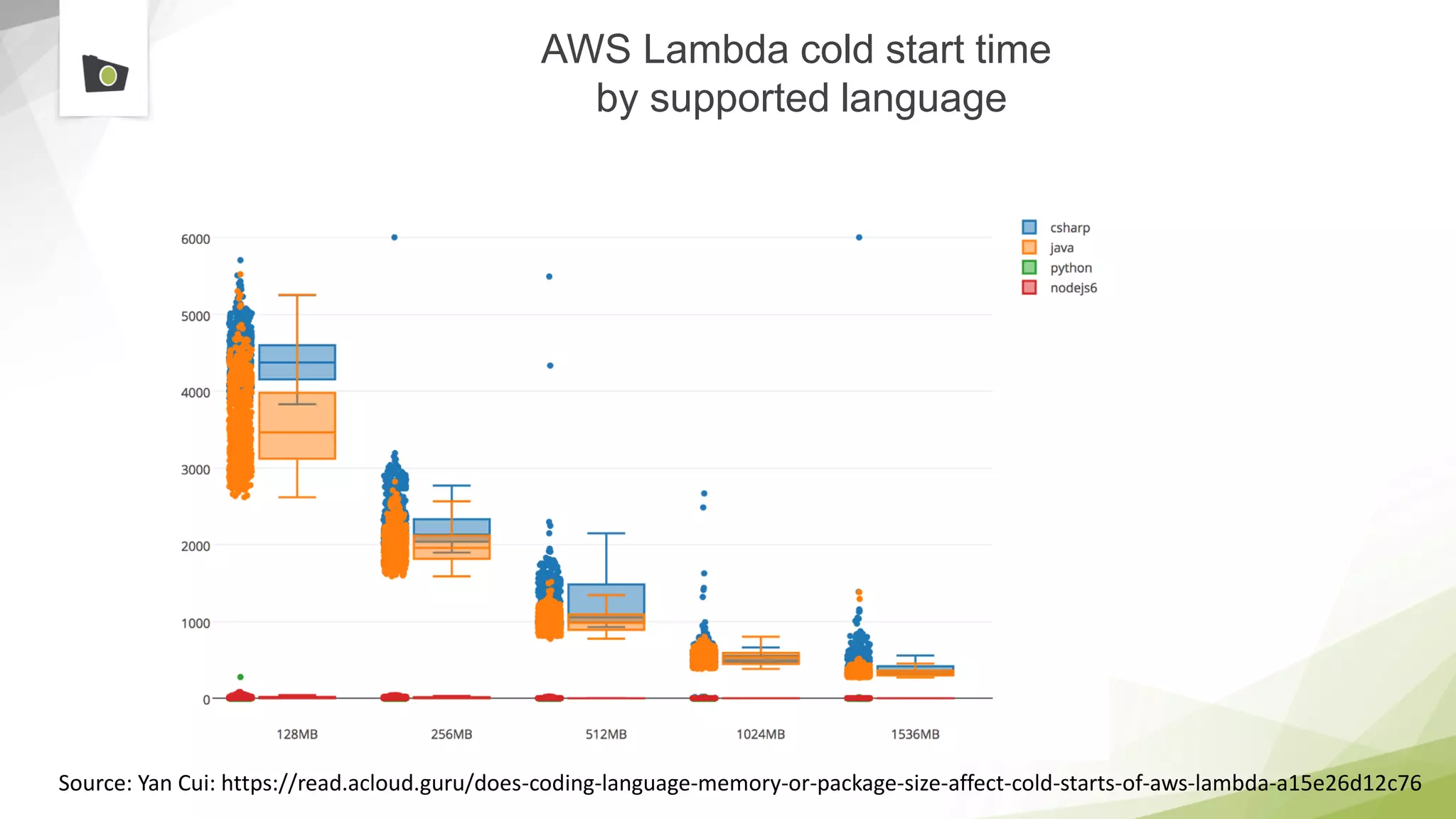
AWS Lambda cold start time
by supported language
Source: Yan Cui: https://read.acloud.guru/does-coding-language-memory-or-package-size-affect-cold-starts-of-aws-lambda-a15e26d12c76
GraalVM on SubstrateVM
A game changer for Java & Serverless?
Java Function compiled into a native executable using GraalVM on
SubstrateVM reduces
● “cold start” times
● memory footprint
by order of magnitude compared to running on JVM.
Project Loom
Fibers and Continuations
Source: http://openjdk.java.net/projects/loom
Project Loom
Goals:
● explore and incubate Java VM features and APIs built on top of them for
the implementation of lightweight user-mode threads (fibers), delimited
continuations
Project Loom
Fibers
Fibre is a thread scheduled not by the OS, but by the Runtime
Project Loom
Fibers
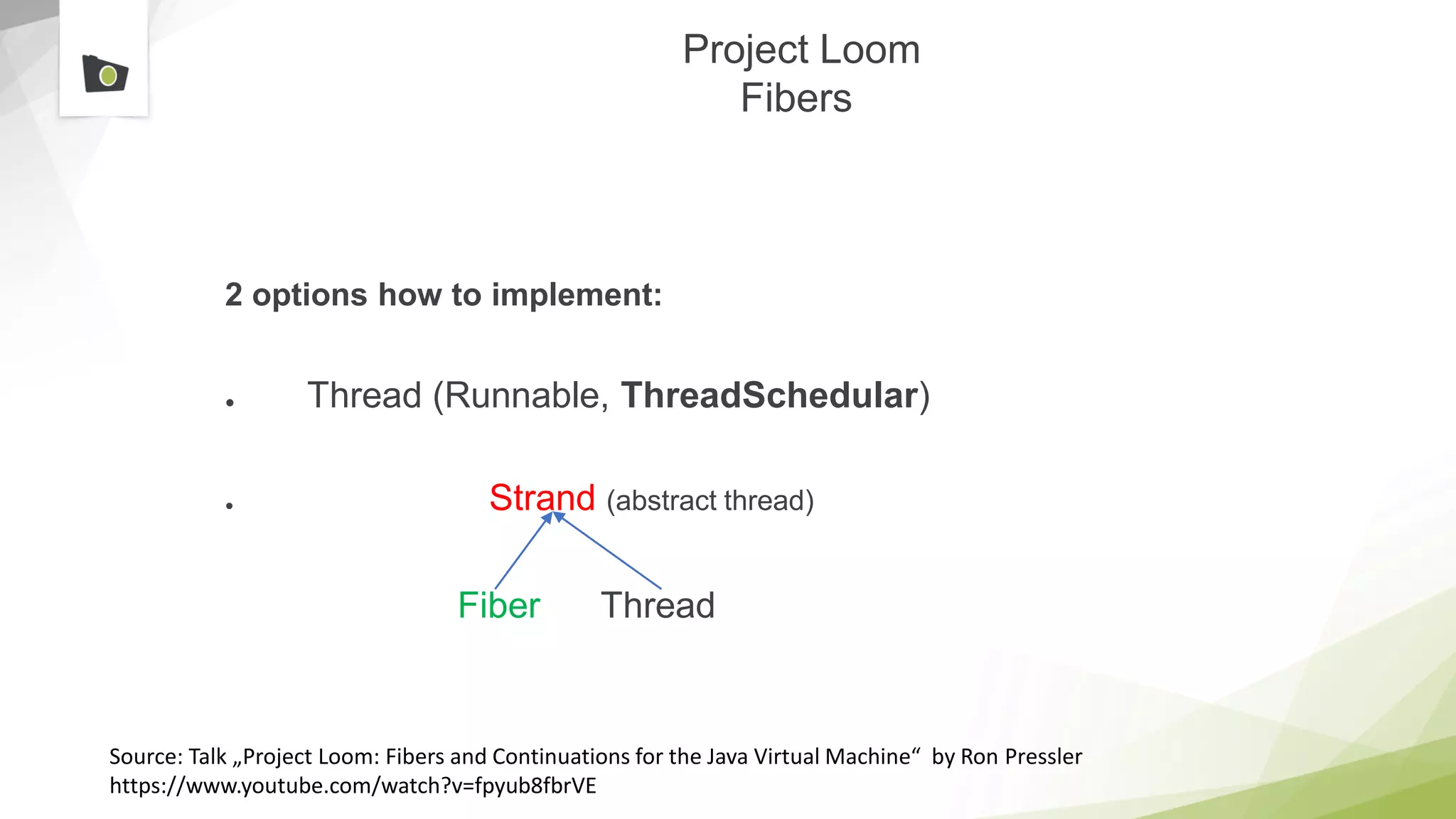
2 options how to implement:
● Thread (Runnable, ThreadSchedular)
● Strand (abstract thread)
Fiber Thread
Source: Talk „Project Loom: Fibers and Continuations for the Java Virtual Machine“ by Ron Pressler
https://www.youtube.com/watch?v=fpyub8fbrVE
Project Loom
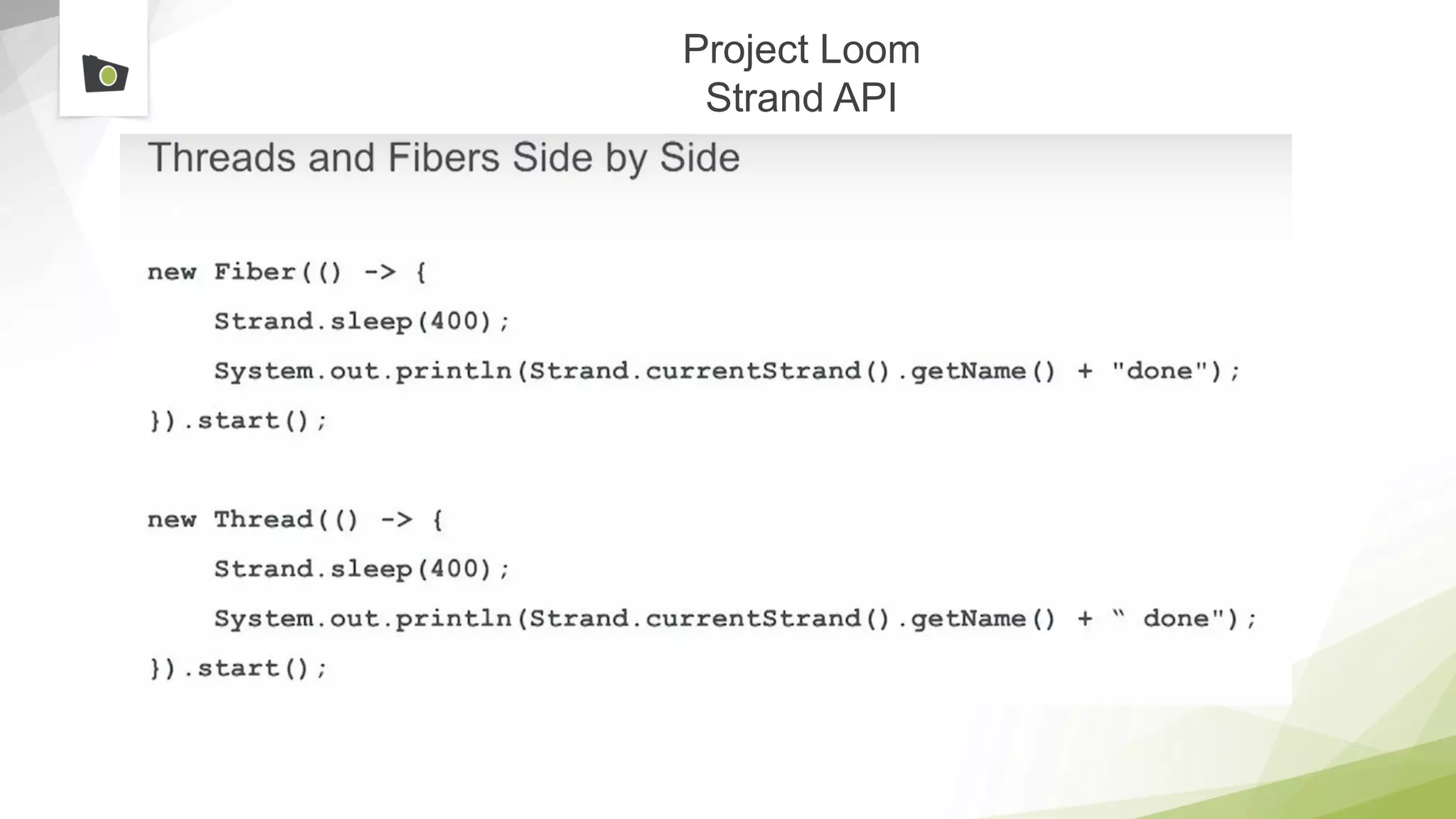
Strand API
Project Loom
Continuation
Continuation is a program object, representing a computation
that may be suspended and resumed
Project Loom
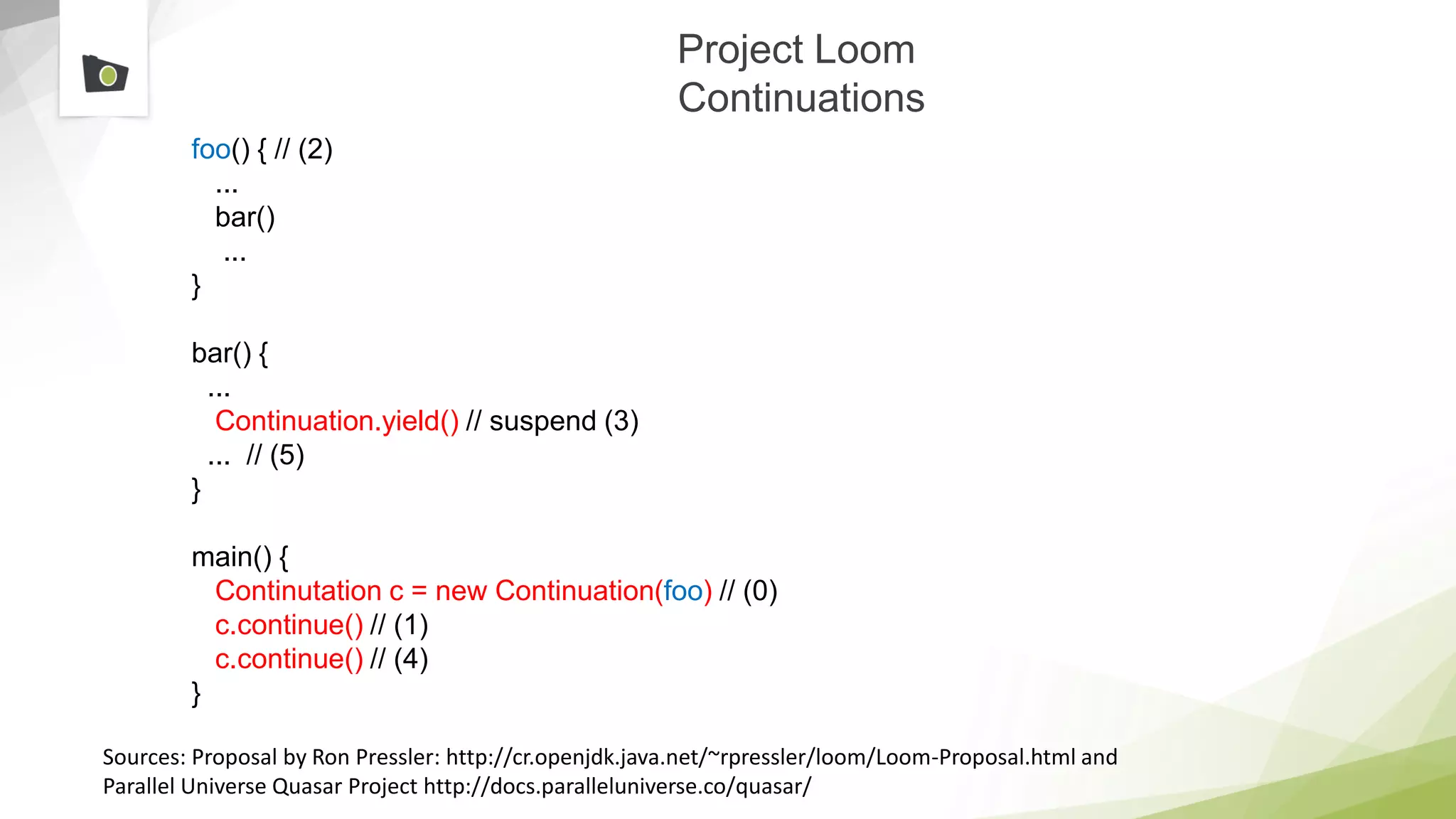
Continuations
foo() { // (2)
...
bar()
...
}​
bar() {
...
Continuation.yield() // suspend (3)
... // (5)
}
main() {
Continutation c = new Continuation(foo) // (0)
c.continue() // (1)
c.continue() // (4)
}
Sources: Proposal by Ron Pressler: http://cr.openjdk.java.net/~rpressler/loom/Loom-Proposal.html and
Parallel Universe Quasar Project http://docs.paralleluniverse.co/quasar/
Project Loom
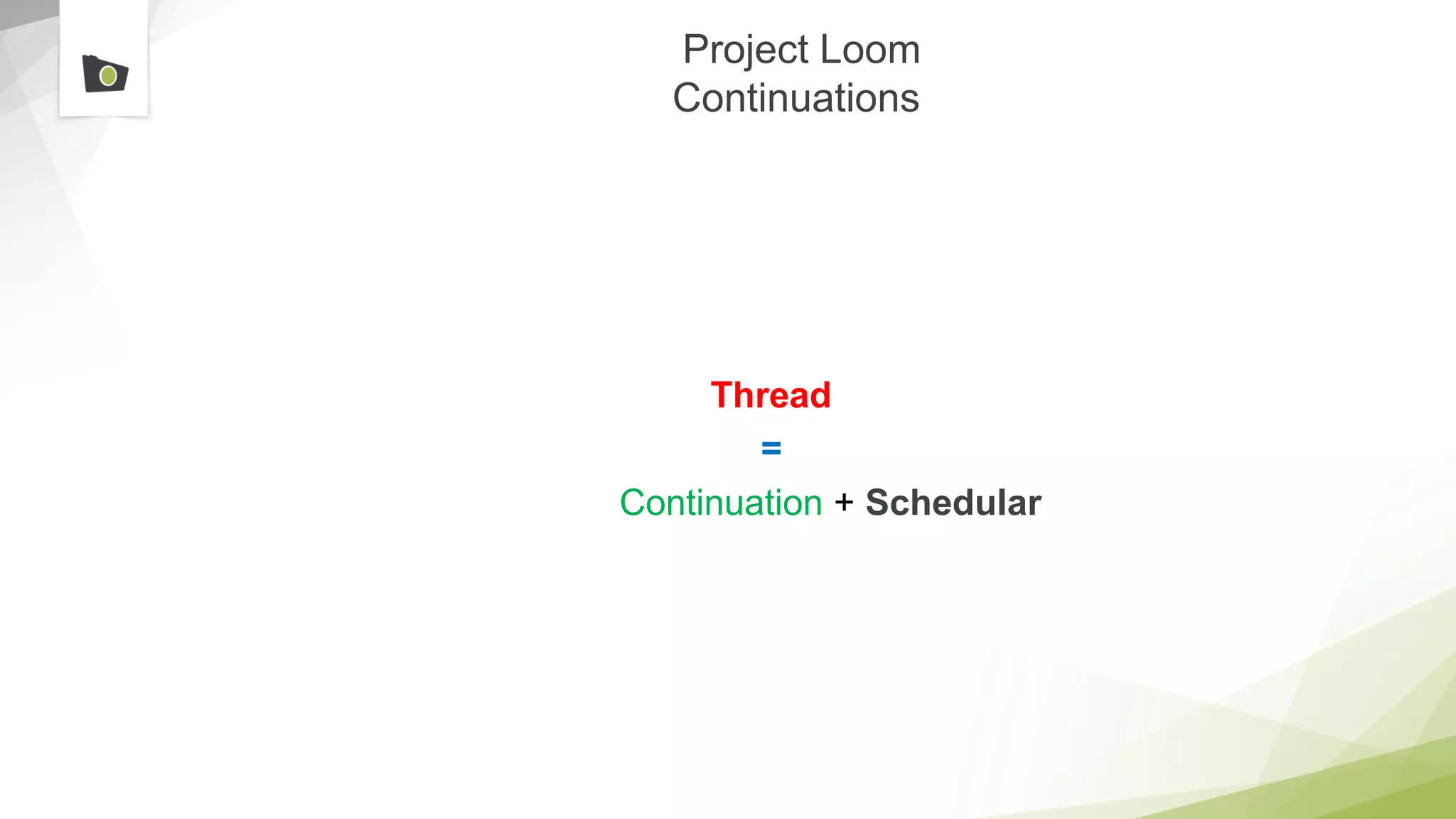
Continuations
Thread
=
Continuation + Schedular
Project Loom
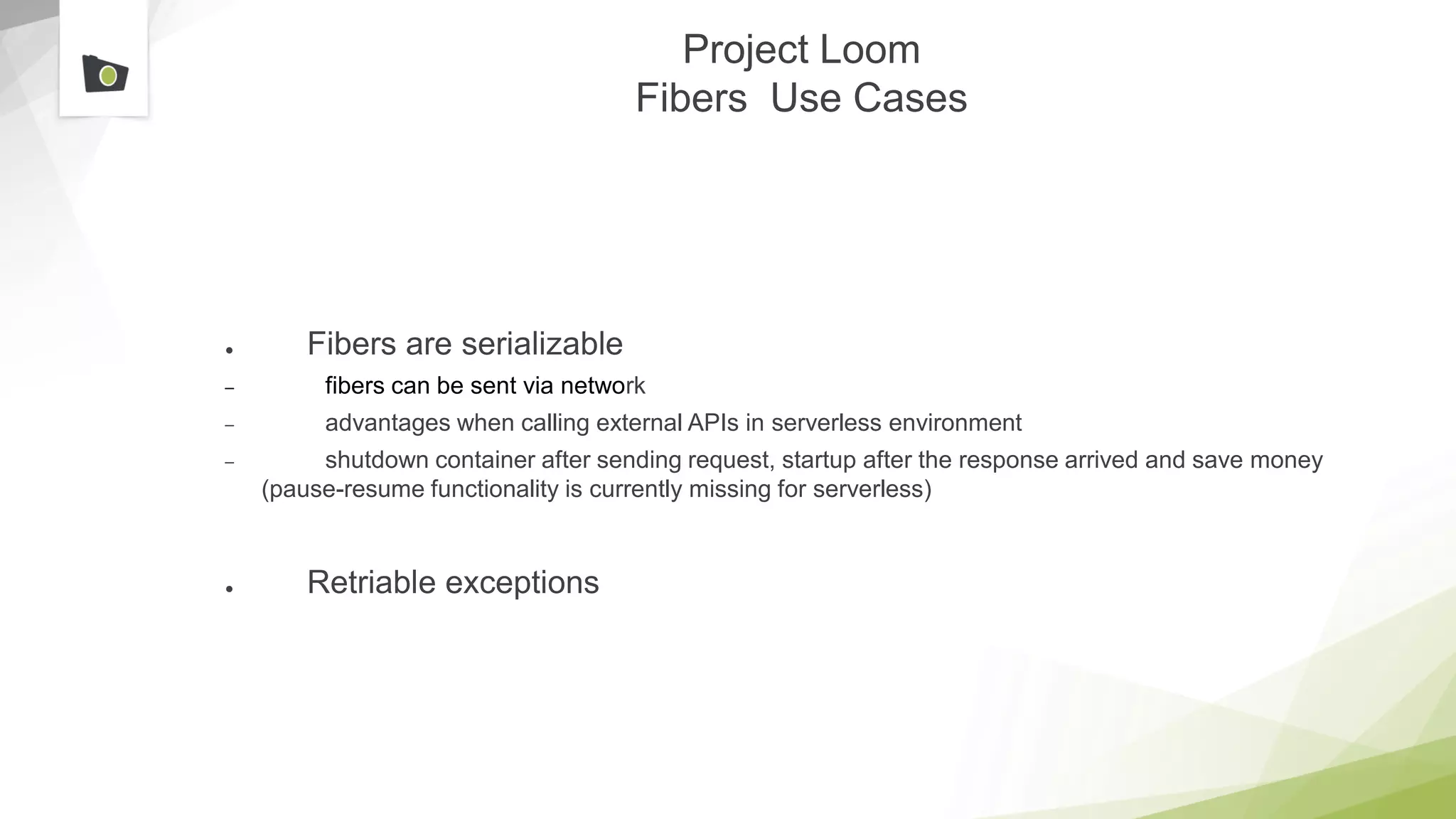
Fibers Use Cases
● Fibers are serializable
– fibers can be sent via network
– advantages when calling external APIs in serverless environment
– shutdown container after sending request, startup after the response arrived and save money
(pause-resume functionality is currently missing for serverless)
● Retriable exceptions
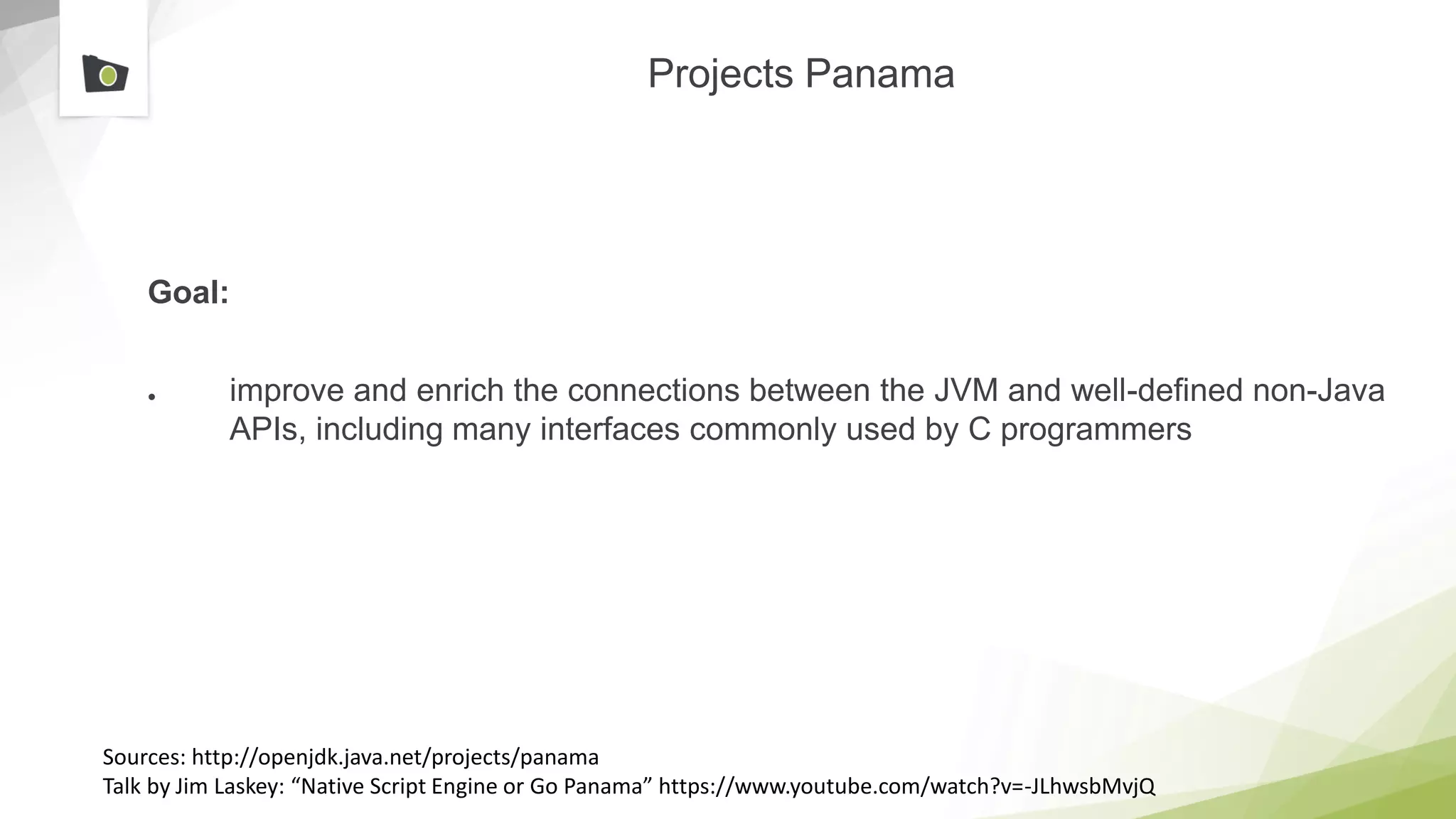
Projects Panama
Goal:
● improve and enrich the connections between the JVM and well-defined non-Java
APIs, including many interfaces commonly used by C programmers
Sources: http://openjdk.java.net/projects/panama
Talk by Jim Laskey: “Native Script Engine or Go Panama” https://www.youtube.com/watch?v=-JLhwsbMvjQ
Project Shenandoah
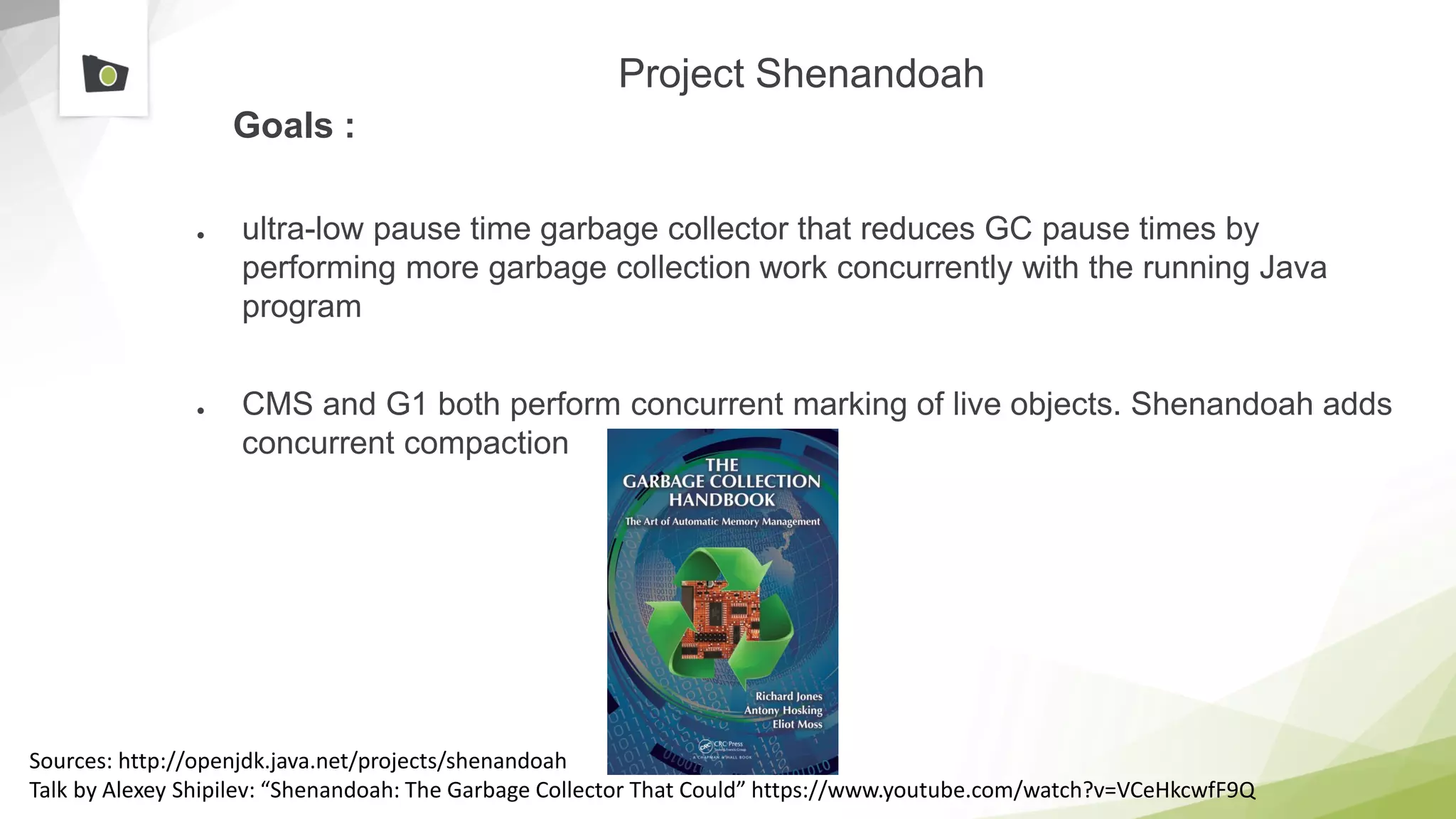
Goals :
● ultra-low pause time garbage collector that reduces GC pause times by
performing more garbage collection work concurrently with the running Java
program
● CMS and G1 both perform concurrent marking of live objects. Shenandoah adds
concurrent compaction
Sources: http://openjdk.java.net/projects/shenandoah
Talk by Alexey Shipilev: “Shenandoah: The Garbage Collector That Could” https://www.youtube.com/watch?v=VCeHkcwfF9Q
is still an interesting and great
programming language
Questions?
www.iplabs.de
Thank You!

"Highlights from Java 10&11 and Future of Java" at Java User Group Bonn 2018 by Vadym Kazulkin

  • 1.
    Highlights from Java10 and 11 and Future of Java by Vadym Kazulkin, ip.labs GmbH
  • 2.
    Contact Vadym Kazulkin, ip.labsGmbH v.kazulkin@gmail.com www.xing.com/profile/Vadym_Kazulkin @VKazulkin
  • 3.
  • 4.
  • 5.
    JEP 286 (ProjectAmber) Local-Variable Type Inference var list = new ArrayList<String>(); // infers ArrayList<String> var stream = list.stream(); // infers Stream<String> strictly speaking var list = new ArrayList<String>() is the same as ArrayList<String> list = new ArrayList<String>(); List<String> list = new ArrayList<String>(); is the same as var list = (List<String>) new ArrayList<String>()
  • 6.
    JEP 307 Parallel FullGC for G1 Goal: ● Improve G1 worst-case latencies (when the concurrent collections can't reclaim memory fast enough) by making the full GC parallel.
  • 7.
    JEP 304 Garbage CollectorInterface Goals: ● Better modularity for HotSpot internal GC code ● Make it simpler to add a new GC to HotSpot without perturbing the current code base ● Make it easier to exclude a GC from a JDK build
  • 8.
    JEP 317 Experimental Java-BasedJIT Compiler Graal, a Java-based JIT compiler on the Linux/x64 platform, is the basis of the experimental Ahead-of-Time (AOT) compiler introduced in JDK 9. To Enable: -XX:+UnlockExperimentalVMOptions -XX:+UseJVMCICompiler
  • 9.
    Miscellanious API Changes Bettercontainer-awareness ● Before later versions of Java 8 – Runtime.getRuntime().availableProcessors() -> retrieves value from sysconf, means the total number of processors for VM – Runtime.getRuntime().maxMemory() -> gets the value for VM overall memory ● Java 9 is container-aware automatically detecting cpusets JVM considers cgroups memory limits if the following flags are specified: – -XX:+UseCGroupMemoryLimitForHeap – -XX:+UnlockExperimentalVMOptions – Max Heap space will be automatically set (if not overwritten) to the limit specified by the cgroup
  • 10.
    Miscellanious API Changes Bettercontainer-awareness ● For “fixing” CPU shares in Java 9 overwrite – -XMX for memory – -XX:ParallelGCThreads and -XX:ConcGCThreads for CPU – -System property java.util.concurrent.ForkJoinPool.common.parallelism for ForkJoinPool ● Better container-awareness in Java 10 (CPU shares support is included) – Runtime.getRuntime().availableProcessors() – Runtime.getRuntime().maxMemory() Sources: „Java SE 9 support for Docker CPU and memory limits“https://blogs.oracle.com/java-platform-group/java-se-support-for- docker-cpu-and-memory-limits „ Nobody puts Java in a container” https://jaxenter.com/nobody-puts-java-container-139373.html „Improve docker container detection and resource configuration usage” https://bugs.openjdk.java.net/browse/JDK-8146115 „ Better containerized JVMs in JDK 10” https://jaxenter.com/better-containerized-jvms-jdk-10-140593.html
  • 11.
    Miscellanious API Changes ●java.util.List, Set, Map.copyOf(Collection) ● java.util.stream.Collectors.toUnmodifiableList/Set/Map(Stream) ● Optional.orElseThrow()
  • 12.
  • 13.
    Long-Term Support Sources: https://jaxenter.de/jdk-support-sag-mal-70294& Azul Systems https://www.oracle.com/corporate/pressrelease/java-se-subscription-offering-062118.html https://www.infoq.com/news/2018/06/new-support-pricing-java
  • 14.
    Extended Oracle PublicJava SE 8 Support Source: http://www.oracle.com/technetwork/java/javase/tech/eol-135779.html
  • 15.
  • 16.
    JEP 323 (ProjectAmber) Local-Variable Syntax for Lambda Parameters ● (x, y) -> x.process(y) // implicitly typed lambda expression ● (var x, var y) -> x.process(y) // implicit typed lambda expression ● (@NonNull var x, @NonNull var y) -> x.process(y)
  • 17.
    JEP 318 Epsilon: ANo-Op Garbage Collector Goals: ● Provide a completely passive GC implementation with a bounded allocation limit and the lowest latency overhead possible, at the expense of memory footprint and memory throughput ● Measure performance of other GCs
  • 18.
    JEP 321 HTTP Client Goals: ●Standardize the incubated HTTP Client API introduced in JDK 9, via JEP 110, and updated in JDK 10 ● HTTP 2.0 Support
  • 19.
    JEP 332 Transport LayerSecurity 1.3 Goal: ● Implement version 1.3 of the Transport Layer Security (TLS) Protocol
  • 20.
    Miscellanious API Changes ●File.isSameContents() in addition to File.isSameFile() ● New methods and behaviour on the Java String class – trim() method : uses the definition of space as any codepoint that is less than or equal to the space character codepoint (u0040.) – String.lines() and String.strip() also use this definition – isBlank() : true if the string is empty or contains only white space – stripLeading(), stripTrailing() : removal of Unicode white space from the beginning/end Sources: https://bugs.openjdk.java.net/browse/JDK-8202285 https://www.javacodegeeks.com/2018/05/new-jdk-11-files-method-issamecontent.html
  • 21.
  • 22.
    Project Amber Simplifying syntax(continuing) Source: http://openjdk.java.net/projects/amber/
  • 23.
    JEP 305 Pattern Matching intnumberOfLetters; switch(season) { case FALL: numberOfLetters=4; break; case WINTER: case SPRING: case SUMMER: numberOfLetters=6; break; default: throw new IllegalStateException(„unknown season “+season); }
  • 24.
    JEP 305 Pattern Matching intnumberOfLetters =switch(season) { case FALL -> 4; case WINTER, SPRING, SUMMER -> 6; default -> throw new IllegalStateException(„unknown season “+season); };
  • 25.
    JEP 305 Pattern Matching Stringformatted = "unknown"; if (obj instanceof Integer) { int i = (Integer) obj; formatted = String.format("int %d", i); } else if (obj instanceof Byte) { byte b = (Byte) obj; formatted = String.format("byte %d", b); } else if (obj instanceof Long) { long l = (Long) obj; formatted = String.format("long %d", l); } else if (obj instanceof Double) { double d = (Double) obj; formatted = String.format(“double %f", d); } else if (obj instanceof String) { String s = (String) obj; formatted = String.format("String %s", s); }
  • 26.
    JEP 305 Pattern Matching Stringformatted; switch (obj) { case Integer i: formatted = String.format("int %d", i); break; case Byte b: formatted = String.format("byte %d", b); break; case Long l: formatted = String.format("long %d", l); break; case Double d: formatted = String.format(“double %f", d); break; case String s: formatted = String.format("String %s", s); break; default: formatted = obj.toString(); }
  • 27.
    Project Valhalla Value typesand specialised generics Source: http://openjdk.java.net/projects/valhalla/
  • 28.
    Project Valhalla Value Object ValueObject is an immutable type that is distinguishable only by the state of its properties
  • 29.
  • 30.
    Project Valhalla Benefits: ● Reducedmemory usage ● Reduced indirection ● Increased locality Codes like a class, works like a primitive (Brian Goetz)
  • 31.
    Project Valhalla Value Types valueclass Point {long x, y ;}
  • 32.
    Project Valhalla Value Types Can ●have method and field ● implement interfaces ● use encapsulation ● be generic Can’t ● be muted ● be sub-classed
  • 33.
    Project Valhalla Specialized Generics List<Long>points= new ArrayList<Long>(); List<Point> points= new ArrayList<Point>(); class Box<any T> { T value; } class Box{T=Long} { Long value; } class Box{T=Point} { Point value; } Source: John Rose: http://cr.openjdk.java.net/~jrose/values/value-type-hygiene.html
  • 34.
    Project Metropolis Polyglot GraalVM(current version 1.0-rc3) Source: http://openjdk.java.net/projects/metropolis
  • 35.
    Project Metropolis Goals: ● Highperformance for all languages ● Zero overhead interoperability between languages ● Language-level virtualization level for shared tooling Source: Oleg Selajev : “Run Code in Any Language Anywhere with GraalVM” https://www.youtube.com/watch?v=JoDOo4FyYMU
  • 36.
    GraalVM Architecture Sources: Practical PartialEvaluation for High-Performance Dynamic Language Runtimes http://chrisseaton.com/rubytruffle/pldi17-truffle/pldi17-truffle.pdf „The LLVM Compiler Infrastructure“ https://llvm.org/
  • 37.
    Project Sulong Source: ThomasWürthinger : “One VM to Rule Them All” https://www.youtube.com/watch?v=mMmOntDWSgw
  • 38.
    GraalVM Polyglot Server Example Source:https://www.graalvm.org/docs/examples/polyglot-javascript-java-r/ JavaScript Java R JavaScript
  • 39.
    GraalVM Performance Source: Oleg Selajev: “Run Code in Any Language Anywhere with GraalVM” https://www.youtube.com/watch?v=JoDOo4FyYMU
  • 40.
    GraalVM Architecture Sources: Practical PartialEvaluation for High-Performance Dynamic Language Runtimes http://chrisseaton.com/rubytruffle/pldi17-truffle/pldi17-truffle.pdf „The LLVM Compiler Infrastructure“ https://llvm.org/
  • 41.
    SubstrateVM Source: Christian Wimmer: “Polyglot Native: Java, Scala, Kotlin, and JVM languages” https://www.youtube.com/watch?v=5BMHIeMXTqA
  • 42.
    SubstrateVM Source: Oleg Selajev: “Run Code in Any Language Anywhere with GraalVM” https://www.youtube.com/watch?v=JoDOo4FyYMU
  • 43.
    Difference Between SubstrateVM & JVM Models Source: Kevin Menard : “Improving TruffleRuby’s Startup Time with the SubstrateVM” https://www.youtube.com/watch?v=hIMldcAzd5o
  • 44.
    GraalVM on SubstrateVM Agame changer for Java & Serverless? Cold Start : Source: Ajay Nair „Become a Serverless Black Belt” https://www.youtube.com/watch?v=oQFORsso2go
  • 45.
    AWS Lambda coldstart time by supported language Source: Yan Cui: https://read.acloud.guru/does-coding-language-memory-or-package-size-affect-cold-starts-of-aws-lambda-a15e26d12c76
  • 46.
    GraalVM on SubstrateVM Agame changer for Java & Serverless? Java Function compiled into a native executable using GraalVM on SubstrateVM reduces ● “cold start” times ● memory footprint by order of magnitude compared to running on JVM.
  • 47.
    Project Loom Fibers andContinuations Source: http://openjdk.java.net/projects/loom
  • 48.
    Project Loom Goals: ● exploreand incubate Java VM features and APIs built on top of them for the implementation of lightweight user-mode threads (fibers), delimited continuations
  • 49.
    Project Loom Fibers Fibre isa thread scheduled not by the OS, but by the Runtime
  • 50.
    Project Loom Fibers 2 optionshow to implement: ● Thread (Runnable, ThreadSchedular) ● Strand (abstract thread) Fiber Thread Source: Talk „Project Loom: Fibers and Continuations for the Java Virtual Machine“ by Ron Pressler https://www.youtube.com/watch?v=fpyub8fbrVE
  • 51.
  • 52.
    Project Loom Continuation Continuation isa program object, representing a computation that may be suspended and resumed
  • 53.
    Project Loom Continuations foo() {// (2) ... bar() ... }​ bar() { ... Continuation.yield() // suspend (3) ... // (5) } main() { Continutation c = new Continuation(foo) // (0) c.continue() // (1) c.continue() // (4) } Sources: Proposal by Ron Pressler: http://cr.openjdk.java.net/~rpressler/loom/Loom-Proposal.html and Parallel Universe Quasar Project http://docs.paralleluniverse.co/quasar/
  • 54.
  • 55.
    Project Loom Fibers UseCases ● Fibers are serializable – fibers can be sent via network – advantages when calling external APIs in serverless environment – shutdown container after sending request, startup after the response arrived and save money (pause-resume functionality is currently missing for serverless) ● Retriable exceptions
  • 56.
    Projects Panama Goal: ● improveand enrich the connections between the JVM and well-defined non-Java APIs, including many interfaces commonly used by C programmers Sources: http://openjdk.java.net/projects/panama Talk by Jim Laskey: “Native Script Engine or Go Panama” https://www.youtube.com/watch?v=-JLhwsbMvjQ
  • 57.
    Project Shenandoah Goals : ●ultra-low pause time garbage collector that reduces GC pause times by performing more garbage collection work concurrently with the running Java program ● CMS and G1 both perform concurrent marking of live objects. Shenandoah adds concurrent compaction Sources: http://openjdk.java.net/projects/shenandoah Talk by Alexey Shipilev: “Shenandoah: The Garbage Collector That Could” https://www.youtube.com/watch?v=VCeHkcwfF9Q
  • 58.
    is still aninteresting and great programming language
  • 59.
  • 60.