XML Serialization
 What is Serialization?
 What is Deserialization?
 What are the different types of serialization?
 What is XML serialization and deserialization?
Serialization
 What is Serialization?
Serialization is the process of converting the state of an object into a form transported
across the processes/machines.
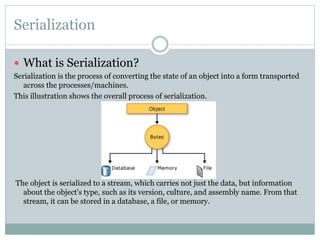
This illustration shows the overall process of serialization.
The object is serialized to a stream, which carries not just the data, but information
about the object's type, such as its version, culture, and assembly name. From that
stream, it can be stored in a database, a file, or memory.
Deserialization
 What is Deserialization?
Deserialization is the opposite of serialization, which is
a process that converts the outcome of serialization
into the original object.
Types of Serializations
 The different types of serialization:
1. Binary Serialization
2. XML Serialization
3. SOAP Serialization
XML Serialization
 XML serialization serializes the public fields and properties of an object,
into an XML stream.
 System.Xml.Serialization contains the classes necessary for serializing and
deserializing XML.
 XML serialization results in strongly typed classes with public properties
and fields that are converted to XML.
Making an Object Serializable
 Apply the SerializableAttribute attribute to a type to indicate that instances of
this type can be serialized.
 Exception will be thrown if a file without SerializableAttribute is attempted to
serialize.
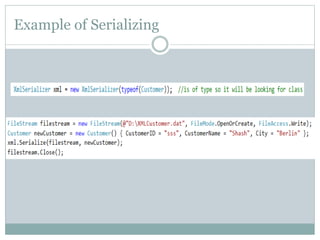
Example of Serializing
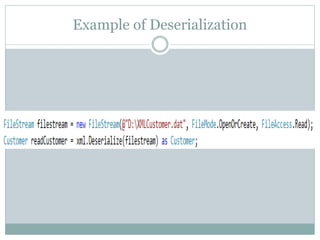
Example of Deserialization
C# Xml serialization

C# Xml serialization

  • 1.
  • 2.
     What isSerialization?  What is Deserialization?  What are the different types of serialization?  What is XML serialization and deserialization?
  • 3.
    Serialization  What isSerialization? Serialization is the process of converting the state of an object into a form transported across the processes/machines. This illustration shows the overall process of serialization. The object is serialized to a stream, which carries not just the data, but information about the object's type, such as its version, culture, and assembly name. From that stream, it can be stored in a database, a file, or memory.
  • 4.
    Deserialization  What isDeserialization? Deserialization is the opposite of serialization, which is a process that converts the outcome of serialization into the original object.
  • 5.
    Types of Serializations The different types of serialization: 1. Binary Serialization 2. XML Serialization 3. SOAP Serialization
  • 6.
    XML Serialization  XMLserialization serializes the public fields and properties of an object, into an XML stream.  System.Xml.Serialization contains the classes necessary for serializing and deserializing XML.  XML serialization results in strongly typed classes with public properties and fields that are converted to XML.
  • 7.
    Making an ObjectSerializable  Apply the SerializableAttribute attribute to a type to indicate that instances of this type can be serialized.  Exception will be thrown if a file without SerializableAttribute is attempted to serialize.
  • 8.
  • 9.