


Presented To:
Resp. Sir Zia-Ul-Haq Zuberi
Presented By:

Dated:

Sheikh Saqib Ahmed
Raja Awais Asgher
Haroon Arshad Jutt
Tahira Yasmeen
Ume Habiba
06-01-2014








Xerox was founded in 1906 in USA
Basically a document and imaging company
an early revolution by introducing 914 plain
paper copiers
sales growth exceeded 25% from year 1946 to
1973 in plain paper copier business
Company that invented photocopier in 1959
and maintained a virtual monopoly for many
years







LCD Monitors
Photo copier
Xerox phaser printers
Multifunction printers
Large volume digital printers
Market Software


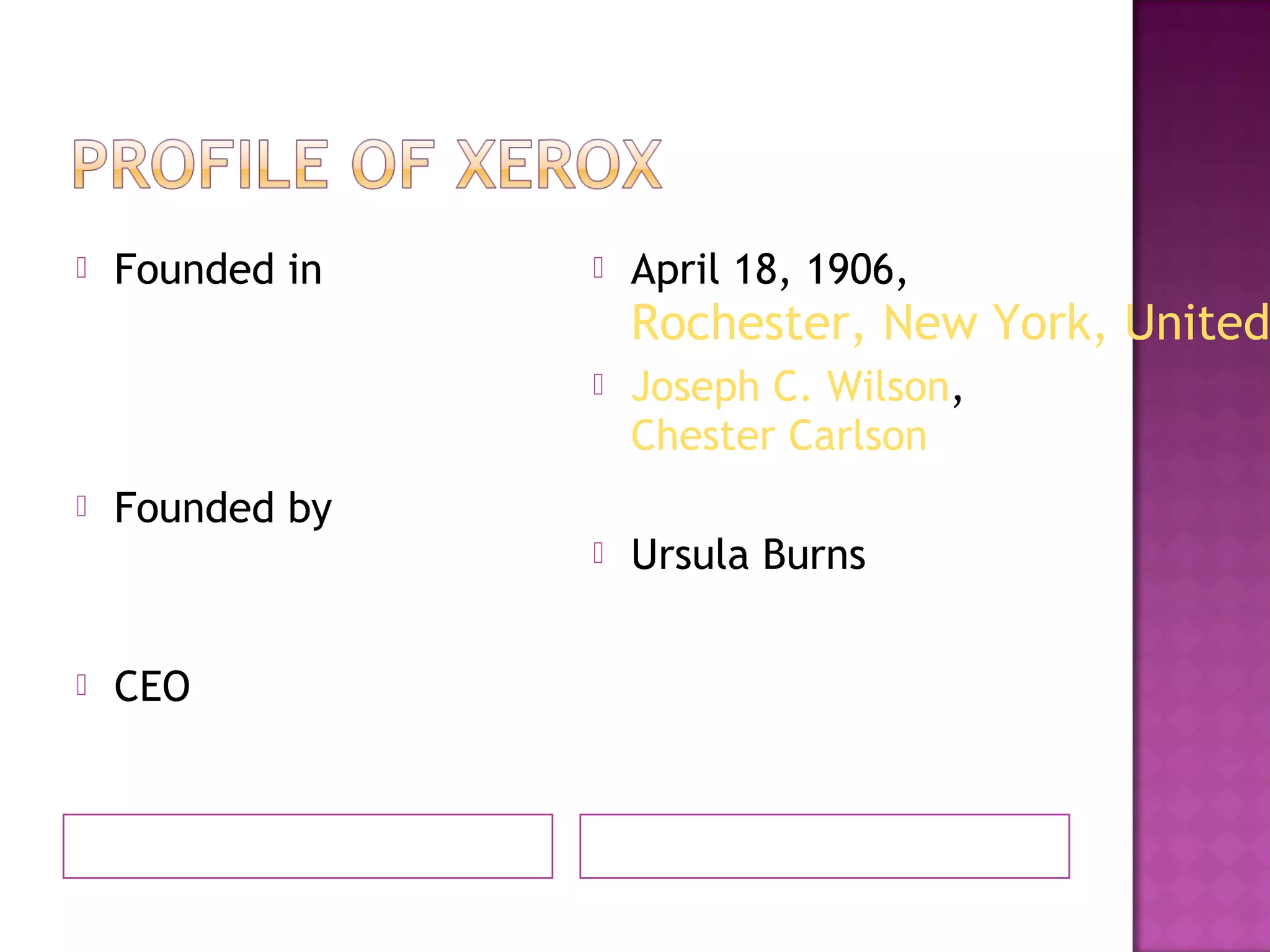
Founded in



April 18, 1906, 

Rochester, New York, United








Joseph C. Wilson, 
Chester Carlson
Ursula Burns

Founded by

CEO








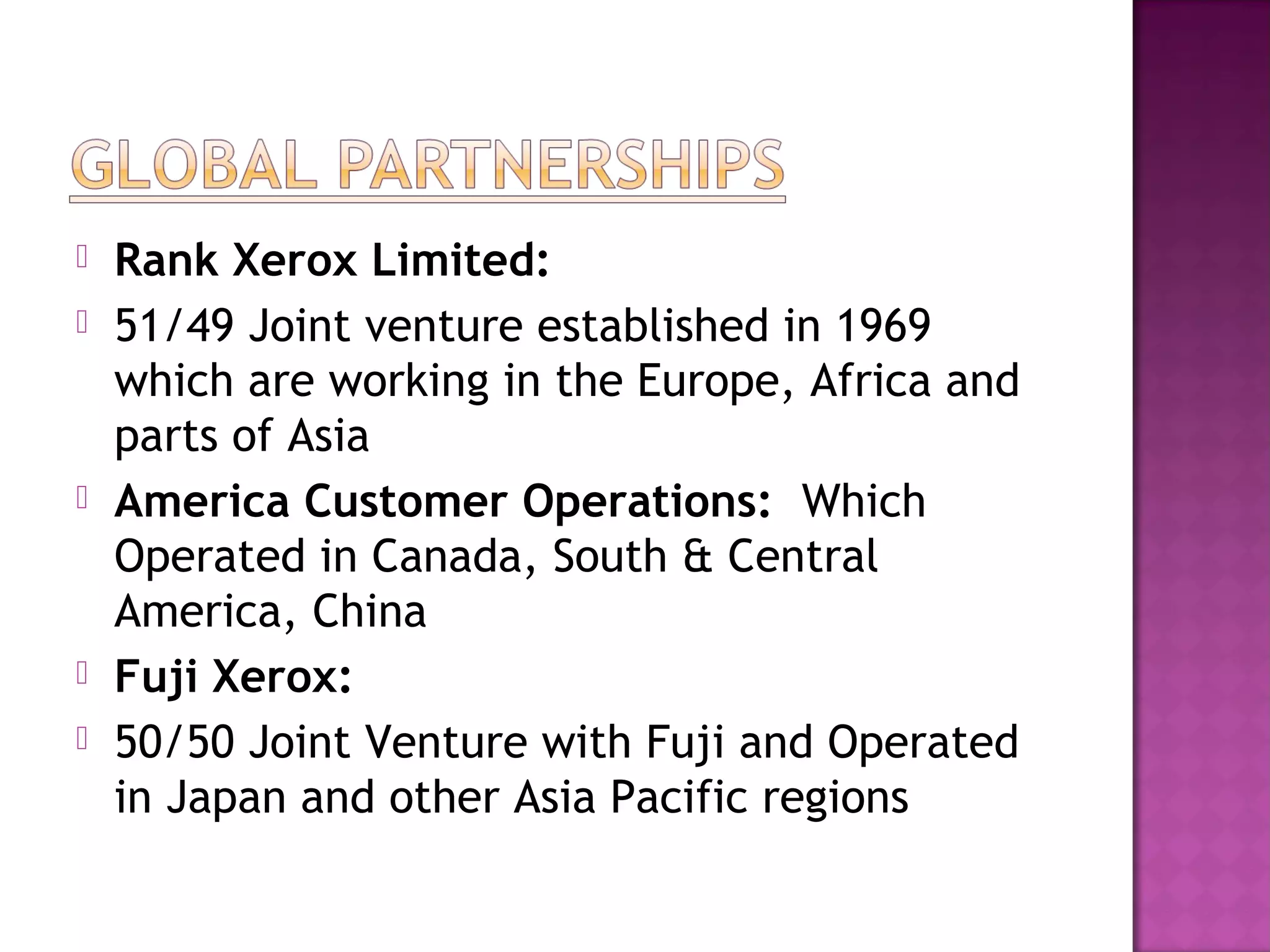
Rank Xerox Limited:
51/49 Joint venture established in 1969
which are working in the Europe, Africa and
parts of Asia
America Customer Operations: Which
Operated in Canada, South & Central
America, China
Fuji Xerox:
50/50 Joint Venture with Fuji and Operated
in Japan and other Asia Pacific regions







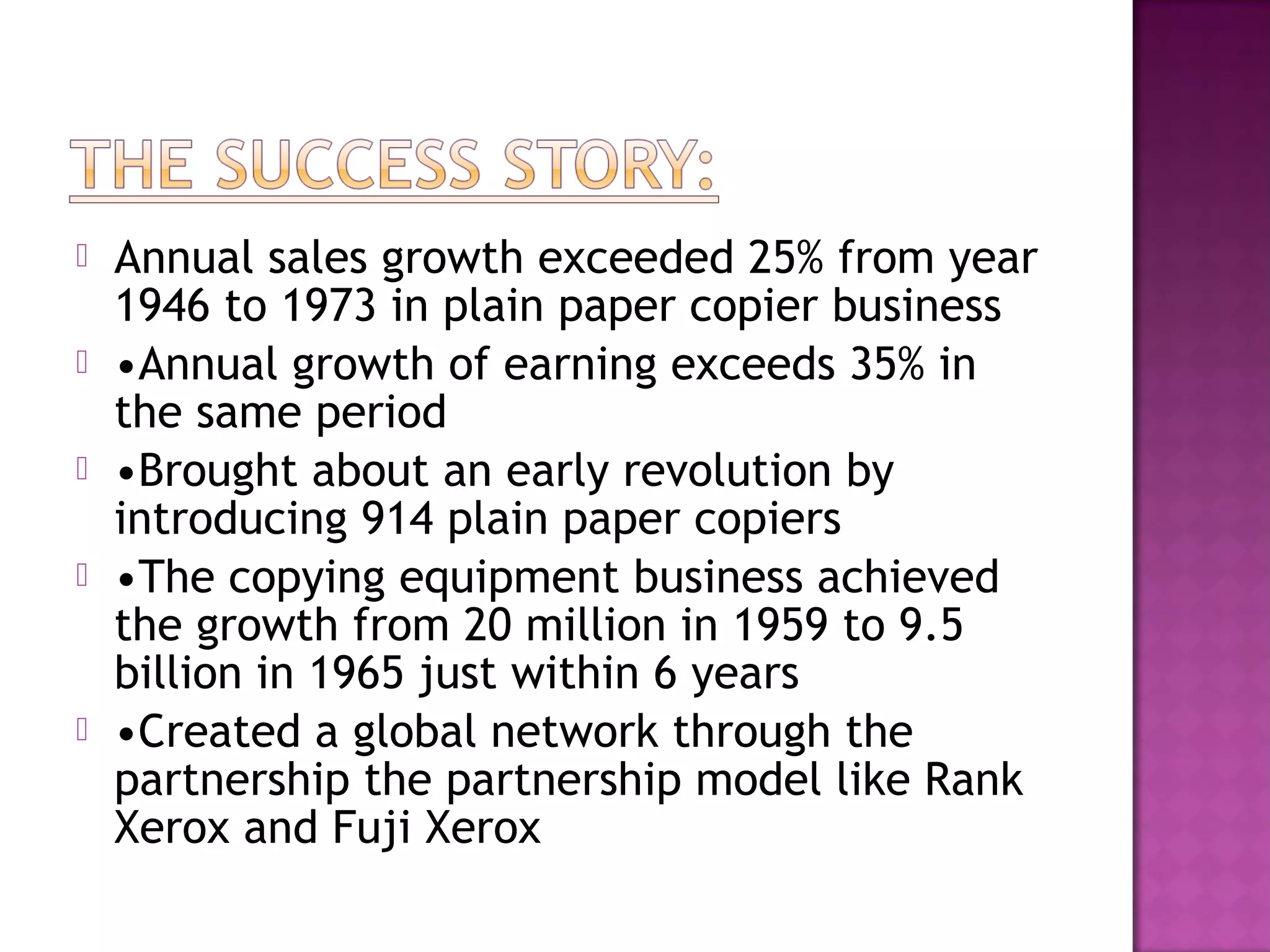
Annual sales growth exceeded 25% from year
1946 to 1973 in plain paper copier business
•Annual growth of earning exceeds 35% in
the same period
•Brought about an early revolution by
introducing 914 plain paper copiers
•The copying equipment business achieved
the growth from 20 million in 1959 to 9.5
billion in 1965 just within 6 years
•Created a global network through the
partnership the partnership model like Rank
Xerox and Fuji Xerox








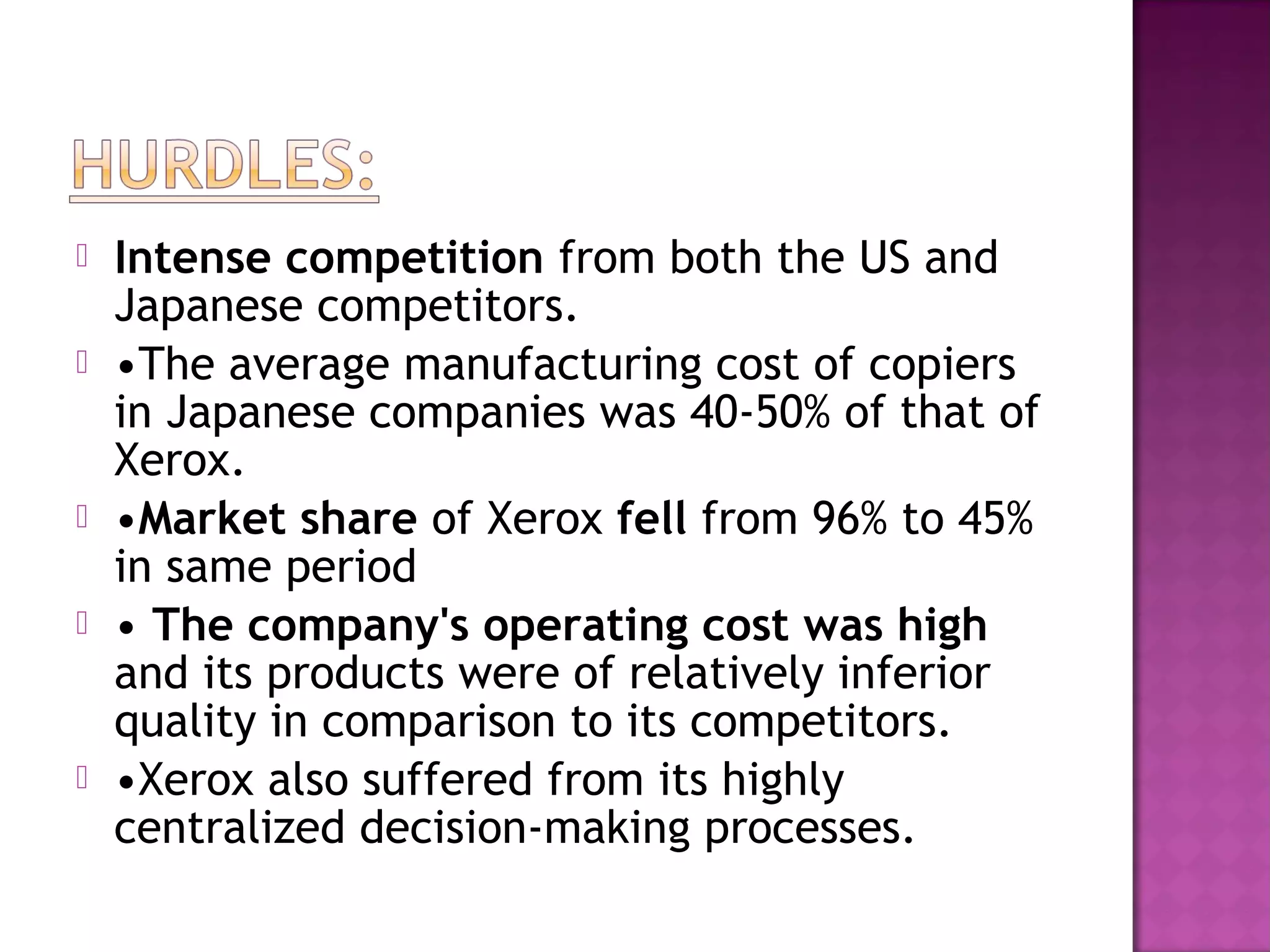
Intense competition from both the US and
Japanese competitors.
•The average manufacturing cost of copiers
in Japanese companies was 40-50% of that of
Xerox.
•Market share of Xerox fell from 96% to 45%
in same period
• The company's operating cost was high
and its products were of relatively inferior
quality in comparison to its competitors.
•Xerox also suffered from its highly
centralized decision-making processes.
After the study xerox find out that:


Competition



Manufacturing cost



Quality




The average manufacturing cost of copiers in
Japanese companies was 40-50% of that of
Xerox. As a result, Japanese companies were
able to undercut Xerox's prices effortlessly.
•Xerox found out that it took twice as long as
it’s Japanese competitors to bring a product
to market, five times the number of
engineers, four times the number of design
changes, and three times the design costs




In the early 1980s, Xerox found itself
increasingly vulnerable to intense
competition from both the US and Japanese
competitors.
•It ignored new entrants (Ricoh, Canon, and
Sevin) who were consolidating their positions
in the lower-end market and in niche
segments.





Xerox's products had over 30,000 defective
parts per million - about 30 times more than
its competitors.
•Xerox would need an 18% annual
productivity growth rate for five consecutive
years to catch up with the Japanese







In 1991, Xerox developed Business
Excellence Certification (BEC) to integrate
benchmarking with the company's overall
strategies
Number of defects reduced by 78 per 100
machines.
•Customer complaints to the president's
office declined by more than 60
• Service response time reduced by 27%.








Inspection of incoming components reduced
to below 5%.
• Defects in incoming parts reduced to
150ppm.
• Marketing productivity increased by onethird.
•Distribution productivity increased by 8-10
%.
• Increased product reliability on account of
40% reduction in unscheduled
maintenance.
• Notable decrease in labour costs






Errors in billing reduced from 8.3 % to 3.5%
percent.
• Became the leader in the high-volume
copier-duplicator market segment.
• Country units improved sales from 152% to
328%.




Customer Replaceable Unit Monitor
A process by which the state or status of
consumable sub systems can be monitored to
enhance the efficiency or productivity of the
machine on which it is installed. 
EA Microspheres
Emulsion Aggregation (EA) is a new
technology for the preparation of
microspheres where 1-15 micron size
particles can be grown from smaller,
nanometer size constituents. 


Image Sensor
Xerox has developed a Full Width Array (FWA)
image sensor that is the best in its class for
speed and image quality in traditional document
scanning markets. 



Switch-A-View
Xerox researchers have developed a novel color
printing technology that allows multiple images
to be combined in a single hard copy print, yet
allows users to view the images one image at a
time by exposing it to a specific color of light. 




Tear and Crush System:
In our "tear and crush" system, paper is torn into
small pieces instead of simply being cut, thereby
leaving the paper fibers intact and not cut off.
This makes it easier to recycle paper and enables
the effective use of paper that was previously
processed as burnable rubbish.
Lgnite
A new technology is in the works at Xerox that
will essentially turn photocopiers into papergrading machines that can even recognize
handwriting to distinguish both math formulas,
as well as long-form essays.
QUESTIONS

COMMENTS
Xerox Benchmarking & IT

Xerox Benchmarking & IT

  • 2.
    Presented To: Resp. SirZia-Ul-Haq Zuberi Presented By: Dated: Sheikh Saqib Ahmed Raja Awais Asgher Haroon Arshad Jutt Tahira Yasmeen Ume Habiba 06-01-2014
  • 4.
         Xerox was foundedin 1906 in USA Basically a document and imaging company an early revolution by introducing 914 plain paper copiers sales growth exceeded 25% from year 1946 to 1973 in plain paper copier business Company that invented photocopier in 1959 and maintained a virtual monopoly for many years
  • 5.
          LCD Monitors Photo copier Xeroxphaser printers Multifunction printers Large volume digital printers Market Software
  • 6.
     Founded in  April 18,1906,  Rochester, New York, United     Joseph C. Wilson,  Chester Carlson Ursula Burns Founded by CEO
  • 7.
         Rank Xerox Limited: 51/49Joint venture established in 1969 which are working in the Europe, Africa and parts of Asia America Customer Operations: Which Operated in Canada, South & Central America, China Fuji Xerox: 50/50 Joint Venture with Fuji and Operated in Japan and other Asia Pacific regions
  • 8.
         Annual sales growthexceeded 25% from year 1946 to 1973 in plain paper copier business •Annual growth of earning exceeds 35% in the same period •Brought about an early revolution by introducing 914 plain paper copiers •The copying equipment business achieved the growth from 20 million in 1959 to 9.5 billion in 1965 just within 6 years •Created a global network through the partnership the partnership model like Rank Xerox and Fuji Xerox
  • 9.
         Intense competition fromboth the US and Japanese competitors. •The average manufacturing cost of copiers in Japanese companies was 40-50% of that of Xerox. •Market share of Xerox fell from 96% to 45% in same period • The company's operating cost was high and its products were of relatively inferior quality in comparison to its competitors. •Xerox also suffered from its highly centralized decision-making processes.
  • 10.
    After the studyxerox find out that:  Competition  Manufacturing cost  Quality
  • 11.
      The average manufacturingcost of copiers in Japanese companies was 40-50% of that of Xerox. As a result, Japanese companies were able to undercut Xerox's prices effortlessly. •Xerox found out that it took twice as long as it’s Japanese competitors to bring a product to market, five times the number of engineers, four times the number of design changes, and three times the design costs
  • 12.
      In the early1980s, Xerox found itself increasingly vulnerable to intense competition from both the US and Japanese competitors. •It ignored new entrants (Ricoh, Canon, and Sevin) who were consolidating their positions in the lower-end market and in niche segments.
  • 13.
        Xerox's products hadover 30,000 defective parts per million - about 30 times more than its competitors. •Xerox would need an 18% annual productivity growth rate for five consecutive years to catch up with the Japanese
  • 14.
        In 1991, Xeroxdeveloped Business Excellence Certification (BEC) to integrate benchmarking with the company's overall strategies Number of defects reduced by 78 per 100 machines. •Customer complaints to the president's office declined by more than 60 • Service response time reduced by 27%.
  • 15.
          Inspection of incomingcomponents reduced to below 5%. • Defects in incoming parts reduced to 150ppm. • Marketing productivity increased by onethird. •Distribution productivity increased by 8-10 %. • Increased product reliability on account of 40% reduction in unscheduled maintenance. • Notable decrease in labour costs
  • 16.
       Errors in billingreduced from 8.3 % to 3.5% percent. • Became the leader in the high-volume copier-duplicator market segment. • Country units improved sales from 152% to 328%.
  • 17.
      Customer Replaceable UnitMonitor A process by which the state or status of consumable sub systems can be monitored to enhance the efficiency or productivity of the machine on which it is installed.  EA Microspheres Emulsion Aggregation (EA) is a new technology for the preparation of microspheres where 1-15 micron size particles can be grown from smaller, nanometer size constituents. 
  • 18.
     Image Sensor Xerox hasdeveloped a Full Width Array (FWA) image sensor that is the best in its class for speed and image quality in traditional document scanning markets.   Switch-A-View Xerox researchers have developed a novel color printing technology that allows multiple images to be combined in a single hard copy print, yet allows users to view the images one image at a time by exposing it to a specific color of light. 
  • 19.
      Tear and CrushSystem: In our "tear and crush" system, paper is torn into small pieces instead of simply being cut, thereby leaving the paper fibers intact and not cut off. This makes it easier to recycle paper and enables the effective use of paper that was previously processed as burnable rubbish. Lgnite A new technology is in the works at Xerox that will essentially turn photocopiers into papergrading machines that can even recognize handwriting to distinguish both math formulas, as well as long-form essays.
  • 20.