E u r o p e a n
                                  C o m m i s s i o n


EU Water Initiative

     International
    Cooperation -
             from
       knowledge
         to action


                      EUR 20612
CCo n t e n t s
     ONTENTS


                   Foreword                                                                            3

                   Policy framework                                                                    4

                   Principal instruments of european international policies                            6

                   Five thousand years of water works supporting diverse human societies               7

                   Balancing people and nature – Integrating approaches                                9

                   Safe water and sanitation –
                   Cost-effective approaches that work                                                12

                   Catchment basin approaches –
                   Strategies for reconciling multiple demands                                        15

                   Protecting mountainous upstream areas                                              17

                   Sustainable lowland-use and irrigation                                             18

                   Urbanisation and water                                                             19

                   Coastal zone management                                                            21

                   The way forward                                                                    22

                   Annex                                                                              25

                   Further reading                                                                    47


  This brochure was produced through a collaboration of Directorates-General Research, Development, External
  Relations, Environment, Fisheries, Information Society as well as the EuropeAid Office and the European
  Investment Bank. Several EC Delegations and projects also contributed generously with information and photos.

  Free copies can be requested from inco@cec.eu.int.

  Photo credits of cover page: Noria in Hama, Syria © Dr. Aly Abbara
  Bangladeshi boy enjoying fresh water from the tap © Heldur Netocny / Panos Pictures

  Published by the European Commission

  LEGAL NOTICE
  Neither the European Commission nor any person acting on behalf of the Commission
  is responsible for the use which might be made of the following information.

  Luxembourg: Office for Official Publications
  of the European Communities, 2003

  ISBN: 92-894-4901-2

  © European Communities, 2003
  Reproduction is authorised for non-commercial purposes provided the source is acknowledged.

  Printed in Belgium
3


  FOREWORD


                                                                                          this approach with the EU Water Framework
                                                                                          Directive. I am convinced that the shared goals of


                                                                ©EC-Audiovisual library
                                                                                          inter-generational fairness, equitable use and conser-
     Romano Prodi
                                                                                          vation of precious water resources offer ample oppor-
      President of the
European Commission                                                                       tunities for co-operation.
                                                                                          The European Union has been working on key issues
                                                                                          related to sustainable use of precious water resources,
  Water is Life, yet over 1 billion people have no access to
                                                                                          not only within its own borders, but also in partnership
  safe drinking water and over 2 billion lack basic sanita-
                                                                                          with many research teams, NGOs, governments and
  tion. This is why leaders at the World Summit on
                                                                                          other actors in all partner countries. It has actively
  Sustainable Development in Johannesburg, South Africa,
                                                                                          participated in a variety of water-related fora and ini-
  in September 2002, called for halving these numbers by
                                                                                          tiatives. A large number of co-operation projects chan-
  2015. In practical terms, this means providing these
                                                                                          nel knowledge and financial resources into addressing
  essential services to 200 000 and 400 000 new people
                                                                                          water problems in many partner countries. Policy dia-
  per day until the end of 2015! The EU strongly supports
                                                                                          logue with several regions, including Africa, Asia,
  these goals and therefore, in Johannesburg, we launched
                                                                                          Eastern Europe, Latin America and the Mediterranean,
  the EU Water Initiative together with Danish Prime
                                                                                          is being reinforced concerning crucial water and asso-
  Minister and EU President in office, Anders Fogh
                                                                                          ciated food security in the expectation of enhancing the
  Rasmussen.
                                                                                          effects of on-going and future co-operation projects.
  It is obvious that such ambitious goals on a global scale
                                                                                          This brochure shows the European Commission’s
  cannot be achieved with conventional means, even
                                                                                          work on issues addressed by the Water Initiative and
  with all the current aid. Scientific knowledge and inno-
                                                                                          its commitment to pursue its goals by partnering with
  vative approaches across policies and their instruments
                                                                                          others. The different Commissioners involved in this
  are important for tangible headway towards these
                                                                                          subject, Philippe Busquin (Research), Poul Nielson
  goals. It will particularly require a great mobilisation of
                                                                                          (Development), Chris Patten (External Relations) and
  partners ranging from governments, water agencies,
                                                                                          Margot Wallström (Environment) and their respective
  water users to civil society organisations and private
                                                                                          services, have been particularly active in this endeavour
  enterprises. Open co-ordination and co-operation at
                                                                                          and will continue to invest in broadening these partner-
  all levels from local to international will be crucial.
                                                                                          ships in the future.
  The second thrust of the Initiative concerns the general
  adoption of river basin-scale policy, planning and man-
  agement, particularly for transboundary catchments.
  Within the European Union, we have already adopted
4


                                                                                                                                     © Marc French/Panos Pictures
    POLICY FRAMEWORK

    Against the backdrop
    of a global water crisis…
    “The total volume of water on Earth is about 1 400 million
    km3 of which only 2.5%, or about 35 million km3, is fresh-
    water. Most freshwater occurs in the form of permanent ice
    or snow, locked up in Antarctica and Greenland, or in deep
    groundwater aquifers. The principal sources of water for
    human use are lakes, rivers, soil moisture and relatively      Haiti. Washing clothes.
    shallow groundwater basins. The usable portion of these
    sources is only about 200 000 km3 of water – less than 1%
                                                                   Devastating floods in Central America and Mozambique in
    of all freshwater” 1. Freshwater is renewable only by snow
                                                                   2001, in Central and Eastern Europe, Central and Southern
    and rainfall, at the rate of about 40-50 000 km3 per year.
                                                                   China and other Asian countries in 2002 have resulted in
    With growing wealth, global consumption of water has           loss of lives, untold material and economic damage and
    recently been doubling every 20 years, more than twice the     pollution of important regional seas in Asia and Eastern
    rate of human population growth. Yet, supply is heavily        Europe. On the other extreme, blistering droughts have hit
    skewed as a function of wealth and power differences within    Sudan, Ethiopia, Australia and North-western China in
                                                                   recent years resulting in dustbowls and rising food insecur-
    and between societies and natural conditions, including
                                                                   ity. Such crises are becoming more frequent and may
    ecosystems’ health. Thus, daily consumption of a person in
                                                                   increase the threat of regional conflicts. They put water into
    a developing country without access to running water is
                                                                   the news headlines and onto the political agenda, both local
    typically around 20 litres, while a person with access to
                                                                   to global.
    piped water may use in excess of 200 litres per day.
    Included in this high figure is pipe leakage, which may        Record keeping for temperature started systematically in
    reach 50% in some cities. Conversely, it is not uncommon       1866. Data shows that the 14 warmest years have all
    for women and girls in rural Africa to spend three hours per   occurred since 1980. In the 1990s the Arctic ice cap lost
    day fetching water from distant water holes and rivers.        almost 20% of its mass, but only 5% of its surface, lead-
                                                                   ing to a break-up at the North Pole during the summer
    According to the United Nations, overall about 1.1 billion
                                                                   months starting in 2000.
    people on Earth do not have access to safe drinking water
    and about 2.4 billion people lack adequate sanitation. An
    estimated 6 000 children die each day from diseases asso-
    ciated with poor sanitation and hygiene and one in two
                                                                   … growing awareness helps spell
    hospital beds in the world is occupied by someone with a
                                                                   frameworks of action
    preventable water-borne disease.
                                                                   Over the last 50 years in particular, the world’s finite sup-
    If current trends persisted, by 2025 the demand for fresh-     ply of freshwater has been subjected to increasing pressures
    water is expected to rise by 56% – more than is currently      and has also suffered quality degradation in many regions.
    available. About 70% of current demand is from agricul-        Taken together, these problems amount to a global water
    ture, the remainder from urban, household and industrial       crisis. This crisis has been analysed and discussed at local
    use, and consumption.                                          and global level, and in governmental and non-govern-
                                                                   mental fora. In 1987, in response to this heightened inter-
    The first response to growing demand for water supply,
                                                                   est in water, the World Commission on Environment and
    power and flood regulation has been to build more dams
                                                                   Development (Brundtland Commission), proposed the
    and divert more rivers. The number of large dams world-        concept of ‘sustainable development’ and identified water
    wide has climbed from just over 5 000 in 1950 to 45 000        as a key issue among global environmental concerns in its
    by the end of the 1990s2. Groundwater has also been tapped     report “Our Common Future”.
    in order to meet the needs of irrigation agriculture, which
    has massively expanded particularly over the last 50 years     At the Rio UN Conference for Environment and Develop-
    alongside demographic growth and rapid urbanisation.           ment (UNCED)3 in 1992, water issues were extensively
    Change of land use, deforestation of mountainous regions
    where springs of the principal river systems of the world      1
                                                                     UNEP, 2002. Global environment outlook 3. Nairobi, Kenya
    are located, the melting of glaciers and changing patterns     2
                                                                     http://www.dams.org/ and reactions to the Report of the World
    of rain and snowfall, are all modifying the run-off regimes      Commission on Dams at http://www.unep-
                                                                     dams.org/document.php?cat_id=4
    of rivers in many parts of the globe. These and other trends   3
                                                                     http://www.unep.org/unep/partners/un/unced/ and
    are usually referred to in the context of ‘global change’.       http://www.ciesin.org/datasets/unced/unced.html
5


debated and incorporated in Chapter 18 of Agenda 21                 management and water saving plans. In Johannesburg,
and were a central piece of the Rio Declaration. Ever since,        EC President, Romano Prodi, launched the EU Water
a string of thematic events has gained momentum. In                 Initiative together with Danish Prime Minister and EU
1995, the Global Water Partnership and the World Water              President, Anders Fogh Rasmussen, in order to harness
Council were created, involving governments, inter-                 commitment and concrete action to water security for the
national agencies, civil society and private sector. The first      21st century. The presidents reflected the willingness of
World Water Forum was held in Marrakech in 1997, with               public, private and civil society actors, all of whom were
the second taking place in The Hague three years later 4.           consulted intensively in the run-up to the conference, to
                                                                    establish open coordination to achieve the goals. The
At European level, after an extensive consultation process,         European Union has a long history of relations with part-
the European Parliament and Council adopted a compre-               ners in partner countries and is willing to invest in stepped
hensive Water Framework Directive, which entered into               up partnerships for water security underpinned by con-
force on 22 December 2000 5. The purpose of this Directive          tinuous dialogue.
is to establish a framework for the protection of inland
surface waters, transitional waters, coastal waters and             The European Union is increasingly engaged in mobilising
groundwater within the EU. It aims at contributing to (a)           the best political, knowledge, development and economic
the provision of a sufficient supply of good quality surface        capacities of both the partner region and Europe around
water and groundwater as needed for sustainable, balanced           addressing the specifics of the water crisis in that region.
and equitable water use, (b) a significant reduction in             Examples of regional platforms are: Africa; the ASEM con-
pollution of groundwater, (c) the protection of territorial         text (Asia-Europe Meetings); Eastern Europe, Caucasus
and marine waters, and (d) achieving the objectives of relevant     and Central Asia (EECCA); Latin America, Caribbean and
international agreements, including those which aim to              Europe (ALCUE); and the most water-scarce region of all,
prevent and eliminate pollution of the marine environ-              the Mediterranean. In particular, President Prodi and the
ment. It adopts a river basin approach and obliges Member           President of Nigeria, Chief Olusegun Obasanjo, signed the
States to make the appropriate governance arrangements,             EU-Africa ‘Water for Life’ Agreement at WSSD in
including for transboundary basins. Action structured               Johannesburg, where an EU/EECCA Ministerial Declaration
around its implementation offers a shared learning ground           was also agreed. The European Commission is convinced
within the European Union, but also experience of interest          that water issues offer fertile grounds for promoting regional
to partners in other parts of the globe.                            co-operation, peace and prosperity.
The International Conference on Freshwater6 (Bonn
Conference, December 2001) enabled a broad coalition of
                                                                    4
                                                                       http://www.worldwaterforum.net/
some 700 international participants to prepare initiatives
                                                                    5
                                                                       http://europa.eu.int/smartapi/cgi/sga_doc?smartapi!celexapi!prod!
on water for the World Summit on Sustainable Develop-                  CELEXnumdoc&lg=en&numdoc=32000L0060&model=guichett
ment (WSSD) 7 in Johannesburg.                                      6
                                                                       http://www.water-2001.de/
                                                                    7
                                                                       http://www.johannesburgsummit.org/default.htm
At the WSSD 8 itself, an important step was taken with the          8
                                                                       http://www.earthsummit2002.org/es/issues/Freshwater/
adoption of a sanitation target, complementing the Millen-             freshwater.htm# Human%20Right%20to%20Water
nium Development Goal on access to drinking water.                  9
                                                                       http://europa.eu.int/prelex/detail_dossier_real.cfm?CL=fr&DosId=172380
Leaders also required the development of integrated water           10
                                                                       http://register.consilium.eu.int/pdf/fr/02/st08/08958f2.pdf


                       COMMISSION COMMUNICATION AND COUNCIL RESOLUTION

  In March 2002, the European Commission adopted a                      especially the poorest and with a clear focus on the needs
  “Communication on water management in developing coun-                of women and children, with the general objective of redu-
  tries” 9. The European Development Council endorsed, on 30            cing poverty and improving people´s health, quality of life
  May 2002, a common Resolution on this issue. These policy
                                   10
                                                                        and livelihood opportunities;
  papers recognise the importance of addressing the global chal-    • Developing sustainable and equitable transboundary water
  lenge of growing scarcity and decreasing quality of water             resources management taking into account all relevant inter-
  resources, particularly acute in developing countries. Water is       ests, integrating the competing needs of the various users and
  a key issue for poverty reduction, sustainable development and        facilitating South-South co-operation;
  the achievement of the Millennium Development Goal on water.      • Implementing cross-sectoral coordination to ensure equit-
  Under the overarching policy framework of Integrated Water            able, sustainable and appropriate distribution of water
  Resources Management, based on a river basin approach, atten-         between users of different kinds. This requires the main-
  tion should be primarily devoted to:                                  streaming of water management principles into related pol-
  • Ensuring a supply of sufficient, good quality drinking water,       icy areas.
    adequate sanitation and hygiene to every human being,
6


    PRINCIPAL INSTRUMENTS
    OF EUROPEAN INTERNATIONAL POLICIES
    The EC’s international co-operation is particularly articulate in
    five areas: foreign affairs, trade, development, environmental
    and scientific co-operation. These policy areas in turn make use
    of many instruments for implementation. They all rely on pol-
    icy dialogue as the central pillar to create an enabling environ-
    ment in partner countries and in the Union for whatever joint
    activities ensue. Because water is so central to the full range of
    human activities, and indeed for life on Earth itself, all can
    impact on the ability to achieve the goals of the EU Water
    Initiative. The annex contains a selection of projects. Web
    resources (footnotes) on all instruments are on p. 47.


    Development co-operation instruments
    At a global level, the Commission has actively contributed to        ACP countries, Asia, Latin America (developing countries), the
    summits from Rio 1992 to Johannesburg 2002 and all those in          Mediterranean, Russia and the other New Independent States
    between, supported the World Water Fora and has invested             and Western Balkans. At the time of writing some 100 INCO
    political capital, knowledge and financial resources into the EU     projects16 relating to water are on-going and another 186, mostly
    Water Initiative. Several lines of the Community budget are          intra-European, projects are funded through the Key Action
    being used to address water and environmental problems.              ‘Sustainable Management and Quality of Water’17 in FP5.

    It is most active on regional, national and local levels, where      Under the new Sixth Framework Programme18 (FP6, 2002-
    operational capacities, knowledge and investment to improve          2006), €315 million has been allocated to 'Specific measures
    the situation are most needed. The Lome Convention and its           in support of scientific co-operation’ (INCO)19 (water being
    successor, the Cotonou Agreement11, are the main geographi-          among the focal topics). Another €285 million is available to
    cally bound instruments for EC co-operation with sub-Saharan         enable the active participation of teams from partner countries
    Africa, the Caribbean and the Pacific – the ‘ACP’ states. The con-   in all thematic priorities of FP6 and giving partners ever
    ventions advocate “a sustainable balance between economic            improved access to significant scientific knowledge of the
    objectives, the rational management of the environment and the       European research community. Water is a major focus within
    enhancement of natural and human resources”. Successive              the various areas of the thematic priority 'Sustainable
    phases of the European Development Fund (EDF) have allo-             Development, Global Change and Ecosystems'20 as well as the
    cated significant resources to water, ranging from direct support    thematic priority 'Aeronautics and Space'21 in the specific area
    for safe drinking water and sanitation in rural and urban settings   of ‘Global Monitoring for Environment and Security’ (GMES).
    in ACP countries to interventions with longer-term effects such
    as support to forest conservation, re-afforestation, hygiene edu-
    cation, more efficient irrigation and support to integrated water    European Investment Bank
    resources management (IWRM) and sectoral policy frameworks.
    Close to €700 million are being spent in on-going projects.          Over the last decade, the annual finance of the European
                                                                         Investment Bank (EIB)22 for water and sanitation projects
    Similar instruments are used to support sustainable water devel-     throughout the world averaged €2 billion. As the EU’s financ-
    opment in Asia and Latin America (ALA) 12, Central and Eastern       ing institution, the EIB operates within the framework of the
    European Countries (CEEC – TACIS)13, the Mediterranean (par-         Maastricht Treaty on European Union. Safeguarding and
    ticularly through the MEDA Programme)14 and Russia and the           improving the environment ranks among its top operational
    other New Independent States (NIS)15. Within the MEDA                objectives. The Bank is participating in the preparations for the
    Programme, for example, some €170 million goes towards the           EU Water Initiative. It now has new means at its disposal – the
    sustainable use of scarce water resources. Since 1992, the TACIS     Facility for Euro-Mediterranean Investment and Partnership
    Programme has committed around €120 million to water                 and the Investment Facility, supported by the Commission.
    management projects.                                                 While EIB lending is focused on the EU and the accession
                                                                         countries, there is also strong emphasis on financing in the
                                                                         critical water sector in the Mediterranean region. Some 70%
                                                                         (€1.2 billion) of loans for public infrastructure over the last five
    International scientific co-operation
                                                                         years related to water supply and wastewater treatment. Its
    From 1994 on, the Commission’s international scientific              operations in the ACP countries, Asia, Latin America and the
    research activities have been given a uniform structure (INCO)       Balkans are also undergoing steady expansion. In addition, the
    as part of the Research Framework Programmes (FP4, 1994-             EIB is involved in financing environmental schemes in the
    1998, FP5, 1998-2002). INternational CO-operation covers             St Petersburg and Kaliningrad regions in Russia.
7


FIVE THOUSAND YEARS OF WATER WORKS
SUPPORTING DIVERSE HUMAN SOCIETIES

Water management played a critical                                 The early development of irrigated agriculture, demography
role in the rise – and collapse –                                  and social organisation, city development and trade involved
of several earlier civilisations                                   the Mesopotamian heartland to Egypt, the Fertile Crescent, in
                                                                   what is today the Near East and Eastern Mediterranean, the
Since water is so central to human life and more generally to
                                                                   Indus Valley and Northern China. It supported a great diver-
the life support system of the Earth, it is worth looking at
                                                                   sity of civilisations and high levels of innovation, particularly
how earlier human societies coped with the challenges of
                                                                   the initial networking of cities.
food, fibre, shelter, and how their evolving social organisa-
tion enabled them to sustain a growing population and com-
                                                                   A thousand years later, the Maya civilisation in Central America
plexity.
                                                                   emerged in the first millennium BC and flourished from 250
                                                                   AD, based on sophisticated agriculture. Raised plots of earth
As early as the fourth millennium BC, the Sumerian civilisation
                                                                   on which maize and other crops grew, were surrounded by
achieved highly productive agriculture on the central Euphrates
                                                                   water supply canals. The surplus enabled the development of
River floodplain in what is now a desolate region. The surplus
                                                                   cities with impressive stone temples and palaces. In order to
generated by the sophisticated irrigation farming then enabled
                                                                   produce food for the rapidly growing population, hillsides
the formation of the first cities and socio-economic specialisa-
                                                                   were deforested, leading to increasing erosion and landslides.
tion, as confirmed by currently available archaeological evi-
                                                                   Archaeological evidence shows anaemia symptoms from skulls
dence. The irrigation required complex social organisation
                                                                   and bones of the later period as well as progressive depopula-
and supported a population growing ten-fold up to an esti-
                                                                   tion. No stone building was constructed after 822 AD. Over-
mated 1 million inhabitants. The Sumerians were also the first
                                                                   farming, deforestation with subsequent soil erosion and loss of
to develop a written language, the cuneiform script.
                                                                   productivity were instrumental in spelling the complete demise
                                                                   of this society by 900 AD.

                                                                   It is not known whether these civilisations fully understood the
                                                                   reasons for their decline or not. But somehow they were not
                                                                   able to muster the social and technical knowledge required to
                                                                   maintain a balance between their society and the natural
                                                                   resources at their disposal. The ensuing lack of food, however,
                                                                   provoked a range of effects, from famine leading to shrinking
                                                                   population to outward migration.

                                                                   During these times, the global human population was much
                                                                   lower than today. Estimates of population for different periods
                                                                   from ancient to moderns times are 23:
Noria in Hama, Syria, from postcard restored by Aly Abbara.

                                                                                                        Range of            Mid-range
Why, then, did this successful society decline? Scientists now                 Period                   of world             of world
believe irrigation techniques played an important role in the                                          population           population
collapse of Sumer. The Mesopotamian irrigation system con-
                                                                              Neolithic
sisted of conducting water from the rivers by gravity onto the          (10 000 BC to 4 000 BC)        4 to 7 million         5 million
fields. The rivers were higher than the surrounding land
because of the accumulation of transported soil. Once the                      Ancient
water was on the fields, it could not be drained, but only per-         (4 001 BC to 1 200 BC)        10 to 50 million       25 million
colated or evaporated. Over time, the combined effects of ris-
ing water tables and rising concentration of mineral salts                     Classic
                                                                        (1 201 BC to 930 AD)         50 to 250 million      150 million
spoiled the soils. By about 2 300 BC the fields supported only
a fraction of their former production. The tale of salt damaged                 Modern
crops is told on Mesopotamian cuneiform tablets. Food scarcity              (after 930 AD)          250 to 9 300a million   5 000 million
eventually undermined this great civilisation.
                                                                   a = latest UN population projection for 2050


                                                                   23
                                                                        Adapted from Modelski, G. & W.R. Thompson, 1996. Evolutionary
                                                                        pulsations in the world economy, at www.faculty.washington.edu/
                                                                        modelski/WEPULSE.html
8


    Learning from our predecessors


                                                                                                                                                                                                                    © Jeremy Horner/Panos Pictures
    in earlier civilisations
    Over hundreds of years if not millennia, ingenious hydraulic
    works serviced a range of water needs, foremost for food
    production, but also for flood control, transport, direct human
    consumption, improving micro-climates and supporting indus-
    trial activities on different scales. These together with increas-
    ing degrees of sophistication in knowledge organisation and
    transmission, and social organisation have served our prede-
    cessors well and supported increasing human populations.

    We can look at some outstanding achievements in harnessing
    water resources for food and socio-economic development in
                                                                                                                                                Cuzco Region, Peru. Winay Wayna Incan ruins.
    history and learn from these to help deal with today’s chal-
    lenges. Among the examples are the ‘tanks’, small reservoirs
                                                                                                                                                the water cycle. Until the advent of cheap motor pumps, par-
    impounded by a dam across a seasonally flooded depression,
                                                                                                                                                ticularly since the 1970s, these tunnels were maintained and
    which are still widespread in India and Sri Lanka. These date
                                                                                                                                                functional. They still account for significant shares of water
    back to ancient times for enabling irrigated agriculture. An EC
                                                                                                                                                supplies in Iran and elsewhere.
    development project operating between 1984 and 1996 in
    Tamil Nadu with a budget of €65.8 million, involved lining the
                                                                                                                                                While much of Europe was under the medieval feudal system
    main irrigation and drainage canals and carrying out other
                                                                                                                                                and had lost touch with its earlier achievements, Abd Al
    essential maintenance work. During a later phase, much more
                                                                                                                                                Rahman I of the Umayad Caliphate reached Spain in the mid-
                                                                                                                                                700s. He became the first Caliph of Al-Andalus, which occupied
                                                                                   © Ammar Boumezbeur, Direction générale des forêts, Algérie


                                                                                                                                                most of the Iberian Peninsula and set up the Umayad Dynasty
                                                                                                                                                that ruled for over 300 years. The Berber, or Moors as they were
                                                                                                                                                called in Europe, imported irrigation systems from Syria and
                                                                                                                                                Arabia, turning the dry plains into a rich agricultural region.

                                                                                                                                                Meltwater from the mountains was canalised for percolation
                                                                                                                                                into the lower ranges so that water could be gravity-fed in early
                                                                                                                                                summer to irrigate elaborate hill-side terraces and lower areas.
                                                                                                                                                This system still exists in the Alpujarra region in Spain, though
                                                                                                                                                changing lifestyles have led to rural exodus, insufficient main-
                                                                                                                                                tenance and partial collapse.


    The 'Kasria' of the Ouled Said Oasis in Adrar, Algeria, serves to distribute                                                                The Moors complemented traditional olives and cereals by
    the waters of the ancient foggara in an equitable way.                                                                                      fruits and vegetables, rice, henna and cotton introduced from
                                                                                                                                                Africa and India. Fertilisation allowed high productivity.
    emphasis was placed on farmer participation and response to                                                                                 Landscaping and gardening provided pleasant micro-climates
    their expressed needs in order to enable economically viable                                                                                during the summer heat and some of the most beautiful gar-
    and sustainable tank modernisation. Responsibility for oper-                                                                                dens still in existence today.
    ation and maintenance was turned over to water user organ-
    isations, which in turn increased equity of water distribution.                                                                             Extensive knowledge exchange existed between the civilisa-
                                                                                                                                                tions through time and space, as exemplified through the net-
    The most sophisticated forms of water harvesting consist of                                                                                 work of Buddhist monasteries lining the ‘Silk Roads’ between
    groundwater tappings, including the famous qanats originat-                                                                                 100 BC and about 1 500 AD and long-range communication
    ing in Iran some 3 000 years ago. Qanats or kariz are tunnels                                                                               through Islamic pilgrimage to Mecca, also favouring trade.
    dug into uphill aquifers conducting water by gravity to use in                                                                              The ability to innovate, organise, share and apply knowledge
    lowlands. The system spread to the Middle and Near East as                                                                                  seems to have been a key factor in determining how societies
    far as Algeria (foggara), Morocco (khottara) and into Andalusia                                                                             coped with change, either brought about by demands on self-
    (madjirat), but is also known from China and sites in Mexico,                                                                               organisation in greater communities or with environmental,
    Peru 24 and Northern Chile. These systems were enabled by                                                                                   political and economic developments exemplified in their
    strong community organisation and were sustainable because                                                                                  investment into water management.
    they could only withdraw as much as was replenished through


    24
         Laureano, P., 2001. Atlante d’Acqua. Conoscenze tradizionali per la
         lotta alla desertificazione. Milano, Bollati Boringhieri, 424 p.
9


BALANCING PEOPLE AND NATURE –
INTEGRATING APPROACHES
This section explores recent experience addressing the chal-       where categorised as transport, power or infrastructure projects.
lenges posed by the need for food and safe water in partner        The talk was – and sometimes still is – of a ‘water sector’, when
countries and regions, home to 80% of the world’s population.      no such unified sector exists. The convergence of many trends
Particular emphasis will be placed on various forms of inter-      briefly alluded to above into what is now perceived as a global
national EC co-operation. At last count, 261 transboundary         water crisis requires rethinking and a much more integrated
river basins exist where two or more states share water            approach to policy, planning and action, modulated in a way
resources 25. They cover 45.3% of the global land area (except     that allows compatible action from local to regional.
Antarctica). Because of the great variation between regions,
emphasis will be placed on regional approaches as a func-          The EC’s development co-operation has found it helpful in
tional scale at which many problems and challenges need to be      most regions to regroup different kinds of activities, in which
approached. Some principles and focal areas cut across regions     water is central or in which water-related investments are
and can influence where the EC investment into international       important, into four ‘Focus Areas’. These address functions
co-operation on water issues goes. Similar principles apply to     rather than technical aspects in isolation: one cross-cutting
river basins within national boundaries.                           focus area called “Water resources assessment and planning”
                                                                   (WARP) and three specific societal functions, namely “Basic
Therefore, this section will look first at some of the structur-   water supply and sanitation services” (BWSS), particularly in
ing and policy approaches, then at safe water and basic sani-      rural and marginal urban areas, “Municipal water and wastewater
tation, which are crucial for human health and quality of life.    services” (MWWS), addressing major urban installations and
It will also address water for food production (farming systems)   their management, and “Agricultural water use and management”
and domestic and urban/industrial consumption. The final           (AWUM).
part discusses how the multiple and often conflicting demands
can be brought in line with what natural ecological systems can


                                                                                                                                                   © Jan Banning / Panos Pictures
support through more generalised adoption of integrated and
basin-approaches, and how the EU Water Initiative should
work towards achieving its very ambitious goals.


Development co-operation puts
emphasis on functional ‘focus areas’
Until recently, development co-operation on water-related activ-
ities in ACP countries often meant drinking water supplies and
basic sanitation. This was a valid priority during the Water
Decade, with improvements in public health and disease con-        Dedougou, Burkina Faso. Water well built with foreign aid.
trol as the key motivation. In other regions, namely the New
Independent States (NIS), the focus was on pollution of shared     25
                                                                        http://www.transboundarywaters.orst.edu/publications/register/
catchments. Investments in irrigation were categorised as agri-         register_paper.html
                                                                   26
cultural development, while dams and major public works                 http://europa.eu.int/comm/development/publicat/water/en/frontpage_en.htm


                                    DEVELOPMENT COOPERATION GUIDELINES

  ‘The guidelines for water resources development co-oper-         and project level that reflect the wider range of issues
  ation’26 provide a unified framework against which such          now considered essential for effective water resource
  co-operation is being developed using instruments such as        management and use. Six sub-principle groupings are con-
  the European Development Fund (EDF) and technical and            sidered namely: management and institutional, social, eco-
  economic co-operation with Latin America, Asia and               nomic and financial, environmental, information, education
  Mediterranean regions (ALA-MED). The guidelines are cen-         and communication, and technical. A checklist approach
  tred around Project Cycle Management (PCM) and under-            offers guidance for resolving dilemmas and difficulties con-
  pinned by policy principles applicable at a programming          tained in the practical implementation of policy principles.
10


     More generally, the EC’s approach to co-operation for the equi-       exclusively financed by private sector investment, which tends
     table, efficient and sustainable use, stewardship and manage-         to be deterred from very high capital outlay with very long pay-
     ment of water resources means that policy and practice should         back times. The historic track record of such schemes shows
     meet a set of guiding principles. Voluntary co-operation needs        that delays and cost overruns are habitually encountered in big
     to be based on mutual respect and underpinned by continuous           schemes and that these have a significant impact on their over-
     interactive dialogue. Policy-makers can learn some principles         all profitability.
     from systems which served various societies well over extended
     periods of time. A few of these stand out. They are increasingly      Emphasis is not only on increasing efficiency, but also on reuse
     recognised by governments and organisations involved in               and recycling. This applies to industrial processes, in aqua-
     development co-operation as crucial for reversing the global          culture, but also to the smart sequencing of water uses, for
     water crisis into an opportunity for positive change in order to      example, using domestic ‘wastewater’ to water public gardens
     meet the goals set by global political decision-makers and            or for peri-urban agriculture. Much research is going on in this
     adopted by the EU Water Initiative. Among the guiding prin-           direction, but is only slowly translating into innovation.
     ciples, equity, sustainability, transparency and accountability       Favoured by greater emphasis on education and training, this
     are perhaps the most critical. In addition, blending old and new,     will open new investment opportunities of high knowledge
     and ensuring citizen participation have proven to be the most         content, requiring more modest capital requirements. In coastal
     effective ways to get widespread acceptance for new and ne-           zones, desalination will also increasingly be an option as cheap
     cessary innovation. This has been the experience in innumerable       supplies of wind power or solar energy become available.
     co-operation projects and formally confirmed by research27.


                                                                                                                                                         © EC Delegation in Niger
     An integrated approach to water
     resources management (IWRM)
     The broad picture emerging from abundant case material in
     practically all regions of the globe is that large centralised sys-
     tems, which require very substantial capital investment, com-
     plex management and often with a single focus, are becoming
     less attractive for new investment. Such systems may be large
     dams, irrigation schemes or even huge urban water systems.
     The strain on resources that has built up to substantial levels
                                                                           Example of a cement tube well in Azelik Village, Upper Niger.
     in many parts of the world has left few opportunities for the
     cheap development of ample untapped resources. Their                  Policy formulation and judicious use of fiscal and other incen-
     negative effects in terms of destroying essential habitat and         tives for policy implementation will determine the speed and
     negatively impacting freshwater fish biodiversity 28 is well-         degree of adoption of new approaches. The more the approach
     documented, as is the case with specific land habitats being          to water use and management is perceived as being ‘owned’ by
     transformed and thereby threatening the survival of many rare         communities – rather than being imposed from outside or
     plants and animals.                                                   being perceived as such – the more effective the policy and its
                                                                           implementation will be. The specific options will have to be
     Existing water schemes have significant efficiency reserves           analysed in relation to each region and locality in relation to its
     when it comes to reducing losses through technical measures,          environmental conditions, economy, social organisation and
     such as better maintenance of pipes and canals. Various types         body of formal and customary laws and regulations, not to
     of adjustments to give water users a higher stake in allocation       mention projected or actual influence through globalising trade
     and management have been shown to hold great potential for            and developments in renewable energies.
     realising higher efficiency. These include sub-dividing grand
     irrigation schemes into smaller components with an ability to         Much more integrated approaches to water resources man-
     time and target flows that are more in tune with crop needs and       agement are thus slowly emerging. They take into account not
     reducing the disadvantages of downstream plots, thus raising          only the engineering, but also environmental, socio-cultural,
     overall productivity. In addition, habitat restoration enticed by     economic, financial and institutional dimensions. The EU is
     socio-economic valuation of wetlands for water purification
     will have other induced effects, such as biodiversity conserva-
     tion. Other implications, for example, on public health, need         27
                                                                                By way of examples: http://www.nuffic.nl/ciran/ikdm/2-
     also to be considered.                                                     1/articles/dialla.html (Dialla: soil and water conservation in Burkina
                                                                                Faso); http://www.geocities.com/jacinta_palerm/noruega.html
                                                                                (J. Palerm-Viqueira, Self-management’s mobilisation capacity in
     The scale of mismatch between supply and demand requires                   irrigation in Mexico); http://www.inpim.org/Library/rab_phil.pdf
     an overall rethink and restructuring well beyond technical                 (N. Raby, Participatory irrigation management in the Philippines:
                                                                                National irrigation systems. EDI Participatory Irrigation Management
     efficiency measures, although these will play a most necessary             Case Studies Series, 65 p.)
     and useful role. New schemes in many regions are likely to be         28
                                                                                http://www.fishbase.org – see also IUCN Red List of endangered
     of a smaller scale, especially if they are to be primarily or              species
11


committed to this approach, particularly for national and trans-              interfaces with all parts of society need to be developed or bet-
boundary river basins and has enshrined it in the recent le-                  ter articulated to strengthen the innovative impact of research
gislation of the Water Framework Directive. Partner regions                   in societies. The combination of increased quantity and qual-
have made political commitments in favour of developing                       ity of societal investment in knowledge and its uptake is a
IWRM approaches, for example, in the Accra Declaration                        critical part in re-balancing the value of knowledge, learning
adopted by the African Ministers Conference on Water                          and spiritual comfort on the one hand and material con-
(AMCOW) and in the New Partnership for African Develop-                       sumption on the other.
ment (NEPAD). In addition, countries in Eastern Europe and
the South Caucasus are particularly interested in harmonising                 Another on-going thematic network composed of four Indian
their regulatory approaches with EU legislation and thus                      and three European partners looks into policy options of water
adopt the IWRM approach and principles of the EU Water                        management in agriculture, industry and domestic contexts.
Framework Directive. Particularly in transboundary river                      The “Thematic Network on sustainable policies for promoting ‘water
basins, integrated water resource management is seen as a catalyst            conservation technologies and practices”’ (SUSTAIN WATER)29
for peace, security and sustainable socio-economic development.               analyses the sustainability initiatives which have a bearing on
                                                                              water-related policy issues, in order to provide policy and
                                                                              decisions-makers with suggestions for new models for enhan-
                                                                              cing sustainable development within the context of water qual-
…more investment in education,
                                                                              ity and its availability.
research and innovation will be
required in the future
This paradigm change will require important investments in
interdisciplinary research in order to increase understanding
and quantification of the factors influencing the way societies               29
                                                                                   http://www.sustainwater.com
relate to their natural resource base, particularly water. Multiple           30
                                                                                   http://www.geog.ox.ac.uk/~prinwass/


                                   BARRIERS FOR PRIVATE SECTOR INVOLVEMENT

  An on-going interdisciplinary research co-operation on                      The collaboration is developing an indicative framework
  “Barriers and conditions for the involvement of private capi-               of strategy and processes for sustainable WSS in devel-
  tal and enterprise in water supply and sanitation in Latin                  oping countries. These guidelines take into account the
  America and Africa: Seeking economic, social, and environ-                  roles of the state (national, regional, and local govern-
  mental sustainability”30 (PRINWASS) investigates the increa-                ment levels), civil society (user associations, citizen
  sed but uneven expansion of private capital investment in the               movements), market forces (privatised water utilities),
  water sector of developing countries. It analyses the exist-                and their interrelations (public-private partnerships, other
  ing theories being applied in water                                                                                         forms of private sector involvement
                                                                                                  © Dr. Jose Esteban Castro


  improvement programmes in the 1990s                                                                                         in WSS). The project mobilises a
  underpinning this expansion. Available                                                                                      growing number of partners (originally
  data suggest that inequality in the access                                                                                  eight, currently 13) and associated
  to water and sanitation services in Latin                                                                                   organisations, in Africa and particu-
  America may have worsened as a result                                                                                       larly in Latin America and Europe.
  of the highly uneven private investment                                                                                     These reach beyond research centres
  flows in the sector. These have been         Water figured prominently at the World Social                                  to include educational institutions,
                                               Forum in Porto Alegre, Brazil, in 2003.
  concentrated in the wealthiest areas of                                                                                     foundations, international organisa-
  a few countries. In addition, most of this investment has                   tions and NGOs, and interact with public authorities,
  been in water supply while sanitation has received minimal                  citizen groups, water utilities and other stakeholders.
  attention. Sustainability of water supply and sanitation                    A series of workshops and participation in conferences,
  services (WSS) goes beyond environmental considerations                     in addition to publications and the project’s popular web-
  and entails dimensions such as equity, economic viability,                  site allow for the wide circulation and debating of the
  policy and public accountability. These receive particular                  research results and ‘testing the waters’ for adjusting
  attention in the case studies supporting the analysis.                      policy and management.
12


     SAFE WATER AND SANITATION –
     COST-EFFECTIVE APPROACHES THAT WORK

     During the 1980s the United Nations spearheaded an                                           transport of sewage. In peri-urban and rural areas, community-
     ‘International Drinking Water Supplies and Sanitation Decade’                                based approaches, including awareness campaigns, public health
     to bring water and sanitation to the millions of people in de-                               and hygiene training and appropriate sanitation technologies,
     veloping countries without access to these basic services. Fifty                             have demonstrated their ability to bring about tangible improve-
     litres of clean water a day are considered necessary to stay                                 ments. End-user participation has invariably been important to
     healthy – for drinking, washing, cooking, sanitation and per-                                success. Such lessons need to be taken into account in planning
     sonal hygiene. And yet in 55 countries, this standard is still not                           future co-operation for water supply and sanitation.
     met. A decade later, despite considerable effort, demographic
     growth and particularly rapid urbanisation have outstripped
     developing countries’ capacity to build pipelines, develop dis-
                                                                                                  The EC supports innovation
     tribution, drainage and management systems, dig latrines,
                                                                                                  and appropriate action on the ground
     bore, pump, and connect users to the water supply, and treat,
     recycle, and re-use waste safely. As convenient and easily                                   The EC is supporting partner countries in their efforts to
     accessible water resources are exhausted by thirsty and often                                increase water efficiency in existing water supply and sanita-
     inefficient irrigation, wasteful city infrastructure (40% losses in                          tion systems, including appropriate technology transfer, insti-
     distribution systems throughout the world are not uncom-                                     tutional reform, incentive and cost-recovery schemes based on
     mon) and industries, there is less opportunity for cost-effective                            a more appropriate valuation of water for different life support
     building and operating new engineering works.                                                and socio-economic functions. The principal aim is to devise
                                                                                                  appropriate modalities for bringing sustainable water and san-
                                                                                                  itation services to vulnerable or formerly excluded segments of
                                                                           © Alistair MacDonald


                                                                                                  the population. EC-sponsored research has generated a wealth
                                                                                                  of knowledge founded on traditional practice and adapted to
                                                                                                  specific climatic, environmental and socio-economic condi-
                                                                                                  tions. EC development co-operation has also been very active
                                                                                                  in this field in many countries. Better linkage between all
                                                                                                  forms of international co-operation and to partner country’s
                                                                                                  own crucial efforts can boost progress towards the
                                                                                                  Johannesburg and EU Water Initiative goals. The few examples
                                                                                                  provided do not even begin to illustrate the range of on-going
                                                                                                  progress and opportunities for further progress in partner
                                                                                                  countries (see Annex and websites for more examples).

                                                                                                  A large number of aid projects address drinking water supply
                                                                                                  and sanitation directly and have a concrete impact on provid-
                                                                                                  ing such services to literally millions of people. Learning from
                                                                                                  past experience and implementing “The guidelines for water
                                                                                                  resources development co-operation” (see page 9), recent projects
                                                                                                  embed technical considerations in crucial policy support and
                                                                                                  management capacity-building. Practising community partici-
                                                                                                  pation is critical to sustainability. Examples include on-going
                                                                                                  and planned water projects in Chad, Mauritania, other Sahel
                                                                                                  countries, Ethiopia, Uganda and several other East and Southern
                                                                                                  African countries, Tunisia, and island states such as Samoa,
                                                                                                  Dominican Republic and Grenada. In Mauritius (Indian Ocean)
                                                                                                  several EDF projects, in place since 1998, address improve-
                                                                                                  ments to sewage treatment and strengthening the capacity of the
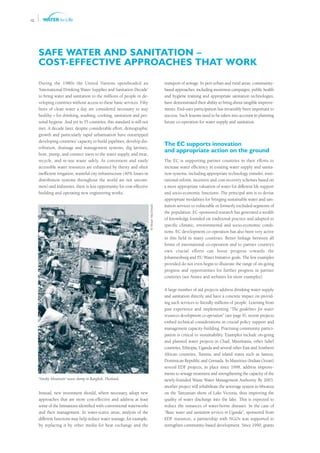
     'Smoky Mountain' waste dump in Bangkok, Thailand.                                            newly-founded Waste Water Management Authority. By 2003,
                                                                                                  another project will rehabilitate the sewerage system in Mwanza
     Instead, new investment should, where necessary, adopt new                                   on the Tanzanian shore of Lake Victoria, thus improving the
     approaches that are more cost-effective and address at least                                 quality of water discharge into the lake. This is expected to
     some of the limitations identified with conventional waterworks                              reduce the instances of water-borne diseases. In the case of
     and their management. In water-scarce areas, analysis of the                                 “Basic water and sanitation services in Uganda”, sponsored from
     different functions may help reduce water wastage, for example,                              EDF resources, a partnership with NGOs was supported to
     by replacing it by other media for heat exchange and the                                     strengthen community-based development. Since 1990, grants
13


have been provided to 16 NGOs for 29 different activities, from       … and learning and acting together
gravity-fed supplies to spring protection, hygiene education and      with partners in other regions…
capacity-building for local organisations to strengthen their self-
                                                                      “Development of cost-effective reclamation technologies for domes-
help potential.
                                                                      tic wastewater and the appropriate agricultural use of the treated
                                                                      effluent under (semi-)arid climate conditions” (CORETECH)41 is
Currently through TACIS, the EC supports major water supply
                                                                      a research collaboration between three Southern Mediterranean
and waste water treatment investment projects in the NIS
                                                                      and three European research teams signalling a major paradigm
(St. Petersburg, Kaliningrad, South Ukraine). In Albania alone,
                                                                      shift towards considering domestic wastewater as a resource.
in the Western Balkan region, the Commission is currently
                                                                      Treatment and re-use will address several concerns concomi-
implementing six projects in water and sanitation services (WSS)
                                                                      tantly, such as health risk, agricultural soil improvement.
funded with a grant of €28 million. Between 1991 and 2001,
                                                                      Treatment will be scaled to low-grade applications (in cotton
the EC water portfolio in the country amounted to €41 million.
                                                                      production, trees and animal fodder) requiring only plain,
                                                                      low-cost techniques and reduced energy demand. It is just
Europe has accumulated considerable experience in innovative
                                                                      one example of a systems perspective adapted to local condi-
approaches to using rainwater collection, initially through an
                                                                      tions in the Southern Mediterranean.
international research collaboration31. INCO enabled partners
from developing countries to take part in the International


                                                                                                                                            © Alistair MacDonald
Conference on Rainwater Catchment Systems, which took
place in Germany in September 2001, in order to share know-
ledge demonstrating that rainwater harvesting is a valid
contribution to alleviating water scarcity, particularly for house-
hold water security. The goal of linking practitioners,
researchers, water policy-makers, manufacturers, clients/
prospective users was successfully achieved. In addition, par-
ticipants included rainwater harvesting as part of the ‘World
Water Vision’ and prepared inputs for the International
Conference on Freshwater, held in Bonn at the end of 2001,
and the WSSD in Johannesburg in September 2002, thus offer-
ing a mechanism that ‘gives a voice’ to partners.
                                                                      Children playing and washing in a canal, Indonesia.


                                                                      “Sustaining changes in hygiene behaviour (Working towards higher
                                                                      effectiveness of water, sanitation and hygiene promotion pro-
Learning in Europe…
                                                                      grammes)” 42 recognises that changes in hygiene behaviour are
“Potable water distribution management” (POWADIMA) 32 is a            crucial to the health impact from water and sanitation facilities.
modelling and monitoring approach towards reducing critical           This Concerted Action brings together experiences from three
leakage and energy usage, and thus future demand on water             continents to help understand the conditions under which
resources. Reduced demand may result in deferring or avoid-           changes in hygiene behaviour promoted by various projects
ing heavy capital investment. This project tests the feasibility
of improved monitoring of water networks to enhance control
and management, and explores cost-effective approaches that           31
                                                                         http://eng.warwick.uk/dtu/rwh/eu.html
can be adapted to different institutional and economic contexts.      32
                                                                         http://dbs.cordis.lu/cordis-cgi/srchidadb?ACTION=D&SES-
Acquired knowledge is complemented by other intra-European               SION=&DOC=1&TBL=EN_PROJ&RCN=EP_RCN:52968&CAL
collaborations such as “Assessing infiltration and exfiltration on       LER=EN_UNIFIEDSRCH
the performance of urban sewer systems” (APUSS)33. Various other      33
                                                                         http://www.insa-lyon.fr/Laboratoires/URGC-HU/apuss
on-going projects work on the development of integrated deci-         34
                                                                         Computer-aided rehabilitation of water networks
sion support systems for the rehabilitation of water supply              http://www2.unife.it/care-w/
(CARE-W 34 ), sewer (CARE-S35) and wastewater services
                                                                      35
                                                                         Computer-aided rehabilitation of sewer networks –
                                                                         http://www2.unife.it/care-w/cares/index.html
(SWAMP 36 , AQUAREC37 ). Research is also targeted at future          36
                                                                         http://www.swamp-eu.org
developments in compliance with the Water Framework                   37
                                                                         http://www.ex.ac.uk/cws/paquarec.htm
Directive (CD4WC38 ) based on more integrated modelling               38
                                                                         Cost-effective development of urban wastewater systems for Water
and performance indicators adapted to local contexts and the             Framework Directive compliance
sustainability of urban water systems, including the impact of        39
                                                                         http://www.uni-
pollution (AISUWRS 39 ). At the same time, projects are com-             karlsruhe.de/~ibk/FORDAT/PROJEKTE/ka8176.htm
bined in clusters, such as CITYNET 40 , in order to promote inte-     40
                                                                         http://www2.unife.it/care-w/citynet1.html
gration of on-going research and its wider dissemination and
                                                                      41
                                                                         http://www.medaqua.org/forum/CORETECH.html and
                                                                         http://home.birzeit.edu/eng/projects.htm
application. Stakeholder participation ranging from research
                                                                      42
                                                                         http://dbs.cordis.lu/fep-cgi/srchidadb?ACTION=D&SES-
institutes to end-users provides an opportunity for testing new          SION=281962003-13&DOC=1&TBL=EN_PROJ&RCN= EP_
knowledge and orienting work to respond to real needs.                   DUR:36&CALLER=PROJ_INCO2
14


     and initiatives take place and are sustained. Analysis of field     cyanobacteria43 (part of the natural phytoplankton in fresh-
     research is generating new insights, which are being widely         waters and the sea). Documented incidents have grown expo-
     disseminated thanks to active participation of management           nentially over the last 50 to 100 years in many parts of the
     agencies, educational establishments and NGOs. The African          world, often in relation to eutrophication (overfertilisation
     partners in Uganda and Ghana are also associated with develop-      from non-point sources and ensuing water quality degradation
     ment co-operation projects and will help to translate research      and health hazards).
     insights into innovative action.

     This is just the latest project in a move to promote and enable     43
                                                                              http://www.linecyano.org/
     the integration of water, sanitation and hygiene considerations     44
                                                                              http://www.fen.bris.ac.uk/engmgt/swg/research/aquapol/html/
     into the strategic planning and practical management of health           project2.html
     care services. Other work between Brazilian, Turkish, Israeli
     and European teams showed the health hazards of toxic


            MASIBAMBANE, A WATER SERVICES
       SUPPORT PROGRAMME IN SOUTH AFRICA

       A three-year water services sector support programme
       (WS-SSP) in South Africa is supported by the South African


                                                                                                                                            © European Commission (EPRD/RSA)
       government, the European Commission and the bilateral
       aid programmes of four EU Member States – UK, The
       Netherlands, Ireland and France – to the tune of about 2
       220 million Rand (€334 million, including an EC budget sup-
       port grant of €75 million). The objective of the programme
       is to provide basic water supply and sanitation services
       through a variety of activities including the support of stra-
       tegic policy development, water and sanitation services pro-           Authorities and Water Service Providers, but NGOs
       vision to selected poor rural communities in three provinces           and private sector will also be involved).
       (Northern Province, KwaZulu Natal and the Eastern Cape).          • Strengthening the sector’s integrated planning and
       The project also provides institutional support to assist var-         coordinated management.
       ious levels of public sector institutions, with an emphasis on    • Establishing a gender unit within the water services
       stakeholder dialogue. In some instances new institutions               chief directorate of DWAF.
       such as district councils, catchment management agencies
       and community structures will be established. Good govern-        An INCO research collaboration between several
       ance and continued coordination among various actors are          Southern African and European teams that looks into
       recognised as being critical to the sustainability of the pro-    “The policy implications of contamination of rural water
       gramme and its effects. The main expected results include:        between source and point-of-use in Kenya, South Africa
       • Reviewing and updating policy and legislation for the water     and Zimbabwe” (AQUAPOL)44 has found that costly
         and sanitation services sector in South Africa, orienting the   water supply infrastructure alone, often confined to
         sector towards consumer-driven interventions.                   urban settings, does not achieve enhanced health out-
       • Providing approximately 2.4 million people in the               comes in vulnerable groups, for example, children in
         Northern Province, KwaZulu Natal and the Eastern Cape           poor rural households. Cultural practices or lack of infor-
         with sustainable water and sanitation services.                 mation are shown to lead to contamination between
       • Including health and hygiene education in all infrastructure    point of source and use and thus greatly diminish the
         projects.                                                       effects of such investments. The project is producing
       • Improving the technical, managerial and administrative          trying to find the right balance between ‘hardware’ and
         capacity of key role players (specifically the capacity of      ‘software’ in water policy formulation, implementation
         Local Government and Department of Water Affairs                and education that will be very useful for the
         and Forestry (DWAF) structures, Water Service                   Masibambane WS-SSP and other efforts in the region.
15


CATCHMENT BASIN APPROACHES – STRATEGIES
FOR RECONCILING MULTIPLE DEMANDS
River basin approaches are increasingly advocated in national            The Black Sea Basin has been seriously damaged by agricultural
and international fora and form the foundation of recent EU              and industrial pollution, including nutrients and wastewater
internal legislation, such as the 2000 Water Framework                   discharges that are carried by the Danube. Their combined
Directive. A worldwide assessment of transboundary relations             effects have affected the eco-system, biodiversity, fishery and
over the last 50 years suggests indeed a strong preference for           tourism activities. TACIS has allocated €10 million to the Black
co-operation, despite some well-known and highly publicised              Sea Environment Programme (BSEP), making it one of the
conflicts 45. The available evidence also suggests that acute con-       main contributors. Current activities comprise assistance to
flict often centres on such factors as quantity and infrastructure       the Regional Activity Centres in the NIS countries to strengthen
(for example, dams and reservoirs). Other frequently cited               monitoring, priority-setting for pollution reduction, biodiver-
factors, such as climate, basin water stress, relative power or          sity conservation, and data and information exchange. It also
dependence on freshwater resources for agriculture or power              plans to co-fund with international financial institutions a
generation, seem not to have statistically significant correlation       waste-water treatment plant in the Black Sea region.
with conflict. Conversely, high population density in the
catchment, low per capita GDP and overall unfriendly relations
between countries hint at some conflict potential, particularly
                                                                         How to improve conditions
when associated with rapid change.
                                                                         in the Caspian and Aral Sea basins
In addition to environmental, engineering, economic, regulatory          The Caspian and Aral basins are two other large areas affected
and legal aspects, social dimensions are crucial to sustainable          by deteriorating environmental and health conditions with
approaches. In particular, socio-economic and anthropological            negative impacts on socio-economic activities.
research has documented – as confirmed by development
co-operation – the different ways in which technological                 The Caspian basin is threatened by pollution from the Volga
choices impact on different groups in societies, be they dis-            and other rivers (the Kura, for example) as well as spillages
tinguished by gender, ethnicity, age, education or wealth.               from the oil and other industries, which affect biodiversity
Focusing on people and leaving room for participation are


                                                                                                                                            © Dieter Telemans / Panos Pictures
therefore key principles of sustainable water management
that can reconcile multiple demands through fair allocation.


Supporting decision-making
for integrated river basin management
in Europe
Characteristic of the work in river basin management at
European level is CATCHMOD (Integrated catchment model-
ling)46. This is a ‘cluster’ project acting as an integration platform
for various research projects and 150 European institutions. It
specifically aims at harmonising work on modelling tools
needed by water authorities to improve integrated water
resources planning and management at river basin scale. Its
results are also intended to support the implementation of the
Water Framework Directive, and other key EU policies (for
example, agriculture, regional development) and provide,
among others, a better understanding of the role of stake-
holders’ participation, the impact of institutional mechanisms
and the importance of risk assessment methodologies.

Another example is the DANUBS 47 project, which focuses on
                                                                         Between Muynak and Ucgsay, on the shores of the Aral Sea,
nutrient management in the Danube basin and its impact on                Uzbekistan. Women pushing a pram along a track beside what
the Black Sea. It pursues an interdisciplinary analysis of the           remains of the Aral Sea.
Danube catchment, the Danube River system and the mixing
zone of the Danube River in the Western Black Sea in order to            45
                                                                            http://www.transboundarywaters.orst.edu/projects/bar/
contribute to sound political decision-making and a more                 46
                                                                            http://www.info.wau.nl/eesd1_1/
effective river basin management.                                        47
                                                                            http://danubs.tuwien.ac.at/
16


     (especially valuable sturgeon species), fisheries and tourism.                                         (SNF) to salinity” (PLADADINFIS)50, aims at reducing land
     High levels of pesticides and evidence of continued use of                                             degradation in Kazakhstan and Uzbekistan.
     DDT are a particular source of concern for the exposed popu-
     lation. TACIS has supported the Caspian Environment                                                    TACIS has supported the Aral Sea Basin Programme through
     Programme (CEP), helping to establish the CEP framework and                                            the “Water resources management and agricultural production in
     carrying out the main part of the technical research required                                          Central Asian Republics projects” (WARMAP). More than €10
     to develop the Caspian Strategic Plans. Current activities focus                                       million has been committed for that purpose and these have
     on the management of fish resources, pollution reduction and                                           contributed to the preparation of inter-state agreements on
     prevention. TACIS also supports preparation and financing of                                           water management, the creation of a regional information
     investment in water projects.                                                                          system (WARMIS) and the analysis of water use and farm
                                                                                                            management (WUFMAS).
     Since 1962, diversion of water resources from the mighty Amu
     Darya and Syr Darya rivers has shrunk the Aral Sea to a frac-
     tion of its original size. These rivers used to replenish the Aral
                                                                                                            Water-stressed Mediterranean seeks
     Sea in Central Asia with about 50 km3 per year. The water has
                                                                                                            to develop basin approaches
     been diverted into the development of massive irrigation
     schemes, primarily for cotton cultivation and rice paddies in                                          The area of highest water stress in the world is the Southern
     Uzbekistan and Turkmenistan and, to a lesser degree, Tajikistan                                        Mediterranean. A region with a very young and still fast-grow-
     and Kazakhstan in Central Asia. By 1995, the remaining water                                           ing population by any standard, it has the lowest per capita
     supplied by the two rivers amounted to a trickle, just 2 to 3                                          availability of water and the highest actual use of all potential
     km3. Between 1960 and 1995, the lake’s surface area shrank                                             freshwater resources. Unsurprisingly, water is among the pri-
     from 64 500 km2 to less than 30 000 km2. It also dropped 19                                            orities in scientific, technical and economic co-operation
     meters and its salinity tripled. More than 50 lakes in the Amu                                         between Europe and Mediterranean partner counties. This is
     Darya delta dried up and its wetlands shrank from 550 000                                              underpinned by various forms of policy dialogue, in particu-
     hectares to less than 20 000 hectares. By now, the Karakum and                                         lar the Barcelona Process, also known as the EURO-MED
     Kyzylkum deserts meet on the Aral’s former seabed.                                                     Partnership51, which is currently being rendered more dynamic.
                                                                                                            It is recognised that basin-wide approaches hold the greatest
     Receding lake waters left behind ghost towns from what were                                            promise for strengthening co-operation rather than conflict
     once fishing communities (commercial fishing ceased in 1982),                                          over water. At the same time, it is understood that water man-
     a saline dust bowl, health problems and uncounted social dis-                                          agement includes not only technical and environmental dimen-
     tress for the 5 million people living in the region around the                                         sions, but that it also requires much greater attention to its eco-
     lake. Numerous research collaborations have analysed the con-                                          nomic, social and political dimensions.
     text and continue to provide knowledge for remedial action.
     Selected projects address some key aspects: “Desertification in                                        A number of other scientific co-operation projects reflect the
     the Aral Sea region: A study of the natural and anthropogenic                                          need to base future co-operation on multifaceted analysis
     Impacts” (ARAL-KUM)48 . “Crop irrigation management for com-                                           and knowledge. The “INCO project cluster for water resource
     bating irrigation induced desertification in the Aral Sea basin”                                       management in the Mediterranean” (MEDAQUA)52 is composed
     (CIRMAN-ARAL)49, focuses on developing strategies for water                                            of some 30 projects linked through workshops and frequent
     saving through improved irrigation scheduling and field prac-                                          exchanges in order to increase cross-fertilisation, outreach and
     tices, thus reducing water demand for agriculture, improving                                           thus impact.
     control of drainage water and soil and water salinity. “Prevention
     of land degradation in the Aral Sea region undergoing disastrous                                       MEDA53 is the principal instrument for implementing the
     desertification by increasing tolerance of symbiotic nitrogen fixation                                 Euro-Mediterranean Partnership and one which can amplify
                                                                                                            the knowledge generated through joint research. Its activities
                                                                                       © Guido Castellano


                                                                                                            in relation to the sustainable use of scarce water resources
                                                                                                            focus mostly on environmental dimensions and agricultural
                                                                                                            water use, which account for the lion’s share of overall demand.
                                                                                                            It is particularly active with numerous projects in Egypt, Tunisia
                                                                                                            and Morocco.


                                                                                                            48
                                                                                                               http://ksk-mhi.narod.ru/Aral/Aral800.htm and
                                                                                                               http://modb.oce.ulg.ac.be/Colloquium/2003.html
                                                                                                            49
                                                                                                               http://www.icwc-aral.uz/cont_en/partner/copern/
                                                                                                            50
                                                                                                               http://www.gm-unccd.org/FIELD/Multi/EU/Kaz/PJ_Prev.htm
                                                                                                            51
                                                                                                               http://europa.eu.int/comm/external_relations/euromed/
                                                                                                            52
                                                                                                               http://www.medaqua.org/
     Example of a small dam aiming at reduction of erosion by flash floods, Tunisia.                        53
                                                                                                               http://europa.eu.int/comm/external_relations/euromed/meda.htm
17


PROTECTING MOUNTAINOUS UPSTREAM AREAS


                                                                        © Bal Ram Singh
                                                                                          great rivers in Asia originate there – the Indus, Ganges, Mekong,
                                                                                          Red River, Yangtze and Yellow rivers. Tangible effects on the
                                                                                          water regime may thus be expected for a number of Asian
                                                                                          countries, including Bangladesh, China, India, Pakistan,
                                                                                          Thailand and Vietnam. Together these countries account for half
                                                                                          of the global population.

                                                                                          Changes in land-use pattern, particularly deforestation in the
                                                                                          upper regions, overgrazing and other interventions are increas-
                                                                                          ingly recognised as additional, more local, drivers in increasing
                                                                                          desertification and changing flood behaviour downstream.
A panoramic view of Mardi watershed together with Mardi Mountain                          They compound the global change effects sketched above. An
and Mt. Machhapuchhre in the background.                                                  INCO research collaboration between three European and three
                                                                                          Asian partners is currently working on “An interdisciplinary
As part of the natural water cycle, most rivers originate in                              approach to analyse the dynamics of forest and soil degradation
mountainous areas and whatever happens upstream will affect                               and to develop sustainable agro-ecological strategies for fragile
regions further down in the basin. Upstream regions and their                             Himalayan watersheds” (HIMALAYAN DEGRADATION)54.
fragile ecosystems are particularly important for water storage,


                                                                                                                                                                       © Bal Ram Singh
groundwater replenishment and flood control, but render many
other important goods and services. They are fundamental for
the overall hydrological regime of the affected countries and
often have great spiritual, cultural and historical value for
people, not only of the mountain regions themselves. The rise
in temperature over the last decades has set in motion a signif-
icant shrinkage of mountain glaciers, a process which acceler-
ated during the 1990s. For example, with the shrinking of its
                                                                                          The view of irrigated rice terraces that are prevalent in the valley floor
ice cap by 33% between 1989 and 2000, Mount Kilimanjaro in
                                                                                          and in hill slopes.
Tanzania will be ice-free by 2015 if current trends persist.

                                                                                          This project adopts a systems approach linking recent histories
Already a relatively modest rise of 1 to 2oC results in a shift of
                                                                                          of socio-economic development through bio-economic models
precipitation from snow to rain. In the past, at lower tempera-
                                                                                          to land-use scenarios. In selected watersheds, GIS models of the
tures, much of the abundant winter precipitation would fall as
                                                                                          recent trajectory of land use will be derived through remote
snow, compact into ice in the glacier and then released gradually
                                                                                          sensing to give a baseline for future predictions. Field experi-
during the seasonal melting of the dry summer months. Now,
                                                                                          ments, household surveys and participatory research will be
a high percentage comes down as rain leading to much more
                                                                                          used to define sustainable management strategies aimed at
frequent flash floods and longer dry period during the rest of
                                                                                          avoiding further land degradation. The major outputs of the
the year. These patterns are observed in all major mountain
                                                                                          project will be models linking development with land degrad-
ranges, from the Alps, the Andes, the Himalayas to the Rocky
                                                                                          ation and recommendations for sustainable land management
Mountains. The ice sheet in the Himalayas is the third biggest
                                                                                          practices in the Himalayan region.
in the world, after the Antarctic and Greenland, and all of the

                                                                                          Applying accumulated knowledge from past research and prac-
                                                                        © Bal Ram Singh


                                                                                          tice in Vietnam, several donors have entered into a partnership
                                                                                          in support of the country’s “Forest Sector Support Programme”
                                                                                          (FSSP). The EC is contributing substantially to the programme.
                                                                                          The EC has also allocated €57 million to three major devel-
                                                                                          opment and conservation projects for the upland areas (includ-
                                                                                          ing irrigation and basic water supply and sanitation): the “Social
                                                                                          forestry and nature conservation project”, the “Cao Bang-Bac Can
                                                                                          rural development project” and the “Son La-Lai Chau rural devel-
                                                                                          opment project”.

                                                                                          54
                                                                                               http://dbs.cordis.lu/fep-cgi/srchidadb?ACTION=D&SES-
The view of Mardi watershed from the valley: forest, grazing land and                          SION=38962003-1-3&DOC=7&TBL=EN_PROJ&RCN=EP_
cultivated lands are major land uses in the watershed.                                         DUR:48&CALLER=PROJ_INCO2
18


     SUSTAINABLE LOWLAND-USE AND IRRIGATION

     With a projected human population of over 9 billion by 2050              are thus concerned that change in the environment and mar-
     and already strong strains on water resources to meet today’s            ket fluctuations may provoke significant shifts in production
     requirements for food and drinking water, the need for innova-           locations and create great social and political instabilities.
     tion is overwhelming. Indeed, after four decades of growth
     fuelled by international research and co-operation, the global           Experts are divided over the implications, for example, for
     harvest began to falter in the second half of the 1980s. Between         grain prices and the ability to feed the world population in the
     1950 and 1984, per capita grain production had grown from 246            medium run. Food security is defined as “access of all people
     kg to 345 kg. Throughout the 1990s the global production hov-            at all times to enough food for an active, healthy life”. It is not
     ered around 300 kg per person and, luckily, prices did not               a simple function of production. As has been amply demon-
     increase in a consistent manner. Thanks to a combination of new          strated by Nobel Prize-winning economist, Amartya Sen56, it
     seeds, fertiliser and pesticides, high-yield farming doubled the         depends, perhaps primarily, on the purchasing or other con-
     world’s grain production between 1960 and 2000, thus keeping             trol power of men, women and children in order to access the
     in tune or slightly ahead of demographic developments. More              food. Long-term food security remains a top priority of EC
     than 90% of this overall increase came from irrigated land with          co-operation policy.
     water use increasing from about 1 500 km3 to 2 500 km3.

     Despite some progress, much of this irrigation is still inefficient
     and salinisation of irrigated land is a growing problem in many
     countries. In Uzbekistan and Turkmenistan up to 80% of the irri-
     gated soils may have suffered salt damage already. While per-
     centages are much lower in major grain producing countries
     such as China and India (15 and 17% respectively), the absolute
     area affected is higher because of their size. The gradual fall, since
     the late 1980s, of per capita irrigated area, the existing strains on
     both the quantity and quality of surface and sub-surface waters,
                                                                              A large number of research co-operation projects have looked
     combine with the encroaching effects of global change.
                                                                              for solutions to problems associated with drought and irriga-
                                                                              tion efficiency and degradation in all developing regions of the
     A research collaboration between European and key Chinese
                                                                              world. They range from rainfall analysis and forecasts as one
     institutions is developing a “Policy decision support for sustain-
                                                                              avenue to more strategic irrigation management in the
     able adaptation of China’s agriculture to globalisation” (CHIN-
                                                                              Southern and Eastern Mediterranean, research into water man-
     AGRO)55. China is facing challenges to its food production as
                                                                              agement, drought and/or salinisation-resistant crops in the
     its population grows, prospers and wants more animal protein
                                                                              Mediterranean, Africa and Asia. Their ‘big sisters’ are rural
     in their diet. The country has recently joined the World Trade
                                                                              development projects picking up on appropriate and relevant
     Organization (WTO) and needs to re-examine its agriculture,
                                                                              solutions according to the local or regional context.
     land and water management policies. All scenarios explored so
     far show demand for grains, other crops, livestock and forestry
     products exceeding national/regional production capacity even            55
                                                                                   http://www.iiasa.ac.at/Research/LUC/
     with innovation. Policy-makers and planners the world over               56
                                                                                   Sen, A., 2000. Development as freedom. New York, Anchor, 366 p.


                                  UPGRADING IRRIGATION SYSTEMS IN SOUTH SUMATRA

        Irrigation plays an important part in the production of               discharged through the system from 26 to 65 m3 per
        rice, the most important food crop for both subsistence               second. Meanwhile, the operations and maintenance
        and cash incomes in the Indonesian island of Sumatra.                 capacity of local user groups is being strengthened
        The EC is making an important contribution to a project               through an extensive training programme. Local engin-
        designed to upgrade and expand the Punggur Utara sys-                 eering capacity is being enhanced through on-the-job
        tem of irrigation canals in the district of Central Lampung           training during canal construction and lining activities. In
        Regency. The EC contributes €29.3 million to the total                addition, agricultural extension services are being
        cost of €34.5 million. In addition to lining parts of the             enhanced and the needs of women are receiving special
        existing primary and secondary canal system over distances            attention through support to existing mass movement
        of 45 and 82 km respectively, the project is constructing             schemes, such as the Programme for Family Nutrition
        tertiary canals to service 14 000 hectares, increasing water          Improvement (PPGK).
19


URBANISATION AND WATER

Urbanisation processes date back more than 5 000 years in            Social organisation and the political economy of water systems
human history, but have attained unprecedented levels over the       enter also into the equation in major ways. Integrated research
last 50 years. According to the UN Human Settlements                 and innovation will be critical to the ability to satisfy the needs
Programme57, in 1800 only 2% of the global population lived          of cities in ways that minimise upstream and downstream
in cities and by 1950 already 30% was urbanised. By 2000,            effects. Several recent regional dialogue workshops debated key
47% of the world’s population was estimated to live in cities,       factors in urban water management embedded in IWRM, such
while projections for 2030 suggest this percentage may climb         as one on Sustainable Development and Urbanisation in Latin
to 60%. Urbanisation rates in developing countries outstrip          America58 and the Changsha Water Conference, organised in
those in industrialised countries, with Africa – still predom-       the context of Asia-Europe Meetings (ASEM) Science and
inantly rural (37.5% of urbanisation in 2000) – showing the          Technology dialogue.
highest annual growth rates at almost 4.9%.

In 1975, five mega-cities had populations in excess of 10 mil-
lion inhabitants – Tokyo (19.8 million), New York (15.9),
Shanghai (11.4), Mexico City (11.2) and Sao Paulo (10).
                                                                     57
                                                                          http://www.unchs.org/ - see also
By 2000, their ranks had swelled to 19, a large majority of them
                                                                          http://www.longman.com.au/atlas/compweb/bn/bn-2001-3/
in developing countries. In addition, the world today has 370             bn-urban.htm for a quick overview
cities with between 1 and 5 million inhabitants. Many of the         58
                                                                          http://walcue.iai.csic.es/ particularly in association with
inhabitants of these big cities live in slums and have no or inad-        http://europa.eu.int/comm/world/lac/st.htm
equate access to running water. Thus, the benefits of urban-
isation are very unequally shared and providing citizens with


                                                                                                                                        © Wolfang Grosse
access to adequate water and sanitation services remains a
major challenge. Clearly, at this scale, the cities’ water demand
has major implications for upstream surface waters and
aquifers, and its effluents or recycling capacity impact signifi-
cantly on downstream water quantity and quality.


         THE WORLD’S LARGEST INTEGRATED
                  WETLAND IN SHENZHEN

   The city of Shenzhen has built the world’s largest inte-          plants. The water flows downwards in the first basin and
   grated two-stage wetland to clean the Longgang River,             upwards in the second. The wetlands clean the water
   which contains the unfiltered effluents of about 20 000           completely of nitrogen, phosphorous, heavy metals and
   inhabitants and their industries. The river feeds into the        other common unwanted substances in the wastewater.
   drinking water supplies of the city of Hong Kong. This            The outflowing water is clean and can be prepared by
   wetland, at an investment of 5 million Chinese RMB (about         standard processing for drinking.
   €700 000) is currently the world’s largest two-stage wet-         Shenzhen is already using two such wetlands and, satisfied
   land with 20 000 m surface and a cleaning capacity of
                         2
                                                                     with the results, is now planning an even larger wetland.
   5 000 to 7 000 tons per day, sufficient for the wastewater        It claims that the installation of a constructed wetland
   load outside the rainy season. Regular operation has              costs about half that of a conventional water treatment
   started in October 2001.                                          plant. Furthermore, they cost almost nothing to maintain.
   The two-stage wetland technology for surface water treat-         Other cities like Shanghai, Wuhan, and Hangzhou are
   ment was developed in an international co-operation               soon to follow. The Chinese Academy of Sciences (CAS)
   (INCO) research project between European and Chinese              has examined the results of the INCO project and plans
   teams. The two-stage wetlands are constructed within              to propose the Chinese participants for an award. This
   two concrete basins, which are filled according to a well-        could mean additional research funds from the Chinese
   studied scheme with various kinds of gravel, sand and             government.
20


                                                                            © Wolfang Grosse
                                                                                               The peri-urban interface, with its often dynamic development
                                                                                               of food, energy demand and production, habitat restoration
                                                                                               and vibrant socio-economic structures, has attracted increas-
                                                                                               ing research and policy attention, but is still poorly understood.
                                                                                               “Women, well-being, work, waste and sanitation: Action research on
                                                                                               alternative strategies of environmental sanitation and waste man-
                                                                                               agement for improved health and socio-economic development in
                                                                                               peri-urban coastal communities in South Asia” (4WS) and
                                                                                               “Sustainable farming at the rural-urban interface – An integrated
                                                                                               knowledge-based approach for nutrient and water-recycling in
                                                                                               small-scale farming systems in peri-urban areas of China and
                                                                                               Vietnam” (RURBIFARM)59 are just two on-going research test
                                                                                               beds responding to some of the above-mentioned challenges.
                                                                                               When successful, such research precedes investment.


                                                                                               59
                                                                                                    http://www.mv.slu.se/Vv/rurbifarm/Abstract.html


     Shenzen integrated wetlands are an example for other Chinese cities.


                                                                                                                                                                     © BURGEAP (C. Kasprzyk)/EC
                          SMALL TOWNS WATER SUPPLY
                                    PROJECT GHANA

        November 26, 2002 – Kokofu, Ghana, 250 km north west
        of the capital Accra: As every week, M. Ansah, Technical
        Manager at the Water and Sanitation Development Board
        (WSDB) of Kokofu, checks the state of the water meters                                 Excitement in the village about the first flow of clean piped water
                                                                                               brought by the EC project.
        of the 13 public standpipes and 50 private connections
        connected to the water distribution network. Under the
        accountant’s supervision, he collects the water sales                                  paying back. During the four years of operation so far,
        revenue from the water vendors. The cost of water is 100                               public works and oversight have been established com-
        cedis per 18-litre bucket (€0.68 per m ). The average
                                                          3                                    bined with private management in two towns. Capacity-
        daily consumption rate here amounts to 11 litres per                                   building efforts ranging from book keeping, system
        person. Thanks to this regular revenue collection, the                                 maintenance, technical monitoring, management tech-
        WSDB has so far operated the system for 10 months, and                                 niques to hygiene education was directed at all levels,
        in this space of time has managed to construct 10 addi-                                from community via district to regional water and sanita-
        tional private connections and providing transport to the                              tion administration.
        operating staff. The bank account is currently credited                                This example is replicated in the 25 small towns in the
        with 15 million cedis (€1 700).                                                        Ashanti, Brong-Ahafo and western regions included in this
        Out of the revenue from the water sales, 10% are                                       project and serving a total population of 310 000 people.
        allocated to maintenance, 10% to small-scale sanitation                                The project is currently preparing the implementation of
        projects and hygiene education, and 5% to the extension                                five additional systems to serve eventually, within the avail-
        of the water supply system. The efforts of the community                               able €15 million allocation, a population of 350 000 in 30
        and their representatives since the beginning of the project                           towns. It is just one example of practicing locally adapted
        (consultations, 5% contribution to investment cost) are                                ‘public-private partnership’ – so far quite successfully.
21


COASTAL ZONE MANAGEMENT

Coastlines are the product of the interplay between rivers and       stress. This allowed researchers to assess the vulnerability of
land-based sediments fertilising the sea, and the sea accreting      coastal areas subjected to tourism development, or planned for
or eroding materials from the beach, estuary or cliff. Upstream      other types of economic development and to raise awareness
interventions affecting river flow quantities and quality, such      among planners and other stakeholders about the options
as dams, irrigation schemes and conventional aquaculture             available within safe limits.
clearly, affect the balance of materials exchanged between the
land and the sea. A well-studied case is the erosion of the Nile     An earlier approach explored in South-east Asia and Africa led
Delta following the closure of the Assuan High Dam in Egypt.         to the development of a rules-based expert system ‘SimCoast’,
Coastal zones are important reservoirs of biodiversity and in        which allows stakeholder participation to modulate rules to
addition to a few existing parks, recent decisions at the            adjust the conceptual framework to local conditions. Following
Johannesburg World Summit on Sustainable Development                 an exploratory and development phase to facilitate clarification
demand the establishment of additional protected areas to            and negotiation processes, the tool will shortly be used during
restore degraded aquatic ecosystems as much as possible.             the inception phase of the “CHARM Project” in Thailand start-
                                                                     ing in the first half of 2003. This aims to design and establish
On the side of the sea, coastal zones are the source of an esti-     a coastal habitats co-management framework in two southern
mated 95% of marine fish, invertebrate and algae production,         Thai locations.
not to mention the important role they play in maritime trans-


                                                                                                                                          © Alistair MacDonald
port and as sources of offshore petroleum and gas. On the side
of the land, coastal zones are home to almost two-thirds of the
human population and associated socio-economic and recre-
ational activities. Because of the resulting heavy demand on
freshwater resources, including coastal freshwater aquifers,
saltwater intrusion is a major problem, particularly in arid
and semi-arid regions.

Integrated coastal management should provide a mechanism
for negotiating acceptable levels of use among often conflict-
ing demands on limited resources, however, despite virtually
hundreds of projects, the true integration of knowledge and          Coastal fishponds, Bulacan Province, central Luzon, Philippines.
associated management remains a challenge for future work.
A few examples may illustrate useful attempts to move forward        “Mediterranean coordination and dissemination of land conserva-
in this direction.                                                   tion management to combat land degradation for the sustainable use
                                                                     of natural resources in the Mediterranean coastal zone” (MED-
EUROCAT60 is a project dealing with the interaction of river         COASTLAND-NET)62 is another approach to bring to bear
catchment coastal zone systems to changing material fluxes,          knowledge on land degradation management (LDM) acquired
under various geographic and socio-economic conditions               through previous research and traditional practice on coastal
across Europe. In order to identify these differences and their      protection and sustainable use. This thematic network coord-
relevance for a better management strategy at catchment level,       inated by CIHEAM in Bari, Italy, assesses the interactions
four coastal seas (Mediterranean Sea, Baltic Sea, North Sea) and     among major factors of resources management such as soil,
eight associated catchments, characterised by relevant envir-        water, biota, human activity, cultural resources, soil erosion and
onmental and management issues, are the subject of various           land degradation, with a view to developing guidelines for
research studies.                                                    LDM. By partnering with research teams, administrations, agri-
                                                                     cultural and other user groups from virtually all riparian coun-
“Measuring, monitoring and managing sustainability: The coastal      tries of the Mediterranean, the project will ground its work,
dimension” (COASTIN) in India61 was a research collaboration         information structuring and dissemination in participatory
between seven partners (three Indian and four European, coord-       approaches and will be mindful of the needs of different stake-
inated by TERI, Goa) that made good progress towards devel-          holder groups. It expects to provide an effective framework to
oping a system for integrated analysis of the bio-geophysical        assist coastal and land use planning in the region.
and human dimensions of coastal resource use. It examined the
policy and institutional matrix in which coastal development         60
                                                                          http://www.iia-cnr.unical.it/EUROCAT/project.htm
occurs and worked to provide knowledge tools in support of           61
                                                                          http://www.teriin.org/teri-wr/coastin/discuss.htm
decision-making. Socio-economic, legal and demographic fac-          62
                                                                          http://dbs.cordis.lu/fep-cgi/srchidadb?ACTION=D&SESSION=
tors and indicators were matched with ecological dimensions               28062003-1-3&DOC=1&TBL=EN_PROJ&RCN=
such as vulnerability maps of coastal aquifers, coastal vegetation        EP_ DUR:48&CALLER=PROJ_INCO2
22


     THE WAY FORWARD

     The above trends and examples show convincingly that more           preciousness in all its uses. Pricing of water services is necessary
     commitment and action is needed from everyone to achieve            to ensure financial sustainability. However, meeting the basic
     water security – in quantity and quality – for the Earth, its       needs of the poor and vulnerable groups requires the design of
     ecosystems and its human inhabitants, today and for future          appropriate tariff structures and collection systems.
     generations.

     Action, and in most cases new and innovative approaches, are
                                                                         Key objectives of the Water Initiative
     needed to tackle urgent and long-term priorities in providing
     water services, expanding sanitation coverage and hygiene           Therefore, progress towards achieving the targets set by the EU
     education, meeting the urban challenge, achieving water and         Water Initiative is largely dependent on the pursuit of the
     food security, protecting water ecosystems and their biodiver-      following universally recognised key objectives.
     sity, managing floods and coastal areas.
                                                                         • The reinforcement of political commitment towards action
     As water resources become scarcer, the long list of related           and innovation oriented partnership
     global issues with significant bearing on the sustainable future
     of the planet become increasingly critical – the impact of          To meet the challenge, the policy profile of water should be
     climate change, the potential impact of the water cycle, the        higher on national and regional agendas. The primary respon-
     occurrence of extreme events like floods and droughts, the vari-    sibility for ensuring equitable and sustainable water resources
     ability of access to water for human and ecosystem health and       management are integrated in development strategies rests with
     food security, the impact of trade on agriculture and industrial    governments, and ownership is essential to achieve results.
     products that include or impact on water substantially.
                                                                         • The promotion of improved water governance, capacity-
     The EU spends an average of €1.4 billion per year on water-           building and awareness
     related development aid and is ready to deliver additional


                                                                                                                                                © European Commission (EPRD/RSA)
     resources according to the Monterrey commitment. This will
     be in response to the countries’ prioritisation in the context of
     Poverty Reduction Strategies and other national sustainable
     development plans.

     Through the Water Initiative, the European Union is recon-
     firming its commitment to contribute to meeting the
     Millennium Development Goals, namely the targets on water
     and sanitation and support IRWM and the development of
     water efficiency plans by 2005. The EU believes that inte-
     grated water resources management (IRWM) with strong public
     participation, transparency and accountability is a key
     approach to reaching these targets.                                 Good governance, political and sectoral reforms are necessary.
                                                                         Awareness-raising, institutional strengthening and capacity-
                                                                         building activities, and expanding the knowledge base, are
     In response to demand from partner regions, the European
                                                                         essential to support planning and decision-making, while
     Commission and EU Member States are forging strong part-
                                                                         ensuring participation of all stakeholders and ownership of
     nerships with regional partners under the EU Water Initiative.
                                                                         policies and strategies. Applying a consistent sectoral approach
     Initial activities are already on-going and scheduled in Africa,
                                                                         to support partner countries and regions also ensures better
     Eastern Europe, Caucasus and Central Asia (EECCA), the
                                                                         coherence and coordination between different efforts.
     Mediterranean, the ASEM context and Latin America. Thus,
     several regional multi-stakeholder dialogue platforms have
                                                                         • Improved efficiency and effectiveness of water manage-
     been set up or are in the process of being developed.                 ment through multi-stakeholder dialogue and coordination

     A shift in thinking is necessary: to recognise that all water       The evidence above suggests that partnerships between pub-
     users have a responsibility; to apply a real integrated approach    lic, private and civil society actors are the most adequate way
     in which all actors co-operate, for example, in integrating land    to ensure improved efficiency and effectiveness of water man-
     and water management, in preventing water pollution; to move        agement. Such partnerships have to be promoted, ensuring that
     towards a sustainable water behaviour, from a supply approach       they remain equitable, transparent, safeguard consumers' and
     to one dominated by demand management; and to introduce the         investors’ interests and maintain high standards of environ-
     need for valuing water by increasing the perception of its          mental protection.
23


• Strengthened co-operation through promoting river basin            Following on WSSD, a Mediterranean and a Latin American
  approaches in national and transboundary waters                    component are being developed. Recognising the central issue
                                                                     of finance, a specific working group within the EU Water
The opportunities for co-operation are many. This is most            Initiative has been established with the objective of increasing
effective at river basin level, both in national and transbound-     the efficiency and catalytic role of ODA. It should also promote
ary waters. Conflict prevention and peace-building, which are        sectoral and budgetary support, where applicable, promote cost
political priorities for the EU, include sustainable and equitable   recovery policies, which are sensitive to the poor, develop
management of shared natural resources, such as water. Based         innovative and sustainable financial mechanisms, and attract
on its own experience and on the analysis of the correct scale       additional financial resources. Initial activities include the
of intervention, support to regional activities is recommended       assessment of financing needs and the identification of current
where a clear commitment to regional collaboration exists.           sources. A central focus will be on showing how development
                                                                     aid can increasingly be used as a catalyst for triggering other
• Identification of additional financial resources and mech-         sources of financing for water. Reducing overlaps in the allo-
  anisms to ensure sustainable financing                             cation of funds and maximising their effectiveness represents
                                                                     a key challenge.
Often, mainstream financial markets do not provide financing
instruments to developing countries. And when they do, they          A specific research component has also been established to
provide them under unfavourable or even prohibitive condi-           address the important contribution of research to the achieve-
tions. When programmes or projects in developing countries           ment of water-related targets. By way of example, the ASEM
are barred from accessing mainstream sources of finance,             (Asia-Europe Meetings) water platform is mentioned. Its roots
Official Development Aid (ODA) has a clear role in ‘unlocking’       go back to a ministerial meeting in October 1999 in Beijing,
this access. While ODA is often used to provide funding and          when science and technology ministers of the 25 ASEM coun-
technical support, it should – and can – through innovative          tries 63 and the European Commission agreed on a list of pri-
instruments, leverage additional financing.                          orities for intensifying scientific and technological co-operation
                                                                     in areas of joint interest to promote sustainable socio-eco-
                                                                     nomic development. Water, forests, aquaculture, sustainable
                                                                     biodiverse food production and clean technologies were among
A modular approach
                                                                     the priorities singled out for immediate follow-up.
In recognition of regional specificities and the similarity of
scales in identified problems and operational capacities, the


                                                                                                                                             © Cornelia E. Nauen
Water Initiative will develop in a modular way with strong
regional focus.

In Africa, following on the signing during WSSD of the
‘Africa/EC strategic partnership on water affairs and sanita-
tion’, two working groups have been established to address the
priorities related to the provision of water and sanitation, and
integrated water resources management issues (IWRM), at
national and transboundary levels. In a spirit of ownership,
open coordination and in harmony with other efforts (such as
NEPAD, EU/Africa Dialogue), the EU partners are working
with the African Ministerial Council on Water (AMCOW),
central and local governments, civil society, private stake-
                                                                     ASEM Workshop on Water Management Issues.
holders and multilateral agencies to contribute to the achieve-
ment of water-related Millennium Development Goals and tar-
                                                                     At a regional conference on water challenges in Changsha,
gets in Africa.
                                                                     Hunan Province, China in June 2002, some 250 participants
                                                                     from different backgrounds from almost all ASEM countries
As far as the countries of Eastern Europe, Caucasus and Central
                                                                     met to discuss effective methods to link knowledge with action.
Asia are concerned, a EU-ECCA Strategic Partnership on Water
                                                                     They unanimously adopted the Changsha Declaration64 on
for Sustainable Development was agreed by ministers at the
WSSD. A working group has been set up to address water sup-
ply and sanitation, and integrated water resources management
aspects. Ministers have committed to implement WSDD targets          63
                                                                          Austria, Belgium, Brunei Darussalam, China, Denmark, Finland,
and obligations in their region and apply integrated river basin          France, Germany, Greece, Indonesia, Ireland, Italy, Japan, Korea
approaches in transboundary water courses. The work is                    (Republic of), Luxemburg, Malaysia, Netherlands, Philippines,
closely linked with the development of an EECCA environ-                  Portugal, Singapore, Spain, Sweden, Thailand, United Kingdom
                                                                          and Vietnam and the European Commission.
mental strategy by the NIS countries. An action plan is              64
                                                                          http://www.brgm.fr/ASEM2002/Resumes/Changsha_Declaration_
expected to be presented at the Pan-European Kiev                         Final%20versionb.pdf
Environmental Ministerial Conference in May 2003.
24


     how best to harness water in the context of sustainable socio-         the goals of the Water Initiative. Resources of the Sixth
     economic development, but also declared basic water needs a            Framework Programme for Research are available to high-
     human right. This was formalised in November 2002 at inter-            quality international research co-operation, coordination and
     national level by the Committee on Economic, Social and                outreach to this effect 71. Possibilities exist in several thematic
     Cultural Rights of the UN Economic and Social Council65.               priorities, particularly in the ‘Global change and environment’
                                                                            and in the ‘Specific measures in support of international co-
     As a result, an ASEM Waternet Multi-Stakeholder Platform is            operation’. Moreover, both on-going and planned development
     being set up. Coordination on the Asian side is ensured by             co-operation projects and activities respond to the challenge
     China (Ministry of Science and Technology 66), on the European         and mobilise know-how and significant financial resources to
     side by France 67 and Portugal68, and overall facilitation by the      the task set by the Water Initiative. In the near future, through
     European Commission 69. Vietnam has expressed interest to con-         the EDF alone, close to €600 million will be mobilised for
     tribute to coordination on the Asian side. The ASEM process is         water projects in the near future.
     built on a framework of respectful, open co-operation between
     equal partners. The platform will promote and enable inter-            Announcing the EU Water Initiative at the 2002 World Summit
     disciplinary networking between the various ASEM partners              on Sustainable Development in Johannesburg, EC President
     (public authorities, private sector, civil society and scientific      Romano Prodi said: “The water crisis is a crisis in governance.
     community). It will constructively interact with existing net-         We will promote better water governance arrangements and
     works in order to mobilise the strengths of the different partners     transparency, building on stronger partnerships between gov-
     synergistically towards meeting the targets of the Water Initiative.   ernments, civil society and the private sector. Our experience
                                                                            shows that effective public services are a basis for sustainable
                                                                            water governance. It is a priority for us to increase the trans-
                                                                            fer of knowledge and know-how through institutional capac-
     The European Research Area (ERA)
                                                                            ity-building, targeted research and scientific co-operation.”
     open to the world
     Knowledge and learning, societal mobilisation and innovation           “We are convinced that progress in water policy means progress
     are recognised as critical for future socio-economic develop-          in all three pillars of sustainable development – social, eco-
     ment and the ability of directing appropriate investment for cop-      nomic and environmental. Business as usual is not an option
     ing with the challenges highlighted in this brochure. Europe is        to solve this crisis. We need to stand close together with our
     willing to share its experience and face the global and regional       partners to overcome their serious water and sanitation prob-
     challenges together with partners in different parts of the globe      lems. That is why the EU decided to make water a top prior-
     and has thus opened the Sixth Research Framework Programme             ity for this summit.”
     to partners in third countries70.
                                                                            And, we might add, for concerted follow-up action in the
     In this context, it is important to reiterate European Research        years to come.
     Commissioner Philippe Busquin’s perspective on the inter-
     national dimension of ERA: “Science and technology have
     already made an outstanding contribution to socio-economic
     development in Europe and elsewhere. Indeed, science has
     always been an international endeavour. But today its inter-
     national dimension is more important than ever for the
     transition towards sustainable development and shared
     prosperity.”

     European Development Commissioner Poul Nielson’s remarks
     to the European Parliament also demonstrate the conceived
                                                                            65
                                                                                 21st Session, Geneva, 11-29 November 2002, http://www.world-
     role of research in development co-operation: “I agree that sus-
                                                                                 watercouncil.org/download/UN_the_right_to_water.pdf for pre-
     tainable improvement of human well-being now depends                        liminary text and
     crucially on knowledge, its production, distribution, owner-                http://www.unhchr.ch/html/menu2/6/cescrnote.htm#29th on
                                                                                 adoption of General Comment No.15 (2002) ‘The right to water
     ship and wise application. Research carried out domestically
                                                                                 (Articles 11 and 12 of the International Convenant on Economic,
     and internationally is vitally important for the production of              Social and Cultural Rights)
     knowledge that a country can use for its development.”                 66
                                                                                 http://www.most.gov.cn and http://www.csonline.com.cn/gb/con-
                                                                                 tent/2002-06/11/content_141139.htm
                                                                            67
                                                                                 http://www.brgm.fr/ASEM2002/1stasem.htm
                                                                            68
                                                                                 http://www-dh.lnec.pt/Gias/english/news.html
     All available co-operation policies                                    69
                                                                                 http://europa.eu.int/comm/research/iscp/ and
     and instruments in support of                                               http://europa.eu.int/comm/external_relations/asem/asem_summits/
     the EU Water Initiative                                                     asem4/4.htm
                                                                            70
                                                                                 http://europa.eu.int/comm/research/iscp/newsletter/agreements_
     This brochure shows the concepts, instruments and examples                  en.html#01
     of harnessing knowledge, capacity-building and action towards          71
                                                                                 http://www.cordis.lu/fp6/sp1_wp.htm
47


FURTHER                     READING :


Chambers, R., 1988. Managing canal irrigation: Practical                  European Council, 2002. Resolution on water management in
   analysis from South Asia. Cambridge, Cambridge                             developing countries. Brussels, SEC/2002/288,
   University Press                                                           http://register.consilium.eu.int/pdf/fr/02/st08/08958f2.pdf

European Commission, 2000. EU Water Framework Directive.                  Gleik, P.H. (ed.), 1993. Water in crisis: A guide to the world’s
    Luxembourg, O.J. and http://europa.eu.int/smartapi/cgi/                   freshwater resources. New York, Oxford University Press
    sga_doc?smartapi!celexapi!prod!CELEXnumdoc&lg=en&
    numdoc=32000L0060&model=guichett                                      Gleick, P A. Singh, and H. Shi, 2001. Threats to the World's
                                                                                   .H.,
                                                                              Freshwater Resources. A Report of the Pacific Institute
European Commission, 2000. The guidelines for water resources                 for Studies in Development, Environment, and Security,
    development cooperation. Brussels, European Commission,                   Oakland, California, in cooperation with the United
    http://europa.eu.int/comm/development/publicat/                           Nations Environment Programme.
    water/en/frontpage_en.htm
                                                                          Groenfeldt, D., 1991. Building on tradition: Indigenous irri-
European Commission, 2002. Capitalising on people and                        gation knowledge and sustainable development in Asia.
   institutions. Ten years of EC scientific cooperation for                  Agriculture and Human Values, 7(1-2):114-120
   the transition towards sustainable development.
   Luxembourg, Office for Official Publications of the EC, 23 p.          Laureano, P., 2001. Atlante d’acqua. Conoscenze tradizionali
                                                                              per la lotta alla desertificazione. Torino, Bollati Boringhieri,
European Commission, 2002. Managed land ecosystems. Ten                       424 p.
    years of EC scientific cooperation for the transition
    towards sustainable development. Luxembourg, Office                   Pereira, W., 1993. Tending the earth: Traditional sustainable
    for Official Publications of the EC, 23 p.                                agriculture in India. Bombay, Earthcare Books, 315 p.

European Commission, 2002. Healthy societies. Ten years of                Ronan, C.A., 1978. The shorter science & civilisation in China:1.
                                                                              An abridgement by Colin A. Ronan of Joseph Needham’s
    EC scientific cooperation for the transition towards sus-
                                                                              original text. Cambridge, Cambridge University Press, 326 p.
    tainable development. Luxembourg, Office for Official
    Publications of the EC, 23 p.                                         The World Commission on Environment and Development,
                                                                             1987. Our common future. Oxford, Oxford University
European Commission, 2002. Aquatic ecosystems. Ten years
                                                                             Press, 400 p.
    of EC scientific cooperation for the transition towards
    sustainable development. Luxembourg, Office for Official              UNEP, 2002. Global environment outlook 3. Nairobi, Kenya,
    Publications of the EC, 23 p.                                            United Nations Environment Programme
                                                                             http://www.unep.org/GEO/geo3/english/index.htm
European Commission, 2002. Communication to the Euro-
    pean Council and Parliament on water management in                    Yoffe, S.B., 2001. Basins at risk: Conflict and co-operation over
    developing countries. Brussels, European Commission,                       international freshwater resources. Dissertation, Oregon
    http://europa.eu.int/prelex/detail_dossier_real.cfm?CL=fr&                 State University, 125 p. + 13 appendices (http://www.trans-
    DosId=172380                                                               boundarywaters.orst.edu/projects/bar/)


Web resources on funding instruments (p.6):                               20
                                                                               Sustainable Development, Global Change
11
                                                                               and Ecosystems (FP6):
     Cotonou Agreement:                                                        http://europa.eu.int/comm/research/fp6/p6/index_en.html
     http://europa.eu.int/comm/development/politique_en.thm               21
                                                                               Aeronautics and Space (FP6):
12
     Asia and Latin America (ALA):                                             http://europa.eu.int/comm/research/fp6/p4/index_en.html
     http://europa.eu.int/comm/development/country/la_en.htm (for Latin   22
                                                                               European Investment Bank:
     America) and
                                                                               http://www.eib.org
     http://europa.eu.int/comm/development/country/a_en.htm (for Asia)
13
     Central and Eastern European Countries (CEEC-TACIS):
     http://europa.eu.int/comm/enlargement/pas/phare                      For additional information:
14
     MEDA Programme :
                                                                          http://europa.eu.int/comm/research/
     http://europa.eu.int/comm/development/country/meda_en.htm
15                                                                        http://europa.eu.int/comm/development/
     Russia and the other new Independent States (NIS) :
     http://europa.eu.int/comm/external_relations/ceeca/tacis/index.htm   http://europa.eu.int/comm/environment/
16
     International S&T cooperation (INCO-FP5):                            http://europa.eu.int/comm/index_en.html
     http://www.cordis.lu/inco2/home.html                                 http://www.jrc.org/
17
     Key Action Sustainable Management and Quality of                     http://www.intas.be/
     Water (FP5): http://www.cordis.lu/eesd/                              http://www.eea.org/
18
     Sixth Framework Programme:                                           http://www.worldwaterforum.org/
     http://www.cordis.lu/fp6
19                                                                        http://www.johannesburgsummit.org/
     Specific measures in support of scientific cooperation
     (INCO-FP6):                                                          http://www.unep.org/
     http://europa.eu.int/comm/research/fp6/inco/index_en.html            http://www.wto.org/
KI-NA-20-612-EN-C
INTERNATIONAL RTD COOPERATION
IN FP6 (2002-2006)
Target Countries of 'Specific measures in support of International Cooperation' (INCO)


                   Data valid: 01.01.2003
                   European Union/Associated States (1)/ Overseas Countries & Territories

                   Developing Countries

                   Mediterranean Partner Countries

                   Western Balkan Countries

                   Russia and the other NIS
                    (1) Some agreements are not yet into force


The European Commission does not guarantee the accuracy of data included in this map and accepts no responsibility whatsoever for any consequence of its use. The boundaries shown do not
imply on the part of the European Commission any judgment on the legal status of any territory or the endorsement or acceptance of such boundaries.


           OFFICE FOR OFFICIAL PUBLICATIONS
           OF THE EUROPEAN COMMUNITIES

           L-2985 Luxembourg

Water for Life - From Knowledge to Action

  • 1.
    E u ro p e a n C o m m i s s i o n EU Water Initiative International Cooperation - from knowledge to action EUR 20612
  • 2.
    CCo n te n t s ONTENTS Foreword 3 Policy framework 4 Principal instruments of european international policies 6 Five thousand years of water works supporting diverse human societies 7 Balancing people and nature – Integrating approaches 9 Safe water and sanitation – Cost-effective approaches that work 12 Catchment basin approaches – Strategies for reconciling multiple demands 15 Protecting mountainous upstream areas 17 Sustainable lowland-use and irrigation 18 Urbanisation and water 19 Coastal zone management 21 The way forward 22 Annex 25 Further reading 47 This brochure was produced through a collaboration of Directorates-General Research, Development, External Relations, Environment, Fisheries, Information Society as well as the EuropeAid Office and the European Investment Bank. Several EC Delegations and projects also contributed generously with information and photos. Free copies can be requested from inco@cec.eu.int. Photo credits of cover page: Noria in Hama, Syria © Dr. Aly Abbara Bangladeshi boy enjoying fresh water from the tap © Heldur Netocny / Panos Pictures Published by the European Commission LEGAL NOTICE Neither the European Commission nor any person acting on behalf of the Commission is responsible for the use which might be made of the following information. Luxembourg: Office for Official Publications of the European Communities, 2003 ISBN: 92-894-4901-2 © European Communities, 2003 Reproduction is authorised for non-commercial purposes provided the source is acknowledged. Printed in Belgium
  • 3.
    3 FOREWORD this approach with the EU Water Framework Directive. I am convinced that the shared goals of ©EC-Audiovisual library inter-generational fairness, equitable use and conser- Romano Prodi vation of precious water resources offer ample oppor- President of the European Commission tunities for co-operation. The European Union has been working on key issues related to sustainable use of precious water resources, Water is Life, yet over 1 billion people have no access to not only within its own borders, but also in partnership safe drinking water and over 2 billion lack basic sanita- with many research teams, NGOs, governments and tion. This is why leaders at the World Summit on other actors in all partner countries. It has actively Sustainable Development in Johannesburg, South Africa, participated in a variety of water-related fora and ini- in September 2002, called for halving these numbers by tiatives. A large number of co-operation projects chan- 2015. In practical terms, this means providing these nel knowledge and financial resources into addressing essential services to 200 000 and 400 000 new people water problems in many partner countries. Policy dia- per day until the end of 2015! The EU strongly supports logue with several regions, including Africa, Asia, these goals and therefore, in Johannesburg, we launched Eastern Europe, Latin America and the Mediterranean, the EU Water Initiative together with Danish Prime is being reinforced concerning crucial water and asso- Minister and EU President in office, Anders Fogh ciated food security in the expectation of enhancing the Rasmussen. effects of on-going and future co-operation projects. It is obvious that such ambitious goals on a global scale This brochure shows the European Commission’s cannot be achieved with conventional means, even work on issues addressed by the Water Initiative and with all the current aid. Scientific knowledge and inno- its commitment to pursue its goals by partnering with vative approaches across policies and their instruments others. The different Commissioners involved in this are important for tangible headway towards these subject, Philippe Busquin (Research), Poul Nielson goals. It will particularly require a great mobilisation of (Development), Chris Patten (External Relations) and partners ranging from governments, water agencies, Margot Wallström (Environment) and their respective water users to civil society organisations and private services, have been particularly active in this endeavour enterprises. Open co-ordination and co-operation at and will continue to invest in broadening these partner- all levels from local to international will be crucial. ships in the future. The second thrust of the Initiative concerns the general adoption of river basin-scale policy, planning and man- agement, particularly for transboundary catchments. Within the European Union, we have already adopted
  • 4.
    4 © Marc French/Panos Pictures POLICY FRAMEWORK Against the backdrop of a global water crisis… “The total volume of water on Earth is about 1 400 million km3 of which only 2.5%, or about 35 million km3, is fresh- water. Most freshwater occurs in the form of permanent ice or snow, locked up in Antarctica and Greenland, or in deep groundwater aquifers. The principal sources of water for human use are lakes, rivers, soil moisture and relatively Haiti. Washing clothes. shallow groundwater basins. The usable portion of these sources is only about 200 000 km3 of water – less than 1% Devastating floods in Central America and Mozambique in of all freshwater” 1. Freshwater is renewable only by snow 2001, in Central and Eastern Europe, Central and Southern and rainfall, at the rate of about 40-50 000 km3 per year. China and other Asian countries in 2002 have resulted in With growing wealth, global consumption of water has loss of lives, untold material and economic damage and recently been doubling every 20 years, more than twice the pollution of important regional seas in Asia and Eastern rate of human population growth. Yet, supply is heavily Europe. On the other extreme, blistering droughts have hit skewed as a function of wealth and power differences within Sudan, Ethiopia, Australia and North-western China in recent years resulting in dustbowls and rising food insecur- and between societies and natural conditions, including ity. Such crises are becoming more frequent and may ecosystems’ health. Thus, daily consumption of a person in increase the threat of regional conflicts. They put water into a developing country without access to running water is the news headlines and onto the political agenda, both local typically around 20 litres, while a person with access to to global. piped water may use in excess of 200 litres per day. Included in this high figure is pipe leakage, which may Record keeping for temperature started systematically in reach 50% in some cities. Conversely, it is not uncommon 1866. Data shows that the 14 warmest years have all for women and girls in rural Africa to spend three hours per occurred since 1980. In the 1990s the Arctic ice cap lost day fetching water from distant water holes and rivers. almost 20% of its mass, but only 5% of its surface, lead- ing to a break-up at the North Pole during the summer According to the United Nations, overall about 1.1 billion months starting in 2000. people on Earth do not have access to safe drinking water and about 2.4 billion people lack adequate sanitation. An estimated 6 000 children die each day from diseases asso- ciated with poor sanitation and hygiene and one in two … growing awareness helps spell hospital beds in the world is occupied by someone with a frameworks of action preventable water-borne disease. Over the last 50 years in particular, the world’s finite sup- If current trends persisted, by 2025 the demand for fresh- ply of freshwater has been subjected to increasing pressures water is expected to rise by 56% – more than is currently and has also suffered quality degradation in many regions. available. About 70% of current demand is from agricul- Taken together, these problems amount to a global water ture, the remainder from urban, household and industrial crisis. This crisis has been analysed and discussed at local use, and consumption. and global level, and in governmental and non-govern- mental fora. In 1987, in response to this heightened inter- The first response to growing demand for water supply, est in water, the World Commission on Environment and power and flood regulation has been to build more dams Development (Brundtland Commission), proposed the and divert more rivers. The number of large dams world- concept of ‘sustainable development’ and identified water wide has climbed from just over 5 000 in 1950 to 45 000 as a key issue among global environmental concerns in its by the end of the 1990s2. Groundwater has also been tapped report “Our Common Future”. in order to meet the needs of irrigation agriculture, which has massively expanded particularly over the last 50 years At the Rio UN Conference for Environment and Develop- alongside demographic growth and rapid urbanisation. ment (UNCED)3 in 1992, water issues were extensively Change of land use, deforestation of mountainous regions where springs of the principal river systems of the world 1 UNEP, 2002. Global environment outlook 3. Nairobi, Kenya are located, the melting of glaciers and changing patterns 2 http://www.dams.org/ and reactions to the Report of the World of rain and snowfall, are all modifying the run-off regimes Commission on Dams at http://www.unep- dams.org/document.php?cat_id=4 of rivers in many parts of the globe. These and other trends 3 http://www.unep.org/unep/partners/un/unced/ and are usually referred to in the context of ‘global change’. http://www.ciesin.org/datasets/unced/unced.html
  • 5.
    5 debated and incorporatedin Chapter 18 of Agenda 21 management and water saving plans. In Johannesburg, and were a central piece of the Rio Declaration. Ever since, EC President, Romano Prodi, launched the EU Water a string of thematic events has gained momentum. In Initiative together with Danish Prime Minister and EU 1995, the Global Water Partnership and the World Water President, Anders Fogh Rasmussen, in order to harness Council were created, involving governments, inter- commitment and concrete action to water security for the national agencies, civil society and private sector. The first 21st century. The presidents reflected the willingness of World Water Forum was held in Marrakech in 1997, with public, private and civil society actors, all of whom were the second taking place in The Hague three years later 4. consulted intensively in the run-up to the conference, to establish open coordination to achieve the goals. The At European level, after an extensive consultation process, European Union has a long history of relations with part- the European Parliament and Council adopted a compre- ners in partner countries and is willing to invest in stepped hensive Water Framework Directive, which entered into up partnerships for water security underpinned by con- force on 22 December 2000 5. The purpose of this Directive tinuous dialogue. is to establish a framework for the protection of inland surface waters, transitional waters, coastal waters and The European Union is increasingly engaged in mobilising groundwater within the EU. It aims at contributing to (a) the best political, knowledge, development and economic the provision of a sufficient supply of good quality surface capacities of both the partner region and Europe around water and groundwater as needed for sustainable, balanced addressing the specifics of the water crisis in that region. and equitable water use, (b) a significant reduction in Examples of regional platforms are: Africa; the ASEM con- pollution of groundwater, (c) the protection of territorial text (Asia-Europe Meetings); Eastern Europe, Caucasus and marine waters, and (d) achieving the objectives of relevant and Central Asia (EECCA); Latin America, Caribbean and international agreements, including those which aim to Europe (ALCUE); and the most water-scarce region of all, prevent and eliminate pollution of the marine environ- the Mediterranean. In particular, President Prodi and the ment. It adopts a river basin approach and obliges Member President of Nigeria, Chief Olusegun Obasanjo, signed the States to make the appropriate governance arrangements, EU-Africa ‘Water for Life’ Agreement at WSSD in including for transboundary basins. Action structured Johannesburg, where an EU/EECCA Ministerial Declaration around its implementation offers a shared learning ground was also agreed. The European Commission is convinced within the European Union, but also experience of interest that water issues offer fertile grounds for promoting regional to partners in other parts of the globe. co-operation, peace and prosperity. The International Conference on Freshwater6 (Bonn Conference, December 2001) enabled a broad coalition of 4 http://www.worldwaterforum.net/ some 700 international participants to prepare initiatives 5 http://europa.eu.int/smartapi/cgi/sga_doc?smartapi!celexapi!prod! on water for the World Summit on Sustainable Develop- CELEXnumdoc&lg=en&numdoc=32000L0060&model=guichett ment (WSSD) 7 in Johannesburg. 6 http://www.water-2001.de/ 7 http://www.johannesburgsummit.org/default.htm At the WSSD 8 itself, an important step was taken with the 8 http://www.earthsummit2002.org/es/issues/Freshwater/ adoption of a sanitation target, complementing the Millen- freshwater.htm# Human%20Right%20to%20Water nium Development Goal on access to drinking water. 9 http://europa.eu.int/prelex/detail_dossier_real.cfm?CL=fr&DosId=172380 Leaders also required the development of integrated water 10 http://register.consilium.eu.int/pdf/fr/02/st08/08958f2.pdf COMMISSION COMMUNICATION AND COUNCIL RESOLUTION In March 2002, the European Commission adopted a especially the poorest and with a clear focus on the needs “Communication on water management in developing coun- of women and children, with the general objective of redu- tries” 9. The European Development Council endorsed, on 30 cing poverty and improving people´s health, quality of life May 2002, a common Resolution on this issue. These policy 10 and livelihood opportunities; papers recognise the importance of addressing the global chal- • Developing sustainable and equitable transboundary water lenge of growing scarcity and decreasing quality of water resources management taking into account all relevant inter- resources, particularly acute in developing countries. Water is ests, integrating the competing needs of the various users and a key issue for poverty reduction, sustainable development and facilitating South-South co-operation; the achievement of the Millennium Development Goal on water. • Implementing cross-sectoral coordination to ensure equit- Under the overarching policy framework of Integrated Water able, sustainable and appropriate distribution of water Resources Management, based on a river basin approach, atten- between users of different kinds. This requires the main- tion should be primarily devoted to: streaming of water management principles into related pol- • Ensuring a supply of sufficient, good quality drinking water, icy areas. adequate sanitation and hygiene to every human being,
  • 6.
    6 PRINCIPAL INSTRUMENTS OF EUROPEAN INTERNATIONAL POLICIES The EC’s international co-operation is particularly articulate in five areas: foreign affairs, trade, development, environmental and scientific co-operation. These policy areas in turn make use of many instruments for implementation. They all rely on pol- icy dialogue as the central pillar to create an enabling environ- ment in partner countries and in the Union for whatever joint activities ensue. Because water is so central to the full range of human activities, and indeed for life on Earth itself, all can impact on the ability to achieve the goals of the EU Water Initiative. The annex contains a selection of projects. Web resources (footnotes) on all instruments are on p. 47. Development co-operation instruments At a global level, the Commission has actively contributed to ACP countries, Asia, Latin America (developing countries), the summits from Rio 1992 to Johannesburg 2002 and all those in Mediterranean, Russia and the other New Independent States between, supported the World Water Fora and has invested and Western Balkans. At the time of writing some 100 INCO political capital, knowledge and financial resources into the EU projects16 relating to water are on-going and another 186, mostly Water Initiative. Several lines of the Community budget are intra-European, projects are funded through the Key Action being used to address water and environmental problems. ‘Sustainable Management and Quality of Water’17 in FP5. It is most active on regional, national and local levels, where Under the new Sixth Framework Programme18 (FP6, 2002- operational capacities, knowledge and investment to improve 2006), €315 million has been allocated to 'Specific measures the situation are most needed. The Lome Convention and its in support of scientific co-operation’ (INCO)19 (water being successor, the Cotonou Agreement11, are the main geographi- among the focal topics). Another €285 million is available to cally bound instruments for EC co-operation with sub-Saharan enable the active participation of teams from partner countries Africa, the Caribbean and the Pacific – the ‘ACP’ states. The con- in all thematic priorities of FP6 and giving partners ever ventions advocate “a sustainable balance between economic improved access to significant scientific knowledge of the objectives, the rational management of the environment and the European research community. Water is a major focus within enhancement of natural and human resources”. Successive the various areas of the thematic priority 'Sustainable phases of the European Development Fund (EDF) have allo- Development, Global Change and Ecosystems'20 as well as the cated significant resources to water, ranging from direct support thematic priority 'Aeronautics and Space'21 in the specific area for safe drinking water and sanitation in rural and urban settings of ‘Global Monitoring for Environment and Security’ (GMES). in ACP countries to interventions with longer-term effects such as support to forest conservation, re-afforestation, hygiene edu- cation, more efficient irrigation and support to integrated water European Investment Bank resources management (IWRM) and sectoral policy frameworks. Close to €700 million are being spent in on-going projects. Over the last decade, the annual finance of the European Investment Bank (EIB)22 for water and sanitation projects Similar instruments are used to support sustainable water devel- throughout the world averaged €2 billion. As the EU’s financ- opment in Asia and Latin America (ALA) 12, Central and Eastern ing institution, the EIB operates within the framework of the European Countries (CEEC – TACIS)13, the Mediterranean (par- Maastricht Treaty on European Union. Safeguarding and ticularly through the MEDA Programme)14 and Russia and the improving the environment ranks among its top operational other New Independent States (NIS)15. Within the MEDA objectives. The Bank is participating in the preparations for the Programme, for example, some €170 million goes towards the EU Water Initiative. It now has new means at its disposal – the sustainable use of scarce water resources. Since 1992, the TACIS Facility for Euro-Mediterranean Investment and Partnership Programme has committed around €120 million to water and the Investment Facility, supported by the Commission. management projects. While EIB lending is focused on the EU and the accession countries, there is also strong emphasis on financing in the critical water sector in the Mediterranean region. Some 70% (€1.2 billion) of loans for public infrastructure over the last five International scientific co-operation years related to water supply and wastewater treatment. Its From 1994 on, the Commission’s international scientific operations in the ACP countries, Asia, Latin America and the research activities have been given a uniform structure (INCO) Balkans are also undergoing steady expansion. In addition, the as part of the Research Framework Programmes (FP4, 1994- EIB is involved in financing environmental schemes in the 1998, FP5, 1998-2002). INternational CO-operation covers St Petersburg and Kaliningrad regions in Russia.
  • 7.
    7 FIVE THOUSAND YEARSOF WATER WORKS SUPPORTING DIVERSE HUMAN SOCIETIES Water management played a critical The early development of irrigated agriculture, demography role in the rise – and collapse – and social organisation, city development and trade involved of several earlier civilisations the Mesopotamian heartland to Egypt, the Fertile Crescent, in what is today the Near East and Eastern Mediterranean, the Since water is so central to human life and more generally to Indus Valley and Northern China. It supported a great diver- the life support system of the Earth, it is worth looking at sity of civilisations and high levels of innovation, particularly how earlier human societies coped with the challenges of the initial networking of cities. food, fibre, shelter, and how their evolving social organisa- tion enabled them to sustain a growing population and com- A thousand years later, the Maya civilisation in Central America plexity. emerged in the first millennium BC and flourished from 250 AD, based on sophisticated agriculture. Raised plots of earth As early as the fourth millennium BC, the Sumerian civilisation on which maize and other crops grew, were surrounded by achieved highly productive agriculture on the central Euphrates water supply canals. The surplus enabled the development of River floodplain in what is now a desolate region. The surplus cities with impressive stone temples and palaces. In order to generated by the sophisticated irrigation farming then enabled produce food for the rapidly growing population, hillsides the formation of the first cities and socio-economic specialisa- were deforested, leading to increasing erosion and landslides. tion, as confirmed by currently available archaeological evi- Archaeological evidence shows anaemia symptoms from skulls dence. The irrigation required complex social organisation and bones of the later period as well as progressive depopula- and supported a population growing ten-fold up to an esti- tion. No stone building was constructed after 822 AD. Over- mated 1 million inhabitants. The Sumerians were also the first farming, deforestation with subsequent soil erosion and loss of to develop a written language, the cuneiform script. productivity were instrumental in spelling the complete demise of this society by 900 AD. It is not known whether these civilisations fully understood the reasons for their decline or not. But somehow they were not able to muster the social and technical knowledge required to maintain a balance between their society and the natural resources at their disposal. The ensuing lack of food, however, provoked a range of effects, from famine leading to shrinking population to outward migration. During these times, the global human population was much lower than today. Estimates of population for different periods from ancient to moderns times are 23: Noria in Hama, Syria, from postcard restored by Aly Abbara. Range of Mid-range Why, then, did this successful society decline? Scientists now Period of world of world believe irrigation techniques played an important role in the population population collapse of Sumer. The Mesopotamian irrigation system con- Neolithic sisted of conducting water from the rivers by gravity onto the (10 000 BC to 4 000 BC) 4 to 7 million 5 million fields. The rivers were higher than the surrounding land because of the accumulation of transported soil. Once the Ancient water was on the fields, it could not be drained, but only per- (4 001 BC to 1 200 BC) 10 to 50 million 25 million colated or evaporated. Over time, the combined effects of ris- ing water tables and rising concentration of mineral salts Classic (1 201 BC to 930 AD) 50 to 250 million 150 million spoiled the soils. By about 2 300 BC the fields supported only a fraction of their former production. The tale of salt damaged Modern crops is told on Mesopotamian cuneiform tablets. Food scarcity (after 930 AD) 250 to 9 300a million 5 000 million eventually undermined this great civilisation. a = latest UN population projection for 2050 23 Adapted from Modelski, G. & W.R. Thompson, 1996. Evolutionary pulsations in the world economy, at www.faculty.washington.edu/ modelski/WEPULSE.html
  • 8.
    8 Learning from our predecessors © Jeremy Horner/Panos Pictures in earlier civilisations Over hundreds of years if not millennia, ingenious hydraulic works serviced a range of water needs, foremost for food production, but also for flood control, transport, direct human consumption, improving micro-climates and supporting indus- trial activities on different scales. These together with increas- ing degrees of sophistication in knowledge organisation and transmission, and social organisation have served our prede- cessors well and supported increasing human populations. We can look at some outstanding achievements in harnessing water resources for food and socio-economic development in Cuzco Region, Peru. Winay Wayna Incan ruins. history and learn from these to help deal with today’s chal- lenges. Among the examples are the ‘tanks’, small reservoirs the water cycle. Until the advent of cheap motor pumps, par- impounded by a dam across a seasonally flooded depression, ticularly since the 1970s, these tunnels were maintained and which are still widespread in India and Sri Lanka. These date functional. They still account for significant shares of water back to ancient times for enabling irrigated agriculture. An EC supplies in Iran and elsewhere. development project operating between 1984 and 1996 in Tamil Nadu with a budget of €65.8 million, involved lining the While much of Europe was under the medieval feudal system main irrigation and drainage canals and carrying out other and had lost touch with its earlier achievements, Abd Al essential maintenance work. During a later phase, much more Rahman I of the Umayad Caliphate reached Spain in the mid- 700s. He became the first Caliph of Al-Andalus, which occupied © Ammar Boumezbeur, Direction générale des forêts, Algérie most of the Iberian Peninsula and set up the Umayad Dynasty that ruled for over 300 years. The Berber, or Moors as they were called in Europe, imported irrigation systems from Syria and Arabia, turning the dry plains into a rich agricultural region. Meltwater from the mountains was canalised for percolation into the lower ranges so that water could be gravity-fed in early summer to irrigate elaborate hill-side terraces and lower areas. This system still exists in the Alpujarra region in Spain, though changing lifestyles have led to rural exodus, insufficient main- tenance and partial collapse. The 'Kasria' of the Ouled Said Oasis in Adrar, Algeria, serves to distribute The Moors complemented traditional olives and cereals by the waters of the ancient foggara in an equitable way. fruits and vegetables, rice, henna and cotton introduced from Africa and India. Fertilisation allowed high productivity. emphasis was placed on farmer participation and response to Landscaping and gardening provided pleasant micro-climates their expressed needs in order to enable economically viable during the summer heat and some of the most beautiful gar- and sustainable tank modernisation. Responsibility for oper- dens still in existence today. ation and maintenance was turned over to water user organ- isations, which in turn increased equity of water distribution. Extensive knowledge exchange existed between the civilisa- tions through time and space, as exemplified through the net- The most sophisticated forms of water harvesting consist of work of Buddhist monasteries lining the ‘Silk Roads’ between groundwater tappings, including the famous qanats originat- 100 BC and about 1 500 AD and long-range communication ing in Iran some 3 000 years ago. Qanats or kariz are tunnels through Islamic pilgrimage to Mecca, also favouring trade. dug into uphill aquifers conducting water by gravity to use in The ability to innovate, organise, share and apply knowledge lowlands. The system spread to the Middle and Near East as seems to have been a key factor in determining how societies far as Algeria (foggara), Morocco (khottara) and into Andalusia coped with change, either brought about by demands on self- (madjirat), but is also known from China and sites in Mexico, organisation in greater communities or with environmental, Peru 24 and Northern Chile. These systems were enabled by political and economic developments exemplified in their strong community organisation and were sustainable because investment into water management. they could only withdraw as much as was replenished through 24 Laureano, P., 2001. Atlante d’Acqua. Conoscenze tradizionali per la lotta alla desertificazione. Milano, Bollati Boringhieri, 424 p.
  • 9.
    9 BALANCING PEOPLE ANDNATURE – INTEGRATING APPROACHES This section explores recent experience addressing the chal- where categorised as transport, power or infrastructure projects. lenges posed by the need for food and safe water in partner The talk was – and sometimes still is – of a ‘water sector’, when countries and regions, home to 80% of the world’s population. no such unified sector exists. The convergence of many trends Particular emphasis will be placed on various forms of inter- briefly alluded to above into what is now perceived as a global national EC co-operation. At last count, 261 transboundary water crisis requires rethinking and a much more integrated river basins exist where two or more states share water approach to policy, planning and action, modulated in a way resources 25. They cover 45.3% of the global land area (except that allows compatible action from local to regional. Antarctica). Because of the great variation between regions, emphasis will be placed on regional approaches as a func- The EC’s development co-operation has found it helpful in tional scale at which many problems and challenges need to be most regions to regroup different kinds of activities, in which approached. Some principles and focal areas cut across regions water is central or in which water-related investments are and can influence where the EC investment into international important, into four ‘Focus Areas’. These address functions co-operation on water issues goes. Similar principles apply to rather than technical aspects in isolation: one cross-cutting river basins within national boundaries. focus area called “Water resources assessment and planning” (WARP) and three specific societal functions, namely “Basic Therefore, this section will look first at some of the structur- water supply and sanitation services” (BWSS), particularly in ing and policy approaches, then at safe water and basic sani- rural and marginal urban areas, “Municipal water and wastewater tation, which are crucial for human health and quality of life. services” (MWWS), addressing major urban installations and It will also address water for food production (farming systems) their management, and “Agricultural water use and management” and domestic and urban/industrial consumption. The final (AWUM). part discusses how the multiple and often conflicting demands can be brought in line with what natural ecological systems can © Jan Banning / Panos Pictures support through more generalised adoption of integrated and basin-approaches, and how the EU Water Initiative should work towards achieving its very ambitious goals. Development co-operation puts emphasis on functional ‘focus areas’ Until recently, development co-operation on water-related activ- ities in ACP countries often meant drinking water supplies and basic sanitation. This was a valid priority during the Water Decade, with improvements in public health and disease con- Dedougou, Burkina Faso. Water well built with foreign aid. trol as the key motivation. In other regions, namely the New Independent States (NIS), the focus was on pollution of shared 25 http://www.transboundarywaters.orst.edu/publications/register/ catchments. Investments in irrigation were categorised as agri- register_paper.html 26 cultural development, while dams and major public works http://europa.eu.int/comm/development/publicat/water/en/frontpage_en.htm DEVELOPMENT COOPERATION GUIDELINES ‘The guidelines for water resources development co-oper- and project level that reflect the wider range of issues ation’26 provide a unified framework against which such now considered essential for effective water resource co-operation is being developed using instruments such as management and use. Six sub-principle groupings are con- the European Development Fund (EDF) and technical and sidered namely: management and institutional, social, eco- economic co-operation with Latin America, Asia and nomic and financial, environmental, information, education Mediterranean regions (ALA-MED). The guidelines are cen- and communication, and technical. A checklist approach tred around Project Cycle Management (PCM) and under- offers guidance for resolving dilemmas and difficulties con- pinned by policy principles applicable at a programming tained in the practical implementation of policy principles.
  • 10.
    10 More generally, the EC’s approach to co-operation for the equi- exclusively financed by private sector investment, which tends table, efficient and sustainable use, stewardship and manage- to be deterred from very high capital outlay with very long pay- ment of water resources means that policy and practice should back times. The historic track record of such schemes shows meet a set of guiding principles. Voluntary co-operation needs that delays and cost overruns are habitually encountered in big to be based on mutual respect and underpinned by continuous schemes and that these have a significant impact on their over- interactive dialogue. Policy-makers can learn some principles all profitability. from systems which served various societies well over extended periods of time. A few of these stand out. They are increasingly Emphasis is not only on increasing efficiency, but also on reuse recognised by governments and organisations involved in and recycling. This applies to industrial processes, in aqua- development co-operation as crucial for reversing the global culture, but also to the smart sequencing of water uses, for water crisis into an opportunity for positive change in order to example, using domestic ‘wastewater’ to water public gardens meet the goals set by global political decision-makers and or for peri-urban agriculture. Much research is going on in this adopted by the EU Water Initiative. Among the guiding prin- direction, but is only slowly translating into innovation. ciples, equity, sustainability, transparency and accountability Favoured by greater emphasis on education and training, this are perhaps the most critical. In addition, blending old and new, will open new investment opportunities of high knowledge and ensuring citizen participation have proven to be the most content, requiring more modest capital requirements. In coastal effective ways to get widespread acceptance for new and ne- zones, desalination will also increasingly be an option as cheap cessary innovation. This has been the experience in innumerable supplies of wind power or solar energy become available. co-operation projects and formally confirmed by research27. © EC Delegation in Niger An integrated approach to water resources management (IWRM) The broad picture emerging from abundant case material in practically all regions of the globe is that large centralised sys- tems, which require very substantial capital investment, com- plex management and often with a single focus, are becoming less attractive for new investment. Such systems may be large dams, irrigation schemes or even huge urban water systems. The strain on resources that has built up to substantial levels Example of a cement tube well in Azelik Village, Upper Niger. in many parts of the world has left few opportunities for the cheap development of ample untapped resources. Their Policy formulation and judicious use of fiscal and other incen- negative effects in terms of destroying essential habitat and tives for policy implementation will determine the speed and negatively impacting freshwater fish biodiversity 28 is well- degree of adoption of new approaches. The more the approach documented, as is the case with specific land habitats being to water use and management is perceived as being ‘owned’ by transformed and thereby threatening the survival of many rare communities – rather than being imposed from outside or plants and animals. being perceived as such – the more effective the policy and its implementation will be. The specific options will have to be Existing water schemes have significant efficiency reserves analysed in relation to each region and locality in relation to its when it comes to reducing losses through technical measures, environmental conditions, economy, social organisation and such as better maintenance of pipes and canals. Various types body of formal and customary laws and regulations, not to of adjustments to give water users a higher stake in allocation mention projected or actual influence through globalising trade and management have been shown to hold great potential for and developments in renewable energies. realising higher efficiency. These include sub-dividing grand irrigation schemes into smaller components with an ability to Much more integrated approaches to water resources man- time and target flows that are more in tune with crop needs and agement are thus slowly emerging. They take into account not reducing the disadvantages of downstream plots, thus raising only the engineering, but also environmental, socio-cultural, overall productivity. In addition, habitat restoration enticed by economic, financial and institutional dimensions. The EU is socio-economic valuation of wetlands for water purification will have other induced effects, such as biodiversity conserva- tion. Other implications, for example, on public health, need 27 By way of examples: http://www.nuffic.nl/ciran/ikdm/2- also to be considered. 1/articles/dialla.html (Dialla: soil and water conservation in Burkina Faso); http://www.geocities.com/jacinta_palerm/noruega.html (J. Palerm-Viqueira, Self-management’s mobilisation capacity in The scale of mismatch between supply and demand requires irrigation in Mexico); http://www.inpim.org/Library/rab_phil.pdf an overall rethink and restructuring well beyond technical (N. Raby, Participatory irrigation management in the Philippines: National irrigation systems. EDI Participatory Irrigation Management efficiency measures, although these will play a most necessary Case Studies Series, 65 p.) and useful role. New schemes in many regions are likely to be 28 http://www.fishbase.org – see also IUCN Red List of endangered of a smaller scale, especially if they are to be primarily or species
  • 11.
    11 committed to thisapproach, particularly for national and trans- interfaces with all parts of society need to be developed or bet- boundary river basins and has enshrined it in the recent le- ter articulated to strengthen the innovative impact of research gislation of the Water Framework Directive. Partner regions in societies. The combination of increased quantity and qual- have made political commitments in favour of developing ity of societal investment in knowledge and its uptake is a IWRM approaches, for example, in the Accra Declaration critical part in re-balancing the value of knowledge, learning adopted by the African Ministers Conference on Water and spiritual comfort on the one hand and material con- (AMCOW) and in the New Partnership for African Develop- sumption on the other. ment (NEPAD). In addition, countries in Eastern Europe and the South Caucasus are particularly interested in harmonising Another on-going thematic network composed of four Indian their regulatory approaches with EU legislation and thus and three European partners looks into policy options of water adopt the IWRM approach and principles of the EU Water management in agriculture, industry and domestic contexts. Framework Directive. Particularly in transboundary river The “Thematic Network on sustainable policies for promoting ‘water basins, integrated water resource management is seen as a catalyst conservation technologies and practices”’ (SUSTAIN WATER)29 for peace, security and sustainable socio-economic development. analyses the sustainability initiatives which have a bearing on water-related policy issues, in order to provide policy and decisions-makers with suggestions for new models for enhan- cing sustainable development within the context of water qual- …more investment in education, ity and its availability. research and innovation will be required in the future This paradigm change will require important investments in interdisciplinary research in order to increase understanding and quantification of the factors influencing the way societies 29 http://www.sustainwater.com relate to their natural resource base, particularly water. Multiple 30 http://www.geog.ox.ac.uk/~prinwass/ BARRIERS FOR PRIVATE SECTOR INVOLVEMENT An on-going interdisciplinary research co-operation on The collaboration is developing an indicative framework “Barriers and conditions for the involvement of private capi- of strategy and processes for sustainable WSS in devel- tal and enterprise in water supply and sanitation in Latin oping countries. These guidelines take into account the America and Africa: Seeking economic, social, and environ- roles of the state (national, regional, and local govern- mental sustainability”30 (PRINWASS) investigates the increa- ment levels), civil society (user associations, citizen sed but uneven expansion of private capital investment in the movements), market forces (privatised water utilities), water sector of developing countries. It analyses the exist- and their interrelations (public-private partnerships, other ing theories being applied in water forms of private sector involvement © Dr. Jose Esteban Castro improvement programmes in the 1990s in WSS). The project mobilises a underpinning this expansion. Available growing number of partners (originally data suggest that inequality in the access eight, currently 13) and associated to water and sanitation services in Latin organisations, in Africa and particu- America may have worsened as a result larly in Latin America and Europe. of the highly uneven private investment These reach beyond research centres flows in the sector. These have been Water figured prominently at the World Social to include educational institutions, Forum in Porto Alegre, Brazil, in 2003. concentrated in the wealthiest areas of foundations, international organisa- a few countries. In addition, most of this investment has tions and NGOs, and interact with public authorities, been in water supply while sanitation has received minimal citizen groups, water utilities and other stakeholders. attention. Sustainability of water supply and sanitation A series of workshops and participation in conferences, services (WSS) goes beyond environmental considerations in addition to publications and the project’s popular web- and entails dimensions such as equity, economic viability, site allow for the wide circulation and debating of the policy and public accountability. These receive particular research results and ‘testing the waters’ for adjusting attention in the case studies supporting the analysis. policy and management.
  • 12.
    12 SAFE WATER AND SANITATION – COST-EFFECTIVE APPROACHES THAT WORK During the 1980s the United Nations spearheaded an transport of sewage. In peri-urban and rural areas, community- ‘International Drinking Water Supplies and Sanitation Decade’ based approaches, including awareness campaigns, public health to bring water and sanitation to the millions of people in de- and hygiene training and appropriate sanitation technologies, veloping countries without access to these basic services. Fifty have demonstrated their ability to bring about tangible improve- litres of clean water a day are considered necessary to stay ments. End-user participation has invariably been important to healthy – for drinking, washing, cooking, sanitation and per- success. Such lessons need to be taken into account in planning sonal hygiene. And yet in 55 countries, this standard is still not future co-operation for water supply and sanitation. met. A decade later, despite considerable effort, demographic growth and particularly rapid urbanisation have outstripped developing countries’ capacity to build pipelines, develop dis- The EC supports innovation tribution, drainage and management systems, dig latrines, and appropriate action on the ground bore, pump, and connect users to the water supply, and treat, recycle, and re-use waste safely. As convenient and easily The EC is supporting partner countries in their efforts to accessible water resources are exhausted by thirsty and often increase water efficiency in existing water supply and sanita- inefficient irrigation, wasteful city infrastructure (40% losses in tion systems, including appropriate technology transfer, insti- distribution systems throughout the world are not uncom- tutional reform, incentive and cost-recovery schemes based on mon) and industries, there is less opportunity for cost-effective a more appropriate valuation of water for different life support building and operating new engineering works. and socio-economic functions. The principal aim is to devise appropriate modalities for bringing sustainable water and san- itation services to vulnerable or formerly excluded segments of © Alistair MacDonald the population. EC-sponsored research has generated a wealth of knowledge founded on traditional practice and adapted to specific climatic, environmental and socio-economic condi- tions. EC development co-operation has also been very active in this field in many countries. Better linkage between all forms of international co-operation and to partner country’s own crucial efforts can boost progress towards the Johannesburg and EU Water Initiative goals. The few examples provided do not even begin to illustrate the range of on-going progress and opportunities for further progress in partner countries (see Annex and websites for more examples). A large number of aid projects address drinking water supply and sanitation directly and have a concrete impact on provid- ing such services to literally millions of people. Learning from past experience and implementing “The guidelines for water resources development co-operation” (see page 9), recent projects embed technical considerations in crucial policy support and management capacity-building. Practising community partici- pation is critical to sustainability. Examples include on-going and planned water projects in Chad, Mauritania, other Sahel countries, Ethiopia, Uganda and several other East and Southern African countries, Tunisia, and island states such as Samoa, Dominican Republic and Grenada. In Mauritius (Indian Ocean) several EDF projects, in place since 1998, address improve- ments to sewage treatment and strengthening the capacity of the 'Smoky Mountain' waste dump in Bangkok, Thailand. newly-founded Waste Water Management Authority. By 2003, another project will rehabilitate the sewerage system in Mwanza Instead, new investment should, where necessary, adopt new on the Tanzanian shore of Lake Victoria, thus improving the approaches that are more cost-effective and address at least quality of water discharge into the lake. This is expected to some of the limitations identified with conventional waterworks reduce the instances of water-borne diseases. In the case of and their management. In water-scarce areas, analysis of the “Basic water and sanitation services in Uganda”, sponsored from different functions may help reduce water wastage, for example, EDF resources, a partnership with NGOs was supported to by replacing it by other media for heat exchange and the strengthen community-based development. Since 1990, grants
  • 13.
    13 have been providedto 16 NGOs for 29 different activities, from … and learning and acting together gravity-fed supplies to spring protection, hygiene education and with partners in other regions… capacity-building for local organisations to strengthen their self- “Development of cost-effective reclamation technologies for domes- help potential. tic wastewater and the appropriate agricultural use of the treated effluent under (semi-)arid climate conditions” (CORETECH)41 is Currently through TACIS, the EC supports major water supply a research collaboration between three Southern Mediterranean and waste water treatment investment projects in the NIS and three European research teams signalling a major paradigm (St. Petersburg, Kaliningrad, South Ukraine). In Albania alone, shift towards considering domestic wastewater as a resource. in the Western Balkan region, the Commission is currently Treatment and re-use will address several concerns concomi- implementing six projects in water and sanitation services (WSS) tantly, such as health risk, agricultural soil improvement. funded with a grant of €28 million. Between 1991 and 2001, Treatment will be scaled to low-grade applications (in cotton the EC water portfolio in the country amounted to €41 million. production, trees and animal fodder) requiring only plain, low-cost techniques and reduced energy demand. It is just Europe has accumulated considerable experience in innovative one example of a systems perspective adapted to local condi- approaches to using rainwater collection, initially through an tions in the Southern Mediterranean. international research collaboration31. INCO enabled partners from developing countries to take part in the International © Alistair MacDonald Conference on Rainwater Catchment Systems, which took place in Germany in September 2001, in order to share know- ledge demonstrating that rainwater harvesting is a valid contribution to alleviating water scarcity, particularly for house- hold water security. The goal of linking practitioners, researchers, water policy-makers, manufacturers, clients/ prospective users was successfully achieved. In addition, par- ticipants included rainwater harvesting as part of the ‘World Water Vision’ and prepared inputs for the International Conference on Freshwater, held in Bonn at the end of 2001, and the WSSD in Johannesburg in September 2002, thus offer- ing a mechanism that ‘gives a voice’ to partners. Children playing and washing in a canal, Indonesia. “Sustaining changes in hygiene behaviour (Working towards higher effectiveness of water, sanitation and hygiene promotion pro- Learning in Europe… grammes)” 42 recognises that changes in hygiene behaviour are “Potable water distribution management” (POWADIMA) 32 is a crucial to the health impact from water and sanitation facilities. modelling and monitoring approach towards reducing critical This Concerted Action brings together experiences from three leakage and energy usage, and thus future demand on water continents to help understand the conditions under which resources. Reduced demand may result in deferring or avoid- changes in hygiene behaviour promoted by various projects ing heavy capital investment. This project tests the feasibility of improved monitoring of water networks to enhance control and management, and explores cost-effective approaches that 31 http://eng.warwick.uk/dtu/rwh/eu.html can be adapted to different institutional and economic contexts. 32 http://dbs.cordis.lu/cordis-cgi/srchidadb?ACTION=D&SES- Acquired knowledge is complemented by other intra-European SION=&DOC=1&TBL=EN_PROJ&RCN=EP_RCN:52968&CAL collaborations such as “Assessing infiltration and exfiltration on LER=EN_UNIFIEDSRCH the performance of urban sewer systems” (APUSS)33. Various other 33 http://www.insa-lyon.fr/Laboratoires/URGC-HU/apuss on-going projects work on the development of integrated deci- 34 Computer-aided rehabilitation of water networks sion support systems for the rehabilitation of water supply http://www2.unife.it/care-w/ (CARE-W 34 ), sewer (CARE-S35) and wastewater services 35 Computer-aided rehabilitation of sewer networks – http://www2.unife.it/care-w/cares/index.html (SWAMP 36 , AQUAREC37 ). Research is also targeted at future 36 http://www.swamp-eu.org developments in compliance with the Water Framework 37 http://www.ex.ac.uk/cws/paquarec.htm Directive (CD4WC38 ) based on more integrated modelling 38 Cost-effective development of urban wastewater systems for Water and performance indicators adapted to local contexts and the Framework Directive compliance sustainability of urban water systems, including the impact of 39 http://www.uni- pollution (AISUWRS 39 ). At the same time, projects are com- karlsruhe.de/~ibk/FORDAT/PROJEKTE/ka8176.htm bined in clusters, such as CITYNET 40 , in order to promote inte- 40 http://www2.unife.it/care-w/citynet1.html gration of on-going research and its wider dissemination and 41 http://www.medaqua.org/forum/CORETECH.html and http://home.birzeit.edu/eng/projects.htm application. Stakeholder participation ranging from research 42 http://dbs.cordis.lu/fep-cgi/srchidadb?ACTION=D&SES- institutes to end-users provides an opportunity for testing new SION=281962003-13&DOC=1&TBL=EN_PROJ&RCN= EP_ knowledge and orienting work to respond to real needs. DUR:36&CALLER=PROJ_INCO2
  • 14.
    14 and initiatives take place and are sustained. Analysis of field cyanobacteria43 (part of the natural phytoplankton in fresh- research is generating new insights, which are being widely waters and the sea). Documented incidents have grown expo- disseminated thanks to active participation of management nentially over the last 50 to 100 years in many parts of the agencies, educational establishments and NGOs. The African world, often in relation to eutrophication (overfertilisation partners in Uganda and Ghana are also associated with develop- from non-point sources and ensuing water quality degradation ment co-operation projects and will help to translate research and health hazards). insights into innovative action. This is just the latest project in a move to promote and enable 43 http://www.linecyano.org/ the integration of water, sanitation and hygiene considerations 44 http://www.fen.bris.ac.uk/engmgt/swg/research/aquapol/html/ into the strategic planning and practical management of health project2.html care services. Other work between Brazilian, Turkish, Israeli and European teams showed the health hazards of toxic MASIBAMBANE, A WATER SERVICES SUPPORT PROGRAMME IN SOUTH AFRICA A three-year water services sector support programme (WS-SSP) in South Africa is supported by the South African © European Commission (EPRD/RSA) government, the European Commission and the bilateral aid programmes of four EU Member States – UK, The Netherlands, Ireland and France – to the tune of about 2 220 million Rand (€334 million, including an EC budget sup- port grant of €75 million). The objective of the programme is to provide basic water supply and sanitation services through a variety of activities including the support of stra- tegic policy development, water and sanitation services pro- Authorities and Water Service Providers, but NGOs vision to selected poor rural communities in three provinces and private sector will also be involved). (Northern Province, KwaZulu Natal and the Eastern Cape). • Strengthening the sector’s integrated planning and The project also provides institutional support to assist var- coordinated management. ious levels of public sector institutions, with an emphasis on • Establishing a gender unit within the water services stakeholder dialogue. In some instances new institutions chief directorate of DWAF. such as district councils, catchment management agencies and community structures will be established. Good govern- An INCO research collaboration between several ance and continued coordination among various actors are Southern African and European teams that looks into recognised as being critical to the sustainability of the pro- “The policy implications of contamination of rural water gramme and its effects. The main expected results include: between source and point-of-use in Kenya, South Africa • Reviewing and updating policy and legislation for the water and Zimbabwe” (AQUAPOL)44 has found that costly and sanitation services sector in South Africa, orienting the water supply infrastructure alone, often confined to sector towards consumer-driven interventions. urban settings, does not achieve enhanced health out- • Providing approximately 2.4 million people in the comes in vulnerable groups, for example, children in Northern Province, KwaZulu Natal and the Eastern Cape poor rural households. Cultural practices or lack of infor- with sustainable water and sanitation services. mation are shown to lead to contamination between • Including health and hygiene education in all infrastructure point of source and use and thus greatly diminish the projects. effects of such investments. The project is producing • Improving the technical, managerial and administrative trying to find the right balance between ‘hardware’ and capacity of key role players (specifically the capacity of ‘software’ in water policy formulation, implementation Local Government and Department of Water Affairs and education that will be very useful for the and Forestry (DWAF) structures, Water Service Masibambane WS-SSP and other efforts in the region.
  • 15.
    15 CATCHMENT BASIN APPROACHES– STRATEGIES FOR RECONCILING MULTIPLE DEMANDS River basin approaches are increasingly advocated in national The Black Sea Basin has been seriously damaged by agricultural and international fora and form the foundation of recent EU and industrial pollution, including nutrients and wastewater internal legislation, such as the 2000 Water Framework discharges that are carried by the Danube. Their combined Directive. A worldwide assessment of transboundary relations effects have affected the eco-system, biodiversity, fishery and over the last 50 years suggests indeed a strong preference for tourism activities. TACIS has allocated €10 million to the Black co-operation, despite some well-known and highly publicised Sea Environment Programme (BSEP), making it one of the conflicts 45. The available evidence also suggests that acute con- main contributors. Current activities comprise assistance to flict often centres on such factors as quantity and infrastructure the Regional Activity Centres in the NIS countries to strengthen (for example, dams and reservoirs). Other frequently cited monitoring, priority-setting for pollution reduction, biodiver- factors, such as climate, basin water stress, relative power or sity conservation, and data and information exchange. It also dependence on freshwater resources for agriculture or power plans to co-fund with international financial institutions a generation, seem not to have statistically significant correlation waste-water treatment plant in the Black Sea region. with conflict. Conversely, high population density in the catchment, low per capita GDP and overall unfriendly relations between countries hint at some conflict potential, particularly How to improve conditions when associated with rapid change. in the Caspian and Aral Sea basins In addition to environmental, engineering, economic, regulatory The Caspian and Aral basins are two other large areas affected and legal aspects, social dimensions are crucial to sustainable by deteriorating environmental and health conditions with approaches. In particular, socio-economic and anthropological negative impacts on socio-economic activities. research has documented – as confirmed by development co-operation – the different ways in which technological The Caspian basin is threatened by pollution from the Volga choices impact on different groups in societies, be they dis- and other rivers (the Kura, for example) as well as spillages tinguished by gender, ethnicity, age, education or wealth. from the oil and other industries, which affect biodiversity Focusing on people and leaving room for participation are © Dieter Telemans / Panos Pictures therefore key principles of sustainable water management that can reconcile multiple demands through fair allocation. Supporting decision-making for integrated river basin management in Europe Characteristic of the work in river basin management at European level is CATCHMOD (Integrated catchment model- ling)46. This is a ‘cluster’ project acting as an integration platform for various research projects and 150 European institutions. It specifically aims at harmonising work on modelling tools needed by water authorities to improve integrated water resources planning and management at river basin scale. Its results are also intended to support the implementation of the Water Framework Directive, and other key EU policies (for example, agriculture, regional development) and provide, among others, a better understanding of the role of stake- holders’ participation, the impact of institutional mechanisms and the importance of risk assessment methodologies. Another example is the DANUBS 47 project, which focuses on Between Muynak and Ucgsay, on the shores of the Aral Sea, nutrient management in the Danube basin and its impact on Uzbekistan. Women pushing a pram along a track beside what the Black Sea. It pursues an interdisciplinary analysis of the remains of the Aral Sea. Danube catchment, the Danube River system and the mixing zone of the Danube River in the Western Black Sea in order to 45 http://www.transboundarywaters.orst.edu/projects/bar/ contribute to sound political decision-making and a more 46 http://www.info.wau.nl/eesd1_1/ effective river basin management. 47 http://danubs.tuwien.ac.at/
  • 16.
    16 (especially valuable sturgeon species), fisheries and tourism. (SNF) to salinity” (PLADADINFIS)50, aims at reducing land High levels of pesticides and evidence of continued use of degradation in Kazakhstan and Uzbekistan. DDT are a particular source of concern for the exposed popu- lation. TACIS has supported the Caspian Environment TACIS has supported the Aral Sea Basin Programme through Programme (CEP), helping to establish the CEP framework and the “Water resources management and agricultural production in carrying out the main part of the technical research required Central Asian Republics projects” (WARMAP). More than €10 to develop the Caspian Strategic Plans. Current activities focus million has been committed for that purpose and these have on the management of fish resources, pollution reduction and contributed to the preparation of inter-state agreements on prevention. TACIS also supports preparation and financing of water management, the creation of a regional information investment in water projects. system (WARMIS) and the analysis of water use and farm management (WUFMAS). Since 1962, diversion of water resources from the mighty Amu Darya and Syr Darya rivers has shrunk the Aral Sea to a frac- tion of its original size. These rivers used to replenish the Aral Water-stressed Mediterranean seeks Sea in Central Asia with about 50 km3 per year. The water has to develop basin approaches been diverted into the development of massive irrigation schemes, primarily for cotton cultivation and rice paddies in The area of highest water stress in the world is the Southern Uzbekistan and Turkmenistan and, to a lesser degree, Tajikistan Mediterranean. A region with a very young and still fast-grow- and Kazakhstan in Central Asia. By 1995, the remaining water ing population by any standard, it has the lowest per capita supplied by the two rivers amounted to a trickle, just 2 to 3 availability of water and the highest actual use of all potential km3. Between 1960 and 1995, the lake’s surface area shrank freshwater resources. Unsurprisingly, water is among the pri- from 64 500 km2 to less than 30 000 km2. It also dropped 19 orities in scientific, technical and economic co-operation meters and its salinity tripled. More than 50 lakes in the Amu between Europe and Mediterranean partner counties. This is Darya delta dried up and its wetlands shrank from 550 000 underpinned by various forms of policy dialogue, in particu- hectares to less than 20 000 hectares. By now, the Karakum and lar the Barcelona Process, also known as the EURO-MED Kyzylkum deserts meet on the Aral’s former seabed. Partnership51, which is currently being rendered more dynamic. It is recognised that basin-wide approaches hold the greatest Receding lake waters left behind ghost towns from what were promise for strengthening co-operation rather than conflict once fishing communities (commercial fishing ceased in 1982), over water. At the same time, it is understood that water man- a saline dust bowl, health problems and uncounted social dis- agement includes not only technical and environmental dimen- tress for the 5 million people living in the region around the sions, but that it also requires much greater attention to its eco- lake. Numerous research collaborations have analysed the con- nomic, social and political dimensions. text and continue to provide knowledge for remedial action. Selected projects address some key aspects: “Desertification in A number of other scientific co-operation projects reflect the the Aral Sea region: A study of the natural and anthropogenic need to base future co-operation on multifaceted analysis Impacts” (ARAL-KUM)48 . “Crop irrigation management for com- and knowledge. The “INCO project cluster for water resource bating irrigation induced desertification in the Aral Sea basin” management in the Mediterranean” (MEDAQUA)52 is composed (CIRMAN-ARAL)49, focuses on developing strategies for water of some 30 projects linked through workshops and frequent saving through improved irrigation scheduling and field prac- exchanges in order to increase cross-fertilisation, outreach and tices, thus reducing water demand for agriculture, improving thus impact. control of drainage water and soil and water salinity. “Prevention of land degradation in the Aral Sea region undergoing disastrous MEDA53 is the principal instrument for implementing the desertification by increasing tolerance of symbiotic nitrogen fixation Euro-Mediterranean Partnership and one which can amplify the knowledge generated through joint research. Its activities © Guido Castellano in relation to the sustainable use of scarce water resources focus mostly on environmental dimensions and agricultural water use, which account for the lion’s share of overall demand. It is particularly active with numerous projects in Egypt, Tunisia and Morocco. 48 http://ksk-mhi.narod.ru/Aral/Aral800.htm and http://modb.oce.ulg.ac.be/Colloquium/2003.html 49 http://www.icwc-aral.uz/cont_en/partner/copern/ 50 http://www.gm-unccd.org/FIELD/Multi/EU/Kaz/PJ_Prev.htm 51 http://europa.eu.int/comm/external_relations/euromed/ 52 http://www.medaqua.org/ Example of a small dam aiming at reduction of erosion by flash floods, Tunisia. 53 http://europa.eu.int/comm/external_relations/euromed/meda.htm
  • 17.
    17 PROTECTING MOUNTAINOUS UPSTREAMAREAS © Bal Ram Singh great rivers in Asia originate there – the Indus, Ganges, Mekong, Red River, Yangtze and Yellow rivers. Tangible effects on the water regime may thus be expected for a number of Asian countries, including Bangladesh, China, India, Pakistan, Thailand and Vietnam. Together these countries account for half of the global population. Changes in land-use pattern, particularly deforestation in the upper regions, overgrazing and other interventions are increas- ingly recognised as additional, more local, drivers in increasing desertification and changing flood behaviour downstream. A panoramic view of Mardi watershed together with Mardi Mountain They compound the global change effects sketched above. An and Mt. Machhapuchhre in the background. INCO research collaboration between three European and three Asian partners is currently working on “An interdisciplinary As part of the natural water cycle, most rivers originate in approach to analyse the dynamics of forest and soil degradation mountainous areas and whatever happens upstream will affect and to develop sustainable agro-ecological strategies for fragile regions further down in the basin. Upstream regions and their Himalayan watersheds” (HIMALAYAN DEGRADATION)54. fragile ecosystems are particularly important for water storage, © Bal Ram Singh groundwater replenishment and flood control, but render many other important goods and services. They are fundamental for the overall hydrological regime of the affected countries and often have great spiritual, cultural and historical value for people, not only of the mountain regions themselves. The rise in temperature over the last decades has set in motion a signif- icant shrinkage of mountain glaciers, a process which acceler- ated during the 1990s. For example, with the shrinking of its The view of irrigated rice terraces that are prevalent in the valley floor ice cap by 33% between 1989 and 2000, Mount Kilimanjaro in and in hill slopes. Tanzania will be ice-free by 2015 if current trends persist. This project adopts a systems approach linking recent histories Already a relatively modest rise of 1 to 2oC results in a shift of of socio-economic development through bio-economic models precipitation from snow to rain. In the past, at lower tempera- to land-use scenarios. In selected watersheds, GIS models of the tures, much of the abundant winter precipitation would fall as recent trajectory of land use will be derived through remote snow, compact into ice in the glacier and then released gradually sensing to give a baseline for future predictions. Field experi- during the seasonal melting of the dry summer months. Now, ments, household surveys and participatory research will be a high percentage comes down as rain leading to much more used to define sustainable management strategies aimed at frequent flash floods and longer dry period during the rest of avoiding further land degradation. The major outputs of the the year. These patterns are observed in all major mountain project will be models linking development with land degrad- ranges, from the Alps, the Andes, the Himalayas to the Rocky ation and recommendations for sustainable land management Mountains. The ice sheet in the Himalayas is the third biggest practices in the Himalayan region. in the world, after the Antarctic and Greenland, and all of the Applying accumulated knowledge from past research and prac- © Bal Ram Singh tice in Vietnam, several donors have entered into a partnership in support of the country’s “Forest Sector Support Programme” (FSSP). The EC is contributing substantially to the programme. The EC has also allocated €57 million to three major devel- opment and conservation projects for the upland areas (includ- ing irrigation and basic water supply and sanitation): the “Social forestry and nature conservation project”, the “Cao Bang-Bac Can rural development project” and the “Son La-Lai Chau rural devel- opment project”. 54 http://dbs.cordis.lu/fep-cgi/srchidadb?ACTION=D&SES- The view of Mardi watershed from the valley: forest, grazing land and SION=38962003-1-3&DOC=7&TBL=EN_PROJ&RCN=EP_ cultivated lands are major land uses in the watershed. DUR:48&CALLER=PROJ_INCO2
  • 18.
    18 SUSTAINABLE LOWLAND-USE AND IRRIGATION With a projected human population of over 9 billion by 2050 are thus concerned that change in the environment and mar- and already strong strains on water resources to meet today’s ket fluctuations may provoke significant shifts in production requirements for food and drinking water, the need for innova- locations and create great social and political instabilities. tion is overwhelming. Indeed, after four decades of growth fuelled by international research and co-operation, the global Experts are divided over the implications, for example, for harvest began to falter in the second half of the 1980s. Between grain prices and the ability to feed the world population in the 1950 and 1984, per capita grain production had grown from 246 medium run. Food security is defined as “access of all people kg to 345 kg. Throughout the 1990s the global production hov- at all times to enough food for an active, healthy life”. It is not ered around 300 kg per person and, luckily, prices did not a simple function of production. As has been amply demon- increase in a consistent manner. Thanks to a combination of new strated by Nobel Prize-winning economist, Amartya Sen56, it seeds, fertiliser and pesticides, high-yield farming doubled the depends, perhaps primarily, on the purchasing or other con- world’s grain production between 1960 and 2000, thus keeping trol power of men, women and children in order to access the in tune or slightly ahead of demographic developments. More food. Long-term food security remains a top priority of EC than 90% of this overall increase came from irrigated land with co-operation policy. water use increasing from about 1 500 km3 to 2 500 km3. Despite some progress, much of this irrigation is still inefficient and salinisation of irrigated land is a growing problem in many countries. In Uzbekistan and Turkmenistan up to 80% of the irri- gated soils may have suffered salt damage already. While per- centages are much lower in major grain producing countries such as China and India (15 and 17% respectively), the absolute area affected is higher because of their size. The gradual fall, since the late 1980s, of per capita irrigated area, the existing strains on both the quantity and quality of surface and sub-surface waters, A large number of research co-operation projects have looked combine with the encroaching effects of global change. for solutions to problems associated with drought and irriga- tion efficiency and degradation in all developing regions of the A research collaboration between European and key Chinese world. They range from rainfall analysis and forecasts as one institutions is developing a “Policy decision support for sustain- avenue to more strategic irrigation management in the able adaptation of China’s agriculture to globalisation” (CHIN- Southern and Eastern Mediterranean, research into water man- AGRO)55. China is facing challenges to its food production as agement, drought and/or salinisation-resistant crops in the its population grows, prospers and wants more animal protein Mediterranean, Africa and Asia. Their ‘big sisters’ are rural in their diet. The country has recently joined the World Trade development projects picking up on appropriate and relevant Organization (WTO) and needs to re-examine its agriculture, solutions according to the local or regional context. land and water management policies. All scenarios explored so far show demand for grains, other crops, livestock and forestry products exceeding national/regional production capacity even 55 http://www.iiasa.ac.at/Research/LUC/ with innovation. Policy-makers and planners the world over 56 Sen, A., 2000. Development as freedom. New York, Anchor, 366 p. UPGRADING IRRIGATION SYSTEMS IN SOUTH SUMATRA Irrigation plays an important part in the production of discharged through the system from 26 to 65 m3 per rice, the most important food crop for both subsistence second. Meanwhile, the operations and maintenance and cash incomes in the Indonesian island of Sumatra. capacity of local user groups is being strengthened The EC is making an important contribution to a project through an extensive training programme. Local engin- designed to upgrade and expand the Punggur Utara sys- eering capacity is being enhanced through on-the-job tem of irrigation canals in the district of Central Lampung training during canal construction and lining activities. In Regency. The EC contributes €29.3 million to the total addition, agricultural extension services are being cost of €34.5 million. In addition to lining parts of the enhanced and the needs of women are receiving special existing primary and secondary canal system over distances attention through support to existing mass movement of 45 and 82 km respectively, the project is constructing schemes, such as the Programme for Family Nutrition tertiary canals to service 14 000 hectares, increasing water Improvement (PPGK).
  • 19.
    19 URBANISATION AND WATER Urbanisationprocesses date back more than 5 000 years in Social organisation and the political economy of water systems human history, but have attained unprecedented levels over the enter also into the equation in major ways. Integrated research last 50 years. According to the UN Human Settlements and innovation will be critical to the ability to satisfy the needs Programme57, in 1800 only 2% of the global population lived of cities in ways that minimise upstream and downstream in cities and by 1950 already 30% was urbanised. By 2000, effects. Several recent regional dialogue workshops debated key 47% of the world’s population was estimated to live in cities, factors in urban water management embedded in IWRM, such while projections for 2030 suggest this percentage may climb as one on Sustainable Development and Urbanisation in Latin to 60%. Urbanisation rates in developing countries outstrip America58 and the Changsha Water Conference, organised in those in industrialised countries, with Africa – still predom- the context of Asia-Europe Meetings (ASEM) Science and inantly rural (37.5% of urbanisation in 2000) – showing the Technology dialogue. highest annual growth rates at almost 4.9%. In 1975, five mega-cities had populations in excess of 10 mil- lion inhabitants – Tokyo (19.8 million), New York (15.9), Shanghai (11.4), Mexico City (11.2) and Sao Paulo (10). 57 http://www.unchs.org/ - see also By 2000, their ranks had swelled to 19, a large majority of them http://www.longman.com.au/atlas/compweb/bn/bn-2001-3/ in developing countries. In addition, the world today has 370 bn-urban.htm for a quick overview cities with between 1 and 5 million inhabitants. Many of the 58 http://walcue.iai.csic.es/ particularly in association with inhabitants of these big cities live in slums and have no or inad- http://europa.eu.int/comm/world/lac/st.htm equate access to running water. Thus, the benefits of urban- isation are very unequally shared and providing citizens with © Wolfang Grosse access to adequate water and sanitation services remains a major challenge. Clearly, at this scale, the cities’ water demand has major implications for upstream surface waters and aquifers, and its effluents or recycling capacity impact signifi- cantly on downstream water quantity and quality. THE WORLD’S LARGEST INTEGRATED WETLAND IN SHENZHEN The city of Shenzhen has built the world’s largest inte- plants. The water flows downwards in the first basin and grated two-stage wetland to clean the Longgang River, upwards in the second. The wetlands clean the water which contains the unfiltered effluents of about 20 000 completely of nitrogen, phosphorous, heavy metals and inhabitants and their industries. The river feeds into the other common unwanted substances in the wastewater. drinking water supplies of the city of Hong Kong. This The outflowing water is clean and can be prepared by wetland, at an investment of 5 million Chinese RMB (about standard processing for drinking. €700 000) is currently the world’s largest two-stage wet- Shenzhen is already using two such wetlands and, satisfied land with 20 000 m surface and a cleaning capacity of 2 with the results, is now planning an even larger wetland. 5 000 to 7 000 tons per day, sufficient for the wastewater It claims that the installation of a constructed wetland load outside the rainy season. Regular operation has costs about half that of a conventional water treatment started in October 2001. plant. Furthermore, they cost almost nothing to maintain. The two-stage wetland technology for surface water treat- Other cities like Shanghai, Wuhan, and Hangzhou are ment was developed in an international co-operation soon to follow. The Chinese Academy of Sciences (CAS) (INCO) research project between European and Chinese has examined the results of the INCO project and plans teams. The two-stage wetlands are constructed within to propose the Chinese participants for an award. This two concrete basins, which are filled according to a well- could mean additional research funds from the Chinese studied scheme with various kinds of gravel, sand and government.
  • 20.
    20 © Wolfang Grosse The peri-urban interface, with its often dynamic development of food, energy demand and production, habitat restoration and vibrant socio-economic structures, has attracted increas- ing research and policy attention, but is still poorly understood. “Women, well-being, work, waste and sanitation: Action research on alternative strategies of environmental sanitation and waste man- agement for improved health and socio-economic development in peri-urban coastal communities in South Asia” (4WS) and “Sustainable farming at the rural-urban interface – An integrated knowledge-based approach for nutrient and water-recycling in small-scale farming systems in peri-urban areas of China and Vietnam” (RURBIFARM)59 are just two on-going research test beds responding to some of the above-mentioned challenges. When successful, such research precedes investment. 59 http://www.mv.slu.se/Vv/rurbifarm/Abstract.html Shenzen integrated wetlands are an example for other Chinese cities. © BURGEAP (C. Kasprzyk)/EC SMALL TOWNS WATER SUPPLY PROJECT GHANA November 26, 2002 – Kokofu, Ghana, 250 km north west of the capital Accra: As every week, M. Ansah, Technical Manager at the Water and Sanitation Development Board (WSDB) of Kokofu, checks the state of the water meters Excitement in the village about the first flow of clean piped water brought by the EC project. of the 13 public standpipes and 50 private connections connected to the water distribution network. Under the accountant’s supervision, he collects the water sales paying back. During the four years of operation so far, revenue from the water vendors. The cost of water is 100 public works and oversight have been established com- cedis per 18-litre bucket (€0.68 per m ). The average 3 bined with private management in two towns. Capacity- daily consumption rate here amounts to 11 litres per building efforts ranging from book keeping, system person. Thanks to this regular revenue collection, the maintenance, technical monitoring, management tech- WSDB has so far operated the system for 10 months, and niques to hygiene education was directed at all levels, in this space of time has managed to construct 10 addi- from community via district to regional water and sanita- tional private connections and providing transport to the tion administration. operating staff. The bank account is currently credited This example is replicated in the 25 small towns in the with 15 million cedis (€1 700). Ashanti, Brong-Ahafo and western regions included in this Out of the revenue from the water sales, 10% are project and serving a total population of 310 000 people. allocated to maintenance, 10% to small-scale sanitation The project is currently preparing the implementation of projects and hygiene education, and 5% to the extension five additional systems to serve eventually, within the avail- of the water supply system. The efforts of the community able €15 million allocation, a population of 350 000 in 30 and their representatives since the beginning of the project towns. It is just one example of practicing locally adapted (consultations, 5% contribution to investment cost) are ‘public-private partnership’ – so far quite successfully.
  • 21.
    21 COASTAL ZONE MANAGEMENT Coastlinesare the product of the interplay between rivers and stress. This allowed researchers to assess the vulnerability of land-based sediments fertilising the sea, and the sea accreting coastal areas subjected to tourism development, or planned for or eroding materials from the beach, estuary or cliff. Upstream other types of economic development and to raise awareness interventions affecting river flow quantities and quality, such among planners and other stakeholders about the options as dams, irrigation schemes and conventional aquaculture available within safe limits. clearly, affect the balance of materials exchanged between the land and the sea. A well-studied case is the erosion of the Nile An earlier approach explored in South-east Asia and Africa led Delta following the closure of the Assuan High Dam in Egypt. to the development of a rules-based expert system ‘SimCoast’, Coastal zones are important reservoirs of biodiversity and in which allows stakeholder participation to modulate rules to addition to a few existing parks, recent decisions at the adjust the conceptual framework to local conditions. Following Johannesburg World Summit on Sustainable Development an exploratory and development phase to facilitate clarification demand the establishment of additional protected areas to and negotiation processes, the tool will shortly be used during restore degraded aquatic ecosystems as much as possible. the inception phase of the “CHARM Project” in Thailand start- ing in the first half of 2003. This aims to design and establish On the side of the sea, coastal zones are the source of an esti- a coastal habitats co-management framework in two southern mated 95% of marine fish, invertebrate and algae production, Thai locations. not to mention the important role they play in maritime trans- © Alistair MacDonald port and as sources of offshore petroleum and gas. On the side of the land, coastal zones are home to almost two-thirds of the human population and associated socio-economic and recre- ational activities. Because of the resulting heavy demand on freshwater resources, including coastal freshwater aquifers, saltwater intrusion is a major problem, particularly in arid and semi-arid regions. Integrated coastal management should provide a mechanism for negotiating acceptable levels of use among often conflict- ing demands on limited resources, however, despite virtually hundreds of projects, the true integration of knowledge and Coastal fishponds, Bulacan Province, central Luzon, Philippines. associated management remains a challenge for future work. A few examples may illustrate useful attempts to move forward “Mediterranean coordination and dissemination of land conserva- in this direction. tion management to combat land degradation for the sustainable use of natural resources in the Mediterranean coastal zone” (MED- EUROCAT60 is a project dealing with the interaction of river COASTLAND-NET)62 is another approach to bring to bear catchment coastal zone systems to changing material fluxes, knowledge on land degradation management (LDM) acquired under various geographic and socio-economic conditions through previous research and traditional practice on coastal across Europe. In order to identify these differences and their protection and sustainable use. This thematic network coord- relevance for a better management strategy at catchment level, inated by CIHEAM in Bari, Italy, assesses the interactions four coastal seas (Mediterranean Sea, Baltic Sea, North Sea) and among major factors of resources management such as soil, eight associated catchments, characterised by relevant envir- water, biota, human activity, cultural resources, soil erosion and onmental and management issues, are the subject of various land degradation, with a view to developing guidelines for research studies. LDM. By partnering with research teams, administrations, agri- cultural and other user groups from virtually all riparian coun- “Measuring, monitoring and managing sustainability: The coastal tries of the Mediterranean, the project will ground its work, dimension” (COASTIN) in India61 was a research collaboration information structuring and dissemination in participatory between seven partners (three Indian and four European, coord- approaches and will be mindful of the needs of different stake- inated by TERI, Goa) that made good progress towards devel- holder groups. It expects to provide an effective framework to oping a system for integrated analysis of the bio-geophysical assist coastal and land use planning in the region. and human dimensions of coastal resource use. It examined the policy and institutional matrix in which coastal development 60 http://www.iia-cnr.unical.it/EUROCAT/project.htm occurs and worked to provide knowledge tools in support of 61 http://www.teriin.org/teri-wr/coastin/discuss.htm decision-making. Socio-economic, legal and demographic fac- 62 http://dbs.cordis.lu/fep-cgi/srchidadb?ACTION=D&SESSION= tors and indicators were matched with ecological dimensions 28062003-1-3&DOC=1&TBL=EN_PROJ&RCN= such as vulnerability maps of coastal aquifers, coastal vegetation EP_ DUR:48&CALLER=PROJ_INCO2
  • 22.
    22 THE WAY FORWARD The above trends and examples show convincingly that more preciousness in all its uses. Pricing of water services is necessary commitment and action is needed from everyone to achieve to ensure financial sustainability. However, meeting the basic water security – in quantity and quality – for the Earth, its needs of the poor and vulnerable groups requires the design of ecosystems and its human inhabitants, today and for future appropriate tariff structures and collection systems. generations. Action, and in most cases new and innovative approaches, are Key objectives of the Water Initiative needed to tackle urgent and long-term priorities in providing water services, expanding sanitation coverage and hygiene Therefore, progress towards achieving the targets set by the EU education, meeting the urban challenge, achieving water and Water Initiative is largely dependent on the pursuit of the food security, protecting water ecosystems and their biodiver- following universally recognised key objectives. sity, managing floods and coastal areas. • The reinforcement of political commitment towards action As water resources become scarcer, the long list of related and innovation oriented partnership global issues with significant bearing on the sustainable future of the planet become increasingly critical – the impact of To meet the challenge, the policy profile of water should be climate change, the potential impact of the water cycle, the higher on national and regional agendas. The primary respon- occurrence of extreme events like floods and droughts, the vari- sibility for ensuring equitable and sustainable water resources ability of access to water for human and ecosystem health and management are integrated in development strategies rests with food security, the impact of trade on agriculture and industrial governments, and ownership is essential to achieve results. products that include or impact on water substantially. • The promotion of improved water governance, capacity- The EU spends an average of €1.4 billion per year on water- building and awareness related development aid and is ready to deliver additional © European Commission (EPRD/RSA) resources according to the Monterrey commitment. This will be in response to the countries’ prioritisation in the context of Poverty Reduction Strategies and other national sustainable development plans. Through the Water Initiative, the European Union is recon- firming its commitment to contribute to meeting the Millennium Development Goals, namely the targets on water and sanitation and support IRWM and the development of water efficiency plans by 2005. The EU believes that inte- grated water resources management (IRWM) with strong public participation, transparency and accountability is a key approach to reaching these targets. Good governance, political and sectoral reforms are necessary. Awareness-raising, institutional strengthening and capacity- building activities, and expanding the knowledge base, are In response to demand from partner regions, the European essential to support planning and decision-making, while Commission and EU Member States are forging strong part- ensuring participation of all stakeholders and ownership of nerships with regional partners under the EU Water Initiative. policies and strategies. Applying a consistent sectoral approach Initial activities are already on-going and scheduled in Africa, to support partner countries and regions also ensures better Eastern Europe, Caucasus and Central Asia (EECCA), the coherence and coordination between different efforts. Mediterranean, the ASEM context and Latin America. Thus, several regional multi-stakeholder dialogue platforms have • Improved efficiency and effectiveness of water manage- been set up or are in the process of being developed. ment through multi-stakeholder dialogue and coordination A shift in thinking is necessary: to recognise that all water The evidence above suggests that partnerships between pub- users have a responsibility; to apply a real integrated approach lic, private and civil society actors are the most adequate way in which all actors co-operate, for example, in integrating land to ensure improved efficiency and effectiveness of water man- and water management, in preventing water pollution; to move agement. Such partnerships have to be promoted, ensuring that towards a sustainable water behaviour, from a supply approach they remain equitable, transparent, safeguard consumers' and to one dominated by demand management; and to introduce the investors’ interests and maintain high standards of environ- need for valuing water by increasing the perception of its mental protection.
  • 23.
    23 • Strengthened co-operationthrough promoting river basin Following on WSSD, a Mediterranean and a Latin American approaches in national and transboundary waters component are being developed. Recognising the central issue of finance, a specific working group within the EU Water The opportunities for co-operation are many. This is most Initiative has been established with the objective of increasing effective at river basin level, both in national and transbound- the efficiency and catalytic role of ODA. It should also promote ary waters. Conflict prevention and peace-building, which are sectoral and budgetary support, where applicable, promote cost political priorities for the EU, include sustainable and equitable recovery policies, which are sensitive to the poor, develop management of shared natural resources, such as water. Based innovative and sustainable financial mechanisms, and attract on its own experience and on the analysis of the correct scale additional financial resources. Initial activities include the of intervention, support to regional activities is recommended assessment of financing needs and the identification of current where a clear commitment to regional collaboration exists. sources. A central focus will be on showing how development aid can increasingly be used as a catalyst for triggering other • Identification of additional financial resources and mech- sources of financing for water. Reducing overlaps in the allo- anisms to ensure sustainable financing cation of funds and maximising their effectiveness represents a key challenge. Often, mainstream financial markets do not provide financing instruments to developing countries. And when they do, they A specific research component has also been established to provide them under unfavourable or even prohibitive condi- address the important contribution of research to the achieve- tions. When programmes or projects in developing countries ment of water-related targets. By way of example, the ASEM are barred from accessing mainstream sources of finance, (Asia-Europe Meetings) water platform is mentioned. Its roots Official Development Aid (ODA) has a clear role in ‘unlocking’ go back to a ministerial meeting in October 1999 in Beijing, this access. While ODA is often used to provide funding and when science and technology ministers of the 25 ASEM coun- technical support, it should – and can – through innovative tries 63 and the European Commission agreed on a list of pri- instruments, leverage additional financing. orities for intensifying scientific and technological co-operation in areas of joint interest to promote sustainable socio-eco- nomic development. Water, forests, aquaculture, sustainable biodiverse food production and clean technologies were among A modular approach the priorities singled out for immediate follow-up. In recognition of regional specificities and the similarity of scales in identified problems and operational capacities, the © Cornelia E. Nauen Water Initiative will develop in a modular way with strong regional focus. In Africa, following on the signing during WSSD of the ‘Africa/EC strategic partnership on water affairs and sanita- tion’, two working groups have been established to address the priorities related to the provision of water and sanitation, and integrated water resources management issues (IWRM), at national and transboundary levels. In a spirit of ownership, open coordination and in harmony with other efforts (such as NEPAD, EU/Africa Dialogue), the EU partners are working with the African Ministerial Council on Water (AMCOW), central and local governments, civil society, private stake- ASEM Workshop on Water Management Issues. holders and multilateral agencies to contribute to the achieve- ment of water-related Millennium Development Goals and tar- At a regional conference on water challenges in Changsha, gets in Africa. Hunan Province, China in June 2002, some 250 participants from different backgrounds from almost all ASEM countries As far as the countries of Eastern Europe, Caucasus and Central met to discuss effective methods to link knowledge with action. Asia are concerned, a EU-ECCA Strategic Partnership on Water They unanimously adopted the Changsha Declaration64 on for Sustainable Development was agreed by ministers at the WSSD. A working group has been set up to address water sup- ply and sanitation, and integrated water resources management aspects. Ministers have committed to implement WSDD targets 63 Austria, Belgium, Brunei Darussalam, China, Denmark, Finland, and obligations in their region and apply integrated river basin France, Germany, Greece, Indonesia, Ireland, Italy, Japan, Korea approaches in transboundary water courses. The work is (Republic of), Luxemburg, Malaysia, Netherlands, Philippines, closely linked with the development of an EECCA environ- Portugal, Singapore, Spain, Sweden, Thailand, United Kingdom and Vietnam and the European Commission. mental strategy by the NIS countries. An action plan is 64 http://www.brgm.fr/ASEM2002/Resumes/Changsha_Declaration_ expected to be presented at the Pan-European Kiev Final%20versionb.pdf Environmental Ministerial Conference in May 2003.
  • 24.
    24 how best to harness water in the context of sustainable socio- the goals of the Water Initiative. Resources of the Sixth economic development, but also declared basic water needs a Framework Programme for Research are available to high- human right. This was formalised in November 2002 at inter- quality international research co-operation, coordination and national level by the Committee on Economic, Social and outreach to this effect 71. Possibilities exist in several thematic Cultural Rights of the UN Economic and Social Council65. priorities, particularly in the ‘Global change and environment’ and in the ‘Specific measures in support of international co- As a result, an ASEM Waternet Multi-Stakeholder Platform is operation’. Moreover, both on-going and planned development being set up. Coordination on the Asian side is ensured by co-operation projects and activities respond to the challenge China (Ministry of Science and Technology 66), on the European and mobilise know-how and significant financial resources to side by France 67 and Portugal68, and overall facilitation by the the task set by the Water Initiative. In the near future, through European Commission 69. Vietnam has expressed interest to con- the EDF alone, close to €600 million will be mobilised for tribute to coordination on the Asian side. The ASEM process is water projects in the near future. built on a framework of respectful, open co-operation between equal partners. The platform will promote and enable inter- Announcing the EU Water Initiative at the 2002 World Summit disciplinary networking between the various ASEM partners on Sustainable Development in Johannesburg, EC President (public authorities, private sector, civil society and scientific Romano Prodi said: “The water crisis is a crisis in governance. community). It will constructively interact with existing net- We will promote better water governance arrangements and works in order to mobilise the strengths of the different partners transparency, building on stronger partnerships between gov- synergistically towards meeting the targets of the Water Initiative. ernments, civil society and the private sector. Our experience shows that effective public services are a basis for sustainable water governance. It is a priority for us to increase the trans- fer of knowledge and know-how through institutional capac- The European Research Area (ERA) ity-building, targeted research and scientific co-operation.” open to the world Knowledge and learning, societal mobilisation and innovation “We are convinced that progress in water policy means progress are recognised as critical for future socio-economic develop- in all three pillars of sustainable development – social, eco- ment and the ability of directing appropriate investment for cop- nomic and environmental. Business as usual is not an option ing with the challenges highlighted in this brochure. Europe is to solve this crisis. We need to stand close together with our willing to share its experience and face the global and regional partners to overcome their serious water and sanitation prob- challenges together with partners in different parts of the globe lems. That is why the EU decided to make water a top prior- and has thus opened the Sixth Research Framework Programme ity for this summit.” to partners in third countries70. And, we might add, for concerted follow-up action in the In this context, it is important to reiterate European Research years to come. Commissioner Philippe Busquin’s perspective on the inter- national dimension of ERA: “Science and technology have already made an outstanding contribution to socio-economic development in Europe and elsewhere. Indeed, science has always been an international endeavour. But today its inter- national dimension is more important than ever for the transition towards sustainable development and shared prosperity.” European Development Commissioner Poul Nielson’s remarks to the European Parliament also demonstrate the conceived 65 21st Session, Geneva, 11-29 November 2002, http://www.world- role of research in development co-operation: “I agree that sus- watercouncil.org/download/UN_the_right_to_water.pdf for pre- tainable improvement of human well-being now depends liminary text and crucially on knowledge, its production, distribution, owner- http://www.unhchr.ch/html/menu2/6/cescrnote.htm#29th on adoption of General Comment No.15 (2002) ‘The right to water ship and wise application. Research carried out domestically (Articles 11 and 12 of the International Convenant on Economic, and internationally is vitally important for the production of Social and Cultural Rights) knowledge that a country can use for its development.” 66 http://www.most.gov.cn and http://www.csonline.com.cn/gb/con- tent/2002-06/11/content_141139.htm 67 http://www.brgm.fr/ASEM2002/1stasem.htm 68 http://www-dh.lnec.pt/Gias/english/news.html All available co-operation policies 69 http://europa.eu.int/comm/research/iscp/ and and instruments in support of http://europa.eu.int/comm/external_relations/asem/asem_summits/ the EU Water Initiative asem4/4.htm 70 http://europa.eu.int/comm/research/iscp/newsletter/agreements_ This brochure shows the concepts, instruments and examples en.html#01 of harnessing knowledge, capacity-building and action towards 71 http://www.cordis.lu/fp6/sp1_wp.htm
  • 25.
    47 FURTHER READING : Chambers, R., 1988. Managing canal irrigation: Practical European Council, 2002. Resolution on water management in analysis from South Asia. Cambridge, Cambridge developing countries. Brussels, SEC/2002/288, University Press http://register.consilium.eu.int/pdf/fr/02/st08/08958f2.pdf European Commission, 2000. EU Water Framework Directive. Gleik, P.H. (ed.), 1993. Water in crisis: A guide to the world’s Luxembourg, O.J. and http://europa.eu.int/smartapi/cgi/ freshwater resources. New York, Oxford University Press sga_doc?smartapi!celexapi!prod!CELEXnumdoc&lg=en& numdoc=32000L0060&model=guichett Gleick, P A. Singh, and H. Shi, 2001. Threats to the World's .H., Freshwater Resources. A Report of the Pacific Institute European Commission, 2000. The guidelines for water resources for Studies in Development, Environment, and Security, development cooperation. Brussels, European Commission, Oakland, California, in cooperation with the United http://europa.eu.int/comm/development/publicat/ Nations Environment Programme. water/en/frontpage_en.htm Groenfeldt, D., 1991. Building on tradition: Indigenous irri- European Commission, 2002. Capitalising on people and gation knowledge and sustainable development in Asia. institutions. Ten years of EC scientific cooperation for Agriculture and Human Values, 7(1-2):114-120 the transition towards sustainable development. Luxembourg, Office for Official Publications of the EC, 23 p. Laureano, P., 2001. Atlante d’acqua. Conoscenze tradizionali per la lotta alla desertificazione. Torino, Bollati Boringhieri, European Commission, 2002. Managed land ecosystems. Ten 424 p. years of EC scientific cooperation for the transition towards sustainable development. Luxembourg, Office Pereira, W., 1993. Tending the earth: Traditional sustainable for Official Publications of the EC, 23 p. agriculture in India. Bombay, Earthcare Books, 315 p. European Commission, 2002. Healthy societies. Ten years of Ronan, C.A., 1978. The shorter science & civilisation in China:1. An abridgement by Colin A. Ronan of Joseph Needham’s EC scientific cooperation for the transition towards sus- original text. Cambridge, Cambridge University Press, 326 p. tainable development. Luxembourg, Office for Official Publications of the EC, 23 p. The World Commission on Environment and Development, 1987. Our common future. Oxford, Oxford University European Commission, 2002. Aquatic ecosystems. Ten years Press, 400 p. of EC scientific cooperation for the transition towards sustainable development. Luxembourg, Office for Official UNEP, 2002. Global environment outlook 3. Nairobi, Kenya, Publications of the EC, 23 p. United Nations Environment Programme http://www.unep.org/GEO/geo3/english/index.htm European Commission, 2002. Communication to the Euro- pean Council and Parliament on water management in Yoffe, S.B., 2001. Basins at risk: Conflict and co-operation over developing countries. Brussels, European Commission, international freshwater resources. Dissertation, Oregon http://europa.eu.int/prelex/detail_dossier_real.cfm?CL=fr& State University, 125 p. + 13 appendices (http://www.trans- DosId=172380 boundarywaters.orst.edu/projects/bar/) Web resources on funding instruments (p.6): 20 Sustainable Development, Global Change 11 and Ecosystems (FP6): Cotonou Agreement: http://europa.eu.int/comm/research/fp6/p6/index_en.html http://europa.eu.int/comm/development/politique_en.thm 21 Aeronautics and Space (FP6): 12 Asia and Latin America (ALA): http://europa.eu.int/comm/research/fp6/p4/index_en.html http://europa.eu.int/comm/development/country/la_en.htm (for Latin 22 European Investment Bank: America) and http://www.eib.org http://europa.eu.int/comm/development/country/a_en.htm (for Asia) 13 Central and Eastern European Countries (CEEC-TACIS): http://europa.eu.int/comm/enlargement/pas/phare For additional information: 14 MEDA Programme : http://europa.eu.int/comm/research/ http://europa.eu.int/comm/development/country/meda_en.htm 15 http://europa.eu.int/comm/development/ Russia and the other new Independent States (NIS) : http://europa.eu.int/comm/external_relations/ceeca/tacis/index.htm http://europa.eu.int/comm/environment/ 16 International S&T cooperation (INCO-FP5): http://europa.eu.int/comm/index_en.html http://www.cordis.lu/inco2/home.html http://www.jrc.org/ 17 Key Action Sustainable Management and Quality of http://www.intas.be/ Water (FP5): http://www.cordis.lu/eesd/ http://www.eea.org/ 18 Sixth Framework Programme: http://www.worldwaterforum.org/ http://www.cordis.lu/fp6 19 http://www.johannesburgsummit.org/ Specific measures in support of scientific cooperation (INCO-FP6): http://www.unep.org/ http://europa.eu.int/comm/research/fp6/inco/index_en.html http://www.wto.org/
  • 26.
    KI-NA-20-612-EN-C INTERNATIONAL RTD COOPERATION INFP6 (2002-2006) Target Countries of 'Specific measures in support of International Cooperation' (INCO) Data valid: 01.01.2003 European Union/Associated States (1)/ Overseas Countries & Territories Developing Countries Mediterranean Partner Countries Western Balkan Countries Russia and the other NIS (1) Some agreements are not yet into force The European Commission does not guarantee the accuracy of data included in this map and accepts no responsibility whatsoever for any consequence of its use. The boundaries shown do not imply on the part of the European Commission any judgment on the legal status of any territory or the endorsement or acceptance of such boundaries. OFFICE FOR OFFICIAL PUBLICATIONS OF THE EUROPEAN COMMUNITIES L-2985 Luxembourg