9
8
3
6
7
9
3
0
7
6
S
O
U
R
A
V
S
I
R
'
S
C
L
A
S
S
E
S
JAM 2020 MATHEMATICS - MA
Paper Specific Instructions
1. The examination is of 3 hours duration. There are a total of 60 questions carrying 100 marks. The entire
paper is divided into three sections, A, B and C. All sections are compulsory. Questions in each section are
of different types.
2. Section – A contains a total of 30 Multiple Choice Questions (MCQ). Each MCQ type question has four
choices out of which only one choice is the correct answer. Questions Q.1 – Q.30 belong to this section
and carry a total of 50 marks. Q.1 – Q.10 carry 1 mark each and Questions Q.11 – Q.30 carry 2 marks
each.
3. Section – B contains a total of 10 Multiple Select Questions (MSQ). Each MSQ type question is similar
to MCQ but with a difference that there may be one or more than one choice(s) that are correct out of
the four given choices. The candidate gets full credit if he/she selects all the correct answers only and no
wrong answers. Questions Q.31 – Q.40 belong to this section and carry 2 marks each with a total of 20
marks.
4. Section – C contains a total of 20 Numerical Answer Type (NAT) questions. For these NAT type ques-
tions, the answer is a real number which needs to be entered using the virtual keyboard on the monitor. No
choices will be shown for this type of questions. Questions Q.41 – Q.60 belong to this section and carry a
total of 30 marks. Q.41 – Q.50 carry 1 mark each and Questions Q.51 – Q.60 carry 2 marks each.
5. In all sections, questions not attempted will result in zero mark. In Section – A (MCQ), wrong answer will
result in NEGATIVE marks. For all 1 mark questions, 1/3 marks will be deducted for each wrong answer.
For all 2 marks questions, 2/3 marks will be deducted for each wrong answer. In Section – B (MSQ),
there is NO NEGATIVE and NO PARTIAL marking provisions. There is NO NEGATIVE marking in
Section – C (NAT) as well.
6. Only Virtual Scientific Calculator is allowed. Charts, graph sheets, tables, cellular phone or other electronic
gadgets are NOT allowed in the examination hall.
7. The Scribble Pad will be provided for rough work.
MA 1 / 17
9
8
3
6
7
9
3
0
7
6
S
O
U
R
A
V
S
I
R
'
S
C
L
A
S
S
E
S
JAM 2020 MATHEMATICS - MA
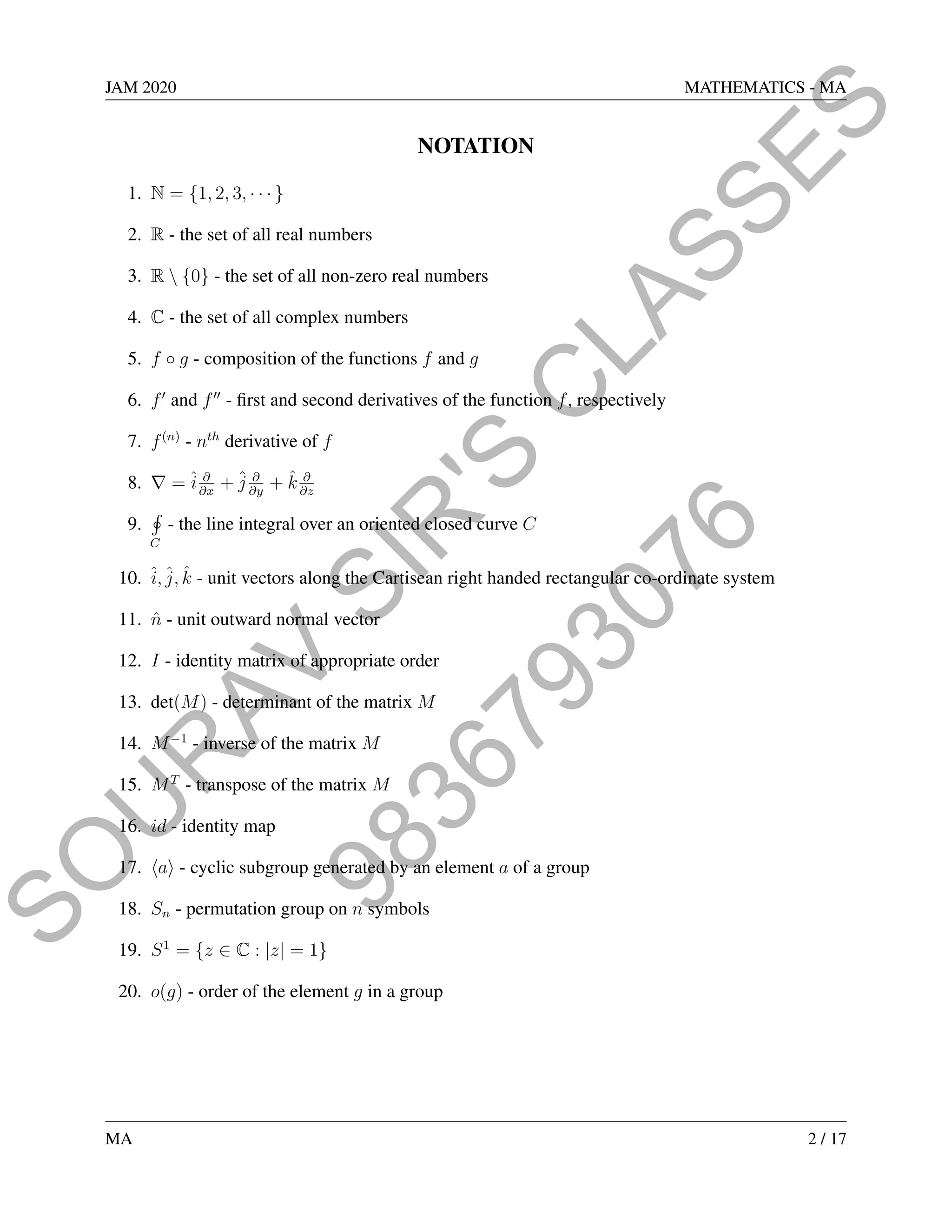
NOTATION
1. N = {1, 2, 3, · · · }
2. R - the set of all real numbers
3. R  {0} - the set of all non-zero real numbers
4. C - the set of all complex numbers
5. f ◦ g - composition of the functions f and g
6. f0
and f00
- first and second derivatives of the function f, respectively
7. f(n)
- nth
derivative of f
8. ∇ = î ∂
∂x
+ ĵ ∂
∂y
+ k̂ ∂
∂z
9.
H
C
- the line integral over an oriented closed curve C
10. î, ĵ, k̂ - unit vectors along the Cartisean right handed rectangular co-ordinate system
11. n̂ - unit outward normal vector
12. I - identity matrix of appropriate order
13. det(M) - determinant of the matrix M
14. M−1
- inverse of the matrix M
15. MT
- transpose of the matrix M
16. id - identity map
17. hai - cyclic subgroup generated by an element a of a group
18. Sn - permutation group on n symbols
19. S1
= {z ∈ C : |z| = 1}
20. o(g) - order of the element g in a group
MA 2 / 17
9
8
3
6
7
9
3
0
7
6
S
O
U
R
A
V
S
I
R
'
S
C
L
A
S
S
E
S
JAM 2020 MATHEMATICS - MA
SECTION – A
MULTIPLE CHOICE QUESTIONS (MCQ)
Q. 1 – Q. 10 carry one mark each.
Q. 1 Let sn = 1 +
(−1)n
n
, n ∈ N. Then the sequence {sn} is
(A) monotonically increasing and is convergent to 1
(B) monotonically decreasing and is convergent to 1
(C) neither monotonically increasing nor monotonically decreasing but is convergent to 1
(D) divergent
Q. 2 Let f(x) = 2x3
− 9x2
+ 7. Which of the following is true?
(A) f is one-one in the interval [−1, 1]
(B) f is one-one in the interval [2, 4]
(C) f is NOT one-one in the interval [−4, 0]
(D) f is NOT one-one in the interval [0, 4]
Q. 3 Which of the following is FALSE?
(A) lim
x→∞
x
ex
= 0 (B) lim
x→0+
1
xe1/x
= 0
(C) lim
x→0+
sin x
1 + 2x
= 0 (D) lim
x→0+
cos x
1 + 2x
= 0
Q. 4 Let g : R → R be a twice differentiable function. If f(x, y) = g(y) + xg0
(y), then
(A)
∂f
∂x
+ y
∂2
f
∂x∂y
=
∂f
∂y
(B)
∂f
∂y
+ y
∂2
f
∂x∂y
=
∂f
∂x
(C)
∂f
∂x
+ x
∂2
f
∂x∂y
=
∂f
∂y
(D)
∂f
∂y
+ x
∂2
f
∂x∂y
=
∂f
∂x
MA 3 / 17
9
8
3
6
7
9
3
0
7
6
S
O
U
R
A
V
S
I
R
'
S
C
L
A
S
S
E
S
JAM 2020 MATHEMATICS - MA
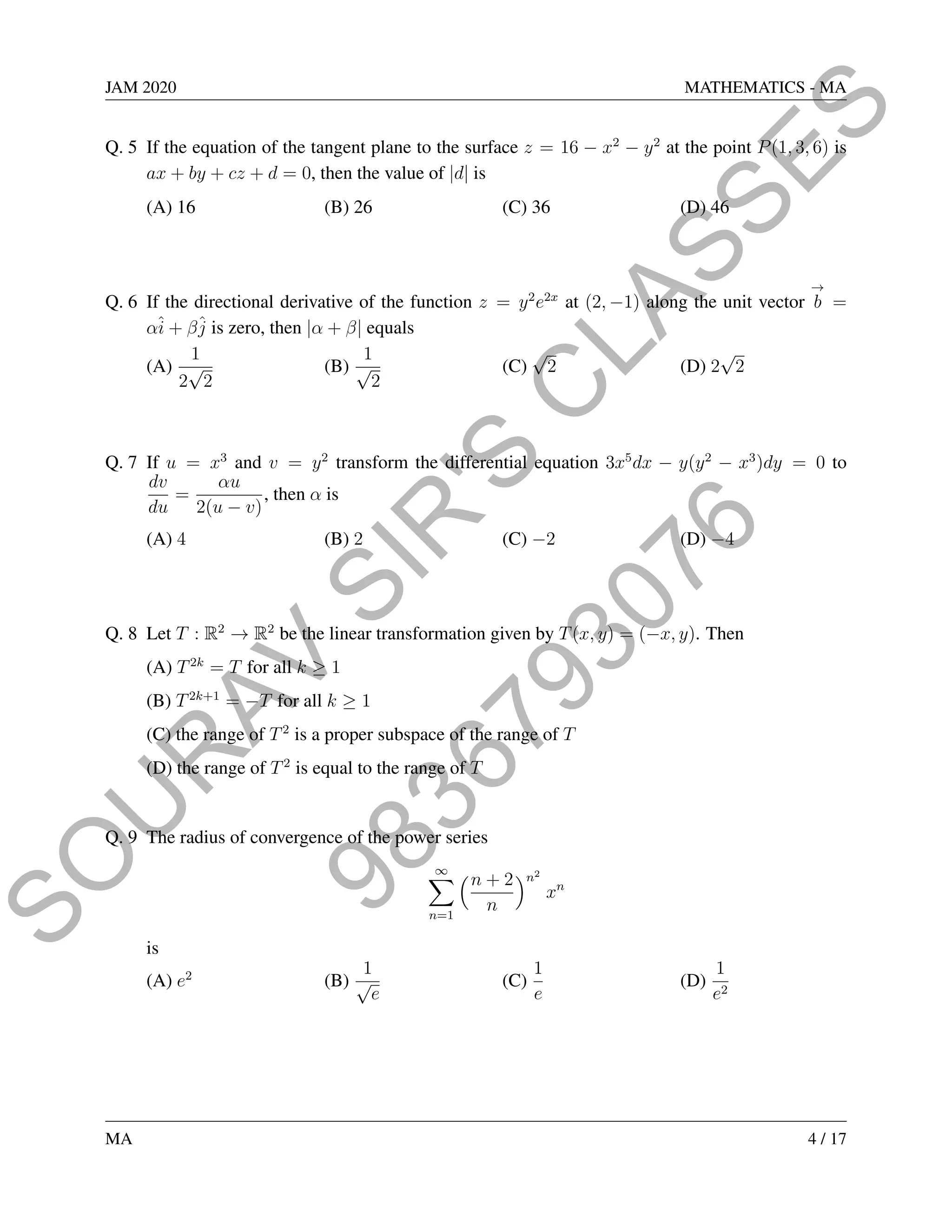
Q. 5 If the equation of the tangent plane to the surface z = 16 − x2
− y2
at the point P(1, 3, 6) is
ax + by + cz + d = 0, then the value of |d| is
(A) 16 (B) 26 (C) 36 (D) 46
Q. 6 If the directional derivative of the function z = y2
e2x
at (2, −1) along the unit vector
→
b =
αî + βĵ is zero, then |α + β| equals
(A)
1
2
√
2
(B)
1
√
2
(C)
√
2 (D) 2
√
2
Q. 7 If u = x3
and v = y2
transform the differential equation 3x5
dx − y(y2
− x3
)dy = 0 to
dv
du
=
αu
2(u − v)
, then α is
(A) 4 (B) 2 (C) −2 (D) −4
Q. 8 Let T : R2
→ R2
be the linear transformation given by T(x, y) = (−x, y). Then
(A) T2k
= T for all k ≥ 1
(B) T2k+1
= −T for all k ≥ 1
(C) the range of T2
is a proper subspace of the range of T
(D) the range of T2
is equal to the range of T
Q. 9 The radius of convergence of the power series
∞
X
n=1
n + 2
n
n2
xn
is
(A) e2
(B)
1
√
e
(C)
1
e
(D)
1
e2
MA 4 / 17
9
8
3
6
7
9
3
0
7
6
S
O
U
R
A
V
S
I
R
'
S
C
L
A
S
S
E
S
JAM 2020 MATHEMATICS - MA
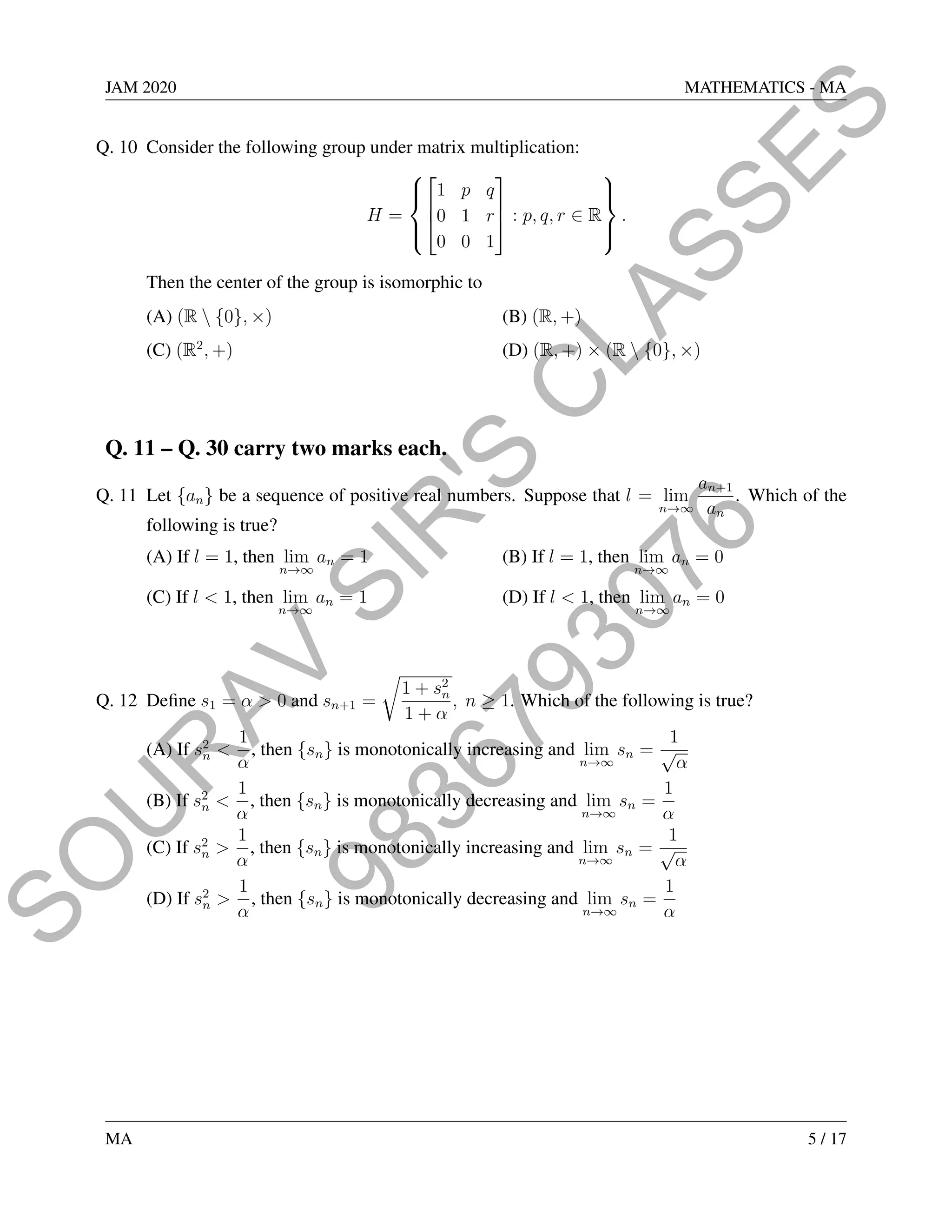
Q. 10 Consider the following group under matrix multiplication:
H =








1 p q
0 1 r
0 0 1


 : p, q, r ∈ R





.
Then the center of the group is isomorphic to
(A) (R  {0}, ×) (B) (R, +)
(C) (R2
, +) (D) (R, +) × (R  {0}, ×)
Q. 11 – Q. 30 carry two marks each.
Q. 11 Let {an} be a sequence of positive real numbers. Suppose that l = lim
n→∞
an+1
an
. Which of the
following is true?
(A) If l = 1, then lim
n→∞
an = 1 (B) If l = 1, then lim
n→∞
an = 0
(C) If l  1, then lim
n→∞
an = 1 (D) If l  1, then lim
n→∞
an = 0
Q. 12 Define s1 = α  0 and sn+1 =
r
1 + s2
n
1 + α
, n ≥ 1. Which of the following is true?
(A) If s2
n 
1
α
, then {sn} is monotonically increasing and lim
n→∞
sn =
1
√
α
(B) If s2
n 
1
α
, then {sn} is monotonically decreasing and lim
n→∞
sn =
1
α
(C) If s2
n 
1
α
, then {sn} is monotonically increasing and lim
n→∞
sn =
1
√
α
(D) If s2
n 
1
α
, then {sn} is monotonically decreasing and lim
n→∞
sn =
1
α
MA 5 / 17
9
8
3
6
7
9
3
0
7
6
S
O
U
R
A
V
S
I
R
'
S
C
L
A
S
S
E
S
JAM 2020 MATHEMATICS - MA
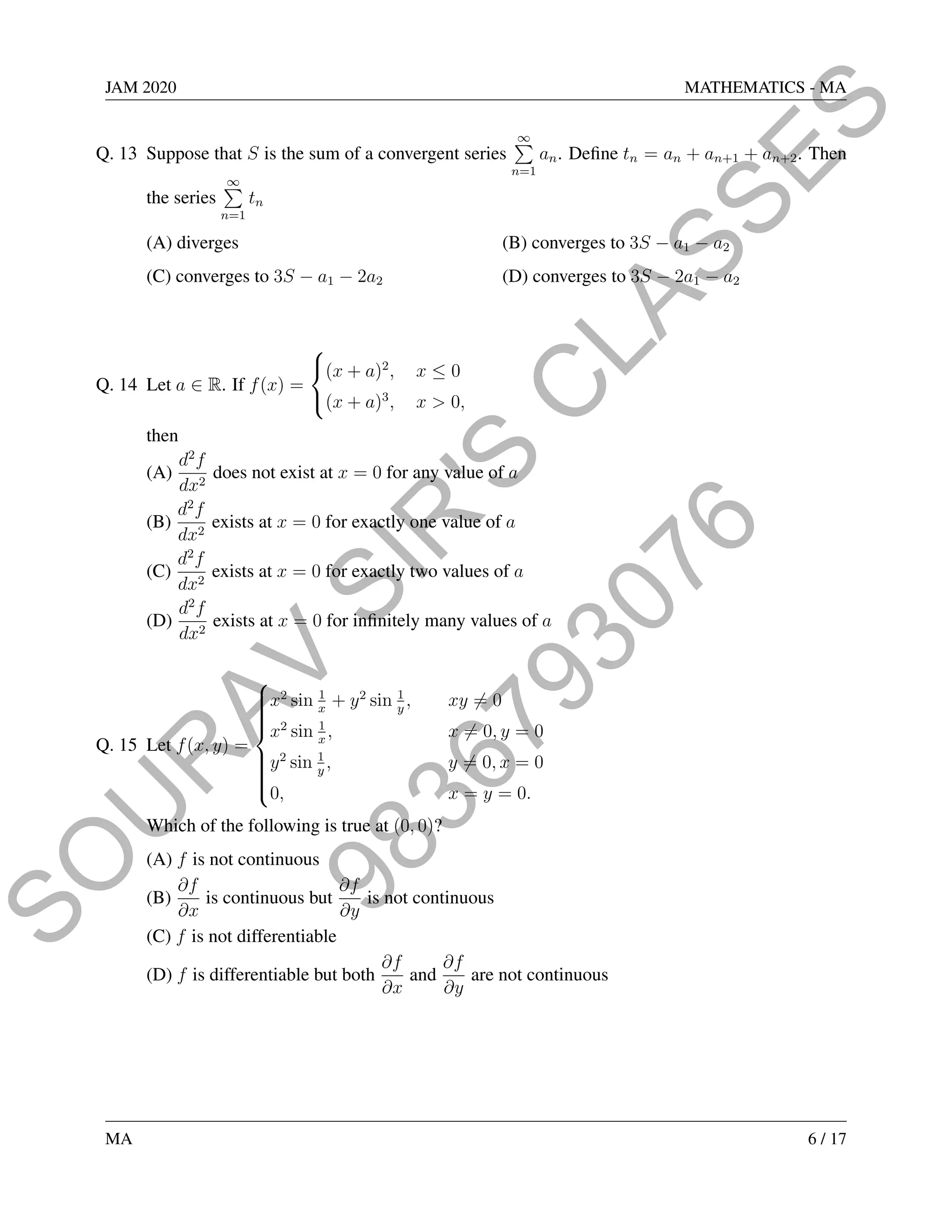
Q. 13 Suppose that S is the sum of a convergent series
∞
P
n=1
an. Define tn = an + an+1 + an+2. Then
the series
∞
P
n=1
tn
(A) diverges (B) converges to 3S − a1 − a2
(C) converges to 3S − a1 − 2a2 (D) converges to 3S − 2a1 − a2
Q. 14 Let a ∈ R. If f(x) =



(x + a)2
, x ≤ 0
(x + a)3
, x  0,
then
(A)
d2
f
dx2
does not exist at x = 0 for any value of a
(B)
d2
f
dx2
exists at x = 0 for exactly one value of a
(C)
d2
f
dx2
exists at x = 0 for exactly two values of a
(D)
d2
f
dx2
exists at x = 0 for infinitely many values of a
Q. 15 Let f(x, y) =













x2
sin 1
x
+ y2
sin 1
y
, xy 6= 0
x2
sin 1
x
, x 6= 0, y = 0
y2
sin 1
y
, y 6= 0, x = 0
0, x = y = 0.
Which of the following is true at (0, 0)?
(A) f is not continuous
(B)
∂f
∂x
is continuous but
∂f
∂y
is not continuous
(C) f is not differentiable
(D) f is differentiable but both
∂f
∂x
and
∂f
∂y
are not continuous
MA 6 / 17
9
8
3
6
7
9
3
0
7
6
S
O
U
R
A
V
S
I
R
'
S
C
L
A
S
S
E
S
JAM 2020 MATHEMATICS - MA
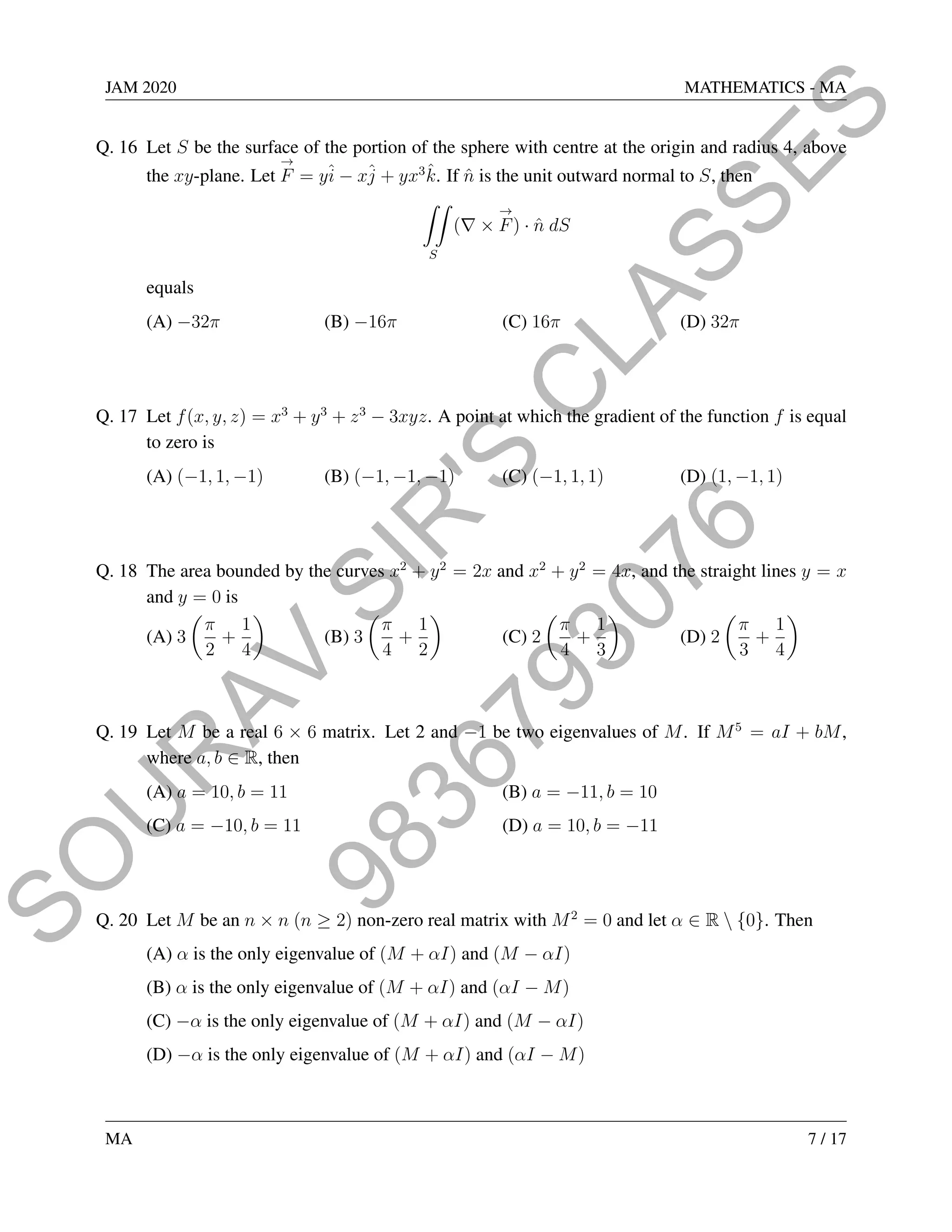
Q. 16 Let S be the surface of the portion of the sphere with centre at the origin and radius 4, above
the xy-plane. Let
→
F = yî − xĵ + yx3
k̂. If n̂ is the unit outward normal to S, then
ZZ
S
(∇ ×
→
F) · n̂ dS
equals
(A) −32π (B) −16π (C) 16π (D) 32π
Q. 17 Let f(x, y, z) = x3
+ y3
+ z3
− 3xyz. A point at which the gradient of the function f is equal
to zero is
(A) (−1, 1, −1) (B) (−1, −1, −1) (C) (−1, 1, 1) (D) (1, −1, 1)
Q. 18 The area bounded by the curves x2
+ y2
= 2x and x2
+ y2
= 4x, and the straight lines y = x
and y = 0 is
(A) 3

π
2
+
1
4

(B) 3

π
4
+
1
2

(C) 2

π
4
+
1
3

(D) 2

π
3
+
1
4

Q. 19 Let M be a real 6 × 6 matrix. Let 2 and −1 be two eigenvalues of M. If M5
= aI + bM,
where a, b ∈ R, then
(A) a = 10, b = 11 (B) a = −11, b = 10
(C) a = −10, b = 11 (D) a = 10, b = −11
Q. 20 Let M be an n × n (n ≥ 2) non-zero real matrix with M2
= 0 and let α ∈ R  {0}. Then
(A) α is the only eigenvalue of (M + αI) and (M − αI)
(B) α is the only eigenvalue of (M + αI) and (αI − M)
(C) −α is the only eigenvalue of (M + αI) and (M − αI)
(D) −α is the only eigenvalue of (M + αI) and (αI − M)
MA 7 / 17
9
8
3
6
7
9
3
0
7
6
S
O
U
R
A
V
S
I
R
'
S
C
L
A
S
S
E
S
JAM 2020 MATHEMATICS - MA
Q. 21 Consider the differential equation L[y] = (y − y2
)dx + xdy = 0. The function f(x, y) is said
to be an integrating factor of the equation if f(x, y)L[y] = 0 becomes exact.
If f(x, y) =
1
x2y2
, then
(A) f is an integrating factor and y = 1 − kxy, k ∈ R is NOT its general solution
(B) f is an integrating factor and y = −1 + kxy, k ∈ R is its general solution
(C) f is an integrating factor and y = −1 + kxy, k ∈ R is NOT its general solution
(D) f is NOT an integrating factor and y = 1 + kxy, k ∈ R is its general solution
Q. 22 A solution of the differential equation 2x2 d2
y
dx2
+ 3x
dy
dx
− y = 0, x  0 that passes through the
point (1, 1) is
(A) y =
1
x
(B) y =
1
x2
(C) y =
1
√
x
(D) y =
1
x3/2
Q. 23 Let M be a 4 × 3 real matrix and let {e1, e2, e3} be the standard basis of R3
. Which of the
following is true?
(A) If rank(M) = 1, then {Me1, Me2} is a linearly independent set
(B) If rank(M) = 2, then {Me1, Me2} is a linearly independent set
(C) If rank(M) = 2, then {Me1, Me3} is a linearly independent set
(D) If rank(M) = 3, then {Me1, Me3} is a linearly independent set
Q. 24 The value of the triple integral
RRR
V
(x2
y+1) dxdydz, where V is the region given by x2
+y2
≤
1, 0 ≤ z ≤ 2 is
(A) π (B) 2π (C) 3π (D) 4π
Q. 25 Let S be the part of the cone z2
= x2
+ y2
between the planes z = 0 and z = 1. Then the value
of the surface integral
RR
S
(x2
+ y2
) dS is
(A) π (B)
π
√
2
(C)
π
√
3
(D)
π
2
MA 8 / 17
9
8
3
6
7
9
3
0
7
6
S
O
U
R
A
V
S
I
R
'
S
C
L
A
S
S
E
S
JAM 2020 MATHEMATICS - MA
Q. 26 Let
→
a = î + ĵ + k̂ and
→
r = xî + yĵ + zk̂, x, y, z ∈ R. Which of the following is FALSE?
(A) ∇(
→
a ·
→
r) =
→
a (B) ∇ · (
→
a ×
→
r) = 0
(C) ∇ × (
→
a ×
→
r) =
→
a (D) ∇ · ((
→
a ·
→
r)
→
r) = 4(
→
a ·
→
r)
Q. 27 Let D = {(x, y) ∈ R2
: |x| + |y| ≤ 1} and f : D → R be a non-constant continuous function.
Which of the following is TRUE?
(A) The range of f is unbounded
(B) The range of f is a union of open intervals
(C) The range of f is a closed interval
(D) The range of f is a union of at least two disjoint closed intervals
Q. 28 Let f : [0, 1] → R be a continuous function such that f

1
2

= −
1
2
and
|f(x) − f(y) − (x − y)| ≤ sin (|x − y|2
)
for all x, y ∈ [0, 1]. Then
1
R
0
f(x) dx is
(A) −
1
2
(B) −
1
4
(C)
1
4
(D)
1
2
Q. 29 Let S1
= {z ∈ C : |z| = 1} be the circle group under multiplication and i =
√
−1. Then the
set {θ ∈ R : hei2πθ
i is infinite} is
(A) empty (B) non-empty and finite
(C) countably infinite (D) uncountable
MA 9 / 17
9
8
3
6
7
9
3
0
7
6
S
O
U
R
A
V
S
I
R
'
S
C
L
A
S
S
E
S
JAM 2020 MATHEMATICS - MA
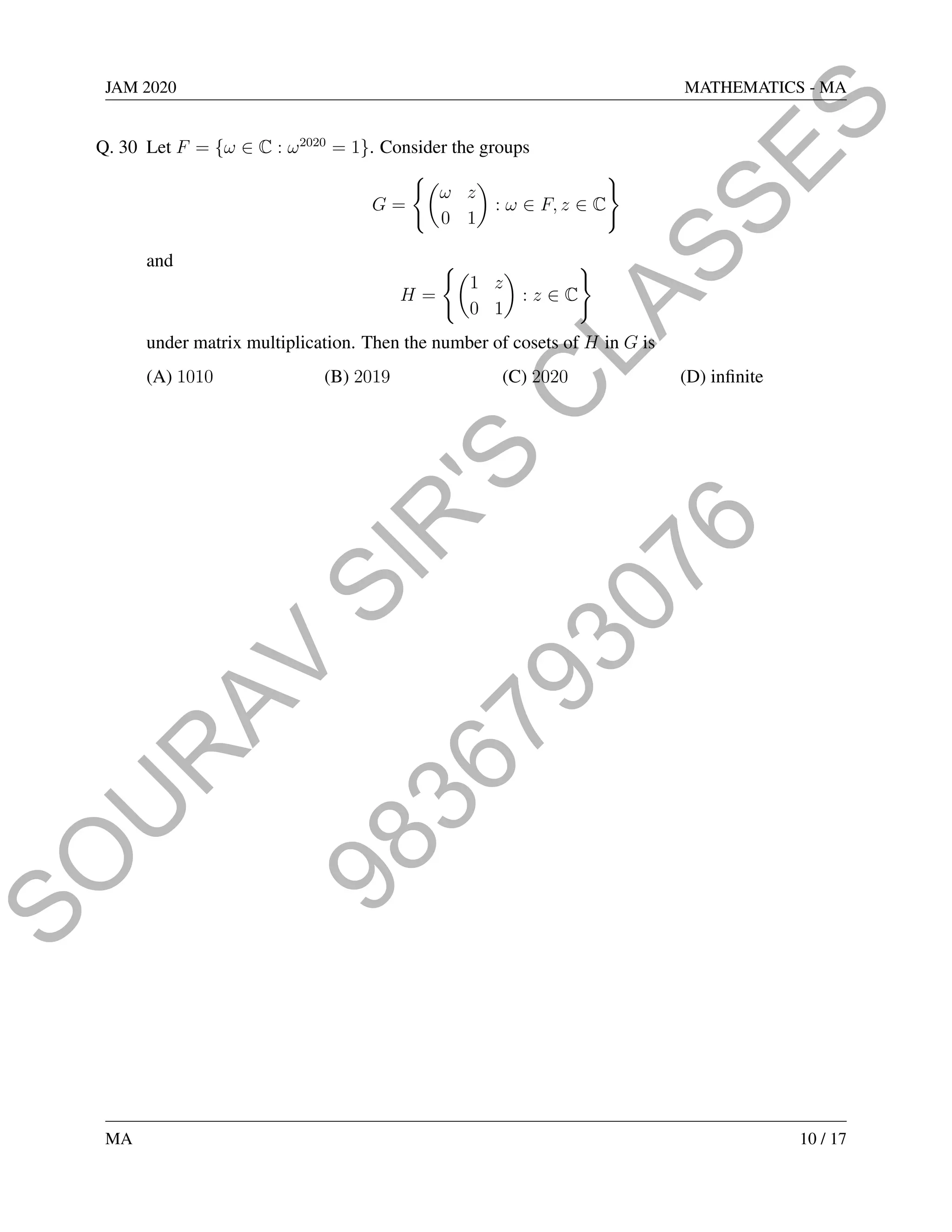
Q. 30 Let F = {ω ∈ C : ω2020
= 1}. Consider the groups
G =
(
ω z
0 1

: ω ∈ F, z ∈ C
)
and
H =
(
1 z
0 1

: z ∈ C
)
under matrix multiplication. Then the number of cosets of H in G is
(A) 1010 (B) 2019 (C) 2020 (D) infinite
MA 10 / 17
9
8
3
6
7
9
3
0
7
6
S
O
U
R
A
V
S
I
R
'
S
C
L
A
S
S
E
S
JAM 2020 MATHEMATICS - MA
SECTION – B
MULTIPLE SELECT QUESTIONS (MSQ)
Q. 31 – Q. 40 carry two marks each.
Q. 31 Let a, b, c ∈ R such that a  b  c. Which of the following is/are true for any continuous
function f : R → R satisfying f(a) = b, f(b) = c and f(c) = a?
(A) There exists α ∈ (a, c) such that f(α) = α
(B) There exists β ∈ (a, b) such that f(β) = β
(C) There exists γ ∈ (a, b) such that (f ◦ f)(γ) = γ
(D) There exists δ ∈ (a, c) such that (f ◦ f ◦ f)(δ) = δ
Q. 32 If sn =
(−1)n
2n + 3
and tn =
(−1)n
4n − 1
, n = 0, 1, 2, ..., then
(A)
∞
P
n=0
sn is absolutely convergent (B)
∞
P
n=0
tn is absolutely convergent
(C)
∞
P
n=0
sn is conditionally convergent (D)
∞
P
n=0
tn is conditionally convergent
Q. 33 Let a, b ∈ R and a  b. Which of the following statement(s) is/are true?
(A) There exists a continuous function f : [a, b] → (a, b) such that f is one-one
(B) There exists a continuous function f : [a, b] → (a, b) such that f is onto
(C) There exists a continuous function f : (a, b) → [a, b] such that f is one-one
(D) There exists a continuous function f : (a, b) → [a, b] such that f is onto
MA 11 / 17
9
8
3
6
7
9
3
0
7
6
S
O
U
R
A
V
S
I
R
'
S
C
L
A
S
S
E
S
JAM 2020 MATHEMATICS - MA
Q. 34 Let V be a non-zero vector space over a field F. Let S ⊂ V be a non-empty set. Consider the
following properties of S:
(I) For any vector space W over F, any map f : S → W extends to a linear map from V to
W.
(II) For any vector space W over F and any two linear maps f, g : V → W satisfying f(s) =
g(s) for all s ∈ S, we have f(v) = g(v) for all v ∈ V .
(III) S is linearly independent.
(IV) The span of S is V.
Which of the following statement(s) is /are true?
(A) (I) implies (IV) (B) (I) implies (III)
(C) (II) implies (III) (D) (II) implies (IV)
Q. 35 Let L[y] = x2 d2
y
dx2
+ px
dy
dx
+ qy, where p, q are real constants. Let y1(x) and y2(x) be two
solutions of L[y] = 0, x  0, that satisfy y1(x0) = 1, y0
1(x0) = 0, y2(x0) = 0 and y0
2(x0) = 1
for some x0  0. Then,
(A) y1(x) is not a constant multiple of y2(x)
(B) y1(x) is a constant multiple of y2(x)
(C) 1, ln x are solutions of L[y] = 0 when p = 1, q = 0
(D) x, ln x are solutions of L[y] = 0 when p + q 6= 0
Q. 36 Consider the following system of linear equations
x + y + 5z = 3, x + 2y + mz = 5 and x + 2y + 4z = k.
The system is consistent if
(A) m 6= 4 (B) k 6= 5 (C) m = 4 (D) k = 5
MA 12 / 17
9
8
3
6
7
9
3
0
7
6
S
O
U
R
A
V
S
I
R
'
S
C
L
A
S
S
E
S
JAM 2020 MATHEMATICS - MA
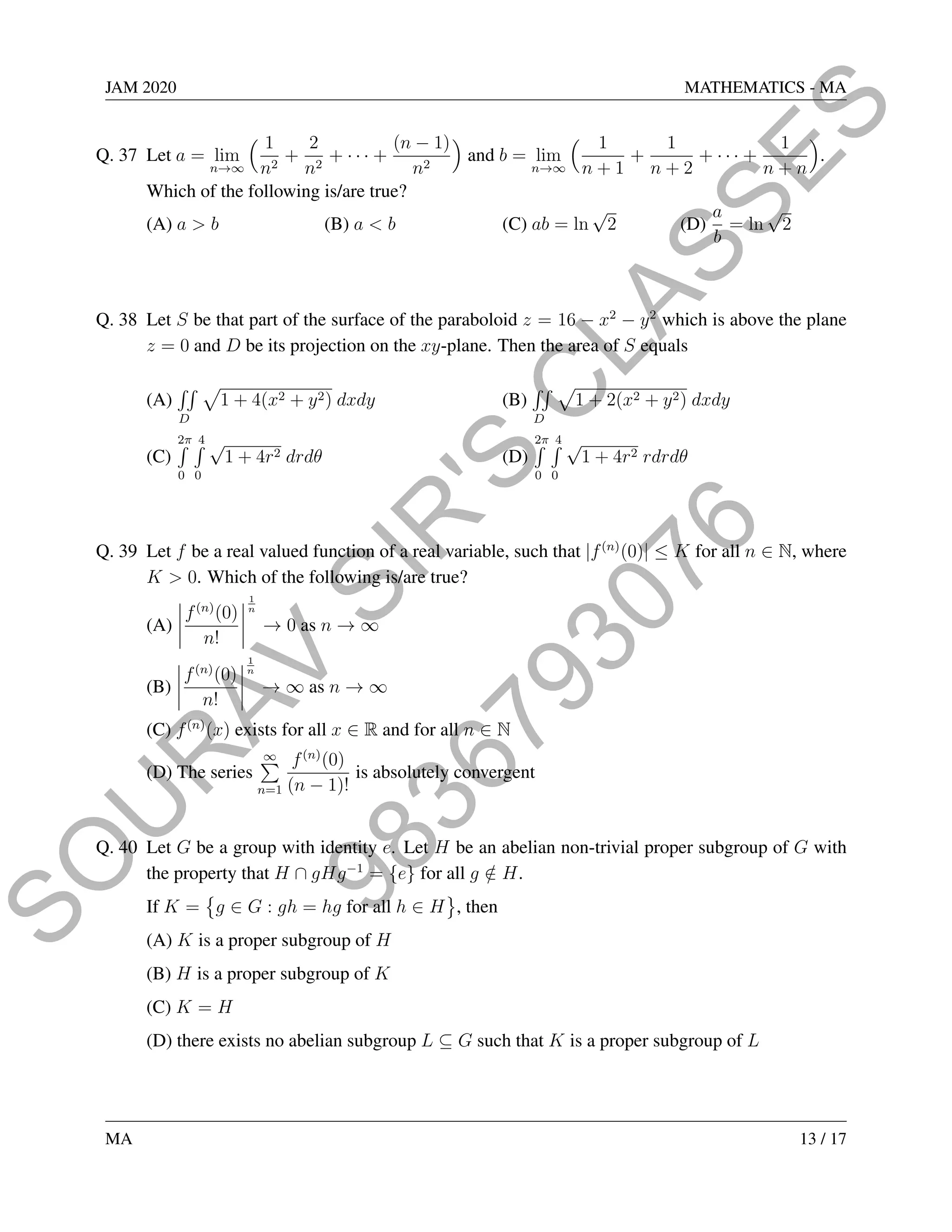
Q. 37 Let a = lim
n→∞
 1
n2
+
2
n2
+ · · · +
(n − 1)
n2

and b = lim
n→∞
 1
n + 1
+
1
n + 2
+ · · · +
1
n + n

.
Which of the following is/are true?
(A) a  b (B) a  b (C) ab = ln
√
2 (D)
a
b
= ln
√
2
Q. 38 Let S be that part of the surface of the paraboloid z = 16 − x2
− y2
which is above the plane
z = 0 and D be its projection on the xy-plane. Then the area of S equals
(A)
RR
D
p
1 + 4(x2 + y2) dxdy (B)
RR
D
p
1 + 2(x2 + y2) dxdy
(C)
2π
R
0
4
R
0
√
1 + 4r2 drdθ (D)
2π
R
0
4
R
0
√
1 + 4r2 rdrdθ
Q. 39 Let f be a real valued function of a real variable, such that |f(n)
(0)| ≤ K for all n ∈ N, where
K  0. Which of the following is/are true?
(A)
f(n)
(0)
n!

IIT JAM MATH 2020 Question Paper | Sourav Sir's Classes

  • 1.
    9 8 3 6 7 9 3 0 7 6 S O U R A V S I R ' S C L A S S E S JAM 2020 MATHEMATICS- MA Paper Specific Instructions 1. The examination is of 3 hours duration. There are a total of 60 questions carrying 100 marks. The entire paper is divided into three sections, A, B and C. All sections are compulsory. Questions in each section are of different types. 2. Section – A contains a total of 30 Multiple Choice Questions (MCQ). Each MCQ type question has four choices out of which only one choice is the correct answer. Questions Q.1 – Q.30 belong to this section and carry a total of 50 marks. Q.1 – Q.10 carry 1 mark each and Questions Q.11 – Q.30 carry 2 marks each. 3. Section – B contains a total of 10 Multiple Select Questions (MSQ). Each MSQ type question is similar to MCQ but with a difference that there may be one or more than one choice(s) that are correct out of the four given choices. The candidate gets full credit if he/she selects all the correct answers only and no wrong answers. Questions Q.31 – Q.40 belong to this section and carry 2 marks each with a total of 20 marks. 4. Section – C contains a total of 20 Numerical Answer Type (NAT) questions. For these NAT type ques- tions, the answer is a real number which needs to be entered using the virtual keyboard on the monitor. No choices will be shown for this type of questions. Questions Q.41 – Q.60 belong to this section and carry a total of 30 marks. Q.41 – Q.50 carry 1 mark each and Questions Q.51 – Q.60 carry 2 marks each. 5. In all sections, questions not attempted will result in zero mark. In Section – A (MCQ), wrong answer will result in NEGATIVE marks. For all 1 mark questions, 1/3 marks will be deducted for each wrong answer. For all 2 marks questions, 2/3 marks will be deducted for each wrong answer. In Section – B (MSQ), there is NO NEGATIVE and NO PARTIAL marking provisions. There is NO NEGATIVE marking in Section – C (NAT) as well. 6. Only Virtual Scientific Calculator is allowed. Charts, graph sheets, tables, cellular phone or other electronic gadgets are NOT allowed in the examination hall. 7. The Scribble Pad will be provided for rough work. MA 1 / 17
  • 2.
    9 8 3 6 7 9 3 0 7 6 S O U R A V S I R ' S C L A S S E S JAM 2020 MATHEMATICS- MA NOTATION 1. N = {1, 2, 3, · · · } 2. R - the set of all real numbers 3. R {0} - the set of all non-zero real numbers 4. C - the set of all complex numbers 5. f ◦ g - composition of the functions f and g 6. f0 and f00 - first and second derivatives of the function f, respectively 7. f(n) - nth derivative of f 8. ∇ = î ∂ ∂x + ĵ ∂ ∂y + k̂ ∂ ∂z 9. H C - the line integral over an oriented closed curve C 10. î, ĵ, k̂ - unit vectors along the Cartisean right handed rectangular co-ordinate system 11. n̂ - unit outward normal vector 12. I - identity matrix of appropriate order 13. det(M) - determinant of the matrix M 14. M−1 - inverse of the matrix M 15. MT - transpose of the matrix M 16. id - identity map 17. hai - cyclic subgroup generated by an element a of a group 18. Sn - permutation group on n symbols 19. S1 = {z ∈ C : |z| = 1} 20. o(g) - order of the element g in a group MA 2 / 17
  • 3.
    9 8 3 6 7 9 3 0 7 6 S O U R A V S I R ' S C L A S S E S JAM 2020 MATHEMATICS- MA SECTION – A MULTIPLE CHOICE QUESTIONS (MCQ) Q. 1 – Q. 10 carry one mark each. Q. 1 Let sn = 1 + (−1)n n , n ∈ N. Then the sequence {sn} is (A) monotonically increasing and is convergent to 1 (B) monotonically decreasing and is convergent to 1 (C) neither monotonically increasing nor monotonically decreasing but is convergent to 1 (D) divergent Q. 2 Let f(x) = 2x3 − 9x2 + 7. Which of the following is true? (A) f is one-one in the interval [−1, 1] (B) f is one-one in the interval [2, 4] (C) f is NOT one-one in the interval [−4, 0] (D) f is NOT one-one in the interval [0, 4] Q. 3 Which of the following is FALSE? (A) lim x→∞ x ex = 0 (B) lim x→0+ 1 xe1/x = 0 (C) lim x→0+ sin x 1 + 2x = 0 (D) lim x→0+ cos x 1 + 2x = 0 Q. 4 Let g : R → R be a twice differentiable function. If f(x, y) = g(y) + xg0 (y), then (A) ∂f ∂x + y ∂2 f ∂x∂y = ∂f ∂y (B) ∂f ∂y + y ∂2 f ∂x∂y = ∂f ∂x (C) ∂f ∂x + x ∂2 f ∂x∂y = ∂f ∂y (D) ∂f ∂y + x ∂2 f ∂x∂y = ∂f ∂x MA 3 / 17
  • 4.
    9 8 3 6 7 9 3 0 7 6 S O U R A V S I R ' S C L A S S E S JAM 2020 MATHEMATICS- MA Q. 5 If the equation of the tangent plane to the surface z = 16 − x2 − y2 at the point P(1, 3, 6) is ax + by + cz + d = 0, then the value of |d| is (A) 16 (B) 26 (C) 36 (D) 46 Q. 6 If the directional derivative of the function z = y2 e2x at (2, −1) along the unit vector → b = αî + βĵ is zero, then |α + β| equals (A) 1 2 √ 2 (B) 1 √ 2 (C) √ 2 (D) 2 √ 2 Q. 7 If u = x3 and v = y2 transform the differential equation 3x5 dx − y(y2 − x3 )dy = 0 to dv du = αu 2(u − v) , then α is (A) 4 (B) 2 (C) −2 (D) −4 Q. 8 Let T : R2 → R2 be the linear transformation given by T(x, y) = (−x, y). Then (A) T2k = T for all k ≥ 1 (B) T2k+1 = −T for all k ≥ 1 (C) the range of T2 is a proper subspace of the range of T (D) the range of T2 is equal to the range of T Q. 9 The radius of convergence of the power series ∞ X n=1 n + 2 n n2 xn is (A) e2 (B) 1 √ e (C) 1 e (D) 1 e2 MA 4 / 17
  • 5.
    9 8 3 6 7 9 3 0 7 6 S O U R A V S I R ' S C L A S S E S JAM 2020 MATHEMATICS- MA Q. 10 Consider the following group under matrix multiplication: H =         1 p q 0 1 r 0 0 1    : p, q, r ∈ R      . Then the center of the group is isomorphic to (A) (R {0}, ×) (B) (R, +) (C) (R2 , +) (D) (R, +) × (R {0}, ×) Q. 11 – Q. 30 carry two marks each. Q. 11 Let {an} be a sequence of positive real numbers. Suppose that l = lim n→∞ an+1 an . Which of the following is true? (A) If l = 1, then lim n→∞ an = 1 (B) If l = 1, then lim n→∞ an = 0 (C) If l 1, then lim n→∞ an = 1 (D) If l 1, then lim n→∞ an = 0 Q. 12 Define s1 = α 0 and sn+1 = r 1 + s2 n 1 + α , n ≥ 1. Which of the following is true? (A) If s2 n 1 α , then {sn} is monotonically increasing and lim n→∞ sn = 1 √ α (B) If s2 n 1 α , then {sn} is monotonically decreasing and lim n→∞ sn = 1 α (C) If s2 n 1 α , then {sn} is monotonically increasing and lim n→∞ sn = 1 √ α (D) If s2 n 1 α , then {sn} is monotonically decreasing and lim n→∞ sn = 1 α MA 5 / 17
  • 6.
    9 8 3 6 7 9 3 0 7 6 S O U R A V S I R ' S C L A S S E S JAM 2020 MATHEMATICS- MA Q. 13 Suppose that S is the sum of a convergent series ∞ P n=1 an. Define tn = an + an+1 + an+2. Then the series ∞ P n=1 tn (A) diverges (B) converges to 3S − a1 − a2 (C) converges to 3S − a1 − 2a2 (D) converges to 3S − 2a1 − a2 Q. 14 Let a ∈ R. If f(x) =    (x + a)2 , x ≤ 0 (x + a)3 , x 0, then (A) d2 f dx2 does not exist at x = 0 for any value of a (B) d2 f dx2 exists at x = 0 for exactly one value of a (C) d2 f dx2 exists at x = 0 for exactly two values of a (D) d2 f dx2 exists at x = 0 for infinitely many values of a Q. 15 Let f(x, y) =              x2 sin 1 x + y2 sin 1 y , xy 6= 0 x2 sin 1 x , x 6= 0, y = 0 y2 sin 1 y , y 6= 0, x = 0 0, x = y = 0. Which of the following is true at (0, 0)? (A) f is not continuous (B) ∂f ∂x is continuous but ∂f ∂y is not continuous (C) f is not differentiable (D) f is differentiable but both ∂f ∂x and ∂f ∂y are not continuous MA 6 / 17
  • 7.
    9 8 3 6 7 9 3 0 7 6 S O U R A V S I R ' S C L A S S E S JAM 2020 MATHEMATICS- MA Q. 16 Let S be the surface of the portion of the sphere with centre at the origin and radius 4, above the xy-plane. Let → F = yî − xĵ + yx3 k̂. If n̂ is the unit outward normal to S, then ZZ S (∇ × → F) · n̂ dS equals (A) −32π (B) −16π (C) 16π (D) 32π Q. 17 Let f(x, y, z) = x3 + y3 + z3 − 3xyz. A point at which the gradient of the function f is equal to zero is (A) (−1, 1, −1) (B) (−1, −1, −1) (C) (−1, 1, 1) (D) (1, −1, 1) Q. 18 The area bounded by the curves x2 + y2 = 2x and x2 + y2 = 4x, and the straight lines y = x and y = 0 is (A) 3 π 2 + 1 4 (B) 3 π 4 + 1 2 (C) 2 π 4 + 1 3 (D) 2 π 3 + 1 4 Q. 19 Let M be a real 6 × 6 matrix. Let 2 and −1 be two eigenvalues of M. If M5 = aI + bM, where a, b ∈ R, then (A) a = 10, b = 11 (B) a = −11, b = 10 (C) a = −10, b = 11 (D) a = 10, b = −11 Q. 20 Let M be an n × n (n ≥ 2) non-zero real matrix with M2 = 0 and let α ∈ R {0}. Then (A) α is the only eigenvalue of (M + αI) and (M − αI) (B) α is the only eigenvalue of (M + αI) and (αI − M) (C) −α is the only eigenvalue of (M + αI) and (M − αI) (D) −α is the only eigenvalue of (M + αI) and (αI − M) MA 7 / 17
  • 8.
    9 8 3 6 7 9 3 0 7 6 S O U R A V S I R ' S C L A S S E S JAM 2020 MATHEMATICS- MA Q. 21 Consider the differential equation L[y] = (y − y2 )dx + xdy = 0. The function f(x, y) is said to be an integrating factor of the equation if f(x, y)L[y] = 0 becomes exact. If f(x, y) = 1 x2y2 , then (A) f is an integrating factor and y = 1 − kxy, k ∈ R is NOT its general solution (B) f is an integrating factor and y = −1 + kxy, k ∈ R is its general solution (C) f is an integrating factor and y = −1 + kxy, k ∈ R is NOT its general solution (D) f is NOT an integrating factor and y = 1 + kxy, k ∈ R is its general solution Q. 22 A solution of the differential equation 2x2 d2 y dx2 + 3x dy dx − y = 0, x 0 that passes through the point (1, 1) is (A) y = 1 x (B) y = 1 x2 (C) y = 1 √ x (D) y = 1 x3/2 Q. 23 Let M be a 4 × 3 real matrix and let {e1, e2, e3} be the standard basis of R3 . Which of the following is true? (A) If rank(M) = 1, then {Me1, Me2} is a linearly independent set (B) If rank(M) = 2, then {Me1, Me2} is a linearly independent set (C) If rank(M) = 2, then {Me1, Me3} is a linearly independent set (D) If rank(M) = 3, then {Me1, Me3} is a linearly independent set Q. 24 The value of the triple integral RRR V (x2 y+1) dxdydz, where V is the region given by x2 +y2 ≤ 1, 0 ≤ z ≤ 2 is (A) π (B) 2π (C) 3π (D) 4π Q. 25 Let S be the part of the cone z2 = x2 + y2 between the planes z = 0 and z = 1. Then the value of the surface integral RR S (x2 + y2 ) dS is (A) π (B) π √ 2 (C) π √ 3 (D) π 2 MA 8 / 17
  • 9.
    9 8 3 6 7 9 3 0 7 6 S O U R A V S I R ' S C L A S S E S JAM 2020 MATHEMATICS- MA Q. 26 Let → a = î + ĵ + k̂ and → r = xî + yĵ + zk̂, x, y, z ∈ R. Which of the following is FALSE? (A) ∇( → a · → r) = → a (B) ∇ · ( → a × → r) = 0 (C) ∇ × ( → a × → r) = → a (D) ∇ · (( → a · → r) → r) = 4( → a · → r) Q. 27 Let D = {(x, y) ∈ R2 : |x| + |y| ≤ 1} and f : D → R be a non-constant continuous function. Which of the following is TRUE? (A) The range of f is unbounded (B) The range of f is a union of open intervals (C) The range of f is a closed interval (D) The range of f is a union of at least two disjoint closed intervals Q. 28 Let f : [0, 1] → R be a continuous function such that f 1 2 = − 1 2 and |f(x) − f(y) − (x − y)| ≤ sin (|x − y|2 ) for all x, y ∈ [0, 1]. Then 1 R 0 f(x) dx is (A) − 1 2 (B) − 1 4 (C) 1 4 (D) 1 2 Q. 29 Let S1 = {z ∈ C : |z| = 1} be the circle group under multiplication and i = √ −1. Then the set {θ ∈ R : hei2πθ i is infinite} is (A) empty (B) non-empty and finite (C) countably infinite (D) uncountable MA 9 / 17
  • 10.
    9 8 3 6 7 9 3 0 7 6 S O U R A V S I R ' S C L A S S E S JAM 2020 MATHEMATICS- MA Q. 30 Let F = {ω ∈ C : ω2020 = 1}. Consider the groups G = ( ω z 0 1 : ω ∈ F, z ∈ C ) and H = ( 1 z 0 1 : z ∈ C ) under matrix multiplication. Then the number of cosets of H in G is (A) 1010 (B) 2019 (C) 2020 (D) infinite MA 10 / 17
  • 11.
    9 8 3 6 7 9 3 0 7 6 S O U R A V S I R ' S C L A S S E S JAM 2020 MATHEMATICS- MA SECTION – B MULTIPLE SELECT QUESTIONS (MSQ) Q. 31 – Q. 40 carry two marks each. Q. 31 Let a, b, c ∈ R such that a b c. Which of the following is/are true for any continuous function f : R → R satisfying f(a) = b, f(b) = c and f(c) = a? (A) There exists α ∈ (a, c) such that f(α) = α (B) There exists β ∈ (a, b) such that f(β) = β (C) There exists γ ∈ (a, b) such that (f ◦ f)(γ) = γ (D) There exists δ ∈ (a, c) such that (f ◦ f ◦ f)(δ) = δ Q. 32 If sn = (−1)n 2n + 3 and tn = (−1)n 4n − 1 , n = 0, 1, 2, ..., then (A) ∞ P n=0 sn is absolutely convergent (B) ∞ P n=0 tn is absolutely convergent (C) ∞ P n=0 sn is conditionally convergent (D) ∞ P n=0 tn is conditionally convergent Q. 33 Let a, b ∈ R and a b. Which of the following statement(s) is/are true? (A) There exists a continuous function f : [a, b] → (a, b) such that f is one-one (B) There exists a continuous function f : [a, b] → (a, b) such that f is onto (C) There exists a continuous function f : (a, b) → [a, b] such that f is one-one (D) There exists a continuous function f : (a, b) → [a, b] such that f is onto MA 11 / 17
  • 12.
    9 8 3 6 7 9 3 0 7 6 S O U R A V S I R ' S C L A S S E S JAM 2020 MATHEMATICS- MA Q. 34 Let V be a non-zero vector space over a field F. Let S ⊂ V be a non-empty set. Consider the following properties of S: (I) For any vector space W over F, any map f : S → W extends to a linear map from V to W. (II) For any vector space W over F and any two linear maps f, g : V → W satisfying f(s) = g(s) for all s ∈ S, we have f(v) = g(v) for all v ∈ V . (III) S is linearly independent. (IV) The span of S is V. Which of the following statement(s) is /are true? (A) (I) implies (IV) (B) (I) implies (III) (C) (II) implies (III) (D) (II) implies (IV) Q. 35 Let L[y] = x2 d2 y dx2 + px dy dx + qy, where p, q are real constants. Let y1(x) and y2(x) be two solutions of L[y] = 0, x 0, that satisfy y1(x0) = 1, y0 1(x0) = 0, y2(x0) = 0 and y0 2(x0) = 1 for some x0 0. Then, (A) y1(x) is not a constant multiple of y2(x) (B) y1(x) is a constant multiple of y2(x) (C) 1, ln x are solutions of L[y] = 0 when p = 1, q = 0 (D) x, ln x are solutions of L[y] = 0 when p + q 6= 0 Q. 36 Consider the following system of linear equations x + y + 5z = 3, x + 2y + mz = 5 and x + 2y + 4z = k. The system is consistent if (A) m 6= 4 (B) k 6= 5 (C) m = 4 (D) k = 5 MA 12 / 17
  • 13.
    9 8 3 6 7 9 3 0 7 6 S O U R A V S I R ' S C L A S S E S JAM 2020 MATHEMATICS- MA Q. 37 Let a = lim n→∞ 1 n2 + 2 n2 + · · · + (n − 1) n2 and b = lim n→∞ 1 n + 1 + 1 n + 2 + · · · + 1 n + n . Which of the following is/are true? (A) a b (B) a b (C) ab = ln √ 2 (D) a b = ln √ 2 Q. 38 Let S be that part of the surface of the paraboloid z = 16 − x2 − y2 which is above the plane z = 0 and D be its projection on the xy-plane. Then the area of S equals (A) RR D p 1 + 4(x2 + y2) dxdy (B) RR D p 1 + 2(x2 + y2) dxdy (C) 2π R 0 4 R 0 √ 1 + 4r2 drdθ (D) 2π R 0 4 R 0 √ 1 + 4r2 rdrdθ Q. 39 Let f be a real valued function of a real variable, such that |f(n) (0)| ≤ K for all n ∈ N, where K 0. Which of the following is/are true? (A)
  • 17.
  • 21.
    1 n → 0 asn → ∞ (B)
  • 25.
  • 29.
    1 n → ∞ asn → ∞ (C) f(n) (x) exists for all x ∈ R and for all n ∈ N (D) The series ∞ P n=1 f(n) (0) (n − 1)! is absolutely convergent Q. 40 Let G be a group with identity e. Let H be an abelian non-trivial proper subgroup of G with the property that H ∩ gHg−1 = {e} for all g / ∈ H. If K = g ∈ G : gh = hg for all h ∈ H , then (A) K is a proper subgroup of H (B) H is a proper subgroup of K (C) K = H (D) there exists no abelian subgroup L ⊆ G such that K is a proper subgroup of L MA 13 / 17
  • 30.
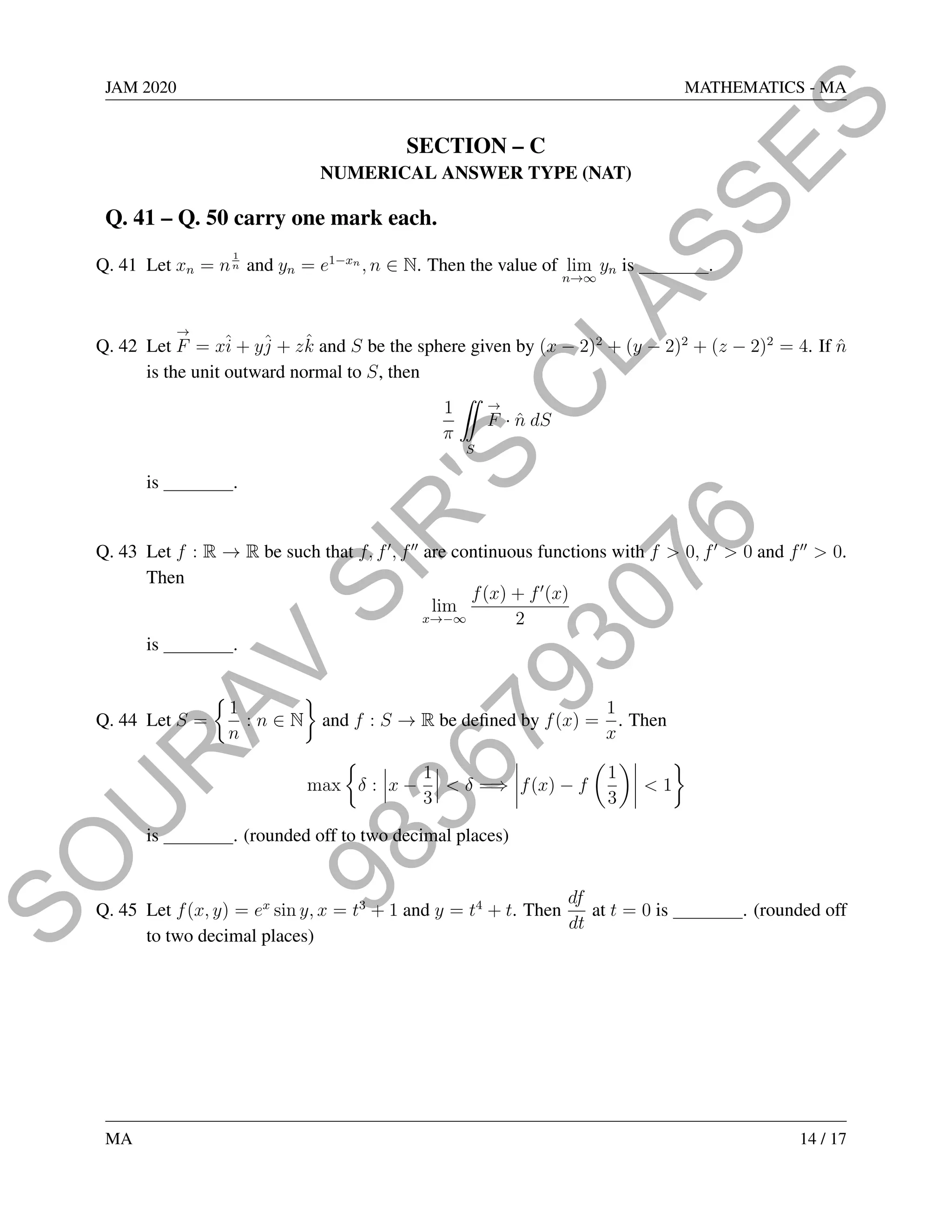
    9 8 3 6 7 9 3 0 7 6 S O U R A V S I R ' S C L A S S E S JAM 2020 MATHEMATICS- MA SECTION – C NUMERICAL ANSWER TYPE (NAT) Q. 41 – Q. 50 carry one mark each. Q. 41 Let xn = n 1 n and yn = e1−xn , n ∈ N. Then the value of lim n→∞ yn is . Q. 42 Let → F = xî + yĵ + zk̂ and S be the sphere given by (x − 2)2 + (y − 2)2 + (z − 2)2 = 4. If n̂ is the unit outward normal to S, then 1 π Z Z S → F · n̂ dS is . Q. 43 Let f : R → R be such that f, f0 , f00 are continuous functions with f 0, f0 0 and f00 0. Then lim x→−∞ f(x) + f0 (x) 2 is . Q. 44 Let S = 1 n : n ∈ N and f : S → R be defined by f(x) = 1 x . Then max δ :
  • 33.
  • 36.
  • 40.
  • 44.
    1 is . (roundedoff to two decimal places) Q. 45 Let f(x, y) = ex sin y, x = t3 + 1 and y = t4 + t. Then df dt at t = 0 is . (rounded off to two decimal places) MA 14 / 17
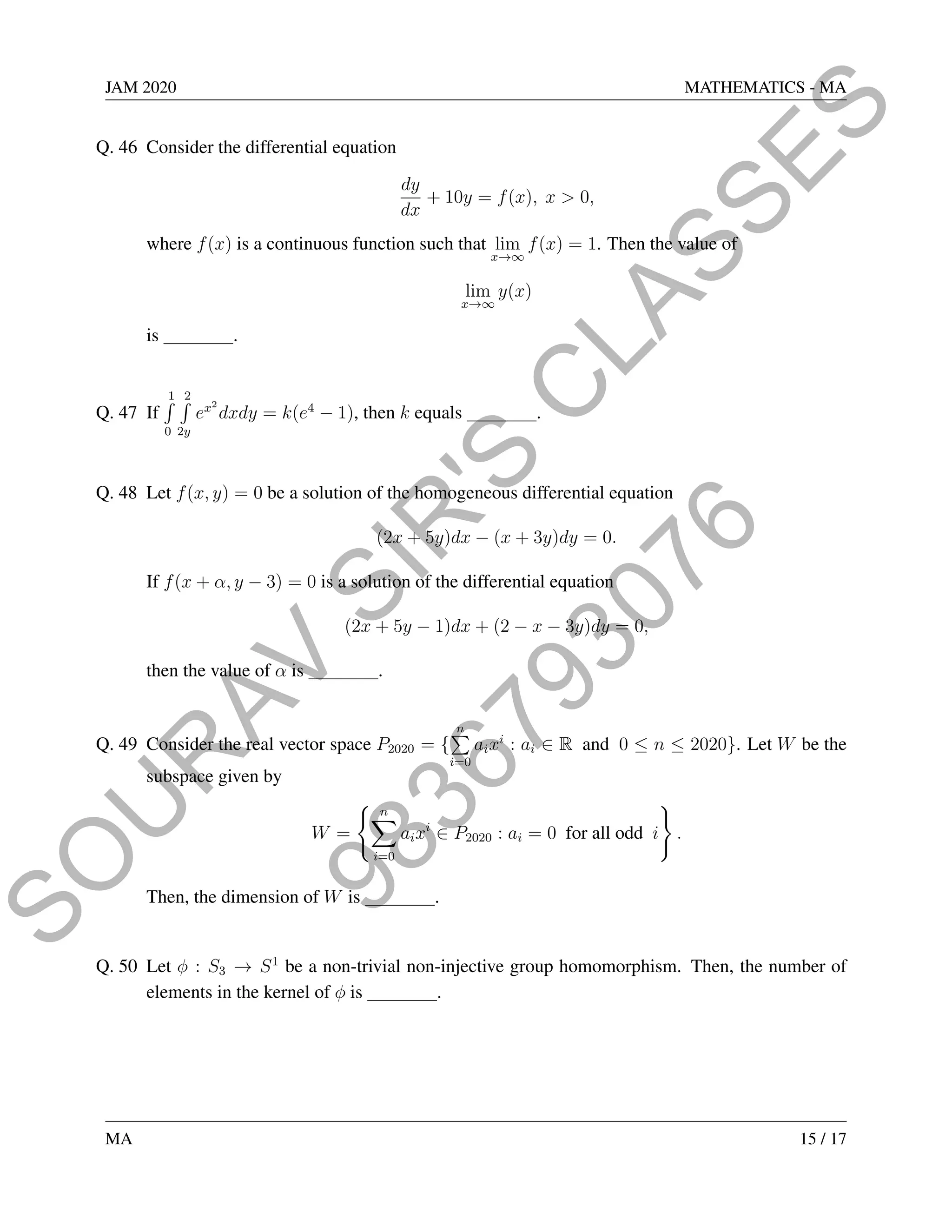
  • 45.
    9 8 3 6 7 9 3 0 7 6 S O U R A V S I R ' S C L A S S E S JAM 2020 MATHEMATICS- MA Q. 46 Consider the differential equation dy dx + 10y = f(x), x 0, where f(x) is a continuous function such that lim x→∞ f(x) = 1. Then the value of lim x→∞ y(x) is . Q. 47 If 1 R 0 2 R 2y ex2 dxdy = k(e4 − 1), then k equals . Q. 48 Let f(x, y) = 0 be a solution of the homogeneous differential equation (2x + 5y)dx − (x + 3y)dy = 0. If f(x + α, y − 3) = 0 is a solution of the differential equation (2x + 5y − 1)dx + (2 − x − 3y)dy = 0, then the value of α is . Q. 49 Consider the real vector space P2020 = { n P i=0 aixi : ai ∈ R and 0 ≤ n ≤ 2020}. Let W be the subspace given by W = ( n X i=0 aixi ∈ P2020 : ai = 0 for all odd i ) . Then, the dimension of W is . Q. 50 Let φ : S3 → S1 be a non-trivial non-injective group homomorphism. Then, the number of elements in the kernel of φ is . MA 15 / 17
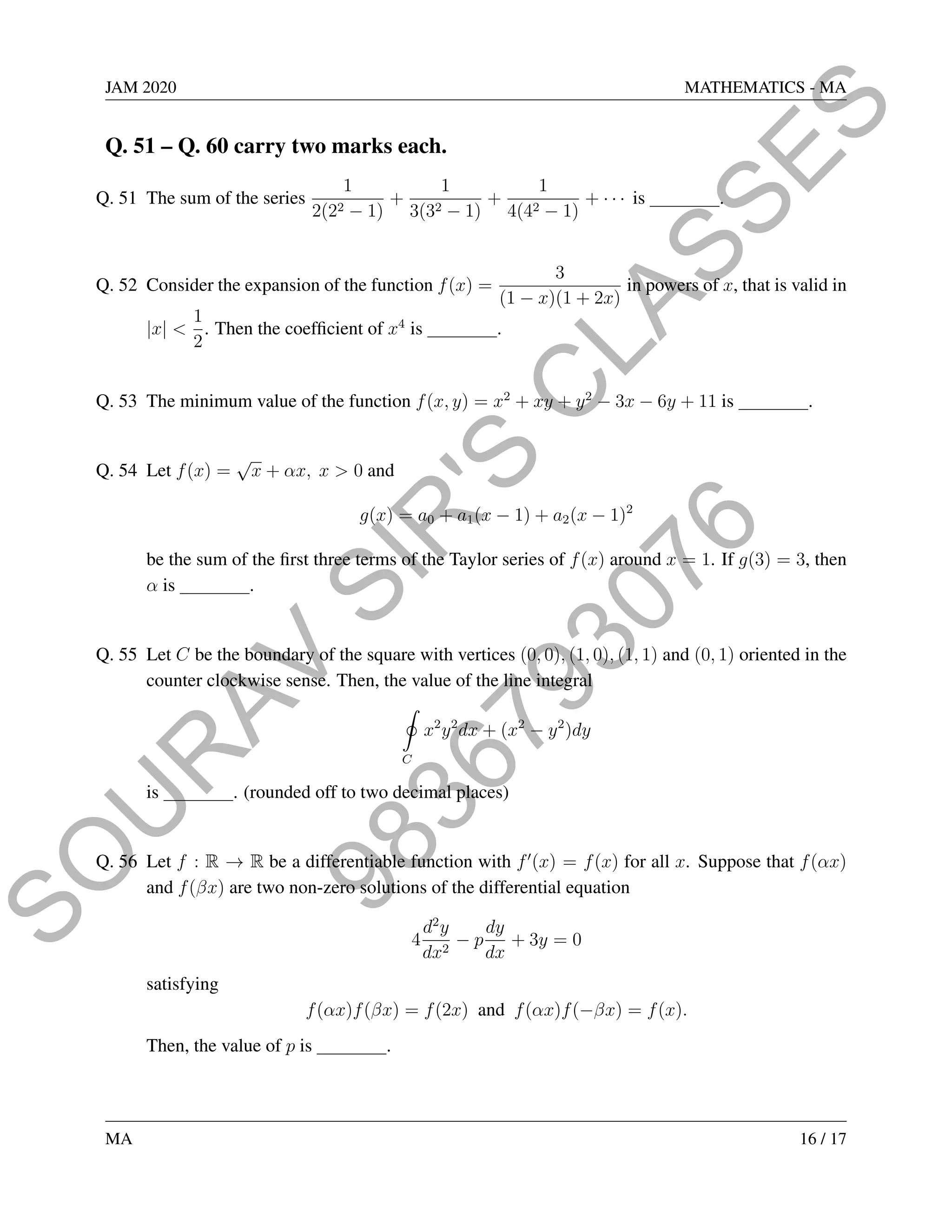
  • 46.
    9 8 3 6 7 9 3 0 7 6 S O U R A V S I R ' S C L A S S E S JAM 2020 MATHEMATICS- MA Q. 51 – Q. 60 carry two marks each. Q. 51 The sum of the series 1 2(22 − 1) + 1 3(32 − 1) + 1 4(42 − 1) + · · · is . Q. 52 Consider the expansion of the function f(x) = 3 (1 − x)(1 + 2x) in powers of x, that is valid in |x| 1 2 . Then the coefficient of x4 is . Q. 53 The minimum value of the function f(x, y) = x2 + xy + y2 − 3x − 6y + 11 is . Q. 54 Let f(x) = √ x + αx, x 0 and g(x) = a0 + a1(x − 1) + a2(x − 1)2 be the sum of the first three terms of the Taylor series of f(x) around x = 1. If g(3) = 3, then α is . Q. 55 Let C be the boundary of the square with vertices (0, 0), (1, 0), (1, 1) and (0, 1) oriented in the counter clockwise sense. Then, the value of the line integral I C x2 y2 dx + (x2 − y2 )dy is . (rounded off to two decimal places) Q. 56 Let f : R → R be a differentiable function with f0 (x) = f(x) for all x. Suppose that f(αx) and f(βx) are two non-zero solutions of the differential equation 4 d2 y dx2 − p dy dx + 3y = 0 satisfying f(αx)f(βx) = f(2x) and f(αx)f(−βx) = f(x). Then, the value of p is . MA 16 / 17
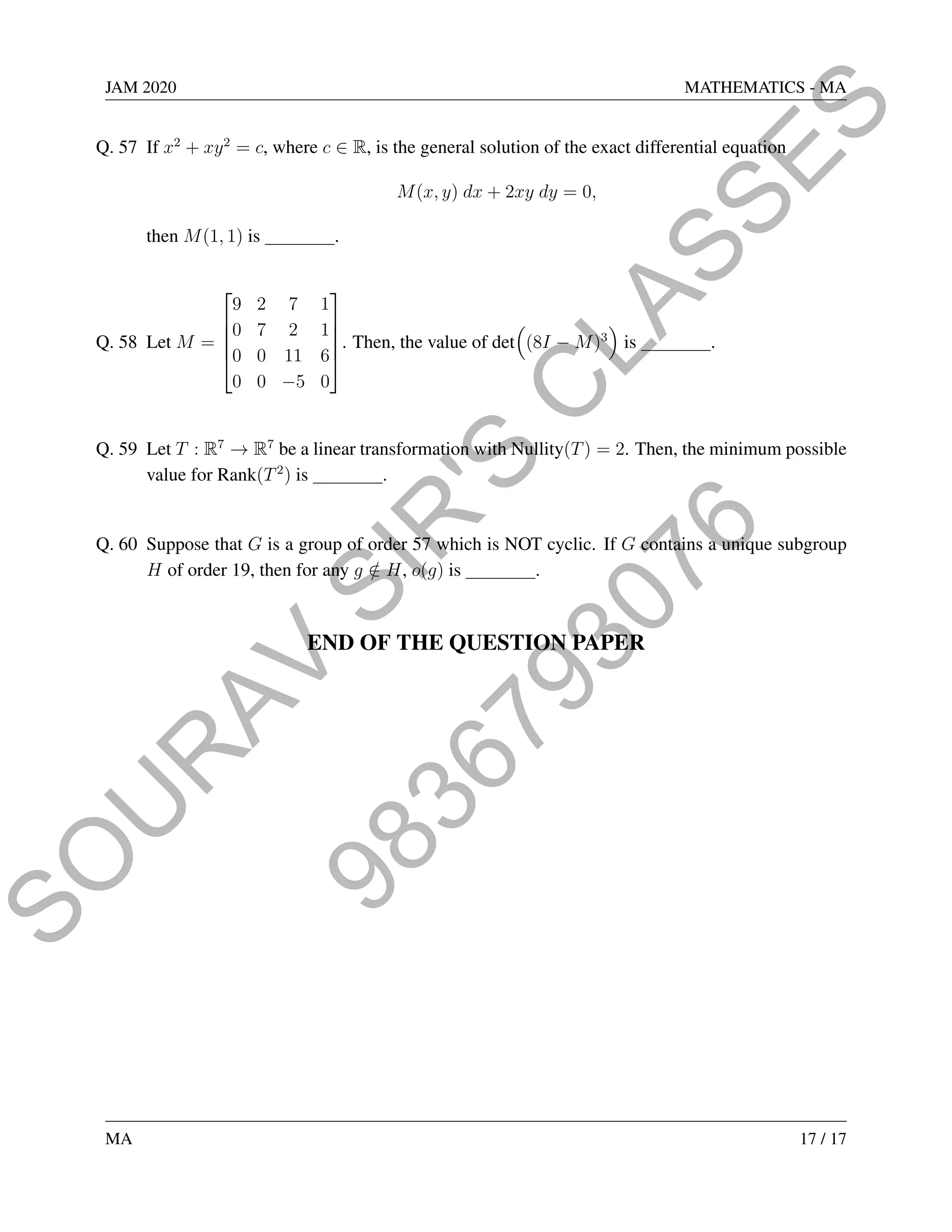
  • 47.
    9 8 3 6 7 9 3 0 7 6 S O U R A V S I R ' S C L A S S E S JAM 2020 MATHEMATICS- MA Q. 57 If x2 + xy2 = c, where c ∈ R, is the general solution of the exact differential equation M(x, y) dx + 2xy dy = 0, then M(1, 1) is . Q. 58 Let M =      9 2 7 1 0 7 2 1 0 0 11 6 0 0 −5 0      . Then, the value of det (8I − M)3 is . Q. 59 Let T : R7 → R7 be a linear transformation with Nullity(T) = 2. Then, the minimum possible value for Rank(T2 ) is . Q. 60 Suppose that G is a group of order 57 which is NOT cyclic. If G contains a unique subgroup H of order 19, then for any g / ∈ H, o(g) is . END OF THE QUESTION PAPER MA 17 / 17