JAM 2022 MATHEMATICS - MA
MA 1/42
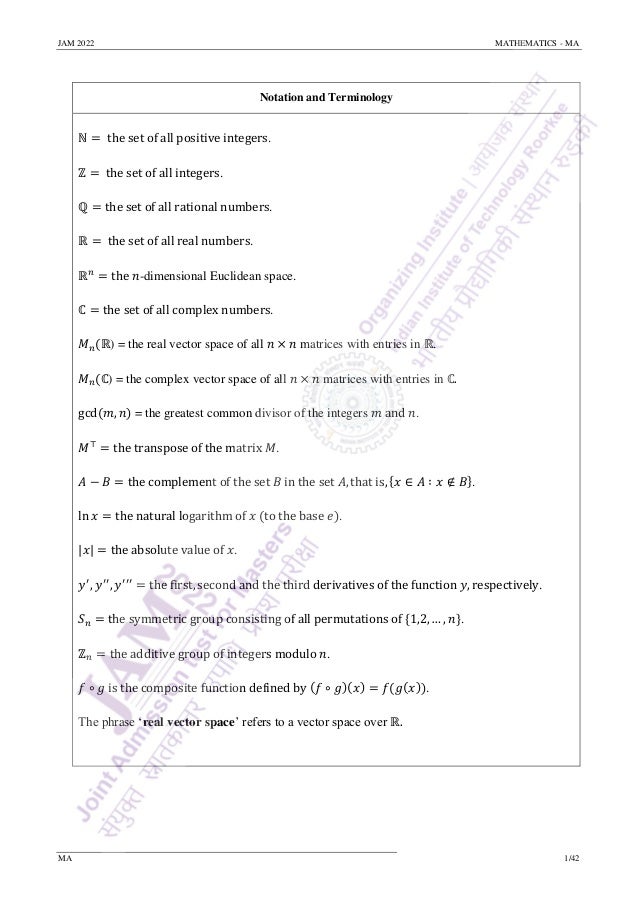
Notation and Terminology
ℕ = the set of all positive integers.
ℤ = the set of all integers.
ℚ = the set of all rational numbers.
ℝ = the set of all real numbers.
ℝ𝑛
= the 𝑛-dimensional Euclidean space.
ℂ = the set of all complex numbers.
𝑀𝑛(ℝ) = the real vector space of all 𝑛 × 𝑛 matrices with entries in ℝ.
𝑀𝑛(ℂ) = the complex vector space of all 𝑛 × 𝑛 matrices with entries in ℂ.
gcd(𝑚, 𝑛) = the greatest common divisor of the integers 𝑚 and 𝑛.
𝑀⊤
= the transpose of the matrix 𝑀.
𝐴 − 𝐵 = the complement of the set 𝐵 in the set 𝐴, that is, {𝑥 ∈ 𝐴 ∶ 𝑥 ∉ 𝐵}.
ln 𝑥 = the natural logarithm of 𝑥 (to the base 𝑒).
|𝑥| = the absolute value of 𝑥.
𝑦′
, 𝑦′′
, 𝑦′′′
= the first, second and the third derivatives of the function 𝑦, respectively.
𝑆𝑛 = the symmetric group consisting of all permutations of {1,2, … , 𝑛}.
ℤ𝑛 = the additive group of integers modulo 𝑛.
𝑓 ∘ 𝑔 is the composite function defined by (𝑓 ∘ 𝑔)(𝑥) = 𝑓(𝑔(𝑥)).
The phrase ‘real vector space’ refers to a vector space over ℝ.
JAM 2022 MATHEMATICS - MA
MA 2/42
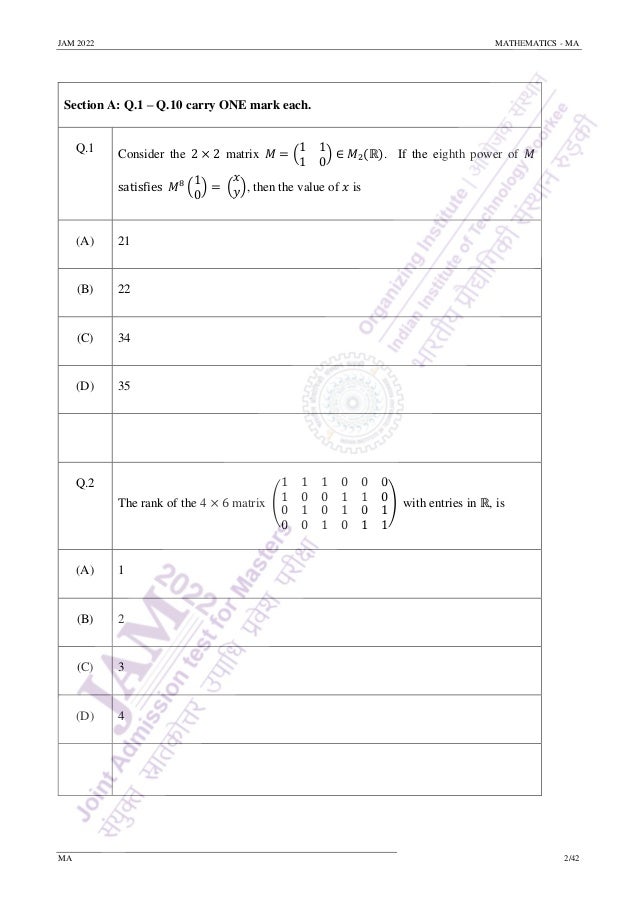
Section A: Q.1 – Q.10 carry ONE mark each.
Q.1 Consider the 2 × 2 matrix 𝑀 = (
1 1
1 0
) ∈ 𝑀2(ℝ). If the eighth power of 𝑀
satisfies 𝑀8
(
1
0
) = (
𝑥
𝑦), then the value of 𝑥 is
(A) 21
(B) 22
(C) 34
(D) 35
Q.2
The rank of the 4 × 6 matrix (
1 1
1 0
1 0
0 1
0 0
1 0
0 1
0 0
0 1
1 0
0 1
1 1
) with entries in ℝ, is
(A) 1
(B) 2
(C) 3
(D) 4
JAM 2022 MATHEMATICS - MA
MA 3/42
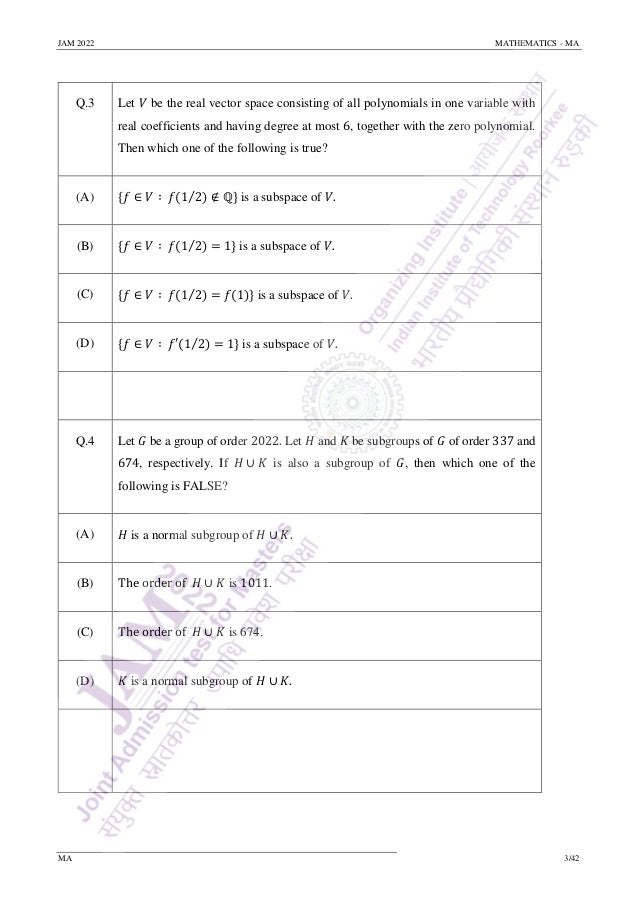
Q.3 Let 𝑉 be the real vector space consisting of all polynomials in one variable with
real coefficients and having degree at most 6, together with the zero polynomial.
Then which one of the following is true?
(A) {𝑓 ∈ 𝑉 ∶ 𝑓(1 2) ∉ ℚ}
⁄ is a subspace of 𝑉.
(B) {𝑓 ∈ 𝑉 ∶ 𝑓(1 2) = 1}
⁄ is a subspace of 𝑉.
(C) {𝑓 ∈ 𝑉 ∶ 𝑓(1 2) = 𝑓(1)}
⁄ is a subspace of 𝑉.
(D) {𝑓 ∈ 𝑉 ∶ 𝑓′(1 2) = 1}
⁄ is a subspace of 𝑉.
Q.4 Let 𝐺 be a group of order 2022. Let 𝐻 and 𝐾 be subgroups of 𝐺 of order 337 and
674, respectively. If 𝐻 ∪ 𝐾 is also a subgroup of 𝐺, then which one of the
following is FALSE?
(A) 𝐻 is a normal subgroup of 𝐻 ∪ 𝐾.
(B) The order of 𝐻 ∪ 𝐾 is 1011.
(C) The order of 𝐻 ∪ 𝐾 is 674.
(D) 𝐾 is a normal subgroup of 𝐻 ∪ 𝐾.
JAM 2022 MATHEMATICS - MA
MA 4/42
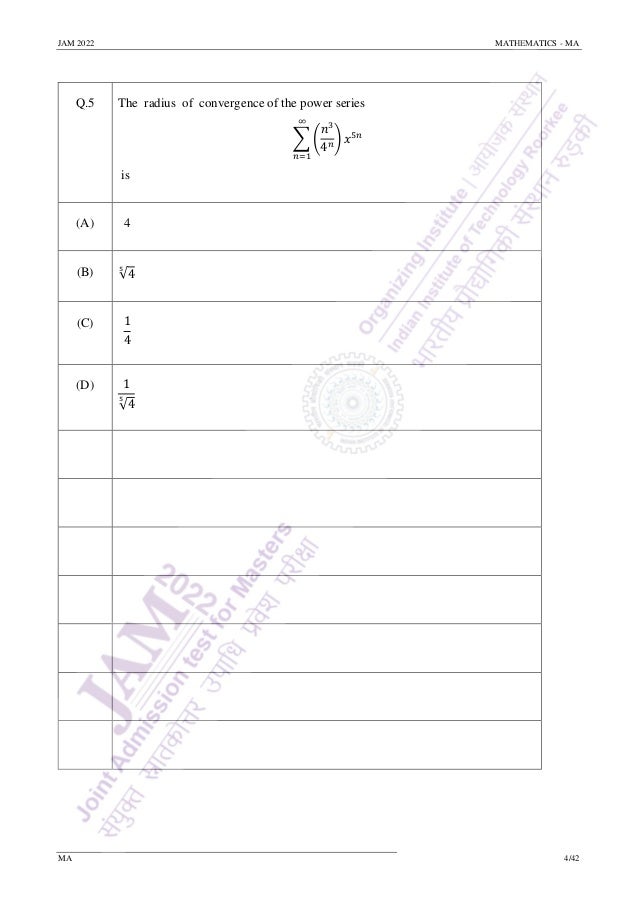
Q.5 The radius of convergence of the power series
∑ (
𝑛3
4𝑛
) 𝑥5𝑛
∞
𝑛=1
is
(A) 4
(B) √4
5
(C) 1
4
(D) 1
√4
5
JAM 2022 MATHEMATICS - MA
MA 5/42
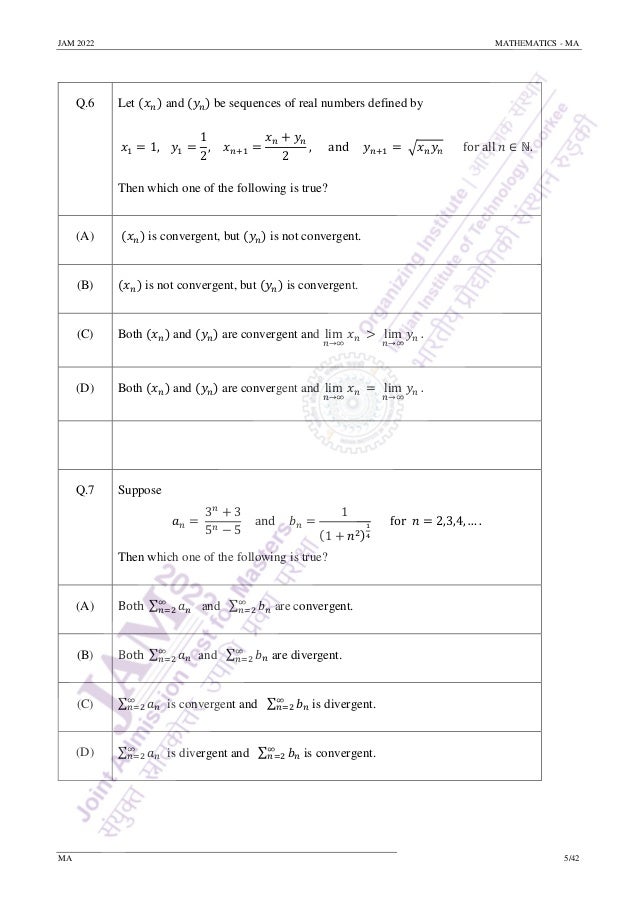
Q.6 Let (𝑥𝑛) and (𝑦𝑛) be sequences of real numbers defined by
𝑥1 = 1, 𝑦1 =
1
2
, 𝑥𝑛+1 =
𝑥𝑛 + 𝑦𝑛
2
, and 𝑦𝑛+1 = √𝑥𝑛𝑦𝑛 for all 𝑛 ∈ ℕ.
Then which one of the following is true?
(A) (𝑥𝑛) is convergent, but (𝑦𝑛) is not convergent.
(B) (𝑥𝑛) is not convergent, but (𝑦𝑛) is convergent.
(C) Both (𝑥𝑛) and (𝑦𝑛) are convergent and lim
𝑛→∞
𝑥𝑛 > lim
𝑛→∞
𝑦𝑛 .
(D) Both (𝑥𝑛) and (𝑦𝑛) are convergent and lim
𝑛→∞
𝑥𝑛 = lim
𝑛→∞
𝑦𝑛 .
Q.7 Suppose
𝑎𝑛 =
3𝑛
+ 3
5𝑛 − 5
and 𝑏𝑛 =
1
(1 + 𝑛2)
1
4
for 𝑛 = 2,3,4, … .
Then which one of the following is true?
(A) Both ∑ 𝑎𝑛
∞
𝑛=2 and ∑ 𝑏𝑛
∞
𝑛=2 are convergent.
(B) Both ∑ 𝑎𝑛
∞
𝑛=2 and ∑ 𝑏𝑛
∞
𝑛=2 are divergent.
(C) ∑ 𝑎𝑛
∞
𝑛=2 is convergent and ∑ 𝑏𝑛
∞
𝑛=2 is divergent.
(D) ∑ 𝑎𝑛
∞
𝑛=2 is divergent and ∑ 𝑏𝑛
∞
𝑛=2 is convergent.
JAM 2022 MATHEMATICS - MA
MA 6/42
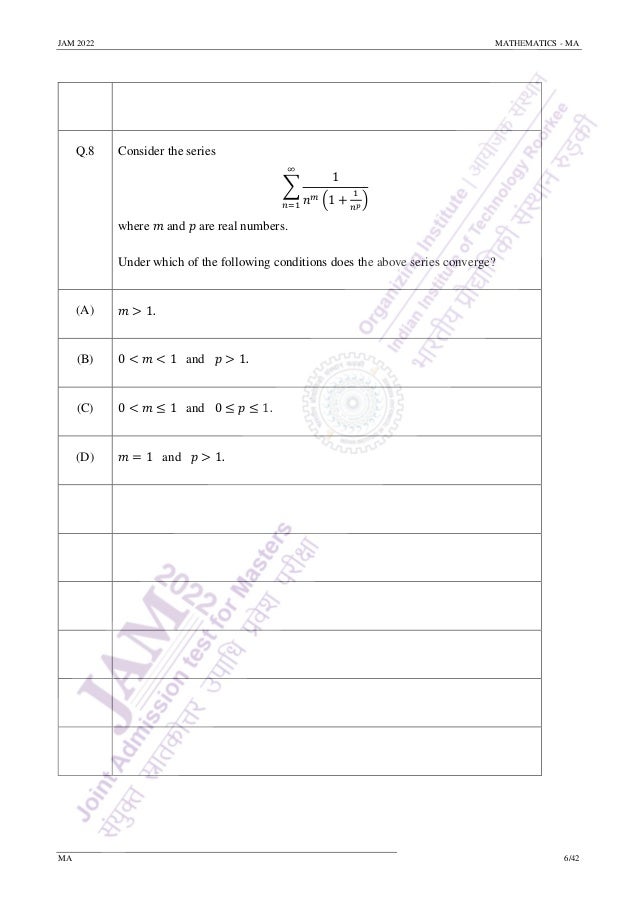
Q.8 Consider the series
∑
1
𝑛𝑚 (1 +
1
𝑛𝑝
)
∞
𝑛=1
where 𝑚 and 𝑝 are real numbers.
Under which of the following conditions does the above series converge?
(A) 𝑚 > 1.
(B) 0 < 𝑚 < 1 and 𝑝 > 1.
(C) 0 < 𝑚 ≤ 1 and 0 ≤ 𝑝 ≤ 1.
(D) 𝑚 = 1 and 𝑝 > 1.
JAM 2022 MATHEMATICS - MA
MA 7/42
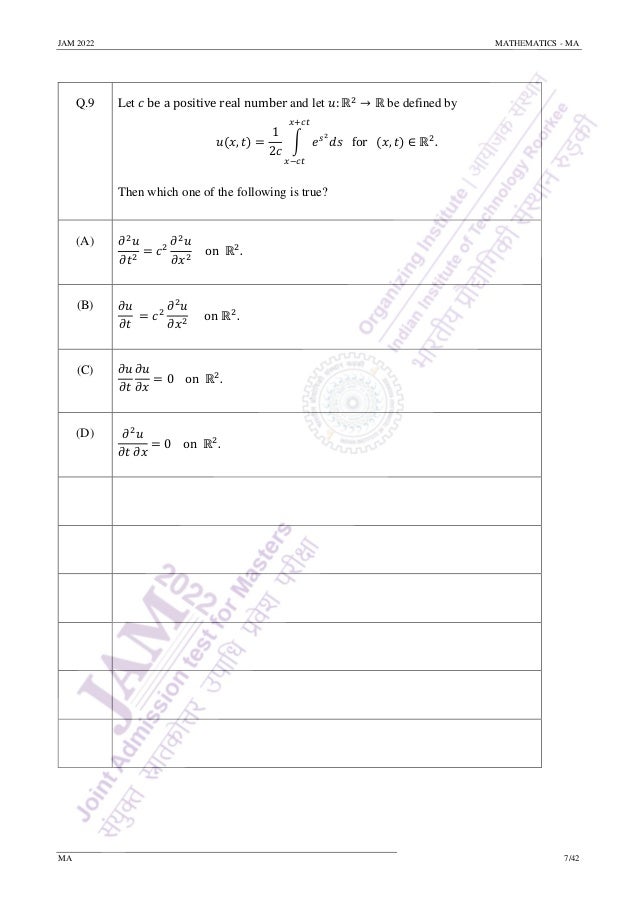
Q.9 Let 𝑐 be a positive real number and let 𝑢: ℝ2
→ ℝ be defined by
𝑢(𝑥, 𝑡) =
1
2𝑐
∫ 𝑒𝑠2
𝑑𝑠 for (𝑥, 𝑡) ∈ ℝ2
.
𝑥+𝑐𝑡
𝑥−𝑐𝑡
Then which one of the following is true?
(A) 𝜕2
𝑢
𝜕𝑡2
= 𝑐2
𝜕2
𝑢
𝜕𝑥2
on ℝ2
.
(B) 𝜕𝑢
𝜕𝑡
= 𝑐2
𝜕2
𝑢
𝜕𝑥2
on ℝ2
.
(C) 𝜕𝑢
𝜕𝑡
𝜕𝑢
𝜕𝑥
= 0 on ℝ2
.
(D) 𝜕2
𝑢
𝜕𝑡 𝜕𝑥
= 0 on ℝ2
.
JAM 2022 MATHEMATICS - MA
MA 8/42
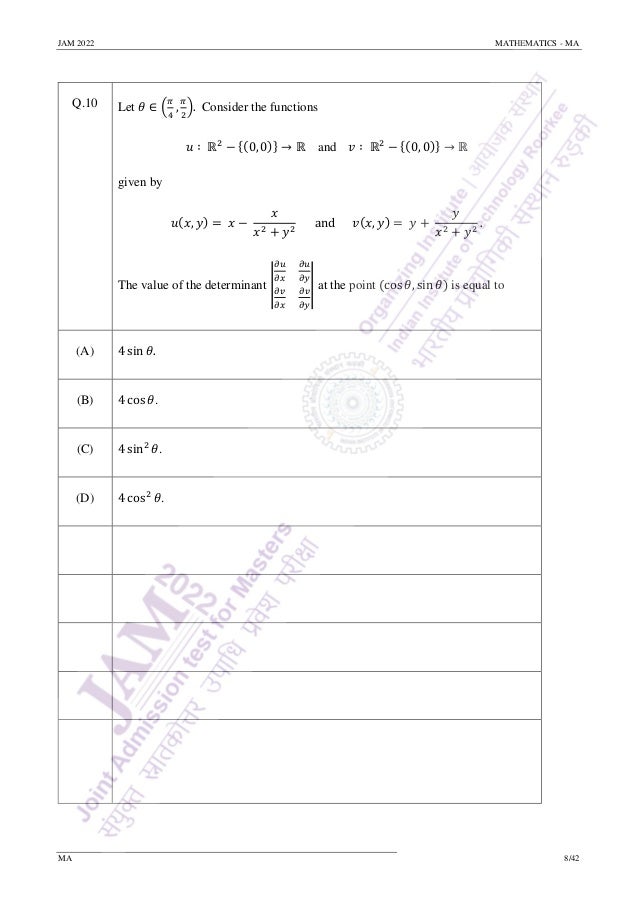
Q.10 Let 𝜃 ∈ (
𝜋
4
,
𝜋
2
). Consider the functions
𝑢 ∶ ℝ2
− {(0, 0)} → ℝ and 𝑣 ∶ ℝ2
− {(0, 0)} → ℝ
given by
𝑢(𝑥, 𝑦) = 𝑥 −
𝑥
𝑥2 + 𝑦2
and 𝑣(𝑥, 𝑦) = 𝑦 +
𝑦
𝑥2 + 𝑦2
.
The value of the determinant |
𝜕𝑢
𝜕𝑥
𝜕𝑢
𝜕𝑦
𝜕𝑣
𝜕𝑥
𝜕𝑣
𝜕𝑦
| at the point (cos 𝜃, sin 𝜃) is equal to
(A) 4 sin 𝜃.
(B) 4 cos 𝜃.
(C) 4 sin2
𝜃.
(D) 4 cos2
𝜃.
JAM 2022 MATHEMATICS - MA
MA 9/42
Section A: Q.11 – Q.30 Carry TWO marks each.
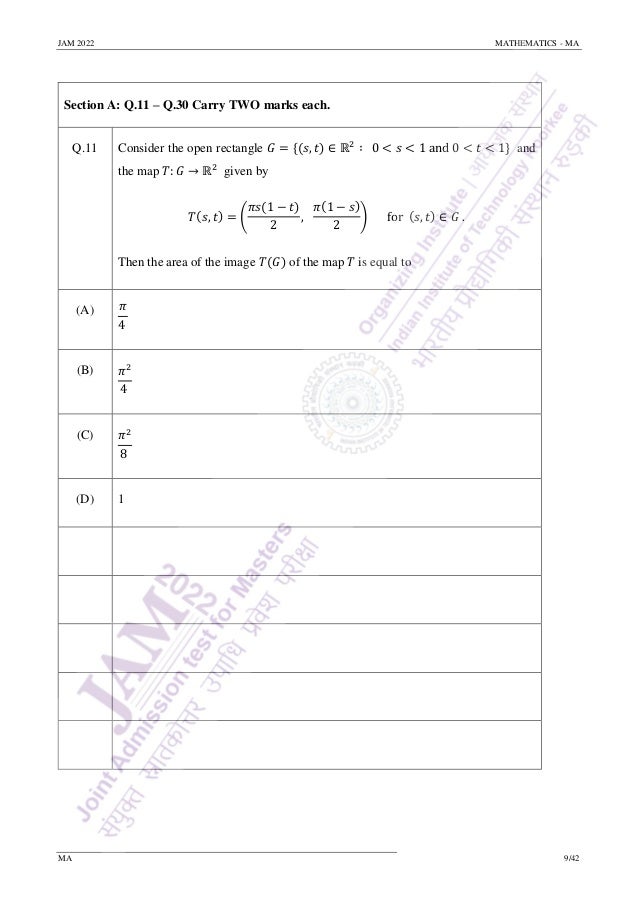
Q.11 Consider the open rectangle 𝐺 = {(𝑠, 𝑡) ∈ ℝ2
∶ 0 < 𝑠 < 1 and 0 < 𝑡 < 1} and
the map 𝑇: 𝐺 → ℝ2
given by
𝑇(𝑠, 𝑡) = (
𝜋𝑠(1 − 𝑡)
2
,
𝜋(1 − 𝑠)
2
) for (𝑠, 𝑡) ∈ 𝐺 .
Then the area of the image 𝑇(𝐺) of the map 𝑇 is equal to
(A) 𝜋
4
(B) 𝜋2
4
(C) 𝜋2
8
(D) 1
JAM 2022 MATHEMATICS - MA
MA 10/42
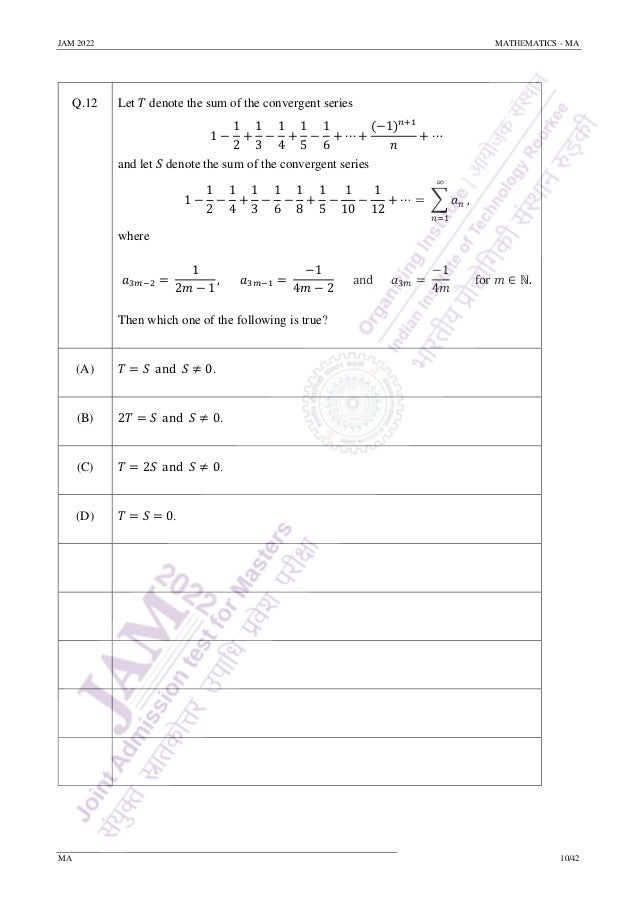
Q.12 Let 𝑇 denote the sum of the convergent series
1 −
1
2
+
1
3
−
1
4
+
1
5
−
1
6
+ ⋯ +
(−1)𝑛+1
𝑛
+ ⋯
and let 𝑆 denote the sum of the convergent series
1 −
1
2
−
1
4
+
1
3
−
1
6
−
1
8
+
1
5
−
1
10
−
1
12
+ ⋯ = ∑ 𝑎𝑛
∞
𝑛=1
,
where
𝑎3𝑚−2 =
1
2𝑚 − 1
, 𝑎3𝑚−1 =
−1
4𝑚 − 2
and 𝑎3𝑚 =
−1
4𝑚
for 𝑚 ∈ ℕ.
Then which one of the following is true?
(A) 𝑇 = 𝑆 and 𝑆 ≠ 0.
(B) 2𝑇 = 𝑆 and 𝑆 ≠ 0.
(C) 𝑇 = 2𝑆 and 𝑆 ≠ 0.
(D) 𝑇 = 𝑆 = 0.
JAM 2022 MATHEMATICS - MA
MA 11/42
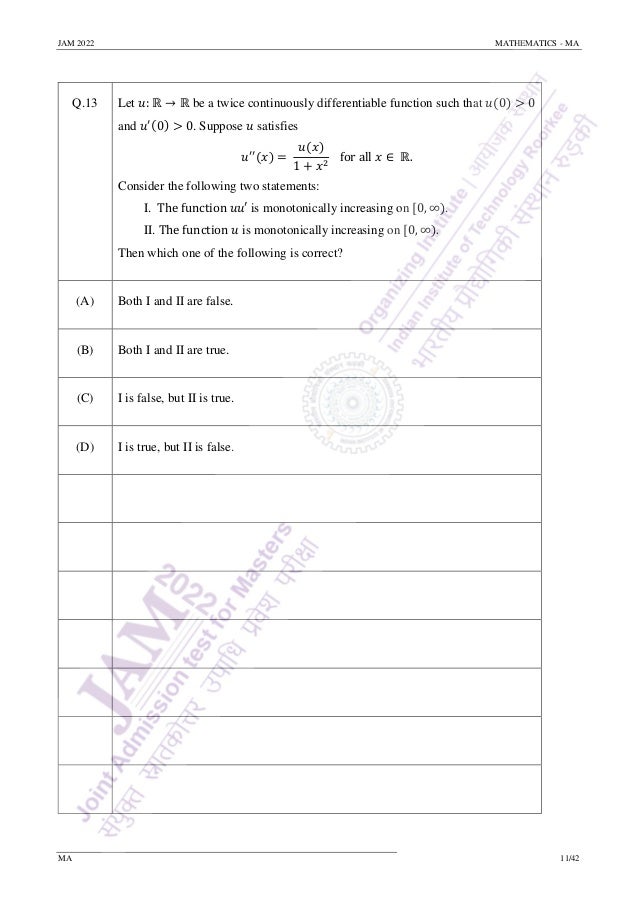
Q.13 Let 𝑢: ℝ → ℝ be a twice continuously differentiable function such that 𝑢(0) > 0
and 𝑢′(0) > 0. Suppose 𝑢 satisfies
𝑢′′(𝑥) =
𝑢(𝑥)
1 + 𝑥2
for all 𝑥 ∈ ℝ.
Consider the following two statements:
I. The function 𝑢𝑢′ is monotonically increasing on [0, ∞).
II. The function 𝑢 is monotonically increasing on [0, ∞).
Then which one of the following is correct?
(A) Both I and II are false.
(B) Both I and II are true.
(C) I is false, but II is true.
(D) I is true, but II is false.
JAM 2022 MATHEMATICS - MA
MA 12/42
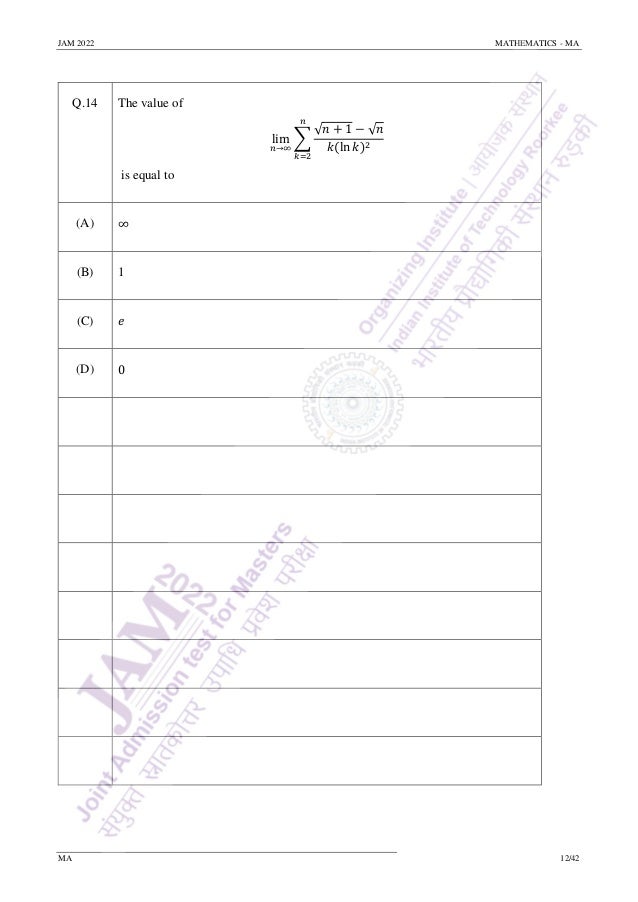
Q.14 The value of
lim
𝑛→∞
∑
√𝑛 + 1 − √𝑛
𝑘(ln 𝑘)2
𝑛
𝑘=2
is equal to
(A) ∞
(B) 1
(C) 𝑒
(D) 0
JAM 2022 MATHEMATICS - MA
MA 13/42
Q.15 For 𝑡 ∈ ℝ, let [𝑡] denote the greatest integer less than or equal to 𝑡. Define
functions ℎ: ℝ2
→ ℝ and 𝑔: ℝ → ℝ by
ℎ(𝑥, 𝑦) = {
−1
𝑥2−𝑦
if 𝑥2
≠ 𝑦,
0 if 𝑥2
= 𝑦
and 𝑔(𝑥) = {
sin 𝑥
𝑥
if 𝑥 ≠ 0,
0 if 𝑥 = 0.
Then which one of the following is FALSE?
(A)
lim
(𝑥,𝑦)→(√2,𝜋)
cos (
𝑥2
𝑦
𝑥2 + 1
) =
−1
2
.
(B) lim
(𝑥,𝑦)→(√2,2)
𝑒ℎ(𝑥,𝑦)
= 0.
(C) lim
(𝑥,𝑦)→(𝑒,𝑒)
ln(𝑥𝑦−[𝑦]
) = 𝑒 − 2.
(D) lim
(𝑥,𝑦)→(0,0)
𝑒2𝑦
𝑔(𝑥) = 1.
JAM 2022 MATHEMATICS - MA
MA 14/42
Q.16 Let 𝑃 ∈ 𝑀4(ℝ) be such that 𝑃4
is the zero matrix, but 𝑃3
is a nonzero matrix.
Then which one of the following is FALSE?
(A) For every nonzero vector 𝑣 ∈ ℝ4
, the subset {𝑣, 𝑃𝑣, 𝑃2
𝑣, 𝑃3
𝑣} of the real vector
space ℝ4
is linearly independent.
(B) The rank of 𝑃𝑘
is 4 − 𝑘 for every 𝑘 ∈ {1,2,3,4}.
(C) 0 is an eigenvalue of 𝑃.
(D) If 𝑄 ∈ 𝑀4(ℝ) is such that 𝑄4
is the zero matrix, but 𝑄3
is a nonzero matrix, then
there exists a nonsingular matrix 𝑆 ∈ 𝑀4(ℝ) such that 𝑆−1
𝑄𝑆 = 𝑃.
JAM 2022 MATHEMATICS - MA
MA 15/42
Q.17 For 𝑋, 𝑌 ∈ 𝑀2(ℝ), define (𝑋, 𝑌) = 𝑋𝑌 − 𝑌𝑋. Let 𝟎 ∈ 𝑀2(ℝ) denote the zero
matrix. Consider the two statements:
𝑃 ∶ (𝑋, (𝑌, 𝑍)) + (𝑌, (𝑍, 𝑋)) + (𝑍, (𝑋, 𝑌)) = 𝟎 for all 𝑋, 𝑌, 𝑍 ∈ 𝑀2(ℝ).
𝑄 ∶ (𝑋, (𝑌, 𝑍)) = ((𝑋, 𝑌), 𝑍) for all 𝑋, 𝑌, 𝑍 ∈ 𝑀2(ℝ).
Then which one of the following is correct?
(A) Both 𝑃 and 𝑄 are true.
(B) 𝑃 is true, but 𝑄 is false.
(C) 𝑃 is false, but 𝑄 is true.
(D) Both 𝑃 and 𝑄 are false.
JAM 2022 MATHEMATICS - MA
MA 16/42
Q.18 Consider the system of linear equations
𝑥 + 𝑦 + 𝑡 = 4,
2𝑥 − 4𝑡 = 7,
𝑥 + 𝑦 + 𝑧 = 5,
𝑥 − 3𝑦 − 𝑧 − 10𝑡 = 𝜆,
where 𝑥, 𝑦, 𝑧, 𝑡 are variables and 𝜆 is a constant. Then which one of the following
is true?
(A) If 𝜆 = 1, then the system has a unique solution.
(B) If 𝜆 = 2, then the system has infinitely many solutions.
(C) If 𝜆 = 1, then the system has infinitely many solutions.
(D) If 𝜆 = 2, then the system has a unique solution.
Q.19 Consider the group (ℚ, +) and its subgroup (ℤ, +).
For the quotient group ℚ/ℤ, which one of the following is FALSE?
(A) ℚ/ℤ contains a subgroup isomorphic to (ℤ, +).
(B) There is exactly one group homomorphism from ℚ/ℤ to (ℚ, +).
(C) For all 𝑛 ∈ ℕ, there exists 𝑔 ∈ ℚ/ℤ such that the order of 𝑔 is 𝑛.
(D) ℚ/ℤ is not a cyclic group.
JAM 2022 MATHEMATICS - MA
MA 17/42
Q.20 For 𝑃 ∈ 𝑀5(ℝ) and 𝑖, 𝑗 ∈ {1,2, … ,5}, let 𝑝𝑖𝑗 denote the (𝑖, 𝑗)th
entry of 𝑃. Let
𝑆 = {𝑃 ∈ 𝑀5(ℝ) ∶ 𝑝𝑖𝑗 = 𝑝𝑟𝑠 for 𝑖, 𝑗, 𝑟, 𝑠 ∈ {1,2, … ,5} with 𝑖 + 𝑟 = 𝑗 + 𝑠}.
Then which one of the following is FALSE?
(A) 𝑆 is a subspace of the vector space over ℝ of all 5 × 5 symmetric matrices.
(B) The dimension of 𝑆 over ℝ is 5.
(C) The dimension of 𝑆 over ℝ is 11.
(D) If 𝑃 ∈ 𝑆 and all the entries of 𝑃 are integers, then 5 divides the sum of all the
diagonal entries of 𝑃.
JAM 2022 MATHEMATICS - MA
MA 18/42
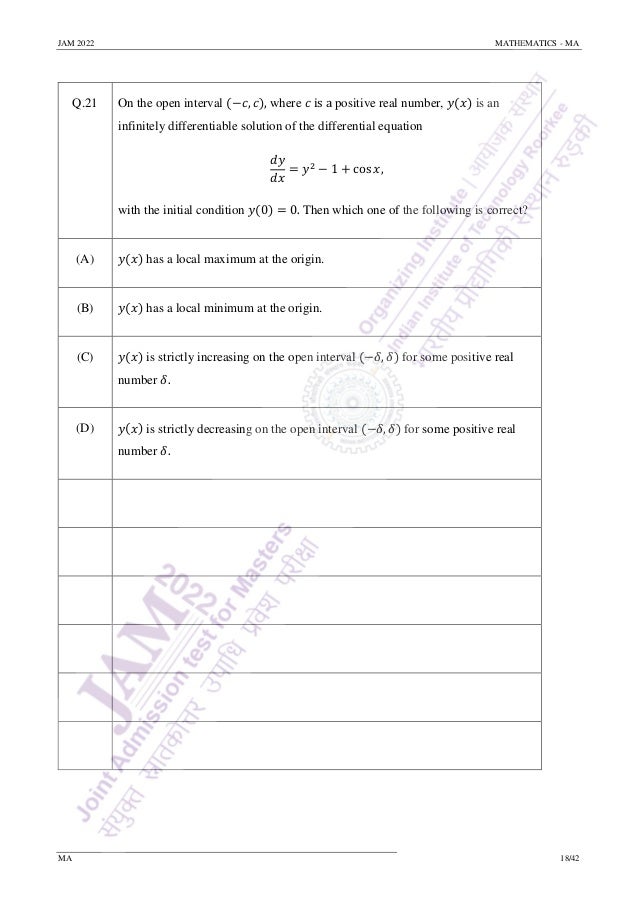
Q.21 On the open interval (−𝑐, 𝑐), where 𝑐 is a positive real number, 𝑦(𝑥) is an
infinitely differentiable solution of the differential equation
𝑑𝑦
𝑑𝑥
= 𝑦2
− 1 + cos 𝑥,
with the initial condition 𝑦(0) = 0. Then which one of the following is correct?
(A) 𝑦(𝑥) has a local maximum at the origin.
(B) 𝑦(𝑥) has a local minimum at the origin.
(C) 𝑦(𝑥) is strictly increasing on the open interval (−𝛿, 𝛿) for some positive real
number 𝛿.
(D) 𝑦(𝑥) is strictly decreasing on the open interval (−𝛿, 𝛿) for some positive real
number 𝛿.
JAM 2022 MATHEMATICS - MA
MA 19/42
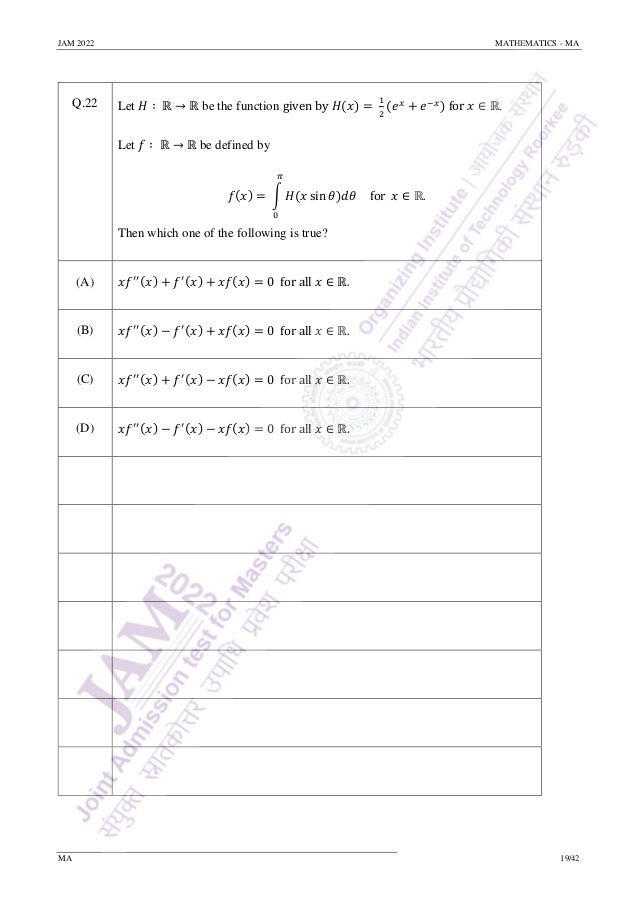
Q.22 Let 𝐻 ∶ ℝ → ℝ be the function given by 𝐻(𝑥) =
1
2
(𝑒𝑥
+ 𝑒−𝑥) for 𝑥 ∈ ℝ.
Let 𝑓 ∶ ℝ → ℝ be defined by
𝑓(𝑥) = ∫ 𝐻(𝑥 sin 𝜃)𝑑𝜃
𝜋
0
for 𝑥 ∈ ℝ.
Then which one of the following is true?
(A) 𝑥𝑓′′(𝑥) + 𝑓′(𝑥) + 𝑥𝑓(𝑥) = 0 for all 𝑥 ∈ ℝ.
(B) 𝑥𝑓′′(𝑥) − 𝑓′(𝑥) + 𝑥𝑓(𝑥) = 0 for all 𝑥 ∈ ℝ.
(C) 𝑥𝑓′′(𝑥) + 𝑓′(𝑥) − 𝑥𝑓(𝑥) = 0 for all 𝑥 ∈ ℝ.
(D) 𝑥𝑓′′(𝑥) − 𝑓′(𝑥) − 𝑥𝑓(𝑥) = 0 for all 𝑥 ∈ ℝ.
JAM 2022 MATHEMATICS - MA
MA 20/42
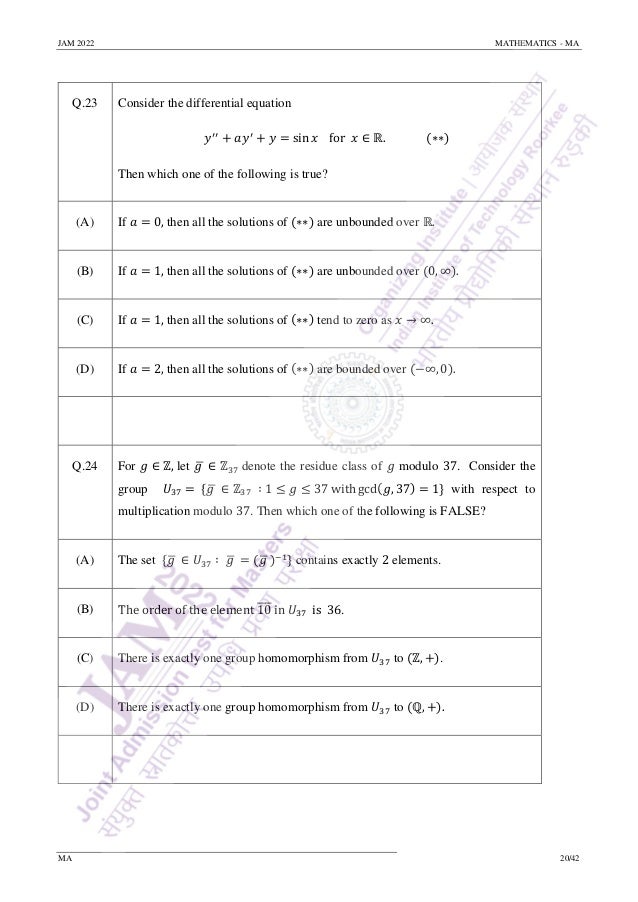
Q.23 Consider the differential equation
𝑦′′
+ 𝑎𝑦′
+ 𝑦 = sin 𝑥 for 𝑥 ∈ ℝ. (∗∗)
Then which one of the following is true?
(A) If 𝑎 = 0, then all the solutions of (∗∗) are unbounded over ℝ.
(B) If 𝑎 = 1, then all the solutions of (∗∗) are unbounded over (0, ∞).
(C) If 𝑎 = 1, then all the solutions of (∗∗) tend to zero as 𝑥 → ∞.
(D) If 𝑎 = 2, then all the solutions of (∗∗) are bounded over (−∞, 0).
Q.24 For 𝑔 ∈ ℤ, let 𝑔
̅ ∈ ℤ37 denote the residue class of 𝑔 modulo 37. Consider the
group 𝑈37 = {𝑔
̅ ∈ ℤ37 ∶ 1 ≤ 𝑔 ≤ 37 with gcd(𝑔, 37) = 1} with respect to
multiplication modulo 37. Then which one of the following is FALSE?
(A) The set {𝑔
̅ ∈ 𝑈37 ∶ 𝑔
̅ = (𝑔
̅)−1} contains exactly 2 elements.
(B) The order of the element 10
̅
̅
̅
̅ in 𝑈37 is 36.
(C) There is exactly one group homomorphism from 𝑈37 to (ℤ, +).
(D) There is exactly one group homomorphism from 𝑈37 to (ℚ, +).
JAM 2022 MATHEMATICS - MA
MA 21/42
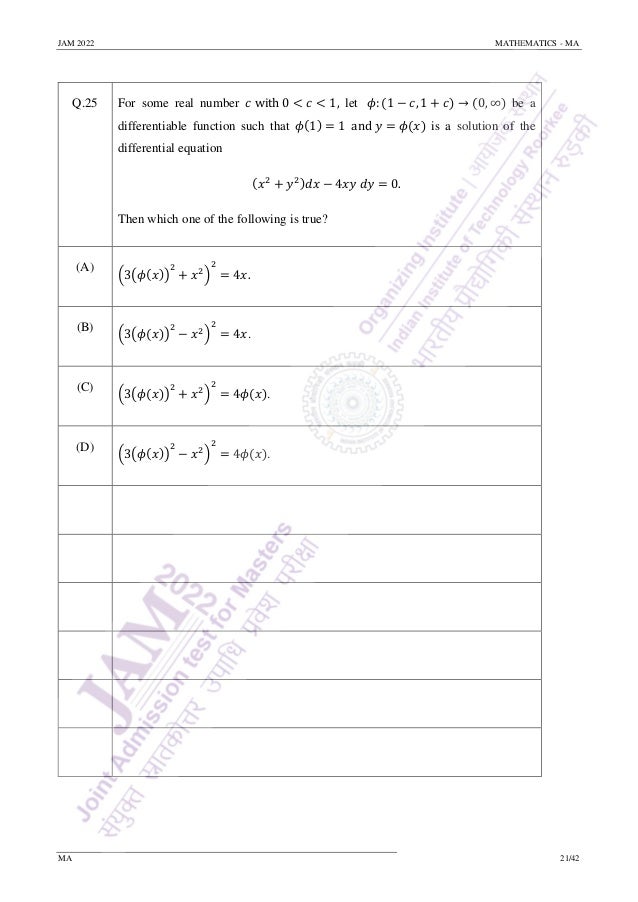
Q.25 For some real number 𝑐 with 0 < 𝑐 < 1, let 𝜙: (1 − 𝑐, 1 + 𝑐) → (0, ∞) be a
differentiable function such that 𝜙(1) = 1 and 𝑦 = 𝜙(𝑥) is a solution of the
differential equation
(𝑥2
+ 𝑦2)𝑑𝑥 − 4𝑥𝑦 𝑑𝑦 = 0.
Then which one of the following is true?
(A)
(3(𝜙(𝑥))
2
+ 𝑥2
)
2
= 4𝑥.
(B)
(3(𝜙(𝑥))
2
− 𝑥2
)
2
= 4𝑥.
(C)
(3(𝜙(𝑥))
2
+ 𝑥2
)
2
= 4𝜙(𝑥).
(D)
(3(𝜙(𝑥))
2
− 𝑥2
)
2
= 4𝜙(𝑥).
JAM 2022 MATHEMATICS - MA
MA 22/42
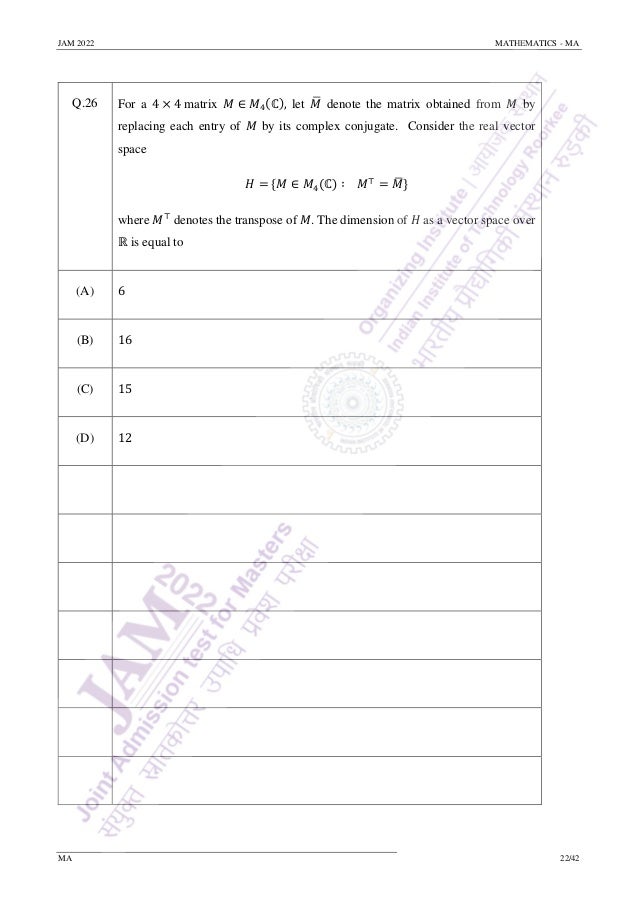
Q.26 For a 4 × 4 matrix 𝑀 ∈ 𝑀4(ℂ), let 𝑀
̅ denote the matrix obtained from 𝑀 by
replacing each entry of 𝑀 by its complex conjugate. Consider the real vector
space
𝐻 = {𝑀 ∈ 𝑀4(ℂ) ∶ 𝑀⊤
= 𝑀
̅}
where 𝑀⊤
denotes the transpose of 𝑀. The dimension of 𝐻 as a vector space over
ℝ is equal to
(A) 6
(B) 16
(C) 15
(D) 12
JAM 2022 MATHEMATICS - MA
MA 23/42
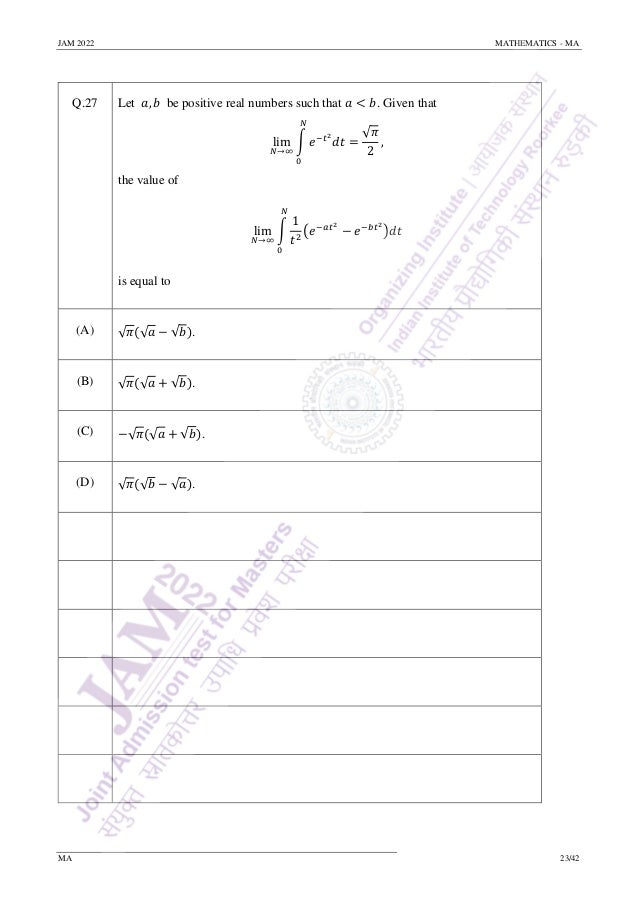
Q.27 Let 𝑎, 𝑏 be positive real numbers such that 𝑎 < 𝑏. Given that
lim
𝑁→∞
∫ 𝑒−𝑡2
𝑑𝑡
𝑁
0
=
√𝜋
2
,
the value of
lim
𝑁→∞
∫
1
𝑡2
(𝑒−𝑎𝑡2
− 𝑒−𝑏𝑡2
)𝑑𝑡
𝑁
0
is equal to
(A) √𝜋(√𝑎 − √𝑏).
(B) √𝜋(√𝑎 + √𝑏).
(C) −√𝜋(√𝑎 + √𝑏).
(D) √𝜋(√𝑏 − √𝑎).
JAM 2022 MATHEMATICS - MA
MA 24/42
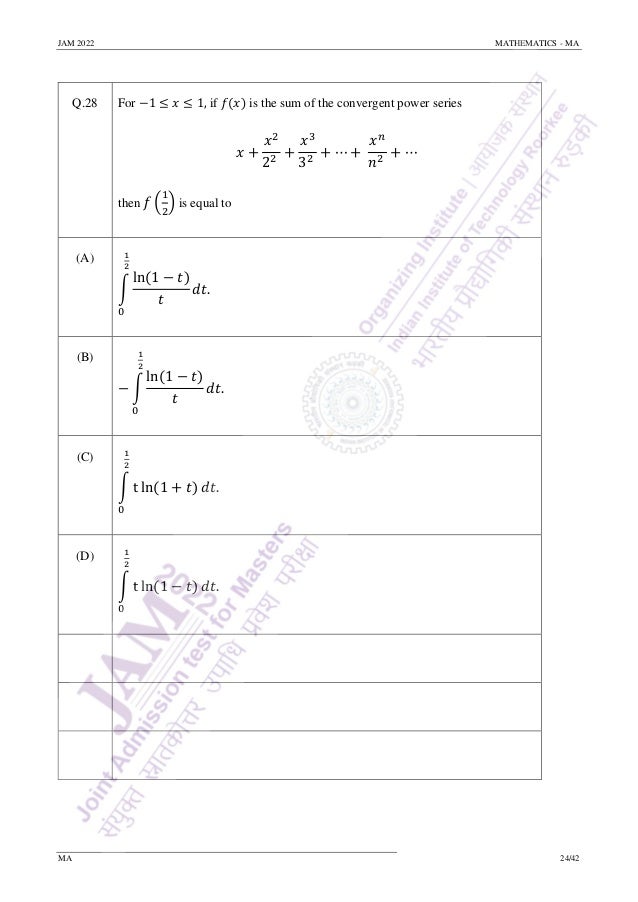
Q.28 For −1 ≤ 𝑥 ≤ 1, if 𝑓(𝑥) is the sum of the convergent power series
𝑥 +
𝑥2
22
+
𝑥3
32
+ ⋯ +
𝑥𝑛
𝑛2
+ ⋯
then 𝑓 (
1
2
) is equal to
(A)
∫
ln(1 − 𝑡)
𝑡
1
2
0
𝑑𝑡.
(B)
− ∫
ln(1 − 𝑡)
𝑡
1
2
0
𝑑𝑡.
(C)
∫ t ln(1 + 𝑡)
1
2
0
𝑑𝑡.
(D)
∫ t ln(1 − 𝑡)
1
2
0
𝑑𝑡.
JAM 2022 MATHEMATICS - MA
MA 25/42
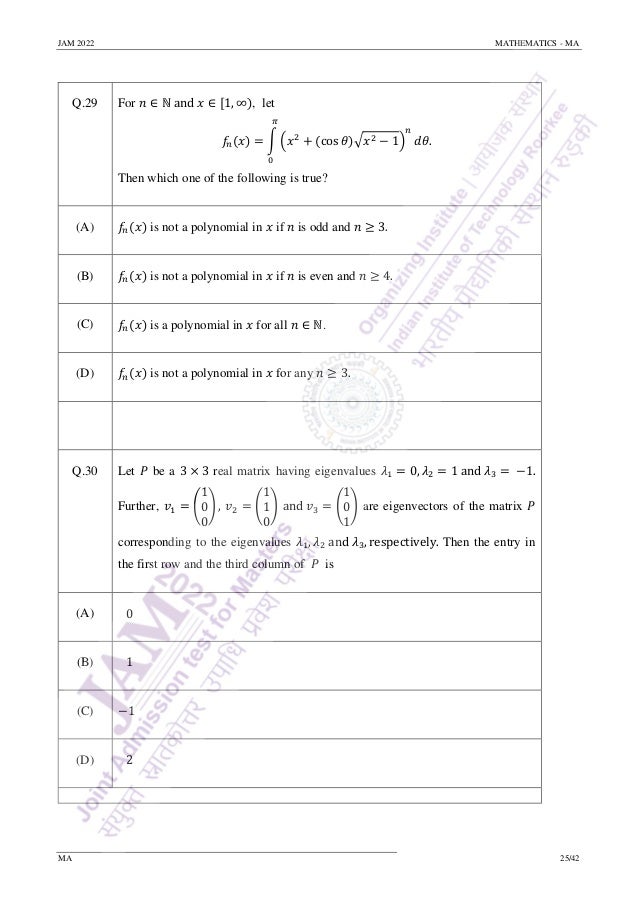
Q.29 For 𝑛 ∈ ℕ and 𝑥 ∈ [1, ∞), let
𝑓
𝑛(𝑥) = ∫ (𝑥2
+ (cos 𝜃)√𝑥2 − 1)
𝑛
𝜋
0
𝑑𝜃.
Then which one of the following is true?
(A) 𝑓𝑛(𝑥) is not a polynomial in 𝑥 if 𝑛 is odd and 𝑛 ≥ 3.
(B) 𝑓𝑛(𝑥) is not a polynomial in 𝑥 if 𝑛 is even and 𝑛 ≥ 4.
(C) 𝑓𝑛(𝑥) is a polynomial in 𝑥 for all 𝑛 ∈ ℕ.
(D) 𝑓𝑛(𝑥) is not a polynomial in 𝑥 for any 𝑛 ≥ 3.
Q.30 Let 𝑃 be a 3 × 3 real matrix having eigenvalues 𝜆1 = 0, 𝜆2 = 1 and 𝜆3 = −1.
Further, 𝑣1 = (
1
0
0
) , 𝑣2 = (
1
1
0
) and 𝑣3 = (
1
0
1
) are eigenvectors of the matrix 𝑃
corresponding to the eigenvalues 𝜆1, 𝜆2 and 𝜆3, respectively. Then the entry in
the first row and the third column of 𝑃 is
(A) 0
(B) 1
(C) −1
(D) 2
JAM 2022 MATHEMATICS - MA
MA 26/42
Section B: Q.31 – Q.40 Carry TWO marks each.
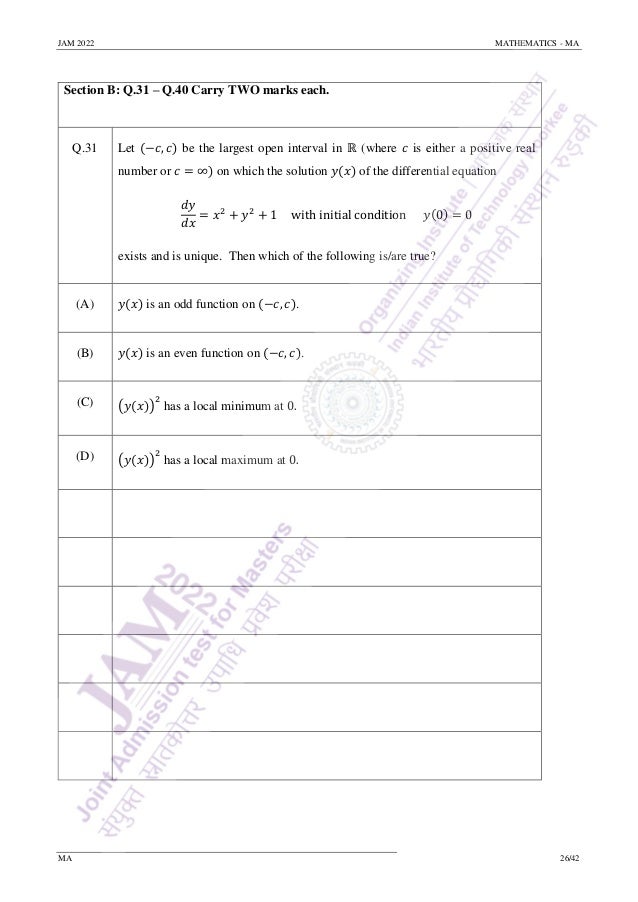
Q.31 Let (−𝑐, 𝑐) be the largest open interval in ℝ (where 𝑐 is either a positive real
number or 𝑐 = ∞) on which the solution 𝑦(𝑥) of the differential equation
𝑑𝑦
𝑑𝑥
= 𝑥2
+ 𝑦2
+ 1 with initial condition 𝑦(0) = 0
exists and is unique. Then which of the following is/are true?
(A) 𝑦(𝑥) is an odd function on (−𝑐, 𝑐).
(B) 𝑦(𝑥) is an even function on (−𝑐, 𝑐).
(C) (𝑦(𝑥))
2
has a local minimum at 0.
(D) (𝑦(𝑥))
2
has a local maximum at 0.
JAM 2022 MATHEMATICS - MA
MA 27/42
Q.32 Let 𝑆 be the set of all continuous functions 𝑓: [−1,1] → ℝ satisfying the following
three conditions:
(i) 𝑓 is infinitely differentiable on the open interval (−1,1),
(ii) the Taylor series
𝑓(0) + 𝑓′(0)𝑥 +
𝑓′′(0)
2!
𝑥2
+ ⋯
of 𝑓 at 0 converges to 𝑓(𝑥) for each 𝑥 ∈ (−1,1),
(iii) 𝑓 (
1
𝑛
) = 0 for all 𝑛 ∈ ℕ.
Then which of the following is/are true?
(A) 𝑓(0) = 0 for every 𝑓 ∈ 𝑆.
(B) 𝑓′ (
1
2
) = 0 for every 𝑓 ∈ 𝑆.
(C) There exists 𝑓 ∈ 𝑆 such that 𝑓′ (
1
2
) ≠ 0.
(D) There exists 𝑓 ∈ 𝑆 such that 𝑓(𝑥) ≠ 0 for some 𝑥 ∈ [−1,1].
JAM 2022 MATHEMATICS - MA
MA 28/42
Q.33 Define 𝑓: [0,1] → [0,1] by
𝑓(𝑥) =
{
1 if 𝑥 = 0,
1
𝑛
if 𝑥 =
𝑚
𝑛
for some 𝑚, 𝑛 ∈ ℕ with 𝑚 ≤ 𝑛 and gcd(𝑚, 𝑛) = 1,
0 if 𝑥 ∈ [0,1] is irrational.
and define 𝑔: [0,1] → [0,1] by
𝑔(𝑥) = {
0 if 𝑥 = 0,
1 if 𝑥 ∈ (0,1].
Then which of the following is/are true?
(A) 𝑓 is Riemann integrable on [0,1].
(B) 𝑔 is Riemann integrable on [0,1].
(C) The composite function 𝑓 ∘ 𝑔 is Riemann integrable on [0,1].
(D) The composite function 𝑔 ∘ 𝑓 is Riemann integrable on [0,1].
JAM 2022 MATHEMATICS - MA
MA 29/42
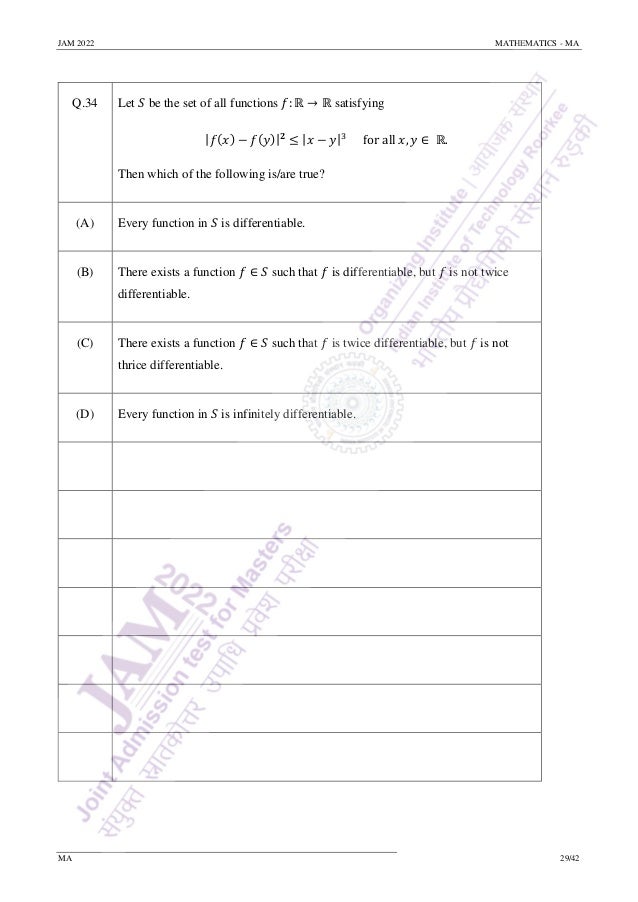
Q.34 Let 𝑆 be the set of all functions 𝑓: ℝ → ℝ satisfying
|𝑓(𝑥) − 𝑓(𝑦)|𝟐
≤ |𝑥 − 𝑦|3
for all 𝑥, 𝑦 ∈ ℝ.
Then which of the following is/are true?
(A) Every function in 𝑆 is differentiable.
(B) There exists a function 𝑓 ∈ 𝑆 such that 𝑓 is differentiable, but 𝑓 is not twice
differentiable.
(C) There exists a function 𝑓 ∈ 𝑆 such that 𝑓 is twice differentiable, but 𝑓 is not
thrice differentiable.
(D) Every function in 𝑆 is infinitely differentiable.
JAM 2022 MATHEMATICS - MA
MA 30/42
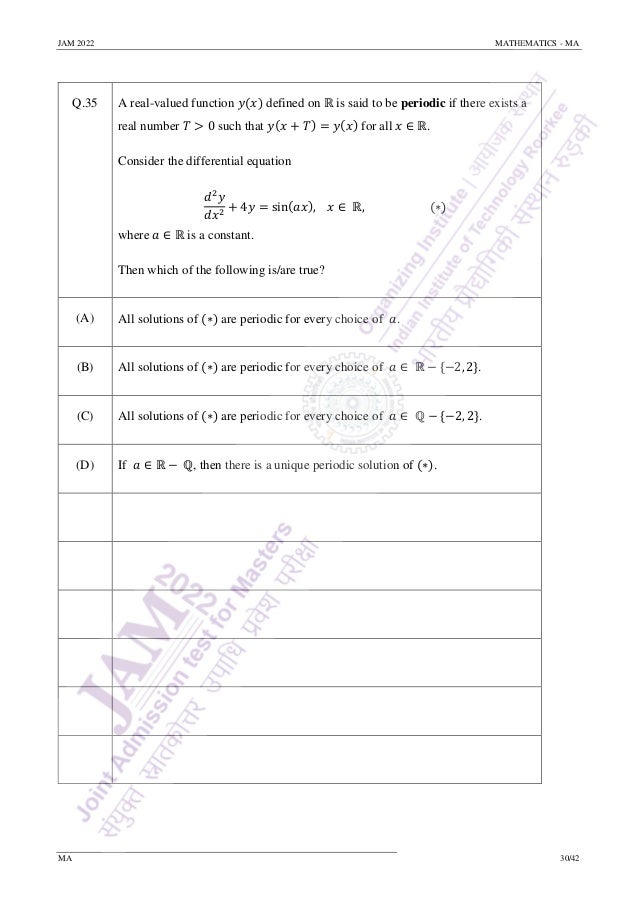
Q.35 A real-valued function 𝑦(𝑥) defined on ℝ is said to be periodic if there exists a
real number 𝑇 > 0 such that 𝑦(𝑥 + 𝑇) = 𝑦(𝑥) for all 𝑥 ∈ ℝ.
Consider the differential equation
𝑑2
𝑦
𝑑𝑥2
+ 4𝑦 = sin(𝑎𝑥), 𝑥 ∈ ℝ, (∗)
where 𝑎 ∈ ℝ is a constant.
Then which of the following is/are true?
(A) All solutions of (∗) are periodic for every choice of 𝑎.
(B) All solutions of (∗) are periodic for every choice of 𝑎 ∈ ℝ − {−2, 2}.
(C) All solutions of (∗) are periodic for every choice of 𝑎 ∈ ℚ − {−2, 2}.
(D) If 𝑎 ∈ ℝ − ℚ, then there is a unique periodic solution of (∗).
JAM 2022 MATHEMATICS - MA
MA 31/42
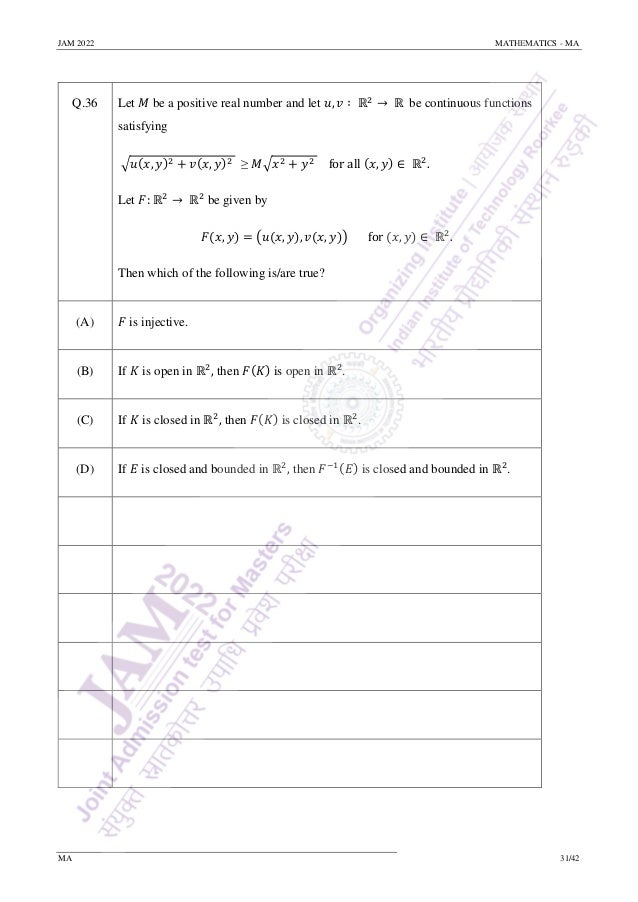
Q.36 Let 𝑀 be a positive real number and let 𝑢, 𝑣 ∶ ℝ2
→ ℝ be continuous functions
satisfying
√𝑢(𝑥, 𝑦)2 + 𝑣(𝑥, 𝑦)2 ≥ 𝑀√𝑥2 + 𝑦2 for all (𝑥, 𝑦) ∈ ℝ2
.
Let 𝐹: ℝ2
→ ℝ2
be given by
𝐹(𝑥, 𝑦) = (𝑢(𝑥, 𝑦), 𝑣(𝑥, 𝑦)) for (𝑥, 𝑦) ∈ ℝ2
.
Then which of the following is/are true?
(A) 𝐹 is injective.
(B) If 𝐾 is open in ℝ2
, then 𝐹(𝐾) is open in ℝ2
.
(C) If 𝐾 is closed in ℝ2
, then 𝐹(𝐾) is closed in ℝ2
.
(D) If 𝐸 is closed and bounded in ℝ2
, then 𝐹−1(𝐸) is closed and bounded in ℝ2
.
JAM 2022 MATHEMATICS - MA
MA 32/42
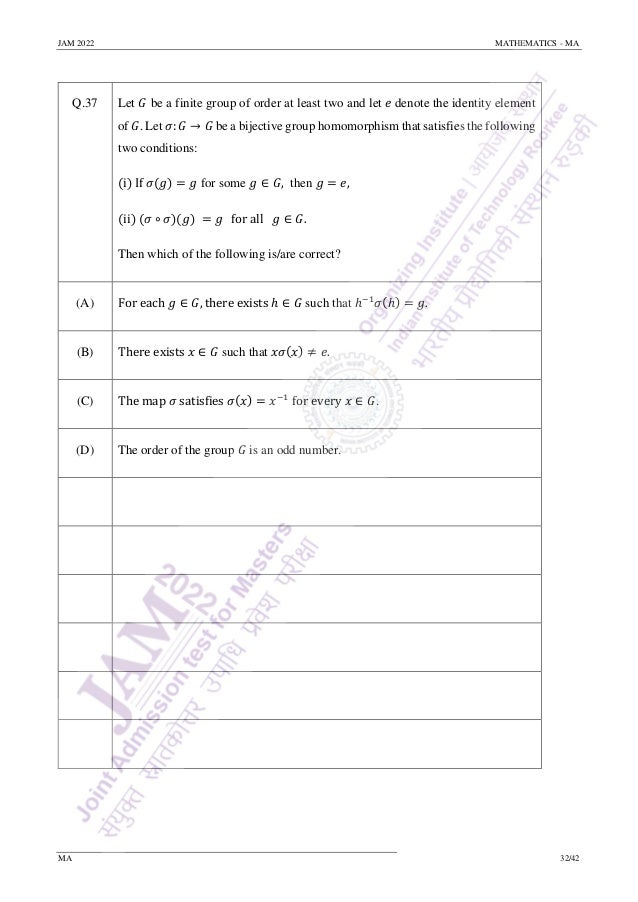
Q.37 Let 𝐺 be a finite group of order at least two and let 𝑒 denote the identity element
of 𝐺. Let 𝜎: 𝐺 → 𝐺 be a bijective group homomorphism that satisfies the following
two conditions:
(i) If 𝜎(𝑔) = 𝑔 for some 𝑔 ∈ 𝐺, then 𝑔 = 𝑒,
(ii) (𝜎 ∘ 𝜎)(𝑔) = 𝑔 for all 𝑔 ∈ 𝐺.
Then which of the following is/are correct?
(A) For each 𝑔 ∈ 𝐺, there exists ℎ ∈ 𝐺 such that ℎ−1
𝜎(ℎ) = 𝑔.
(B) There exists 𝑥 ∈ 𝐺 such that 𝑥𝜎(𝑥) ≠ 𝑒.
(C) The map 𝜎 satisfies 𝜎(𝑥) = 𝑥−1
for every 𝑥 ∈ 𝐺.
(D) The order of the group 𝐺 is an odd number.
JAM 2022 MATHEMATICS - MA
MA 33/42
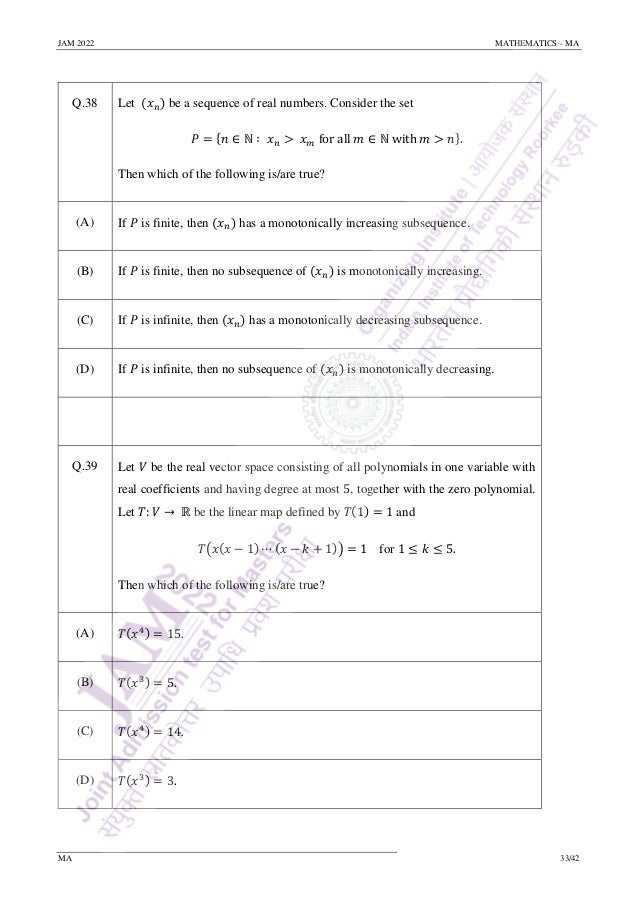
Q.38 Let (𝑥𝑛) be a sequence of real numbers. Consider the set
𝑃 = {𝑛 ∈ ℕ ∶ 𝑥𝑛 > 𝑥𝑚 for all 𝑚 ∈ ℕ with 𝑚 > 𝑛}.
Then which of the following is/are true?
(A) If 𝑃 is finite, then (𝑥𝑛) has a monotonically increasing subsequence.
(B) If 𝑃 is finite, then no subsequence of (𝑥𝑛) is monotonically increasing.
(C) If 𝑃 is infinite, then (𝑥𝑛) has a monotonically decreasing subsequence.
(D) If 𝑃 is infinite, then no subsequence of (𝑥𝑛) is monotonically decreasing.
Q.39 Let 𝑉 be the real vector space consisting of all polynomials in one variable with
real coefficients and having degree at most 5, together with the zero polynomial.
Let 𝑇: 𝑉 → ℝ be the linear map defined by 𝑇(1) = 1 and
𝑇(𝑥(𝑥 − 1) ⋯ (𝑥 − 𝑘 + 1)) = 1 for 1 ≤ 𝑘 ≤ 5.
Then which of the following is/are true?
(A) 𝑇(𝑥4) = 15.
(B) 𝑇(𝑥3) = 5.
(C) 𝑇(𝑥4) = 14.
(D) 𝑇(𝑥3) = 3.
JAM 2022 MATHEMATICS - MA
MA 34/42
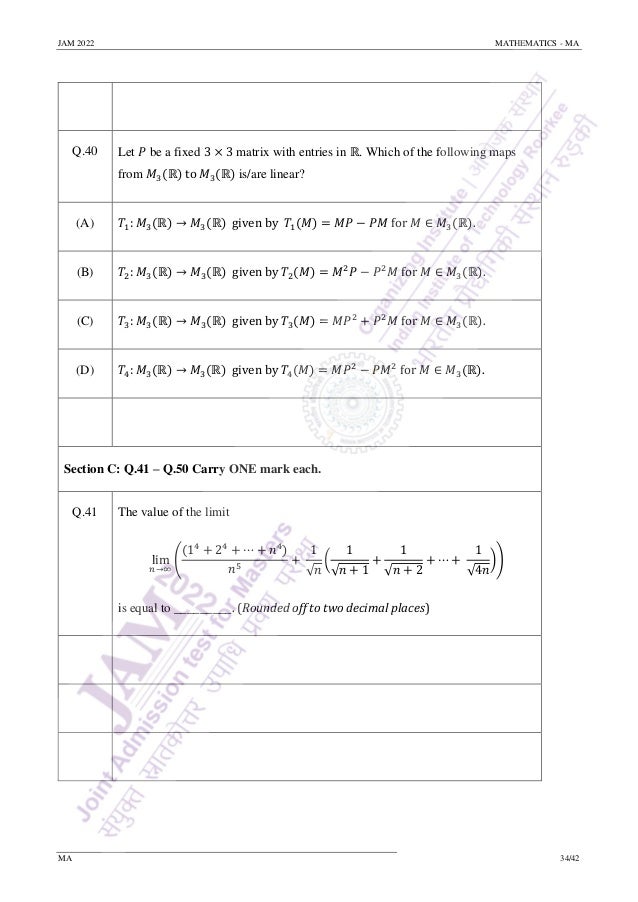
Q.40 Let 𝑃 be a fixed 3 × 3 matrix with entries in ℝ. Which of the following maps
from 𝑀3(ℝ) to 𝑀3(ℝ) is/are linear?
(A) 𝑇1: 𝑀3(ℝ) → 𝑀3(ℝ) given by 𝑇1(𝑀) = 𝑀𝑃 − 𝑃𝑀 for 𝑀 ∈ 𝑀3(ℝ).
(B) 𝑇2: 𝑀3(ℝ) → 𝑀3(ℝ) given by 𝑇2(𝑀) = 𝑀2
𝑃 − 𝑃2
𝑀 for 𝑀 ∈ 𝑀3(ℝ).
(C) 𝑇3: 𝑀3(ℝ) → 𝑀3(ℝ) given by 𝑇3(𝑀) = 𝑀𝑃2
+ 𝑃2
𝑀 for 𝑀 ∈ 𝑀3(ℝ).
(D) 𝑇4: 𝑀3(ℝ) → 𝑀3(ℝ) given by 𝑇4(𝑀) = 𝑀𝑃2
− 𝑃𝑀2
for 𝑀 ∈ 𝑀3(ℝ).
Section C: Q.41 – Q.50 Carry ONE mark each.
Q.41 The value of the limit
lim
𝑛→∞
(
(14
+ 24
+ ⋯ + 𝑛4
)
𝑛5
+
1
√𝑛
(
1
√𝑛 + 1
+
1
√𝑛 + 2
+ ⋯ +
1
√4𝑛
))
is equal to _________. (Rounded off to two decimal places)
JAM 2022 MATHEMATICS - MA
MA 35/42
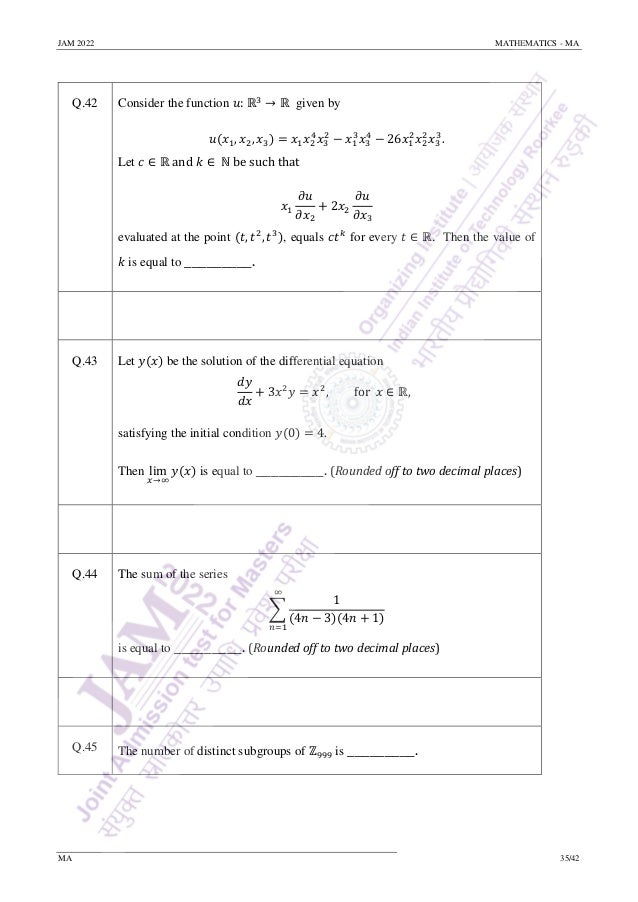
Q.42 Consider the function 𝑢: ℝ3
→ ℝ given by
𝑢(𝑥1, 𝑥2, 𝑥3) = 𝑥1𝑥2
4
𝑥3
2
− 𝑥1
3
𝑥3
4
− 26𝑥1
2
𝑥2
2
𝑥3
3
.
Let 𝑐 ∈ ℝ and 𝑘 ∈ ℕ be such that
𝑥1
𝜕𝑢
𝜕𝑥2
+ 2𝑥2
𝜕𝑢
𝜕𝑥3
evaluated at the point (𝑡, 𝑡2
, 𝑡3
), equals 𝑐𝑡𝑘
for every 𝑡 ∈ ℝ. Then the value of
𝑘 is equal to _________.
Q.43 Let 𝑦(𝑥) be the solution of the differential equation
𝑑𝑦
𝑑𝑥
+ 3𝑥2
𝑦 = 𝑥2
, for 𝑥 ∈ ℝ,
satisfying the initial condition 𝑦(0) = 4.
Then lim
𝑥→∞
𝑦(𝑥) is equal to _________. (Rounded off to two decimal places)
Q.44 The sum of the series
∑
1
(4𝑛 − 3)(4𝑛 + 1)
∞
𝑛=1
is equal to _________. (Rounded off to two decimal places)
Q.45 The number of distinct subgroups of ℤ999 is _________.
JAM 2022 MATHEMATICS - MA
MA 36/42
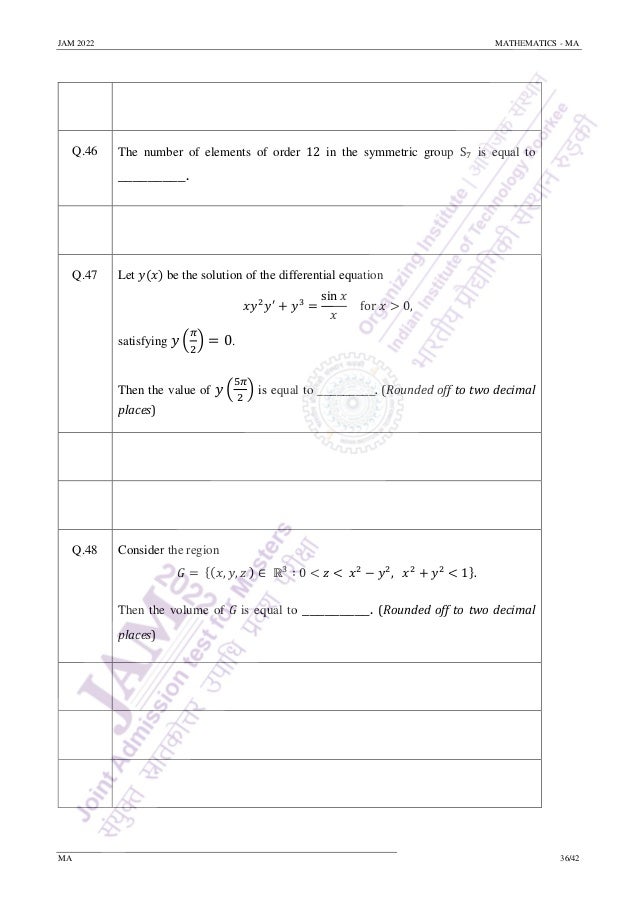
Q.46 The number of elements of order 12 in the symmetric group S7 is equal to
_________.
Q.47 Let 𝑦(𝑥) be the solution of the differential equation
𝑥𝑦2
𝑦′
+ 𝑦3
=
sin 𝑥
𝑥
for 𝑥 > 0,
satisfying 𝑦 (
𝜋
2
) = 0.
Then the value of 𝑦 (
5𝜋
2
) is equal to _________. (Rounded off to two decimal
places)
Q.48 Consider the region
𝐺 = {(𝑥, 𝑦, 𝑧 ) ∈ ℝ3
∶ 0 < 𝑧 < 𝑥2
− 𝑦2
, 𝑥2
+ 𝑦2
< 1}.
Then the volume of 𝐺 is equal to _________. (Rounded off to two decimal
places)
JAM 2022 MATHEMATICS - MA
MA 37/42
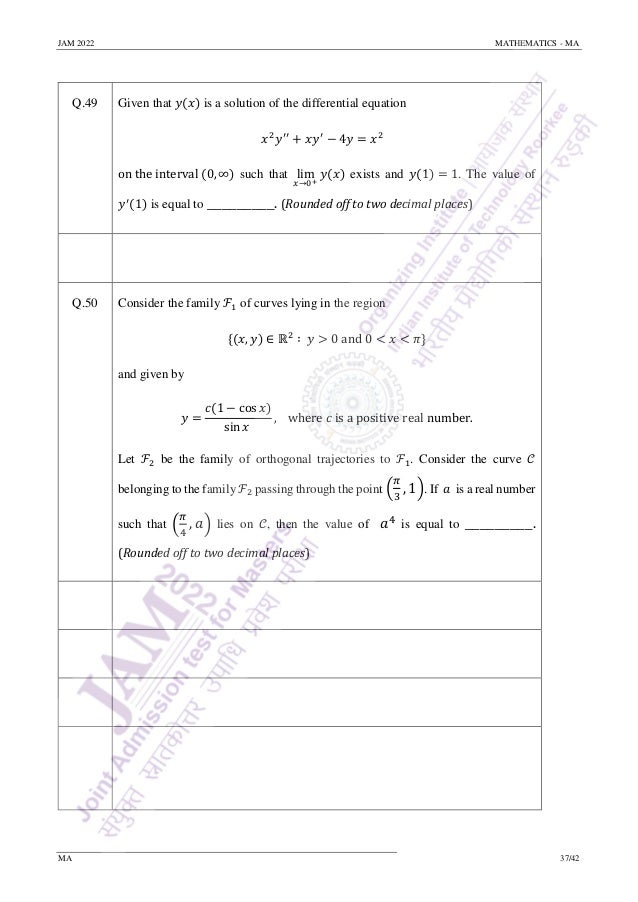
Q.49 Given that 𝑦(𝑥) is a solution of the differential equation
𝑥2
𝑦′′
+ 𝑥𝑦′
− 4𝑦 = 𝑥2
on the interval (0, ∞) such that lim
𝑥→0+
𝑦(𝑥) exists and 𝑦(1) = 1. The value of
𝑦′
(1) is equal to _________. (Rounded off to two decimal places)
Q.50 Consider the family ℱ1 of curves lying in the region
{(𝑥, 𝑦) ∈ ℝ2
∶ 𝑦 > 0 and 0 < 𝑥 < 𝜋}
and given by
𝑦 =
𝑐(1 − cos 𝑥)
sin 𝑥
, where 𝑐 is a positive real number.
Let ℱ2 be the family of orthogonal trajectories to ℱ1. Consider the curve 𝒞
belonging to the family ℱ2 passing through the point (
𝜋
3
, 1). If 𝑎 is a real number
such that (
𝜋
4
, 𝑎) lies on 𝒞, then the value of 𝑎4
is equal to _________.
(Rounded off to two decimal places)
JAM 2022 MATHEMATICS - MA
MA 38/42
Section C: Q.51 – Q.60 Carry TWO marks each.
Q.51 For 𝑡 ∈ ℝ, let [𝑡] denote the greatest integer less than or equal to 𝑡.
Let 𝐷 = {(𝑥, 𝑦) ∈ ℝ2
∶ 𝑥2
+ 𝑦2
< 4}. Let 𝑓: 𝐷 → ℝ and 𝑔: 𝐷 → ℝ be defined
by 𝑓(0, 0) = 𝑔(0, 0) = 0 and
𝑓(𝑥, 𝑦) = [𝑥2
+ 𝑦2]
𝑥2
𝑦2
𝑥4 + 𝑦4
, 𝑔(𝑥, 𝑦) = [𝑦2]
𝑥𝑦
𝑥2 + 𝑦2
for (𝑥, 𝑦) ≠ (0, 0). Let 𝐸 be the set of points of 𝐷 at which both 𝑓 and 𝑔 are
discontinuous. The number of elements in the set 𝐸 is _________.
Q.52 If 𝐺 is the region in ℝ2
given by
𝐺 = {(𝑥, 𝑦) ∈ ℝ2
∶ 𝑥2
+ 𝑦2
< 1,
𝑥
√3
< 𝑦 < √3𝑥, 𝑥 > 0, 𝑦 > 0}
then the value of
200
𝜋
∬𝑥2
𝑑𝑥 𝑑𝑦
𝐺
is equal to _________. (Rounded off to two decimal places)
JAM 2022 MATHEMATICS - MA
MA 39/42
Q.53
Let 𝐴 = (
1 1
0 1
−1 1
) and let 𝐴⊤
denote the transpose of 𝐴. Let 𝑢 = (
𝑢1
𝑢2
) and
𝑣 = (
𝑣1
𝑣2
𝑣3
) be column vectors with entries in ℝ such that 𝑢1
2
+ 𝑢2
2
= 1 and
𝑣1
2
+ 𝑣2
2
+ 𝑣3
2
= 1. Suppose
𝐴𝑢 = √2 𝑣 and 𝐴⊤
𝑣 = √2 𝑢.
Then |𝑢1 + 2 √2 𝑣1| is equal to _________. (Rounded off to two decimal places)
Q.54 Let 𝑓: [0, 𝜋] → ℝ be the function defined by
𝑓(𝑥) = {
(𝑥 − 𝜋)𝑒sin 𝑥
if 0 ≤ 𝑥 ≤
𝜋
2
,
𝑥𝑒sin 𝑥
+
4
𝜋
if
𝜋
2
< 𝑥 ≤ 𝜋.
Then the value of
∫ 𝑓(𝑥)𝑑𝑥
𝜋
0
is equal to _________. (Rounded off to two decimal places)
JAM 2022 MATHEMATICS - MA
MA 40/42
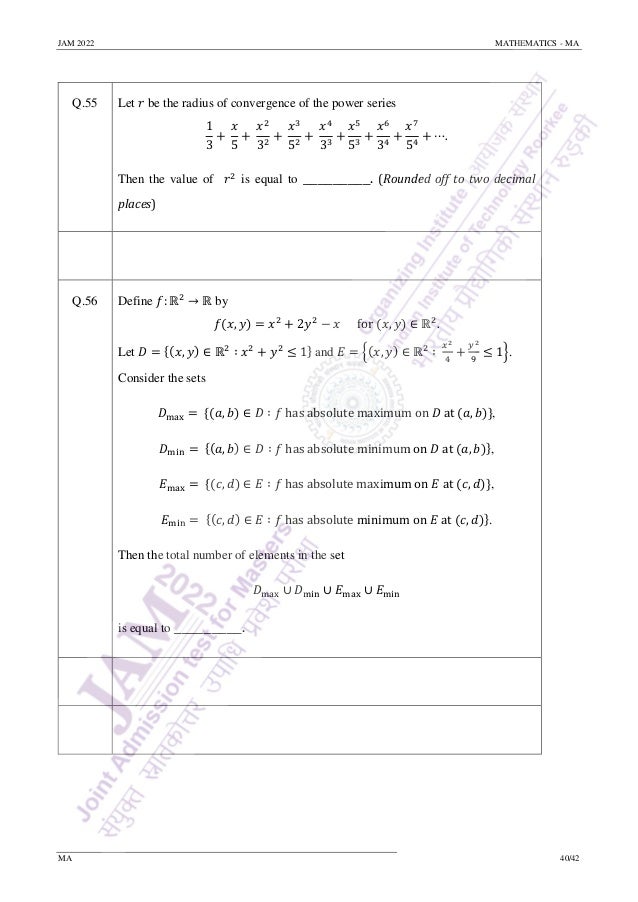
Q.55 Let 𝑟 be the radius of convergence of the power series
1
3
+
𝑥
5
+
𝑥2
32
+
𝑥3
52
+
𝑥4
33
+
𝑥5
53
+
𝑥6
34
+
𝑥7
54
+ ⋯.
Then the value of 𝑟2
is equal to _________. (Rounded off to two decimal
places)
Q.56 Define 𝑓: ℝ2
→ ℝ by
𝑓(𝑥, 𝑦) = 𝑥2
+ 2𝑦2
− 𝑥 for (𝑥, 𝑦) ∈ ℝ2
.
Let 𝐷 = {(𝑥, 𝑦) ∈ ℝ2
∶ 𝑥2
+ 𝑦2
≤ 1} and 𝐸 = {(𝑥, 𝑦) ∈ ℝ2
∶
𝑥2
4
+
𝑦2
9
≤ 1}.
Consider the sets
𝐷max = {(𝑎, 𝑏) ∈ 𝐷 ∶ 𝑓 has absolute maximum on 𝐷 at (𝑎, 𝑏)},
𝐷min = {(𝑎, 𝑏) ∈ 𝐷 ∶ 𝑓 has absolute minimum on 𝐷 at (𝑎, 𝑏)},
𝐸max = {(𝑐, 𝑑) ∈ 𝐸 ∶ 𝑓 has absolute maximum on 𝐸 at (𝑐, 𝑑)},
𝐸min = {(𝑐, 𝑑) ∈ 𝐸 ∶ 𝑓 has absolute minimum on 𝐸 at (𝑐, 𝑑)}.
Then the total number of elements in the set
𝐷max ∪ 𝐷min ∪ 𝐸max ∪ 𝐸min
is equal to _________.
JAM 2022 MATHEMATICS - MA
MA 41/42
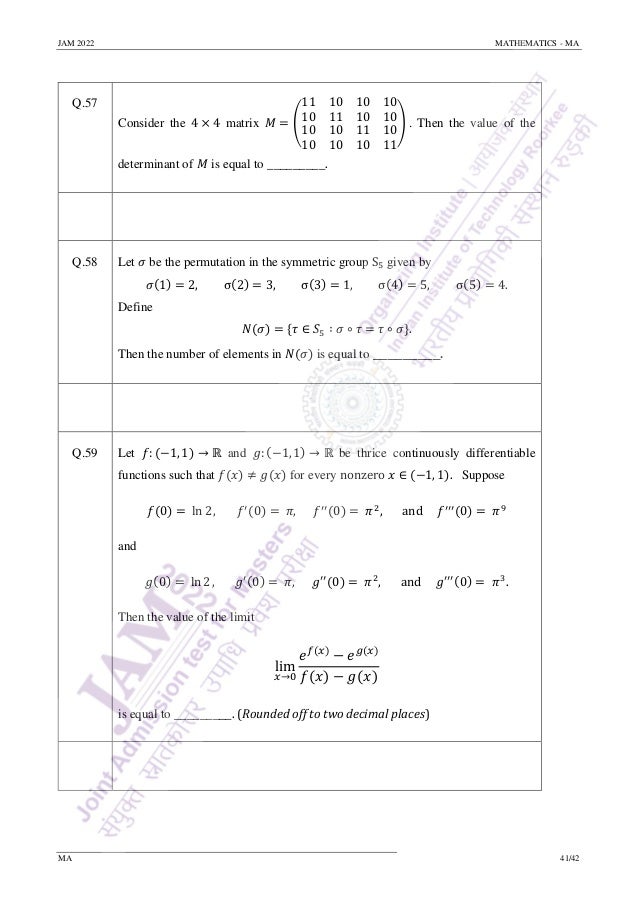
Q.57
Consider the 4 × 4 matrix 𝑀 = (
11 10
10 11
10 10
10 10
10 10
10 10
11 10
10 11
) . Then the value of the
determinant of 𝑀 is equal to _________.
Q.58 Let 𝜎 be the permutation in the symmetric group S5 given by
𝜎(1) = 2, σ(2) = 3, σ(3) = 1, σ(4) = 5, σ(5) = 4.
Define
𝑁(𝜎) = {𝜏 ∈ 𝑆5 ∶ 𝜎 ∘ 𝜏 = 𝜏 ∘ 𝜎}.
Then the number of elements in 𝑁(𝜎) is equal to _________.
Q.59 Let 𝑓: (−1, 1) → ℝ and 𝑔: (−1, 1) → ℝ be thrice continuously differentiable
functions such that 𝑓(𝑥) ≠ 𝑔(𝑥) for every nonzero 𝑥 ∈ (−1, 1). Suppose
𝑓(0) = ln 2, 𝑓′(0) = 𝜋, 𝑓′′(0) = 𝜋2
, and 𝑓′′′(0) = 𝜋9
and
𝑔(0) = ln 2, 𝑔′(0) = 𝜋, 𝑔′′
(0) = 𝜋2
, and 𝑔′′′(0) = 𝜋3
.
Then the value of the limit
lim
𝑥→0
𝑒𝑓(𝑥)
− 𝑒𝑔(𝑥)
𝑓(𝑥) − 𝑔(𝑥)
is equal to _________. (Rounded off to two decimal places)
JAM 2022 MATHEMATICS - MA
MA 42/42
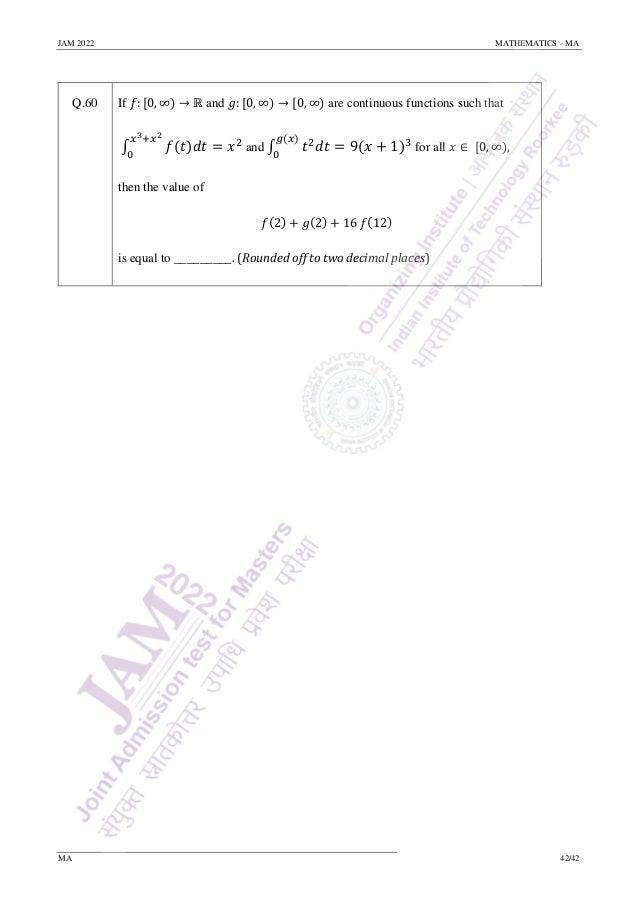
Q.60 If 𝑓: [0, ∞) → ℝ and 𝑔: [0, ∞) → [0, ∞) are continuous functions such that
∫ 𝑓(𝑡)𝑑𝑡
𝑥3+𝑥2
0
= 𝑥2
and ∫ 𝑡2
𝑑𝑡 = 9(𝑥 + 1)3
𝑔(𝑥)
0
for all 𝑥 ∈ [0, ∞),
then the value of
𝑓(2) + 𝑔(2) + 16 𝑓(12)
is equal to _________. (Rounded off to two decimal places)

IIT JAM Math 2022 Question Paper | Sourav Sir's Classes

  • 1.
    JAM 2022 MATHEMATICS- MA MA 1/42 Notation and Terminology ℕ = the set of all positive integers. ℤ = the set of all integers. ℚ = the set of all rational numbers. ℝ = the set of all real numbers. ℝ𝑛 = the 𝑛-dimensional Euclidean space. ℂ = the set of all complex numbers. 𝑀𝑛(ℝ) = the real vector space of all 𝑛 × 𝑛 matrices with entries in ℝ. 𝑀𝑛(ℂ) = the complex vector space of all 𝑛 × 𝑛 matrices with entries in ℂ. gcd(𝑚, 𝑛) = the greatest common divisor of the integers 𝑚 and 𝑛. 𝑀⊤ = the transpose of the matrix 𝑀. 𝐴 − 𝐵 = the complement of the set 𝐵 in the set 𝐴, that is, {𝑥 ∈ 𝐴 ∶ 𝑥 ∉ 𝐵}. ln 𝑥 = the natural logarithm of 𝑥 (to the base 𝑒). |𝑥| = the absolute value of 𝑥. 𝑦′ , 𝑦′′ , 𝑦′′′ = the first, second and the third derivatives of the function 𝑦, respectively. 𝑆𝑛 = the symmetric group consisting of all permutations of {1,2, … , 𝑛}. ℤ𝑛 = the additive group of integers modulo 𝑛. 𝑓 ∘ 𝑔 is the composite function defined by (𝑓 ∘ 𝑔)(𝑥) = 𝑓(𝑔(𝑥)). The phrase ‘real vector space’ refers to a vector space over ℝ.
  • 2.
    JAM 2022 MATHEMATICS- MA MA 2/42 Section A: Q.1 – Q.10 carry ONE mark each. Q.1 Consider the 2 × 2 matrix 𝑀 = ( 1 1 1 0 ) ∈ 𝑀2(ℝ). If the eighth power of 𝑀 satisfies 𝑀8 ( 1 0 ) = ( 𝑥 𝑦), then the value of 𝑥 is (A) 21 (B) 22 (C) 34 (D) 35 Q.2 The rank of the 4 × 6 matrix ( 1 1 1 0 1 0 0 1 0 0 1 0 0 1 0 0 0 1 1 0 0 1 1 1 ) with entries in ℝ, is (A) 1 (B) 2 (C) 3 (D) 4
  • 3.
    JAM 2022 MATHEMATICS- MA MA 3/42 Q.3 Let 𝑉 be the real vector space consisting of all polynomials in one variable with real coefficients and having degree at most 6, together with the zero polynomial. Then which one of the following is true? (A) {𝑓 ∈ 𝑉 ∶ 𝑓(1 2) ∉ ℚ} ⁄ is a subspace of 𝑉. (B) {𝑓 ∈ 𝑉 ∶ 𝑓(1 2) = 1} ⁄ is a subspace of 𝑉. (C) {𝑓 ∈ 𝑉 ∶ 𝑓(1 2) = 𝑓(1)} ⁄ is a subspace of 𝑉. (D) {𝑓 ∈ 𝑉 ∶ 𝑓′(1 2) = 1} ⁄ is a subspace of 𝑉. Q.4 Let 𝐺 be a group of order 2022. Let 𝐻 and 𝐾 be subgroups of 𝐺 of order 337 and 674, respectively. If 𝐻 ∪ 𝐾 is also a subgroup of 𝐺, then which one of the following is FALSE? (A) 𝐻 is a normal subgroup of 𝐻 ∪ 𝐾. (B) The order of 𝐻 ∪ 𝐾 is 1011. (C) The order of 𝐻 ∪ 𝐾 is 674. (D) 𝐾 is a normal subgroup of 𝐻 ∪ 𝐾.
  • 4.
    JAM 2022 MATHEMATICS- MA MA 4/42 Q.5 The radius of convergence of the power series ∑ ( 𝑛3 4𝑛 ) 𝑥5𝑛 ∞ 𝑛=1 is (A) 4 (B) √4 5 (C) 1 4 (D) 1 √4 5
  • 5.
    JAM 2022 MATHEMATICS- MA MA 5/42 Q.6 Let (𝑥𝑛) and (𝑦𝑛) be sequences of real numbers defined by 𝑥1 = 1, 𝑦1 = 1 2 , 𝑥𝑛+1 = 𝑥𝑛 + 𝑦𝑛 2 , and 𝑦𝑛+1 = √𝑥𝑛𝑦𝑛 for all 𝑛 ∈ ℕ. Then which one of the following is true? (A) (𝑥𝑛) is convergent, but (𝑦𝑛) is not convergent. (B) (𝑥𝑛) is not convergent, but (𝑦𝑛) is convergent. (C) Both (𝑥𝑛) and (𝑦𝑛) are convergent and lim 𝑛→∞ 𝑥𝑛 > lim 𝑛→∞ 𝑦𝑛 . (D) Both (𝑥𝑛) and (𝑦𝑛) are convergent and lim 𝑛→∞ 𝑥𝑛 = lim 𝑛→∞ 𝑦𝑛 . Q.7 Suppose 𝑎𝑛 = 3𝑛 + 3 5𝑛 − 5 and 𝑏𝑛 = 1 (1 + 𝑛2) 1 4 for 𝑛 = 2,3,4, … . Then which one of the following is true? (A) Both ∑ 𝑎𝑛 ∞ 𝑛=2 and ∑ 𝑏𝑛 ∞ 𝑛=2 are convergent. (B) Both ∑ 𝑎𝑛 ∞ 𝑛=2 and ∑ 𝑏𝑛 ∞ 𝑛=2 are divergent. (C) ∑ 𝑎𝑛 ∞ 𝑛=2 is convergent and ∑ 𝑏𝑛 ∞ 𝑛=2 is divergent. (D) ∑ 𝑎𝑛 ∞ 𝑛=2 is divergent and ∑ 𝑏𝑛 ∞ 𝑛=2 is convergent.
  • 6.
    JAM 2022 MATHEMATICS- MA MA 6/42 Q.8 Consider the series ∑ 1 𝑛𝑚 (1 + 1 𝑛𝑝 ) ∞ 𝑛=1 where 𝑚 and 𝑝 are real numbers. Under which of the following conditions does the above series converge? (A) 𝑚 > 1. (B) 0 < 𝑚 < 1 and 𝑝 > 1. (C) 0 < 𝑚 ≤ 1 and 0 ≤ 𝑝 ≤ 1. (D) 𝑚 = 1 and 𝑝 > 1.
  • 7.
    JAM 2022 MATHEMATICS- MA MA 7/42 Q.9 Let 𝑐 be a positive real number and let 𝑢: ℝ2 → ℝ be defined by 𝑢(𝑥, 𝑡) = 1 2𝑐 ∫ 𝑒𝑠2 𝑑𝑠 for (𝑥, 𝑡) ∈ ℝ2 . 𝑥+𝑐𝑡 𝑥−𝑐𝑡 Then which one of the following is true? (A) 𝜕2 𝑢 𝜕𝑡2 = 𝑐2 𝜕2 𝑢 𝜕𝑥2 on ℝ2 . (B) 𝜕𝑢 𝜕𝑡 = 𝑐2 𝜕2 𝑢 𝜕𝑥2 on ℝ2 . (C) 𝜕𝑢 𝜕𝑡 𝜕𝑢 𝜕𝑥 = 0 on ℝ2 . (D) 𝜕2 𝑢 𝜕𝑡 𝜕𝑥 = 0 on ℝ2 .
  • 8.
    JAM 2022 MATHEMATICS- MA MA 8/42 Q.10 Let 𝜃 ∈ ( 𝜋 4 , 𝜋 2 ). Consider the functions 𝑢 ∶ ℝ2 − {(0, 0)} → ℝ and 𝑣 ∶ ℝ2 − {(0, 0)} → ℝ given by 𝑢(𝑥, 𝑦) = 𝑥 − 𝑥 𝑥2 + 𝑦2 and 𝑣(𝑥, 𝑦) = 𝑦 + 𝑦 𝑥2 + 𝑦2 . The value of the determinant | 𝜕𝑢 𝜕𝑥 𝜕𝑢 𝜕𝑦 𝜕𝑣 𝜕𝑥 𝜕𝑣 𝜕𝑦 | at the point (cos 𝜃, sin 𝜃) is equal to (A) 4 sin 𝜃. (B) 4 cos 𝜃. (C) 4 sin2 𝜃. (D) 4 cos2 𝜃.
  • 9.
    JAM 2022 MATHEMATICS- MA MA 9/42 Section A: Q.11 – Q.30 Carry TWO marks each. Q.11 Consider the open rectangle 𝐺 = {(𝑠, 𝑡) ∈ ℝ2 ∶ 0 < 𝑠 < 1 and 0 < 𝑡 < 1} and the map 𝑇: 𝐺 → ℝ2 given by 𝑇(𝑠, 𝑡) = ( 𝜋𝑠(1 − 𝑡) 2 , 𝜋(1 − 𝑠) 2 ) for (𝑠, 𝑡) ∈ 𝐺 . Then the area of the image 𝑇(𝐺) of the map 𝑇 is equal to (A) 𝜋 4 (B) 𝜋2 4 (C) 𝜋2 8 (D) 1
  • 10.
    JAM 2022 MATHEMATICS- MA MA 10/42 Q.12 Let 𝑇 denote the sum of the convergent series 1 − 1 2 + 1 3 − 1 4 + 1 5 − 1 6 + ⋯ + (−1)𝑛+1 𝑛 + ⋯ and let 𝑆 denote the sum of the convergent series 1 − 1 2 − 1 4 + 1 3 − 1 6 − 1 8 + 1 5 − 1 10 − 1 12 + ⋯ = ∑ 𝑎𝑛 ∞ 𝑛=1 , where 𝑎3𝑚−2 = 1 2𝑚 − 1 , 𝑎3𝑚−1 = −1 4𝑚 − 2 and 𝑎3𝑚 = −1 4𝑚 for 𝑚 ∈ ℕ. Then which one of the following is true? (A) 𝑇 = 𝑆 and 𝑆 ≠ 0. (B) 2𝑇 = 𝑆 and 𝑆 ≠ 0. (C) 𝑇 = 2𝑆 and 𝑆 ≠ 0. (D) 𝑇 = 𝑆 = 0.
  • 11.
    JAM 2022 MATHEMATICS- MA MA 11/42 Q.13 Let 𝑢: ℝ → ℝ be a twice continuously differentiable function such that 𝑢(0) > 0 and 𝑢′(0) > 0. Suppose 𝑢 satisfies 𝑢′′(𝑥) = 𝑢(𝑥) 1 + 𝑥2 for all 𝑥 ∈ ℝ. Consider the following two statements: I. The function 𝑢𝑢′ is monotonically increasing on [0, ∞). II. The function 𝑢 is monotonically increasing on [0, ∞). Then which one of the following is correct? (A) Both I and II are false. (B) Both I and II are true. (C) I is false, but II is true. (D) I is true, but II is false.
  • 12.
    JAM 2022 MATHEMATICS- MA MA 12/42 Q.14 The value of lim 𝑛→∞ ∑ √𝑛 + 1 − √𝑛 𝑘(ln 𝑘)2 𝑛 𝑘=2 is equal to (A) ∞ (B) 1 (C) 𝑒 (D) 0
  • 13.
    JAM 2022 MATHEMATICS- MA MA 13/42 Q.15 For 𝑡 ∈ ℝ, let [𝑡] denote the greatest integer less than or equal to 𝑡. Define functions ℎ: ℝ2 → ℝ and 𝑔: ℝ → ℝ by ℎ(𝑥, 𝑦) = { −1 𝑥2−𝑦 if 𝑥2 ≠ 𝑦, 0 if 𝑥2 = 𝑦 and 𝑔(𝑥) = { sin 𝑥 𝑥 if 𝑥 ≠ 0, 0 if 𝑥 = 0. Then which one of the following is FALSE? (A) lim (𝑥,𝑦)→(√2,𝜋) cos ( 𝑥2 𝑦 𝑥2 + 1 ) = −1 2 . (B) lim (𝑥,𝑦)→(√2,2) 𝑒ℎ(𝑥,𝑦) = 0. (C) lim (𝑥,𝑦)→(𝑒,𝑒) ln(𝑥𝑦−[𝑦] ) = 𝑒 − 2. (D) lim (𝑥,𝑦)→(0,0) 𝑒2𝑦 𝑔(𝑥) = 1.
  • 14.
    JAM 2022 MATHEMATICS- MA MA 14/42 Q.16 Let 𝑃 ∈ 𝑀4(ℝ) be such that 𝑃4 is the zero matrix, but 𝑃3 is a nonzero matrix. Then which one of the following is FALSE? (A) For every nonzero vector 𝑣 ∈ ℝ4 , the subset {𝑣, 𝑃𝑣, 𝑃2 𝑣, 𝑃3 𝑣} of the real vector space ℝ4 is linearly independent. (B) The rank of 𝑃𝑘 is 4 − 𝑘 for every 𝑘 ∈ {1,2,3,4}. (C) 0 is an eigenvalue of 𝑃. (D) If 𝑄 ∈ 𝑀4(ℝ) is such that 𝑄4 is the zero matrix, but 𝑄3 is a nonzero matrix, then there exists a nonsingular matrix 𝑆 ∈ 𝑀4(ℝ) such that 𝑆−1 𝑄𝑆 = 𝑃.
  • 15.
    JAM 2022 MATHEMATICS- MA MA 15/42 Q.17 For 𝑋, 𝑌 ∈ 𝑀2(ℝ), define (𝑋, 𝑌) = 𝑋𝑌 − 𝑌𝑋. Let 𝟎 ∈ 𝑀2(ℝ) denote the zero matrix. Consider the two statements: 𝑃 ∶ (𝑋, (𝑌, 𝑍)) + (𝑌, (𝑍, 𝑋)) + (𝑍, (𝑋, 𝑌)) = 𝟎 for all 𝑋, 𝑌, 𝑍 ∈ 𝑀2(ℝ). 𝑄 ∶ (𝑋, (𝑌, 𝑍)) = ((𝑋, 𝑌), 𝑍) for all 𝑋, 𝑌, 𝑍 ∈ 𝑀2(ℝ). Then which one of the following is correct? (A) Both 𝑃 and 𝑄 are true. (B) 𝑃 is true, but 𝑄 is false. (C) 𝑃 is false, but 𝑄 is true. (D) Both 𝑃 and 𝑄 are false.
  • 16.
    JAM 2022 MATHEMATICS- MA MA 16/42 Q.18 Consider the system of linear equations 𝑥 + 𝑦 + 𝑡 = 4, 2𝑥 − 4𝑡 = 7, 𝑥 + 𝑦 + 𝑧 = 5, 𝑥 − 3𝑦 − 𝑧 − 10𝑡 = 𝜆, where 𝑥, 𝑦, 𝑧, 𝑡 are variables and 𝜆 is a constant. Then which one of the following is true? (A) If 𝜆 = 1, then the system has a unique solution. (B) If 𝜆 = 2, then the system has infinitely many solutions. (C) If 𝜆 = 1, then the system has infinitely many solutions. (D) If 𝜆 = 2, then the system has a unique solution. Q.19 Consider the group (ℚ, +) and its subgroup (ℤ, +). For the quotient group ℚ/ℤ, which one of the following is FALSE? (A) ℚ/ℤ contains a subgroup isomorphic to (ℤ, +). (B) There is exactly one group homomorphism from ℚ/ℤ to (ℚ, +). (C) For all 𝑛 ∈ ℕ, there exists 𝑔 ∈ ℚ/ℤ such that the order of 𝑔 is 𝑛. (D) ℚ/ℤ is not a cyclic group.
  • 17.
    JAM 2022 MATHEMATICS- MA MA 17/42 Q.20 For 𝑃 ∈ 𝑀5(ℝ) and 𝑖, 𝑗 ∈ {1,2, … ,5}, let 𝑝𝑖𝑗 denote the (𝑖, 𝑗)th entry of 𝑃. Let 𝑆 = {𝑃 ∈ 𝑀5(ℝ) ∶ 𝑝𝑖𝑗 = 𝑝𝑟𝑠 for 𝑖, 𝑗, 𝑟, 𝑠 ∈ {1,2, … ,5} with 𝑖 + 𝑟 = 𝑗 + 𝑠}. Then which one of the following is FALSE? (A) 𝑆 is a subspace of the vector space over ℝ of all 5 × 5 symmetric matrices. (B) The dimension of 𝑆 over ℝ is 5. (C) The dimension of 𝑆 over ℝ is 11. (D) If 𝑃 ∈ 𝑆 and all the entries of 𝑃 are integers, then 5 divides the sum of all the diagonal entries of 𝑃.
  • 18.
    JAM 2022 MATHEMATICS- MA MA 18/42 Q.21 On the open interval (−𝑐, 𝑐), where 𝑐 is a positive real number, 𝑦(𝑥) is an infinitely differentiable solution of the differential equation 𝑑𝑦 𝑑𝑥 = 𝑦2 − 1 + cos 𝑥, with the initial condition 𝑦(0) = 0. Then which one of the following is correct? (A) 𝑦(𝑥) has a local maximum at the origin. (B) 𝑦(𝑥) has a local minimum at the origin. (C) 𝑦(𝑥) is strictly increasing on the open interval (−𝛿, 𝛿) for some positive real number 𝛿. (D) 𝑦(𝑥) is strictly decreasing on the open interval (−𝛿, 𝛿) for some positive real number 𝛿.
  • 19.
    JAM 2022 MATHEMATICS- MA MA 19/42 Q.22 Let 𝐻 ∶ ℝ → ℝ be the function given by 𝐻(𝑥) = 1 2 (𝑒𝑥 + 𝑒−𝑥) for 𝑥 ∈ ℝ. Let 𝑓 ∶ ℝ → ℝ be defined by 𝑓(𝑥) = ∫ 𝐻(𝑥 sin 𝜃)𝑑𝜃 𝜋 0 for 𝑥 ∈ ℝ. Then which one of the following is true? (A) 𝑥𝑓′′(𝑥) + 𝑓′(𝑥) + 𝑥𝑓(𝑥) = 0 for all 𝑥 ∈ ℝ. (B) 𝑥𝑓′′(𝑥) − 𝑓′(𝑥) + 𝑥𝑓(𝑥) = 0 for all 𝑥 ∈ ℝ. (C) 𝑥𝑓′′(𝑥) + 𝑓′(𝑥) − 𝑥𝑓(𝑥) = 0 for all 𝑥 ∈ ℝ. (D) 𝑥𝑓′′(𝑥) − 𝑓′(𝑥) − 𝑥𝑓(𝑥) = 0 for all 𝑥 ∈ ℝ.
  • 20.
    JAM 2022 MATHEMATICS- MA MA 20/42 Q.23 Consider the differential equation 𝑦′′ + 𝑎𝑦′ + 𝑦 = sin 𝑥 for 𝑥 ∈ ℝ. (∗∗) Then which one of the following is true? (A) If 𝑎 = 0, then all the solutions of (∗∗) are unbounded over ℝ. (B) If 𝑎 = 1, then all the solutions of (∗∗) are unbounded over (0, ∞). (C) If 𝑎 = 1, then all the solutions of (∗∗) tend to zero as 𝑥 → ∞. (D) If 𝑎 = 2, then all the solutions of (∗∗) are bounded over (−∞, 0). Q.24 For 𝑔 ∈ ℤ, let 𝑔 ̅ ∈ ℤ37 denote the residue class of 𝑔 modulo 37. Consider the group 𝑈37 = {𝑔 ̅ ∈ ℤ37 ∶ 1 ≤ 𝑔 ≤ 37 with gcd(𝑔, 37) = 1} with respect to multiplication modulo 37. Then which one of the following is FALSE? (A) The set {𝑔 ̅ ∈ 𝑈37 ∶ 𝑔 ̅ = (𝑔 ̅)−1} contains exactly 2 elements. (B) The order of the element 10 ̅ ̅ ̅ ̅ in 𝑈37 is 36. (C) There is exactly one group homomorphism from 𝑈37 to (ℤ, +). (D) There is exactly one group homomorphism from 𝑈37 to (ℚ, +).
  • 21.
    JAM 2022 MATHEMATICS- MA MA 21/42 Q.25 For some real number 𝑐 with 0 < 𝑐 < 1, let 𝜙: (1 − 𝑐, 1 + 𝑐) → (0, ∞) be a differentiable function such that 𝜙(1) = 1 and 𝑦 = 𝜙(𝑥) is a solution of the differential equation (𝑥2 + 𝑦2)𝑑𝑥 − 4𝑥𝑦 𝑑𝑦 = 0. Then which one of the following is true? (A) (3(𝜙(𝑥)) 2 + 𝑥2 ) 2 = 4𝑥. (B) (3(𝜙(𝑥)) 2 − 𝑥2 ) 2 = 4𝑥. (C) (3(𝜙(𝑥)) 2 + 𝑥2 ) 2 = 4𝜙(𝑥). (D) (3(𝜙(𝑥)) 2 − 𝑥2 ) 2 = 4𝜙(𝑥).
  • 22.
    JAM 2022 MATHEMATICS- MA MA 22/42 Q.26 For a 4 × 4 matrix 𝑀 ∈ 𝑀4(ℂ), let 𝑀 ̅ denote the matrix obtained from 𝑀 by replacing each entry of 𝑀 by its complex conjugate. Consider the real vector space 𝐻 = {𝑀 ∈ 𝑀4(ℂ) ∶ 𝑀⊤ = 𝑀 ̅} where 𝑀⊤ denotes the transpose of 𝑀. The dimension of 𝐻 as a vector space over ℝ is equal to (A) 6 (B) 16 (C) 15 (D) 12
  • 23.
    JAM 2022 MATHEMATICS- MA MA 23/42 Q.27 Let 𝑎, 𝑏 be positive real numbers such that 𝑎 < 𝑏. Given that lim 𝑁→∞ ∫ 𝑒−𝑡2 𝑑𝑡 𝑁 0 = √𝜋 2 , the value of lim 𝑁→∞ ∫ 1 𝑡2 (𝑒−𝑎𝑡2 − 𝑒−𝑏𝑡2 )𝑑𝑡 𝑁 0 is equal to (A) √𝜋(√𝑎 − √𝑏). (B) √𝜋(√𝑎 + √𝑏). (C) −√𝜋(√𝑎 + √𝑏). (D) √𝜋(√𝑏 − √𝑎).
  • 24.
    JAM 2022 MATHEMATICS- MA MA 24/42 Q.28 For −1 ≤ 𝑥 ≤ 1, if 𝑓(𝑥) is the sum of the convergent power series 𝑥 + 𝑥2 22 + 𝑥3 32 + ⋯ + 𝑥𝑛 𝑛2 + ⋯ then 𝑓 ( 1 2 ) is equal to (A) ∫ ln(1 − 𝑡) 𝑡 1 2 0 𝑑𝑡. (B) − ∫ ln(1 − 𝑡) 𝑡 1 2 0 𝑑𝑡. (C) ∫ t ln(1 + 𝑡) 1 2 0 𝑑𝑡. (D) ∫ t ln(1 − 𝑡) 1 2 0 𝑑𝑡.
  • 25.
    JAM 2022 MATHEMATICS- MA MA 25/42 Q.29 For 𝑛 ∈ ℕ and 𝑥 ∈ [1, ∞), let 𝑓 𝑛(𝑥) = ∫ (𝑥2 + (cos 𝜃)√𝑥2 − 1) 𝑛 𝜋 0 𝑑𝜃. Then which one of the following is true? (A) 𝑓𝑛(𝑥) is not a polynomial in 𝑥 if 𝑛 is odd and 𝑛 ≥ 3. (B) 𝑓𝑛(𝑥) is not a polynomial in 𝑥 if 𝑛 is even and 𝑛 ≥ 4. (C) 𝑓𝑛(𝑥) is a polynomial in 𝑥 for all 𝑛 ∈ ℕ. (D) 𝑓𝑛(𝑥) is not a polynomial in 𝑥 for any 𝑛 ≥ 3. Q.30 Let 𝑃 be a 3 × 3 real matrix having eigenvalues 𝜆1 = 0, 𝜆2 = 1 and 𝜆3 = −1. Further, 𝑣1 = ( 1 0 0 ) , 𝑣2 = ( 1 1 0 ) and 𝑣3 = ( 1 0 1 ) are eigenvectors of the matrix 𝑃 corresponding to the eigenvalues 𝜆1, 𝜆2 and 𝜆3, respectively. Then the entry in the first row and the third column of 𝑃 is (A) 0 (B) 1 (C) −1 (D) 2
  • 26.
    JAM 2022 MATHEMATICS- MA MA 26/42 Section B: Q.31 – Q.40 Carry TWO marks each. Q.31 Let (−𝑐, 𝑐) be the largest open interval in ℝ (where 𝑐 is either a positive real number or 𝑐 = ∞) on which the solution 𝑦(𝑥) of the differential equation 𝑑𝑦 𝑑𝑥 = 𝑥2 + 𝑦2 + 1 with initial condition 𝑦(0) = 0 exists and is unique. Then which of the following is/are true? (A) 𝑦(𝑥) is an odd function on (−𝑐, 𝑐). (B) 𝑦(𝑥) is an even function on (−𝑐, 𝑐). (C) (𝑦(𝑥)) 2 has a local minimum at 0. (D) (𝑦(𝑥)) 2 has a local maximum at 0.
  • 27.
    JAM 2022 MATHEMATICS- MA MA 27/42 Q.32 Let 𝑆 be the set of all continuous functions 𝑓: [−1,1] → ℝ satisfying the following three conditions: (i) 𝑓 is infinitely differentiable on the open interval (−1,1), (ii) the Taylor series 𝑓(0) + 𝑓′(0)𝑥 + 𝑓′′(0) 2! 𝑥2 + ⋯ of 𝑓 at 0 converges to 𝑓(𝑥) for each 𝑥 ∈ (−1,1), (iii) 𝑓 ( 1 𝑛 ) = 0 for all 𝑛 ∈ ℕ. Then which of the following is/are true? (A) 𝑓(0) = 0 for every 𝑓 ∈ 𝑆. (B) 𝑓′ ( 1 2 ) = 0 for every 𝑓 ∈ 𝑆. (C) There exists 𝑓 ∈ 𝑆 such that 𝑓′ ( 1 2 ) ≠ 0. (D) There exists 𝑓 ∈ 𝑆 such that 𝑓(𝑥) ≠ 0 for some 𝑥 ∈ [−1,1].
  • 28.
    JAM 2022 MATHEMATICS- MA MA 28/42 Q.33 Define 𝑓: [0,1] → [0,1] by 𝑓(𝑥) = { 1 if 𝑥 = 0, 1 𝑛 if 𝑥 = 𝑚 𝑛 for some 𝑚, 𝑛 ∈ ℕ with 𝑚 ≤ 𝑛 and gcd(𝑚, 𝑛) = 1, 0 if 𝑥 ∈ [0,1] is irrational. and define 𝑔: [0,1] → [0,1] by 𝑔(𝑥) = { 0 if 𝑥 = 0, 1 if 𝑥 ∈ (0,1]. Then which of the following is/are true? (A) 𝑓 is Riemann integrable on [0,1]. (B) 𝑔 is Riemann integrable on [0,1]. (C) The composite function 𝑓 ∘ 𝑔 is Riemann integrable on [0,1]. (D) The composite function 𝑔 ∘ 𝑓 is Riemann integrable on [0,1].
  • 29.
    JAM 2022 MATHEMATICS- MA MA 29/42 Q.34 Let 𝑆 be the set of all functions 𝑓: ℝ → ℝ satisfying |𝑓(𝑥) − 𝑓(𝑦)|𝟐 ≤ |𝑥 − 𝑦|3 for all 𝑥, 𝑦 ∈ ℝ. Then which of the following is/are true? (A) Every function in 𝑆 is differentiable. (B) There exists a function 𝑓 ∈ 𝑆 such that 𝑓 is differentiable, but 𝑓 is not twice differentiable. (C) There exists a function 𝑓 ∈ 𝑆 such that 𝑓 is twice differentiable, but 𝑓 is not thrice differentiable. (D) Every function in 𝑆 is infinitely differentiable.
  • 30.
    JAM 2022 MATHEMATICS- MA MA 30/42 Q.35 A real-valued function 𝑦(𝑥) defined on ℝ is said to be periodic if there exists a real number 𝑇 > 0 such that 𝑦(𝑥 + 𝑇) = 𝑦(𝑥) for all 𝑥 ∈ ℝ. Consider the differential equation 𝑑2 𝑦 𝑑𝑥2 + 4𝑦 = sin(𝑎𝑥), 𝑥 ∈ ℝ, (∗) where 𝑎 ∈ ℝ is a constant. Then which of the following is/are true? (A) All solutions of (∗) are periodic for every choice of 𝑎. (B) All solutions of (∗) are periodic for every choice of 𝑎 ∈ ℝ − {−2, 2}. (C) All solutions of (∗) are periodic for every choice of 𝑎 ∈ ℚ − {−2, 2}. (D) If 𝑎 ∈ ℝ − ℚ, then there is a unique periodic solution of (∗).
  • 31.
    JAM 2022 MATHEMATICS- MA MA 31/42 Q.36 Let 𝑀 be a positive real number and let 𝑢, 𝑣 ∶ ℝ2 → ℝ be continuous functions satisfying √𝑢(𝑥, 𝑦)2 + 𝑣(𝑥, 𝑦)2 ≥ 𝑀√𝑥2 + 𝑦2 for all (𝑥, 𝑦) ∈ ℝ2 . Let 𝐹: ℝ2 → ℝ2 be given by 𝐹(𝑥, 𝑦) = (𝑢(𝑥, 𝑦), 𝑣(𝑥, 𝑦)) for (𝑥, 𝑦) ∈ ℝ2 . Then which of the following is/are true? (A) 𝐹 is injective. (B) If 𝐾 is open in ℝ2 , then 𝐹(𝐾) is open in ℝ2 . (C) If 𝐾 is closed in ℝ2 , then 𝐹(𝐾) is closed in ℝ2 . (D) If 𝐸 is closed and bounded in ℝ2 , then 𝐹−1(𝐸) is closed and bounded in ℝ2 .
  • 32.
    JAM 2022 MATHEMATICS- MA MA 32/42 Q.37 Let 𝐺 be a finite group of order at least two and let 𝑒 denote the identity element of 𝐺. Let 𝜎: 𝐺 → 𝐺 be a bijective group homomorphism that satisfies the following two conditions: (i) If 𝜎(𝑔) = 𝑔 for some 𝑔 ∈ 𝐺, then 𝑔 = 𝑒, (ii) (𝜎 ∘ 𝜎)(𝑔) = 𝑔 for all 𝑔 ∈ 𝐺. Then which of the following is/are correct? (A) For each 𝑔 ∈ 𝐺, there exists ℎ ∈ 𝐺 such that ℎ−1 𝜎(ℎ) = 𝑔. (B) There exists 𝑥 ∈ 𝐺 such that 𝑥𝜎(𝑥) ≠ 𝑒. (C) The map 𝜎 satisfies 𝜎(𝑥) = 𝑥−1 for every 𝑥 ∈ 𝐺. (D) The order of the group 𝐺 is an odd number.
  • 33.
    JAM 2022 MATHEMATICS- MA MA 33/42 Q.38 Let (𝑥𝑛) be a sequence of real numbers. Consider the set 𝑃 = {𝑛 ∈ ℕ ∶ 𝑥𝑛 > 𝑥𝑚 for all 𝑚 ∈ ℕ with 𝑚 > 𝑛}. Then which of the following is/are true? (A) If 𝑃 is finite, then (𝑥𝑛) has a monotonically increasing subsequence. (B) If 𝑃 is finite, then no subsequence of (𝑥𝑛) is monotonically increasing. (C) If 𝑃 is infinite, then (𝑥𝑛) has a monotonically decreasing subsequence. (D) If 𝑃 is infinite, then no subsequence of (𝑥𝑛) is monotonically decreasing. Q.39 Let 𝑉 be the real vector space consisting of all polynomials in one variable with real coefficients and having degree at most 5, together with the zero polynomial. Let 𝑇: 𝑉 → ℝ be the linear map defined by 𝑇(1) = 1 and 𝑇(𝑥(𝑥 − 1) ⋯ (𝑥 − 𝑘 + 1)) = 1 for 1 ≤ 𝑘 ≤ 5. Then which of the following is/are true? (A) 𝑇(𝑥4) = 15. (B) 𝑇(𝑥3) = 5. (C) 𝑇(𝑥4) = 14. (D) 𝑇(𝑥3) = 3.
  • 34.
    JAM 2022 MATHEMATICS- MA MA 34/42 Q.40 Let 𝑃 be a fixed 3 × 3 matrix with entries in ℝ. Which of the following maps from 𝑀3(ℝ) to 𝑀3(ℝ) is/are linear? (A) 𝑇1: 𝑀3(ℝ) → 𝑀3(ℝ) given by 𝑇1(𝑀) = 𝑀𝑃 − 𝑃𝑀 for 𝑀 ∈ 𝑀3(ℝ). (B) 𝑇2: 𝑀3(ℝ) → 𝑀3(ℝ) given by 𝑇2(𝑀) = 𝑀2 𝑃 − 𝑃2 𝑀 for 𝑀 ∈ 𝑀3(ℝ). (C) 𝑇3: 𝑀3(ℝ) → 𝑀3(ℝ) given by 𝑇3(𝑀) = 𝑀𝑃2 + 𝑃2 𝑀 for 𝑀 ∈ 𝑀3(ℝ). (D) 𝑇4: 𝑀3(ℝ) → 𝑀3(ℝ) given by 𝑇4(𝑀) = 𝑀𝑃2 − 𝑃𝑀2 for 𝑀 ∈ 𝑀3(ℝ). Section C: Q.41 – Q.50 Carry ONE mark each. Q.41 The value of the limit lim 𝑛→∞ ( (14 + 24 + ⋯ + 𝑛4 ) 𝑛5 + 1 √𝑛 ( 1 √𝑛 + 1 + 1 √𝑛 + 2 + ⋯ + 1 √4𝑛 )) is equal to _________. (Rounded off to two decimal places)
  • 35.
    JAM 2022 MATHEMATICS- MA MA 35/42 Q.42 Consider the function 𝑢: ℝ3 → ℝ given by 𝑢(𝑥1, 𝑥2, 𝑥3) = 𝑥1𝑥2 4 𝑥3 2 − 𝑥1 3 𝑥3 4 − 26𝑥1 2 𝑥2 2 𝑥3 3 . Let 𝑐 ∈ ℝ and 𝑘 ∈ ℕ be such that 𝑥1 𝜕𝑢 𝜕𝑥2 + 2𝑥2 𝜕𝑢 𝜕𝑥3 evaluated at the point (𝑡, 𝑡2 , 𝑡3 ), equals 𝑐𝑡𝑘 for every 𝑡 ∈ ℝ. Then the value of 𝑘 is equal to _________. Q.43 Let 𝑦(𝑥) be the solution of the differential equation 𝑑𝑦 𝑑𝑥 + 3𝑥2 𝑦 = 𝑥2 , for 𝑥 ∈ ℝ, satisfying the initial condition 𝑦(0) = 4. Then lim 𝑥→∞ 𝑦(𝑥) is equal to _________. (Rounded off to two decimal places) Q.44 The sum of the series ∑ 1 (4𝑛 − 3)(4𝑛 + 1) ∞ 𝑛=1 is equal to _________. (Rounded off to two decimal places) Q.45 The number of distinct subgroups of ℤ999 is _________.
  • 36.
    JAM 2022 MATHEMATICS- MA MA 36/42 Q.46 The number of elements of order 12 in the symmetric group S7 is equal to _________. Q.47 Let 𝑦(𝑥) be the solution of the differential equation 𝑥𝑦2 𝑦′ + 𝑦3 = sin 𝑥 𝑥 for 𝑥 > 0, satisfying 𝑦 ( 𝜋 2 ) = 0. Then the value of 𝑦 ( 5𝜋 2 ) is equal to _________. (Rounded off to two decimal places) Q.48 Consider the region 𝐺 = {(𝑥, 𝑦, 𝑧 ) ∈ ℝ3 ∶ 0 < 𝑧 < 𝑥2 − 𝑦2 , 𝑥2 + 𝑦2 < 1}. Then the volume of 𝐺 is equal to _________. (Rounded off to two decimal places)
  • 37.
    JAM 2022 MATHEMATICS- MA MA 37/42 Q.49 Given that 𝑦(𝑥) is a solution of the differential equation 𝑥2 𝑦′′ + 𝑥𝑦′ − 4𝑦 = 𝑥2 on the interval (0, ∞) such that lim 𝑥→0+ 𝑦(𝑥) exists and 𝑦(1) = 1. The value of 𝑦′ (1) is equal to _________. (Rounded off to two decimal places) Q.50 Consider the family ℱ1 of curves lying in the region {(𝑥, 𝑦) ∈ ℝ2 ∶ 𝑦 > 0 and 0 < 𝑥 < 𝜋} and given by 𝑦 = 𝑐(1 − cos 𝑥) sin 𝑥 , where 𝑐 is a positive real number. Let ℱ2 be the family of orthogonal trajectories to ℱ1. Consider the curve 𝒞 belonging to the family ℱ2 passing through the point ( 𝜋 3 , 1). If 𝑎 is a real number such that ( 𝜋 4 , 𝑎) lies on 𝒞, then the value of 𝑎4 is equal to _________. (Rounded off to two decimal places)
  • 38.
    JAM 2022 MATHEMATICS- MA MA 38/42 Section C: Q.51 – Q.60 Carry TWO marks each. Q.51 For 𝑡 ∈ ℝ, let [𝑡] denote the greatest integer less than or equal to 𝑡. Let 𝐷 = {(𝑥, 𝑦) ∈ ℝ2 ∶ 𝑥2 + 𝑦2 < 4}. Let 𝑓: 𝐷 → ℝ and 𝑔: 𝐷 → ℝ be defined by 𝑓(0, 0) = 𝑔(0, 0) = 0 and 𝑓(𝑥, 𝑦) = [𝑥2 + 𝑦2] 𝑥2 𝑦2 𝑥4 + 𝑦4 , 𝑔(𝑥, 𝑦) = [𝑦2] 𝑥𝑦 𝑥2 + 𝑦2 for (𝑥, 𝑦) ≠ (0, 0). Let 𝐸 be the set of points of 𝐷 at which both 𝑓 and 𝑔 are discontinuous. The number of elements in the set 𝐸 is _________. Q.52 If 𝐺 is the region in ℝ2 given by 𝐺 = {(𝑥, 𝑦) ∈ ℝ2 ∶ 𝑥2 + 𝑦2 < 1, 𝑥 √3 < 𝑦 < √3𝑥, 𝑥 > 0, 𝑦 > 0} then the value of 200 𝜋 ∬𝑥2 𝑑𝑥 𝑑𝑦 𝐺 is equal to _________. (Rounded off to two decimal places)
  • 39.
    JAM 2022 MATHEMATICS- MA MA 39/42 Q.53 Let 𝐴 = ( 1 1 0 1 −1 1 ) and let 𝐴⊤ denote the transpose of 𝐴. Let 𝑢 = ( 𝑢1 𝑢2 ) and 𝑣 = ( 𝑣1 𝑣2 𝑣3 ) be column vectors with entries in ℝ such that 𝑢1 2 + 𝑢2 2 = 1 and 𝑣1 2 + 𝑣2 2 + 𝑣3 2 = 1. Suppose 𝐴𝑢 = √2 𝑣 and 𝐴⊤ 𝑣 = √2 𝑢. Then |𝑢1 + 2 √2 𝑣1| is equal to _________. (Rounded off to two decimal places) Q.54 Let 𝑓: [0, 𝜋] → ℝ be the function defined by 𝑓(𝑥) = { (𝑥 − 𝜋)𝑒sin 𝑥 if 0 ≤ 𝑥 ≤ 𝜋 2 , 𝑥𝑒sin 𝑥 + 4 𝜋 if 𝜋 2 < 𝑥 ≤ 𝜋. Then the value of ∫ 𝑓(𝑥)𝑑𝑥 𝜋 0 is equal to _________. (Rounded off to two decimal places)
  • 40.
    JAM 2022 MATHEMATICS- MA MA 40/42 Q.55 Let 𝑟 be the radius of convergence of the power series 1 3 + 𝑥 5 + 𝑥2 32 + 𝑥3 52 + 𝑥4 33 + 𝑥5 53 + 𝑥6 34 + 𝑥7 54 + ⋯. Then the value of 𝑟2 is equal to _________. (Rounded off to two decimal places) Q.56 Define 𝑓: ℝ2 → ℝ by 𝑓(𝑥, 𝑦) = 𝑥2 + 2𝑦2 − 𝑥 for (𝑥, 𝑦) ∈ ℝ2 . Let 𝐷 = {(𝑥, 𝑦) ∈ ℝ2 ∶ 𝑥2 + 𝑦2 ≤ 1} and 𝐸 = {(𝑥, 𝑦) ∈ ℝ2 ∶ 𝑥2 4 + 𝑦2 9 ≤ 1}. Consider the sets 𝐷max = {(𝑎, 𝑏) ∈ 𝐷 ∶ 𝑓 has absolute maximum on 𝐷 at (𝑎, 𝑏)}, 𝐷min = {(𝑎, 𝑏) ∈ 𝐷 ∶ 𝑓 has absolute minimum on 𝐷 at (𝑎, 𝑏)}, 𝐸max = {(𝑐, 𝑑) ∈ 𝐸 ∶ 𝑓 has absolute maximum on 𝐸 at (𝑐, 𝑑)}, 𝐸min = {(𝑐, 𝑑) ∈ 𝐸 ∶ 𝑓 has absolute minimum on 𝐸 at (𝑐, 𝑑)}. Then the total number of elements in the set 𝐷max ∪ 𝐷min ∪ 𝐸max ∪ 𝐸min is equal to _________.
  • 41.
    JAM 2022 MATHEMATICS- MA MA 41/42 Q.57 Consider the 4 × 4 matrix 𝑀 = ( 11 10 10 11 10 10 10 10 10 10 10 10 11 10 10 11 ) . Then the value of the determinant of 𝑀 is equal to _________. Q.58 Let 𝜎 be the permutation in the symmetric group S5 given by 𝜎(1) = 2, σ(2) = 3, σ(3) = 1, σ(4) = 5, σ(5) = 4. Define 𝑁(𝜎) = {𝜏 ∈ 𝑆5 ∶ 𝜎 ∘ 𝜏 = 𝜏 ∘ 𝜎}. Then the number of elements in 𝑁(𝜎) is equal to _________. Q.59 Let 𝑓: (−1, 1) → ℝ and 𝑔: (−1, 1) → ℝ be thrice continuously differentiable functions such that 𝑓(𝑥) ≠ 𝑔(𝑥) for every nonzero 𝑥 ∈ (−1, 1). Suppose 𝑓(0) = ln 2, 𝑓′(0) = 𝜋, 𝑓′′(0) = 𝜋2 , and 𝑓′′′(0) = 𝜋9 and 𝑔(0) = ln 2, 𝑔′(0) = 𝜋, 𝑔′′ (0) = 𝜋2 , and 𝑔′′′(0) = 𝜋3 . Then the value of the limit lim 𝑥→0 𝑒𝑓(𝑥) − 𝑒𝑔(𝑥) 𝑓(𝑥) − 𝑔(𝑥) is equal to _________. (Rounded off to two decimal places)
  • 42.
    JAM 2022 MATHEMATICS- MA MA 42/42 Q.60 If 𝑓: [0, ∞) → ℝ and 𝑔: [0, ∞) → [0, ∞) are continuous functions such that ∫ 𝑓(𝑡)𝑑𝑡 𝑥3+𝑥2 0 = 𝑥2 and ∫ 𝑡2 𝑑𝑡 = 9(𝑥 + 1)3 𝑔(𝑥) 0 for all 𝑥 ∈ [0, ∞), then the value of 𝑓(2) + 𝑔(2) + 16 𝑓(12) is equal to _________. (Rounded off to two decimal places)