TARDIS: Go for Haxe!
A talk by Elliott Stoneham at WWX2014 on 24th May 2014
Haxe as a compilation target
for other languages
a new use-case
• 50 years ago: watched very first Dr Who episode
• 40 years ago: started programming (punch cards)
• 20 years ago: became a manager
• 10 years ago: stopped programming
• 1 year ago: discovered Go and Haxe…
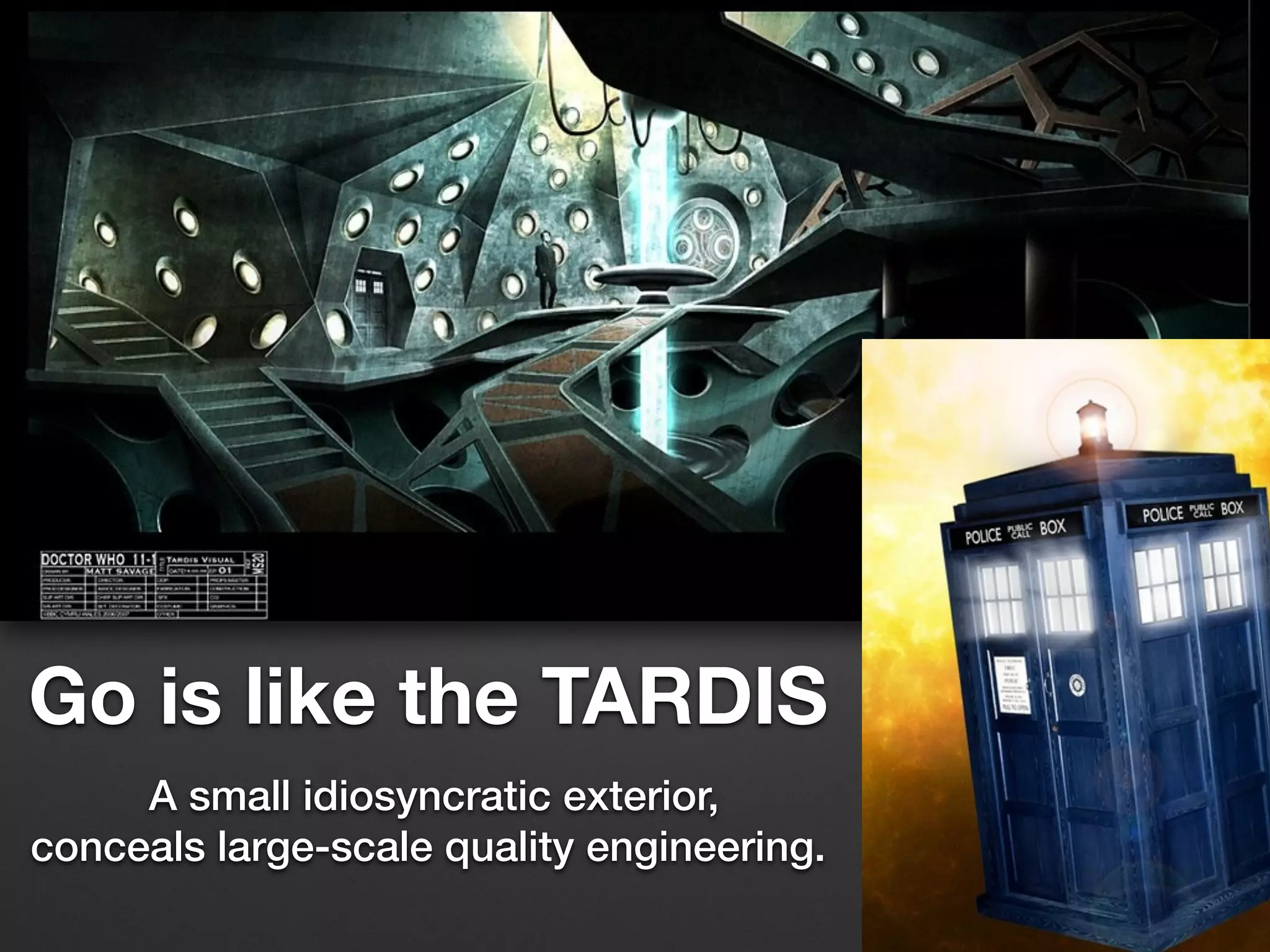
Go is like the TARDIS
A small idiosyncratic exterior,
conceals large-scale quality engineering.
Haxe is like a sonic screwdriver
An easy to use tool, built on engineering excellence,
that is useful in a wide range of situations.
overview
• Introduction to Go
• TARDIS Go transpiler
• Go —> Haxe issues
• Go/Haxe interaction
• Hopes & dreams
the birth of Go in 2007
“When the three of us got started, it was pure research.
The three of us got together and decided that we hated
C++.
...we started off with the idea that all three of us had to
be talked into every feature in the language, so there
was no extraneous garbage put into the language for
any reason.”
—Ken Thompson (who designed and implemented the
original Unix operating system)
the objectives of Go
• “Readable, safe, and efficient code.
• A build system that scales.
• Good concurrency support.
• Tools that can operate at Google-scale."
— Robert Griesemer (worked on code generation for
Google's V8 JavaScript engine)
–Bruce Eckel, author and
founding member of the ANSI/ISO C++ standard committee
“Now, Go makes much more sense for the
class of problems that C++ was originally
intended to solve.”
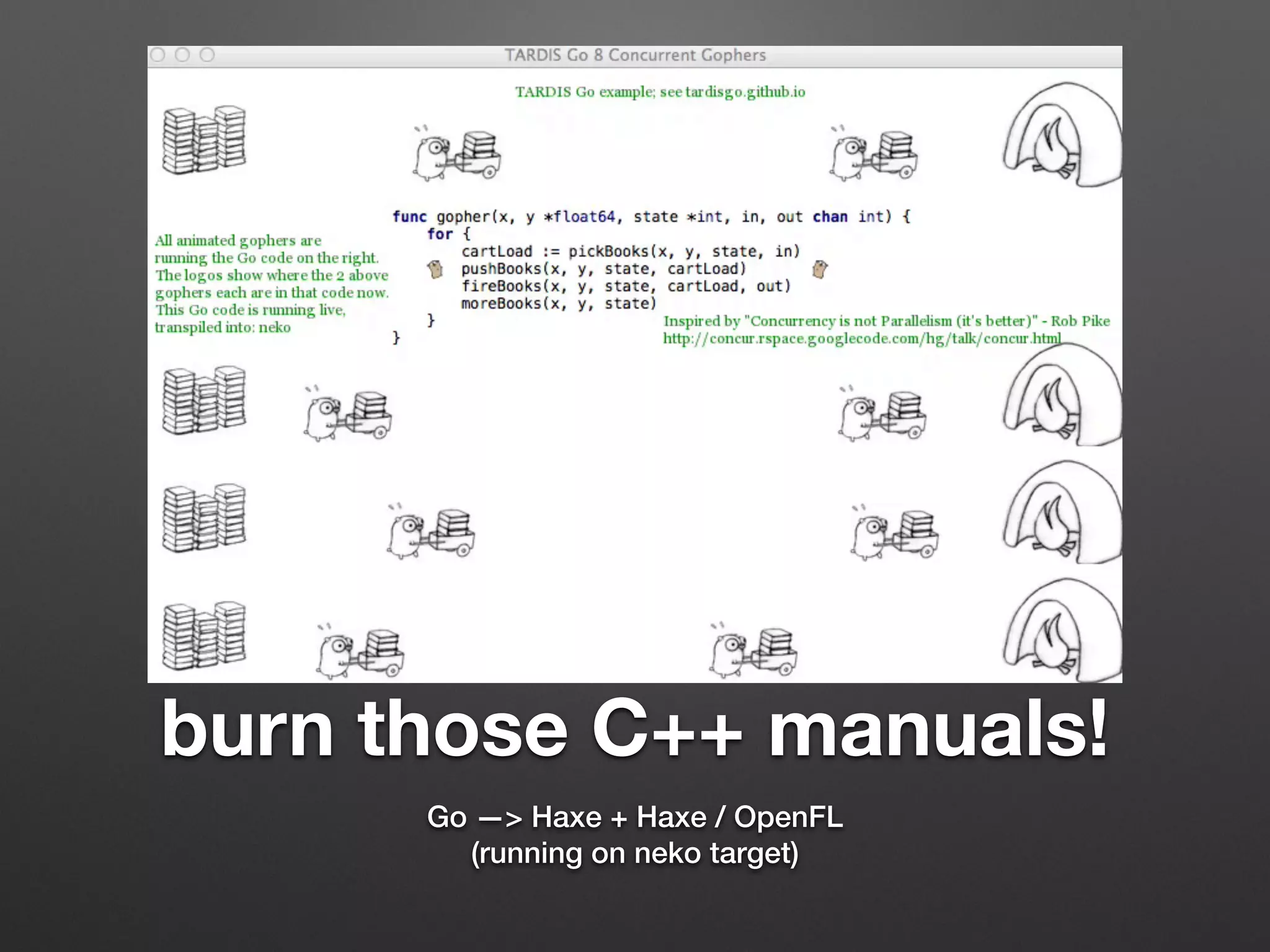
burn those C++ manuals!
Go —> Haxe + Haxe / OpenFL
(running on neko target)
Where is Go now?
• Open-source more than 4 years, 2 official compilers
• Google-scale usage: dl.google.com, youtube.com etc.
• Non-Google: docker.com, nsq.io, juju.ubuntu.com etc.
• 800 attendees at first conference last month in Denver
Go vs Haxe
• Github repos: Go >25,600; Haxe > 1,900
• Twitter: Go >11,100; Haxe >1,700
• Google+: Go+ >13,800; Haxe >800
• TIOBE Index for March 2014: Go #36; Haxe not listed
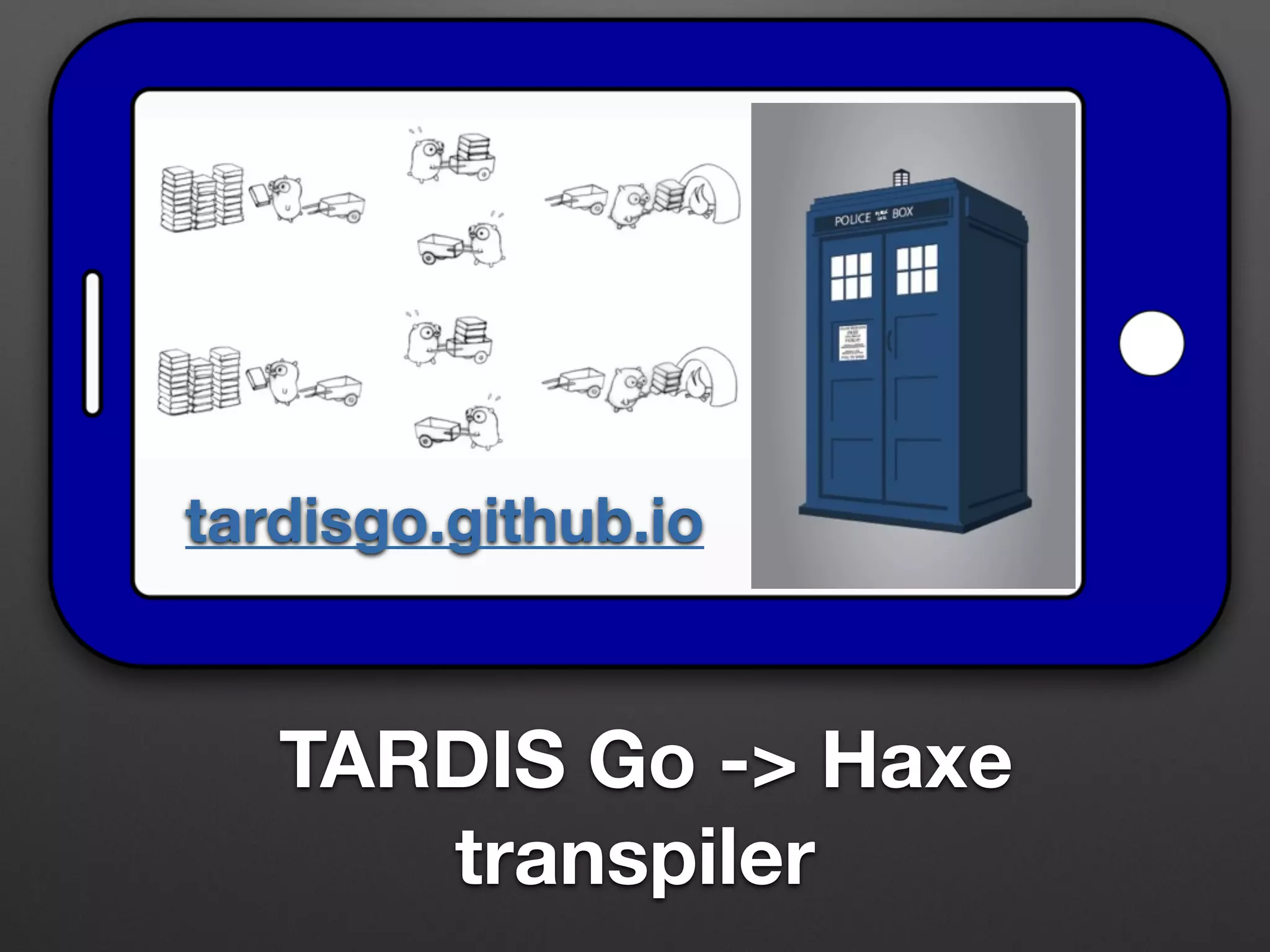
TARDIS Go -> Haxe
transpiler
tardisgo.github.io
TARDIS Go objectives
• Go running on Haxe cross-platform targets
• Go using cross-platform UI APIs like OpenFL
• Show that Haxe is viable as an intermediate language
• Create a viable Go/Haxe programming ecosystem
• Influence the future directions of Haxe and Go
concurrency
Go provides simple concurrency primitives:
• goroutines
• lightweight threads: “go doit(a,b,c)”
• channels
• typed thread-safe communication & synchronisation
• send: “ch <- 3” receive: “x, ok = <-ch”
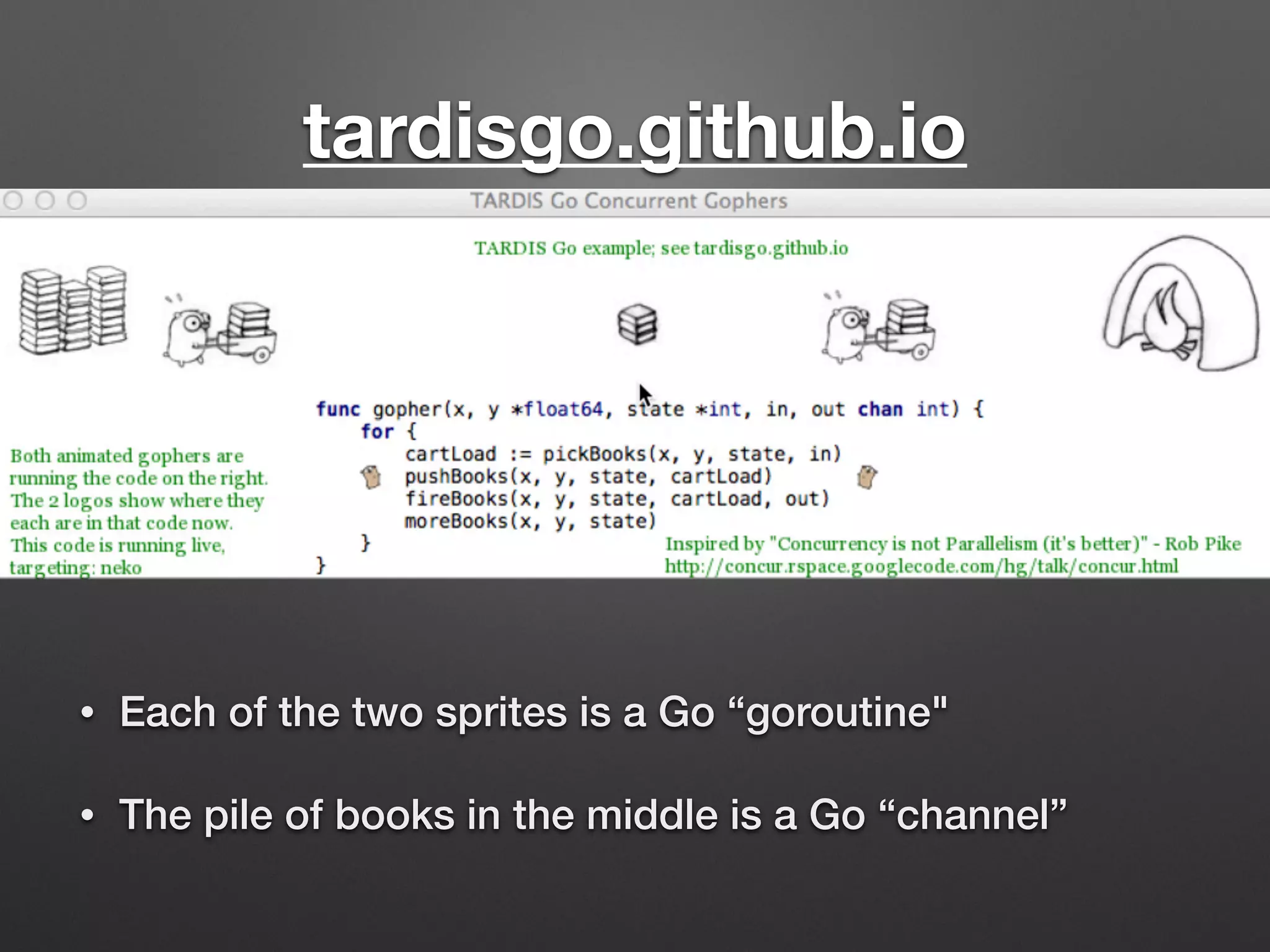
tardisgo.github.io
• Each of the two sprites is a Go “goroutine"
• The pile of books in the middle is a Go “channel”
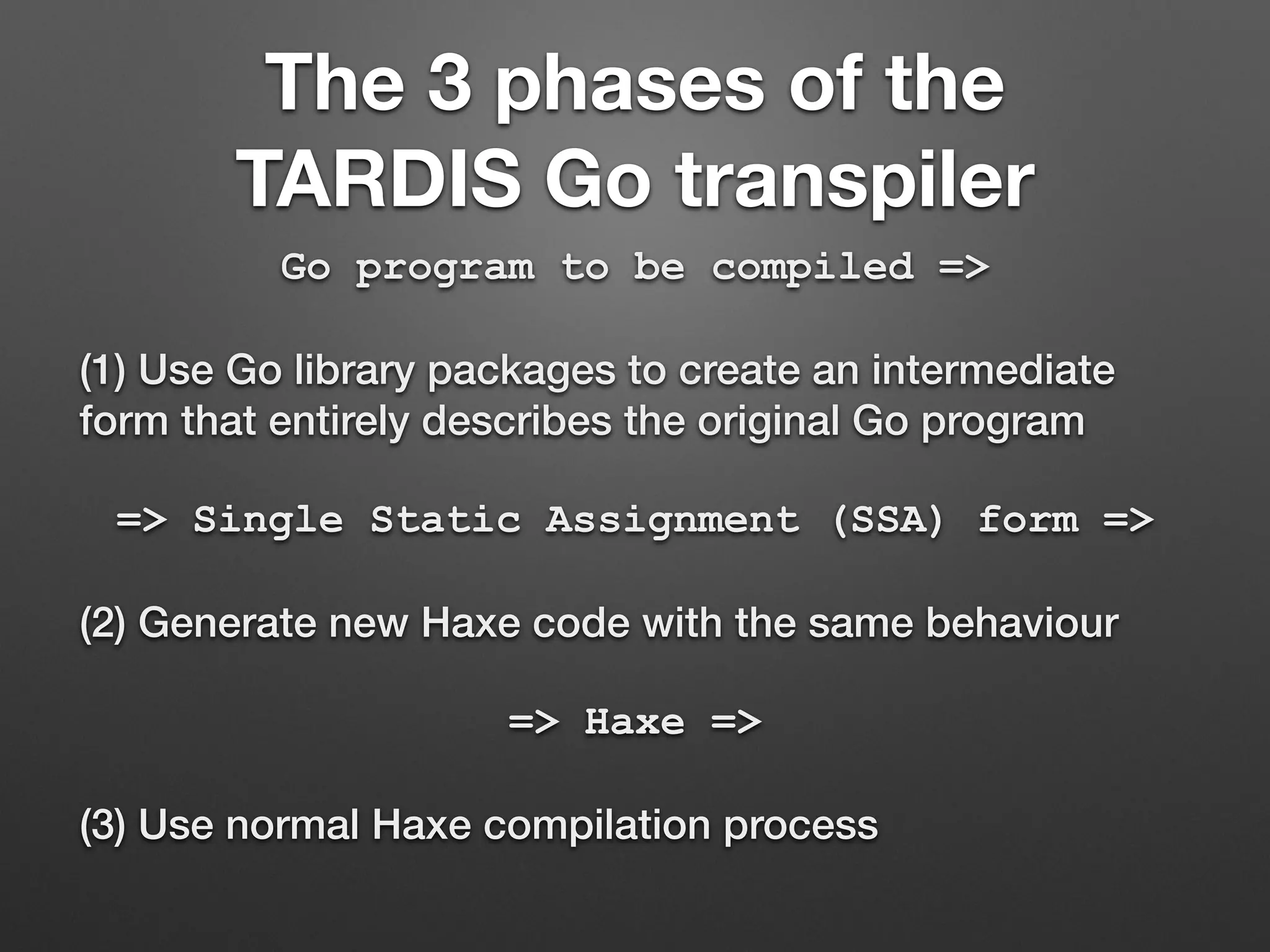
The 3 phases of the
TARDIS Go transpiler
Go program to be compiled =>
(1) Use Go library packages to create an intermediate
form that entirely describes the original Go program
=> Single Static Assignment (SSA) form =>
(2) Generate new Haxe code with the same behaviour
=> Haxe =>
(3) Use normal Haxe compilation process
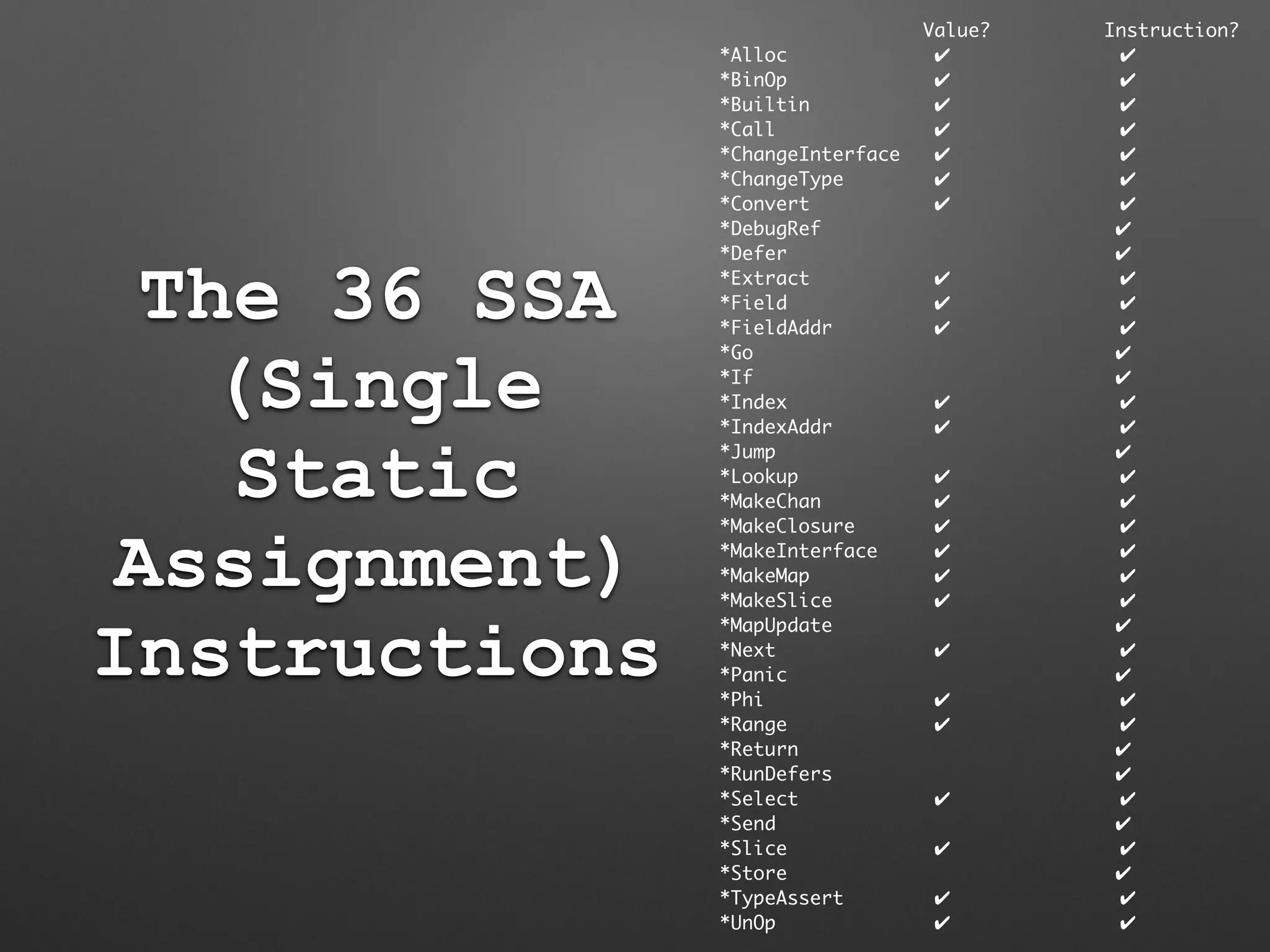
The 36 SSA
(Single
Static
Assignment)
Instructions
Value? Instruction? 	
*Alloc ✔ ✔	
*BinOp ✔ ✔	
*Builtin ✔ ✔	
*Call ✔ ✔	
*ChangeInterface ✔ ✔	
*ChangeType ✔ ✔	
*Convert ✔ ✔	
*DebugRef ✔	
*Defer ✔	
*Extract ✔ ✔	
*Field ✔ ✔	
*FieldAddr ✔ ✔	
*Go ✔	
*If ✔	
*Index ✔ ✔	
*IndexAddr ✔ ✔	
*Jump ✔	
*Lookup ✔ ✔	
*MakeChan ✔ ✔	
*MakeClosure ✔ ✔	
*MakeInterface ✔ ✔	
*MakeMap ✔ ✔	
*MakeSlice ✔ ✔	
*MapUpdate ✔	
*Next ✔ ✔	
*Panic ✔	
*Phi ✔ ✔	
*Range ✔ ✔	
*Return ✔	
*RunDefers ✔	
*Select ✔ ✔	
*Send ✔	
*Slice ✔ ✔	
*Store ✔	
*TypeAssert ✔ ✔	
*UnOp ✔ ✔
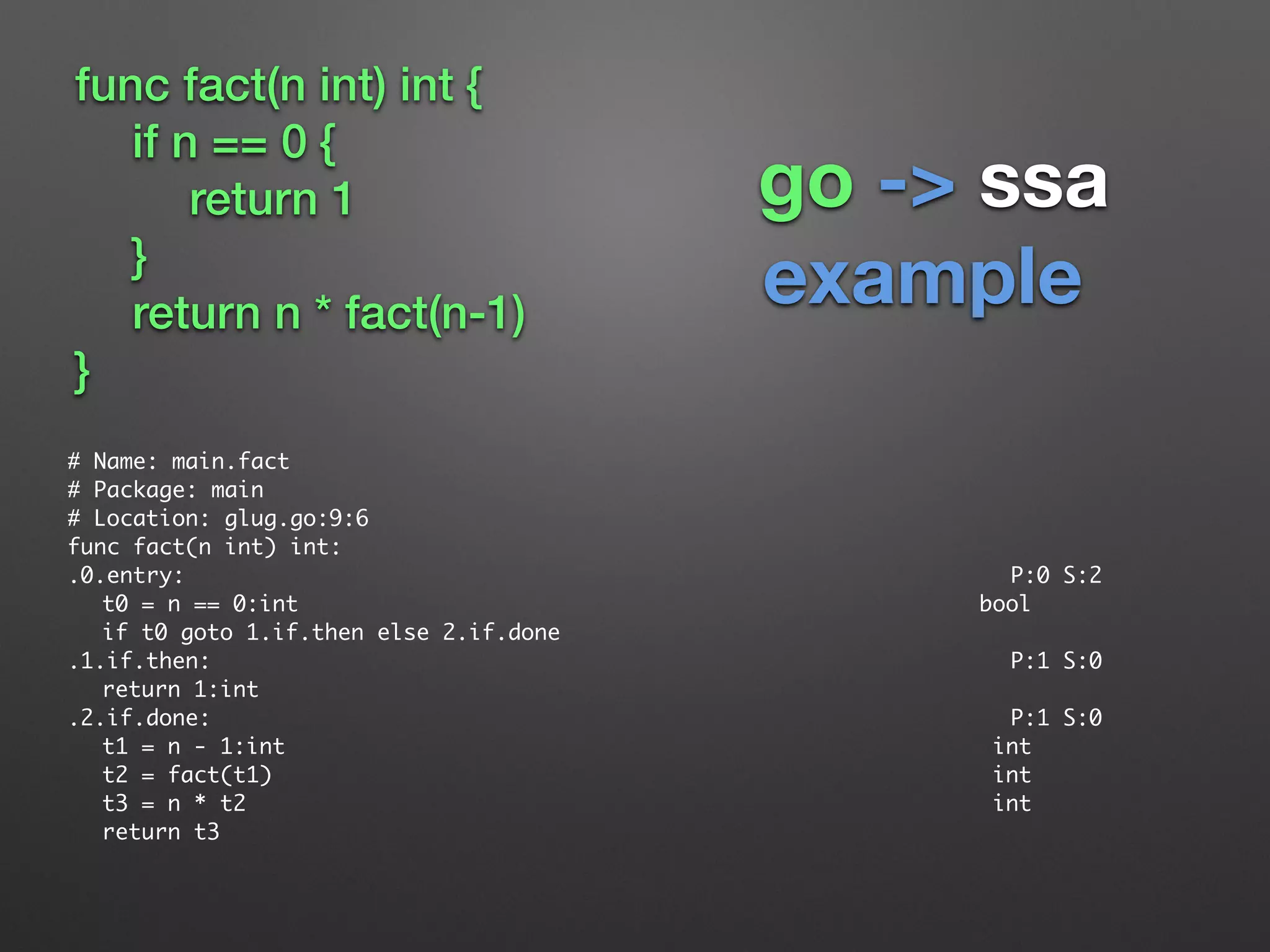
go -> ssa
example
# Name: main.fact	
# Package: main	
# Location: glug.go:9:6	
func fact(n int) int:	
.0.entry: P:0 S:2	
	 t0 = n == 0:int bool	
	 if t0 goto 1.if.then else 2.if.done	
.1.if.then: P:1 S:0	
	 return 1:int	
.2.if.done: P:1 S:0	
	 t1 = n - 1:int int	
	 t2 = fact(t1) int	
	 t3 = n * t2 int	
	 return t3	
!
!
func fact(n int) int {
if n == 0 {
return 1
}
return n * fact(n-1)
}
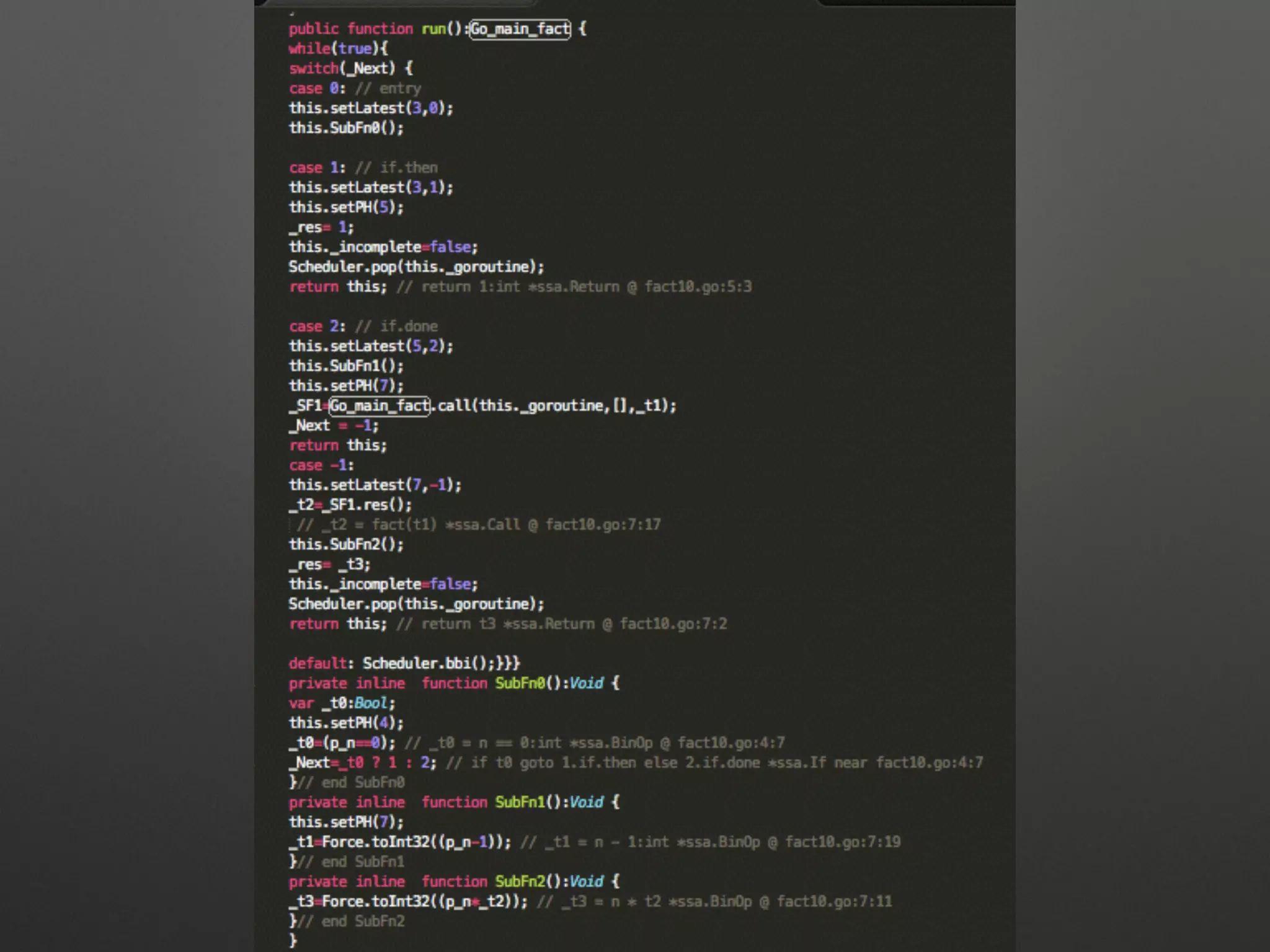
go -> ssa -> haxe
# Name: main.fact	
# Package: main	
# Location: glug.go:9:6	
func fact(n int) int:	
.0.entry:
	 t0 = n == 0:int
	 if t0 goto 1.if.then else 2.if.done	
.1.if.then:
	 return 1:int	
.2.if.done:
	 t1 = n - 1:int
	 t2 = fact(t1)
	 t3 = n * t2
	 return t3	
!
!
func fact(n int) int {
if n == 0 {
return 1
}
return n * fact(n-1)
}
!
public function run():Pogo_main_fact {	
while(true){	
switch(_Next) {	
case 0: // entry	
this.setLatest(9,0);	
this.SubFn0();	
case 1: // if.then	
this.setLatest(9,1);	
_res= 1;	
this._incomplete=false;	
Scheduler.pop(this._goroutine);	
return this; // return 1:int *ssa.Return @ glug.go:11:3	
case 2: // if.done	
this.setLatest(11,2);	
this.SubFn1();	
_SF1=Pogo_main_fact.call(this._goroutine,[],_t1);	
_Next = -1;	
return this;	
case -1:	
this.setLatest(13,-1);	
_t2=_SF1.res();	
// _t2 = fact(t1) *ssa.Call @ glug.go:13:15	
this.SubFn2();	
_res= _t3;	
this._incomplete=false;	
Scheduler.pop(this._goroutine);	
return this; // return t3 *ssa.Return @ glug.go:14:2	
default: throw "Next?";}}}	
private inline function SubFn0():Void {	
var _t0:Bool;	
_t0=(p_n==0); // _t0 = n == 0:int *ssa.BinOp @ glug.go:10:7	
_Next=_t0 ? 1 : 2; // if t0 goto 1.if.then else 2.if.done *ssa.If near glug.go:10:7	
}// end SubFn0	
private inline function SubFn1():Void {	
_t1=(p_n-1); // _t1 = n - 1:int *ssa.BinOp @ glug.go:13:17	
}// end SubFn1	
private inline function SubFn2():Void {	
_t3=(p_n*_t2); // _t3 = n * t2 *ssa.BinOp @ glug.go:13:9	
}// end SubFn2	
!
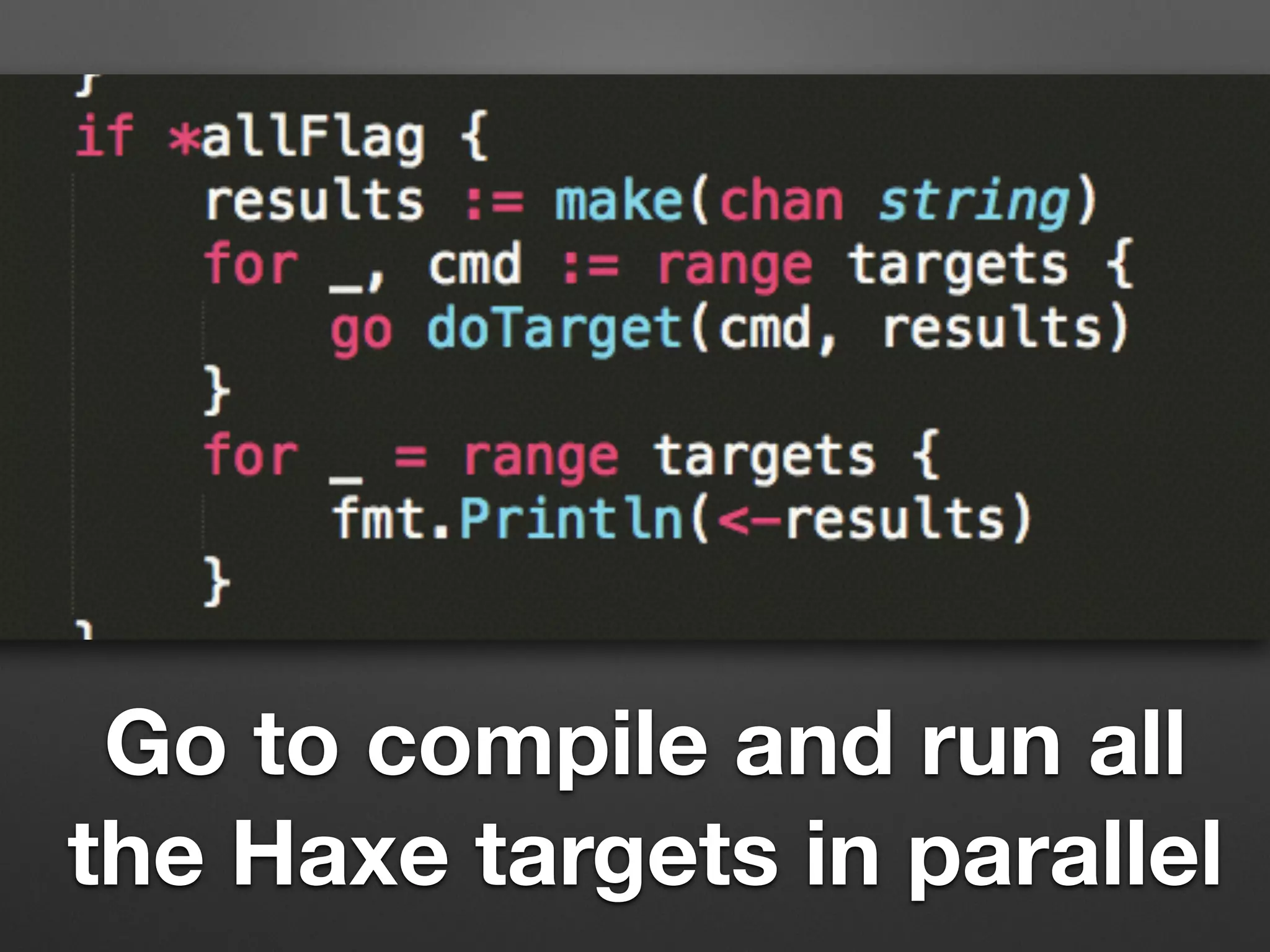
Go to compile and run all
the Haxe targets in parallel
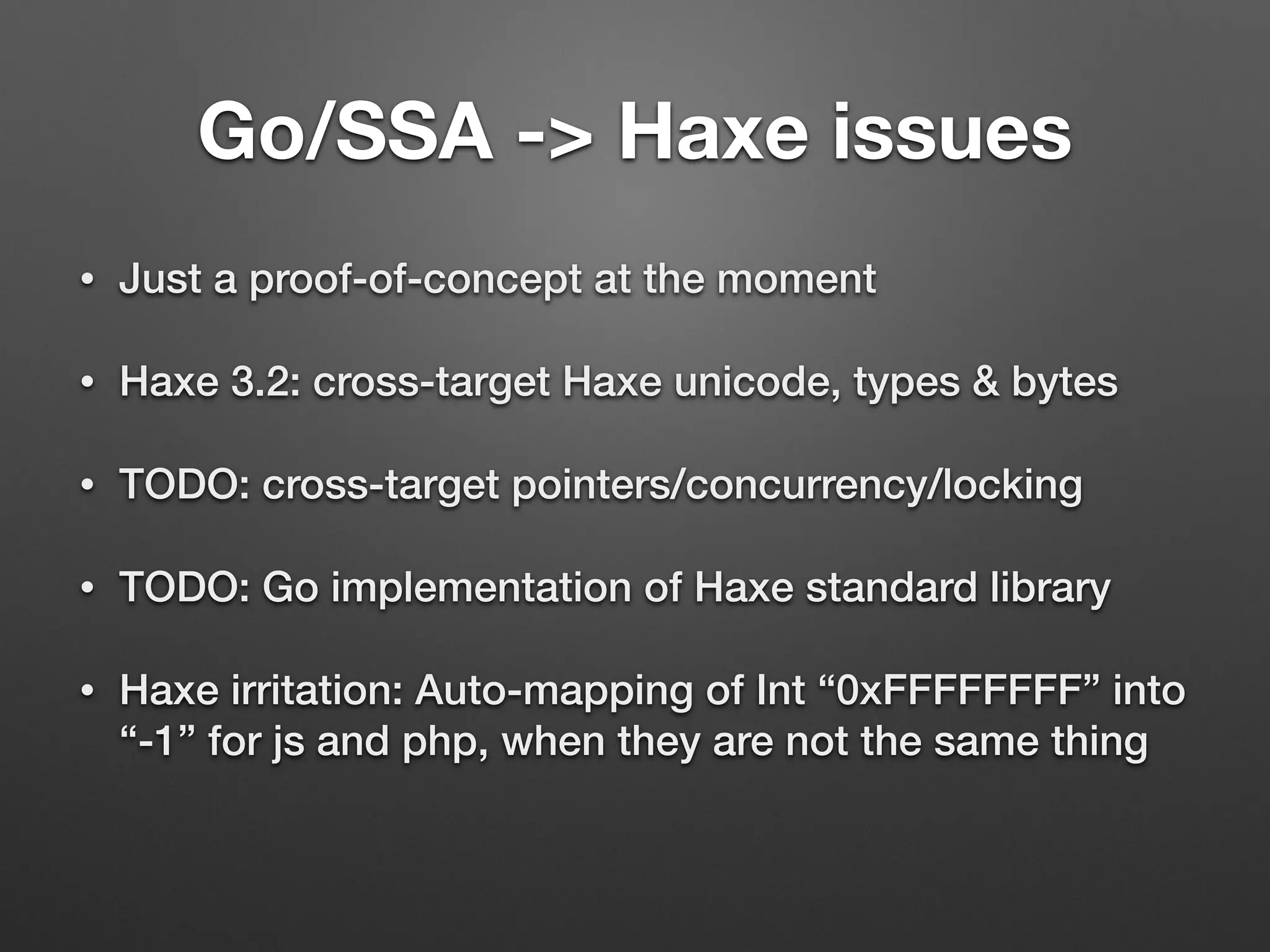
Go/SSA -> Haxe issues
• Just a proof-of-concept at the moment
• Haxe 3.2: cross-target Haxe unicode, types & bytes
• TODO: cross-target pointers/concurrency/locking
• TODO: Go implementation of Haxe standard library
• Haxe irritation: Auto-mapping of Int “0xFFFFFFFF” into
“-1” for js and php, when they are not the same thing
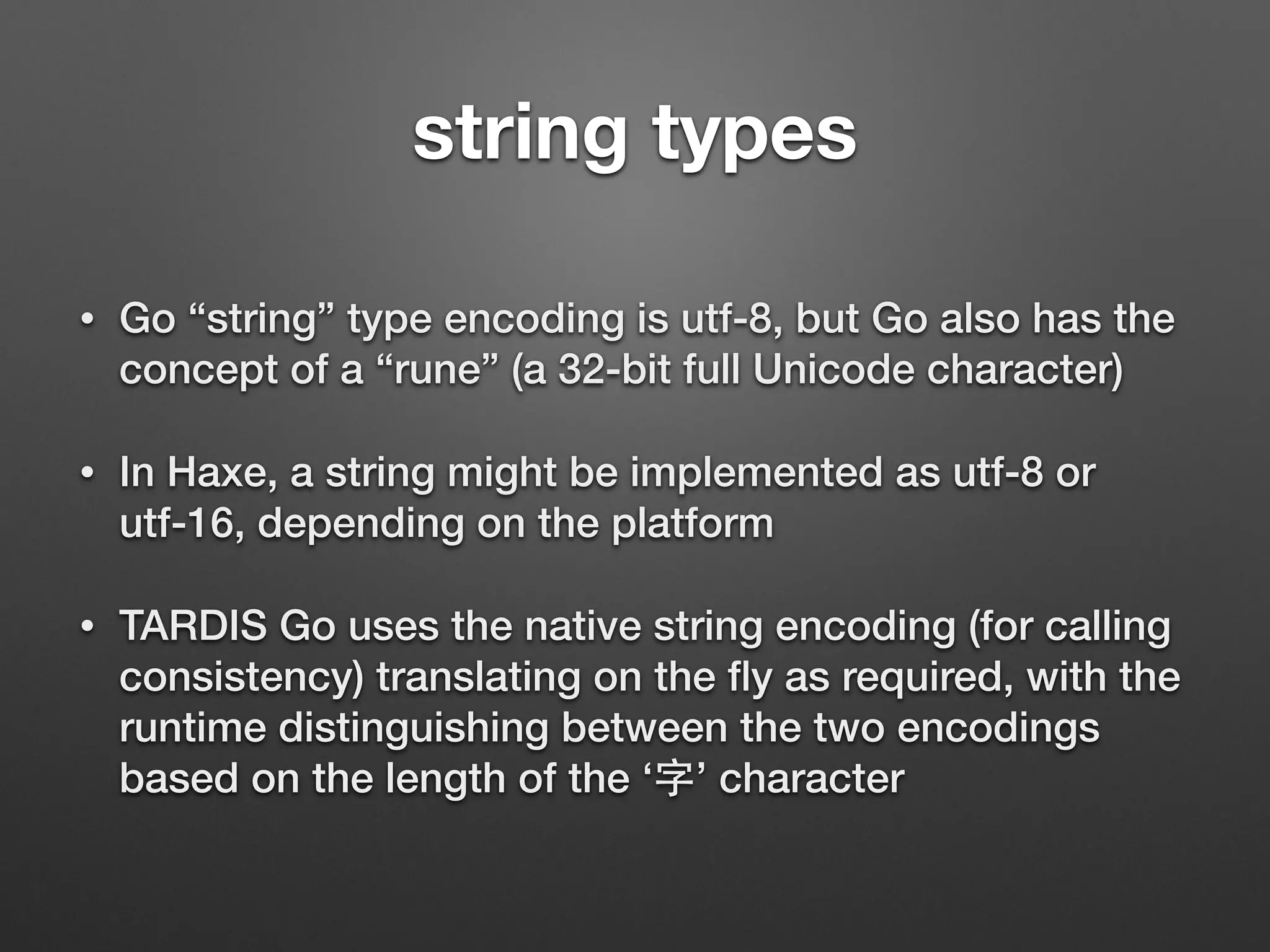
• Go “string” type encoding is utf-8, but Go also has the
concept of a “rune” (a 32-bit full Unicode character)
• In Haxe, a string might be implemented as utf-8 or
utf-16, depending on the platform
• TARDIS Go uses the native string encoding (for calling
consistency) translating on the fly as required, with the
runtime distinguishing between the two encodings
based on the length of the ‘字’ character
string types
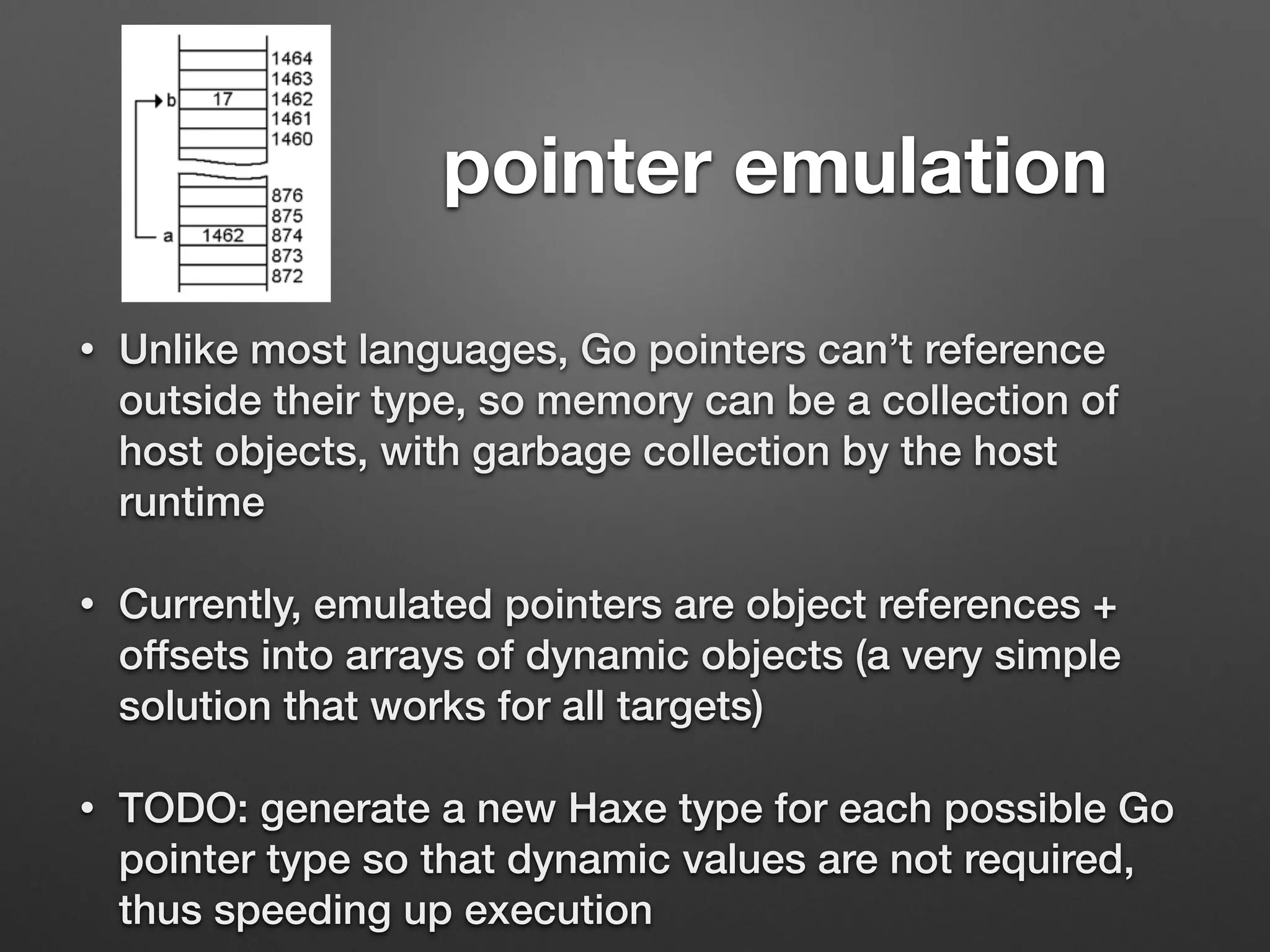
pointer emulation
• Unlike most languages, Go pointers can’t reference
outside their type, so memory can be a collection of
host objects, with garbage collection by the host
runtime
• Currently, emulated pointers are object references +
offsets into arrays of dynamic objects (a very simple
solution that works for all targets)
• TODO: generate a new Haxe type for each possible Go
pointer type so that dynamic values are not required,
thus speeding up execution
goroutines
• Implemented using co-routines, emulating multiple
stacks
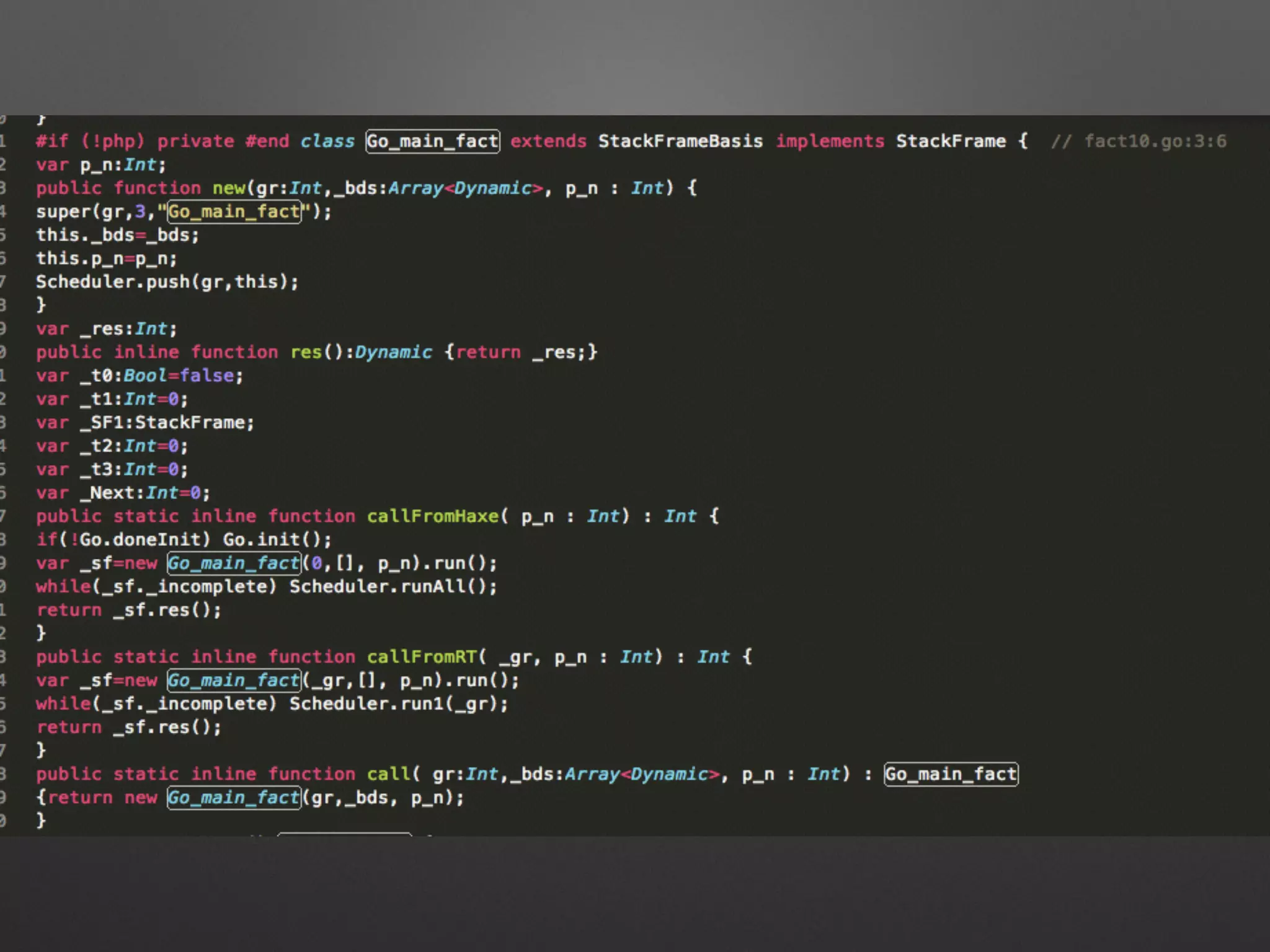
• Each Go function is a Haxe class, with all the local
Go variables
• SSA block # used as the Program Counter
• Haxe timer and other events run the co-routines
goroutine TODO
• improve by using threads, for Haxe targets that
support them
• Don’t implement goroutines if not used, they add a
significant execution overhead and are not always
required
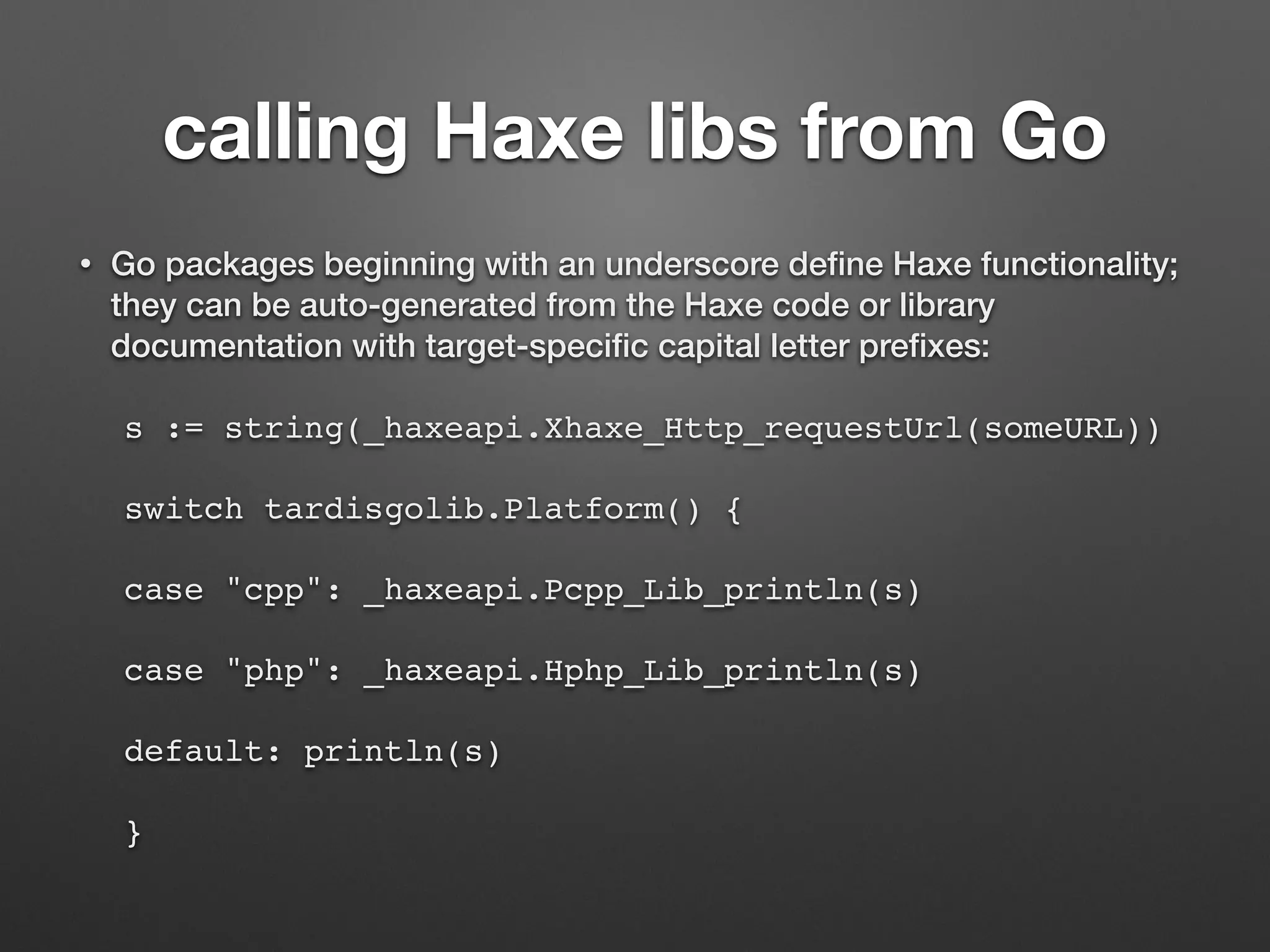
calling Haxe libs from Go
• Go packages beginning with an underscore define Haxe functionality;
they can be auto-generated from the Haxe code or library
documentation with target-specific capital letter prefixes:
s := string(_haxeapi.Xhaxe_Http_requestUrl(someURL))!
switch tardisgolib.Platform() {!
case "cpp": _haxeapi.Pcpp_Lib_println(s)!
case "php": _haxeapi.Hphp_Lib_println(s)!
default: println(s)!
}
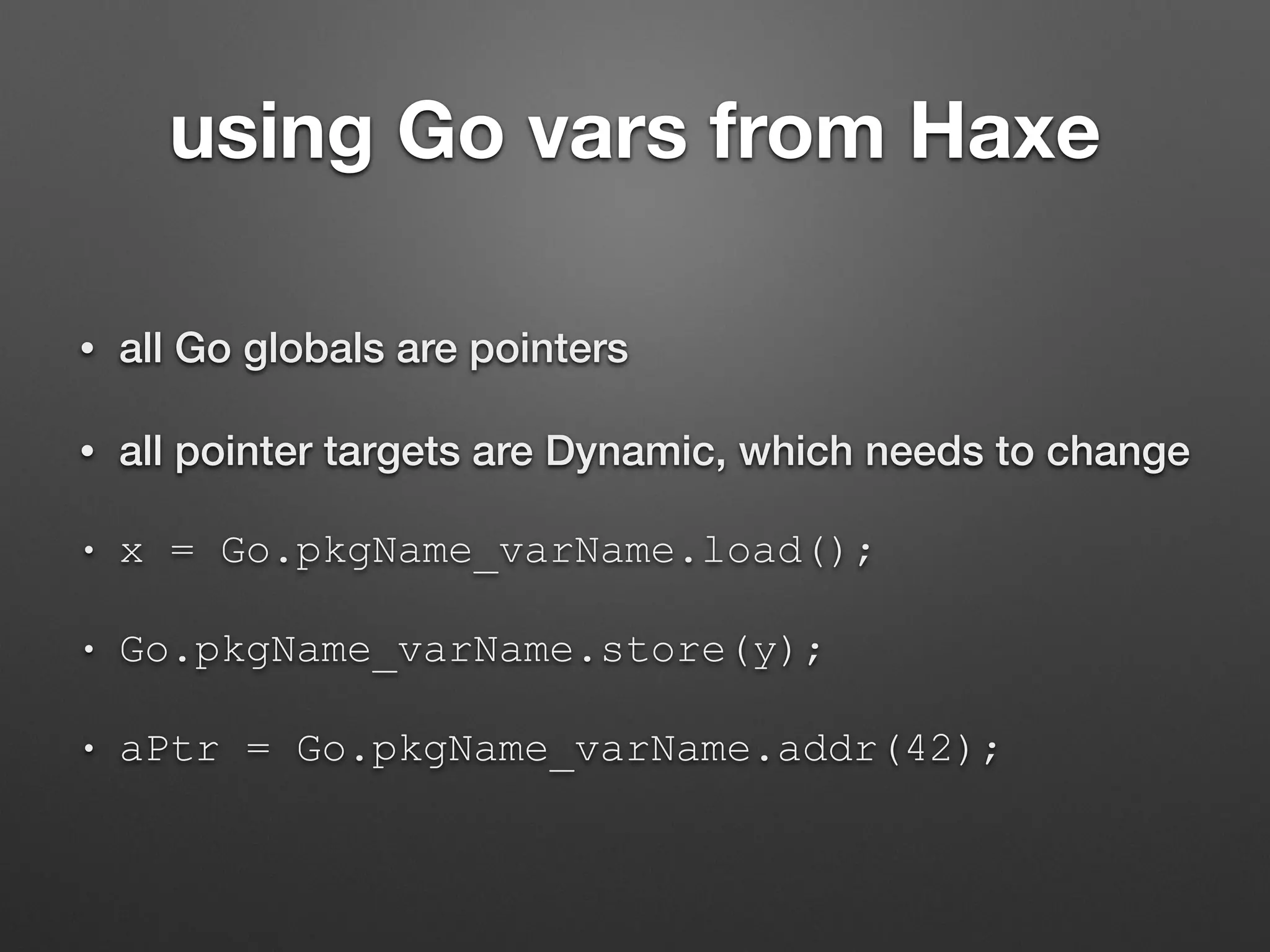
using Go vars from Haxe
• all Go globals are pointers
• all pointer targets are Dynamic, which needs to change
• x = Go.pkgName_varName.load();
• Go.pkgName_varName.store(y);
• aPtr = Go.pkgName_varName.addr(42);
calling Go code from Haxe
• x=Go.Go_pkgNam_funcNam.callFromHaxe(y,z);
• TODO: there is a need to build a simple
“methodFromHaxe” calling interface, as using Go
methods from Haxe is currently too complex, for
example:
• _SF1=Go__star_main_dot_rect_area.call(this
._goroutine,[],_t0); // by reference
• _SF2=Go_main_dot_rect_perim.call(this._gor
outine,[],Deep.copy(_t5)); // by value
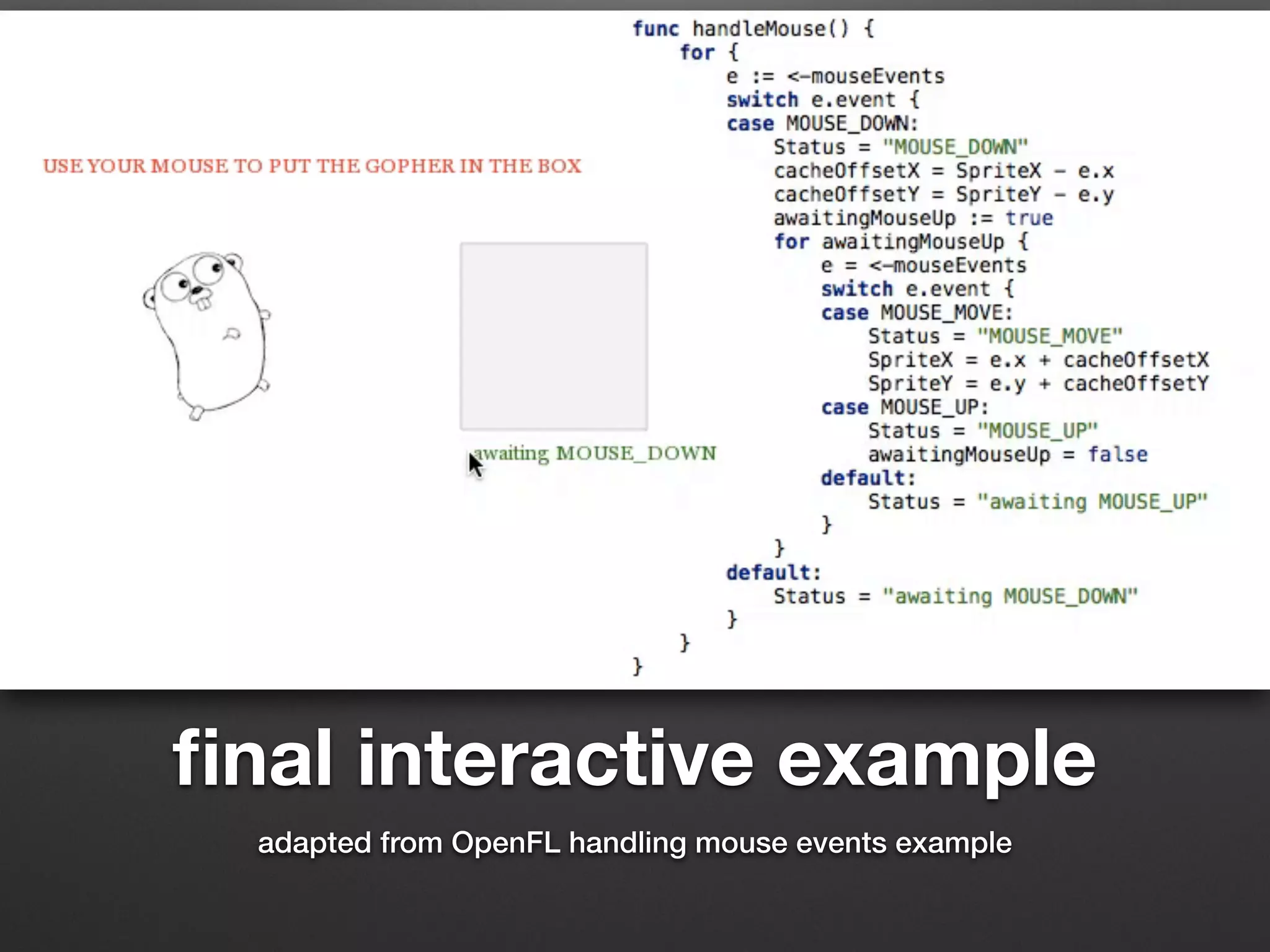
final interactive example
adapted from OpenFL handling mouse events example
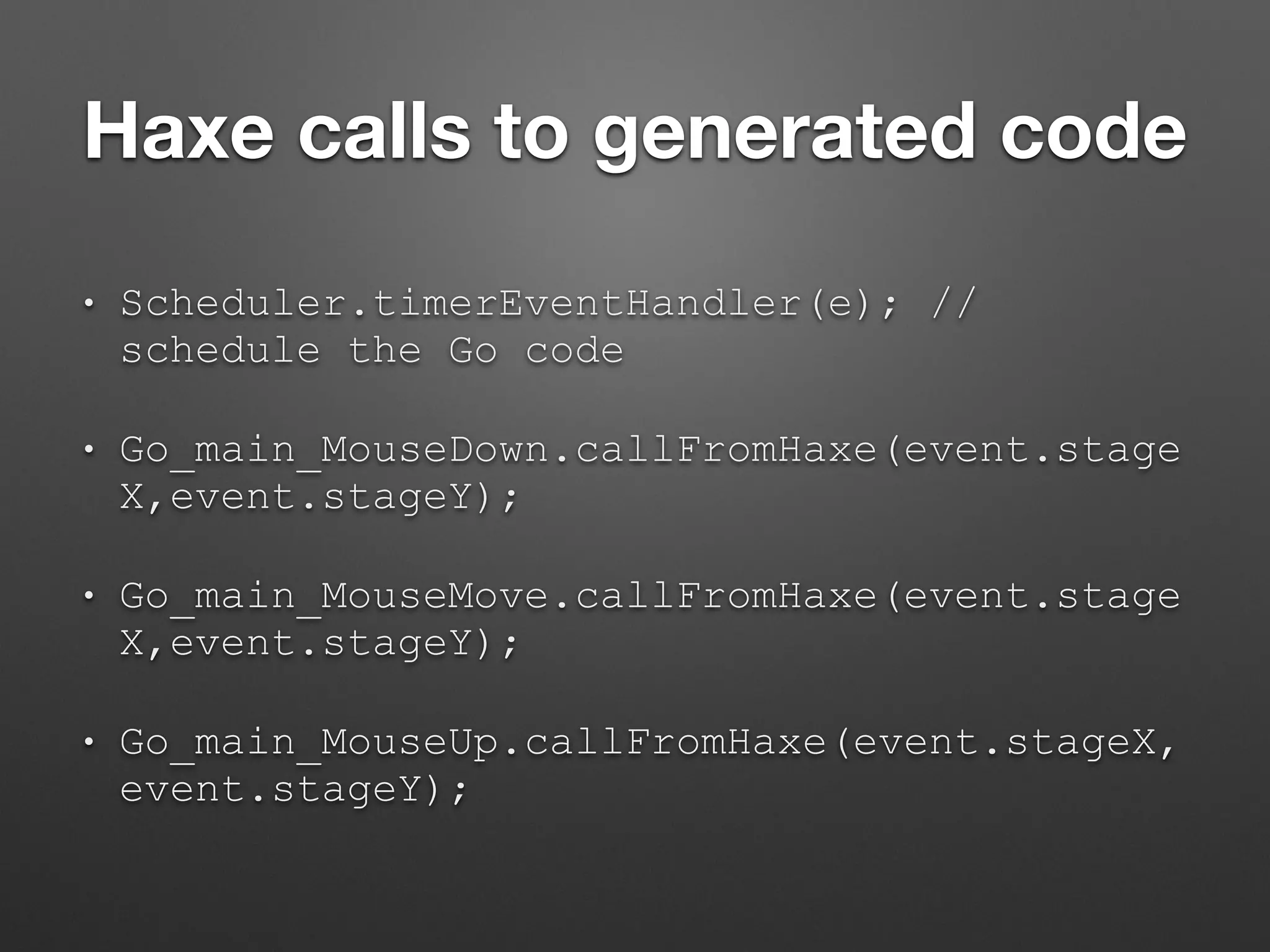
Haxe calls to generated code
• Scheduler.timerEventHandler(e); //
schedule the Go code
• Go_main_MouseDown.callFromHaxe(event.stage
X,event.stageY);
• Go_main_MouseMove.callFromHaxe(event.stage
X,event.stageY);
• Go_main_MouseUp.callFromHaxe(event.stageX,
event.stageY);
Haxe -> Go
• https://code.google.com/p/haxego/ by Lee Sylvester
seems to be inactive
• Efficient server-side operation & concurrency support
• Shared runtime library with TARDIS Go
• Go style concurrency in Haxe?
? -> Haxe -> ?
• TARDIS Go
• Tarwin's AS3 to Haxe Conversion Script
• Typescript to Haxe Conversion Script
• PHP to Haxe Conversion Utility
• CS2HX - C# to haXe converter
• Write a LLVM or GCC compiler Haxe back-end?
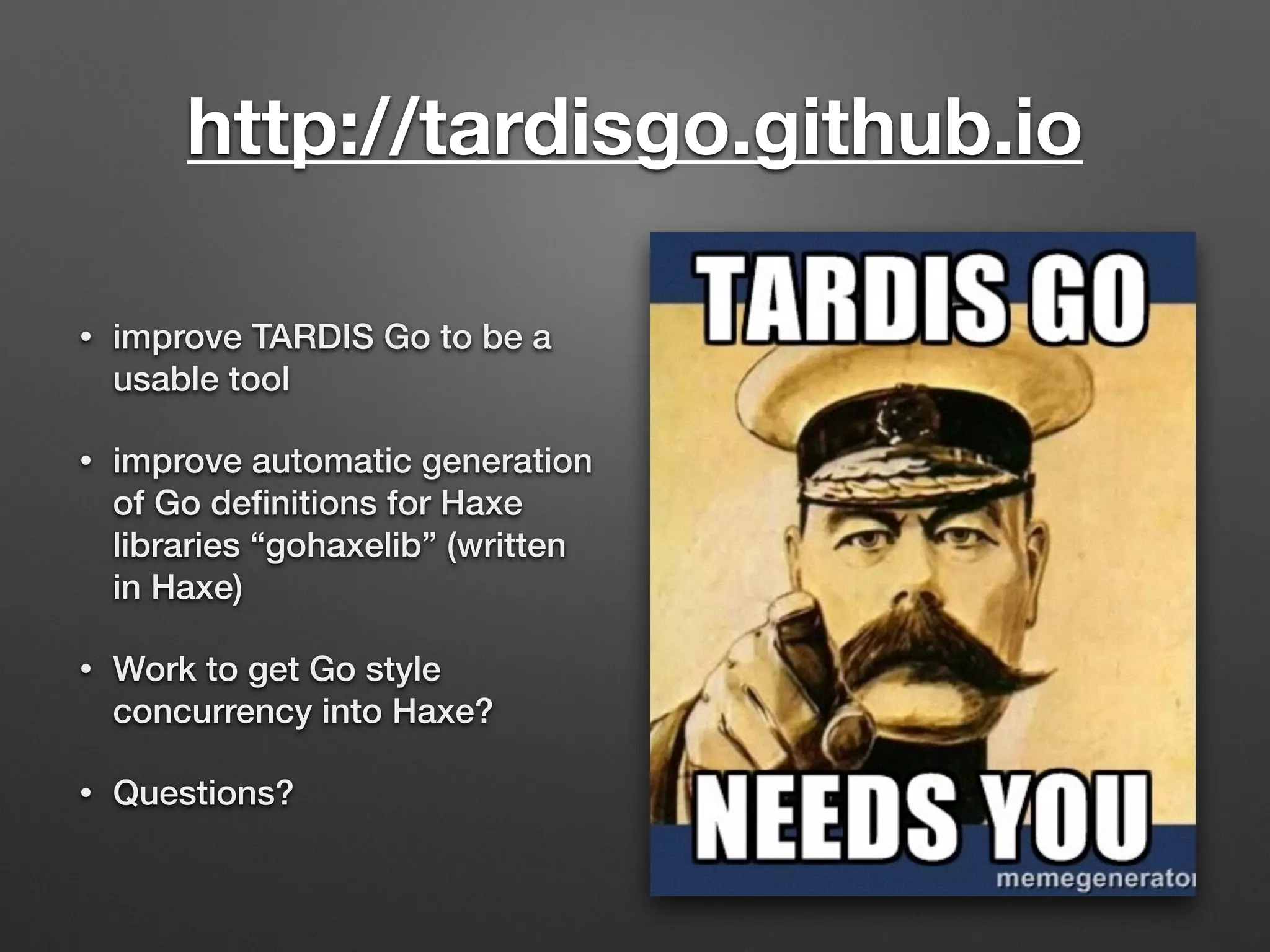
http://tardisgo.github.io
• improve TARDIS Go to be a
usable tool
• improve automatic generation
of Go definitions for Haxe
libraries “gohaxelib” (written
in Haxe)
• Work to get Go style
concurrency into Haxe?
• Questions?
Image Sources
• Gopher Logo by Renée French
• TARDIS image (c) BBC from http://bbc.co.uk
• http://commons.wikimedia.org/
• http://www.wikipedia.org/
• http://memegenerator.net/Your-Country-Needs-You
• Project related images from relevant project sites
• Other images self-created

WWX2014 speech : Elliott Stoneham "Tardis go"

  • 1.
    TARDIS: Go forHaxe! A talk by Elliott Stoneham at WWX2014 on 24th May 2014
  • 2.
    Haxe as acompilation target for other languages a new use-case
  • 3.
    • 50 yearsago: watched very first Dr Who episode • 40 years ago: started programming (punch cards) • 20 years ago: became a manager • 10 years ago: stopped programming • 1 year ago: discovered Go and Haxe…
  • 4.
    Go is likethe TARDIS A small idiosyncratic exterior, conceals large-scale quality engineering.
  • 5.
    Haxe is likea sonic screwdriver An easy to use tool, built on engineering excellence, that is useful in a wide range of situations.
  • 6.
    overview • Introduction toGo • TARDIS Go transpiler • Go —> Haxe issues • Go/Haxe interaction • Hopes & dreams
  • 7.
    the birth ofGo in 2007 “When the three of us got started, it was pure research. The three of us got together and decided that we hated C++. ...we started off with the idea that all three of us had to be talked into every feature in the language, so there was no extraneous garbage put into the language for any reason.” —Ken Thompson (who designed and implemented the original Unix operating system)
  • 8.
    the objectives ofGo • “Readable, safe, and efficient code. • A build system that scales. • Good concurrency support. • Tools that can operate at Google-scale." — Robert Griesemer (worked on code generation for Google's V8 JavaScript engine)
  • 9.
    –Bruce Eckel, authorand founding member of the ANSI/ISO C++ standard committee “Now, Go makes much more sense for the class of problems that C++ was originally intended to solve.”
  • 10.
    burn those C++manuals! Go —> Haxe + Haxe / OpenFL (running on neko target)
  • 11.
    Where is Gonow? • Open-source more than 4 years, 2 official compilers • Google-scale usage: dl.google.com, youtube.com etc. • Non-Google: docker.com, nsq.io, juju.ubuntu.com etc. • 800 attendees at first conference last month in Denver
  • 12.
    Go vs Haxe •Github repos: Go >25,600; Haxe > 1,900 • Twitter: Go >11,100; Haxe >1,700 • Google+: Go+ >13,800; Haxe >800 • TIOBE Index for March 2014: Go #36; Haxe not listed
  • 13.
    TARDIS Go ->Haxe transpiler tardisgo.github.io
  • 14.
    TARDIS Go objectives •Go running on Haxe cross-platform targets • Go using cross-platform UI APIs like OpenFL • Show that Haxe is viable as an intermediate language • Create a viable Go/Haxe programming ecosystem • Influence the future directions of Haxe and Go
  • 15.
    concurrency Go provides simpleconcurrency primitives: • goroutines • lightweight threads: “go doit(a,b,c)” • channels • typed thread-safe communication & synchronisation • send: “ch <- 3” receive: “x, ok = <-ch”
  • 16.
    tardisgo.github.io • Each ofthe two sprites is a Go “goroutine" • The pile of books in the middle is a Go “channel”
  • 17.
    The 3 phasesof the TARDIS Go transpiler Go program to be compiled => (1) Use Go library packages to create an intermediate form that entirely describes the original Go program => Single Static Assignment (SSA) form => (2) Generate new Haxe code with the same behaviour => Haxe => (3) Use normal Haxe compilation process
  • 18.
    The 36 SSA (Single Static Assignment) Instructions Value?Instruction? *Alloc ✔ ✔ *BinOp ✔ ✔ *Builtin ✔ ✔ *Call ✔ ✔ *ChangeInterface ✔ ✔ *ChangeType ✔ ✔ *Convert ✔ ✔ *DebugRef ✔ *Defer ✔ *Extract ✔ ✔ *Field ✔ ✔ *FieldAddr ✔ ✔ *Go ✔ *If ✔ *Index ✔ ✔ *IndexAddr ✔ ✔ *Jump ✔ *Lookup ✔ ✔ *MakeChan ✔ ✔ *MakeClosure ✔ ✔ *MakeInterface ✔ ✔ *MakeMap ✔ ✔ *MakeSlice ✔ ✔ *MapUpdate ✔ *Next ✔ ✔ *Panic ✔ *Phi ✔ ✔ *Range ✔ ✔ *Return ✔ *RunDefers ✔ *Select ✔ ✔ *Send ✔ *Slice ✔ ✔ *Store ✔ *TypeAssert ✔ ✔ *UnOp ✔ ✔
  • 19.
    go -> ssa example #Name: main.fact # Package: main # Location: glug.go:9:6 func fact(n int) int: .0.entry: P:0 S:2 t0 = n == 0:int bool if t0 goto 1.if.then else 2.if.done .1.if.then: P:1 S:0 return 1:int .2.if.done: P:1 S:0 t1 = n - 1:int int t2 = fact(t1) int t3 = n * t2 int return t3 ! ! func fact(n int) int { if n == 0 { return 1 } return n * fact(n-1) }
  • 20.
    go -> ssa-> haxe # Name: main.fact # Package: main # Location: glug.go:9:6 func fact(n int) int: .0.entry: t0 = n == 0:int if t0 goto 1.if.then else 2.if.done .1.if.then: return 1:int .2.if.done: t1 = n - 1:int t2 = fact(t1) t3 = n * t2 return t3 ! ! func fact(n int) int { if n == 0 { return 1 } return n * fact(n-1) } ! public function run():Pogo_main_fact { while(true){ switch(_Next) { case 0: // entry this.setLatest(9,0); this.SubFn0(); case 1: // if.then this.setLatest(9,1); _res= 1; this._incomplete=false; Scheduler.pop(this._goroutine); return this; // return 1:int *ssa.Return @ glug.go:11:3 case 2: // if.done this.setLatest(11,2); this.SubFn1(); _SF1=Pogo_main_fact.call(this._goroutine,[],_t1); _Next = -1; return this; case -1: this.setLatest(13,-1); _t2=_SF1.res(); // _t2 = fact(t1) *ssa.Call @ glug.go:13:15 this.SubFn2(); _res= _t3; this._incomplete=false; Scheduler.pop(this._goroutine); return this; // return t3 *ssa.Return @ glug.go:14:2 default: throw "Next?";}}} private inline function SubFn0():Void { var _t0:Bool; _t0=(p_n==0); // _t0 = n == 0:int *ssa.BinOp @ glug.go:10:7 _Next=_t0 ? 1 : 2; // if t0 goto 1.if.then else 2.if.done *ssa.If near glug.go:10:7 }// end SubFn0 private inline function SubFn1():Void { _t1=(p_n-1); // _t1 = n - 1:int *ssa.BinOp @ glug.go:13:17 }// end SubFn1 private inline function SubFn2():Void { _t3=(p_n*_t2); // _t3 = n * t2 *ssa.BinOp @ glug.go:13:9 }// end SubFn2 !
  • 22.
    Go to compileand run all the Haxe targets in parallel
  • 23.
    Go/SSA -> Haxeissues • Just a proof-of-concept at the moment • Haxe 3.2: cross-target Haxe unicode, types & bytes • TODO: cross-target pointers/concurrency/locking • TODO: Go implementation of Haxe standard library • Haxe irritation: Auto-mapping of Int “0xFFFFFFFF” into “-1” for js and php, when they are not the same thing
  • 24.
    • Go “string”type encoding is utf-8, but Go also has the concept of a “rune” (a 32-bit full Unicode character) • In Haxe, a string might be implemented as utf-8 or utf-16, depending on the platform • TARDIS Go uses the native string encoding (for calling consistency) translating on the fly as required, with the runtime distinguishing between the two encodings based on the length of the ‘字’ character string types
  • 25.
    pointer emulation • Unlikemost languages, Go pointers can’t reference outside their type, so memory can be a collection of host objects, with garbage collection by the host runtime • Currently, emulated pointers are object references + offsets into arrays of dynamic objects (a very simple solution that works for all targets) • TODO: generate a new Haxe type for each possible Go pointer type so that dynamic values are not required, thus speeding up execution
  • 26.
    goroutines • Implemented usingco-routines, emulating multiple stacks • Each Go function is a Haxe class, with all the local Go variables • SSA block # used as the Program Counter • Haxe timer and other events run the co-routines
  • 29.
    goroutine TODO • improveby using threads, for Haxe targets that support them • Don’t implement goroutines if not used, they add a significant execution overhead and are not always required
  • 30.
    calling Haxe libsfrom Go • Go packages beginning with an underscore define Haxe functionality; they can be auto-generated from the Haxe code or library documentation with target-specific capital letter prefixes: s := string(_haxeapi.Xhaxe_Http_requestUrl(someURL))! switch tardisgolib.Platform() {! case "cpp": _haxeapi.Pcpp_Lib_println(s)! case "php": _haxeapi.Hphp_Lib_println(s)! default: println(s)! }
  • 31.
    using Go varsfrom Haxe • all Go globals are pointers • all pointer targets are Dynamic, which needs to change • x = Go.pkgName_varName.load(); • Go.pkgName_varName.store(y); • aPtr = Go.pkgName_varName.addr(42);
  • 32.
    calling Go codefrom Haxe • x=Go.Go_pkgNam_funcNam.callFromHaxe(y,z); • TODO: there is a need to build a simple “methodFromHaxe” calling interface, as using Go methods from Haxe is currently too complex, for example: • _SF1=Go__star_main_dot_rect_area.call(this ._goroutine,[],_t0); // by reference • _SF2=Go_main_dot_rect_perim.call(this._gor outine,[],Deep.copy(_t5)); // by value
  • 33.
    final interactive example adaptedfrom OpenFL handling mouse events example
  • 34.
    Haxe calls togenerated code • Scheduler.timerEventHandler(e); // schedule the Go code • Go_main_MouseDown.callFromHaxe(event.stage X,event.stageY); • Go_main_MouseMove.callFromHaxe(event.stage X,event.stageY); • Go_main_MouseUp.callFromHaxe(event.stageX, event.stageY);
  • 35.
    Haxe -> Go •https://code.google.com/p/haxego/ by Lee Sylvester seems to be inactive • Efficient server-side operation & concurrency support • Shared runtime library with TARDIS Go • Go style concurrency in Haxe?
  • 36.
    ? -> Haxe-> ? • TARDIS Go • Tarwin's AS3 to Haxe Conversion Script • Typescript to Haxe Conversion Script • PHP to Haxe Conversion Utility • CS2HX - C# to haXe converter • Write a LLVM or GCC compiler Haxe back-end?
  • 37.
    http://tardisgo.github.io • improve TARDISGo to be a usable tool • improve automatic generation of Go definitions for Haxe libraries “gohaxelib” (written in Haxe) • Work to get Go style concurrency into Haxe? • Questions?
  • 38.
    Image Sources • GopherLogo by Renée French • TARDIS image (c) BBC from http://bbc.co.uk • http://commons.wikimedia.org/ • http://www.wikipedia.org/ • http://memegenerator.net/Your-Country-Needs-You • Project related images from relevant project sites • Other images self-created