Kelsey Hellwig
Stan Hitron
Dona Cady
Middlesex Community College
Writing Redesign101: Assessment in
Action
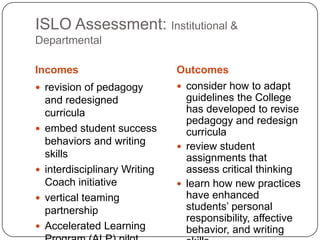
ISLO Assessment: Institutional &
Departmental
Incomes Outcomes
 revision of pedagogy
and redesigned
curricula
 embed student success
behaviors and writing
skills
 interdisciplinary Writing
Coach initiative
 vertical teaming
partnership
 Accelerated Learning
 consider how to adapt
guidelines the College
has developed to revise
pedagogy and redesign
curricula
 review student
assignments that
assess critical thinking
 learn how new practices
have enhanced
students’ personal
responsibility, affective
behavior, and writing
Interdisciplinary Writing Coaches
ISLO Assessment: Written
Communication
 across disciplines
 artifacts collected from courses
 rubric developed and reviewed by faculty
 artifact sets for assessment selected at random
 norming and assessment of study set
Results: Written Communication 2007
4 3 2 1
Ideas are
well
formulated
and
clarified 8 33 25 4
59% adequate or
above
Appropriate
language is
employed 11 33 23 3
63% adequate or
above
Organizatio
n is clear,
logical and
suitable for
the
assignment 13 22 20 16
49% adequate or
above
Standard
grammar
Intervention: Writing Coaches
 presented
 division meetings
 department meetings
 consulted
 individual faculty and staff
 professional development workshops
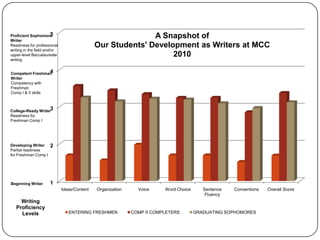
1
2
3
4
5
Ideas/Content Organization Voice Word Choice Sentence
Fluency
Conventions Overall Score
Writing
Proficiency
Levels
A Snapshot of
Our Students' Development as Writers at MCC
2010
ENTERING FRESHMEN COMP II COMPLETERS GRADUATING SOPHOMORES
Proficient Sophomore
Writer
Readiness for professional
writing in the field and/or
upper-level Baccalaureate
writing
Competent Freshman
Writer
Competency with
Freshman
Comp I & II skills
College-Ready Writer
Readiness for
Freshman Comp I
Developing Writer
Partial readiness
for Freshman Comp I
Beginning Writer
Vertical Teaming
Vertical Teaming
 bring together English faculty
 MCC
 UMass Lowell,
 Billerica High School
 Lowell High School
 Greater Lowell Tech
Procedures
 map
 national writing standards to MA curriculum frameworks and
SLO’s
 Composition I and II
 develop
 assessment instrument and rubric
 measure readiness for college writing
 developmental students and high school seniors
 administer and assess results
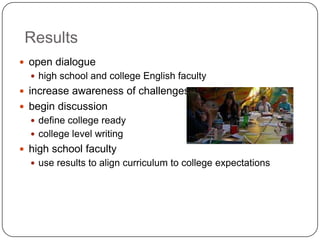
Results
 open dialogue
 high school and college English faculty
 increase awareness of challenges
 begin discussion
 define college ready
 college level writing
 high school faculty
 use results to align curriculum to college expectations
Accelerated Learning Program
ALP
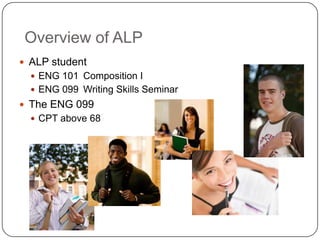
Overview of ALP
 ALP student
 ENG 101 Composition I
 ENG 099 Writing Skills Seminar
 The ENG 099
 CPT above 68
The MCC Model
 12 ALP students enrolled in ENG 099 (~ENG
071)
 split into 2 groups of 6
 each group integrated into 1 section of ENG 101
 same instructor for ENG 099 and ENG 101
Three Guiding Principles
 empower students
 scaffold assignments
 time on task
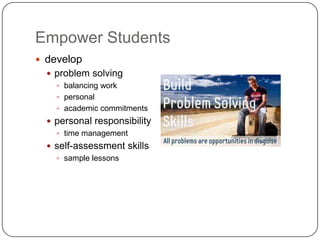
Empower Students
 develop
 problem solving
 balancing work
 personal
 academic commitments
 personal responsibility
 time management
 self-assessment skills
 sample lessons
Scaffold Assignments
 breakdown required tasks for each ENG 101 major
assignment
 Q & A at beginning of each ENG 099 class
 sample lessons
 walk students through writing process
 help students develop specific approaches
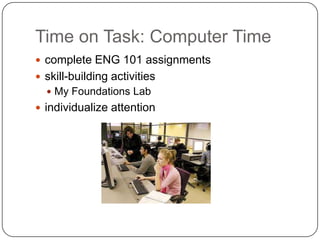
Time on Task: Computer Time
 complete ENG 101 assignments
 skill-building activities
 My Foundations Lab
 individualize attention
The Data: Course Completion ENG
099
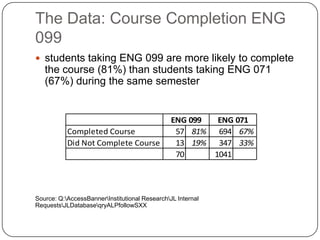
 students taking ENG 099 are more likely to complete
the course (81%) than students taking ENG 071
(67%) during the same semester
Source: Q:AccessBannerInstitutional ResearchJL Internal
RequestsJLDatabaseqryALPfollowSXX
ENG 099 ENG 071
Completed Course 57 81% 694 67%
Did Not Complete Course 13 19% 347 33%
70 1041
The Data: Course Completion ENG
101
 student success was evaluated by ENG 101 course
completion
 74% of ALP students completed ENG 101 compared
to 61% of Non-ALP students
Students Success (ALP versus Non-ALP) Based on English 101 Course Completion
Fall 2011
ALP Non-ALP
Total N N N % N N %
Enrolled Eng
101
Completed
Eng 101
% Completed
Eng 101
Enrolled Eng
101
Completed
Eng 101
% Completed
Eng 101
Group 1 47 12 11 92% 35 25 71%
Group 2 45 12 8 67% 33 13 39%
Group 3 41 10 5 50% 31 18 58%
Group 4 44 12 12 100% 32 23 72%
Group 5 41 12 7 58% 29 12 41%
Group 6 44 12 9 75% 32 27 84%
Total 262 70 52 74% 192 118 61%
The Data: Grade in ENG 101
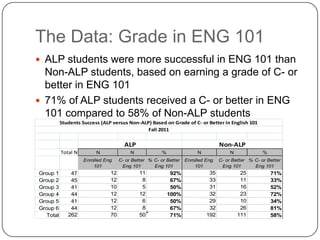
 ALP students were more successful in ENG 101 than
Non-ALP students, based on earning a grade of C- or
better in ENG 101
 71% of ALP students received a C- or better in ENG
101 compared to 58% of Non-ALP students
Students Success (ALP versus Non-ALP) Based on Grade of C- or Better in English 101
Fall 2011
ALP Non-ALP
Total N N N % N N %
Enrolled Eng
101
C- or Better
Eng 101
% C- or Better
Eng 101
Enrolled Eng
101
C- or Better
Eng 101
% C- or Better
Eng 101
Group 1 47 12 11 92% 35 25 71%
Group 2 45 12 8 67% 33 11 33%
Group 3 41 10 5 50% 31 16 52%
Group 4 44 12 12 100% 32 23 72%
Group 5 41 12 6 50% 29 10 34%
Group 6 44 12 8 67% 32 26 81%
Total 262 70 50 71% 192 111 58%
The Data: Persistence Spring
2012
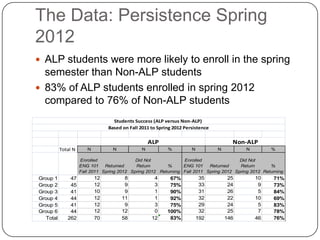
 ALP students were more likely to enroll in the spring
semester than Non-ALP students
 83% of ALP students enrolled in spring 2012
compared to 76% of Non-ALP students
Students Success (ALP versus Non-ALP)
Based on Fall 2011 to Spring 2012 Persistence
ALP Non-ALP
Total N N N N % N N N %
Enrolled
ENG 101
Fall 2011
Returned
Spring 2012
Did Not
Return
Spring 2012
%
Returning
Enrolled
ENG 101
Fall 2011
Returned
Spring 2012
Did Not
Return
Spring 2012
%
Returning
Group 1 47 12 8 4 67% 35 25 10 71%
Group 2 45 12 9 3 75% 33 24 9 73%
Group 3 41 10 9 1 90% 31 26 5 84%
Group 4 44 12 11 1 92% 32 22 10 69%
Group 5 41 12 9 3 75% 29 24 5 83%
Group 6 44 12 12 0 100% 32 25 7 78%
Total 262 70 58 12 83% 192 146 46 76%
Writing+redesign+101+ +assessment+in+action++amcoa+2-9-12

Writing+redesign+101+ +assessment+in+action++amcoa+2-9-12

  • 1.
    Kelsey Hellwig Stan Hitron DonaCady Middlesex Community College Writing Redesign101: Assessment in Action
  • 2.
    ISLO Assessment: Institutional& Departmental Incomes Outcomes  revision of pedagogy and redesigned curricula  embed student success behaviors and writing skills  interdisciplinary Writing Coach initiative  vertical teaming partnership  Accelerated Learning  consider how to adapt guidelines the College has developed to revise pedagogy and redesign curricula  review student assignments that assess critical thinking  learn how new practices have enhanced students’ personal responsibility, affective behavior, and writing
  • 3.
  • 4.
    ISLO Assessment: Written Communication across disciplines  artifacts collected from courses  rubric developed and reviewed by faculty  artifact sets for assessment selected at random  norming and assessment of study set
  • 5.
    Results: Written Communication2007 4 3 2 1 Ideas are well formulated and clarified 8 33 25 4 59% adequate or above Appropriate language is employed 11 33 23 3 63% adequate or above Organizatio n is clear, logical and suitable for the assignment 13 22 20 16 49% adequate or above Standard grammar
  • 6.
    Intervention: Writing Coaches presented  division meetings  department meetings  consulted  individual faculty and staff  professional development workshops
  • 7.
    1 2 3 4 5 Ideas/Content Organization VoiceWord Choice Sentence Fluency Conventions Overall Score Writing Proficiency Levels A Snapshot of Our Students' Development as Writers at MCC 2010 ENTERING FRESHMEN COMP II COMPLETERS GRADUATING SOPHOMORES Proficient Sophomore Writer Readiness for professional writing in the field and/or upper-level Baccalaureate writing Competent Freshman Writer Competency with Freshman Comp I & II skills College-Ready Writer Readiness for Freshman Comp I Developing Writer Partial readiness for Freshman Comp I Beginning Writer
  • 8.
  • 9.
    Vertical Teaming  bringtogether English faculty  MCC  UMass Lowell,  Billerica High School  Lowell High School  Greater Lowell Tech
  • 10.
    Procedures  map  nationalwriting standards to MA curriculum frameworks and SLO’s  Composition I and II  develop  assessment instrument and rubric  measure readiness for college writing  developmental students and high school seniors  administer and assess results
  • 11.
    Results  open dialogue high school and college English faculty  increase awareness of challenges  begin discussion  define college ready  college level writing  high school faculty  use results to align curriculum to college expectations
  • 12.
  • 13.
    Overview of ALP ALP student  ENG 101 Composition I  ENG 099 Writing Skills Seminar  The ENG 099  CPT above 68
  • 14.
    The MCC Model 12 ALP students enrolled in ENG 099 (~ENG 071)  split into 2 groups of 6  each group integrated into 1 section of ENG 101  same instructor for ENG 099 and ENG 101
  • 15.
    Three Guiding Principles empower students  scaffold assignments  time on task
  • 16.
    Empower Students  develop problem solving  balancing work  personal  academic commitments  personal responsibility  time management  self-assessment skills  sample lessons
  • 17.
    Scaffold Assignments  breakdownrequired tasks for each ENG 101 major assignment  Q & A at beginning of each ENG 099 class  sample lessons  walk students through writing process  help students develop specific approaches
  • 18.
    Time on Task:Computer Time  complete ENG 101 assignments  skill-building activities  My Foundations Lab  individualize attention
  • 19.
    The Data: CourseCompletion ENG 099  students taking ENG 099 are more likely to complete the course (81%) than students taking ENG 071 (67%) during the same semester Source: Q:AccessBannerInstitutional ResearchJL Internal RequestsJLDatabaseqryALPfollowSXX ENG 099 ENG 071 Completed Course 57 81% 694 67% Did Not Complete Course 13 19% 347 33% 70 1041
  • 20.
    The Data: CourseCompletion ENG 101  student success was evaluated by ENG 101 course completion  74% of ALP students completed ENG 101 compared to 61% of Non-ALP students Students Success (ALP versus Non-ALP) Based on English 101 Course Completion Fall 2011 ALP Non-ALP Total N N N % N N % Enrolled Eng 101 Completed Eng 101 % Completed Eng 101 Enrolled Eng 101 Completed Eng 101 % Completed Eng 101 Group 1 47 12 11 92% 35 25 71% Group 2 45 12 8 67% 33 13 39% Group 3 41 10 5 50% 31 18 58% Group 4 44 12 12 100% 32 23 72% Group 5 41 12 7 58% 29 12 41% Group 6 44 12 9 75% 32 27 84% Total 262 70 52 74% 192 118 61%
  • 21.
    The Data: Gradein ENG 101  ALP students were more successful in ENG 101 than Non-ALP students, based on earning a grade of C- or better in ENG 101  71% of ALP students received a C- or better in ENG 101 compared to 58% of Non-ALP students Students Success (ALP versus Non-ALP) Based on Grade of C- or Better in English 101 Fall 2011 ALP Non-ALP Total N N N % N N % Enrolled Eng 101 C- or Better Eng 101 % C- or Better Eng 101 Enrolled Eng 101 C- or Better Eng 101 % C- or Better Eng 101 Group 1 47 12 11 92% 35 25 71% Group 2 45 12 8 67% 33 11 33% Group 3 41 10 5 50% 31 16 52% Group 4 44 12 12 100% 32 23 72% Group 5 41 12 6 50% 29 10 34% Group 6 44 12 8 67% 32 26 81% Total 262 70 50 71% 192 111 58%
  • 22.
    The Data: PersistenceSpring 2012  ALP students were more likely to enroll in the spring semester than Non-ALP students  83% of ALP students enrolled in spring 2012 compared to 76% of Non-ALP students Students Success (ALP versus Non-ALP) Based on Fall 2011 to Spring 2012 Persistence ALP Non-ALP Total N N N N % N N N % Enrolled ENG 101 Fall 2011 Returned Spring 2012 Did Not Return Spring 2012 % Returning Enrolled ENG 101 Fall 2011 Returned Spring 2012 Did Not Return Spring 2012 % Returning Group 1 47 12 8 4 67% 35 25 10 71% Group 2 45 12 9 3 75% 33 24 9 73% Group 3 41 10 9 1 90% 31 26 5 84% Group 4 44 12 11 1 92% 32 22 10 69% Group 5 41 12 9 3 75% 29 24 5 83% Group 6 44 12 12 0 100% 32 25 7 78% Total 262 70 58 12 83% 192 146 46 76%

Editor's Notes