Reverse Multiple-Choice
Method (RMCM)
Indu M. Anand
Mathematics Department
University of Massachusetts – Lowell
AMCOA Conference, February 9, 2012
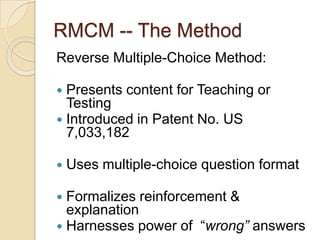
RMCM -- The Method
Reverse Multiple-Choice Method:
 Presents content for Teaching or
Testing
 Introduced in Patent No. US
7,033,182
 Uses multiple-choice question format
 Formalizes reinforcement &
explanation
 Harnesses power of “wrong” answers
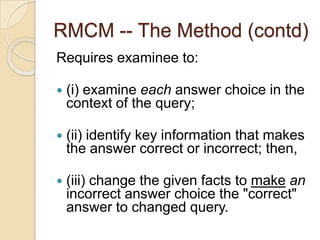
RMCM -- The Method (contd)
Requires examinee to:
 (i) examine each answer choice in the
context of the query;
 (ii) identify key information that makes
the answer correct or incorrect; then,
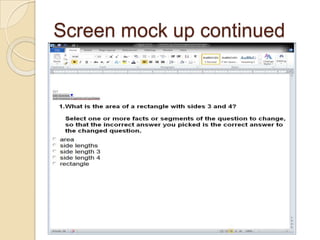
 (iii) change the given facts to make an
incorrect answer choice the "correct"
answer to changed query.
RMCM Method (contd)…
 Correct answer,  no modification
 For a “wrong” answer choice
Examinee:--
 Must examine answer choice
 Must understand why answer is
incorrect
 Must communicate why it is incorrect
 More efficient than Open format /
essay
 May be automated for grading
How it works – Examinee‟s
view…
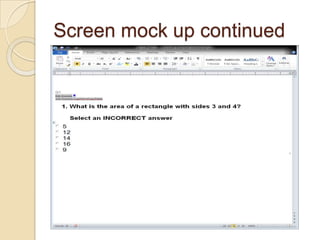
Examinee, typically, is asked:
 To select correct answer
 Then --
 select one (or more) wrong answer
 change the query so that
selected wrong answer is the
correct answer for changed query
 Modification criteria may be provided
How it works – RMCM Question
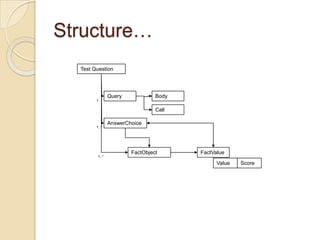
 Question is key data structure of system.
 Components of the Question object are:
◦ Query – “Narrative” + Call of the question
◦ Answer choices – Multiple , One correct
others incorrect
 RMCM Questions:
◦ May be written from the scratch, or
◦ May be developed from other multiple-
choice questions
◦ Stored in persistent databanks of
questions
RMCM Question (contd)
◦ Special features of RMCM question:
◦ Fact Objects (FO‟s) = Facts / segments
of the query on which the answer turns;
FO = True or False for an answer
choice, depending on its relevance to
answer choice
◦ Fact Object Values (FV‟s) – Values
assigned to relevant FO‟s for original or
modified query.
Structure…
Test Question
Query
AnswerChoice
Body
Call
FactObject FactValue
Value Score
1
1..*
1..*
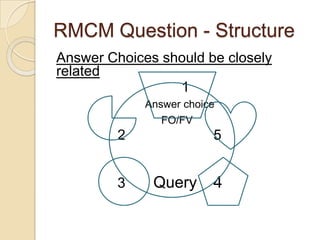
RMCM Question - Structure
Answer Choices should be closely
related
1
Answer choice
FO/FV
2 5
3 Query 4
How it works – Examiner‟s
view…
 Select incorrect answer choices
strategically in order to --
 Emphasize the facts provided in the
question
 Identify “Fact Objects” for each
answer choice;
 Provide “Fact Values” of the “True”
Fact Objects ( for each answer choice)
 Provide score / partial score for each
FO for each answer choice
RMCM – Examiner‟s view
(contd)
Examiner must:
 Define the Objectives for the question
Figure out what concept to assess
 Know where and how students miss the
concept
Form answer choices around common errors
 Work Backwards
Correlate facts / segments in query with
errors
 Determine importance of each FO
Apportion relative credit for the facts /
segments
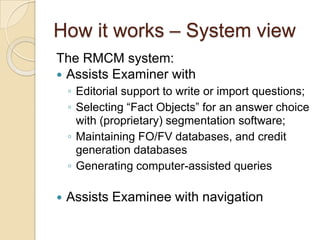
How it works – System view
The RMCM system:
 Assists Examiner with
◦ Editorial support to write or import questions;
◦ Selecting “Fact Objects” for an answer choice
with (proprietary) segmentation software;
◦ Maintaining FO/FV databases, and credit
generation databases
◦ Generating computer-assisted queries
 Assists Examinee with navigation
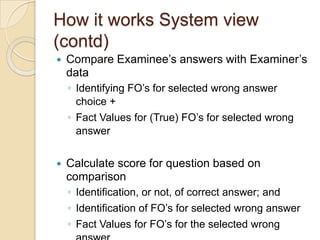
How it works System view
(contd)
 Compare Examinee‟s answers with Examiner‟s
data
◦ Identifying FO‟s for selected wrong answer
choice +
◦ Fact Values for (True) FO‟s for selected wrong
answer
 Calculate score for question based on
comparison
◦ Identification, or not, of correct answer; and
◦ Identification of FO‟s for selected wrong answer
◦ Fact Values for FO‟s for the selected wrong
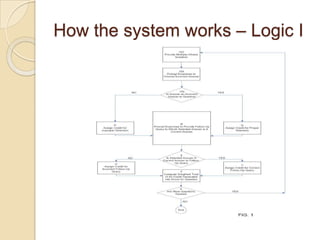
How the system works – Logic I
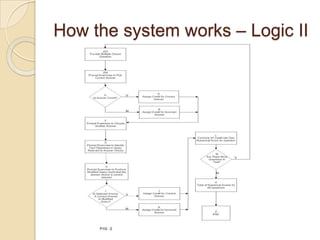
How the system works – Logic II
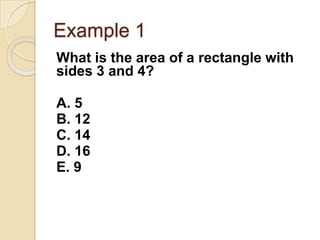
Example 1
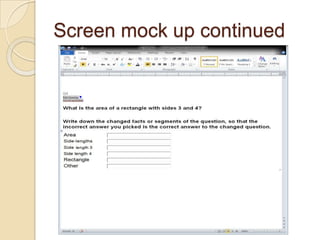
What is the area of a rectangle with
sides 3 and 4?
A. 5
B. 12
C. 14
D. 16
E. 9
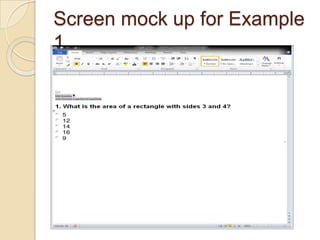
Screen mock up for Example
1
Screen mock up continued
Example 2
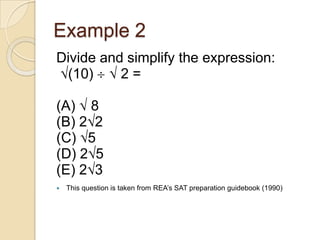
Divide and simplify the expression:
(10) 2 =
(A) 8
(B) 2 2
(C) 5
(D) 2 5
(E) 2 3
 This question is taken from REA‟s SAT preparation guidebook (1990)
Example 2 (contd)
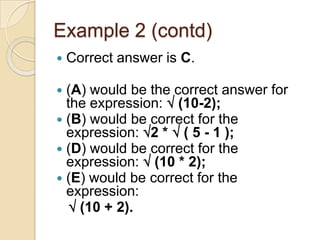
 Correct answer is C.
 (A) would be the correct answer for
the expression: (10-2);
 (B) would be correct for the
expression: 2 * ( 5 - 1 );
 (D) would be correct for the
expression: (10 * 2);
 (E) would be correct for the
expression:
(10 + 2).
Example 3
Example 3 (contd)
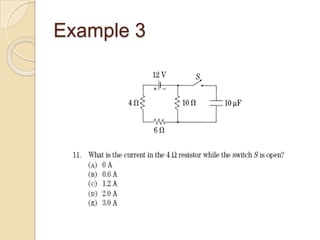
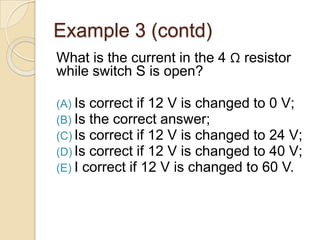
What is the current in the 4 Ω resistor
while switch S is open?
(A) Is correct if 12 V is changed to 0 V;
(B) Is the correct answer;
(C) Is correct if 12 V is changed to 24 V;
(D) Is correct if 12 V is changed to 40 V;
(E) I correct if 12 V is changed to 60 V.
Example 3 & Discussion
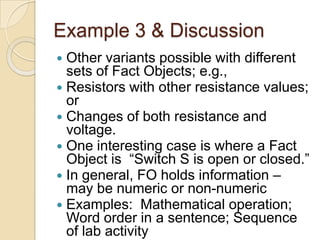
 Other variants possible with different
sets of Fact Objects; e.g.,
 Resistors with other resistance values;
or
 Changes of both resistance and
voltage.
 One interesting case is where a Fact
Object is “Switch S is open or closed.”
 In general, FO holds information –
may be numeric or non-numeric
 Examples: Mathematical operation;
Word order in a sentence; Sequence
of lab activity
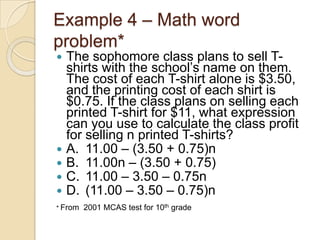
Example 4 – Math word
problem*
 The sophomore class plans to sell T-
shirts with the school‟s name on them.
The cost of each T-shirt alone is $3.50,
and the printing cost of each shirt is
$0.75. If the class plans on selling each
printed T-shirt for $11, what expression
can you use to calculate the class profit
for selling n printed T-shirts?
 A. 11.00 – (3.50 + 0.75)n
 B. 11.00n – (3.50 + 0.75)
 C. 11.00 – 3.50 – 0.75n
 D. (11.00 – 3.50 – 0.75)n
* From 2001 MCAS test for 10th grade
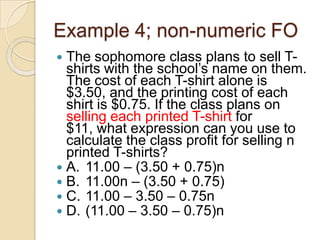
Example 4; non-numeric FO
 The sophomore class plans to sell T-
shirts with the school‟s name on them.
The cost of each T-shirt alone is
$3.50, and the printing cost of each
shirt is $0.75. If the class plans on
selling each printed T-shirt for
$11, what expression can you use to
calculate the class profit for selling n
printed T-shirts?
 A. 11.00 – (3.50 + 0.75)n
 B. 11.00n – (3.50 + 0.75)
 C. 11.00 – 3.50 – 0.75n
 D. (11.00 – 3.50 – 0.75)n
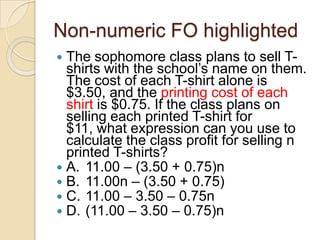
Non-numeric FO highlighted
 The sophomore class plans to sell T-
shirts with the school‟s name on them.
The cost of each T-shirt alone is
$3.50, and the printing cost of each
shirt is $0.75. If the class plans on
selling each printed T-shirt for
$11, what expression can you use to
calculate the class profit for selling n
printed T-shirts?
 A. 11.00 – (3.50 + 0.75)n
 B. 11.00n – (3.50 + 0.75)
 C. 11.00 – 3.50 – 0.75n
 D. (11.00 – 3.50 – 0.75)n
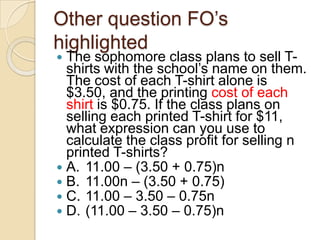
Other question FO‟s
highlighted
 The sophomore class plans to sell T-
shirts with the school‟s name on them.
The cost of each T-shirt alone is
$3.50, and the printing cost of each
shirt is $0.75. If the class plans on
selling each printed T-shirt for $11,
what expression can you use to
calculate the class profit for selling n
printed T-shirts?
 A. 11.00 – (3.50 + 0.75)n
 B. 11.00n – (3.50 + 0.75)
 C. 11.00 – 3.50 – 0.75n
 D. (11.00 – 3.50 – 0.75)n
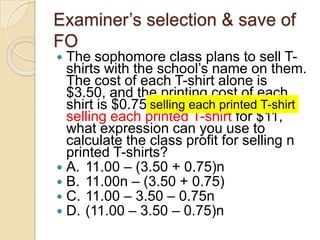
Examiner‟s selection & save of
FO
 The sophomore class plans to sell T-
shirts with the school‟s name on them.
The cost of each T-shirt alone is
$3.50, and the printing cost of each
shirt is $0.75. If the class plans on
selling each printed T-shirt for $11,
what expression can you use to
calculate the class profit for selling n
printed T-shirts?
 A. 11.00 – (3.50 + 0.75)n
 B. 11.00n – (3.50 + 0.75)
 C. 11.00 – 3.50 – 0.75n
 D. (11.00 – 3.50 – 0.75)n
selling each printed T-shirt
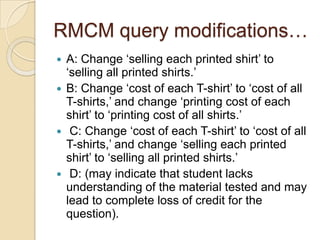
RMCM query modifications…
 A: Change „selling each printed shirt‟ to
„selling all printed shirts.‟
 B: Change „cost of each T-shirt‟ to „cost of all
T-shirts,‟ and change „printing cost of each
shirt‟ to „printing cost of all shirts.‟
 C: Change „cost of each T-shirt‟ to „cost of all
T-shirts,‟ and change „selling each printed
shirt‟ to „selling all printed shirts.‟
 D: (may indicate that student lacks
understanding of the material tested and may
lead to complete loss of credit for the
question).
Another RMCM embodiment of
Example 4…
 Examinee Task:
◦ choose an answer that you believe
is incorrect.
◦ find facts /segments from LIST, so
that chosen incorrect answer
becomes correct answer to
changed question
◦ LIST: --„cost of each T-shirt;‟
„alone;‟ „$3.50;‟ „printing cost of
each shirt;‟ „$0.75;‟ „selling each
printed shirt;‟ „$11;‟ „profit;‟ „selling n
printed shirts‟
◦ LIST: „cost of each T-shirt;‟ „alone;‟
„$3.50;‟ „printing cost of each shirt;‟
„$0.75;‟ „selling each printed shirt;‟
„$11;‟ „‟profit;‟ „selling n printed
shirts.‟
Expected answers:
 A: „selling each printed shirt.‟
 B: „cost of each T-shirt‟ and „printing cost of each
shirt.‟
 C: „cost of each T-shirt‟ and „selling each printed
shirt.‟
 D: (test-taker lacks understanding of subject
Wrap up - Advantages of RMCM
 Multiple-choice format used for
RMCM:--
 Allows context definition economically
 Questions may be reused
 Scoring may be automated
 Other advantages of automation e.g.
computer-aided generation of queries
 Forces analysis/ compares / contrasts
of similar and related concepts
Wrap up - Disadvantages
mitigated by RMCM
 Unlike traditional Multiple-choice
RMCM:
 Discourages answering without careful
reading
 Encourages analysis of questions
 Finds depth of student‟s learning
 Databank of questions has lasting
value
Disadvantages of open format/
essay mitigated by RMCM
◦ Encourages identification of context
◦ Discourages padding of answers
with irrelevant writing
◦ More efficient
◦ Computer-aided assessment
possible
Invitation
 If you would like to get involved --
 Effort is underway to:
◦ Assemble groups of educators / others
◦ Assemble RMCM Questions databanks
◦ Develop self-study courses
◦ Develop instructor-led courses
You are also invited to contribute to further
design and development of RMCM
software
Thank You!
Contact
Indu M. Anand
 indu_m_anand@yahoo.com
 indu_anand@uml.edu

Reverse+multiple choice+method--presentation 6-feb12

  • 1.
    Reverse Multiple-Choice Method (RMCM) InduM. Anand Mathematics Department University of Massachusetts – Lowell AMCOA Conference, February 9, 2012
  • 2.
    RMCM -- TheMethod Reverse Multiple-Choice Method:  Presents content for Teaching or Testing  Introduced in Patent No. US 7,033,182  Uses multiple-choice question format  Formalizes reinforcement & explanation  Harnesses power of “wrong” answers
  • 3.
    RMCM -- TheMethod (contd) Requires examinee to:  (i) examine each answer choice in the context of the query;  (ii) identify key information that makes the answer correct or incorrect; then,  (iii) change the given facts to make an incorrect answer choice the "correct" answer to changed query.
  • 4.
    RMCM Method (contd)… Correct answer,  no modification  For a “wrong” answer choice Examinee:--  Must examine answer choice  Must understand why answer is incorrect  Must communicate why it is incorrect  More efficient than Open format / essay  May be automated for grading
  • 5.
    How it works– Examinee‟s view… Examinee, typically, is asked:  To select correct answer  Then --  select one (or more) wrong answer  change the query so that selected wrong answer is the correct answer for changed query  Modification criteria may be provided
  • 6.
    How it works– RMCM Question  Question is key data structure of system.  Components of the Question object are: ◦ Query – “Narrative” + Call of the question ◦ Answer choices – Multiple , One correct others incorrect  RMCM Questions: ◦ May be written from the scratch, or ◦ May be developed from other multiple- choice questions ◦ Stored in persistent databanks of questions
  • 7.
    RMCM Question (contd) ◦Special features of RMCM question: ◦ Fact Objects (FO‟s) = Facts / segments of the query on which the answer turns; FO = True or False for an answer choice, depending on its relevance to answer choice ◦ Fact Object Values (FV‟s) – Values assigned to relevant FO‟s for original or modified query.
  • 8.
  • 9.
    RMCM Question -Structure Answer Choices should be closely related 1 Answer choice FO/FV 2 5 3 Query 4
  • 10.
    How it works– Examiner‟s view…  Select incorrect answer choices strategically in order to --  Emphasize the facts provided in the question  Identify “Fact Objects” for each answer choice;  Provide “Fact Values” of the “True” Fact Objects ( for each answer choice)  Provide score / partial score for each FO for each answer choice
  • 11.
    RMCM – Examiner‟sview (contd) Examiner must:  Define the Objectives for the question Figure out what concept to assess  Know where and how students miss the concept Form answer choices around common errors  Work Backwards Correlate facts / segments in query with errors  Determine importance of each FO Apportion relative credit for the facts / segments
  • 12.
    How it works– System view The RMCM system:  Assists Examiner with ◦ Editorial support to write or import questions; ◦ Selecting “Fact Objects” for an answer choice with (proprietary) segmentation software; ◦ Maintaining FO/FV databases, and credit generation databases ◦ Generating computer-assisted queries  Assists Examinee with navigation
  • 13.
    How it worksSystem view (contd)  Compare Examinee‟s answers with Examiner‟s data ◦ Identifying FO‟s for selected wrong answer choice + ◦ Fact Values for (True) FO‟s for selected wrong answer  Calculate score for question based on comparison ◦ Identification, or not, of correct answer; and ◦ Identification of FO‟s for selected wrong answer ◦ Fact Values for FO‟s for the selected wrong
  • 14.
    How the systemworks – Logic I
  • 15.
    How the systemworks – Logic II
  • 16.
    Example 1 What isthe area of a rectangle with sides 3 and 4? A. 5 B. 12 C. 14 D. 16 E. 9
  • 17.
    Screen mock upfor Example 1
  • 18.
    Screen mock upcontinued
  • 19.
    Screen mock upcontinued
  • 20.
    Screen mock upcontinued
  • 21.
    Example 2 Divide andsimplify the expression: (10) 2 = (A) 8 (B) 2 2 (C) 5 (D) 2 5 (E) 2 3  This question is taken from REA‟s SAT preparation guidebook (1990)
  • 22.
    Example 2 (contd) Correct answer is C.  (A) would be the correct answer for the expression: (10-2);  (B) would be correct for the expression: 2 * ( 5 - 1 );  (D) would be correct for the expression: (10 * 2);  (E) would be correct for the expression: (10 + 2).
  • 23.
  • 24.
    Example 3 (contd) Whatis the current in the 4 Ω resistor while switch S is open? (A) Is correct if 12 V is changed to 0 V; (B) Is the correct answer; (C) Is correct if 12 V is changed to 24 V; (D) Is correct if 12 V is changed to 40 V; (E) I correct if 12 V is changed to 60 V.
  • 25.
    Example 3 &Discussion  Other variants possible with different sets of Fact Objects; e.g.,  Resistors with other resistance values; or  Changes of both resistance and voltage.  One interesting case is where a Fact Object is “Switch S is open or closed.”  In general, FO holds information – may be numeric or non-numeric  Examples: Mathematical operation; Word order in a sentence; Sequence of lab activity
  • 26.
    Example 4 –Math word problem*  The sophomore class plans to sell T- shirts with the school‟s name on them. The cost of each T-shirt alone is $3.50, and the printing cost of each shirt is $0.75. If the class plans on selling each printed T-shirt for $11, what expression can you use to calculate the class profit for selling n printed T-shirts?  A. 11.00 – (3.50 + 0.75)n  B. 11.00n – (3.50 + 0.75)  C. 11.00 – 3.50 – 0.75n  D. (11.00 – 3.50 – 0.75)n * From 2001 MCAS test for 10th grade
  • 27.
    Example 4; non-numericFO  The sophomore class plans to sell T- shirts with the school‟s name on them. The cost of each T-shirt alone is $3.50, and the printing cost of each shirt is $0.75. If the class plans on selling each printed T-shirt for $11, what expression can you use to calculate the class profit for selling n printed T-shirts?  A. 11.00 – (3.50 + 0.75)n  B. 11.00n – (3.50 + 0.75)  C. 11.00 – 3.50 – 0.75n  D. (11.00 – 3.50 – 0.75)n
  • 28.
    Non-numeric FO highlighted The sophomore class plans to sell T- shirts with the school‟s name on them. The cost of each T-shirt alone is $3.50, and the printing cost of each shirt is $0.75. If the class plans on selling each printed T-shirt for $11, what expression can you use to calculate the class profit for selling n printed T-shirts?  A. 11.00 – (3.50 + 0.75)n  B. 11.00n – (3.50 + 0.75)  C. 11.00 – 3.50 – 0.75n  D. (11.00 – 3.50 – 0.75)n
  • 29.
    Other question FO‟s highlighted The sophomore class plans to sell T- shirts with the school‟s name on them. The cost of each T-shirt alone is $3.50, and the printing cost of each shirt is $0.75. If the class plans on selling each printed T-shirt for $11, what expression can you use to calculate the class profit for selling n printed T-shirts?  A. 11.00 – (3.50 + 0.75)n  B. 11.00n – (3.50 + 0.75)  C. 11.00 – 3.50 – 0.75n  D. (11.00 – 3.50 – 0.75)n
  • 30.
    Examiner‟s selection &save of FO  The sophomore class plans to sell T- shirts with the school‟s name on them. The cost of each T-shirt alone is $3.50, and the printing cost of each shirt is $0.75. If the class plans on selling each printed T-shirt for $11, what expression can you use to calculate the class profit for selling n printed T-shirts?  A. 11.00 – (3.50 + 0.75)n  B. 11.00n – (3.50 + 0.75)  C. 11.00 – 3.50 – 0.75n  D. (11.00 – 3.50 – 0.75)n selling each printed T-shirt
  • 31.
    RMCM query modifications… A: Change „selling each printed shirt‟ to „selling all printed shirts.‟  B: Change „cost of each T-shirt‟ to „cost of all T-shirts,‟ and change „printing cost of each shirt‟ to „printing cost of all shirts.‟  C: Change „cost of each T-shirt‟ to „cost of all T-shirts,‟ and change „selling each printed shirt‟ to „selling all printed shirts.‟  D: (may indicate that student lacks understanding of the material tested and may lead to complete loss of credit for the question).
  • 32.
    Another RMCM embodimentof Example 4…  Examinee Task: ◦ choose an answer that you believe is incorrect. ◦ find facts /segments from LIST, so that chosen incorrect answer becomes correct answer to changed question ◦ LIST: --„cost of each T-shirt;‟ „alone;‟ „$3.50;‟ „printing cost of each shirt;‟ „$0.75;‟ „selling each printed shirt;‟ „$11;‟ „profit;‟ „selling n printed shirts‟
  • 33.
    ◦ LIST: „costof each T-shirt;‟ „alone;‟ „$3.50;‟ „printing cost of each shirt;‟ „$0.75;‟ „selling each printed shirt;‟ „$11;‟ „‟profit;‟ „selling n printed shirts.‟ Expected answers:  A: „selling each printed shirt.‟  B: „cost of each T-shirt‟ and „printing cost of each shirt.‟  C: „cost of each T-shirt‟ and „selling each printed shirt.‟  D: (test-taker lacks understanding of subject
  • 34.
    Wrap up -Advantages of RMCM  Multiple-choice format used for RMCM:--  Allows context definition economically  Questions may be reused  Scoring may be automated  Other advantages of automation e.g. computer-aided generation of queries  Forces analysis/ compares / contrasts of similar and related concepts
  • 35.
    Wrap up -Disadvantages mitigated by RMCM  Unlike traditional Multiple-choice RMCM:  Discourages answering without careful reading  Encourages analysis of questions  Finds depth of student‟s learning  Databank of questions has lasting value
  • 36.
    Disadvantages of openformat/ essay mitigated by RMCM ◦ Encourages identification of context ◦ Discourages padding of answers with irrelevant writing ◦ More efficient ◦ Computer-aided assessment possible
  • 37.
    Invitation  If youwould like to get involved --  Effort is underway to: ◦ Assemble groups of educators / others ◦ Assemble RMCM Questions databanks ◦ Develop self-study courses ◦ Develop instructor-led courses You are also invited to contribute to further design and development of RMCM software
  • 39.
    Thank You! Contact Indu M.Anand  indu_m_anand@yahoo.com  indu_anand@uml.edu

Editor's Notes

  • #3 Tip: Add your own speaker notes here.