Writing your dissertation: 14 suggestions
Arguing the point with clarity.
free@thefreeschoool.education
www.threfreeschool.education
Objective
This presentation offers constructive advice about pitfalls
you must avoid when writing your thesis or dissertation.
This information may help you to complete your writing
sooner and aid you to write a better piece of work.
14 Points
Recommendations
1. Tautology
2. Disconnects
3. Run-on sentences
4. Inappropriate data
5. Fresh conclusions
6. Even chapter sizes
7. Explicit contribution
8. Circular arguments
9. Generalised arguments
10. Rehearsing and repetition
11. Repetition of strong words
12. Conceptualise your discussion
13. Examples in introductory chapters
14. Examples in data analysis chapters
Similar size chapters
You should aim to write
data analysis chapters
that are approximately the
same size. You should also
aim to have a set of
introductory chapters that
are of a similar size.
The number of pages is a
good initial yardstick. If
some chapters have more
diagrams, you may
compare the number of
paragraphs of discussion.
Chapters that are not a
similar size make the
thesis appear unbalanced
and this mismatch may
suggest that the skinnier
chapters lack the
minimum detail required
to engage in adequate
discussion of theory and
evidence.
If one chapter is very short,
you can consider merging it
within another chapter that
overlaps with the theme of
the slim chapter.
For example, if your
historical context chapter is
too short you could move
this to your introduction
chapter.
You may expand the slim
chapter or shrink the other
chapter sets (e.g. the
collection of data chapters).
.
Oh my, what a
small text box
above! :-(
Example of a run on sentence.
This study explores the sociology of race
and focuses on a case study which
explores discrimination in the rural work
sector; it maintains a focus on unskilled
labor in the farming industry; it also
compares Canada and the United States
(40 words).
Four manageable sentences:
This research is about the sociology of
race. It focuses on a case study which
explores discrimination in the work
sector. It maintains a focus on unskilled
labor in the farming industry. The bounds
of this study compares Canada and the
United States of America.
Run-on sentences
A ‘run-on sentence’ is a sentence that is
overly long. Shorter sentences makes your
discussion easier to digest as you do not
overwhelm the reader. A run-on sentence is
often characterised by multiple punctuation
marks such as commas and semicolons.
Whether a sentence is too long is subjective.
Consider these guidelines:
1. Avoid sentences that are greater than
circa 20 to 22 words.
1. Minimise the number of sentences that
are greater than the equivalent of three
lines of text on a word document or
page.
Example of a circular argument
The government should not conduct
a poll to confirm if the public wants
to change its democratic
constitution. There is anecdotal
evidence that the majority of the
nation’s voters are against referenda
that seek to change the constitution,
and so conducting a poll to confirm
this would violate principles of
democratic rule by the majority.
The above statement is a circular
argument. Until such a poll is taken,
it is not possible to know if this is
what the majority desire.
Circular arguments
You should not include circular
arguments in your thesis.
Circular reasoning occurs when the
speaker commences an argument by
using the conclusion as supporting
evidence. It is not possible to establish
whether a claim is true if we cannot
separate the argument from the
evidence.
Dissertation examiners require you to
pose theoretical arguments that you
can illustrate using data that
independently supports your argument.
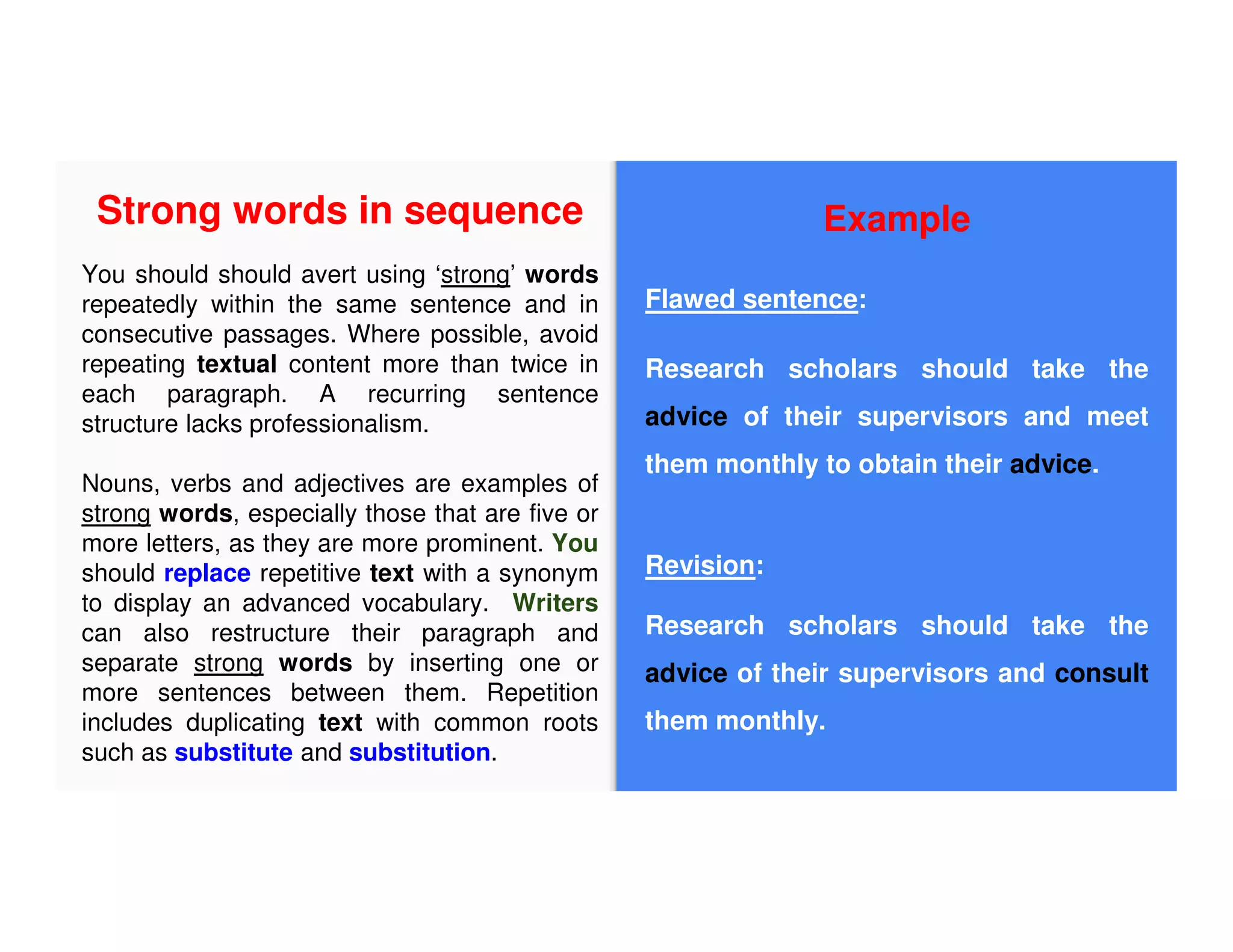
Example
Flawed sentence:
Research scholars should take the
advice of their supervisors and meet
them monthly to obtain their advice.
Revision:
Research scholars should take the
advice of their supervisors and consult
them monthly.
Strong words in sequence
You should should avert using ‘strong’ words
repeatedly within the same sentence and in
consecutive passages. Where possible, avoid
repeating textual content more than twice in
each paragraph. A recurring sentence
structure lacks professionalism.
Nouns, verbs and adjectives are examples of
strong words, especially those that are five or
more letters, as they are more prominent. You
should replace repetitive text with a synonym
to display an advanced vocabulary. Writers
can also restructure their paragraph and
separate strong words by inserting one or
more sentences between them. Repetition
includes duplicating text with common roots
such as substitute and substitution.
Repetition and rehearsing arguments
Your thesis should avoid making repetitious statements within chapters and between
chapters. There are multiple reasons for this, two of which are listed on this slide.
Repetition lacks imagine and may tire or bore your reader. In some ways, a thesis is
similar to a marketing brochure. The author aims to sell an argument to the reader.
Your discovery of knowledge may positively influence others by changing their
mindset and actions. Your discovery of truth may make the world a better place.
Recycling the same sentence structures is a bit like cheating insofar as you are
padding your discussion with work that is not new. Most institutions require you to
submit a doctoral thesis of around 80, 000 to 100, 000 words. If you present a thesis
of 90, 000 words and 45, 000 of these words are duplicates, you have not truly
satisfied the word count.
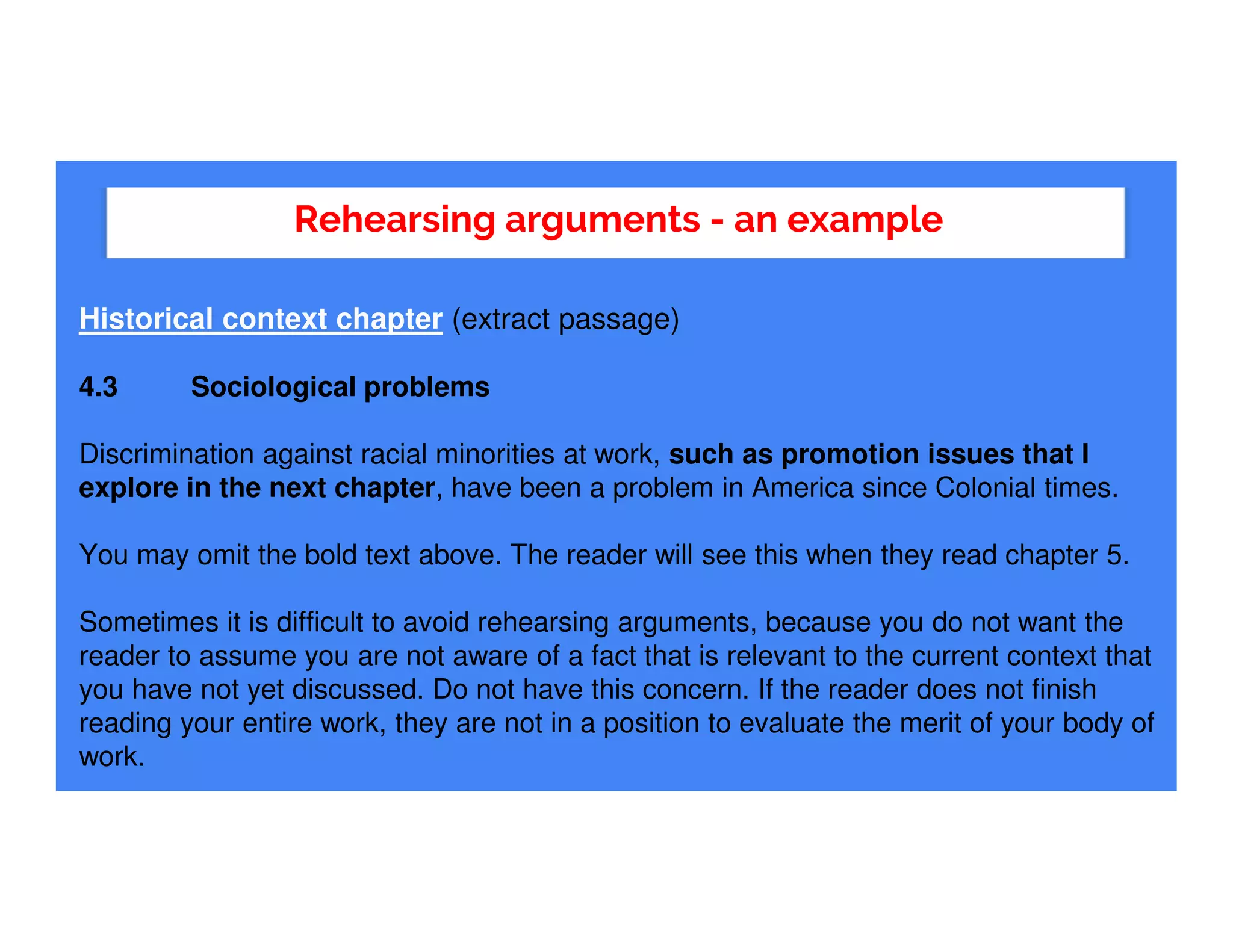
Rehearsing arguments - an example
Historical context chapter (extract passage)
4.3 Sociological problems
Discrimination against racial minorities at work, such as promotion issues that I
explore in the next chapter, have been a problem in America since Colonial times.
You may omit the bold text above. The reader will see this when they read chapter 5.
Sometimes it is difficult to avoid rehearsing arguments, because you do not want the
reader to assume you are not aware of a fact that is relevant to the current context that
you have not yet discussed. Do not have this concern. If the reader does not finish
reading your entire work, they are not in a position to evaluate the merit of your body of
work.
Tautology
Tautology examples
Students should never, ever claim the
work of other scholars as their own, as
this behaviour is one of the most
serious forms of plagiarism.
The word ‘ever’ in the passage above
is tautology and should be omitted.
This thesis explores an original
argument. No scholar has examined
this argument in the past.
The second sentence is tautology.
The word ‘tautology’ may refer to the repetitious
use of language. Tautology violates English
language grammar because it is unnecessary to say
the same thing twice.
Tautology may be legitimate in cases where the
speaker/writer repeats the same word or sentence
with purpose as they wish to reinforce a point to
their audience. In such cases, the speaker should
use explicit language to acknowledge that they
mean to replicate language. This gesture informs
their audience that the speaker is not ignorant of
English language conventions.
Tautology also refers to the inclusion of a word or
term that is not necessary. For example, a speaker
should not refer to a ‘female widow’. The word
‘female’ is tautology. ‘Widow’ is a feminine
adjective/noun (c.f. widower, the masculine).
Disconnected passages
You must avoid the inclusion of disconnected paragraphs in your thesis. There
must be a connection between the last sentence of each paragraph and the first
sentence of the next paragraph. This transition works best when it is subtle.
A poor example is when a writer uses a ‘forced’ sentence to complete a
paragraph, such as: “In the next paragraph I develop this argument further.”
Disconnected passages (continued)
The text below illustrates an orderly transition between paragraphs:
Paragraph 1: Tham and Campbell (2011) examine how employee-sponsored
work visas can drive the exploitation of foreign workers. The bearer of this
visa may be enslaved by the one-way conditions imposed on them. Their
study centres on the example of the 457 visa in Australia during the past
decade. Employees who hold this visa are sometimes bullied into working
overtime without additional pay.
Paragraph 2 (first sentence only): A worker’s pay and conditions are core
factors that human rights scholars examine when they evaluate the fairness
of a nation’s labour market laws (Tham & Campbell, 2011).
Tham, J. and Campbell, I. (2011), Temporary migrant labour in Australia: The 457 visa scheme and challenges for labour regulation,
http://law.unimelb.edu.au/__data/assets/pdf_file/0006/1649022/CELRL-Working-Paper-No-50-March-2011-FINAL.pdf
Discussion must be conceptual
In most cases, writing a thesis is not the same as writing a nonfiction work for a
mainstream corporate publishing company. Most commercial non-fiction works do
not conceptualise their methodological design or provide a list of peer reviewed
scholarly references as these works are not intended for an academic audience.
Non-fiction works that argue a point may engage in general discussion that aims to
appeal to a person’s intuition. It may also cite anecdotal evidence to illustrate their
point. The following is an example of such discussion:
“Historical records offer proof that most societies believe in principles of fairness.”
Scholars must draw on theoretical principles to frame their argument and defend their
position. The statement above might be reworded in a thesis as follows:
Rawls (1975) text ‘A Theory of Justice’ offers a framework for theorising empirical
observations that show how fairness is an organising principle of liberal democracies.
Be explicit - clearly state what
contributions are yours
Examples of work that is yours includes:
1. Original data that you have collected
3. Gaps in the literature you have identified
4. The analysis of your data
5. Fresh critiques you make of other scholars’
theoretical work
6. Conceptual arguments of your creation
Using the words “My” and “I” are one way that you
can be explicit. “My original data set ….”
Be
explicit
Examples: data analysis
An example of an example
The passage below uses fictitious
qualitative data for illustration
purposes.
My data dated 2015 shows that
most migrants in Iceland cannot
afford to rent their own room. For
example, ‘Stella’ (participant
number 17) stated that “the cost of
renting the most affordable single
room accounted for around 105%
of my net pay”.
You should always analyse data to support
arguments in your data chapters.
There are exceptions to this advice. These will
become clear as your writing skills develop. The
major exception is when you are discussing an
argument that is widely accepted as true. For
example, it might be acceptable to state “anecdotal
observations support the argument that it is usually
not commercially viable to establish an artificial ski
resort in isolated arid desert environments”. You do
not need to cite scientific evidence or find an
example of a failed ski resort that existed in a
desert environment. The logic of your argument is
simple, obvious and this is not a widely contested
argument.
If you were to state “all of America’s presidents
have been male” you need not state an example
such as Jimmy Carter. This statement is a fact, not
an opinion and it is also common knowledge.
Offer an example to support discussion in your
introduction chapters
In most cases, you must also offer a relevant example to support your
arguments in your introductory chapters.
Consider this illustration:
Between 1960 and 2012, government authorities that hosted the Summer
Olympics have incurred debts to fund the infrastructure required to host this
event. An example is Barcelona, which hosted the games in 1988 and loaned
billions of dollars to fund these games (Flyvberg & Stewart, 2012).
Flyvbjerg, B., & Stewart, A. (2012). Olympic proportions: Cost and cost overrun at the Olympics 1960-
2012,
https://www.researchgate.net/profile/Bent_Flyvbjerg/publication/244484259_Olympic_Proportions_Cost_and_Cost_Overrun_at_the_Olympics_1960-
2012/links/00b4952d507ca765ee000000.pdf
Arguments must have focus
Avoid posing arguments that lack specific details to illustrate a point. Consider this
statement:
“It is clear that the democratic majority do not support conducting a referendum
that seeks to change the national flag. Poll data supports this argument”.
A revision of this statement above offers specific details to strengthen this claim:
“It is clear that the democratic majority do not support the forthcoming referendum
that seeks to change Fiji’s national flag. Poll data collected by independent think-
tanks in July 2016 validate this argument. For example, ABC Consulting and XYZ
Consulting both report that 73% of enrolled voters do not support this poll”.
Data must support your argument
Take care that the data you offer as evidence clearly supports your
argument. Do not use evidence if there is no connection or the link is
weak. The following is an example of evidence which is tenuous:
The interview data shows that all employees at ABCXYZ Limited were
unhappy with the management. A statement by ‘Jenny’ is indicative of
feedback volunteered by all 30 respondents:
“I think there is room for management to improve their practices”
The quote above is not evidence. Jenny does not express satisfaction or
dissatisfaction towards management practices.
Conclusions should be fresh
The conclusion section of each chapter should not merely restate, in the same
order, the arguments that you pose throughout the chapter. You should aim to
find a fresh way to articulate what you discuss in the body of the chapter. You
should synthesise the individual arguments and highlight the common threads.
You should try to not to repeat the introduction of the paragraph.
This suggestion is critical in the grand conclusion chapter of your thesis. You
should not use the following type of discussion in this chapter: “In data chapter
one I showed that” … “In data chapter two I argued that” … “In data chapter three I
proved that”.
The grand conclusion chapter is the discussion that imparts a final impression on
your reader. It is imperative that you are inventive in this section of your work.
Writing your dissertation with clarity focus and purpose

Writing your dissertation with clarity focus and purpose

  • 1.
    Writing your dissertation:14 suggestions Arguing the point with clarity. free@thefreeschoool.education www.threfreeschool.education
  • 2.
    Objective This presentation offersconstructive advice about pitfalls you must avoid when writing your thesis or dissertation. This information may help you to complete your writing sooner and aid you to write a better piece of work.
  • 3.
    14 Points Recommendations 1. Tautology 2.Disconnects 3. Run-on sentences 4. Inappropriate data 5. Fresh conclusions 6. Even chapter sizes 7. Explicit contribution 8. Circular arguments 9. Generalised arguments 10. Rehearsing and repetition 11. Repetition of strong words 12. Conceptualise your discussion 13. Examples in introductory chapters 14. Examples in data analysis chapters
  • 4.
    Similar size chapters Youshould aim to write data analysis chapters that are approximately the same size. You should also aim to have a set of introductory chapters that are of a similar size. The number of pages is a good initial yardstick. If some chapters have more diagrams, you may compare the number of paragraphs of discussion. Chapters that are not a similar size make the thesis appear unbalanced and this mismatch may suggest that the skinnier chapters lack the minimum detail required to engage in adequate discussion of theory and evidence. If one chapter is very short, you can consider merging it within another chapter that overlaps with the theme of the slim chapter. For example, if your historical context chapter is too short you could move this to your introduction chapter. You may expand the slim chapter or shrink the other chapter sets (e.g. the collection of data chapters). . Oh my, what a small text box above! :-(
  • 5.
    Example of arun on sentence. This study explores the sociology of race and focuses on a case study which explores discrimination in the rural work sector; it maintains a focus on unskilled labor in the farming industry; it also compares Canada and the United States (40 words). Four manageable sentences: This research is about the sociology of race. It focuses on a case study which explores discrimination in the work sector. It maintains a focus on unskilled labor in the farming industry. The bounds of this study compares Canada and the United States of America. Run-on sentences A ‘run-on sentence’ is a sentence that is overly long. Shorter sentences makes your discussion easier to digest as you do not overwhelm the reader. A run-on sentence is often characterised by multiple punctuation marks such as commas and semicolons. Whether a sentence is too long is subjective. Consider these guidelines: 1. Avoid sentences that are greater than circa 20 to 22 words. 1. Minimise the number of sentences that are greater than the equivalent of three lines of text on a word document or page.
  • 6.
    Example of acircular argument The government should not conduct a poll to confirm if the public wants to change its democratic constitution. There is anecdotal evidence that the majority of the nation’s voters are against referenda that seek to change the constitution, and so conducting a poll to confirm this would violate principles of democratic rule by the majority. The above statement is a circular argument. Until such a poll is taken, it is not possible to know if this is what the majority desire. Circular arguments You should not include circular arguments in your thesis. Circular reasoning occurs when the speaker commences an argument by using the conclusion as supporting evidence. It is not possible to establish whether a claim is true if we cannot separate the argument from the evidence. Dissertation examiners require you to pose theoretical arguments that you can illustrate using data that independently supports your argument.
  • 7.
    Example Flawed sentence: Research scholarsshould take the advice of their supervisors and meet them monthly to obtain their advice. Revision: Research scholars should take the advice of their supervisors and consult them monthly. Strong words in sequence You should should avert using ‘strong’ words repeatedly within the same sentence and in consecutive passages. Where possible, avoid repeating textual content more than twice in each paragraph. A recurring sentence structure lacks professionalism. Nouns, verbs and adjectives are examples of strong words, especially those that are five or more letters, as they are more prominent. You should replace repetitive text with a synonym to display an advanced vocabulary. Writers can also restructure their paragraph and separate strong words by inserting one or more sentences between them. Repetition includes duplicating text with common roots such as substitute and substitution.
  • 8.
    Repetition and rehearsingarguments Your thesis should avoid making repetitious statements within chapters and between chapters. There are multiple reasons for this, two of which are listed on this slide. Repetition lacks imagine and may tire or bore your reader. In some ways, a thesis is similar to a marketing brochure. The author aims to sell an argument to the reader. Your discovery of knowledge may positively influence others by changing their mindset and actions. Your discovery of truth may make the world a better place. Recycling the same sentence structures is a bit like cheating insofar as you are padding your discussion with work that is not new. Most institutions require you to submit a doctoral thesis of around 80, 000 to 100, 000 words. If you present a thesis of 90, 000 words and 45, 000 of these words are duplicates, you have not truly satisfied the word count.
  • 9.
    Rehearsing arguments -an example Historical context chapter (extract passage) 4.3 Sociological problems Discrimination against racial minorities at work, such as promotion issues that I explore in the next chapter, have been a problem in America since Colonial times. You may omit the bold text above. The reader will see this when they read chapter 5. Sometimes it is difficult to avoid rehearsing arguments, because you do not want the reader to assume you are not aware of a fact that is relevant to the current context that you have not yet discussed. Do not have this concern. If the reader does not finish reading your entire work, they are not in a position to evaluate the merit of your body of work.
  • 10.
    Tautology Tautology examples Students shouldnever, ever claim the work of other scholars as their own, as this behaviour is one of the most serious forms of plagiarism. The word ‘ever’ in the passage above is tautology and should be omitted. This thesis explores an original argument. No scholar has examined this argument in the past. The second sentence is tautology. The word ‘tautology’ may refer to the repetitious use of language. Tautology violates English language grammar because it is unnecessary to say the same thing twice. Tautology may be legitimate in cases where the speaker/writer repeats the same word or sentence with purpose as they wish to reinforce a point to their audience. In such cases, the speaker should use explicit language to acknowledge that they mean to replicate language. This gesture informs their audience that the speaker is not ignorant of English language conventions. Tautology also refers to the inclusion of a word or term that is not necessary. For example, a speaker should not refer to a ‘female widow’. The word ‘female’ is tautology. ‘Widow’ is a feminine adjective/noun (c.f. widower, the masculine).
  • 11.
    Disconnected passages You mustavoid the inclusion of disconnected paragraphs in your thesis. There must be a connection between the last sentence of each paragraph and the first sentence of the next paragraph. This transition works best when it is subtle. A poor example is when a writer uses a ‘forced’ sentence to complete a paragraph, such as: “In the next paragraph I develop this argument further.”
  • 12.
    Disconnected passages (continued) Thetext below illustrates an orderly transition between paragraphs: Paragraph 1: Tham and Campbell (2011) examine how employee-sponsored work visas can drive the exploitation of foreign workers. The bearer of this visa may be enslaved by the one-way conditions imposed on them. Their study centres on the example of the 457 visa in Australia during the past decade. Employees who hold this visa are sometimes bullied into working overtime without additional pay. Paragraph 2 (first sentence only): A worker’s pay and conditions are core factors that human rights scholars examine when they evaluate the fairness of a nation’s labour market laws (Tham & Campbell, 2011). Tham, J. and Campbell, I. (2011), Temporary migrant labour in Australia: The 457 visa scheme and challenges for labour regulation, http://law.unimelb.edu.au/__data/assets/pdf_file/0006/1649022/CELRL-Working-Paper-No-50-March-2011-FINAL.pdf
  • 13.
    Discussion must beconceptual In most cases, writing a thesis is not the same as writing a nonfiction work for a mainstream corporate publishing company. Most commercial non-fiction works do not conceptualise their methodological design or provide a list of peer reviewed scholarly references as these works are not intended for an academic audience. Non-fiction works that argue a point may engage in general discussion that aims to appeal to a person’s intuition. It may also cite anecdotal evidence to illustrate their point. The following is an example of such discussion: “Historical records offer proof that most societies believe in principles of fairness.” Scholars must draw on theoretical principles to frame their argument and defend their position. The statement above might be reworded in a thesis as follows: Rawls (1975) text ‘A Theory of Justice’ offers a framework for theorising empirical observations that show how fairness is an organising principle of liberal democracies.
  • 14.
    Be explicit -clearly state what contributions are yours Examples of work that is yours includes: 1. Original data that you have collected 3. Gaps in the literature you have identified 4. The analysis of your data 5. Fresh critiques you make of other scholars’ theoretical work 6. Conceptual arguments of your creation Using the words “My” and “I” are one way that you can be explicit. “My original data set ….” Be explicit
  • 15.
    Examples: data analysis Anexample of an example The passage below uses fictitious qualitative data for illustration purposes. My data dated 2015 shows that most migrants in Iceland cannot afford to rent their own room. For example, ‘Stella’ (participant number 17) stated that “the cost of renting the most affordable single room accounted for around 105% of my net pay”. You should always analyse data to support arguments in your data chapters. There are exceptions to this advice. These will become clear as your writing skills develop. The major exception is when you are discussing an argument that is widely accepted as true. For example, it might be acceptable to state “anecdotal observations support the argument that it is usually not commercially viable to establish an artificial ski resort in isolated arid desert environments”. You do not need to cite scientific evidence or find an example of a failed ski resort that existed in a desert environment. The logic of your argument is simple, obvious and this is not a widely contested argument. If you were to state “all of America’s presidents have been male” you need not state an example such as Jimmy Carter. This statement is a fact, not an opinion and it is also common knowledge.
  • 16.
    Offer an exampleto support discussion in your introduction chapters In most cases, you must also offer a relevant example to support your arguments in your introductory chapters. Consider this illustration: Between 1960 and 2012, government authorities that hosted the Summer Olympics have incurred debts to fund the infrastructure required to host this event. An example is Barcelona, which hosted the games in 1988 and loaned billions of dollars to fund these games (Flyvberg & Stewart, 2012). Flyvbjerg, B., & Stewart, A. (2012). Olympic proportions: Cost and cost overrun at the Olympics 1960- 2012, https://www.researchgate.net/profile/Bent_Flyvbjerg/publication/244484259_Olympic_Proportions_Cost_and_Cost_Overrun_at_the_Olympics_1960- 2012/links/00b4952d507ca765ee000000.pdf
  • 17.
    Arguments must havefocus Avoid posing arguments that lack specific details to illustrate a point. Consider this statement: “It is clear that the democratic majority do not support conducting a referendum that seeks to change the national flag. Poll data supports this argument”. A revision of this statement above offers specific details to strengthen this claim: “It is clear that the democratic majority do not support the forthcoming referendum that seeks to change Fiji’s national flag. Poll data collected by independent think- tanks in July 2016 validate this argument. For example, ABC Consulting and XYZ Consulting both report that 73% of enrolled voters do not support this poll”.
  • 18.
    Data must supportyour argument Take care that the data you offer as evidence clearly supports your argument. Do not use evidence if there is no connection or the link is weak. The following is an example of evidence which is tenuous: The interview data shows that all employees at ABCXYZ Limited were unhappy with the management. A statement by ‘Jenny’ is indicative of feedback volunteered by all 30 respondents: “I think there is room for management to improve their practices” The quote above is not evidence. Jenny does not express satisfaction or dissatisfaction towards management practices.
  • 19.
    Conclusions should befresh The conclusion section of each chapter should not merely restate, in the same order, the arguments that you pose throughout the chapter. You should aim to find a fresh way to articulate what you discuss in the body of the chapter. You should synthesise the individual arguments and highlight the common threads. You should try to not to repeat the introduction of the paragraph. This suggestion is critical in the grand conclusion chapter of your thesis. You should not use the following type of discussion in this chapter: “In data chapter one I showed that” … “In data chapter two I argued that” … “In data chapter three I proved that”. The grand conclusion chapter is the discussion that imparts a final impression on your reader. It is imperative that you are inventive in this section of your work.