Adapted from Choices, a handbook on writing
from Pearson

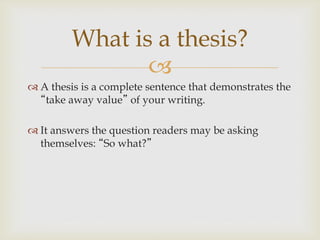
 A thesis is a complete sentence that demonstrates the
“take away value” of your writing.
 It answers the question readers may be asking
themselves: “So what?”
What is a thesis?

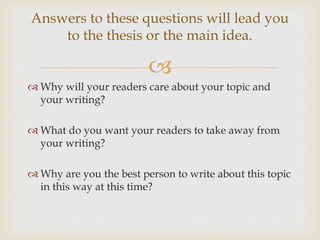
 Why will your readers care about your topic and
your writing?
 What do you want your readers to take away from
your writing?
 Why are you the best person to write about this topic
in this way at this time?
Answers to these questions will lead you
to the thesis or the main idea.

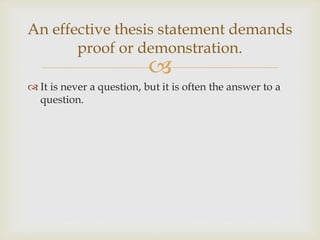
 It is never a question, but it is often the answer to a
question.
An effective thesis statement demands
proof or demonstration.

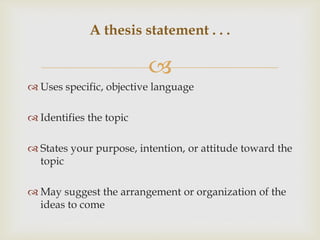
 Uses specific, objective language
 Identifies the topic
 States your purpose, intention, or attitude toward the
topic
 May suggest the arrangement or organization of the
ideas to come
A thesis statement . . .

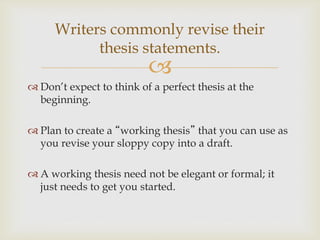
 Don’t expect to think of a perfect thesis at the
beginning.
 Plan to create a “working thesis” that you can use as
you revise your sloppy copy into a draft.
 A working thesis need not be elegant or formal; it
just needs to get you started.
Writers commonly revise their
thesis statements.

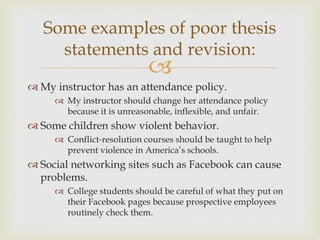
 My instructor has an attendance policy.
 My instructor should change her attendance policy
because it is unreasonable, inflexible, and unfair.
 Some children show violent behavior.
 Conflict-resolution courses should be taught to help
prevent violence in America’s schools.
 Social networking sites such as Facebook can cause
problems.
 College students should be careful of what they put on
their Facebook pages because prospective employees
routinely check them.
Some examples of poor thesis
statements and revision:

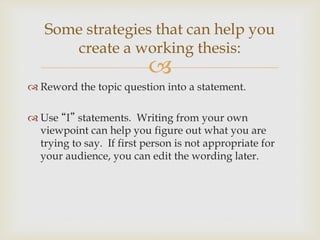
 Reword the topic question into a statement.
 Use “I” statements. Writing from your own
viewpoint can help you figure out what you are
trying to say. If first person is not appropriate for
your audience, you can edit the wording later.
Some strategies that can help you
create a working thesis:

 Choose a sentence from the last paragraph of your
sloppy copy. Writers often figure out what they want
to say as they are writing.
 Choose any sentence from your sloppy copy that
meets the criteria. You just need something to get
you started; you can change your working thesis as
you write.
More Strategies

 “Although many people think ____, in reality, ____
because ____.”
 “_____ is the most significant _____ because _____.”
 “______ illuminates the role of ______ in people’s
lives by showing us how _______, _____, and _____.”
Use a fill-in-the-blank
sentence.

 “Although many reasons have been suggested for _____,
they all boil down to _____.”
 “_____ is true for these reasons: _____, _____, _____, and
_____.
 “X has argued that _____, but Y’s position is stronger
because _____.”
 “The more important effects of _____ went beyond those
of _____.”
More fill-in-the-blanks

 Different thesis statements lead to different papers.
 If you find that your paper does not match your
working thesis, you will need to change one to fit the
other.
Remember that a thesis statement
helps to shape the rest of your paper.

Note: This PowerPoint was first developed by Professor
David Carithers, Department of English and MFL, and has
helped numerous students with shaping thesis statements.
Example thesis statements were taken from Patterns for
College Writing by Laurie G. Kirszner and Stephen R.
Mandell. In September of 2014, Riley Rich, student
assistant in the Writing Center, redesigned this PowerPoint
and added example thesis statements.
Any Questions?

Thesis Statements 2014 (new).ppt

  • 1.
    Adapted from Choices,a handbook on writing from Pearson
  • 2.
      A thesisis a complete sentence that demonstrates the “take away value” of your writing.  It answers the question readers may be asking themselves: “So what?” What is a thesis?
  • 3.
      Why willyour readers care about your topic and your writing?  What do you want your readers to take away from your writing?  Why are you the best person to write about this topic in this way at this time? Answers to these questions will lead you to the thesis or the main idea.
  • 4.
      It isnever a question, but it is often the answer to a question. An effective thesis statement demands proof or demonstration.
  • 5.
      Uses specific,objective language  Identifies the topic  States your purpose, intention, or attitude toward the topic  May suggest the arrangement or organization of the ideas to come A thesis statement . . .
  • 6.
      Don’t expectto think of a perfect thesis at the beginning.  Plan to create a “working thesis” that you can use as you revise your sloppy copy into a draft.  A working thesis need not be elegant or formal; it just needs to get you started. Writers commonly revise their thesis statements.
  • 7.
      My instructorhas an attendance policy.  My instructor should change her attendance policy because it is unreasonable, inflexible, and unfair.  Some children show violent behavior.  Conflict-resolution courses should be taught to help prevent violence in America’s schools.  Social networking sites such as Facebook can cause problems.  College students should be careful of what they put on their Facebook pages because prospective employees routinely check them. Some examples of poor thesis statements and revision:
  • 8.
      Reword thetopic question into a statement.  Use “I” statements. Writing from your own viewpoint can help you figure out what you are trying to say. If first person is not appropriate for your audience, you can edit the wording later. Some strategies that can help you create a working thesis:
  • 9.
      Choose asentence from the last paragraph of your sloppy copy. Writers often figure out what they want to say as they are writing.  Choose any sentence from your sloppy copy that meets the criteria. You just need something to get you started; you can change your working thesis as you write. More Strategies
  • 10.
      “Although manypeople think ____, in reality, ____ because ____.”  “_____ is the most significant _____ because _____.”  “______ illuminates the role of ______ in people’s lives by showing us how _______, _____, and _____.” Use a fill-in-the-blank sentence.
  • 11.
      “Although manyreasons have been suggested for _____, they all boil down to _____.”  “_____ is true for these reasons: _____, _____, _____, and _____.  “X has argued that _____, but Y’s position is stronger because _____.”  “The more important effects of _____ went beyond those of _____.” More fill-in-the-blanks
  • 12.
      Different thesisstatements lead to different papers.  If you find that your paper does not match your working thesis, you will need to change one to fit the other. Remember that a thesis statement helps to shape the rest of your paper.
  • 13.
     Note: This PowerPointwas first developed by Professor David Carithers, Department of English and MFL, and has helped numerous students with shaping thesis statements. Example thesis statements were taken from Patterns for College Writing by Laurie G. Kirszner and Stephen R. Mandell. In September of 2014, Riley Rich, student assistant in the Writing Center, redesigned this PowerPoint and added example thesis statements. Any Questions?