ADVICE IN
ACADEMIC
WRITING
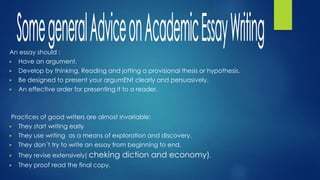
An essay should :
▶ Have an argument.
▶ Develop by thinking, Reading and jotting a provisional thesis or hypothesis.
▶ Be designed to present your argumENt clearly and persuasively.
▶ An effective order for presenting it to a reader.
Practices of good writers are almost invariable:
▶ They start writing early
▶ They use writing as a means of exploration and discovery.
▶ They don´t try to write an essay from beginning to end.
▶ They revise extensively( cheking diction and economy).
▶ They proof read the final copy.
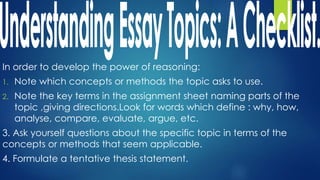
In order to develop the power of reasoning:
1. Note which concepts or methods the topic asks to use.
2. Note the key terms in the assignment sheet naming parts of the
topic ,giving directions.Look for words which define : why, how,
analyse, compare, evaluate, argue, etc.
3. Ask yourself questions about the specific topic in terms of the
concepts or methods that seem applicable.
4. Formulate a tentative thesis statement.
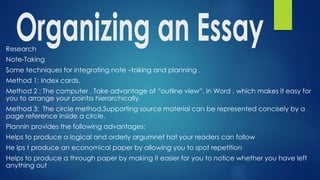
Research
Note-Taking
Some techniques for integrating note –taking and planning .
Method 1: Index cards.
Method 2 : The computer . Take advantage of “outline view”, in Word , which makes it easy for
you to arrange your pointss hierarchically.
Method 3: The circle method.Supporting source material can be represented concisely by a
page reference inside a circle.
Plannin provides the following advantages:
Helps to produce a logical and orderly argumnet hat your readers can follow
He lps t produce an economical paper by allowing you to spot repetition
Helps to produce a through paper by making it easier for you to notice whether you have left
anything out
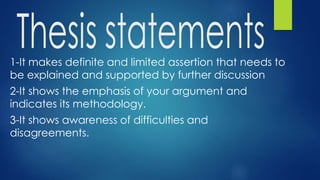
1-It makes definite and limited assertion that needs to
be explained and supported by further discussion
2-It shows the emphasis of your argument and
indicates its methodology.
3-It shows awareness of difficulties and
disagreements.
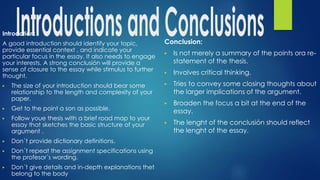
Introdction:
A good introduction should identify your topic,
provide essential context , and indicate your
particular focus in the essay. It also needs to engage
your interests. A strong conclusión will provide a
sense of closure to the essay while stimulus to further
thought.
▶ The size of your introduction should bear some
relationship to the length and complexity of your
paper.
▶ Get to the point a son as possible.
▶ Follow youe thesis with a brief road map to your
essay that sketches the basic structure of your
argument .
▶ Don´t provide dictionary definitions.
▶ Don´t repeat the assignment specifications using
the profesor´s wording.
▶ Don´t give details and in-depth explanations thet
belong to the body
Conclusion:
▶ Is not merely a summary of the points ora re-
statement of the thesis.
▶ Involves critical thinking.
▶ Tries to convey some closing thoughts about
the larger implications of the argument.
▶ Broaden the focus a bit at the end of the
essay.
▶ The lenght of the conclusión should reflect
the lenght of the essay.
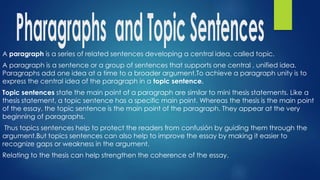
A paragraph is a series of related sentences developing a central idea, called topic.
A paragraph is a sentence or a group of sentences that supports one central , unified idea.
Paragraphs add one idea at a time to a broader argument.To achieve a paragraph unity is to
express the central idea of the paragraph in a topic sentence.
Topic sentences state the main point of a paragraph are similar to mini thesis statements. Like a
thesis statement, a topic sentence has a specific main point. Whereas the thesis is the main point
of the essay, the topic sentence is the main point of the paragraph. They appear at the very
beginning of paragraphs.
Thus topics sentences help to protect the readers from confusión by guiding them through the
argument.But topics sentences can also help to improve the essay by making it easier to
recognize gaps or weakness in the argument.
Relating to the thesis can help strengthen the coherence of the essay.
Critical Reading Toward critcal writing:
Critical writing depends on critical
reding. Most of the essays you write will
involve reflection on written texts.
The judgements and interpretations
you make of the texts you read are the
first steps towards formulating your own
approach.
To read critically THE KEY IS THIS.
▶ Don´t read looking only or primarily
for information
▶ Do read looking ways of thinking
about the subject matter
Taking Notes from Research
Reading
▶ Good note-taking startegies will
help read with more
understanding
▶ Save time and frustation when
writing a paper.
▶ Focuus your approach to the
topic before starting the resarch.
▶ Dont´t write down too much.
▶ Label you notes intelligently
Research on the Net is very different from a traditional library research.
O the internet ,”anything goes”.Anyone can put they want on a Web site, ther is no review or screening process,
there are not agreed-upon standard ways of identifying subjects and creating cross-references. It is important to
pay close attention when doing research on-line .There are a great Manny solid academic resources available on
theNet, including hundreds of on- line journals and sites set up by universities and scholarly or scientific
organizations.
Basics Guidelines to remember:
▶ Don´t rely exclusively on Net resorces
▶ Before you start your search, think about what you,re looking for, and if posible formulate some very specific
qustions to direct and limit your search.
Keep detailed record of sites you visit and sites you use. Doing research on the Net inevitably means visiting some
sites that are useful and many taht are not.
The following points are guidelines for evaluating specific resources you find on the Net Asking these questions
when looking at a Web site, you can avoid many errors and problems.
Authority
Affiliation
Audience Level Currency
ContentRelaibility/Accuracy
About previewing
It is preferable to read with certain goals in mind.
The primary purposes in Reading are shaped by the course a person is taking/or the papers
writing.
Spending a few minits previewing a text before starting to read, will help to orient toward what is
important in the Reading.
▶ Read the title
▶ Think about the subject matter.
▶ Who wrote this text?
▶ Where and when was this text originally published?
▶ Read the chapter titles or the headings .
▶ Why this text has been asigned to you?
▶ What kind of facts an ideas are you expected to retain from this Reading ?
Skimming
One of the most effective methods for toughtful
Reading is too get a general overview of the text
before beginning to read it in detail.By firsta
skimming a text, you can get a sense of its overall
logical progression.
▶ Use some of the previewing techniques.
▶ Read carefully the introductory paragraph to
predict the direction of the coming
explanations.
▶ Read carefully the first or two sentences of
each paragraph as well as the concluding
sentence.
▶ Keeps your eyes moving.
▶ Read carefully the concluding paragraph.
▶ Read through the text carefully.
▶ Adjsut your focus.
Scanning
Is basically skimming with a more tightly focused
purpose:
To locate a particular fact or figure,
Or to see whether this text mentions a subject you
are researching.
Summarizing a text has two aims:
1. To reproduce the overarching ideas in a text, identifying the general concepts that run through the entire
piece, and
2. To express a way to give an overview of these points without your own sentences becoming too general.
▶ Include the title and identify the author in your first sentence
▶ The first sentence or two of your summary should contain the author´s thesis, or central concept,sayed in
your own words.
▶ When summarizing a longer article, try to see how the various stages in the explanation or argument are
built up into groups of related paragraphs.
▶ Divide the article into sections, then write a sentence to cover the key ideas in each section.
▶ Omit the ideas that are not really central to the text.
▶ Omit minor details and specific examples.
▶ Avoid writing opinions or personal responses in your sumaries
▶ Be careful not to plaiarize the autor´s words.
▶ You need to integrate your acknowledgement into your own writing. Give the reference as
soon as you´ve mentioned the idea you are using, not just at the end of the paragraph.
▶ You need to keep mentioning authors and pages and dates to show how your ideas are
related to those of the experts.
▶ You can cut down and clutter by recognizing that some ideas are “common knowledge” in
the field-that is, taking for granted by people knowledgeable about the topic.For example
.THE DATE FOR Armistice for World War I.
▶ Always write down the author, title and publication information (including the URL and other
identifiyingi information for web pages)
▶ Taking good notes is also essential. Don´t paste passages from online sources into your draft.
▶ If you use the author´s exact words, enclose them in quotation marks, or indent passages of
more than four lines.
▶ To paraprase means to restate someone
else´s ideas in your own language at
roughly the same level of detail.
▶ You must provide a reference .
▶ The paraphrase must be in your own
words .You must also créate your own
sentence structures.
▶ Convert the ideas from your notes into full
sentences.
▶ Provide a reference.
▶ Go back to the original to ensure(a) your
paraphrase is accurate and (b) you have
truly expressed the ideas in your own
words.
▶ To summarize means to reduce the
most essential points of someone
else´s work into a shorter form.
Summary moves much further tan
paraphrase from point-by-point
translation. When you summarize a
passage, you need first to absorb the
meaning and then to capture in your
own words the most important
elements from the original passage .
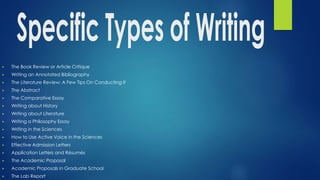
▶ The Book Review or Article Critique
▶ Writing an Annotated Bibliography
▶ The Literature Review: A Few Tips On Conducting It
▶ The Abstract
▶ The Comparative Essay
▶ Writing about History
▶ Writing about Literature
▶ Writing a Philosophy Essay
▶ Writing in the Sciences
▶ How to Use Active Voice in the Sciences
▶ Effective Admission Letters
▶ Application Letters and Résumés
▶ The Academic Proposal
▶ Academic Proposals in Graduate School
▶ The Lab Report
▶ Revising gives you the chance to preview your work on behalf of the eventual reader.
Revision is much more tan proofreading.
▶ First check whether you have fulfilled the intention of the assignment.
▶ Have you performed the kind of thinking the assignment sheet asked for(e.g.,analyse,
argue, compare, explore)?
▶ Have you written the genre of document called for(e.g book review, critique, personal
response, field notes, research, lab report, essay)?
▶ Have you used concepts and methods of reasoning dsiscussed in the course?
▶ Then look at overall organization
▶ Introduction, Each section, connections, conclusion.
▶ Different disciplines use their own systems to give information about
sources . Here are samples of the main systems,showing the kinds of
information needed and some details of punctuation, typeface, and
indentation.
▶ Traditional Ednotes or Fotnotes with Supercript Numbers.
▶ MLA System: Parenthetical Author- Page References.
▶ APA System: Parenthetical Author- Date References.
▶ Numbered Note Systems(e.g.,IEEE, Medical and Life Sciences).
You can indicate your attitude to the sources you cite by choosing specific verbs to refer to
them.
Here are some grammatical pattern sto follow in using these verbs
Pattern 1 : reporting+ verb +that +subject +verb
acknowledge-admit-assert-hypothesize-object-say
Da souza argues that previous researches have misinterpreted the data.
Pattern2: reporting verb+somebody/something+for+noun/gerund
Applaud-fault-blame-praise-censure-ridicule-criticize-single out
Smith criticized jones for his use of incomplete data(or for using incomplete data)
Pattern 3: reporting verb+somebody/something+as+noun/gerund/adjective
Appraise-define-interpret-asses-depict-portrary-present-describe-characterize-class
Jones describes the finding as resting on irrefutable evidence.
▶ Fredman,J(n.d) English Language Learning, Arts & Science
http://advice.writing.utoronto.ca/planning/intros-and-conclusions/
▶ Hall, H (n.d) Using Topic Sentences http://advice.writing.utoronto.ca/planning/topic-
sentences/
▶ Knott, D (n.d) http://advice.writing.utoronto.ca/researching/critical-reading/
▶ MacDonald,B (n.d) Researching Using the
Internethttp://advice.writing.utoronto.ca/researching/research-using-internet/
▶ Plotnick, J (n.d) Thesis Statement http://advice.writing.utoronto.ca/planning/organizing/
▶ Procter, M (n.d) Writing Support http://advice.writing.utoronto.ca/general/essay-topics/
▶ Procter, M (n.d) Thesis Statements http://advice.writing.utoronto.ca/planning/thesis-
statements/
▶ Visvis, V (n.d) Pharagraphs http://advice.writing.utoronto.ca/planning/paragraphs/

Advice In Academic Writing

  • 1.
  • 3.
    An essay should: ▶ Have an argument. ▶ Develop by thinking, Reading and jotting a provisional thesis or hypothesis. ▶ Be designed to present your argumENt clearly and persuasively. ▶ An effective order for presenting it to a reader. Practices of good writers are almost invariable: ▶ They start writing early ▶ They use writing as a means of exploration and discovery. ▶ They don´t try to write an essay from beginning to end. ▶ They revise extensively( cheking diction and economy). ▶ They proof read the final copy.
  • 4.
    In order todevelop the power of reasoning: 1. Note which concepts or methods the topic asks to use. 2. Note the key terms in the assignment sheet naming parts of the topic ,giving directions.Look for words which define : why, how, analyse, compare, evaluate, argue, etc. 3. Ask yourself questions about the specific topic in terms of the concepts or methods that seem applicable. 4. Formulate a tentative thesis statement.
  • 6.
    Research Note-Taking Some techniques forintegrating note –taking and planning . Method 1: Index cards. Method 2 : The computer . Take advantage of “outline view”, in Word , which makes it easy for you to arrange your pointss hierarchically. Method 3: The circle method.Supporting source material can be represented concisely by a page reference inside a circle. Plannin provides the following advantages: Helps to produce a logical and orderly argumnet hat your readers can follow He lps t produce an economical paper by allowing you to spot repetition Helps to produce a through paper by making it easier for you to notice whether you have left anything out
  • 7.
    1-It makes definiteand limited assertion that needs to be explained and supported by further discussion 2-It shows the emphasis of your argument and indicates its methodology. 3-It shows awareness of difficulties and disagreements.
  • 8.
    Introdction: A good introductionshould identify your topic, provide essential context , and indicate your particular focus in the essay. It also needs to engage your interests. A strong conclusión will provide a sense of closure to the essay while stimulus to further thought. ▶ The size of your introduction should bear some relationship to the length and complexity of your paper. ▶ Get to the point a son as possible. ▶ Follow youe thesis with a brief road map to your essay that sketches the basic structure of your argument . ▶ Don´t provide dictionary definitions. ▶ Don´t repeat the assignment specifications using the profesor´s wording. ▶ Don´t give details and in-depth explanations thet belong to the body Conclusion: ▶ Is not merely a summary of the points ora re- statement of the thesis. ▶ Involves critical thinking. ▶ Tries to convey some closing thoughts about the larger implications of the argument. ▶ Broaden the focus a bit at the end of the essay. ▶ The lenght of the conclusión should reflect the lenght of the essay.
  • 9.
    A paragraph isa series of related sentences developing a central idea, called topic. A paragraph is a sentence or a group of sentences that supports one central , unified idea. Paragraphs add one idea at a time to a broader argument.To achieve a paragraph unity is to express the central idea of the paragraph in a topic sentence. Topic sentences state the main point of a paragraph are similar to mini thesis statements. Like a thesis statement, a topic sentence has a specific main point. Whereas the thesis is the main point of the essay, the topic sentence is the main point of the paragraph. They appear at the very beginning of paragraphs. Thus topics sentences help to protect the readers from confusión by guiding them through the argument.But topics sentences can also help to improve the essay by making it easier to recognize gaps or weakness in the argument. Relating to the thesis can help strengthen the coherence of the essay.
  • 11.
    Critical Reading Towardcritcal writing: Critical writing depends on critical reding. Most of the essays you write will involve reflection on written texts. The judgements and interpretations you make of the texts you read are the first steps towards formulating your own approach. To read critically THE KEY IS THIS. ▶ Don´t read looking only or primarily for information ▶ Do read looking ways of thinking about the subject matter Taking Notes from Research Reading ▶ Good note-taking startegies will help read with more understanding ▶ Save time and frustation when writing a paper. ▶ Focuus your approach to the topic before starting the resarch. ▶ Dont´t write down too much. ▶ Label you notes intelligently
  • 12.
    Research on theNet is very different from a traditional library research. O the internet ,”anything goes”.Anyone can put they want on a Web site, ther is no review or screening process, there are not agreed-upon standard ways of identifying subjects and creating cross-references. It is important to pay close attention when doing research on-line .There are a great Manny solid academic resources available on theNet, including hundreds of on- line journals and sites set up by universities and scholarly or scientific organizations. Basics Guidelines to remember: ▶ Don´t rely exclusively on Net resorces ▶ Before you start your search, think about what you,re looking for, and if posible formulate some very specific qustions to direct and limit your search. Keep detailed record of sites you visit and sites you use. Doing research on the Net inevitably means visiting some sites that are useful and many taht are not. The following points are guidelines for evaluating specific resources you find on the Net Asking these questions when looking at a Web site, you can avoid many errors and problems. Authority Affiliation Audience Level Currency ContentRelaibility/Accuracy
  • 13.
    About previewing It ispreferable to read with certain goals in mind. The primary purposes in Reading are shaped by the course a person is taking/or the papers writing. Spending a few minits previewing a text before starting to read, will help to orient toward what is important in the Reading. ▶ Read the title ▶ Think about the subject matter. ▶ Who wrote this text? ▶ Where and when was this text originally published? ▶ Read the chapter titles or the headings . ▶ Why this text has been asigned to you? ▶ What kind of facts an ideas are you expected to retain from this Reading ?
  • 14.
    Skimming One of themost effective methods for toughtful Reading is too get a general overview of the text before beginning to read it in detail.By firsta skimming a text, you can get a sense of its overall logical progression. ▶ Use some of the previewing techniques. ▶ Read carefully the introductory paragraph to predict the direction of the coming explanations. ▶ Read carefully the first or two sentences of each paragraph as well as the concluding sentence. ▶ Keeps your eyes moving. ▶ Read carefully the concluding paragraph. ▶ Read through the text carefully. ▶ Adjsut your focus. Scanning Is basically skimming with a more tightly focused purpose: To locate a particular fact or figure, Or to see whether this text mentions a subject you are researching.
  • 15.
    Summarizing a texthas two aims: 1. To reproduce the overarching ideas in a text, identifying the general concepts that run through the entire piece, and 2. To express a way to give an overview of these points without your own sentences becoming too general. ▶ Include the title and identify the author in your first sentence ▶ The first sentence or two of your summary should contain the author´s thesis, or central concept,sayed in your own words. ▶ When summarizing a longer article, try to see how the various stages in the explanation or argument are built up into groups of related paragraphs. ▶ Divide the article into sections, then write a sentence to cover the key ideas in each section. ▶ Omit the ideas that are not really central to the text. ▶ Omit minor details and specific examples. ▶ Avoid writing opinions or personal responses in your sumaries ▶ Be careful not to plaiarize the autor´s words.
  • 17.
    ▶ You needto integrate your acknowledgement into your own writing. Give the reference as soon as you´ve mentioned the idea you are using, not just at the end of the paragraph. ▶ You need to keep mentioning authors and pages and dates to show how your ideas are related to those of the experts. ▶ You can cut down and clutter by recognizing that some ideas are “common knowledge” in the field-that is, taking for granted by people knowledgeable about the topic.For example .THE DATE FOR Armistice for World War I. ▶ Always write down the author, title and publication information (including the URL and other identifiyingi information for web pages) ▶ Taking good notes is also essential. Don´t paste passages from online sources into your draft. ▶ If you use the author´s exact words, enclose them in quotation marks, or indent passages of more than four lines.
  • 18.
    ▶ To paraprasemeans to restate someone else´s ideas in your own language at roughly the same level of detail. ▶ You must provide a reference . ▶ The paraphrase must be in your own words .You must also créate your own sentence structures. ▶ Convert the ideas from your notes into full sentences. ▶ Provide a reference. ▶ Go back to the original to ensure(a) your paraphrase is accurate and (b) you have truly expressed the ideas in your own words. ▶ To summarize means to reduce the most essential points of someone else´s work into a shorter form. Summary moves much further tan paraphrase from point-by-point translation. When you summarize a passage, you need first to absorb the meaning and then to capture in your own words the most important elements from the original passage .
  • 19.
    ▶ The BookReview or Article Critique ▶ Writing an Annotated Bibliography ▶ The Literature Review: A Few Tips On Conducting It ▶ The Abstract ▶ The Comparative Essay ▶ Writing about History ▶ Writing about Literature ▶ Writing a Philosophy Essay ▶ Writing in the Sciences ▶ How to Use Active Voice in the Sciences ▶ Effective Admission Letters ▶ Application Letters and Résumés ▶ The Academic Proposal ▶ Academic Proposals in Graduate School ▶ The Lab Report
  • 21.
    ▶ Revising givesyou the chance to preview your work on behalf of the eventual reader. Revision is much more tan proofreading. ▶ First check whether you have fulfilled the intention of the assignment. ▶ Have you performed the kind of thinking the assignment sheet asked for(e.g.,analyse, argue, compare, explore)? ▶ Have you written the genre of document called for(e.g book review, critique, personal response, field notes, research, lab report, essay)? ▶ Have you used concepts and methods of reasoning dsiscussed in the course? ▶ Then look at overall organization ▶ Introduction, Each section, connections, conclusion.
  • 22.
    ▶ Different disciplinesuse their own systems to give information about sources . Here are samples of the main systems,showing the kinds of information needed and some details of punctuation, typeface, and indentation. ▶ Traditional Ednotes or Fotnotes with Supercript Numbers. ▶ MLA System: Parenthetical Author- Page References. ▶ APA System: Parenthetical Author- Date References. ▶ Numbered Note Systems(e.g.,IEEE, Medical and Life Sciences).
  • 24.
    You can indicateyour attitude to the sources you cite by choosing specific verbs to refer to them. Here are some grammatical pattern sto follow in using these verbs Pattern 1 : reporting+ verb +that +subject +verb acknowledge-admit-assert-hypothesize-object-say Da souza argues that previous researches have misinterpreted the data. Pattern2: reporting verb+somebody/something+for+noun/gerund Applaud-fault-blame-praise-censure-ridicule-criticize-single out Smith criticized jones for his use of incomplete data(or for using incomplete data) Pattern 3: reporting verb+somebody/something+as+noun/gerund/adjective Appraise-define-interpret-asses-depict-portrary-present-describe-characterize-class Jones describes the finding as resting on irrefutable evidence.
  • 25.
    ▶ Fredman,J(n.d) EnglishLanguage Learning, Arts & Science http://advice.writing.utoronto.ca/planning/intros-and-conclusions/ ▶ Hall, H (n.d) Using Topic Sentences http://advice.writing.utoronto.ca/planning/topic- sentences/ ▶ Knott, D (n.d) http://advice.writing.utoronto.ca/researching/critical-reading/ ▶ MacDonald,B (n.d) Researching Using the Internethttp://advice.writing.utoronto.ca/researching/research-using-internet/ ▶ Plotnick, J (n.d) Thesis Statement http://advice.writing.utoronto.ca/planning/organizing/ ▶ Procter, M (n.d) Writing Support http://advice.writing.utoronto.ca/general/essay-topics/ ▶ Procter, M (n.d) Thesis Statements http://advice.writing.utoronto.ca/planning/thesis- statements/ ▶ Visvis, V (n.d) Pharagraphs http://advice.writing.utoronto.ca/planning/paragraphs/