Modifying Existing Programs: Strategies for Adapting Instructional Materials.pptx
1.
Modifying Existing Programs:
Strategiesfor Adapting Instructional
Materials, Assignments, and
Assessments to meet Diverse
Learning Needs
Reporter: DOMILEN R. RABE
MASPED
Submitted to: Nodel Turiano,Phd
Professor
2.
Educators are mandatedto see that all students
meet the standards of their district and state.
Through the use of differentiated instructional
strategies, educators can meet the needs of all
students and help them to meet and exceed the
established standards (Levy, 2008).The objective is
accomplished by choosing appropriate teaching
methods to match each individual student’s learning
needs (Adami, 2004).
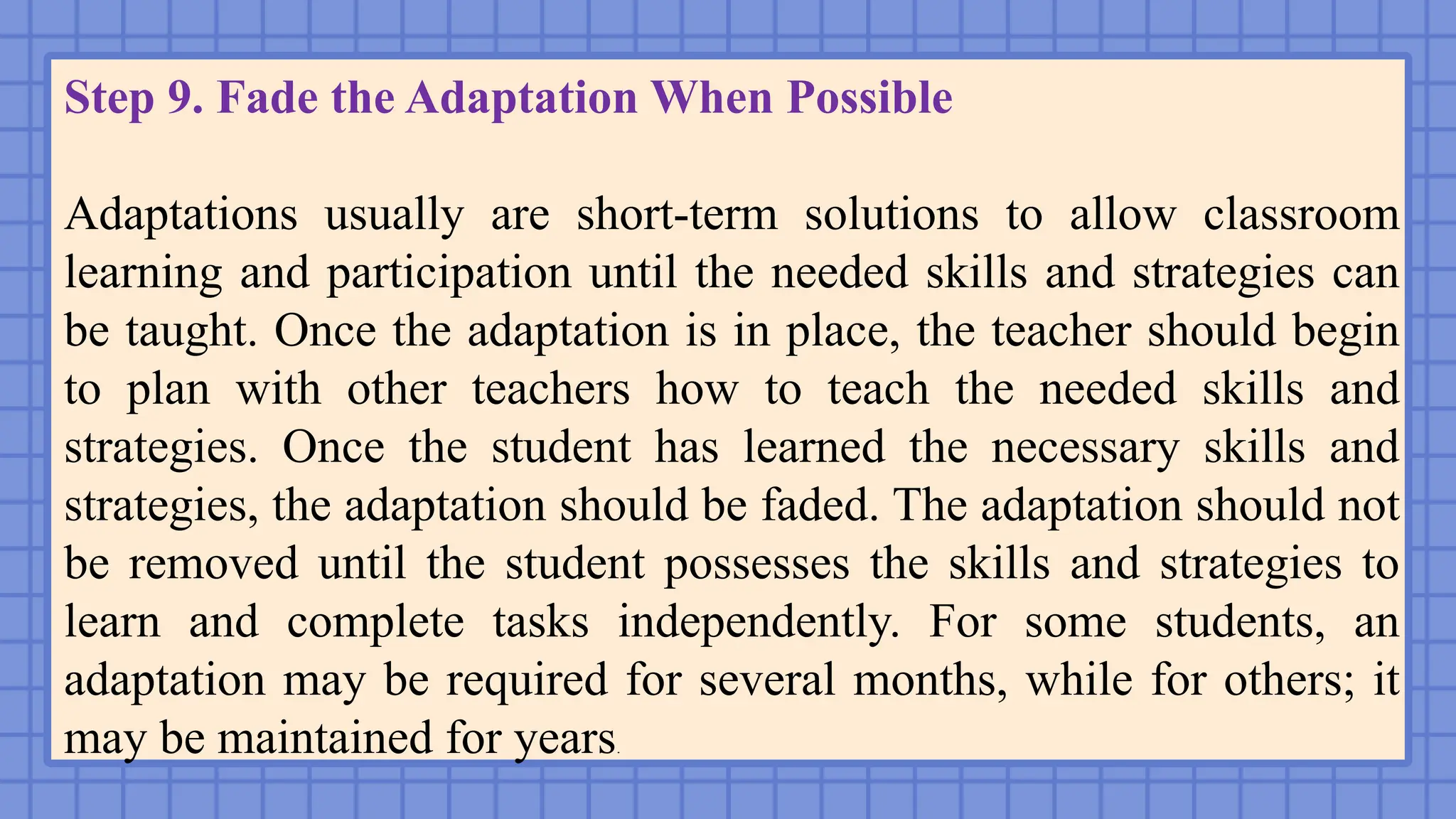
3.
Differentiated instruction isappropriate for virtually all
general education classes and is particularly beneficial to
students with an array of learning challenges. Students
demonstrate varying learning abilities, academic levels,
learning styles, and learning preferences and need tailored
instruction to meet their unique needs (Bender, 2012).
Differentiated instruction recognizes the value and worth
that exist in each individual; it allows students from all
backgrounds and with diverse abilities to demonstrate
what they know, understand, and are capable of doing
(Adami, 2004).
4.
Differentiated instruction wasoriginated by C.A. Tomlinson in
1999, basing it primarily on Howard Gardner’s concept of multiple
intelligences and brain-compatible research literature. Teachers were
encouraged to consider students’ unique learning styles and
differentiate educational activities to provide for their divergent
learning styles by differentiating instruction in three areas: content,
process, and product (Bender, 2012). In differentiating instruction,
teachers proactively modify the curriculum, teaching methods,
resources, learning activities, and student products to address the
needs of individual students and small groups of students to
maximize the learning opportunity for each student in the classroom
(Hillier, 2011).
5.
Areas of differentiatedinstructions:
1. Content: What the student needs to learn. The instructional
concepts should be broad based, and all students should be given
access to the same core content. However, the content’s
complexity should be adapted to students’ learner profiles.
Teachers can vary the presentation of content, (e.g., textbooks,
lecture, demonstrations, taped texts) to best meet students’
needs.
6.
2. Process: Activitiesin which the student
engages to make sense of or master the content.
Examples of differentiating process activities
include scaffolding, flexible grouping, interest
centers, manipulatives, varying the length of time
for a student to master content, and encouraging
an advanced learner to pursue a topic
in greater depth.
7.
3. Products: Theculminating projects that ask
students to apply and extend what they have
learned. Products should provide students with
different ways to demonstrate their knowledge
as well as various levels of difficulty, group or
individual work, and various means of scoring.
8.
4. Learning stylesand teaching styles
How much a student learns in a class is governed in part
by that student’s native ability and prior preparation but
also by the compatibility of his or her learning style and the
instructor’s teaching style. If mismatches exist between
learning styles and teaching styles students become bored
and inattentive in class, do poorly on tests, get discouraged
about the courses, the curriculum, and themselves, and in
some cases change to other curricula or drop out of school
(Felder & Silverman, 1988).
9.
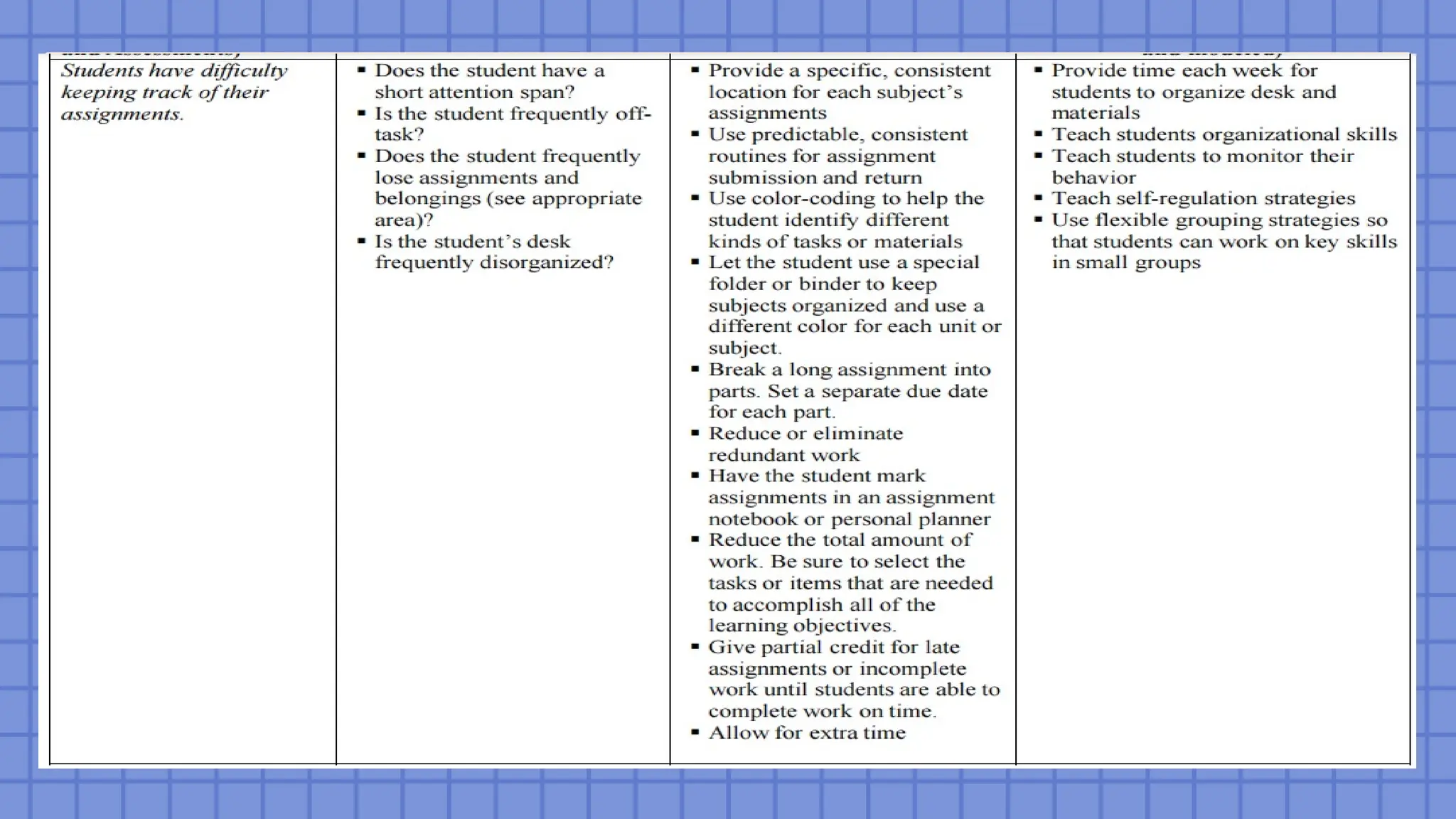
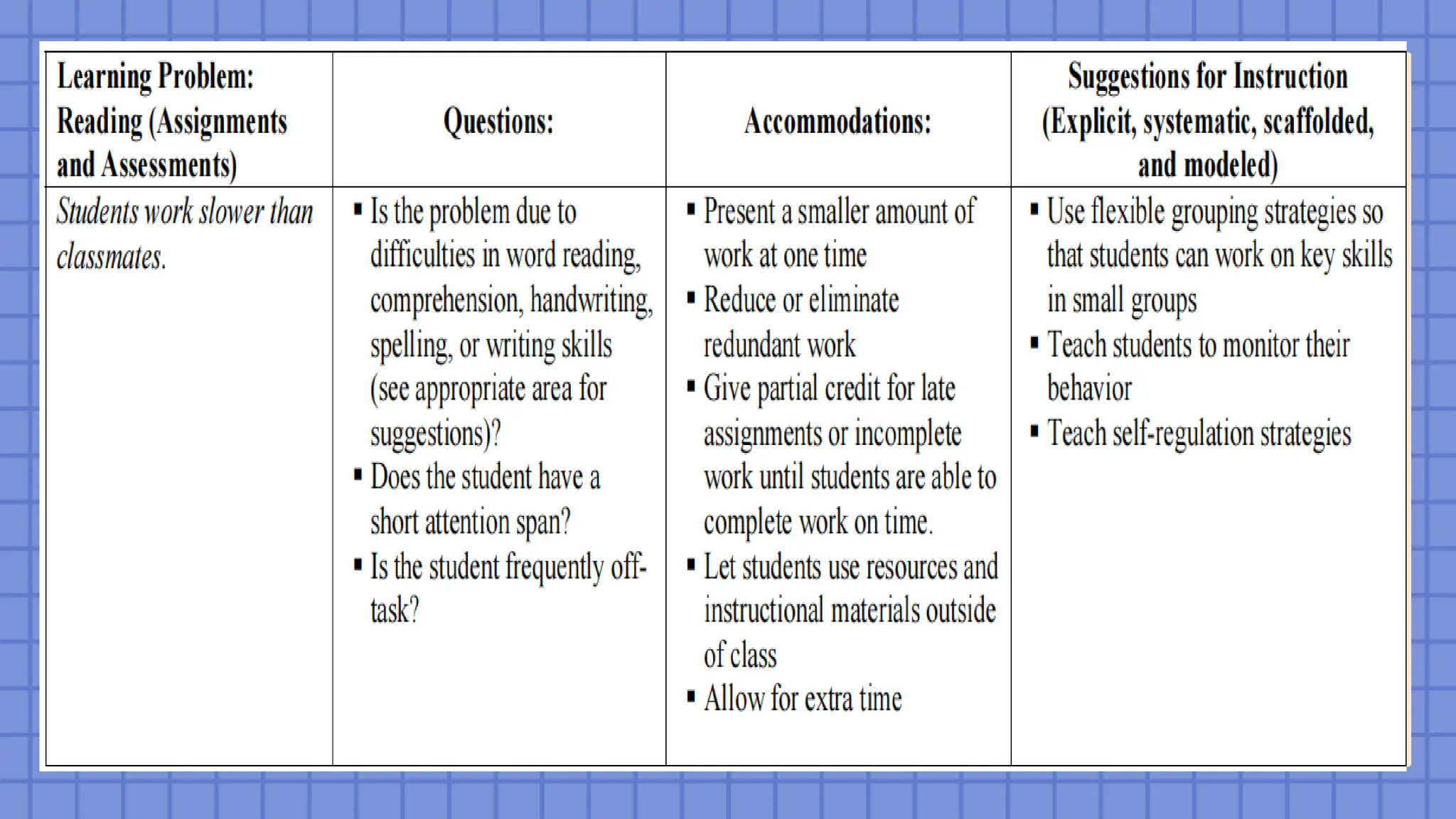
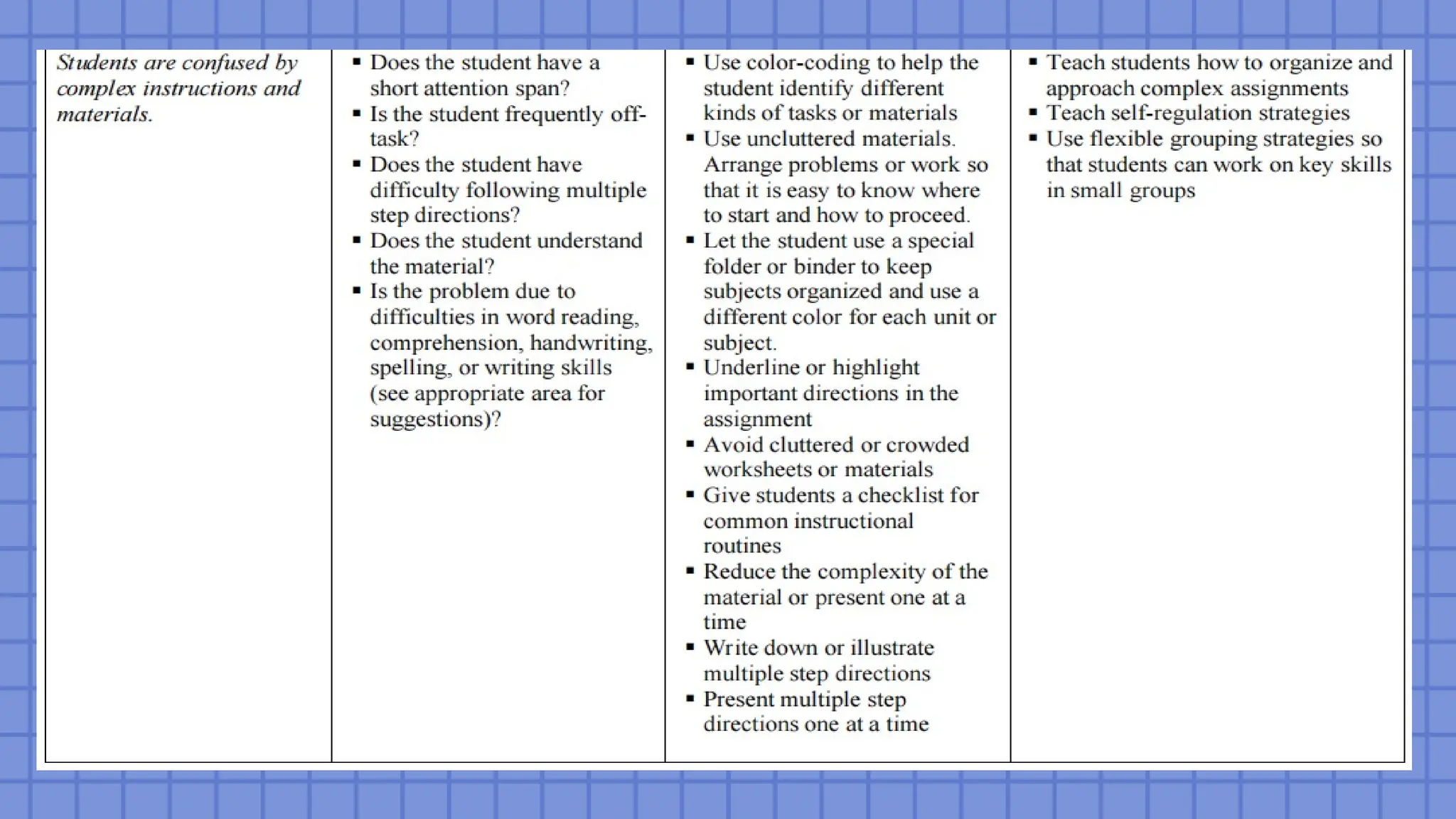
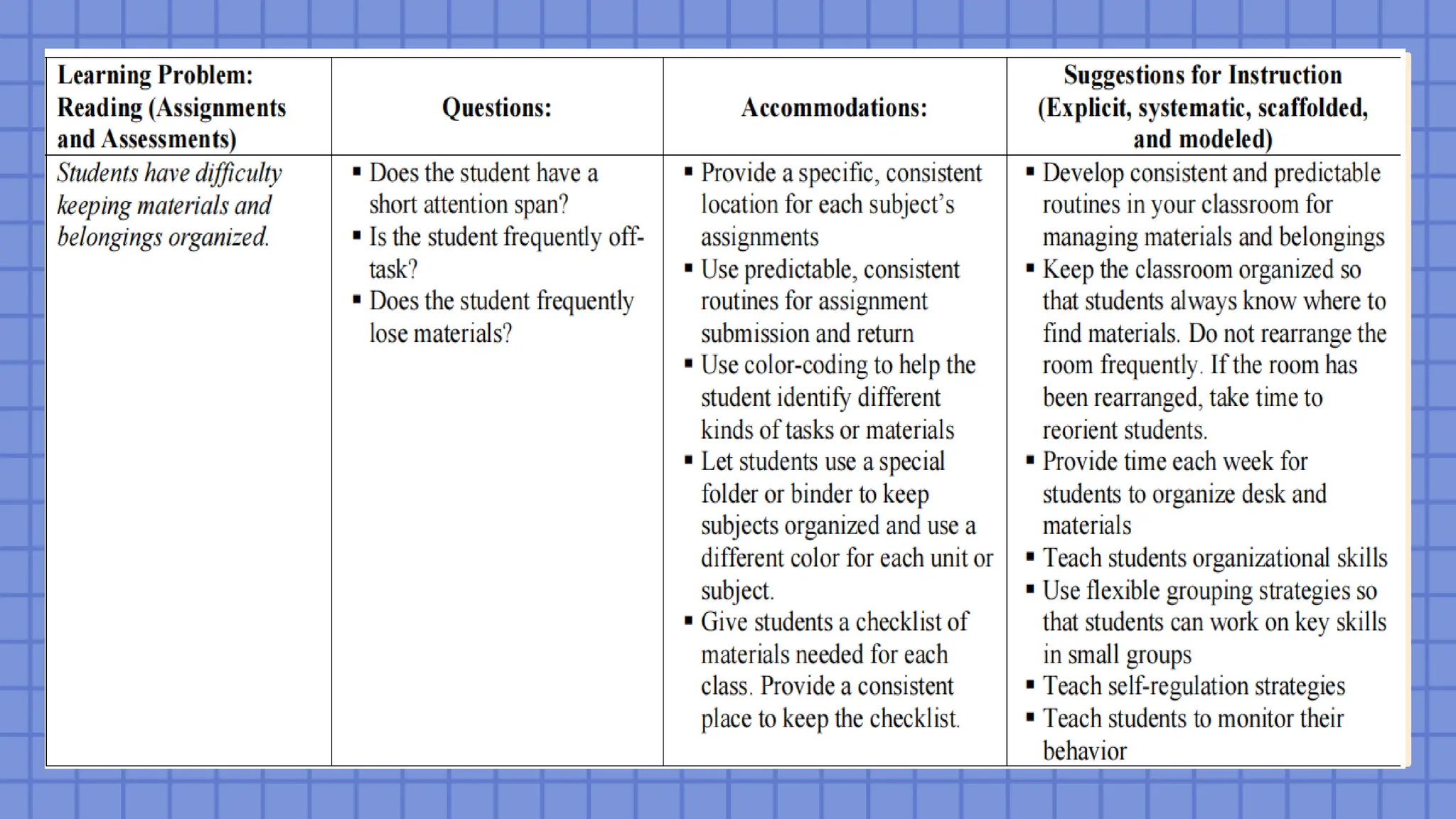
Use the followingsteps to providing accommodations:
Step 1. Create a Plan for Adapting Materials
Effective adaptations require sustained development and support.
They must be made within the framework of a larger plan that
includes consideration of (a) basic and strategic skills instruction and
(b) the roles of people involved in the adaptation process. In some
cases, it is important to involve your administrator and curriculum or
program coordinator from the beginning, and identify exactly who
will be responsible for making, implementing, supporting and
evaluating the adaptation over the course of the year. As much as
possible, involve students, parents, paraprofessionals, and others.
Adaptations that can benefit an entire class or several classes are
more likely to be supported and maintained.
10.
Step 2. Identifyand Evaluate the Demands that Students Are Not
Meeting
The purpose of this step is to define the problem to be addressed by
the adaptation. Observe students' performance when they use typical
instructional materials. They may have difficulty acquiring or getting
the important information from written materials, storing or
remembering the information presented in the materials, or
expressing the information or demonstrating competence on written
tests. If students have difficulty with a given task, different solutions
may be required depending on the level of difficulty and the student’s
individual needs.
11.
Step 3. DevelopGoals for Teaching Strategies and
Making Adaptations
Some problems can be solved by adaptations; other
problems may signal the need for intensive instruction in
skills or strategies. Often, teachers may need to provide
adaptations while simultaneously teaching the student
the learning strategies he or she needs in order to
perform the work. All adaptations lead students to
become dependent on the person who makes them.
12.
Before an adaptationis made for an individual
student, educators must carefully consider the best
approach to addressing the student's difficulty and
promoting success. Adaptations should be
approached as short-term solutions within a long-
term plan for teaching skills and strategies that will
promote the student's independence as a learner
and ultimately reduce the need for adaptations.
13.
Step 4. DetermineWhether Content or Format Adaptations Are
Needed
Content adaptations may be made only when the student's
Individualized Educational Program (IEP) notes that the general
curriculum is inappropriate for this student. Content adaptations
must also meet local and state education standards. In some cases,
the IEP may address the degree to which the requirements
associated with meeting state standards and taking assessments may
be modified. The teacher must decide which parts of the curriculum
the student will be required to learn and will constitute mastery of
the course content.
14.
When the curriculumis considered appropriate for the student,
adaptations may focus on format rather than content. Again, the
teacher must identify the critical elements of course content that
students must learn: First, identify the critical course ideas or
concepts. Then identify the information that must be mastered in
each unit to ensure that the critical course ideas are mastered.
Finally, determine how students will demonstrate their mastery at
the end of each unit and at the end of the course. Format
adaptations are made to compensate for mismatches between the
presentation or design of the materials and the skills and strategies
of the student. In format adaptations, the content is not altered.
15.
Step 5. Identifythe Features of the Materials that Need
To Be Adapted
The design of materials can present many different types of
problems for students who struggle. Teachers adapting
materials should examine each curricular unit for features
that might cause a learning problem. For example, the
content may be very abstract, complex, or poorly organized,
or it might present too much information. It may not be
relevant to students or it may be boring.
16.
Further, it maycall for skills or strategies or
background information that the student does not
possess. It may present activities that do not lead to
mastery, or it may fail to give students cues about how
to think about or study the information. Materials also
may not provide a variety of flexible options through
which students can demonstrate competence.
Guidelines for identifying these and other problems in
the design of instructional materials may be found in
resources like those listed at the end of this article.
17.
Step 6. Determinethe Type of Adaptation That Will Enable the
Student To Meet the Demand
Once the materials have been evaluated and possible problem areas
identified, the type of format adaptation must be selected. Format
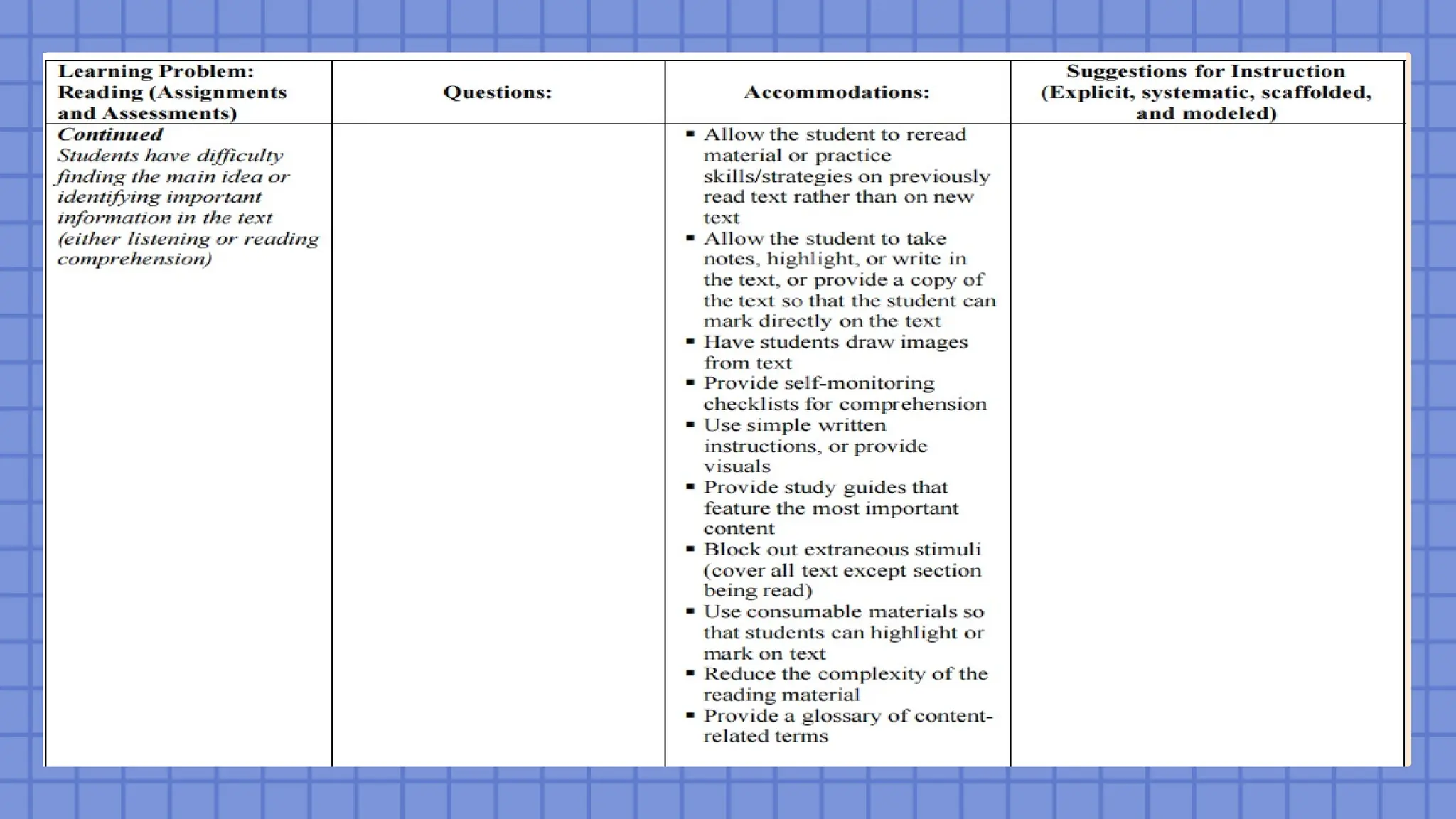
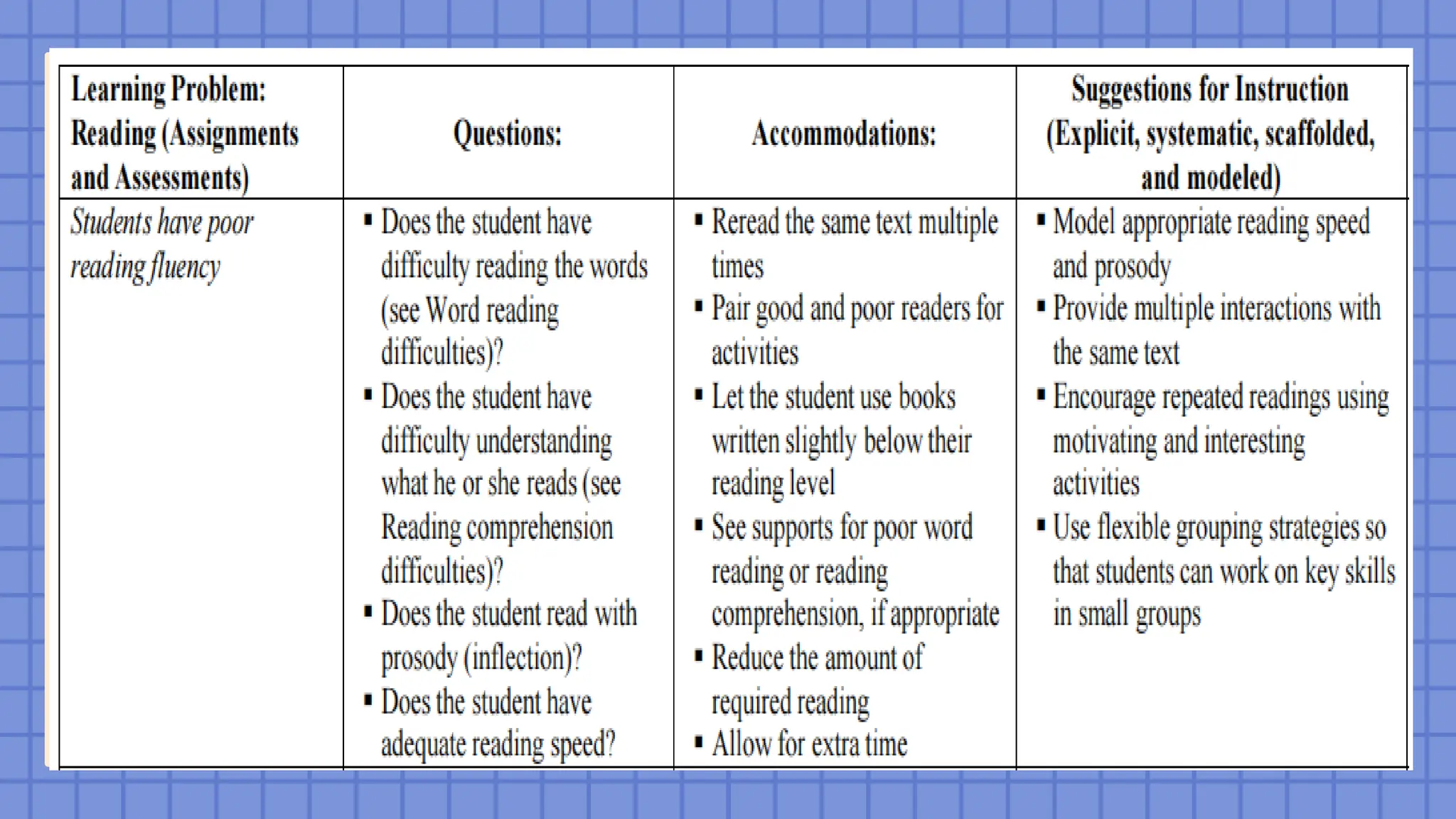
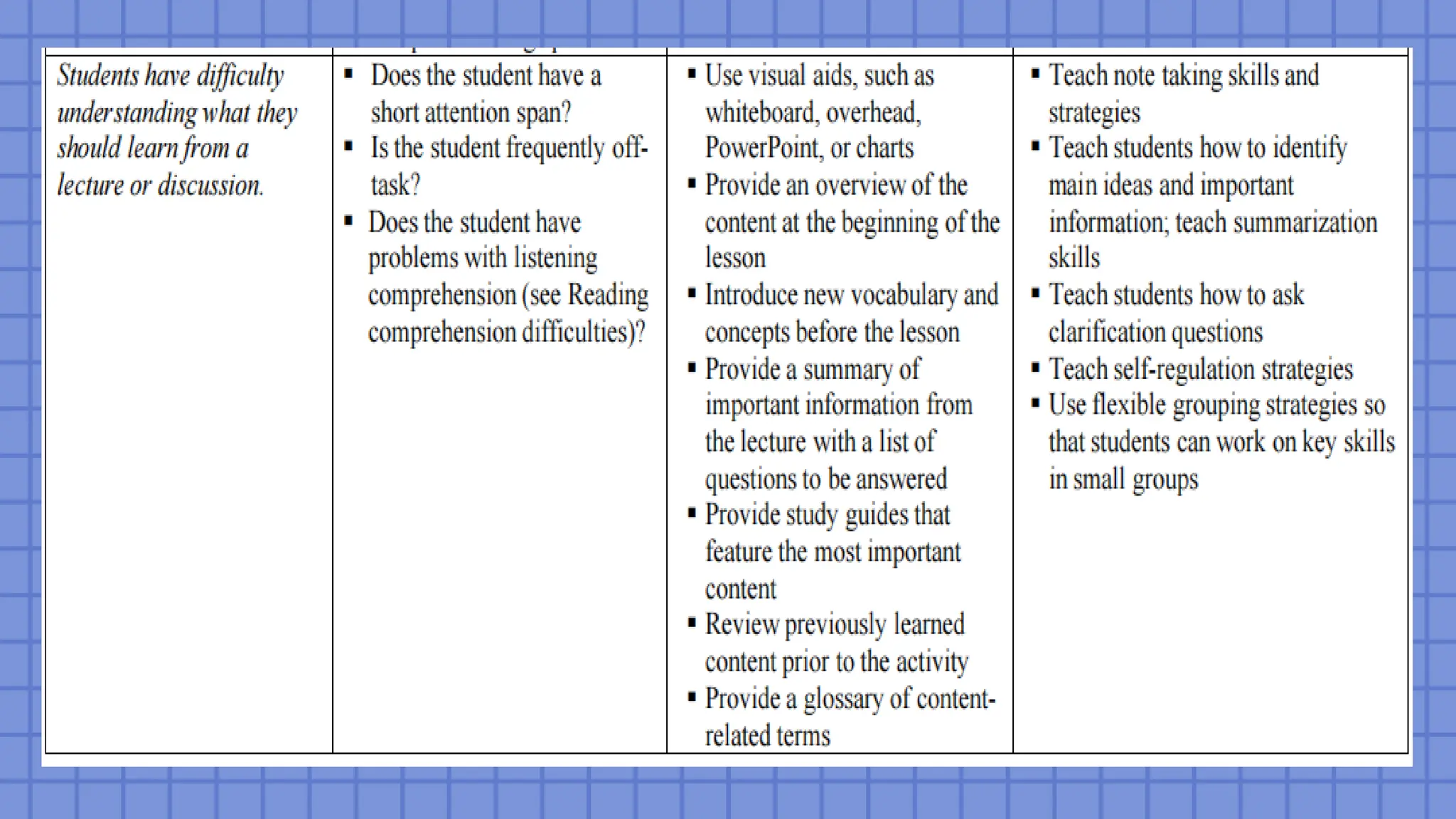
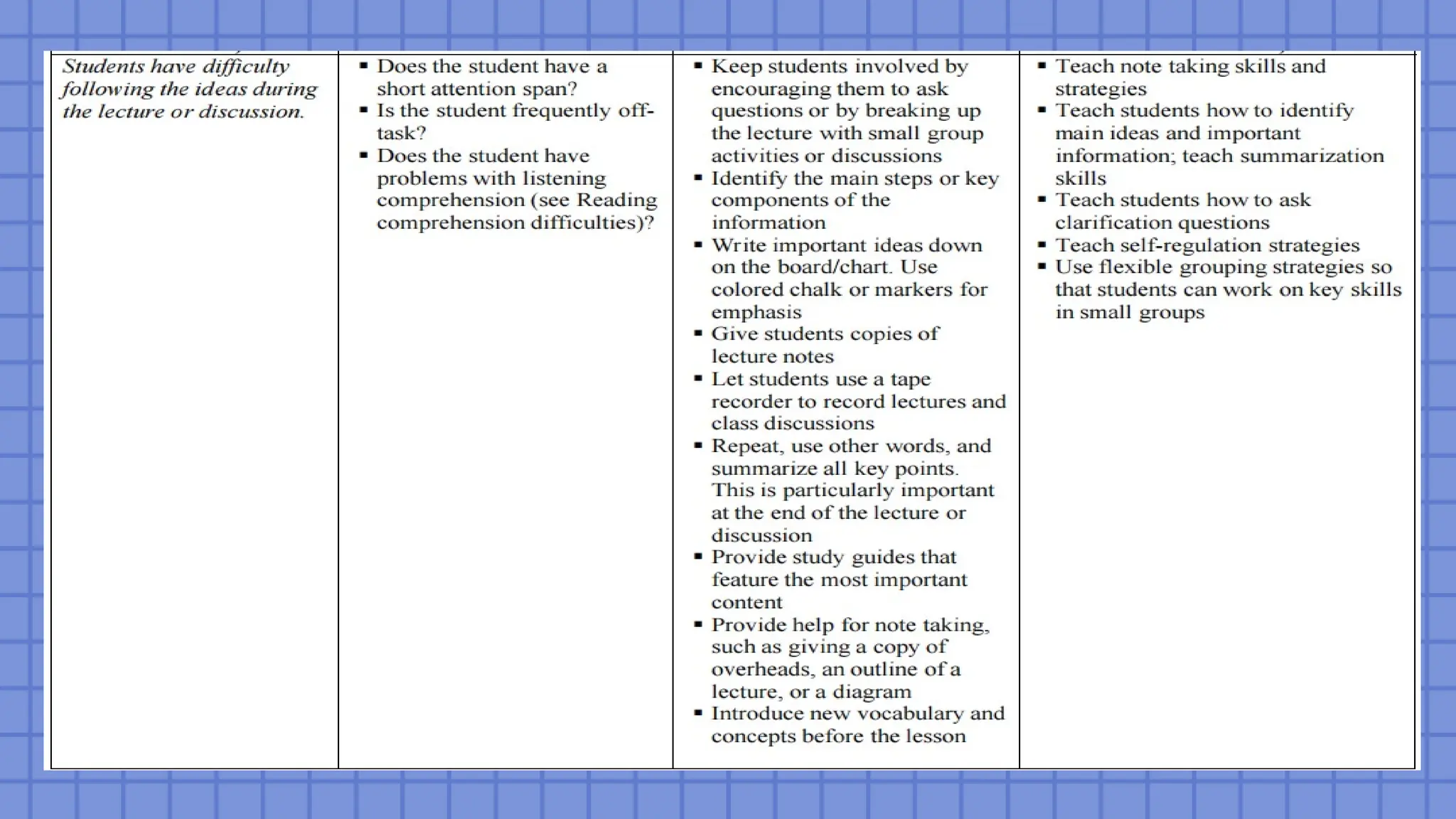
adaptations can be made by
• Altering existing materials-Rewrite, reorganize, add to, or recast the
information so that the student can access the regular curriculum
material independently, e.g., prepare a study guide and audiotape.
• Mediating existing materials-provide additional instructional support,
guidance, and direction to the student in the use of the materials. Alter
your instruction to mediate the barriers presented by the materials so
that you directly lead the student to interact with the materials in
different ways.
18.
For example, havestudents survey the reading material,
collaboratively preview the text, and create an outline of the
material to use as a study guide.
•Selecting alternate materials-Select new materials that
are more sensitive to the needs of students with disabilities
or are inherently designed to compensate for learning
problems. For example, use an interactive computer
program that cues critical ideas, reads text, inserts graphic
organizers, defines and illustrates words, presents and
reinforces learning in smaller increments, and provides
more opportunities for practice and cumulative review.
19.
Step 7. InformStudents and Parents About the
Adaptation
Adaptations are more successful when they are offered and
introduced to students at the beginning of the year. Parents
should also be informed about them at the beginning of the
year. Students should be taught explicit strategies to use any
adaptation effectively and how to process the information
received through the adaptation. As students progress, they
should be taught how to recognize the need for and request
materials adaptations.
20.
Step 8. Implement,Evaluate, and Adjust the
Adaptation
As the adaptation is implemented, the teacher should
evaluate its effects to determine whether the desired
outcomes are being achieved. If not, adjustments will
need to be made either in the adaptation or the
instructions to the student in its use. Adaptations
should significantly reduce failure and learning
difficulties.
21.
Step 9. Fadethe Adaptation When Possible
Adaptations usually are short-term solutions to allow classroom
learning and participation until the needed skills and strategies can
be taught. Once the adaptation is in place, the teacher should begin
to plan with other teachers how to teach the needed skills and
strategies. Once the student has learned the necessary skills and
strategies, the adaptation should be faded. The adaptation should not
be removed until the student possesses the skills and strategies to
learn and complete tasks independently. For some students, an
adaptation may be required for several months, while for others; it
may be maintained for years.
Questions:
1. What arethe effective strategies for adapting
instructional materials to accommodate students with
diverse learning needs?
2. What considerations should be made when adapting
assessments for students with special educational needs?
3. How can assessments be differentiatedto accurately
measure the understanding of students with diverse
learning needs?