Java EE Microservices
with WildFly Swarm
Heiko Braun <hbraun@redhat.com>
Feb 2016
Organised by the Lightweight Java User Group Munich,
hosted at ComSysto. Thanks to both.
This evening
• The Context: Microservices and Java EE
• WildFly Swarm: Concepts, Ideas & Mechanics
• Code and Demo
• Outlook, Discussions and (hopefully) beer
What are
Microservices anyway?
Like SOA, but different …
• Microservices are different

primarily due to innovations like:
• Linux containers,
• automated, elastic infrastructure, you know, the
cloud
• plus wide adoption of CI, continuous integration
• and the growing adoption of DevOps principles &
practices
“In short, the microservice architectural style is
an approach to developing a single application
as a suite of small services, each running in its
own process and communicating with
lightweight mechanisms, often an HTTP
resource API. These services are built around
business capabilities and independently
deployable by fully automated deployment
machinery. There is a bare minimum of
centralized management of these services,
which may be written in different programming
languages and use different data storage
technologies.”
– Martin Fowler, ThoughtWorks
What is Java EE
anyway?
Perspectives on Java EE
• It’s different things to different people:
• A collection of (useful) API’s
• Technical capabilities of a system
• A love/hate relationship (of the past)
• (Existing) knowledge and expertise
Hello WildFly Swarm
WildFly Swarm
• OSS Project sponsored by Red Hat
• Sidekick of Wildfly Application Server
• Small, but ambitious and friendly community
• Part of a bigger system of interrelated projects
under the JBoss / Red Hat umbrella
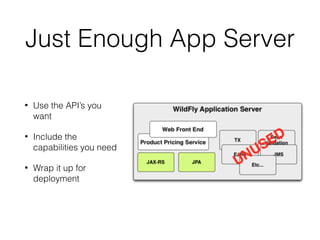
Just Enough App Server
• Use the API’s you
want
• Include the
capabilities you need
• Wrap it up for
deployment
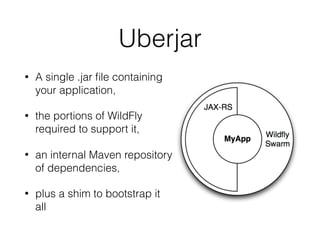
Uberjar
• A single .jar file containing
your application,
• the portions of WildFly
required to support it,
• an internal Maven repository
of dependencies,
• plus a shim to bootstrap it
all
Fractions
• A well-defined collection of application capabilities.
• May map directly to a WildFly subsystem,
• or bring in external capabilities such as Netflix
Ribbon.
What Fractions can do
• Enable WildFly subsystems (JAX-RS, Infinispan)
• Integrate additional system capabilities (Topology)
• Provide deployments (ribbon-webapp, jolokia)
• Alter deployments (keycloak)
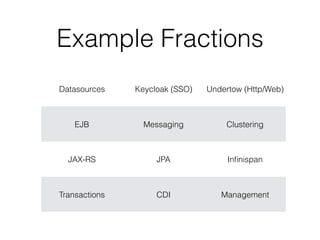
Example Fractions
Datasources Keycloak (SSO) Undertow (Http/Web)
EJB Messaging Clustering
JAX-RS JPA Infinispan
Transactions CDI Management
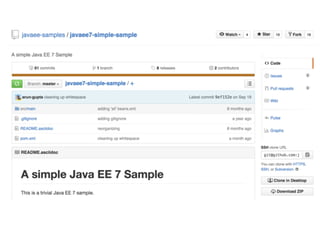
Convert Java EE App
to use WildFly Swarm
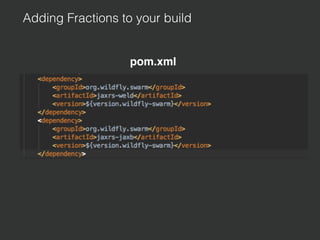
pom.xml
Adding Fractions to your build
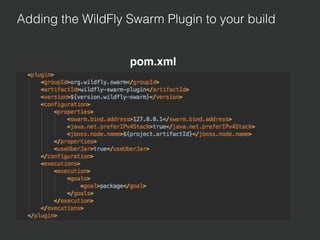
pom.xml
Adding the WildFly Swarm Plugin to your build
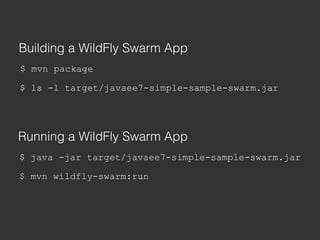
Running a WildFly Swarm App
$ java -jar target/javaee7-simple-sample-swarm.jar
$ mvn wildfly-swarm:run
Building a WildFly Swarm App
$ mvn package
$ ls -l target/javaee7-simple-sample-swarm.jar
Going beyond simple
(and Java EE)
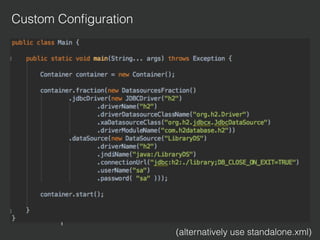
Custom Configuration
(alternatively use standalone.xml)
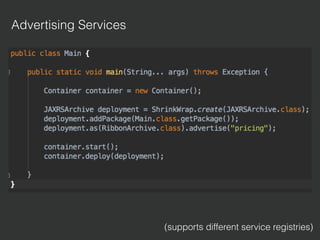
Advertising Services
(supports different service registries)
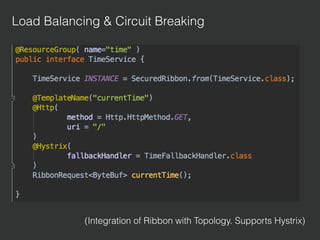
Load Balancing & Circuit Breaking
(Integration of Ribbon with Topology. Supports Hystrix)
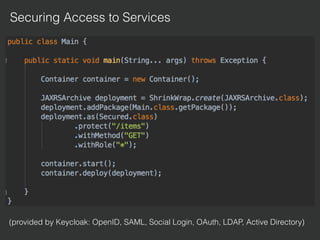
Securing Access to Services
(provided by Keycloak: OpenID, SAML, Social Login, OAuth, LDAP, Active Directory)
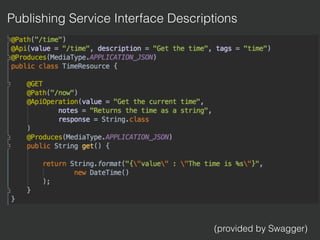
Publishing Service Interface Descriptions
(provided by Swagger)
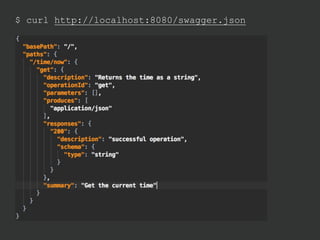
$ curl http://localhost:8080/swagger.json
Other Noteworthy Features
• Testing:
• Arquillian (in container, web driver)
• Consumer-Driven Contracts 

(expressing and asserting expectations of a provider contract)
• Logging & Monitoring
• Simple REST interface on each node
• Centralised Logging with Logstash
• Push Runtime Data to Hawkular,Influx,etc
• Remote Management
• CLI (full access to the server config and runtime state)
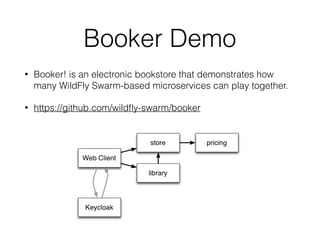
Booker Demo
• Booker! is an electronic bookstore that demonstrates how
many WildFly Swarm-based microservices can play together.
• https://github.com/wildfly-swarm/booker
The Road Ahead
• API Gateway 

(integration with APIMan)
• Integration with Kubernetes / OpenShift V3

(i.e. Service Discovery)
• Environment Abstractions (Local, CI, Cloud)
• Tooling (Forge, Eclipse, IntelliJ)
• Spring Support
Get Involved
• Project Home: http://wildfly-swarm.io
• GitHub: https://github.com/wildfly-swarm
• Twitter: @wildflyswarm
• Freenode: @wildfly-swarm
• Issues: https://issues.jboss.org/projects/SWARM

(see ‘getting-started’ labels)
Resources
• Keycloak: http://keycloak.jboss.org/
• Hawkular: http://www.hawkular.org/
• OpenShift V3: https://blog.openshift.com/openshift-v3-deep-
dive-docker-kubernetes/
• APIMan: http://www.apiman.io/latest/
• Arquillian: http://arquillian.org/
• WildFly: http://wildfly.org
• Consul: https://www.consul.io/

Writing Java EE microservices using WildFly Swarm

  • 1.
    Java EE Microservices withWildFly Swarm Heiko Braun <hbraun@redhat.com> Feb 2016 Organised by the Lightweight Java User Group Munich, hosted at ComSysto. Thanks to both.
  • 2.
    This evening • TheContext: Microservices and Java EE • WildFly Swarm: Concepts, Ideas & Mechanics • Code and Demo • Outlook, Discussions and (hopefully) beer
  • 3.
  • 4.
    Like SOA, butdifferent … • Microservices are different
 primarily due to innovations like: • Linux containers, • automated, elastic infrastructure, you know, the cloud • plus wide adoption of CI, continuous integration • and the growing adoption of DevOps principles & practices
  • 5.
    “In short, themicroservice architectural style is an approach to developing a single application as a suite of small services, each running in its own process and communicating with lightweight mechanisms, often an HTTP resource API. These services are built around business capabilities and independently deployable by fully automated deployment machinery. There is a bare minimum of centralized management of these services, which may be written in different programming languages and use different data storage technologies.” – Martin Fowler, ThoughtWorks
  • 6.
    What is JavaEE anyway?
  • 7.
    Perspectives on JavaEE • It’s different things to different people: • A collection of (useful) API’s • Technical capabilities of a system • A love/hate relationship (of the past) • (Existing) knowledge and expertise
  • 8.
  • 9.
    WildFly Swarm • OSSProject sponsored by Red Hat • Sidekick of Wildfly Application Server • Small, but ambitious and friendly community • Part of a bigger system of interrelated projects under the JBoss / Red Hat umbrella
  • 10.
    Just Enough AppServer • Use the API’s you want • Include the capabilities you need • Wrap it up for deployment
  • 11.
    Uberjar • A single.jar file containing your application, • the portions of WildFly required to support it, • an internal Maven repository of dependencies, • plus a shim to bootstrap it all
  • 12.
    Fractions • A well-definedcollection of application capabilities. • May map directly to a WildFly subsystem, • or bring in external capabilities such as Netflix Ribbon.
  • 13.
    What Fractions cando • Enable WildFly subsystems (JAX-RS, Infinispan) • Integrate additional system capabilities (Topology) • Provide deployments (ribbon-webapp, jolokia) • Alter deployments (keycloak)
  • 14.
    Example Fractions Datasources Keycloak(SSO) Undertow (Http/Web) EJB Messaging Clustering JAX-RS JPA Infinispan Transactions CDI Management
  • 15.
    Convert Java EEApp to use WildFly Swarm
  • 17.
  • 18.
    pom.xml Adding the WildFlySwarm Plugin to your build
  • 19.
    Running a WildFlySwarm App $ java -jar target/javaee7-simple-sample-swarm.jar $ mvn wildfly-swarm:run Building a WildFly Swarm App $ mvn package $ ls -l target/javaee7-simple-sample-swarm.jar
  • 20.
  • 21.
  • 22.
  • 23.
    Load Balancing &Circuit Breaking (Integration of Ribbon with Topology. Supports Hystrix)
  • 24.
    Securing Access toServices (provided by Keycloak: OpenID, SAML, Social Login, OAuth, LDAP, Active Directory)
  • 25.
    Publishing Service InterfaceDescriptions (provided by Swagger)
  • 26.
  • 27.
    Other Noteworthy Features •Testing: • Arquillian (in container, web driver) • Consumer-Driven Contracts 
 (expressing and asserting expectations of a provider contract) • Logging & Monitoring • Simple REST interface on each node • Centralised Logging with Logstash • Push Runtime Data to Hawkular,Influx,etc • Remote Management • CLI (full access to the server config and runtime state)
  • 28.
    Booker Demo • Booker!is an electronic bookstore that demonstrates how many WildFly Swarm-based microservices can play together. • https://github.com/wildfly-swarm/booker
  • 29.
    The Road Ahead •API Gateway 
 (integration with APIMan) • Integration with Kubernetes / OpenShift V3
 (i.e. Service Discovery) • Environment Abstractions (Local, CI, Cloud) • Tooling (Forge, Eclipse, IntelliJ) • Spring Support
  • 30.
    Get Involved • ProjectHome: http://wildfly-swarm.io • GitHub: https://github.com/wildfly-swarm • Twitter: @wildflyswarm • Freenode: @wildfly-swarm • Issues: https://issues.jboss.org/projects/SWARM
 (see ‘getting-started’ labels)
  • 31.
    Resources • Keycloak: http://keycloak.jboss.org/ •Hawkular: http://www.hawkular.org/ • OpenShift V3: https://blog.openshift.com/openshift-v3-deep- dive-docker-kubernetes/ • APIMan: http://www.apiman.io/latest/ • Arquillian: http://arquillian.org/ • WildFly: http://wildfly.org • Consul: https://www.consul.io/