Refactoring your Java EE
applications using

Microservices and Containers
Arun Gupta, Red Hat
Arun Gupta
Director, Developer Advocacy
@arungupta
blog.arungupta.me
arungupta@redhat.com
2
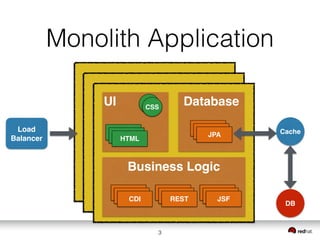
Monolith Application
UI Database
Business Logic
HTMLHTMLHTML
CSSCSS
HTMLHTMLCDI
HTMLHTMLREST
HTMLHTMLJSF
HTMLHTMLJPA
Load
Balancer
Cache
DB
3
EAR
Monolith Application
EAR
WAR
Load
Balancer
WAR
WAR
JAR
JAR
JAR
JAR
4
Cache
DB
Advantages of 

Monolith Application
• Typically packaged in a single .ear
• Easy to test (all required services are up)
• Simple to develop
5
Monolith Application
UI Database
Business Logic
HTMLHTML
HTMLHTML HTMLHTML HTMLHTML
HTMLHTML
Version 1
UI Database
Business Logic
HTMLHTML
HTMLHTML HTMLHTML HTMLHTML
HTMLHTML
Version 2
UI Database
Business Logic
HTMLHTML
HTMLHTML HTMLHTML HTMLHTML
HTMLHTML
Version 3
UI Database
Business Logic
HTMLHTML
HTMLHTML HTMLHTML HTMLHTML
HTMLHTML
Version 4
6
Disadvantages of 

Monolith Application
• Difficult to deploy and maintain
• Obstacle to frequent deployments
• Makes it difficult to try out new technologies/
framework
7
http://akfpartners.com/techblog/2008/05/08/splitting-applications-or-services-for-scale/
8
–Martin Fowler
“building applications as suites of services. As well as
the fact that services are independently deployable
and scalable, each service also provides a firm module
boundary, even allowing for different services to be
written in different programming languages. They can
also be managed by different teams”
http://martinfowler.com/articles/microservices.html
9
Characteristics of
microservices
• Domain driven design (full-stack developer)
• Explicitly published interface, bounded context
• Independently deployable and automated (CI / CD)
• Decentralized, use IPC to communicate
• Heterogeneous, can be polyglot
• “Smart endpoints, dumb pipes”
11
Designed for failure
Fault tolerance is a requirement, not a feature
http://techblog.netflix.com/2012/02/fault-tolerance-in-high-volume.html
12
“you build it, you run it!”
With great
power, comes great
responsibility
13
–Melvin Conway
“Any organization that designs a system
(defined more broadly here than just information
systems) will inevitably produce a design
whose structure is a copy of the
organization's communication structure.”
14
http://www.melconway.com/Home/Committees_Paper.html
Strategies for decomposing
15
Strategies for decomposing
• Verb or usecase - e.g. Checkout UI
• Noun - e.g. Catalog product service
• Single Responsible Principle - e.g. Unix utilities
16
Service A
Towards microservices
EAR
WAR
Load
Balancer
WAR
WAR
JAR
JAR
JAR
JAR
DBCache
17
Cache
DB
Aggregator
Service C
WAR
Service B
WAR
Aggregator Pattern #1
DBCache
Service A
WAR
DBCache
DBCache
Aggregator
Load
Balancer
18
Aggregator
Service C
WAR
Service B
WAR
Proxy Pattern #2
DBCache
Service A
WAR
DBCache
DBCache
Proxy
Load
Balancer
19
Chained Pattern #3
Service A
WAR
DBCache
Load
Balancer
20
Service B
WAR
DBCache
Service C
WAR
DBCache
Branch Pattern #4
Service A
WAR
DBCache
Load
Balancer Service B
WAR
DBCache
Service D
WAR
DBCache
21
Service C
WAR
DBCache
Shared Resources #5
Service B
WAR
DBCache
Service C
WAR
Service D
WAR
22
DBCache
Service A
WAR
DBCache
Load
Balancer
Async Messaging #5
Service B
WAR
DBCache
Service C
WAR
Service D
WAR
DBCache
23
DBCache
Service A
WAR
DBCache
Load
Balancer
Proxy
Queue
Advantages of
microservices
• Easier to develop, understand, maintain
• Starts faster than a monolith, speeds up deployments
• Local change can be easily deployed, great enabler of CD
• Each service can scale on X- and Y-axis
• Improves fault isolation
• Eliminates any long-term commitment to a technology stack
• Freedom of choice of technology, tools, frameworks
25
“If you can't build a [well-structured]
monolith, what makes you think
microservices are the answer?”
http://www.codingthearchitecture.com/2014/07/06/distributed_big_balls_of_mud.html
26
JSF

Pages
RESTful Web Services
Batch Artifacts
Java Message Service
Database
WebSocket Endpoint
Enterprise JavaBeans
JSON
JPA
JPA
JPA
JavaScript
User

Interface
Add/Delete Movie
Ticket Sales
Movie Points
Database
Chat Room
Show Booking
User

Interface
Add/Delete Movie
Ticket Sales
Movie Points
Database
Chat Room
Show Booking
Config
Files
Classes
Web
Pages
1
JAR
JAR
JAR
Web Pages
Config Files
2
Config
Files
Classes
Web
Pages
WAR → EAR
JAR
JAR
JAR
Web Pages
Config Files
JAR
JARJAR
3 EAR → WAR
4 WAR in Container
5 WAR: Scale on X-axis or Y-Axis
NoOps
• Service replication (Kubernetes)
• Dependency resolution (Nexus)
• Failover (Circuit Breaker)
• Resiliency (Hystrix)
• Service monitoring, alerts and events (logstash)
34
https://gigaom.com/2012/01/31/why-2013-is-the-year-of-noops-for-programmers-infographic/
Drawbacks of microservices
• Additional complexity of distributed systems
• Significant operational complexity, need high-level
of automation
• Rollout plan to coordinate deployments
• Slower ROI, to begin with
36
What is Docker?
• Open source project and company


• Used to create containers for software applications
• Package Once Deploy Anywhere (PODA)
Underlying Technology
• Written in Go

• Uses several Linux features
• Namespaces to provide isolation
• Control groups to share/limit hardware resources
• Union File System makes it light and fast
• libcontainer defines container format
• Image defined in text-based Dockerfile
• List of commands to build the image
FROM fedora:latest


CMD echo “Hello world”
FROM jboss/wildfly
RUN curl -L https://github.com/javaee-samples/javaee7-hol/raw/master/solution/
movieplex7-1.0-SNAPSHOT.war -o /opt/jboss/wildfly/standalone/deployments/
movieplex7-1.0-SNAPSHOT.war
39
Advantages of Containers
• Faster deployments
• Isolation
• Portability - “it works
on my machine”
• Snapshotting
• Security sandbox
• Limit resource usage
• Simplified dependency
• Sharing
40
Docker: Pros and Cons
• PROS
• Extreme application portability
• Very easy to create and work with derivative
• Fast boot on containers
• CONS
• Host-centric solution, not aware of anything
• No higher-level provisioning
• No usage tracking/reporting
41
Kubernetes
• Open source orchestration system for Docker
containers
• Provide declarative primitives for the “desired state”
• Self-healing
• Auto-restarting
• Schedule across hosts
• Replicating
42
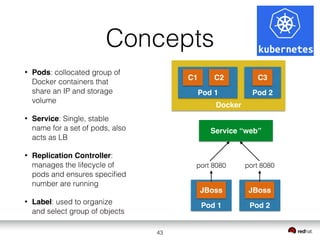
Concepts
• Pods: collocated group of
Docker containers that
share an IP and storage
volume
• Service: Single, stable
name for a set of pods, also
acts as LB
• Replication Controller:
manages the lifecycle of
pods and ensures specified
number are running
• Label: used to organize
and select group of objects
Docker
Pod 1 Pod 2
C1 C2 C3
Pod 1
JBoss
Pod 2
JBoss
Service “web”
port 8080 port 8080
43
Kubernetes: Pros and Cons
• PROS
• Manage related Docker containers as a unit
• Container communication across hosts
• Availability and scalability through automated deployment
and monitoring of pods and their replicas, across hosts
44
Kubernetes: Pros and Cons
• CONS
• Lifecycle of applications - build, deploy, manage, promote
• Port existing source code to run in Kubernetes
• DevOps: Dev -> Test -> Production
• No multi-tenancy
• On-premise (available on GCE)
• Assumes inter-pod networking as part of infrastructure
• Requires explicit load balancer
45
Pod 3
JBoss
Pod 4
JBoss
“javaee”
port 8080 port 8080
Pod 5
MySQL
Pod 6
MySQL
“db”
port 3306 port 3306
Pod 7
ActiveMQ
Pod 8
ActiveMQ
“mq”
port 8161 port 8161
Pod 1
Apache
Pod 2
Apache
“web”
port 80 port 80
OpenShift

Application
46
Container Host
Container
Cluster Management
User Experience
47
jboss.org
48

Refactor your Java EE application using Microservices and Containers - Arun Gupta - Codemotion Rome 2015