Writing good std::future<C++>
Anton Bikineev, 2016
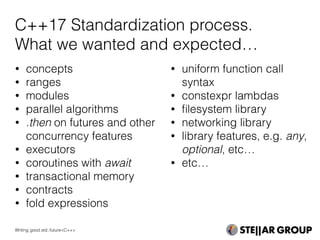
C++17 Standardization process.
What we wanted and expected…
• concepts
• ranges
• modules
• parallel algorithms
• .then on futures and other
concurrency features
• executors
• coroutines with await
• transactional memory
• contracts
• fold expressions
• uniform function call
syntax
• constexpr lambdas
• filesystem library
• networking library
• library features, e.g. any,
optional, etc…
• etc…
Writing good std::future<C++>
• concepts
• ranges
• modules
• parallel algorithms
• .then on futures and other
concurrency features
• executors
• coroutines with await
• transactional memory
• contracts
• fold expressions
• uniform function call
syntax
• constexpr lambdas
• filesystem library
• networking library
• library features, e.g. any,
optional, etc…
• etc…
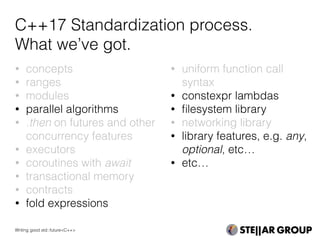
C++17 Standardization process.
What we’ve got.
Writing good std::future<C++>
• concepts
• ranges
• modules
• parallel algorithms
• .then on futures and other
concurrency features
• executors
• coroutines with await
• transactional memory
• contracts
• fold expressions
• uniform function call
syntax
• constexpr lambdas
• filesystem library
• networking library
• library features, e.g. any,
optional, etc…
• etc…
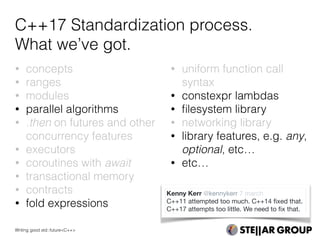
C++17 Standardization process.
What we’ve got.
Kenny Kerr @kennykerr 7 march

C++11 attempted too much. C++14 xed that.

C++17 attempts too little. We need to x that.
Writing good std::future<C++>
C++’s view on polymorphism
Writing good std::future<C++>
C++’s view on polymorphism
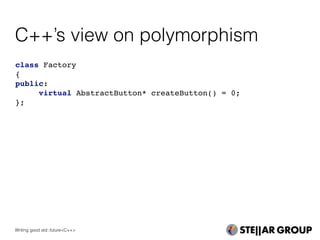
class Factory
{
public:
virtual AbstractButton* createButton() = 0;
};
Writing good std::future<C++>
C++’s view on polymorphism
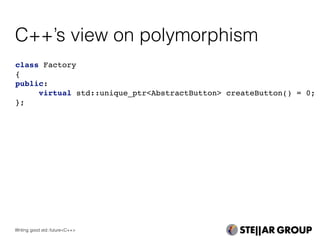
class Factory
{
public:
virtual std::unique_ptr<AbstractButton> createButton() = 0;
};
Writing good std::future<C++>
C++’s view on polymorphism
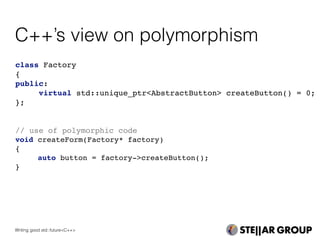
class Factory
{
public:
virtual std::unique_ptr<AbstractButton> createButton() = 0;
};
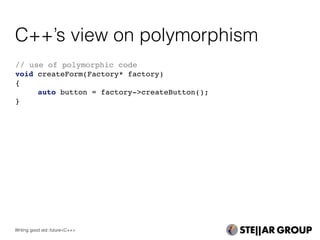
// use of polymorphic code
void createForm(Factory* factory)
{
auto button = factory->createButton();
}
Writing good std::future<C++>
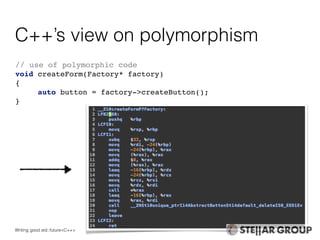
C++’s view on polymorphism
// use of polymorphic code
void createForm(Factory* factory)
{
auto button = factory->createButton();
}
Writing good std::future<C++>
C++’s view on polymorphism
// use of polymorphic code
void createForm(Factory* factory)
{
auto button = factory->createButton();
}
Writing good std::future<C++>
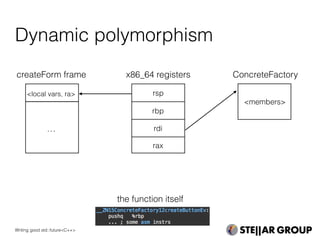
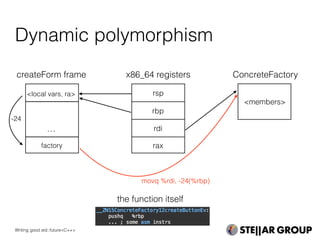
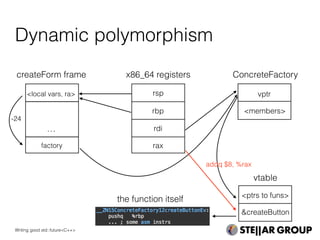
Dynamic polymorphism
rsp
createForm frame
rbp
rdi
rax
x86_64 registers
…
<local vars, ra>
the function itself
<members>
Writing good std::future<C++>
ConcreteFactory
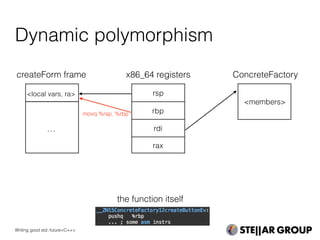
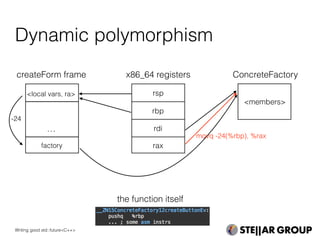
Dynamic polymorphism
rsp
createForm frame
rbp
rdi
rax
x86_64 registers
…
<local vars, ra>
the function itself
<members>
movq %rsp, %rbp
Writing good std::future<C++>
ConcreteFactory
Dynamic polymorphism
rsp
createForm frame
rbp
rdi
rax
x86_64 registers
…
<local vars, ra>
the function itself
<members>
factory
-24
movq %rdi, -24(%rbp)
Writing good std::future<C++>
ConcreteFactory
Dynamic polymorphism
rsp
createForm frame
rbp
rdi
rax
x86_64 registers
…
<local vars, ra>
the function itself
<members>
factory
-24
movq -24(%rbp), %rax
Writing good std::future<C++>
ConcreteFactory
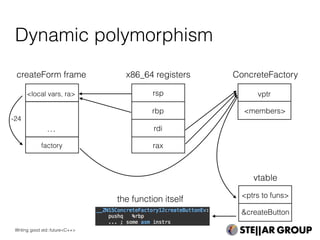
Dynamic polymorphism
rsp
createForm frame
rbp
rdi
rax
x86_64 registers
…
<local vars, ra>
the function itself
factory
-24
<members>
vptr
<ptrs to funs>
&createButton
Writing good std::future<C++>
ConcreteFactory
vtable
Dynamic polymorphism
rsp
createForm frame
rbp
rdi
rax
x86_64 registers
…
<local vars, ra>
the function itself
factory
-24
<members>
vptr
<ptrs to funs>
&createButton
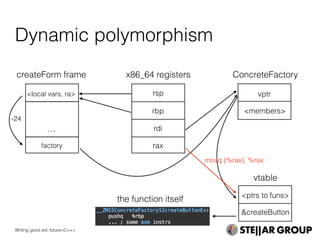
movq (%rax), %rax
Writing good std::future<C++>
ConcreteFactory
vtable
Dynamic polymorphism
rsp
createForm frame
rbp
rdi
rax
x86_64 registers
…
<local vars, ra>
the function itself
factory
-24
<members>
vptr
<ptrs to funs>
&createButton
addq $8, %rax
Writing good std::future<C++>
ConcreteFactory
vtable
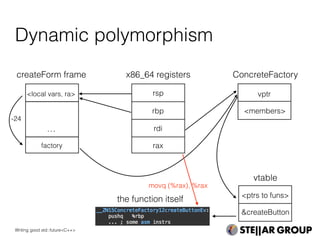
Dynamic polymorphism
rsp
createForm frame
rbp
rdi
rax
x86_64 registers
…
<local vars, ra>
<members>
vptr
<ptrs to funs>
&createButton
factory
-24
the function itself
movq (%rax), %rax
Writing good std::future<C++>
ConcreteFactory
vtable
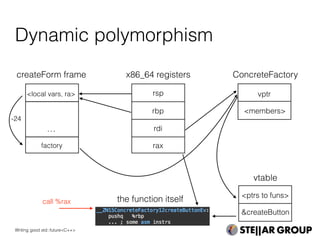
Dynamic polymorphism
rsp
createForm frame
rbp
rdi
rax
x86_64 registers
…
<local vars, ra>
<members>
vptr
<ptrs to funs>
&createButton
factory
-24
the function itselfcall %rax
Writing good std::future<C++>
ConcreteFactory
vtable
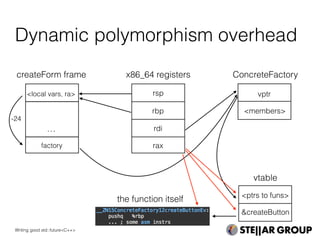
Dynamic polymorphism overhead
rsp
createForm frame
rbp
rdi
rax
x86_64 registers
…
<local vars, ra>
ConcreteFactory
<members>
vptr
vtable
<ptrs to funs>
&createButton
factory
-24
the function itself
Writing good std::future<C++>
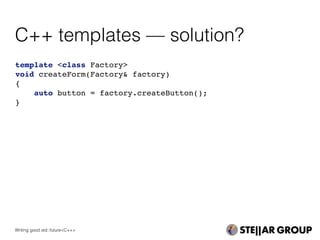
C++ templates — solution?
template <class Factory>
void createForm(Factory& factory)
{
auto button = factory.createButton();
}
Writing good std::future<C++>
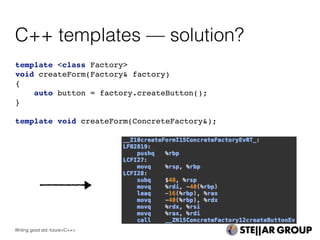
C++ templates — solution?
template <class Factory>
void createForm(Factory& factory)
{
auto button = factory.createButton();
}
template void createForm(ConcreteFactory&);
Writing good std::future<C++>
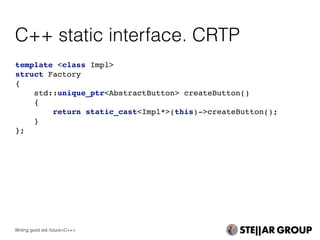
C++ static interface. CRTP
template <class Impl>
struct Factory
{
std::unique_ptr<AbstractButton> createButton()
{
return static_cast<Impl*>(this)->createButton();
}
};
Writing good std::future<C++>
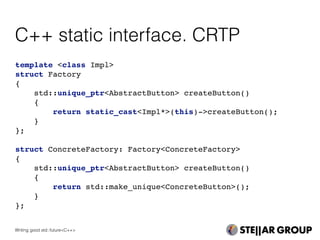
C++ static interface. CRTP
template <class Impl>
struct Factory
{
std::unique_ptr<AbstractButton> createButton()
{
return static_cast<Impl*>(this)->createButton();
}
};
struct ConcreteFactory: Factory<ConcreteFactory>
{
std::unique_ptr<AbstractButton> createButton()
{
return std::make_unique<ConcreteButton>();
}
};
Writing good std::future<C++>
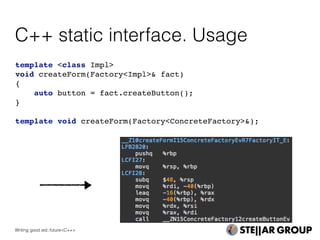
C++ static interface. Usage
template <class Impl>
void createForm(Factory<Impl>& fact)
{
auto button = fact.createButton();
}
template void createForm(Factory<ConcreteFactory>&);
Writing good std::future<C++>
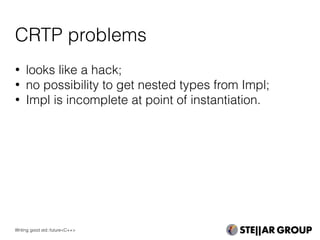
CRTP problems
• looks like a hack;
• no possibility to get nested types from Impl;
• Impl is incomplete at point of instantiation.
Writing good std::future<C++>
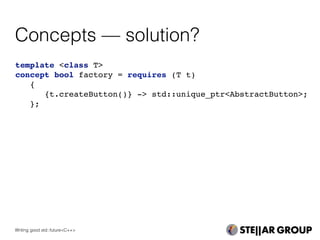
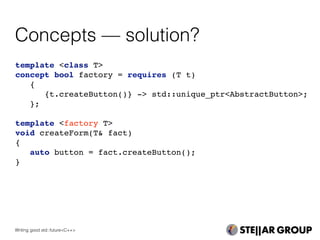
Concepts — solution?
template <class T>
concept bool factory = requires (T t)
{
{t.createButton()} -> std::unique_ptr<AbstractButton>;
};
Writing good std::future<C++>
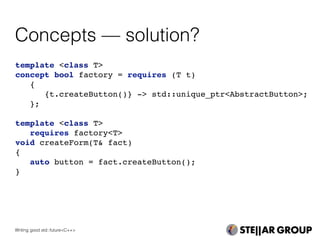
Concepts — solution?
template <class T>
concept bool factory = requires (T t)
{
{t.createButton()} -> std::unique_ptr<AbstractButton>;
};
template <class T>
requires factory<T>
void createForm(T& fact)
{
auto button = fact.createButton();
}
Writing good std::future<C++>
Concepts — solution?
template <class T>
concept bool factory = requires (T t)
{
{t.createButton()} -> std::unique_ptr<AbstractButton>;
};
template <factory T>
void createForm(T& fact)
{
auto button = fact.createButton();
}
Writing good std::future<C++>
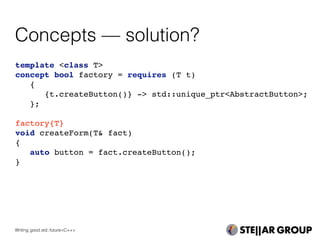
Concepts — solution?
template <class T>
concept bool factory = requires (T t)
{
{t.createButton()} -> std::unique_ptr<AbstractButton>;
};
factory{T}
void createForm(T& fact)
{
auto button = fact.createButton();
}
Writing good std::future<C++>
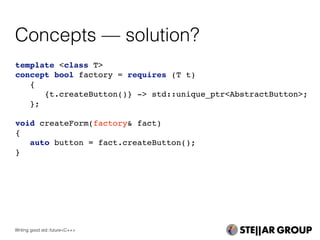
Concepts — solution?
template <class T>
concept bool factory = requires (T t)
{
{t.createButton()} -> std::unique_ptr<AbstractButton>;
};
void createForm(factory& fact)
{
auto button = fact.createButton();
}
Writing good std::future<C++>
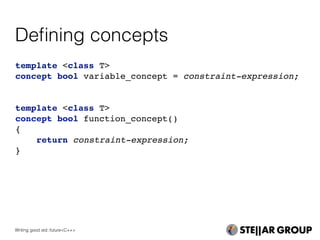
Dening concepts
template <class T>
concept bool variable_concept = constraint-expression;
template <class T>
concept bool function_concept()
{
return constraint-expression;
}
Writing good std::future<C++>
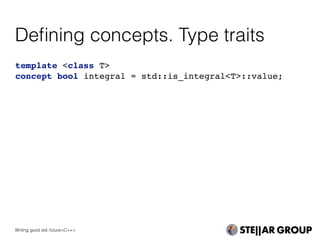
Dening concepts. Type traits
template <class T>
concept bool integral = std::is_integral<T>::value;
Writing good std::future<C++>
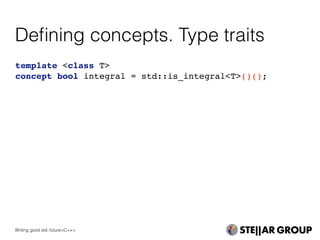
Dening concepts. Type traits
template <class T>
concept bool integral = std::is_integral<T>()();
Writing good std::future<C++>
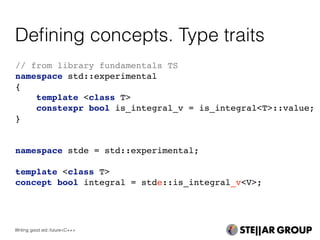
Dening concepts. Type traits
// from library fundamentals TS
namespace std::experimental
{
template <class T>
constexpr bool is_integral_v = is_integral<T>::value;
}
namespace stde = std::experimental;
template <class T>
concept bool integral = stde::is_integral_v<V>;
Writing good std::future<C++>
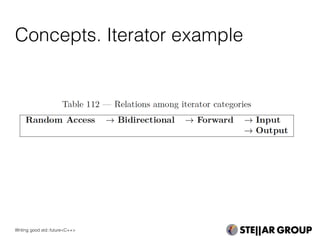
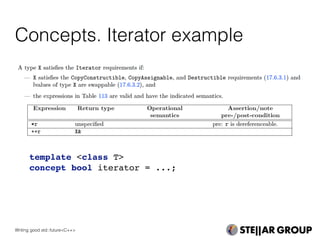
Concepts. Iterator example
Writing good std::future<C++>
Concepts. Iterator example
template <class T>
concept bool iterator = ...;
Writing good std::future<C++>
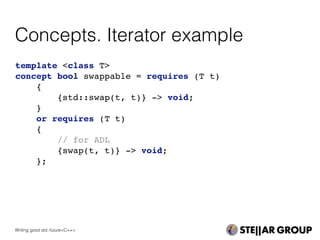
Concepts. Iterator example
template <class T>
concept bool swappable = requires (T t)
{
{std::swap(t, t)} -> void;
}
or requires (T t)
{
// for ADL
{swap(t, t)} -> void;
};
Writing good std::future<C++>
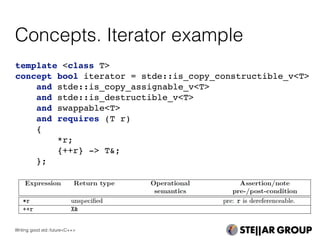
Concepts. Iterator example
template <class T>
concept bool iterator = stde::is_copy_constructible_v<T>
and stde::is_copy_assignable_v<T>
and stde::is_destructible_v<T>
and swappable<T>
and requires (T r)
{
*r;
{++r} -> T&;
};
Writing good std::future<C++>
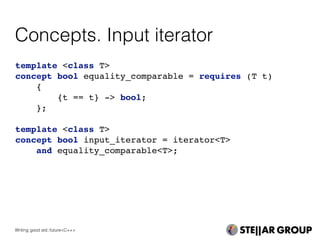
Concepts. Input iterator
template <class T>
concept bool equality_comparable = requires (T t)
{
{t == t} -> bool;
};
template <class T>
concept bool input_iterator = iterator<T>
and equality_comparable<T>;
Writing good std::future<C++>
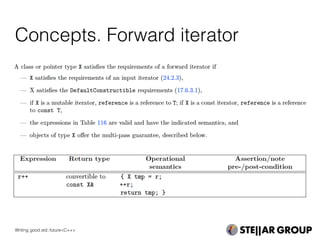
Concepts. Forward iterator
Writing good std::future<C++>
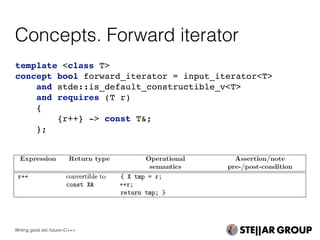
Concepts. Forward iterator
template <class T>
concept bool forward_iterator = input_iterator<T>
and stde::is_default_constructible_v<T>
and requires (T r)
{
{r++} -> const T&;
};
Writing good std::future<C++>
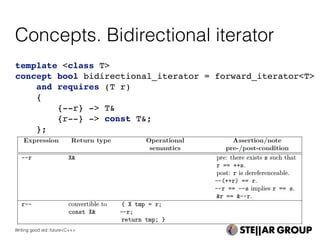
Concepts. Bidirectional iterator
template <class T>
concept bool bidirectional_iterator = forward_iterator<T>
and requires (T r)
{
{--r} -> T&
{r--} -> const T&;
};
Writing good std::future<C++>
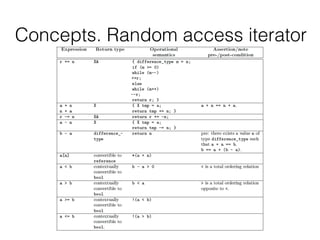
Concepts. Random access iterator
template <class T>
concept bool random_access_iterator = bidirectional_iterator<T>
and requires (T it,
typename std::iterator_traits<T>::difference_type n)
{
{it += n} -> T&;
{it + n} -> T;
{n + it} -> T;
{it -= n} -> T&;
{it - it} ->
typename std::iterator_traits<T>::difference_type;
{it[n]} ->
typename std::iterator_traits<T>::reference;
{it < it} -> bool;
{it <= it} -> bool;
{it > it} -> bool;
{it >= it} -> bool;
};
Concepts. Random access iterator
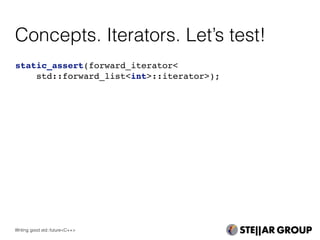
static_assert(forward_iterator<
std::forward_list<int>::iterator>);
Concepts. Iterators. Let’s test!
Writing good std::future<C++>
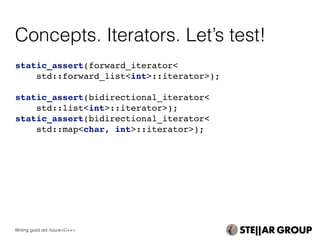
static_assert(forward_iterator<
std::forward_list<int>::iterator>);
static_assert(bidirectional_iterator<
std::list<int>::iterator>);
static_assert(bidirectional_iterator<
std::map<char, int>::iterator>);
Concepts. Iterators. Let’s test!
Writing good std::future<C++>
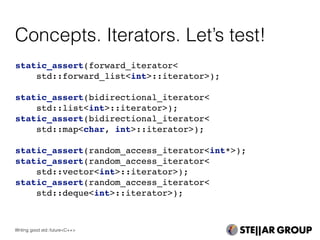
static_assert(forward_iterator<
std::forward_list<int>::iterator>);
static_assert(bidirectional_iterator<
std::list<int>::iterator>);
static_assert(bidirectional_iterator<
std::map<char, int>::iterator>);
static_assert(random_access_iterator<int*>);
static_assert(random_access_iterator<
std::vector<int>::iterator>);
static_assert(random_access_iterator<
std::deque<int>::iterator>);
Concepts. Iterators. Let’s test!
Writing good std::future<C++>
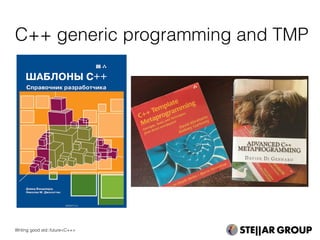
C++ generic programming and TMP
Writing good std::future<C++>
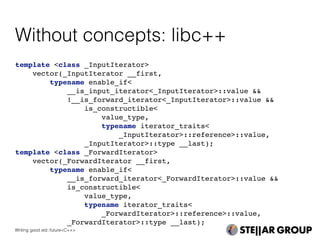
template <class _InputIterator>
vector(_InputIterator __first,
typename enable_if<
__is_input_iterator<_InputIterator>::value &&
!__is_forward_iterator<_InputIterator>::value &&
is_constructible<
value_type,
typename iterator_traits<
_InputIterator>::reference>::value,
_InputIterator>::type __last);
template <class _ForwardIterator>
vector(_ForwardIterator __first,
typename enable_if<
__is_forward_iterator<_ForwardIterator>::value &&
is_constructible<
value_type,
typename iterator_traits<
_ForwardIterator>::reference>::value,
_ForwardIterator>::type __last);
Without concepts: libc++
Writing good std::future<C++>
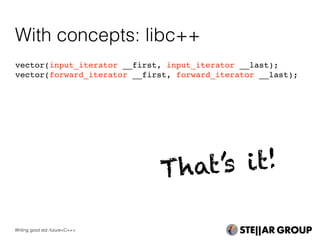
vector(input_iterator __first, input_iterator __last);
vector(forward_iterator __first, forward_iterator __last);
With concepts: libc++
Writing good std::future<C++>
That’s it!
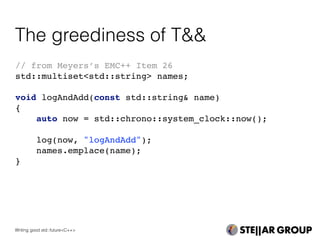
The greediness of T&&
Writing good std::future<C++>
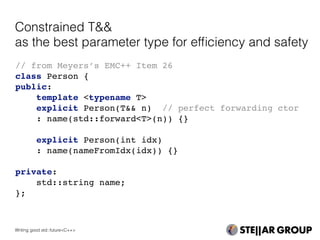
// from Meyers’s EMC++ Item 26
std::multiset<std::string> names;
void logAndAdd(const std::string& name)
{
auto now = std::chrono::system_clock::now();
log(now, "logAndAdd");
names.emplace(name);
}
The greediness of T&&
Writing good std::future<C++>
// from Meyers’s EMC++ Item 26
std::multiset<std::string> names;
void logAndAdd(const std::string& name)
{
auto now = std::chrono::system_clock::now();
log(now, "logAndAdd");
names.emplace(name);
}
std::string petName("Darla");
logAndAdd(petName); // 1)
logAndAdd(std::string("Persephone")); // 2)
logAndAdd("Patty Dog”); // 3)
The greediness of T&&
Writing good std::future<C++>
// from Meyers’s EMC++ Item 26
std::multiset<std::string> names;
void logAndAdd(const std::string& name)
{
auto now = std::chrono::system_clock::now();
log(now, "logAndAdd");
names.emplace(name);
}
std::string petName("Darla");
logAndAdd(petName); // 1) okay, just copying
logAndAdd(std::string("Persephone")); // 2) extra copy
logAndAdd("Patty Dog”); // 3) no need to copy or move
The greediness of T&&
Writing good std::future<C++>
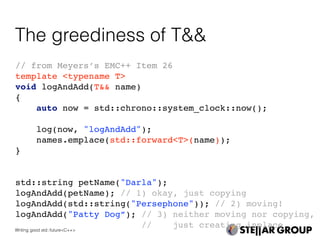
The greediness of T&&
// from Meyers’s EMC++ Item 26
template <typename T>
void logAndAdd(T&& name)
{
auto now = std::chrono::system_clock::now();
log(now, "logAndAdd");
names.emplace(std::forward<T>(name));
}
std::string petName("Darla");
logAndAdd(petName); // 1) okay, just copying
logAndAdd(std::string("Persephone")); // 2) moving!
logAndAdd("Patty Dog”); // 3) neither moving nor copying,
// just creating inplaceWriting good std::future<C++>
// from Meyers’s EMC++ Item 26
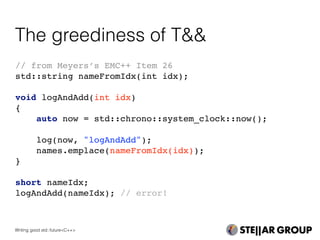
std::string nameFromIdx(int idx);
void logAndAdd(int idx)
{
auto now = std::chrono::system_clock::now();
log(now, "logAndAdd");
names.emplace(nameFromIdx(idx));
}
short nameIdx;
logAndAdd(nameIdx); // error!
The greediness of T&&
Writing good std::future<C++>
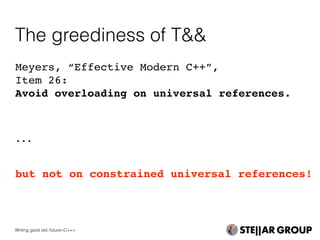
Meyers, “Effective Modern C++”,
Item 26:
Avoid overloading on universal references.
The greediness of T&&
Writing good std::future<C++>
Meyers, “Effective Modern C++”,
Item 26:
Avoid overloading on universal references.
...
The greediness of T&&
Writing good std::future<C++>
Meyers, “Effective Modern C++”,
Item 26:
Avoid overloading on universal references.
...
but not on constrained universal references!
The greediness of T&&
Writing good std::future<C++>
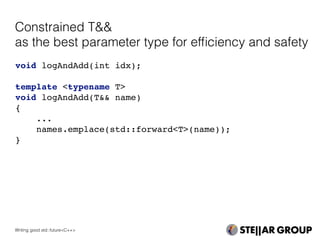
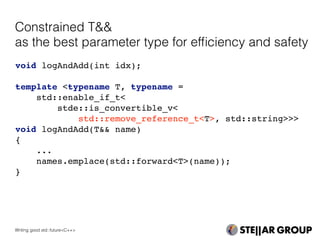
void logAndAdd(int idx);
template <typename T>
void logAndAdd(T&& name)
{
...
names.emplace(std::forward<T>(name));
}
Constrained T&&
as the best parameter type for efciency and safety
Writing good std::future<C++>
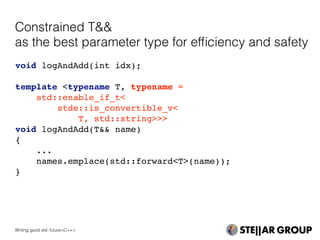
void logAndAdd(int idx);
template <typename T, typename =
std::enable_if_t<
stde::is_convertible_v<
T, std::string>>>
void logAndAdd(T&& name)
{
...
names.emplace(std::forward<T>(name));
}
Constrained T&&
as the best parameter type for efciency and safety
Writing good std::future<C++>
void logAndAdd(int idx);
template <typename T, typename =
std::enable_if_t<
stde::is_convertible_v<
std::remove_reference_t<T>, std::string>>>
void logAndAdd(T&& name)
{
...
names.emplace(std::forward<T>(name));
}
Constrained T&&
as the best parameter type for efciency and safety
Writing good std::future<C++>
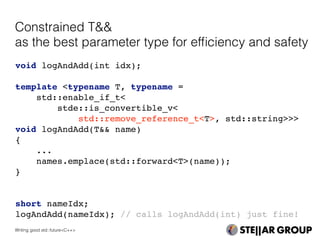
void logAndAdd(int idx);
template <typename T, typename =
std::enable_if_t<
stde::is_convertible_v<
std::remove_reference_t<T>, std::string>>>
void logAndAdd(T&& name)
{
...
names.emplace(std::forward<T>(name));
}
short nameIdx;
logAndAdd(nameIdx); // calls logAndAdd(int) just fine!
Constrained T&&
as the best parameter type for efciency and safety
Writing good std::future<C++>
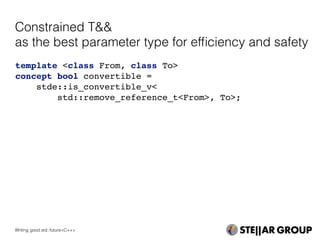
template <class From, class To>
concept bool convertible =
stde::is_convertible_v<
std::remove_reference_t<From>, To>;
Constrained T&&
as the best parameter type for efciency and safety
Writing good std::future<C++>
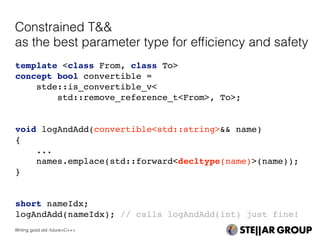
template <class From, class To>
concept bool convertible =
stde::is_convertible_v<
std::remove_reference_t<From>, To>;
void logAndAdd(convertible<std::string>&& name)
{
...
names.emplace(std::forward<decltype(name)>(name));
}
short nameIdx;
logAndAdd(nameIdx); // calls logAndAdd(int) just fine!
Constrained T&&
as the best parameter type for efciency and safety
Writing good std::future<C++>
// from Meyers’s EMC++ Item 26
class Person {
public:
template <typename T>
explicit Person(T&& n) // perfect forwarding ctor
: name(std::forward<T>(n)) {}
explicit Person(int idx)
: name(nameFromIdx(idx)) {}
private:
std::string name;
};
Constrained T&&
as the best parameter type for efciency and safety
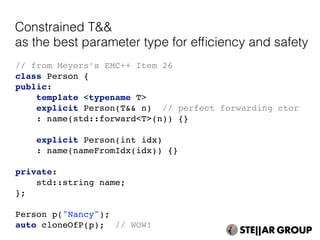
Writing good std::future<C++>
// from Meyers’s EMC++ Item 26
class Person {
public:
template <typename T>
explicit Person(T&& n) // perfect forwarding ctor
: name(std::forward<T>(n)) {}
explicit Person(int idx)
: name(nameFromIdx(idx)) {}
private:
std::string name;
};
Person p("Nancy");
auto cloneOfP(p); // WOW!
Constrained T&&
as the best parameter type for efciency and safety
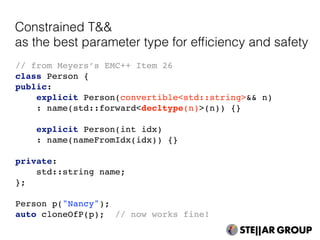
// from Meyers’s EMC++ Item 26
class Person {
public:
explicit Person(convertible<std::string>&& n)
: name(std::forward<decltype(n)>(n)) {}
explicit Person(int idx)
: name(nameFromIdx(idx)) {}
private:
std::string name;
};
Person p("Nancy");
auto cloneOfP(p); // now works fine!
Constrained T&&
as the best parameter type for efciency and safety
std::future<C++> example:
flat_map
Writing good std::future<C++>
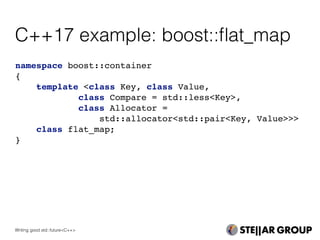
namespace boost::container
{
template <class Key, class Value,
class Compare = std::less<Key>,
class Allocator =
std::allocator<std::pair<Key, Value>>>
class flat_map;
}
C++17 example: boost::flat_map
Writing good std::future<C++>
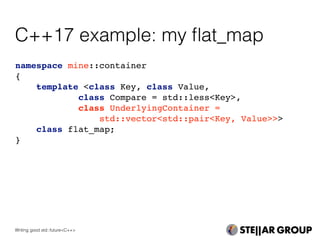
namespace mine::container
{
template <class Key, class Value,
class Compare = std::less<Key>,
class UnderlyingContainer =
std::vector<std::pair<Key, Value>>>
class flat_map;
}
C++17 example: my flat_map
Writing good std::future<C++>
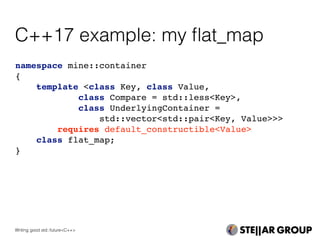
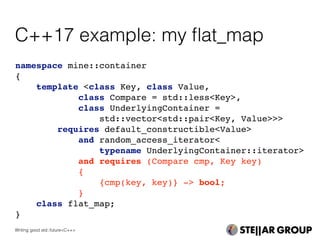
namespace mine::container
{
template <class Key, class Value,
class Compare = std::less<Key>,
class UnderlyingContainer =
std::vector<std::pair<Key, Value>>>
requires default_constructible<Value>
class flat_map;
}
C++17 example: my flat_map
Writing good std::future<C++>
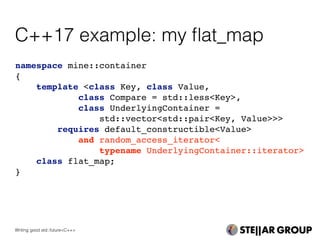
namespace mine::container
{
template <class Key, class Value,
class Compare = std::less<Key>,
class UnderlyingContainer =
std::vector<std::pair<Key, Value>>>
requires default_constructible<Value>
and random_access_iterator<
typename UnderlyingContainer::iterator>
class flat_map;
}
C++17 example: my flat_map
Writing good std::future<C++>
namespace mine::container
{
template <class Key, class Value,
class Compare = std::less<Key>,
class UnderlyingContainer =
std::vector<std::pair<Key, Value>>>
requires default_constructible<Value>
and random_access_iterator<
typename UnderlyingContainer::iterator>
and requires (Compare cmp, Key key)
{
{cmp(key, key)} -> bool;
}
class flat_map;
}
C++17 example: my flat_map
Writing good std::future<C++>
template <...>
class flat_map final: private UnderlyingContainer
{
using key_type = Key;
using mapped_type = Value;
using underlying_type = UnderlyingContainer;
using typename underlying_type::value_type;
static_assert(stde::is_same_v<value_type,
std::pair<key_type, mapped_type>>);
using key_compare = Compare;
using value_compare = struct {
...
};
};
flat_map: typedefs
Writing good std::future<C++>
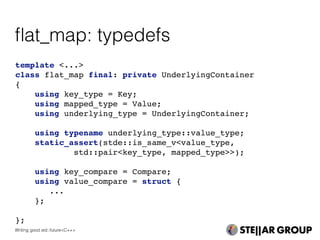
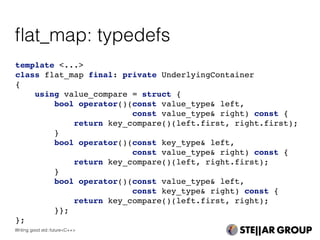
template <...>
class flat_map final: private UnderlyingContainer
{
using value_compare = struct {
bool operator()(const value_type& left,
const value_type& right) const {
return key_compare()(left.first, right.first);
}
bool operator()(const key_type& left,
const value_type& right) const {
return key_compare()(left, right.first);
}
bool operator()(const value_type& left,
const key_type& right) const {
return key_compare()(left.first, right);
}};
};
flat_map: typedefs
Writing good std::future<C++>
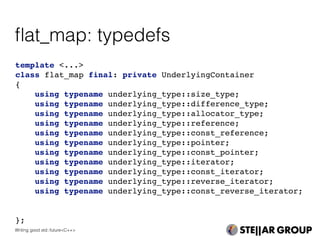
template <...>
class flat_map final: private UnderlyingContainer
{
using typename underlying_type::size_type;
using typename underlying_type::difference_type;
using typename underlying_type::allocator_type;
using typename underlying_type::reference;
using typename underlying_type::const_reference;
using typename underlying_type::pointer;
using typename underlying_type::const_pointer;
using typename underlying_type::iterator;
using typename underlying_type::const_iterator;
using typename underlying_type::reverse_iterator;
using typename underlying_type::const_reverse_iterator;
};
flat_map: typedefs
Writing good std::future<C++>
template <...>
class flat_map final: private UnderlyingContainer
{
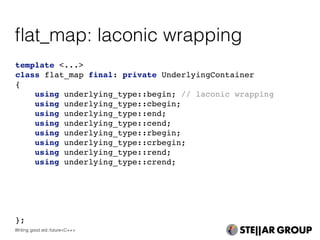
using underlying_type::begin; // laconic wrapping
using underlying_type::cbegin;
using underlying_type::end;
using underlying_type::cend;
using underlying_type::rbegin;
using underlying_type::crbegin;
using underlying_type::rend;
using underlying_type::crend;
};
flat_map: laconic wrapping
Writing good std::future<C++>
template <...>
class flat_map final: private UnderlyingContainer
{
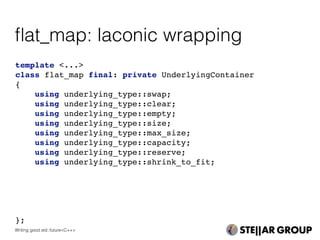
using underlying_type::swap;
using underlying_type::clear;
using underlying_type::empty;
using underlying_type::size;
using underlying_type::max_size;
using underlying_type::capacity;
using underlying_type::reserve;
using underlying_type::shrink_to_fit;
};
flat_map: laconic wrapping
Writing good std::future<C++>
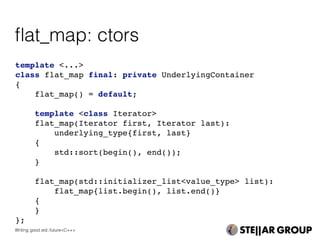
template <...>
class flat_map final: private UnderlyingContainer
{
flat_map() = default;
template <class Iterator>
flat_map(Iterator first, Iterator last):
underlying_type{first, last}
{
std::sort(begin(), end());
}
flat_map(std::initializer_list<value_type> list):
flat_map{list.begin(), list.end()}
{
}
};
flat_map: ctors
Writing good std::future<C++>
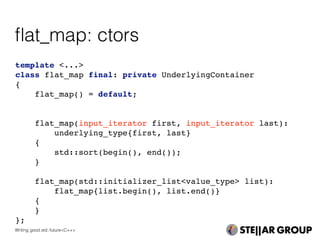
template <...>
class flat_map final: private UnderlyingContainer
{
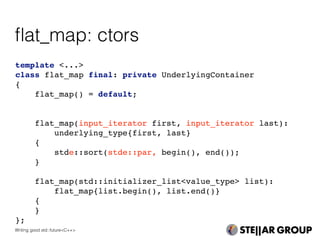
flat_map() = default;
flat_map(input_iterator first, input_iterator last):
underlying_type{first, last}
{
std::sort(begin(), end());
}
flat_map(std::initializer_list<value_type> list):
flat_map{list.begin(), list.end()}
{
}
};
flat_map: ctors
Writing good std::future<C++>
template <...>
class flat_map final: private UnderlyingContainer
{
flat_map() = default;
flat_map(input_iterator first, input_iterator last):
underlying_type{first, last}
{
stde::sort(stde::par, begin(), end());
}
flat_map(std::initializer_list<value_type> list):
flat_map{list.begin(), list.end()}
{
}
};
flat_map: ctors
Writing good std::future<C++>
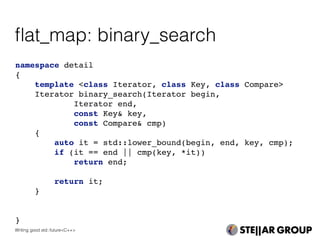
namespace detail
{
template <class Iterator, class Key, class Compare>
Iterator binary_search(Iterator begin,
Iterator end,
const Key& key,
const Compare& cmp)
{
auto it = std::lower_bound(begin, end, key, cmp);
if (it == end || cmp(key, *it))
return end;
return it;
}
}
flat_map: binary_search
Writing good std::future<C++>
namespace detail
{
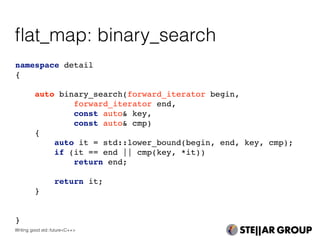
auto binary_search(forward_iterator begin,
forward_iterator end,
const auto& key,
const auto& cmp)
{
auto it = std::lower_bound(begin, end, key, cmp);
if (it == end || cmp(key, *it))
return end;
return it;
}
}
flat_map: binary_search
Writing good std::future<C++>
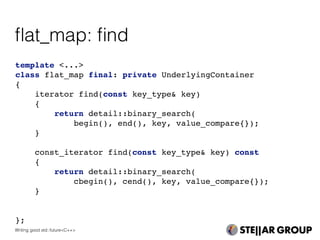
template <...>
class flat_map final: private UnderlyingContainer
{
iterator find(const key_type& key)
{
return detail::binary_search(
begin(), end(), key, value_compare{});
}
const_iterator find(const key_type& key) const
{
return detail::binary_search(
cbegin(), cend(), key, value_compare{});
}
};
flat_map: find
Writing good std::future<C++>
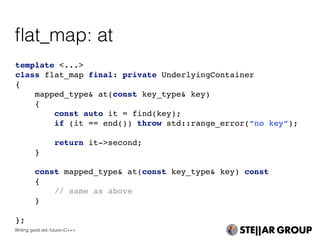
template <...>
class flat_map final: private UnderlyingContainer
{
mapped_type& at(const key_type& key)
{
const auto it = find(key);
if (it == end()) throw std::range_error(“no key”);
return it->second;
}
const mapped_type& at(const key_type& key) const
{
// same as above
}
};
flat_map: at
Writing good std::future<C++>
template <...>
class flat_map final: private UnderlyingContainer
{
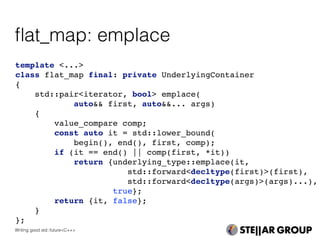
std::pair<iterator, bool> emplace(
auto&& first, auto&&... args)
{
value_compare comp;
const auto it = std::lower_bound(
begin(), end(), first, comp);
if (it == end() || comp(first, *it))
return {underlying_type::emplace(it,
std::forward<decltype(first)>(first),
std::forward<decltype(args)>(args)...),
true};
return {it, false};
}
};
flat_map: emplace
Writing good std::future<C++>
template <...>
class flat_map final: private UnderlyingContainer
{
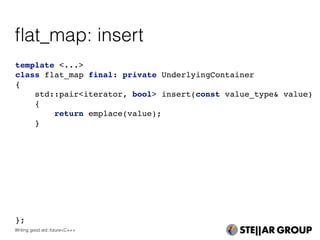
std::pair<iterator, bool> insert(const value_type& value)
{
return emplace(value);
}
};
flat_map: insert
Writing good std::future<C++>
template <...>
class flat_map final: private UnderlyingContainer
{
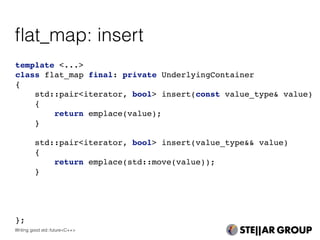
std::pair<iterator, bool> insert(const value_type& value)
{
return emplace(value);
}
std::pair<iterator, bool> insert(value_type&& value)
{
return emplace(std::move(value));
}
};
flat_map: insert
Writing good std::future<C++>
template <...>
class flat_map final: private UnderlyingContainer
{
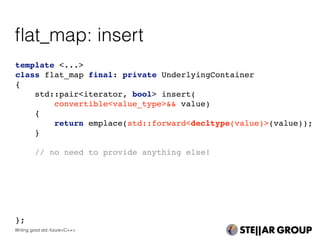
std::pair<iterator, bool> insert(
convertible<value_type>&& value)
{
return emplace(std::forward<decltype(value)>(value));
}
// no need to provide anything else!
};
flat_map: insert
Writing good std::future<C++>
template <...>
class flat_map final: private UnderlyingContainer
{
void insert(input_iterator first,
input_iterator last)
{
const auto count = std::distance(first, last);
const auto room = capacity() - size();
if (room < count)
reserve(size() + count);
for (; first != last; ++first)
emplace(*first);
}
};
flat_map: insert
Writing good std::future<C++>
template <...>
class flat_map final: private UnderlyingContainer
{
void insert(std::initializer_list<value_type> list)
{
insert(list.begin(), list.end());
}
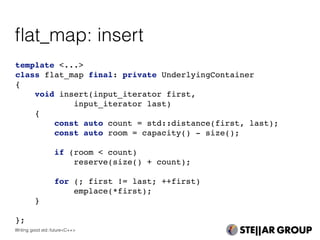
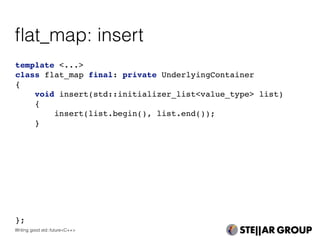
};
flat_map: insert
Writing good std::future<C++>
template <...>
class flat_map final: private UnderlyingContainer
{
mapped_type& operator[](convertible<key_type>&& key)
{
return emplace(
std::forward<decltype(key)>(key),
mapped_type{}
).first->second;
}
};
flat_map: index operator
Writing good std::future<C++>
template <...>
class flat_map final: private UnderlyingContainer
{
using underlying_type::erase;
size_type erase(const key_type& key)
{
const auto it = find(key);
if (it == end())
return 0u;
erase(it);
return 1u;
}
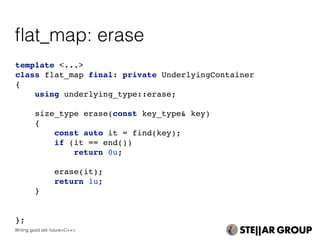
};
flat_map: erase
Writing good std::future<C++>
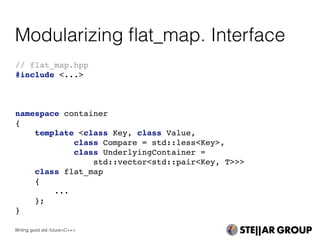
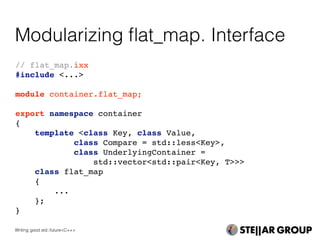
Modularizing flat_map. Interface
Writing good std::future<C++>
// flat_map.hpp
#include <...>
namespace container
{
template <class Key, class Value,
class Compare = std::less<Key>,
class UnderlyingContainer =
std::vector<std::pair<Key, T>>>
class flat_map
{
...
};
}
Modularizing flat_map. Interface
Writing good std::future<C++>
// flat_map.ixx
#include <...>
module container.flat_map;
export namespace container
{
template <class Key, class Value,
class Compare = std::less<Key>,
class UnderlyingContainer =
std::vector<std::pair<Key, T>>>
class flat_map
{
...
};
}
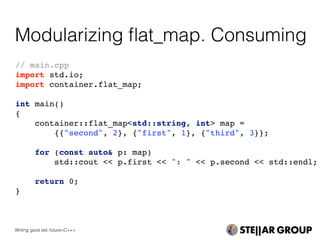
Modularizing flat_map. Consuming
Writing good std::future<C++>
// main.cpp
import std.io;
import container.flat_map;
int main()
{
container::flat_map<std::string, int> map =
{{"second", 2}, {"first", 1}, {"third", 3}};
for (const auto& p: map)
std::cout << p.first << ": " << p.second << std::endl;
return 0;
}
Some more slides…
Writing good std::future<C++>
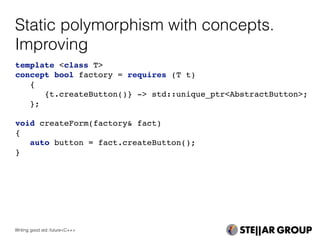
Static polymorphism with concepts.
Improving
template <class T>
concept bool factory = requires (T t)
{
{t.createButton()} -> std::unique_ptr<AbstractButton>;
};
void createForm(factory& fact)
{
auto button = fact.createButton();
}
Writing good std::future<C++>
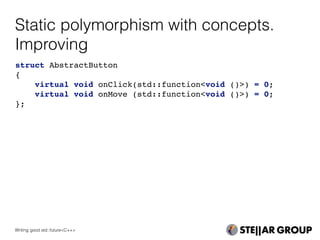
Static polymorphism with concepts.
Improving
struct AbstractButton
{
virtual void onClick(std::function<void ()>) = 0;
virtual void onMove (std::function<void ()>) = 0;
};
Writing good std::future<C++>
Static polymorphism with concepts.
Improving
namespace detail // or std? or whatever
{
constexpr auto empty = [](auto...){};
}
template <class T>
concept bool button = requires (T t)
{
t.onClick(detail::empty);
t.onMove(detail::empty);
};
Writing good std::future<C++>
Static polymorphism with concepts.
Improving
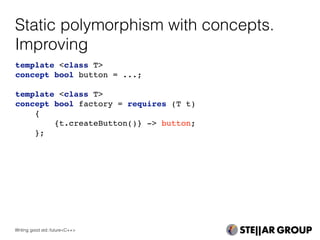
template <class T>
concept bool button = ...;
template <class T>
concept bool factory = requires (T t)
{
{t.createButton()} -> button;
};
Writing good std::future<C++>
Static polymorphism with concepts.
Improving
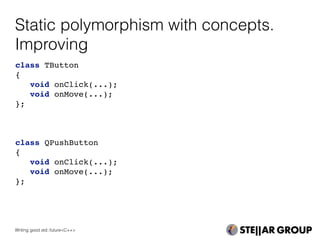
class TButton
{
void onClick(...);
void onMove(...);
};
class QPushButton
{
void onClick(...);
void onMove(...);
};
Writing good std::future<C++>
Static polymorphism with concepts.
Improving
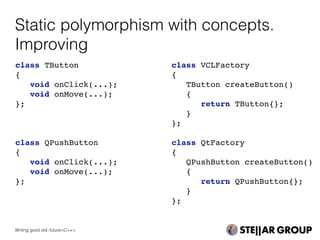
class TButton
{
void onClick(...);
void onMove(...);
};
class QPushButton
{
void onClick(...);
void onMove(...);
};
class VCLFactory
{
TButton createButton()
{
return TButton{};
}
};
class QtFactory
{
QPushButton createButton()
{
return QPushButton{};
}
};
Writing good std::future<C++>
Static polymorphism with concepts.
Using
void createForm(factory& fact)
{
auto button = fact.createButton();
button.onClick([]{ /* pum pum pum */ });
}
int main()
{
QtFactory factory;
createForm(factory);
QApplication::run();
}
Writing good std::future<C++>
Thank you for your attention!

Writing good std::future&lt;c++>

  • 1.
  • 2.
    C++17 Standardization process. Whatwe wanted and expected… • concepts • ranges • modules • parallel algorithms • .then on futures and other concurrency features • executors • coroutines with await • transactional memory • contracts • fold expressions • uniform function call syntax • constexpr lambdas • filesystem library • networking library • library features, e.g. any, optional, etc… • etc… Writing good std::future<C++>
  • 3.
    • concepts • ranges •modules • parallel algorithms • .then on futures and other concurrency features • executors • coroutines with await • transactional memory • contracts • fold expressions • uniform function call syntax • constexpr lambdas • filesystem library • networking library • library features, e.g. any, optional, etc… • etc… C++17 Standardization process. What we’ve got. Writing good std::future<C++>
  • 4.
    • concepts • ranges •modules • parallel algorithms • .then on futures and other concurrency features • executors • coroutines with await • transactional memory • contracts • fold expressions • uniform function call syntax • constexpr lambdas • filesystem library • networking library • library features, e.g. any, optional, etc… • etc… C++17 Standardization process. What we’ve got. Kenny Kerr @kennykerr 7 march C++11 attempted too much. C++14 fixed that. C++17 attempts too little. We need to fix that. Writing good std::future<C++>
  • 5.
  • 6.
    C++’s view onpolymorphism Writing good std::future<C++>
  • 7.
    C++’s view onpolymorphism class Factory { public: virtual AbstractButton* createButton() = 0; }; Writing good std::future<C++>
  • 8.
    C++’s view onpolymorphism class Factory { public: virtual std::unique_ptr<AbstractButton> createButton() = 0; }; Writing good std::future<C++>
  • 9.
    C++’s view onpolymorphism class Factory { public: virtual std::unique_ptr<AbstractButton> createButton() = 0; }; // use of polymorphic code void createForm(Factory* factory) { auto button = factory->createButton(); } Writing good std::future<C++>
  • 10.
    C++’s view onpolymorphism // use of polymorphic code void createForm(Factory* factory) { auto button = factory->createButton(); } Writing good std::future<C++>
  • 11.
    C++’s view onpolymorphism // use of polymorphic code void createForm(Factory* factory) { auto button = factory->createButton(); } Writing good std::future<C++>
  • 12.
    Dynamic polymorphism rsp createForm frame rbp rdi rax x86_64registers … <local vars, ra> the function itself <members> Writing good std::future<C++> ConcreteFactory
  • 13.
    Dynamic polymorphism rsp createForm frame rbp rdi rax x86_64registers … <local vars, ra> the function itself <members> movq %rsp, %rbp Writing good std::future<C++> ConcreteFactory
  • 14.
    Dynamic polymorphism rsp createForm frame rbp rdi rax x86_64registers … <local vars, ra> the function itself <members> factory -24 movq %rdi, -24(%rbp) Writing good std::future<C++> ConcreteFactory
  • 15.
    Dynamic polymorphism rsp createForm frame rbp rdi rax x86_64registers … <local vars, ra> the function itself <members> factory -24 movq -24(%rbp), %rax Writing good std::future<C++> ConcreteFactory
  • 16.
    Dynamic polymorphism rsp createForm frame rbp rdi rax x86_64registers … <local vars, ra> the function itself factory -24 <members> vptr <ptrs to funs> &createButton Writing good std::future<C++> ConcreteFactory vtable
  • 17.
    Dynamic polymorphism rsp createForm frame rbp rdi rax x86_64registers … <local vars, ra> the function itself factory -24 <members> vptr <ptrs to funs> &createButton movq (%rax), %rax Writing good std::future<C++> ConcreteFactory vtable
  • 18.
    Dynamic polymorphism rsp createForm frame rbp rdi rax x86_64registers … <local vars, ra> the function itself factory -24 <members> vptr <ptrs to funs> &createButton addq $8, %rax Writing good std::future<C++> ConcreteFactory vtable
  • 19.
    Dynamic polymorphism rsp createForm frame rbp rdi rax x86_64registers … <local vars, ra> <members> vptr <ptrs to funs> &createButton factory -24 the function itself movq (%rax), %rax Writing good std::future<C++> ConcreteFactory vtable
  • 20.
    Dynamic polymorphism rsp createForm frame rbp rdi rax x86_64registers … <local vars, ra> <members> vptr <ptrs to funs> &createButton factory -24 the function itselfcall %rax Writing good std::future<C++> ConcreteFactory vtable
  • 21.
    Dynamic polymorphism overhead rsp createFormframe rbp rdi rax x86_64 registers … <local vars, ra> ConcreteFactory <members> vptr vtable <ptrs to funs> &createButton factory -24 the function itself Writing good std::future<C++>
  • 22.
    C++ templates —solution? template <class Factory> void createForm(Factory& factory) { auto button = factory.createButton(); } Writing good std::future<C++>
  • 23.
    C++ templates —solution? template <class Factory> void createForm(Factory& factory) { auto button = factory.createButton(); } template void createForm(ConcreteFactory&); Writing good std::future<C++>
  • 24.
    C++ static interface.CRTP template <class Impl> struct Factory { std::unique_ptr<AbstractButton> createButton() { return static_cast<Impl*>(this)->createButton(); } }; Writing good std::future<C++>
  • 25.
    C++ static interface.CRTP template <class Impl> struct Factory { std::unique_ptr<AbstractButton> createButton() { return static_cast<Impl*>(this)->createButton(); } }; struct ConcreteFactory: Factory<ConcreteFactory> { std::unique_ptr<AbstractButton> createButton() { return std::make_unique<ConcreteButton>(); } }; Writing good std::future<C++>
  • 26.
    C++ static interface.Usage template <class Impl> void createForm(Factory<Impl>& fact) { auto button = fact.createButton(); } template void createForm(Factory<ConcreteFactory>&); Writing good std::future<C++>
  • 27.
    CRTP problems • lookslike a hack; • no possibility to get nested types from Impl; • Impl is incomplete at point of instantiation. Writing good std::future<C++>
  • 28.
    Concepts — solution? template<class T> concept bool factory = requires (T t) { {t.createButton()} -> std::unique_ptr<AbstractButton>; }; Writing good std::future<C++>
  • 29.
    Concepts — solution? template<class T> concept bool factory = requires (T t) { {t.createButton()} -> std::unique_ptr<AbstractButton>; }; template <class T> requires factory<T> void createForm(T& fact) { auto button = fact.createButton(); } Writing good std::future<C++>
  • 30.
    Concepts — solution? template<class T> concept bool factory = requires (T t) { {t.createButton()} -> std::unique_ptr<AbstractButton>; }; template <factory T> void createForm(T& fact) { auto button = fact.createButton(); } Writing good std::future<C++>
  • 31.
    Concepts — solution? template<class T> concept bool factory = requires (T t) { {t.createButton()} -> std::unique_ptr<AbstractButton>; }; factory{T} void createForm(T& fact) { auto button = fact.createButton(); } Writing good std::future<C++>
  • 32.
    Concepts — solution? template<class T> concept bool factory = requires (T t) { {t.createButton()} -> std::unique_ptr<AbstractButton>; }; void createForm(factory& fact) { auto button = fact.createButton(); } Writing good std::future<C++>
  • 33.
    Dening concepts template <classT> concept bool variable_concept = constraint-expression; template <class T> concept bool function_concept() { return constraint-expression; } Writing good std::future<C++>
  • 34.
    Dening concepts. Typetraits template <class T> concept bool integral = std::is_integral<T>::value; Writing good std::future<C++>
  • 35.
    Dening concepts. Typetraits template <class T> concept bool integral = std::is_integral<T>()(); Writing good std::future<C++>
  • 36.
    Dening concepts. Typetraits // from library fundamentals TS namespace std::experimental { template <class T> constexpr bool is_integral_v = is_integral<T>::value; } namespace stde = std::experimental; template <class T> concept bool integral = stde::is_integral_v<V>; Writing good std::future<C++>
  • 37.
  • 38.
    Concepts. Iterator example template<class T> concept bool iterator = ...; Writing good std::future<C++>
  • 39.
    Concepts. Iterator example template<class T> concept bool swappable = requires (T t) { {std::swap(t, t)} -> void; } or requires (T t) { // for ADL {swap(t, t)} -> void; }; Writing good std::future<C++>
  • 40.
    Concepts. Iterator example template<class T> concept bool iterator = stde::is_copy_constructible_v<T> and stde::is_copy_assignable_v<T> and stde::is_destructible_v<T> and swappable<T> and requires (T r) { *r; {++r} -> T&; }; Writing good std::future<C++>
  • 41.
    Concepts. Input iterator template<class T> concept bool equality_comparable = requires (T t) { {t == t} -> bool; }; template <class T> concept bool input_iterator = iterator<T> and equality_comparable<T>; Writing good std::future<C++>
  • 42.
  • 43.
    Concepts. Forward iterator template<class T> concept bool forward_iterator = input_iterator<T> and stde::is_default_constructible_v<T> and requires (T r) { {r++} -> const T&; }; Writing good std::future<C++>
  • 44.
    Concepts. Bidirectional iterator template<class T> concept bool bidirectional_iterator = forward_iterator<T> and requires (T r) { {--r} -> T& {r--} -> const T&; }; Writing good std::future<C++>
  • 45.
  • 46.
    template <class T> conceptbool random_access_iterator = bidirectional_iterator<T> and requires (T it, typename std::iterator_traits<T>::difference_type n) { {it += n} -> T&; {it + n} -> T; {n + it} -> T; {it -= n} -> T&; {it - it} -> typename std::iterator_traits<T>::difference_type; {it[n]} -> typename std::iterator_traits<T>::reference; {it < it} -> bool; {it <= it} -> bool; {it > it} -> bool; {it >= it} -> bool; }; Concepts. Random access iterator
  • 47.
  • 48.
  • 49.
  • 50.
    C++ generic programmingand TMP Writing good std::future<C++>
  • 51.
    template <class _InputIterator> vector(_InputIterator__first, typename enable_if< __is_input_iterator<_InputIterator>::value && !__is_forward_iterator<_InputIterator>::value && is_constructible< value_type, typename iterator_traits< _InputIterator>::reference>::value, _InputIterator>::type __last); template <class _ForwardIterator> vector(_ForwardIterator __first, typename enable_if< __is_forward_iterator<_ForwardIterator>::value && is_constructible< value_type, typename iterator_traits< _ForwardIterator>::reference>::value, _ForwardIterator>::type __last); Without concepts: libc++ Writing good std::future<C++>
  • 52.
    vector(input_iterator __first, input_iterator__last); vector(forward_iterator __first, forward_iterator __last); With concepts: libc++ Writing good std::future<C++> That’s it!
  • 53.
    The greediness ofT&& Writing good std::future<C++>
  • 54.
    // from Meyers’sEMC++ Item 26 std::multiset<std::string> names; void logAndAdd(const std::string& name) { auto now = std::chrono::system_clock::now(); log(now, "logAndAdd"); names.emplace(name); } The greediness of T&& Writing good std::future<C++>
  • 55.
    // from Meyers’sEMC++ Item 26 std::multiset<std::string> names; void logAndAdd(const std::string& name) { auto now = std::chrono::system_clock::now(); log(now, "logAndAdd"); names.emplace(name); } std::string petName("Darla"); logAndAdd(petName); // 1) logAndAdd(std::string("Persephone")); // 2) logAndAdd("Patty Dog”); // 3) The greediness of T&& Writing good std::future<C++>
  • 56.
    // from Meyers’sEMC++ Item 26 std::multiset<std::string> names; void logAndAdd(const std::string& name) { auto now = std::chrono::system_clock::now(); log(now, "logAndAdd"); names.emplace(name); } std::string petName("Darla"); logAndAdd(petName); // 1) okay, just copying logAndAdd(std::string("Persephone")); // 2) extra copy logAndAdd("Patty Dog”); // 3) no need to copy or move The greediness of T&& Writing good std::future<C++>
  • 57.
    The greediness ofT&& // from Meyers’s EMC++ Item 26 template <typename T> void logAndAdd(T&& name) { auto now = std::chrono::system_clock::now(); log(now, "logAndAdd"); names.emplace(std::forward<T>(name)); } std::string petName("Darla"); logAndAdd(petName); // 1) okay, just copying logAndAdd(std::string("Persephone")); // 2) moving! logAndAdd("Patty Dog”); // 3) neither moving nor copying, // just creating inplaceWriting good std::future<C++>
  • 58.
    // from Meyers’sEMC++ Item 26 std::string nameFromIdx(int idx); void logAndAdd(int idx) { auto now = std::chrono::system_clock::now(); log(now, "logAndAdd"); names.emplace(nameFromIdx(idx)); } short nameIdx; logAndAdd(nameIdx); // error! The greediness of T&& Writing good std::future<C++>
  • 59.
    Meyers, “Effective ModernC++”, Item 26: Avoid overloading on universal references. The greediness of T&& Writing good std::future<C++>
  • 60.
    Meyers, “Effective ModernC++”, Item 26: Avoid overloading on universal references. ... The greediness of T&& Writing good std::future<C++>
  • 61.
    Meyers, “Effective ModernC++”, Item 26: Avoid overloading on universal references. ... but not on constrained universal references! The greediness of T&& Writing good std::future<C++>
  • 62.
    void logAndAdd(int idx); template<typename T> void logAndAdd(T&& name) { ... names.emplace(std::forward<T>(name)); } Constrained T&& as the best parameter type for efciency and safety Writing good std::future<C++>
  • 63.
    void logAndAdd(int idx); template<typename T, typename = std::enable_if_t< stde::is_convertible_v< T, std::string>>> void logAndAdd(T&& name) { ... names.emplace(std::forward<T>(name)); } Constrained T&& as the best parameter type for efciency and safety Writing good std::future<C++>
  • 64.
    void logAndAdd(int idx); template<typename T, typename = std::enable_if_t< stde::is_convertible_v< std::remove_reference_t<T>, std::string>>> void logAndAdd(T&& name) { ... names.emplace(std::forward<T>(name)); } Constrained T&& as the best parameter type for efciency and safety Writing good std::future<C++>
  • 65.
    void logAndAdd(int idx); template<typename T, typename = std::enable_if_t< stde::is_convertible_v< std::remove_reference_t<T>, std::string>>> void logAndAdd(T&& name) { ... names.emplace(std::forward<T>(name)); } short nameIdx; logAndAdd(nameIdx); // calls logAndAdd(int) just fine! Constrained T&& as the best parameter type for efciency and safety Writing good std::future<C++>
  • 66.
    template <class From,class To> concept bool convertible = stde::is_convertible_v< std::remove_reference_t<From>, To>; Constrained T&& as the best parameter type for efciency and safety Writing good std::future<C++>
  • 67.
    template <class From,class To> concept bool convertible = stde::is_convertible_v< std::remove_reference_t<From>, To>; void logAndAdd(convertible<std::string>&& name) { ... names.emplace(std::forward<decltype(name)>(name)); } short nameIdx; logAndAdd(nameIdx); // calls logAndAdd(int) just fine! Constrained T&& as the best parameter type for efciency and safety Writing good std::future<C++>
  • 68.
    // from Meyers’sEMC++ Item 26 class Person { public: template <typename T> explicit Person(T&& n) // perfect forwarding ctor : name(std::forward<T>(n)) {} explicit Person(int idx) : name(nameFromIdx(idx)) {} private: std::string name; }; Constrained T&& as the best parameter type for efficiency and safety Writing good std::future<C++>
  • 69.
    // from Meyers’sEMC++ Item 26 class Person { public: template <typename T> explicit Person(T&& n) // perfect forwarding ctor : name(std::forward<T>(n)) {} explicit Person(int idx) : name(nameFromIdx(idx)) {} private: std::string name; }; Person p("Nancy"); auto cloneOfP(p); // WOW! Constrained T&& as the best parameter type for efficiency and safety
  • 70.
    // from Meyers’sEMC++ Item 26 class Person { public: explicit Person(convertible<std::string>&& n) : name(std::forward<decltype(n)>(n)) {} explicit Person(int idx) : name(nameFromIdx(idx)) {} private: std::string name; }; Person p("Nancy"); auto cloneOfP(p); // now works fine! Constrained T&& as the best parameter type for efficiency and safety
  • 71.
  • 72.
    namespace boost::container { template <classKey, class Value, class Compare = std::less<Key>, class Allocator = std::allocator<std::pair<Key, Value>>> class flat_map; } C++17 example: boost::flat_map Writing good std::future<C++>
  • 73.
    namespace mine::container { template <classKey, class Value, class Compare = std::less<Key>, class UnderlyingContainer = std::vector<std::pair<Key, Value>>> class flat_map; } C++17 example: my flat_map Writing good std::future<C++>
  • 74.
    namespace mine::container { template <classKey, class Value, class Compare = std::less<Key>, class UnderlyingContainer = std::vector<std::pair<Key, Value>>> requires default_constructible<Value> class flat_map; } C++17 example: my flat_map Writing good std::future<C++>
  • 75.
    namespace mine::container { template <classKey, class Value, class Compare = std::less<Key>, class UnderlyingContainer = std::vector<std::pair<Key, Value>>> requires default_constructible<Value> and random_access_iterator< typename UnderlyingContainer::iterator> class flat_map; } C++17 example: my flat_map Writing good std::future<C++>
  • 76.
    namespace mine::container { template <classKey, class Value, class Compare = std::less<Key>, class UnderlyingContainer = std::vector<std::pair<Key, Value>>> requires default_constructible<Value> and random_access_iterator< typename UnderlyingContainer::iterator> and requires (Compare cmp, Key key) { {cmp(key, key)} -> bool; } class flat_map; } C++17 example: my flat_map Writing good std::future<C++>
  • 77.
    template <...> class flat_mapfinal: private UnderlyingContainer { using key_type = Key; using mapped_type = Value; using underlying_type = UnderlyingContainer; using typename underlying_type::value_type; static_assert(stde::is_same_v<value_type, std::pair<key_type, mapped_type>>); using key_compare = Compare; using value_compare = struct { ... }; }; flat_map: typedefs Writing good std::future<C++>
  • 78.
    template <...> class flat_mapfinal: private UnderlyingContainer { using value_compare = struct { bool operator()(const value_type& left, const value_type& right) const { return key_compare()(left.first, right.first); } bool operator()(const key_type& left, const value_type& right) const { return key_compare()(left, right.first); } bool operator()(const value_type& left, const key_type& right) const { return key_compare()(left.first, right); }}; }; flat_map: typedefs Writing good std::future<C++>
  • 79.
    template <...> class flat_mapfinal: private UnderlyingContainer { using typename underlying_type::size_type; using typename underlying_type::difference_type; using typename underlying_type::allocator_type; using typename underlying_type::reference; using typename underlying_type::const_reference; using typename underlying_type::pointer; using typename underlying_type::const_pointer; using typename underlying_type::iterator; using typename underlying_type::const_iterator; using typename underlying_type::reverse_iterator; using typename underlying_type::const_reverse_iterator; }; flat_map: typedefs Writing good std::future<C++>
  • 80.
    template <...> class flat_mapfinal: private UnderlyingContainer { using underlying_type::begin; // laconic wrapping using underlying_type::cbegin; using underlying_type::end; using underlying_type::cend; using underlying_type::rbegin; using underlying_type::crbegin; using underlying_type::rend; using underlying_type::crend; }; flat_map: laconic wrapping Writing good std::future<C++>
  • 81.
    template <...> class flat_mapfinal: private UnderlyingContainer { using underlying_type::swap; using underlying_type::clear; using underlying_type::empty; using underlying_type::size; using underlying_type::max_size; using underlying_type::capacity; using underlying_type::reserve; using underlying_type::shrink_to_fit; }; flat_map: laconic wrapping Writing good std::future<C++>
  • 82.
    template <...> class flat_mapfinal: private UnderlyingContainer { flat_map() = default; template <class Iterator> flat_map(Iterator first, Iterator last): underlying_type{first, last} { std::sort(begin(), end()); } flat_map(std::initializer_list<value_type> list): flat_map{list.begin(), list.end()} { } }; flat_map: ctors Writing good std::future<C++>
  • 83.
    template <...> class flat_mapfinal: private UnderlyingContainer { flat_map() = default; flat_map(input_iterator first, input_iterator last): underlying_type{first, last} { std::sort(begin(), end()); } flat_map(std::initializer_list<value_type> list): flat_map{list.begin(), list.end()} { } }; flat_map: ctors Writing good std::future<C++>
  • 84.
    template <...> class flat_mapfinal: private UnderlyingContainer { flat_map() = default; flat_map(input_iterator first, input_iterator last): underlying_type{first, last} { stde::sort(stde::par, begin(), end()); } flat_map(std::initializer_list<value_type> list): flat_map{list.begin(), list.end()} { } }; flat_map: ctors Writing good std::future<C++>
  • 85.
    namespace detail { template <classIterator, class Key, class Compare> Iterator binary_search(Iterator begin, Iterator end, const Key& key, const Compare& cmp) { auto it = std::lower_bound(begin, end, key, cmp); if (it == end || cmp(key, *it)) return end; return it; } } flat_map: binary_search Writing good std::future<C++>
  • 86.
    namespace detail { auto binary_search(forward_iteratorbegin, forward_iterator end, const auto& key, const auto& cmp) { auto it = std::lower_bound(begin, end, key, cmp); if (it == end || cmp(key, *it)) return end; return it; } } flat_map: binary_search Writing good std::future<C++>
  • 87.
    template <...> class flat_mapfinal: private UnderlyingContainer { iterator find(const key_type& key) { return detail::binary_search( begin(), end(), key, value_compare{}); } const_iterator find(const key_type& key) const { return detail::binary_search( cbegin(), cend(), key, value_compare{}); } }; flat_map: find Writing good std::future<C++>
  • 88.
    template <...> class flat_mapfinal: private UnderlyingContainer { mapped_type& at(const key_type& key) { const auto it = find(key); if (it == end()) throw std::range_error(“no key”); return it->second; } const mapped_type& at(const key_type& key) const { // same as above } }; flat_map: at Writing good std::future<C++>
  • 89.
    template <...> class flat_mapfinal: private UnderlyingContainer { std::pair<iterator, bool> emplace( auto&& first, auto&&... args) { value_compare comp; const auto it = std::lower_bound( begin(), end(), first, comp); if (it == end() || comp(first, *it)) return {underlying_type::emplace(it, std::forward<decltype(first)>(first), std::forward<decltype(args)>(args)...), true}; return {it, false}; } }; flat_map: emplace Writing good std::future<C++>
  • 90.
    template <...> class flat_mapfinal: private UnderlyingContainer { std::pair<iterator, bool> insert(const value_type& value) { return emplace(value); } }; flat_map: insert Writing good std::future<C++>
  • 91.
    template <...> class flat_mapfinal: private UnderlyingContainer { std::pair<iterator, bool> insert(const value_type& value) { return emplace(value); } std::pair<iterator, bool> insert(value_type&& value) { return emplace(std::move(value)); } }; flat_map: insert Writing good std::future<C++>
  • 92.
    template <...> class flat_mapfinal: private UnderlyingContainer { std::pair<iterator, bool> insert( convertible<value_type>&& value) { return emplace(std::forward<decltype(value)>(value)); } // no need to provide anything else! }; flat_map: insert Writing good std::future<C++>
  • 93.
    template <...> class flat_mapfinal: private UnderlyingContainer { void insert(input_iterator first, input_iterator last) { const auto count = std::distance(first, last); const auto room = capacity() - size(); if (room < count) reserve(size() + count); for (; first != last; ++first) emplace(*first); } }; flat_map: insert Writing good std::future<C++>
  • 94.
    template <...> class flat_mapfinal: private UnderlyingContainer { void insert(std::initializer_list<value_type> list) { insert(list.begin(), list.end()); } }; flat_map: insert Writing good std::future<C++>
  • 95.
    template <...> class flat_mapfinal: private UnderlyingContainer { mapped_type& operator[](convertible<key_type>&& key) { return emplace( std::forward<decltype(key)>(key), mapped_type{} ).first->second; } }; flat_map: index operator Writing good std::future<C++>
  • 96.
    template <...> class flat_mapfinal: private UnderlyingContainer { using underlying_type::erase; size_type erase(const key_type& key) { const auto it = find(key); if (it == end()) return 0u; erase(it); return 1u; } }; flat_map: erase Writing good std::future<C++>
  • 97.
    Modularizing flat_map. Interface Writinggood std::future<C++> // flat_map.hpp #include <...> namespace container { template <class Key, class Value, class Compare = std::less<Key>, class UnderlyingContainer = std::vector<std::pair<Key, T>>> class flat_map { ... }; }
  • 98.
    Modularizing flat_map. Interface Writinggood std::future<C++> // flat_map.ixx #include <...> module container.flat_map; export namespace container { template <class Key, class Value, class Compare = std::less<Key>, class UnderlyingContainer = std::vector<std::pair<Key, T>>> class flat_map { ... }; }
  • 99.
    Modularizing flat_map. Consuming Writinggood std::future<C++> // main.cpp import std.io; import container.flat_map; int main() { container::flat_map<std::string, int> map = {{"second", 2}, {"first", 1}, {"third", 3}}; for (const auto& p: map) std::cout << p.first << ": " << p.second << std::endl; return 0; }
  • 100.
    Some more slides… Writinggood std::future<C++>
  • 101.
    Static polymorphism withconcepts. Improving template <class T> concept bool factory = requires (T t) { {t.createButton()} -> std::unique_ptr<AbstractButton>; }; void createForm(factory& fact) { auto button = fact.createButton(); } Writing good std::future<C++>
  • 102.
    Static polymorphism withconcepts. Improving struct AbstractButton { virtual void onClick(std::function<void ()>) = 0; virtual void onMove (std::function<void ()>) = 0; }; Writing good std::future<C++>
  • 103.
    Static polymorphism withconcepts. Improving namespace detail // or std? or whatever { constexpr auto empty = [](auto...){}; } template <class T> concept bool button = requires (T t) { t.onClick(detail::empty); t.onMove(detail::empty); }; Writing good std::future<C++>
  • 104.
    Static polymorphism withconcepts. Improving template <class T> concept bool button = ...; template <class T> concept bool factory = requires (T t) { {t.createButton()} -> button; }; Writing good std::future<C++>
  • 105.
    Static polymorphism withconcepts. Improving class TButton { void onClick(...); void onMove(...); }; class QPushButton { void onClick(...); void onMove(...); }; Writing good std::future<C++>
  • 106.
    Static polymorphism withconcepts. Improving class TButton { void onClick(...); void onMove(...); }; class QPushButton { void onClick(...); void onMove(...); }; class VCLFactory { TButton createButton() { return TButton{}; } }; class QtFactory { QPushButton createButton() { return QPushButton{}; } }; Writing good std::future<C++>
  • 107.
    Static polymorphism withconcepts. Using void createForm(factory& fact) { auto button = fact.createButton(); button.onClick([]{ /* pum pum pum */ }); } int main() { QtFactory factory; createForm(factory); QApplication::run(); } Writing good std::future<C++>
  • 108.
    Writing good std::future<C++> Thankyou for your attention!