October 26, 2012
Digital Marketing Boot Camp for Arts Marketers | Writing for the web


hugeinc.com
info@hugeinc.com
45 Main St. #220 Brooklyn, NY 11201
+1 718 625 4843
Michal Pasternak
Partner, User Experience


John McCrory
Content Strategy Lead
About us.
We help transform brands
 and grow businesses.
Our approach.
Great user experiences are what drive
business performance and marketing.
Agenda:
 1. The journey of your message
2. Key Principles 3. 10 Things you
    can do right away 4. Q&A
The journey of
your message.
We’re here to talk about
     writing for the web.
What do we mean by the web?
Our writing is carried through
 many different channels.
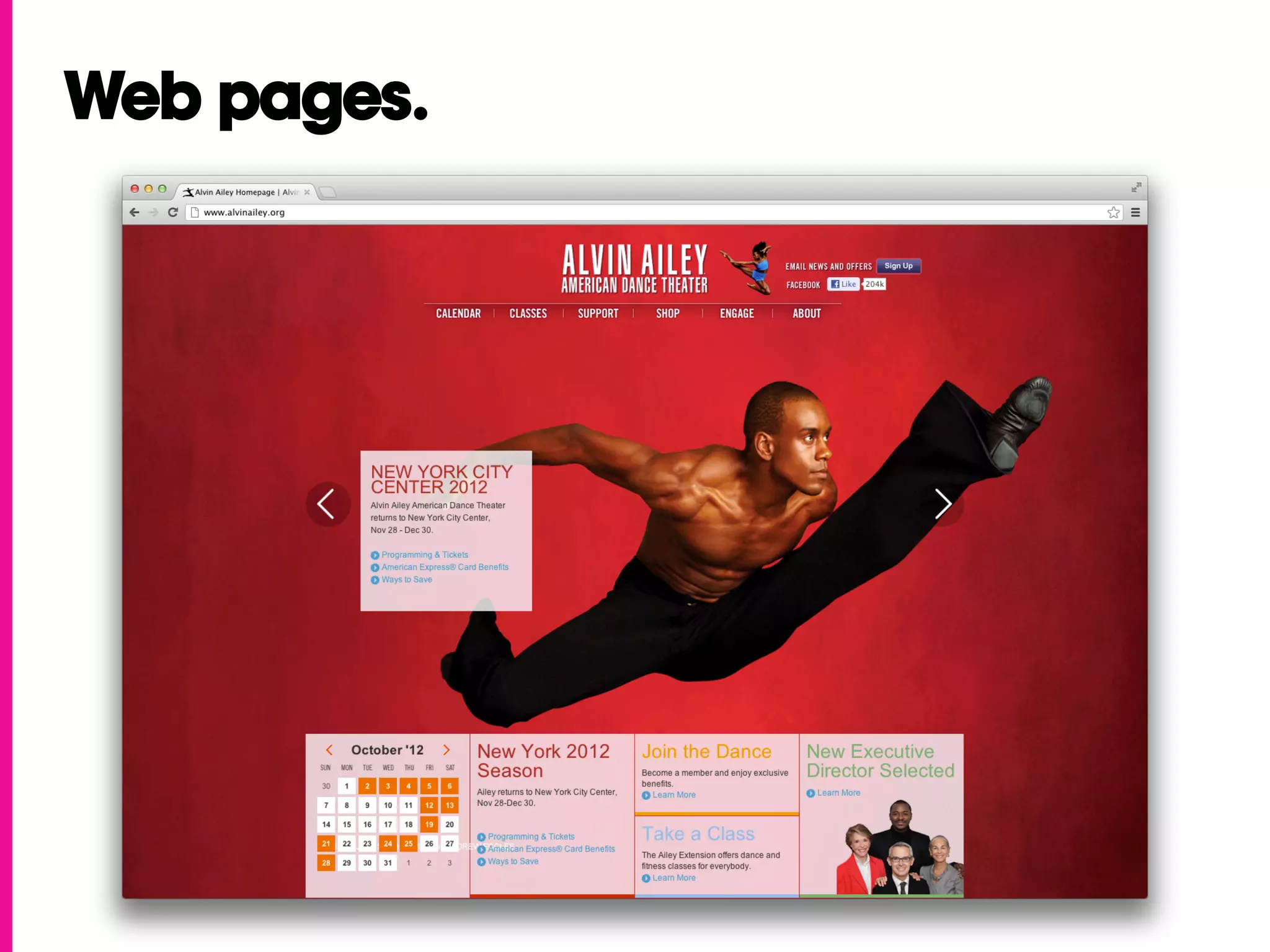
Web pages.
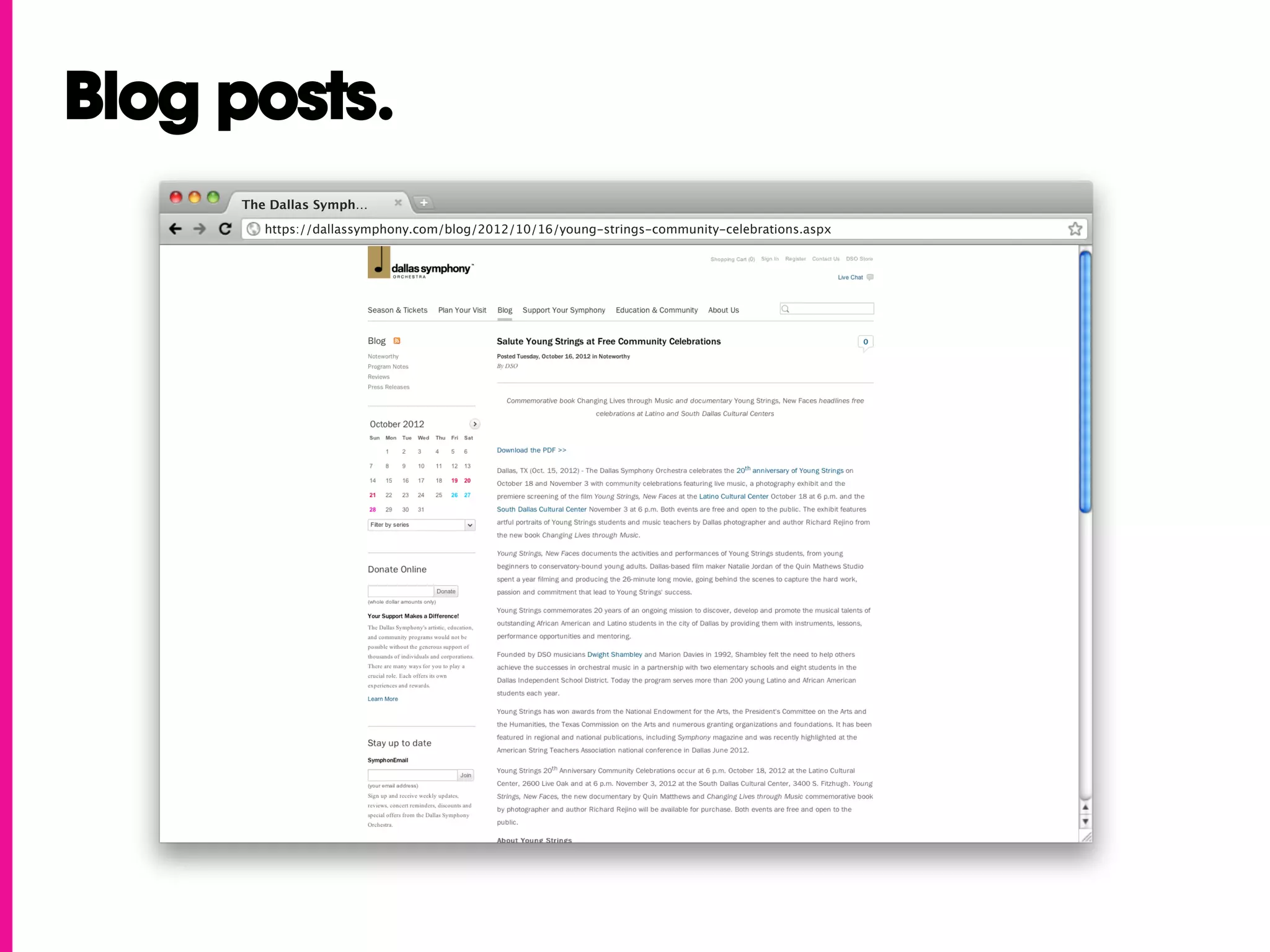
Blog posts.
     The Dallas Symph…
        https://dallassymphony.com/blog/2012/10/16/young-strings-community-celebrations.aspx
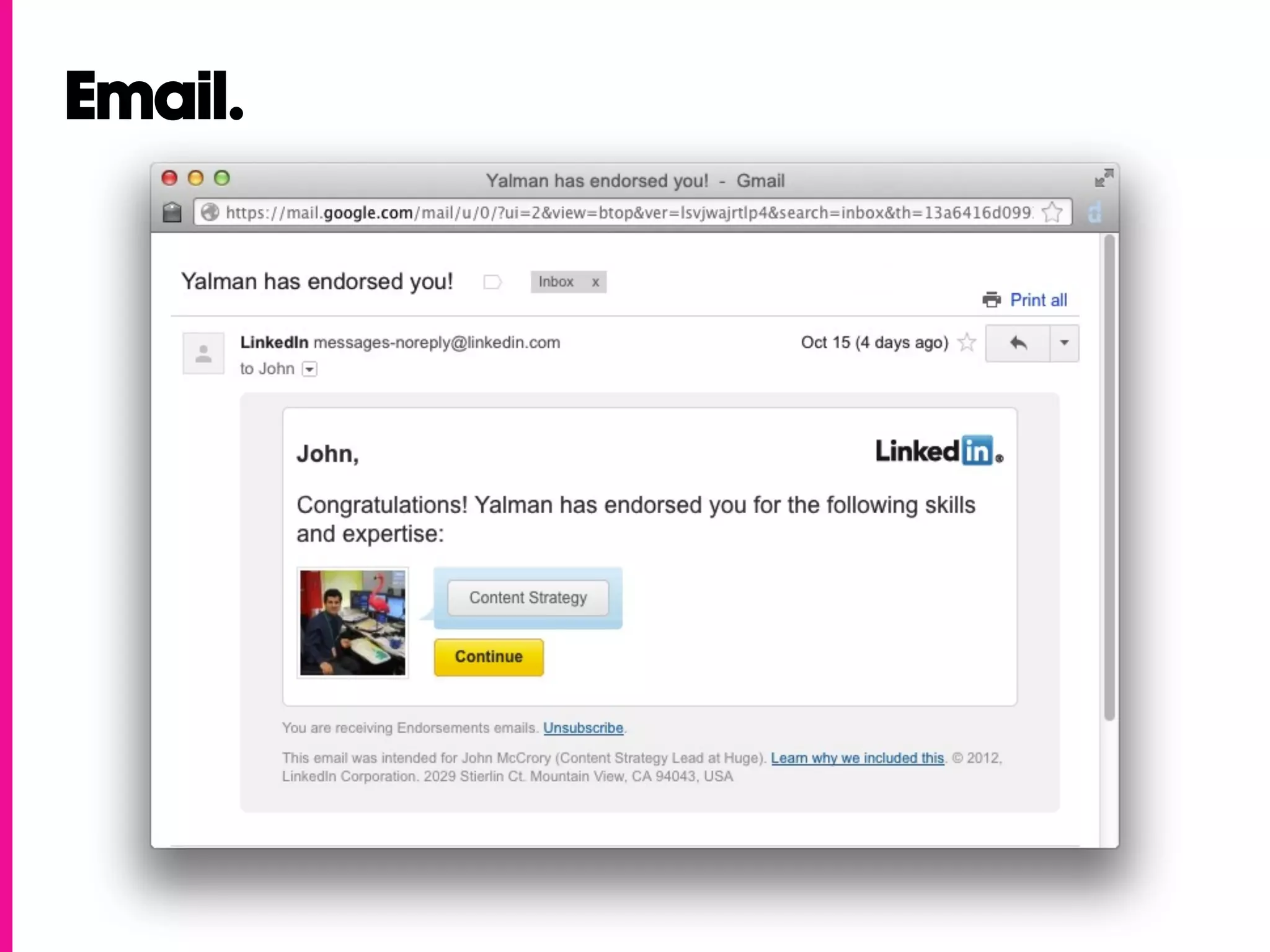
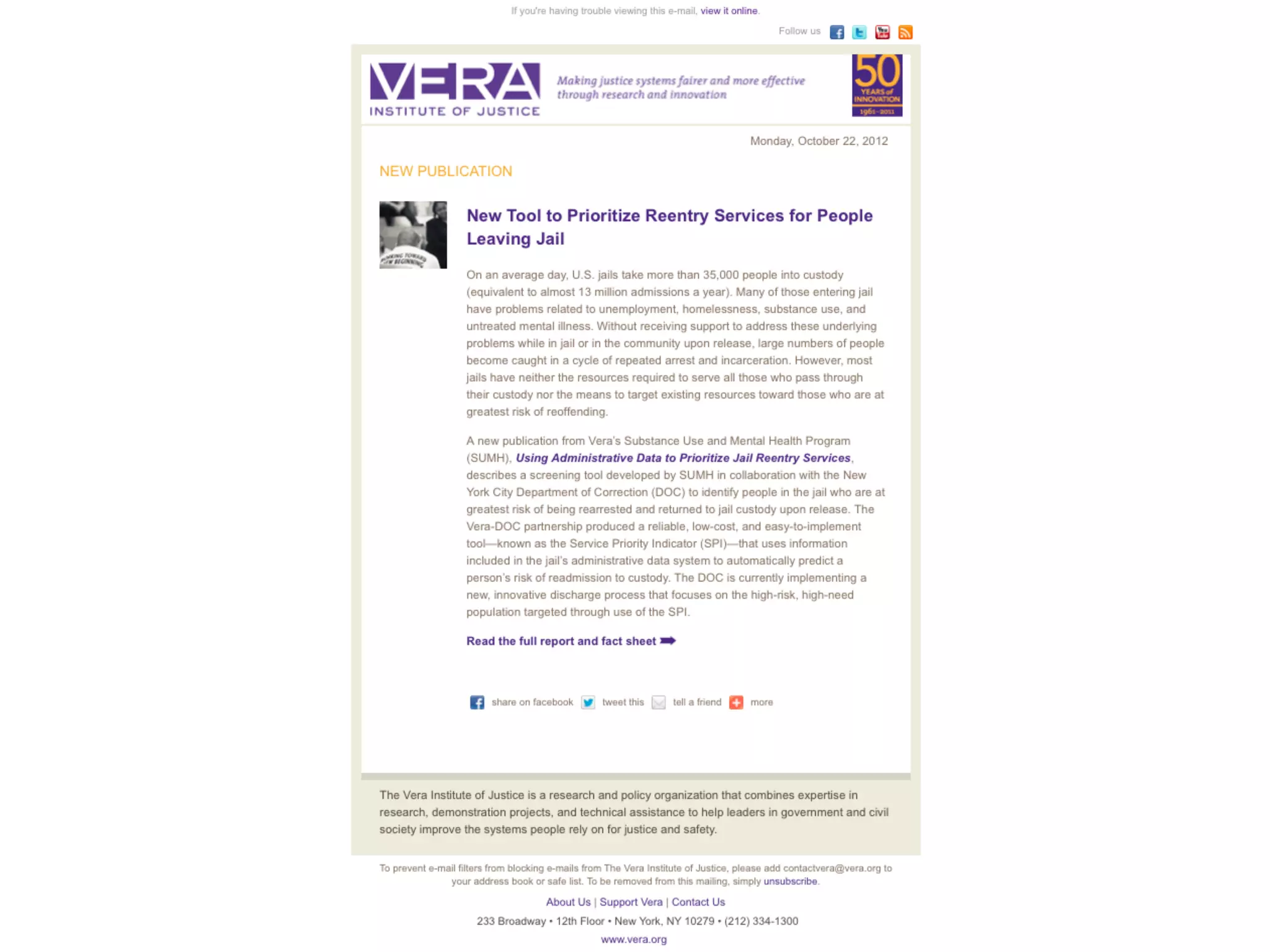
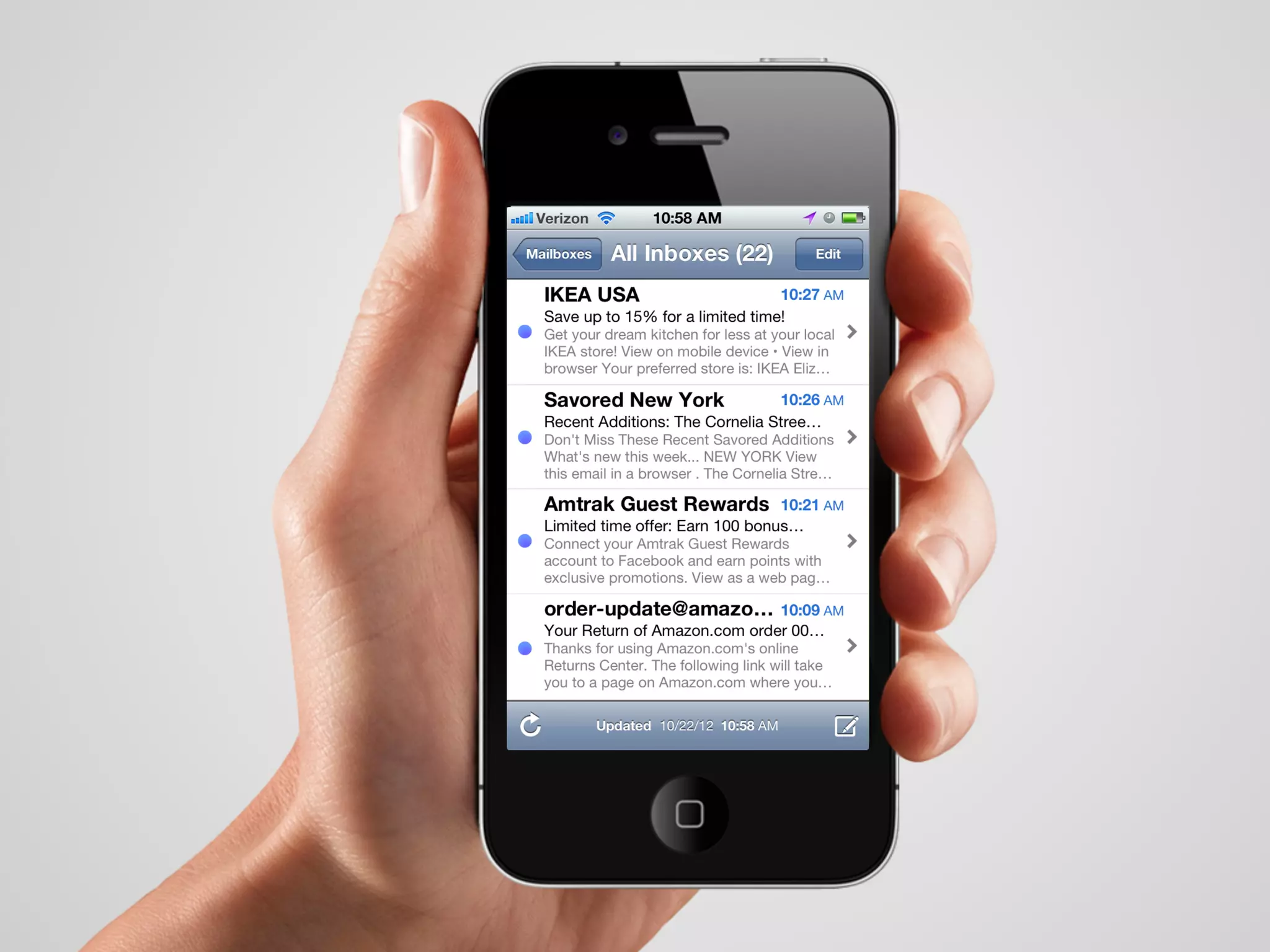
Email.
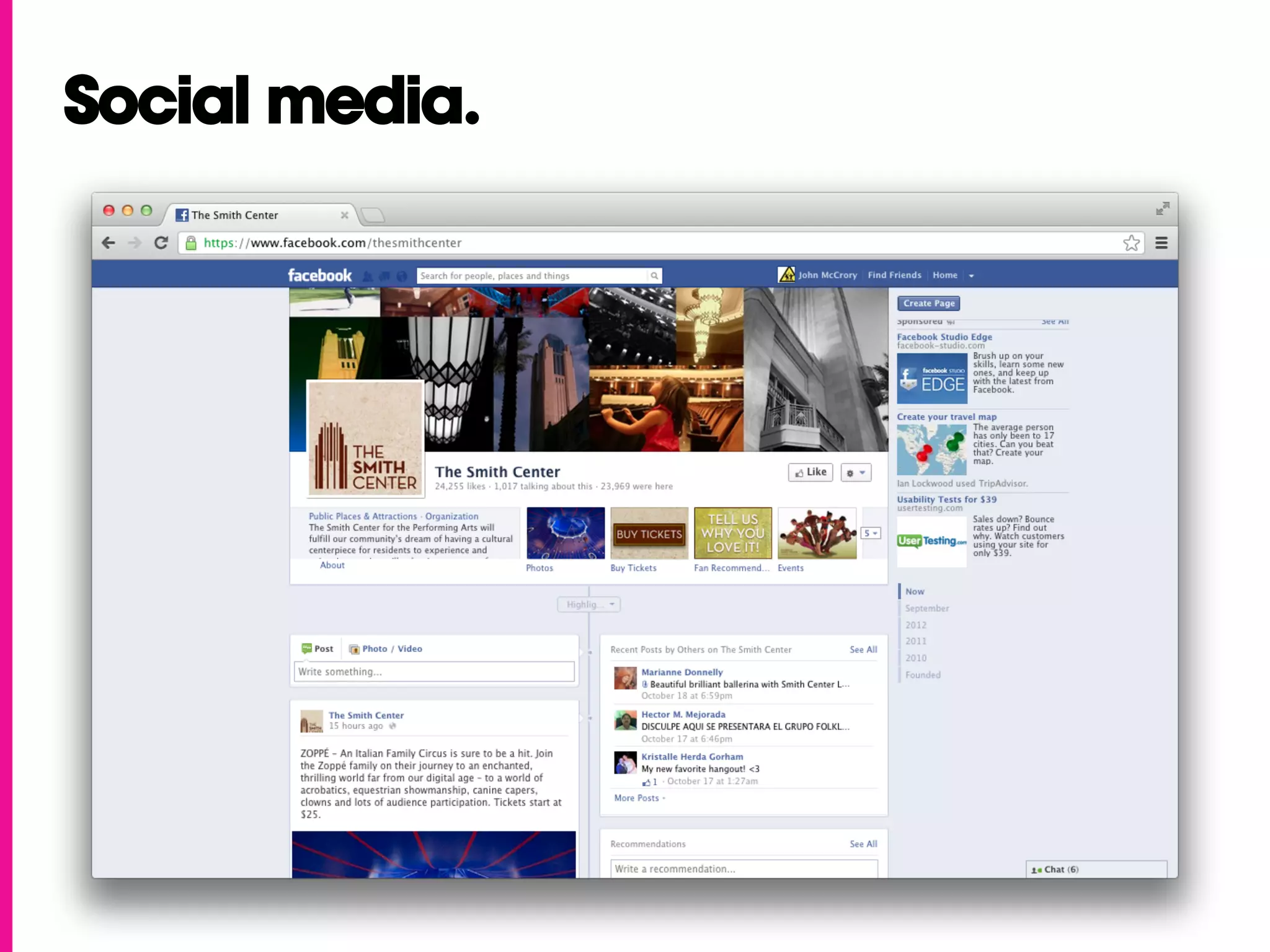
Social media.
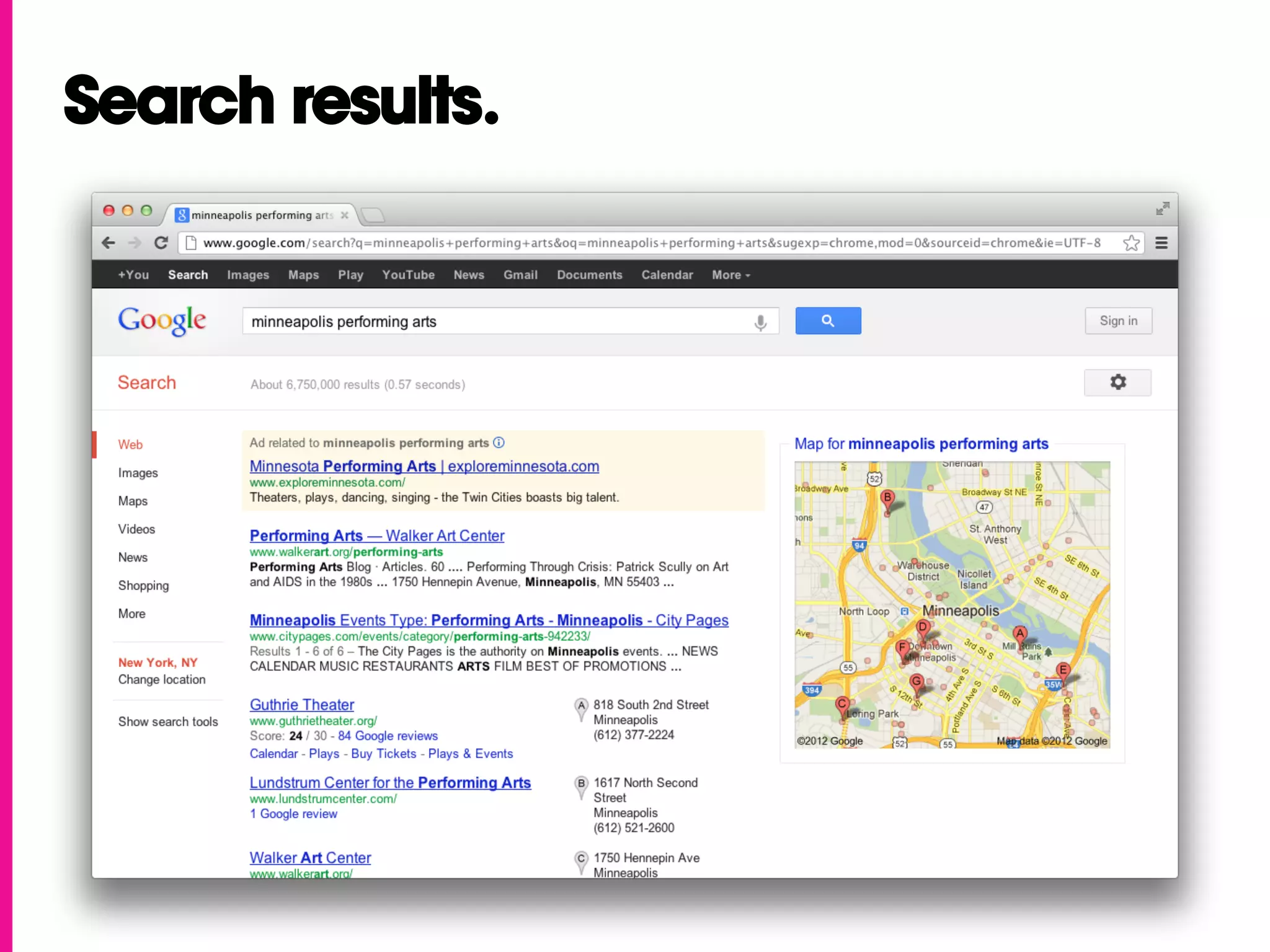
Search results.
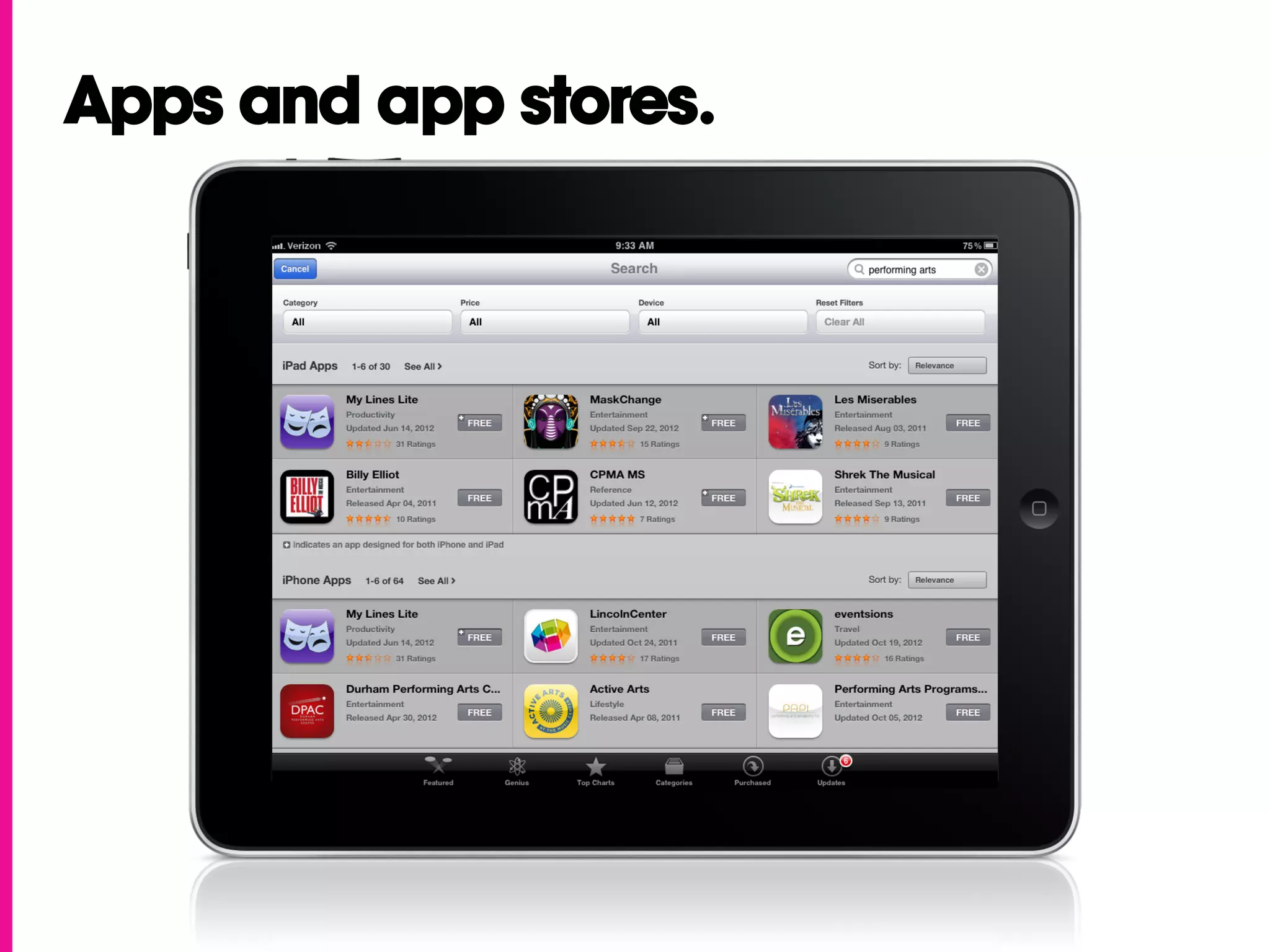
Apps and app stores.
Our writing reaches people in
  many different contexts.
Receive	
  module	
  on	
  Facebook	
  
Receive	
  module	
  on	
  Facebook	
  
A message serves many situations.
•  A person is seeking information from you


•  You are sending your message to someone


•  Another organization (sponsor, newspaper, artist) is
   sharing your message with its audience


•  Natural word of mouth in which an individual shares your
   message with a friend
We are writing for an ecosystem
   of channels, devices and
           situations.
You face a host of challenges.
•  You aren’t only a writer… you wear a lot of different hats in
   your organization


•  Your time and resources are constrained


•  Sometimes, it feels like you have to do it all alone


•  Your organization can’t afford the technology you need to
   produce and publish efficiently
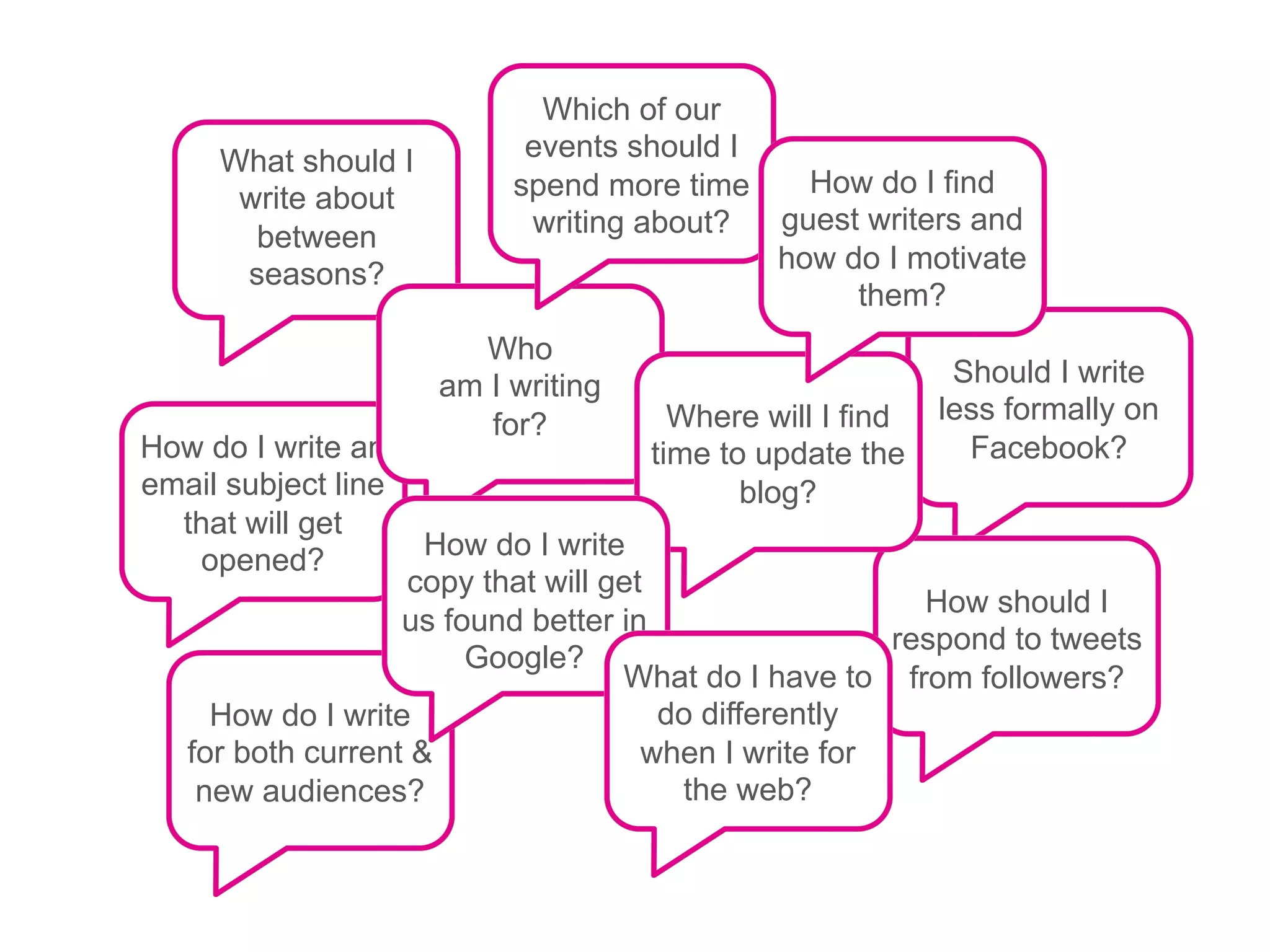
Which of our
     What should I         events should I
      write about         spend more time    How do I find
                           writing about?  guest writers and
       between
      seasons?                             how do I motivate
                                                them?
                       Who
                     am I writing                          Should I write
                        for?          Where will I find   less formally on
How do I write an                   time to update the      Facebook?
email subject line                         blog?
  that will get
   opened?           How do I write
                   copy that will get
                                                        How should I
                   us found better in
                                                      respond to tweets
                        Google?
                                   What do I have to from followers?
     How do I write                   do differently
   for both current &                when I write for
    new audiences?                     the web?
2 most frequent questions we
hear about writing for the web:
How often should we…
•  Send email to our subscribers


•  Update our Facebook page


•  Tweet
Answer:
    It doesn’t really matter
—if you are being relevant and
 interesting to your audience.

Instead, pace yourself based on
what you know can handle and
      do well. Start small.
What’s the best length for…
•  Our email newsletter


•  A blog post


•  A web page
Answer:
 The best length for writing is the
   same length as a miniskirt:

    Long enough to cover the
subject, but short enough to keep
           it interesting.
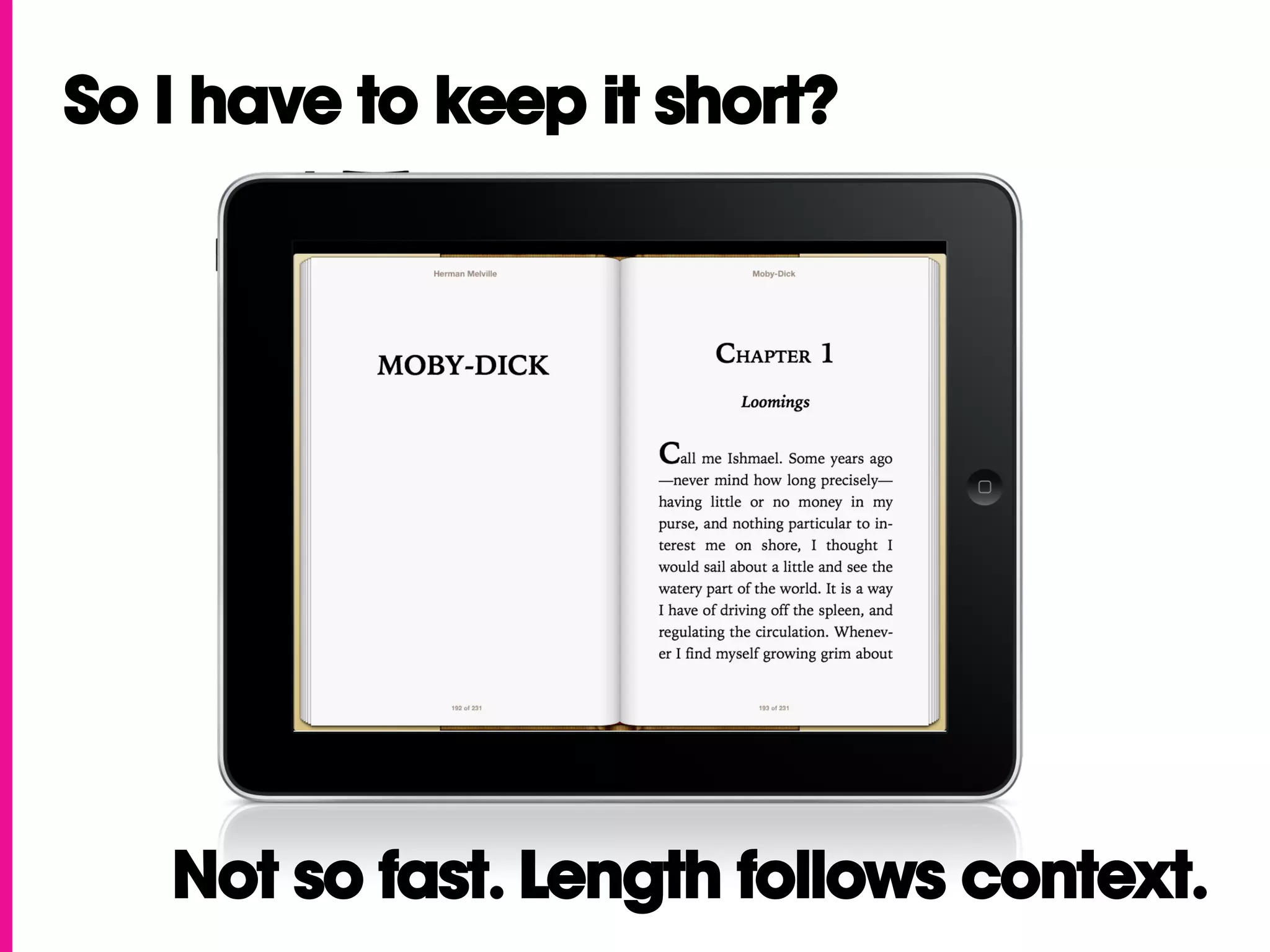
So I have to keep it short?


   Not so fast. Length follows context.
Key principles.
Key Principles
1. Know your audience.
2. Know yourself.
3. Know the competition.

Your audience already talks to you.
•  Web analytics can tell you which topics and formats
   provoke more or less audience interest.


•  Search analytics can provide insight into the subjects your
   audience cares about – and the terms they use.


•  URL shorteners like bit.ly can help you learn from your
   audience across different channels.


•  Social media let you listen in on the conversations your
   audience is already having.
Talk directly to your audience.
•  Meet them face to face, not through third parties or the
   computer.


•  Anybody who is in your audience is also in your digital
   audience.


•  Focus groups can be formal or informal: greet audience
   members when they come to a show, and ask them
   questions.
Visualize your users as real people.
•  Demographic group


•  Aspirations


•  Inspirations


•  Relationship to your brand


•  How they consume and engage with media


•  How they spend their time and money
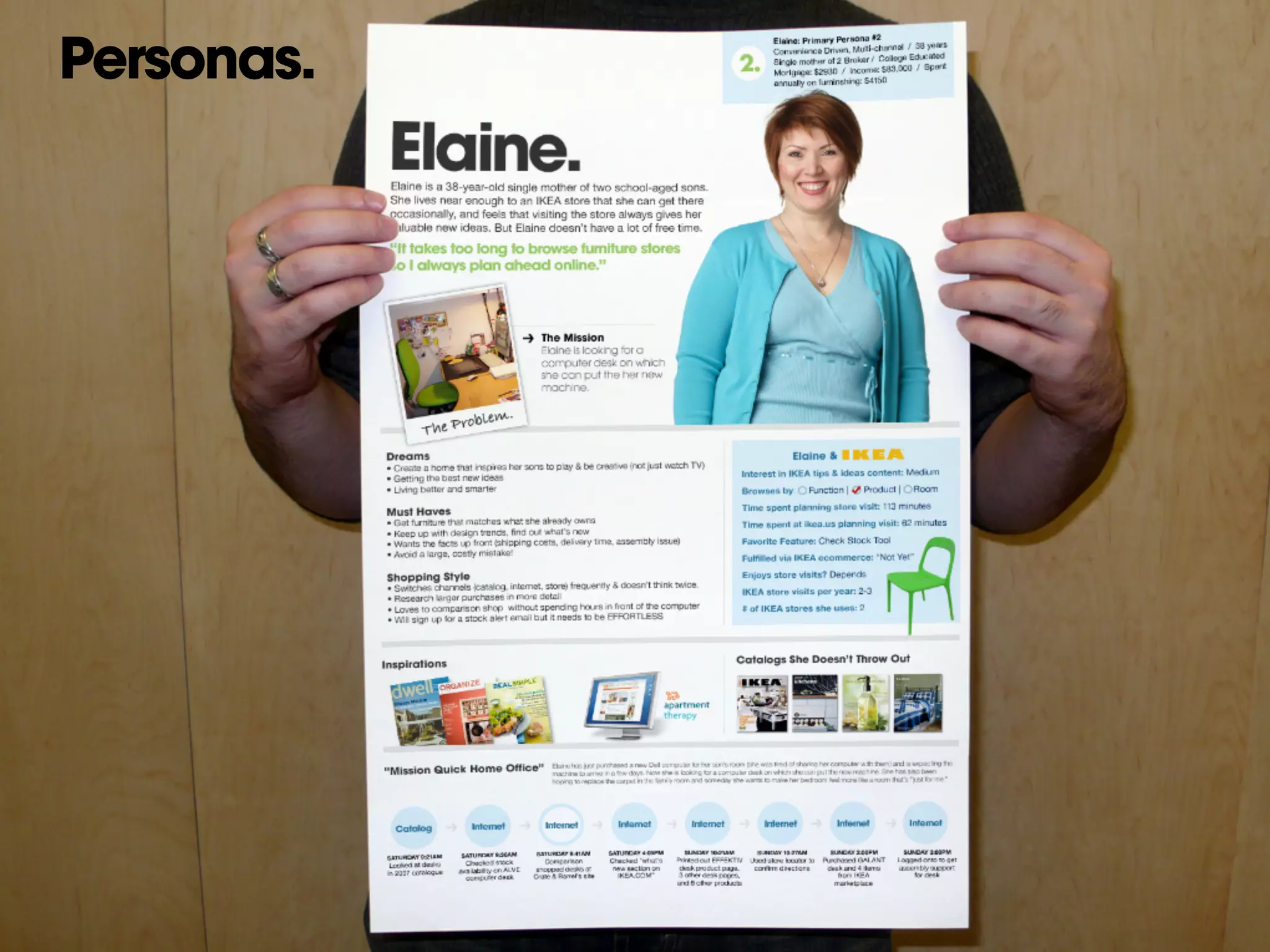
Personas.
Key Principles
1. Know your audience.
2. Know yourself.
3. Know the competition.
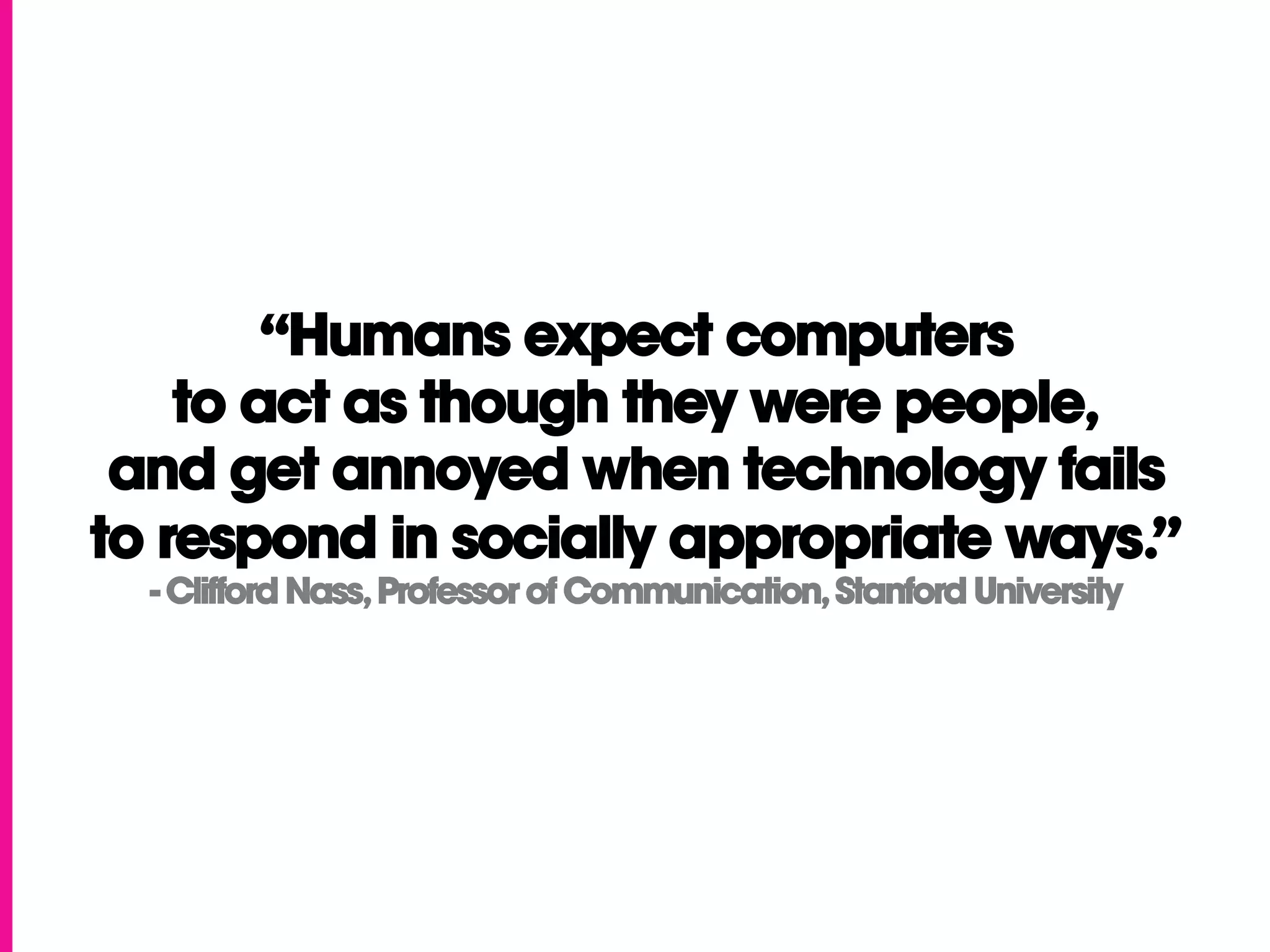
“Humans expect computers
    to act as though they were people,
 and get annoyed when technology fails
to respond in socially appropriate ways.”
  - Clifford Nass, Professor of Communication, Stanford University
“Are you a real person?”
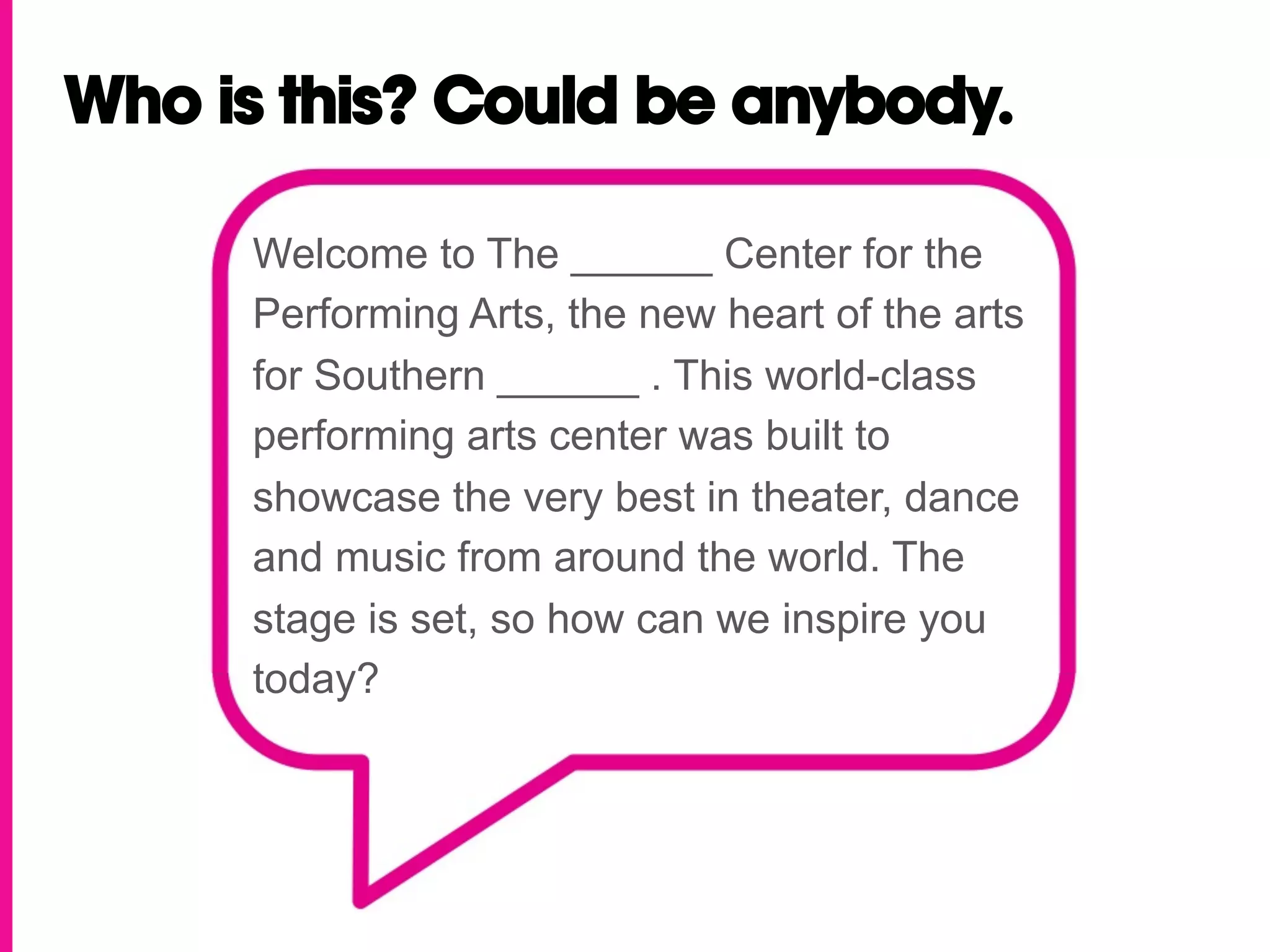
Who is this? Could be anybody.

     Welcome to The ______ Center for the
     Performing Arts, the new heart of the arts
     for Southern ______ . This world-class
     performing arts center was built to
     showcase the very best in theater, dance
     and music from around the world. The
     stage is set, so how can we inspire you
     today?
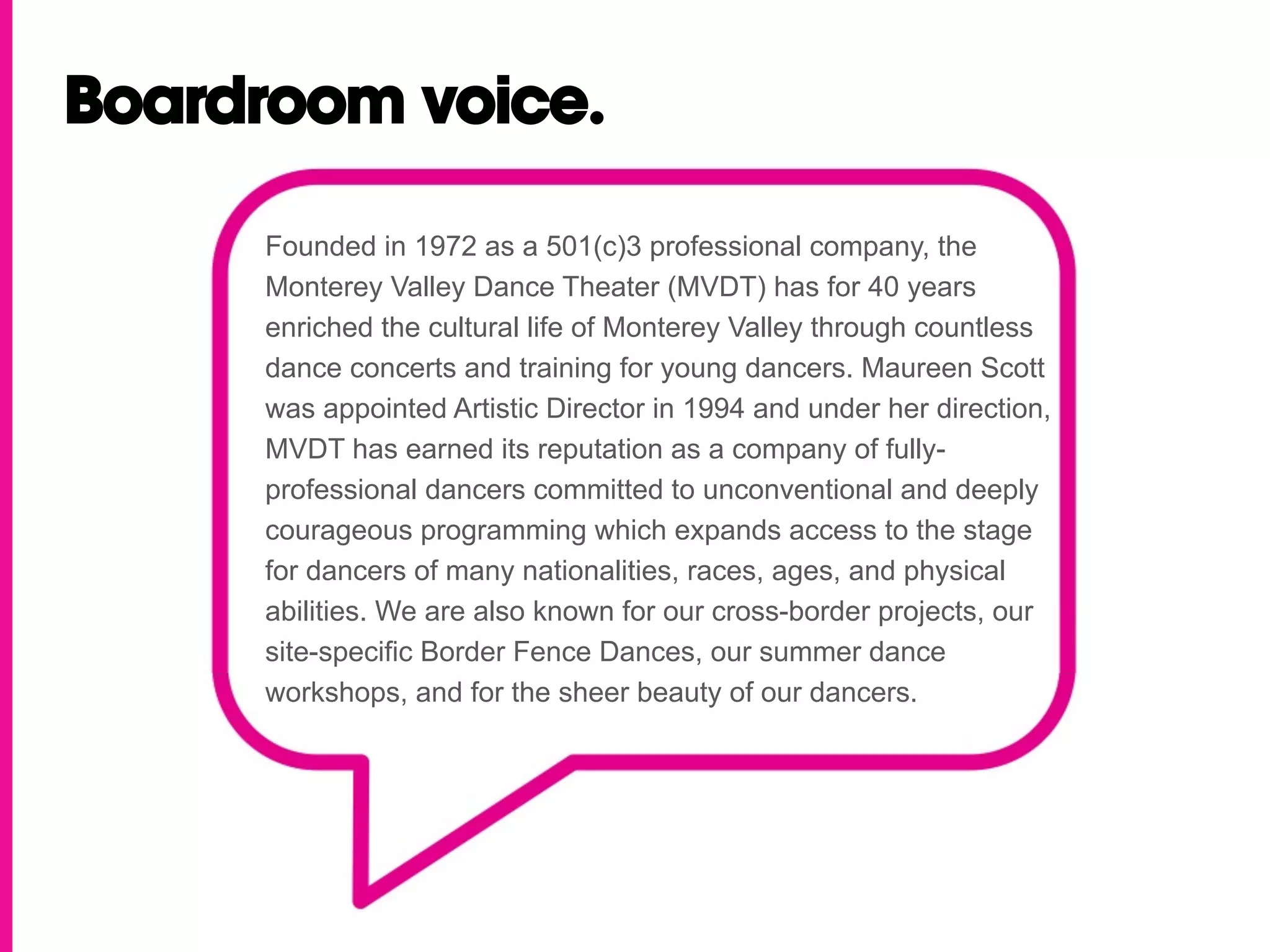
Boardroom voice.

     Founded in 1972 as a 501(c)3 professional company, the
     Monterey Valley Dance Theater (MVDT) has for 40 years
     enriched the cultural life of Monterey Valley through countless
     dance concerts and training for young dancers. Maureen Scott
     was appointed Artistic Director in 1994 and under her direction,
     MVDT has earned its reputation as a company of fully-
     professional dancers committed to unconventional and deeply
     courageous programming which expands access to the stage
     for dancers of many nationalities, races, ages, and physical
     abilities. We are also known for our cross-border projects, our
     site-specific Border Fence Dances, our summer dance
     workshops, and for the sheer beauty of our dancers.
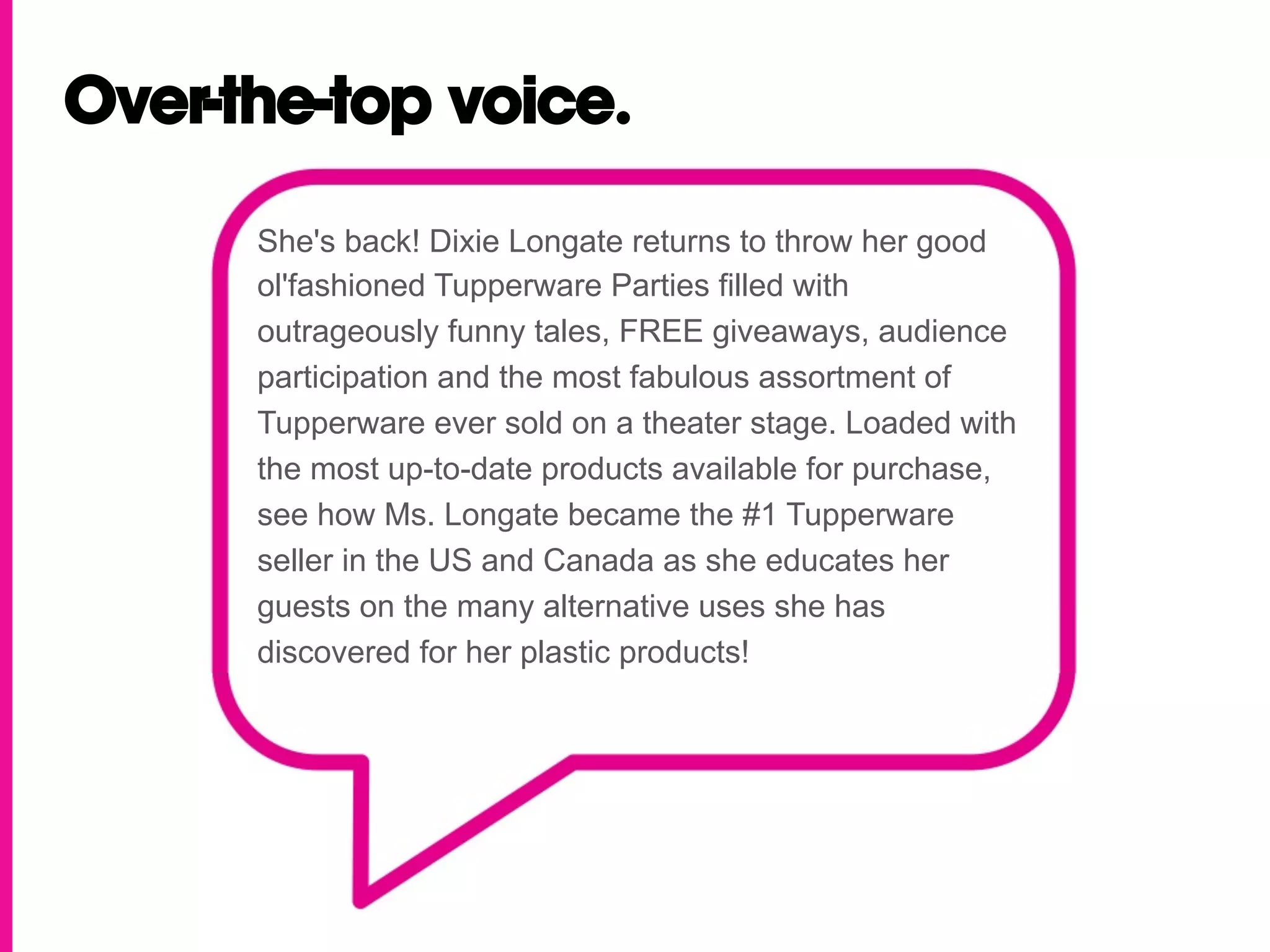
Over-the-top voice.

      She's back! Dixie Longate returns to throw her good
      ol'fashioned Tupperware Parties filled with
      outrageously funny tales, FREE giveaways, audience
      participation and the most fabulous assortment of
      Tupperware ever sold on a theater stage. Loaded with
      the most up-to-date products available for purchase,
      see how Ms. Longate became the #1 Tupperware
      seller in the US and Canada as she educates her
      guests on the many alternative uses she has
      discovered for her plastic products!
There is no perfect model.
    Use your own voice, but in
language your audience actually
  uses — avoid your own jargon.
Be the person I want to know.
•  The friend with great taste who is always in the know


•  The curator who deftly articulates an artist’s unique vision


•  The concierge who can direct you to experiences that match
   your interests


•  The performer or artist who cares about sharing the works of
   other artists


•  The outsider who knows all the insider gossip, and dishes
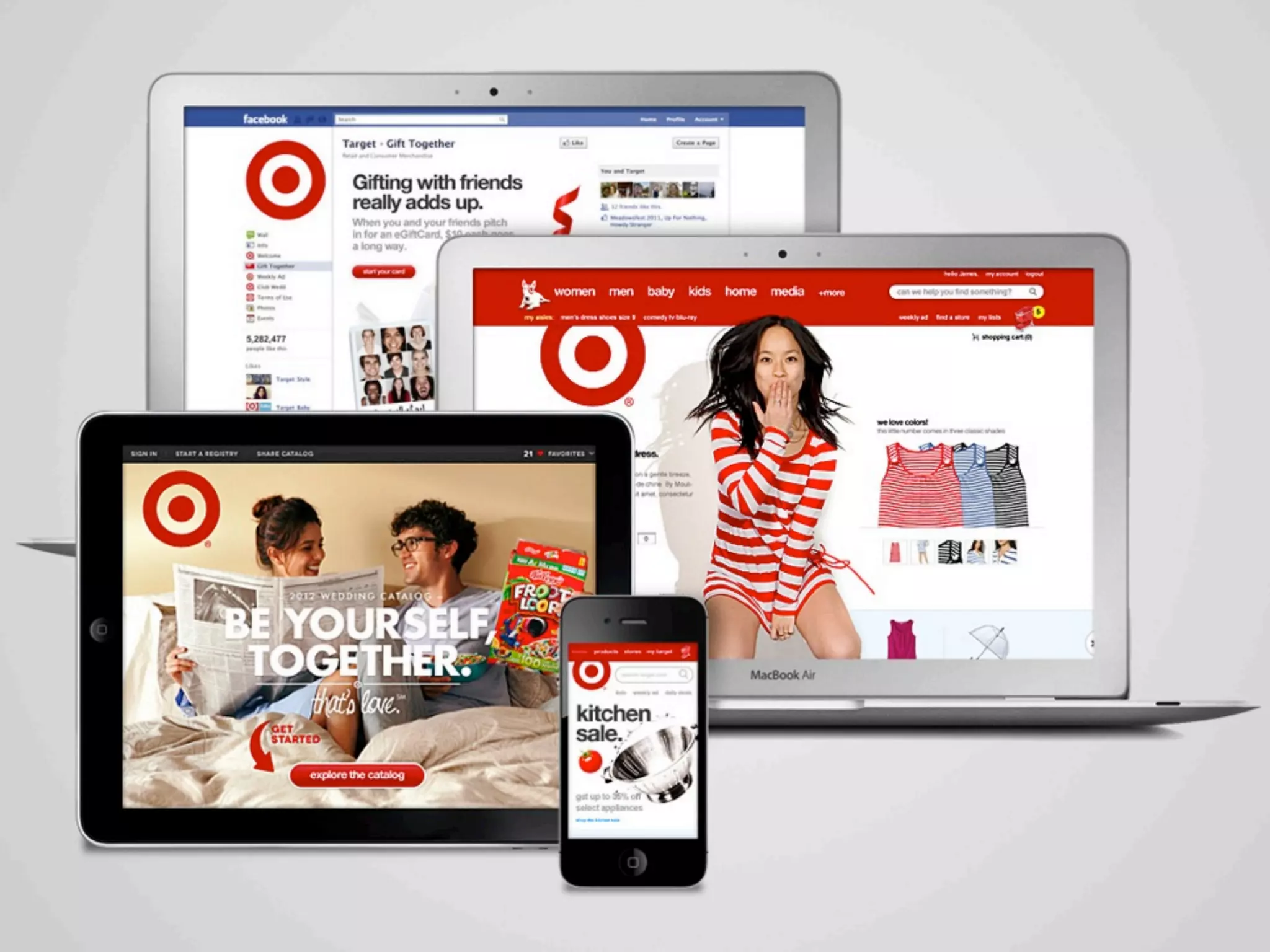
Re-write in your own voice.
Target sells nearly 1 million products. The descriptions of
these products are delivered by the manufacturers –
thousands of different brands, each with their own voice.


Thousands of new products are being added every month.


We designed a publishing workflow that helped Target bring
these products “on-brand.”


Start with the top priorities – pick the top 10%.
Key Principles
1. Know your audience.
2. Know yourself.
3. Know the competition.
You have 3 kinds of competitors.
•  Our audience’s other interests


•  Demands on our audience’s time


•  Claims for our audience’s attention
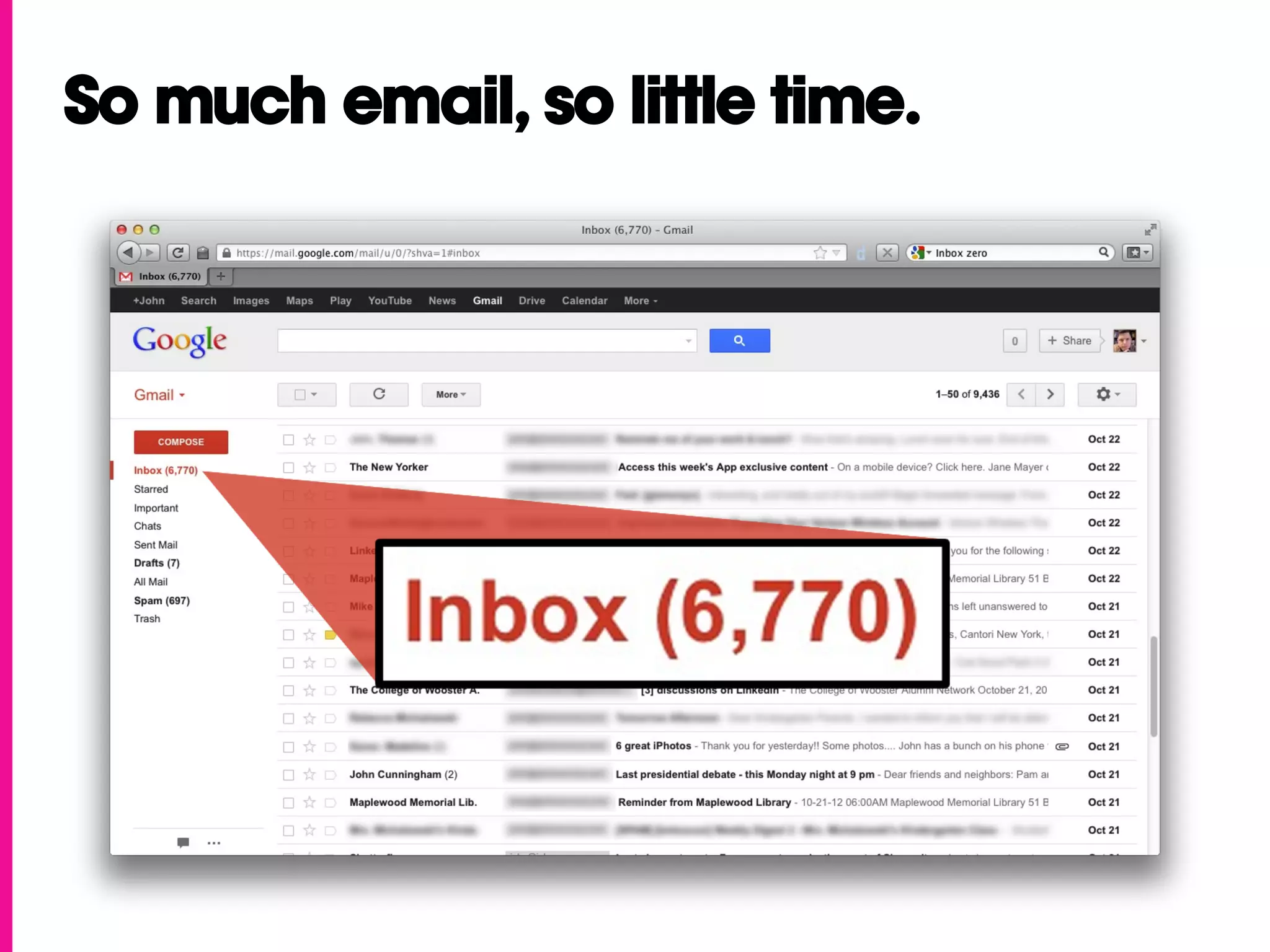
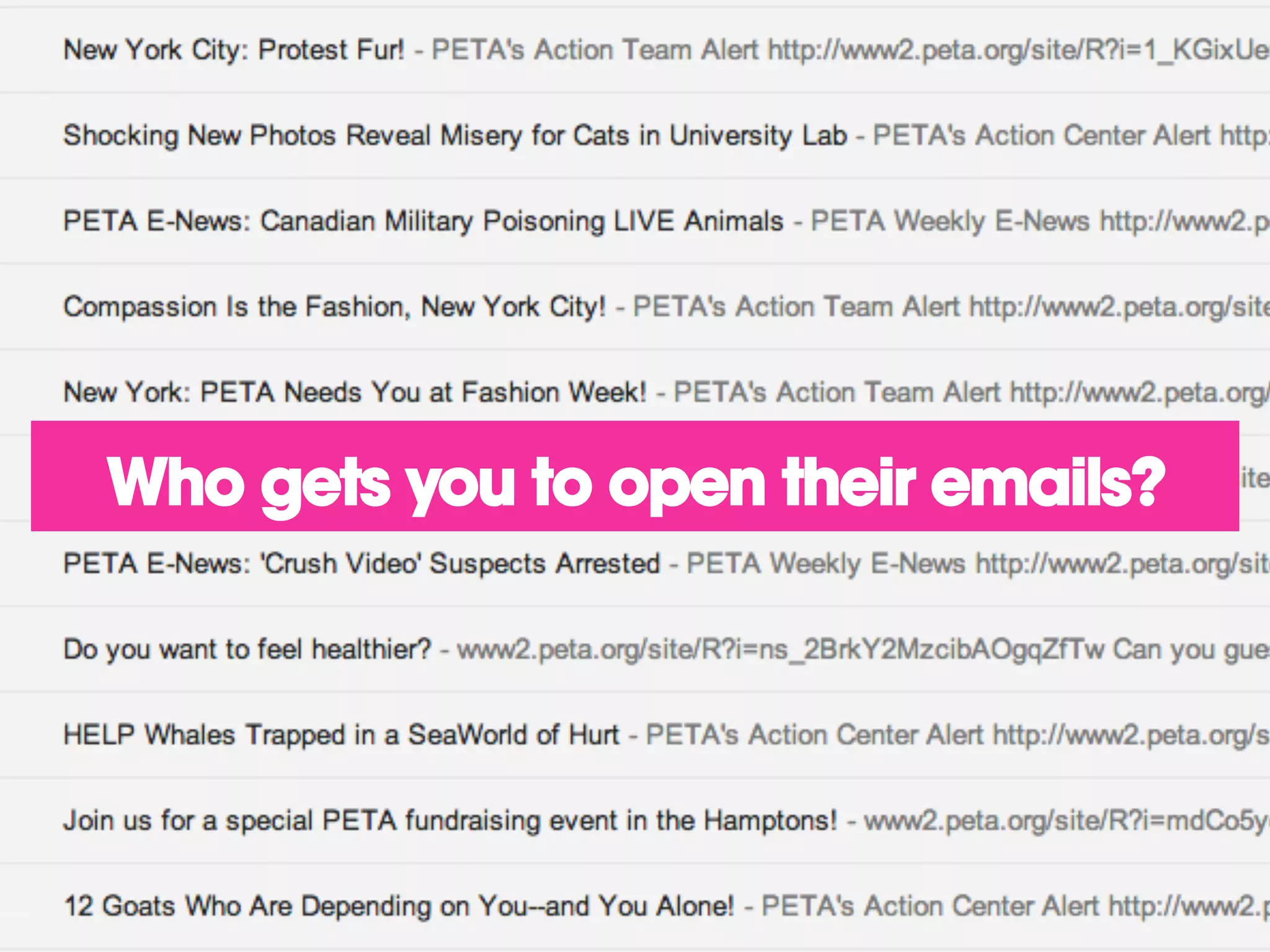
So much email, so little time.
Who gets you to open their emails?


 Who gets you to open their emails?
Do: make me care.

Don’t: tell me how to feel.
10 ideas to start
working with
today.
1.
Find your voice.
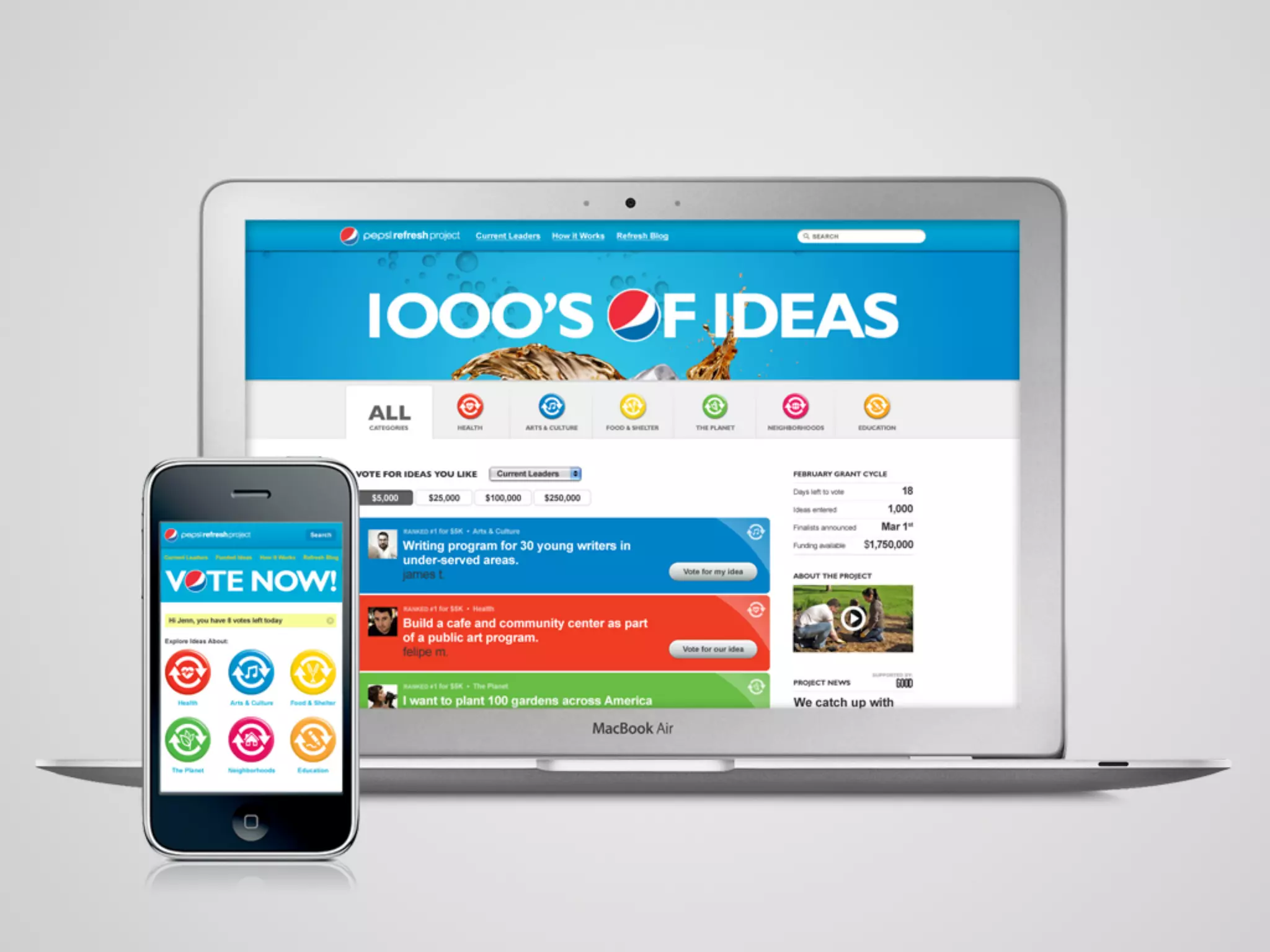
How do you market to members?
“World-class service is our brand.”
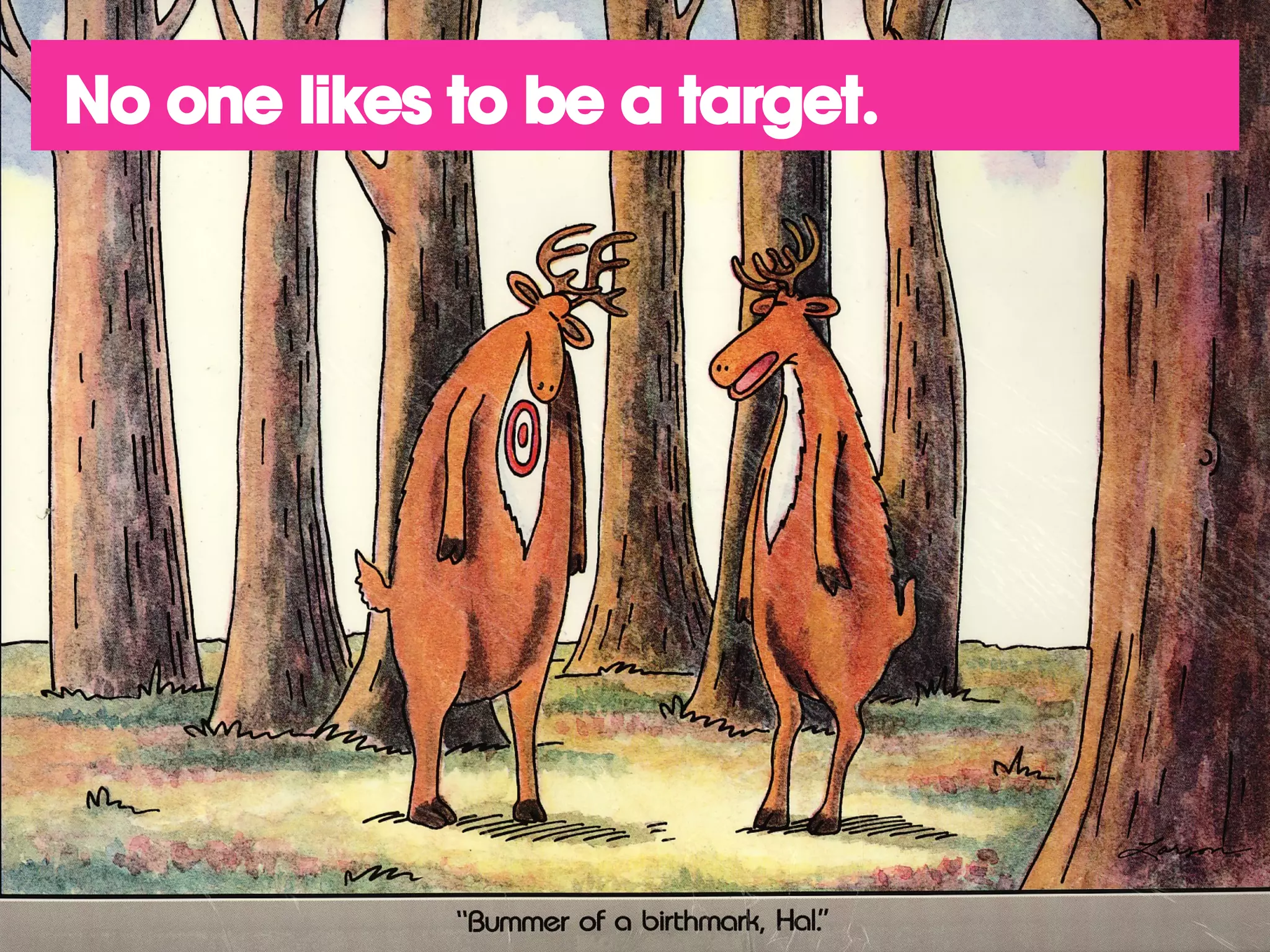
No one likes to be a target.
Stop marketing and start helping.
•  Create an editorial style guide:
     — Audience personas
     — Voice, the personality we speak from
     — Tone, the feelings and values we convey
     — Value proposition, the unique promise we make that
        differentiates us from others


•  Structure your message: a single core message, and
   supporting messages for different offerings or different
   audiences.
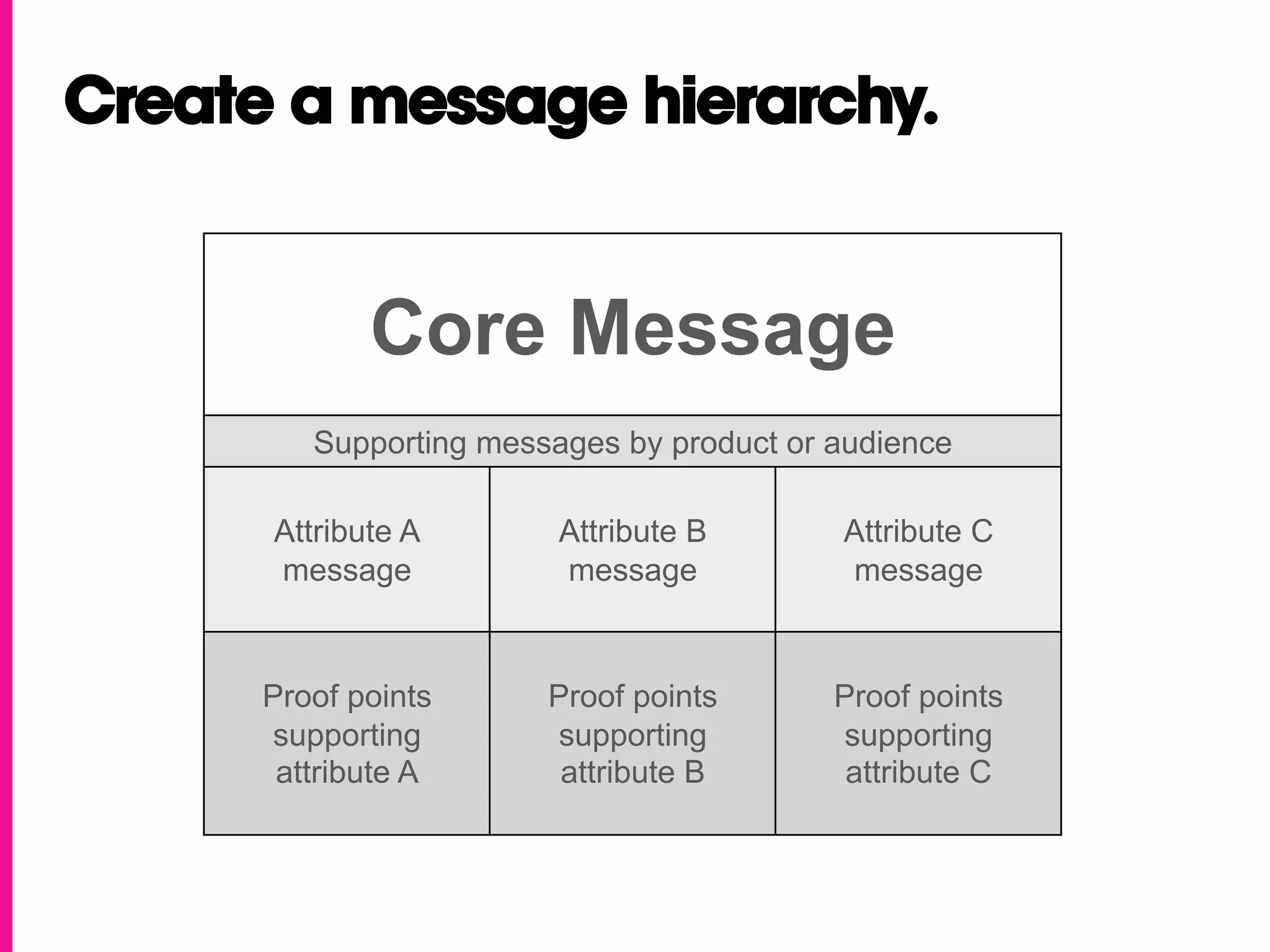
Create a message hierarchy.


                  Core Message
    	
  
              Supporting messages by product or audience

           Attribute A        Attribute B       Attribute C
           message            message           message


           Proof points      Proof points       Proof points
           supporting        supporting         supporting
            attribute A       attribute B        attribute C
2.
The same rules of good writing
         still apply.
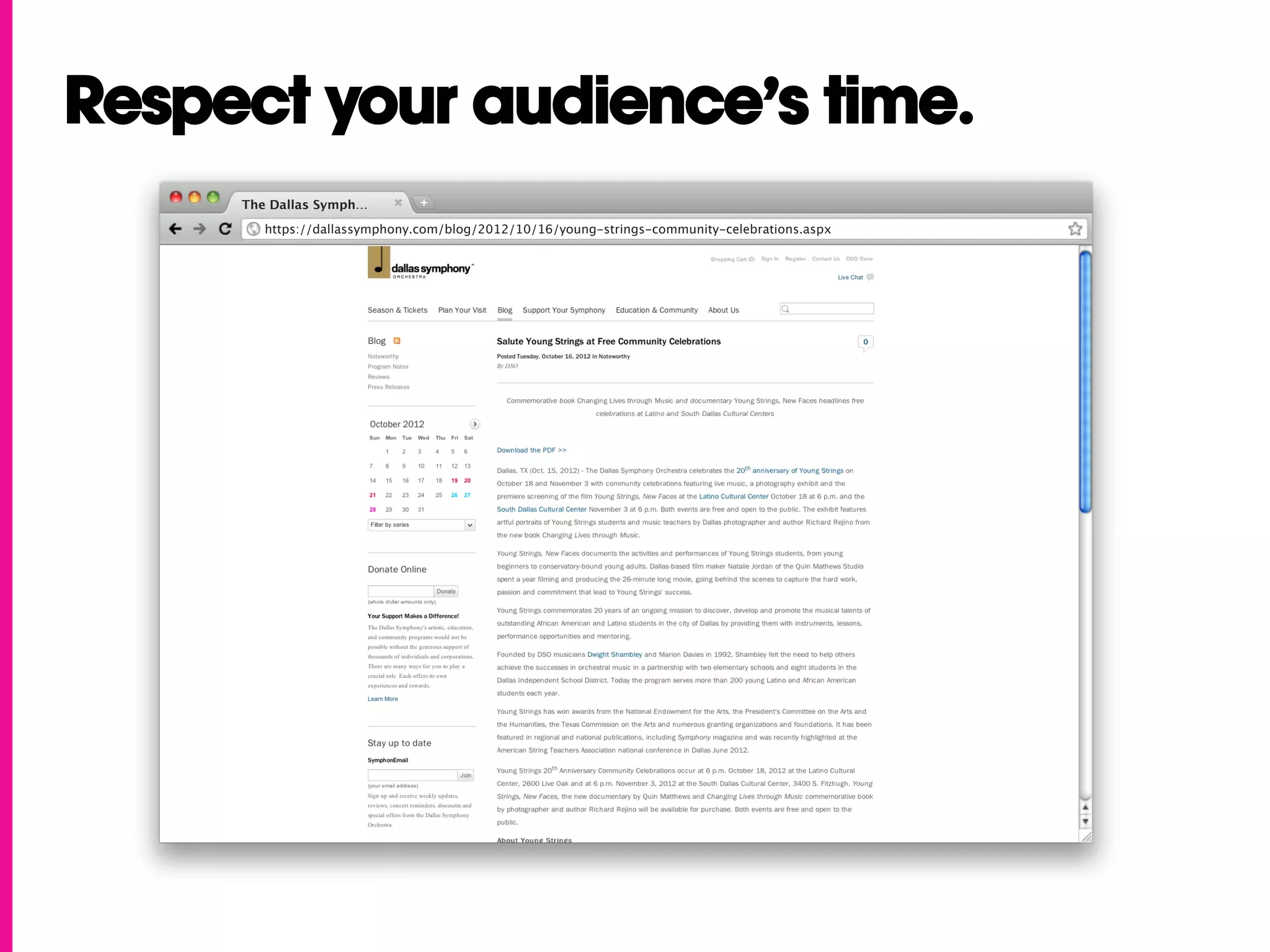
Respect your audience’s time.
     The Dallas Symph…
        https://dallassymphony.com/blog/2012/10/16/young-strings-community-celebrations.aspx
Help the reader scan the page.
•  Write in tight chunks: one idea per paragraph.


•  Break up blocks of copy with headings and subheadings


•  Write meaningful headings, not clever or cute ones


•  Use bullets to highlight key details
Remember the essentials.
•  Be direct. Use active voice: When we make the performer of
   the action the subject of a sentence, we build up energy in our
   writing.

•  Write short, declarative sentences. Avoid parenthetical
   explanation.

•  Omit needless words.

•  Describe what things are, not what they aren’t.

•  Stick to one tense.
Be punchy.
•  Favor short words. They hit us in the gut.


•  Multisyllabic words tend towards the abstract, requiring
   our brains to interpret them to understand your meaning.


•  Etymology trick: replace Latinate words when a simpler
   Germanic word will do.
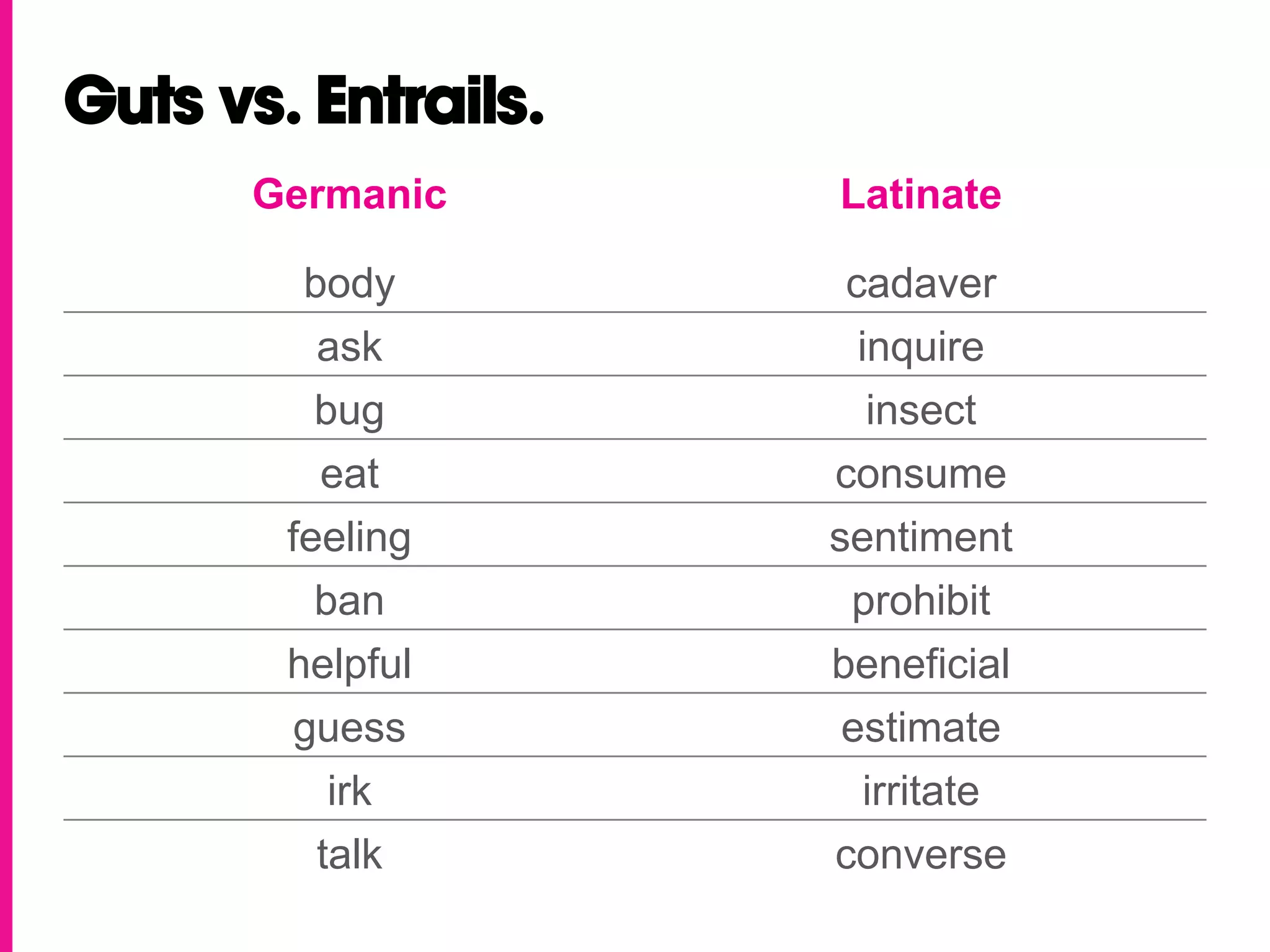
Guts vs. Entrails.
       Germanic      Latinate

         body         cadaver
          ask          inquire
          bug           insect
          eat        consume
        feeling      sentiment
          ban         prohibit
        helpful      beneficial
         guess        estimate
           irk          irritate
         talk        converse
3.
Write for humans.
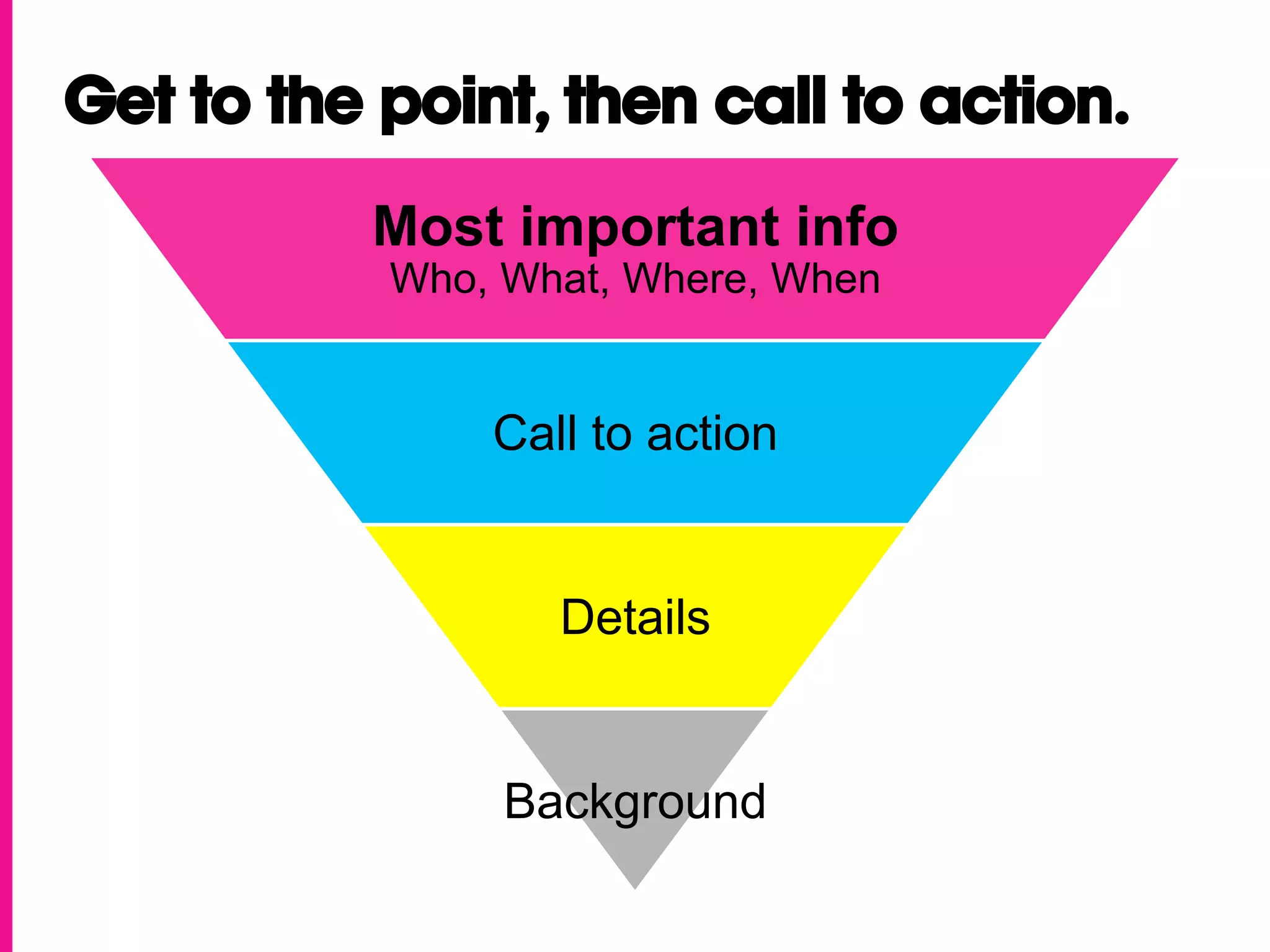
Get to the point, then call to action.
          Most important info
           Who, What, Where, When


               Call to action


                  Details


                Background
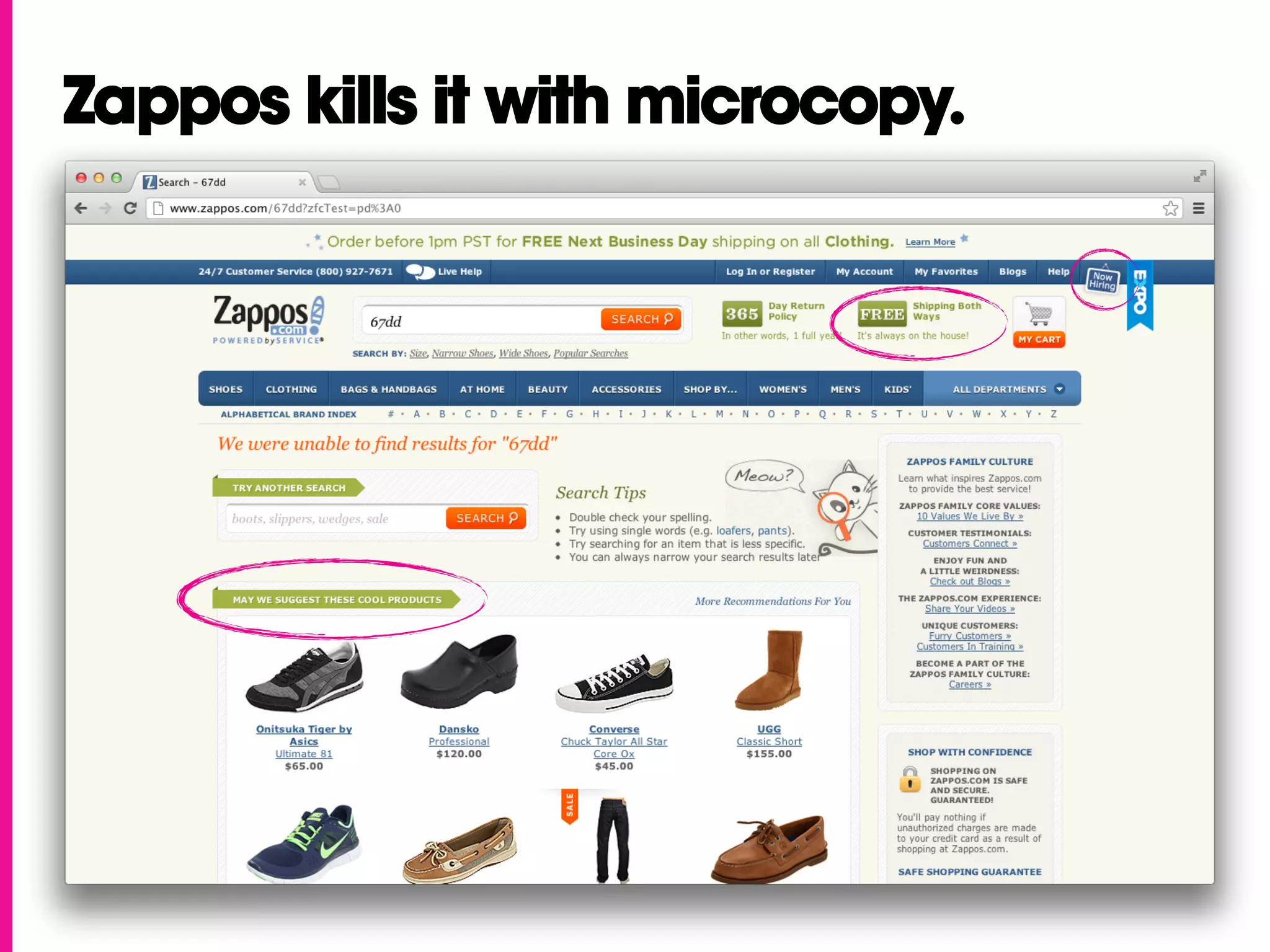
Zappos kills it with microcopy.
Write microcopy calls to action
  for people, not machines.
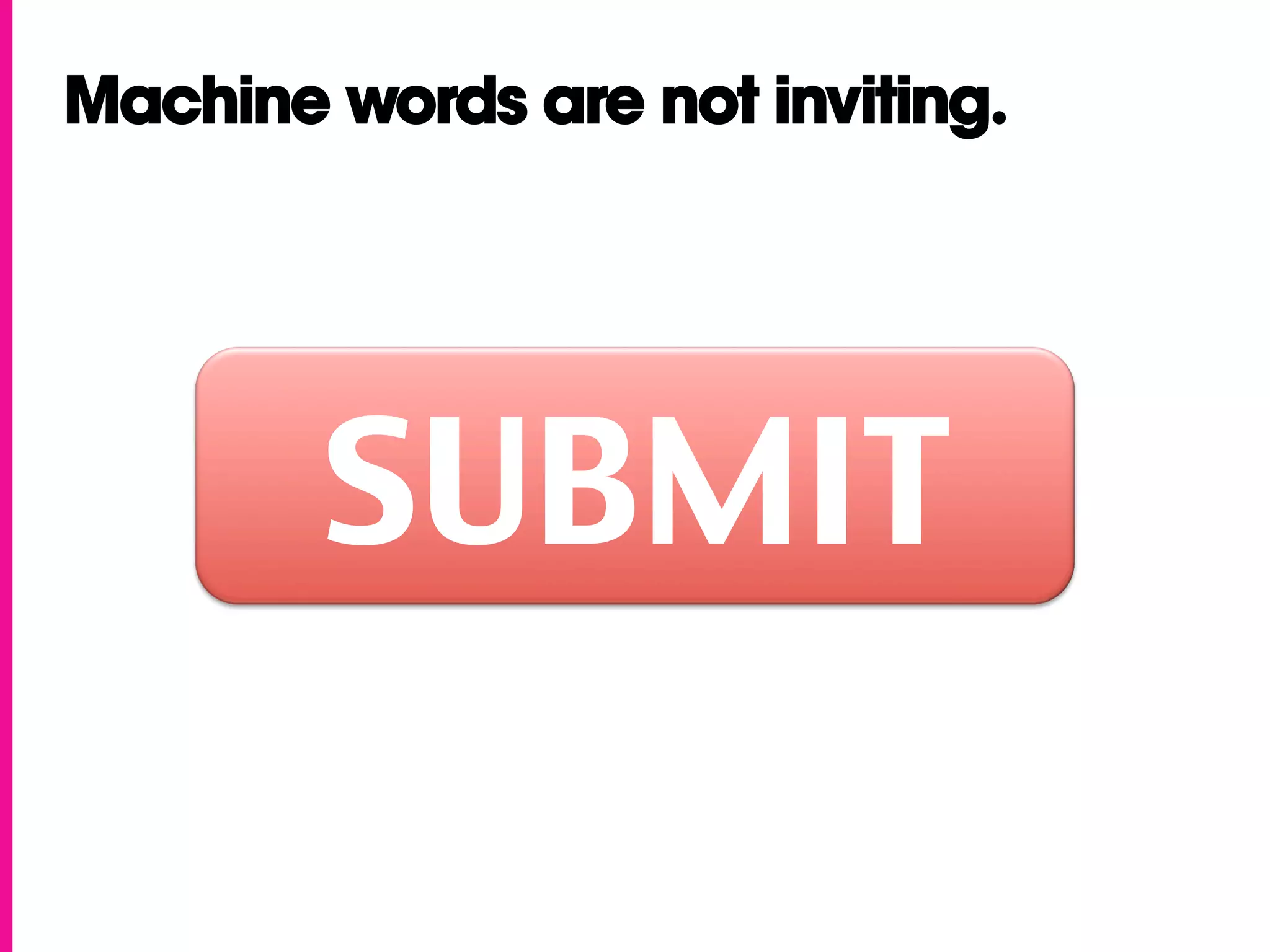
Machine words are not inviting.


        SUBMIT
Human language has verve.


      LET’S GO
4.
But, also write for robots.
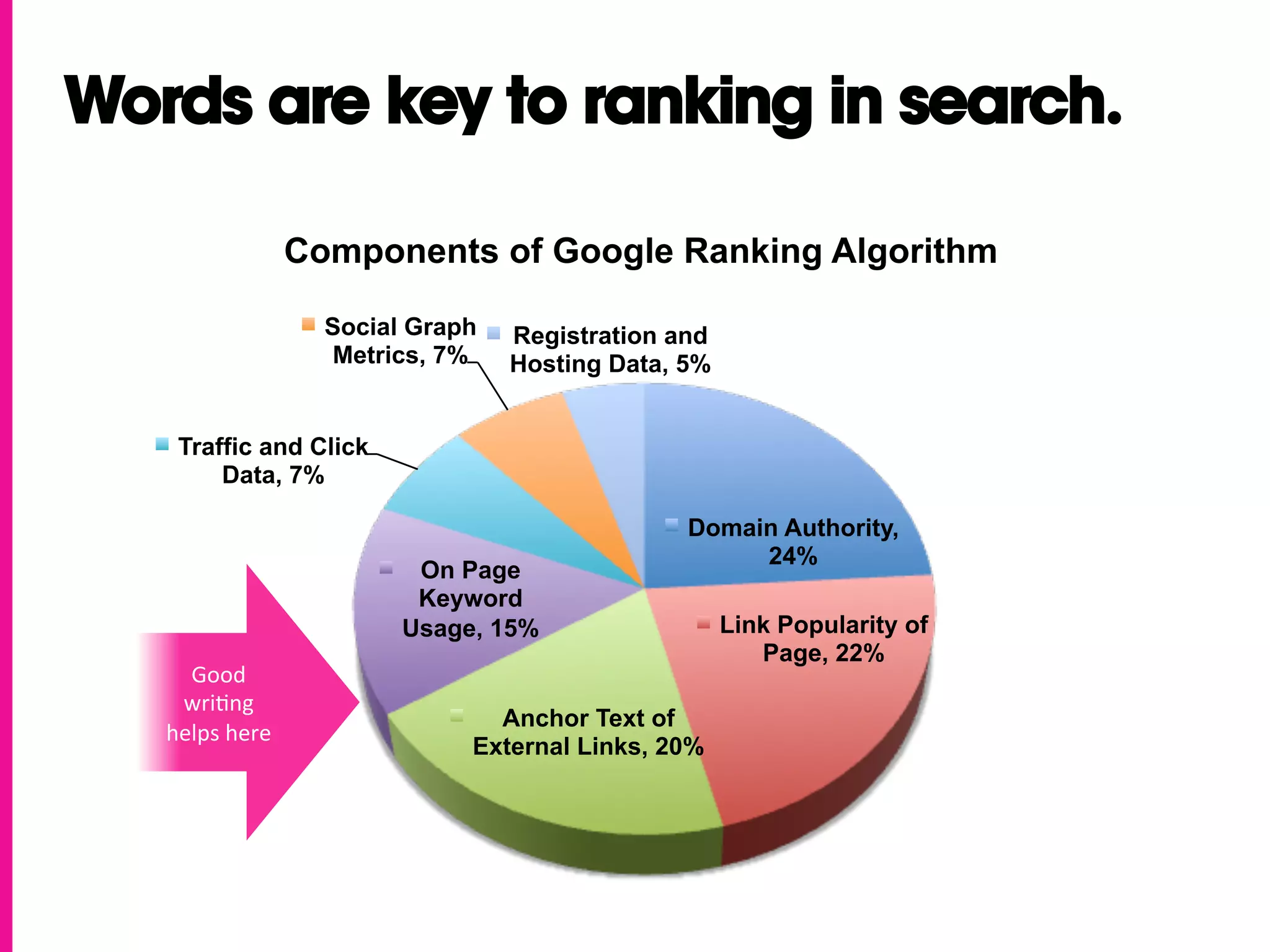
Words are key to ranking in search.

                       Components of Google Ranking Algorithm

                         Social Graph   Registration and
                         Metrics, 7%    Hosting Data, 5%


    Traffic and Click
        Data, 7%

                                                      Domain Authority,
                                                           24%
                                On Page
                                Keyword
                               Usage, 15%                  Link Popularity of
                                                              Page, 22%
     Good	
  	
  
    wri(ng	
  	
  
                                      Anchor Text of
   helps	
  here	
  
                                    External Links, 20%
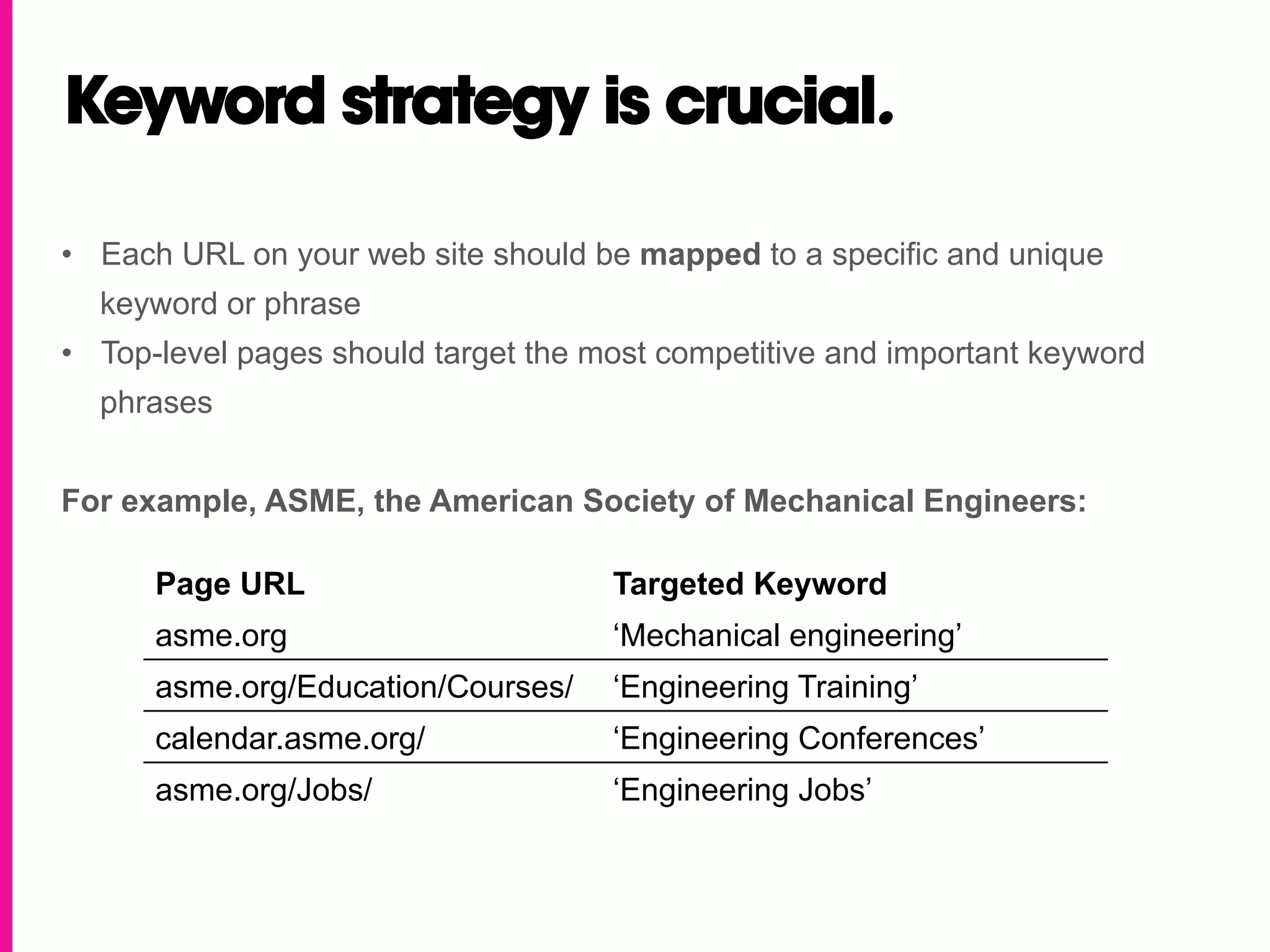
Keyword strategy is crucial.

•  Each URL on your web site should be mapped to a specific and unique
  keyword or phrase
•  Top-level pages should target the most competitive and important keyword
  phrases


For example, ASME, the American Society of Mechanical Engineers:

      Page URL                        Targeted Keyword
      asme.org                        ‘Mechanical engineering’
      asme.org/Education/Courses/     ‘Engineering Training’
      calendar.asme.org/              ‘Engineering Conferences’
      asme.org/Jobs/                  ‘Engineering Jobs’
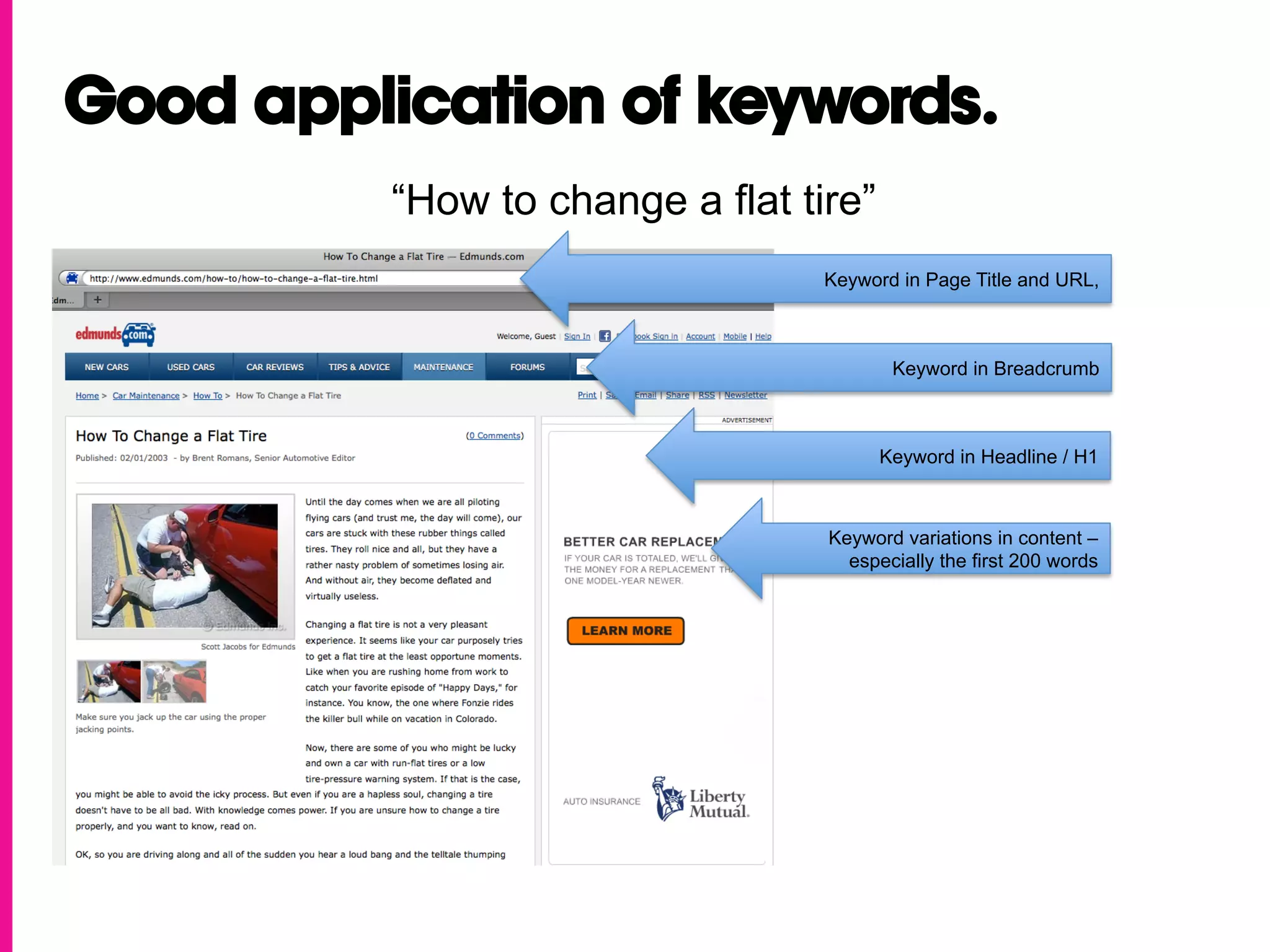
Good application of keywords.
          “How to change a flat tire”
                                  Keyword in Page Title and URL,


                                         Keyword in Breadcrumb


                                        Keyword in Headline / H1


                                  Keyword variations in content –
                                    especially the first 200 words
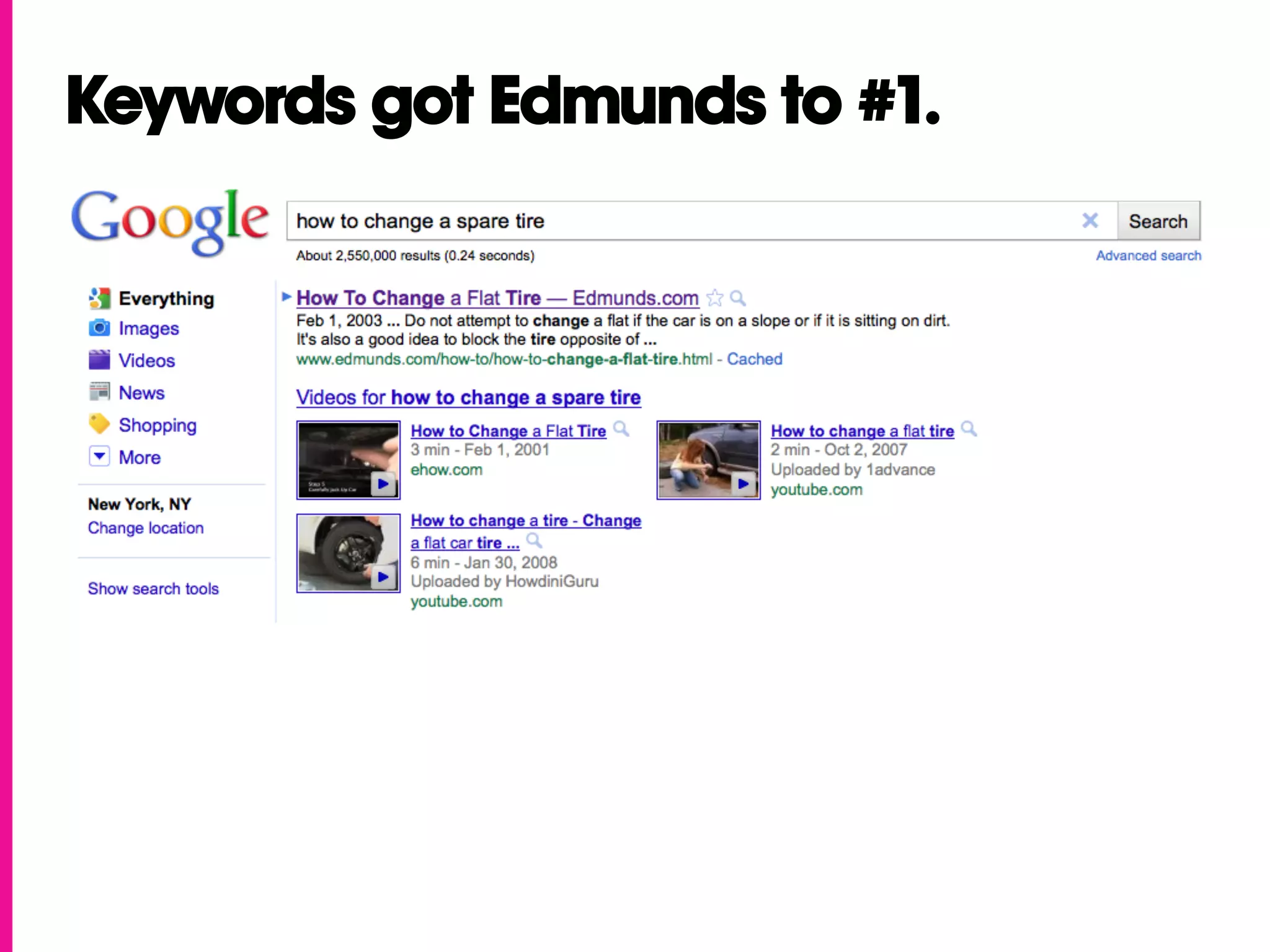
Keywords got Edmunds to #1.
5.
Write portable headlines
    and summaries.
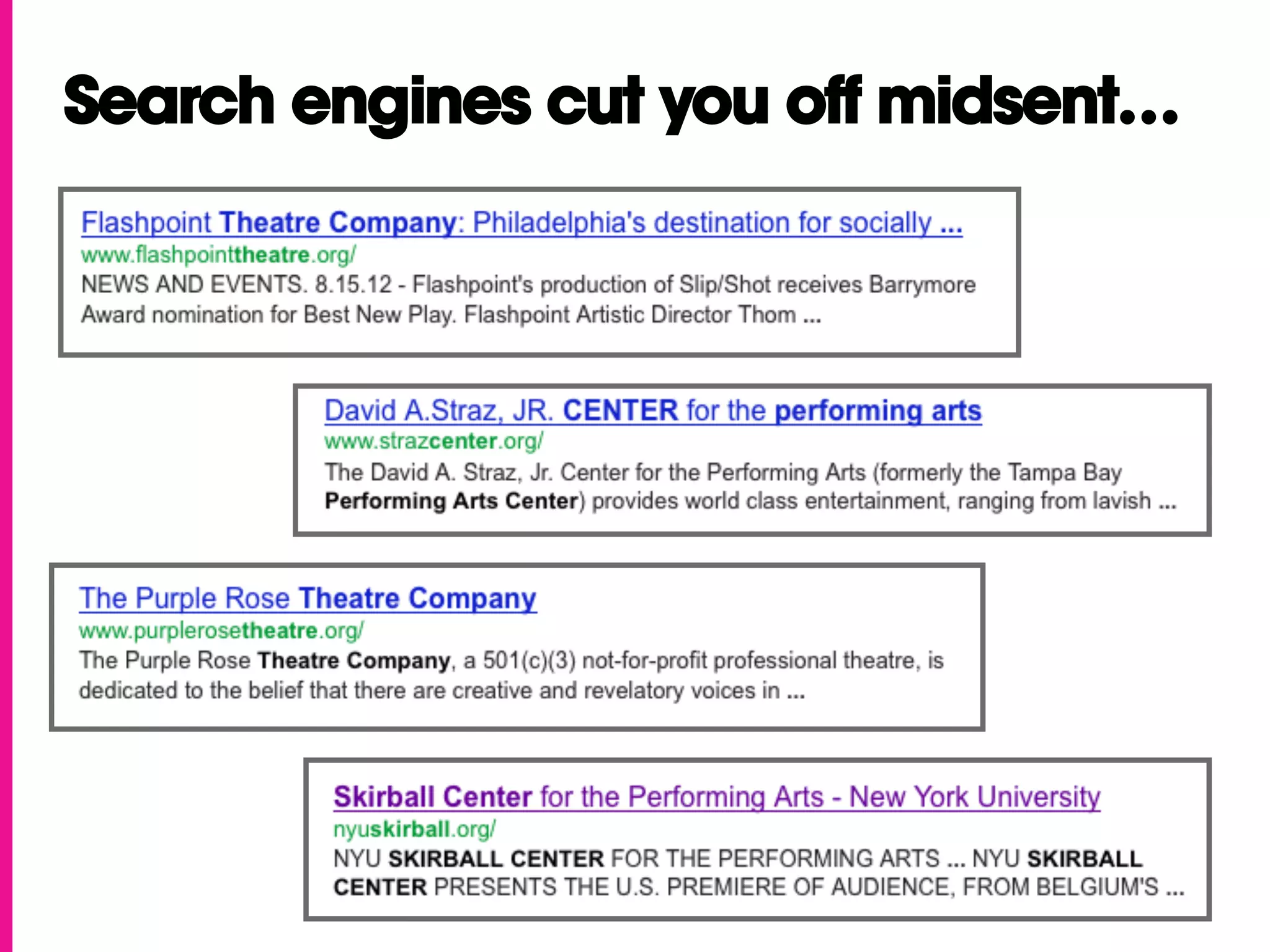
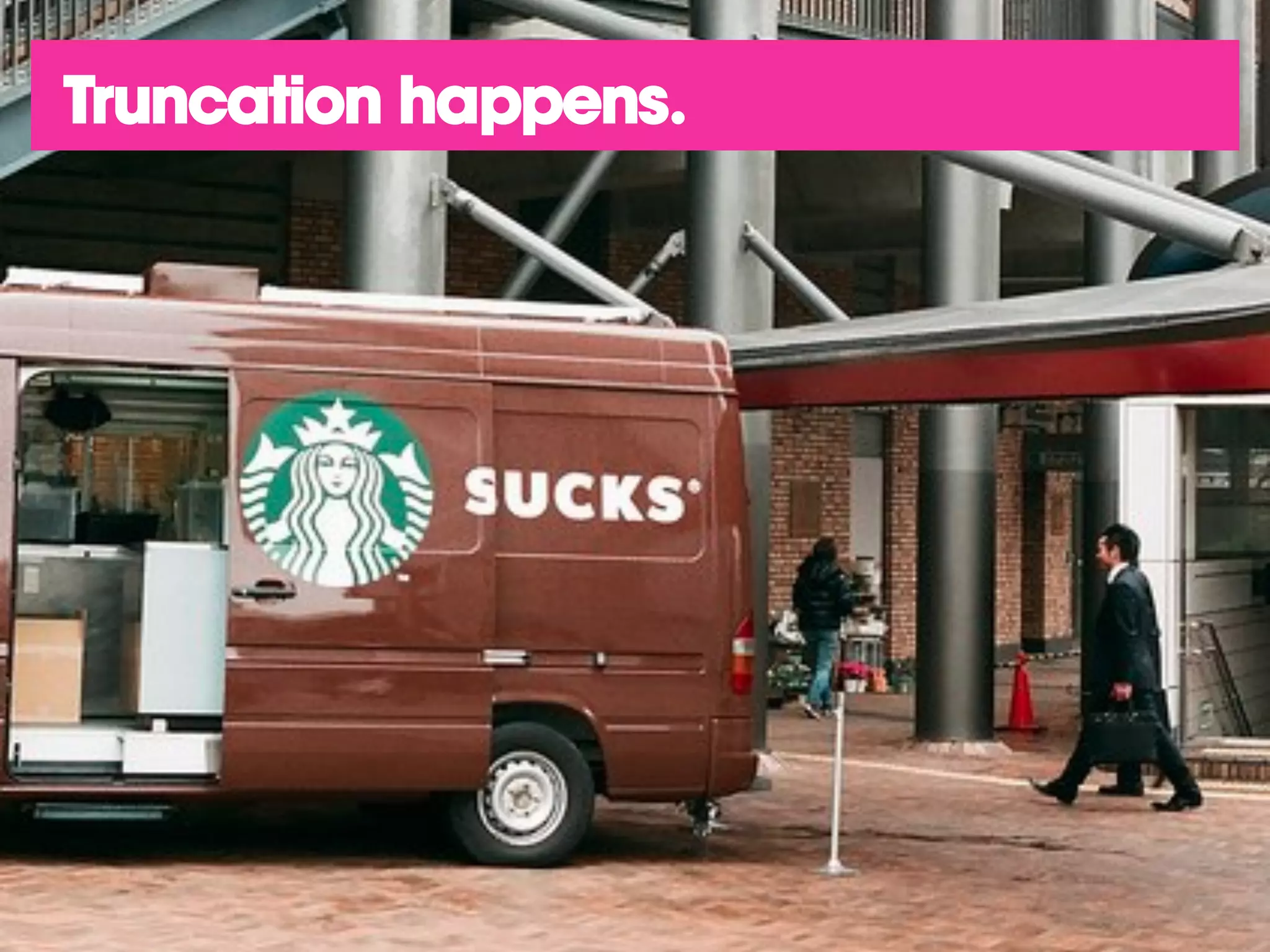
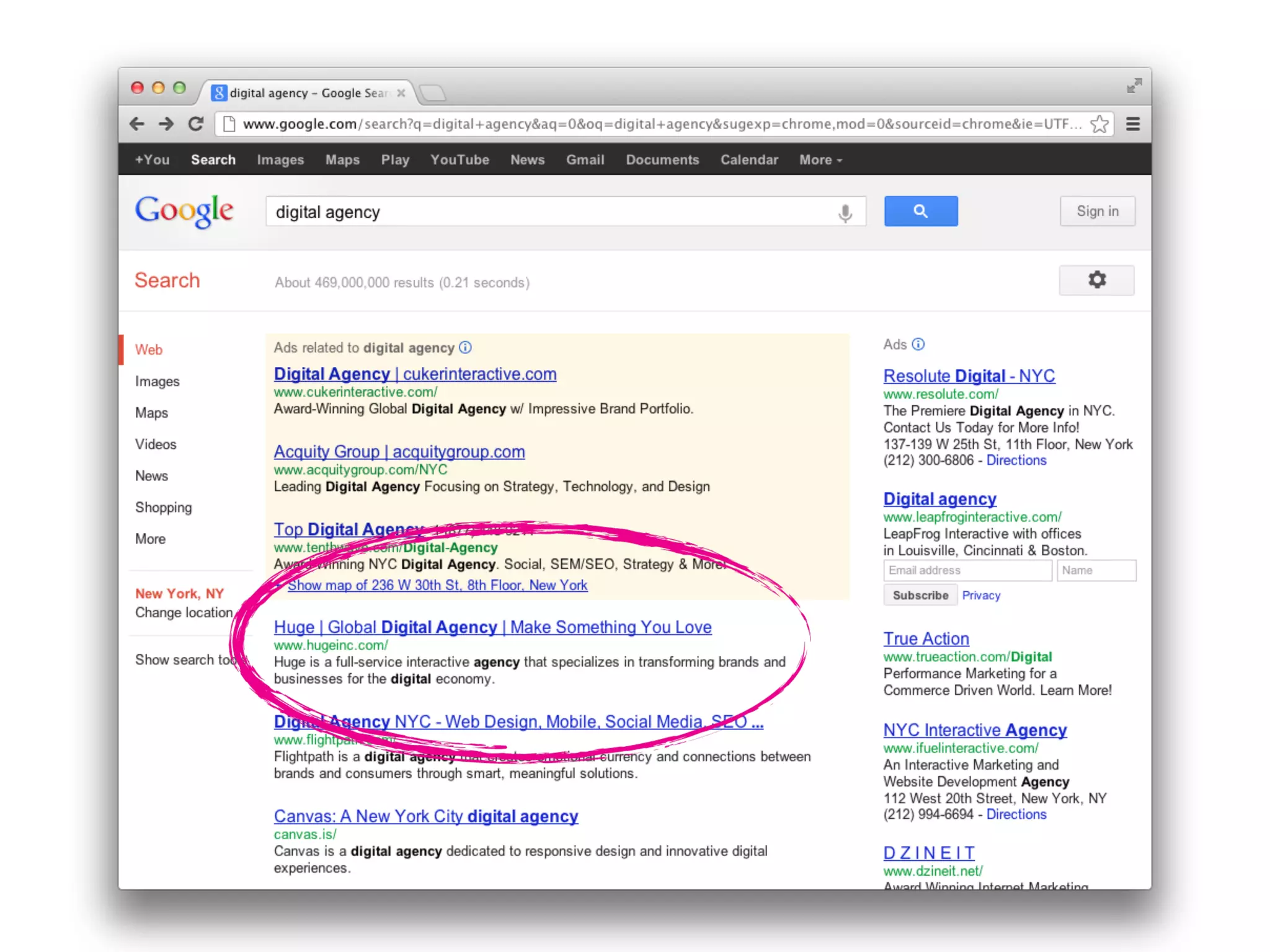
Search engines cut you off midsent…
Truncation happens.
How brief is brief?
•  For page titles and headings
   50 characters


•  Summaries and descriptions
   160 characters


•  Tweets are limited to
   140 characters


•  Allow space: don’t write up to the limit
“A line is the length
of a boulevard.”
—Derek Walcott
6.
Choose link words carefully.
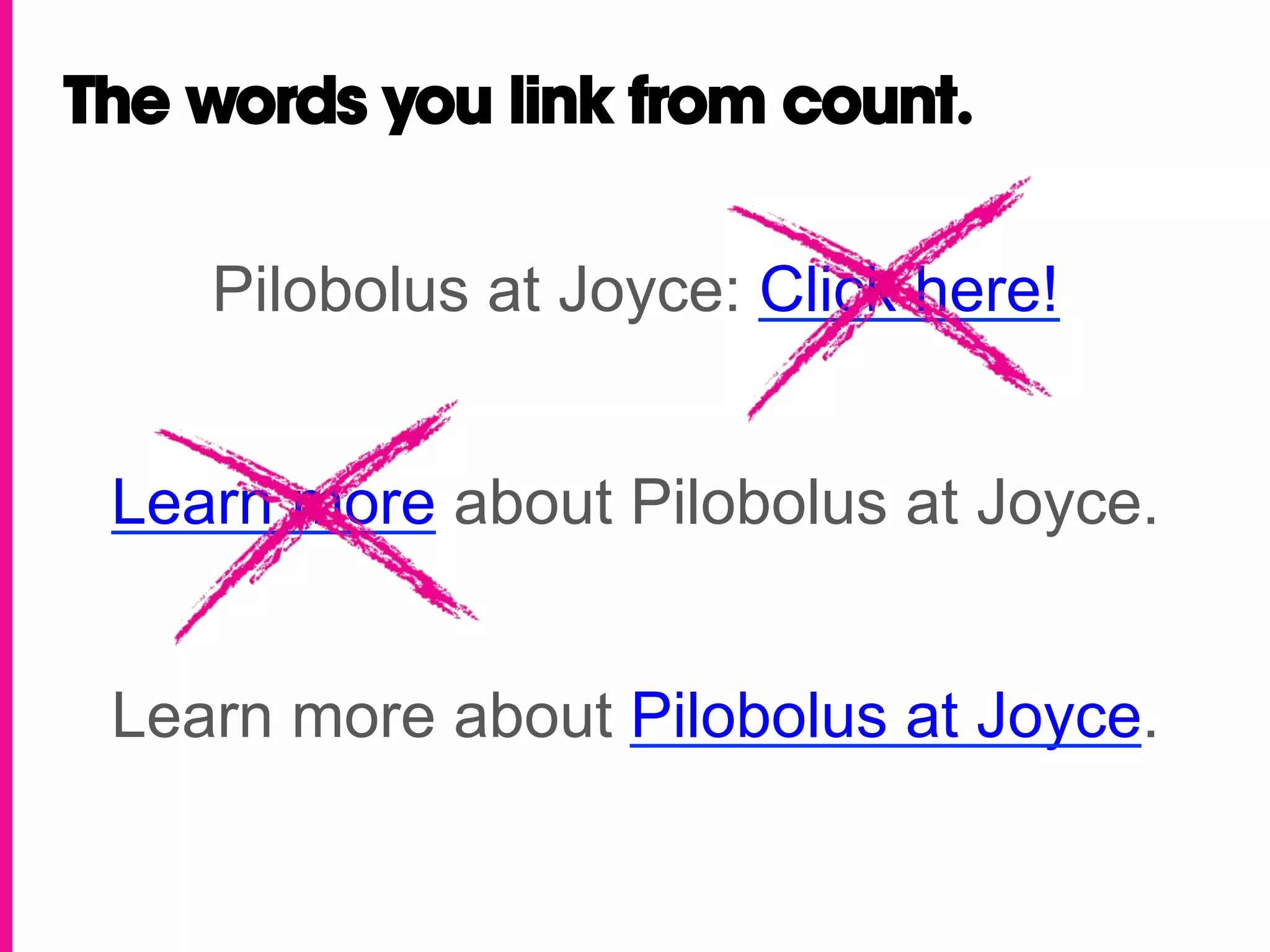
The words you link from count.

    Pilobolus at Joyce: Click here!


 Learn more about Pilobolus at Joyce.


 Learn more about Pilobolus at Joyce.
7.
Write for each stage of the
    customer journey.
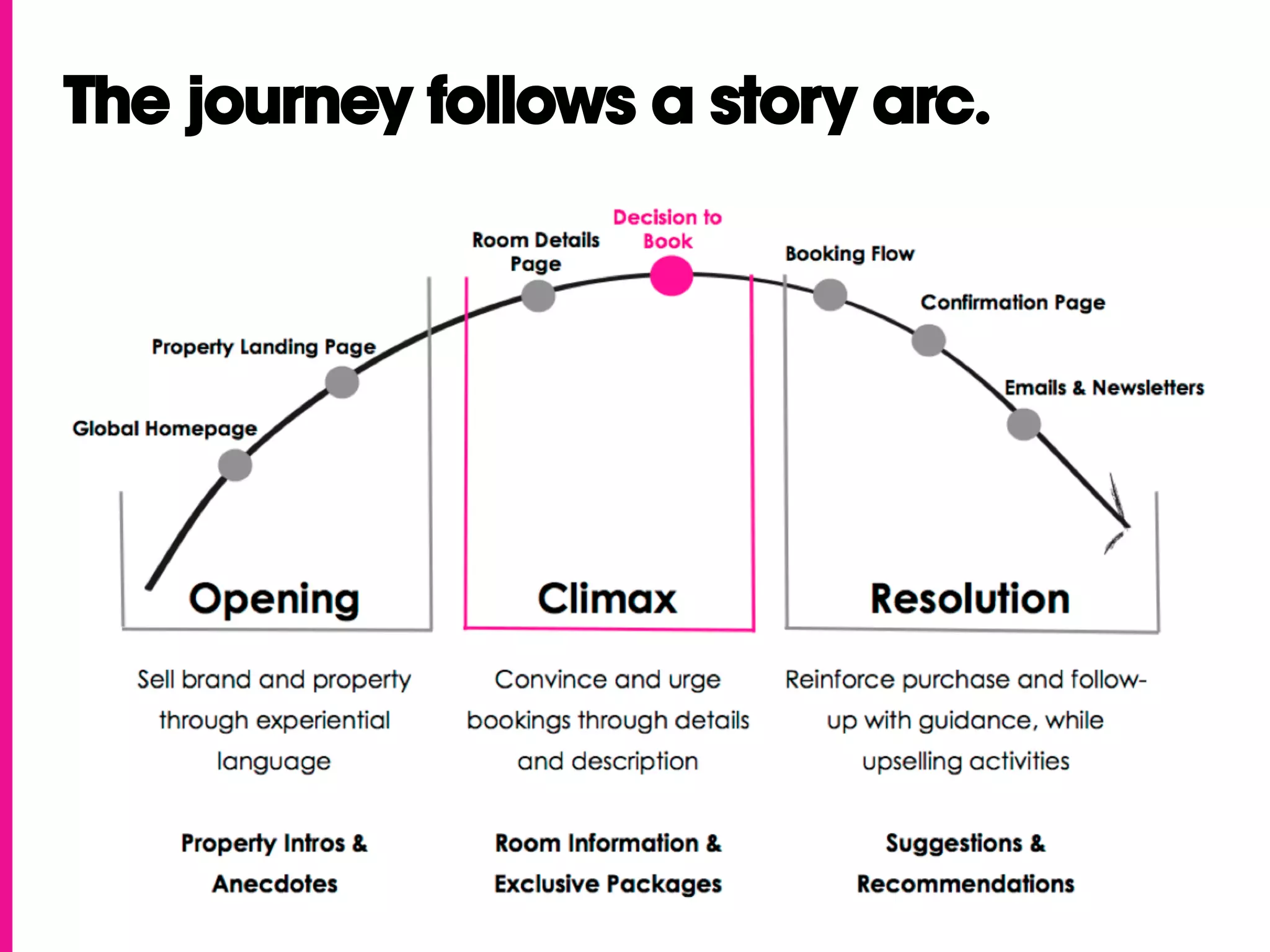
The journey follows a story arc.
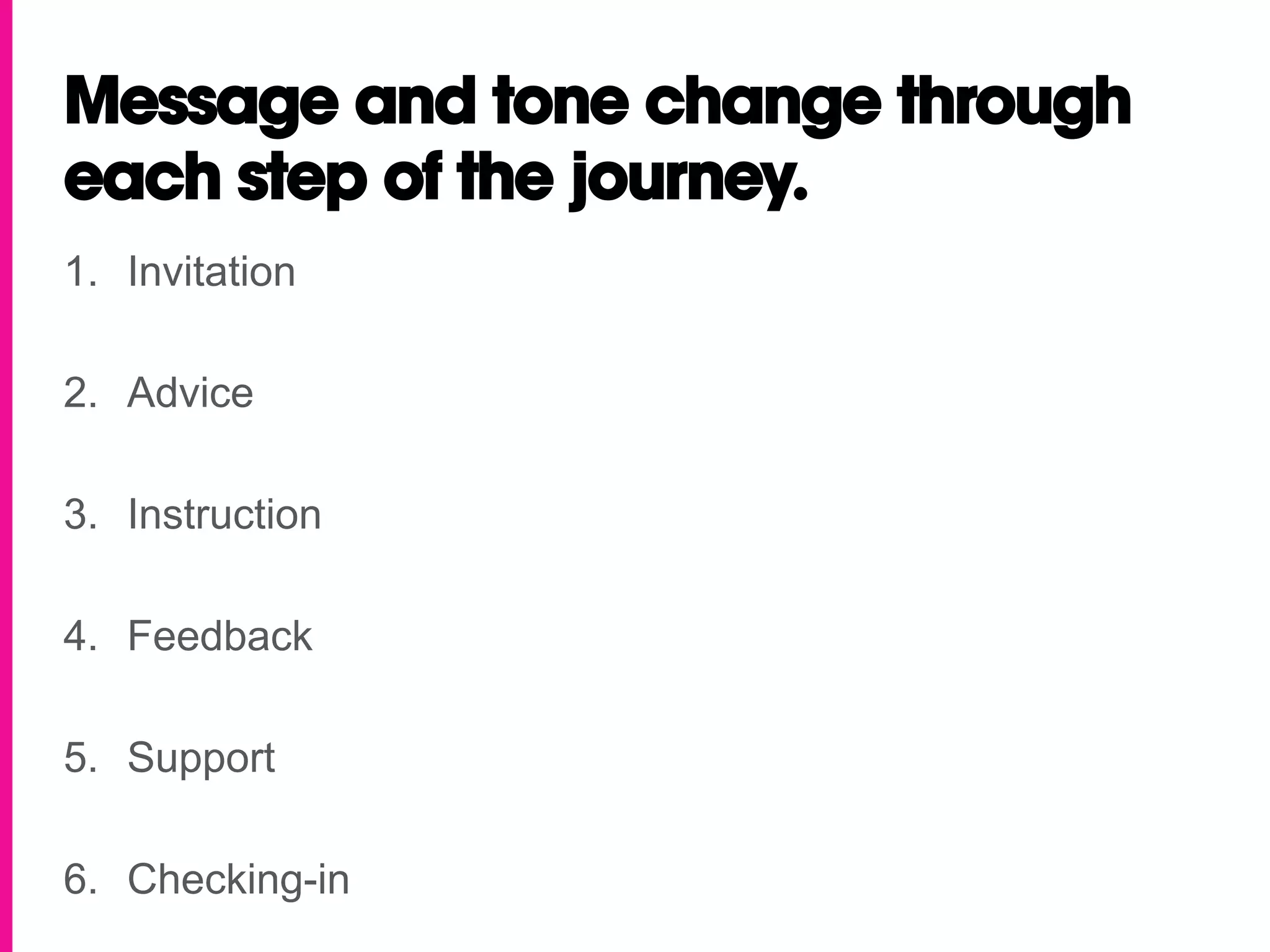
Message and tone change through
each step of the journey.
1.  Invitation

2.  Advice

3.  Instruction

4.  Feedback

5.  Support

6.  Checking-in
8.
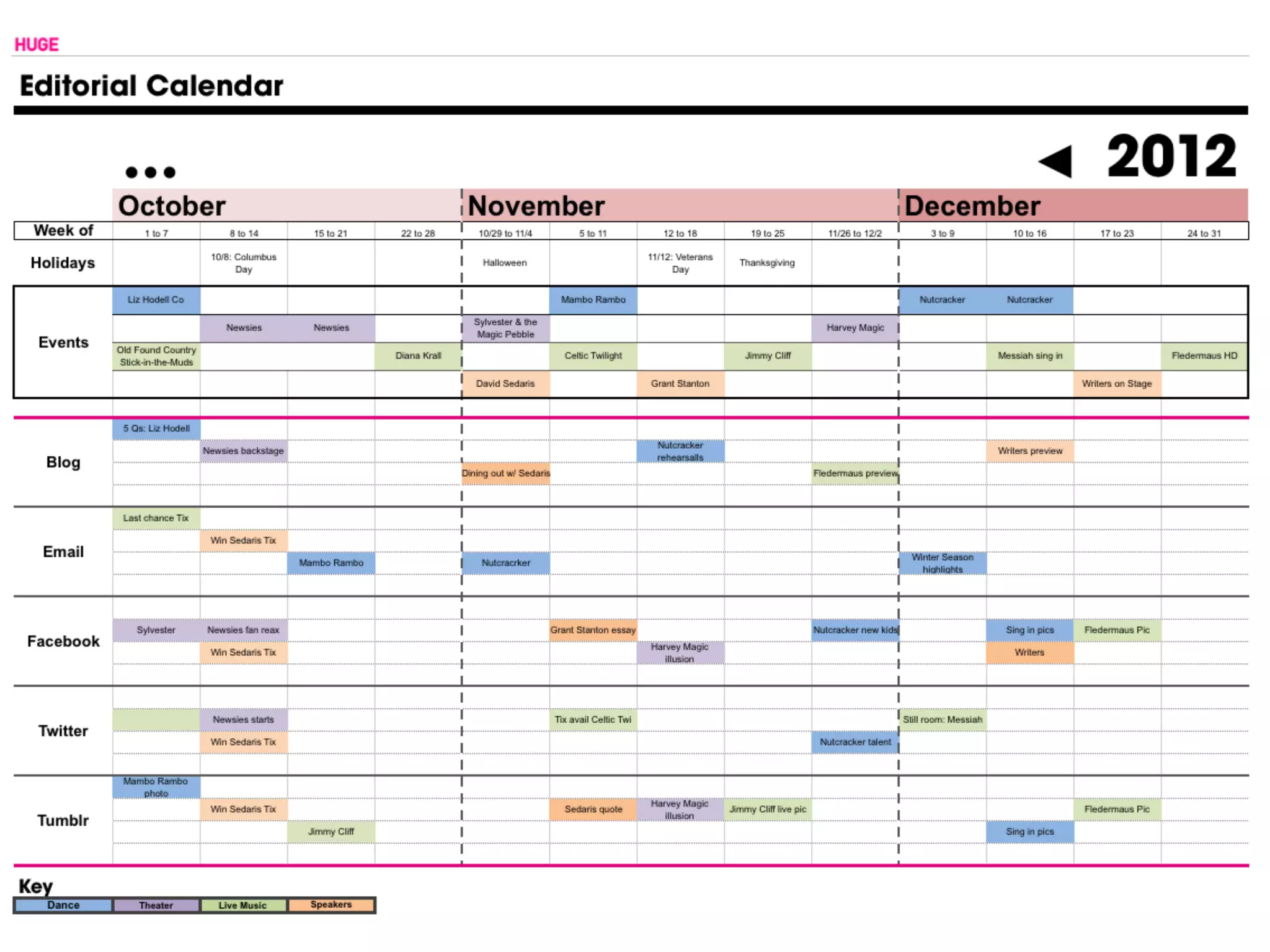
Create an editorial calendar.
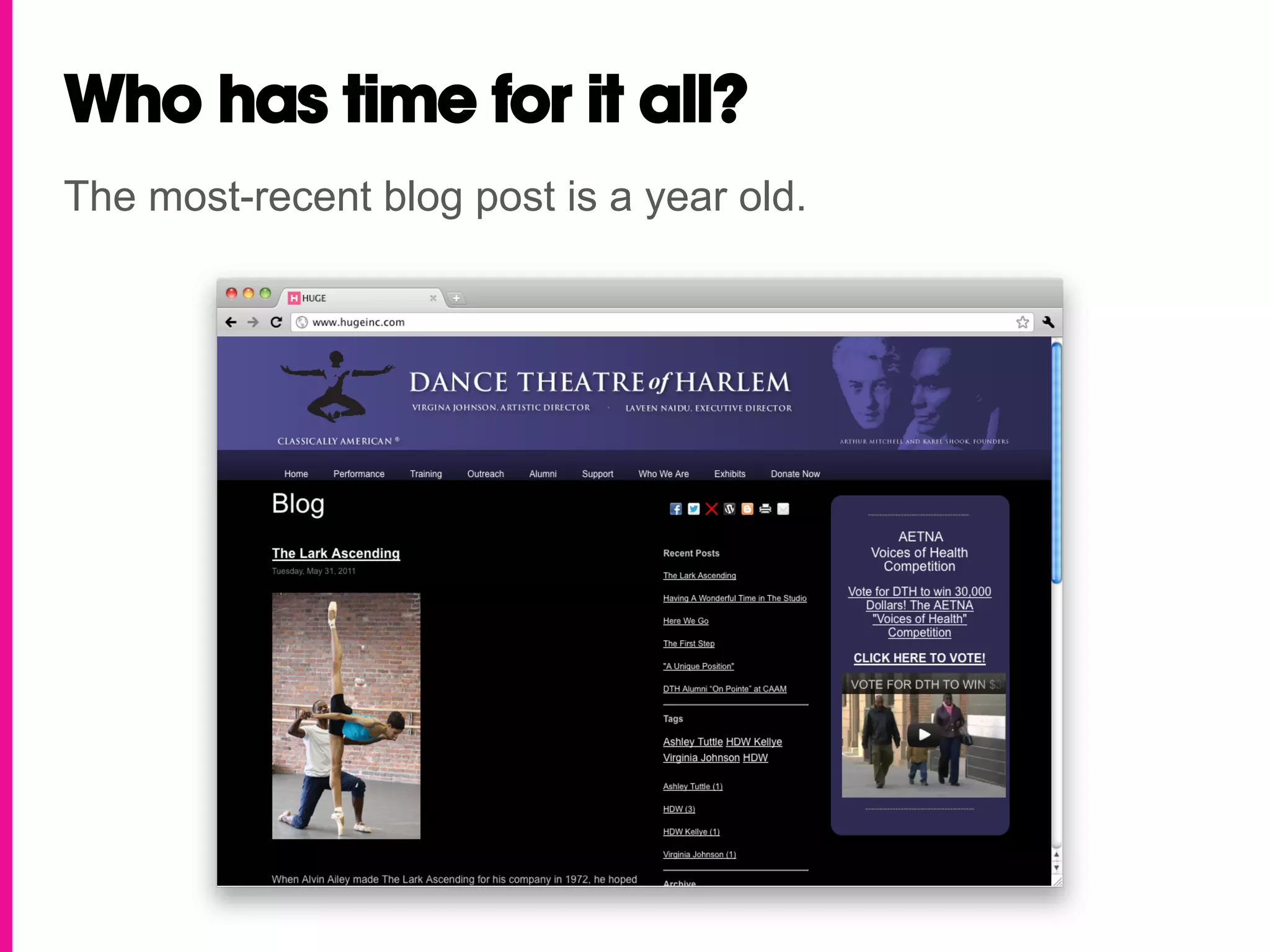
Who has time for it all?
The most-recent blog post is a year old.
How do we feed the beast?
Planning ahead cuts anxiety.
•  Make a spreadsheet with a column for each week for the next
   three months.

•  List each week’s events at the top of its column.

•  Make rows for each channel you use, and decide what you’ll
   create in each channel for each week.

•  Bonus points: color code your events by type or audience.

•  Near the end of the second month of a quarter, create the next
   quarter’s calendar.
Start small and do it really well.
9.
Create a workflow.
How do we work together?
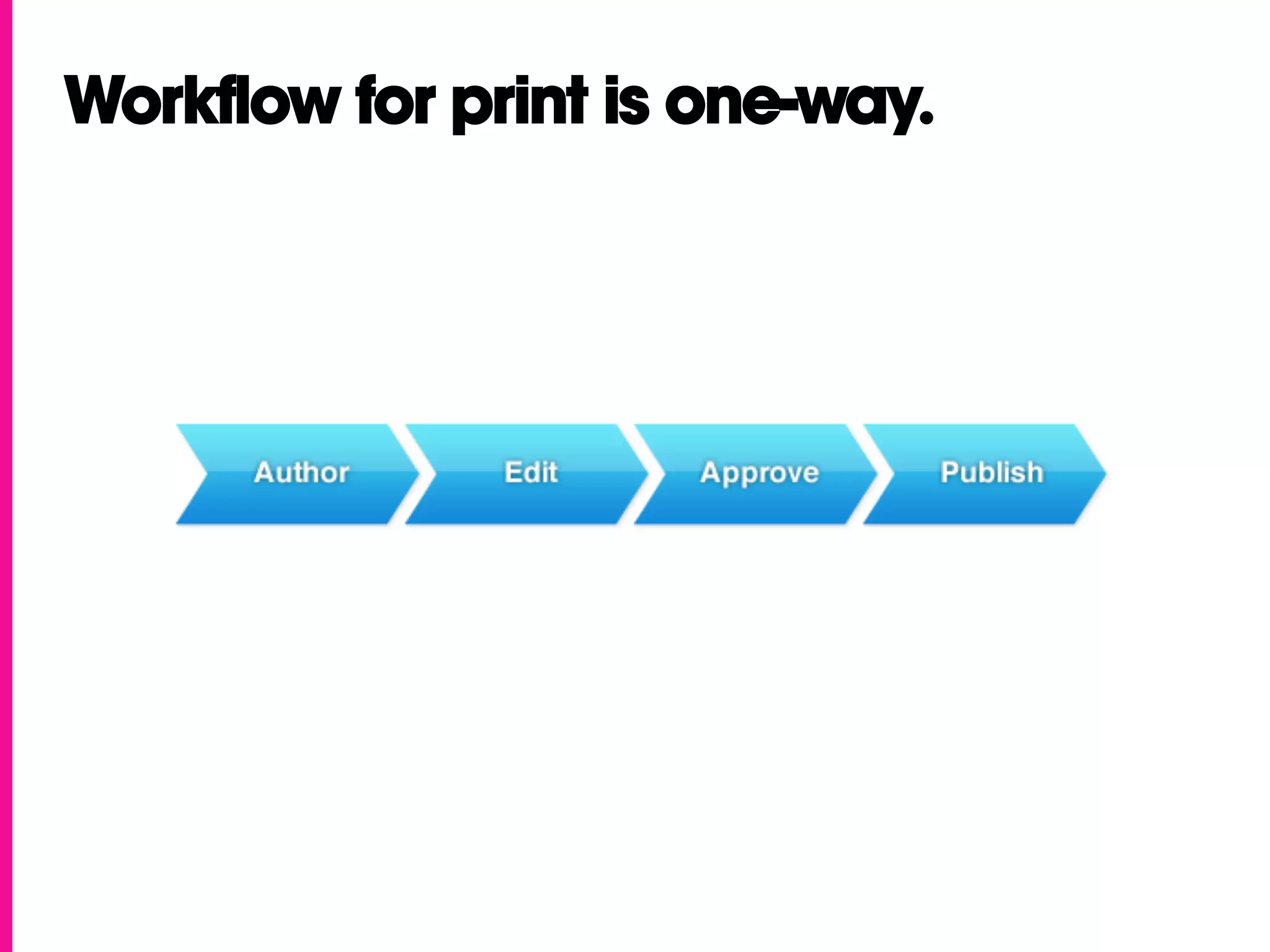
Workflow for print is one-way.
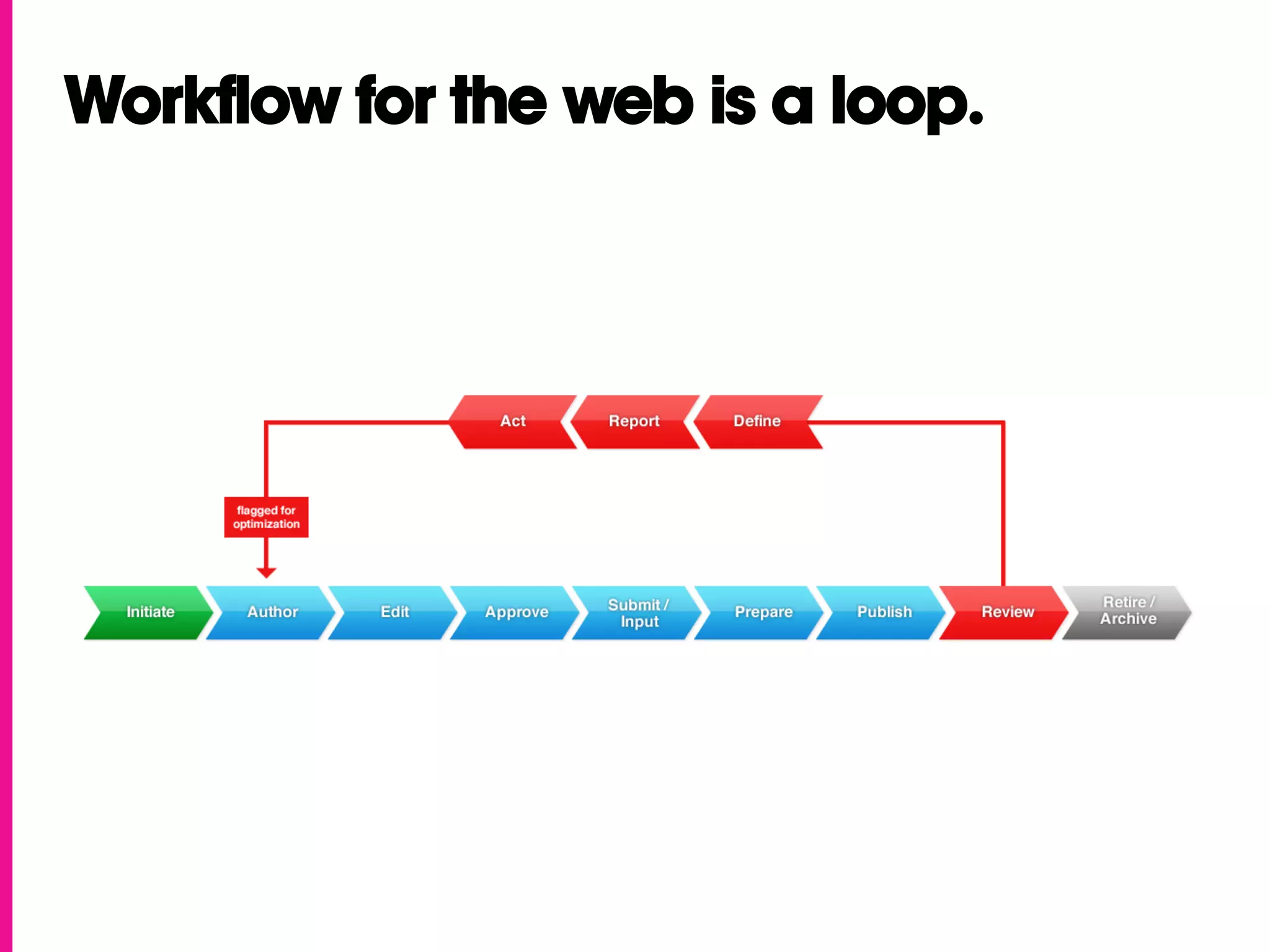
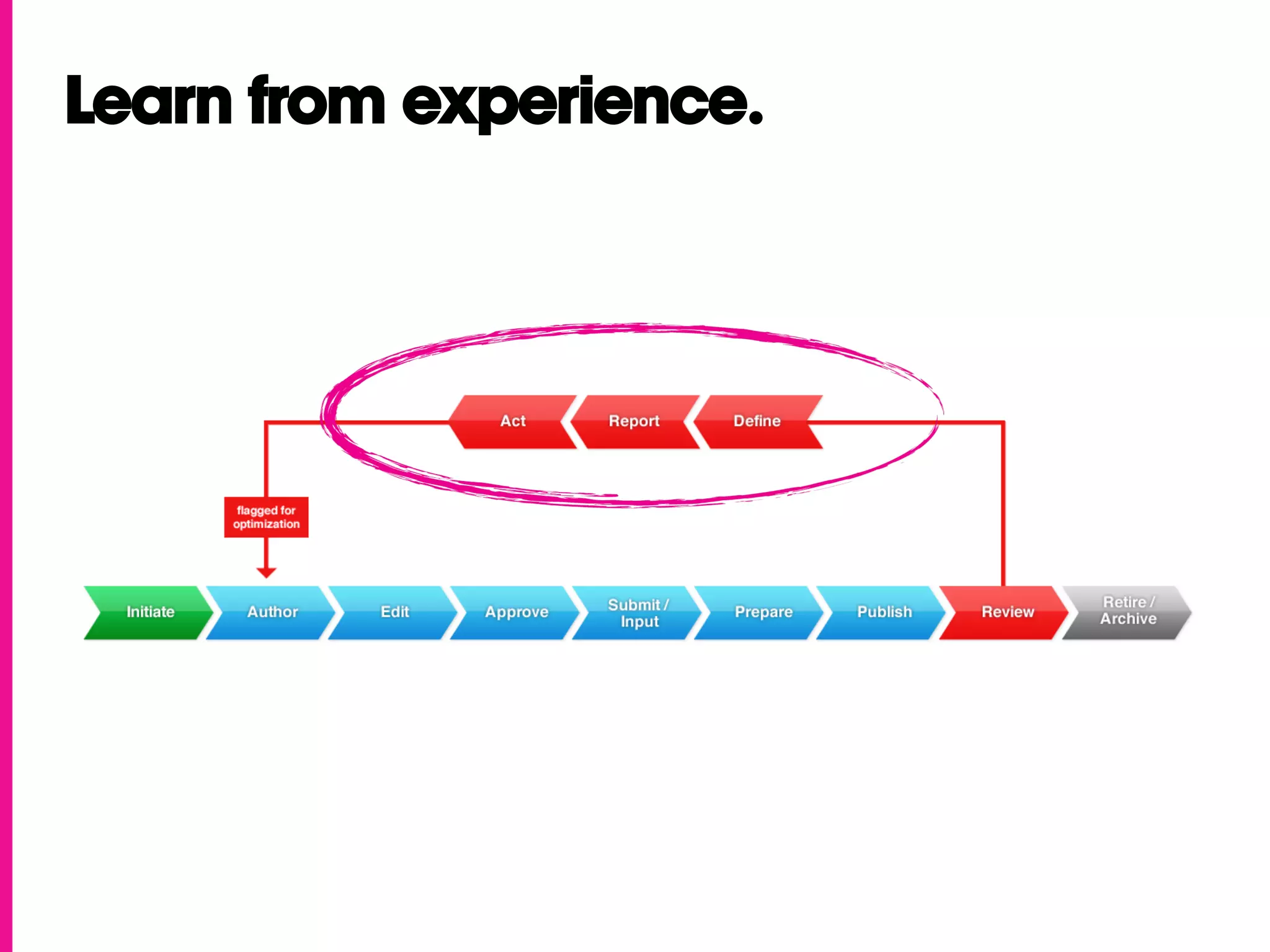
Workflow for the web is a loop.
Learn from experience.
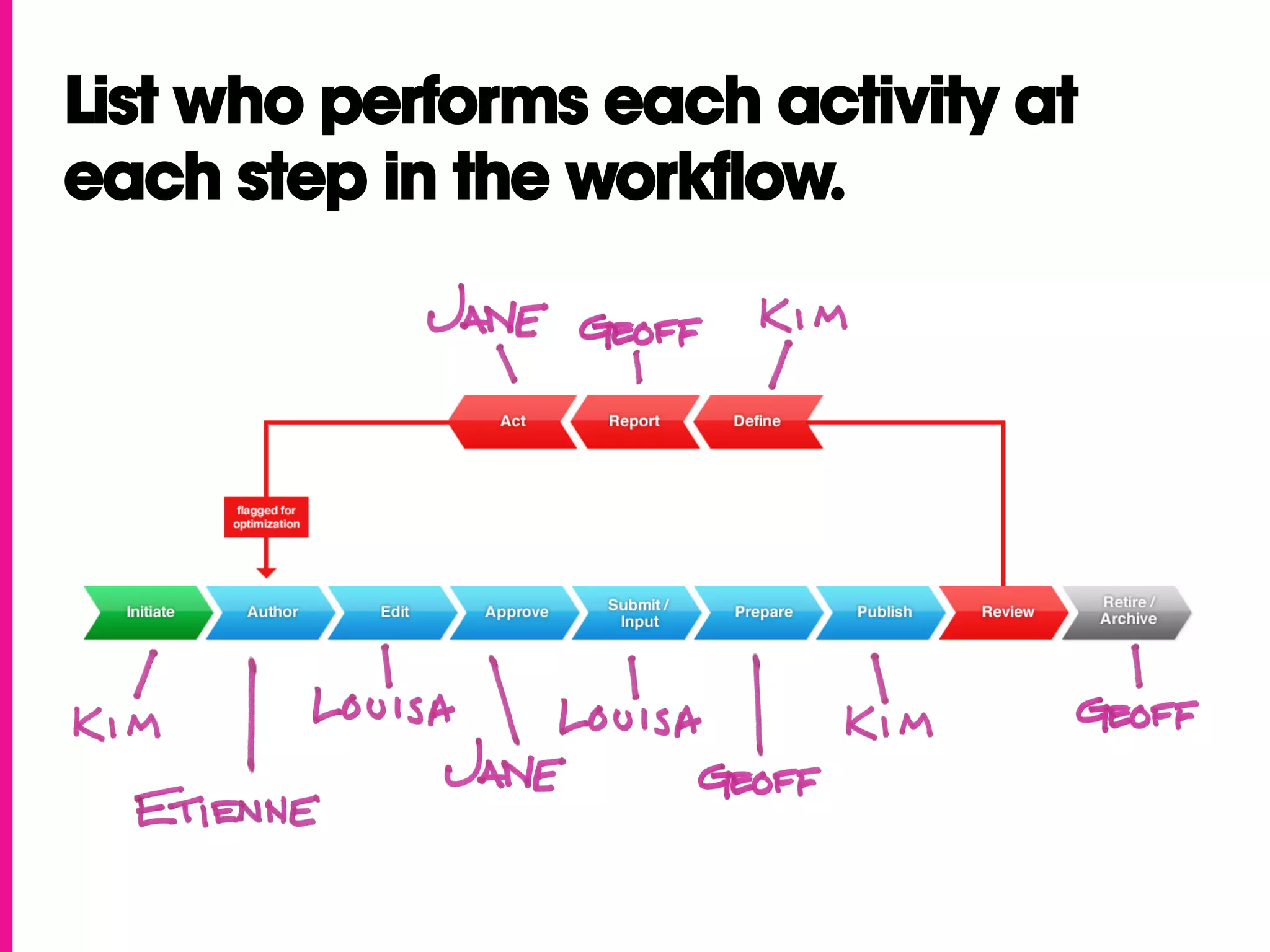
List who performs each activity at
each step in the workflow.
10.
Have a point of view.
Really, really care, and be interesting.
      Amazing Heroes has come a long way. I started collecting as a young
      child. Comics, Sports cards, Coins and Stamps. If you could collect it, I
      did. (I even collected Insolators from phone poles.) ….Steve's
      Collectables was our first name and we moved into the worlds smallest
      store. It was 7 x 12, I built the floor and put in lights and paid the
      rent late every month but I was able to learn what NOT to do. I also
      picked up Pete at this time. He started by just watching the store when I
      needed to use the rest room (the first store didn't have one and I had to
      go next door) and he has been a big part of the success ever since.
      Then came the dark time. I moved to a bigger store but I picked up a
      partner. We changed the name to We Could Be Heroes (I never liked
      that name, too far back in the phone book) and we started selling
      records as well as Cards and Comics. Long story short, came back
      from dinner to a empty store. I changed the name to Amazing
      Heroes and restocked the place…
“When you write, you are finding
the never-before thought about.”
If you want your audience to give
    you time in their day, to pay
    attention and listen to you,
you gotta have something to say.
hugeinc.com
info@hugeinc.com
45 Main St. #220 Brooklyn, NY 11201
+1 718 625 4843
Questions…

Writing for the Web

  • 1.
    October 26, 2012 DigitalMarketing Boot Camp for Arts Marketers | Writing for the web hugeinc.com info@hugeinc.com 45 Main St. #220 Brooklyn, NY 11201 +1 718 625 4843
  • 2.
    Michal Pasternak Partner, UserExperience John McCrory Content Strategy Lead
  • 3.
    About us. We helptransform brands and grow businesses.
  • 4.
    Our approach. Great userexperiences are what drive business performance and marketing.
  • 11.
    Agenda: 1. Thejourney of your message 2. Key Principles 3. 10 Things you can do right away 4. Q&A
  • 12.
  • 13.
    We’re here totalk about writing for the web. What do we mean by the web?
  • 14.
    Our writing iscarried through many different channels.
  • 15.
  • 16.
    Blog posts. The Dallas Symph… https://dallassymphony.com/blog/2012/10/16/young-strings-community-celebrations.aspx
  • 17.
  • 18.
  • 19.
  • 20.
    Apps and appstores.
  • 21.
    Our writing reachespeople in many different contexts.
  • 24.
  • 27.
  • 28.
    A message servesmany situations. •  A person is seeking information from you •  You are sending your message to someone •  Another organization (sponsor, newspaper, artist) is sharing your message with its audience •  Natural word of mouth in which an individual shares your message with a friend
  • 29.
    We are writingfor an ecosystem of channels, devices and situations.
  • 30.
    You face ahost of challenges. •  You aren’t only a writer… you wear a lot of different hats in your organization •  Your time and resources are constrained •  Sometimes, it feels like you have to do it all alone •  Your organization can’t afford the technology you need to produce and publish efficiently
  • 31.
    Which of our What should I events should I write about spend more time How do I find writing about? guest writers and between seasons? how do I motivate them? Who am I writing Should I write for? Where will I find less formally on How do I write an time to update the Facebook? email subject line blog? that will get opened? How do I write copy that will get How should I us found better in respond to tweets Google? What do I have to from followers? How do I write do differently for both current & when I write for new audiences? the web?
  • 32.
    2 most frequentquestions we hear about writing for the web:
  • 33.
    How often shouldwe… •  Send email to our subscribers •  Update our Facebook page •  Tweet
  • 34.
    Answer: It doesn’t really matter —if you are being relevant and interesting to your audience. Instead, pace yourself based on what you know can handle and do well. Start small.
  • 35.
    What’s the bestlength for… •  Our email newsletter •  A blog post •  A web page
  • 36.
    Answer: The bestlength for writing is the same length as a miniskirt: Long enough to cover the subject, but short enough to keep it interesting.
  • 38.
    So I haveto keep it short? Not so fast. Length follows context.
  • 39.
  • 40.
    Key Principles 1. Knowyour audience. 2. Know yourself. 3. Know the competition.
  • 42.
  • 43.
    Your audience alreadytalks to you. •  Web analytics can tell you which topics and formats provoke more or less audience interest. •  Search analytics can provide insight into the subjects your audience cares about – and the terms they use. •  URL shorteners like bit.ly can help you learn from your audience across different channels. •  Social media let you listen in on the conversations your audience is already having.
  • 44.
    Talk directly toyour audience. •  Meet them face to face, not through third parties or the computer. •  Anybody who is in your audience is also in your digital audience. •  Focus groups can be formal or informal: greet audience members when they come to a show, and ask them questions.
  • 45.
    Visualize your usersas real people. •  Demographic group •  Aspirations •  Inspirations •  Relationship to your brand •  How they consume and engage with media •  How they spend their time and money
  • 46.
  • 47.
    Key Principles 1. Knowyour audience. 2. Know yourself. 3. Know the competition.
  • 48.
    “Humans expect computers to act as though they were people, and get annoyed when technology fails to respond in socially appropriate ways.” - Clifford Nass, Professor of Communication, Stanford University
  • 49.
    “Are you areal person?”
  • 50.
    Who is this?Could be anybody. Welcome to The ______ Center for the Performing Arts, the new heart of the arts for Southern ______ . This world-class performing arts center was built to showcase the very best in theater, dance and music from around the world. The stage is set, so how can we inspire you today?
  • 51.
    Boardroom voice. Founded in 1972 as a 501(c)3 professional company, the Monterey Valley Dance Theater (MVDT) has for 40 years enriched the cultural life of Monterey Valley through countless dance concerts and training for young dancers. Maureen Scott was appointed Artistic Director in 1994 and under her direction, MVDT has earned its reputation as a company of fully- professional dancers committed to unconventional and deeply courageous programming which expands access to the stage for dancers of many nationalities, races, ages, and physical abilities. We are also known for our cross-border projects, our site-specific Border Fence Dances, our summer dance workshops, and for the sheer beauty of our dancers.
  • 52.
    Over-the-top voice. She's back! Dixie Longate returns to throw her good ol'fashioned Tupperware Parties filled with outrageously funny tales, FREE giveaways, audience participation and the most fabulous assortment of Tupperware ever sold on a theater stage. Loaded with the most up-to-date products available for purchase, see how Ms. Longate became the #1 Tupperware seller in the US and Canada as she educates her guests on the many alternative uses she has discovered for her plastic products!
  • 53.
    There is noperfect model. Use your own voice, but in language your audience actually uses — avoid your own jargon.
  • 54.
    Be the personI want to know. •  The friend with great taste who is always in the know •  The curator who deftly articulates an artist’s unique vision •  The concierge who can direct you to experiences that match your interests •  The performer or artist who cares about sharing the works of other artists •  The outsider who knows all the insider gossip, and dishes
  • 56.
    Re-write in yourown voice. Target sells nearly 1 million products. The descriptions of these products are delivered by the manufacturers – thousands of different brands, each with their own voice. Thousands of new products are being added every month. We designed a publishing workflow that helped Target bring these products “on-brand.” Start with the top priorities – pick the top 10%.
  • 57.
    Key Principles 1. Knowyour audience. 2. Know yourself. 3. Know the competition.
  • 58.
    You have 3kinds of competitors. •  Our audience’s other interests •  Demands on our audience’s time •  Claims for our audience’s attention
  • 59.
    So much email,so little time.
  • 60.
    Who gets youto open their emails? Who gets you to open their emails?
  • 61.
    Do: make mecare. Don’t: tell me how to feel.
  • 62.
    10 ideas tostart working with today.
  • 63.
  • 65.
    How do youmarket to members?
  • 66.
  • 67.
    No one likesto be a target.
  • 68.
    Stop marketing andstart helping. •  Create an editorial style guide: — Audience personas — Voice, the personality we speak from — Tone, the feelings and values we convey — Value proposition, the unique promise we make that differentiates us from others •  Structure your message: a single core message, and supporting messages for different offerings or different audiences.
  • 69.
    Create a messagehierarchy.   Core Message   Supporting messages by product or audience Attribute A Attribute B Attribute C message message message Proof points Proof points Proof points supporting supporting supporting attribute A attribute B attribute C
  • 70.
    2. The same rulesof good writing still apply.
  • 71.
    Respect your audience’stime. The Dallas Symph… https://dallassymphony.com/blog/2012/10/16/young-strings-community-celebrations.aspx
  • 72.
    Help the readerscan the page. •  Write in tight chunks: one idea per paragraph. •  Break up blocks of copy with headings and subheadings •  Write meaningful headings, not clever or cute ones •  Use bullets to highlight key details
  • 73.
    Remember the essentials. • Be direct. Use active voice: When we make the performer of the action the subject of a sentence, we build up energy in our writing. •  Write short, declarative sentences. Avoid parenthetical explanation. •  Omit needless words. •  Describe what things are, not what they aren’t. •  Stick to one tense.
  • 74.
    Be punchy. •  Favorshort words. They hit us in the gut. •  Multisyllabic words tend towards the abstract, requiring our brains to interpret them to understand your meaning. •  Etymology trick: replace Latinate words when a simpler Germanic word will do.
  • 75.
    Guts vs. Entrails. Germanic Latinate body cadaver ask inquire bug insect eat consume feeling sentiment ban prohibit helpful beneficial guess estimate irk irritate talk converse
  • 76.
  • 77.
    Get to thepoint, then call to action. Most important info Who, What, Where, When Call to action Details Background
  • 78.
    Zappos kills itwith microcopy.
  • 79.
    Write microcopy callsto action for people, not machines.
  • 80.
    Machine words arenot inviting. SUBMIT
  • 81.
    Human language hasverve. LET’S GO
  • 82.
    4. But, also writefor robots.
  • 83.
    Words are keyto ranking in search. Components of Google Ranking Algorithm Social Graph Registration and Metrics, 7% Hosting Data, 5% Traffic and Click Data, 7% Domain Authority, 24% On Page Keyword Usage, 15% Link Popularity of Page, 22% Good     wri(ng     Anchor Text of helps  here   External Links, 20%
  • 84.
    Keyword strategy iscrucial. •  Each URL on your web site should be mapped to a specific and unique keyword or phrase •  Top-level pages should target the most competitive and important keyword phrases For example, ASME, the American Society of Mechanical Engineers: Page URL Targeted Keyword asme.org ‘Mechanical engineering’ asme.org/Education/Courses/ ‘Engineering Training’ calendar.asme.org/ ‘Engineering Conferences’ asme.org/Jobs/ ‘Engineering Jobs’
  • 85.
    Good application ofkeywords. “How to change a flat tire” Keyword in Page Title and URL, Keyword in Breadcrumb Keyword in Headline / H1 Keyword variations in content – especially the first 200 words
  • 86.
  • 87.
  • 88.
    Search engines cutyou off midsent…
  • 89.
  • 90.
    How brief isbrief? •  For page titles and headings 50 characters •  Summaries and descriptions 160 characters •  Tweets are limited to 140 characters •  Allow space: don’t write up to the limit
  • 91.
    “A line isthe length of a boulevard.” —Derek Walcott
  • 92.
  • 93.
    The words youlink from count. Pilobolus at Joyce: Click here! Learn more about Pilobolus at Joyce. Learn more about Pilobolus at Joyce.
  • 97.
    7. Write for eachstage of the customer journey.
  • 98.
    The journey followsa story arc.
  • 99.
    Message and tonechange through each step of the journey. 1.  Invitation 2.  Advice 3.  Instruction 4.  Feedback 5.  Support 6.  Checking-in
  • 100.
  • 101.
    Who has timefor it all? The most-recent blog post is a year old.
  • 102.
    How do wefeed the beast?
  • 104.
    Planning ahead cutsanxiety. •  Make a spreadsheet with a column for each week for the next three months. •  List each week’s events at the top of its column. •  Make rows for each channel you use, and decide what you’ll create in each channel for each week. •  Bonus points: color code your events by type or audience. •  Near the end of the second month of a quarter, create the next quarter’s calendar.
  • 105.
    Start small anddo it really well.
  • 106.
  • 107.
    How do wework together?
  • 108.
    Workflow for printis one-way.
  • 109.
    Workflow for theweb is a loop.
  • 110.
  • 111.
    List who performseach activity at each step in the workflow.
  • 112.
  • 113.
    Really, really care,and be interesting. Amazing Heroes has come a long way. I started collecting as a young child. Comics, Sports cards, Coins and Stamps. If you could collect it, I did. (I even collected Insolators from phone poles.) ….Steve's Collectables was our first name and we moved into the worlds smallest store. It was 7 x 12, I built the floor and put in lights and paid the rent late every month but I was able to learn what NOT to do. I also picked up Pete at this time. He started by just watching the store when I needed to use the rest room (the first store didn't have one and I had to go next door) and he has been a big part of the success ever since. Then came the dark time. I moved to a bigger store but I picked up a partner. We changed the name to We Could Be Heroes (I never liked that name, too far back in the phone book) and we started selling records as well as Cards and Comics. Long story short, came back from dinner to a empty store. I changed the name to Amazing Heroes and restocked the place…
  • 114.
    “When you write,you are finding the never-before thought about.”
  • 115.
    If you wantyour audience to give you time in their day, to pay attention and listen to you, you gotta have something to say.
  • 116.
    hugeinc.com info@hugeinc.com 45 Main St.#220 Brooklyn, NY 11201 +1 718 625 4843
  • 117.