WRITING ACROSS THE CURRICULUM Exploring the 6 Traits Shanghai American School, Pudong Campus Shanghai, China February 11, 2008 Presenter: Fay Leong
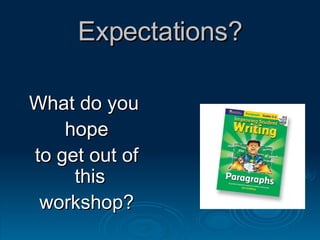
Expectations? What do you  hope to get out of this  workshop?
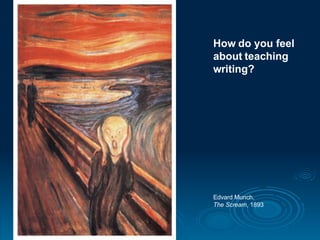
How do you feel about teaching writing? Edvard Munch,  The Scream , 1893
Why do we write? The reason one writes isn't the fact he wants to say something. He writes because he has something to say.   F. Scott Fitzgerald
Essential questions
What kind of writing do we expect  our students to be learning/doing?
Once we know the purpose,  what characteristics make good writing?
Writing Frameworks
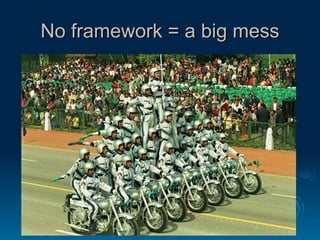
No framework = a big mess
When something can be read without effort, great effort has gone into its writing.     Enrique Jardiel Poncela  (Spanish playwright, 1901 – 1952)
Different frameworks 6+1 Traits RAFT (Role, Audience, Format, Topic)
To use any framework you must first decide on the form of writing that you want
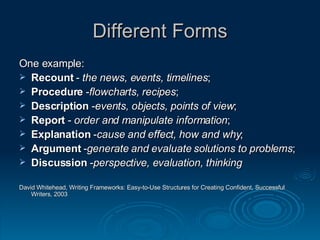
Different Forms One example: Recount  -  the news, events, timelines ; Procedure  - flowcharts, recipes ; Description  - events, objects, points of view ; Report  -  order and manipulate information ; Explanation  - cause and effect, how and why ; Argument  - generate and evaluate solutions to problems ; Discussion  - perspective, evaluation, thinking David Whitehead, Writing Frameworks: Easy-to-Use Structures for Creating Confident, Successful Writers, 2003
6+1 Traits
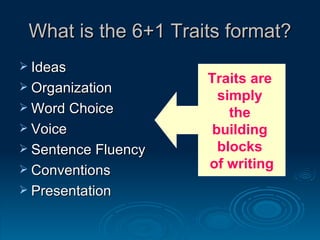
What is the 6+1 Traits format? Ideas Organization Word Choice Voice Sentence Fluency Conventions Presentation Traits are  simply  the  building  blocks  of writing
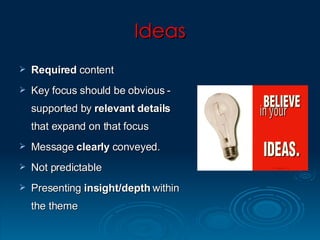
Ideas Required  content  Key focus should be obvious - supported by  relevant   details  that expand on that focus Message  clearly  conveyed.  Not predictable Presenting  insight/depth  within the theme
Organization A strong  framework/structure Central  idea maintained throughout  Must suit the  purpose  (report, analysis, expository) Has a clear  beginning Direction  is obvious and controlled throughout – providing substance Connections  between ideas provide the foundation of the piece/structure Has an emphatic ending that brings  closure  to the central idea/theme
Voice The writer behind the words is obvious A clear sense of  engagement ‘Jumps’ off the page How do you want to help the student create this?
Zest. Gusto. How rarely one hears these words used. How rarely do we see people living, or for that matter, creating by them. Yet if I were asked to name the most important items in a writer’s make-up, the things that shape his material and rush him along the road to where he wants to go, I could only warn him to look to his zest, see to his gusto. Ray Bradbury
Word Choice The language suits the purpose Precise Rich Engaging  Writer has carefully chosen words that gives depth to the ideas Careful use of everyday words as well as subject specific vocabulary
Sentence Fluency Is the writing stilted? Is it confusing? Does the writing help the message/story/report, or does it obscure it?
Conventions Mechanics –  Depends on grade level and standards and benchmarks for that subject Correct usage of grammar  Paragraphing  Use of capitals Punctuation.
Presentation Decide on the visual and verbal elements Subject specific Dependent on the purpose of the piece
Writing Assessments
Creating Writing Assessments P urpose P rocess P roduct Know what you want from your students
Things to think about From K-12, what forms of writing does your subject expect (a writing continuum)? At your grade level, what processes do you want them to have?
Continuum + Skills + Content  Required Assessments
Rubrics:  Scoring writing assessments
Rubrics: the positives Outlines what’s expected Makes sure teacher and student have worked out the requirements of the assessment Good check-in Grading process is clear
Rubrics: the negatives Do students really read them? Time-consuming to make Outcome is sometimes not a good fit to the letter/number grade
I need direction! Know the purpose of your assessment Identify your grading criteria  Keep it simple Set up your basic rubrics for the criteria Modify 6 Traits examples for specific ideas/content and organization
To Re-cap
Ask yourself: What is your writing continuum (K-12) within your subject? What do you want to have at your level? Where are the students coming from? Where are they going? Where can we come together across the curriculum to help our students be confident writers no matter what the content or genre?
The pen is the tongue of the mind Miguel de Cervantes
Acknowledgements Art of Europe, Munch –  The Scream ,  www.artofeurope.com/munch/mun3.htm   Camel smile, Aha Jokes,  www.ahajokes.com/crt313.html Daredevils: human pyramid,  pib.nic.in /.../pg26jan2003/26012003.html   Ideas,  www.allposters.com/-sp/Ideas-Posters_i838569_.htm   Keystone Search,  www.keystonesearch.com/contact.php   Learning Resources,  www.learningresources.com/product/improving+s ...   Northwestern Regional Educational Laboratory, 6+1 Trait® Writing,  http://www.nwrel.org/assessment/department.php?d=1 Pocket compass, The Magnetic Compass: History,  www.solarnavigator.net/compass.htm   Tom’s cartoons, Mad Faces,  protonicus.studentenweb.org /.../? tutnr =2   Writing Frameworks, Silver Creek CSD, October 30, 2006,  http://www.slideshare.net/TGray/writing-frameworks/

Writing Across the Curriculum: Exploring the 6 Traits

  • 1.
    WRITING ACROSS THECURRICULUM Exploring the 6 Traits Shanghai American School, Pudong Campus Shanghai, China February 11, 2008 Presenter: Fay Leong
  • 2.
    Expectations? What doyou hope to get out of this workshop?
  • 3.
    How do youfeel about teaching writing? Edvard Munch, The Scream , 1893
  • 4.
    Why do wewrite? The reason one writes isn't the fact he wants to say something. He writes because he has something to say. F. Scott Fitzgerald
  • 5.
  • 6.
    What kind ofwriting do we expect our students to be learning/doing?
  • 7.
    Once we knowthe purpose, what characteristics make good writing?
  • 8.
  • 9.
    No framework =a big mess
  • 10.
    When something canbe read without effort, great effort has gone into its writing.   Enrique Jardiel Poncela (Spanish playwright, 1901 – 1952)
  • 11.
    Different frameworks 6+1Traits RAFT (Role, Audience, Format, Topic)
  • 12.
    To use anyframework you must first decide on the form of writing that you want
  • 13.
    Different Forms Oneexample: Recount - the news, events, timelines ; Procedure - flowcharts, recipes ; Description - events, objects, points of view ; Report - order and manipulate information ; Explanation - cause and effect, how and why ; Argument - generate and evaluate solutions to problems ; Discussion - perspective, evaluation, thinking David Whitehead, Writing Frameworks: Easy-to-Use Structures for Creating Confident, Successful Writers, 2003
  • 14.
  • 15.
    What is the6+1 Traits format? Ideas Organization Word Choice Voice Sentence Fluency Conventions Presentation Traits are simply the building blocks of writing
  • 16.
    Ideas Required content Key focus should be obvious - supported by relevant details that expand on that focus Message clearly conveyed. Not predictable Presenting insight/depth within the theme
  • 17.
    Organization A strong framework/structure Central idea maintained throughout Must suit the purpose (report, analysis, expository) Has a clear beginning Direction is obvious and controlled throughout – providing substance Connections between ideas provide the foundation of the piece/structure Has an emphatic ending that brings closure to the central idea/theme
  • 18.
    Voice The writerbehind the words is obvious A clear sense of engagement ‘Jumps’ off the page How do you want to help the student create this?
  • 19.
    Zest. Gusto. Howrarely one hears these words used. How rarely do we see people living, or for that matter, creating by them. Yet if I were asked to name the most important items in a writer’s make-up, the things that shape his material and rush him along the road to where he wants to go, I could only warn him to look to his zest, see to his gusto. Ray Bradbury
  • 20.
    Word Choice Thelanguage suits the purpose Precise Rich Engaging Writer has carefully chosen words that gives depth to the ideas Careful use of everyday words as well as subject specific vocabulary
  • 21.
    Sentence Fluency Isthe writing stilted? Is it confusing? Does the writing help the message/story/report, or does it obscure it?
  • 22.
    Conventions Mechanics – Depends on grade level and standards and benchmarks for that subject Correct usage of grammar Paragraphing Use of capitals Punctuation.
  • 23.
    Presentation Decide onthe visual and verbal elements Subject specific Dependent on the purpose of the piece
  • 24.
  • 25.
    Creating Writing AssessmentsP urpose P rocess P roduct Know what you want from your students
  • 26.
    Things to thinkabout From K-12, what forms of writing does your subject expect (a writing continuum)? At your grade level, what processes do you want them to have?
  • 27.
    Continuum + Skills+ Content Required Assessments
  • 28.
    Rubrics: Scoringwriting assessments
  • 29.
    Rubrics: the positivesOutlines what’s expected Makes sure teacher and student have worked out the requirements of the assessment Good check-in Grading process is clear
  • 30.
    Rubrics: the negativesDo students really read them? Time-consuming to make Outcome is sometimes not a good fit to the letter/number grade
  • 31.
    I need direction!Know the purpose of your assessment Identify your grading criteria Keep it simple Set up your basic rubrics for the criteria Modify 6 Traits examples for specific ideas/content and organization
  • 32.
  • 33.
    Ask yourself: Whatis your writing continuum (K-12) within your subject? What do you want to have at your level? Where are the students coming from? Where are they going? Where can we come together across the curriculum to help our students be confident writers no matter what the content or genre?
  • 34.
    The pen isthe tongue of the mind Miguel de Cervantes
  • 35.
    Acknowledgements Art ofEurope, Munch – The Scream , www.artofeurope.com/munch/mun3.htm Camel smile, Aha Jokes, www.ahajokes.com/crt313.html Daredevils: human pyramid, pib.nic.in /.../pg26jan2003/26012003.html Ideas, www.allposters.com/-sp/Ideas-Posters_i838569_.htm Keystone Search, www.keystonesearch.com/contact.php Learning Resources, www.learningresources.com/product/improving+s ... Northwestern Regional Educational Laboratory, 6+1 Trait® Writing, http://www.nwrel.org/assessment/department.php?d=1 Pocket compass, The Magnetic Compass: History, www.solarnavigator.net/compass.htm Tom’s cartoons, Mad Faces, protonicus.studentenweb.org /.../? tutnr =2 Writing Frameworks, Silver Creek CSD, October 30, 2006, http://www.slideshare.net/TGray/writing-frameworks/