D E F I N I T I O N S , C H A R A C T E R I S T I C S , A N D P O W E R
4.1 What’s in a word?
Japanese writing systems
 https://www.youtube.com/watch?v=CFq2Y43DY0U
W O R D S A L L A R O U N D U S
Defining a word
Introduction
 The word is probably the most familiar linguistic
concept to non-linguists.
 People love playing with words and creating new
expressions, or neologisms, and the strange facts
about their lexicon (the vocabulary of their
language as a whole).
 However, despite all this talk about words, it can be
more difficult than we think to pin down a definition.
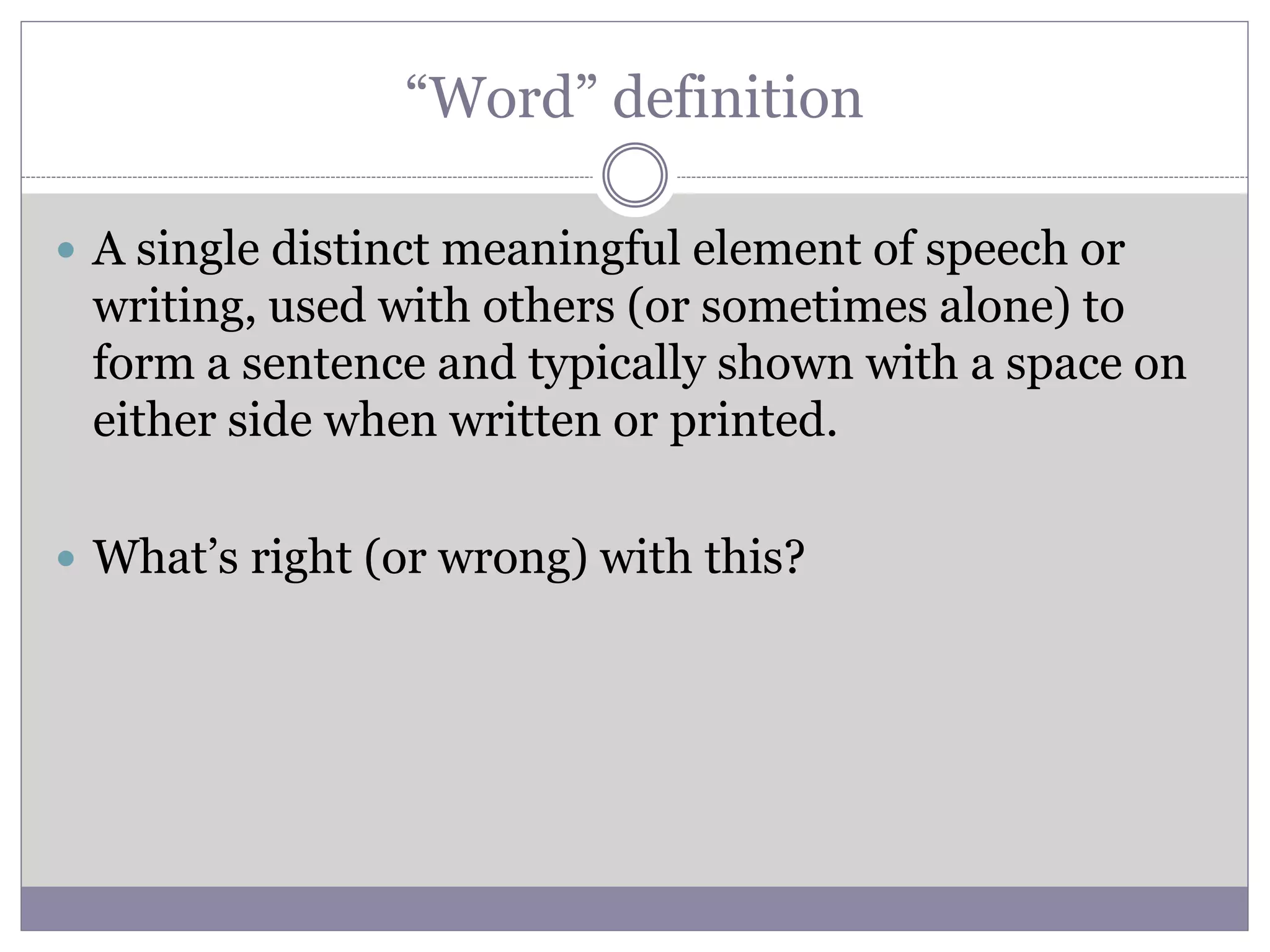
“Word” definition
 A single distinct meaningful element of speech or
writing, used with others (or sometimes alone) to
form a sentence and typically shown with a space on
either side when written or printed.
 What’s right (or wrong) with this?
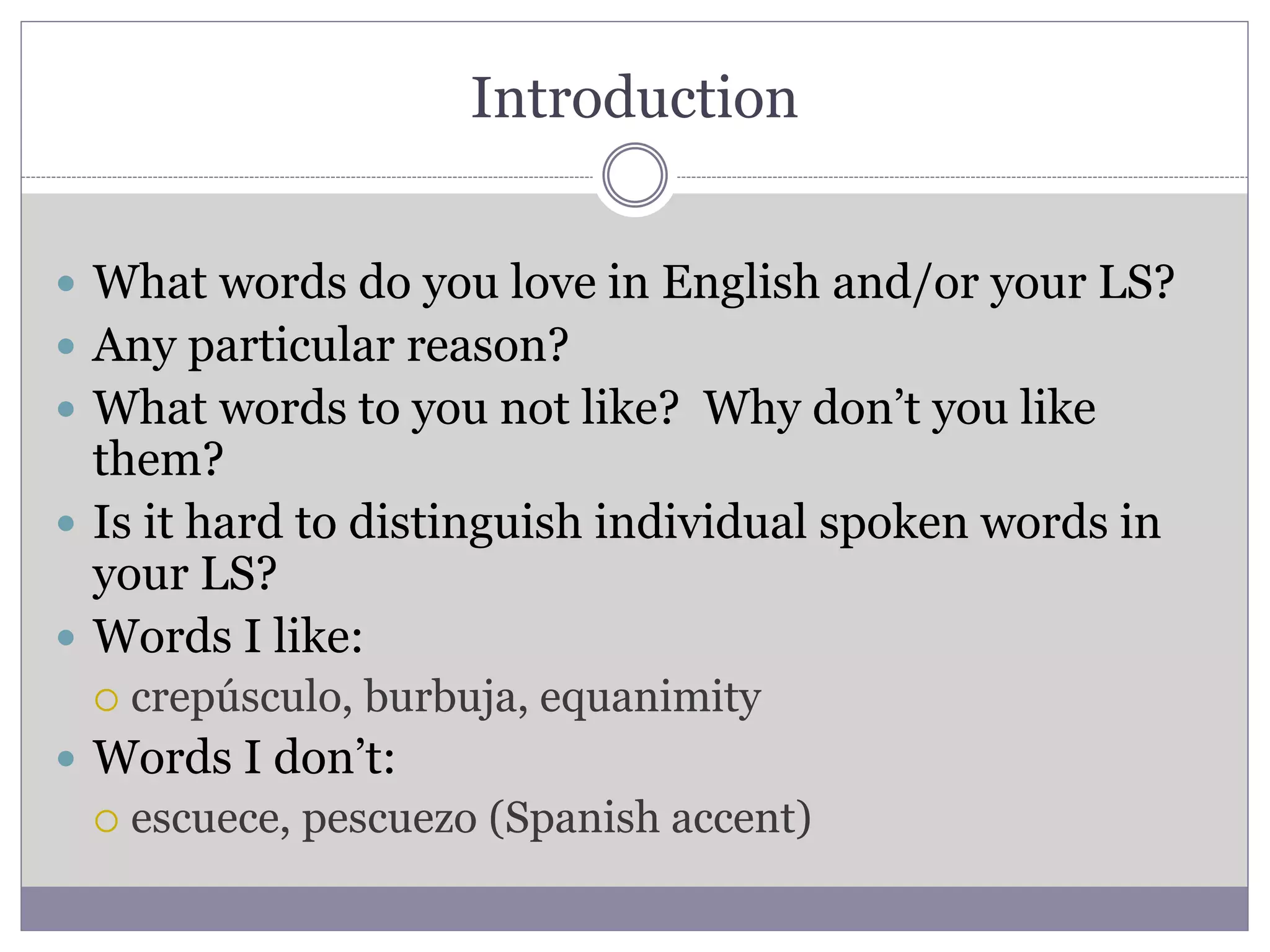
Introduction
 What words do you love in English and/or your LS?
 Any particular reason?
 What words to you not like? Why don’t you like
them?
 Is it hard to distinguish individual spoken words in
your LS?
 Words I like:
 crepúsculo, burbuja, equanimity
 Words I don’t:
 escuece, pescuezo (Spanish accent)
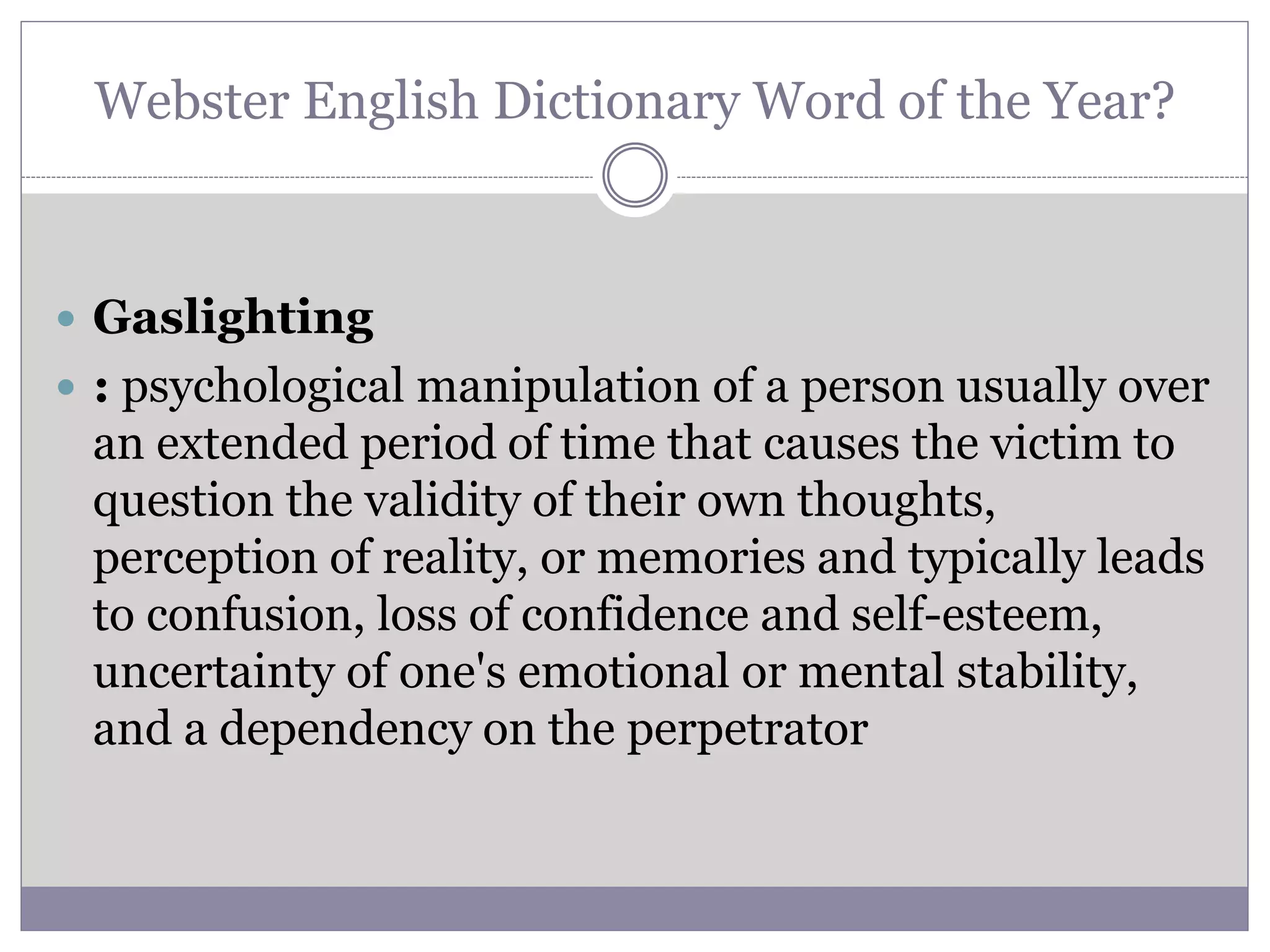
Webster English Dictionary Word of the Year?
 Gaslighting
 : psychological manipulation of a person usually over
an extended period of time that causes the victim to
question the validity of their own thoughts,
perception of reality, or memories and typically leads
to confusion, loss of confidence and self-esteem,
uncertainty of one's emotional or mental stability,
and a dependency on the perpetrator
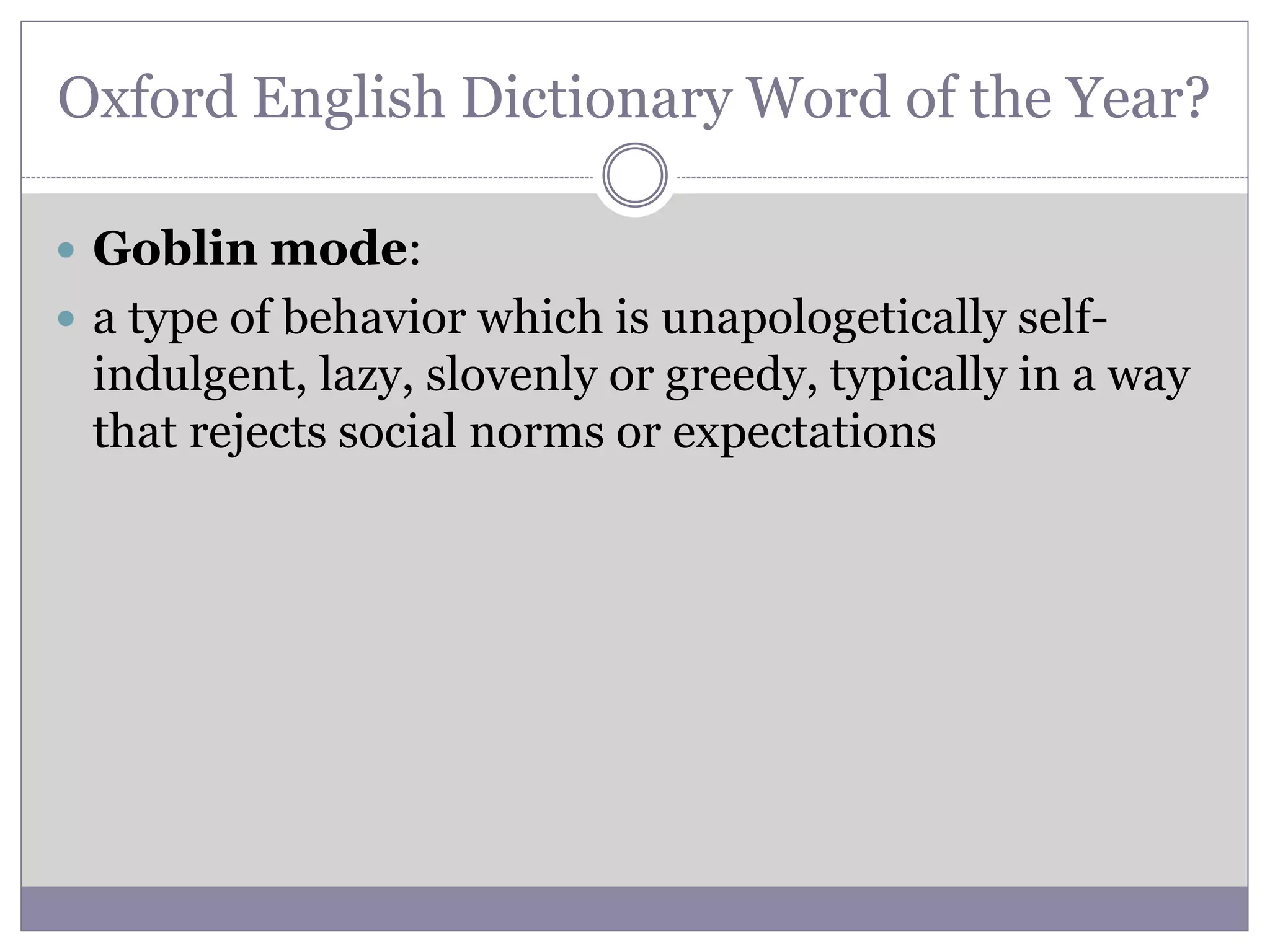
Oxford English Dictionary Word of the Year?
 Goblin mode:
 a type of behavior which is unapologetically self-
indulgent, lazy, slovenly or greedy, typically in a way
that rejects social norms or expectations
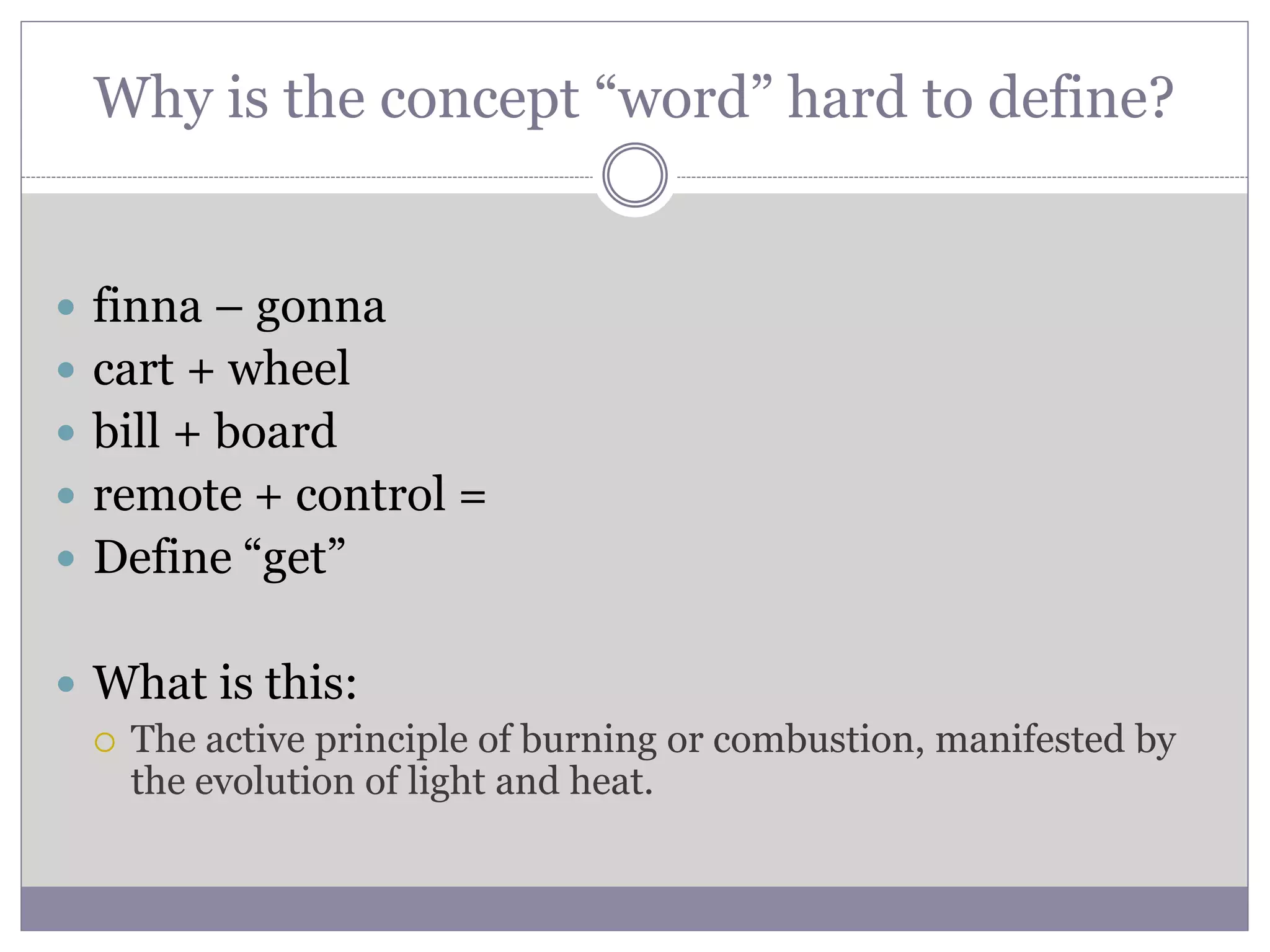
Why is the concept “word” hard to define?
 finna – gonna
 cart + wheel
 bill + board
 remote + control =
 Define “get”
 What is this:
 The active principle of burning or combustion, manifested by
the evolution of light and heat.
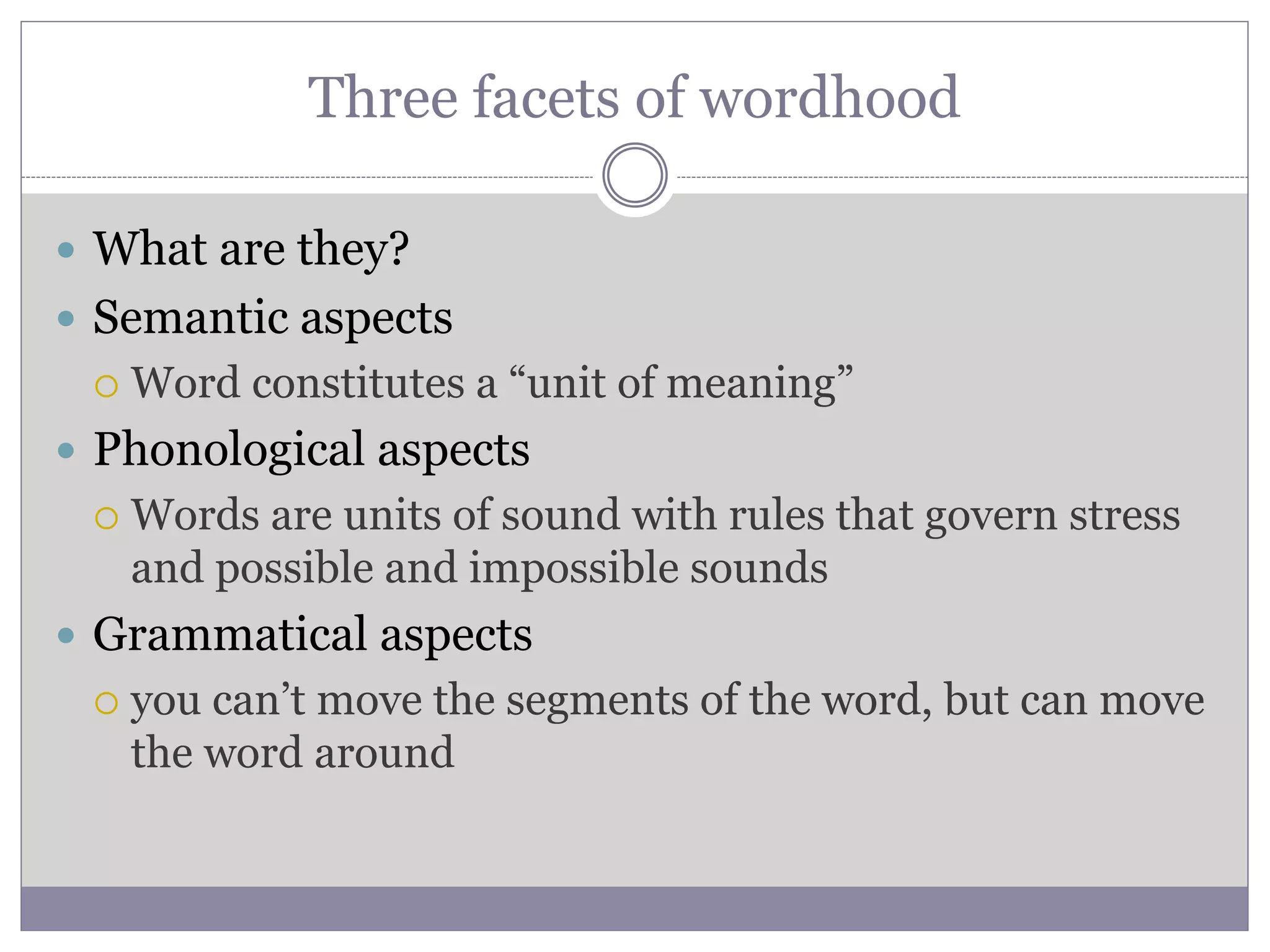
Three facets of wordhood
 What are they?
 Semantic aspects
 Word constitutes a “unit of meaning”
 Phonological aspects
 Words are units of sound with rules that govern stress
and possible and impossible sounds
 Grammatical aspects
 you can’t move the segments of the word, but can move
the word around
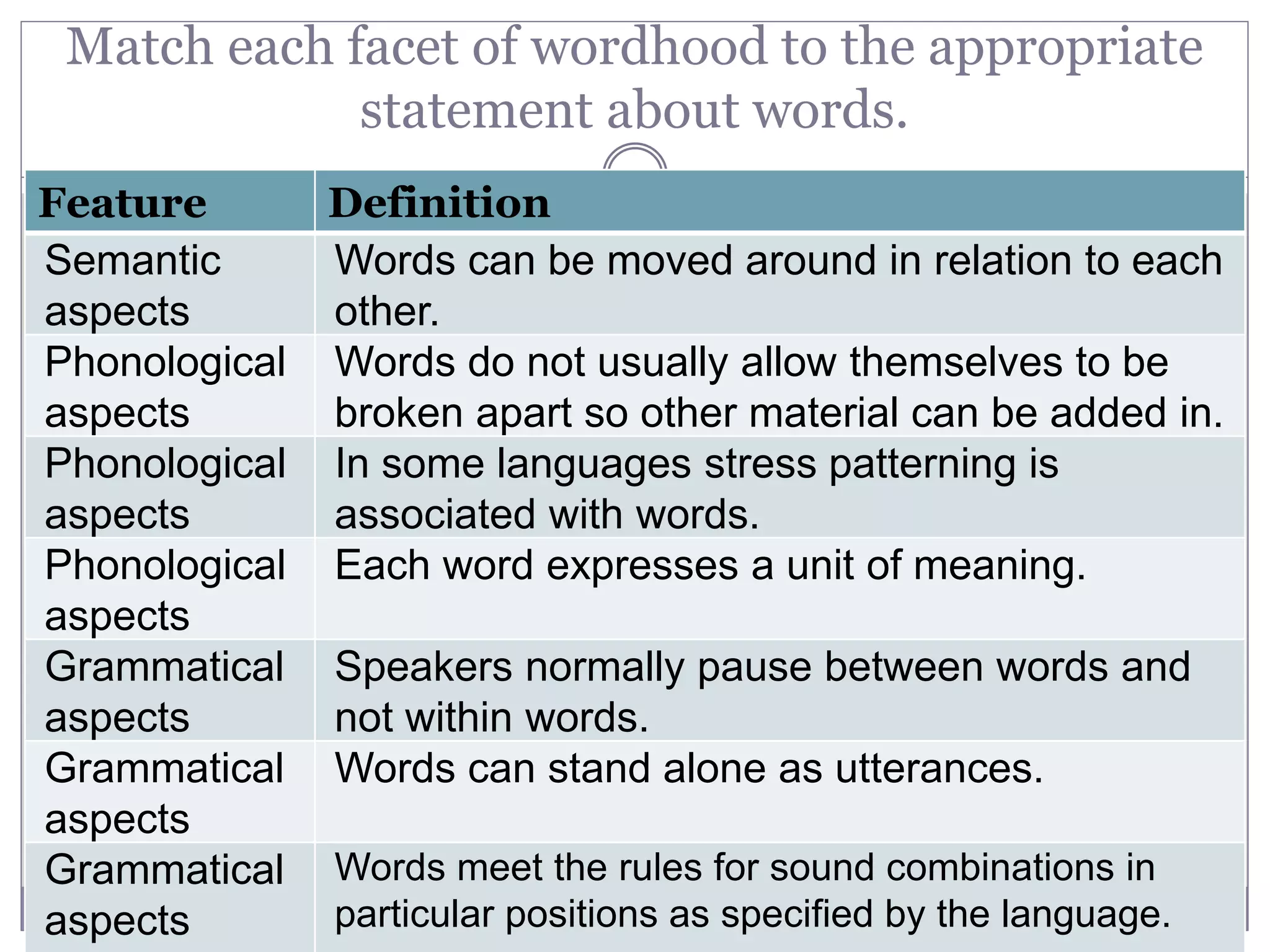
Match each facet of wordhood to the appropriate
statement about words.
Feature Definition
Semantic
aspects
Words can be moved around in relation to each
other.
Phonological
aspects
Words do not usually allow themselves to be
broken apart so other material can be added in.
Phonological
aspects
In some languages stress patterning is
associated with words.
Phonological
aspects
Each word expresses a unit of meaning.
Grammatical
aspects
Speakers normally pause between words and
not within words.
Grammatical
aspects
Words can stand alone as utterances.
Grammatical
aspects
Words meet the rules for sound combinations in
particular positions as specified by the language.
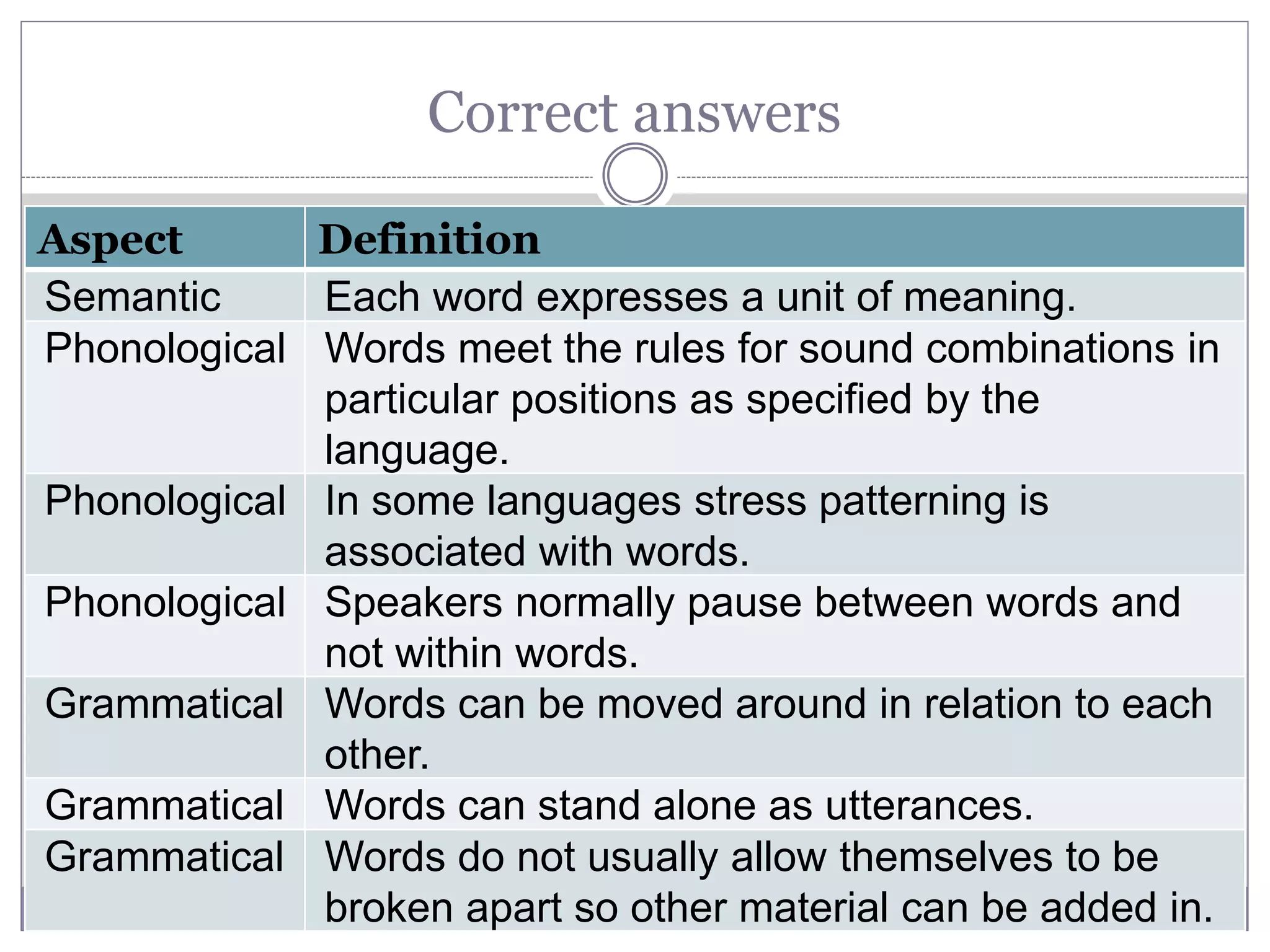
Correct answers
Aspect Definition
Semantic Each word expresses a unit of meaning.
Phonological Words meet the rules for sound combinations in
particular positions as specified by the
language.
Phonological In some languages stress patterning is
associated with words.
Phonological Speakers normally pause between words and
not within words.
Grammatical Words can be moved around in relation to each
other.
Grammatical Words can stand alone as utterances.
Grammatical Words do not usually allow themselves to be
broken apart so other material can be added in.
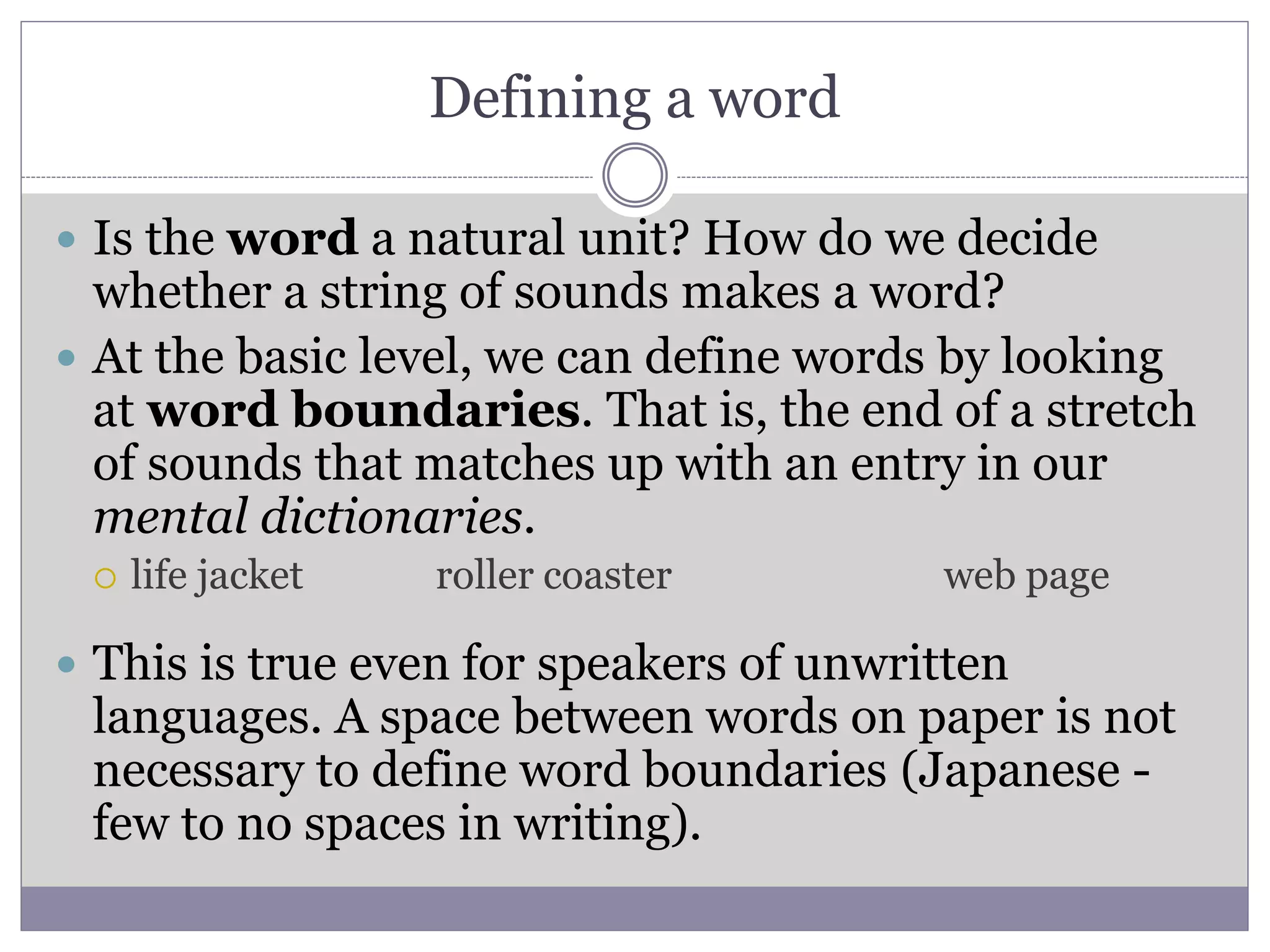
Defining a word
 Is the word a natural unit? How do we decide
whether a string of sounds makes a word?
 At the basic level, we can define words by looking
at word boundaries. That is, the end of a stretch
of sounds that matches up with an entry in our
mental dictionaries.
 life jacket roller coaster web page
 This is true even for speakers of unwritten
languages. A space between words on paper is not
necessary to define word boundaries (Japanese -
few to no spaces in writing).
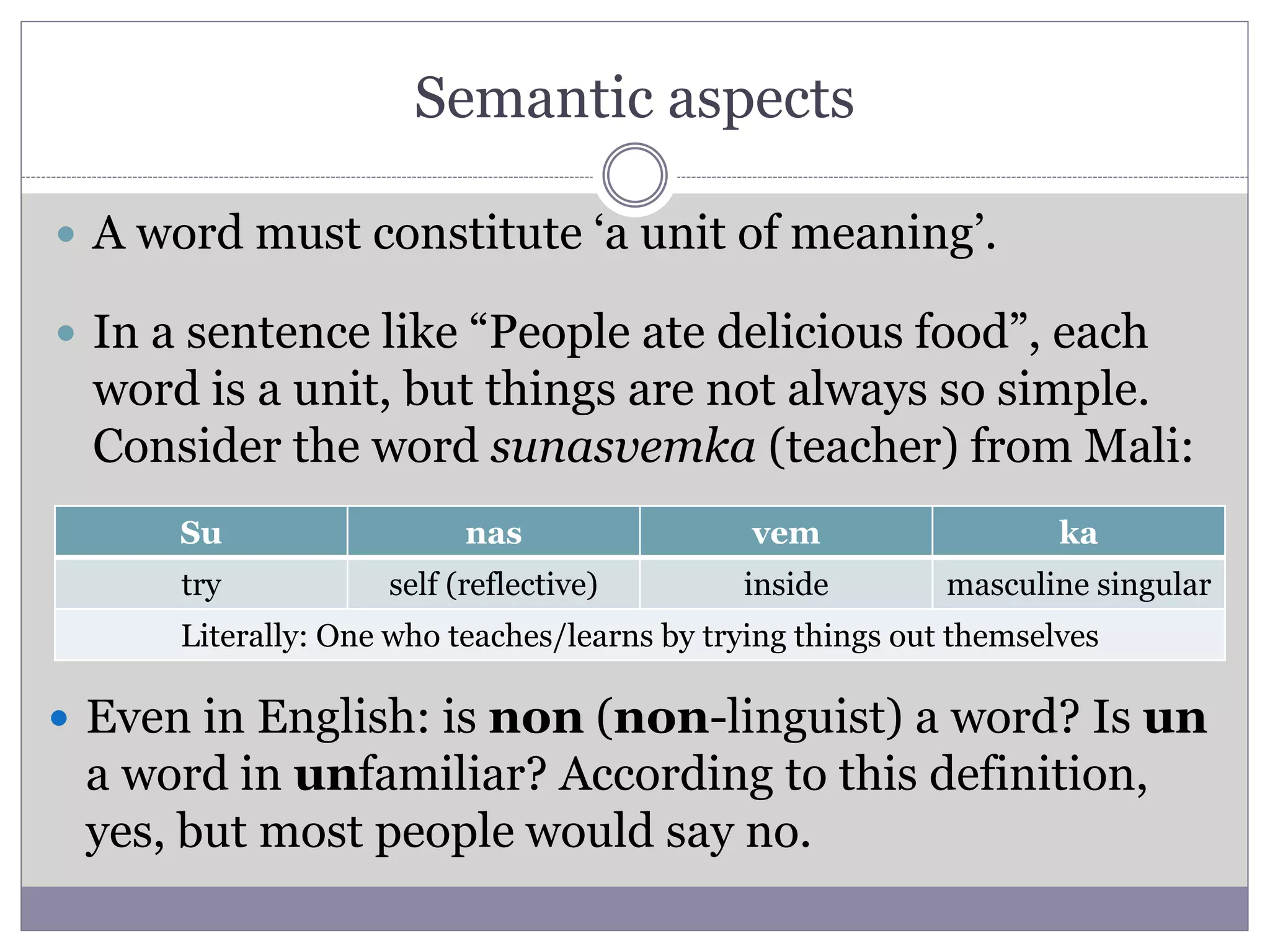
Semantic aspects
 A word must constitute ‘a unit of meaning’.
 In a sentence like “People ate delicious food”, each
word is a unit, but things are not always so simple.
Consider the word sunasvemka (teacher) from Mali:
Su nas vem ka
try self (reflective) inside masculine singular
Literally: One who teaches/learns by trying things out themselves
 Even in English: is non (non-linguist) a word? Is un
a word in unfamiliar? According to this definition,
yes, but most people would say no.
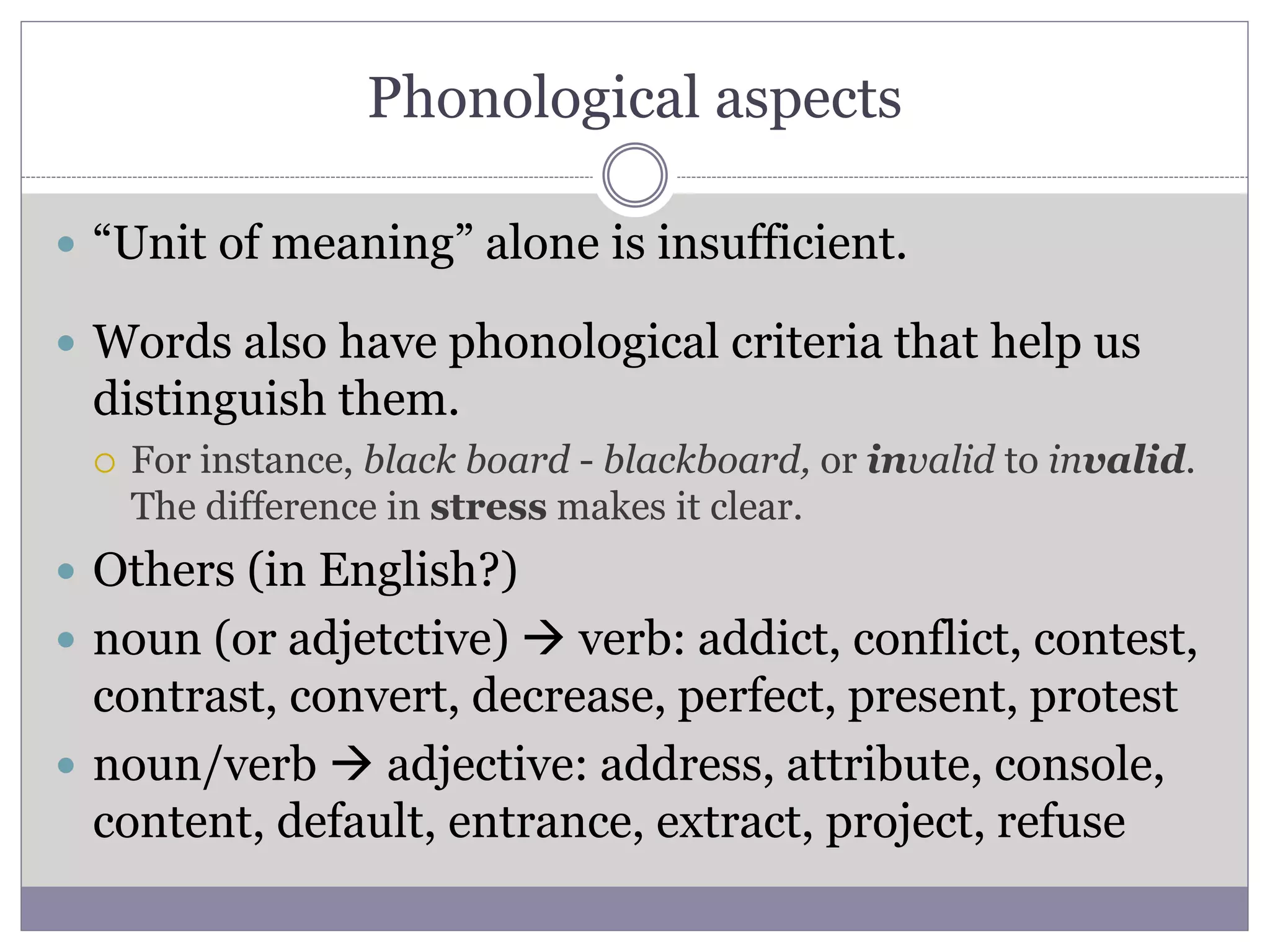
Phonological aspects
 “Unit of meaning” alone is insufficient.
 Words also have phonological criteria that help us
distinguish them.
 For instance, black board - blackboard, or invalid to invalid.
The difference in stress makes it clear.
 Others (in English?)
 noun (or adjetctive)  verb: addict, conflict, contest,
contrast, convert, decrease, perfect, present, protest
 noun/verb  adjective: address, attribute, console,
content, default, entrance, extract, project, refuse
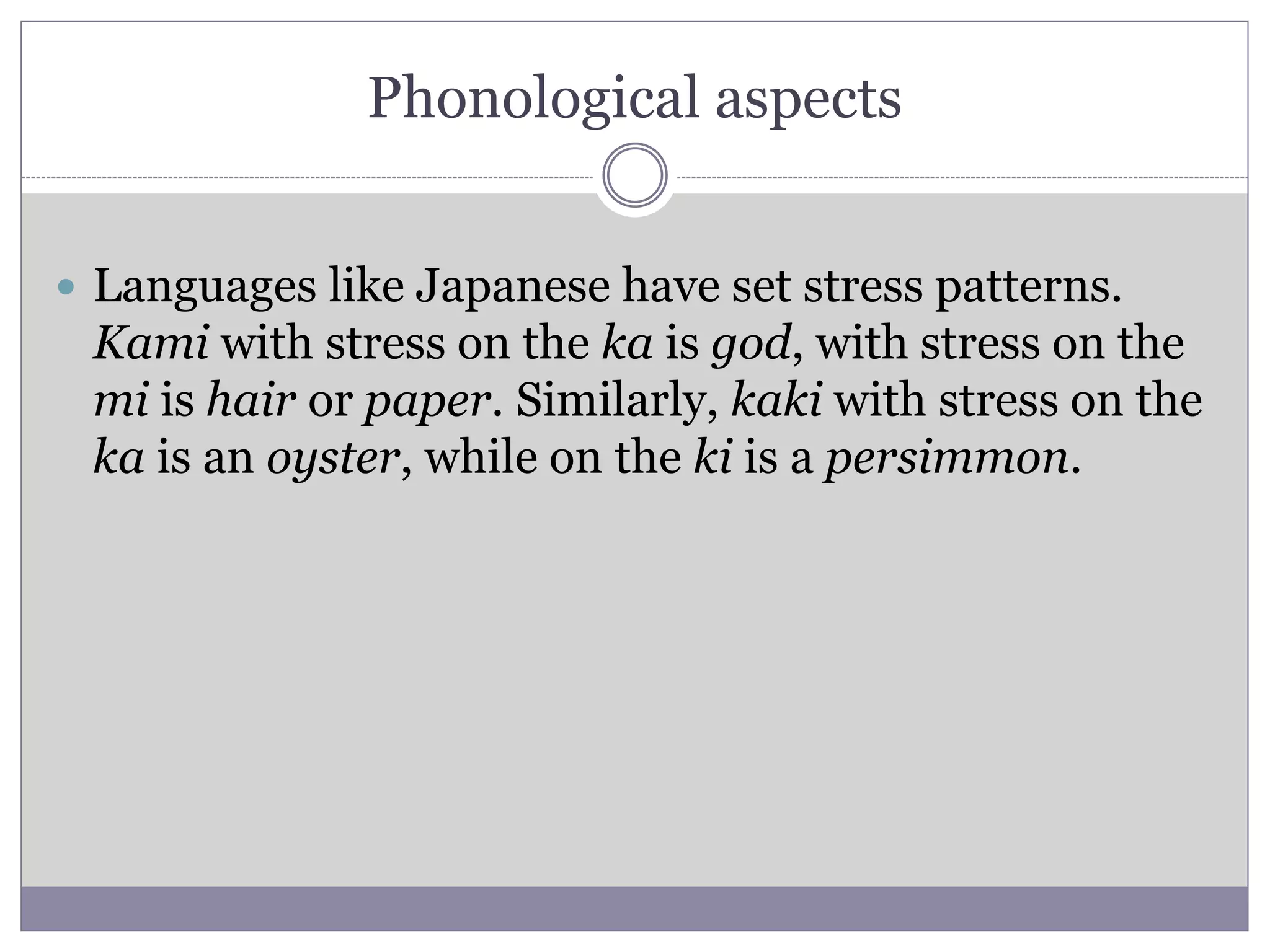
Phonological aspects
 Languages like Japanese have set stress patterns.
Kami with stress on the ka is god, with stress on the
mi is hair or paper. Similarly, kaki with stress on the
ka is an oyster, while on the ki is a persimmon.
Sounds and sequences
 Other phonological properties deal with the
sounds/sound sequences that are allowed.
 Some languages only permit certain consonants in
initial and final positions. For instance, in English
[kn] can appear at the end of a word (beckon), but
not at the beginning (we don’t pronounce the k in
knight or knee).
 Speakers also often stop to think or correct
themselves while speaking in between word
boundaries (silence, ummm, errr).
Grammatical properties
 Words are grammatical units, in that they have three
properties:
o Mobility
o Non-interruptibility
o The ability to stand alone
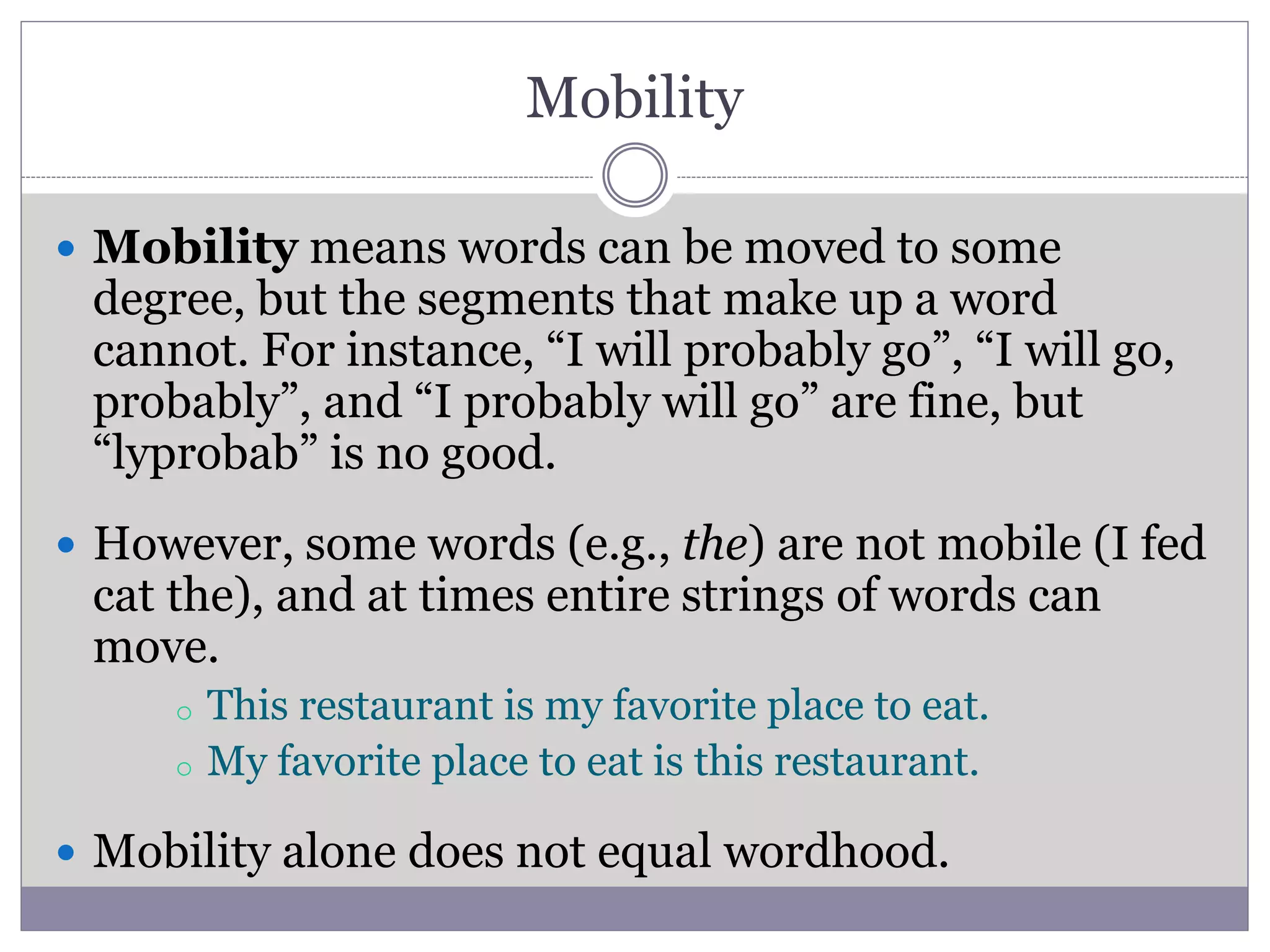
Mobility
 Mobility means words can be moved to some
degree, but the segments that make up a word
cannot. For instance, “I will probably go”, “I will go,
probably”, and “I probably will go” are fine, but
“lyprobab” is no good.
 However, some words (e.g., the) are not mobile (I fed
cat the), and at times entire strings of words can
move.
o This restaurant is my favorite place to eat.
o My favorite place to eat is this restaurant.
 Mobility alone does not equal wordhood.
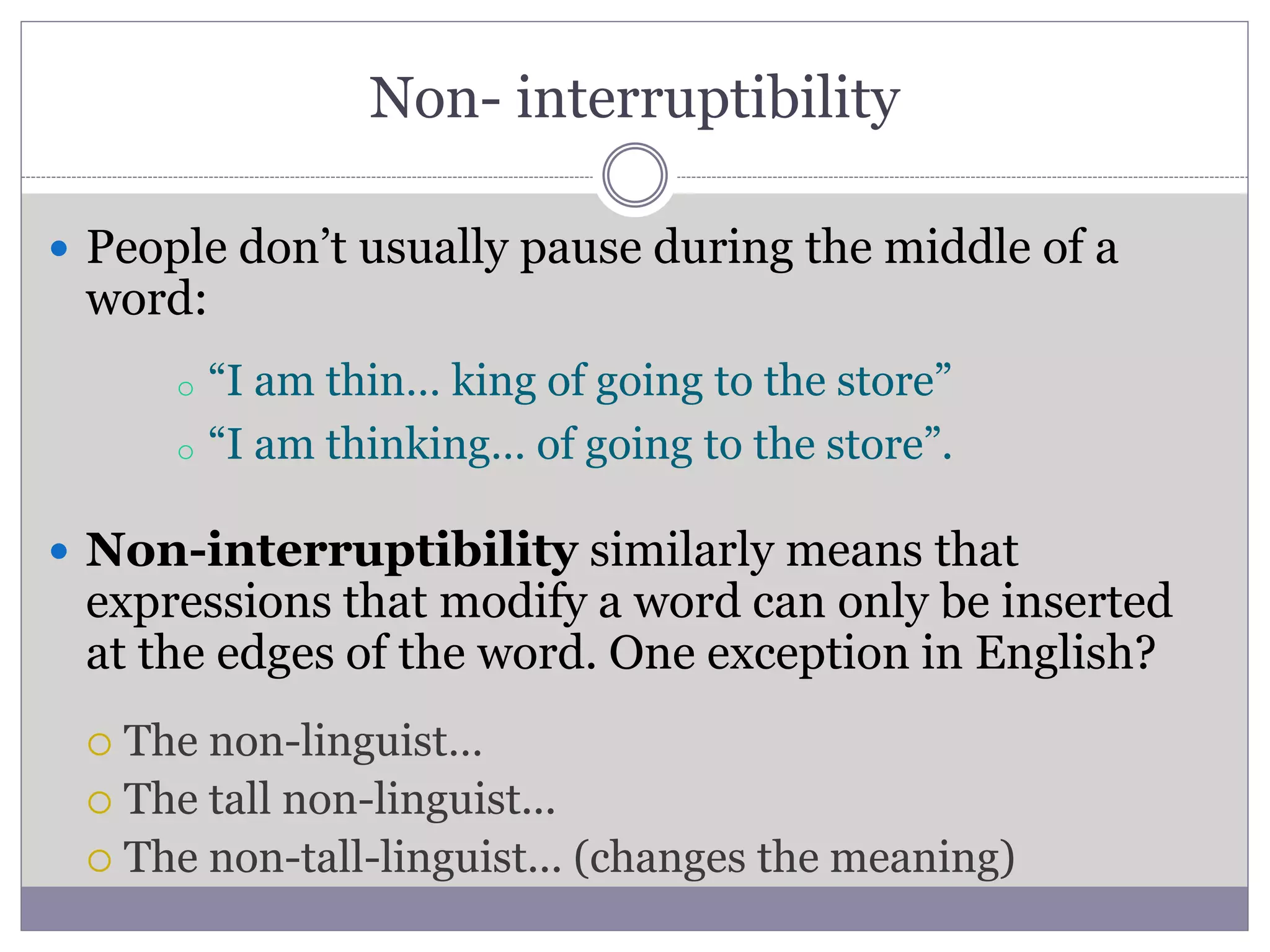
Non- interruptibility
 People don’t usually pause during the middle of a
word:
 Non-interruptibility similarly means that
expressions that modify a word can only be inserted
at the edges of the word. One exception in English?
 The non-linguist…
 The tall non-linguist...
 The non-tall-linguist... (changes the meaning)
o “I am thin… king of going to the store”
o “I am thinking… of going to the store”.
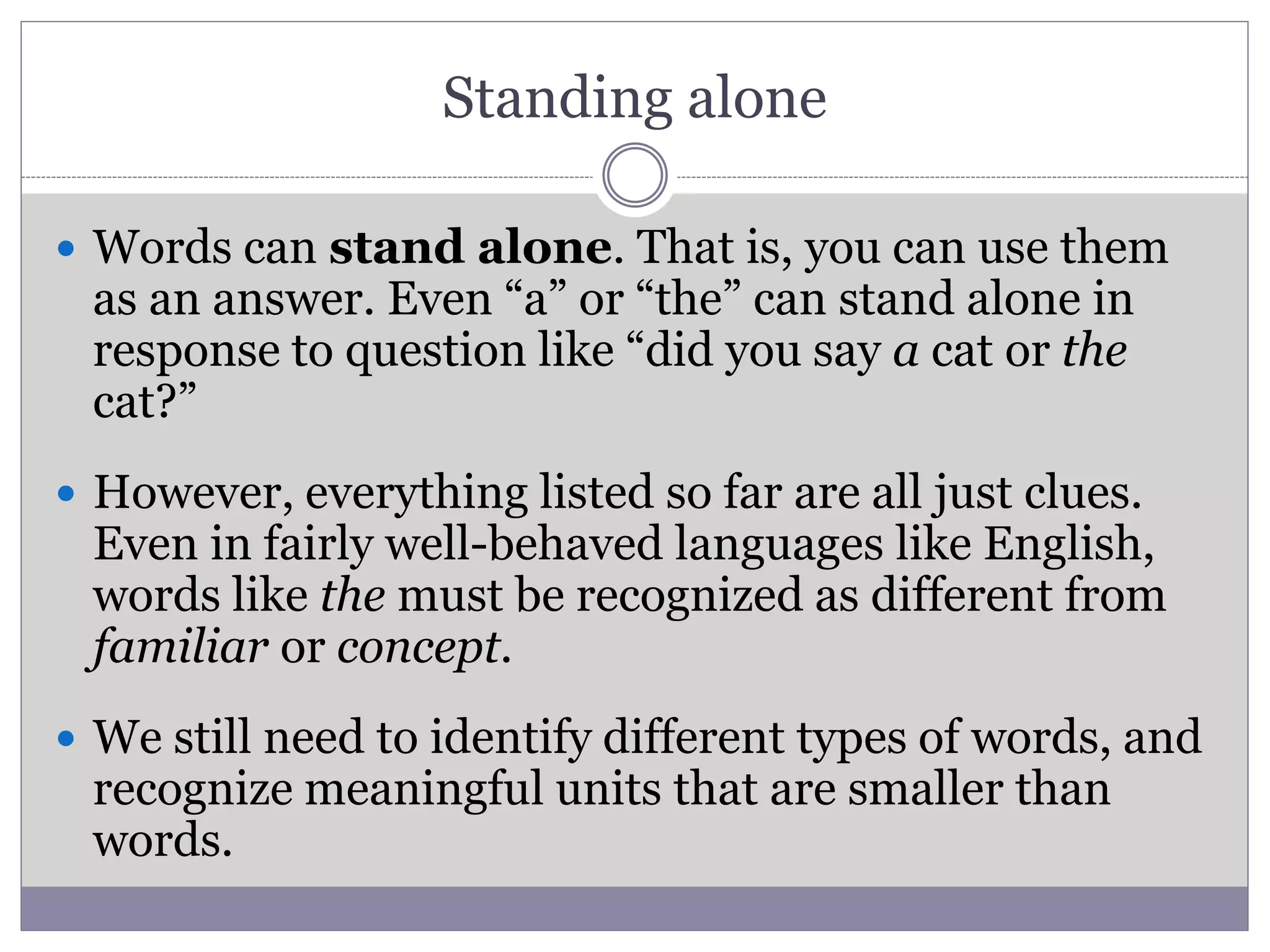
Standing alone
 Words can stand alone. That is, you can use them
as an answer. Even “a” or “the” can stand alone in
response to question like “did you say a cat or the
cat?”
 However, everything listed so far are all just clues.
Even in fairly well-behaved languages like English,
words like the must be recognized as different from
familiar or concept.
 We still need to identify different types of words, and
recognize meaningful units that are smaller than
words.
S E M A N T I C C O N T E N T A N D R E L A T I O N S H I P S
Lexical versus
grammatical words
Lexical and grammatical words
 What are lexical words and grammatical words?
 Can you name five of each in your LS?
Lexical words
 Lexical words semantic content.
 if you put an ad in the paper, you’d probably pay for mostly
(only?) lexical words.
 Lexical words (word, probably, familiar, linguistic)
are referable. They relate to aspects of human
experience that exist in the real world (although they
may vary in how concrete they are).
 Often nouns, verbs, adjectives, and adverbs.
 New ones all the time!
o Refurbished townhouse, 2,000/mo, no pets. Washer, dryer, fridge
included.
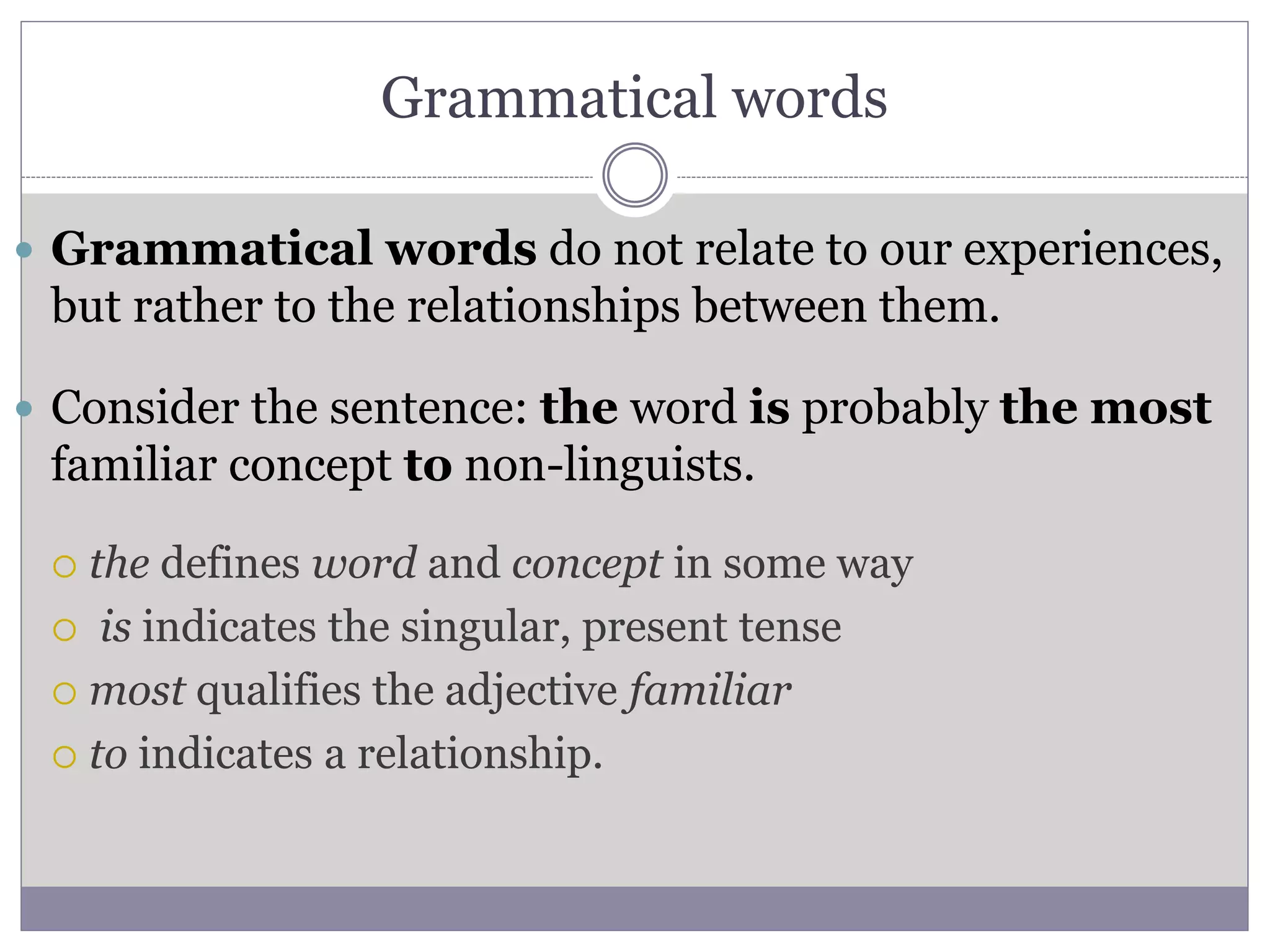
Grammatical words
 Grammatical words do not relate to our experiences,
but rather to the relationships between them.
 Consider the sentence: the word is probably the most
familiar concept to non-linguists.
 the defines word and concept in some way
 is indicates the singular, present tense
 most qualifies the adjective familiar
 to indicates a relationship.
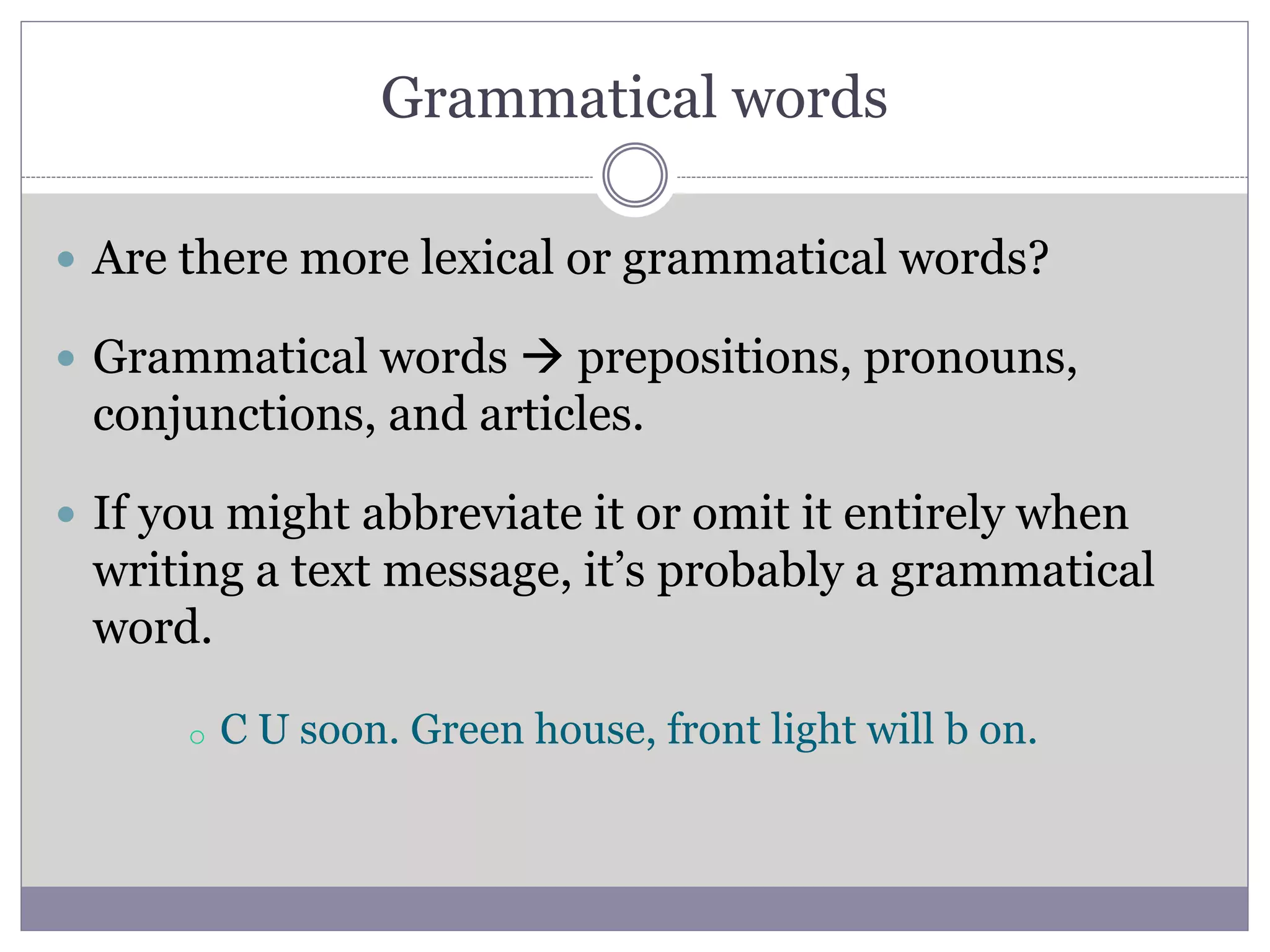
Grammatical words
 Are there more lexical or grammatical words?
 Grammatical words  prepositions, pronouns,
conjunctions, and articles.
 If you might abbreviate it or omit it entirely when
writing a text message, it’s probably a grammatical
word.
o C U soon. Green house, front light will b on.
 Create an activity in which students have to identify
examples of these.
( O R L E X I C A L C H U N K S )
Formulaic expressions
Creative potential and production
 Humans have a vast creative potential when using
language. New sentence:
 Actual production of language is more limited.
 A lot of our utterances involve prefabricated chunks of
language, sequences that have been stored and
retrieved in our minds as single units.
o Quick, grab hold of my left shoe lest the storm wash us out
of the kitchen and into the pinkish river where I met your cat.
Ready-made language
 Short phrases that function like individual words -
can’t be separated or varied.
o By and large
o So far so good
o Once and for all
 Most of these are idiomatic
 the meaning can’t be predicted from the sum of the parts
 and the parts cannot be altered in any way.
o “He bit the dust” = He is dead.
o “The dust was bitten by him” = He literally bit dust.
In your LS?
 Do you know any lexical chunks in your LS?
 Keep your eyes (ears) open! Try to find a dozen or
more lexical chunks by the end of the semester.
 Para que lo sepas
 “so that you know”
 Gravemente herido
 “seriously injured”
 Rebanada de pan
 “slice of bread”
Institutionalized expressions
 An institutionalised expression is another type
of fixed phrase.
 These are short sentences that are also fixed and
immutable, and they include proverbs, quoteable
quotes, aphorism, catchphrases, and the set word
strings we use for greetings, leave-taking, and other
politeness routines.
 Examples include long time no see, thank you for
having me, and to each his own.
 ¡Cuánto tiempo sin verte!
Some routines allow variation
 Some routines allow restricted variation. For
instance, as far as I can be followed by:
o know
o can tell
o am concerned
 Tests also show that people are sensitive to word
collocations (words that often function as a set) like
blind and date or sheer and coincidence.
 Up to 70 percent of our spoken language is
made up of different fixed expressions.
W H A T ’ S I N A N A M E ?
Magical words: names
The power of names
 Do you go by your given name?
 Do you have a nickname?
 Is it annoying when someone mispronounces your
name?
 What do you think about this section?
The power of names
 Throughout history, many people have attributed
supernatural powers to names. From the Egyptian
sun god Ra to Rumpelstiltskin, there are many
stories where knowing a name means having power
over the person.
 In many parts of the world, personal names have
been or still are taboo. Sorcerers can harm a person
if they possess the person’s true name. Here, a name
is not just a symbol of a person, but a proper part of
them, a verbal expression of their personality.
Names as an inalienable possession
 For example, in the aboriginal language
Pitjantjatjara, a name is treated similar to body
parts, but differently from a boomerang. Contrast the
endings of (a) and (b) with (c):
(a) My name ngayu-nya ini
1:SG-ACCUSATIVE name
(b) My hand ngayu-nya mara
1:SG-ACCUSATIVE hand
(c) My boomerang ngayu-ku karli
1:SG-POSSESSIVE boomerang
True names and name bearers
 In societies where names are treated as an
inalienable possession, sometimes no two living
persons can go by the same name.
 Furthermore, true names are often secret
(substitution names are used in public), and the
names of the dead are often taboo.
 In many traditional Australian Aboriginal
communities, any vocabulary item can be proscribed
if it is the same or similar to the name of a recently
dead person. Replacements are created through
shifting, borrowing, or even hand gestures.
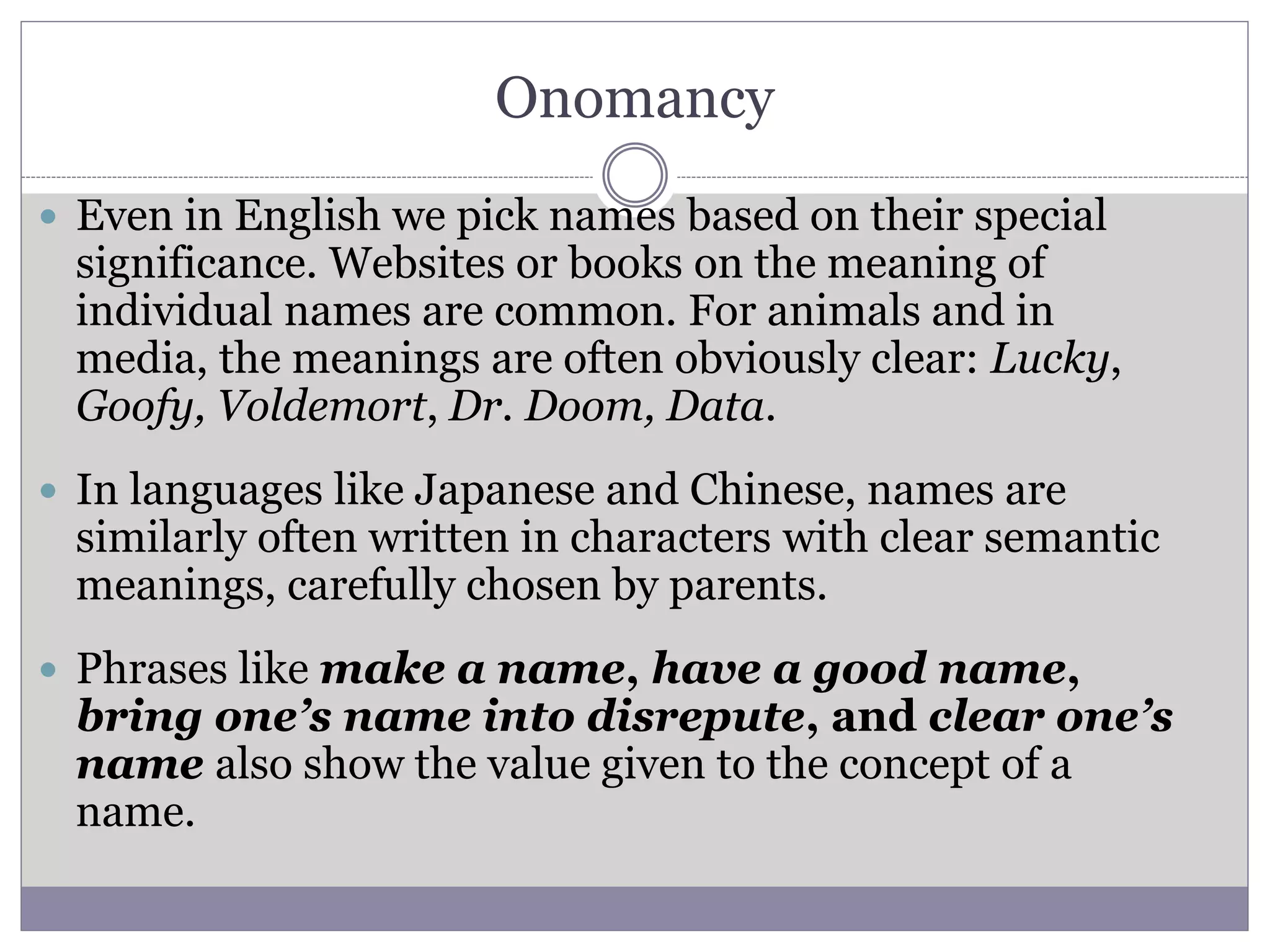
Onomancy
 Even in English we pick names based on their special
significance. Websites or books on the meaning of
individual names are common. For animals and in
media, the meanings are often obviously clear: Lucky,
Goofy, Voldemort, Dr. Doom, Data.
 In languages like Japanese and Chinese, names are
similarly often written in characters with clear semantic
meanings, carefully chosen by parents.
 Phrases like make a name, have a good name,
bring one’s name into disrepute, and clear one’s
name also show the value given to the concept of a
name.
T H E C R E A T I O N / C O I N A G E O F W O R D S
Lexical addition
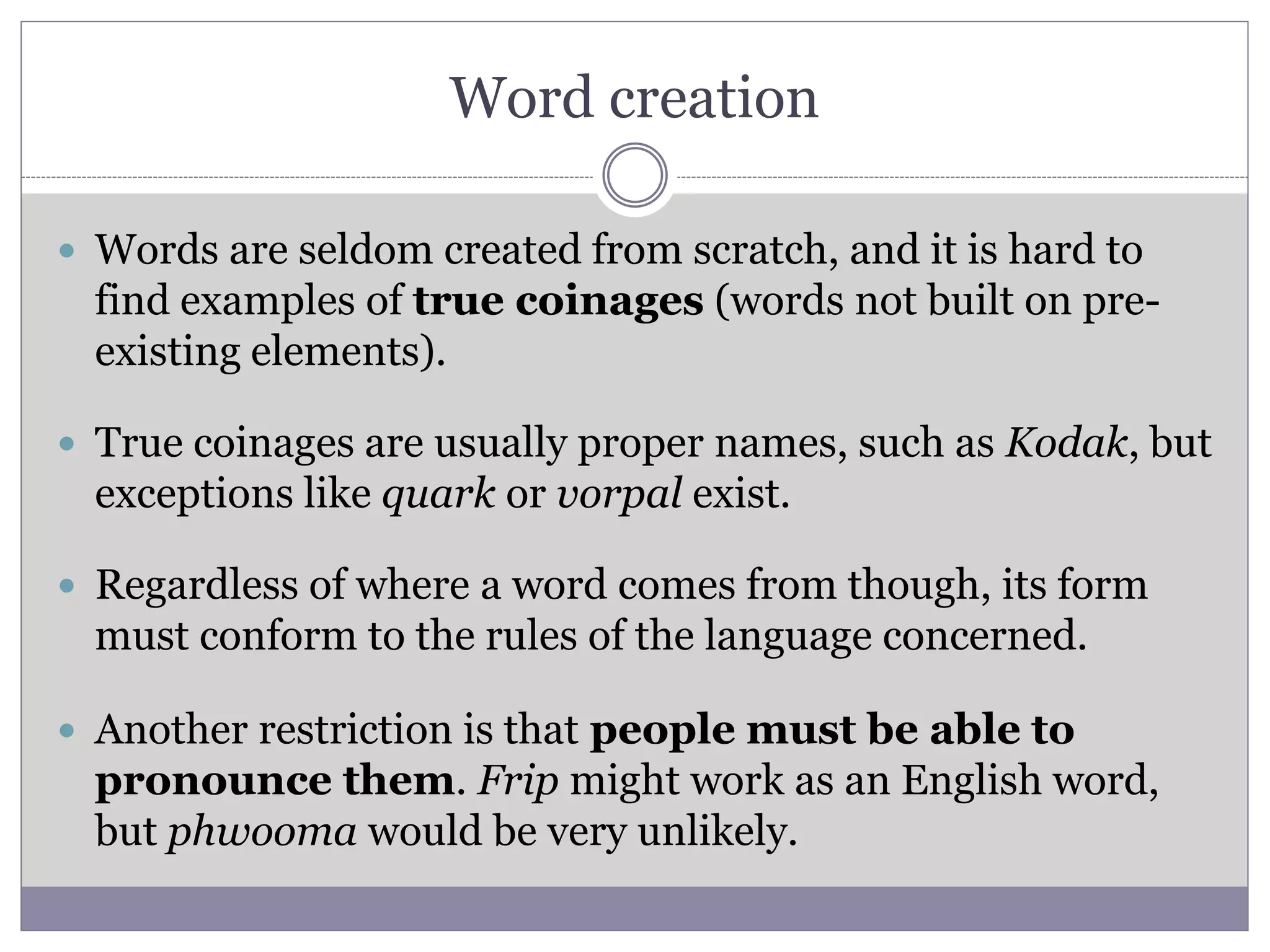
Word creation
 Words are seldom created from scratch, and it is hard to
find examples of true coinages (words not built on pre-
existing elements).
 True coinages are usually proper names, such as Kodak, but
exceptions like quark or vorpal exist.
 Regardless of where a word comes from though, its form
must conform to the rules of the language concerned.
 Another restriction is that people must be able to
pronounce them. Frip might work as an English word,
but phwooma would be very unlikely.
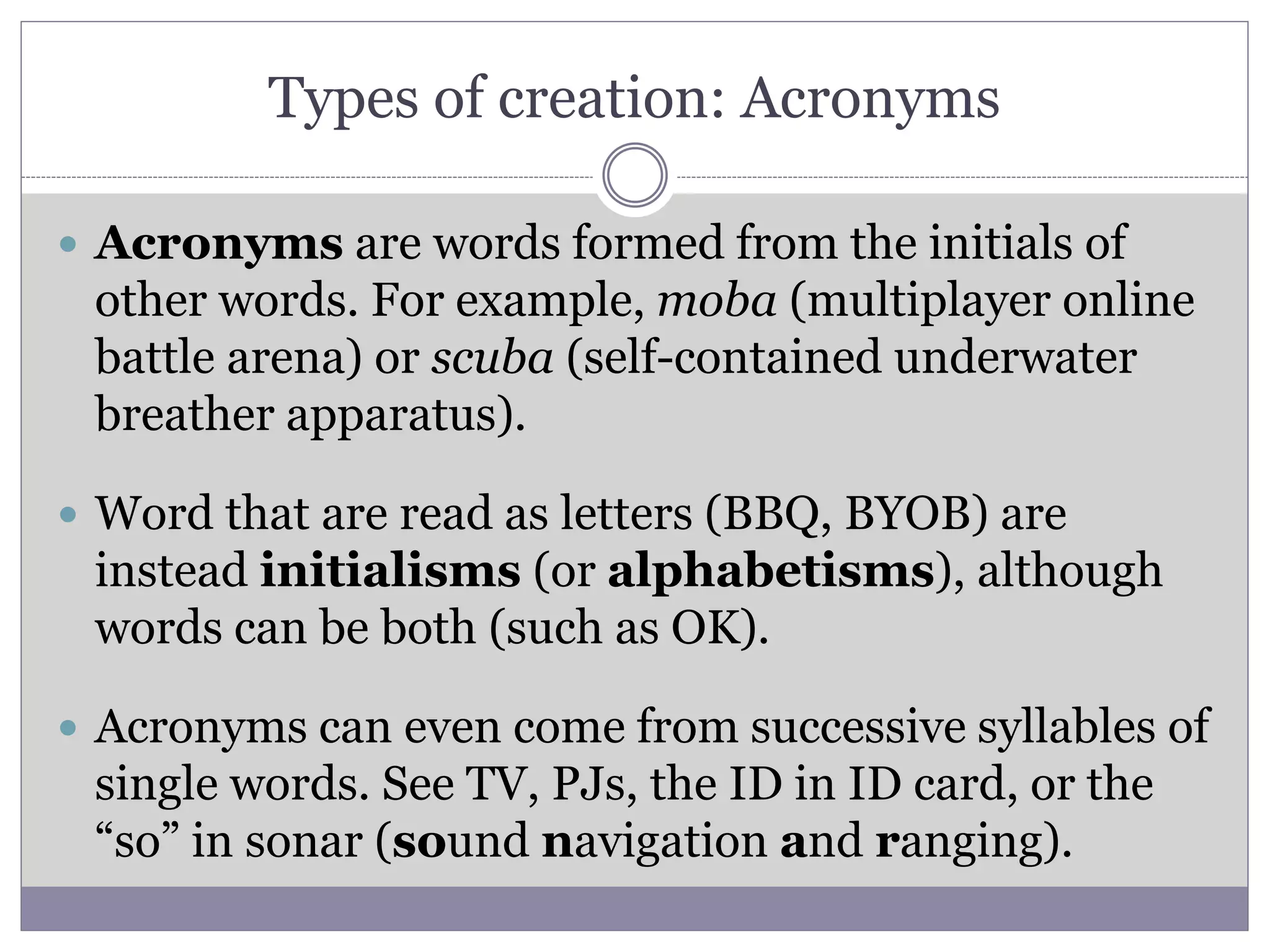
Types of creation: Acronyms
 Acronyms are words formed from the initials of
other words. For example, moba (multiplayer online
battle arena) or scuba (self-contained underwater
breather apparatus).
 Word that are read as letters (BBQ, BYOB) are
instead initialisms (or alphabetisms), although
words can be both (such as OK).
 Acronyms can even come from successive syllables of
single words. See TV, PJs, the ID in ID card, or the
“so” in sonar (sound navigation and ranging).
Types of creation: Acronyms (2)
 Acronyms are common, but rarely become part of the
general lexicon as anything other than proper nouns unless
they manage to stay around for a while.
 Often times, the original source is forgotten. Consider “HIV
(human immuno-deficiency) virus”, “PIN (personal
identification number) number”, “ATM (automatic teller
machine) machine”.
 Backronyms occur when acronyms are purposefully
created through fiddling with the sequence of words, such
as the USA PATRIOT ("Uniting and Strengthening
America by Providing Appropriate Tools Required to
Intercept and Obstruct Terrorism”) act.
Acronyms in your LS?

Chapter 4.1.pptx

  • 1.
    D E FI N I T I O N S , C H A R A C T E R I S T I C S , A N D P O W E R 4.1 What’s in a word?
  • 2.
    Japanese writing systems https://www.youtube.com/watch?v=CFq2Y43DY0U
  • 3.
    W O RD S A L L A R O U N D U S Defining a word
  • 4.
    Introduction  The wordis probably the most familiar linguistic concept to non-linguists.  People love playing with words and creating new expressions, or neologisms, and the strange facts about their lexicon (the vocabulary of their language as a whole).  However, despite all this talk about words, it can be more difficult than we think to pin down a definition.
  • 5.
    “Word” definition  Asingle distinct meaningful element of speech or writing, used with others (or sometimes alone) to form a sentence and typically shown with a space on either side when written or printed.  What’s right (or wrong) with this?
  • 6.
    Introduction  What wordsdo you love in English and/or your LS?  Any particular reason?  What words to you not like? Why don’t you like them?  Is it hard to distinguish individual spoken words in your LS?  Words I like:  crepúsculo, burbuja, equanimity  Words I don’t:  escuece, pescuezo (Spanish accent)
  • 7.
    Webster English DictionaryWord of the Year?  Gaslighting  : psychological manipulation of a person usually over an extended period of time that causes the victim to question the validity of their own thoughts, perception of reality, or memories and typically leads to confusion, loss of confidence and self-esteem, uncertainty of one's emotional or mental stability, and a dependency on the perpetrator
  • 8.
    Oxford English DictionaryWord of the Year?  Goblin mode:  a type of behavior which is unapologetically self- indulgent, lazy, slovenly or greedy, typically in a way that rejects social norms or expectations
  • 9.
    Why is theconcept “word” hard to define?  finna – gonna  cart + wheel  bill + board  remote + control =  Define “get”  What is this:  The active principle of burning or combustion, manifested by the evolution of light and heat.
  • 10.
    Three facets ofwordhood  What are they?  Semantic aspects  Word constitutes a “unit of meaning”  Phonological aspects  Words are units of sound with rules that govern stress and possible and impossible sounds  Grammatical aspects  you can’t move the segments of the word, but can move the word around
  • 11.
    Match each facetof wordhood to the appropriate statement about words. Feature Definition Semantic aspects Words can be moved around in relation to each other. Phonological aspects Words do not usually allow themselves to be broken apart so other material can be added in. Phonological aspects In some languages stress patterning is associated with words. Phonological aspects Each word expresses a unit of meaning. Grammatical aspects Speakers normally pause between words and not within words. Grammatical aspects Words can stand alone as utterances. Grammatical aspects Words meet the rules for sound combinations in particular positions as specified by the language.
  • 12.
    Correct answers Aspect Definition SemanticEach word expresses a unit of meaning. Phonological Words meet the rules for sound combinations in particular positions as specified by the language. Phonological In some languages stress patterning is associated with words. Phonological Speakers normally pause between words and not within words. Grammatical Words can be moved around in relation to each other. Grammatical Words can stand alone as utterances. Grammatical Words do not usually allow themselves to be broken apart so other material can be added in.
  • 13.
    Defining a word Is the word a natural unit? How do we decide whether a string of sounds makes a word?  At the basic level, we can define words by looking at word boundaries. That is, the end of a stretch of sounds that matches up with an entry in our mental dictionaries.  life jacket roller coaster web page  This is true even for speakers of unwritten languages. A space between words on paper is not necessary to define word boundaries (Japanese - few to no spaces in writing).
  • 14.
    Semantic aspects  Aword must constitute ‘a unit of meaning’.  In a sentence like “People ate delicious food”, each word is a unit, but things are not always so simple. Consider the word sunasvemka (teacher) from Mali: Su nas vem ka try self (reflective) inside masculine singular Literally: One who teaches/learns by trying things out themselves  Even in English: is non (non-linguist) a word? Is un a word in unfamiliar? According to this definition, yes, but most people would say no.
  • 15.
    Phonological aspects  “Unitof meaning” alone is insufficient.  Words also have phonological criteria that help us distinguish them.  For instance, black board - blackboard, or invalid to invalid. The difference in stress makes it clear.  Others (in English?)  noun (or adjetctive)  verb: addict, conflict, contest, contrast, convert, decrease, perfect, present, protest  noun/verb  adjective: address, attribute, console, content, default, entrance, extract, project, refuse
  • 16.
    Phonological aspects  Languageslike Japanese have set stress patterns. Kami with stress on the ka is god, with stress on the mi is hair or paper. Similarly, kaki with stress on the ka is an oyster, while on the ki is a persimmon.
  • 17.
    Sounds and sequences Other phonological properties deal with the sounds/sound sequences that are allowed.  Some languages only permit certain consonants in initial and final positions. For instance, in English [kn] can appear at the end of a word (beckon), but not at the beginning (we don’t pronounce the k in knight or knee).  Speakers also often stop to think or correct themselves while speaking in between word boundaries (silence, ummm, errr).
  • 18.
    Grammatical properties  Wordsare grammatical units, in that they have three properties: o Mobility o Non-interruptibility o The ability to stand alone
  • 19.
    Mobility  Mobility meanswords can be moved to some degree, but the segments that make up a word cannot. For instance, “I will probably go”, “I will go, probably”, and “I probably will go” are fine, but “lyprobab” is no good.  However, some words (e.g., the) are not mobile (I fed cat the), and at times entire strings of words can move. o This restaurant is my favorite place to eat. o My favorite place to eat is this restaurant.  Mobility alone does not equal wordhood.
  • 20.
    Non- interruptibility  Peopledon’t usually pause during the middle of a word:  Non-interruptibility similarly means that expressions that modify a word can only be inserted at the edges of the word. One exception in English?  The non-linguist…  The tall non-linguist...  The non-tall-linguist... (changes the meaning) o “I am thin… king of going to the store” o “I am thinking… of going to the store”.
  • 21.
    Standing alone  Wordscan stand alone. That is, you can use them as an answer. Even “a” or “the” can stand alone in response to question like “did you say a cat or the cat?”  However, everything listed so far are all just clues. Even in fairly well-behaved languages like English, words like the must be recognized as different from familiar or concept.  We still need to identify different types of words, and recognize meaningful units that are smaller than words.
  • 22.
    S E MA N T I C C O N T E N T A N D R E L A T I O N S H I P S Lexical versus grammatical words
  • 24.
    Lexical and grammaticalwords  What are lexical words and grammatical words?  Can you name five of each in your LS?
  • 25.
    Lexical words  Lexicalwords semantic content.  if you put an ad in the paper, you’d probably pay for mostly (only?) lexical words.  Lexical words (word, probably, familiar, linguistic) are referable. They relate to aspects of human experience that exist in the real world (although they may vary in how concrete they are).  Often nouns, verbs, adjectives, and adverbs.  New ones all the time! o Refurbished townhouse, 2,000/mo, no pets. Washer, dryer, fridge included.
  • 26.
    Grammatical words  Grammaticalwords do not relate to our experiences, but rather to the relationships between them.  Consider the sentence: the word is probably the most familiar concept to non-linguists.  the defines word and concept in some way  is indicates the singular, present tense  most qualifies the adjective familiar  to indicates a relationship.
  • 27.
    Grammatical words  Arethere more lexical or grammatical words?  Grammatical words  prepositions, pronouns, conjunctions, and articles.  If you might abbreviate it or omit it entirely when writing a text message, it’s probably a grammatical word. o C U soon. Green house, front light will b on.
  • 28.
     Create anactivity in which students have to identify examples of these.
  • 29.
    ( O RL E X I C A L C H U N K S ) Formulaic expressions
  • 30.
    Creative potential andproduction  Humans have a vast creative potential when using language. New sentence:  Actual production of language is more limited.  A lot of our utterances involve prefabricated chunks of language, sequences that have been stored and retrieved in our minds as single units. o Quick, grab hold of my left shoe lest the storm wash us out of the kitchen and into the pinkish river where I met your cat.
  • 31.
    Ready-made language  Shortphrases that function like individual words - can’t be separated or varied. o By and large o So far so good o Once and for all  Most of these are idiomatic  the meaning can’t be predicted from the sum of the parts  and the parts cannot be altered in any way. o “He bit the dust” = He is dead. o “The dust was bitten by him” = He literally bit dust.
  • 32.
    In your LS? Do you know any lexical chunks in your LS?  Keep your eyes (ears) open! Try to find a dozen or more lexical chunks by the end of the semester.  Para que lo sepas  “so that you know”  Gravemente herido  “seriously injured”  Rebanada de pan  “slice of bread”
  • 33.
    Institutionalized expressions  Aninstitutionalised expression is another type of fixed phrase.  These are short sentences that are also fixed and immutable, and they include proverbs, quoteable quotes, aphorism, catchphrases, and the set word strings we use for greetings, leave-taking, and other politeness routines.  Examples include long time no see, thank you for having me, and to each his own.  ¡Cuánto tiempo sin verte!
  • 34.
    Some routines allowvariation  Some routines allow restricted variation. For instance, as far as I can be followed by: o know o can tell o am concerned  Tests also show that people are sensitive to word collocations (words that often function as a set) like blind and date or sheer and coincidence.  Up to 70 percent of our spoken language is made up of different fixed expressions.
  • 35.
    W H AT ’ S I N A N A M E ? Magical words: names
  • 36.
    The power ofnames  Do you go by your given name?  Do you have a nickname?  Is it annoying when someone mispronounces your name?  What do you think about this section?
  • 37.
    The power ofnames  Throughout history, many people have attributed supernatural powers to names. From the Egyptian sun god Ra to Rumpelstiltskin, there are many stories where knowing a name means having power over the person.  In many parts of the world, personal names have been or still are taboo. Sorcerers can harm a person if they possess the person’s true name. Here, a name is not just a symbol of a person, but a proper part of them, a verbal expression of their personality.
  • 38.
    Names as aninalienable possession  For example, in the aboriginal language Pitjantjatjara, a name is treated similar to body parts, but differently from a boomerang. Contrast the endings of (a) and (b) with (c): (a) My name ngayu-nya ini 1:SG-ACCUSATIVE name (b) My hand ngayu-nya mara 1:SG-ACCUSATIVE hand (c) My boomerang ngayu-ku karli 1:SG-POSSESSIVE boomerang
  • 39.
    True names andname bearers  In societies where names are treated as an inalienable possession, sometimes no two living persons can go by the same name.  Furthermore, true names are often secret (substitution names are used in public), and the names of the dead are often taboo.  In many traditional Australian Aboriginal communities, any vocabulary item can be proscribed if it is the same or similar to the name of a recently dead person. Replacements are created through shifting, borrowing, or even hand gestures.
  • 40.
    Onomancy  Even inEnglish we pick names based on their special significance. Websites or books on the meaning of individual names are common. For animals and in media, the meanings are often obviously clear: Lucky, Goofy, Voldemort, Dr. Doom, Data.  In languages like Japanese and Chinese, names are similarly often written in characters with clear semantic meanings, carefully chosen by parents.  Phrases like make a name, have a good name, bring one’s name into disrepute, and clear one’s name also show the value given to the concept of a name.
  • 41.
    T H EC R E A T I O N / C O I N A G E O F W O R D S Lexical addition
  • 42.
    Word creation  Wordsare seldom created from scratch, and it is hard to find examples of true coinages (words not built on pre- existing elements).  True coinages are usually proper names, such as Kodak, but exceptions like quark or vorpal exist.  Regardless of where a word comes from though, its form must conform to the rules of the language concerned.  Another restriction is that people must be able to pronounce them. Frip might work as an English word, but phwooma would be very unlikely.
  • 43.
    Types of creation:Acronyms  Acronyms are words formed from the initials of other words. For example, moba (multiplayer online battle arena) or scuba (self-contained underwater breather apparatus).  Word that are read as letters (BBQ, BYOB) are instead initialisms (or alphabetisms), although words can be both (such as OK).  Acronyms can even come from successive syllables of single words. See TV, PJs, the ID in ID card, or the “so” in sonar (sound navigation and ranging).
  • 44.
    Types of creation:Acronyms (2)  Acronyms are common, but rarely become part of the general lexicon as anything other than proper nouns unless they manage to stay around for a while.  Often times, the original source is forgotten. Consider “HIV (human immuno-deficiency) virus”, “PIN (personal identification number) number”, “ATM (automatic teller machine) machine”.  Backronyms occur when acronyms are purposefully created through fiddling with the sequence of words, such as the USA PATRIOT ("Uniting and Strengthening America by Providing Appropriate Tools Required to Intercept and Obstruct Terrorism”) act.
  • 45.