Planning for Substation
Maintenance and Reliability
Thank You To Our Sponsor
Before We Start
 This webinar will be available at
www.windpowerengineering.com & email
 Q&A at the end of the presentation
 Hashtag for this webinar: #WindWebinar
Moderator Presenters
Nic Sharpley
Windpower Engineering
& Development
Chris Petrola
Acciona Energy North America
Paul Idziak
Shermco Industries
5
How to Properly Plan Your
Substation Maintenance
Chris Petrola – Acciona Energy
Paul Idziak – Shermco Industries
6
What Steps does an owner have to take to properly plan a
substation maintenance?
Understanding the steps the contractor has to take in
order to ensure the outage is performed to the owner’s
expectations
What are the synergies between the owner and contractor
to help reduce downtime and ensure a successful
outage?
Objectives
7
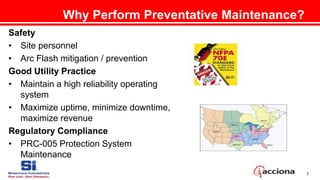
Why Perform Preventative Maintenance?
Safety
• Site personnel
• Arc Flash mitigation / prevention
Good Utility Practice
• Maintain a high reliability operating
system
• Maximize uptime, minimize downtime,
maximize revenue
Regulatory Compliance
• PRC-005 Protection System
Maintenance
8
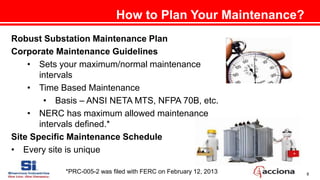
How to Plan Your Maintenance?
Robust Substation Maintenance Plan
Corporate Maintenance Guidelines
• Sets your maximum/normal maintenance
intervals
• Time Based Maintenance
• Basis – ANSI NETA MTS, NFPA 70B, etc.
• NERC has maximum allowed maintenance
intervals defined.*
Site Specific Maintenance Schedule
• Every site is unique
*PRC-005-2 was filed with FERC on February 12, 2013
9
How to Plan Your Maintenance?
Data Gathering
Monthly Inspections
• Visual Inspection
• High corona / PD
• Rust forming
• Insulator damage
• Trend temperatures, oil levels, etc.
Previous Years Report
• Punch List of Items
• Test Results
Predictive Maintenance
• IR Scans
• Corona Scans
• Insulating oil analytics
10
How to Plan Your Maintenance?
Substation Maintenance Work Scope
Key Items Needed to Create Your
Work Scope
• Previous years report info
• Monthly inspections
• Predictive maintenance test results
• Standard time based maintenance
• Recognized international consensus
standards
• Regulatory Standards
11
How to Plan Your Maintenance?
Substation Maintenance Work Scope
What Should Your Work Scope Contain?
• General Site Requirements
• Outage Date(s)
• Equipment List
• All Equipment
• Equipment to be tested / maintained
• Relay List – Manufacture and Style
• Scope of Work
• Time Based Items
• Inspections, cleaning, greasing
• Testing to be performed
• Maintenance Items
• Built from the data gathered – Inspections, test results, IR scans,
oil samples
• Contingency planning
12
How to Plan Your Maintenance?
Substation Maintenance Work Scope
What Should Your Work Scope Contain? (Cont.)
• Reporting Requirements
• Data Format
 Relay files
 Excel
• Test data sheets (Yours or Contractors?)
• Final Report Format and Schedule
• Technician Requirements
• Skill qualifications
• Consensus based certifications?
• Electrical One-Line diagrams
• Control diagrams/schematics
13
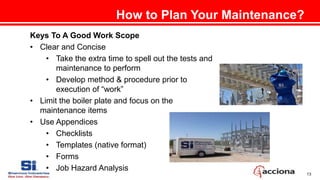
Keys To A Good Work Scope
• Clear and Concise
• Take the extra time to spell out the tests and
maintenance to perform
• Develop method & procedure prior to
execution of “work”
• Limit the boiler plate and focus on the
maintenance items
• Use Appendices
• Checklists
• Templates (native format)
• Forms
• Job Hazard Analysis
How to Plan Your Maintenance?
14
Proposal Stage
• Open communication with end user
– Ensure SOW is clearly defined
– Verification of outage schedule
– Verification of type of equipment and amount
– Agree upon equipment counts
– Understanding of PRC-005 requirements
– Onsite safety requirements
– Other contractors onsite
15
After Receipt of PO
• Internally
– Assign project manager to substation shutdown project
– Review proposal for clarity and understanding
– Develop initial schedule/plan for completing project
• With Customer
– Project Kickoff meeting
 Walk thru proposal, RFP, and SOW
 Determine goals for project
 Contingency plans
 Information Requests
16
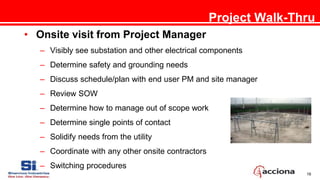
Project Walk-Thru
• Onsite visit from Project Manager
– Visibly see substation and other electrical components
– Determine safety and grounding needs
– Discuss schedule/plan with end user PM and site manager
– Review SOW
– Determine how to manage out of scope work
– Determine single points of contact
– Solidify needs from the utility
– Coordinate with any other onsite contractors
– Switching procedures
17
Pre-Outage Planning
• Determine test equipment needed
– Oil sample bottles
– Cameras (IR, Corona)
– PD Testers
• Schedule technicians with correct skill sets
• Make transportation arrangements
– Flights
• Solidify mobilization methods
– Equipment
– Personnel from remote offices
18
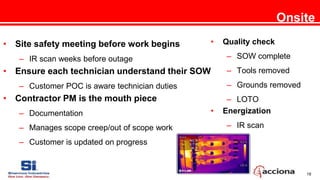
Onsite
• Site safety meeting before work begins
– IR scan weeks before outage
• Ensure each technician understand their SOW
– Customer POC is aware technician duties
• Contractor PM is the mouth piece
– Documentation
– Manages scope creep/out of scope work
– Customer is updated on progress
• Quality check
– SOW complete
– Tools removed
– Grounds removed
– LOTO
• Energization
– IR scan
19
During the Outage
• Safety
– Site specific safety / Job Safety Analysis
– Site de-energizing: Have your switching procedure reviewed and in place before the outage in
order to not occur delays
– Review all LOTO and grounding locations. Keep a record of all grounds placed in the system
• Communication
– Have one clear point of contact for the site
– Make timely decisions
– Beware of scope changes, items that can increase cost or outage time.
• Quality
– Perform a quality audit of your contractor
– Verify all test equipment is calibrated
– Verify the work scope has been completed in full
– Document deficiencies found
20
Post-Outage
• Final Report
– Received in a timely manner
 Note: Specify timing in work scope
– Verify all tests completed are in the report
– Verify the report is in the required format
 Forms and templates provided in the Work Scope
 Agreed upon forms before or during the maintenance
• Maintenance Schedule Modifications
– Based on the final report and site observations:
 You may want to shift your time based testing and maintenances
 You may want to perform additional testing. I.E. Corona, PD, etc.
21
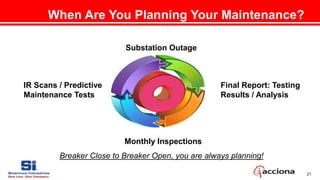
Substation Outage
Final Report: Testing
Results / Analysis
Monthly Inspections
IR Scans / Predictive
Maintenance Tests
When Are You Planning Your Maintenance?
Breaker Close to Breaker Open, you are always planning!
22
Questions or Comments?
Discussion
Questions?
Nic Sharpley
Windpower Engineering & Development
nsharpley@wtwhmedia.com
Twitter: @WPE_Nic
Paul Idziak
Shermco Industries
pidziak@shermco.com
Phone: 972.793.5523
Twitter: @Paul_Idziak
Chris Petrola
Acciona Energy North America
cpetrola@acciona-na.com
Phone: 312.673.3085
Thank You
 This webinar will be available at
www.windpowerengineering.com & email
 Tweet with hashtag #WindWebinar
 Connect with Windpower Engineering & Development
 Discuss this on the EngineeringExchange.com

Planning for Substation Maintenance and Reliability

  • 1.
  • 2.
    Thank You ToOur Sponsor
  • 3.
    Before We Start This webinar will be available at www.windpowerengineering.com & email  Q&A at the end of the presentation  Hashtag for this webinar: #WindWebinar
  • 4.
    Moderator Presenters Nic Sharpley WindpowerEngineering & Development Chris Petrola Acciona Energy North America Paul Idziak Shermco Industries
  • 5.
    5 How to ProperlyPlan Your Substation Maintenance Chris Petrola – Acciona Energy Paul Idziak – Shermco Industries
  • 6.
    6 What Steps doesan owner have to take to properly plan a substation maintenance? Understanding the steps the contractor has to take in order to ensure the outage is performed to the owner’s expectations What are the synergies between the owner and contractor to help reduce downtime and ensure a successful outage? Objectives
  • 7.
    7 Why Perform PreventativeMaintenance? Safety • Site personnel • Arc Flash mitigation / prevention Good Utility Practice • Maintain a high reliability operating system • Maximize uptime, minimize downtime, maximize revenue Regulatory Compliance • PRC-005 Protection System Maintenance
  • 8.
    8 How to PlanYour Maintenance? Robust Substation Maintenance Plan Corporate Maintenance Guidelines • Sets your maximum/normal maintenance intervals • Time Based Maintenance • Basis – ANSI NETA MTS, NFPA 70B, etc. • NERC has maximum allowed maintenance intervals defined.* Site Specific Maintenance Schedule • Every site is unique *PRC-005-2 was filed with FERC on February 12, 2013
  • 9.
    9 How to PlanYour Maintenance? Data Gathering Monthly Inspections • Visual Inspection • High corona / PD • Rust forming • Insulator damage • Trend temperatures, oil levels, etc. Previous Years Report • Punch List of Items • Test Results Predictive Maintenance • IR Scans • Corona Scans • Insulating oil analytics
  • 10.
    10 How to PlanYour Maintenance? Substation Maintenance Work Scope Key Items Needed to Create Your Work Scope • Previous years report info • Monthly inspections • Predictive maintenance test results • Standard time based maintenance • Recognized international consensus standards • Regulatory Standards
  • 11.
    11 How to PlanYour Maintenance? Substation Maintenance Work Scope What Should Your Work Scope Contain? • General Site Requirements • Outage Date(s) • Equipment List • All Equipment • Equipment to be tested / maintained • Relay List – Manufacture and Style • Scope of Work • Time Based Items • Inspections, cleaning, greasing • Testing to be performed • Maintenance Items • Built from the data gathered – Inspections, test results, IR scans, oil samples • Contingency planning
  • 12.
    12 How to PlanYour Maintenance? Substation Maintenance Work Scope What Should Your Work Scope Contain? (Cont.) • Reporting Requirements • Data Format  Relay files  Excel • Test data sheets (Yours or Contractors?) • Final Report Format and Schedule • Technician Requirements • Skill qualifications • Consensus based certifications? • Electrical One-Line diagrams • Control diagrams/schematics
  • 13.
    13 Keys To AGood Work Scope • Clear and Concise • Take the extra time to spell out the tests and maintenance to perform • Develop method & procedure prior to execution of “work” • Limit the boiler plate and focus on the maintenance items • Use Appendices • Checklists • Templates (native format) • Forms • Job Hazard Analysis How to Plan Your Maintenance?
  • 14.
    14 Proposal Stage • Opencommunication with end user – Ensure SOW is clearly defined – Verification of outage schedule – Verification of type of equipment and amount – Agree upon equipment counts – Understanding of PRC-005 requirements – Onsite safety requirements – Other contractors onsite
  • 15.
    15 After Receipt ofPO • Internally – Assign project manager to substation shutdown project – Review proposal for clarity and understanding – Develop initial schedule/plan for completing project • With Customer – Project Kickoff meeting  Walk thru proposal, RFP, and SOW  Determine goals for project  Contingency plans  Information Requests
  • 16.
    16 Project Walk-Thru • Onsitevisit from Project Manager – Visibly see substation and other electrical components – Determine safety and grounding needs – Discuss schedule/plan with end user PM and site manager – Review SOW – Determine how to manage out of scope work – Determine single points of contact – Solidify needs from the utility – Coordinate with any other onsite contractors – Switching procedures
  • 17.
    17 Pre-Outage Planning • Determinetest equipment needed – Oil sample bottles – Cameras (IR, Corona) – PD Testers • Schedule technicians with correct skill sets • Make transportation arrangements – Flights • Solidify mobilization methods – Equipment – Personnel from remote offices
  • 18.
    18 Onsite • Site safetymeeting before work begins – IR scan weeks before outage • Ensure each technician understand their SOW – Customer POC is aware technician duties • Contractor PM is the mouth piece – Documentation – Manages scope creep/out of scope work – Customer is updated on progress • Quality check – SOW complete – Tools removed – Grounds removed – LOTO • Energization – IR scan
  • 19.
    19 During the Outage •Safety – Site specific safety / Job Safety Analysis – Site de-energizing: Have your switching procedure reviewed and in place before the outage in order to not occur delays – Review all LOTO and grounding locations. Keep a record of all grounds placed in the system • Communication – Have one clear point of contact for the site – Make timely decisions – Beware of scope changes, items that can increase cost or outage time. • Quality – Perform a quality audit of your contractor – Verify all test equipment is calibrated – Verify the work scope has been completed in full – Document deficiencies found
  • 20.
    20 Post-Outage • Final Report –Received in a timely manner  Note: Specify timing in work scope – Verify all tests completed are in the report – Verify the report is in the required format  Forms and templates provided in the Work Scope  Agreed upon forms before or during the maintenance • Maintenance Schedule Modifications – Based on the final report and site observations:  You may want to shift your time based testing and maintenances  You may want to perform additional testing. I.E. Corona, PD, etc.
  • 21.
    21 Substation Outage Final Report:Testing Results / Analysis Monthly Inspections IR Scans / Predictive Maintenance Tests When Are You Planning Your Maintenance? Breaker Close to Breaker Open, you are always planning!
  • 22.
  • 23.
    Questions? Nic Sharpley Windpower Engineering& Development nsharpley@wtwhmedia.com Twitter: @WPE_Nic Paul Idziak Shermco Industries pidziak@shermco.com Phone: 972.793.5523 Twitter: @Paul_Idziak Chris Petrola Acciona Energy North America cpetrola@acciona-na.com Phone: 312.673.3085
  • 24.
    Thank You  Thiswebinar will be available at www.windpowerengineering.com & email  Tweet with hashtag #WindWebinar  Connect with Windpower Engineering & Development  Discuss this on the EngineeringExchange.com