EXTERNAL CAROTID ARTERY,
BRANCHES AND LIGATION
R.Kavitha
1st Yr PG
INTRODUCTION
• External carotid artery is the chief artery which
supplies to structures in the front of the neck
and in the face
EMBRYOLOGY OF ECA
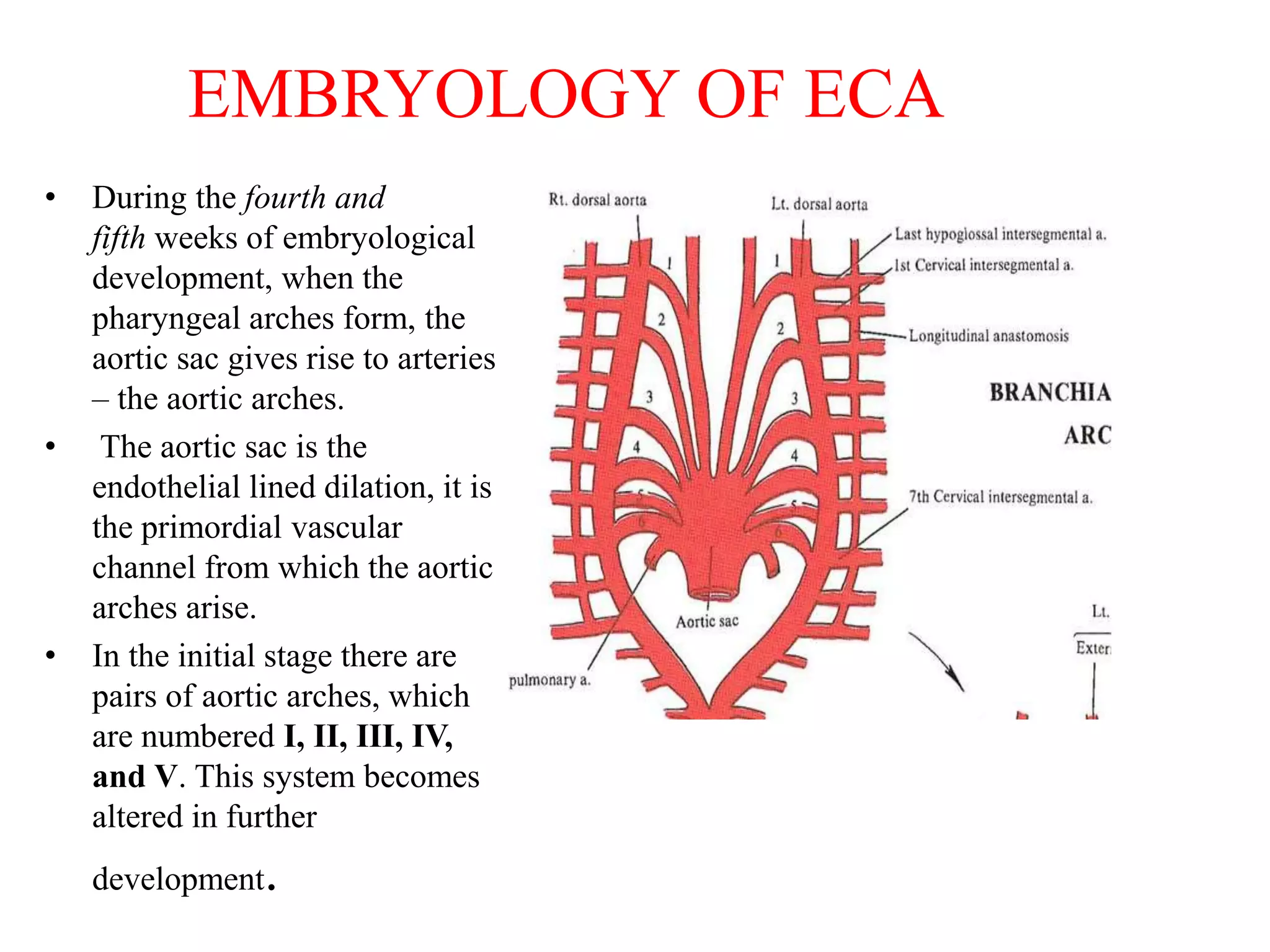
• During the fourth and
fifth weeks of embryological
development, when the
pharyngeal arches form, the
aortic sac gives rise to arteries
– the aortic arches.
• The aortic sac is the
endothelial lined dilation, it is
the primordial vascular
channel from which the aortic
arches arise.
• In the initial stage there are
pairs of aortic arches, which
are numbered I, II, III, IV,
and V. This system becomes
altered in further
development.
• 3rd Arch : forms common
carotid
artery, first (cervical) part
of internal carotid
artery (rest of internal
carotid arises from dorsal
aorta), and external carotid
artery.
COMMON CAROTID ARTERIES
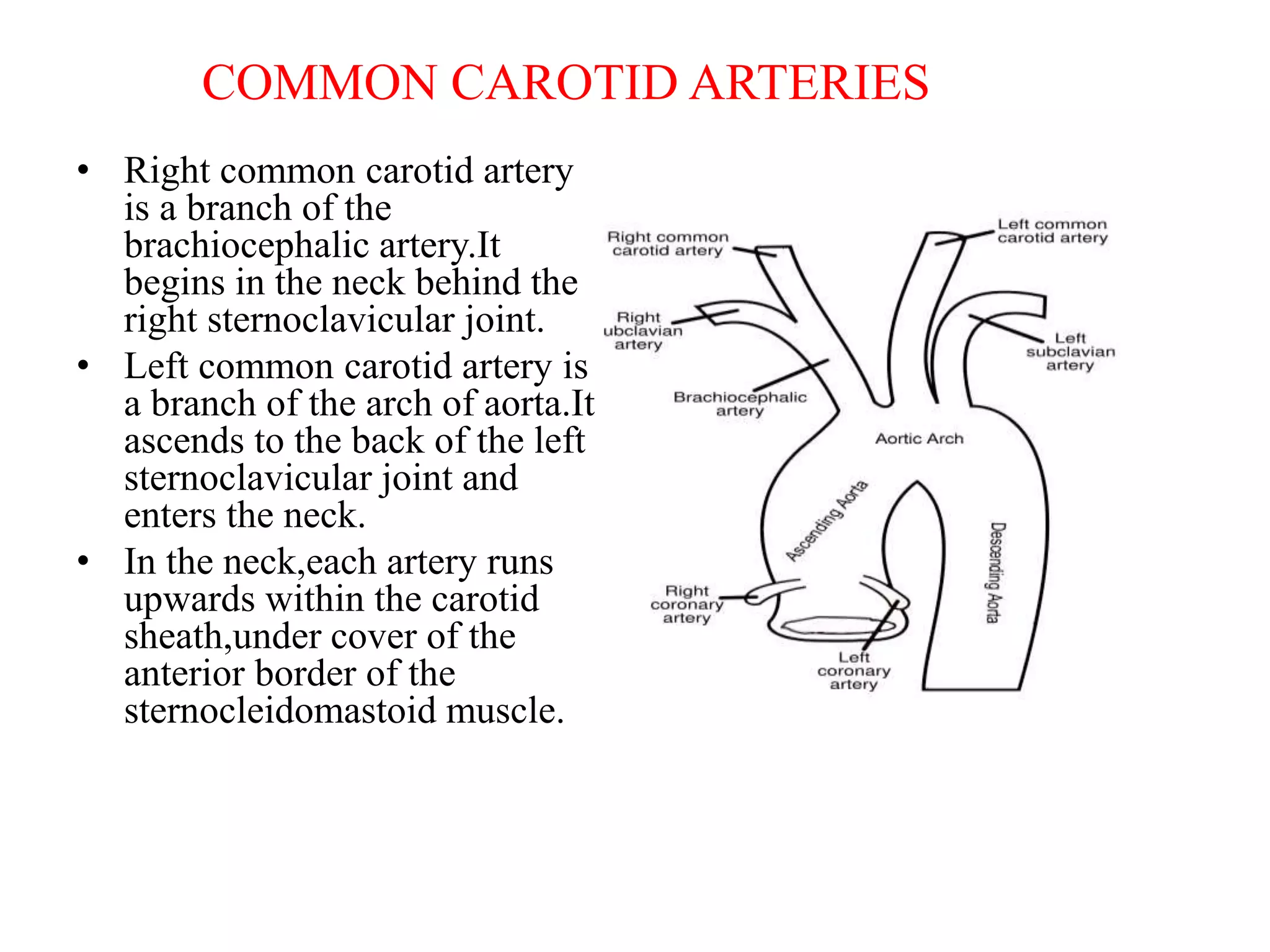
• Right common carotid artery
is a branch of the
brachiocephalic artery.It
begins in the neck behind the
right sternoclavicular joint.
• Left common carotid artery is
a branch of the arch of aorta.It
ascends to the back of the left
sternoclavicular joint and
enters the neck.
• In the neck,each artery runs
upwards within the carotid
sheath,under cover of the
anterior border of the
sternocleidomastoid muscle.
Carotid sheath
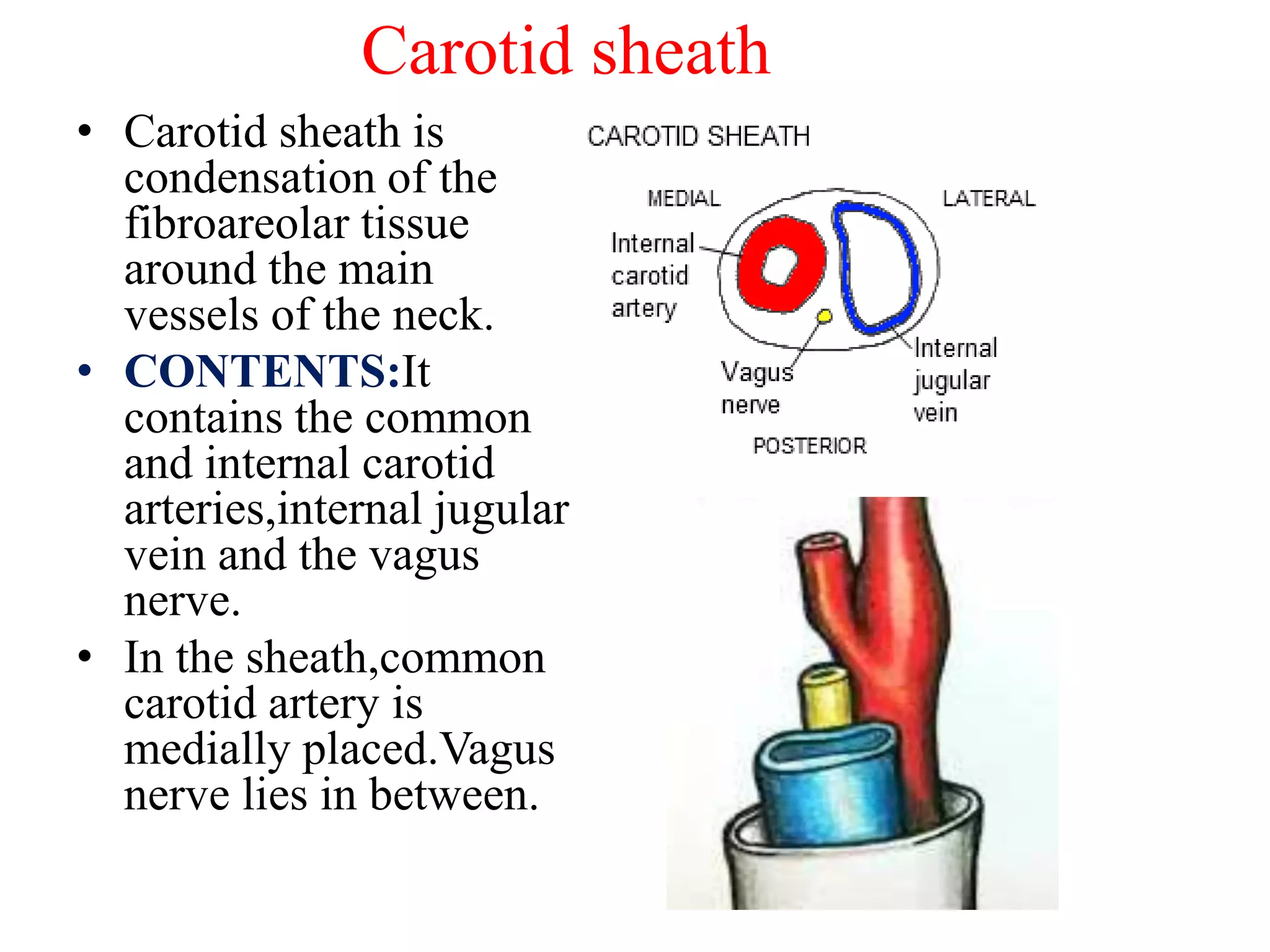
• Carotid sheath is
condensation of the
fibroareolar tissue
around the main
vessels of the neck.
• CONTENTS:It
contains the common
and internal carotid
arteries,internal jugular
vein and the vagus
nerve.
• In the sheath,common
carotid artery is
medially placed.Vagus
nerve lies in between.
RELATIONS
• The ansa
cervicalis lies
embedded in
the anterior
wall of the
carotid
sheath.
• The cervical
sympathetic
chain lies
behind the
sheath.
BIFURCATION OF COMMON
CAROTID ARTERY
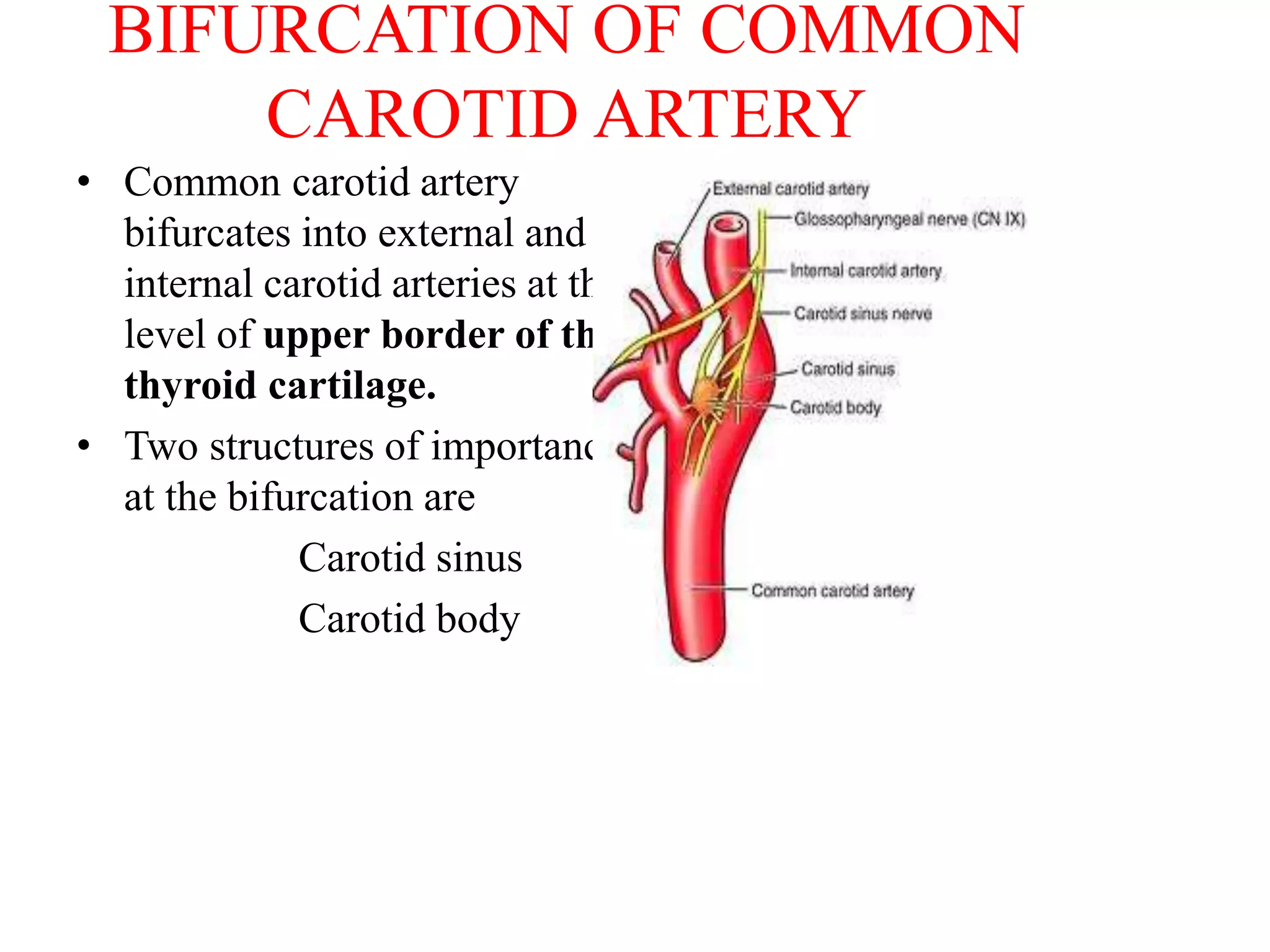
• Common carotid artery
bifurcates into external and
internal carotid arteries at the
level of upper border of the
thyroid cartilage.
• Two structures of importance
at the bifurcation are
Carotid sinus
Carotid body
CAROTID SINUS
• Carotid sinus is slight dilatation at the
termination of the common carotid artery
or the beginning of the internal carotid
artery.
• It receives a rich innervation from the
glossopharyngeal and sympathetic nerves.
FUNCTION:
Carotid sinus acts as a baroreceptor or
pressure receptor and regulates pressure.
CAROTID BODY
• Carotid body is a small,oval reddish-brown
structure situated behind the bifurcation.
• It receives nerve supply mainly from the
glossopharyngeal nerve, but also from the
vagus and sympathetic nerves.
FUNCTION:
Carotid body acts as a chemoreceptor and
responds to changes in the oxygen and
carbon dioxide and Ph content of the blood.
External carotid artery
• Generally,it lies anterior to the internal
carotid artery.
• It is the chief artery of supply to
structures in the front of the neck and in
the face.
SURFACE MARKING
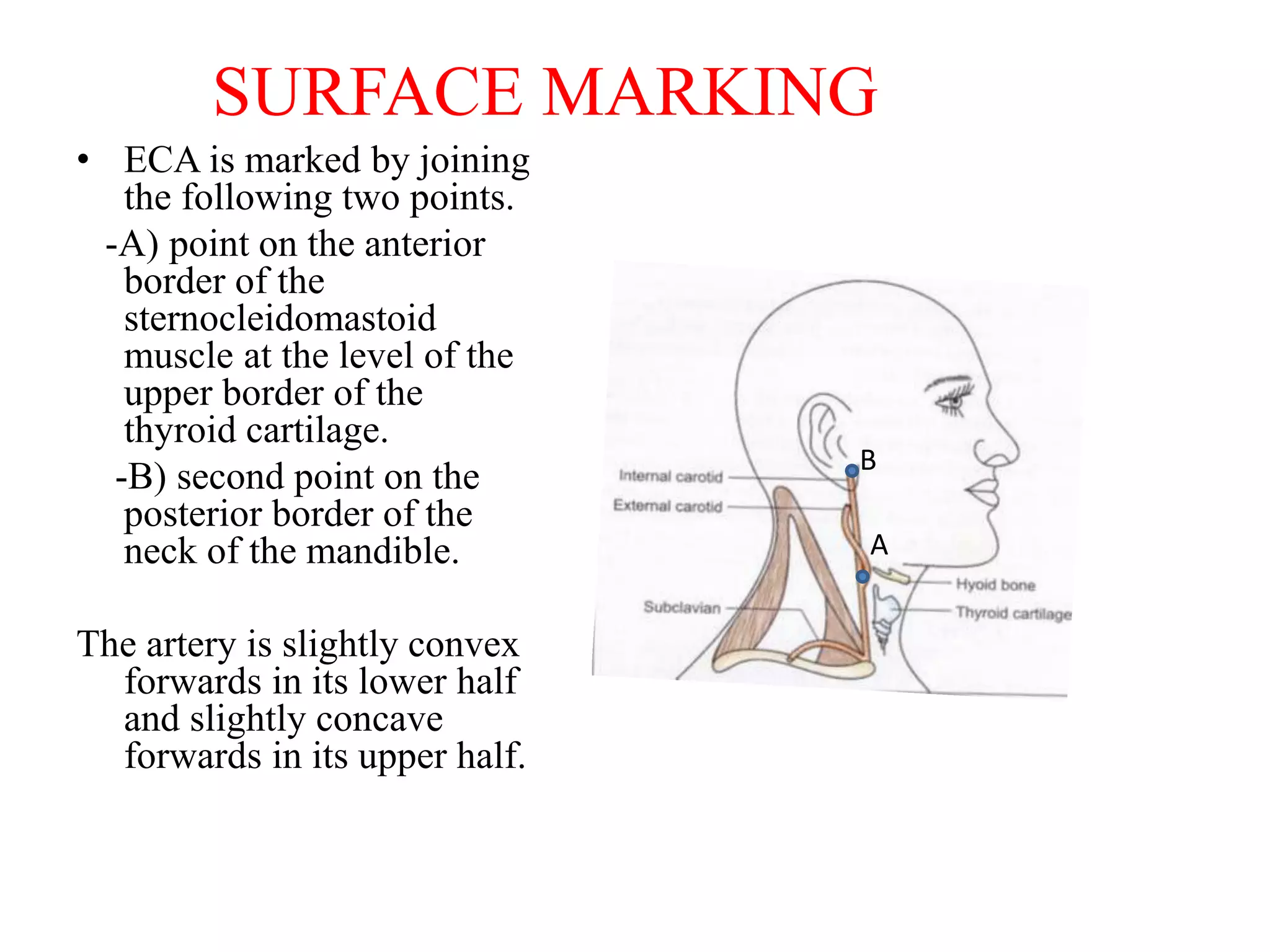
• ECA is marked by joining
the following two points.
-A) point on the anterior
border of the
sternocleidomastoid
muscle at the level of the
upper border of the
thyroid cartilage.
-B) second point on the
posterior border of the
neck of the mandible.
The artery is slightly convex
forwards in its lower half
and slightly concave
forwards in its upper half.
B
A
COURSE
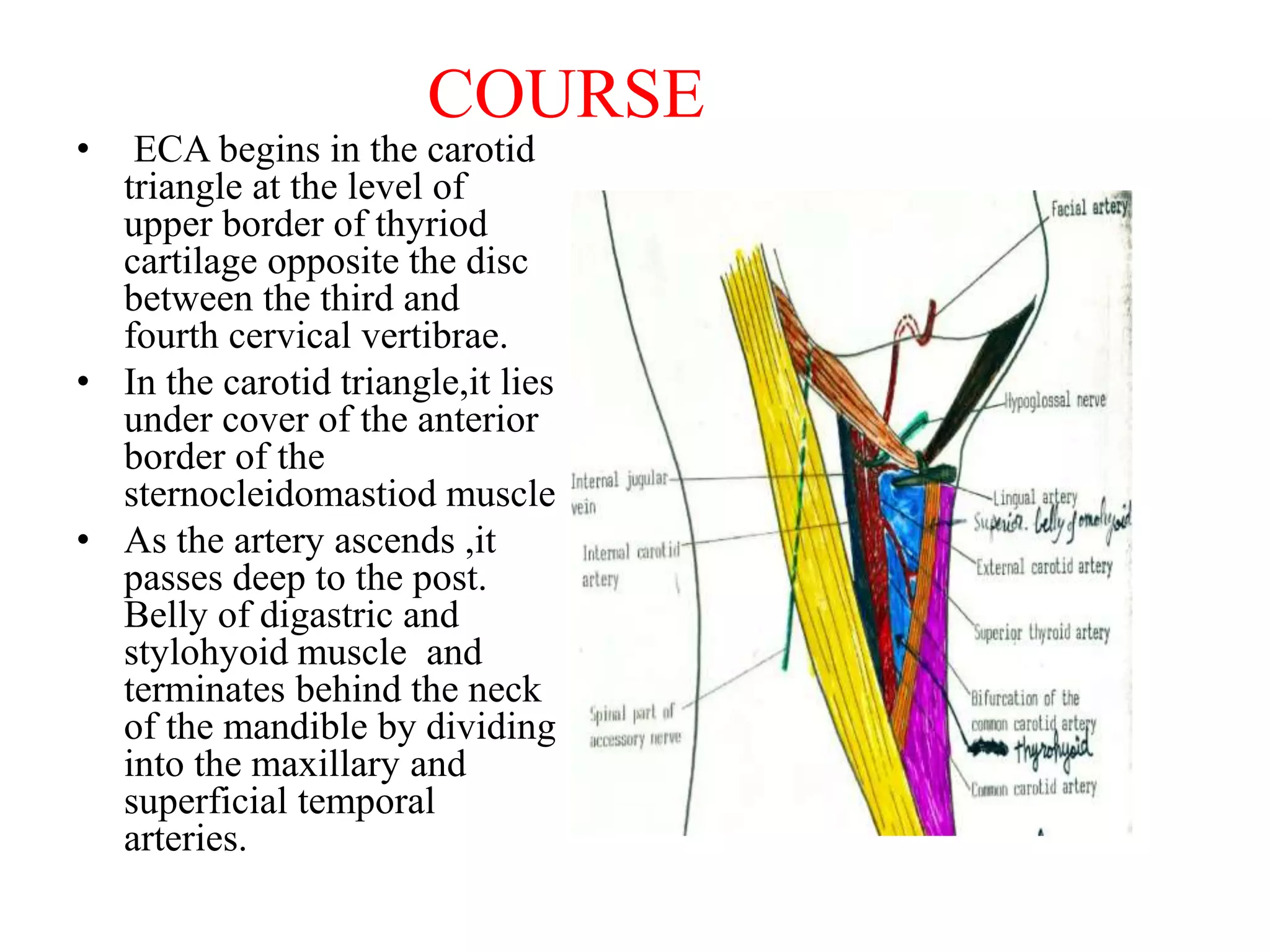
• ECA begins in the carotid
triangle at the level of
upper border of thyriod
cartilage opposite the disc
between the third and
fourth cervical vertibrae.
• In the carotid triangle,it lies
under cover of the anterior
border of the
sternocleidomastiod muscle
• As the artery ascends ,it
passes deep to the post.
Belly of digastric and
stylohyoid muscle and
terminates behind the neck
of the mandible by dividing
into the maxillary and
superficial temporal
arteries.
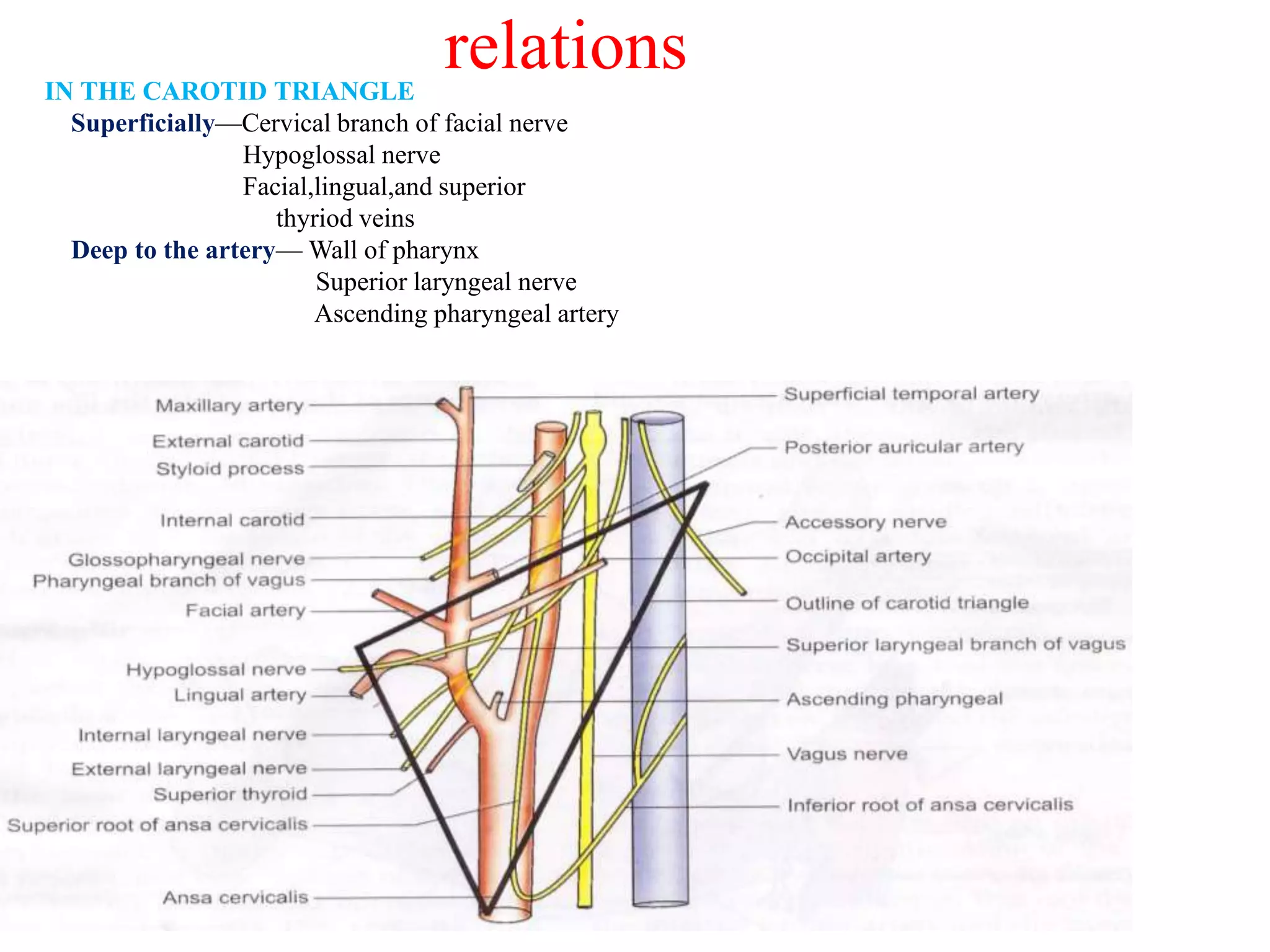
relationsIN THE CAROTID TRIANGLE
Superficially—Cervical branch of facial nerve
Hypoglossal nerve
Facial,lingual,and superior
thyriod veins
Deep to the artery— Wall of pharynx
Superior laryngeal nerve
Ascending pharyngeal artery
ABOVE THE CAROTID
TRIANGLE
Lies deep in the substance of the
parotid triangle.
Within the gland, it is related
Superficially—Retromandibular vein
Facial nerve
Deep to the artery—ICA
Structures passing between ECA
and ICA
Styloglossus
Stylopharyngeus
IXth nerve
Pharyngeal branch of
Xth nerve
Styloid process
BRANCHES
Total of 8 branches
• ANTERIOR— Superior thyroid
Lingual
Facial
• POSTERIOR-- Occipital
Posterior auricular
• MEDIAL— Ascending
pharyngeal
• TERMINAL— Maxillary
Superficial
temporal
ANTERIOR BRANCHES
Superior thyriod artery
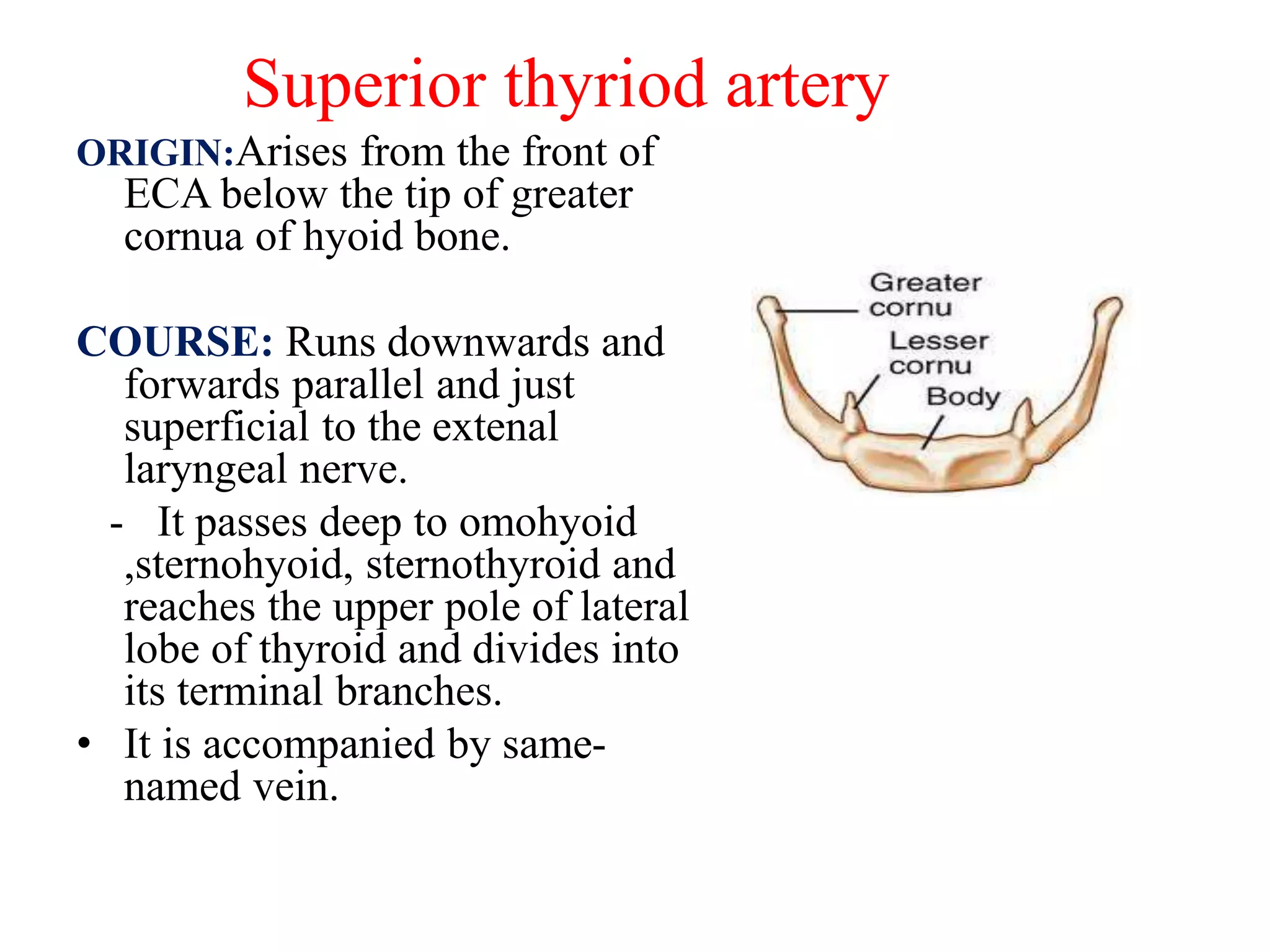
ORIGIN:Arises from the front of
ECA below the tip of greater
cornua of hyoid bone.
COURSE: Runs downwards and
forwards parallel and just
superficial to the extenal
laryngeal nerve.
- It passes deep to omohyoid
,sternohyoid, sternothyroid and
reaches the upper pole of lateral
lobe of thyroid and divides into
its terminal branches.
• It is accompanied by same-
named vein.
BRANCHES:
INFRAHYOID ARTERY
STERNOCLEIDOMASTOID ARTERY
SUPERIOR LARYNGEALARTERY
CRICOTHYROID ARTERY
GLANDULAR BRANCHES
LINGUAL ARTERY
ORIGIN:Arises from ECA opposite
the tip of the greater cornua of
hyoid bone.
-It may arise in common with the
facial artery, then becoming the
linguofacial trunk.
COURSE:Divided into three parts
by hypoglossus muscle.
FIRST PART – In carotid triangle,
extends from origin to the
posterior border of hyoglossus.
- Rests on the middle
constrictor,forms a upward loop
which is crossed by hypoglossal
nerve. This loop permits the free
movements of the hyiod bone.
SECOND PART – Deep to
hyoglossus, runs horizontally
forward along the upper border of
hyoid bone between hyoglossus
laterally and middle constrictor,
stylohyoid ligament medially.
THIRD PART [ ‘arteria profunda
linguae’ ]—Also called as deep
lingual artery.
-It runs upwards along the anterior
Border of hyoglossus, then
horizontally forwards on the
undersurface of tongue on each
side of frenum linguae.
-In vertical course,it lies b/t the
genioglossus medially & inferior
longitudinal muscle of tongue
laterally. Horizontal part is
accompanied by lingual nerve.
BRANCHES
• SUPRAHYOID ARTERY
• DORSAL LINGUALARTERY
• SUBLINGUALARTERY
• DEEP LINGUALARTERY
APPLIED ANATOMY
• In surgical removal of tongue , first part of
artery is ligated before it gives any
branches to the tongue or tonsil.
LIGATION OF LINGUALARTERY :
Incision – circling the lower pole of
submandibular gland.
- Skin, platysma, deep fascia incised,
submandibular gland exposed , lifted,
tendon of diagastric visible.
-Free border of mylohyoid muscle seen,
hypoglossal nerve identified. Digastric tendon
pulled downwards –enlarges the lingual
triangle, hyoglossus muscle visible.
- Muscle divided bluntly, in the gap of its vertical
fibers lingual artery found & ligated.
FACIAL ARTERY
ORIGIN: Arises from the ECA just above
the tip of greater cornua of hyoid bone.
COURSE: Runs upwards in -- neck as
cervical part ; face -- facial part.
Tortuous course—In neck allows free
movements of pharynx during deglutition,
on face -- free movements of mandible ,
lips, & cheek during mastication & facial
expressions, escapes traction & pressure
during movements.
.
Cervical part : Cervical
part Runs upwards on
superior constrictor of
pharynx deep to the
posterior belly of
digastric.
-It grooves the posterior
border of
submandibular gland,
makes S-bend [2 loops]
1st winding down over
submandibular gland &
then up over the base
of mandible.
Facial part:The vessel enters the face by
winding around the base of the mandible,
and by piercing the deep cervical fascia,at
the anteroinferior angle of the masseter
muscle.
• It runs upwards and forwards deep to the
risorus, to a point 1.25cm lateral to the
angle of the mouth.
• Then it ascends by the side of the nose upto
the medial angle of the eye where it
terminates by anastomosing with the dorsal
nasal branch of the ophthalmic artery.
BRANCHES
CERVICAL PART:
ASCENDING PALATINE ARTERY
TONSILLAR A RTERY
GLANDULAR ARTERIES
SUBMENTALARTERY
FACIAL PART:
INFERIOR LABIALARTERY
SUPERIOR LABIALARTERY
LATERAL NASALARTERY
ANGULAR ARTERY
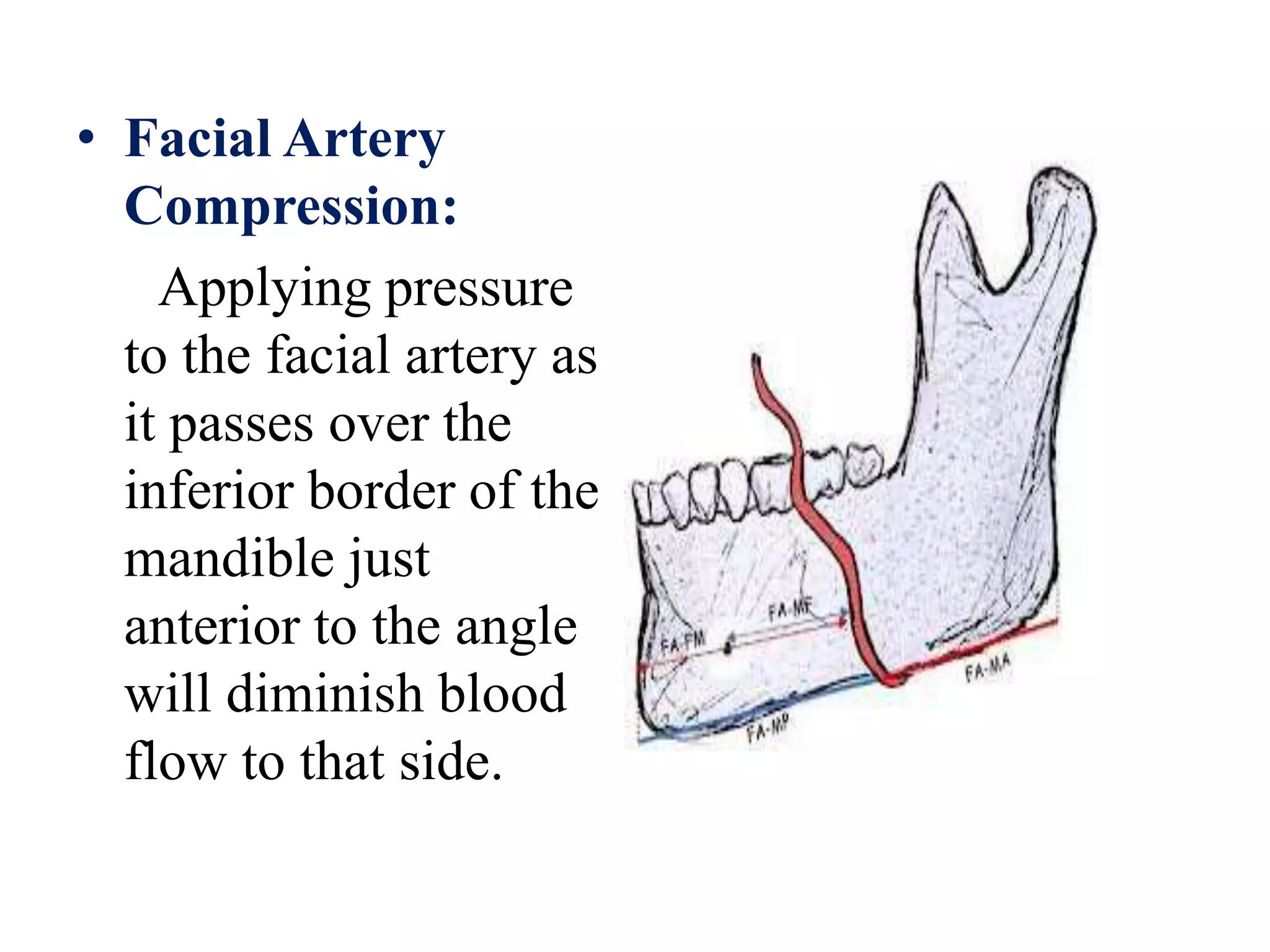
• Facial Artery
Compression:
Applying pressure
to the facial artery as
it passes over the
inferior border of the
mandible just
anterior to the angle
will diminish blood
flow to that side.
LIGATION OF FACIAL ARTERY.
• Exposed --at the point crossing the lower
border of mandible .
• Using contracted masseter as a landmark,
pulse of facial artery felt at point situated
anterior to the attachment of masseter.
,
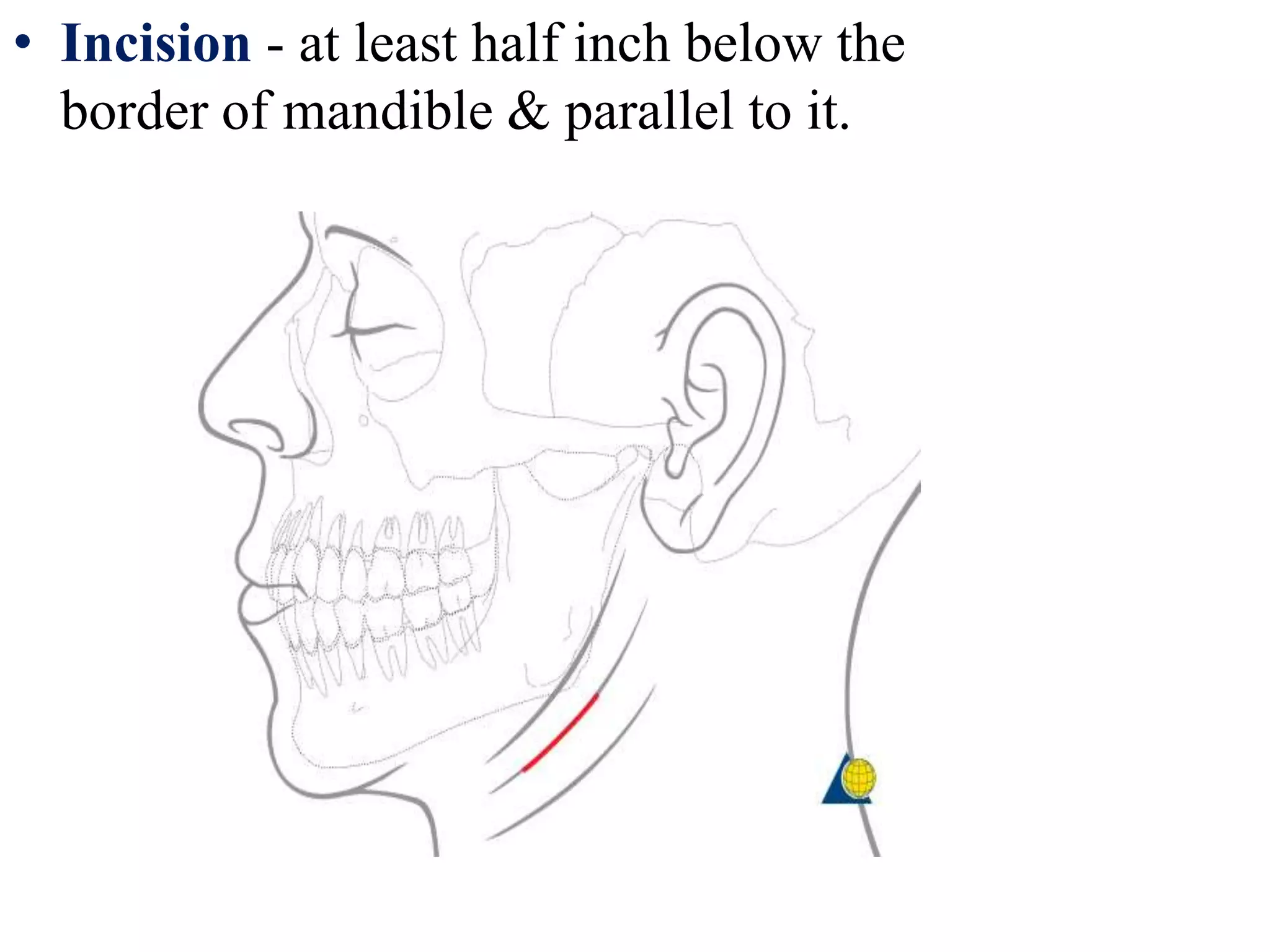
• Incision - at least half inch below the
border of mandible & parallel to it.
Skin,platysma and deep cervical fascia cut
Artery is accompanied by facial vein & crossed superficially by marginal
mandibular branch of facial nerve
Pulse of facial artery felt. Artery- isolated, tied & cut
POSTERIOR BRANCHES
OCCIPITAL ARTERY
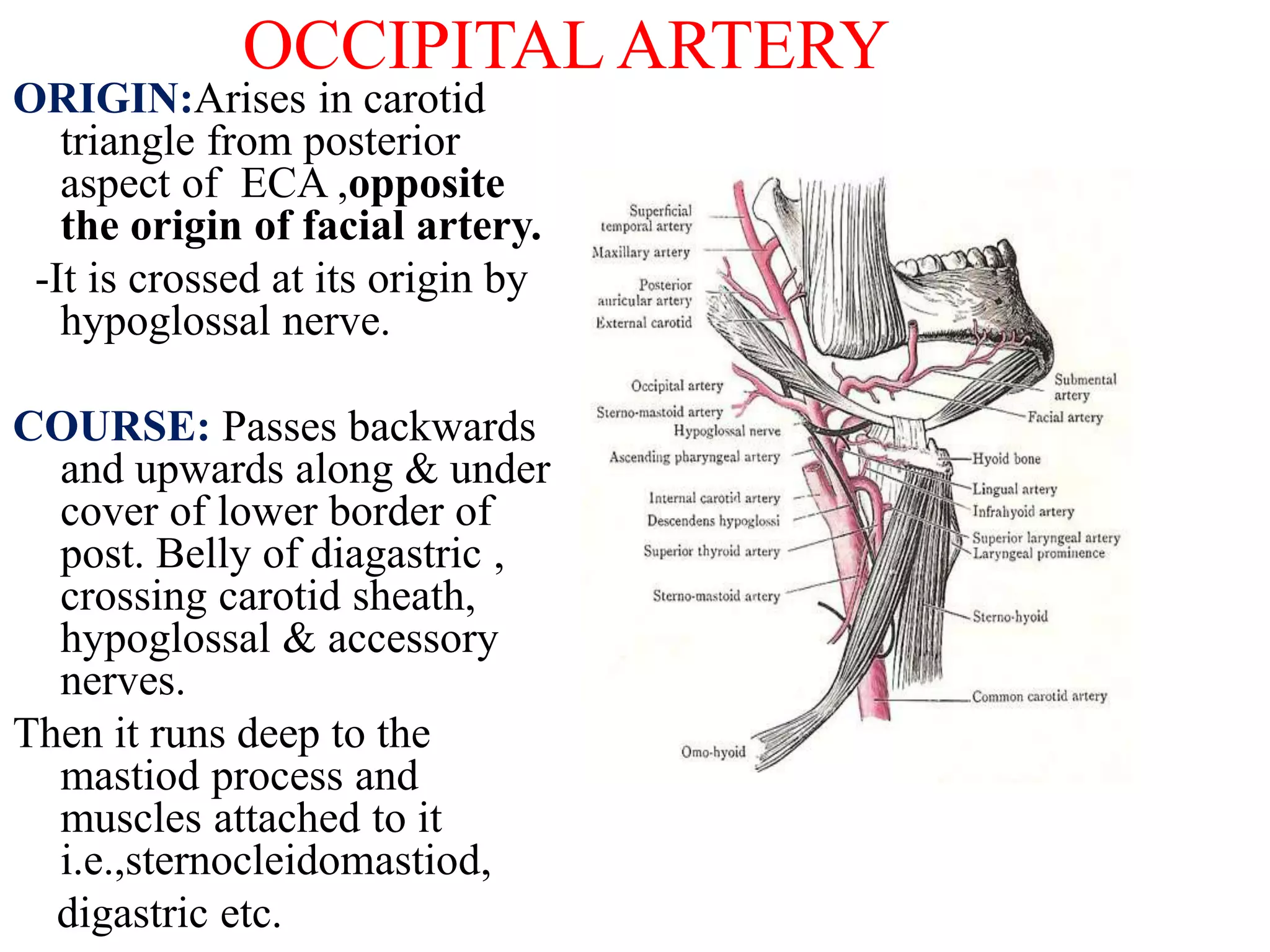
ORIGIN:Arises in carotid
triangle from posterior
aspect of ECA ,opposite
the origin of facial artery.
-It is crossed at its origin by
hypoglossal nerve.
COURSE: Passes backwards
and upwards along & under
cover of lower border of
post. Belly of diagastric ,
crossing carotid sheath,
hypoglossal & accessory
nerves.
Then it runs deep to the
mastiod process and
muscles attached to it
i.e.,sternocleidomastiod,
digastric etc.
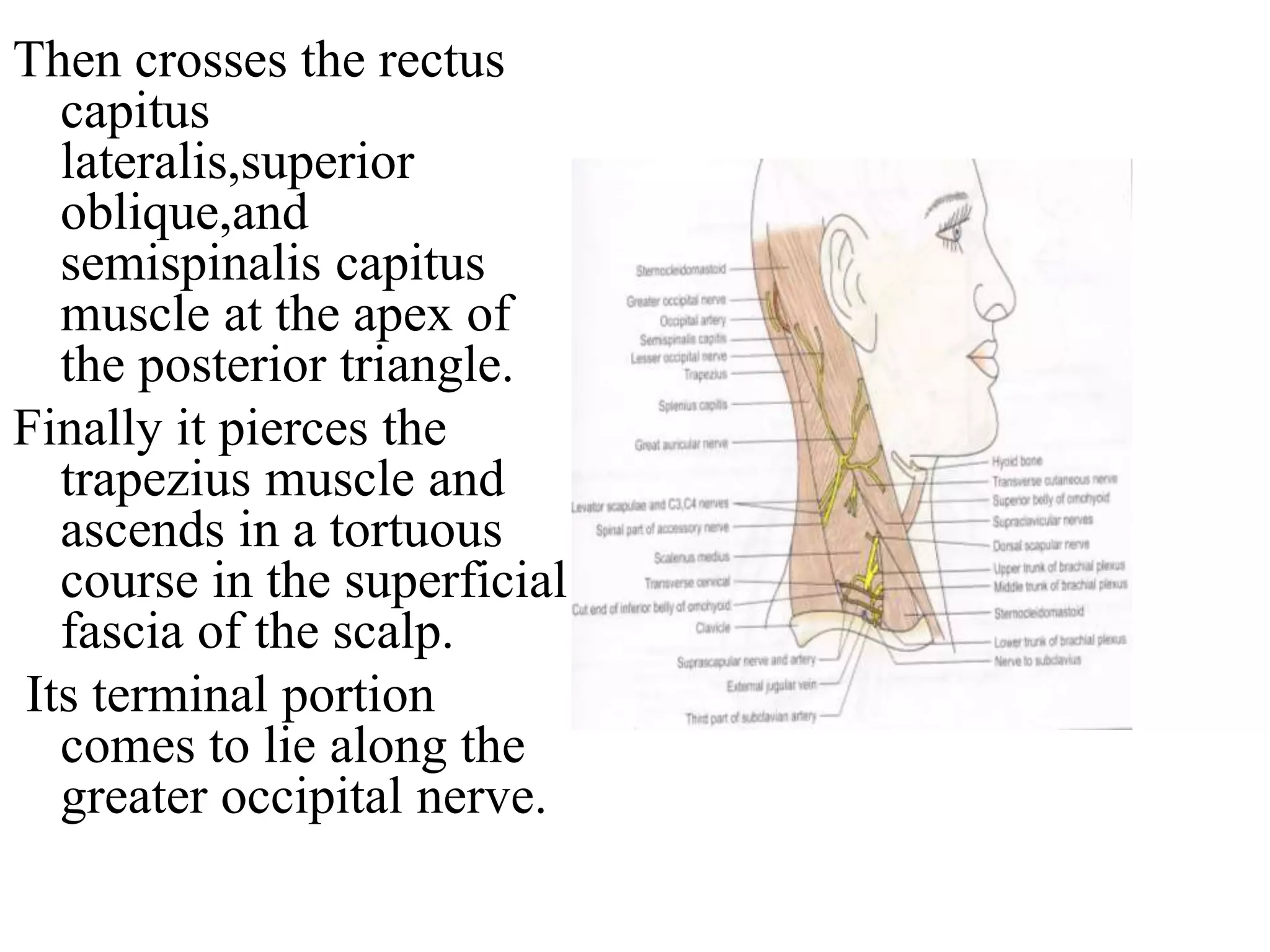
Then crosses the rectus
capitus
lateralis,superior
oblique,and
semispinalis capitus
muscle at the apex of
the posterior triangle.
Finally it pierces the
trapezius muscle and
ascends in a tortuous
course in the superficial
fascia of the scalp.
Its terminal portion
comes to lie along the
greater occipital nerve.
BRANCHES
• STERNOMASTOID BRANCHES
• AURICULAR BRANCH
• MASTOID BRANCH
• MENINGEAL BRANCH
• MUSCULAR BRANCH
POSTERIOR AURICULAR
ARTERYORIGIN: Arises from the
posterior aspect of the
external carotid artery
just above the posterior
belly of the digastric.
COURSE:It runs upwards
and backwards deep to
parotid gland, but
superficial to the styloid
process.It crosses the
base of the mastiod
process and ascends
behind the auricle.
BRANCHES
Stylomastoid.
Auricular
Occipital.
MEDIAL BRANCH
ASCENDING PHARYNGEAL
ARTERY
ORIGIN:The smallest
branch arising from the
medial side of the
external carotid artery,
near its commencement.
COURSE: Ascends
vertically between the
internal carotid and the
side of the pharynx, to
the under surface of the
base of the skull, lying
on the Longus capitis.
BRANCHES
• PHARYNGEAL BRANCHES
• PALATINE BRANCH
• PREVERTEBRAL BRANCHES
• INFERIOR TYMPANIC ARTERY
• MENINGEAL BRANCHES
TERMINAL
BRANCHES
MAXILLARY ARTERY
ORIGIN:Large terminal branch
given off behind the neck of the
mandible.
COURSE: Divided into three
parts by lateral pterygiod
muscle.
• The first or mandibular
portion passes horizontally
forward, between the ramus of
the mandible and the
sphenomandibular ligament,
where it lies parallel to and a
little below the auriculotemporal
nerve; it crosses the inferior
alveolar nerve, and runs along
the lower border of the lateral
pterygiod.
• The second or pterygoid portion runs
obliquely forward and upward
superficial to the lower head of the
lateral pterygiod.
• The third or pterygopalatine portion
passes between the two heads of the
lateral pterygiod and pterygomaxillary
fissure,to enter into the pterygopalatine
fossa where it lies in front of the
sphenopalatine ganglion.
BRANCHES
First or Mandibular
Portion
• Deep Auricular.
• Anterior Tympanic.
• Middle Meningeal
• Accessory Meningeal
• Inferior Alveolar.
Second or Pterygoid
Portion
• Deep Temporal.
• Masseteric.
• Pterygoid.
• Buccinator.
Third or Pterygopalatine
Portion
•Posterior Superior
Alveolar.
•Infraorbital.
•Greater palatine artery
•Pharyngeal.
•Aretry of pterygiod canal
•Sphenopalatine.
SUPERFICIAL TEMPORAL
ARTERY
ORIGIN: The smaller of the two terminal
branches of the external carotid, appears,
to be the continuation of ECA. It begins in
the substance of the parotid gland, behind
the neck of the mandible.
COURSE: It runs vertically upwards
crossing over the root of the zygomatic
process
-about 5 cm. above this process it divides
into two branches, a frontal and a parietal.
• Relations.—As it
crosses the zygomatic
process, it is covered by
the Auricularis anterior
muscle, and by a dense
fascia; it is crossed by
the temporal and
zygomatic branches of
the facial nerve and one
or two veins, and is
accompanied by the
auriculotemporal nerve,
which lies immediately
behind it.
BRANCHES
Besides some twigs to the parotid gland, to the
temporomandibular joint, and to the Masseter muscle,
its branches are:
• Transverse Facial.
• Anterior Auricular.
• Middle Temporal.
• Frontal.
• Parietal
INDICATIONS OF LIGATION
• Uncontrolled
haemorrhage from
Mouth
Tongue
Tonsils
Maxillary sinus
• Acute massive epistaxis
• Hereditary teliangectiasis
• Nasopharyngeal
angiofibroma
• Aneurysms( traumatic
aneurysms, of head and
neck, parotid gland)
SURGICAL APPROACHES
• THERE ARE TWO SURGICAL EXPOSURES TO
LIGATE THE ECA
» CAROTID TRIANGLE
» RETROMANDIBULAR FOSSA
PATIENT POSITION:
Supine position with shoulder on roll, neck
extended and turned to opposite side.
LANDMARKS
1)Upper border of
thyriod cartilage
2)Carotid bulb
3)Internal jugular
vein
4)Anterior jugular
vein
-lower border of
mandible
-Anterior border of
sternocleidomasti
od muscle
Ligation in carotid triangle:
KEY POINTS:
-ICA doesn’t branch in the neck,except for
rare exceptions.
-ECA is usually anterior and superficial to
ICA but not always.
-Follow the ECA to its 2nd branch,atleast.
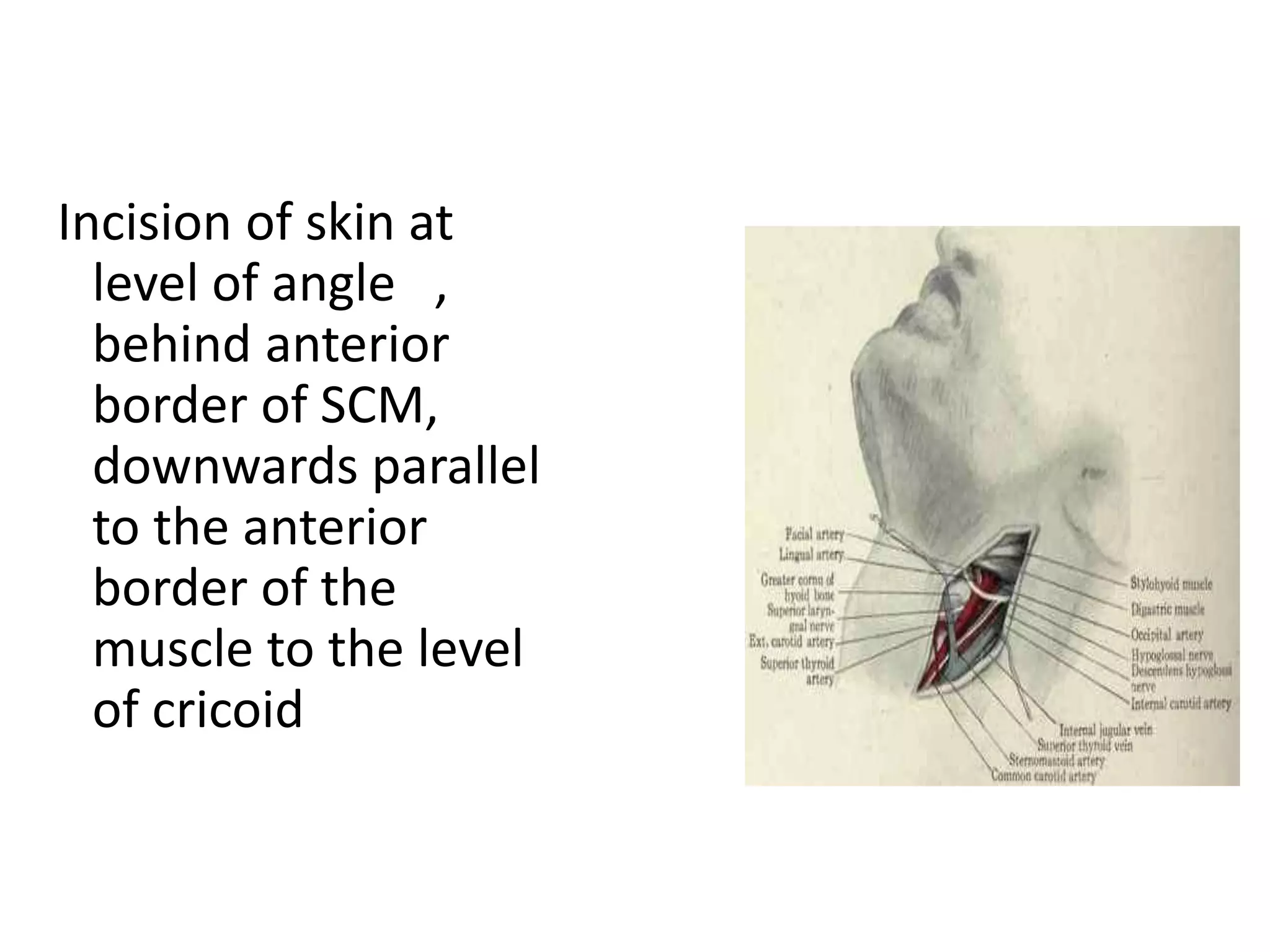
Incision of skin at
level of angle ,
behind anterior
border of SCM,
downwards parallel
to the anterior
border of the
muscle to the level
of cricoid
• Dissection is carried through
skin,platysma,then anterior border of SCM
is identified and retracted posteriorly.
• A clamp is used to dissect anterior to the
muscle parallel to great vessels ,to identify
carotid sheath.
• The CCA is carefully separated from other
contents of sheath.
• The IJV, vagus nerve and ansa hypoglossi
are retracted posteriorly.
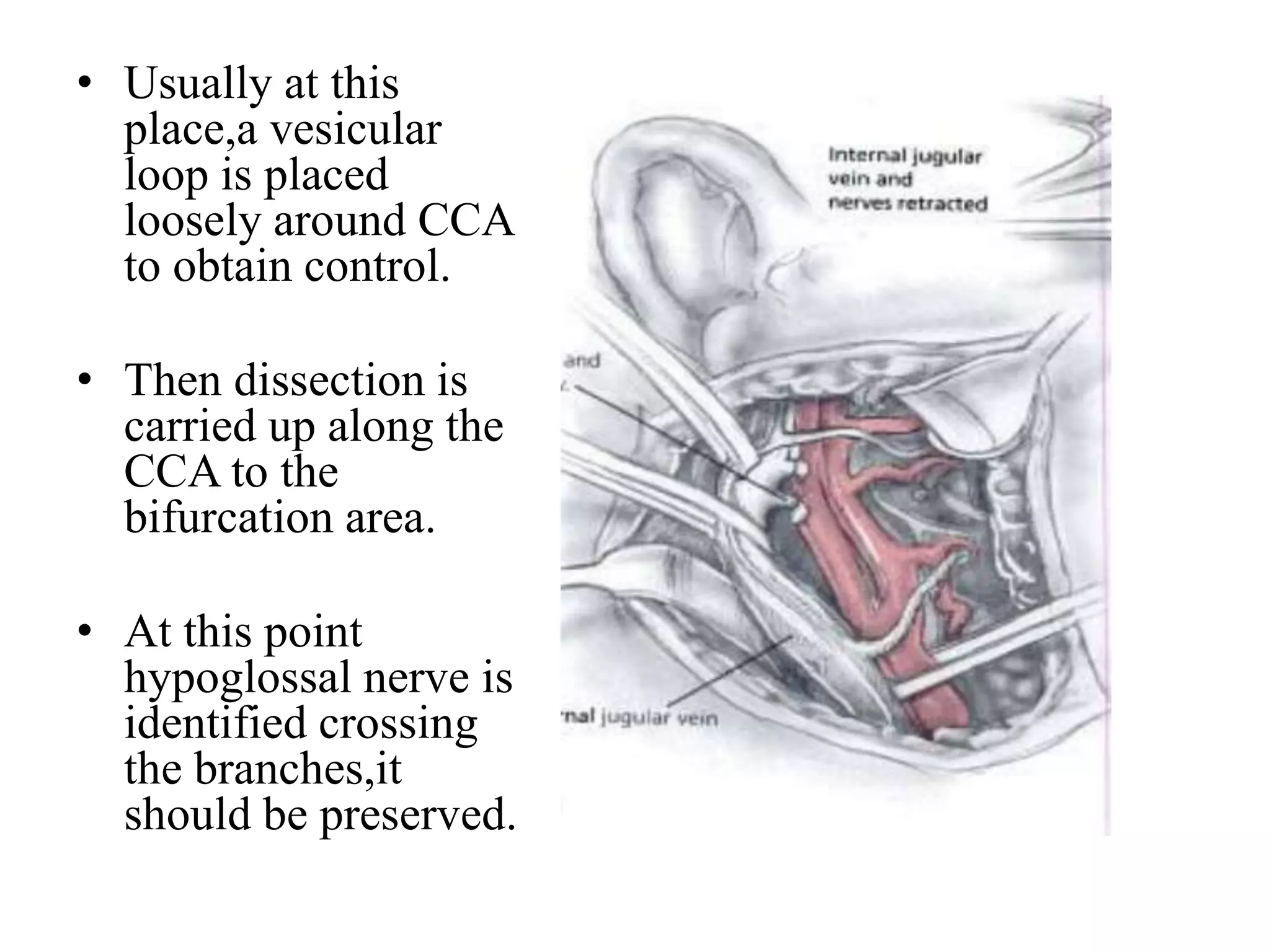
• Usually at this
place,a vesicular
loop is placed
loosely around CCA
to obtain control.
• Then dissection is
carried up along the
CCA to the
bifurcation area.
• At this point
hypoglossal nerve is
identified crossing
the branches,it
should be preserved.
-ICA doesn’t branch in the
neck,except for rare
exceptions.
-ECA is usually anterior and
superficial to ICA but not
always.
-Follow the ECA to its 2nd
branch,atleast
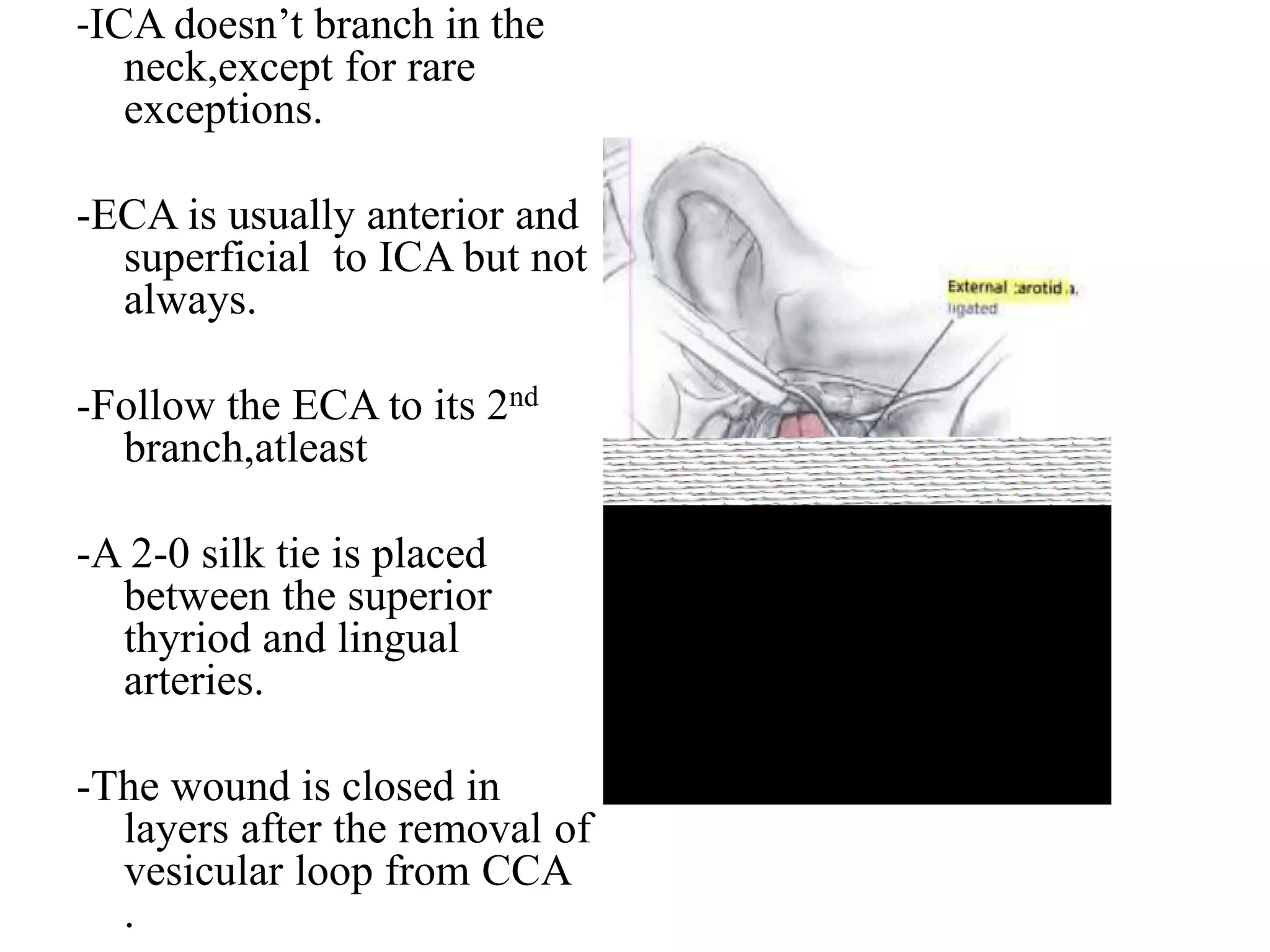
-A 2-0 silk tie is placed
between the superior
thyriod and lingual
arteries.
-The wound is closed in
layers after the removal of
vesicular loop from CCA
.
COMPLICATIONS:
-Damage to vital structures.
-Retrograde thrombus formation.
-Persistence of bleeding due to collateral
flow.
.
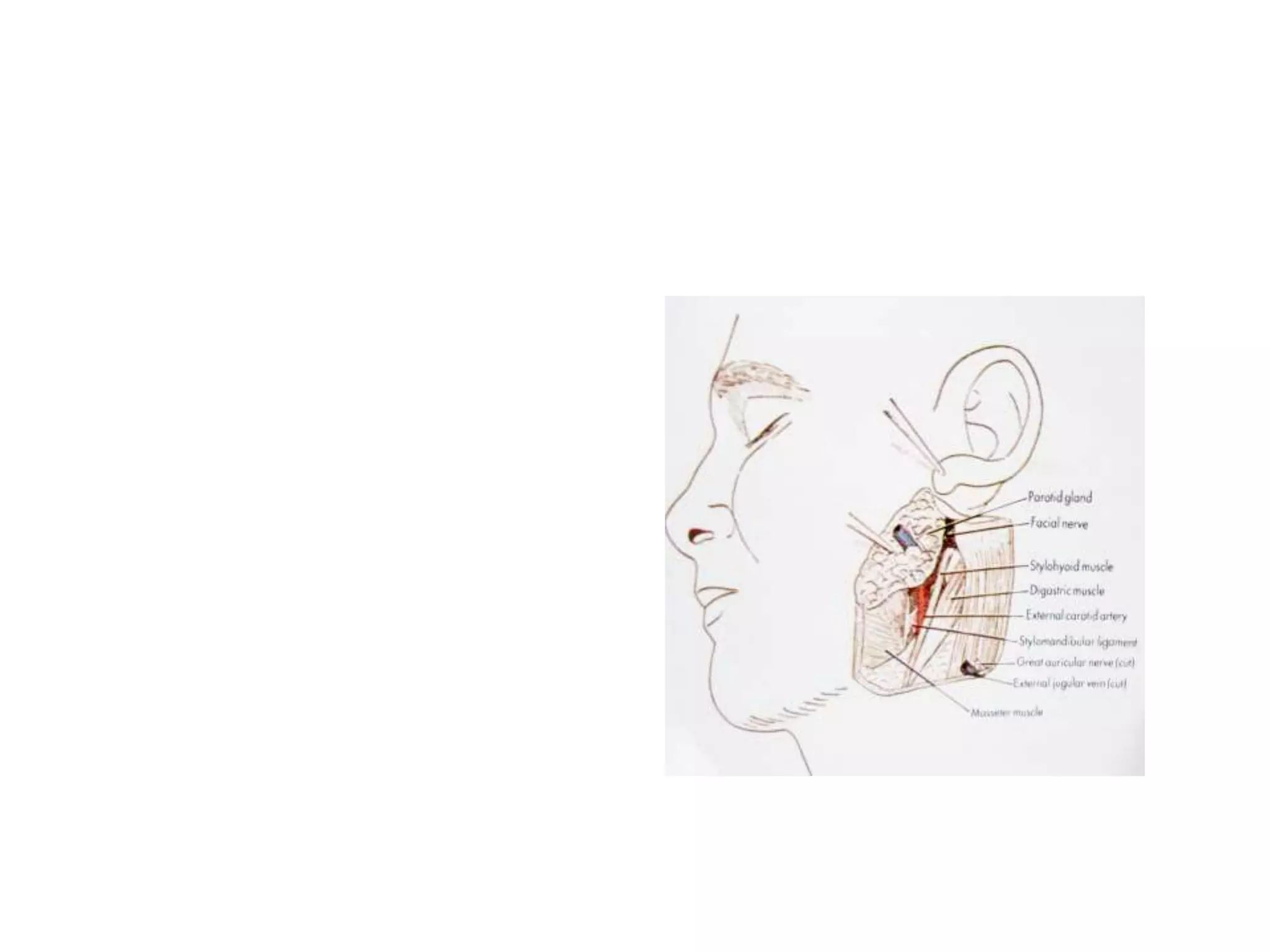
LIGATION IN RETROMANDIBULAR
FOSSA:
Done when there are maxillary artery injuries.
• Skin incision--- at line starting at the tip of
mastoid process , circling the mandibular
angle, continuing forward below the
mandible one inch.
• Skin & posterior fibers of platysma are cut,
the retromandibular vein or EJV is located,
tied & cut.
• Branches of great auricular nerve cut --
permit mobilization of cervical lobe of
parotid gland.
• Attachment of parotid capsule to the anterior border of
sternomastoid severed with scalpel. Parotid gland
retracted .
• post. Belly of digastric ,stylohyoid muscle is visible.
Above this stylomandibular ligament can be palpated
if lower jaw of the patient is pulled forward.
• This movement--- widens the entrance into
retromandibular fossa , tenses the stylomandibular
ligament.
• Pulsations of ECA are felt , isolated & tied.
CONCLUSION
• After ligation of the external carotid artery the
circulation is later re-established by the free
communication between most of the large
branches of the arteries and its corresponding
artery in the opposite side and also
anastomosing with the internal carotid
sysytem

External carotid artery, branches and ligation

  • 1.
    EXTERNAL CAROTID ARTERY, BRANCHESAND LIGATION R.Kavitha 1st Yr PG
  • 2.
    INTRODUCTION • External carotidartery is the chief artery which supplies to structures in the front of the neck and in the face
  • 3.
    EMBRYOLOGY OF ECA •During the fourth and fifth weeks of embryological development, when the pharyngeal arches form, the aortic sac gives rise to arteries – the aortic arches. • The aortic sac is the endothelial lined dilation, it is the primordial vascular channel from which the aortic arches arise. • In the initial stage there are pairs of aortic arches, which are numbered I, II, III, IV, and V. This system becomes altered in further development.
  • 4.
    • 3rd Arch: forms common carotid artery, first (cervical) part of internal carotid artery (rest of internal carotid arises from dorsal aorta), and external carotid artery.
  • 5.
    COMMON CAROTID ARTERIES •Right common carotid artery is a branch of the brachiocephalic artery.It begins in the neck behind the right sternoclavicular joint. • Left common carotid artery is a branch of the arch of aorta.It ascends to the back of the left sternoclavicular joint and enters the neck. • In the neck,each artery runs upwards within the carotid sheath,under cover of the anterior border of the sternocleidomastoid muscle.
  • 6.
    Carotid sheath • Carotidsheath is condensation of the fibroareolar tissue around the main vessels of the neck. • CONTENTS:It contains the common and internal carotid arteries,internal jugular vein and the vagus nerve. • In the sheath,common carotid artery is medially placed.Vagus nerve lies in between.
  • 7.
    RELATIONS • The ansa cervicalislies embedded in the anterior wall of the carotid sheath. • The cervical sympathetic chain lies behind the sheath.
  • 8.
    BIFURCATION OF COMMON CAROTIDARTERY • Common carotid artery bifurcates into external and internal carotid arteries at the level of upper border of the thyroid cartilage. • Two structures of importance at the bifurcation are Carotid sinus Carotid body
  • 9.
    CAROTID SINUS • Carotidsinus is slight dilatation at the termination of the common carotid artery or the beginning of the internal carotid artery. • It receives a rich innervation from the glossopharyngeal and sympathetic nerves. FUNCTION: Carotid sinus acts as a baroreceptor or pressure receptor and regulates pressure.
  • 10.
    CAROTID BODY • Carotidbody is a small,oval reddish-brown structure situated behind the bifurcation. • It receives nerve supply mainly from the glossopharyngeal nerve, but also from the vagus and sympathetic nerves. FUNCTION: Carotid body acts as a chemoreceptor and responds to changes in the oxygen and carbon dioxide and Ph content of the blood.
  • 11.
    External carotid artery •Generally,it lies anterior to the internal carotid artery. • It is the chief artery of supply to structures in the front of the neck and in the face.
  • 12.
    SURFACE MARKING • ECAis marked by joining the following two points. -A) point on the anterior border of the sternocleidomastoid muscle at the level of the upper border of the thyroid cartilage. -B) second point on the posterior border of the neck of the mandible. The artery is slightly convex forwards in its lower half and slightly concave forwards in its upper half. B A
  • 13.
    COURSE • ECA beginsin the carotid triangle at the level of upper border of thyriod cartilage opposite the disc between the third and fourth cervical vertibrae. • In the carotid triangle,it lies under cover of the anterior border of the sternocleidomastiod muscle • As the artery ascends ,it passes deep to the post. Belly of digastric and stylohyoid muscle and terminates behind the neck of the mandible by dividing into the maxillary and superficial temporal arteries.
  • 14.
    relationsIN THE CAROTIDTRIANGLE Superficially—Cervical branch of facial nerve Hypoglossal nerve Facial,lingual,and superior thyriod veins Deep to the artery— Wall of pharynx Superior laryngeal nerve Ascending pharyngeal artery
  • 15.
    ABOVE THE CAROTID TRIANGLE Liesdeep in the substance of the parotid triangle. Within the gland, it is related Superficially—Retromandibular vein Facial nerve Deep to the artery—ICA Structures passing between ECA and ICA Styloglossus Stylopharyngeus IXth nerve Pharyngeal branch of Xth nerve Styloid process
  • 16.
    BRANCHES Total of 8branches • ANTERIOR— Superior thyroid Lingual Facial • POSTERIOR-- Occipital Posterior auricular • MEDIAL— Ascending pharyngeal • TERMINAL— Maxillary Superficial temporal
  • 18.
  • 19.
    Superior thyriod artery ORIGIN:Arisesfrom the front of ECA below the tip of greater cornua of hyoid bone. COURSE: Runs downwards and forwards parallel and just superficial to the extenal laryngeal nerve. - It passes deep to omohyoid ,sternohyoid, sternothyroid and reaches the upper pole of lateral lobe of thyroid and divides into its terminal branches. • It is accompanied by same- named vein.
  • 20.
    BRANCHES: INFRAHYOID ARTERY STERNOCLEIDOMASTOID ARTERY SUPERIORLARYNGEALARTERY CRICOTHYROID ARTERY GLANDULAR BRANCHES
  • 21.
    LINGUAL ARTERY ORIGIN:Arises fromECA opposite the tip of the greater cornua of hyoid bone. -It may arise in common with the facial artery, then becoming the linguofacial trunk. COURSE:Divided into three parts by hypoglossus muscle. FIRST PART – In carotid triangle, extends from origin to the posterior border of hyoglossus. - Rests on the middle constrictor,forms a upward loop which is crossed by hypoglossal nerve. This loop permits the free movements of the hyiod bone.
  • 22.
    SECOND PART –Deep to hyoglossus, runs horizontally forward along the upper border of hyoid bone between hyoglossus laterally and middle constrictor, stylohyoid ligament medially. THIRD PART [ ‘arteria profunda linguae’ ]—Also called as deep lingual artery. -It runs upwards along the anterior Border of hyoglossus, then horizontally forwards on the undersurface of tongue on each side of frenum linguae. -In vertical course,it lies b/t the genioglossus medially & inferior longitudinal muscle of tongue laterally. Horizontal part is accompanied by lingual nerve.
  • 23.
    BRANCHES • SUPRAHYOID ARTERY •DORSAL LINGUALARTERY • SUBLINGUALARTERY • DEEP LINGUALARTERY
  • 24.
    APPLIED ANATOMY • Insurgical removal of tongue , first part of artery is ligated before it gives any branches to the tongue or tonsil. LIGATION OF LINGUALARTERY : Incision – circling the lower pole of submandibular gland. - Skin, platysma, deep fascia incised, submandibular gland exposed , lifted, tendon of diagastric visible.
  • 25.
    -Free border ofmylohyoid muscle seen, hypoglossal nerve identified. Digastric tendon pulled downwards –enlarges the lingual triangle, hyoglossus muscle visible. - Muscle divided bluntly, in the gap of its vertical fibers lingual artery found & ligated.
  • 26.
    FACIAL ARTERY ORIGIN: Arisesfrom the ECA just above the tip of greater cornua of hyoid bone. COURSE: Runs upwards in -- neck as cervical part ; face -- facial part. Tortuous course—In neck allows free movements of pharynx during deglutition, on face -- free movements of mandible , lips, & cheek during mastication & facial expressions, escapes traction & pressure during movements. .
  • 27.
    Cervical part :Cervical part Runs upwards on superior constrictor of pharynx deep to the posterior belly of digastric. -It grooves the posterior border of submandibular gland, makes S-bend [2 loops] 1st winding down over submandibular gland & then up over the base of mandible.
  • 28.
    Facial part:The vesselenters the face by winding around the base of the mandible, and by piercing the deep cervical fascia,at the anteroinferior angle of the masseter muscle. • It runs upwards and forwards deep to the risorus, to a point 1.25cm lateral to the angle of the mouth. • Then it ascends by the side of the nose upto the medial angle of the eye where it terminates by anastomosing with the dorsal nasal branch of the ophthalmic artery.
  • 29.
    BRANCHES CERVICAL PART: ASCENDING PALATINEARTERY TONSILLAR A RTERY GLANDULAR ARTERIES SUBMENTALARTERY
  • 30.
    FACIAL PART: INFERIOR LABIALARTERY SUPERIORLABIALARTERY LATERAL NASALARTERY ANGULAR ARTERY
  • 31.
    • Facial Artery Compression: Applyingpressure to the facial artery as it passes over the inferior border of the mandible just anterior to the angle will diminish blood flow to that side.
  • 32.
    LIGATION OF FACIALARTERY. • Exposed --at the point crossing the lower border of mandible . • Using contracted masseter as a landmark, pulse of facial artery felt at point situated anterior to the attachment of masseter. ,
  • 33.
    • Incision -at least half inch below the border of mandible & parallel to it.
  • 34.
    Skin,platysma and deepcervical fascia cut
  • 35.
    Artery is accompaniedby facial vein & crossed superficially by marginal mandibular branch of facial nerve
  • 36.
    Pulse of facialartery felt. Artery- isolated, tied & cut
  • 37.
  • 38.
    OCCIPITAL ARTERY ORIGIN:Arises incarotid triangle from posterior aspect of ECA ,opposite the origin of facial artery. -It is crossed at its origin by hypoglossal nerve. COURSE: Passes backwards and upwards along & under cover of lower border of post. Belly of diagastric , crossing carotid sheath, hypoglossal & accessory nerves. Then it runs deep to the mastiod process and muscles attached to it i.e.,sternocleidomastiod, digastric etc.
  • 39.
    Then crosses therectus capitus lateralis,superior oblique,and semispinalis capitus muscle at the apex of the posterior triangle. Finally it pierces the trapezius muscle and ascends in a tortuous course in the superficial fascia of the scalp. Its terminal portion comes to lie along the greater occipital nerve.
  • 40.
    BRANCHES • STERNOMASTOID BRANCHES •AURICULAR BRANCH • MASTOID BRANCH • MENINGEAL BRANCH • MUSCULAR BRANCH
  • 41.
    POSTERIOR AURICULAR ARTERYORIGIN: Arisesfrom the posterior aspect of the external carotid artery just above the posterior belly of the digastric. COURSE:It runs upwards and backwards deep to parotid gland, but superficial to the styloid process.It crosses the base of the mastiod process and ascends behind the auricle.
  • 42.
  • 43.
  • 44.
    ASCENDING PHARYNGEAL ARTERY ORIGIN:The smallest brancharising from the medial side of the external carotid artery, near its commencement. COURSE: Ascends vertically between the internal carotid and the side of the pharynx, to the under surface of the base of the skull, lying on the Longus capitis.
  • 45.
    BRANCHES • PHARYNGEAL BRANCHES •PALATINE BRANCH • PREVERTEBRAL BRANCHES • INFERIOR TYMPANIC ARTERY • MENINGEAL BRANCHES
  • 46.
  • 47.
    MAXILLARY ARTERY ORIGIN:Large terminalbranch given off behind the neck of the mandible. COURSE: Divided into three parts by lateral pterygiod muscle. • The first or mandibular portion passes horizontally forward, between the ramus of the mandible and the sphenomandibular ligament, where it lies parallel to and a little below the auriculotemporal nerve; it crosses the inferior alveolar nerve, and runs along the lower border of the lateral pterygiod.
  • 48.
    • The secondor pterygoid portion runs obliquely forward and upward superficial to the lower head of the lateral pterygiod. • The third or pterygopalatine portion passes between the two heads of the lateral pterygiod and pterygomaxillary fissure,to enter into the pterygopalatine fossa where it lies in front of the sphenopalatine ganglion.
  • 49.
    BRANCHES First or Mandibular Portion •Deep Auricular. • Anterior Tympanic. • Middle Meningeal • Accessory Meningeal • Inferior Alveolar. Second or Pterygoid Portion • Deep Temporal. • Masseteric. • Pterygoid. • Buccinator. Third or Pterygopalatine Portion •Posterior Superior Alveolar. •Infraorbital. •Greater palatine artery •Pharyngeal. •Aretry of pterygiod canal •Sphenopalatine.
  • 50.
    SUPERFICIAL TEMPORAL ARTERY ORIGIN: Thesmaller of the two terminal branches of the external carotid, appears, to be the continuation of ECA. It begins in the substance of the parotid gland, behind the neck of the mandible. COURSE: It runs vertically upwards crossing over the root of the zygomatic process -about 5 cm. above this process it divides into two branches, a frontal and a parietal.
  • 51.
    • Relations.—As it crossesthe zygomatic process, it is covered by the Auricularis anterior muscle, and by a dense fascia; it is crossed by the temporal and zygomatic branches of the facial nerve and one or two veins, and is accompanied by the auriculotemporal nerve, which lies immediately behind it.
  • 52.
    BRANCHES Besides some twigsto the parotid gland, to the temporomandibular joint, and to the Masseter muscle, its branches are: • Transverse Facial. • Anterior Auricular. • Middle Temporal. • Frontal. • Parietal
  • 53.
    INDICATIONS OF LIGATION •Uncontrolled haemorrhage from Mouth Tongue Tonsils Maxillary sinus • Acute massive epistaxis • Hereditary teliangectiasis • Nasopharyngeal angiofibroma • Aneurysms( traumatic aneurysms, of head and neck, parotid gland)
  • 54.
    SURGICAL APPROACHES • THEREARE TWO SURGICAL EXPOSURES TO LIGATE THE ECA » CAROTID TRIANGLE » RETROMANDIBULAR FOSSA
  • 55.
    PATIENT POSITION: Supine positionwith shoulder on roll, neck extended and turned to opposite side.
  • 56.
    LANDMARKS 1)Upper border of thyriodcartilage 2)Carotid bulb 3)Internal jugular vein 4)Anterior jugular vein -lower border of mandible -Anterior border of sternocleidomasti od muscle
  • 57.
    Ligation in carotidtriangle: KEY POINTS: -ICA doesn’t branch in the neck,except for rare exceptions. -ECA is usually anterior and superficial to ICA but not always. -Follow the ECA to its 2nd branch,atleast.
  • 58.
    Incision of skinat level of angle , behind anterior border of SCM, downwards parallel to the anterior border of the muscle to the level of cricoid
  • 59.
    • Dissection iscarried through skin,platysma,then anterior border of SCM is identified and retracted posteriorly. • A clamp is used to dissect anterior to the muscle parallel to great vessels ,to identify carotid sheath. • The CCA is carefully separated from other contents of sheath. • The IJV, vagus nerve and ansa hypoglossi are retracted posteriorly.
  • 60.
    • Usually atthis place,a vesicular loop is placed loosely around CCA to obtain control. • Then dissection is carried up along the CCA to the bifurcation area. • At this point hypoglossal nerve is identified crossing the branches,it should be preserved.
  • 61.
    -ICA doesn’t branchin the neck,except for rare exceptions. -ECA is usually anterior and superficial to ICA but not always. -Follow the ECA to its 2nd branch,atleast -A 2-0 silk tie is placed between the superior thyriod and lingual arteries. -The wound is closed in layers after the removal of vesicular loop from CCA .
  • 62.
    COMPLICATIONS: -Damage to vitalstructures. -Retrograde thrombus formation. -Persistence of bleeding due to collateral flow. .
  • 63.
    LIGATION IN RETROMANDIBULAR FOSSA: Donewhen there are maxillary artery injuries. • Skin incision--- at line starting at the tip of mastoid process , circling the mandibular angle, continuing forward below the mandible one inch. • Skin & posterior fibers of platysma are cut, the retromandibular vein or EJV is located, tied & cut. • Branches of great auricular nerve cut -- permit mobilization of cervical lobe of parotid gland.
  • 65.
    • Attachment ofparotid capsule to the anterior border of sternomastoid severed with scalpel. Parotid gland retracted . • post. Belly of digastric ,stylohyoid muscle is visible. Above this stylomandibular ligament can be palpated if lower jaw of the patient is pulled forward. • This movement--- widens the entrance into retromandibular fossa , tenses the stylomandibular ligament. • Pulsations of ECA are felt , isolated & tied.
  • 67.
    CONCLUSION • After ligationof the external carotid artery the circulation is later re-established by the free communication between most of the large branches of the arteries and its corresponding artery in the opposite side and also anastomosing with the internal carotid sysytem