z
z
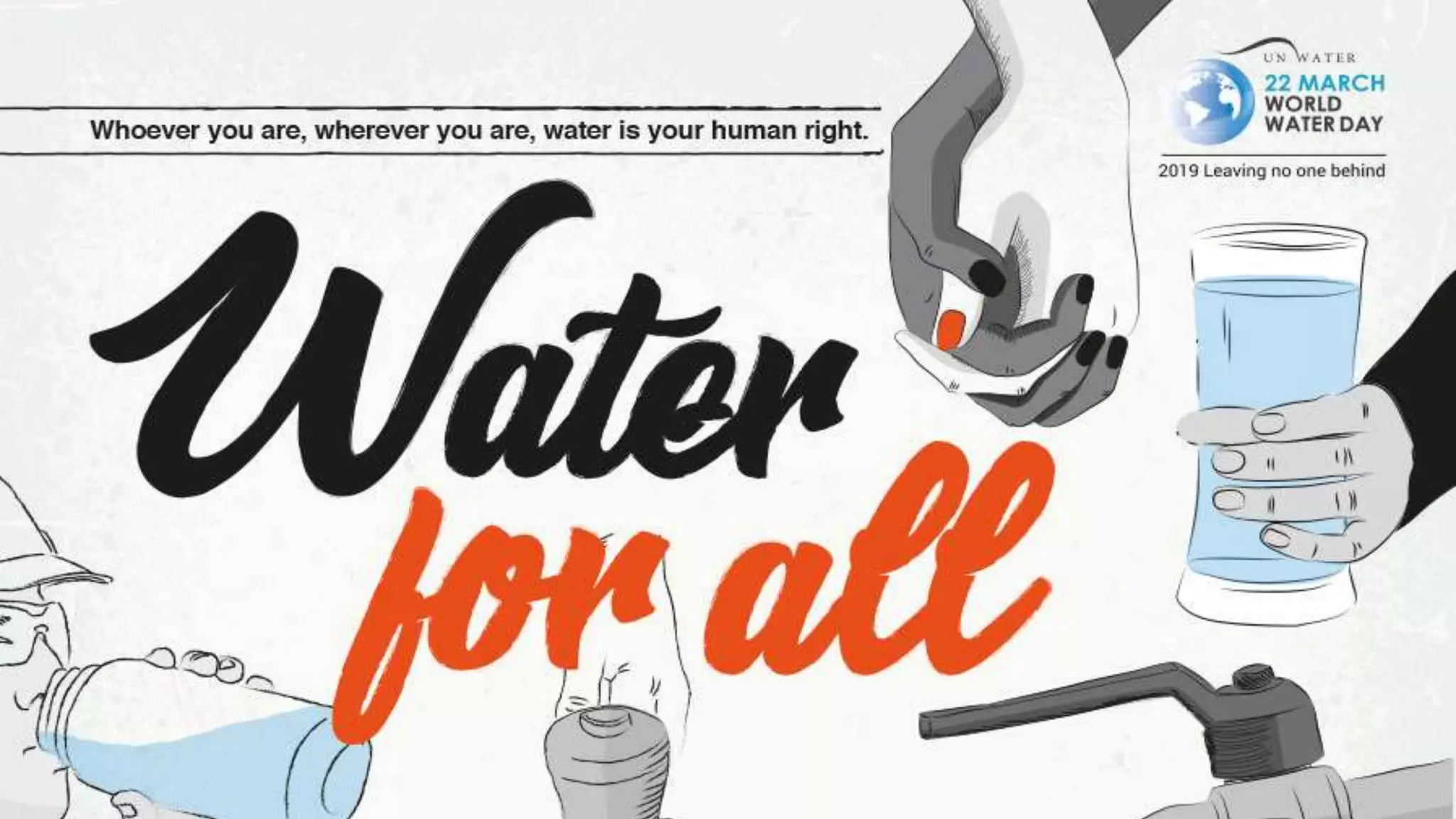
WORLD WATER DAY-2019
 World water day is observed on March 22nd since 1993 when the
United Nations General Assembly declared March 22nd as world day
for water
 The UN and its member nations devote this day to implement UN
recommendations.
 In addition to the UN member states, a number of NGOs are promoting
clean water and sustainable aquatic habitats.
z
WHY WORLD WATER DAY?
 The UN hopes that the decade will boost the chances of achieving
international water-related goals
 For the rapidly urbanizing developing world, safe and affordable water
is key to health and livelihoods, as well as meeting the Millenium
Development Goals.
 This is an unique occasion to bring all the stakeholders together to
apply solutions to that work.
z
ANNUAL THEMES
•1994: Caring for our Water Resources is Everybody's Business
•1995: Women and Water
•1996: Water for Thirsty Cities
•1997: The World's Water: Is there enough?
•1998: Groundwater– The Invisible Resource.
•1999: Everyone Lives Downstream
•2000: Water for the 21st century
•2001: Water for Health
•2002: Water for Development.
•2003: Water for Future.
•2004: Water and Disasters.
•2005: Water for Life Decade 2005–2015.
z
•2006: Water and Culture.
•2007: Coping With Water Scarcity
•2008: Sanitation
•2009: Trans Waters.
•2010: Clean Water for a Healthy World
•2011: Water for cities.
•2012: Water and Food Security
•2013: International Year of Cooperation
•2014 – Water and Energy
•2015 – Water and Sustainable Development
•2016 – Better Water, Better Jobs
•2017 – Why Waste Water?
•2018 – Nature for Water
•2019 – Leaving no one behind
z
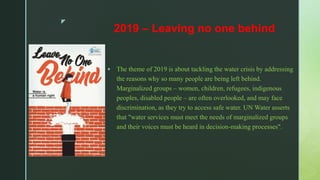
2019 – Leaving no one behind
 The theme of 2019 is about tackling the water crisis by addressing
the reasons why so many people are being left behind.
Marginalized groups – women, children, refugees, indigenous
peoples, disabled people – are often overlooked, and may face
discrimination, as they try to access safe water. UN Water asserts
that "water services must meet the needs of marginalized groups
and their voices must be heard in decision-making processes".
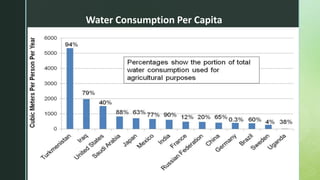
Water Consumption Per Capita
z
IMPORTANT USES OF WATER:
1.Water is mainly used for domestic purposes like drinking, cooking, bathing and
washing etc.
2. Water is also used for commercial purposes like hotels, theatres, educational
institutions, offices, etc.
3. Another important use of water is for irrigation, like agriculture . Almost 60-70 % of
the fresh water is used for irrigation.
4.20-30 % of the total fresh water is used for so many industrial operations like refineries,
iron and steel, paper and pulp industries.
5. Water is very essential for the sustainance of all the living organisms. 6. Water also
plays a key role in sculpting the earth's surface, moderating climate and diluting
pollutants.
z
z
OVER UTILIZATION OF WATER:
 The rapid increase in population and industrial growth have increased the demand for water resources.
Due to increase of ground water usage,the annual extraction of ground water is in the far excess than
the natural recharge
EFFECTS:
i. Decrease of ground water
ii. Ground subsidence
iii. Lowering of water table
iv. Intrusion of salt water
v. Earthquake and landslides
vi. Drying up of wells
vii. Pollution of water
z
Conflicts of water:
 Water is so essential for our existence and is fast becoming a scarce resource. Freshwater is
considered to be the most issue environmental issue of this century. Nearly 1.2 billion people do
not have access to safe drinking water .
 Thus due to increase in population and decrease in water resources, conflicts over water starts.
CAUSES:
1. Conflict through use
2. Construction of dams or power stations
3. Conflict through pollution
z
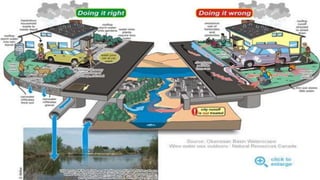
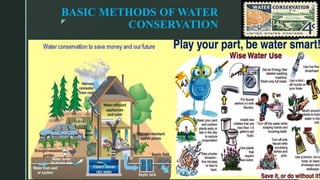
BASIC METHODS OF WATER
CONSERVATION
z
TECHNIQUES OF CONSERVING WATER
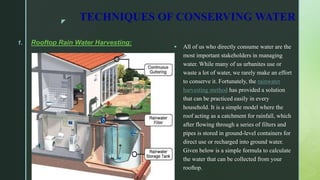
1. Rooftop Rain Water Harvesting:
 All of us who directly consume water are the
most important stakeholders in managing
water. While many of us urbanites use or
waste a lot of water, we rarely make an effort
to conserve it. Fortunately, the rainwater
harvesting method has provided a solution
that can be practiced easily in every
household. It is a simple model where the
roof acting as a catchment for rainfall, which
after flowing through a series of filters and
pipes is stored in ground-level containers for
direct use or recharged into ground water.
Given below is a simple formula to calculate
the water that can be collected from your
rooftop.
z
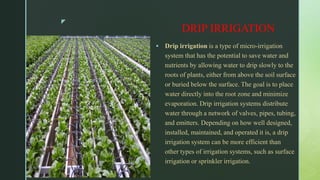
DRIP IRRIGATION
 Drip irrigation is a type of micro-irrigation
system that has the potential to save water and
nutrients by allowing water to drip slowly to the
roots of plants, either from above the soil surface
or buried below the surface. The goal is to place
water directly into the root zone and minimize
evaporation. Drip irrigation systems distribute
water through a network of valves, pipes, tubing,
and emitters. Depending on how well designed,
installed, maintained, and operated it is, a drip
irrigation system can be more efficient than
other types of irrigation systems, such as surface
irrigation or sprinkler irrigation.
z
MANAGEMENT OF CONFLICTS
OVER WATER:
 Efforts are mainly concentrated to enact laws to check these practices
to control water pollution.
 The conflicts over sharing of river water in the country has been
studied by many organizations and several solutions are suggested. The
interlinking of rivers has been one such solution.
 Demand for Nationalisation of water (rivers) needs serious
consideration. Therefore power must be given to National Water
Authority and River Basin Authority for equitable distribution of basin
water.
z
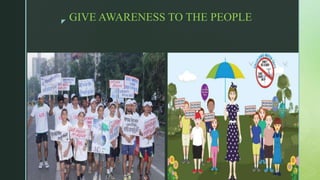
GIVE AWARENESS TO THE PEOPLE
z
z
z

World water day 2019

  • 1.
  • 2.
    z WORLD WATER DAY-2019 World water day is observed on March 22nd since 1993 when the United Nations General Assembly declared March 22nd as world day for water  The UN and its member nations devote this day to implement UN recommendations.  In addition to the UN member states, a number of NGOs are promoting clean water and sustainable aquatic habitats.
  • 3.
    z WHY WORLD WATERDAY?  The UN hopes that the decade will boost the chances of achieving international water-related goals  For the rapidly urbanizing developing world, safe and affordable water is key to health and livelihoods, as well as meeting the Millenium Development Goals.  This is an unique occasion to bring all the stakeholders together to apply solutions to that work.
  • 4.
    z ANNUAL THEMES •1994: Caringfor our Water Resources is Everybody's Business •1995: Women and Water •1996: Water for Thirsty Cities •1997: The World's Water: Is there enough? •1998: Groundwater– The Invisible Resource. •1999: Everyone Lives Downstream •2000: Water for the 21st century •2001: Water for Health •2002: Water for Development. •2003: Water for Future. •2004: Water and Disasters. •2005: Water for Life Decade 2005–2015.
  • 5.
    z •2006: Water andCulture. •2007: Coping With Water Scarcity •2008: Sanitation •2009: Trans Waters. •2010: Clean Water for a Healthy World •2011: Water for cities. •2012: Water and Food Security •2013: International Year of Cooperation •2014 – Water and Energy •2015 – Water and Sustainable Development •2016 – Better Water, Better Jobs •2017 – Why Waste Water? •2018 – Nature for Water •2019 – Leaving no one behind
  • 6.
    z 2019 – Leavingno one behind  The theme of 2019 is about tackling the water crisis by addressing the reasons why so many people are being left behind. Marginalized groups – women, children, refugees, indigenous peoples, disabled people – are often overlooked, and may face discrimination, as they try to access safe water. UN Water asserts that "water services must meet the needs of marginalized groups and their voices must be heard in decision-making processes".
  • 7.
  • 8.
    z IMPORTANT USES OFWATER: 1.Water is mainly used for domestic purposes like drinking, cooking, bathing and washing etc. 2. Water is also used for commercial purposes like hotels, theatres, educational institutions, offices, etc. 3. Another important use of water is for irrigation, like agriculture . Almost 60-70 % of the fresh water is used for irrigation. 4.20-30 % of the total fresh water is used for so many industrial operations like refineries, iron and steel, paper and pulp industries. 5. Water is very essential for the sustainance of all the living organisms. 6. Water also plays a key role in sculpting the earth's surface, moderating climate and diluting pollutants.
  • 9.
  • 10.
    z OVER UTILIZATION OFWATER:  The rapid increase in population and industrial growth have increased the demand for water resources. Due to increase of ground water usage,the annual extraction of ground water is in the far excess than the natural recharge EFFECTS: i. Decrease of ground water ii. Ground subsidence iii. Lowering of water table iv. Intrusion of salt water v. Earthquake and landslides vi. Drying up of wells vii. Pollution of water
  • 11.
    z Conflicts of water: Water is so essential for our existence and is fast becoming a scarce resource. Freshwater is considered to be the most issue environmental issue of this century. Nearly 1.2 billion people do not have access to safe drinking water .  Thus due to increase in population and decrease in water resources, conflicts over water starts. CAUSES: 1. Conflict through use 2. Construction of dams or power stations 3. Conflict through pollution
  • 12.
    z BASIC METHODS OFWATER CONSERVATION
  • 13.
    z TECHNIQUES OF CONSERVINGWATER 1. Rooftop Rain Water Harvesting:  All of us who directly consume water are the most important stakeholders in managing water. While many of us urbanites use or waste a lot of water, we rarely make an effort to conserve it. Fortunately, the rainwater harvesting method has provided a solution that can be practiced easily in every household. It is a simple model where the roof acting as a catchment for rainfall, which after flowing through a series of filters and pipes is stored in ground-level containers for direct use or recharged into ground water. Given below is a simple formula to calculate the water that can be collected from your rooftop.
  • 14.
    z DRIP IRRIGATION  Dripirrigation is a type of micro-irrigation system that has the potential to save water and nutrients by allowing water to drip slowly to the roots of plants, either from above the soil surface or buried below the surface. The goal is to place water directly into the root zone and minimize evaporation. Drip irrigation systems distribute water through a network of valves, pipes, tubing, and emitters. Depending on how well designed, installed, maintained, and operated it is, a drip irrigation system can be more efficient than other types of irrigation systems, such as surface irrigation or sprinkler irrigation.
  • 15.
    z MANAGEMENT OF CONFLICTS OVERWATER:  Efforts are mainly concentrated to enact laws to check these practices to control water pollution.  The conflicts over sharing of river water in the country has been studied by many organizations and several solutions are suggested. The interlinking of rivers has been one such solution.  Demand for Nationalisation of water (rivers) needs serious consideration. Therefore power must be given to National Water Authority and River Basin Authority for equitable distribution of basin water.
  • 16.
  • 17.
  • 18.
  • 19.

Editor's Notes

  • #8 Water consumption per capita varies widely across countries.