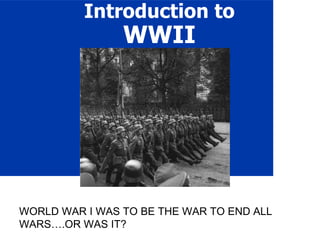
Introduction to  WWII WORLD WAR I WAS TO BE THE WAR TO END ALL WARS….OR WAS IT?
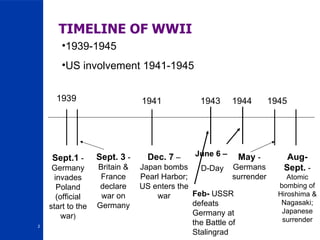
TIMELINE OF WWII 1939 Sept.1  - Germany invades Poland (official start to the war ) Dec. 7  – Japan bombs Pearl Harbor; US enters the war 1941 Aug-Sept.  -  Atomic bombing of Hiroshima & Nagasaki; Japanese surrender 1945 1939-1945 US involvement 1941-1945 1944 1943 Sept. 3  -Britain & France declare war on Germany May  - Germans surrender June 6 –  D-Day Feb-  USSR defeats Germany at the Battle of Stalingrad
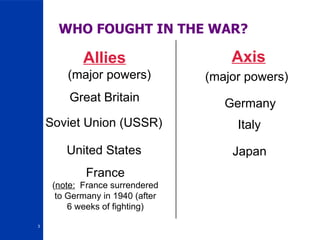
WHO FOUGHT IN THE WAR? Allies Axis Great Britain France ( note:   France surrendered to Germany in 1940 (after 6 weeks of fighting) United States Soviet Union (USSR) Germany Italy Japan (major powers) (major powers)
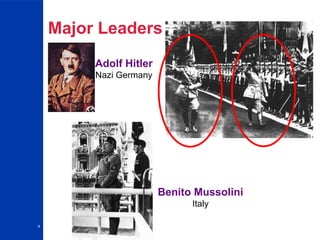
Major Leaders Adolf Hitler Nazi Germany Benito Mussolini Italy
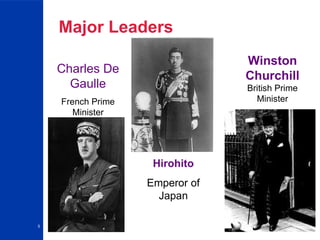
Major Leaders Winston Churchill British Prime Minister Hirohito Emperor of Japan Charles De Gaulle French Prime Minister
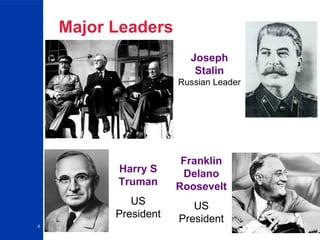
Major Leaders Harry S Truman US President Joseph Stalin Russian Leader Franklin Delano Roosevelt US President
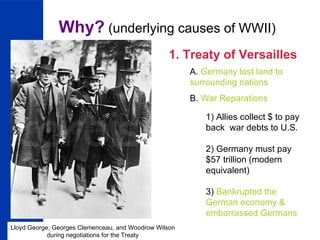
Why?  (underlying causes of WWII) 1. Treaty of Versailles A.  Germany lost land to surrounding nations B.  War Reparations 1) Allies collect $ to pay back  war debts to U.S. 2) Germany must pay $57 trillion (modern equivalent) 3)  Bankrupted the German economy & embarrassed Germans Lloyd George, Georges Clemenceau, and Woodrow Wilson during negotiations for the Treaty
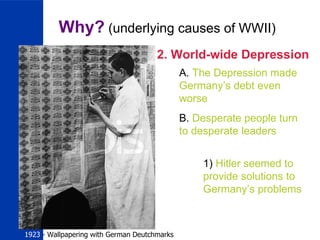
Why?  (underlying causes of WWII) 2. World-wide Depression A.  The Depression made Germany’s debt even  worse B.  Desperate people turn to desperate leaders 1)  Hitler seemed to provide solutions to Germany’s problems  1923  - Wallpapering with German Deutchmarks
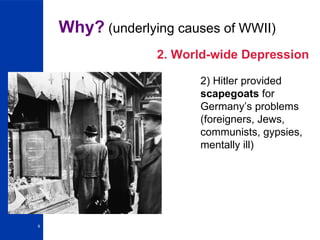
Why?  (underlying causes of WWII) 2. World-wide Depression 2) Hitler provided  scapegoats  for Germany’s problems (foreigners, Jews, communists, gypsies, mentally ill)
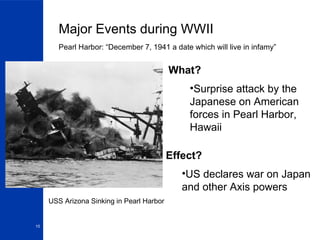
Major Events during WWII Pearl Harbor: “December 7, 1941 a date which will live in infamy” USS Arizona Sinking in Pearl Harbor What? Surprise attack by the Japanese on American forces in Pearl Harbor, Hawaii Effect? US declares war on Japan and other Axis powers
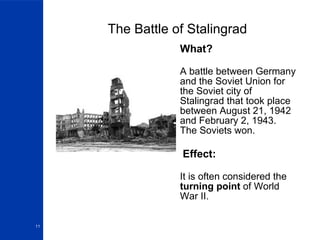
The Battle of Stalingrad What? A battle between Germany and the Soviet Union for the Soviet city of Stalingrad that took place between August 21, 1942 and February 2, 1943.  The Soviets won. Effect: It is often considered the  turning point  of World War II.
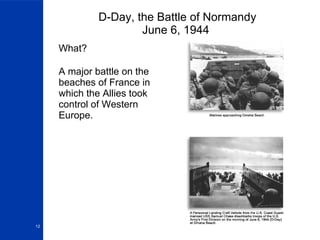
D-Day, the Battle of Normandy June 6, 1944  What? A major battle on the beaches of France in which the Allies took control of Western Europe.
Leading up to the end of WWII *  On April 27, as Allied forces closed in on Milan, Italian dictator Benito Mussolini was captured and executed. His body was then taken to Milan and hung for public display. On April 30, realizing that all was lost, German dictator Adolf Hitler committed suicide in his bunker along with Eva Braun, his long-time companion and wife.  In May 1945 German forces surrender.
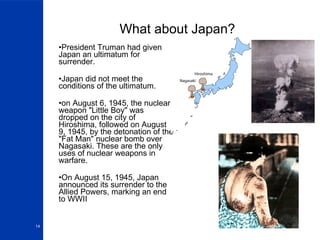
What about Japan? President Truman had given Japan an ultimatum for surrender. Japan did not meet the conditions of the ultimatum. on August 6, 1945, the nuclear weapon "Little Boy" was dropped on the city of Hiroshima, followed on August 9, 1945, by the detonation of the "Fat Man" nuclear bomb over Nagasaki. These are the only uses of nuclear weapons in warfare. On August 15, 1945, Japan announced its surrender to the Allied Powers, marking an end to WWII

Intro wwii

  • 1.
    Introduction to WWII WORLD WAR I WAS TO BE THE WAR TO END ALL WARS….OR WAS IT?
  • 2.
    TIMELINE OF WWII1939 Sept.1 - Germany invades Poland (official start to the war ) Dec. 7 – Japan bombs Pearl Harbor; US enters the war 1941 Aug-Sept. - Atomic bombing of Hiroshima & Nagasaki; Japanese surrender 1945 1939-1945 US involvement 1941-1945 1944 1943 Sept. 3 -Britain & France declare war on Germany May - Germans surrender June 6 – D-Day Feb- USSR defeats Germany at the Battle of Stalingrad
  • 3.
    WHO FOUGHT INTHE WAR? Allies Axis Great Britain France ( note: France surrendered to Germany in 1940 (after 6 weeks of fighting) United States Soviet Union (USSR) Germany Italy Japan (major powers) (major powers)
  • 4.
    Major Leaders AdolfHitler Nazi Germany Benito Mussolini Italy
  • 5.
    Major Leaders WinstonChurchill British Prime Minister Hirohito Emperor of Japan Charles De Gaulle French Prime Minister
  • 6.
    Major Leaders HarryS Truman US President Joseph Stalin Russian Leader Franklin Delano Roosevelt US President
  • 7.
    Why? (underlyingcauses of WWII) 1. Treaty of Versailles A. Germany lost land to surrounding nations B. War Reparations 1) Allies collect $ to pay back war debts to U.S. 2) Germany must pay $57 trillion (modern equivalent) 3) Bankrupted the German economy & embarrassed Germans Lloyd George, Georges Clemenceau, and Woodrow Wilson during negotiations for the Treaty
  • 8.
    Why? (underlyingcauses of WWII) 2. World-wide Depression A. The Depression made Germany’s debt even worse B. Desperate people turn to desperate leaders 1) Hitler seemed to provide solutions to Germany’s problems 1923 - Wallpapering with German Deutchmarks
  • 9.
    Why? (underlyingcauses of WWII) 2. World-wide Depression 2) Hitler provided scapegoats for Germany’s problems (foreigners, Jews, communists, gypsies, mentally ill)
  • 10.
    Major Events duringWWII Pearl Harbor: “December 7, 1941 a date which will live in infamy” USS Arizona Sinking in Pearl Harbor What? Surprise attack by the Japanese on American forces in Pearl Harbor, Hawaii Effect? US declares war on Japan and other Axis powers
  • 11.
    The Battle ofStalingrad What? A battle between Germany and the Soviet Union for the Soviet city of Stalingrad that took place between August 21, 1942 and February 2, 1943. The Soviets won. Effect: It is often considered the turning point of World War II.
  • 12.
    D-Day, the Battleof Normandy June 6, 1944 What? A major battle on the beaches of France in which the Allies took control of Western Europe.
  • 13.
    Leading up tothe end of WWII * On April 27, as Allied forces closed in on Milan, Italian dictator Benito Mussolini was captured and executed. His body was then taken to Milan and hung for public display. On April 30, realizing that all was lost, German dictator Adolf Hitler committed suicide in his bunker along with Eva Braun, his long-time companion and wife. In May 1945 German forces surrender.
  • 14.
    What about Japan?President Truman had given Japan an ultimatum for surrender. Japan did not meet the conditions of the ultimatum. on August 6, 1945, the nuclear weapon "Little Boy" was dropped on the city of Hiroshima, followed on August 9, 1945, by the detonation of the "Fat Man" nuclear bomb over Nagasaki. These are the only uses of nuclear weapons in warfare. On August 15, 1945, Japan announced its surrender to the Allied Powers, marking an end to WWII