When conversations matter but the evidence is
missing: Developing community resources for
suicide prevention
conversationsmatter.com.au
The Hunter Institute of Mental Health is a leading national
organisation dedicated to reducing mental illness and
suicide and improving wellbeing for all Australians. For
more than 20 years we have been delivering successful,
evidence-based mental health and suicide prevention
programs from our base in Newcastle, NSW. These have
made a considerable contribution to the mental health
and wellbeing of many Australians.
Project Overview
• Funded under the NSW Suicide Prevention Strategy 2010-2015;
• Developed by the Hunter Institute of Mental Health;
• AIM: to develop resources to guide safe and effective conversations
about suicide for educational settings, workplaces, families and
communities to strengthen their capacity to participate in suicide
prevention action.
• FOR: Aboriginal and Torres Strait Islander people; people from
culturally and linguistically diverse backgrounds; gay, lesbian,
bisexual, and transgender people; young people; older people;
males.
Generate evidence through
analysis of current approaches,
consultation with experts and
communities, and using a
measurable approach to finalise
resources
It has never been developed or
evaluated before and the
research evidence is limited and
conflicting with many variables
to be tested
The problem The approach
Talking about suicide
• Suicide is an important issue of community concern;
• It is important that as a community we are engaged with the issue;
• Often confusion about what is meant by “discussing” or “talking
about” suicide, and confusion about the evidence;
• Need to ensure we are not “too afraid” to talk about suicide, while
respecting and understanding the risks.
The risk associated with the “discussion” seems to be related to:
 The focus of the information (about death, about how to cope
with a death, about the broader issue);
 The status of the individual receiving the information (little
interest, vulnerable, bereaved by suicide);
 The format they receive the information (face-to-face, media);
 The place they receive the information.
Lenses considered
• Why? = Focus of discussion
• Prevention, Intervention or Postvention;
• How? = Format of discussion
• One-on-one, small group, wide-scale (e.g. media);
• Where? = Setting
• School, Workplace, Families, Community, Online, Media;
• Who? = Target groups to be considered
• Carers, GLBTI, Young People, Older People, Aboriginal and Torres Strait
Islander People, CALD Communities, People with a mental illness, People
Living in Rural and Remote Areas, Men, People Bereaved by Suicide.
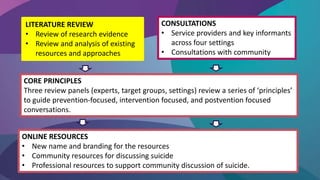
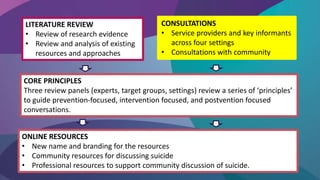
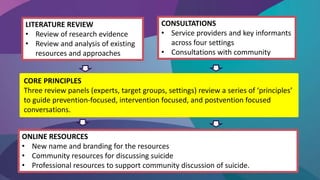
LITERATURE REVIEW
• Review of research evidence
• Review and analysis of existing
resources and approaches
CORE PRINCIPLES
Three review panels (experts, target groups, settings) review a series of ‘principles’
to guide prevention-focused, intervention focused, and postvention focused
conversations.
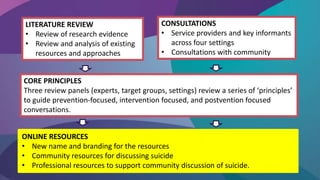
ONLINE RESOURCES
• New name and branding for the resources
• Community resources for discussing suicide
• Professional resources to support community discussion of suicide.
CONSULTATIONS
• Service providers and key informants
across four settings
• Consultations with community
Evidence review – general findings
• There is very little research evidence to either support or refute a number
of common assertions when talking about suicide;
• While there is support amongst experts that discussing suicide does not
increase risk, there is no scientific evidence that discussing suicide has
either a positive or negative impact on actual suicidal behaviour;
• Emotional discomfort and sense of self-efficacy have been identified in the
as obstacles to discussing suicide in clinical and educational settings;
• Evidence from specific settings is mixed with variable outcomes;
• Research suggests that people do want to discuss suicide despite it being
difficult.
Review of Resources
• 120 local, national and international approaches which assist people to
talk about or discuss suicide were collected and reviewed.
• Most resources were focussed in intervention (50%), followed by
Postvention (41.7%) and a small number prevention focussed (8.3%);
• Most resources guided one-on-one conversations (67.5%) and less for
groups (17.5%) and large audience (15%)
• There are major gaps – ie, prevention focussed resources, public speaking
and recommendations for particular groups;
• Resources rarely address communication theory, motivations and other
“skills” required to implement the recommendations.
LITERATURE REVIEW
• Review of research evidence
• Review and analysis of existing
resources and approaches
CORE PRINCIPLES
Three review panels (experts, target groups, settings) review a series of ‘principles’
to guide prevention-focused, intervention focused, and postvention focused
conversations.
ONLINE RESOURCES
• New name and branding for the resources
• Community resources for discussing suicide
• Professional resources to support community discussion of suicide.
CONSULTATIONS
• Service providers and key informants
across four settings
• Consultations with community
Setting Based Consultation Forums
• Four face-to-face consultations were held focussing on educational
settings, workplaces, families, and communities (including online);
• Apart from particular priorities across the four settings,
recommendations for action focussed around:
• The need for appropriate dissemination;
• Integration into existing programs and approaches;
• Training for gatekeepers;
• Addressing cultural, age and other differences but not making everything
separate and complex.
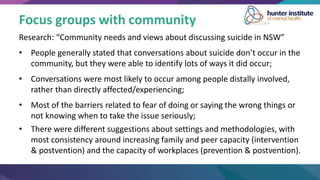
Focus groups with community
Research: “Community needs and views about discussing suicide in NSW”
• People generally stated that conversations about suicide don’t occur in the
community, but they were able to identify lots of ways it did occur;
• Conversations were most likely to occur among people distally involved,
rather than directly affected/experiencing;
• Most of the barriers related to fear of doing or saying the wrong things or
not knowing when to take the issue seriously;
• There were different suggestions about settings and methodologies, with
most consistency around increasing family and peer capacity (intervention
& postvention) and the capacity of workplaces (prevention & postvention).
LITERATURE REVIEW
• Review of research evidence
• Review and analysis of existing
resources and approaches
CORE PRINCIPLES
Three review panels (experts, target groups, settings) review a series of ‘principles’
to guide prevention-focused, intervention focused, and postvention focused
conversations.
ONLINE RESOURCES
• New name and branding for the resources
• Community resources for discussing suicide
• Professional resources to support community discussion of suicide.
CONSULTATIONS
• Service providers and key informants
across four settings
• Consultations with community
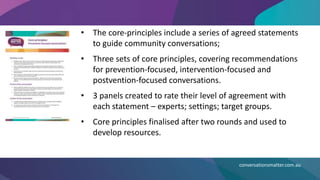
• The core-principles include a series of agreed statements
to guide community conversations;
• Three sets of core principles, covering recommendations
for prevention-focused, intervention-focused and
postvention-focused conversations.
• 3 panels created to rate their level of agreement with
each statement – experts; settings; target groups.
• Core principles finalised after two rounds and used to
develop resources.
conversationsmatter.com.au
LITERATURE REVIEW
• Review of research evidence
• Review and analysis of existing
resources and approaches
CORE PRINCIPLES
Three review panels (experts, target groups, settings) review a series of ‘principles’
to guide prevention-focused, intervention focused, and postvention focused
conversations.
ONLINE RESOURCES
• New name and branding for the resources
• Community resources for discussing suicide
• Professional resources to support community discussion of suicide.
CONSULTATIONS
• Service providers and key informants
across four settings
• Consultations with community
conversationsmatter.com.au
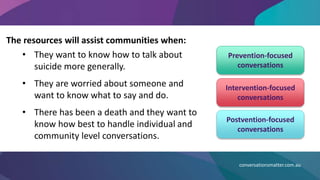
The resources will assist communities when:
• They want to know how to talk about
suicide more generally.
• They are worried about someone and
want to know what to say and do.
• There has been a death and they want to
know how best to handle individual and
community level conversations.
These resources have
been designed for
community level
conversations and not for
clinical or health related
conversations.
Prevention-focused
conversations
Intervention-focused
conversations
Postvention-focused
conversations
Five initial community resources:
1. Conversations Matter when holding group discussions about
suicide prevention
2. Conversations Matter when you are worried someone may be
thinking about suicide
3. Conversations Matter when communities are affected by suicide
4. Conversations Matter to those bereaved by suicide
5. Conversations Matter when needing to inform a child about
suicide.
conversationsmatter.com.au
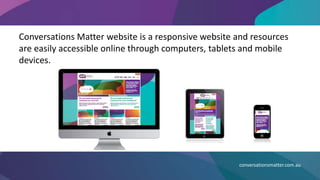
Conversations Matter website is a responsive website and resources
are easily accessible online through computers, tablets and mobile
devices.
conversationsmatter.com.au
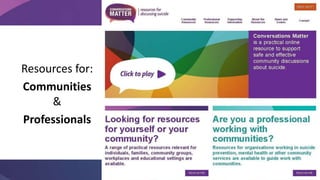
Resources for:
Communities
&
Professionals
Each community resource can be
accessed as:
• Online presentation
• Printed factsheet
• Podcast in male or female voice
You will also find:
• Supporting information
• Links to services, programs and
resources.
conversationsmatter.com.au
Following extensive
community
consultation the
resources have been
developed in multiple
formats.
Next steps
The mental health, community services and other community sectors have a
key role in disseminating messages to the community.
1. Identify gate-keepers and identify pilot organisations for more
comprehensive support (and evaluation);
2. Develop Capacity building plan and get baseline information;
3. Implement Plan with targeted organisations, including professional
develop and support for engaging communities;
4. Support ongoing communities of practice around the Conversations
Matter resources.
conversationsmatter.com.au
www.conversationsmatter.com.au
conversationsmatter.com.au
All of the background reports are
available online.
You can register your interest in
receiving Conversations Matter
updates – just visit us!
Follow us on twitter @HInstMH
Questions?
conversationsmatter.com.au

When conversations matter but the evidence is missing

  • 1.
    When conversations matterbut the evidence is missing: Developing community resources for suicide prevention conversationsmatter.com.au
  • 2.
    The Hunter Instituteof Mental Health is a leading national organisation dedicated to reducing mental illness and suicide and improving wellbeing for all Australians. For more than 20 years we have been delivering successful, evidence-based mental health and suicide prevention programs from our base in Newcastle, NSW. These have made a considerable contribution to the mental health and wellbeing of many Australians.
  • 3.
    Project Overview • Fundedunder the NSW Suicide Prevention Strategy 2010-2015; • Developed by the Hunter Institute of Mental Health; • AIM: to develop resources to guide safe and effective conversations about suicide for educational settings, workplaces, families and communities to strengthen their capacity to participate in suicide prevention action. • FOR: Aboriginal and Torres Strait Islander people; people from culturally and linguistically diverse backgrounds; gay, lesbian, bisexual, and transgender people; young people; older people; males.
  • 4.
    Generate evidence through analysisof current approaches, consultation with experts and communities, and using a measurable approach to finalise resources It has never been developed or evaluated before and the research evidence is limited and conflicting with many variables to be tested The problem The approach
  • 5.
    Talking about suicide •Suicide is an important issue of community concern; • It is important that as a community we are engaged with the issue; • Often confusion about what is meant by “discussing” or “talking about” suicide, and confusion about the evidence; • Need to ensure we are not “too afraid” to talk about suicide, while respecting and understanding the risks.
  • 6.
    The risk associatedwith the “discussion” seems to be related to:  The focus of the information (about death, about how to cope with a death, about the broader issue);  The status of the individual receiving the information (little interest, vulnerable, bereaved by suicide);  The format they receive the information (face-to-face, media);  The place they receive the information.
  • 7.
    Lenses considered • Why?= Focus of discussion • Prevention, Intervention or Postvention; • How? = Format of discussion • One-on-one, small group, wide-scale (e.g. media); • Where? = Setting • School, Workplace, Families, Community, Online, Media; • Who? = Target groups to be considered • Carers, GLBTI, Young People, Older People, Aboriginal and Torres Strait Islander People, CALD Communities, People with a mental illness, People Living in Rural and Remote Areas, Men, People Bereaved by Suicide.
  • 8.
    LITERATURE REVIEW • Reviewof research evidence • Review and analysis of existing resources and approaches CORE PRINCIPLES Three review panels (experts, target groups, settings) review a series of ‘principles’ to guide prevention-focused, intervention focused, and postvention focused conversations. ONLINE RESOURCES • New name and branding for the resources • Community resources for discussing suicide • Professional resources to support community discussion of suicide. CONSULTATIONS • Service providers and key informants across four settings • Consultations with community
  • 9.
    Evidence review –general findings • There is very little research evidence to either support or refute a number of common assertions when talking about suicide; • While there is support amongst experts that discussing suicide does not increase risk, there is no scientific evidence that discussing suicide has either a positive or negative impact on actual suicidal behaviour; • Emotional discomfort and sense of self-efficacy have been identified in the as obstacles to discussing suicide in clinical and educational settings; • Evidence from specific settings is mixed with variable outcomes; • Research suggests that people do want to discuss suicide despite it being difficult.
  • 10.
    Review of Resources •120 local, national and international approaches which assist people to talk about or discuss suicide were collected and reviewed. • Most resources were focussed in intervention (50%), followed by Postvention (41.7%) and a small number prevention focussed (8.3%); • Most resources guided one-on-one conversations (67.5%) and less for groups (17.5%) and large audience (15%) • There are major gaps – ie, prevention focussed resources, public speaking and recommendations for particular groups; • Resources rarely address communication theory, motivations and other “skills” required to implement the recommendations.
  • 11.
    LITERATURE REVIEW • Reviewof research evidence • Review and analysis of existing resources and approaches CORE PRINCIPLES Three review panels (experts, target groups, settings) review a series of ‘principles’ to guide prevention-focused, intervention focused, and postvention focused conversations. ONLINE RESOURCES • New name and branding for the resources • Community resources for discussing suicide • Professional resources to support community discussion of suicide. CONSULTATIONS • Service providers and key informants across four settings • Consultations with community
  • 12.
    Setting Based ConsultationForums • Four face-to-face consultations were held focussing on educational settings, workplaces, families, and communities (including online); • Apart from particular priorities across the four settings, recommendations for action focussed around: • The need for appropriate dissemination; • Integration into existing programs and approaches; • Training for gatekeepers; • Addressing cultural, age and other differences but not making everything separate and complex.
  • 13.
    Focus groups withcommunity Research: “Community needs and views about discussing suicide in NSW” • People generally stated that conversations about suicide don’t occur in the community, but they were able to identify lots of ways it did occur; • Conversations were most likely to occur among people distally involved, rather than directly affected/experiencing; • Most of the barriers related to fear of doing or saying the wrong things or not knowing when to take the issue seriously; • There were different suggestions about settings and methodologies, with most consistency around increasing family and peer capacity (intervention & postvention) and the capacity of workplaces (prevention & postvention).
  • 14.
    LITERATURE REVIEW • Reviewof research evidence • Review and analysis of existing resources and approaches CORE PRINCIPLES Three review panels (experts, target groups, settings) review a series of ‘principles’ to guide prevention-focused, intervention focused, and postvention focused conversations. ONLINE RESOURCES • New name and branding for the resources • Community resources for discussing suicide • Professional resources to support community discussion of suicide. CONSULTATIONS • Service providers and key informants across four settings • Consultations with community
  • 15.
    • The core-principlesinclude a series of agreed statements to guide community conversations; • Three sets of core principles, covering recommendations for prevention-focused, intervention-focused and postvention-focused conversations. • 3 panels created to rate their level of agreement with each statement – experts; settings; target groups. • Core principles finalised after two rounds and used to develop resources. conversationsmatter.com.au
  • 16.
    LITERATURE REVIEW • Reviewof research evidence • Review and analysis of existing resources and approaches CORE PRINCIPLES Three review panels (experts, target groups, settings) review a series of ‘principles’ to guide prevention-focused, intervention focused, and postvention focused conversations. ONLINE RESOURCES • New name and branding for the resources • Community resources for discussing suicide • Professional resources to support community discussion of suicide. CONSULTATIONS • Service providers and key informants across four settings • Consultations with community
  • 17.
    conversationsmatter.com.au The resources willassist communities when: • They want to know how to talk about suicide more generally. • They are worried about someone and want to know what to say and do. • There has been a death and they want to know how best to handle individual and community level conversations. These resources have been designed for community level conversations and not for clinical or health related conversations. Prevention-focused conversations Intervention-focused conversations Postvention-focused conversations
  • 18.
    Five initial communityresources: 1. Conversations Matter when holding group discussions about suicide prevention 2. Conversations Matter when you are worried someone may be thinking about suicide 3. Conversations Matter when communities are affected by suicide 4. Conversations Matter to those bereaved by suicide 5. Conversations Matter when needing to inform a child about suicide. conversationsmatter.com.au
  • 19.
    Conversations Matter websiteis a responsive website and resources are easily accessible online through computers, tablets and mobile devices. conversationsmatter.com.au
  • 20.
  • 21.
    Each community resourcecan be accessed as: • Online presentation • Printed factsheet • Podcast in male or female voice You will also find: • Supporting information • Links to services, programs and resources. conversationsmatter.com.au Following extensive community consultation the resources have been developed in multiple formats.
  • 22.
    Next steps The mentalhealth, community services and other community sectors have a key role in disseminating messages to the community. 1. Identify gate-keepers and identify pilot organisations for more comprehensive support (and evaluation); 2. Develop Capacity building plan and get baseline information; 3. Implement Plan with targeted organisations, including professional develop and support for engaging communities; 4. Support ongoing communities of practice around the Conversations Matter resources. conversationsmatter.com.au
  • 23.
    www.conversationsmatter.com.au conversationsmatter.com.au All of thebackground reports are available online. You can register your interest in receiving Conversations Matter updates – just visit us! Follow us on twitter @HInstMH
  • 24.

Editor's Notes

  • #6 Suicide is an important issue of community concern. Consultations in New South Wales revealed that in fact, communities wanted to talk more about suicide but lacks the knowledge and confidence to do it well. It is important that as a community we are engaged with the issue of suicide and suicide prevention. However, there is often confusion about the different ways communities can talk about suicide, the role that “talking about suicide” plays in suicide prevention and confusion about what the evidence and current opinion says about discussing suicide in different contexts. It is clear that as a community we need to ensure we are not too afraid to talk about suicide, while respecting and understanding the risks in certain circumstances.
  • #7 Many will often say that talking about suicide is safe and will not increase risk. However, there is very little research looking at the impact of conversations in community settings. Rather, most of the research looks at clinical settings or screening practices in community settings. From the available research evidence, it appears that the following issues should be considered to determine whether there is any risk or benefit that may arise from conversations. Firstly the focus of the information – for example is it about a specific suicide, about how to cope following a death or about the broader issue of suicide. Secondly – the status, or wellbeing, of the individual receiving the information – for example whether they currently have little interest in the issue, whether they are currently thinking about suicide or if they have been impacted or bereaved by suicide. Thirdly – the format they receive the information in – for example whether this is face to face, one on one, in a group, or online. And finally – the place they receive the information – whether it is in a school, at home or via the media.
  • #8 Conversations Matter was developed considering the following lenses. Firstly – Why the conversation was occurring. So, whether it was prevention-focused, intervention focused or postvention focused. Secondly – How the conversation was conducted – whether this was one-on-one, in a group or wide-scale formats like the media. Thirdly – where the conversation was occurring – and whether there were specific recommendations for certain settings. And finally, who was having the conversation – considering the diversity of the community.
  • #9 Conversations Matter is the first of it’s kind and so a comprehensive scoping, consultation and development phase was undertaken. To better understand the issues and the status of what we know and don’t know – a review of the literature as well as a review and analysis of current resources and programs was undertaken. In addition to the reviews a series of consultations were conducted with people who work in suicide prevention, others who work with communities and community members themselves. Based on the reviews and consultations a series of draft core principles for prevention-focused, intervention-focused and postvention-focused conversations were developed and reviewed by three independent review panels until consistent agreement was reached. These final core principles are available to guide the work of professionals and organisations and were used to develop core content for the community resources.
  • #12 Conversations Matter is the first of it’s kind and so a comprehensive scoping, consultation and development phase was undertaken. To better understand the issues and the status of what we know and don’t know – a review of the literature as well as a review and analysis of current resources and programs was undertaken. In addition to the reviews a series of consultations were conducted with people who work in suicide prevention, others who work with communities and community members themselves. Based on the reviews and consultations a series of draft core principles for prevention-focused, intervention-focused and postvention-focused conversations were developed and reviewed by three independent review panels until consistent agreement was reached. These final core principles are available to guide the work of professionals and organisations and were used to develop core content for the community resources.
  • #15 Conversations Matter is the first of it’s kind and so a comprehensive scoping, consultation and development phase was undertaken. To better understand the issues and the status of what we know and don’t know – a review of the literature as well as a review and analysis of current resources and programs was undertaken. In addition to the reviews a series of consultations were conducted with people who work in suicide prevention, others who work with communities and community members themselves. Based on the reviews and consultations a series of draft core principles for prevention-focused, intervention-focused and postvention-focused conversations were developed and reviewed by three independent review panels until consistent agreement was reached. These final core principles are available to guide the work of professionals and organisations and were used to develop core content for the community resources.
  • #16 While the professional resources are being developed, you can immediately access a set of three core principles to guide your work with communities. The core principles contain a series of agreed statements to guide the way communities can safely and effectively discuss suicide. The core principles cover: Prevention-focused, intervention-focused and postvention-focused conversations and can be dowloaded from this resource page. The core principles can assist you to prepare work or presentations with communities, to review current presentations or work and to develop or review key messages about discussing suicide. It is important for communities that those working with them are informed and consistent in their approach.
  • #17 Conversations Matter is the first of it’s kind and so a comprehensive scoping, consultation and development phase was undertaken. To better understand the issues and the status of what we know and don’t know – a review of the literature as well as a review and analysis of current resources and programs was undertaken. In addition to the reviews a series of consultations were conducted with people who work in suicide prevention, others who work with communities and community members themselves. Based on the reviews and consultations a series of draft core principles for prevention-focused, intervention-focused and postvention-focused conversations were developed and reviewed by three independent review panels until consistent agreement was reached. These final core principles are available to guide the work of professionals and organisations and were used to develop core content for the community resources.
  • #18 The online resources will assist communities to talk about suicide in ways that breaks down the stigma and increases understanding and support for those thinking about suicide and or those affected by suicide. They will assist individuals and communities when: They want to know how to talk about suicide more generally – this includes group presentations or discussions about suicide prevention; When they are worried about someone and want to know what to say and what to do; And when there has been a death by suicide and they want to know how best to handle individual and community level conversations as well as conversations with those bereaved by suicide. These resources are not to be used as advice for clinical or health-related conversations. They are basic advice for community conversations only.
  • #19 Each community resource appears as an online presentation. You can access the presentation by clicking on the title slides on the resources page. Online presentations are on average about 10 minutes in duration and provide slides with helpful tips for safe discussions, breakout boxes to highlight important information to be considered as well as speech bubbles with examples of what to say. You can automatically work through each online presentation or forward to the next slide by clicking the forward button located on the bottom left of the presentation. Each online presentation is accompanied by voice over for you to listen to while working through the slides. There is an option to turn off the sound by clicking the mute button located on the bottom right of the presentation. Please note: It is recommended that you listen to the voice over, for it enhances the content and provides further context for you to consider in addition to the helpful tips provided.
  • #20 Conversations Matter resources are hosted on a stand alone responsive website – which means you can access it on your computer, tablet or other mobile device. So make sure you book mark it as a favourite so you can access it quickly while on the go.
  • #22 Following extensive consultations with the community, the resources have been built in multiple formats, so you can access them in the format that best suits you. You can view the resources as an online presentation that will run through tips for conversations, a series of slides with added voice over. You can view or download the resources as a printed fact sheet by using the links on each resource page. You can also download and listen to each resource as a podcast. The resources are enhanced by a range of supporting information and fact sheets. Links to other services, training, programs and resources are also available.   
  • #24 We hope you find the Conversations Matter resources helpful. You can stay in touch with new development and activities by registering your interest in the website footer. You can also share the website with friends, family, colleagues and other people you know who may find them useful.
  • #25 We hope you find the Conversations Matter resources helpful. You can stay in touch with new development and activities by registering your interest in the website footer. You can also share the website with friends, family, colleagues and other people you know who may find them useful.