Web access: technical requirements and
      usability requirements
      Dealing with copyright and other rights


4-5 September 2012   Vietnam Film Archive Workshops   1
The technology has never been easier:
•Make a website to be the portal (Wordpress etc)
•Put the audio and video content ‘somewhere
else’ – YouTube (mid quality) or Vimeo (higher
quality)
•Link to the content from the portal; job done !
•YouTube and Vimeo will recode for you, but you
can code it yourself: H.264/MPEG-4 AVC, 1 Mb/s
•Vimeo example: https://vimeo.com/44836302
4-5 September 2012   Vietnam Film Archive Workshops   2
Six requirements for sensible
                     access to time-based content
•   Granularity
•   Navigation
•   Reference and Citation
•   Annotation
•   Rights
•   Access


4-5 September 2012       Vietnam Film Archive Workshops   3
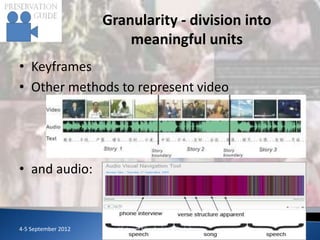
Granularity - division into
                         meaningful units
• Keyframes
• Other methods to represent video


• and audio:


4-5 September 2012     Vietnam Film Archive Workshops   4
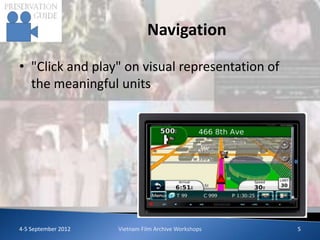
Navigation

• "Click and play" on visual representation of
  the meaningful units


4-5 September 2012   Vietnam Film Archive Workshops   5
Reference and Citation

• the core requirement for scholarly discourse
     – along with a major change in attitude!
• Needs a permanent place for “things to be”
     – Hence the need for stable audiovisual collections

                     “Hamlet, for example, is comparable to Saxo
                     Grammaticus' Gesta Danorum.[citation needed]
                     King Lear is based on King Leir in Historia Regum
                     Britanniae by Geoffrey of Monmouth, retold in
                     1587 by Raphael Holinshed.[citation needed] “
                                                        wikipedia
4-5 September 2012         Vietnam Film Archive Workshops            6
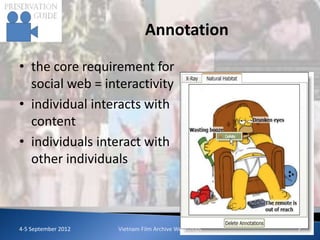
Annotation

• the core requirement for
  social web = interactivity
• individual interacts with
  content
• individuals interact with
  other individuals


4-5 September 2012   Vietnam Film Archive Workshops   7
Rights
• 95% of cost of BBC trial of archive access
     – 20 hours per hour of content
     – Does not scale
• PrestoPRIME Ontology – supporting
  codification of owners, users and uses
     – Ten years ago we had matrices in a spreadsheet,
       now we have an ontology
• New laws needed (for publicly-funded content)
  – Denmark leading the way

4-5 September 2012   Vietnam Film Archive Workshops      8
Economic Theory: Public Goods

Things that can be consumed by everybody in a
  society, or nobody at all. They have three
  characteristics. They are:
• non-rival – one person consuming them does not
  stop another person consuming them;
• non-excludable – if one person can consume them,
  it is impossible to stop another person consuming
  them;
• non-rejectable – people cannot choose not to
  consume them even if they want to.
4-5 September 2012        Vietnam Film Archive Workshops   9
Public Goods

Examples include:
     – clean air
     – national defence
     – judges and courts
 They might not be provided at all if left to
  MARKET FORCES.
In most countries they are provided for by
  GOVERNMENT and paid for through
  compulsory taxation.”
http://www.economist.com/research/economics/alphabetic.cfm?term=publi
   cgoods#publicgoods

4-5 September 2012      Vietnam Film Archive Workshops              10
Public Goods, the Public Sector
                         and Cultural Heritage
• Argument: archives, libraries, museums are
   publicly-supported institutions that hold
   public goods
• Rights laws that apply to private goods need
   to be re-interpreted for public goods
Is access for entertainment and leisure activity
   or for education and research activity?
But: doesn’t everyone deserve to be taken
   seriously? Can’t we all be researchers?

4-5 September 2012        Vietnam Film Archive Workshops   11
Digital Public Space
                     www.bbc.co.uk/blogs/bbcinternet/2012/06/the_space
                                     _one_month.html

• A place for public goods
• an access point for all of the UK's cultural archives
• an 'Umbrella' data model, based on RDF =
  Resource Discovery Format (semantic web)
• a platform for navigating, annotating and curating
  heritage content
• “providing permanent access to the UK's cultural
  archives in a digital environment that's available
  to everybody” Jake Berger, BBC

4-5 September 2012            Vietnam Film Archive Workshops         12
Digital Public Space

• Tony Ageh (BBC): "As a nation, we need to
  decide that we are going to create an
  environment where every one of our citizens
  can get value from these technologies. The
  BBC should facilitate this, but it is an
  opportunity for these technologies to remind
  all our national institutions what they were
  trying to achieve in the first place."

4-5 September 2012   Vietnam Film Archive Workshops   13
Access

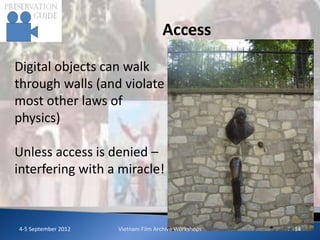
Digital objects can walk
through walls (and violate
most other laws of
physics)

Unless access is denied –
interfering with a miracle!


4-5 September 2012   Vietnam Film Archive Workshops   14
EUScreen report: Online Access to Audiovisual
Heritage (concentrates on TV)
Download the Second EUscreen Status Report
[PDF]: http://bit.ly/OVLcZV
Download the First EUscreen status report
[PDF]: http://bit.ly/MF1hsL


4-5 September 2012   Vietnam Film Archive Workshops   15
European Film Gateway
                     www.europeanfilmgateway.eu/
A European Union project www.efgproject.eu/
• Also connected to Europeana
     “Your single access point to films, images and texts from
       selected collections of 16 film archives across Europe”
•   VIDEOS:              27.547               (27 on Vietnam)
•   IMAGES:              521.021
•   TEXTS:               25.537
•   PROVIDERS:           16


4-5 September 2012       Vietnam Film Archive Workshops          16
EFG documents:
• D 5.3 The European Film Gateway - Final
  Guidelines on Copyright Clearance and IPR
  Management
• M 5.4 Digital rights management and
  watermarking expression
• M 5.3 Research Report on open content models
• D 4.3 Guidelines for Digitisation, digital storage
  and retrieval
• On the History and Function of Film Archives
And lots more

4-5 September 2012   Vietnam Film Archive Workshops    17
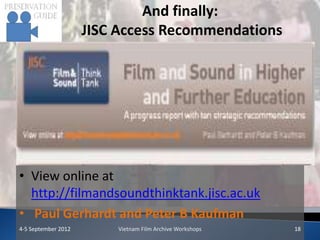
And finally:
                     JISC Access Recommendations


• View online at
  http://filmandsoundthinktank.jisc.ac.uk
• Paul Gerhardt and Peter B Kaufman
4-5 September 2012       Vietnam Film Archive Workshops   18
JISC: Ten Guides for Use of AV
                                Content
1. Extend Awareness of Resources. Develop marketing
   strategies and case studies.
2. Enable Resource Discovery. Make content searchable;
   audiovisual extension of JSTOR and ARTstor.
3. Clear Rights, Facilitate Use. Inventory, legal
   documents, collaborations.
4. Build a Citation System. Use of video and audio in
   academic writing and publishing.
5. Work with Primary Audiovisual Sources. Storage,
   curation, and distribution of uncut raw materials.

4-5 September 2012       Vietnam Film Archive Workshops   19
6. Build Digital Literacy. Tools for audiovisual
   materials in academic environments.
7. Open National Collections. Partnerships with
   broadcasters and other AV collections.
8. Model New Productions. Explicit requirements
   for products to be freely licensable.
9. Establish an Integrated Media Service for
   Higher Education.
10.Call a Summit. Experiment

4-5 September 2012   Vietnam Film Archive Workshops   20
Thank You

Lunch time !
• After lunch – review of digital technology
• Then our two days are nearly over
• Conclusion: further sources of information
• And on organisations concerned with audio,
  video and film (and heritage and preservation)


 4-5 September 2012   Vietnam Film Archive Workshops   21

Workshop 7 web access technology (for audiovisual content)

  • 1.
    Web access: technicalrequirements and usability requirements Dealing with copyright and other rights 4-5 September 2012 Vietnam Film Archive Workshops 1
  • 2.
    The technology hasnever been easier: •Make a website to be the portal (Wordpress etc) •Put the audio and video content ‘somewhere else’ – YouTube (mid quality) or Vimeo (higher quality) •Link to the content from the portal; job done ! •YouTube and Vimeo will recode for you, but you can code it yourself: H.264/MPEG-4 AVC, 1 Mb/s •Vimeo example: https://vimeo.com/44836302 4-5 September 2012 Vietnam Film Archive Workshops 2
  • 3.
    Six requirements forsensible access to time-based content • Granularity • Navigation • Reference and Citation • Annotation • Rights • Access 4-5 September 2012 Vietnam Film Archive Workshops 3
  • 4.
    Granularity - divisioninto meaningful units • Keyframes • Other methods to represent video • and audio: 4-5 September 2012 Vietnam Film Archive Workshops 4
  • 5.
    Navigation • "Click andplay" on visual representation of the meaningful units 4-5 September 2012 Vietnam Film Archive Workshops 5
  • 6.
    Reference and Citation •the core requirement for scholarly discourse – along with a major change in attitude! • Needs a permanent place for “things to be” – Hence the need for stable audiovisual collections “Hamlet, for example, is comparable to Saxo Grammaticus' Gesta Danorum.[citation needed] King Lear is based on King Leir in Historia Regum Britanniae by Geoffrey of Monmouth, retold in 1587 by Raphael Holinshed.[citation needed] “ wikipedia 4-5 September 2012 Vietnam Film Archive Workshops 6
  • 7.
    Annotation • the corerequirement for social web = interactivity • individual interacts with content • individuals interact with other individuals 4-5 September 2012 Vietnam Film Archive Workshops 7
  • 8.
    Rights • 95% ofcost of BBC trial of archive access – 20 hours per hour of content – Does not scale • PrestoPRIME Ontology – supporting codification of owners, users and uses – Ten years ago we had matrices in a spreadsheet, now we have an ontology • New laws needed (for publicly-funded content) – Denmark leading the way 4-5 September 2012 Vietnam Film Archive Workshops 8
  • 9.
    Economic Theory: PublicGoods Things that can be consumed by everybody in a society, or nobody at all. They have three characteristics. They are: • non-rival – one person consuming them does not stop another person consuming them; • non-excludable – if one person can consume them, it is impossible to stop another person consuming them; • non-rejectable – people cannot choose not to consume them even if they want to. 4-5 September 2012 Vietnam Film Archive Workshops 9
  • 10.
    Public Goods Examples include: – clean air – national defence – judges and courts They might not be provided at all if left to MARKET FORCES. In most countries they are provided for by GOVERNMENT and paid for through compulsory taxation.” http://www.economist.com/research/economics/alphabetic.cfm?term=publi cgoods#publicgoods 4-5 September 2012 Vietnam Film Archive Workshops 10
  • 11.
    Public Goods, thePublic Sector and Cultural Heritage • Argument: archives, libraries, museums are publicly-supported institutions that hold public goods • Rights laws that apply to private goods need to be re-interpreted for public goods Is access for entertainment and leisure activity or for education and research activity? But: doesn’t everyone deserve to be taken seriously? Can’t we all be researchers? 4-5 September 2012 Vietnam Film Archive Workshops 11
  • 12.
    Digital Public Space www.bbc.co.uk/blogs/bbcinternet/2012/06/the_space _one_month.html • A place for public goods • an access point for all of the UK's cultural archives • an 'Umbrella' data model, based on RDF = Resource Discovery Format (semantic web) • a platform for navigating, annotating and curating heritage content • “providing permanent access to the UK's cultural archives in a digital environment that's available to everybody” Jake Berger, BBC 4-5 September 2012 Vietnam Film Archive Workshops 12
  • 13.
    Digital Public Space •Tony Ageh (BBC): "As a nation, we need to decide that we are going to create an environment where every one of our citizens can get value from these technologies. The BBC should facilitate this, but it is an opportunity for these technologies to remind all our national institutions what they were trying to achieve in the first place." 4-5 September 2012 Vietnam Film Archive Workshops 13
  • 14.
    Access Digital objects canwalk through walls (and violate most other laws of physics) Unless access is denied – interfering with a miracle! 4-5 September 2012 Vietnam Film Archive Workshops 14
  • 15.
    EUScreen report: OnlineAccess to Audiovisual Heritage (concentrates on TV) Download the Second EUscreen Status Report [PDF]: http://bit.ly/OVLcZV Download the First EUscreen status report [PDF]: http://bit.ly/MF1hsL 4-5 September 2012 Vietnam Film Archive Workshops 15
  • 16.
    European Film Gateway www.europeanfilmgateway.eu/ A European Union project www.efgproject.eu/ • Also connected to Europeana “Your single access point to films, images and texts from selected collections of 16 film archives across Europe” • VIDEOS: 27.547 (27 on Vietnam) • IMAGES: 521.021 • TEXTS: 25.537 • PROVIDERS: 16 4-5 September 2012 Vietnam Film Archive Workshops 16
  • 17.
    EFG documents: • D5.3 The European Film Gateway - Final Guidelines on Copyright Clearance and IPR Management • M 5.4 Digital rights management and watermarking expression • M 5.3 Research Report on open content models • D 4.3 Guidelines for Digitisation, digital storage and retrieval • On the History and Function of Film Archives And lots more 4-5 September 2012 Vietnam Film Archive Workshops 17
  • 18.
    And finally: JISC Access Recommendations • View online at http://filmandsoundthinktank.jisc.ac.uk • Paul Gerhardt and Peter B Kaufman 4-5 September 2012 Vietnam Film Archive Workshops 18
  • 19.
    JISC: Ten Guidesfor Use of AV Content 1. Extend Awareness of Resources. Develop marketing strategies and case studies. 2. Enable Resource Discovery. Make content searchable; audiovisual extension of JSTOR and ARTstor. 3. Clear Rights, Facilitate Use. Inventory, legal documents, collaborations. 4. Build a Citation System. Use of video and audio in academic writing and publishing. 5. Work with Primary Audiovisual Sources. Storage, curation, and distribution of uncut raw materials. 4-5 September 2012 Vietnam Film Archive Workshops 19
  • 20.
    6. Build DigitalLiteracy. Tools for audiovisual materials in academic environments. 7. Open National Collections. Partnerships with broadcasters and other AV collections. 8. Model New Productions. Explicit requirements for products to be freely licensable. 9. Establish an Integrated Media Service for Higher Education. 10.Call a Summit. Experiment 4-5 September 2012 Vietnam Film Archive Workshops 20
  • 21.
    Thank You Lunch time! • After lunch – review of digital technology • Then our two days are nearly over • Conclusion: further sources of information • And on organisations concerned with audio, video and film (and heritage and preservation) 4-5 September 2012 Vietnam Film Archive Workshops 21

Editor's Notes

  • #3 http://en.wikipedia.org/wiki/BBC_iPlayer#Online_streaming_servicehttp://en.wikipedia.org/wiki/H.264
  • #10 Definition from http://www.economist.com/economics-a-to-z/p
  • #14 www.guardian.co.uk/media/2010/nov/01/tony-ageh-interview-bbc-archive
  • #15 The man who could walk through walls (Le Passe-Muraille)http://www.stresscafe.com/translations/pm/index.htm
  • #18 http://www.efgproject.eu/outcomes.php