Inside   
                                                                               Industry Report................................2
                                                                               Pursuing Federal Contracts.............4
                                                                               Social Networking...........................7
                                                                               Construction Industry
                                                                               Bankruptcies..................................10
                                                                                           .
                                                                               Member Projects............................14
                                                                               New Members................................15
                                                                               WBC Calendar............................. 16
The Official Publication of the Washington Building Congress | May/June 2009


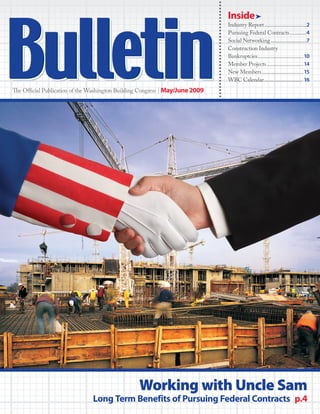
                                                 Working with Uncle Sam 
                               Long Term Benefits of Pursuing Federal Contracts  p.4
Feature Article


                                                                     “What drives success as a federal contractor is a long term

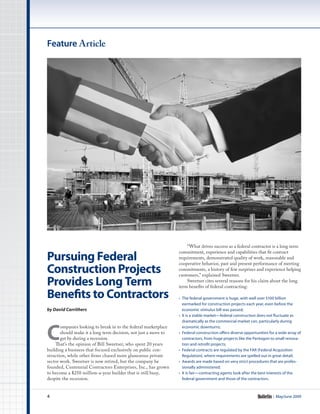
Pursuing Federal
                                                                 commitment, experience and capabilities that fit contract
                                                                 requirements, demonstrated quality of work, reasonable and
                                                                 cooperative behavior, past and present performance of meeting
Construction Projects                                            commitments, a history of few surprises and experience helping
                                                                 customers,” explained Sweetser.
Provides Long Term                                                   Sweetser cites several reasons for his claim about the long
                                                                 term benefits of federal contracting:

Benefits to Contractors                                          •	 The federal government is huge, with well over $100 billion
                                                                    earmarked for construction projects each year, even before the
by David Carrithers	                                                economic stimulus bill was passed;
                                                                 •	 It is a stable market—federal construction does not fluctuate as


C
                                                                    dramatically as the commercial market can, particularly during
       ompanies looking to break in to the federal marketplace      economic downturns;
       should make it a long term decision, not just a move to   •	 Federal construction offers diverse opportunities for a wide array of
       get by during a recession.                                   contractors, from huge projects like the Pentagon to small renova-
    That’s the opinion of Bill Sweetser, who spent 20 years         tion and retrofit projects;
building a business that focused exclusively on public con-      •	 Federal contracts are regulated by the FAR (Federal Acquisition
struction, while other firms chased more glamorous private          Regulation), where requirements are spelled out in great detail;
sector work. Sweetser is now retired, but the company he         •	 Awards are made based on very strict procedures that are profes-
founded, Centennial Contractors Enterprises, Inc., has grown        sionally administered;
to become a $250 million-a-year builder that is still busy,      •	 It is fair—contracting agents look after the best interests of the
despite the recession.                                              federal government and those of the contractors.


4                                                                                                                       | May/June 2009
Feature Article
                                                                              •	 For subcontractors and suppliers, he suggested going to general
                                                                                 contractors’ Web sites and registering their companies and their
                                                                                 areas of expertise;
                                                                              •	 Find a surety because all federal work has to be bonded.

                                                                                   “If you are going to work for the federal government,”
                                                                              Sweetser said, “this is a good time to start. The stimulus pack-
                                                                              age is going to put pressure on contracting officers to spend
                                                                              money quickly.”

                                                                              American Recovery and Reinvestment Act Yields
                                                                              Direction for Federal Work
                                                                              The recently passed American Recovery and Reinvestment Act
                                                                              of 2009 provides a good starting point for companies looking
                                                                              to begin or ramp up their federal construction efforts. A sig-
                                                                              nificant portion of the plan—about $134 billion—is earmarked
                                                                              for construction spending. Additionally, an estimated $8.7 bil-
                                                                              lion will be available to states for school construction by way of
                                                                              the American Recovery and Reinvestment Act’s State Stabili-
                                                                              zation Funds. Exactly how and when the money will be spent is
                                                                              outlined at www.recovery.gov.
                                                                                   The largest single category of construction spend-
                                                                              ing—$49.3 billion—is for transportation infrastructure. Of
                                                                              that, $27.5 billion will be allocated for highway and bridge
                                                                              construction.
                                                                                   One of the Act’s primary goals, according to the White
“Every day is a good day to work for the federal government,” explains Bill   House, is to “Revive the renewable energy industry and provide
Sweetser, retired founder of Centennial Contractors Enterprises, Inc.         the capital over the next three years to eventually double
                                                                              domestic renewable energy capacity.” To that goal, $29.8 billion
                                                                              will be spent on energy and technology.
     “If you’ve got a company that has been making a liv-                          $29.5 billion will be spent on building infrastructure, a
ing in the private sector, you would be well served to put                    category of great interest to many commercial contractors. The
emphasis on federal work,” urged Sweetser. He said that                       funds are divided among six primary programs:
what drives success as a federal contractor are both tangible
and intangible — a long term commitment to being a federal                    1.	 $5.6 billion for GSA (General Services Administration) federal build-
contractor; experience and capabilities that fit contract                         ings and facilities
requirements; demonstrated quality of work; reasonable and                    2.	 $7.12 for military construction
cooperative behavior; and past and present performance of                     3.	 $1 billion for VA (Veterans Affairs) construction
meeting commitments, a history of few surprises, and expe-                    4.	 $8.04 billion for housing facilities
rience helping customers.                                                     5.	 $7.74 billion for other facilities
     Sweetser emphasized that working for the federal govern-                 6.	 An additional $8.7 billion will be funded through separate aspects
ment is not easy, and that there are unique considerations that                   of the bill for K-12 and higher education school construction
federal contractors have to think about. He also stressed the
need to have talented proposal writers. He also urged people                       All of the GSA funds will be distributed for existing
interested in federal contracting to consider adding partners                 project backlog. The same is true of the military construction
who can strengthen their teams. In order for partnerships to                  funds, with the exception of $120 million to be distributed
work, he said, “the most important thing you want to think                    by DOE (Department of Energy) on a discretionary basis for
about is mutual trust.”                                                       energy efficiency upgrades
     Sweetser also encouraged contractors to build relationships                   $8.04 billion will be spent on new construction of hous-
with contracting officers.                                                    ing facilities and $7.74 billion to fund other facilities, more
                                                                              than half of which—$4.53 billion—will be used to fund
To get started, Sweetser offered several immediate suggestions:               existing project backlogs. The remaining $3.21 billion in
•	 Talk to government procurement officers to learn about the process         funding will be distributed by agencies on a discretionary
   and specific contract opportunities;                                       basis, for new or existing projects. This includes $2 billion
•	 Go to federal procurement seminars;                                        from the Department of Health and Human Services (HHS)
•	 Consider teaming with someone working for the federal government;          for community health centers.


The Washington Building Congress | www.wbcnet.org                                                                                                    5
Feature Article
     Another $21.4 billion in funds will be allocated to water          these partnerships, through programs like their 8(a) business
and environmental infrastructure. The funds are divided                 development and the Mentor-Protégé program. The details
among programs supporting clean water, water resources and              of how these programs work are explained at www.sba.gov.
environmental cleanup. In addition, $4.3 billion in funds               The federal government makes it quite clear, however, that
will go toward workforce development and safety. Most of                the joint ventures have to provide benefits to both large and
that—$4 billion—is for training and employment services.                small firms, and that each has to contribute their fair share
                                                                        of the work.
Getting Started in Federal Construction
Getting starting working for the federal government is not easy.        Contracting With the Federal Government
Like anything else in business, you have to build relationships and     There are many ways to participate in federal contracting—as
trust with the people who could potentially buy your services.          prime contractor, subcontractor, via set-aside programs, in joint
     Federal procurement officers encourage contractors to con-         ventures or other teaming arrangements. Regardless of how
tact them. First, however, they should take these three steps:          you approach the project, there are essentially two ways the
                                                                        federal government contracts for services—sealed bidding and
•	 Identify your product or service by federal supply classification    competitive negotiation.
   code (FSC) or product service code (PSC) on the government’s Web          “In a sealed bidding acquisition, the agency must award
   site (http://fpdcapp.gsa.gov/pls/fpdsweb/PscWiz)                     to the responsible bidder who submits the lowest responsive
•	 Identify your North American Industry Classification Codes—as        bid (price). In contrast, competitive negotiation is a more flex-
   many as apply since this is a primary way government search          ible process that enables the agency to conduct discussions,
   engines find contractors (http://www.census.gov/eped/www/naics.      evaluate offers, and award the contract using price and other
   html)                                                                factors,” according to Carl L. Vacketta of DLA Piper US
•	 Determine SBA size standard (there is a separate size standard for   LLP, of Washington.
   each NAICS) (http://www.sba.gov/services/contractingopportuni-            While lowest responsive bids are typically the way contrac-
   ties/sizestandardstopics/index.html)                                 tors with less government experience get federal contracts,
                                                                        competitive negotiation is far more satisfactory.
     Most proposed DOD and federal contracting activities                    “If you show you have better people and a better process
above $25,000 in contract value are posted at FEDBIZOPPS                you can win an RFP without the lowest price,” explained
(www.fedbizopps.gov). However, not all government contract              Sweetser. “The federal government believes in that,” he added.
opportunities are listed on FEDBIZOPPS, and projects under                   “The Federal Acquisition Regulation (FAR) -- codified
$25,000 are never listed, so procurement officers encourage             at Title 48 of the Code of Federal Regulations -- contains
contractors to contact each government installation’s facility          the uniform policies and procedures for acquisitions by all
manager to enquire about their projects.                                federal agencies. It implements or addresses nearly every
     Moreover, contractors should start with a narrow field             procurement-related statute or executive policy. In doing
of vision. Trying to go after all federal work is an impossible         so, the FAR reaches every stage of the acquisition process,”
task for any size business, so contractors are urged to explore         added Vacketta.
opportunities at one agency—the Naval Facilities Engineering                 To learn more about federal contracting, visit www.cce-inc.
Command (NAVFAC) for instance—or even to try to establish               com/whitepapers.html and download “Federal Construction as
relationships with one venue, like the Bethesda Naval Hospi-            a Long Term Business Growth Strategy.”
tal, where millions of federal dollars are being spent on new
construction projects.
     Another very early step for someone interested in federal
contracting is to register on the Central Contractor Registra-                              David Carrithers is vice president, marketing
tion (www.ccr.gov), a search engine tool for a variety of federal                           at Centennial Contractors Enterprises, Inc., a
agencies to locate small businesses.                                                        construction services and solution contrac-
                                                                                            tor headquartered in Vienna Virginia.
The Benefits of Teaming
One effective way to jump start the process is to team with                                 www.CentennialNOW.com
another contractor who has experience in federal construction.                              dcarrithers@cce-inc.com
The only way to do this is to make an offer that is a win-win
for both parties, either by providing expertise that is unique          David Carrithers
to the other party or access to markets or contracts that is not
available to them.
     A common way of doing this is through a joint venture
or partnership between large contractors with capabilities
and experience and small businesses that have access to
government contracts. The government actively encourages


6                                                                                                                          | May/June 2009

Working With Uncle Sam, Washington Building Congress

  • 1.
    Inside    Industry Report................................2 Pursuing Federal Contracts.............4 Social Networking...........................7 Construction Industry Bankruptcies..................................10 . Member Projects............................14 New Members................................15 WBC Calendar............................. 16 The Official Publication of the Washington Building Congress | May/June 2009  Working with Uncle Sam  Long Term Benefits of Pursuing Federal Contracts  p.4
  • 2.
    Feature Article “What drives success as a federal contractor is a long term Pursuing Federal commitment, experience and capabilities that fit contract requirements, demonstrated quality of work, reasonable and cooperative behavior, past and present performance of meeting Construction Projects commitments, a history of few surprises and experience helping customers,” explained Sweetser. Provides Long Term Sweetser cites several reasons for his claim about the long term benefits of federal contracting: Benefits to Contractors • The federal government is huge, with well over $100 billion earmarked for construction projects each year, even before the by David Carrithers economic stimulus bill was passed; • It is a stable market—federal construction does not fluctuate as C dramatically as the commercial market can, particularly during ompanies looking to break in to the federal marketplace economic downturns; should make it a long term decision, not just a move to • Federal construction offers diverse opportunities for a wide array of get by during a recession. contractors, from huge projects like the Pentagon to small renova- That’s the opinion of Bill Sweetser, who spent 20 years tion and retrofit projects; building a business that focused exclusively on public con- • Federal contracts are regulated by the FAR (Federal Acquisition struction, while other firms chased more glamorous private Regulation), where requirements are spelled out in great detail; sector work. Sweetser is now retired, but the company he • Awards are made based on very strict procedures that are profes- founded, Centennial Contractors Enterprises, Inc., has grown sionally administered; to become a $250 million-a-year builder that is still busy, • It is fair—contracting agents look after the best interests of the despite the recession. federal government and those of the contractors. 4 | May/June 2009
  • 3.
    Feature Article • For subcontractors and suppliers, he suggested going to general contractors’ Web sites and registering their companies and their areas of expertise; • Find a surety because all federal work has to be bonded. “If you are going to work for the federal government,” Sweetser said, “this is a good time to start. The stimulus pack- age is going to put pressure on contracting officers to spend money quickly.” American Recovery and Reinvestment Act Yields Direction for Federal Work The recently passed American Recovery and Reinvestment Act of 2009 provides a good starting point for companies looking to begin or ramp up their federal construction efforts. A sig- nificant portion of the plan—about $134 billion—is earmarked for construction spending. Additionally, an estimated $8.7 bil- lion will be available to states for school construction by way of the American Recovery and Reinvestment Act’s State Stabili- zation Funds. Exactly how and when the money will be spent is outlined at www.recovery.gov. The largest single category of construction spend- ing—$49.3 billion—is for transportation infrastructure. Of that, $27.5 billion will be allocated for highway and bridge construction. One of the Act’s primary goals, according to the White “Every day is a good day to work for the federal government,” explains Bill House, is to “Revive the renewable energy industry and provide Sweetser, retired founder of Centennial Contractors Enterprises, Inc. the capital over the next three years to eventually double domestic renewable energy capacity.” To that goal, $29.8 billion will be spent on energy and technology. “If you’ve got a company that has been making a liv- $29.5 billion will be spent on building infrastructure, a ing in the private sector, you would be well served to put category of great interest to many commercial contractors. The emphasis on federal work,” urged Sweetser. He said that funds are divided among six primary programs: what drives success as a federal contractor are both tangible and intangible — a long term commitment to being a federal 1. $5.6 billion for GSA (General Services Administration) federal build- contractor; experience and capabilities that fit contract ings and facilities requirements; demonstrated quality of work; reasonable and 2. $7.12 for military construction cooperative behavior; and past and present performance of 3. $1 billion for VA (Veterans Affairs) construction meeting commitments, a history of few surprises, and expe- 4. $8.04 billion for housing facilities rience helping customers. 5. $7.74 billion for other facilities Sweetser emphasized that working for the federal govern- 6. An additional $8.7 billion will be funded through separate aspects ment is not easy, and that there are unique considerations that of the bill for K-12 and higher education school construction federal contractors have to think about. He also stressed the need to have talented proposal writers. He also urged people All of the GSA funds will be distributed for existing interested in federal contracting to consider adding partners project backlog. The same is true of the military construction who can strengthen their teams. In order for partnerships to funds, with the exception of $120 million to be distributed work, he said, “the most important thing you want to think by DOE (Department of Energy) on a discretionary basis for about is mutual trust.” energy efficiency upgrades Sweetser also encouraged contractors to build relationships $8.04 billion will be spent on new construction of hous- with contracting officers. ing facilities and $7.74 billion to fund other facilities, more than half of which—$4.53 billion—will be used to fund To get started, Sweetser offered several immediate suggestions: existing project backlogs. The remaining $3.21 billion in • Talk to government procurement officers to learn about the process funding will be distributed by agencies on a discretionary and specific contract opportunities; basis, for new or existing projects. This includes $2 billion • Go to federal procurement seminars; from the Department of Health and Human Services (HHS) • Consider teaming with someone working for the federal government; for community health centers. The Washington Building Congress | www.wbcnet.org 5
  • 4.
    Feature Article Another $21.4 billion in funds will be allocated to water these partnerships, through programs like their 8(a) business and environmental infrastructure. The funds are divided development and the Mentor-Protégé program. The details among programs supporting clean water, water resources and of how these programs work are explained at www.sba.gov. environmental cleanup. In addition, $4.3 billion in funds The federal government makes it quite clear, however, that will go toward workforce development and safety. Most of the joint ventures have to provide benefits to both large and that—$4 billion—is for training and employment services. small firms, and that each has to contribute their fair share of the work. Getting Started in Federal Construction Getting starting working for the federal government is not easy. Contracting With the Federal Government Like anything else in business, you have to build relationships and There are many ways to participate in federal contracting—as trust with the people who could potentially buy your services. prime contractor, subcontractor, via set-aside programs, in joint Federal procurement officers encourage contractors to con- ventures or other teaming arrangements. Regardless of how tact them. First, however, they should take these three steps: you approach the project, there are essentially two ways the federal government contracts for services—sealed bidding and • Identify your product or service by federal supply classification competitive negotiation. code (FSC) or product service code (PSC) on the government’s Web “In a sealed bidding acquisition, the agency must award site (http://fpdcapp.gsa.gov/pls/fpdsweb/PscWiz) to the responsible bidder who submits the lowest responsive • Identify your North American Industry Classification Codes—as bid (price). In contrast, competitive negotiation is a more flex- many as apply since this is a primary way government search ible process that enables the agency to conduct discussions, engines find contractors (http://www.census.gov/eped/www/naics. evaluate offers, and award the contract using price and other html) factors,” according to Carl L. Vacketta of DLA Piper US • Determine SBA size standard (there is a separate size standard for LLP, of Washington. each NAICS) (http://www.sba.gov/services/contractingopportuni- While lowest responsive bids are typically the way contrac- ties/sizestandardstopics/index.html) tors with less government experience get federal contracts, competitive negotiation is far more satisfactory. Most proposed DOD and federal contracting activities “If you show you have better people and a better process above $25,000 in contract value are posted at FEDBIZOPPS you can win an RFP without the lowest price,” explained (www.fedbizopps.gov). However, not all government contract Sweetser. “The federal government believes in that,” he added. opportunities are listed on FEDBIZOPPS, and projects under “The Federal Acquisition Regulation (FAR) -- codified $25,000 are never listed, so procurement officers encourage at Title 48 of the Code of Federal Regulations -- contains contractors to contact each government installation’s facility the uniform policies and procedures for acquisitions by all manager to enquire about their projects. federal agencies. It implements or addresses nearly every Moreover, contractors should start with a narrow field procurement-related statute or executive policy. In doing of vision. Trying to go after all federal work is an impossible so, the FAR reaches every stage of the acquisition process,” task for any size business, so contractors are urged to explore added Vacketta. opportunities at one agency—the Naval Facilities Engineering To learn more about federal contracting, visit www.cce-inc. Command (NAVFAC) for instance—or even to try to establish com/whitepapers.html and download “Federal Construction as relationships with one venue, like the Bethesda Naval Hospi- a Long Term Business Growth Strategy.” tal, where millions of federal dollars are being spent on new construction projects. Another very early step for someone interested in federal contracting is to register on the Central Contractor Registra- David Carrithers is vice president, marketing tion (www.ccr.gov), a search engine tool for a variety of federal at Centennial Contractors Enterprises, Inc., a agencies to locate small businesses. construction services and solution contrac- tor headquartered in Vienna Virginia. The Benefits of Teaming One effective way to jump start the process is to team with www.CentennialNOW.com another contractor who has experience in federal construction. dcarrithers@cce-inc.com The only way to do this is to make an offer that is a win-win for both parties, either by providing expertise that is unique David Carrithers to the other party or access to markets or contracts that is not available to them. A common way of doing this is through a joint venture or partnership between large contractors with capabilities and experience and small businesses that have access to government contracts. The government actively encourages 6 | May/June 2009