WORKING WITH COMMUNITY HEALTH WORKERS AS
‘VOLUNTEERS’
IN A VACCINE TRIAL: PRACTICAL AND ETHICAL
EXPERIENCES
AND IMPLICATIONS
VIBIAN ANGWENYI, DORCAS KAMUYA, DOROTHY
MWACHIRO, VICKI MARSH,
PATRICIA NJUGUNA AND SASSY MOLYNEUX
Keywords
developing world bioethics,
research ethics,
informed consent,
clinical trials,
sub-Saharan Africa
ABSTRACT
Community engagement is increasingly emphasized in
biomedical research,
as a right in itself, and to strengthen ethical practice. We draw
on interviews
and observations to consider the practical and ethical
implications of involv-
ing Community Health Workers (CHWs) as part of a community
engagement
strategy for a vaccine trial on the Kenyan Coast. CHWs were
initially engaged
as an important network to be informed about the trial. However
over time,
and in response to community advice, they became involved in
trial informa-
tion sharing and identifying potential participants; thereby
taking on roles that
overlapped with those of employed fieldworkers (FWs). While
CHWs involve-
ment was generally perceived as positive and appreciated, there
were chal-
lenges in their relations with FWs and other community
members, partly
related to levels and forms of remuneration. Specifically,
payment of CHWs
was not as high as for FWs and was based on ‘performance’.
This extrinsic
motivation had the potential to crowd out CHWs intrinsic
motivation to
perform their pre-existing community roles. CHWs
remuneration potentially
also contributed to CHWs distorting trial information to
encourage community
members to participate; and to researchers encouraging CHWs
to utilize their
social connections and status to increase the numbers of people
who
attended information giving sessions. Individual consent
processes were
protected in this trial through final information sharing and
consent being
conducted by trained clinical staff who were not embedded in
study commu-
nities. However, our experiences suggest that roles and
remuneration of all
front line staff and volunteers involved in trials need careful
consideration
from the outset, and monitoring and discussion over time.
BACKGROUND
Community engagement is increasingly emphasized as
central to biomedical research in international settings,
both as a right in itself, and as a means to uphold ethical
principles, enhance protection and benefits, create legiti-
macy, share responsibility between researchers and com-
munities, and strengthen science.1 Communities can
potentially be involved in a broad range of research activi-
ties, from protocol development, to research conduct,
reviewing access to data and samples, and dissemination
or publication of research findings. Community members
are also often employed in research studies to simultane-
ously recruit, and conduct research processes such as
interviews and simple study procedures. Less commonly
community members may also recruit participants as part
1 E. Emanuel, et al. What makes clinical research in developing
coun-
tries ethical? The benchmarks of ethical research. J Infect Dis
2004; 189:
930–937; N. Dickert & J. Sugarman. Ethical goals of
community con-
sultation in research. Am J Public Health 2005; 95: 1123–1127.
Address for correspondence: Sassy Molyneux: KEMRI –
Wellcome Trust Research Programme, 230, Kilifi, Coast 80108,
Kenya, Email: [email protected]
kilifi.kemri-wellcome.org.
Conflict of interest statement: No conflicts declared
Developing World Bioethics ISSN 1471-8731 (print); 1471-
8847 (online) doi:10.1111/dewb.12015
Volume 13 Number 1 2013 pp 38–47
bs_bs_banner bioethics
developing world
© 2013 Blackwell Publishing Ltd., 9600 Garsington Road,
Oxford OX4 2DQ, UK and 350 Main Street, Malden, MA 02148,
USA.
of Peer Driven Recruitment (PDR) or community-based
participatory research.2
There has been relatively little published information
about the experience with community engagement in low
income settings, including information about the ethical
issues and dilemmas associated with who the ‘communi-
ties’ are, and who is selected by whom to represent those
communities in what way.3 In this paper we share our
experiences of having included community health workers
(CHWs) in community engagement activities for a vaccine
trial, as encouraged by members of the Ministry of Health
in Kilifi, Kenya. Following an overview of relevant litera-
ture and some background to the trial site, we describe the
shifting role of CHWs within the trial over time, from
initially being considered a key community to inform, to
increasingly involving them in information giving to com-
munity members about the trial, and identification of
potential trial participants. We consider the practical and
ethical implications – both positive and challenging – of
having CHWs and employed fieldworkers (FWs) working
at the interface with community members, with overlap-
ping roles, and of CHWs’ involvement essentially devel-
oping into a form of peer recruitment. We show that the
type and level of CHW remuneration and support, and
how this differed to that of FWs, contributed to some
relationship challenges and potentially to some distortion
of trial information by CHWs, and how the possible
negative implications were minimised.
Engaging communities in trials
Communities can be defined based on geography, on
special interests or goals, or on shared situations or expe-
riences, with key communities relevant for research likely
to include health care system and research staff, as well as
the general public and potential research participants.4
Available information suggests that researchers often
interact with both existing structures within communities
of interest (for example, chiefs and community leaders,
leaders of women’s groups or health support groups, and
health care facility committees), and with structures that
have been specifically established, with the most widely
cited example of the latter being Community Advisory
Boards (CABs), or variants of these.5 While working with
these channels can strengthen research relationships and
ethical practice, documented challenges, particularly of
working with specifically established structures, include:
ensuring clarity in roles and forms of representation;
facilitating appropriate selection of members; balancing
motivation of members against the need to ensure
adequate independence from researchers in a way that
facilitates critical and meaningful dialogue; and avoiding
politicisation.
With regards to the specific issue of involvement of
community members in recruitment, a range of ethical
and practical strengths and challenges are recognised.6
Potential strengths include remuneration for those
employed, enhanced research through improved access
and responsiveness to local communities, and strength-
ened consent processes that encourage potential partici-
pants to feel greater comfort and ease to ask questions
and understand information and its’ implications.
Ethical challenges potentially include exploitation of
local recruiters through unfair employment practices,
recruiters exploiting the trust of peers in their efforts to
meet recruitment quotas (including through compromis-
ing consent processes), and privacy and confidentiality
breaches.7 The latter two concerns feature particularly
where community members have prior relationships
with potential participants and in cases where recruiters
are paid according to performance measures. In addition
to these vertical forms of exploitation (wherein a group
of outside researchers exploits the social connections
that recruiters have with members of the local commu-
nity), there are also potentially horizontal forms of
exploitation where ‘select members of the local commu-
nity recognise the potential to partner with outside
researchers in a way that allows them to gain power and
influence within their community’.8
Such challenges suggest that the manner in which
community members are recruited should be carefully
2 M. Constantine. Disentangling Methodologies: The Ethics of
Tradi-
tional Sampling Methodologies, Community-Based Participatory
Research, and Respondent-Driven Sampling. The American
Journal of
Bioethics 2010; 10: 22–24; C. Simon & M. Mosavel.
Community
Members as Recruiters of Human Subjects: Ethical
Considerations. The
American Journal of Bioethics 2010; 10: 3–11; S. Molyneux, et
al. Com-
munity Members Employed on Research Projects Face Crucial,
Often
Under-Recognized, Ethical Dilemmas. The American Journal of
Bioeth-
ics 2010; 10: 24–26.
3 D. Kamuya, et al. 2012. Engaging communities to strengthen
research
ethics in low-income settings: selection and perceptions of
members of a
network in coastal Kenya. Developing World Bioethics, in
press.
4 T.A. Lang, et al. Approaching the community about screening
chil-
dren for a multicentre malaria vaccine trial. International Health
2011.
5 Kamuya, et al. op. cit. note 3; NIMH. The role of Community
Advi-
sory Boards (CABs) in Project Eban. J Acquir Immune Defic
Syndr
2008; 49 Suppl 1: S68–S74; K. Shubis, et al. Challenges of
establishing
a Community Advisory Board (CAB) in a low-income, low-
resource
setting: experiences from Bagamoyo, Tanzania. Health Research
Policy
and Systems 2009; 7: 16.
6 Constantine. op. cit. note 2; Molyneux, et al. op. cit. note 2;
Simon &
Mosavel. op. cit. note 2.
7 C.L. Fry. Ethical Implications of Peer-Driven Recruitment:
Guide-
lines from Public Health Research. The American Journal of
Bioethics
2010; 10: 16–17; T. Phillips. Protecting the Subject: PDR and
the Poten-
tial for Compromised Consent. The American Journal of
Bioethics 2010;
10: 14–15; Simon & Mosavel. op. cit. note 2; G. True, et al.
Misbehav-
iors of Front-Line Research Personnel and the Integrity of
Community-
Based Research. J Empir Res Hum Res Ethics 2011; 6: 3–12.
8 D. Landy & R. Sharp. Examining the Potential for
Exploitation by
Local Intermediaries. American Journal of Bioethics 2010; 10:
12–13.
p. 12.
Community Health Workers as ‘Volunteers’ in Research 39
© 2013 Blackwell Publishing Ltd.
considered as part of a broader framework of community
engagement, and that this framework should include a
broad range of communication channels or sets of repre-
sentatives. For health research, the Ministry of Health
(MoH) is likely to be an important ‘community’ to
include in community engagement plans: health research
is often conducted within or linked to health care facili-
ties; community members may often consult health care
staff or managers about studies being conducted in their
communities; and research activities have the potential to
support or undermine health care systems in the short
and longer term.9
CHWs a relevant trial community
At the local community level, one potential channel
linked to the health care system is Community Health
Workers (CHWs). CHWs are “selected by community
members, trained to carry out one or more health care
functions, answerable to communities for their activities
and supported by the health care system.”10 They have
reportedly played an important role in health care in
many developing country settings: by filling in service
provision gaps where more skilled personnel are not
available; by broadening health care access and coverage
in remote areas; by helping attain millennium develop-
ment goals such as childhood immunization; and by
serving as a bridge between professional health care staff
and communities.11 However CHWs have also faced
numerous challenges, including unclear roles, inadequate
or inappropriate incentives, unmet training needs and
supervision, high attrition rates, and lack of (social) rec-
ognition.12 Including CHWs in research trials can poten-
tially build on the strengths of such a network, and
contribute to overcoming some of their challenges,
including strengthening their motivation and recognition.
In research, CHWs have been drawn upon to assist
researchers to access and educate targeted populations,
to act as data collectors, and to help recruit potential
participants and conduct reminder visits.13 However
there is little published documentation about the experi-
ences of involving this key group in research.
In Kenya, CHWs, referred to locally as ‘madaktari wa
vijijini’ (village doctors), are recruited and trained by the
MoH. CHWs have been promoted to the public as key
players in the health care system since the 1970s and early
1980s, as part of broader national efforts to strengthen
primary health care, and have faced similar achievements
and challenges to those in other settings.14 They are
expected to play an increasingly central role at the inter-
face between communities and health care systems with
the roll out of the national ‘Community Strategy’, in
which a large network of CHWs are identified and
trained to link households to governing structures at
location, sub-locational, village, and health facility levels.
Within the community strategy, CHWs roles include
delivering health care messages, collecting health-related
data, and relaying information and referring sick people
to health care facilities.
The trial and trial setting
The vaccine trial site of interest is in Kilifi District, on the
Kenyan Coast, led by the KEMRI-Wellcome Trust
Research Programme.15 Within the research Programme,
a core group of community facilitators, the Community
Liaison Group (CLG) coordinates Programme-wide and
study-specific community engagement activities.
The vaccine trial was set up in three rural health care
facilities in Kilifi district, enrolling children aged less than
17 months old from villages surrounding the health care
facilities. Following a complete health check-up, partici-
pants were randomized into one of three research trial
arms to receive either the vaccine under investigation or a
comparator vaccine. Fieldworkers from the local commu-
nity were employed to assist with informing community
members about the trial, and identifying potential partici-
pants. They also conducted home visits for six consecutive
9 Lang, et al. op. cit. note 4.
10 U. Lehmann & D. Sanders. January 2007 Community health
workers:
What do we know about them? The state of the evidence on
programmes,
activities, costs and impact on health outcomes of using
community health
workers. Geneva: World Health Organisation, Evidence and
Informa-
tion for Policy, Department of Human Resources for Health.
Available
at:
http://www.who.int/hrh/documents/community_health_workers_
brief.pdf [Accessed 8 Nov 2012]. p. 5.
11 A. Haines, et al. Achieving child survival goals: potential
contribu-
tion of community health workers. Lancet 2007; 369: 2121–
2131;
K. Bhattacharyya, et al. October 2001. Community Health
Worker:
Incentives and Disincentives-How They Affect Motivation,
Retention,
and Sustainability. Arlington, Virginia: Basic Support for
Institution-
alizing Child Survival Project (BASICS II) for the United States
Agency
for International Development; Lehmann & Sanders. op. cit.
note 10.
12 Ibid: D. Mukanga, et al. Community acceptability of use of
rapid
diagnostic tests for malaria by community health workers in
Uganda.
Malaria Journal 2010; 9: 203; H. Schneider & U. Lehmann. Lay
health
workers and HIV programmes: implications for health systems.
AIDS
Care 2010; 22 Suppl 1: 60–67; Lehmann & Sanders. op. cit.
note 10.
13 J.O. Andrews, et al. Use of community health workers in
research
with ethnic minority women. Journal of Nursing Scholarship
2004; 36:
358–365; S.S. Kane, et al. A realist synthesis of randomised
control
trials involving use of community health workers for delivering
child
health interventions in low and middle income countries. BMC
Health
Services Research 2010; 10: (13 October 2010).
14 Ministry of Health. April 2006. Taking the Kenya Essential
Package
for Health to the Community-A Strategy for the Delivery of
Level One
Services. Ministry of Health: Health Sector Reform Secretariat.
15 V. Marsh, et al. Beginning community engagement at a busy
bio-
medical research programme: Experiences from the KEMRI
CGMRC-
Wellcome Trust Research Programme, Kilifi, Kenya. Social
Science and
Medicine 2008; 67: 721–733; V.M. Marsh, et al. Working with
Con-
cepts: The Role of Community in International Collaborative
Biomedi-
cal Research. Public Health Ethics 2011; 4: 26–39.
Vibian Angwenyi et al.40
© 2013 Blackwell Publishing Ltd.
days after vaccination and once a month over the three
year study period to check on participants’ overall health.
Benefits for participants included free treatment and
transport to health care facilities, and 24 hour medical
services at local public health care facilities over the entire
study period.
For all studies involving participants in Kilifi, study
teams are requested, with the support of the CLG, to
consider whether or not a community engagement strat-
egy is needed, and if so, what key issues need to be dis-
cussed and addressed when and with whom. As with
many local research studies,16 the vaccine trial strategy
included interactions with a range of communities and
individuals, including Ministry of Health (MoH) manag-
ers (see Box 1).
METHODS
We conducted a multi-method social science study along-
side the trial, including observations of community
engagement and consent processes, and interviews with
all key stakeholders. In this paper we draw upon in-depth
interviews (IDIs) with parents who were approached to
enrol their children in the trial (n = 25), three of whom
were CHWs, on a household survey with parents of par-
ticipants (n = 200), on IDIs with staff involved in design-
ing and implementing the community engagement plan
16 Ibid; See for example C. Gikonyo, et al. Taking social
relationships
seriously: lessons learned from the informed consent practices
of a
vaccine trial on the Kenyan Coast. Soc Sci Med 2008; 67: 708–
720;
Lang, et al. op. cit. note 4.
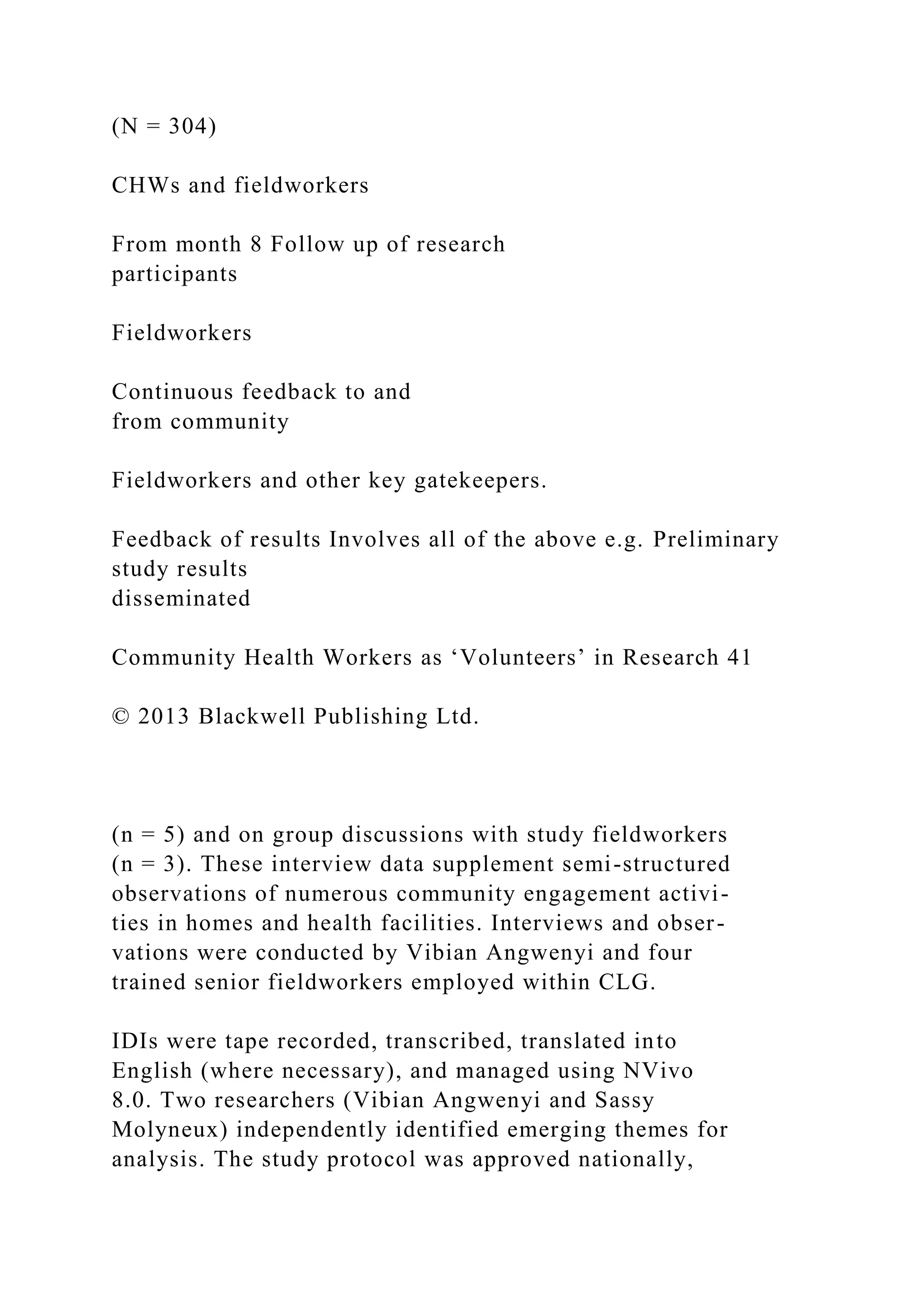
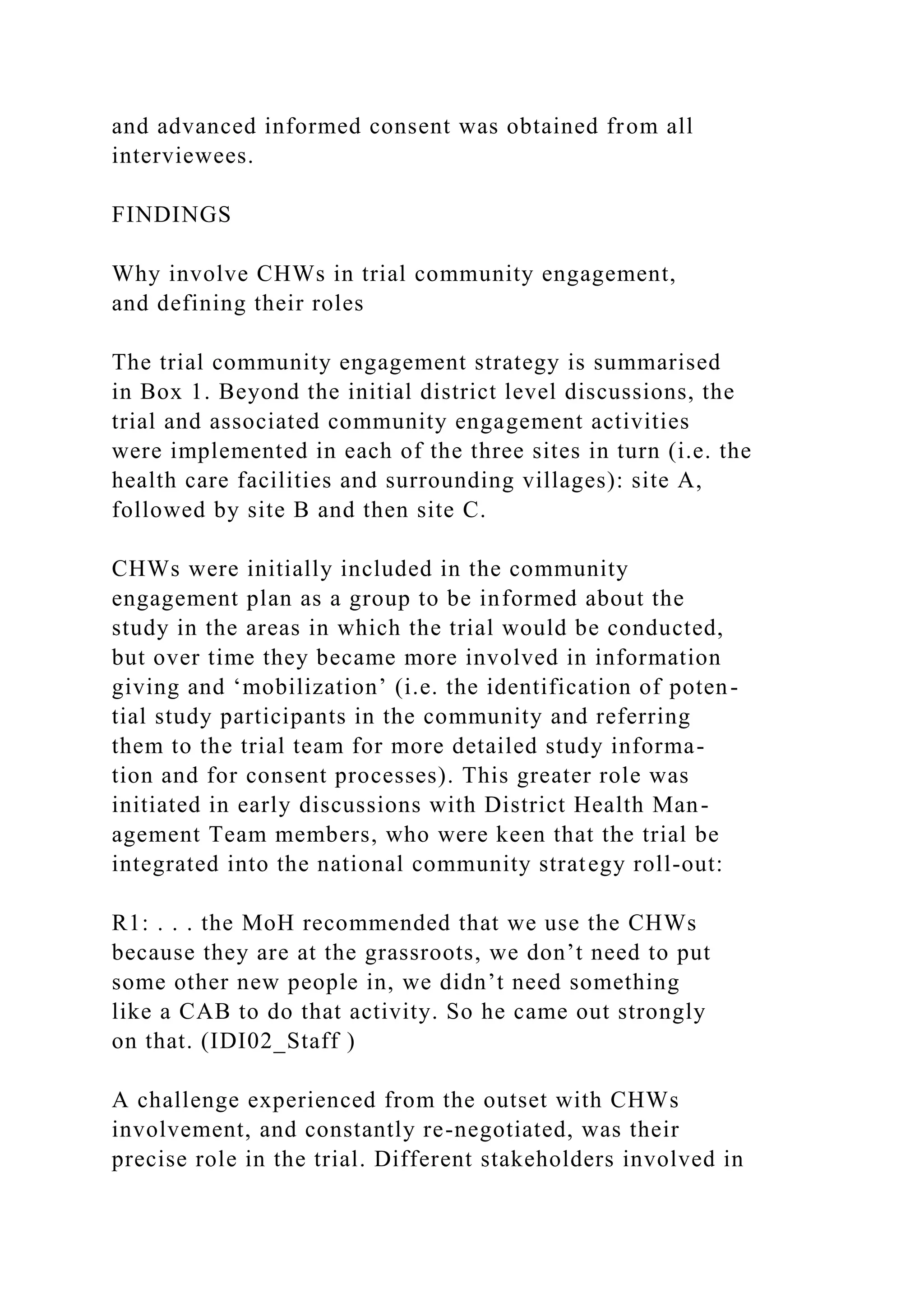
Box 1. Summary of community engagement activities
PERIOD ACTIVITY WHO INVOLVED
Month 1 Consultation and sensitization
of Kilifi District stakeholders
1. MoH structure:
District Medical of Health and District Health Management
Team at Kilifi District Hospital. All health facility in-charges
working in Kilifi District.
2. Provincial administration structures:
District Commissioner, Senior District Officer, all chiefs
working in Kilifi District
Months 2–6 Community entry and
sensitization of stakeholders
in Sites A, B and C
respectively
1. MoH Structure:
Dispensary health committees, dispensary staff (facility
in-charges, nurses, public health officers, community health
extension workers), and community health workers (CHWs)
2. Local administration:
District officers, local (assistant) chiefs and village elders
3. Others:
Primary school head teachers, religious leaders, Vitengeni
District Stakeholders Forum
Months 8–13 Identification and recruitment
of 5–17 month old children
(N = 600)
CHWs and fieldworkers
Months 15–27 Identification and recruitment
of 6-12 weeks-old children
(N = 304)
CHWs and fieldworkers
From month 8 Follow up of research
participants
Fieldworkers
Continuous feedback to and
from community
Fieldworkers and other key gatekeepers.
Feedback of results Involves all of the above e.g. Preliminary
study results
disseminated
Community Health Workers as ‘Volunteers’ in Research 41
© 2013 Blackwell Publishing Ltd.
(n = 5) and on group discussions with study fieldworkers
(n = 3). These interview data supplement semi-structured
observations of numerous community engagement activi-
ties in homes and health facilities. Interviews and obser-
vations were conducted by Vibian Angwenyi and four
trained senior fieldworkers employed within CLG.
IDIs were tape recorded, transcribed, translated into
English (where necessary), and managed using NVivo
8.0. Two researchers (Vibian Angwenyi and Sassy
Molyneux) independently identified emerging themes for
analysis. The study protocol was approved nationally,
and advanced informed consent was obtained from all
interviewees.
FINDINGS
Why involve CHWs in trial community engagement,
and defining their roles
The trial community engagement strategy is summarised
in Box 1. Beyond the initial district level discussions, the
trial and associated community engagement activities
were implemented in each of the three sites in turn (i.e. the
health care facilities and surrounding villages): site A,
followed by site B and then site C.
CHWs were initially included in the community
engagement plan as a group to be informed about the
study in the areas in which the trial would be conducted,
but over time they became more involved in information
giving and ‘mobilization’ (i.e. the identification of poten-
tial study participants in the community and referring
them to the trial team for more detailed study informa-
tion and for consent processes). This greater role was
initiated in early discussions with District Health Man-
agement Team members, who were keen that the trial be
integrated into the national community strategy roll-out:
R1: . . . the MoH recommended that we use the CHWs
because they are at the grassroots, we don’t need to put
some other new people in, we didn’t need something
like a CAB to do that activity. So he came out strongly
on that. (IDI02_Staff )
A challenge experienced from the outset with CHWs
involvement, and constantly re-negotiated, was their
precise role in the trial. Different stakeholders involved in
the community engagement plan differed in their views.
For example, MoH official(s) initially wanted CHWs
restricted to identifying potential participants, while local
leaders and some research staff were keen that CHWs
were also involved in active information sharing about
the trial and referring potential participants to the trial
team. As a staff member explained:
R1: . . . I did feel that we should use them [CHWs] to
enrol but the [MoH officials] felt that we shouldn’t
really give them a job as such. . .so [site A] said ‘why
don’t we allow the CHWs to mobilize’, that helped.
When we went to [site C] when we had a meeting with
the chief, village elders and CHWs they said “well we
have CHWs they’ll mobilize . . .” (IDI04_staff)
In site A, CHW roles were initially restricted to visiting
people at home with fieldworkers. During those periods
of time when recruitment was difficult, CHWs also
assisted through home visits with research staff to enquire
about reasons for refusal and help clear any misconcep-
tions about the trial. In site B and C, CHWs from the
outset were more centrally involved as primary mobiliz-
ers: informing potential participants about the trial and
inviting them to information and consent sessions by trial
team members at the health care facilities.
CHWs-fieldworker relationships and interactions
Shifting CHWs roles over time was linked in part to the
number of fieldworkers in the trial, and the relationship
between CHWs and fieldworkers. In KEMRI-Wellcome
Trust, ‘fieldworkers’ are frontline staff, employed by
KEMRI from the local communities in which study
participants reside, to undertake specific study related
activities.17 Employment is a high priority for local com-
munities, given the low income and high unemployment
levels in the area. In community engagement activities for
the broader programme, community members have often
therefore argued for more transparent employment pro-
cedures, and more evenly spread employment across the
communities where much of the programme’s research is
conducted (i.e. the 250,000 people living in the main dis-
trict hospital catchment area). One approach adopted to
respond to these requests has been to, wherever possible,
employ fieldworkers from the villages in which the
research will take place.18 For this trial, this approach
meant that both FWs and CHWs often came from the
same communities.
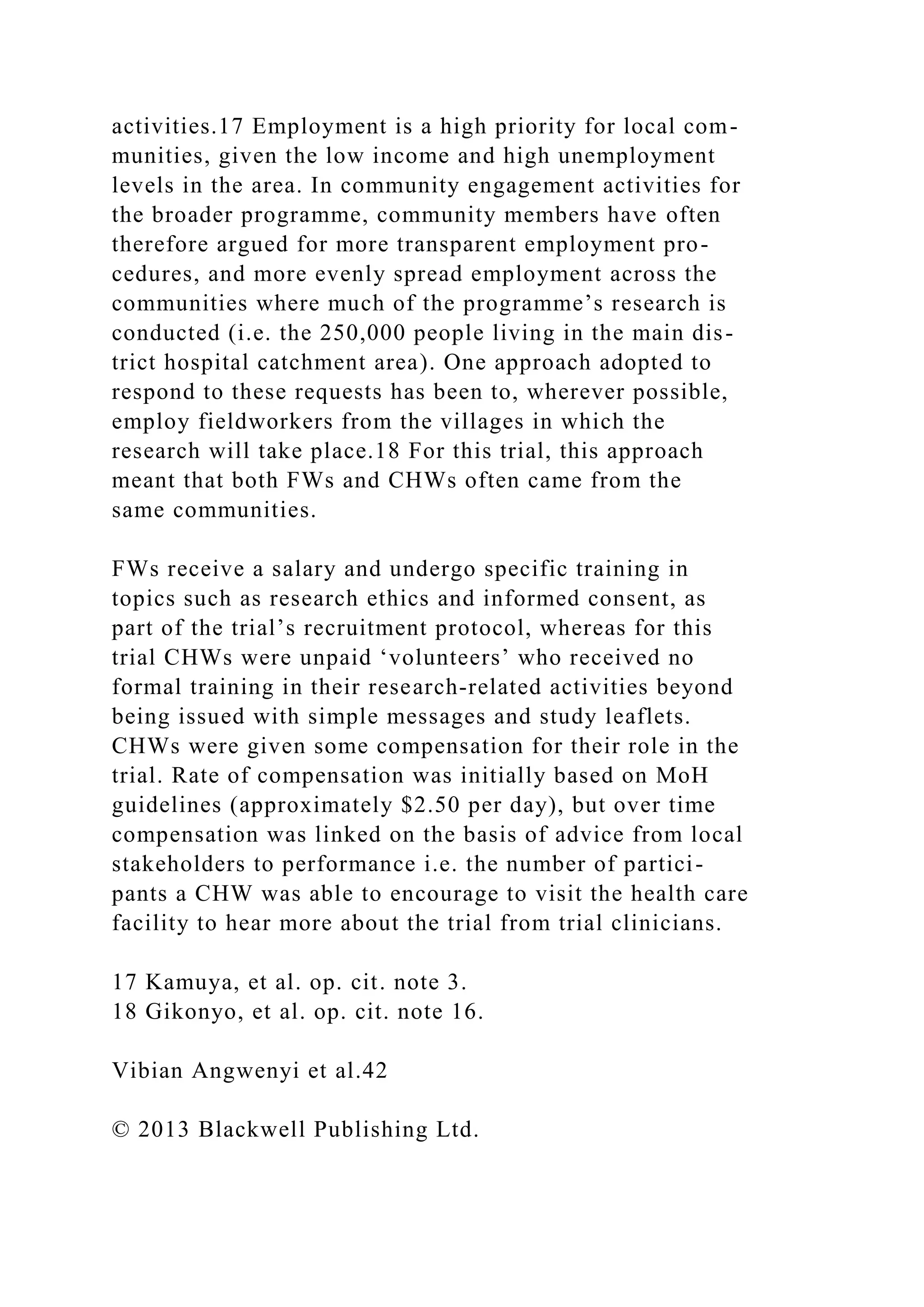
FWs receive a salary and undergo specific training in
topics such as research ethics and informed consent, as
part of the trial’s recruitment protocol, whereas for this
trial CHWs were unpaid ‘volunteers’ who received no
formal training in their research-related activities beyond
being issued with simple messages and study leaflets.
CHWs were given some compensation for their role in the
trial. Rate of compensation was initially based on MoH
guidelines (approximately $2.50 per day), but over time
compensation was linked on the basis of advice from local
stakeholders to performance i.e. the number of partici-
pants a CHW was able to encourage to visit the health care
facility to hear more about the trial from trial clinicians.
17 Kamuya, et al. op. cit. note 3.
18 Gikonyo, et al. op. cit. note 16.
Vibian Angwenyi et al.42
© 2013 Blackwell Publishing Ltd.
When compensated by performance, CHWs were given
about $2.50 for four potential participant parents. In site
A, an initial activity by CHWs of registering all names of
children eligible by age was also compensated for, at a rate
suggested and agreed with the Health Facility Committee,
which includes the health care facility in-charge and
elected community representatives.
In site A, by the time CHWs were involved in the study,
FWs were already employed and trained. There were
therefore relatively clear demarcations in roles between
FWs and CHWs. In the other two sites CHWs were more
heavily involved in identifying potential participants
from the outset of the study, partly because FWs were
hired and trained after participant recruitment had
started. Over time, in all the three sites, CHWs became
less directly involved in the study in relation to FWs:
R1: . . . their roles are different [FWs and CHWs] and
we explain to them. The roles of . . . CHWs end at the
point where they have invited eligible study partici-
pants to the dispensary. . . they don’t have any direct
contact with study participants, they will just be
helping them [FWs] as . . . leaders of the community [as
they go about their] normal activities . . . in case they
come across an issue, then they would make an effort
of seeing the field worker . . . (IDI03_staff )
Overall, the relationship between CHWs and FWs
appeared to be mutually supportive. However there were
some challenges. In group discussions with FWs, for
example, some CHWs reportedly distorted study infor-
mation causing difficulties for FWs in recruitment, or
would only assist FWs in mobilization if they were com-
pensated. The latter was linked to apparently overlapping
activities but with different levels of remuneration; a chal-
lenge understood by FWs:
S21: So as we went round he [CHW] used to say “you
my colleagues earn but for me I go round and get
nothing. You have bicycles and we have nothing but
when we go, we go together. It’s like I am helping you
in your work yet no one looks after us.” So that is one
of the challenges. But honestly if I look at it fairly its
true; we climb hills together so you find there is some
difficulty in convincing him . . . if he had gone to work
[he would have] earned something for a living . . . so it
becomes hard because he wants something from there
and you see I can’t help them. At times it can go to an
extent of them asking “why can’t KEMRI help us out
in this work” so I told them I can’t answer or promise
anything. (FWs group interview 3_site B).
Overall level of activity and impact on the trial
In IDIs, community members and trial staff reported that
CHWs played an important role in the trial. CHWs were
considered by trial staff and some community members
to be easily accessible and approachable for discussions
on study-related issues: they are relatively well-known
and mature (older) when compared to FWs; and the
nature of their tasks fitted well with their broader CHW
roles (Box 2: quotes 1–3). Survey data supported that a
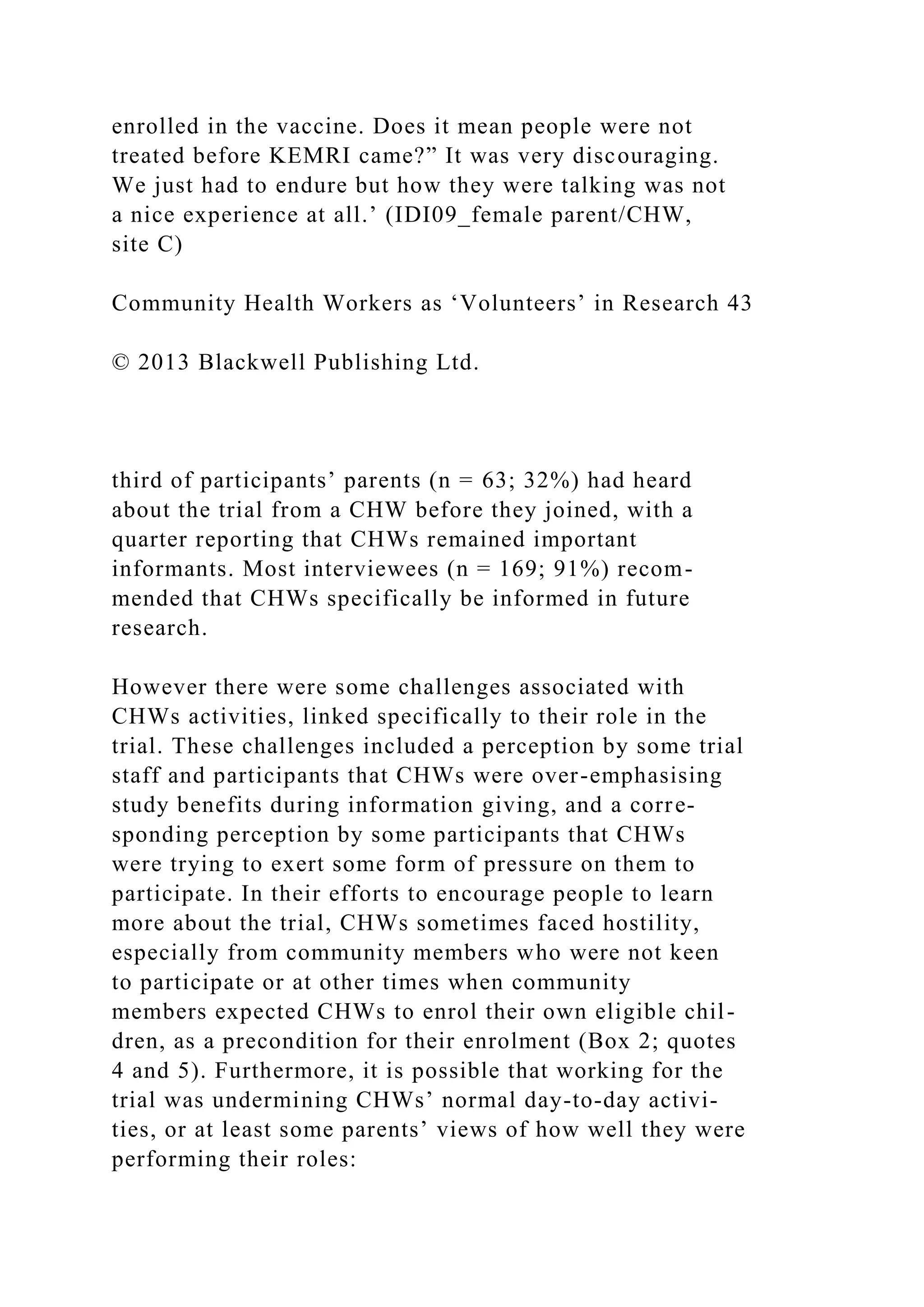
Box 2. Strengths and challenges of working with
CHWs in the trial (illustrative quotes)
Quote 1: ‘. . . those [CHWs] were the people who
could actually mobilize [help identify] people to come
and join the study coz they are used to giving out
sort of health messages . . . the initial mobilization
[identification of study participants] would be heavily
assisted by the CHWs because they have direct contact,
they are a bit more mature and they probably have
more community standing than a young fieldworker’.
(IDI04_Staff )
Quote 2: ‘Yes [our roles as CHWs] was of importance.
If you explain to people and they agree to go with their
kids and get treated, they must appreciate you, they will
say “had it not been this person my child wouldn’t have
been getting this treatment”. So you are assisting the
community’. (IDI14_female parent/CHW, site C)
Quote 3: ‘. . . there was some scepticism about using the
community strategy and even I was a bit sceptic about it
because this is not something we have done. But seeing
that this is a new area and there is nothing [i.e. no other
formal mechanism for the area such as CABs or KCR]
. . . am quite impressed that using the community strategy
it seems to somehow work’. (IDI01_Staff )
Quote 4: ‘She tried to explain more to me and she
thought that I had not understood about the study.
Therefore she came to me again and explained again
very well and I absolutely understood her but then the
decision is, I had already decided.’ (IDI21_male parent,
site A)
Quote 5: ‘. . . we were stopped from entering one home,
we did that three times, we were told “go back because we
already know what brings you here”. The third time we
went to see if these people had changed their thoughts and
they told us, “it’s like you have nothing to do, why do you
all the time go round to homes looking for children to be
enrolled in the vaccine. Does it mean people were not
treated before KEMRI came?” It was very discouraging.
We just had to endure but how they were talking was not
a nice experience at all.’ (IDI09_female parent/CHW,
site C)
Community Health Workers as ‘Volunteers’ in Research 43
© 2013 Blackwell Publishing Ltd.
third of participants’ parents (n = 63; 32%) had heard
about the trial from a CHW before they joined, with a
quarter reporting that CHWs remained important
informants. Most interviewees (n = 169; 91%) recom-
mended that CHWs specifically be informed in future
research.
However there were some challenges associated with
CHWs activities, linked specifically to their role in the
trial. These challenges included a perception by some trial
staff and participants that CHWs were over-emphasising
study benefits during information giving, and a corre-
sponding perception by some participants that CHWs
were trying to exert some form of pressure on them to
participate. In their efforts to encourage people to learn
more about the trial, CHWs sometimes faced hostility,
especially from community members who were not keen
to participate or at other times when community
members expected CHWs to enrol their own eligible chil-
dren, as a precondition for their enrolment (Box 2; quotes
4 and 5). Furthermore, it is possible that working for the
trial was undermining CHWs’ normal day-to-day activi-
ties, or at least some parents’ views of how well they were
performing their roles:
R1: You know in the beginning they were really con-
cerned with the health of children but since KEMRI
came it’s mostly FWs who come to visit these children
at home . . . CHWs take a long period of time before
they come. In fact since KEMRI activities started we
haven’t seen them. Not unless you have questions then
you follow them. (IDI12_female parent, site C)
Key factors influencing CHWs perceived
effectiveness in supporting the trial
1. Prior functioning of CHWs, and prior exposure to
KEMRI and the trial. There were differences in CHWs
structure and organisation across the three sites before
the trial was introduced, and differences in prior exposure
to KEMRI. In site C, where trial staff felt performance of
CHWs was particularly impressive, CHWs organised and
held regular meetings among themselves before the trial,
had participated in previous trainings and workshops
organised by non-governmental organisations (NGO) or
the MoH, and had interacted with KEMRI in a previous
study. In sites A and B, during trial recruitment CHWs
were newly recruited and trained under the community
strategy, and this group was already experiencing a high
rate of attrition. They also had little or no prior exposure
to KEMRI and expressed some scepticism about the trial
at the outset:
R1: . . . in site C the response was so good they [CHWs]
were all excited about the study and they were willing
to help . . . but in site A, I think the CHWs themselves
were not enthusiastic about the study so they didn’t
receive it with a lot of weight. That’s why they were a
bit reluctant; some of them were active but majority
were a bit reluctant to work with us. (IDI03_Staff )
2. Incentives. Compensation was considered crucial to
CHWs motivation in this and all other community activi-
ties they are involved in, but it was also associated with
some pragmatic challenges around exactly how a fair
compensation system would be established:
R1: . . . In site A because we didn’t actually use them
[CHWs] to mobilize we didn’t have a standard way of
doing it. So when they were collecting names we
assumed that you would do it in so many days, and
therefore paid them for so many days. But it brought a
bit of confusion and concerns because some people
said “well I walked round and saw all my children
and so and so just sat down and wrote them from their
head . . .” (IDI04_staff )
The performance model in particular was considered very
motivating to CHWs. However it also clearly resulted in
competition and struggle among CHWs:
R1: . . . we were told if you get many mothers you will
get a ‘big gift’ . . . by that time every CHW was strug-
gling to get mothers. You would find about 4 CHWs
going to one homestead . . . you’d hear the CHWs
saying “even me I went there and advised them” . . . we
therefore have to divide that amount because everyone
claims they went to advise . . . (IDI09_female parent/
CHW, site C)
Negotiations for increased allowances remained a feature
in CHWs meetings with trial staff in all sites, including
site C.
3. Other support for CHWs from KEMRI and the
community. CHWs were trained by the trial team to
conduct their roles. However given that they were not
expected to discuss the trial in detail with potential par-
ticipants, or consent participants, their training was nec-
essarily less in-depth than that of paid full time staff,
including field workers. CHWs interviewed felt that they
were ill-equipped relative to fieldworkers with study
information, which in turn limited their ability to address
community concerns. They also expressed a desire to
have more frequent meetings with senior study staff over
the course of the trial, and not just during busy times such
as recruitment.
During KEMRI-CHWs meetings we observed that in
addition to requests for more allowances (noted above)
there were also demands from CHWs for bicycles (site B),
and frequent requests for employment particularly when
FW positions were being advertised:
Vibian Angwenyi et al.44
© 2013 Blackwell Publishing Ltd.
R1: Can you [KEMRI] employ people if they have
such a certificate [i.e. a CHW training certificate]? . . .
we are asking this because sometimes we have certifi-
cates which are just lying idle in our houses and if there
are any chances we can also apply. We have been vol-
unteering since 2000 up to now . . . (IDI14_female
parent/CHW, site C)
Although the positive perception of CHWs in the local
community was described above, there was also some
hint that they were not always considered to be knowl-
edgeable or active:
R1: Yes, CHWs can be (pause) those are not CHWs
but volunteers. They carry out these roles but not very
keenly because they know nothing. They are like ‘Red
Cross’. So you will find their mobilization is not so
good . . . (IDI08_male parent/CHW, site A)
DISCUSSION
Representatives of the health care system can be impor-
tant players to include in community engagement strate-
gies in clinical trials. CHWs are clearly an important
group to consider interacting within community- based
trials given their position at the interface between health
care systems and local communities. Furthermore, as
in our setting, engagement with CHWs is likely to be
recommended by community members and representa-
tives. Beyond simply being informed of research as
part of community sensitisation activities, CHWs can be
given the more proactive roles they had in this trial, such
as introducing trial team members to community
members, assisting the trial team with identification of
potential participants, sharing information about the
trial, and responding to trial- related concerns in the
community.
Echoing some of the debates expressed in the wider
literature, our experience suggests that having CHWs
work with other frontline staff performing similar roles
has potential practical and ethical benefits and challenges.
Studies benefit from working with and learning from well-
known and respected individuals in the study communi-
ties, who in turn appreciate being given financial support
(where this is given) to conduct activities that appear to be
particularly related to their training and that increase their
visibility locally. As discussions nationally continue on
what support CHWs should be given by the Ministry of
Health to roll out the community strategy, and where the
funds to support this should come from,19 CHWs are
expected to continue performing their roles either on an
entirely voluntary basis, or with the support of locally
active governmental or non-governmental organizations.
Offering some compensation for CHWs to be involved in
research-related activities, as was done for this trial,
appeared to assist in keeping CHWs motivated and active
over the course of the trial, as was envisioned by MoH staff
and community elders who recommended their involve-
ment. The importance of ensuring that there is adequate
motivation for CHWs, whether it is extrinsic or intrinsic,
and financial or non-financial, is widely recognised inter-
nationally.20 It is feasible that the financial contribution
offered by the trial to CHWs in our context assisted in
some small way the implementation of the national com-
munity strategy in the trial communities. Involvement of
CHWs in community engagement was also perceived by
trial staff to assist indirectly with ensuring that expected
numbers of participants were recruited into the trial
through encouraging potential participants to come and
hear about the study, and to strengthen relationships and
trust more broadly between the trial team and the com-
munities in which the research was being conducted.
Given that strengthened science and appropriate levels of
trust are often included as ethical goals of community
engagement strategies,21 engagement of CHWs in the ways
described in this paper, could be described as a potentially
important element of a wider set of community engage-
ment activities. Although the roles of CHWs evolved over
time, leading to differences across the three sites in the
nature of how CHWs were involved, this is to some extent
inevitable, given community engagement can never be a
pre-fabricated set of activities applied uniformly across all
settings, but rather a dynamic and ever changing set of
negotiated relationships.22
However, there are clearly dilemmas associated with
involving CHWs and other frontline research staff.
Firstly, although there was a clear distinction main-
tained between employees and CHW volunteers, with
the former having more diverse roles and training (in
research, ethics, and trial details), there was some indi-
cation of overlaps in roles, of tensions between CHWs
and fieldworkers, and of conflicts among CHWs them-
selves. In particular there were suggestions that CHWs
were undermining study-related information provided to
potential participants by fieldworkers, and exerting some
pressure on participants to visit health care facilities for
further information in order to increase their own reim-
bursements. These findings could be interpreted as indi-
cating both vertical exploitation – where CHWs were
19 Ministry of Health. op. cit. note 14.
20 C. Glenton, et al. The female community health volunteer
pro-
gramme in Nepal: decision makers’ perceptions of volunteerism,
payment and other incentives. Social Science & Medicine 2010;
70:
1920–1927.
21 Marsh, et al. op. cit. note 15; Participants. 2011. In Consent
and
Community Engagment in Health Research: Reviewing and
Developing
Research and Practice. Kilifi.
22 J.V. Lavery, et al. Towards a framework for community
engagement
in global health research. Trends in Parasitology 2010; 26: 279–
283.
Community Health Workers as ‘Volunteers’ in Research 45
© 2013 Blackwell Publishing Ltd.
being encouraged by researchers to exploit their social
connections and status in the community – and horizon-
tal exploitation, through CHWs seeking to gain income
and influence in their communities.23 However, both of
these forms of exploitation were eased by excluding
CHWs from any final information giving or consenting
for the trial; roles which were performed individually by
carefully trained study clinicians. CHWs were also inad-
equately trained to understand and share key trial mes-
sages, and may therefore have been simply ill-informed
or unable to give correct information or answers to com-
munity members. Furthermore, as community members
with a keen interest in health care, CHWs may have
been less interested in their own gains than in ensuring
that households had the opportunity to access what were
indeed significant health related benefits associated with
trial participation for participants. Given the high
degree of poverty and unemployment levels in the trial
communities,24 the inadequate resources allocated to
support CHWs by Ministries of Health and NGOs in
Kenya as elsewhere (noted above), and the significant
health-related burdens and costs facing low income
households in these communities, these challenges and
tensions between interface staff and volunteers are not
surprising or unreasonable, including to fieldworkers.
These findings suggest the importance from the outset of
carefully considering (and discussing and re-considering)
the roles, training and support systems of CHWs and
how these relate to those of FWs. In so doing, it should
be recognised that fieldworkers themselves also face
many similar ethical and practical challenges in their
roles at the interface, with their level of embeddedness in
the particular study communities influencing their
familiarity with local social networks and norms, and
therefore the way in which they experience and handle
these challenges.25
A second dilemma associated with including CHWs in
the trial, possibly motivated by the hope of remuneration
or future employment in the research programme, was
some indication that their involvement might have
impacted negatively on their pre-existing CHW roles in
the community. This was possibly more likely where
CHWs were not already highly active and with clear roles
and relationships within the community. This would be
plausible either through CHWs spending significant
amounts of time on trial-related activities, or through
undermining their relationship with community members
through repeated visits to homes as part of their mobili-
zation efforts. In both cases, extrinsic incentives might
also have begun to crowd out CHWs intrinsic motivation
such as social recognition, knowledge gain, and the
opportunity to make a social contribution.26 More
broadly therefore, engagement of CHWs in this way can
potentially undermine rather than support CHW pro-
grammes which are ultimately intended to benefit com-
munity health, with the possibility of this depending on
pre-existing dynamics of the cadre. Clearly this would
operate against the ethical gains of working with CHWs
described above, and against community leaders’ initial
motivation for suggesting CHWs involvement in the trial.
Specifically it would potentially undermine fair benefits in
research through reducing benefits to communities
during and after trials, and potentially cause harm or
disadvantage through undermining community engage-
ment in local health care systems. It was beyond the scope
of our study to explore this in depth, or the long term
implications of CHW involvement in this trial. However,
this finding suggests the need to recognise differences
among CHWs, and to consider and monitor such poten-
tial perverse outcomes of engaging with CHWs, in future
trials, and more specifically of different CHW reimburse-
ment strategies. Depending on the context, careful dis-
cussion and agreement with Ministry of Health and NGO
managers and implementers is likely to be important.
Another potential challenge in paying some level of
remuneration to CHWs, although not identified as a
challenge in this study, is that other community leaders
and representatives who are informed about a trial and
who typically help to raise and respond to community
concerns, might also be keen to receive some financial
support for any involvement they (perceive themselves)
to have in the trial. The dilemma with providing motiva-
tion for other community ‘volunteers’ (for example chiefs
and elders, and women’s group representatives), as for
CHWs, is the possibility of crowding out any sense of
intrinsic motivation. For all groups, there is also a
concern that increasing motivation of community
members has to be balanced against the need to ensure
that they maintain an independence from researchers in a
way that facilitates critical and meaningful dialogue. On
the other hand there should be recognition of community
members’ contributions, and efforts to minimise trial
costs – in time and especially financially – for community
members. Challenges in achieving an appropriate
balance have been regularly observed for community
advisory boards. Where there is no motivation, or inde-
pendence and dialogue is compromised, the potential of
community engagement to strengthen research relation-
ships and ethical practice is undermined. This opens up
the possibility to identify other forms of motivation that
minimise such limitations, including for example provid-
ing appropriate training or exposure to health care
research.
23 Landy & Sharp. op. cit. note 8.
24 Marsh, et al. op. cit. note 15.
25 Molyneux, et al. op. cit. note 2. Simon & Mosavel. op. cit.
note 2;
Kamuya, et al. op. cit. note 3; True, et al. op. cit. note 7. 26
Glenton, et al. op. cit. note 20.
Vibian Angwenyi et al.46
© 2013 Blackwell Publishing Ltd.
CONCLUSION
We have identified a range of practical and ethical ben-
efits and challenges of involving CHWs proactively in a
community-based vaccine trial. How these benefits and
challenges balance out is difficult to fully predict in
advance of a study. That the form of involvement of
CHWs and how they were motivated to do this shifted
over the course of the trial, and continues to do so, is
perhaps an inevitable aspect of a broader community
engagement activity that is designed to be constantly lis-
tening to and responding to issues raised by key local
stakeholders. However there are some lessons that
emerge from this experience. These include the impor-
tance from the outset and over time of carefully consid-
ering (and discussing) the roles of CHWs and how these
relate to those of FWs and other community representa-
tives, ensuring that there is clarity in those roles for all
key players at the local level, and providing adequate
training, supervision and financial support for those roles
to be performed.
Acknowledgements
We are grateful to vaccine study team, fieldworkers and
participants for
sharing their experiences with us; the Health Systems and
Social Science
Research (HSSR) fieldworkers for conducting the FGDs and
transla-
tion, and the HSSR data entry clerks for transcribing all
interviews.
This research was conducted with financial support from
KEMRI-
Wellcome Trust (Strategic Award and fellowship to SM). The
paper is
published with permission from the Director, KEMRI.
Biography
Vibian Angwenyi is a research officer at the KEMRI/Wellcome
Trust
Research Programme, Kilifi. She holds a BA in Sociology from
Moi
University, Kenya and an MSc in Public Health, specializing in
health
services research from the London School of Hygiene and
Tropical
Medicine. Her research interests are around community
engagement for
clinical trials, research ethics and health services research.
Dorcas M. Kamuya (final year PhD student, MSc in Public
Health,
BSc.) is a research officer at KEMRI-Wellcome Trust Research
Pro-
gramme (KWTRP). Her research interests include ethical and
practical
challenges and dilemmas for interface research staff, ethical
implica-
tions of community engagement processes in international
collaborative
research in developing countries, and social behavioural
research. Pre-
vious works include setting-up mechanisms for engaging with
over
250,000 residents often involved in research, strengthening
collabora-
tion with key research stakeholders, and community
development work.
Dorothy Mwachiro is an MA graduate in Sustainable
International
Development from Brandeis University, Massachusetts, USA.
Prior to
her graduate studies she was Community Facilitation Officer for
the
Vaccine Trial at KEMRI/Wellcome Trust Research Programme,
Kilifi,
Kenya. She was responsible for coordinating community
engagement
activities for vaccine trials.
Dr. Vicki Marsh is a senior social science and public health
researcher at
the KEMRI/Wellcome Trust Research Programme, Kilifi, Kenya
and
University Research Lecturer in the Nuffield Department of
Medicine,
Oxford University, UK. Her main current research interests are
in
empirical approaches to understanding and strengthening ethical
aspects of international biomedical research. Other roles include
sup-
porting strategic research planning programme and capacity
building in
research ethics and social science.
Dr. Patricia Njuguna is a Pediatrician/Clinical Researcher at the
KEMRI/Wellcome Trust Research Programme, Kilifi. She holds
an
MA in Paediatrics and Child Health from University of Nairobi,
Kenya. Her research interests are around clinical trials, vaccines
and
paediatrics.
Sassy Molyneux, PhD, is a social scientist employed by Oxford
Univer-
sity, UK, and based at the Kenya Medical Research Institute-
Wellcome
Trust Research Programme in Kilifi, Kenya. Her current main
research
interests include health system finance and governance, and
research
ethics. One theme cross-cutting these research areas is an
interest in
producing new thinking, evidence and recommendations around
strengthening community involvement in biomedical research
and
health delivery in sub-Saharan Africa.
Community Health Workers as ‘Volunteers’ in Research 47
© 2013 Blackwell Publishing Ltd.

WORKING WITH COMMUNITY HEALTH WORKERS AS ‘VOLUNTEERS’IN A VA.docx

  • 1.
    WORKING WITH COMMUNITYHEALTH WORKERS AS ‘VOLUNTEERS’ IN A VACCINE TRIAL: PRACTICAL AND ETHICAL EXPERIENCES AND IMPLICATIONS VIBIAN ANGWENYI, DORCAS KAMUYA, DOROTHY MWACHIRO, VICKI MARSH, PATRICIA NJUGUNA AND SASSY MOLYNEUX Keywords developing world bioethics, research ethics, informed consent, clinical trials, sub-Saharan Africa ABSTRACT Community engagement is increasingly emphasized in biomedical research, as a right in itself, and to strengthen ethical practice. We draw on interviews and observations to consider the practical and ethical implications of involv- ing Community Health Workers (CHWs) as part of a community engagement strategy for a vaccine trial on the Kenyan Coast. CHWs were initially engaged as an important network to be informed about the trial. However over time, and in response to community advice, they became involved in trial informa-
  • 2.
    tion sharing andidentifying potential participants; thereby taking on roles that overlapped with those of employed fieldworkers (FWs). While CHWs involve- ment was generally perceived as positive and appreciated, there were chal- lenges in their relations with FWs and other community members, partly related to levels and forms of remuneration. Specifically, payment of CHWs was not as high as for FWs and was based on ‘performance’. This extrinsic motivation had the potential to crowd out CHWs intrinsic motivation to perform their pre-existing community roles. CHWs remuneration potentially also contributed to CHWs distorting trial information to encourage community members to participate; and to researchers encouraging CHWs to utilize their social connections and status to increase the numbers of people who attended information giving sessions. Individual consent processes were protected in this trial through final information sharing and consent being conducted by trained clinical staff who were not embedded in study commu- nities. However, our experiences suggest that roles and remuneration of all front line staff and volunteers involved in trials need careful consideration from the outset, and monitoring and discussion over time. BACKGROUND
  • 3.
    Community engagement isincreasingly emphasized as central to biomedical research in international settings, both as a right in itself, and as a means to uphold ethical principles, enhance protection and benefits, create legiti- macy, share responsibility between researchers and com- munities, and strengthen science.1 Communities can potentially be involved in a broad range of research activi- ties, from protocol development, to research conduct, reviewing access to data and samples, and dissemination or publication of research findings. Community members are also often employed in research studies to simultane- ously recruit, and conduct research processes such as interviews and simple study procedures. Less commonly community members may also recruit participants as part 1 E. Emanuel, et al. What makes clinical research in developing coun- tries ethical? The benchmarks of ethical research. J Infect Dis 2004; 189: 930–937; N. Dickert & J. Sugarman. Ethical goals of community con- sultation in research. Am J Public Health 2005; 95: 1123–1127. Address for correspondence: Sassy Molyneux: KEMRI – Wellcome Trust Research Programme, 230, Kilifi, Coast 80108, Kenya, Email: [email protected] kilifi.kemri-wellcome.org. Conflict of interest statement: No conflicts declared Developing World Bioethics ISSN 1471-8731 (print); 1471- 8847 (online) doi:10.1111/dewb.12015 Volume 13 Number 1 2013 pp 38–47 bs_bs_banner bioethics
  • 4.
    developing world © 2013Blackwell Publishing Ltd., 9600 Garsington Road, Oxford OX4 2DQ, UK and 350 Main Street, Malden, MA 02148, USA. of Peer Driven Recruitment (PDR) or community-based participatory research.2 There has been relatively little published information about the experience with community engagement in low income settings, including information about the ethical issues and dilemmas associated with who the ‘communi- ties’ are, and who is selected by whom to represent those communities in what way.3 In this paper we share our experiences of having included community health workers (CHWs) in community engagement activities for a vaccine trial, as encouraged by members of the Ministry of Health in Kilifi, Kenya. Following an overview of relevant litera- ture and some background to the trial site, we describe the shifting role of CHWs within the trial over time, from initially being considered a key community to inform, to increasingly involving them in information giving to com- munity members about the trial, and identification of potential trial participants. We consider the practical and ethical implications – both positive and challenging – of having CHWs and employed fieldworkers (FWs) working at the interface with community members, with overlap- ping roles, and of CHWs’ involvement essentially devel- oping into a form of peer recruitment. We show that the type and level of CHW remuneration and support, and how this differed to that of FWs, contributed to some relationship challenges and potentially to some distortion of trial information by CHWs, and how the possible
  • 5.
    negative implications wereminimised. Engaging communities in trials Communities can be defined based on geography, on special interests or goals, or on shared situations or expe- riences, with key communities relevant for research likely to include health care system and research staff, as well as the general public and potential research participants.4 Available information suggests that researchers often interact with both existing structures within communities of interest (for example, chiefs and community leaders, leaders of women’s groups or health support groups, and health care facility committees), and with structures that have been specifically established, with the most widely cited example of the latter being Community Advisory Boards (CABs), or variants of these.5 While working with these channels can strengthen research relationships and ethical practice, documented challenges, particularly of working with specifically established structures, include: ensuring clarity in roles and forms of representation; facilitating appropriate selection of members; balancing motivation of members against the need to ensure adequate independence from researchers in a way that facilitates critical and meaningful dialogue; and avoiding politicisation. With regards to the specific issue of involvement of community members in recruitment, a range of ethical and practical strengths and challenges are recognised.6 Potential strengths include remuneration for those employed, enhanced research through improved access and responsiveness to local communities, and strength-
  • 6.
    ened consent processesthat encourage potential partici- pants to feel greater comfort and ease to ask questions and understand information and its’ implications. Ethical challenges potentially include exploitation of local recruiters through unfair employment practices, recruiters exploiting the trust of peers in their efforts to meet recruitment quotas (including through compromis- ing consent processes), and privacy and confidentiality breaches.7 The latter two concerns feature particularly where community members have prior relationships with potential participants and in cases where recruiters are paid according to performance measures. In addition to these vertical forms of exploitation (wherein a group of outside researchers exploits the social connections that recruiters have with members of the local commu- nity), there are also potentially horizontal forms of exploitation where ‘select members of the local commu- nity recognise the potential to partner with outside researchers in a way that allows them to gain power and influence within their community’.8 Such challenges suggest that the manner in which community members are recruited should be carefully 2 M. Constantine. Disentangling Methodologies: The Ethics of Tradi- tional Sampling Methodologies, Community-Based Participatory Research, and Respondent-Driven Sampling. The American Journal of Bioethics 2010; 10: 22–24; C. Simon & M. Mosavel. Community Members as Recruiters of Human Subjects: Ethical Considerations. The American Journal of Bioethics 2010; 10: 3–11; S. Molyneux, et al. Com- munity Members Employed on Research Projects Face Crucial,
  • 7.
    Often Under-Recognized, Ethical Dilemmas.The American Journal of Bioeth- ics 2010; 10: 24–26. 3 D. Kamuya, et al. 2012. Engaging communities to strengthen research ethics in low-income settings: selection and perceptions of members of a network in coastal Kenya. Developing World Bioethics, in press. 4 T.A. Lang, et al. Approaching the community about screening chil- dren for a multicentre malaria vaccine trial. International Health 2011. 5 Kamuya, et al. op. cit. note 3; NIMH. The role of Community Advi- sory Boards (CABs) in Project Eban. J Acquir Immune Defic Syndr 2008; 49 Suppl 1: S68–S74; K. Shubis, et al. Challenges of establishing a Community Advisory Board (CAB) in a low-income, low- resource setting: experiences from Bagamoyo, Tanzania. Health Research Policy and Systems 2009; 7: 16. 6 Constantine. op. cit. note 2; Molyneux, et al. op. cit. note 2; Simon & Mosavel. op. cit. note 2. 7 C.L. Fry. Ethical Implications of Peer-Driven Recruitment: Guide- lines from Public Health Research. The American Journal of Bioethics 2010; 10: 16–17; T. Phillips. Protecting the Subject: PDR and the Poten- tial for Compromised Consent. The American Journal of
  • 8.
    Bioethics 2010; 10: 14–15;Simon & Mosavel. op. cit. note 2; G. True, et al. Misbehav- iors of Front-Line Research Personnel and the Integrity of Community- Based Research. J Empir Res Hum Res Ethics 2011; 6: 3–12. 8 D. Landy & R. Sharp. Examining the Potential for Exploitation by Local Intermediaries. American Journal of Bioethics 2010; 10: 12–13. p. 12. Community Health Workers as ‘Volunteers’ in Research 39 © 2013 Blackwell Publishing Ltd. considered as part of a broader framework of community engagement, and that this framework should include a broad range of communication channels or sets of repre- sentatives. For health research, the Ministry of Health (MoH) is likely to be an important ‘community’ to include in community engagement plans: health research is often conducted within or linked to health care facili- ties; community members may often consult health care staff or managers about studies being conducted in their communities; and research activities have the potential to support or undermine health care systems in the short and longer term.9 CHWs a relevant trial community At the local community level, one potential channel linked to the health care system is Community Health Workers (CHWs). CHWs are “selected by community
  • 9.
    members, trained tocarry out one or more health care functions, answerable to communities for their activities and supported by the health care system.”10 They have reportedly played an important role in health care in many developing country settings: by filling in service provision gaps where more skilled personnel are not available; by broadening health care access and coverage in remote areas; by helping attain millennium develop- ment goals such as childhood immunization; and by serving as a bridge between professional health care staff and communities.11 However CHWs have also faced numerous challenges, including unclear roles, inadequate or inappropriate incentives, unmet training needs and supervision, high attrition rates, and lack of (social) rec- ognition.12 Including CHWs in research trials can poten- tially build on the strengths of such a network, and contribute to overcoming some of their challenges, including strengthening their motivation and recognition. In research, CHWs have been drawn upon to assist researchers to access and educate targeted populations, to act as data collectors, and to help recruit potential participants and conduct reminder visits.13 However there is little published documentation about the experi- ences of involving this key group in research. In Kenya, CHWs, referred to locally as ‘madaktari wa vijijini’ (village doctors), are recruited and trained by the MoH. CHWs have been promoted to the public as key players in the health care system since the 1970s and early 1980s, as part of broader national efforts to strengthen primary health care, and have faced similar achievements and challenges to those in other settings.14 They are expected to play an increasingly central role at the inter- face between communities and health care systems with the roll out of the national ‘Community Strategy’, in
  • 10.
    which a largenetwork of CHWs are identified and trained to link households to governing structures at location, sub-locational, village, and health facility levels. Within the community strategy, CHWs roles include delivering health care messages, collecting health-related data, and relaying information and referring sick people to health care facilities. The trial and trial setting The vaccine trial site of interest is in Kilifi District, on the Kenyan Coast, led by the KEMRI-Wellcome Trust Research Programme.15 Within the research Programme, a core group of community facilitators, the Community Liaison Group (CLG) coordinates Programme-wide and study-specific community engagement activities. The vaccine trial was set up in three rural health care facilities in Kilifi district, enrolling children aged less than 17 months old from villages surrounding the health care facilities. Following a complete health check-up, partici- pants were randomized into one of three research trial arms to receive either the vaccine under investigation or a comparator vaccine. Fieldworkers from the local commu- nity were employed to assist with informing community members about the trial, and identifying potential partici- pants. They also conducted home visits for six consecutive 9 Lang, et al. op. cit. note 4. 10 U. Lehmann & D. Sanders. January 2007 Community health workers: What do we know about them? The state of the evidence on programmes, activities, costs and impact on health outcomes of using community health workers. Geneva: World Health Organisation, Evidence and
  • 11.
    Informa- tion for Policy,Department of Human Resources for Health. Available at: http://www.who.int/hrh/documents/community_health_workers_ brief.pdf [Accessed 8 Nov 2012]. p. 5. 11 A. Haines, et al. Achieving child survival goals: potential contribu- tion of community health workers. Lancet 2007; 369: 2121– 2131; K. Bhattacharyya, et al. October 2001. Community Health Worker: Incentives and Disincentives-How They Affect Motivation, Retention, and Sustainability. Arlington, Virginia: Basic Support for Institution- alizing Child Survival Project (BASICS II) for the United States Agency for International Development; Lehmann & Sanders. op. cit. note 10. 12 Ibid: D. Mukanga, et al. Community acceptability of use of rapid diagnostic tests for malaria by community health workers in Uganda. Malaria Journal 2010; 9: 203; H. Schneider & U. Lehmann. Lay health workers and HIV programmes: implications for health systems. AIDS Care 2010; 22 Suppl 1: 60–67; Lehmann & Sanders. op. cit. note 10. 13 J.O. Andrews, et al. Use of community health workers in research with ethnic minority women. Journal of Nursing Scholarship 2004; 36: 358–365; S.S. Kane, et al. A realist synthesis of randomised
  • 12.
    control trials involving useof community health workers for delivering child health interventions in low and middle income countries. BMC Health Services Research 2010; 10: (13 October 2010). 14 Ministry of Health. April 2006. Taking the Kenya Essential Package for Health to the Community-A Strategy for the Delivery of Level One Services. Ministry of Health: Health Sector Reform Secretariat. 15 V. Marsh, et al. Beginning community engagement at a busy bio- medical research programme: Experiences from the KEMRI CGMRC- Wellcome Trust Research Programme, Kilifi, Kenya. Social Science and Medicine 2008; 67: 721–733; V.M. Marsh, et al. Working with Con- cepts: The Role of Community in International Collaborative Biomedi- cal Research. Public Health Ethics 2011; 4: 26–39. Vibian Angwenyi et al.40 © 2013 Blackwell Publishing Ltd. days after vaccination and once a month over the three year study period to check on participants’ overall health. Benefits for participants included free treatment and transport to health care facilities, and 24 hour medical services at local public health care facilities over the entire study period.
  • 13.
    For all studiesinvolving participants in Kilifi, study teams are requested, with the support of the CLG, to consider whether or not a community engagement strat- egy is needed, and if so, what key issues need to be dis- cussed and addressed when and with whom. As with many local research studies,16 the vaccine trial strategy included interactions with a range of communities and individuals, including Ministry of Health (MoH) manag- ers (see Box 1). METHODS We conducted a multi-method social science study along- side the trial, including observations of community engagement and consent processes, and interviews with all key stakeholders. In this paper we draw upon in-depth interviews (IDIs) with parents who were approached to enrol their children in the trial (n = 25), three of whom were CHWs, on a household survey with parents of par- ticipants (n = 200), on IDIs with staff involved in design- ing and implementing the community engagement plan 16 Ibid; See for example C. Gikonyo, et al. Taking social relationships seriously: lessons learned from the informed consent practices of a vaccine trial on the Kenyan Coast. Soc Sci Med 2008; 67: 708– 720; Lang, et al. op. cit. note 4. Box 1. Summary of community engagement activities PERIOD ACTIVITY WHO INVOLVED Month 1 Consultation and sensitization
  • 14.
    of Kilifi Districtstakeholders 1. MoH structure: District Medical of Health and District Health Management Team at Kilifi District Hospital. All health facility in-charges working in Kilifi District. 2. Provincial administration structures: District Commissioner, Senior District Officer, all chiefs working in Kilifi District Months 2–6 Community entry and sensitization of stakeholders in Sites A, B and C respectively 1. MoH Structure: Dispensary health committees, dispensary staff (facility in-charges, nurses, public health officers, community health extension workers), and community health workers (CHWs) 2. Local administration: District officers, local (assistant) chiefs and village elders 3. Others: Primary school head teachers, religious leaders, Vitengeni District Stakeholders Forum Months 8–13 Identification and recruitment of 5–17 month old children (N = 600) CHWs and fieldworkers Months 15–27 Identification and recruitment of 6-12 weeks-old children
  • 15.
    (N = 304) CHWsand fieldworkers From month 8 Follow up of research participants Fieldworkers Continuous feedback to and from community Fieldworkers and other key gatekeepers. Feedback of results Involves all of the above e.g. Preliminary study results disseminated Community Health Workers as ‘Volunteers’ in Research 41 © 2013 Blackwell Publishing Ltd. (n = 5) and on group discussions with study fieldworkers (n = 3). These interview data supplement semi-structured observations of numerous community engagement activi- ties in homes and health facilities. Interviews and obser- vations were conducted by Vibian Angwenyi and four trained senior fieldworkers employed within CLG. IDIs were tape recorded, transcribed, translated into English (where necessary), and managed using NVivo 8.0. Two researchers (Vibian Angwenyi and Sassy Molyneux) independently identified emerging themes for analysis. The study protocol was approved nationally,
  • 16.
    and advanced informedconsent was obtained from all interviewees. FINDINGS Why involve CHWs in trial community engagement, and defining their roles The trial community engagement strategy is summarised in Box 1. Beyond the initial district level discussions, the trial and associated community engagement activities were implemented in each of the three sites in turn (i.e. the health care facilities and surrounding villages): site A, followed by site B and then site C. CHWs were initially included in the community engagement plan as a group to be informed about the study in the areas in which the trial would be conducted, but over time they became more involved in information giving and ‘mobilization’ (i.e. the identification of poten- tial study participants in the community and referring them to the trial team for more detailed study informa- tion and for consent processes). This greater role was initiated in early discussions with District Health Man- agement Team members, who were keen that the trial be integrated into the national community strategy roll-out: R1: . . . the MoH recommended that we use the CHWs because they are at the grassroots, we don’t need to put some other new people in, we didn’t need something like a CAB to do that activity. So he came out strongly on that. (IDI02_Staff ) A challenge experienced from the outset with CHWs involvement, and constantly re-negotiated, was their precise role in the trial. Different stakeholders involved in
  • 17.
    the community engagementplan differed in their views. For example, MoH official(s) initially wanted CHWs restricted to identifying potential participants, while local leaders and some research staff were keen that CHWs were also involved in active information sharing about the trial and referring potential participants to the trial team. As a staff member explained: R1: . . . I did feel that we should use them [CHWs] to enrol but the [MoH officials] felt that we shouldn’t really give them a job as such. . .so [site A] said ‘why don’t we allow the CHWs to mobilize’, that helped. When we went to [site C] when we had a meeting with the chief, village elders and CHWs they said “well we have CHWs they’ll mobilize . . .” (IDI04_staff) In site A, CHW roles were initially restricted to visiting people at home with fieldworkers. During those periods of time when recruitment was difficult, CHWs also assisted through home visits with research staff to enquire about reasons for refusal and help clear any misconcep- tions about the trial. In site B and C, CHWs from the outset were more centrally involved as primary mobiliz- ers: informing potential participants about the trial and inviting them to information and consent sessions by trial team members at the health care facilities. CHWs-fieldworker relationships and interactions Shifting CHWs roles over time was linked in part to the number of fieldworkers in the trial, and the relationship between CHWs and fieldworkers. In KEMRI-Wellcome Trust, ‘fieldworkers’ are frontline staff, employed by KEMRI from the local communities in which study participants reside, to undertake specific study related
  • 18.
    activities.17 Employment isa high priority for local com- munities, given the low income and high unemployment levels in the area. In community engagement activities for the broader programme, community members have often therefore argued for more transparent employment pro- cedures, and more evenly spread employment across the communities where much of the programme’s research is conducted (i.e. the 250,000 people living in the main dis- trict hospital catchment area). One approach adopted to respond to these requests has been to, wherever possible, employ fieldworkers from the villages in which the research will take place.18 For this trial, this approach meant that both FWs and CHWs often came from the same communities. FWs receive a salary and undergo specific training in topics such as research ethics and informed consent, as part of the trial’s recruitment protocol, whereas for this trial CHWs were unpaid ‘volunteers’ who received no formal training in their research-related activities beyond being issued with simple messages and study leaflets. CHWs were given some compensation for their role in the trial. Rate of compensation was initially based on MoH guidelines (approximately $2.50 per day), but over time compensation was linked on the basis of advice from local stakeholders to performance i.e. the number of partici- pants a CHW was able to encourage to visit the health care facility to hear more about the trial from trial clinicians. 17 Kamuya, et al. op. cit. note 3. 18 Gikonyo, et al. op. cit. note 16. Vibian Angwenyi et al.42 © 2013 Blackwell Publishing Ltd.
  • 19.
    When compensated byperformance, CHWs were given about $2.50 for four potential participant parents. In site A, an initial activity by CHWs of registering all names of children eligible by age was also compensated for, at a rate suggested and agreed with the Health Facility Committee, which includes the health care facility in-charge and elected community representatives. In site A, by the time CHWs were involved in the study, FWs were already employed and trained. There were therefore relatively clear demarcations in roles between FWs and CHWs. In the other two sites CHWs were more heavily involved in identifying potential participants from the outset of the study, partly because FWs were hired and trained after participant recruitment had started. Over time, in all the three sites, CHWs became less directly involved in the study in relation to FWs: R1: . . . their roles are different [FWs and CHWs] and we explain to them. The roles of . . . CHWs end at the point where they have invited eligible study partici- pants to the dispensary. . . they don’t have any direct contact with study participants, they will just be helping them [FWs] as . . . leaders of the community [as they go about their] normal activities . . . in case they come across an issue, then they would make an effort of seeing the field worker . . . (IDI03_staff ) Overall, the relationship between CHWs and FWs appeared to be mutually supportive. However there were some challenges. In group discussions with FWs, for example, some CHWs reportedly distorted study infor- mation causing difficulties for FWs in recruitment, or would only assist FWs in mobilization if they were com-
  • 20.
    pensated. The latterwas linked to apparently overlapping activities but with different levels of remuneration; a chal- lenge understood by FWs: S21: So as we went round he [CHW] used to say “you my colleagues earn but for me I go round and get nothing. You have bicycles and we have nothing but when we go, we go together. It’s like I am helping you in your work yet no one looks after us.” So that is one of the challenges. But honestly if I look at it fairly its true; we climb hills together so you find there is some difficulty in convincing him . . . if he had gone to work [he would have] earned something for a living . . . so it becomes hard because he wants something from there and you see I can’t help them. At times it can go to an extent of them asking “why can’t KEMRI help us out in this work” so I told them I can’t answer or promise anything. (FWs group interview 3_site B). Overall level of activity and impact on the trial In IDIs, community members and trial staff reported that CHWs played an important role in the trial. CHWs were considered by trial staff and some community members to be easily accessible and approachable for discussions on study-related issues: they are relatively well-known and mature (older) when compared to FWs; and the nature of their tasks fitted well with their broader CHW roles (Box 2: quotes 1–3). Survey data supported that a Box 2. Strengths and challenges of working with CHWs in the trial (illustrative quotes) Quote 1: ‘. . . those [CHWs] were the people who could actually mobilize [help identify] people to come
  • 21.
    and join thestudy coz they are used to giving out sort of health messages . . . the initial mobilization [identification of study participants] would be heavily assisted by the CHWs because they have direct contact, they are a bit more mature and they probably have more community standing than a young fieldworker’. (IDI04_Staff ) Quote 2: ‘Yes [our roles as CHWs] was of importance. If you explain to people and they agree to go with their kids and get treated, they must appreciate you, they will say “had it not been this person my child wouldn’t have been getting this treatment”. So you are assisting the community’. (IDI14_female parent/CHW, site C) Quote 3: ‘. . . there was some scepticism about using the community strategy and even I was a bit sceptic about it because this is not something we have done. But seeing that this is a new area and there is nothing [i.e. no other formal mechanism for the area such as CABs or KCR] . . . am quite impressed that using the community strategy it seems to somehow work’. (IDI01_Staff ) Quote 4: ‘She tried to explain more to me and she thought that I had not understood about the study. Therefore she came to me again and explained again very well and I absolutely understood her but then the decision is, I had already decided.’ (IDI21_male parent, site A) Quote 5: ‘. . . we were stopped from entering one home, we did that three times, we were told “go back because we already know what brings you here”. The third time we went to see if these people had changed their thoughts and they told us, “it’s like you have nothing to do, why do you all the time go round to homes looking for children to be
  • 22.
    enrolled in thevaccine. Does it mean people were not treated before KEMRI came?” It was very discouraging. We just had to endure but how they were talking was not a nice experience at all.’ (IDI09_female parent/CHW, site C) Community Health Workers as ‘Volunteers’ in Research 43 © 2013 Blackwell Publishing Ltd. third of participants’ parents (n = 63; 32%) had heard about the trial from a CHW before they joined, with a quarter reporting that CHWs remained important informants. Most interviewees (n = 169; 91%) recom- mended that CHWs specifically be informed in future research. However there were some challenges associated with CHWs activities, linked specifically to their role in the trial. These challenges included a perception by some trial staff and participants that CHWs were over-emphasising study benefits during information giving, and a corre- sponding perception by some participants that CHWs were trying to exert some form of pressure on them to participate. In their efforts to encourage people to learn more about the trial, CHWs sometimes faced hostility, especially from community members who were not keen to participate or at other times when community members expected CHWs to enrol their own eligible chil- dren, as a precondition for their enrolment (Box 2; quotes 4 and 5). Furthermore, it is possible that working for the trial was undermining CHWs’ normal day-to-day activi- ties, or at least some parents’ views of how well they were performing their roles:
  • 23.
    R1: You knowin the beginning they were really con- cerned with the health of children but since KEMRI came it’s mostly FWs who come to visit these children at home . . . CHWs take a long period of time before they come. In fact since KEMRI activities started we haven’t seen them. Not unless you have questions then you follow them. (IDI12_female parent, site C) Key factors influencing CHWs perceived effectiveness in supporting the trial 1. Prior functioning of CHWs, and prior exposure to KEMRI and the trial. There were differences in CHWs structure and organisation across the three sites before the trial was introduced, and differences in prior exposure to KEMRI. In site C, where trial staff felt performance of CHWs was particularly impressive, CHWs organised and held regular meetings among themselves before the trial, had participated in previous trainings and workshops organised by non-governmental organisations (NGO) or the MoH, and had interacted with KEMRI in a previous study. In sites A and B, during trial recruitment CHWs were newly recruited and trained under the community strategy, and this group was already experiencing a high rate of attrition. They also had little or no prior exposure to KEMRI and expressed some scepticism about the trial at the outset: R1: . . . in site C the response was so good they [CHWs] were all excited about the study and they were willing to help . . . but in site A, I think the CHWs themselves were not enthusiastic about the study so they didn’t receive it with a lot of weight. That’s why they were a bit reluctant; some of them were active but majority
  • 24.
    were a bitreluctant to work with us. (IDI03_Staff ) 2. Incentives. Compensation was considered crucial to CHWs motivation in this and all other community activi- ties they are involved in, but it was also associated with some pragmatic challenges around exactly how a fair compensation system would be established: R1: . . . In site A because we didn’t actually use them [CHWs] to mobilize we didn’t have a standard way of doing it. So when they were collecting names we assumed that you would do it in so many days, and therefore paid them for so many days. But it brought a bit of confusion and concerns because some people said “well I walked round and saw all my children and so and so just sat down and wrote them from their head . . .” (IDI04_staff ) The performance model in particular was considered very motivating to CHWs. However it also clearly resulted in competition and struggle among CHWs: R1: . . . we were told if you get many mothers you will get a ‘big gift’ . . . by that time every CHW was strug- gling to get mothers. You would find about 4 CHWs going to one homestead . . . you’d hear the CHWs saying “even me I went there and advised them” . . . we therefore have to divide that amount because everyone claims they went to advise . . . (IDI09_female parent/ CHW, site C) Negotiations for increased allowances remained a feature in CHWs meetings with trial staff in all sites, including site C. 3. Other support for CHWs from KEMRI and the
  • 25.
    community. CHWs weretrained by the trial team to conduct their roles. However given that they were not expected to discuss the trial in detail with potential par- ticipants, or consent participants, their training was nec- essarily less in-depth than that of paid full time staff, including field workers. CHWs interviewed felt that they were ill-equipped relative to fieldworkers with study information, which in turn limited their ability to address community concerns. They also expressed a desire to have more frequent meetings with senior study staff over the course of the trial, and not just during busy times such as recruitment. During KEMRI-CHWs meetings we observed that in addition to requests for more allowances (noted above) there were also demands from CHWs for bicycles (site B), and frequent requests for employment particularly when FW positions were being advertised: Vibian Angwenyi et al.44 © 2013 Blackwell Publishing Ltd. R1: Can you [KEMRI] employ people if they have such a certificate [i.e. a CHW training certificate]? . . . we are asking this because sometimes we have certifi- cates which are just lying idle in our houses and if there are any chances we can also apply. We have been vol- unteering since 2000 up to now . . . (IDI14_female parent/CHW, site C) Although the positive perception of CHWs in the local community was described above, there was also some hint that they were not always considered to be knowl-
  • 26.
    edgeable or active: R1:Yes, CHWs can be (pause) those are not CHWs but volunteers. They carry out these roles but not very keenly because they know nothing. They are like ‘Red Cross’. So you will find their mobilization is not so good . . . (IDI08_male parent/CHW, site A) DISCUSSION Representatives of the health care system can be impor- tant players to include in community engagement strate- gies in clinical trials. CHWs are clearly an important group to consider interacting within community- based trials given their position at the interface between health care systems and local communities. Furthermore, as in our setting, engagement with CHWs is likely to be recommended by community members and representa- tives. Beyond simply being informed of research as part of community sensitisation activities, CHWs can be given the more proactive roles they had in this trial, such as introducing trial team members to community members, assisting the trial team with identification of potential participants, sharing information about the trial, and responding to trial- related concerns in the community. Echoing some of the debates expressed in the wider literature, our experience suggests that having CHWs work with other frontline staff performing similar roles has potential practical and ethical benefits and challenges. Studies benefit from working with and learning from well- known and respected individuals in the study communi- ties, who in turn appreciate being given financial support (where this is given) to conduct activities that appear to be particularly related to their training and that increase their
  • 27.
    visibility locally. Asdiscussions nationally continue on what support CHWs should be given by the Ministry of Health to roll out the community strategy, and where the funds to support this should come from,19 CHWs are expected to continue performing their roles either on an entirely voluntary basis, or with the support of locally active governmental or non-governmental organizations. Offering some compensation for CHWs to be involved in research-related activities, as was done for this trial, appeared to assist in keeping CHWs motivated and active over the course of the trial, as was envisioned by MoH staff and community elders who recommended their involve- ment. The importance of ensuring that there is adequate motivation for CHWs, whether it is extrinsic or intrinsic, and financial or non-financial, is widely recognised inter- nationally.20 It is feasible that the financial contribution offered by the trial to CHWs in our context assisted in some small way the implementation of the national com- munity strategy in the trial communities. Involvement of CHWs in community engagement was also perceived by trial staff to assist indirectly with ensuring that expected numbers of participants were recruited into the trial through encouraging potential participants to come and hear about the study, and to strengthen relationships and trust more broadly between the trial team and the com- munities in which the research was being conducted. Given that strengthened science and appropriate levels of trust are often included as ethical goals of community engagement strategies,21 engagement of CHWs in the ways described in this paper, could be described as a potentially important element of a wider set of community engage- ment activities. Although the roles of CHWs evolved over time, leading to differences across the three sites in the nature of how CHWs were involved, this is to some extent inevitable, given community engagement can never be a
  • 28.
    pre-fabricated set ofactivities applied uniformly across all settings, but rather a dynamic and ever changing set of negotiated relationships.22 However, there are clearly dilemmas associated with involving CHWs and other frontline research staff. Firstly, although there was a clear distinction main- tained between employees and CHW volunteers, with the former having more diverse roles and training (in research, ethics, and trial details), there was some indi- cation of overlaps in roles, of tensions between CHWs and fieldworkers, and of conflicts among CHWs them- selves. In particular there were suggestions that CHWs were undermining study-related information provided to potential participants by fieldworkers, and exerting some pressure on participants to visit health care facilities for further information in order to increase their own reim- bursements. These findings could be interpreted as indi- cating both vertical exploitation – where CHWs were 19 Ministry of Health. op. cit. note 14. 20 C. Glenton, et al. The female community health volunteer pro- gramme in Nepal: decision makers’ perceptions of volunteerism, payment and other incentives. Social Science & Medicine 2010; 70: 1920–1927. 21 Marsh, et al. op. cit. note 15; Participants. 2011. In Consent and Community Engagment in Health Research: Reviewing and Developing Research and Practice. Kilifi. 22 J.V. Lavery, et al. Towards a framework for community engagement in global health research. Trends in Parasitology 2010; 26: 279–
  • 29.
    283. Community Health Workersas ‘Volunteers’ in Research 45 © 2013 Blackwell Publishing Ltd. being encouraged by researchers to exploit their social connections and status in the community – and horizon- tal exploitation, through CHWs seeking to gain income and influence in their communities.23 However, both of these forms of exploitation were eased by excluding CHWs from any final information giving or consenting for the trial; roles which were performed individually by carefully trained study clinicians. CHWs were also inad- equately trained to understand and share key trial mes- sages, and may therefore have been simply ill-informed or unable to give correct information or answers to com- munity members. Furthermore, as community members with a keen interest in health care, CHWs may have been less interested in their own gains than in ensuring that households had the opportunity to access what were indeed significant health related benefits associated with trial participation for participants. Given the high degree of poverty and unemployment levels in the trial communities,24 the inadequate resources allocated to support CHWs by Ministries of Health and NGOs in Kenya as elsewhere (noted above), and the significant health-related burdens and costs facing low income households in these communities, these challenges and tensions between interface staff and volunteers are not surprising or unreasonable, including to fieldworkers. These findings suggest the importance from the outset of carefully considering (and discussing and re-considering) the roles, training and support systems of CHWs and
  • 30.
    how these relateto those of FWs. In so doing, it should be recognised that fieldworkers themselves also face many similar ethical and practical challenges in their roles at the interface, with their level of embeddedness in the particular study communities influencing their familiarity with local social networks and norms, and therefore the way in which they experience and handle these challenges.25 A second dilemma associated with including CHWs in the trial, possibly motivated by the hope of remuneration or future employment in the research programme, was some indication that their involvement might have impacted negatively on their pre-existing CHW roles in the community. This was possibly more likely where CHWs were not already highly active and with clear roles and relationships within the community. This would be plausible either through CHWs spending significant amounts of time on trial-related activities, or through undermining their relationship with community members through repeated visits to homes as part of their mobili- zation efforts. In both cases, extrinsic incentives might also have begun to crowd out CHWs intrinsic motivation such as social recognition, knowledge gain, and the opportunity to make a social contribution.26 More broadly therefore, engagement of CHWs in this way can potentially undermine rather than support CHW pro- grammes which are ultimately intended to benefit com- munity health, with the possibility of this depending on pre-existing dynamics of the cadre. Clearly this would operate against the ethical gains of working with CHWs described above, and against community leaders’ initial motivation for suggesting CHWs involvement in the trial. Specifically it would potentially undermine fair benefits in research through reducing benefits to communities
  • 31.
    during and aftertrials, and potentially cause harm or disadvantage through undermining community engage- ment in local health care systems. It was beyond the scope of our study to explore this in depth, or the long term implications of CHW involvement in this trial. However, this finding suggests the need to recognise differences among CHWs, and to consider and monitor such poten- tial perverse outcomes of engaging with CHWs, in future trials, and more specifically of different CHW reimburse- ment strategies. Depending on the context, careful dis- cussion and agreement with Ministry of Health and NGO managers and implementers is likely to be important. Another potential challenge in paying some level of remuneration to CHWs, although not identified as a challenge in this study, is that other community leaders and representatives who are informed about a trial and who typically help to raise and respond to community concerns, might also be keen to receive some financial support for any involvement they (perceive themselves) to have in the trial. The dilemma with providing motiva- tion for other community ‘volunteers’ (for example chiefs and elders, and women’s group representatives), as for CHWs, is the possibility of crowding out any sense of intrinsic motivation. For all groups, there is also a concern that increasing motivation of community members has to be balanced against the need to ensure that they maintain an independence from researchers in a way that facilitates critical and meaningful dialogue. On the other hand there should be recognition of community members’ contributions, and efforts to minimise trial costs – in time and especially financially – for community members. Challenges in achieving an appropriate balance have been regularly observed for community advisory boards. Where there is no motivation, or inde- pendence and dialogue is compromised, the potential of
  • 32.
    community engagement tostrengthen research relation- ships and ethical practice is undermined. This opens up the possibility to identify other forms of motivation that minimise such limitations, including for example provid- ing appropriate training or exposure to health care research. 23 Landy & Sharp. op. cit. note 8. 24 Marsh, et al. op. cit. note 15. 25 Molyneux, et al. op. cit. note 2. Simon & Mosavel. op. cit. note 2; Kamuya, et al. op. cit. note 3; True, et al. op. cit. note 7. 26 Glenton, et al. op. cit. note 20. Vibian Angwenyi et al.46 © 2013 Blackwell Publishing Ltd. CONCLUSION We have identified a range of practical and ethical ben- efits and challenges of involving CHWs proactively in a community-based vaccine trial. How these benefits and challenges balance out is difficult to fully predict in advance of a study. That the form of involvement of CHWs and how they were motivated to do this shifted over the course of the trial, and continues to do so, is perhaps an inevitable aspect of a broader community engagement activity that is designed to be constantly lis- tening to and responding to issues raised by key local stakeholders. However there are some lessons that emerge from this experience. These include the impor- tance from the outset and over time of carefully consid- ering (and discussing) the roles of CHWs and how these
  • 33.
    relate to thoseof FWs and other community representa- tives, ensuring that there is clarity in those roles for all key players at the local level, and providing adequate training, supervision and financial support for those roles to be performed. Acknowledgements We are grateful to vaccine study team, fieldworkers and participants for sharing their experiences with us; the Health Systems and Social Science Research (HSSR) fieldworkers for conducting the FGDs and transla- tion, and the HSSR data entry clerks for transcribing all interviews. This research was conducted with financial support from KEMRI- Wellcome Trust (Strategic Award and fellowship to SM). The paper is published with permission from the Director, KEMRI. Biography Vibian Angwenyi is a research officer at the KEMRI/Wellcome Trust Research Programme, Kilifi. She holds a BA in Sociology from Moi University, Kenya and an MSc in Public Health, specializing in health services research from the London School of Hygiene and Tropical Medicine. Her research interests are around community engagement for clinical trials, research ethics and health services research.
  • 34.
    Dorcas M. Kamuya(final year PhD student, MSc in Public Health, BSc.) is a research officer at KEMRI-Wellcome Trust Research Pro- gramme (KWTRP). Her research interests include ethical and practical challenges and dilemmas for interface research staff, ethical implica- tions of community engagement processes in international collaborative research in developing countries, and social behavioural research. Pre- vious works include setting-up mechanisms for engaging with over 250,000 residents often involved in research, strengthening collabora- tion with key research stakeholders, and community development work. Dorothy Mwachiro is an MA graduate in Sustainable International Development from Brandeis University, Massachusetts, USA. Prior to her graduate studies she was Community Facilitation Officer for the Vaccine Trial at KEMRI/Wellcome Trust Research Programme, Kilifi, Kenya. She was responsible for coordinating community engagement activities for vaccine trials. Dr. Vicki Marsh is a senior social science and public health researcher at the KEMRI/Wellcome Trust Research Programme, Kilifi, Kenya and
  • 35.
    University Research Lecturerin the Nuffield Department of Medicine, Oxford University, UK. Her main current research interests are in empirical approaches to understanding and strengthening ethical aspects of international biomedical research. Other roles include sup- porting strategic research planning programme and capacity building in research ethics and social science. Dr. Patricia Njuguna is a Pediatrician/Clinical Researcher at the KEMRI/Wellcome Trust Research Programme, Kilifi. She holds an MA in Paediatrics and Child Health from University of Nairobi, Kenya. Her research interests are around clinical trials, vaccines and paediatrics. Sassy Molyneux, PhD, is a social scientist employed by Oxford Univer- sity, UK, and based at the Kenya Medical Research Institute- Wellcome Trust Research Programme in Kilifi, Kenya. Her current main research interests include health system finance and governance, and research ethics. One theme cross-cutting these research areas is an interest in producing new thinking, evidence and recommendations around strengthening community involvement in biomedical research and health delivery in sub-Saharan Africa. Community Health Workers as ‘Volunteers’ in Research 47
  • 36.
    © 2013 BlackwellPublishing Ltd.