Working Safely in Confined Space
What is a confined space?
As per Occupational Safety and Health Administration (OSHA)
• Which is large enough and so configured that an employee can enter
bodily and perform work
• Which has limited or restricted means of entry and exit (e.g; Boilers, LDO
tanks, Silos, Ducts, CW Pipes, DW Bins,Tunnels,Hoppers,Bunker,SAC,SBA,WBA,
DDVS , Sec. Crushers, Chutes, S/R slew chamber, ESP, Cooling Tower Hot water
pipe chamber etc. )
• Which is not designed for continuous human occupancy
Job Safety Analysis (JSA)
Hazard: Source or situation with potential for harm, something that can cause
body injury / occupational illness, damage company property.
Hazard Identification & Risk Assessment: Hazard Identification & Risk
Assessment is to identify and evaluate the hazards, Risk and put controls
measures for safe execution of activities.
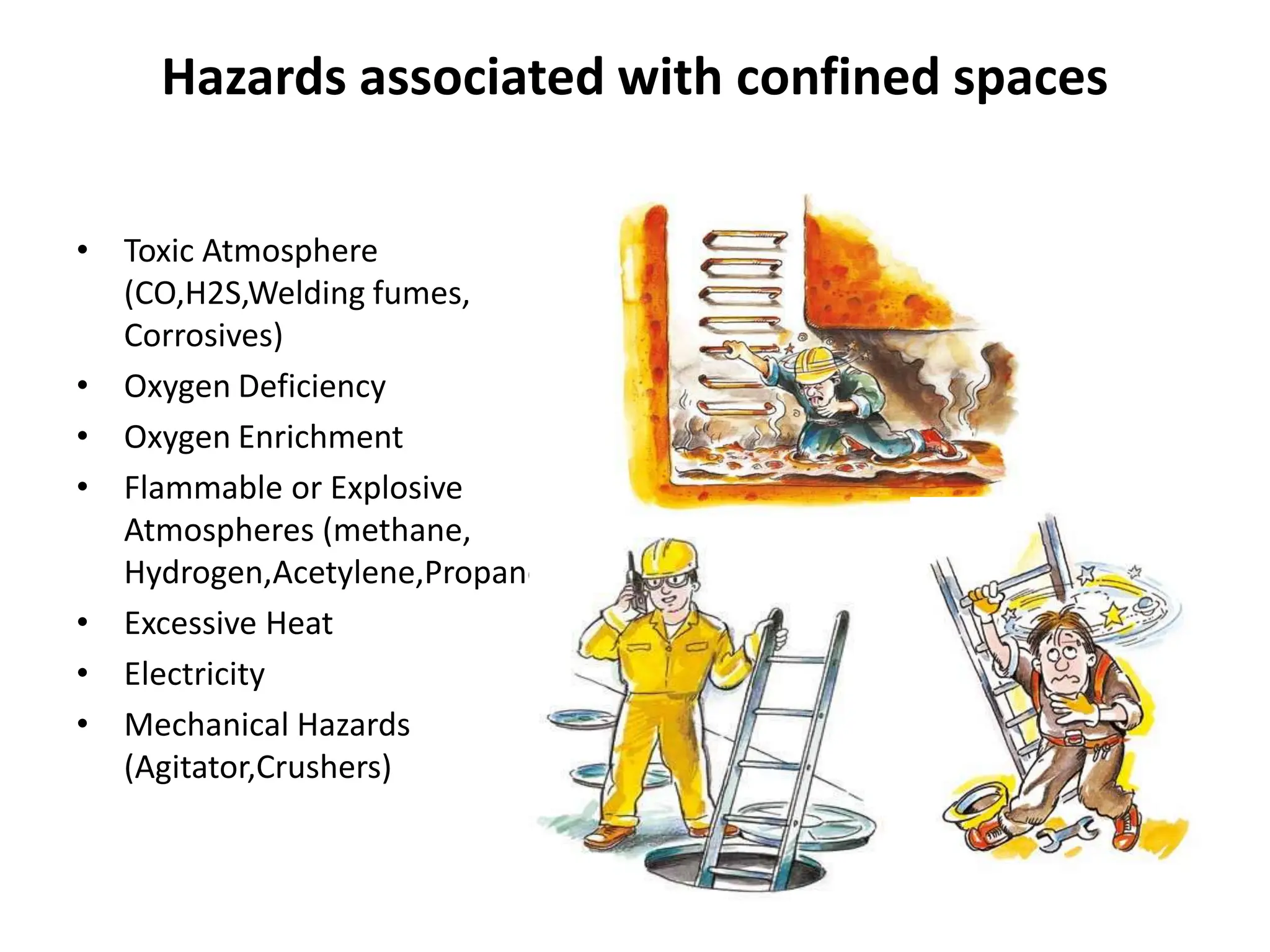
Hazards associated with confined spaces
• Toxic Atmosphere
(CO,H2S,Welding fumes,
Corrosives)
• Oxygen Deficiency
• Oxygen Enrichment
• Flammable or Explosive
Atmospheres (methane,
Hydrogen,Acetylene,Propane)
• Excessive Heat
• Electricity
• Mechanical Hazards
(Agitator,Crushers)
Persons Appointed for Confined Space
Jobs
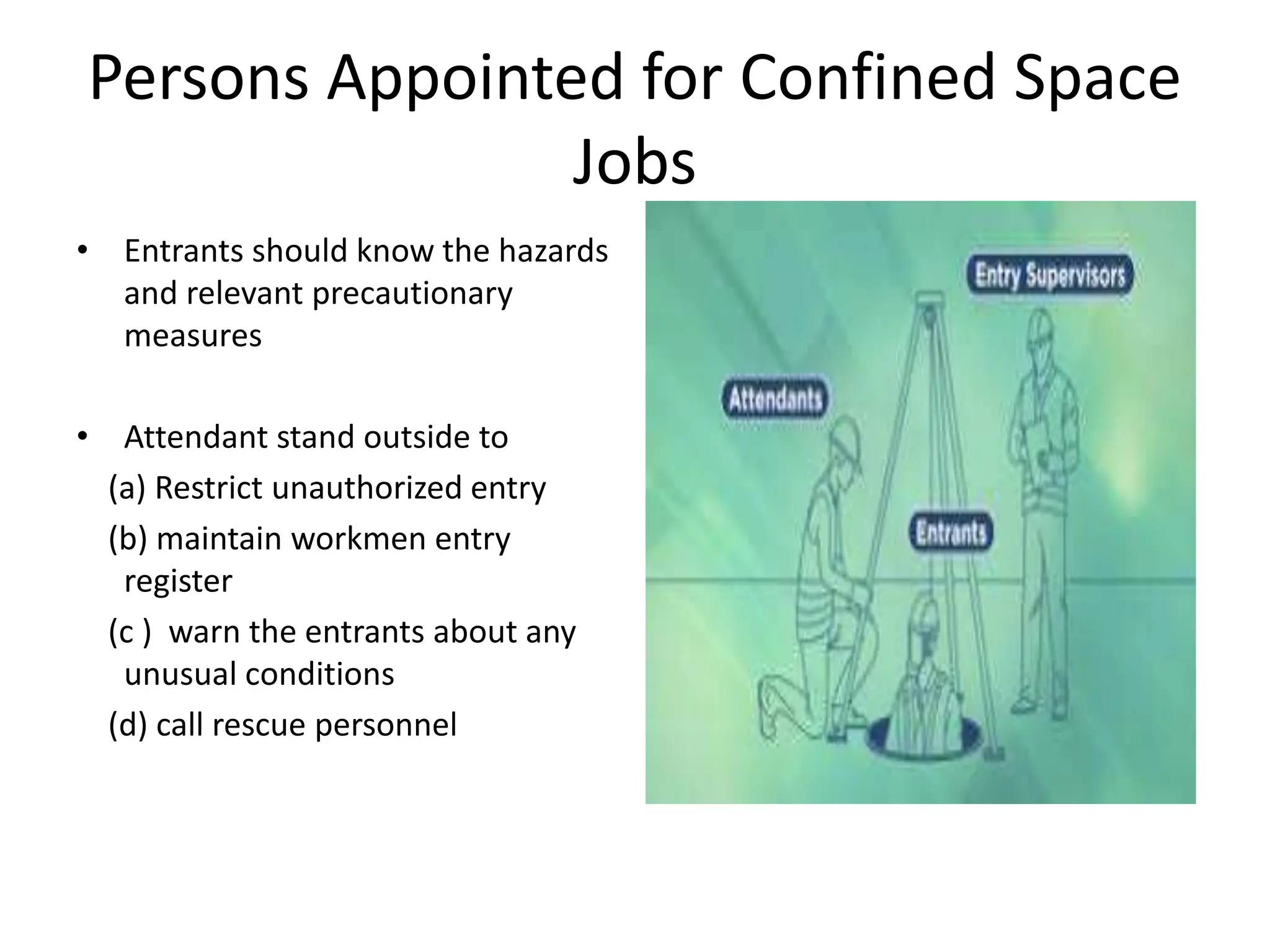
• Entrants should know the hazards
and relevant precautionary
measures
• Attendant stand outside to
(a) Restrict unauthorized entry
(b) maintain workmen entry
register
(c ) warn the entrants about any
unusual conditions
(d) call rescue personnel
Appoint suitable persons for the work
Suitable workers should meet the
following requirements:
– have received training to become
“certified workers”;
– have sufficient experience in the
type of work to be carried out;
– have a suitable build for the work if
the risk assessment highlights
exceptional constraints as a result
of the physical layout;
– be fit to wear breathing apparatus
if the work requires the use of such
apparatus, and there is no medical
advice against an individual’s
suitability to work in a confined
space. (e.g-diver)
MULTI GAS DETECTOR
• A multi gas detector is a portable device designed to detect multiple gases
simultaneously.
• A portable gas detector is usually the last line of defence to alerting
operators of dangerous gas leaks.
• The most common sensor configuration for a multi gas detector is carbon
monoxide, hydrogen sulphide, flammable (infrared) and oxygen.
MULTI GAS DETECTOR
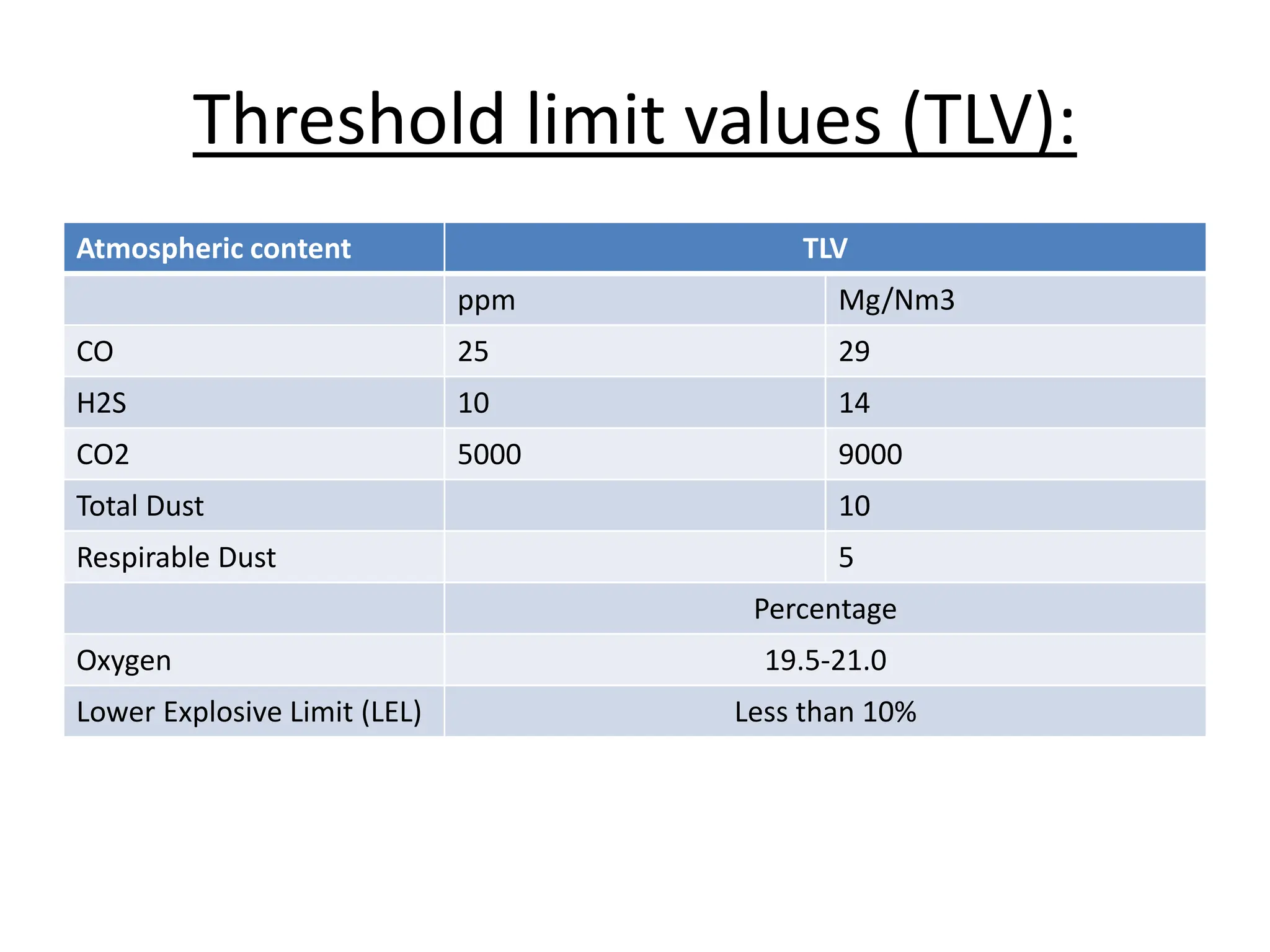
Threshold limit values (TLV):
Atmospheric content TLV
ppm Mg/Nm3
CO 25 29
H2S 10 14
CO2 5000 9000
Total Dust 10
Respirable Dust 5
Percentage
Oxygen 19.5-21.0
Lower Explosive Limit (LEL) Less than 10%
Safety Do’s
• Do a risk assessment based on
the nature of the work and the
type of confined space.
• Check the size of entrance.
• Follow the work permit system
(confined space work permit) and
attached the blind list or line
brake note if a confined space is
connected to liquid or gas lines.
• Communicate the hazards, risks
and safety measures to workers
before starting work in a confined
space.
Safety Do’s
• Drain, wash, dry and purge for
sufficient time to ensure a safe
atmosphere inside.
• Positively isolate the confined
space by blinding or
disconnecting the pipeline.
• Vent the confined space and
provide continuous
ventilation.
• Check the isolation at site &
with the defect card, at
Breaker/module .
Safety Do’s
• Keep all manholes open and
provide continuous ventilation by
natural or mechanical means.
• Check and monitor levels of LEL,
oxygen, toxics gases.
• If TLV exceeds at any point of time,
entrants should come out & enter
the space only when system
condition return to safe limits.
• Test the atmosphere by multigas
detector
(a) In ventilated condition
(b) 15 minutes after stopping the
ventilation fan.
Safety Do’s
• Deploy and keep standby
personnel at manhole or entry
point with an entry and exit
logbook.
• The person on standby must
ensure communication with the
workers.
• Provide a tag board at the
entrance/ manhole and record
people entering and leaving the
confined space.
• When entering a tank or deep
vessel, use a full body harness
and lifeline, with the free end
held by the standby person.
-
Safety Do’s
• A competent person should confirm
that the space is safe for work by
confirming the healthy atmosphere
and other safety measures as per risk
assessment.
• Post a hazard board or label such as
"Danger - Confined Space" and
"Restricted Entry“
• Use an SCBA if the oxygen
concentration is less than 19.5% or if
there is a risk of exposure to toxic
gases.
• All tools and equipment must be
spark or flame proof if the confined
space presents a risk of flammable
gases / vapours.
Safety Do’s
• Electrical tools and equipments
shall be flame proof or replaced
by Pneumatic ones.
• For Gas cutting, Cylinder should
be at outside and no leakage at
hose.
• Welding machine should be
outside confined space
• All lights / light bulbs must be in a
protected enclosure to prevent
physical damage. Use Big battery
driven torch, if possible.
Safety Do’s
• Only Non sparking tools should
be used.
• Electrical tools and equipments
shall be flame proof or replaced
by Pneumatic ones.
• Transformers & other electrical
equipments should be equipped
with ELCB.
• Check the condition of the fixed
ladders
• Emergency vehicle can be made
ready at outside, if required
• Proper communication procedure
Safety Do’s
• Emergency plan
Provide and keep readily available in a satisfactory condition a sufficient
supply of:
• approved breathing apparatus;
• suitable reviving apparatus;
• vessels containing oxygen or air;
• safety harness and ropes;
• an audio and visual alarm for alerting others outside the confined
space.
• Liaison and rescue
• Shut down
• First-aid procedures
• Drills
• Emergency services
Safety Dont’s
• Don’t enter a confined space without an entry permit.
• Don’t work unsupervised in a confined space.
• Don’t work if you are medically unfit.
• Don’t enter a confined space with an oxygen parentage less than 19.5 or
greater than 22.5.
• Don’t rely on closed valves without blinding for isolation.
• Don’t use any electrical equipment, including a light bulb with a voltage
greater than 24 V.
• Don’t take gas cylinders inside the confined space for welding work.
• Don’t allow more than one type of work simultaneously in a confined
space.
• Don’t leave the unused manhole open without barricades and warning
signs.
• Don’t smoke or eat food in the confined space.
• Don’t stay in the confined space if you feel uncomfortable.
Section 36 in The Factories Act, 1948
• Precautions against dangerous fumes, gases, etc.—
(1) No person shall be required or allowed to enter any chamber, tank, vat,
pit, pipe, flue or other confined space in any factory in which any gas,
fume vapour or dust is likely to be present to such an extent as to involve
risk to persons being overcome thereby, unless it is provided with a
manhole of adequate size or other effective means of egress.
(2) No person shall be required or allowed to enter any confined space as is
referred to in sub-section (1), until all practicable measures have been
taken to remove any gas, fume, vapour or dust, which may be present so
as to bring its level within the permissible limits and to prevent any ingress
of such gas, fume, vapour or dust and unless—
(a) a certificate in writing has been given by a competent
person, based on a test carried out by himself that the space is reasonably
free from dangerous gas, fume, vapour or dust; or
(b) such person is wearing suitable breathing apparatus and a
belt securely attached to a rope the free end of which is held by a person
outside the confined space.]
Working safely at  confined space (1).pptx

Working safely at confined space (1).pptx

  • 1.
    Working Safely inConfined Space
  • 2.
    What is aconfined space? As per Occupational Safety and Health Administration (OSHA) • Which is large enough and so configured that an employee can enter bodily and perform work • Which has limited or restricted means of entry and exit (e.g; Boilers, LDO tanks, Silos, Ducts, CW Pipes, DW Bins,Tunnels,Hoppers,Bunker,SAC,SBA,WBA, DDVS , Sec. Crushers, Chutes, S/R slew chamber, ESP, Cooling Tower Hot water pipe chamber etc. ) • Which is not designed for continuous human occupancy
  • 3.
    Job Safety Analysis(JSA) Hazard: Source or situation with potential for harm, something that can cause body injury / occupational illness, damage company property. Hazard Identification & Risk Assessment: Hazard Identification & Risk Assessment is to identify and evaluate the hazards, Risk and put controls measures for safe execution of activities.
  • 4.
    Hazards associated withconfined spaces • Toxic Atmosphere (CO,H2S,Welding fumes, Corrosives) • Oxygen Deficiency • Oxygen Enrichment • Flammable or Explosive Atmospheres (methane, Hydrogen,Acetylene,Propane) • Excessive Heat • Electricity • Mechanical Hazards (Agitator,Crushers)
  • 5.
    Persons Appointed forConfined Space Jobs • Entrants should know the hazards and relevant precautionary measures • Attendant stand outside to (a) Restrict unauthorized entry (b) maintain workmen entry register (c ) warn the entrants about any unusual conditions (d) call rescue personnel
  • 6.
    Appoint suitable personsfor the work Suitable workers should meet the following requirements: – have received training to become “certified workers”; – have sufficient experience in the type of work to be carried out; – have a suitable build for the work if the risk assessment highlights exceptional constraints as a result of the physical layout; – be fit to wear breathing apparatus if the work requires the use of such apparatus, and there is no medical advice against an individual’s suitability to work in a confined space. (e.g-diver)
  • 7.
    MULTI GAS DETECTOR •A multi gas detector is a portable device designed to detect multiple gases simultaneously. • A portable gas detector is usually the last line of defence to alerting operators of dangerous gas leaks. • The most common sensor configuration for a multi gas detector is carbon monoxide, hydrogen sulphide, flammable (infrared) and oxygen.
  • 8.
  • 9.
    Threshold limit values(TLV): Atmospheric content TLV ppm Mg/Nm3 CO 25 29 H2S 10 14 CO2 5000 9000 Total Dust 10 Respirable Dust 5 Percentage Oxygen 19.5-21.0 Lower Explosive Limit (LEL) Less than 10%
  • 10.
    Safety Do’s • Doa risk assessment based on the nature of the work and the type of confined space. • Check the size of entrance. • Follow the work permit system (confined space work permit) and attached the blind list or line brake note if a confined space is connected to liquid or gas lines. • Communicate the hazards, risks and safety measures to workers before starting work in a confined space.
  • 11.
    Safety Do’s • Drain,wash, dry and purge for sufficient time to ensure a safe atmosphere inside. • Positively isolate the confined space by blinding or disconnecting the pipeline. • Vent the confined space and provide continuous ventilation. • Check the isolation at site & with the defect card, at Breaker/module .
  • 12.
    Safety Do’s • Keepall manholes open and provide continuous ventilation by natural or mechanical means. • Check and monitor levels of LEL, oxygen, toxics gases. • If TLV exceeds at any point of time, entrants should come out & enter the space only when system condition return to safe limits. • Test the atmosphere by multigas detector (a) In ventilated condition (b) 15 minutes after stopping the ventilation fan.
  • 13.
    Safety Do’s • Deployand keep standby personnel at manhole or entry point with an entry and exit logbook. • The person on standby must ensure communication with the workers. • Provide a tag board at the entrance/ manhole and record people entering and leaving the confined space. • When entering a tank or deep vessel, use a full body harness and lifeline, with the free end held by the standby person. -
  • 14.
    Safety Do’s • Acompetent person should confirm that the space is safe for work by confirming the healthy atmosphere and other safety measures as per risk assessment. • Post a hazard board or label such as "Danger - Confined Space" and "Restricted Entry“ • Use an SCBA if the oxygen concentration is less than 19.5% or if there is a risk of exposure to toxic gases. • All tools and equipment must be spark or flame proof if the confined space presents a risk of flammable gases / vapours.
  • 15.
    Safety Do’s • Electricaltools and equipments shall be flame proof or replaced by Pneumatic ones. • For Gas cutting, Cylinder should be at outside and no leakage at hose. • Welding machine should be outside confined space • All lights / light bulbs must be in a protected enclosure to prevent physical damage. Use Big battery driven torch, if possible.
  • 16.
    Safety Do’s • OnlyNon sparking tools should be used. • Electrical tools and equipments shall be flame proof or replaced by Pneumatic ones. • Transformers & other electrical equipments should be equipped with ELCB. • Check the condition of the fixed ladders • Emergency vehicle can be made ready at outside, if required • Proper communication procedure
  • 17.
    Safety Do’s • Emergencyplan Provide and keep readily available in a satisfactory condition a sufficient supply of: • approved breathing apparatus; • suitable reviving apparatus; • vessels containing oxygen or air; • safety harness and ropes; • an audio and visual alarm for alerting others outside the confined space. • Liaison and rescue • Shut down • First-aid procedures • Drills • Emergency services
  • 18.
    Safety Dont’s • Don’tenter a confined space without an entry permit. • Don’t work unsupervised in a confined space. • Don’t work if you are medically unfit. • Don’t enter a confined space with an oxygen parentage less than 19.5 or greater than 22.5. • Don’t rely on closed valves without blinding for isolation. • Don’t use any electrical equipment, including a light bulb with a voltage greater than 24 V. • Don’t take gas cylinders inside the confined space for welding work. • Don’t allow more than one type of work simultaneously in a confined space. • Don’t leave the unused manhole open without barricades and warning signs. • Don’t smoke or eat food in the confined space. • Don’t stay in the confined space if you feel uncomfortable.
  • 19.
    Section 36 inThe Factories Act, 1948 • Precautions against dangerous fumes, gases, etc.— (1) No person shall be required or allowed to enter any chamber, tank, vat, pit, pipe, flue or other confined space in any factory in which any gas, fume vapour or dust is likely to be present to such an extent as to involve risk to persons being overcome thereby, unless it is provided with a manhole of adequate size or other effective means of egress. (2) No person shall be required or allowed to enter any confined space as is referred to in sub-section (1), until all practicable measures have been taken to remove any gas, fume, vapour or dust, which may be present so as to bring its level within the permissible limits and to prevent any ingress of such gas, fume, vapour or dust and unless— (a) a certificate in writing has been given by a competent person, based on a test carried out by himself that the space is reasonably free from dangerous gas, fume, vapour or dust; or (b) such person is wearing suitable breathing apparatus and a belt securely attached to a rope the free end of which is held by a person outside the confined space.]